The Vision of Saint Jerome by Parmigianino

The Vision of St Jerome by Parmigianino (1527)

Another day, another painting and as was the case yesterday, I present you with an Italian artist whose known name is a derivative of the name of his birthplace.  Girolamo Francesco Maria Mazzola is the full name of today’s artist and he was born in Parma in 1503.  He is more commonly known by his nickname Parmigianino which means “the little one from Parma.  Parmigianino was the leading painter of Parma after Correggio, an artist he studied under, and is celebrated as one of the originators of the Mannerism movement.  He was influenced by artists such as Michelangelo and Raphael and was also a prolific draughtsman and printmaker.

He was one of  eight children.  His father was also a painter but sadly died of the plague when Parmigianino was only two years of age, who then went to live with his aunt and uncle, Michele and Pier Ilario, who were also both artists.  He became active in and around Parma.  In 1524, at the age of twenty-one, he went to live in Rome where he remained until 1527, the year the   Sack of Rome by Imperial troops took place.  His workshop was invaded by German soldiers but, according to Vasari, they were so amazed by his work they left him to continue unhindered.  However that year he left Rome and went to Bologna.  In 1530 he moved back to Parma.   There, he was contracted to paint frescos in Santa Maria della Steccata but failed to complete the commission and was jailed for breach of contract.   According to Vasari, the Renaissance art biographer, after Parmigianino returned to Parma he lost interest in his art and became infatuated with alchemy.   He died in 1540 at the young age of 37 and is buried in Caslamaggiore.

My Daily Art Display today is the altarpiece The Vision of St Jerome which Parmigianino completed in 1527 whilst in Rome and can be found in the National Gallery, London.  It is considered to be his most important work of this time.  Parmigianino experimented with complex poses, contortion and twisting of the human body and in this painting one can see an example of this style.  In a number of his paintings and as can be seen in this work, his figures are elongated, taking up twisted, if slightly unnatural, poses.

In today’s painting we have the Virgin Mary with the Infant Christ held between her knees.  We see Saint Jerome lying on the ground in a deep sleep dreaming of his vision of John the Baptist.  His cardinal’s hat is balanced on the jaw of a skull.  In the foreground we have John the Baptist who leans in a dramatic fashion towards the viewer.  His body is twisted around as he points heavenwards with his right index figure towards the Christ Child whose coming he had predicted.  This pointing gesture was often used by Leonardo.  Attached to his belt is a bowl which he employs for baptism and in his left hand he holds a reed cross.  The Christ Child assumes a contrapposto posture, hovering as if just about to take a step forward.

The Visitation by Jacopo Pontormo

The Visitation by Jacopo Pontormo (1528)

Today’s featured artist is Jacopo Carucci, who because of his birthplace, was usually known as Jacopo Pontormo.  He was an Italian Mannerist painter who was born in 1494 in the small town of Pontormo near Empoli.  Most of his work was carried out in and around Florence where he was recognised as one of the most exceptional painters of his time.  He studied with the likes of Leonardo da Vinci, Albertinelli, and worked in the workshop of Andrea del Sarto, where he served his apprenticeship.

My Daily Art Display today is Pontormo’s painting The Visitation which he completed in 1528 and now adorns the altar of a side chapel in a small church called the Pieve di San Michele in Carmignano, a town west of Florence. 

The setting for this painting is the visitation of the Virgin Mary on her pregnant but aged cousin Elisabeth who was the wife of Zacharias.  The two figures in the painting with their interlinked arms form a lozenge shape.  This intertwining of figures was one of Pontormo’s trademarks as was the way he makes the characters seem to be almost floating.  The two main characters, Elizabeth and Mary, who are painted in profile, gracefully embrace each other as they exchange glances of mutual affection.  They dominate the canvas as they stand on the threshold of Zacharias’s house. 

The two other figures in the background seem quite unbending and statuesque as they look at something outside the picture.  There is a lack of emotion in their faces and they seem to be taking no part in the main event.  They seem older than the main characters and may indeed be servants awaiting their instructions. 

In the middle ground of the picture, on the left hand side, we can just make out two small figures seated on a wall looking on at the greeting scene.  They are just small specks in comparison to the main figures and maybe Pontormo, by doing this, is saying that in comparison to Mary and Elisabeth the onlookers are just mere mortals watching an historic event.

Pontormo set great store, some say he was obsessive, in the portrayal of gestures of the characters in his paintings.  In this picture this factor is emphasised by the tense still gazes of the Mary and Elisabeth as they stare at each other, tight-lipped, with little hint of a smile.

Montagne Sainte-Victoire by Paul Cézanne

Montagne Sainte-Victoire by Cezanne (1887)

I suppose it is only natural that when a landscape artist moves to live in a new place the surrounding area will become subjects for their future paintings.  The year 1886 was a memorable year for the French Impressionist painter Paul Cézanne.  Firstly he married Hortense Fiquet, a model he had been living with for seventeen years and in this same year his father died.  After the death of his father, Louis that August, Cézanne inherited the family estate, Jas de Bouffain, which was situated on the outskirts of Aix, in Provence, and he moved there from Paris.  Nearby and to the east, looms the mountain, Sainte-Victoire, which dominates the countryside of this area.   Cézanne was mesmerised by, and fell in love with, the view of this peak and the surrounding area.  Locals venerated it for its legendary ties to antiquity—its very name had come to be associated with a celebrated victory by the ancient Romans against invading Teutonic armies.   Over many years, Cézanne produced forty four oil paintings and forty three watercolours of the area.

My Daily Art Display today features an early painting of this subject, simply entitled Montagne Sainte-Victoire which he completed in 1887 and hangs in the Courtauld Gallery in London.  It shows the mountain as viewed from the west, some eight miles away.  The tree branches in the foreground frame the panoramic view of the valley in the middle ground and the mountain in the background.  Cezanne has focused on a comparatively small part of the scene but the mountain has been given a dominant central position in the work.  The middle ground is dominated by farmland and the yellows of the wheat fields.  To the far right of the painting in the middle-ground, one can see the presence of a railway viaduct.

There is a gradual transition from the clearer greens of the vegetation and the orange-yellows of the buildings seen in the foreground of the picture to the softer atmospheric blues and pinks on the mountain in the background.  Cézanne has connected the foreground and the background by the way he has given the foliage in the foreground the blue and pink tinges similar to the colour shades of the mountain.

With this painting, Cézanne has captured the peaceful and serene beauty of this part of Provence.  This was Cézanne’s truly exquisite and picturesque Shangri-la.

The Family of Jan Brueghel the Elder by Peter Paul Rubens

The Family of Jan Brueghel the Elder by Rubens (c.1615)

My Daily Art Display for today is The Family of Jan Brueghel the Elder painted by Peter Paul Rubens circa 1613-15 and now hangs in the Courtauld Gallery, London.  He was a close friend of Jan Brueghel the Elder.  In the painting we have Jan with his second wife Catherina van Marienberghe and their children Pieter who was born in 1608 and Elizabeth who was born a year later.  For a family portrait it is unusual that the mother should be the central and most dominant of all the figures present.   It is thought that the original idea of the portrait was to be just that of Catherine and her two children and that Jan was missing from early copies but added, somewhat unsymmetrically in an otherwise balanced composition later.   All are dressed as if they were members of Antwerp’s wealthy and highly regarded middle class and maybe this was Rubens’ idea to establish that artists were on an equal social and professional footing to the likes of physicians, lawyers and bankers. 

Father and mother are dressed in black adding a certain amount of gravitas to the parents unlike the children who are dressed much more colourfully.  Jan, with his kindly features, is dressed soberley with a tall black hat enfolding his family with his outstretched left hand and in turn Catherina, the loving mother and wife, has one hand around her son, Peter can be seen touching his mother’s precious bracelet, probably a betrothal gift, as if to draw attention to it.   Catherina’s other hand clasps the delicate fingers of her daughter, Elisabeth who is gazing lovingly at her mother. This meeting of hands occurs in the very centre of the canvas and is intended to portray familial love and devotion.  The way in which the family are depicted in the painting, almost in a huddle, emphasises the closeness of the family.

This is a very touching family portrait with its unusual intimacy.  Sadly such family love and happiness was to be devastated ten years later, in 1625, when a cholera epidemic struck Antwerp and of the four people in the picture, only Catherine survived.

Esau Sells his Birthright by Hendrick ter Brugghen

Esau Sells his Birthright by Hendrick ter Brugghen (c.1626)

In the book of Genesis (25:29-34) we learn about the twin brothers of Isaac and Rebecca.  Esau was the first-born followed by Jacob.  In those ancient times, the birthright belonged to the first born child and thus the birthright belonged to Esau as well as his right to have the chief portion of the inheritance.   But it was more than just a title to the physical assets of a family; it was also a spiritual position.  However Esau did not appreciate what he had as the tale unfurls:

“…When Jacob had cooked stew, Esau came in from the field and he was famished; and Esau said to Jacob, ‘Please let me have a swallow of that red stuff there, for I am famished.’ Therefore his name was called Edom. But Jacob said, ‘First sell me your birthright.’ Esau said, ‘Behold, I am about to die; so of what use then is the birthright to me?’ And Jacob said, ‘First swear to me”; so he swore to him, and sold his birthright to Jacob. Then Jacob gave Esau bread and lentil stew; and he ate and drank, and rose and went on his way. Thus Esau despised his birthright.”

It is this biblical tale which is depicted in today’s painting, Esau Sells his Birthright by Dutch artist, Hendrick Jansz ter Brugghen.   He completed the painting around 1627 and is now part of a collection of his work in the Gemäldegalerie Berlin.  Ter Brugghen or Terbrugghen was born in The Hague in 1588 but shortly after the family move to the predominantly Catholic Utrecht.  Hendrick was apprenticed to Abraham Bloemaert, the Dutch painter and printmaker.  Terbrugghen spent time in Italy in his late teens to gain some artistic experience and was in Rome during the time of Caravaggio and would have come under his artistic influence and other Italian Caravaggisti such as Gentileschi, Carracci and Reni.

He returned to Utrecht around 1616 where he and fellow artist and friend, the Utrecht painter Thijman van Galen, whom he had lodged with whilst in Milan, were registered as master painters.  In that same year Ter Brugghen married Jacomijna Verbeeck, the stepdaughter of his elder brother who was an innkeeper.  They went on to have eight children.  Neither he nor his wife were active churchgoers.  He considered himself to be a Protestant but rejected the hard-line Calvanist approach to religion.   He must have had some sympathy towards the Catholic cause by the way he treated Catholic subjects in his paintings.  

Today’s painting in which Esau returns hungry from hunting and sells his birthright to his brother Jacob for a dish of lentils draws life entirely from the expressive, but silent dialogue between the brothers.   The fateful deal is concentrated on their hands, which are holding the bowl of lentils.  Directly above this gesture, whitish-yellow candlelight forms the centre of the picture and illuminates the beautifully formed profiles of the boys, turned eloquently towards each other.  The parents, Isaac and Rebecca are present in the room but seem untouched by this bargain.  To the left, Isaac is bending over the table spooning up his soup whilst Rebecca, whose shadow is reflected on the side wall, busy but restrained, is behind the table carrying a copper plate.  She is holding herself stiffly but with a positively dignified expression.

Hendrick ter Brugghen died in 1629 three years after completing this painting, aged 41.

Peasant Couple Eating by Georges de la Tour

Peasant Couple Eating by Georges de la Tour (c.1623)

Georges de la Tour was born in 1593 in Vic-sur-Seille a small town in the department of Lorraine in north-eastern France which, at the time, was part of the Holy Roman Empire  He was one of seven children born to father Jean, a baker and mother Sybille.  Little is known of his early upbringing but we know he married Diane le Nerf at the age of twenty four and they went on to have ten children.  Three years after marrying, the couple moved to Lunéville, his wife’s home town, a short distance from Georges’ birthplace, where he spent the rest of his life.    He had quite a successful career and his paintings were bought by the likes of King Louis XIII, Cardinal Richelieu and the Duke of Lorraine whom he worked for between 1639 and 1642. He died in 1652 just short of his fifty-ninth birthday.

    The style of Georges de la Tour is incredibly unique in its depiction of common subject matter as well as in the design and composition of the works themselves.  De la Tour devoted himself mainly to the representation of genre and religious subjects, both in day scenes as well as nocturnal ones.  On the whole, the paintings are generally small, and thus it can be assumed that he was patronised by mostly private clients from the bourgeoisie or for small religious houses.

My Daily Art Display today is the Peasant Couple Eating painted by Georges de la Tour around 1623 at the early part of his artistic career.   The two half length figures which are almost life-size are tightly framed in the pictorial space.  They face us as if we have interrupted them during their meagre meal of dried peas.  The man exhibits a sour and resentful look as he looks down.  The woman stares fixedly at us with her deep-set almost dead eyes as she raises a spoon to her mouth.  As the background is a simple grey we have no idea where the event is taking place.  However, this background enhances the old couple.  The painting of half-length figures like this one was a characteristic of Caravaggio’s style, an artist who influenced de la Tour in his early works.  This painting proved very popular and there are records of three 17th century copies.

In the book, Georges de la Tour of Lorraine, 1593-1652, by Furness, the author wrote of the artist:

“……Georges de la Tour is classed as a realist.  Realist he is in that his subjects, predominantly if not exclusively religious, are represented in terms of “real” life, often the life of his own country-town and surroundings in Lorraine.  But he avoided naturalism; rather, he chose to simplify, modelling his forms by marked contrasts of light and shade, and using large volumes and severe lines, with great selective economy of detail…”

Georges de la Tour’s use of light in his paintings of people, including this one, bestows them with a sharp eye to detail and clearness within the scene depicted.  He wants us to react to the figures and in some way believes an elaborate background would detract from that scenario.  Grove Art OnLine comments about his lack of backgrounds in his paintings and states:

“…..La Tour’s sparsely populated pictures almost always represent scenes that take place nowhere, if they are judged by the almost complete absence of scenery. The boundaries of the settings are, nevertheless, delineated. There appear to be walls, but they have no texture and the colour is not descriptive….”

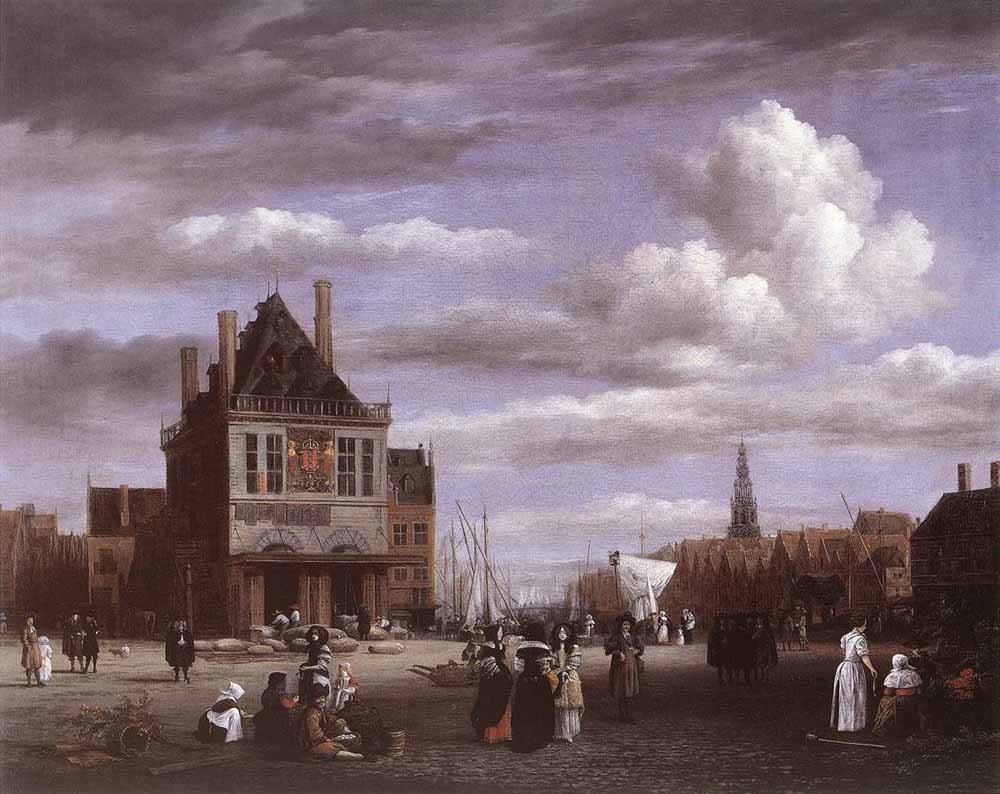
Dam Square in Amsterdam by Jacob van Ruisdael

Dam Square Amsterdam by Jacob van Ruisdael (1670)

Today, Jacob van Ruisdael is my featured artist in My Daily Art Display.   He was born in Haarlem in 1628 and was brought up in an artistic household.  His father, Isaak van Ruysdael and his uncle, Salomon van Ruysdael were both landscape painters.  Little is known about Jacob’s early artistic training but it is thought that his father probably taught him with guidance from his uncle.  At the age of twenty he was admitted as a member of the Guild of St Luke in Haarlem.  The Guild of Saint Luke was the most common name for a city guild for painters and other artists especially in the Low Countries.   They were named in honor of the Evangelist Luke, who was the patron saint of artists.

Unfortunately during his lifetime Jacob van Ruisdael’s artistic talent was not appreciated and by all accounts he led a poverty-stricken existence.  At the age of fifty three the Haarlem council was petitioned for his admission into the town’s almshouse.  He died in Amsterdam a year later in 1682 and his body was brought back to be buried in Haarlem

Jacob van Ruisdael travelled considerably during his lifetime but seldom went outside his own country.   He was a prolific painter with over seven hundred paintings and a hundred drawings attributed to him.  His great love was to paint countryside scenes showing fields of corn and windmills as well as woodland scenes.  He was also a renowned painter of trees and their foliage.    Another favourite subject of his was seascapes and the neighbouring dune lands.  He also liked to paint waterfalls based on the work of Allart van Everdingen, the Dutch painter, who had travelled extensively in Scandinavia.

Today’s painting, The Dam Square in Amsterdam, completed in 1670 is neither a landscape nor a seascape.  The subject is Dam Square in Amsterdam, a place which he was very familiar with as he lived on the south side of the square at this time.   The square was dominated by the old Amsterdam municipal weighbridge and one can see several bales of goods under the canopy waiting to be weighed.   On the right of the building one can see the Damark with its sailing boats and the tower of Oude Kerk.  In the foreground of the painting there are a large number of figures.  It is not thought that Ruisdael actually painted these as he was not an established figure specialist.  Experts believe they may have been painted by the Rotterdam artist Gerard van Battem.  The pale light from the left of the painting casting long shadows across the square suggests that it is daybreak.

 His artistic works although not fully appreciated during his lifetime have since his death been highly praised and he is now often considered the greatest Dutch landscape painter of all time.

The Lute Player by Orazio Gentileschi

The Lute Player by Orazio Gentileschi

My Daily Art Display offering today is The Lute Player and is one of the most famous works by the Italian artist, Orazio Gentileschi.

 Gentileschi was born in Pisa in 1563.  At the age of thirteen he moved to Rome.  The first word we have of him is when, along with a large number of artistic collaborators, he decorated the Vatican Library in 1588.  His collaboration on works of art continued but remained unheralded.  It was around this time in Rome that the young Caravaggio came to the forefront of the Art scene with his revolutionary new style of painting.  It was from around the early 1600’s that we find that Gentileschi is influenced by him and became one of the few Caravaggisti who was also one of his inner circle of friends.  After Caravaggio fled from Rome, Gentileschi’s style changed somewhat and his pictures became lighter in colour and more precise in subject detail.  In 1621 he moved Genoa where he received commissions from Giovanni Battista Sauli, a Genoese nobleman.   He stayed for two years and thereafter went to Paris where he carried out commissions for Marie de Médici and other royal and noble patrons.  At the time he was regarded as one of the leading Italian painters residing in France.   In 1623 he travelled to England and became court painter to Charles I.  He died in London in 1639.

 It was in 1626, whilst in London that he painted The Lute Player.  As a Caravaggisti, he would have been aware of Caravaggio’s own painting of The Lute Player (c.1596).  In Gentileschi’s painting we see a graceful young woman with her back to us.  Dressed in a white blouse and a flowery yellow dress with her hair in braids, she sits with her face turned towards us.  She is sitting at a table with the pear-shaped body of the lute almost touching her ear as she listens intently to the resonance of a note.  She appears totally immersed in her work.  At this time she maybe in the process of tuning the instrument before a musical performance.   On the table, covered by a velvet cloth, we can see a songbook and other instruments including a shawm and a violin.  The way in which Gentileschi paints the textures of her dress and the cloths covering the table and her stool is masterful and it is said that Dutch painters famous for their reproduction of fabrics in their works improved by scrutinising the works of Gentileschi.

American Gothic by Grant Wood

American Gothic by Grant Wood (1930)

My Daily Art Display offering today is the oil on beaverboard painting by American artist Grant Wood entitled American Gothic which hangs in the Art Institute of Chicago.  This is said to be one of the most famous paintings in the history of American art.

Grant Wood was born in small town America, in Anamosa, Iowa in 1892.  During his early artistic life his works of art showed no one distinguishable style but he enjoyed painting the “niceties” of American Midwestern life with all its small villages and their white-painted churches.  That all changed in 1927 after he spent some time in Munich on a commission supervising the putting together of stained glass windows for the Cedar Rapids Veterans Memorial Building.  Whilst in Munich he visited the large art gallery, Alte Pinakothek and was introduced to the Early Netherlandish works of art and witnessed first hand the Neue Sachlichkeit (New Objectivity) movement in German paintings which reflected the resignation and cynicism of the post-war period.  In all he made four trips to Europe and after each journey he returned home with a much greater appreciation of the Midwest lifestyle, culture and its traditions and this love of Midwest America was transformed into his paintings.

On his return home his painting style changed and his paintings took on a more painstaking and sharply detailed style.  As is the case in today’s painting Wood liked to paint ordinary every day people and their commonplace lifestyle in the Midwest of America.  His style of painting was often termed Regionalism and exuded a sense of patriotism and nostalgia and in some ways was an artistic record of the history of small town America.  He hoped that this style of his art and the subjects he displayed would, in some way, act as  a boost to the morale of people who were suffering badly during the Great Depression, reminding them that they should retain their self belief and steadfast American pioneer spirit.  American Regionalism opposed the European abstract art and the art which was very popular at the time on the East Coast of America and California and preferred depictions of homely rural America and its people

In American Gothic we see a farmer and his spinster daughter standing in front of their late nineteenth century Gothic Revival styled house with its distinctive upper window.  The actual building in Eldon, Iowa, is still standing and is a popular tourist attraction.  The figures were modelled by the artist’s dentist, Doctor Byron McKeeby and Wood’s sister, Nan.  They are both dressed in clothes dating from the 1890’s.  The man, because of the way he is dressed, and the fact he is holding a three-pronged pitchfork , one believes him to be a farmer but he also has the studious look of a banker’s clerk.  Maybe the pitchfork is there to signify man’s traditional role as hard working but it also gives him a slight air of hostility and someone who has a bad temper.   There is something puritanical in his look.  In contrast, the woman exhibiting a side-long glance seems more prim and dowdy with her colonial-print apron with its white collar.  She conveys an air of domesticity.   The precise realism of the rigid frontal arrangement of the man and woman was probably inspired by the Northern Renaissance Art Wood saw when he was in Europe.  There is a definite similarity with van Eyck’s double portrait, The Arnolfini Portrait, (see Nov 27th) and also the way mystery surrounds the symbolic meaning and interpretation of both works.

However with regards symbolism and interpretation maybe we should leave the last word to the artist for when asked about the satirical nature of his painting and the two characters he merely replied that “they were the kind of people I fancied should live in that house”.

Wood entered the painting in a competition at the Art Institute of Chicago and although it was not liked by all the judges, it achieved a bronze medal and the Institute bought the work of art.  Copies of the painting were published nationwide in many newspapers and all was well until the local newspaper in Cedar Rapids, Iowa published it.   The locals were up in arms at the depiction of the couple as “pinched, grim-faced Bible-thumpers”.   Woods’ sister was embarrassed and horrified as being portrayed as the wife of somebody old enough to be her father and was quick to state that the couple were indeed father and daughter.

It is a strange painting but one, like the Arnolfini Portrait, which may hold symbolic messages and is open to many interpretations despite the artist himself denying any hidden meaning to his famous work of art.

The Kiss by Francesco Hayez

The Kiss by Francesco Hayez (1859)

“……….A kiss is a lovely trick, designed by nature, to stop words when speech becomes unnecessary……”

                       Ingrid Bergman Swedish movie actress (1915 – 1982)

With the possible exception of Gustav Klimt’s The Kiss, the most famous painting featuring a kiss is Il Bacio by Francesco Hayez, as it is entitled in the Pinacoteca Brera in Milan, but to most of us, is known simply as The Kiss.  This masterpiece, painted by the Italian artist in 1859, is his most famous work and a prime example of Italian Romanticism. 

Francesco Hayez was born in Venice in 1791.  He was the youngest of five sons and was brought up by his maternal aunt who was married to Giovanni Binascoa a prosperous ship-owner and an avid art collector.  Living in this household the young Francesco showed a love for drawing and so his uncle arranged an apprenticeship for him with an art restorer.  At the age of eighteen, after studying under the Venetian artist Francisco Magiotto and the Italian artist Teodoro Matteini, he won a competition, the prize for which was a one year placement at the Academia di San Lucia in Rome.  He lived in Rome until 1814 and then moved to Naples.  In the mid 1830’s he moved once again, this time to Milan where in 1850 he was appointed director of the Academy of Brera.  For many years he taught at the Brera and he exercised great influence on his pupils.  The Academy of Brera has a large collection of his paintings including My Daily Art Display’s featured painting, The Kiss.  Francesco Hayez died in Milan in 1882 aged 91.

Although the two characters in the painting are dressed in 14th century costumes the painting was intended to celebrate the Risorgimento (resurgence), which was the nineteenth century movement that brought together all the separate Italian states and by so doing, bring about the unification of Italy. The red and green of the man’s clothes along with the white of the cuffs of the woman’s dress are the three colours of the Italian tricoloured flag (il Tricolore).  The man supporting the woman passionately kisses her.  It is not known who the characters are as the artist wanted the main focus of attention to be on the kiss itself rather than who were doing the kissing.

All in all it is probably the most sensual and spell-binding kiss ever to grace a canvas.