The Brown Boy by Sir Joshua Reynolds

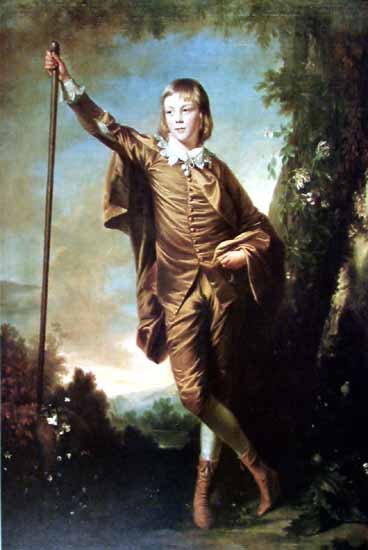
The Brown Boy by Sir Joshua Reynolds (1764)

My Daily Art Display today moves away from symbolism and interpretation and allegorical tales.  Today we have a simple portrait by an artist who was one of the greatest influences on English painting.  His name was Sir Joshua Reynolds.   His portraits were of the lofty and rhetorical manner of history painting a genre which showed figures involved in significantly important or morally enlightening scenes and treated them in a suitably impressive and gallant way.  It was often termed painting in the Grand Manner.   It was an idealized aesthetic style derived from classical art, and the modern “classic art” of the High Renaissance and it depended on the idealization of the imperfect.

Reynolds was born in Plympton St Maurice, Devon in 1723.  At the age of seventeen, he was apprenticed for three years to the prolific English portrait artist, Thomas Hudson.  In 1749 he travelled to Italy where he spent more than two years, mainly in Rome, during which time he studied the Old Masters and it was here that he developed a liking for the “Grand Style” of painting…  He was back in London in 1753 and made friends with the artistic and literary elite of the time including writers Samuel Johnson, Oliver Goldsmith, Edmund Burke and the actor David Garrick.  He became an early member of the Royal Society of Arts and later with Thomas Gainsborough, the great portrait and landscape painter, founded the Royal Academy.  Reynolds and Gainsborough were the dominant portraitists of the late 18th century.  Sadly in 1789 when Reynolds was 62 he lost the sight in his left eye.  Three years later he died and was buried in St Paul’s Cathedral, London.

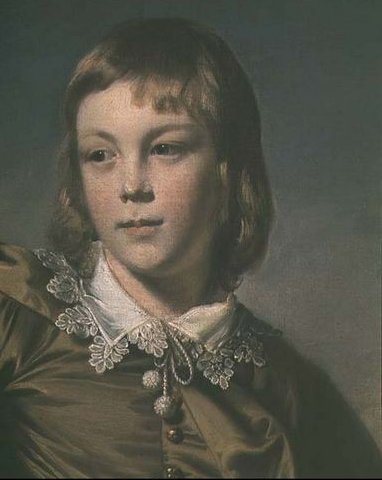
The cherubic face of Master Thomas

The other person featured in My Daily Art Display today is the person depicted in the painting, 12-year old Master Thomas Lister, who would become the 1st Baron Ribblesdale of Gisburn Park in 1797 when he was forty-five years old.  Reynolds has given the young lad’s face a flattering, slightly romantic look.  The young boy looks thoughtful as he stands leaning slightly on his stick.  There are child-like qualities in the way in which he has been portrayed.  He is at an “in-between” age, neither man nor boy he is embarking on a new stage in his life.   His costume is of plush velvet and reminds one of the ways Anthony Van Dyke, a century earlier, painted portraits of aristocrats which gave them a look of both grandeur and poise.  In this picture the colour of Thomas Lister’s clothes blends with the colour Reynolds used for the background which has an Arcadian feel to it is reminiscent of classical landscapes of the Italianate painters. 

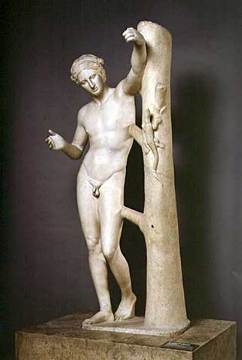
Apollo Sauroctonos


Art historians believe that Reynolds had the boy pose in a similar way to the Apollo Sauroctonos, a sculpture dating back c. 350BC, which Reynolds would have seen when he was in Rome.

In the mid 18th century, history painting was the most favoured of art genres and in this painting Reynolds has managed to intertwine historical references into this painting. 

Reynolds was well loved and admired.  William Makepeace Thackeray said of him:

“…of all the polite men of that age, Joshua Reynolds was the finest gentleman…”

I will close today with part of a poem by Thomas Bernard, who was to become Bishop of Killaloe, and who wrote in his verses on Reynolds:

“ Dear knight of Plympton, teach me how
To suffer, with unruffled brow
And smile serene, like thine,
The jest uncouth or truth severe;
To such I’ll turn my deafest ear
And calmly drink my wine.

Thou say’st not only skill is gained
But genius too may be attained
By studious imitation;
Thy temper mild, thy genius fine
I’ll copy till I make them mine
By constant application.”


The Peasant Dance by Pieter Bruegel the Elder

Peasant Dance by Pieter Bruegel the Elder (c.1567)

Today for My Daily Art Display, I return, after too long an absence,  to one of my favourite painters, Pieter Bruegel the Elder.  I want to look at his painting the Peasant Dance which is not dated but thought to be a companion painting of the same size to Peasant Wedding, which he completed around 1567 and both of which illustrated peasant life.  This is an example of his later work which is characterised by his use of monumental Italianate figures.  This painting can be found in the Kunsthistoriches Museum Vienna.   There is a very similar painting by Bruegel in the Institute of Arts, Detroit which is entitled The Wedding Dance in the Open Air, the main difference between the two is that the Detroit version has more figures in it making it a more crowded scene. 

But I start with a poem by the American poet; William Carlos Williams entitled The Dance, which sums up the painting, the setting of which is the village fair (La Kermess).

In Brueghel’s great picture, The Kermess,

the dancers go round, they go round and

around, the squeal and ther blare and the

tweedle of bagpipes, a bugle and fiddles

tipping their bellies (round as the thick-

sided glasses whose wash they impound)

their hips and their bellies off balance

to turn them.  Kicking and rolling about

 the Fair Grounds, swinging their butts, those

shanks must be sound to bear up under such

rollicking measures, prance as they dance

in Brueghel’s great picture, The Kermess.


The Peasant Dance, along with Peasant Wedding are thought to be the most outstanding examples of Breugel’s late style and are personified by his use of enormous figures.   Bruegel the Elder was well known for his peasant scenes, so much so, he was often referred to as “Peasant Bruegel”.  Bruegel specialised in genre paintings which depicted peasants at work and at play.  From his paintings we came to understand more about village life of that time and the about the peasants who inhabited them – how they ate, how they dressed, how they hunted and as is the case of today’s painting, how they relaxed and celebrated.  He never sentimentalised the life of the peasant folk as they got on with their life and his portraits were a great source of evidence regarding both the physical and social aspects of 16th century life in the Netherlands.  Bruegel pioneered the painting of ordinary life and although he was not of “peasant-class”, he would associate with the peasants so as to understand their lifestyle which he then painted.

The picture is about a dance at a fair which is being held in the village square outside an inn.  This picture of a dance is in sharp contrast to the paintings featuring the courtly settings of formal dances where everybody is dressed in their finest clothes.  Here we see a scene of rural merriment reflecting sixteenth century custom.  It is an actual point in the celebrations – the opening of a Kermesse, or village fair with a traditional dance performed by two couples.  The large couple in the foreground appear to be hurrying to the dance whilst we observe further back two other couple lost in the joys of the dance.  If we look at the house with the banner, to the left side of the background, we can see a man trying to coax (or is it drag!) a reluctant woman towards the dancing.

Bruegel in this painting has once again put a moral slant on what he depicts.  This is not just a humorous picture recording village life.  Gluttony, lust and anger can all be seen in this painting.   Look at the man seated next to the bagpipe player.  He looks drunkenly at the bagpipe player trying to offer him a jug of ale.   See how he has a peacock feather in his hair.  This is symbolic of vanity and pride.   Bruegel also draws our attention to the fact that although this is a “saint’s day”  he has depicted the dancers having turned their backs on the church and take little notice of the picture of the Virgin which hangs from the tree. 

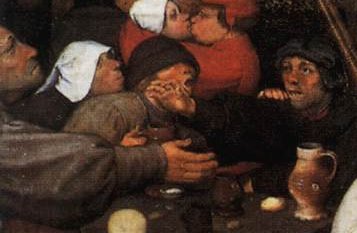
Three men arguing

The positioning of the tavern in the foreground and all that is going on around the table clearly shows that the peasants are engrossed with material things rather than spiritual issues.   An animated conversation between three men is taking place at the table.   One of them stretches out his hand to another on the extreme left but probably due to an excess of alcohol, he knocks his neighbour in the face.

Two small females

There are two strange figures in the left foreground.  They are two small females.  I have heard these being described as a mother and child even though the size of the one seated would be completely wrong.  However it should be noted that children often dressed like smaller versions of their parents and these could be two children.

Bottle of Bruegel beer


Finally this excellent work of art has been the inspiration for Bruegel Belgian Amber Ale from Brewery Van Steenberge. The 5.2 percent alcohol by volume beer has a scene from The Peasant Dance on the label.  So you see, Bruegel is still making his mark on today’s society !

Minerva Expelling the Vices from the Garden of Virtue by Andrea Mantegna

Minerva Expelling the Vices from the Garden of Virtue by Andrea Mantegna (1502)

Nowadays,  whenever we switch on the television, we are bombarded by property shows and house renovations programmes, all wanting to know what our ideal house would be and suggesting how we should utilise the interior space of our dream home.  Questions are posed such as, should we have a gymnasium or a pool room or an office?  In 15th century Italy, the wealthy had similar things to ponder over and one of the popular ideas in those days was to incorporate a room in your residence, which would act as a private study or a meeting place for your intellectual friends.  However having the space for such a room was only one part of the dilemma.  The house owner then had to furnish it in such a way so as to impress their guests.  Sounds familiar?

In the 15th century Italy the fashionable thing to do was to have a studiolo, which was a type of private study, which would be set aside for intellectual activities.  Isabella d’Este, the Marchesa of Mantua, one of the leading women of the Italian Renaissance was a major cultural figure of that time and a patron of the arts.  In 1490, she decided to create a studiolo in a tower of the Castello di San Giorgio and she commissioned Andrea Mantagna to paint two canvases to hang in the room entitled Parnassus and Minerva which she would have positioned opposite each other in the study.  Her biographer wrote:

“…It was Isabella’s dream to make this Studiolo a place of retreat from the world, where she could enjoy the pleasures of solitude or the company of a few chosen friends, surrounded by beautiful paintings and exquisite works of art….. In this sanctuary from which the cares and the noise of the outer world were banished, it was Isabella’s dream that the walls should be adorned with paintings giving expression to her ideals of culture and disposing the mind to pure and noble thoughts…”

My Daily Art Display today is the second of these works of art by Andrea Mantegna entitled Minerva Expelling the Vices from the Garden of Virtue which he completed in 1502.  The artist was in his seventies at this time and would live just another four years after he completed the works of art. 

Clouds with faces

The painting is full of anecdotal detail and the story is not so much historical but allegorical.  On the left of the picture we have the Greek goddess of wisdom, Pallas Athena, (who was known to the Romans as Minerva), spear in hand, as she rushes towards and drives away the various malformed monstrous Vices in order to re-establish the reign and rule of Virtue, who we see imprisoned in the olive tree on the far left.  

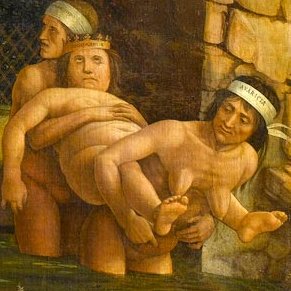
The three Vices, Avarice, Ingratitude and Ignorance

If you look at the far right of the painting you can see the Vices, Avarice and Ingratitude carrying off to the swamp-like pool the fat, stupid Ignorance, who is wearing a crown.  The painting is full of bizarre and weird entities.  Clouds with faces, talking trees and anthropomorphic monkeys are just some of the creepy items on display in this painting.  In the sky on the right hand side we have the three theological virtues, Faith, Hope and Charity.  They had been driven out previously by the depravities which had been occupying garden and now return.  The fourth Virtue, Prudence, is walled up inside the stone structure on the far right of the painting and only a white fluttering banner reflects her cry of help.

It is not the sort of painting I would like hung in my study.  I think I would prefer a beautiful landscape but again this painting would be sure to fuel the conversation of one’s guests as they study the multi-faceted composition.

The Portinari Triptych by Hugo van der Goes

The Portinari Triptych by Hugo van der Goes (c.1475)

Today My Daily Art Display looks at the oil on wood triptych painting by the Flemish artist Hugo van Goes known as the Portinari Altarpiece or the Portinari Triptych.   It was completed around 1475 and can now be found in the Uffizi Gallery, Florence.   The work was commissioned by Tommaso Portinari, an Italian banker for the Mèdici bank in Bruges and a wealthy man in his own right.   The commission was for the high altar of the Sant’ Egidio, the  church of the hospital of Santa Maria Nuova in Florence which was founded two hundred years earlier by Tommaso’s ancestor, Folco Portinari.  This is a huge work of art measuring 253cms x 586cms (almost 8.5ft high and 19ft across)

The three shepherds

The triptych consists of three hinged panels.  The centre and largest panel depicts The Adoration of the Shepherds.  One can see the three shepherds on their knees with their hands clasped in prayer.  Look how well the artist has portrayed the facial expressions of the three men.  They look mesmerised by what lies before them.    Look at the detail he has put into their lined faces.  Look at their hands, rough and wrinkled.  These are hard working-class men of meagre wealth who have left their place of work to come and pay homage to the baby Jesus.  They look down at the baby with a degree of wonderment and affection.  It is interesting to note that the artist has not included the three Kings with all their wealth.  Was this intentional and if so why was there this omission?

Kneeling around the Virgin Mary and the baby we can see a number of angels.  The artist for some unknown reason does not present us with the baby Jesus in a crib but instead has him lying on the ground and for this reason many have said that this is not a Nativity scene but rather an Adoration of the Child setting.  In the background, on the right hand side of this central panel, we have the shepherds being visited by the angel telling them of the birth of Jesus.  In the foreground we have a still-life of two vases, one earthenware with a grape motif and one made of glass containing flowers behind which is a sheaf of wheat.   Art historians would have us believe that the glass vase symbolizes the “entry of the Christ Child into the Virgin’s womb without destroying her virginity the way light passes through the glass without breaking it”.  Of the grape motif on the earthenware vase, this alludes to the fact that it is wine made from the grapes and then we are to believe that this therefore is symbolic of the Eucharist wine.

Floral display and wheatsheaf

The flowers are a mixture of orange lilies, red carnations, blue columbine and purple and white irises.  The orange lilies symbolise The Passion whilst the white irises are a sign of purity.   The purple irises and blue columbine represent the seven sorrows of the Virgin.    Many art historians who love delving into interpretations of paintings would have us believe that the three red carnations symbolise the three nails of cross.  The bundled wheat in all probability is there to remind us of bread and the Last Supper in which Christ broke the bread.  In the centre middle-ground we have the Virgin Mary with eyes closed, contemplative and in prayer.  To the left of this central panel we see the figure of Saint Joseph, almost lost from our view in the shadows.  He exudes dignity and humbleness but appears rather weary.

 Saint Margaret holding a book and Mary Magdalen with the pot of ointment are shown on the right wing of the triptych along with Portinari’s wife Maria di Francesco Baroncelli and their daughter Margarita both seen kneeling in front of the saints.     On the left wing we see Saint Anthony, with a bell, and Saint Thomas, holding the spear along with Tommaso Portinari himself and his two sons Antonio and Pigello.

The closed triptych

The two outer wings of the closed triptych are painted in monochrome and are much more sombre than the three colourful inner panels.  On one side one has the Archangel Gabriel and on the other one has the depiction of the Virgin of the Annunciation.  Both figures stand under retreating arches.  The figures themselves and the way in which the artist has painted the folds of their robes give the two scenes a somewhat 3-D feel.  There is also an emptiness about the scenes which is in sharp contrast to what our eyes are greeted with when the wings of the triptych are opened.  Surely this contrast was intentional.  I am sure the artist intended to astound people when the wings were opened and they beheld the three panels and the amazing colourful scenes before them.

This was one of Hugo van de Goes‘s last masterpieces and probably marks the high point in his artistic career.  His mental state began to fail and he became afflicted by severe depressions.  He gained some solace by entering a monastery in Brussels where he continued to paint and he lived there until his death in 1482.   Once again we look at the life of an artist who created such beauty and had given so much pleasure to so many and yet  during his later life was unable to alleviate his own depression.  Maybe he was a perfectionist who just could not believe in the perfection he created.

Portrait of a Woman Inspired by Lucretia by Lorenzo Lotto

Portrait of a Woman Inspired by Lucretia by Lorenzo Lotto (c.1533)

The featured artist in My Daily Art Display today is Lorenzo Lotto.   He was born in Venice around 1480 and although we do not know much about his early life we are led to believe that he was greatly influenced by the works of Bellini.  He was an artist of the High Renaissance period but there are signs in his work, such as unusual posing of his figures and some distortions in their body shape that he was a follower of the transitional stage leading to the Mannerism genre of art.

One knows that Lotto moved from Venice to Treviso around 1503.  This move of his may have been due to the intense artistic competition in Venice with the likes of Giorgione and Titian and he may have believed he would fare better in the affluent town of Treviso.  It was while here that he met the bishop, Bernardino de’ Rossi, who became his patron.  After a few years spent here he moved to the Marche region of Italy and eventually ended up in Rome in 1508 where the pope, Julius II,  commissioned some of his work.  He carried on his nomadic lifestyle, travelling around Italy before finally returning to Venice in 1525.  Here he took up residence at the Dominican monastery but his stay was cut short after a conflict with one of the brethren.  By 1554 he was partially blind and he became a lay brother at a monastery at Loreto where he eventually died.

This nomadic and restless lifestyle of his mirrored his temperament which was said to be an existence of constant anxiety and change which made him a difficult person to get on with.  His painting styles differed enormously.  He was a keen observer of people.   He is probably best known for his portraiture but in most of his portraits he conveyed a mood of psychological turmoil which was probably a mirror-image of his own mindset.  His works of art often focused on religious works and he completed many altarpieces.

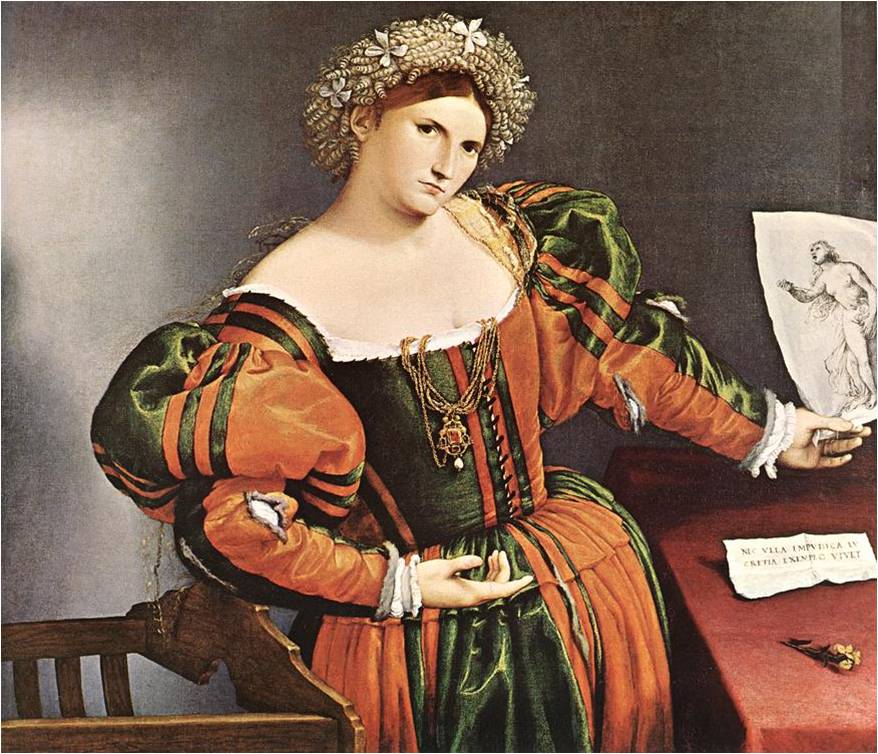
My Daily Art Display today is his oil on canvas painting entitled Portrait of a Woman Inspired by Lucretia which he painted around 1533 and which now hangs in the London National Gallery.    The “Lucretia” in the title of the painting is a character in a Roman legend and according to the ancient tale Lucretia was the beautiful wife of the early Roman army commander Lucius Tarquinius Collatinus. During a military expedition, Lucius and the other Roman leaders talked about how moral and good their wives were. They decided to return to Rome to see if the women were actually as faithful as each man claimed. They found only Lucretia at home; the other wives were misbehaving while their husbands were away.   One of the men in the group, Sextus Tarquinius, was the son of the Roman king. Fascinated by Lucretia’s beauty and goodness, he went to see her again and raped her at knifepoint. Lucretia made her husband and father swear to avenge the deed and then killed herself.   According to Roman legend, people were so outraged by the incident that they overthrew the monarchy and founded the Roman Republic. The story of Lucretia appears in works by the Italian artists Botticelli and Titian and in Shakespeare’s poem The Rape of Lucrece.

In today’s painting we see a woman leaning against a seat.  She is dressed in a decorative orange and green costume.  She looks directly at us.  It is a fixed stare which is somewhat grave and challenging.  It unsettles the viewer.  In her left hand she holds out a scrap of paper, on which is drawn a sketch of her namesake, the Roman Lucretia committing suicide by stabbing herself.  On the table lies a note inscribed:

NEC  VILA  IMPVDICA   LV  CRETIA  EXEMPLO  VIVAT

Which translated means “After Lucretia’s example let no violated woman live”

It is this drawing and this note that the woman in the painting is demanding that we should look at.  She insists that we have high regard for the sacrifice of Lucretia and that we understand why such a terrible sacrifice was necessary.    She is demanding of all women to acknowledge, and by so doing, agree to marital fidelity and to cast aside any thoughts of treachery. 

Lotto has filled the painting with the figure of the woman and by so doing has been able to give us wonderful details of the sitter such as her intense and expressive facial quality as well as being able to offer us a close-up look at her sumptuous and decorative attire.

Lorenzo Lotto was almost a forgotten painter until the mid twentieth century when there was a revival of interest in his works.  I believe he was a troubled soul who did not lead a happy life.  He was an outsider who was spurned by his contemporaries.  It is sad to think that such a lonely and unhappy person could produce such a beautiful work of art which has given pleasure to so many.

Portrait of Federico da Montefeltro and his Son by Pedro Berruguete

Portrait of Federico da Montefeltro by Pedro Berruguette (1476)

My Daily Art Display today is a double portrait entitled Portrait of Federico da Montefeltro and his Son.  The artist who painted this work was Pedro Berruguete.  He was a Spanish Renaissance painter who was born around 1450 in Paredes de Nava, a town close to Valladolid.   He went to Italy in 1473 and it was whilst there that he received his early artistic training.  He began working for the Federico de Montefeltro, the Duke of Urbino.  Montefeltro was one of the most sought-after and most feared condottieri (mercenary captain) of that time.  He was an excellent commander and an expert in military technology and the art of warfare.    He was a successful warrior who was rarely defeated in battle.  This was a very lucrative trade and with the money he amassed he became a great patron of the arts. 

Montefeltro’s land, the Duchy of Urbino, was a small and a somewhat insignificant territory sandwiched between Romagna and the Marche region close to the Adriatic Sea.  To counteract the insignificance of his duchy he would invite the leading artists and intellectuals from different areas to come to his palace.  Around 1480 he summoned Joos van Gent, the Netherlandish painter, to come and decorate the library and study, in his magnificent palace with allegories of the liberal arts and portraits of Biblical and pagan thinkers.  It is believed that Pedro Berruguete helped in this commission.  His library was ranked as one of the best in fifteenth century Europe housing studies in geography, history, poetry and theology and included many works in Latin, Greek, Hebrew and Arabic.  As well as the books, his library and his study, which was specially designed for intellectual contemplation and the reception room for important guests, housed musical and scientific instruments and coats of armour.

Montefeltro commissioned Berruguete to paint the portrait of him and his young son Guidobaldo.  Looking at the portrait we see Montefeltro seated before a lectern with his young son, Guidobaldo, standing on his right hand side, resting his arm on his father’s thigh.  The portrait is a left hand profile of the duke, which was what he preferred as he had lost his right eye in a jousting accident.  The portrait, and the way in which Berguette portrays Montefeltro to us, is as a man of many talents.   The Duke sits upright reading a manuscript which has been identified by art historian, Marcello Simonetta, as being Saint Gregory’s Commentary on the Book of Job.   He is dressed in an ermine-bordered cloak which is topped by the collar of the Golden Fleece.  I am sure Berruguete has captured the look the Duke wanted portrayed – that of a well-read man of great intelligence.  He would also have wanted to be portrayed as an international diplomat and this is probably the reason for the inclusion of the pearl-studded tiara which is on top of the lectern, and which was a gift from the Sultan of Constantinople.

However besides wanting to be just shown as an intellectual, Montefeltro wanted to remind viewers that he was a military man and that this is probably why he resorted to wearing his armour underneath his robes for the portrait.  His sword and baton of command are shown at his side and his helmet is placed by his feet in the foreground.   If you look closely at his left leg you will see a ribbon tied just below the knee.  This is the Order of the Garter which the Duke of Urbino received from King Edward IV of England.

Frederico’s son Guidobaldo who was heir to the Duchy is seen standing besides him.  There is a look of complete innocence in the young child’s face and although he symbolically holds the baton of command in his right hand, one senses that for him it is just another toy.  The large string of pearls around his neck symbolise his and his father’s wealth and standing.

It is an interesting portrait in the way the artist and sitter have decided on how the Duke should pose and what inanimate objects should be included in the work so as to convey all the messages the sitter wanted revealing.

Meeting of the Betrothed Couple and the Departure of the Pilgrims by Vittore Carpaccio

Meeting of the Betrothed Couple and the Departure of the Pilgrims (1495)

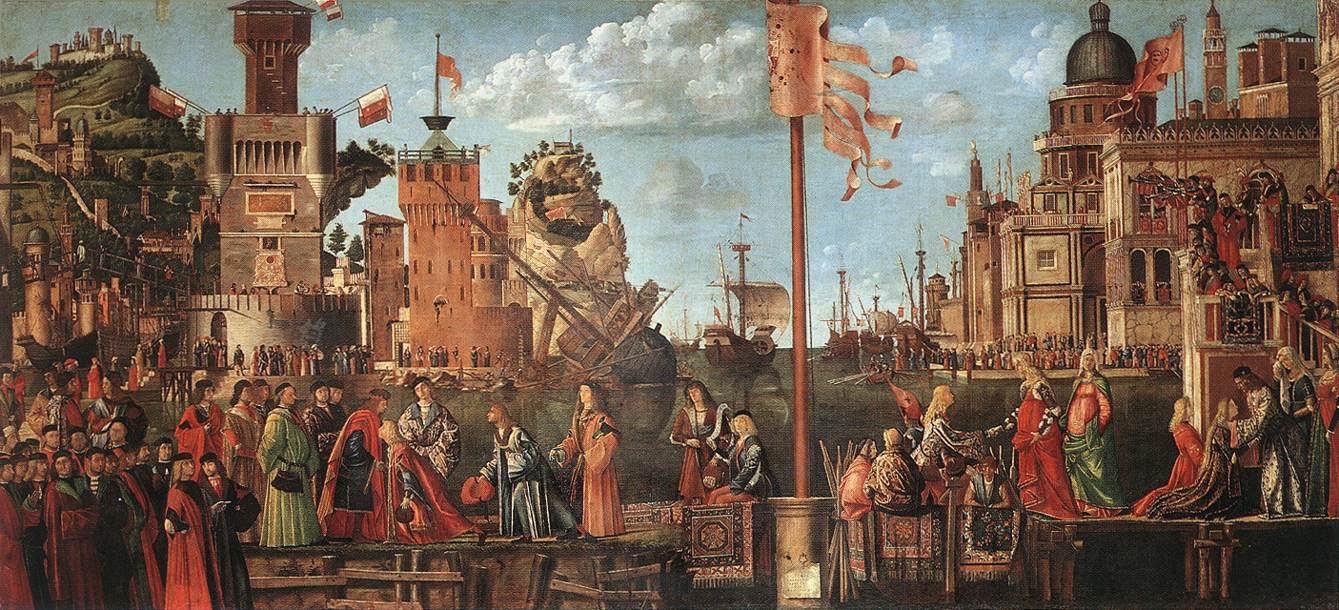
My Daily Art Display today features a painting by the Venetian artist Vittore Carpaccio.  The painting is massive in size, measuring 280cms high and 611cms wide (9ft high by 20ft wide).  It is one of a series of nine, tempera on canvas, paintings.   The set of paintings, commissioned in 1488 by the Lordean family  They were a noble Venetian dynasty, three of whom became Doges of Venice, including Doge Leonardo Lordean whose portrait by Bellini was featured in an earlier blog (Nov 17th).   The paintings were created for the Scuola di Sant’ Orsola (Ursula) in Venice, a confraternity ( a type of brotherhood or society) of which the Lordean family was a patron.  All nine paintings can now be found in the Gallerie dell’ Accademia in Venice.  The artist was asked to tell the story of Saint Ursula through a series of paintings.  This legendary tale of the northern saint, Ursula, was very popular in the Middle Ages and Carpaccio’s design for the paintings came from Jacobus de Varigine’s Legenda Aurea (Golden Legends) which featured stories of the Saints and which had only just been translated into Italian.

The legend of Saint Ursula has like all good stories, over time, been added to and twisted, to make it a more thrilling tale.  The story is as follows….

At that time young girls did not choose their own husbands, their parents decided whom they would marry. A powerful pagan king and ruler of what is now Brittany requested of Ursula’s father that she would marry his son Ethereus. The pagan king sent ambassadors to Ursula’s father offering large sums of money and other promises if the marriage took place. However they added terrible threats of what would happen if the marriage were not to take place. Ursula’s father was very troubled by this turn of events.  He was afraid of the violent reaction of the other king if he declined the request and he wasn’t sure that Ursula would agree to marry and in any case both he and Ursula would prefer a Christian marriage.

However much to her father’s surprise Ursula, inspired by God, agreed to the marriage but only on certain conditions.   She demanded that her father and the pagan king put ten girls at her disposal and each of them would be accompanied by another thousand girls and that she and her entourage of ten thousand virgins would travel to Rome and once there, she would be granted three years to dedicate herself to God and that her future husband, Ethereus, would receive Christian instruction for baptism.  Ursula actually thought the proposal would be withdrawn on these conditions – but no, the king agreed and Ursula’s demands were carried out immediately.

Ursula’s father also invited a group of young men to accompany her and young people began arriving from all directions to join the voyage. During the journey Ursula converted all the girls to Christianity and soon they arrived in Cologne, Germany. Here an angel appeared to Ursula and told her that she and all her companions would return to this place and win the crown of martyrdom.

They moved on to Rome and Pope Cyriacus was delighted to see them since he himself came from Britain and he had many relations among Ursula’s travelling companions. That night an angel told the Pope that he too along with Ursula and her companions would gain the crown of martyrdom. In the next few days Pope Cyriacus asked to join Ursula’s group. He put another Pope in his place called Ametos. Pope Cyriacus, Ursula and her companions set out to return to Cologne.

The Huns were afraid that Christianity would become popular and that many people would become Christians. They gathered an army and plotted to kill Ursula and all her companions on their arrival back in Cologne.

Back in Britain, Ethereus who had now become king received a message from an angel that Ursula was on her way back to Cologne with the Pope and her companions and that he should go quickly and join them. He too would become a martyr. Ethereus set off for Germany and met Ursula and her companions in Cologne.

When Ursula and her companions arrived in Cologne they met the Huns who were only interested in women for pleasure. Ursula and her young girls resisted this violation. Julius, leader of the Huns, instructed his army to kill them all, including Ethereus and the ex-pope Cyriacus. Julius decided not to kill Ursula as he thought she was so beautiful he wanted to marry her. Ursula firmly refused his proposal because she wanted to keep the promise she had made to God to remain a virgin. Julius was so enraged he threw an arrow towards her, which pierced her heart and killed her. And so Ursula and her companions were martyred in Cologne.

With that story in mind Vittorio Carpacci set about his nine-painting story of Saint Ursula.  He didn’t paint the canvases in the chronological order of the events but in the order that the wall space at the Scuola di Sant’ Orsola was available for him.  He began this huge commission in 1490 and did not complete the ninth canvas until 1496. The full list of paintings is as follows:

Arrival of the Ambassadors – the arrival of the ambassadors of the pagan King of England at the Court of the Christian King of Brittany, to ask for the hands of his daughter Ursula for the son of their Lord

The Departure of the Ambassadors-  the conditions Ursula sets out before accepting the marriage proposal

The Return of the Ambassadors- the ambassadors return to the English Court

Meeting of Ursula and the Prince and the Departure of the Pilgrims-  the farewells and Ursula’s pilgrimage

The Saint’s Dream- the dream in which Ursula is forewarned of her martyrdom

Meeting of the Pilgrims with the Pope- her encounter with Pope Cyriacus in Rome

Arrivals of the Pilgrims in Cologne- her arrival in Cologne, occupied by the Huns

The Martyrdom and the Funeral of St. Ursula – the slaughter of the pilgrims and Ursula’s funeral

Glory of St. Ursula-  St Ursula in glory above the host of martyrs

I am not going to give you the nine paintings over nine days as I think that would be a little hard to swallow so for My Daily Art Display today, I have just chosen one – the fourth painting of the cycle entitled Meeting of the Betrothed Couple and the Departure of the Pilgrims which Carpaccio completed in 1495.  This was the largest of the nine paintings which make up the Stories of the Life of Saint Ursula.

The painting has been divided vertically into two halves by a pennant with its fluttering banners atop.  The various events which take place are all incorporated in this one painting.  To the left of the pennant we see Eretheus taking leave of his father and to the right we see the betrothed couple meeting for the first time as they prepare to depart from her parents and board their twelve-oared sloop and then to their ship.  To the left one can see their ship having departed with its sails billowing in the wind and the inscription “MALO” which is rather like a foreboding of what is to befall the pilgrims as they start their journey to Rome.

In the left background, perched on top of a hill we have the English town with its walled fortification and this is in complete contrast to the city in Britanny built along the water’s edge, which is shown on the right hand side of the painting and seems to be without any fortification at all.    It is thought that the buildings Carpaccio has placed on the right hand side of the painting were copies of Venetian palaces that were built at the end of the 15th century.   To the left of centre of the middle-ground Carpaccio has given us two towers situated on the steep slopes of the hill and fortified by high walls.  These are reproductions of the towers of the Knights of Rhodes and St Mark of Candia and more than likely modelled on the pictures found in Bernhard Von Breydenbach book Peregrinatio in terram sanctum.

Antonio Loredan (seated on the right)

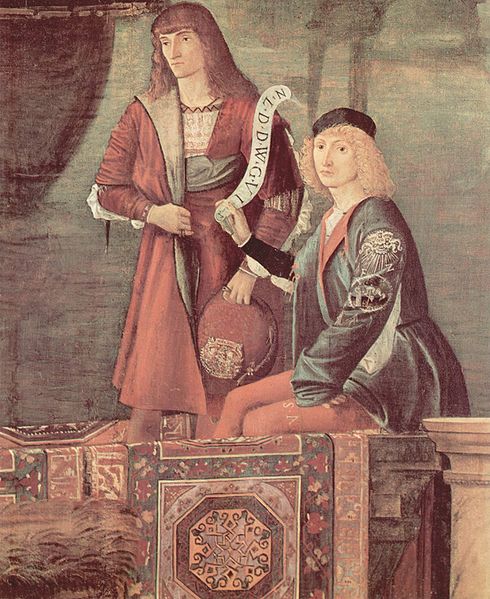
The bridges, piers and harbour-lined streets are full of people attired in the most decorative clothing.  People hang out of windows to catch a glimpse of the departure of the betrothed couple.  In the foreground sitting on the left of the central pennant and looking slightly towards us is Antonio Loredan, a member of the family who commissioned this work.  He is splendidly dressed and one can see, embroidered on his sleeve, the coat of arms of the Fratelli Zardinieri, one of the Compagnie della Calza.   In the centre-middleground on has the busy harbour and to the left we can see a large vessel lying on its side whilst the wooden planking of its hull is being re-caulked

This work of art is a hive of activity and one can spend lots of time scrutinising every facet of this large painting.  I look forward to going to Venice next month and visiting the Gallerie dell’ Accademia and standing in front of this magnificent work of art and the eight other paintings of the St Ursula cycle and absorbing all that is on display.

The Meyer Madonna by Hans Holbein the Younger

The Meyer Madonna by Holbein the Younger (1526-28)

My painting today is the 1526 work by Hans Holbein the Younger and is known as the Meyer Madonna or sometimes as the Darmstadt Madonna as the painting was commissioned by Jakob Meyer zum Hasen a senior official and sometime mayor of Basel and  the painting is housed  in the Schlossmuseum, Darmstadt.  It is considered to be one of the great masterpieces of European art.  At first glance there seems nothing unusual about the figures in the painting but in fact nothing is quite as it seems.  Let us look closely at what is being displayed.

Before Hans Holbein left Germany for England, he was approached by his early and most important patron, Jakob Meyer, to paint this family portrait which would hang in the Meyer chapel at Gross Gundeldingen.  Meyer had a colourful and controversial life.  He was a businessman who in 1516 was elected Burgermeister (Mayor) of Basel.  In 1521, he was impeached for taking a large bribe from the French, imprisoned and when he protested at this treatment he was barred from office thereafter. Meyer was a staunch Catholic even after the city’s secession to the reformed religion and led the Catholic party in the city.  Holbein started the painting in 1526 before journeying to England but on his return two years later, at Meyer’s request, made some changes to it.

In the upper central portion of the painting we have the Virgin Mary and the baby Jesus.  This is a Schutzmantelmadonna, a Virgin of Pity painting in which the Virgin Mary covers Meyer and his family with a mantle of protection and stands within a scallop-shell like niche.  A friend of Holbein, possibly also his mistress and who appears in other Holbein paintings, Magdalena Offenburg, posed for the Madonna.  The Virgin’s symbolic inclusion into this family portrait is because it was believed that by her intercession she can win the mercy of the Father. What such a figure represents is benign, protecting power of destiny. Holbein depicts the Madonna as a cloaked figure enthroned by the scallop shell, which symbolizes the womb, divine space, and femininity. The golden crown she wears is a symbol of sovereignty. The Child’s twisting body emphasizes the weight the Madonna’s arms must carry.  To the left we have Meyer himself and two young boys who were thought to be his two sons.  To the right are three women.  In the foreground, kneeling, we have Meyer’s daughter Anna.  In the middle we have Meyer’s second wife Dorothea Kannengiesser and the other lady is his first wife Magdalena Baer who died in 1511.  So before you is a family portrait with religious connotations and so, what you see is how it was?

Meyer's two wives

Well actually NO.  What you see was not how it was.     I suppose you may have reasoned that something was not quite right, seeing the two wives side by side and of course I had already said that Meyer’s first wife Magdalena had died fifteen years before Holbein had started the painting.  Jakob Meyer, when he discussed the composition of the painting with Hans Holbein on his return to Basle two years later, stipulated that the artist included his first wife, even though she had died in 1511.  Holbein had of course never seen her and that is probably why, not knowing her facial features , added her at the back of the group and almost covered her face in cloth.   One should remember that this was what Meyer wanted to remember as having been his family at one time or another.  However there is another unhappy  twist in the saga of this deceptive looking happy family portrait. 

Father and sons

This painting acted as a grim reminder to Meyer of his two sons who are seen in the painting positioned close to him.  At the time of the painting both were dead.   In fact only he and his daughter were alive at the completion of this work by Holbein but Meyer insisted that Holbein included all members of his family, living and dead, rather than omit any individual.  Unlike Holbein’s depiction of Meyer’s daughter Anna, the figures of the boys are not portraits, since they lack any individual features. In his elegant face and hands, the seated youth shows a certain resemblance to the Mary figure.    The naked boy, Meyer’s younger son and the Child Jesus also look similar and correspond to figure types found in Italian Renaissance paintings, and it is conceivable that Holbein was inspired by compositions by Raphael and Leonardo that he had seen on his trip to France.

The original sketch of Anna, the daughter

As I said earlier, this painting was started by Holbein in 1526.  He then left for England and did not return to Basle until 1528.   It was on his return that Meyer asked Holbein to make changes to this family grouping.  The main change was to be made to the portrait of his daughter Anna.  When Holbein first made sketches of her for the painting she was shown seated, almost child-like,  with long flowing hair, probably signifying her virginity.  When Holbein returned two years later she was probably fifteen years old and at a marriageable age and Meyer wanted his daughter portrayed as a young woman not as a child.   

The “updated” depiction of Anna

In the final version of the painting, Anna is now seen kneeling next to the two wives and looks older.   Gone are the long flowing locks and instead her hair is tucked into a chaplet headdress which was how girls of that age wore their hair when they went to church.  In her hair one can see pink flowers which often symbolised a girl’s betrothal.  So Meyer obviously wanted either to have his daughter portrayed as a girl of marriageable age or he wanted people to know that she was betrothed.

And so you see, at first glance this appears to be a simple family portrait with a religious connotation.  We know by the clothes of the man that he is of some importance.  We know by the elder son’s clothing that the family was wealthy.  This wealth is also shown by how Holbein has included a beautiful and expensive-looking carpet.  At first glance one may be slightly jealous and envious of the Meyer family’s depicted affluent and happy lifestyle but then once the facts are revealed one’s envy evaporates and one looks at the composition with some sympathy for this man who at one time had everything and then was left with just his painting and his memories.

Trial by Fire by Dieric Bouts

Justice of Otto III The Trial by Fire panel by Dieiric Bouts (1470-75)

Yesterday we looked at the left hand panel of the Justice of Emperor Otto diptych entitled The Execution of the Innocent Count.  Today I want to show you the right-hand panel which is entitled Trial by Fire.

To follow on from yesterday’s story regarding the execution of the innocent nobleman we delve further into the legendary tale The Golden Legend  written by Jacobus de Voragine in the late Middle Ages to seek out the consequences of that execution and discover the meaning behind Bout’s painting.   The nobleman’s widow, convinced of her dead husband’s innocence, asked for an audience with Emperor Otto so that she be allowed to prove the truth of her husband’s claim of innocence and clear her husband of the stain of adultery by suffering an ordeal of fire.   The Golden Legend tells of the event as follows:

 “…In the year of the Lord 984 Otto III, surnamed the Wonder of the World, succeeded Otto II. According to one chronicle his wife wanted to prostitute herself to a certain count. When the count refused to perpetrate so gross a crime, the woman spitefully denounced him to the emperor, who had him beheaded without a hearing. Before he was executed, the count prayed his wife to undergo the ordeal of the red-hot iron after his death, and thus to prove his innocence. Came the day when the emperor declared that he was about to render justice to widows and orphans, and the count’s widow was present carrying her husband’s head in her arms. She asked the ruler what death anyone who killed a man unjustly was worthy of. He answered that such a one deserved to lose his head. She responded: “You are that man! You believed your wife’s accusation and ordered my husband to be put to death. Now, so that you may be sure that I am speaking the truth, I shall prove it by enduring the ordeal of the burning iron.”

Seeing this done the emperor was overwhelmed and surrendered himself to the woman to be punished. The prelates and princes intervened, however, and the widow agreed to delays of ten, eight, seven, and six days successively. Then the emperor, having examined the case and discovered the truth, condemned his wife to death by fire, and as ransom for himself gave the widow four burgs, naming them Ten, Eight, Seven, and Six after the above-mentioned delays….”

So now look at the painting which depicts the scene described in the passage from the book.  As was the case with yesterday’s left panel, the painting on the right panel is split into two different scenes.  The main scene is featured in the foreground and middle-ground and features the widow kneeling before the emperor with the head of her dead husband, cradled by her right arm. In her left hand she defiantly holds the red-hot iron bar and by this action has, according to the emperor’s dictate, passed the test.    Otto sits on his throne surrounded by six courtiers.  He wears his red and gold brocaded robe with its sumptuous brown ermine lining.  A crown sits upon his head and he holds his sceptre of office in his right hand.  His eyes are transfixed on the poor woman before him as she pleads with him.   He realises with some disconcert that he has ordered the death of an innocent and loyal man.  His left hand is placed over his heart acknowledging his heartfelt contrition.  He is dumbstruck at the realisation he has condemned an innocent man to death and has discovered the truth about his wife’s infidelity and perjury.  He knows he has to try and rectify the wrong and orders the execution of his wife. 

In the second scene we see the burning of his wife at the stake, watched by crowds, and is depicted in the background of the painting.  She is bound to a pole watched over by a white-frocked cleric, who has been with her during her last few moments extending God’s mercy to the hapless woman.  The place of execution appears to be on the hillside in the country, outside the walls of the town.

 The diptych on view for the magistrates of Louvin to see each day was to act as a salutary lesson of the consequences of hasty and ill-thought out judgements and the perils of not hearing both sides in a case.  It also reminds them that no matter how powerful they may be they should not sit in judgement in cases in which they are personally involved for fear of bias.  Some historians believe Bouts was putting forward the idea that such errors of judgement ultimately cause the judges great anguish.

To end on an historical note Emperor Otto III in reality lived a very short life, dying of the plague or malaria at the age of twenty-one in the year 1002 during one of his military campaigns.  So what of his wife?   Actually Otto never married and had never had any children and on his death the great Ottonian Dynasty ended.

The Execution of the Innocent Count by Dieric Bouts

The Execution of the Innocent Man by Dieric Bouts (1470-5)

On January 27th  I showed you two painting by Gerard David entitled the Judgement of Cambyses and the Flaying of Sisamnes which was originally hung in the magistrates chambers in Bruges to act as a salutary warning to all those who dispensed justice in that city.  Town halls were often decorated with justice scenes in those days and today and tomorrow I want to look at two more examples of this artistic genre.  Our artist featured in today’s My Daily Art Display is the Dutch artist, Dieric Bouts the Elder.

Bouts was born in Haarlem around 1420 where he spent most of his early life.  Little is known about his childhood and early life except to say that most of his work was carried out whilst he was living in Louvain from 1457 until his death in 1475.  It was in this town that Bouts became city painter in 1468.  We know that he was influenced by the works of Jan van Eyck and Rogier van der Weyden, the latter at one time being his tutor.  Art critics talk of a certain stiffness to his drawing and drew attention to the disproportionate length and angular nature of the figures in his paintings.  However they do concede that his figures are extremely expressive and that there is a richness of colour in all his works especially the backgrounds of his landscapes.

 Our painting today is one half of the diptych known as the Justice of the Emperor Otto or simply the Justice Panels which he commenced in 1470 and which he was still working on at the time of his death five years later.  He had completed one of the two panels and had begun on the second one.  There were to be four panels in all but the third and fourth panel were never completed.  The two panels that exist and now form a diptych are now on view at the Musées Royaux, Brussels.  In 1468, Bouts who was at the height of his career had just completed his greatest masterpiece, The Last Supper.  He was approached by the town council of Louvain to paint a series of four panels for the town hall.  The town council’s reason behind such a commission was that they believed that their magistrates would benefit from the depictions of this old moral story – a judicial exemplum.

 Today I am going to look at the left hand panel which is entitled The Execution of the Innocent Count.  First let me relate the background to this painting.  The tale which is wholly legendary comes from the 12th century chronicle of Gottfried the then Bishop of Viterbo.  The story is also mentioned in Jacobus de Voragine’s Golden Legend or Aurea Legenda.  It tells of the Holy Roman Emperor Otto III whose wife was the daughter of the King of Aragon.  According to the story Otto’s wife was a very hot-blooded and feisty young Aragonese woman.  She became captivated by a married nobleman of Otto’s imperial court and without a care of the consequences tried to seduce him.  However, to her horror and anger, the nobleman rejected her amorous approaches and remained faithful to his wife and loyal to his lord, Otto.  The woman had been scorned and was furious and sought revenge on the noble who had rebuffed her.  She immediately went to her husband, Otto, and falsely accused the nobleman of having raped her and this set in motion a terrible set of events and a great injustice.  The emperor was furious and without even listening to the pleas of innocence from the nobleman ordered his execution by beheading. 

Otto and his wife

This oil on panel painting which is very large, measuring 325cms tall and 182cms wide and the people depicted in the scene are life-sized.    There are three distinct scenes to this painting and they are arranged in chronological order.  To the right, in the middle-ground, behind a stone wall, in their Imperial garden, we have the Emperor and his wife.  Their high position in the painting symbolises the fact that they were present, overseeing the proceedings.  They are witnessing the execution of the innocent man solely condemned by the perjury of the emperor’s wife.  She is emotionless and even seems bored with the event unfolding before her.

The condemned man and his wife.

On the left hand side of the middle-ground we have the accused, barefooted, with his hands tied before him.  He is dressed in a simple white robe and stands next to his wife who is dressed in red, with clasped hands praying for the soul of her husband.   The nobleman shows no emotion and seems resigned to his fate.  A Franciscan monk walks ahead of the man and his wife as they share their last words.  He is the confessor.  His hand is raised as he begins to make the sign of the cross.  He will listen to the nobleman’s last wishes and will pray with him at the end and offer him absolution for his sins.

Executioner and the severed head

In the foreground we see the aftermath of the execution.  The executioner is dressed in green and yellow tights which show splashes of blood.   His bloodied sword is held behind his back as he hands the severed head of the nobleman to the grieving wife.  She lovingly cradles the head in a white shroud.  The decapitated body of her husband with blood pouring from the severed neck lies on the green grass.  This stark contrast of the two colours intensifies the painting.   The scene is witnessed by townspeople, merchants and the clergy and probably some of them would be portraits of actual people of Louvain at the time of Bouts.

The moral of the tale depicted in this painting and what the burgers of Louvain wanted to stress to their magistrates was that one should not judge top hastily.  One should not judge a case without hearing the other side of a story and finally a judge should not make a judgement on a case in which he is personally involved.   The tale and the painting also highlight the damage which can be done through perjury and defamation.

This is just the first part of the story depicted by Bouts on one of the two panels.  Tomorrow I will focus on and discuss the second panel which deals with the repercussions of the execution of the innocent man.