Museu Nacional de Bellas Artes, Part 1 – Victor Meirelles

MUSEU NACIONAL DE BELAS ARTES Rio de Janeiro
MUSEU NACIONAL DE BELAS ARTES
Rio de Janeiro

Ten days ago I had a holiday in search of some sun and hot weather and arrived in Rio.   Besides the usual things to do like swim in the sea, visit Corcovado and Christ the Redeemer and take cable car journeys to the top of Sugar Loaf Mountain I went to the main art gallery in the city, Museu Nacional de Bellas Artes.  One travel book said it held 18,000 works of art and sculpture whilst another put the figure at 20,000.  Drawn in by those figures and having little or no knowledge about Brazilian art it was a destination I did not want to miss.  The building housing this vast collection was in the centre of the city and when we walked in we were told the collection was on the second and third floor.  Whether I am not good at counting but I would estimate the total number of artworks to be about 500 with about 200 sculptures so what happened to the others?  There was room after room of empty white walls so maybe there was once a large collection but it has now disappeared.  I am sure somebody will tell me where they all went.  Before I show you some of the fine works which were on display I have another complaint!  How many art galleries have you been to that have no shop or café?  Well this was a first for me.  I so wanted to buy some catalogues to find out about the works which were on display so I asked about the whereabouts of the shop only to be told that unfortunately there wasn’t one….unbelievable !!!!

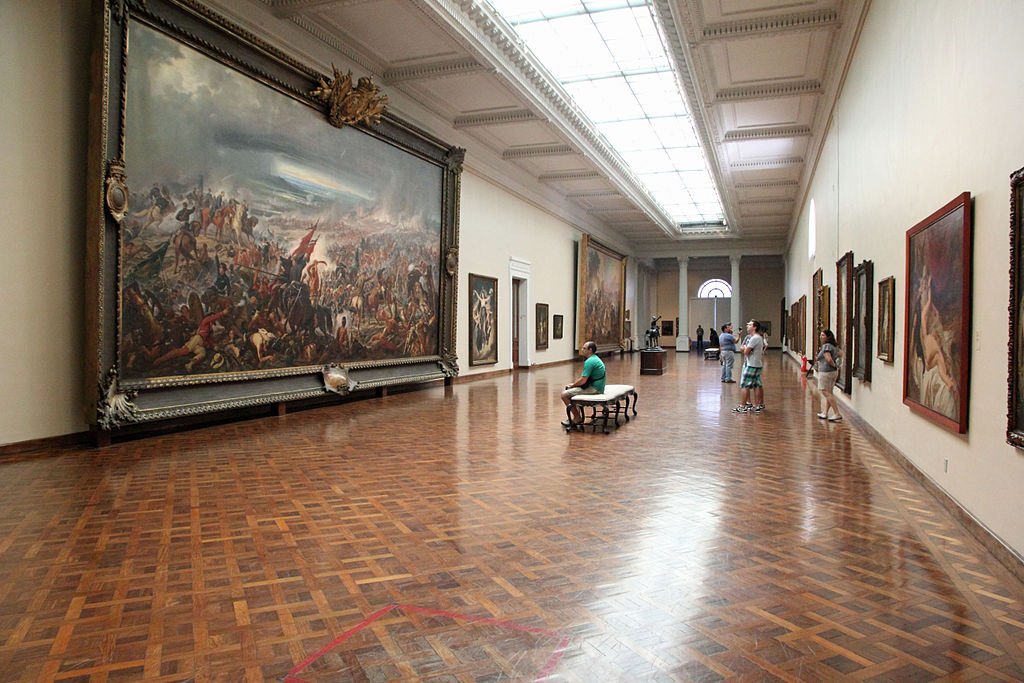
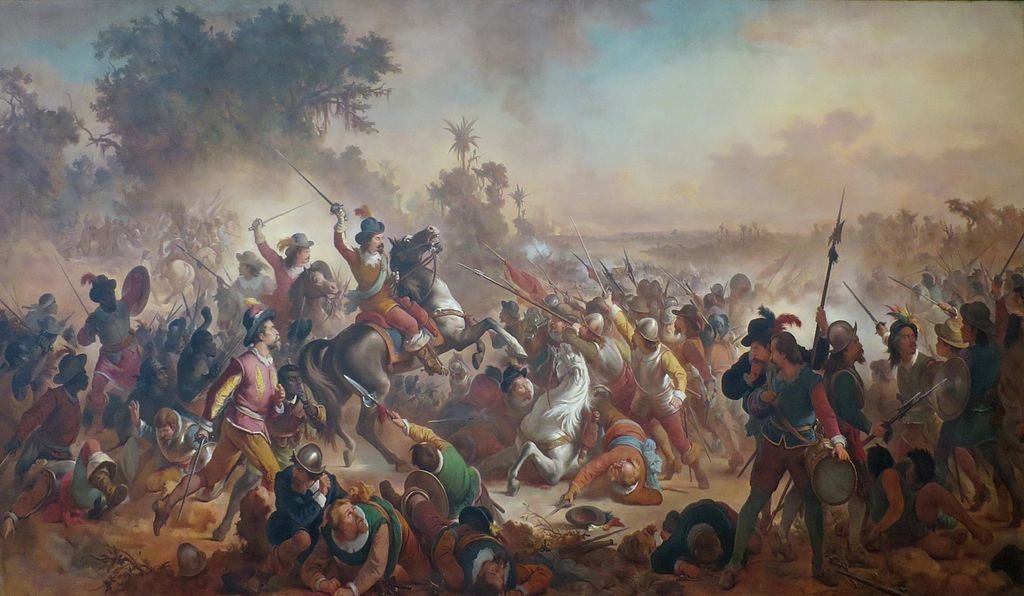
In my next couple of blogs I am going to put those disappointments behind me and concentrate on what was good about the museum.  There were many beautiful paintings on display including two monumental historical works by two different Brazilian painters, which were displayed along one wall of a very long room.   The first work was by Victor Meirelles and was entitled Battle of Guararapes which he completed in 1879.  It measured 494cms x 923cms and the other, which was even bigger was entitled, Battle of Avaí and was by the Brazilian artist Pedro Américo.  This one measured 600cms x 1100cms.  However today I want to concentrate on the art work of Victor Meirelles.

Victor Meirelles
Victor Meirelles

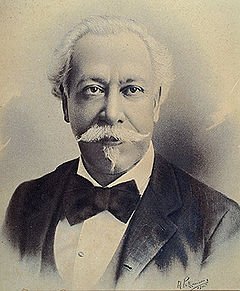
Victor Meirelles de Lima was born in August 1832 in Nossa Senhora do Desterro, which is now known as Florianópolis, a town on the island of Santa Catarina, in southern Brazil.  His parents, Antonio Meirelles de Lima and Maria da Conceição, were impoverished Portuguese immigrants.

He showed an early talent for art and in 1849, aged 17, he attended the Imperial Academy of Fine Arts in Rio de Janeiro.  It was here that he specialised in genre and historical painting. This Academy was founded by the then present ruler of the United Kingdom of Portugal, Brazil, and the Algarves, Don João VI, around 1816.  It was the main official institution of Brazilian academic art.  It had come to fruition with the arrival of the Missão Artistica Francesca (French Artistic Mission), which arrived in Brazil in 1816 and had suggested the creation of an art academy which would be modelled on the French Académie des Beaux-Arts.  It, like its French counterpart, would have graduation courses both for artists and craftsmen for such diverse activities modelling, decorating and carpentry.  The leader of the mission and the instigator of this plan was Joachim Lebreton who had fallen foul of the post-French revolutionary leaders and had sort exile in Brazil.  Like the French Academy the Imperial Academy of Fine Arts in Rio awarded as a prize to the best artists a travel scholarship.

Saint John the Baptist in Prison by Victor Meirelles (1852)

Victor Meirelles was a brilliant scholar and in 1852 won the travel scholarship to Europe with his painting São João Batista no Cárcere (St. John the Baptist in Prison) and in June 1853 he set off on his artistic journey.  His first port of call was Le Havre and then after a brief stay in Paris headed to Rome.

His initial studies were at the Piazza Venezia studio of the Italian painter and author of books on art theory, Tommaso Minardi but Meirelles found his tuition too dogmatic and he felt artistically constrained and felt that he lacked the prospect of developing his own artistic ideas.   He then moved to the studio of Nicola Consonni  who was a member of Rome’s Guild of St. Luke.  Again Meirelles found his mentor too strict but the one thing he did gain was the opportunity to improve his life drawing skills as Consonni gave his students drawing sessions with live models.  The ability to master the art of figure drawing was a prerequisite to becoming a talented historical painter.  Meirelles left Rome and moved to Florence where the museums were overflowing with the works of the great Italian Masters such as Titian, Tintoretto and Veronese and he spent much of his time copying their works. One of the stipulations of the Travel Prize was that he would regularly send back to Rio work he had completed as proof of his artistic progress and this he had done during his three-year European stay.  The Brazilian government was so impressed with the work they received, that they granted him a further three year scholarship in Europe.

In 1856, Meirelles moved from Florence to Milan and then on to Paris where he studied at the ateliers of the French historical painter and portraitist, Léon Cogniet and the Paris-based Italian historical painter, André Gastaldi.  Meirelles was a dedicated student whose whole life was devoted to learning about art and when his extended scholarship came to an end the Brazilian government on seeing the work he had sent to them agreed to a further two year scholarship extension.  They were well aware that Meirelles was going to become one of Brazil’s finest painters.

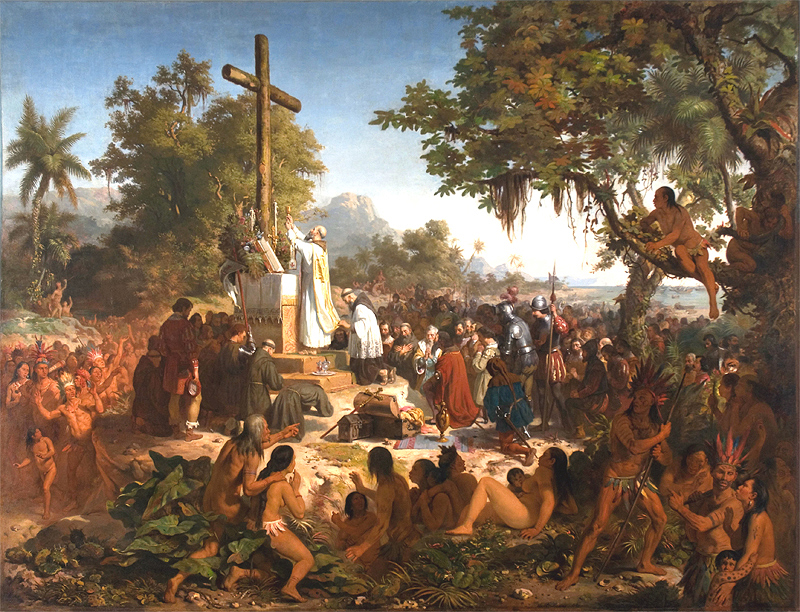
First Mass in Brazil by Victor Meirelles (1861)

It was during this final scholarship extension that Meirelles painted his most famous work, Primeira Missa no Brasil,  (The First Mass in Brazil), which was exhibited at the 1861 Paris Salon. In fact it was the first work by a Brazilian artist to appear at the Salon.  It is now housed at the art museum in Rio.  The painting depicts the official historic version of the discovery of Brazil as a heroic and peaceful event, celebrated in harmony by colonists and native Indians.  Meirelles had based his depiction on some resources he found about the Brazilian Indian at the Sainte-Geneviève Library in Paris.   In the work we see the monk Henrique de Coimbra celebrating mass on April 26, 1500. The painting made Meirelles’s name and has illustrated many history books, stamps, bank notes, catalogues and magazines.  It is such an iconic work and is probably the best known painting in Brazil.

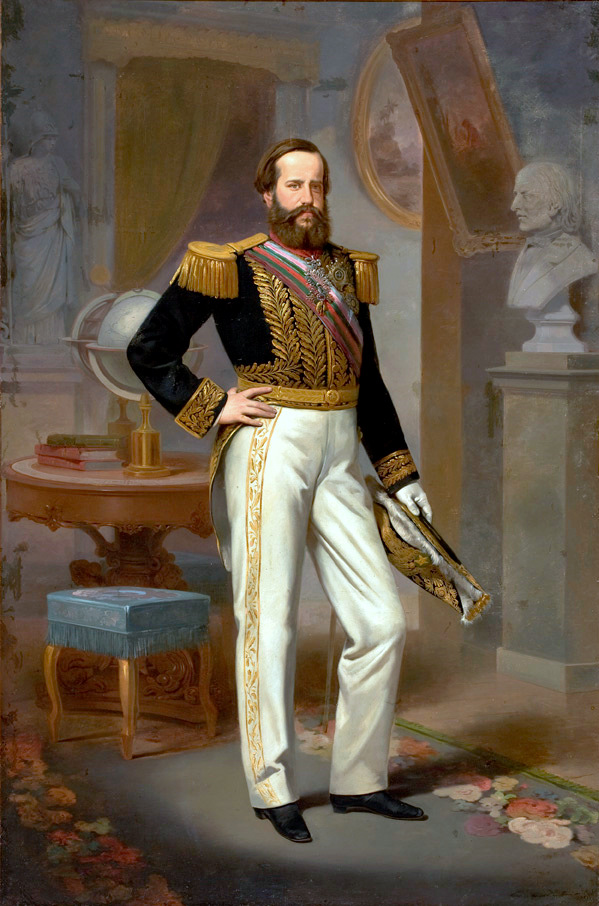
Dom Pedro II by Victor Meirelles (1864)

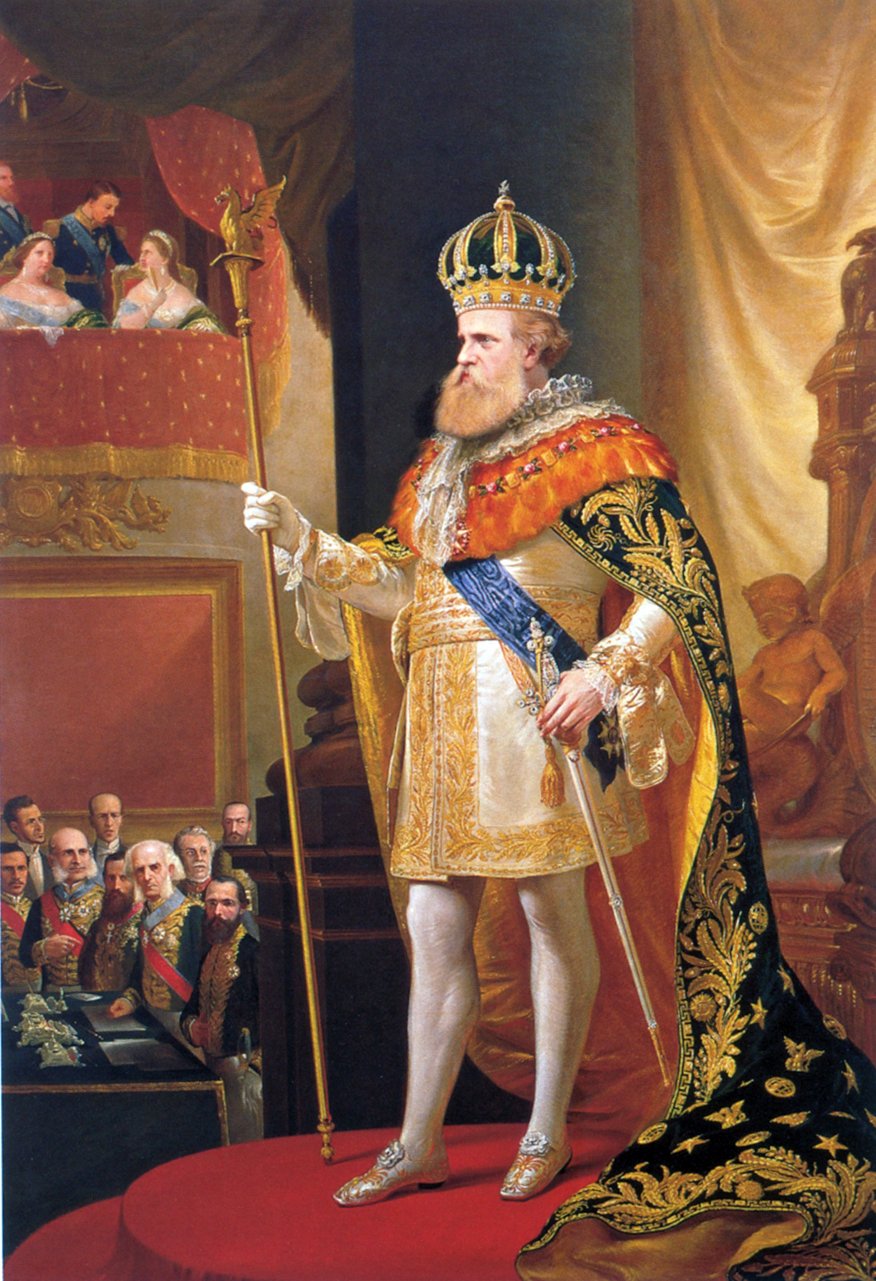
Following his artistic success with his painting, Meirelles returned to Brazil in 1861 as an artistic hero because of  this painting.  He was awarded the Imperial Ordem da Rosa (Knight of the Order of the Rose) by Emperor Dom Pedro II and he became one of the Emperor’s favourite painters, and in 1864 he completed a portrait of the Emperor.

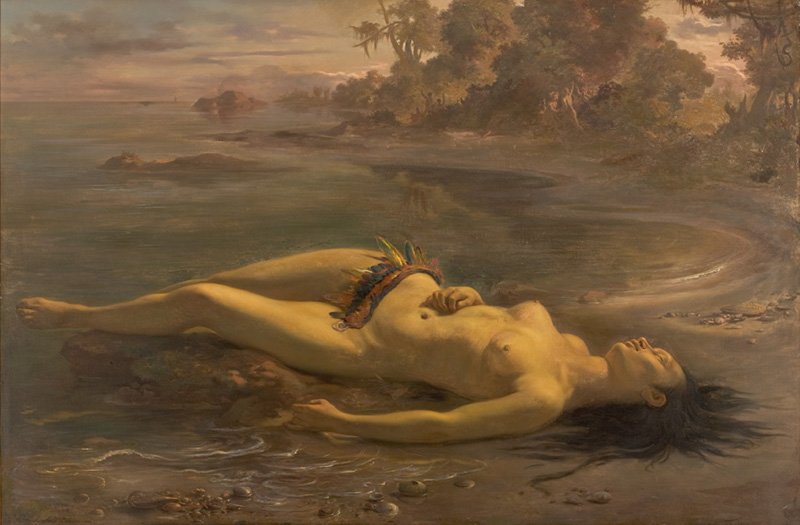
Moema by Victor Meirelles (1866)

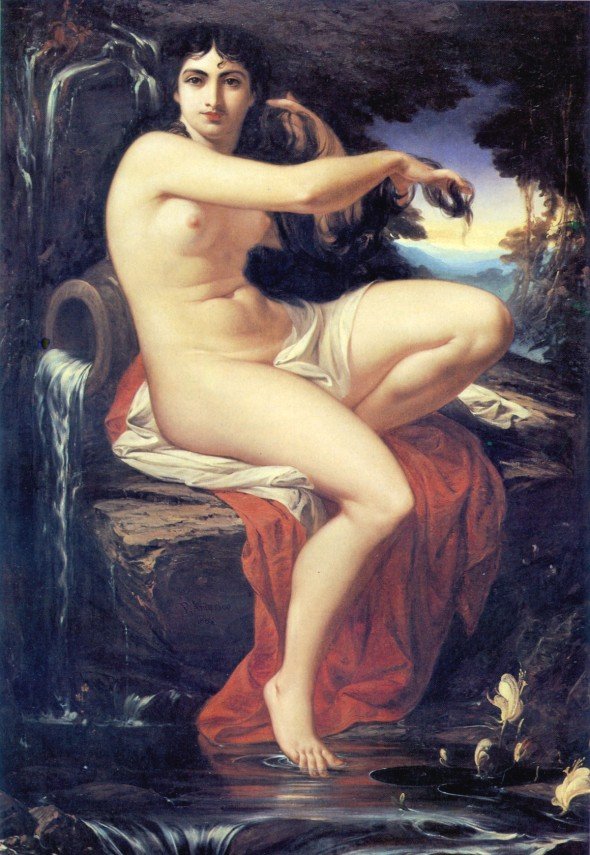
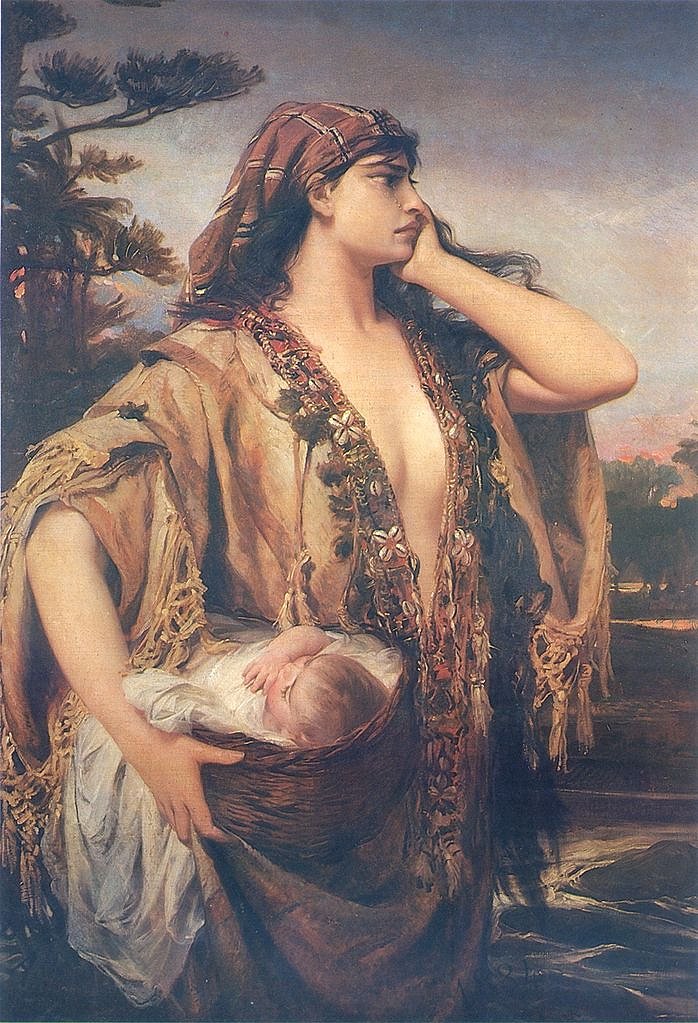
He was appointed Honorary Professor of the Academy, and shortly after promoted to Acting Teacher of the Imperial Academy of Fine Arts in Rio de Janeiro.   He continued painting important historical works, which for many Brazilians pictorially recounted their history. In his 1866 work entitled Moema he highlighted the sad plight of the Brazilian indigenous population and their clashes with the Dutch and Portuguese colonists.  It was a work of art which was known as Indianism which was the term used which refers to the idealisation of the indigenous people of Brazil,d who were sometimes portrayed as mythical national heroes.  In nineteenth century Brazilian literature the indigenous people of the country were chosen to represent the new nation.  Indianism was a form of Romanticism in Brazilian art.

Battle of Guararapes by Victor Meirelles (1879)

In 1875 Meirelles was commissioned to produce a historical work based on a seventeenth century battle between the Dutch colonizers and the Portugeuse/Brazilian army.  He went to the area where the conflict had occurred in order to produce a topographical accurate background and began making preliminary sketches for his monumental historical work which became known as Batalha de Guararapes (Battle of Guararapes).  Meirelles completed the work four years later. It was a depiction of the First Battle of Guararapes which took place in 1648 in the Guararapes Hills in the north-east of the country and was part of the Pemambucana Insurrection between the Dutch army who had colonized much of the area and the Portuguese army.  However it was not the Portuguese army per se as the forces fighting the Dutch colonizing army were in fact considered the origin of the Brazilian Army, because it was the first time where whites, blacks and Indians joined forces to fight for Brazil, their land, instead of fighting for Portugal.

The painting had a surface area of 45 square metres, measuring 494cms x 923cms.  I stood before this work and marvelled at the detail that went into it.   It really is an awesome work of art.

Naval Battle of Riachuelo"by Victor Meirelles (1883)
Naval Battle of Riachuelo by Victor Meirelles (1883)

Being known as a strong supporter of the Empire and because of his loyalty to the national cause, Meirelles was also commissioned in 1868 by the Brazilian government to create an historical work which featured Brazil’s crucial naval victory during its war with Paraguay.  The Battle of Riachuelo took place on the Paraná River in June 1865 and it was a turning point in the war between Paraguay and the Triple Alliance of Brazil, Argentina and Uruguay.  The war which had begun in 1864 lasted six years.  Meirelles travelled to the region of the conflict so as to gather impressions of the landscape and the military environment. He installed a workshop on the ship Brazil, which was the flagship of the Brazilian fleet, and remained on board for six months preparing sketches for the painting.

Everything was going well for Meirelles until on November 15, 1889, Marshal Deodoro da Fonseca headed a military coup which led to the downfall and exile of the sixty-eight year old Emperor Dom Pedro II .  The Empire had fallen and was replaced by a Republic.  As was the case with many French artists who had connections with the family of Louis XVI and Marie-Antoinette, they too quickly fell out of favour with the onset of the French Revolution.  Whereas When Emperor Dom Pedro was ruler of Brazil his patronage of Victor Meirelles was a boon to the artist but when the Emperor was deposed artists connected with the Emperor and the court were cut adrift.  Meirelles also lost his position at the Imperial Academy of Fine Arts, the spurious reason for his sacking was that he was too old.  He was just fifty-seven years of age.  Victor Meirelles de Lima died in Rio de Janeiro on February 23rd 1903 aged 70.  It was a Sunday morning and the Carnival was in full swing but few mourned the passing of the once iconic artist.

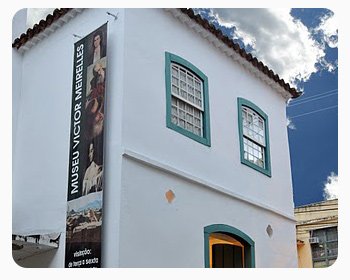
Victor Meirelles Museum, Florianapolis

Today, besides his work which is on display at the Museu Nacional de Bellas Artes in Rio de Janeiro, there is a museum dedicated to him and his work in his birthplace, Florianapolis.  The museum is in a house, built of stone masonry, bricks and stucco, fences which have openings with a wooden roof with tiles. It was acquired by the Union in 1947 and National Heritage and National Art in 1950  The works of Meirelles are exhibited on the upper floor whilst the ground floor contains works by contemporary artists.  The mission of the Victor Meirelles Museum, set in its Museum Plan, is set out as:

“…To preserve, research, and the life and work of Victor Meirelles, and disseminate, promote and preserve the historical, artistic and cultural society, and also stimulate reflection and experimentation in the arts, heritage and contemporary thought, contributing to the expansion of access to the most different cultural events and for training and exercise of citizenship…”

It is good that the country that once hailed Meirelles as an iconic artist and then abandoned him have finally realised the contribution he made to the history and life of Brazil.

Seymour Joseph Guy

At the Opera by Seymour Joseph Guy (1887)

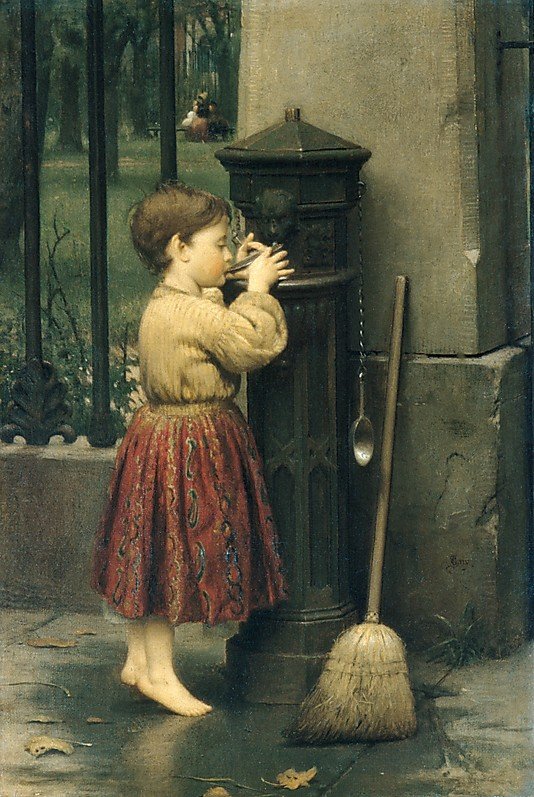
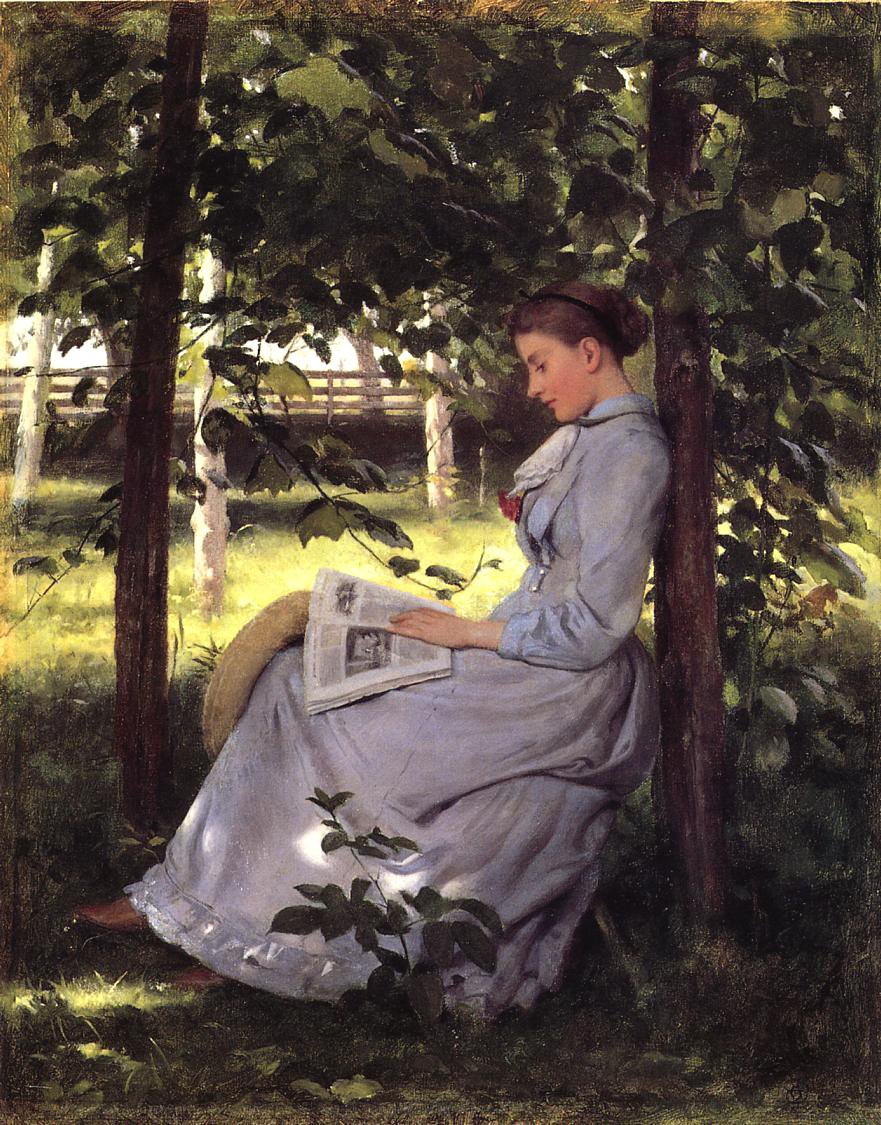
I was looking at the website of a person who had commented on one of my blogs and I was fascinated by a painting he had posted.  I had to find out more about it and the artist who had painted it.  The title of the work is At the Opera and the creator of the work was the nineteenth century English-born,  American genre painter, Seymour Joseph Guy.  Genre paintings are works, which depict one or more persons going about their every day life.  They could be scenes in the kitchen, at the market or in a tavern and they are nearly always realistic depictions, lacking any sense of idealisation.  They are “warts and all” depictions of life.  Seymour Joseph Guy’s later works, which were often quite small “cabinet pieces”, concentrated mainly on depictions of children.  His works were meticulous in detail.

 Seymour Joseph Guy was born in 1824 in England, in the south London borough of Greenwich.   His father was Frederick Bennett Guy who owned an inn as well as a number of commercial properties.   His mother was Jane Delver Wilson.  Seymour had an elder brother, Frederick Bennett Guy Jnr. and a younger brother, Charles Henry.  When Seymour was five years old, his mother died and he and his brothers were brought up by their father.  Four years later their father died and the executors of their late father’s will were John Locke who was the owner of the inn called the Spanish Galleon and a local cheese merchant and friend of Seymour’s father, John Hughes.   It is the thought that the three orphaned boys came under the legal guardianship of one of these gentlemen.  Seymour’s schooling was at a local school in Surrey and it was during these early informative years that he took an interest in art and he liked to spend time drawing dogs and horses.   He enjoyed drawing so much that, when he was thirteen years old, he made it known that he would like to become an artist, or maybe a civil engineer.  This choice of career did not go down well with his guardian who actively discouraged the teenager, going as far as stopping his pocket money so he couldn’t buy any pencils and sketchbooks and that he believed would force his charge to abandon his artistic plans.  Seymour was not to be put off and despite his lack of pocket money; he managed to earn enough to buy his own drawing materials by becoming a part time sign-painter.

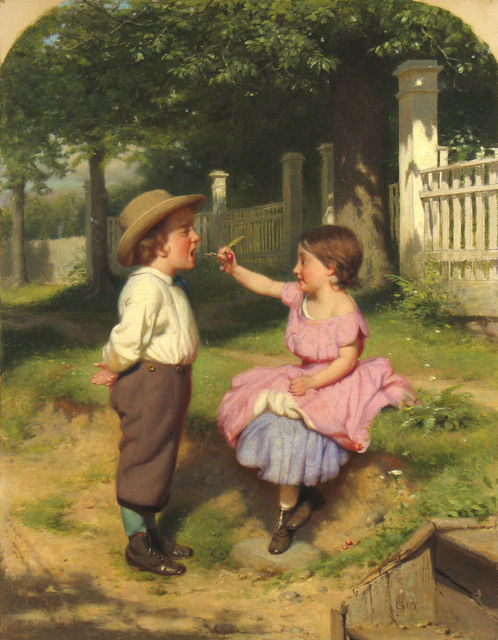
Open Your Mouth and Shut Your Eyes by Seymour Joseph Guy (c.1863)

Seymour Guy continued with his ambition to become a painter and in his late teenage years received some artistic tuition from Thomas Butterworth.  Butterworth, who had served as a seaman in the Royal Navy during the Napoleonic wars period, lived in Greenwich and was a marine painter.  His guardian decided that a good career for Seymour, and in line with his artistic ambitions, would be to become an engraver.  However the cost of an apprenticeship to learn the engraving trade was prohibitive and this proposed profession had to be abandoned and instead his guardian arranged for Seymour to begin a seven-year apprenticeship at an oil and colour firm which oversaw the making of pigments, preparing binders, as well as combining the two skills in order to make paint either by hand-grinding them or using a steam driven machine.   This was a valuable experience for Seymour as he learnt the intricacies and expertise of mixing various pigments which he would himself use in the future for his own paintings.

In 1845 Seymour’s legal guardian died. It was also a time, when having reached the age of twenty-one, the brothers’ late father’s estate was split between them.  In Seymour’s case this also coincided with the end of his seven-year apprenticeship at the colour factory.    Seymour Guy was twenty-one years of age and now had sufficient money to pursue his dream of becoming a professional painter.  A friend offered to sponsor him to enable his entrance to the Royal Academy but instead he decided to work on his own and so he obtained a copying permit and took his easel and brushes to the British Museum where he copied some of the works of art.  Understanding that working alone was not the answer to learning about art he also enrolled at the studio of the portrait and historical painter, Ambrosini Jerome, who had received a number of commissions from the English royal family.  Seymour Guy was to work with Jerome for the next four years.

The Crossing Sweeper by Seymour Joseph Guy (c.1860's)
The Crossing Sweeper by Seymour Joseph Guy (c.1860’s)

In 1852, aged twenty-eight, Seymour married Anna Maria Barber, who was the daughter of William Barber, an engraver.  The couple went on to have nine children, many of whom were used by Seymour as models for his genre paintings.  Two years later in 1854, Seymour moved his family from London to New York and settled in Brooklyn.  Here he set up his studio in Brooklyn Heights, played a leading role in the art life of the city and founded the Sketch Club and it was during these early times in Brooklyn that he met and became a close friend of another genre painter, John George Brown.  Brown who was also English-born had left his home in Durham and immigrated to America in 1853.  This close bond of friendship probably stemmed from them both being English born, and both genre painters who liked to concentrate on small-scale works which gave them the opportunity to demonstrate their intricate minute workmanship.   In those early days in Brooklyn Seymour Guy also completed a number of portraits of leading local figures.

In 1861, the two friends, Seymour Guy and John Brown, decided to move their studios from Brooklyn to the more fashionable Manhattan.  Seymour Guy had his studio on Broadway whilst John Brown moved into the Tenth Street Studio Building. Two years later Guy decided to leave his Broadway studio and move into the Tenth Street Studio Building.  The Tenth Street Building, which was on 51 West 10th Street, between Fifth and Sixth Avenue, was constructed in 1857 and was the first modern facility designed exclusively to the needs of artists.  Soon it became the hub of the New York art world and would remain so for the rest of the nineteenth century.  It was to be the home for many famous American artists including Winslow Homer, Frederic Edwin Church, William Merritt Chase and Albert Bierstadt.

Summer Issue by Seymour Joseph Guy (1861)

The genre work of John Brown with its depiction of young children in rural settings influenced Seymour Guy for around about 1861 he too started to produce similar depictions. Around this time, the two artists made a number of ferry trips across the East River,  to escape the manic setting of the big city, to the tranquil setting of Fort Lee in New Jersey.  The two artists liked the peace and quiet so much that they decided to quit Manhattan and move home to the New Jersey countryside.  Brown went in 1864 and Seymour Guy followed with his family two years later.  Seymour Guy and his family lived the quiet existence in the country for seven years until in 1873 when they moved back to Manhattan where they remained for the rest of their life.

Seymour Joseph Guy died in 1910, aged 86, by which time his art was out of vogue and he was almost completely forgotten as an artist.   During that first decade of the twentieth century Guy’s health had begun to fail and his role as an artist seemed simply to have acted as an elder statesman to younger artists who sought out his vast knowledge about the art and the craft of painting. One of the most complimentary eulogies to him following his death appeared in the Century Association’s annual journal, which stated:

“…He is remembered with deep affection by artists who came to him as to an older man of recognized position. He was most genial, cordial, and ready to place himself and the methods of his art at their disposal, rejoicing in their companionship and keeping himself young through participation in their pursuits. For twenty-two years he was of the rare artistic fellowship of The Century, though of late years, through the infirmities of age, seldom here…”

The Contest for the Bouquet.  The Family of Robert Gordon in Their New York Dining-Room  by Seymour Joseph Guy (1866)
The Contest for the Bouquet. The Family of Robert Gordon in Their New York Dining-Room by Seymour Joseph Guy (1866)

In 1866 Seymour Guy completed a painting entitled The Contest for the Bouquet: The Family of Robert Gordon in Their New York Dining-Room, which is a combination of a group portrait and a genre work.  It is a conversation piece sometimes referred to as a narrative painting.  Seymour had received the commission from the head of the family, Robert Gordon, a British-born financier and an avid collector of American art, who was also a founding trustee of the New York Metropolitan Museum of Art.  The commission was for the portrait of Gordon’s wife, Frances, and four of their children.  In this charming family portrayal we see the three older children of Robert Gordon playfully fighting to gain hold of a small floral corsage.  The elder boy, who is by far the tallest, holds the flowers aloft out of the reach of his sister whilst his brother stands on a chair to help him reach the “prize”.   To the right we can see the youngest child sitting on her mother’s lap, clinging to her, in order to avoid her three siblings.  The setting is the family dining room and appears to be around breakfast time as the three older children are already dressed in their school clothes.

The Story of Golden Locks by Seymour Joseph Guy

The final two paintings I am featuring were set in the same room.  The painting The Story of Golden Locks by Seymour Guy was completed around 1870 and in it we see a young girl reading the story of Goldilocks to two young boys, probably her brothers.  The storyteller is very animated and for the two young listeners it has probably turned the story telling into a somewhat nightmarish tale.  Look at their faces.  They are wide-eyed, unsure whether they want to hear more.  Maybe the frightening shadow of the girl’s head on the curtain above their bed has added to their trepidation.  On the chair next to the bed is the girl’s doll which lies in a drawer and this is thought to allude to the fact that the storyteller has finished with children’s toys and is transitioning between childhood and womanhood.

Making a Train by Seymour Joseph Guy (1867)

My final selected work by Seymour Guy was completed in 1867 and is entitled Making a Train.  There is an innocence about this painting although I am sure its content, the semi-nudity of a female child, would be criticised as being too salacious if it had been exhibited now.  In the same attic room as the setting for the previous work we see a young girl standing by her bed with a dress which has been lowered so that it drags along the ground like the train of a ball gown.  She looks over her shoulder to see the finished effect.   The painting is lit up by the light from an oil lamp which sits on a book on a wooden chair, to the right of the picture.  Once again Guy is depicting this young girl as moving from childhood to womanhood.  In the cabinet to the left of the picture we see a doll which has been put away.  This is the end of the era of playing with toys.  Now the interest is in fine clothing.  Her small breasts are both an evocation of her child-like innocence but also the start of her journey towards being a young woman.  In an era when realist painters liked to portray children as often sickly, dirty and poor street urchins many would have found favour with this work which depicts the young, clean, and healthy girl enjoying dressing-up.  It is thought that Seymour Guy’s daughter Anna modelled for this work.

For a further and much more detailed look at the life of Seymour Joseph Guy have a look at the website below, from which I got most of my information:

http://www.themagazineantiques.com/articles/seymour-joseph-guy/

Adélaïde Labille-Guiard

Self portrait of Adélaïde Labille-Guiard )

In my last blog I looked at the life of the eighteenth century French artist, Anne Vallayer-Coster and featured a number of her exquisitely painted floral still-life works.   In today´s blog I am looking at the life and works of a contemporary of hers, the talented French miniaturist and portrait painter, Adélaide Labille-Guiard.

Adélaïde Labille was born in Paris in April 1749, the youngest of eight children, to Marie-Anne Saint-Martin and Claude-Edme Labille.  Her father was a marchand du corps de la mercerize (a haberdasher) and he and his wife owned a haberdashery shop, La Toilette, in the rue Neuve des Petits-Champs, at the heart of the capital.  Their home was also situated on this street.   The shop became very popular and by the 1760’s it had built up an élite clientele.  One interesting fact about the family shop was that in 1761 a young girl, Jeanne Antoinette Bécu, applied to work in it, was taken on and became friends with Adélaïde.  Whilst there she met the comte du Barry, became his mistress, left the shop and would later become la maitresse-en-titre, the chief mistress of Louis XV.

Giving birth to eight children took its toll on Adélaïde´s mother and she was often laid low with one illness after another.  In 1768, when Adélaïde was nineteen years old, her mother died.  Little is known about Adélaïde’s siblings except that one of her older sisters, Félicité, married the painter and art collector, Jean Antoine Gros in 1764.  However in a letter Adélaïde wrote to Comtesse d´Angiviller in 1783, she said she was the only surviving member of the family.

The Sculptor Augustin Pajou by Adélaïde Labille-Guiard (1783)

So what made Adélaïde want to become an artist?  One reason could be the location of the family home, which was close to the Palais Royale and had become the hub of theatres, music halls and dance halls but was also home to a large collection of professional artists as it was close to the Louvre, which at the time was the headquarters of the Académie Royale.  The most talented artists of the time, who were willing to comply with the strict guidelines of the Académie, had become members of this august establishment but many others painters who failed to be accepted into the halls of the institution had become members of the city’s trade guild, the Academy of Saint Luke.  It is thought that Adélaïde may have got her earliest artistic tuition from some of her artistic neighbours, one of whom was the Swiss-born painter of portrait miniatures, François-Élie Vincent, a member of the Guild of Saint Luke, who also lived in rue Neuve des Petits-Champs.  In 1769, Adélaïde, aged twenty, joined his classes and it was during this time as Vincent’s apprentice that she was able to exhibit some of her work at the Académie de Saint-Luc.   This was also the year she married.  Her husband was Louis-Nicolas Guiard who was an official in the Treasury of the Clergy and who lived on the same street as Adélaïde.  The ceremony took place at the local church of St Eustace on August 25th 1769.  The marriage contract recorded that Adélaïde was a professional painter at the Académie de Saint-Luc.

Madame de Genlis by Adelaide Labille-Guiard (1780)

Five years on, in 1774, Adélaïde had moved on artistically to work with pastels under the tutelage of the distinguished seventy year old French pastelist, Maurice-Quentin de la Tour who had his studio a few blocks away from Adélaïde’s home.  It is believed that Adélaïde had been introduced to him by one of his former students and a neighbour of hers, the Swedish portraitist Alexander Roslin.  Roslin, an Academician since 1753, was married to the painter, Marie Suzanne Giroud, and was a great believer in women’s right to become artists and was aware of the problems they had in trying to progress as professional painters.  Art historians believe that Roslin was the person who would later put forward Adélaïde’s name to become a member of the Académie Royale.

Three years on, around 1777, she started to work in oils and her introduction to, and tuition in this painting media came from François-André Vincent the son of her former tutor.  He was to become a leader of the neoclassical and historical movement in French art.  They became very close and such closeness fuelled rumours of a romantic tryst between the two artists.  Whether such rumours damaged her marriage or whether there were other reasons, the couple went their own separate ways in 1777 and her child-less marriage to Guiard ended in legal separation in 1779.  Adélaïde however kept signing her work Labille-Guiard. The relationship between Adélaïde and Vincent is examined in the 2012 book by Elizabeth Mansfield, entitled The Perfect Foil: François-André Vincent and the Revolution in French Painting and in it she suggests that the pair had been very close as far back as 1769 when she worked in his father’s studio, but the fact that he was a Protestant found little favour with Adélaïde’s father and so marriage was not a possibility.  However following the separation from her husband and after the reformation of divorce laws, the couple were able to marry in 1800. 


Portrait of François André Vincent by  Adélaïde Labille-Guiard (1795) Louvre, Paris
Portrait of François André Vincent by Adélaïde Labille-Guiard (1795)
Louvre, Paris

Adélaïde’s second husband François-André Vincent, being a talented artist and having the right connections, became a student at the Académie Royal in 1765, three years later won the prestigious Académie prize, Prix de Rome and was awarded a four-year scholarship at the Palazzo Mancini, the French Academy school in Rome.  On his return to Paris in 1782 he was made a full Academician.   For Adélaïde, her artistic journey was far more difficult.  Females wishing to become artists struggled to receive artistic training unless they had family members who were artists and who had their own studios but this was not the case for Adélaïde whose father was a merchant.  However as I said earlier she did eventually secure artistic tuition and with the support of Roslin she became a member of the Académie Royale on May 31st 1783, the same day in which Élizabeth Vigée-Lebrun was received into the Academy.  The addition of these two females to the Academy brought the number of female Academicians to four.  Anne Vallayer-Coster, the floral and still life painter and the miniaturist, Marie-Thérèse Réboul, also known as Madame Vien being the other two Academicians.  A royal decree had set a cap of four female Academicians at any one time.  The French Arts Minister, comte d’Angiviller, had obtained the royal ruling and had stated that such a cap would be sufficient to honour the talent of female artists but added condescendingly that they could never be useful to the progress of the arts!

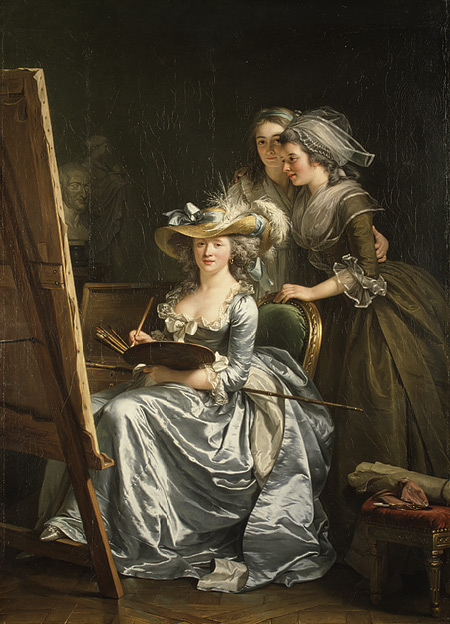
Self-Portrait with Two Pupils, Mademoiselle Marie Gabrielle Capet and Mademoiselle Carreaux de Rosemond by Adélaïde Labille-Guiard (1785)

In 1780 Adélaïde had set up her own studio and had accepted a group of women pupils, several of whom went on to become successful portraitists. By 1784, her reputation as a gifted art teacher was firmly established and one of her most famous works, which is now housed in the Metropolitan Museum of Art in New York, is her 1785 work entitled Self–Portrait with Two Pupils, Mademoiselle Marie Gabrielle Capet and Mademoiselle Carreaux de Rosemond, which highlights her role as a tutor. The work has often been construed as a piece of propaganda, symbolising the dispute over the role of women in the Academy. She has portrayed herself in her studio which is richly furnished and this was her way of denoting her favourable financial situation.  She is seated in front of a large canvas and behind her stand two of her students, Marie Gabrielle Capet and Mademoiselle Carreaux de Rosemond, who have been depicted in much plainer clothes.  Adélaïde wears a sumptuous and expensive low cut gown and large plumed hat neither of which would have been worn by an artist at work but is more likely to be a declaration of her femininity, and the fact that she is an artist who moved in high society.  The feminist stand on art education was further enhanced by the inclusion of her two female students both of whom would become great artists in their own right.  In the background she has included the bust of the Vestal Virgin as an additional emphasis of the feminist mood of the time.  One can tell by this work that she had a great belief in herself as an artist.  So if she wanted to paint a self-portrait, why include two other people in the work?  The reason for their inclusion is probably two-fold.  First of all, because she was a strong proponent of the education of women artists, it is her statement of belief that females should receive artistic tuition and secondly she is demonstrating her ability as a group portraitist and this painting received critical acclaim when it was exhibited which led to many commissions for family group portraits.  This was indeed a clever self advertisement by the artist.  One of the pupils in the painting, Marie Gabrielle Capet, became Adélaïde’s close friend and her favourite student.  She became a miniaturist and pastel portraitist in her own right and lived with Adélaïde Labille-Guiard before and after the artist’s marriage to Vincent.  After Adélaïde died Marie Gabrielle Capet remained in the house and continued to care for Adélaïde’s husband.

Marie Adélaïde de France, Known as Madame Adélaïde daughter of Louis XV and Marie Leszczyńska by Adélaïde Labille-Guiard (1787)

Labille-Guillard was an extremely talented portraitist and unlike her fellow Academician, Lebrun, she received portrait commissions from both sides of society, members of the aristocracy as well as revolutionary figures.  She also received royal commissions and one of her royal patrons was Princess Marie Adélaïde, the aunt of Louis XVI and through this received an annual government pension of 1000 livres.  Labille-Guiard painted the portrait of the princess and her sister, Princess Victoire-Louise, as well as a portrait of the sister of Louis XVI, Princess Élisabeth. Because of these royal commissions to paint portraits of female family members of Louis XVI, she came to be known as Peintre des Mesdames.  She would normally have been also allowed a studio at the royal court but because her pupils were female that was not to be.  However such royal patronage, in some ways, made Labille-Guiard politically vulnerable at the time of the French Revolution of 1789 and she was made to destroy a number of her portraits of court members of the fallen monarchy and for a time she decided, for her own safety, to leave Paris.   At the Salon exhibition of 1791 she exhibited portraits of two prominent members of the French National Assembly, Maximilien Robespierre and Armand, duc d’Aiguillon.

In 1795 Adélaïde was granted artists’ lodgings at the Louvre and had her government pension enhanced to 2000 livres.  As a member of the Académie Royale she continued to regularly exhibit her portraits at the Salon until 1800.   Adélaïde Labille-Guiard died in April 1803, aged 54.

Whilst researching the life of Adélaïde Labille-Guiard I came across a book entitled Adélaïde Labille-Guiard – Artist in the Age of Revolution by Laura Auricchio.  It is from this literary work that I gleaned most of the information regarding her life.   I can highly recommend the book if you want to find out more about the artist and study some of her exquisite works.

Anne Vallayer-Coster. The Queen of Floral Still-Life works

Anne Vallayer-Coster

At the end of 1362 the Florentine writer, Giuseppe Boccaccio, he of The Decameron fame, (see my Daily Art Display Feb 21st 2012), had completed his book, De mulieribus claris (Of Famous Women), a biography of famous (and infamous) women, some real, some mythological.  In it he wrote about three female artists and commented:

“…Art is Alien to the mind of women, and these things cannot be accomplished without a great deal of talent, which in women is usually very scarce…”

In this blog I am returning to look at female artists and I am featuring a highly talented lady whose superb artistic talent rubbishes Boccaccio’s theory.  Today, I am looking at the struggle she, like other female painters of the time, had fighting their way through to success in a male-dominated field.  One of my favourite paintings is by the eighteenth century French female artist Louise Elisabeth Vigée Le Brun (See My Daily Art Display November 21st 2012) and recently I have been reading about a contemporary of hers, the very talented 18th century French painter who, like Le Brun, gained the patronage of Marie-Antoinette, the wife of the French monarch, Louis XVI.   She is Anne Vallayer-Coster.   Such royal patronage was the ultimate prize for aspiring painters as it led to many lucrative commissions.  However, unlike Le Brun, Anne Vallayer was not solely a portraitist but was an exceptional still-life and floral painter.

Anne Vallayer-Coster was born in Paris in December 1744.  She was the second of four daughters.  Her mother was a painter of miniatures.  Her father, Joseph Vallayer, was a goldsmith working at the Gobelins Manufactory Company in Paris, and the family lived on the grounds of the Gobelins Manufacturing complex, which produced the finest tapestries as well as luxury objects, which often adorned the royal palaces.  In 1757 the family moved to another area of Paris and Anne’s father started to trade in jewellery.  His business soon expanded with royal patronage and was granted the right to produce metal products for the military.

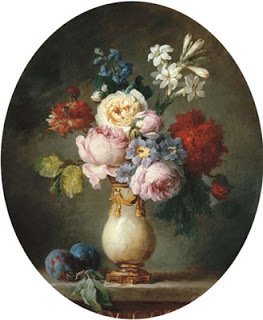
Anne Vallayer became interested in sketching and painting at an early age and her mother encouraged her by arranging for her to have private tuition from an art teacher, Madeleine Françoise Basseporte, a one-time pupil of the great French botanical painter, Claude Aubriet, and she, like him, was made the Royal Painter at the court of Louis XV, teaching the royal princesses to paint flowers.  Anne Vallayer learnt well from Basseport and she too was to become a talented botanical artist.  Her next art tutor was the landscape painter Claude Joseph Vernet.  In a short period of time Anne Vallayer became an accomplished artist concentrating on floral still-life works.  Her works were a beautiful juxtaposition of the flowers and inanimate objects such as books, musical instruments, tableware and furnishings.  The inanimate objects Vallayer included in her floral depictions allowed her to highlight her artistry by depicting the various different surfaces, such as glass, pewter, and silver and how the light played differently on each of them.   The still-life works often included aspects of trompe-l’oeil affording depth perception.

Attributs de la musique by Anne Vallayer-Coster (1770)

In 1770, when she was just twenty-six years of age, such was her artistic talent that a number of her tutors and fellow artists suggested that she should apply to become a member of the Académie Royale.  To gain admittance to the Académie Royale de Peinture et de Sculpture she submitted two reception pieces.  They were still life works entitled Les attributs de la peinture, de la sculpture et de l’architecture (The Attributes of Painting), and Attributs de la musique (The Attributes of Music).

Les attributs de la peinture, de la sculpture et de l'architecture by Anne Vallayer-Coster  (1769)
Les attributs de la peinture, de la sculpture et de l’architecture by Anne Vallayer-Coster (1769)

It could be that Anne Valleyer was quite canny when she put forward to the Académie elders her reception piece The Attributes of Painting, as all the objects we see depicted are references to the various arts taught at the academy. The brushes and palette symbolize painting, the bust and torso epitomize sculpture, and the building plans signify architecture. The books and portfolios of drawings symbolize the scholarly facet of the fine arts.  It is thought that the bust is a self-portrait of Anne.

Her works met with great acclaim and the honourable Academicians unanimously elected her.  This was an extraordinary endorsement as there was a “four female artist at any one time cap” on admissions to the Académie at this time.    This achievement was recognised in the twice-weekly gazette and literary magazine Mercure de France of that year, when the journal paid tribute to her achievement, writing:

“…the disadvantages of her sex notwithstanding, she has taken the difficult art of rendering nature to a degree of perfection that enchants and surprises us…”

This should have been the happiest time of her life but the sudden death of her father overshadowed the joyous news.   With the main family breadwinner now gone, her mother had no choice but to take over the family business, whilst Anne helped the family finances with the sale of her paintings.

However, despite her being admitted to the Academy she, unlike the male Academicians, was still not allowed to take part in any of the establishment’s drawing courses which involved nude models, as women drawing nude men was considered indecent.  So with the drawing course out of her reach she was not able to break into the highest genre of art as set down by the Académie, historical paintings, and so she continued with her favoured art genre, still-lifes as well as some portraiture and landscapes and as an Academician she was now allowed to exhibit some of her work at the biennial Paris Salon exhibitions.  This she did starting in 1771 and went on exhibiting regularly there until 1817.  In a review of her work shown at the 1771 exhibition, the prominent French philosopher and art critic Denis Diderot wrote:

“…if all new members of the Royal Academy made a showing like Mademoiselle Vallayer’s, and sustained the same high level of quality, the Salon would look very different…”

Portrait of Marie-Adelaide-Louisa de France, called Madame Adelaide by Anne Vallayer-Coster (1780)

She completed a number of portraits of the royal family including one of Marie-Antoinette.  It is said that the queen disliked her portrait.  The French critics who were complimentary with regards her floral works, were  dismissive of her figurative work.  With this in mind and being aware that she had major rivals in that genre, including two fellow Academicians, Elisabeth Vigée Le Brun and Adelaide Labille-Guiard,  who were the favoured female portraitist of the time,  she decided to concentrate on her still-life painting.

Art was a very important facet in the life of the upper class and nobility.  A thorough knowledge of which artists were in vogue and who were the up-and-coming artists was of great importance.  Soon through word of mouth in Court circles and the glowing evaluations of her artistic ability, the floral still-life work of Anne Valleyer came to the attention of Queen Marie-Antoinette.  Anne Valleyer received a number of painting commissions from Marie-Antoinette and many members of the royal court as well as a number of wealthy art collectors.  As was the case with Elisabeth Vigée Le Brun, the artist and queen became friends and in fact, it was the queen who, at a ceremony at Versailles in 1781, witnessed and signed off the marriage contract between Anne and her betrothed, Jean-Pierre-Silvestre Coster, a wealthy lawyer and respected member of a powerful family from Lorraine.

A Vase of Flowers, two Plums on a Marble Table top by Anne Vallayer-Coster (1781)

In total, Anne Valleyer-Coster painted over one hundred and twenty floral still-life works.  One painting which she completed in 1781 entitled A Vase of Flowers and Two Plums on a Marble Tabletop was used as a model by Gobelins for one of their tapestries.

Bouquet of Flowers in a Terracotta Vase, with Peaches and Grapes by Anne Vallayer-Coster (1776)

To fully appreciate the talent of Anne Valleyer-Coster as an artist take a look at a work she completed in 1776 entitled Bouquet of Flowers in a Terracotta Vase, with Peaches and GrapesThis still-life painting was one of a pendant pair and was commissioned by a high-ranking official of the entourage of the Queen of France, Marie Antoinette. Both paintings were exhibited at the Salon of 1777, the year after they were completed.  One has come to recognise her expertise in the way she depicts flowers but in this painting we see how accomplished she was when it came to her bas-relief imités.

Detail of bas-relief imités on vase

Look carefully  at the vase and the depicted bas-relief work.  In sculptural terms, Bas-relief is a form of sculpture in which a solid piece of material is carved so that objects project from a background.    This painting combines a number of different elements.  We have the exquisite floral painting.  We have the still-life depiction of the terracotta vase and the various fruit and finally we have the bas-relief imités depicted on the vase.  The skill of the artist in completing such a work is dramatic and totally eye-catching.

Vase of Flowers and Conch Shell by Anne Vallayer-Coster (1780).  Metroppolitan Museum of Art, New York
Vase of Flowers and Conch Shell by Anne Vallayer-Coster (1780).
Metroppolitan Museum of Art, New York

Another famous work of hers is Vase of Flowers and Conch Shell, which she completed in 1780.  This work of art is thought to be one of three small oval paintings of flowers and fruits which she exhibited in the Salon of 1781. The flowers are a selection of anemones and marguerites.  Look carefully how she has depicted the light reflecting on the gilt of the blue porcelain vase and the vase itself and how it shimmers on the multi-coloured conch shell.  She has paid close attention to the various textures of the objects on display and how the light reflects differently on their surfaces.

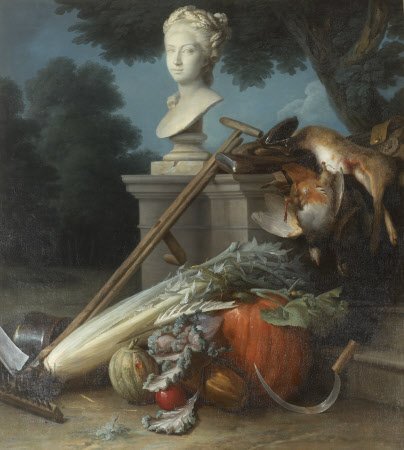
Garden Still Life, with Implements, Vegetables, Dead Game, and a Bust of Ceres (The Attributes of Hunting and Gardening by Anne Valleyer-Coster (1780)

A number of her paintings are in British galleries but her still-life work, Garden Still Life, with Implements, Vegetables, Dead Game, and a Bust of Ceres (The Attributes of Hunting and Gardening) can be found in Basildon Park, Berkshire, a country house run by the National Trust of Great Britain.

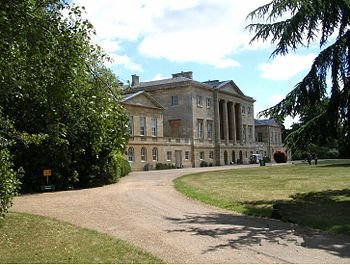
BasildonPark
BasildonPark

The Palladin-style house itself is worth a visit.  It was built between 1776 and 1783 for Sir Francis Sykes, a wealth English landowner, Member of Parliament and who was once the Governor of Kasimbazar, India.  Valleyer-Coster received this painting  commission along with its companion piece, A Still Life of a Vase of Flowers, Fruit, and a Bust of Flora, on a Table in an interior from Joseph-Marie Terray, abbé de Molesme,  who was the directeur-général des Bâtiments du Roy and contrôleur–général des finances.   The National Trust came by this work of art when it was allocated to them by the UK Government who, in 2010, had taken it in lieu of inheritance tax from the state of Lord and Lady Iliffe, the previous owners.  The setting is a park and in the work we see a rake and scythe propped up against a plinth.  In the foreground there is a variety of vegetables, a cardoon or wild artichoke, a gourd, a marrow, a melon, a cabbage, a tomato, along with a sickle.  On the plinth itself besides the bust of a young woman with an ear of corn in her hair, we see depicted  a gun, game-bag, two dead partridges and a hare.

When the fall of the ancien régime came during the French revolution all those close to Louis XVI and his wife Marie-Antoinette were in great danger and many of the artists, such as Vigée Le Brun, had to go into exile to save themselves.  Anne Valleyer-Coster was fortunate in as much as, regardless of her closeness to the queen, who along with her husband, Louis XVI, was hated by the common people, she managed to survive the bloodshed of the French Revolution.   However, along with the fall of the French monarchy, went her primary patrons and her lucrative commissions dried up completely.  She, as an artist, was forgotten during these turbulent times.

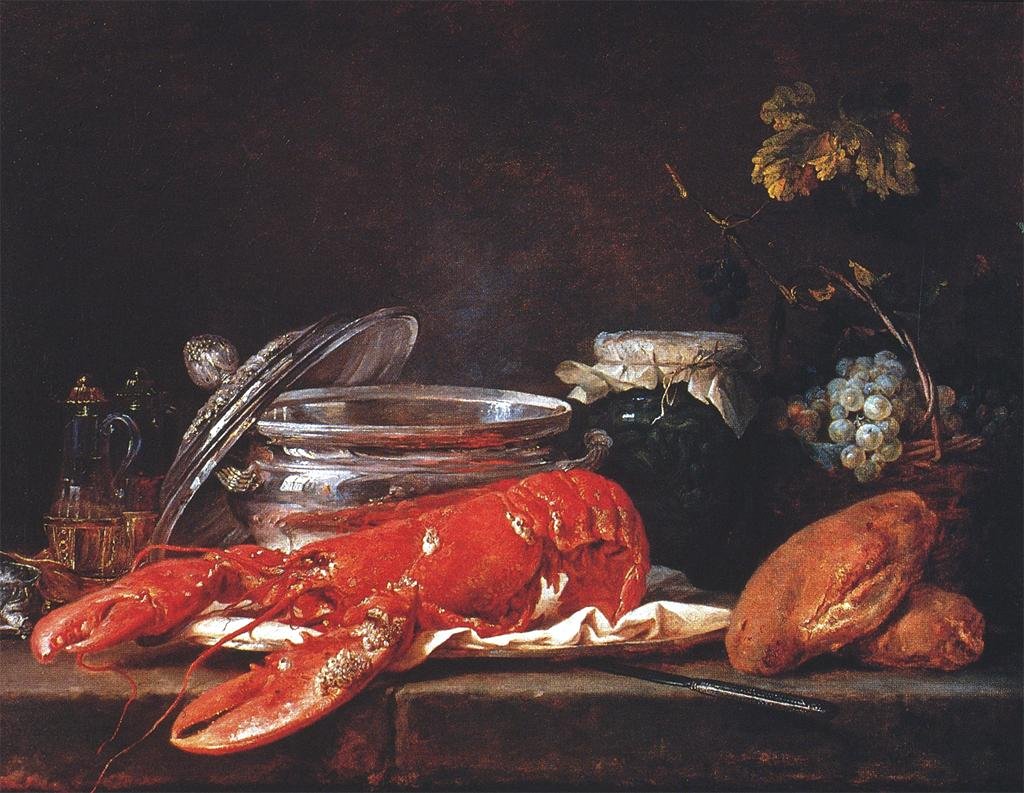
Still Life with Lobster by Anne Vallayer-Coster (1781)

It is interesting to note that a painting, Still Life with Lobster, which she completed in 1781.  Many believe it to be her best still-life work.  In 1817 she exhibited it in that year’s Paris Salon.  This painting came into the hands of Louis XVIII after he had been restored to the French throne in 1814.  Some art historians believe Vallayer-Coster gave it to the king as an expression of her joy as somebody who had remained loyal to the Bourbon cause throughout the turbulent years of the Revolution and the following Napoleonic imperialism. However, it should be noted that she had produced two works of art in 1804 for Napoleon’s Empress Josephine.  In the work, she has included many of the previous objects she had incorporated in earlier still life works. 

Anne Valleyer-Coster was one of the greatest still-life painters of the eighteenth century and art historians believe that her work was influenced by the great Jean-Baptiste-Siméon Chardin who died in 1779 and who is still considered to be one of the greatest French still-life and genre painters. She imitated his dark and shadowy tabletops on which were her arrangements of fruit, bread and dead game. In her later years she turned to a more unrestrained lavishness which was seen in Dutch floral painting.  She died in  Paris in 1818, aged 73 and will always be remembered for her still-life works with their distinctive colouristic brilliance and their almost photographic quality.  If you are lover of still-life and floral paintings, you will love her beautiful works of art.

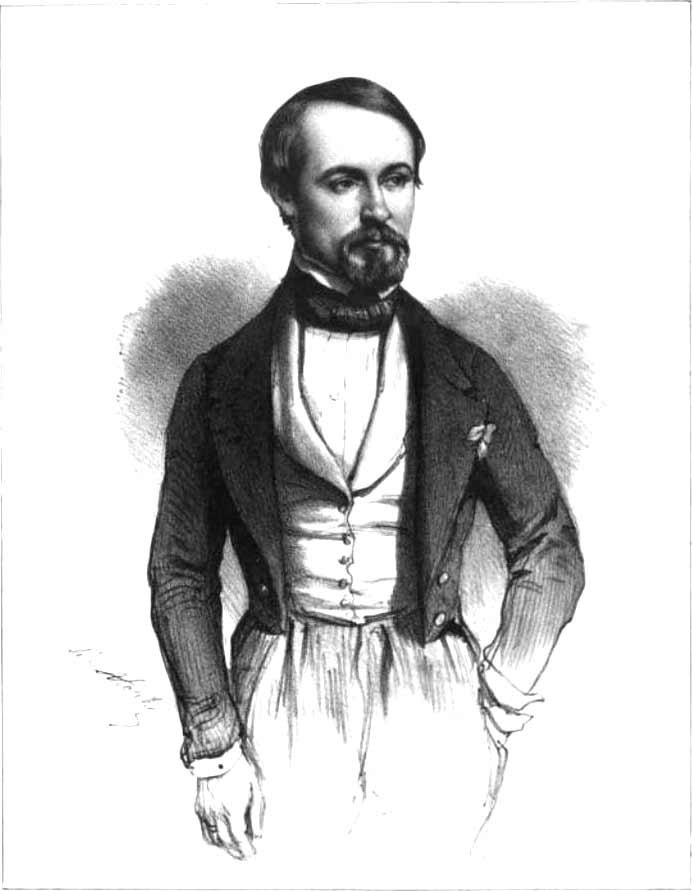
Camille-Joseph-Étienne Roqueplan

Camille-Joseph-Étienne Roqueplan

My featured artist today is the 19th century French Romantic painter and lithographer, Camille-Joseph-Étienne Roqueplan .   He was born in the small town of Mallemort which lies thirty-five kilometres south west of Avignon, but his family moved to Paris when he was still quite young.  He came from a well-to-do and cultured family and his younger brother Louis-Victor-Nestor Roqueplan went on to become a well-known writer, journalist, and co-director of the Paris Opera. Contrary to most young people who want to become artists despite opposition from their parents, Camille Roqueplan was wary about having art as his future profession despite his father’s encouragement that this should be his future path.  Camille liked to paint, but he believed art was just something to do for relaxation and should not be conceived as a future profession for he was adamant that his future lay in medicine.  His foray into studying medicine and anatomy was brief and having failed his first set of exams he went to work in the same office as his father, as a clerk in the Department of Finance.  This bureaucratic career was also short lived as he became bored and so after many career false starts he returned to painting

In February 1818, shortly after Camille’s eighteenth birthday he enrolled at the École des Beaux-Arts in Paris where he received his initial art tuition in the workshop of the French artist, Alexandre-Denis Abel de Pujol, but remained with him for just a short period before working in the studio of Antoine-Jean Gros, the French history and neo-classical painter, where he learnt to paint landscapes, marine paintings, historical subjects and genre scenes.  He used both the mediums of watercolours and oil and was taught the secrets of lithography, which at the time was a new method of printmaking.  He remained in Antoine-Jean Gros’ workshop for three years.

he Pardon Refused by Camille-Joseph-Étienjne Roqueplan (c.1829)

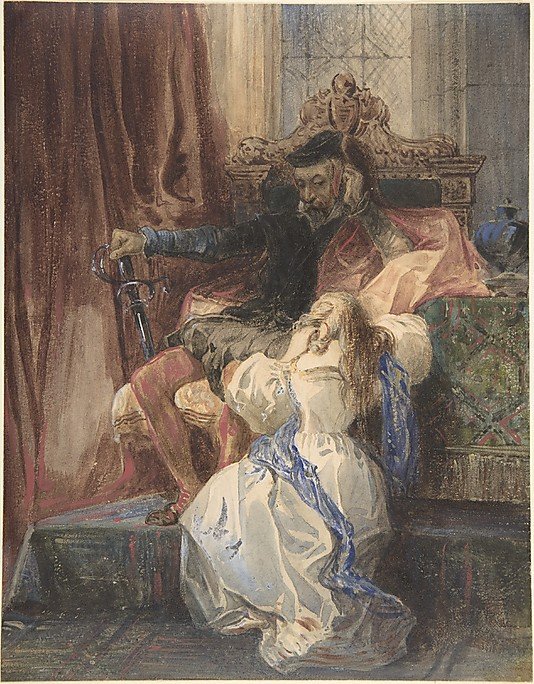
One of Roqueplan’s fellow students at L’ École des Beaux-Arts was the Nottingham-born, English painter Richard Parkes Bonnington, eighteen months younger than Roqueplan, who had moved to Paris when he was fourteen years of age and began studying at the  École des Beaux-Arts in 1820.  Bonnington favoured landscape painting and this no doubt influenced Roqueplan who began to produce small-scale paintings including some landscape works.  Roqueplan was also influenced by the works of the Scottish historical novelist, Sir Walter Scott and in 1824 he completed a work entitled Historical Landscape based on Scott’s novel, Quentin Durward.  Another small painting by Roqueplan, which he completed around 1829,  also featured characters from a Sir Walter Scott romantic tragedy novel, Kenilworth, in which we see the heroine Amy Robsart pleading for forgiveness from her father, Sir Hugh Robsart but he is untouched by her tearful pleadings.  This work, entitled The Pardon Refused, is housed in New York’s Metropolitan Museum of Art.

The Lion in Love by Roqueplan (1836)

Around 1835, Roqueplan changes his painting style from small landscape paintings to large-scale anecdotal works and one of his most famous of these can be seen at the Wallace Collection in London.  It was completed by Roqueplan in 1836, in time to be exhibited at that year’s Salon in Paris.  It is a large painting, measuring 219cms x 174cms and is entitled The Lion in Love.  The work is all about the power of love even if it is at the expense of wisdom.  I am sure many of us know how that feels!    The painting is based on a fable written by the Jean de la Fontaine, who was the most famous French writer of fables and one of the most widely read French poets of the 17th century.   There are 243 of these fables, originally written in French, by the poet in the late 1600’s which have since been translated in to many different languages.   The Lion in Love is a sad tale which tells of a noble lion, which has fallen in love with a shepherdess.  His love for the girl is so strong that he  unwisely consents to her father’s demand that his teeth and claws are clipped lest they should hurt his daughter .  The lion does not see through the father’s trickery and when his teeth and claws are paired down, his defence mechanism is rendered ineffectual, enabling the father to set his dogs on the defenceless lion.  The question of who shaves down the teeth and claws of the lion is not told in the poem but in Roqueplan’s painting he depicts the act being carried out by the shepherdess herself.  Maybe Roqueplan was drawing a parallel with the biblical tale of Delilah shaving off the hair of Samson, which rendered him defenceless.  Below is an English translation of the poem by Jean De La Fontaine which I found on the Aesop’s Fables website.

THE LION IN LOVE


Sévigné, whose attractiveness

Serves as a model to Beauties,

You were born so beautiful,

In case you are indifferent,

Would you be enclined

To an innocent Fable’s games,

And see, without fear,

A lion  tamed by Love?

Love is a strange master.

Happy is he who experiences it

Only through tales, minus its pains!

When it is told in front of you,

If  the truth offends you,

The Fable at least can be endured:

It is bold enough

To come offer itself at your feet,

By zeal or by gratitude.

In the times when animals spoke,

Lions among others wanted

To be accepted in our circles.

Why not? since their   kins

Were worth ours back in those times,

Having courage, intelligence,

And a beautiful head, moreover.

Here is how it happened:

A Lion from highly ranking parents,

While walking through a certain pasture,

Met a Sheperdess to his liking :

He asked for her in marriage.

The father would have preferred

A son-in-law a little less scary.

To give her to him seemed very harsh;

To refuse her was not so wise;

Even a rejection might have  made it possible

That some fine morning we’d have seen

A clandestine marriage.

Furthermore anyway

The beautiful girl was meant for noble people,

-Daughter becomes easily infatuated with

A long  maned lover.

So the father openly

Not daring to dismiss the lover,

Said to him: “My daughter is delicate;

Your claws could wound her

When you’ll wish to caress her.

Allow therefore that each paw of yours

Be declawed, and that your teeth,

Be filed down at the same time.

Your kisses will be less harsh,

And for you more delicious;

Because my daughter will respond to them better,

Being without these worries.

The Lion consented,

His heart was so blinded!

Without teeth or claws here he is,

Like a dismantled room.

A few dogs were turned aloose on him:

He did not resist much.

Love, Love when thou holdest us

One can well say: “Farewell prudence.”

In 1830, on the abdication of Charles X of France, a new king was crowned.  He was Louis Philippe and it was he who decided that some of the palace rooms at Versailles should be set aside for a Museum of the History of France.  These rooms were then filled with a large collection of paintings from the likes of Philippe de Champaigne, Charles Le Brun, Jacques-Louis David, Antoine Jean Gros, Rubens and the great female artist of the time, Elisabeth Vigée Le Brun, and one room was designated as the Galerie des Batailles (Hall of Battles) in which works depicting great French battles could be displayed.  Roqueplan contributed a work entitled  Battle of Elchingem ,which he completed in 1837, and featured a scene from the October 1805 battle between the victorious French forces under Marshal Ney and the Austrian army around the town of Elchingem in south west Bavaria

Peasants of the Béarn by Roqueplan (1846)

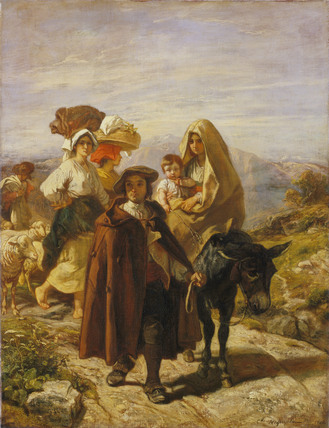
 Roqueplan’s health deteriorated in 1843 and as an aid to recovery he spent time in the foothills of the Pyrennees with its fresher and cleaner air.  He remained there for three years during which time he painted many scenes depicting mountainous landscapes and peasant life.  One such work can be found at the Wallace Collection in London with the title Peasants of the Béarn dated 1846.  Béarn is a French province in the Basse-Pyrenees and one of the geographical features of this province is the Ossau Valley.  It may be more than just a coincidence, but at the 1847 Salon, the year after the completion date given to  Peasants of the Béarn, Roqueplan exhibited a work with the title, Peasants of the Valley of Ossau.  Could these be one and the same painting?

Girl with Flowers by Roqueplan (1843)

Another painting of his which I like was painted around the same time, 1843.  It is an oval work, entitled Girl with Flowers and is now housed in the Hermitage Museum in St. Petersburg.  It is an everyday genre piece in which we see a young girl walking home with a bunch of wild flowers that she has collected, and which are held carefully in the folds of her raised skirt.  She is young and pretty.

Girl with Flowers (detail)

On her head is a wide-brimmed straw-coloured hat adorned with a pink flower and ribbons that seem to flutter down and fly off behind her giving us an impression of motion.  She holds on to the brim of her hat, pulling it downwards affording her more shade from the sun and maybe ensuring it does not fly from her head due to the breeze.  The hat frames her face.  She looks at us enticingly and we cannot help but fall under the spell of her young beauty.  What of course is more haunting is the sight of her left breast which has been uncovered due to lowering the neckline of her white linen blouse.

Rousseau and Mlle. Galley gathering Cherries by Rocqueplan (1851)
Rousseau and Mlle. Galley gathering Cherries by Roqueplan (1851)

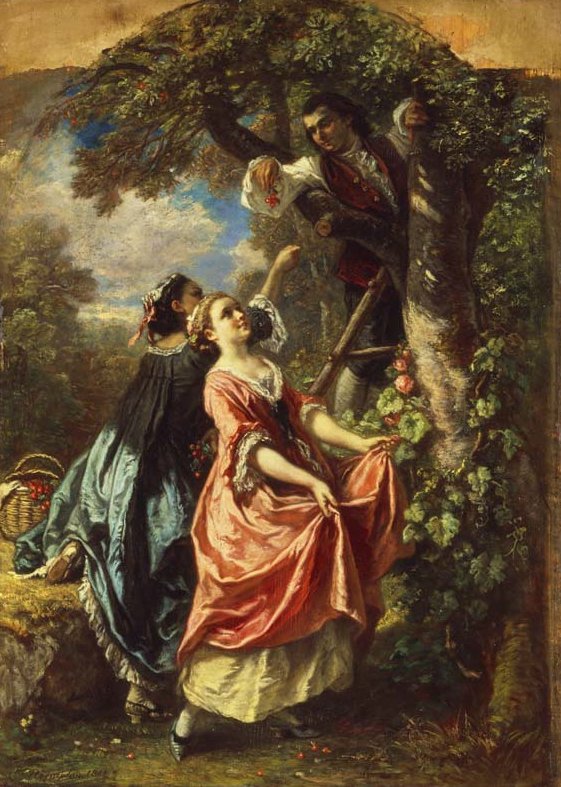
My final offering is a work he completed in 1851 entitled Rousseau and Mlle. Galley gathering Cherries and is based on one of the autobiographical tales from The Confessions of Jean-Jacques Rousseau , written by the French philosopher and writer Jean-Jacques Rousseau.  This great work came in twelve volumes and recounted the first thirty-five years of his life.  In Volume IV  he recounts a tale from 1731, when he was nineteen years old, when he met and befriended a lady and her companion who were travelling through the countryside.  He had assisted them with getting their horses across a stream and then they had stopped at a hostelry and were partaking of lunch when they decided to go outside and look for some cherries and it was then that Rousseau tells of his longing for the lady:

“…After dinner, we were economical; instead of drinking the coffee we had reserved at breakfast, we kept it for an afternoon collation, with cream, and some cakes they had brought with them. To keep our appetites in play, we went into the orchard, meaning to finish our dessert with cherries. I got into a tree, throwing them down bunches, from which they returned the stones through the branches. One time, Mademoiselle Galley, holding out her apron, and drawing back her head, stood so fair, and I took such good aim, that I dropped a bunch into her bosom. On her laughing, I said to myself, “Why are not my lips cherries? how gladly would I throw them there likewise!…”

 In the painting we see Rousseau, having climbed a little way up the cherry tree, is dangling the fruit above Madamoiselle Galley.  She stands holding her apron open to catch the fruit but Rousseau has other ideas as to where the cherries should land!  The smile on her slightly flushed face is an indication that she too would like the cherries to be his lips.

Camille-Joseph-Étienne Roqueplan died in Paris in September 1855, aged 55.

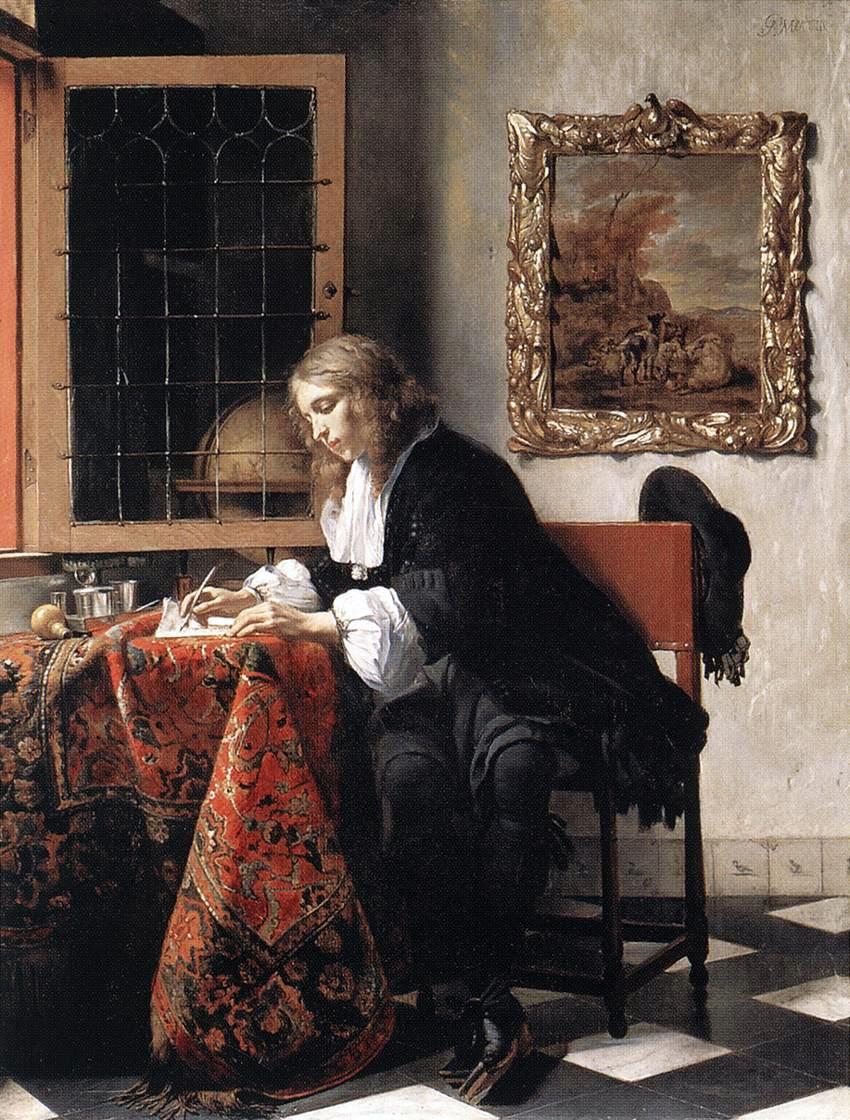
 In this and my previous blogs about Gabriel Metsu I have featured paintings which are housed at the Wallace Collection in London.   If you are ever in London and want to visit an art gallery but are spoiled for choice, you must go to this one.  It is right in the centre of town, a five minute walk from the major department stores on Oxford Street.  I can assure you that you will not be disappointed with the collection.

Alexandre-François Desportes. The Animal and Still Life painter.

Alexandre-François Desportes

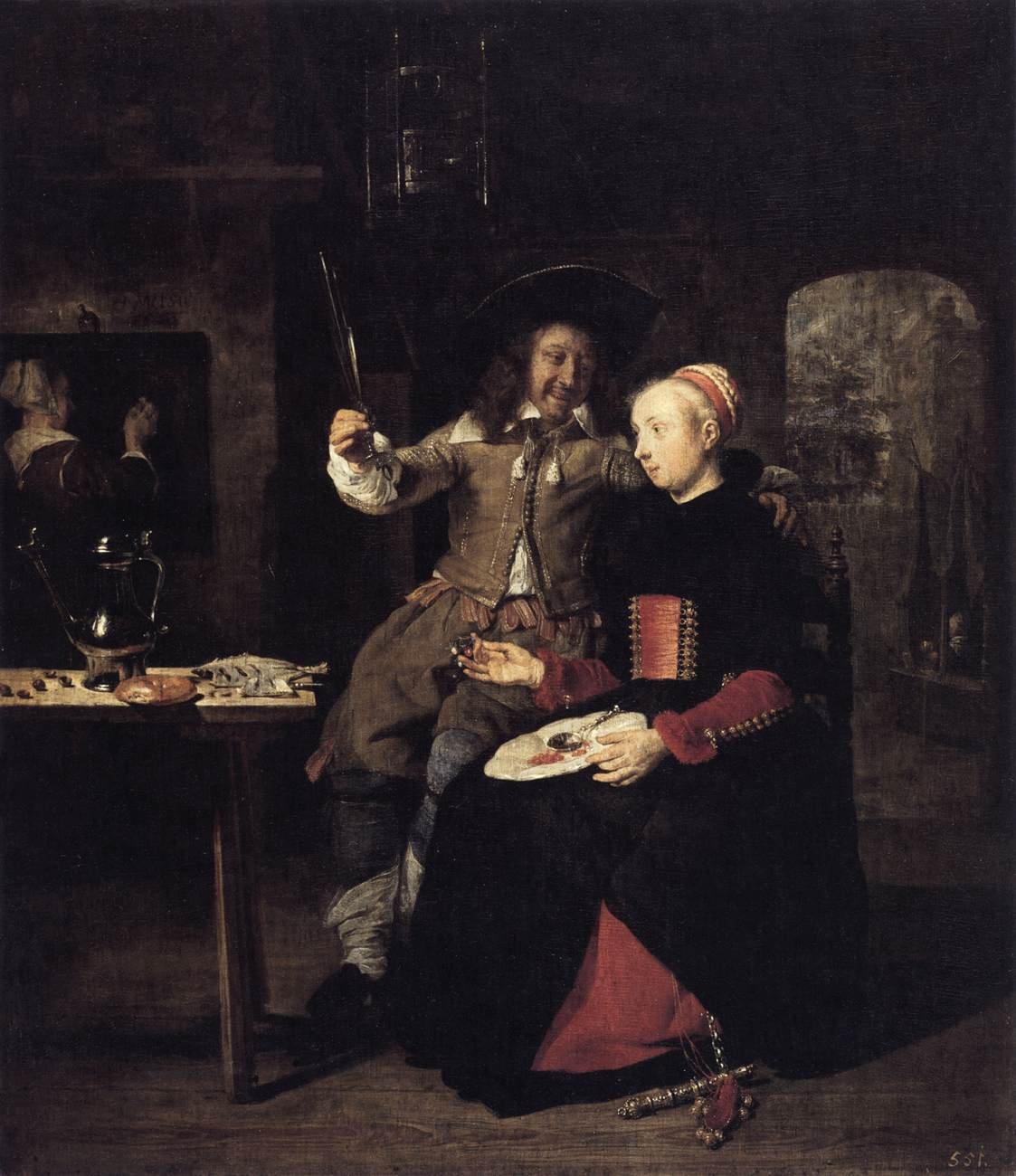
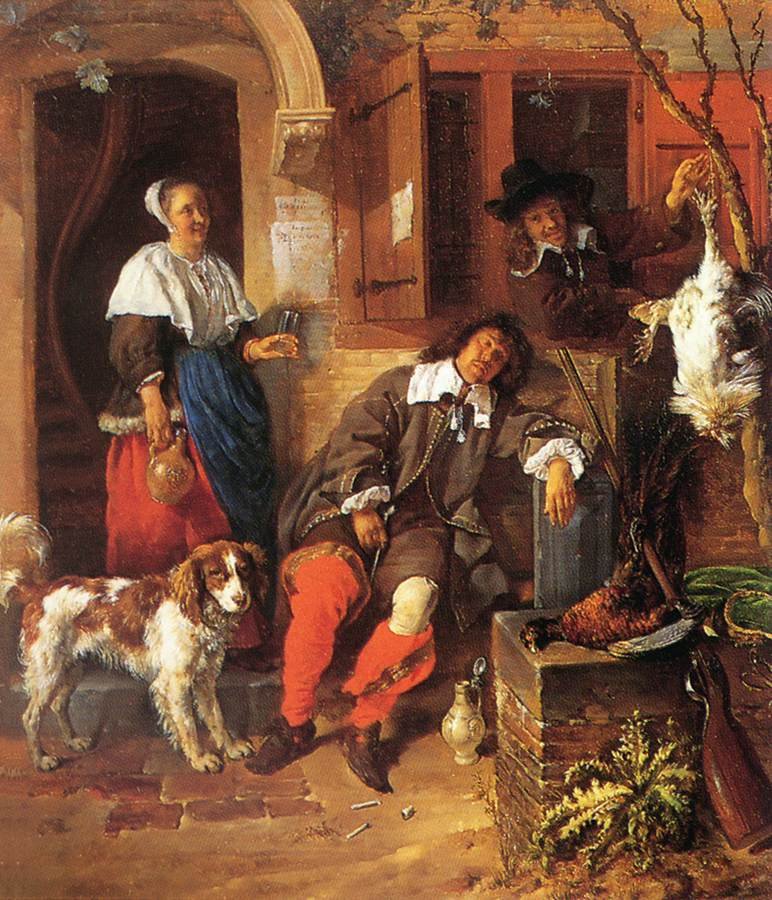
When I looked at works by Gabriel Metsu in a recent blog I featured a couple of scenes which depicted hunters.  Scenes with hunters were very popular at the time especially with the upper classes and nobility as hunting was a pastime of the rich and so any painting which depicted the hunter alluded to wealth.  Hunting in the eyes of the nobility was one of the last symbols of class distinction.   It was not just the portrayal of the hunter and the hunt which was popular with the wealthy classes but also the portrayal of the hunted – the prey and the hunting dogs.    Today I am featuring the works of the French painter and decorative designer who specialised in animal paintings. Alexandre-François Desportes.

Dog and Wild Duck by Alexandre-François Desportes   (c. 1720)
Dog and Wild Duck by Alexandre-François Desportes (c. 1720)

Alexandre-François Desportes was born in Champigneulle, a small town fifty kilometres south of Reims, on February 24, 1661.   His father was a farm labourer.  When François was twelve years of age his father sent him to Paris to live with his uncle.  Shortly after his arrival at his uncle’s home he took ill and was confined to bed.  To while away his time his uncle gave him an engraving and told his nephew to try and copy it.  François’ effort was so good that his uncle arranged for him to study art under the Flemish painter Nicasius Bernaerts.  Bernaerts was an accomplished artist who had studied with Frans Snyders, the Flemish painter, famous for his depiction of animals and hunting scenes.  Bernaerts carried on the painting tradition of Snyders and had worked at Gobelins, the Parisian tapestry manufacturers, where his cartoons of animals were often used as designs in their tapestries.  He was to greatly influence the future work of François Desportes.  Whilst studying under Bernaerts, Desportes was put to work copying Flemish paintings, particularly those depicting animals and hunting scenes.  He was also encouraged to sketch flowers direct from nature and paint floral still-lifes.  Desportes never found this period of his life very fulfilling as Bernaerts, who although only in his mid-fifties, was often ill and his health was further impaired by his alcoholism and very rarely offered practical advice or assistance to his students.   Bernaerts died in 1678, aged 58.  After the death of Bernaerts, Desportes continued his artistic training at the Académie Royale where he was able to learn about traditional classical drawing but was also able to continue with his favoured painting method – en plein air.  Desportes had to fund his schooling, as well as buy food and pay for his lodgings, and to do this he earned money by designing stage scenery, gained portrait commissions and commissions to paint decorations in Paris hotels

During the 1680’s he assisted the French painter Claude Auran III in supplying paintings for Louis Joseph de Bourbon, Duc de Vendôme’s Chateau d’Anet.  Artists survive on commissions and without commissions they struggle to make ends meet.  France at the end of the seventeenth century struggled financially as it had been a century of costly wars.  France and Spain clashed during the Franco – Spanish war (1635 – 1639) and again between 1683 and 1684 during the War of Reunions.  The French and the Dutch clashed between 1672 and 1678 and France went into battle with most of its neighbours in the War of the Grand Alliance (1688-1697).  Wars cost money – lots of money and in consequence, the French government had no money left for grand artistic endeavours, which meant that lesser known painters, who had yet to establish their reputation, struggled to make a living.  Desportes did struggle but despite his financial hardship, Alexandre-François Desportes married Eléonore-Angélique Baudet.  His wife was a linen and lace maker and through her occupation she was able to support her husband and allow him to search out commissions and carry on with his studies.

Self-Portrait as a Huntsman by Alexandre-François Desportes (1699)

Desportes luck changed when in 1695 he received an invitation from the French ambassador to Poland to come to the court of the Polish king John III Sobieski who was also the Grand Duke of Lithuania.  Desportes was commissioned to paint portraits of the king, his wife Maria Kasimiera and some of the palace courtiers.  His stay at the royal court lasted less than a year as the Polish king died in June 1696.  Desportes was summoned to return to France by Louis XIV.  Desportes had spent a number of years painting portraits of wealthy people and he intended to carry on doing this when he returned to his homeland.  However he soon found that the art establishment was awash with highly skilful portraitists and realised that it would be difficult to obtain portraiture commissions and so he decided to revert back to the training he received from Nicasius Bernaerts – the depiction of animals and still life painting and as a twist to this he would incorporate the two in his artistry.  In August 1699 Desportes was received into the Académie Royale as an animal painter and his reception piece was Self Portrait as a Hunter.  The painting, in which we see the thirty-eight year old artist seated in a landscape with his two hunting dogs and a large array of dead game, was a move away from the normal self-portrait as he has used the setting and what has been included in the work was a tribute to his own skill as a specialist animal painter as well as being a talented landscape artist.  He was advertising his abilities!

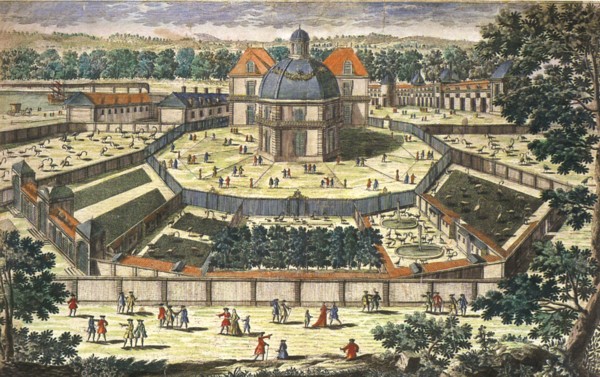
Backyard of the royal menagerie of Versailles during the reign of Louis XIV by Pierre Alexandre Aveline
Backyard of the Royal Menagerie of Versailles during the reign of Louis XIV by Pierre Alexandre Aveline

Louis XIV had started to have his palace at Versailles built in 1664 and he decided to incorporate a menagerie within the palace’s park.  The design of his menagerie was in line with other Baroque menageries of the time with its circular layout, in the centre of which was a magnificent pavilion. People were able to walk along the paths which surrounded this central building, and alongside them were the cages which housed the wild animals.  The king had been very impressed with the animal paintings of Desportes and commissioned him to complete five works of art which depicted animals and hunting scenes for the menagerie pavilion.  Desportes, like a present day method actor who immerses himself into his character, often went on hunting trips with Louis XIV so that he could realise the thrill of the hunt.  During the hunt he would carry with him a small notebook in which he would make on-site sketches of the hunt “trophies” – the dead animals, which could then be used later for still-life depictions of the game that resulted from the day’s hunt,  Louis XIV would then choose the best sketches and Desportes would go off and complete an oil on canvas painting of the king’s chosen subject.   Four such paintings, Deer Kill, Boar Hunt, Wolf Hunt and Hounds Guarding a Dead Deer,  still survive and are housed in the private Paris museum, Musée de la Chasse et de la Nature (Museum of Hunting and Nature).

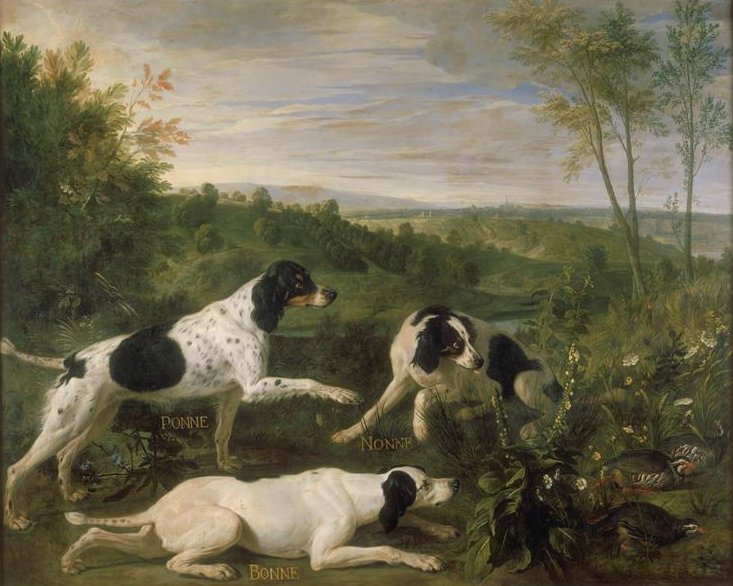
Bonne, Nonne and Ponne by Desportes

Louis XIV was so pleased with these paintings that in 1702, he commissioned Desportes to paint six works, portraying the portraits of the hunting dogs which were his personal favourites.  In one such work entitled Bonne, Nonne and Ponne we see the king’s three favourite hunting dogs chasing and flushing out pheasants and partridges from the long grass.  The king was so pleased with the work Desportes produced for him that he awarded him a pension and two years later he made Desportes a councillor of the Académie Royale.

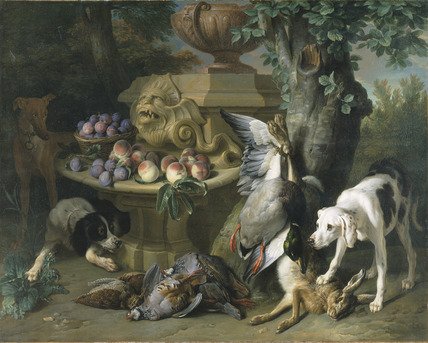
Dogs, Dead Game and Fruit by Alexandre-François Desportes (1715)

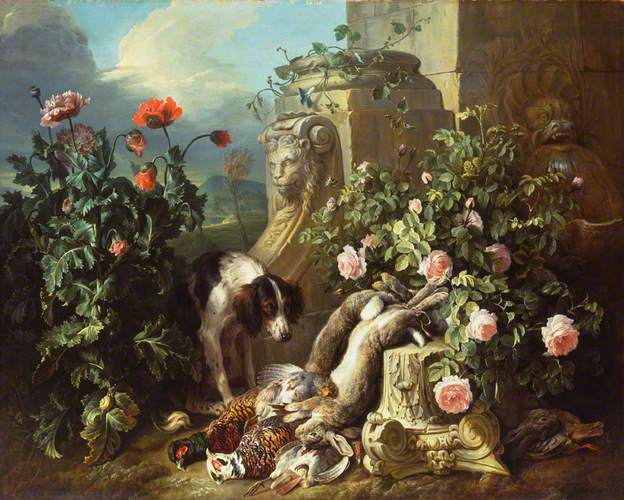
Desportes reputation as an artist spread outside of France and soon he was in high demand.  In 1712 he visited London and stayed for six months working on commissions.  When Louis XIV died in 1715, Desportes carried on working for the Regent of France, Philippe, Duc d’Orleans, who was ruling for the infant Louis XV, the grandson of Louis XIV and over time provided many paintings for the royal residences at Versailles, Marly, Meudon, Compiègne and Choisy.  It was not just hunting scenes that Desportes had mastered for he also spent time painting still-life works featuring the dead “trophies” brought back from the hunt cleverly arranged alongside floral displays or displays of vegetables lying on a table or even in landscape settings.  Two such paintings, Dog, Dead Game and Fruit and Dog with Flowers and Dead Game completed in 1715, can be seen in the Wallace Collection in London.

Dog with Flowers and Dead Game by Alexandre-François Desportes (1715)

These pendant pictures were commented on by the Revue Universelle des Arts in 1857 as being:

“…incontestably the finest which came from the brush of Desportes…”

The two works were bought by Captain Richard Seymour-Conway,  the 4th Marquess of Hertford in 1857 for his country house, Château de Bagatelle,  in France and at the time he commented on his acquisitions saying:

“… a little rubbish for the country…. beautiful of the sort and perfect for my shooting place…”

There is an interesting connection between the buyer of these paintings and where they are housed today for the purchaser of the paintings, Lord Hertford, also owned a house in London known as Manchester House, situated in Manchester Square.    He was an avid art collector and built up a sizeable collection of European art.  On his death in 1870, his illegitimate son, who had acted as his secretary, Sir Richard Wallace, inherited his father’s unentailed estates, and large collection of art in 1871. Wallace added to the collection himself, and in 1897, after his death, the works of art were donated to the nation by his widow. They are now housed in what was his London home, Hertford House, Manchester Square, London, and are part of the Wallace Collection.

Still Life with Silver  by Alexandre-François Desportes (c.1720)
Still Life with Silver
by Alexandre-François Desportes (c.1720)

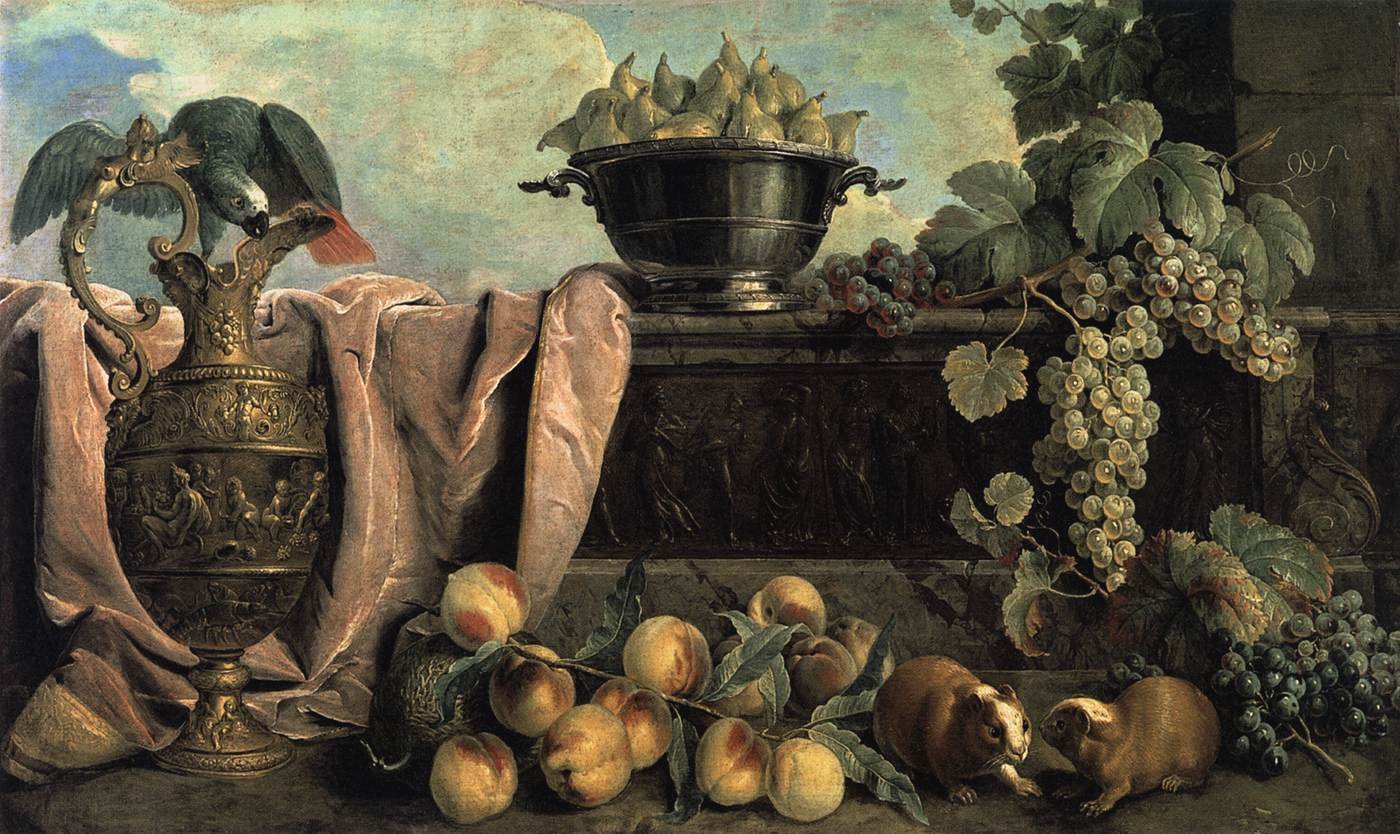
Several of his still-life paintings which combined game with fruit or flower displays also featured some beautiful pieces of silverware which came from Louis XIV’s collection.  One such painting is entitled Still Life with Silver and was completed around 1720.  Before us is a buffet laid out with an array of objects in silver, porcelain, and semi-precious stone as an array of fruit.  The gold and silver vessels are displayed on a tiered console table which is weighed down with fruit and flowers. The composition is monumental in scale, measuring  262cms x 187cms (almost 8ft x 6ft).  This is what one might have seen as a centrepiece on the table if we had attended a royal banquet.  At the centre we can see the dragon-handled tureen and vermeil salvers both of which are in the Régence style of 1715-23.

Still-Life with Ewer by Alexandre-François Desportes (1734)

Alexandre-François Desportes died in April 1743, aged 82.  He left a legacy of paintings and sketches as well as his cartoons which were used as designs for tapestries made up at the famous Parisian tapestry company, Gobelins.  Many of his designs were also used at the Savonnerie company, the Parisian carpet factory at Chaillot, which manufactured the most prestigious European manufacturer of knotted-pile carpets.

Csontváry – The troubled artistic genius from Hungary

Self portrait by Csontváry (c.1900)

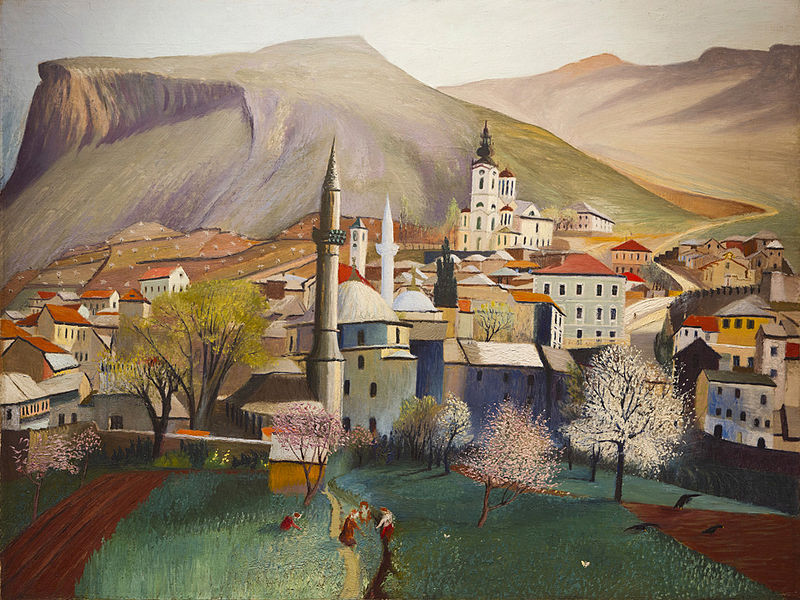
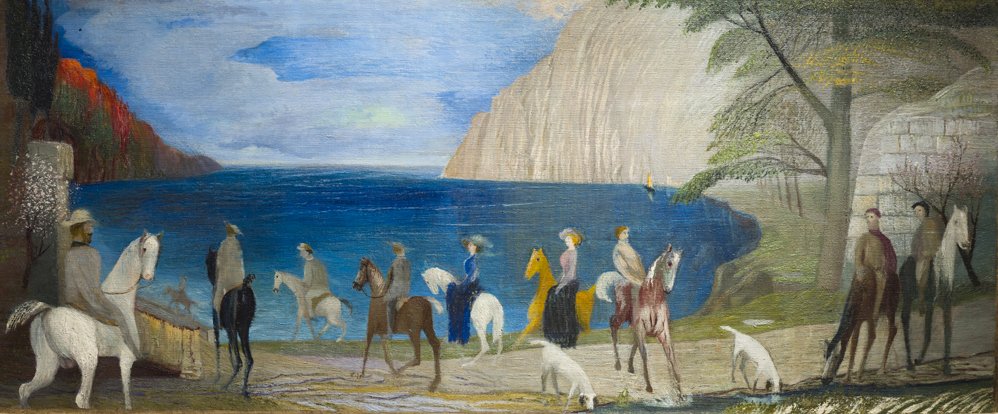
The thing that brings me the greatest pleasure about writing this blog is that I am constantly unearthing artists whom I had not heard of before.  My blog today is another example of such a discovery and I have one of my readers, Mary Ann Barton, to thank for this, as it was she who asked me to write a piece about the artist who had created two of her favourite works.  So today, come with me on this voyage of discovery and find out something about a Hungarian artist and at the same time, savour some of his beautiful works of art.  Let me introduce you to Mihály Tivadar Kosztka, although, in 1900, he used the pseudonym of Csontváry and that is the name he is always referred to when people talk of his art.

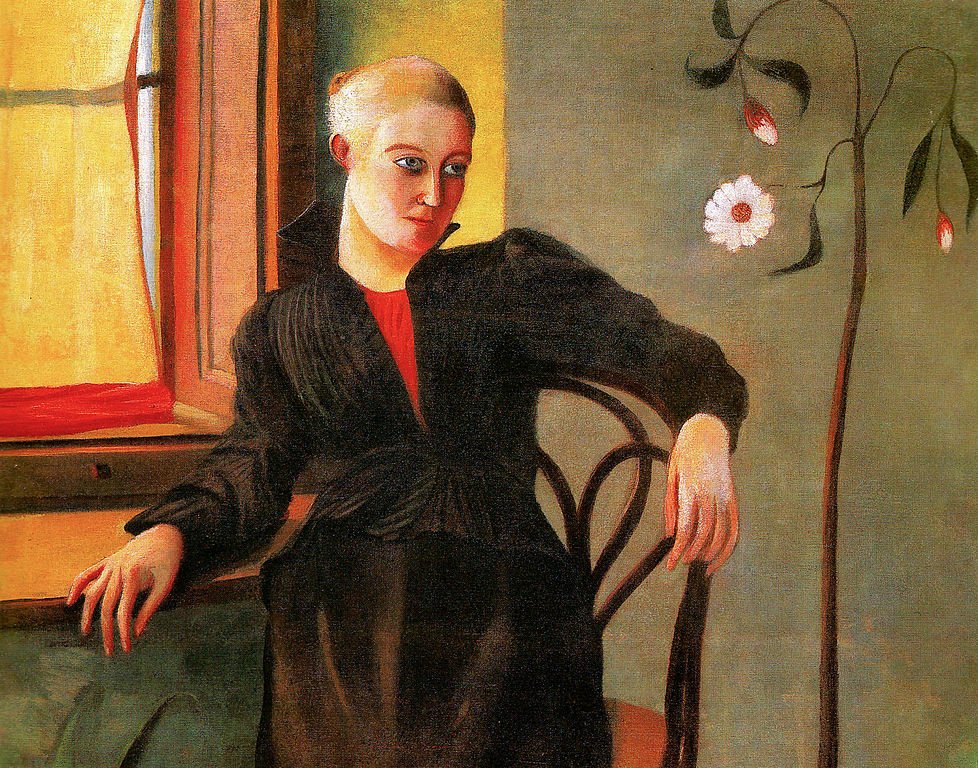
Woman Sitting by the Window by Csontváry (c.1890) Hungarian National Gallery, Budapest
Woman Sitting by the Window by Csontváry (c.1890)
Hungarian National Gallery, Budapest

Csontváry (pronounced sont varee) was born in Kisszeben in July 1853.  Kisszeben was originally situated in northern Hungary and is the Hungarian name of a small town which is now situated in the north east of Slovakia and is the present day Sabinov.  Csontváry’s forefathers were originally from Poland but later moved to Hungary in the seventeenth century.  His father was a pharmacist, who later gained a diploma in medicine. Csontváry’s early education took place in his home town of Kisszeben and his secondary education is recorded to have taken place in the town of Ungvár (now the western Ukraine town of Uzhorod).  At the age of twenty, having completed his education, he followed in his father’s footsteps and worked in a pharmacy in Presov.  He eventually became a pharmacist in his own right in 1874, at the age of twenty-one, after attending the University of Budapest. He completed his military service and later studied at the university’s Faculty of Law whilst working in the local government magistrates office.  In 1879 he, along with many of his fellow university students, played a part in the relief operation of the town of Szeged which was almost completely destroyed in a major flood.  .

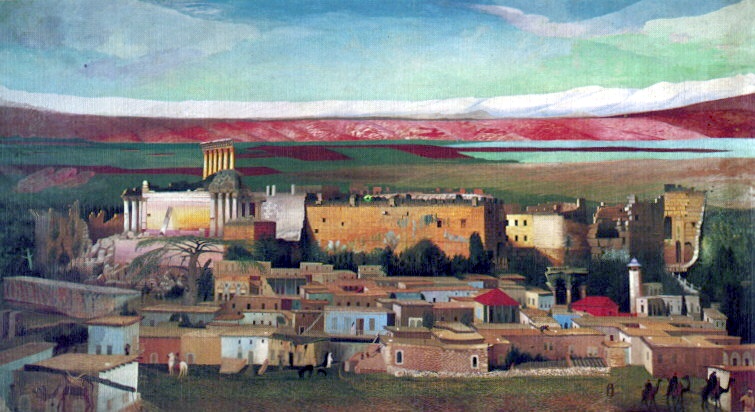
Baalbek by Csontváry (1905)
One of his largest works measuring 714 × 385 cm (281.1 × 151.6 in).
Csontváry Múzeum, Pécs

This is not a story about a person who, as a young man, always loved to draw and paint and wanted to free himself of the shackles of his father’s profession.  He loved working as a pharmacist and had no desire to become an artist.  If  we are to believe what he later wrote in his autobiography, the beginning of his artistic journey came to him, in the autumn of 1880, through what he termed, a mystical vision in which he was told that he would become a great painter, even as great as Raphael.  He believed that it was God’s wish that he should become a great painter.  It could well be that this was the first of many schizophrenic happenings which would dog him all his life.   He decided there and then that he wanted to be the world’s greatest exponent of plein air painting and his hope was that one day his reputation would surpass that of Raphael Sanzio, his artistic hero.  With the money he had accrued, he set off for Rome in the spring of 1881 to study the works of the Masters of the Italian Renaissance, especially Raphael.  However, on his return, he did not immediately change his lifestyle and turn to art, in fact, he returned home and continued to work as a pharmacist for another ten years and, whilst a pharmacist, he wrote many articles regarding pharmaceutical work and its regulations.   It could be that he realised that to become a full-time artist was a financial gamble and so decided to build up his savings before abandoning his life as a pharmacist and in fact his break from that work did not come until 1894, when he considered himself financially independent.  He was now forty-one years of age and ready to devote himself to art.

The Old Fisherman by Csontváry (1902)

Hungary at the time had no Academies of Art and so Csontváry travelled to Munich where he enrolled on a six month course at a private art school run by the Hungarian painter, Simon Hollósy.  Hollósy, who was actually four years younger than Csontváry, had studied art at the Munich Academy but had become disillusioned with the its training, which like many of the formal European Academies of Art, concentrated on historical paintings and the copying of such classical works.  Hollósy believed in more realistic art and the more realistic depiction of people and was influenced by the likes of Gustave Courbet, who had his work exhibited in the German city.   Hollósy was also influenced by the new style of art produced by the French Impressionists.

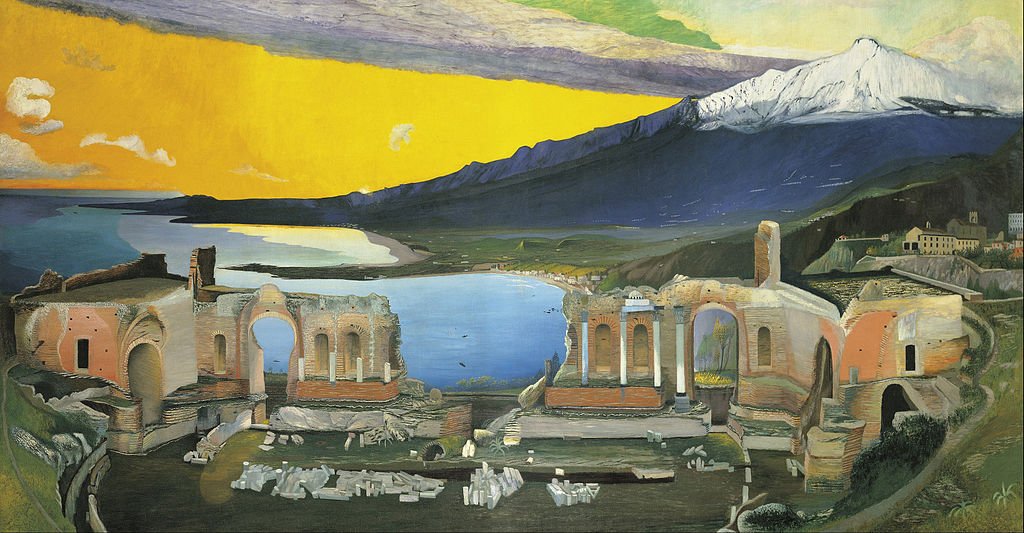
Ruins of the Greek Theatre in Taormina by Csontváry (1905)

Following stays in the German cities of Dusseldorf and Karlsruhe where he studied under the German painter, Friedrich Kallmorgen, he went to Paris where he studied at the Académie Julien.  All the time during his travels he was learning about art but he never remained still and most of his art was self-taught.  From Paris, he travelled to Switzerland, along the Dalmatian coast and Italy where he visited Rome and Naples and the nearby ancient site of Pompei, where he stayed during the winter of 1895, constantly sketching the various landscapes.  He moved south and visited eastern Sicily and the town of Taormina and the nearby ruins of the ancient Greek colony of Naxos.  He was always looking for that special place or special site which he could depict in one of his paintings.  He finally returned to his homeland and the Tatras mountain region in the summer of 1902.  It was here that he discovered the natural beauty and the way it looked in the natural sunlight.  The following year, 1903, he decided to go off on his travels once again and applied for a travel grant from the Cultural Ministry but his request was turned down.  Not deterred, and with money he had borrowed, he set off for the Near East visiting the Egyptian city of Cairo and the Palestinian cities of Jerusalem and Bethlehem.  From Palestine he journeyed north to Damascus and then crossed over the mountains to Lebanon and the town of Baalbek in the Beqaa Valley which was once the site of the Roman “city of the sun”, Héliopolis.  In 1905 he travelled to Greece and stayed in Athens.

Springtime in Mostar by Csontváry (1903)

His constant travelling and his constant search for the perfect location to depict in one of his paintings took a toll on his health.  It was not just the deterioration to his physical health brought about by his tiring travelling itinerary but more and more he was suffering from mental problems partly brought about by the solitude on his travels but also his never ending and all-consuming search for the perfect subject and the perfect light.  His mental wellbeing was also sorely tested with the mixed reception he received when his work was first exhibited in Budapest in 1905 and again, four years later, in 1908.  His paintings received a better reception when shown in Paris in 1907 and following that he went off to the Lebanon where he painted his famous “Cedar paintings”.  What disappointed him the most was that he felt that his work was unappreciated by the people of Hungary and that he himself was unloved, so much so that he ended his painting career in 1909, totally disillusioned with it, just fifteen years after it had begun. His last painting was Riding on the Seashore.   Instead, he worked on his autobiography and published a number of pamphlets, often controversial, about life in general, religion and pacifism.  One in 1912, entitled Energy and Art, laid out his strong beliefs opposing modernity and another, Men of genius, published a year later asserted his genius.  Sadly, during his lifetime in his native Hungary, he was thought of as an oddball mainly because of his outspoken views.  He was a vegetarian, shunned all forms of alcohol and condemned the habit of smoking.  He was also a forthright pacifist.  All these traits were condemned by his biographers who would often dismiss him as being a schizophrenic and totally rejected his visionary ideas as being manic.  His so-called prophetic writings were probably derived from his ever more serious mental issues which ended his creative ability to paint.  He did carry on sketching but the subjects became more bizarre as his schizophrenia became more serious and more debilitating.

The Solitary Cedar by Csontváry (1907)

Csontváry died in Budapest in June 1919, six weeks before his 66th birthday.  He died alone and virtually penniless.  Like many artists before him, his work was not appreciated fully until after his death.  It was not until 1930 that his work was re-assessed at a posthumous exhibition held at the Ernst Museum in Budapest and it was nearly twenty years later, in 1949, when his work was exhibited in Paris that his ability as an artist was fully appreciated.  However it was not until two exhibitions held in his homeland, a retrospective held in the Hungarian town of Székesfehérvár in 1963 and at the Hungarian National Gallery in 1964, that his contribution to Hungarian art was fully appreciated by the Hungarian people.    An further exhibition of his work was shown at the World Fair in Brussels in 1958 and again a major exhibition in Belgrade in 1963 and both were held to be very successful.  Most of Csontvary’s artistic works are to be found in the Hungarian National Gallery in Budapest and the Csontváry Museum in the southern Hungarian town of Pécs while others are in private collections.

Riding on the seashore by Csontváry (1909)

Csontváry is looked upon as being a loner, a genius because of his eccentricity which became more pronounced in his later life due to the severity of his mental issues.  He was unappreciated in his own lifetime and it was not until long after his death that he was considered to be one of Hungary’s greatest painters.

Gabriel Metsu. Part 2 – his later life and paintings

Portrait of the Artist with His Wife Isabella de Wolff in a Tavern by Gabriel Metsu (1661)

In my last blog I looked at the early life of Gabriel Metsu and had reached the year 1651, the year in which his mother died.  Gabriel Metsu was twenty-one years of age and, as such, was still not looked upon as an adult.  In the Netherlands at that time, adult status was only reached when a person became twenty-five years of age, and for that reason Gabriel came under the guardianship of Cornelis Jansz. and Jacob Jansz. de Haes.  Around this time it is thought that he was advised by a fellow aspiring artist, Jan Steen, to seek employment as an apprentice with Nicolaus Knupfer, a painter from Utrecht.  Metsu remained with Knupfer for a few years during which time he completed a number of religious paintings.

In 1654, his guardianship came to an end and his late mother’s estate was finally settled and Gabriel received an inheritance.  With this newly found wealth, Metsu left Leiden and moved to Amsterdam where he had enough money to set up a workshop in a small house off the Prinsengracht.  He remained there for a short time before moving to a canal-side residence.  It is believed the reason he moved was that he had got into so many arguments with his neighbours for keeping chickens at the rear of his house.

His desire to move to Amsterdam was probably due to his search for artistic commissions as the city had far more opportunities for an artist than that of the smaller town of Leiden.  The other thing that Metsu realised when he arrived in Amsterdam was that small-scale genre scenes were far more popular with art buyers than large scale religious works and so he made a conscious decision to change his painting style and for his inspiration into that art genre, he could study the works of the Leiden painter, Gerard Dou and the Deventer artist Ter Borch.  Metsu’s favourite subjects became young women, often maids, drinking with clients and engaged in domestic work often in tavern settings.

Saint Cecilia by Gabriel Metsu (1663)

In May 1658 Gabriel Metsu married Isabella de Wolff who came from Enkhuizen.  Her father was a potter and her mother, Maria de Grebber, was a painter and came from a family of well-known artists.  Metsu had probably met Isabella through his connection with the de Grebber family when he was a teenager.  Anthonie de Grebber, who had given Metsu some early artistic training in those days, was a witness to Metsu and Isabella’s pre-wedding settlement.  They married voor schepenen which means “before magistrates” which presumably meant that the couple did not belong to the Dutch Reformed Church and it is thought more likely that they were both Catholics.  Isabella became one of Metsu’s favourite models and appeared in many of his works.  In 1663 he completed a work featuring his wife, Isabella, as the model for Saint Cecilia.  She is seated playing the viola da gamba.  St Cecilia was a Catholic martyr who was revered for her faithfulness to her husband (note the lap dog) and it could be that Metsu by having his wife model for the martyr was his way of publicly recognising his wife’s fidelity.  This would not have been the first time an artist had used his wife in a depiction of this Catholic saint as in 1633 Rubens completed a painting of St Cecilia in which he used his second wife, Hélène Fourmen,t as the model.  It is entirely possible that Metsu had seen the Rubens’ painting and then decided to use Isabella for his depiction of the martyr.

Gabriel Metsu died in October 1667, just a few months before his thirty-eighth birthday and was buried in the Nieuwe Kerk in Amsterdam.  Following the death of her husband Isabella moved back to Enkhuizen to live with her mother, where she died in her late eighties.

A Woman Artist, (Le Corset Rouge) by Gabriel Metsu (1661-4)

Another painting by Metsu, featuring his wife as an artist, was entitled A Woman Artist, (Le Corset Rouge) and is dated 1661-4.  So is this just simply a painting of an artist for which his wife modeled?   Maybe not, for one must remember that Isabella was actually an artist in her own right, having been trained as an artist by her mother, Maria de Grebber, who had come from a family of artists and so this painting by Metsu may just be a loving portrait of his wife, highlighting her talent as a painter.

Do you ever re-read a book or watch the same film more than once?   Many people who do tell of how they saw things in the film or read things in the book the second or third time which they had not picked up the first time and that for them was the joy for re-visiting the work.  Genre works have the same effect on me.  The more times I study them, the more new things I discover which were not apparent during my initial viewing.  I also like the fact that often one cannot take things depicted at face value as there is often a hint of symbolism with the iconography of some of the objects that are dotted around the work and this I find utterly fascinating.  I read art historians’ views on such things and often wonder whether what the artist has added to the work is as symbolic as the historians would have us believe.

In my previous blog about Metsu I talked about certain iconography in the painting entitled Woman Reading a Letter, and was rather scornful with regards the supposed sexual connotation of the abandoned shoe which was prominently depicted lying on the floor.  In my next two featured paintings there is more iconography that has a supposed sexual nuance.  In the next two featured works we see a dead bird being offered to a woman.  Just a mere offering of food?  Maybe not for the Dutch word for bird is vogel and in the seventeenth century the word was synonymous with “phallus” and the Dutch word vogelen, which literally means “to bird”, was slang for “to have sexual intercourse with”.  So when we look at the two paintings we should look at the offer of a bird not as a gift of food but an enticement to have sexual intercourse!

The Sleeping Sportsman by Gabriel Metsu (1660)

In the Wallace Collection in London there is a magnificent painting by Metsu entitled The Sleeping Sportsman which he completed between 1658 and 1661.  It is a kind of “hunter’s scene” and it was in this painting that we need to think laterally in as much as the hunt is the gentleman’s hunt of a woman.  In this painting by Metsu the setting is the outside of a tavern. A hunter has called in for a drink after a long day’s shooting.  His gun is propped against a low wall and the two birds he has shot are on view, a pheasant atop the wall and another bird, probably a fowl, is seen hanging from the tree.   Metsu has depicted a lady coming out of the inn with a glass and a jug of alcohol which has presumably been ordered by the hunter-sportsman.   It would appear that the jug she brings him is not his first, as he has passed out from overindulging, and we observe an empty jug lying at his feet.  After a day of hunting game he has decided to end it with a few drinks and search for the company of a female or as the French would say cherchez la femme, but, sadly for him, alcohol has won the day.  Take a careful look at the stupefied hunter.   It is supposedly a self-portrait of the artist.  He lies slumped against the end of a bench, clay pipe in his lap lying loosely against his genitals which could be interpreted as the drunken state he is in has made him temporarily impotent.  On the floor we see the remnants of another pipe which he must have dropped.  Although finely dressed he looks a mess with one of his red gaiters sagging down his leg.

However, if we look again at the woman who is bringing the hunter’s refreshment, we notice that she is not looking at her “customer”, but her eyes are fixed on the man to the right of the painting who is hanging out of the window of the inn.  He looks knowingly out at us.  He is about to take the hunter’s bird from the tree and if we go back to the slang meaning of bird then he may also be also about to take the woman away from the comatose hunter.  On the floor at the feet of the hunter is his hunting dog.  He even looks meaningfully at us, its tail wagging, as if it too sees the funny side of the incident. It is a painting with a moral, warning us of the consequences of inebriation.  Moralistic paintings were very fashionable and popular at the time in the Netherlands.

The Hunter's Present  by Gabriel Metsu  (c. 1658-61)
The Hunter’s Present by Gabriel Metsu (c. 1658-61)

Gabriel Metsu painted a similar work around the same time entitled The Hunter’s Present.  In this work we see a woman in a white dress with a red frock coat trimmed with ermine, again like the female in Woman Reading a Letter, ermine, being expensive,  signified the wealth of the wearer.  The lady is sitting demurely on a chair with a cushion on her lap as an aid to her sewing. She looks to her left at the dead bird the huntsman is offering her.  In this depiction, the hunter is sober.   Now that we know about the bird/vogelen/sexual intercourse implications then we are now also aware what the man maybe “hunting” for.  If we look at the cupboard, behind the lady, we see the statue of Cupid, the God of Love, which gives us another hint that “love is in the air”.  Standing by his master’s side, with its head faithfully on his lap, is a similar spaniel hunting dog we saw in the previous painting.   There are also another couple of additional items of symbolism incorporated in the work, besides the bird offering, that I should draw to your attention.  Look on the floor in front of the woman.  Here again we have the abandoned shoe or slipper and although I was sceptical in my last blog as to its sexual meaning I am starting to believe that it has a symbolic sexual connotation.  So is the woman, because of the abandoned slipper, to be looked upon as a sexually permissive female.  Maybe to counter that argument we should look at her right arm which rests on the table and there, by it, we see a small lap dog, which is staring at the hunter’s dog.  Lap dogs have always been looked upon as a symbol of faithfulness.  So maybe the woman is not as wanton as we would first have believed.  Maybe the hunter is not some unknown man, chancing his luck, but it is a man known to her, maybe her lover and so perhaps the bird symbolism in this case should be looked upon as just a prelude to lovers making love rather than a more sordid prelude – vogelen! .

The Sick Child by Gabriel Metsu (c.1663)

The third and final painting by Gabriel Metsu I am featuring is by far one of his most sentimental and poignant.  It is entitled The Sick Child and was completed in the early 1660’s.  Netherlands, like most of Europe had been devastated by the bubonic plague.  Amsterdam was ravaged in 1663–1664, with the death toll believed to be as many as 50,000, killing one in ten citizens and Metsu would have been well aware of the heartbreak and suffering felt by people who had lost their loved ones.

The painting has a dull grey background and the lack of background colour ensures that we are not distracted away from the two main characters.   There is a religious feel about this work.   The reasons for this assertion are threefold.   Firstly the positioning of the mother and child is very evocative of the Pietà, the portrayal of the Virgin Mary holding her son’s lifeless body in her lap, as seen in Italian Renaissance art.  Secondly, the mother is depicted wearing a grey shirt and, as a working woman with a child, one would also expect this but one would have expected her to be also wearing a plain coloured dress but in fact Metsu has depicted her in a royal blue skirt with a red undergarment and these  are the colours of the clothes one associates with Italian Renaissance paintings depicting the Virgin Mary.

Crucifixion painting on back wall

Finally on the wall we see Metsu has added a painting of the crucifixion.  These three factors go to show that Metsu consciously asks us to compare the circumstances of the Virgin Mary and her dead son with that of this mother and very ill child.  The child, who is drooped in her mother’s lap, looks very ill and this is further underlined by the way the artist has painted her face.  It is pallid and has a deathly blue tinge to it.  The child’s legs fall lifelessly over her mother’s knees.

Tragically, Metsu died very young, at the age of thirty-seven.  He was one of the most popular painters of his era and his paintings fetched high prices.   Many art historians believe Metsu  was one of the greatest of the Dutch Golden Age genre artists and that a number of his paintings were the best of their time.   As I said earlier, although Vermeer is now one of the best loved seventeenth century Dutch painters, in the 18th and 19th centuries, Metsu was far more popular than him, and often Vermeer’s works were attributed to Metsu so that they would sell.  Through Metsu’s works we can get a feel for everyday Dutch seventeenth life.  His earlier genre works focused on the common man and woman but in the 1660’s he concentrated on scenes featuring the better-off Dutch folk, like the letter writer and his beau, and these are the paintings I have focused on in my two blogs featuring Gabriel Metsu.

Gabriel Metsu. Part 1 – Early life and The Letter

A Hunter Getting Dressed after Bathing by Gabriel Metsu (c.1654)

In A Hunter Getting Dressed after Bathing (above), Gabriel Metsu depicted himself as a nobleman and hunter, but of course the unusual twist to the depiction was the fact that he depicted himself in an a full-length, un-idealized, naturalistic nude pose.

If I was asked who was my favourite artist or what was my favourite artistic era, I would probably choose one of the 17th century Dutch Golden Age painters.  To be more precise, I would almost certainly choose an artists who painted genre scenes, all of which I find quite fascinating. Nowadays the most well known and most popular Dutch Golden Age painter is almost certainly, Johannes Vermeer.  However, for the next two blogs, I am going to feature some of my favourite works by a contemporary of Vermeer, and who during their lifetime was by far the more popular.  Let me introduce you to Gabriel Metsu.

Gabriel Metsu was the son of the Flemish painter Jacques Metsu, and Jacomijntje Garniers.  Jacques Metsu besides being a painter was also believed to be a tapestry designer or cartoon painter.  A cartoon being a full size drawing made for the purpose of transferring a design to a painting or tapestry or other large work.  Records show that Jacques came from “Belle in Flanders” which is now Bailleul, a small town in French Flanders close to the France-Belgium border. Jacques Metsu married his first wife, Maeyken, who died in 1619 without giving him any children.  He married his second wife, Machtelt Dircx the following year and the couple went on to have four children, but only the first child, Jacob, survived childhood, the others probably succumbed to the plague which  swept through the region in 1624 and which also claimed the life of Machtelt.

Jacomijntje Garnier’s family came from Ypres but by 1608 when she was eighteen years of age she was living with her family in Amsterdam.  It was in this year that she became betrothed to her first husband, Abraham Lefoutere, a citizen of Antwerp.  His profession was given as a teacher but some records show him as an innkeeper.  The couple had four children, Philips, Sara, Marytgen and Abraham who died in infancy. Her husband, Abraham, died in 1614 and soon after Jacomijntje remarried.  Her second husband was Willem Fermout but he too died at a young age in 1624

Jacomijntje Garnier moved, with her three children, to Leiden and there she met Jacques Metsu and the couple were married in November 1625.  In 1629 she became pregnant with Gabriel but sadly her husband, Jacques died in the March of that year, eight months before Gabriel was born, some time between the end of November and the middle of December 1629.  Jacomijntje’s occupation around this time was given as a midwife.  Gabriel Metsu, along with his step-brother and two step-sisters from his mother’s first marriage, were brought up by her alone, until, in 1636, when Gabriel was six years old, she married her fourth husband, Cornelis Gerritsz. Bontecraey, who then became their stepfather   Bontecraey was a wealthy captain and owner of a barge and two houses in Leiden.  He died in 1649 making Jacomijntje a widow for the fourth time.  She died two years later in 1651.

  There are few hard facts with regards Gabriel Metsu’s early artistic training and teenage years.  However it is believed he could have helped in the workshop of Claes Pietersz de Grebber, a silversmith.   Because Gabriel Metsu’s earliest work, which is still in existence, entitled Ecce Homo, which he completed around the late 1640’s was a religious one,  it is believed that his early artistic tuition must have come from a history painter.  It maybe just a coincidence, but his employer’s son, Anthonie de Grebber, who Metsu must have known, was a history painter and maybe he gave Gabriel some of his first artistic tuition.   In 1644, when just fifteen years of age, Gabriel Metsu joined a  group of local artists, and even at  such an early age, his name was entered in the membership rolls as a “painter.”  Other larger Dutch cities such as Gouda and Haarlem had their own painters’ guild, Guild of Saint Luke, and it was mandatory that artists were members of these guilds in order to sell their wares.  Leiden, up until March 10th 1648, had no such guild but on that date the Leidse Sint Lucasgilde (Leiden Guild of St Luke) was founded by Gerard Dou and Abraham Lambertsz van den Tempel.  Six days after its formation Gabriel Metsu, aged 18,  became a member.

I will continue Gabriel Metsu’s life story in my next blog but for today I want to feature two of his most famous works, two narrative pendants, Man Writing a Letter and its companion piece Woman Reading a Letter, both of which were completed around 1666 and now hang in the National Art Gallery of Ireland in Dublin.  Dutch artists were the first to make the private letter a central focus in genre scenes.

Man writing a Letter by Gabriel Metsu  (c. 1664-1666)
Man writing a Letter by Gabriel Metsu
(c. 1664-1666)

The setting for the painting, Man Reading a Letter, is a study.  The scene is bathed in sunlight.  We see a young, fine-looking man, with long blonde curls, sitting at a table, pen in hand.  He is finely dressed in a black velvet jacket and the white of his shirt and neckerchief are lit up by the sunlight, which streams through the open window in front of him and reflects off the light-coloured back wall.   His hat is precariously balanced on the back of his chair.  He is quietly contemplating the words he wants to write to the woman he loves.  The sunlight highlights him.  He is at centre stage of this work and the sunlight acts as a spotlight.  If this is indeed a love letter he is writing then he must be careful with his words.  He cannot countenance a misunderstanding caused by what he has written.  Look at the resolute expression on his face.  He is totally lost in thought knowing the importance of the words he uses.  They have to say exactly what he wants them to say.  He must avoid ambiguity.  The missive must be perfect.

Observe his opulent surroundings.  The floor is made up of smooth black and white marble slabs, a sure indication that the owner of this house is wealthy.   Everything points to this being a room belonging to a well-to-do person.  We can tell this by some of the furnishings on view.   The table at which he writes the letter is covered with a finely detailed expensive Oriental rug or table tapestry.  Behind him we see a landscape painting in an expensive heavily carved gilt Baroque frame. To his right, partially hidden by the opened window frame we see a globe.  The globe appeared in many Dutch paintings of the time and is almost certainly a reminder of the Dutch Golden Age when the country was one of the leaders in exploration and trade with the far corners of the world.

Woman Reading a Letter by Gabriel Metsu  (c. 1664-1666)
Woman Reading a Letter by Gabriel Metsu
(c. 1664-1666)

The companion work to this painting is Woman Reading a Letter.  The Metsu’s pendants, when seen together, combine to become a set of narrative works in which we see the man writing to the woman and the woman reading his letter.  In this second work by Metsu, we see the lady sitting in the corner on a wooden zoldertje platform in a marble-floored hall.  She is wearing a long pink skirt, and her yellow top is trimmed with ermine, which is a sure sign of wealth.   A pillow rests on her knees, which has been used as a support whilst sewing.  Her sewing has been cast aside when the maidservant brought in a letter for her.  In her excitement at receiving the letter she has dropped her thimble which we see lying on the floor.    The letter obviously means a lot to her.  She is totally absorbed by what he has written.  Look how she tilts the letter at an angle as she thoughtfully reads it.  Maybe it could be that she needs the sunlight which is streaming through the window to illuminate the words, making them easier for her to read or maybe she is shielding the contents from her maidservant.  The painting is full of symbolism which adds intrigue to the painting.  With this being one of a pair of paintings we know that the man has written the letter to her, which she is now reading but what is the relationship between the man and the woman?  Look at the woman’s forehead. The hairline is receding and to achieve that it could be that some of her hair had been plucked or the forehead shaved giving a higher forehead, which was the fashion of the day.  Look more closely and one can see a single curl of hair at the centre of the forehead and this usually signified that the lady was engaged.

The inclusion of the dog is a symbol of fidelity and one presumes its inclusion probably signifies the woman’s faithfulness. According to some art historians and iconographers, a cast-off shoe, one of which we see on the floor, has erotic connotations.  I find that a slight stretch of their imagination but I suppose their line of thought is that lovers hastily cast of shoes in their rush to make love.  It is interesting to look at the maidservant who stands next to her mistress.  Because of her lowly status in the household she has been depicted in a drab brown dress although a little colour has been added with the blue of her apron.  Under her left arms she has a bucket with two arrows scribed on it.  Could this once again symbolise that love is in the air and these are Cupid’s arrows.  To me they look more like the arrows one used to see on the back of prisoners’ jackets in 1930’s movies.  She also holds in her left hand an envelope.  There is a word on the envelope which I cannot quite read although it seems to start with the letter “M”.  I read somewhere that the word is “Metsu” but until I stand before the original work I will not be sure.  Hopefully I will get to Dublin next month and have a closer look.

The maidservant is drawing back the green curtain, which is hanging from a rod, and which is covering a framed painting on the back wall.  Covers over paintings were not unusual as it was a means of preventing sunlight from falling on them causing them to fade.  The subject of the painting is a seascape in which we see two sailing ship battering their way through a storm. Is the subject of the painting symbolic?  There are two theories about this.  One is that the woman’s betrothed is a seafarer and the other is that the ship struggling in a storm symbolises the romantic struggles ahead for the two lovers.  Also on the wall is a mirror which is in a plain black frame, the colour of which I read symbolised a warning against narcissism and lewdness, but like the abandoned shoe I remain unconvinced with that theory.

As I said earlier, both the paintings are housed in the National Gallery of Ireland, part of the Beit Collection which is housed in the .  The paintings were owned by Sir Alfred Beit and his wife, Lady Beit.  Sir Alfred Beit was a British Conservative politician, philanthropist, art lover, and honorary Irish citizen.  He donated the two paintings I have featured today along with fifteen other masterpieces to the National Gallery of Ireland in 1987, whilst the other major art works remained at their home, Russborough House, which was once described as the most beautiful house in Ireland.   Sir Alfred and Lady Beit bought Russborough House in 1952 to house their art collection and in 1976 established the Alfred Beit Foundation to manage the property. Beit died in 1994 but Lady Beit remained in residence until her own death in 2005.  Due to a number of armed robberies and thefts of some of the paintings, which fortunately were recovered, the Foundation agreed to move them to the National Gallery of Ireland for safekeeping.

In my next blog I will complete the life story of Gabriel Metsu and feature some more of his paintings.

Pere Borrell del Caso and trampantojo

Pere Borrell del Caso

“…Everything that deceives may be said to enchant…

                                                                                                     – Plato

Have you ever heard of the word trampantojo in relationship to art?  Maybe if you are Spanish you will have come across this Spanish word, which means “sleight of hand” or “trick”.  If I had asked you whether you knew what trompe-l’œil meant then maybe there would have been more hands up as this is a more common artistic term but similar in meaning to trampantojoTrompe-l’œil is a French phrase which literally means “deceives the eye” and, in painting terms, refers to an artistic technique that deliberately has in mind to hoodwink the viewer into thinking that he or she is seeing the depicted object or person in 3-D when of course it is just a two dimensional representation of it.  One looks blearily at the work desperately trying to fathom out the boundaries between the real and the imaginary.

Still Life  by Pieter-Claesz
Still Life with Oysters by Pieter-Claesz (c.1633)

The English artistic term often used for this technique is illusionism, something which creates an illusion of reality in a work of art.  We often see such an illusion in still-life works, such as the Still Life with Oysters by the 17th century Dutch Golden Age painter, Pieter Claesz, in which we see the rind from a peeled lemon lying over the edge of a silver salver which itself overlaps the table, giving the painting a sense of depth as if it was a 3-D image.

This artistic trickery is not a new phenomenon as it is said to go back to around 5th century BC.  Pliny the Elder in his AD 79 book, Naturalis Historia wrote about a myth involving an artistic contest, which happened around that time between the two greatest Greek painters of that era, Parrhasius and Zeuxis.  Zeuxis was born in Heraclea sometime around 464 BCE and was said to be the student of Apollodorus, a painter who lived at the end of the 5th century BC and introduced great improvements in perspective and chiaroscuro.  Parrhasius of Ephesus was a contemporary of Zeuxis. Both artists produced works on both wooden panels and frescoes on walls.  Each of the painters believed that they were the greatest artist of the time and so they decided that once and for all to settle the matter with a painting contest, a kind of painting duel!    They assigned themselves two areas of a wall, each invisible from the other, so that they might work in private. Each artist was then set the task of painting a mural.   They also arranged for a set of knowledgeable people to become judges for the competition.  The contest was all about producing a realistic depiction and the one thing they had in common they were both skilled in the technique we now refer to trompe-l’œil.

The competition between Zeuxis and Parrhasius

The artists completed their works, each of which was covered by a curtain.  Zeuxis work was to be viewed first and he drew back the curtain.  On the wall he had painted a simple bowl of mixed fruit.  It was a beautifully painted still life work. Sunlight shone down on the pale green surface of the pears and made them seem moist and firm. The pomegranates Zeuxis had depicted were so well painted that the judges and onlookers could almost taste them.  The audience was stunned by Zeuxis’ artistic mastery and whilst they stood before his work a bird, which had been perched on the wall above, flew down straight into the painted bowl of fruit, from which it had hoped to fly off with one of the succulent-looking grapes.  The bird hit his head on the wall and fell to the ground, a victim of illusion.  His work was the height of realism and Zeuxis was sure he had won, notwithstanding what his fellow artist, Parrhasius had conjured up.

The judges and the crowd, now led by Zeuxis, moved towards the curtained wall on which Parrahasius had painted his work.  The people stared at the curtain, behind which they believed hid Parrahasius’ work.  Zeuxis asked his rival to pull the curtain aside and so all could see the work behind it.  Parrahasius told him and the crowd that it was not possible.  His words baffled the onlookers.  He then turned to them to say the curtain was actually the work he had completed.  Although the work by Zeuxis fooled the bird by its realism, Parrahasius’ curtain had been so real that it had fooled Zeuxis, the judges and the crowd.  Parrahasius won the day.

My blog today looks at a Spanish artist who used the trampantojo technique in a number of his works.  He is the nineteenth century painter Pere Borrell del Caso.   He was born in 1835 in the Catalonian village of Puigcerdà, which lies close to the Spanish-French border and some twenty kilometres south east of Andorra.  His father was a carpenter and he taught his son the art of working with wood.  He eventually left home and went to Barcelona where he attended art classes at the Escola de la Llotja, the prestigious School of Fine Arts in BarcelonaTo earn some money for food, lodgings and to pay for his education he worked part time as a carpenter making wooden chests.

Escaping Criticism by Pere Borrell del Caso
Escaping Criticism by Pere Borrell del Caso (1874)

Although he was a portraitist as well as an accomplished painter of religious scenes, many of which are housed in the Museu Nacional d’ Art de Catalunya in Barcelona, he is probably best known for his trompe-l’œil works.  Borrell was a great believer in realism in art and felt that the Romanticism genre of art, which was the cornerstone of art education at the Llotja in Barcelona, was not the way art should be taught.  He set up his own academy of drawing and painting, the Sociedad de Bellas Artes, in which he sort to introduce his students to the world of realism in art and sought to influence his students with the works of the contemporary Catalan painters such as Romà Ribera, Ricard Canals and the muralist, Josep Maria Sert.  He encouraged his students to leave the confines of the school and paint en plein air.  Pere Borrell fervently believed in his teaching methods so much so that he turned down offers to become a professor of at the Llotja.   It is thought that his rejection of the chair at the Llotja with its rigid academic stance to art tuition and its ruthless critique of the work of its students was foremost in his mind when he created one of his most famous paintings, the oil on canvas work, Fugint de la critica (Escaping Criticism) which he completed in 1874 and which is now part of a collection owned by the Bank of Spain.

Cropped image
Cropped image

This painting is a classic example of trampantojo.   So how has the artist “converted” this work into a 3-D image?  It is simply the way in which he has positioned the boy’s hands, feet, and head outside the painted canvas area and continued the depiction on the surrounding frame and it is that which makes it look like the boy is climbing out of the painting in a desperate attempt to escape.  It is that which heightens the illusion.   I have cropped the image (above) so that only the depiction on the canvas is shown and one can now see it becomes more of a normal two-dimensional image rather than a 3-D one.  The depiction of the poorly dressed, bare-footed boy with his dishevelled hair, and terrified expression desperately trying to escape out of the picture is so realistic and the effect is further heightened by the trampantojo technique.   Many believe that Borrell’s depiction  mirrored his own desperate attempt to free himself from the confines of official academic training methods of art and the art critics of his day who championed the Romantic art of the time, with all its heroic figures and who were highly critical of art which depicted the not so pleasant “real” world.  The title of the work is Escape from Criticism and this probably indicative of the struggle young artists had to go through with the constant bombardment of criticism from so-called knowledgeable art critics.

Two Laughing Girls by Pere Borrell del Caso
Two Laughing Girls by Pere Borrell del Caso (1880)

The second work of Pere Borrell I wanted to feature is one he completed in 1880 entitled Two Laughing Girls which can be found at the Museu del Modernisme Català (Museum for Catalan Modernism)In this painting, Borrell has ingeniously depicted the two girls partly entering our space.

Two Laughing Girls by Pere Borrell del Caso (detail)

He has achieved this effect by depicting the girl in the green dress leaning her elbow on the ornamental picture frame.   The girl with a blue ribbon in her hair, in the background, extends her hand right hand towards us and her index finger almost seems as if it is coming out of the painting.

Supper at Erasmus by Caravaggio
Supper at Emmaus by Caravaggio

The elbow of the girl which seems to be extending out of the painting reminds me of Caravaggio’s work Supper at Emmaus in which the elbow of the man in the left foreground, with his back to us, seems to “come out’ of the picture.  The effect is enhanced by the small splash of white on his green coat sleeve in way of his elbow.   The 3-D effect is also enhanced by the positioning of the basket of fruit overhanging the edge of the table.

People are fascinated by the trompe-l’œil technique and there have been many exhibitions of works of art featuring works that have incorporated this method.  Borrell’s Escaping Criticism featured in many exhibitions such as the Deceptions and Illusions, Five Centuries of Trompe l’ Oeil Painting, exhibition in 2002 at the National Gallery of Art in Washington.  Again it was shown at the 2008 exhibition Lura Ogat at the National Museum of Stockholm.    The following year the painting was exhibited in Japan at the Visual Deception exhibition in the Nagoya City Art Museum and at The Bunkamura Museum of Art in Tokyo. In 2010 the painting was displayed in the exhibition Täuschend  Echt. Illusion und Wirklichkeit in der Kunst, held in the Bucherius Kunst Forum, a private art gallery in Hamburg.

Pere Borrell del Caso is probably not a household name outside of Catalonia but there is no doubt his trompe-l’œil paintings have, for many years, fascinated many observers.