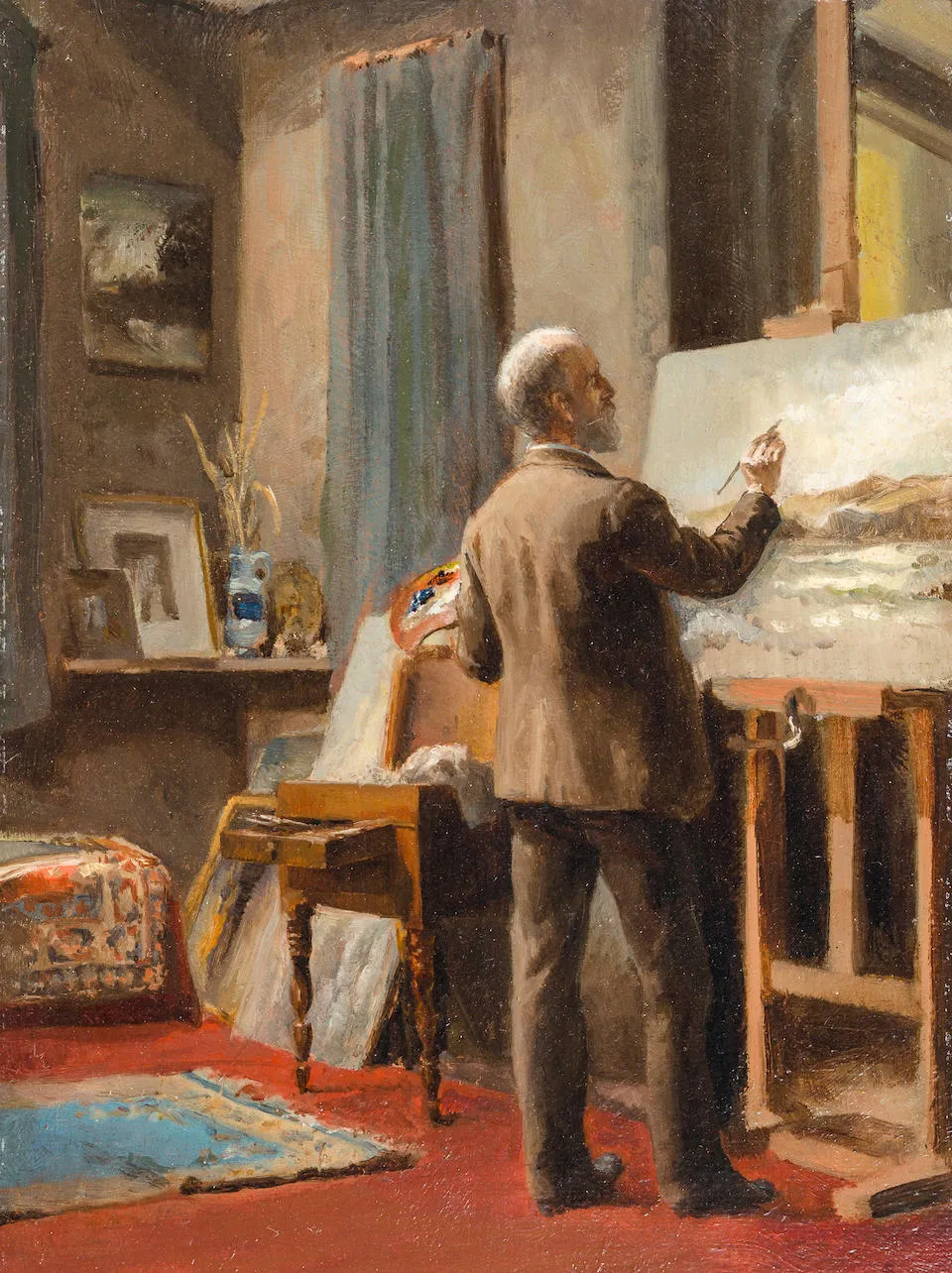
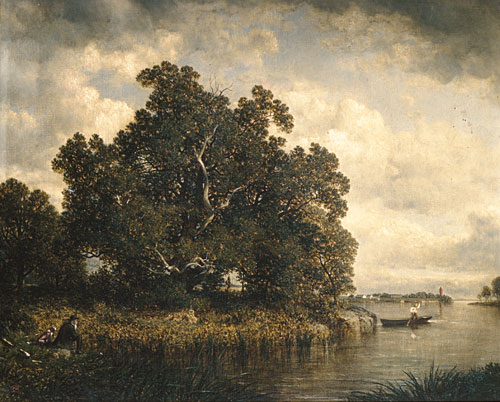
Anna Richards Brewster. Part 1. 

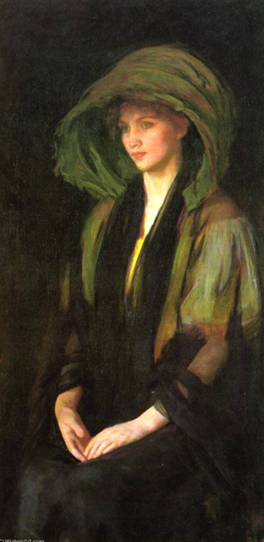
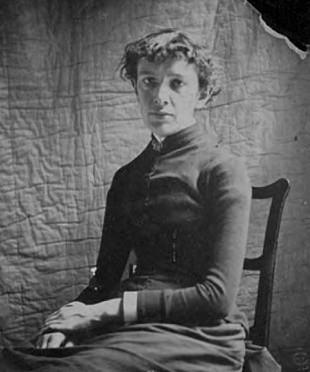
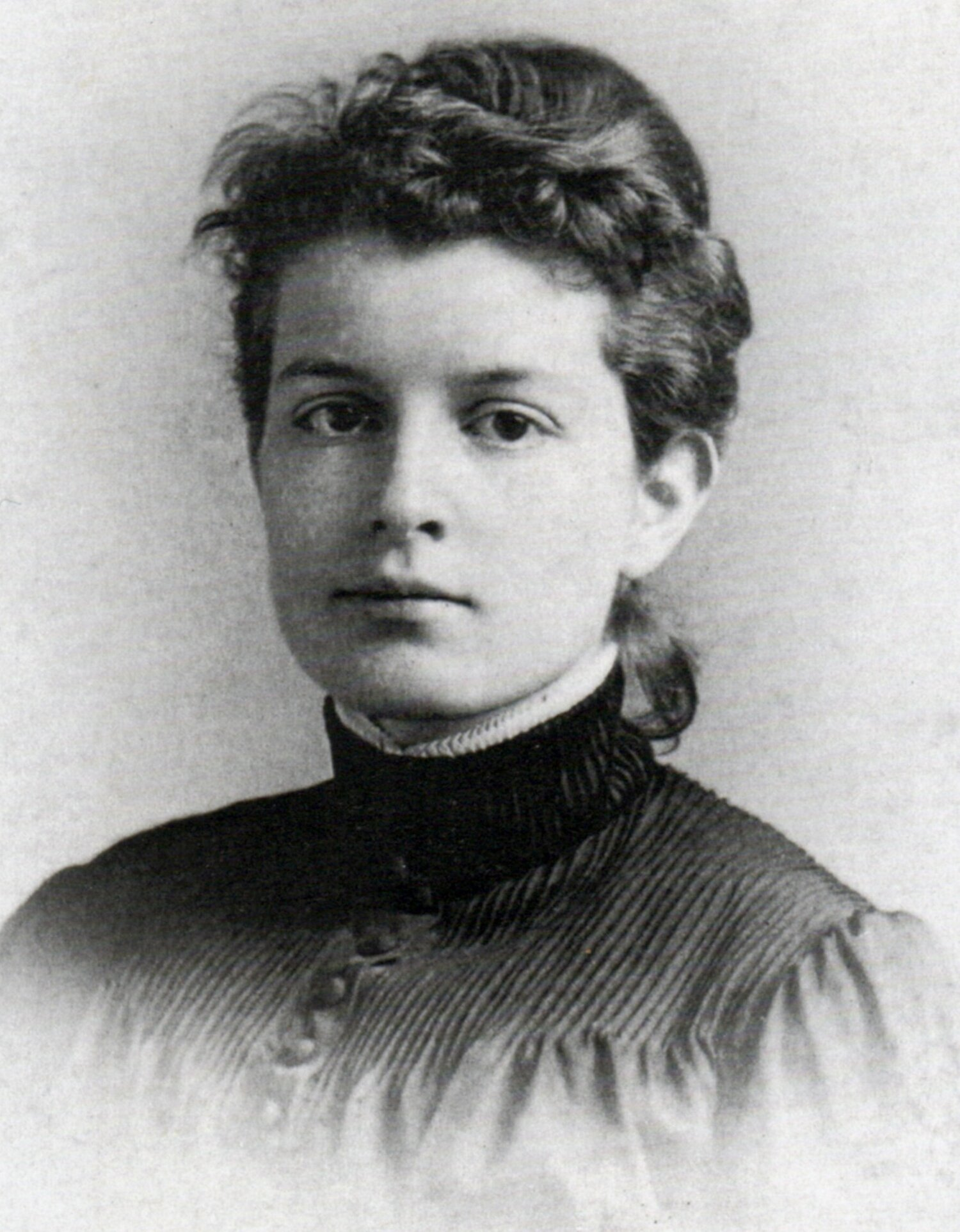
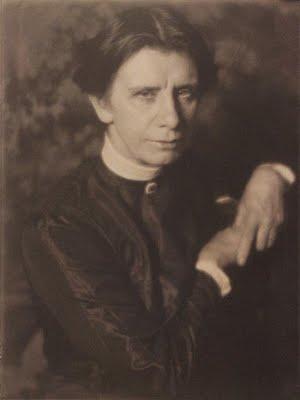
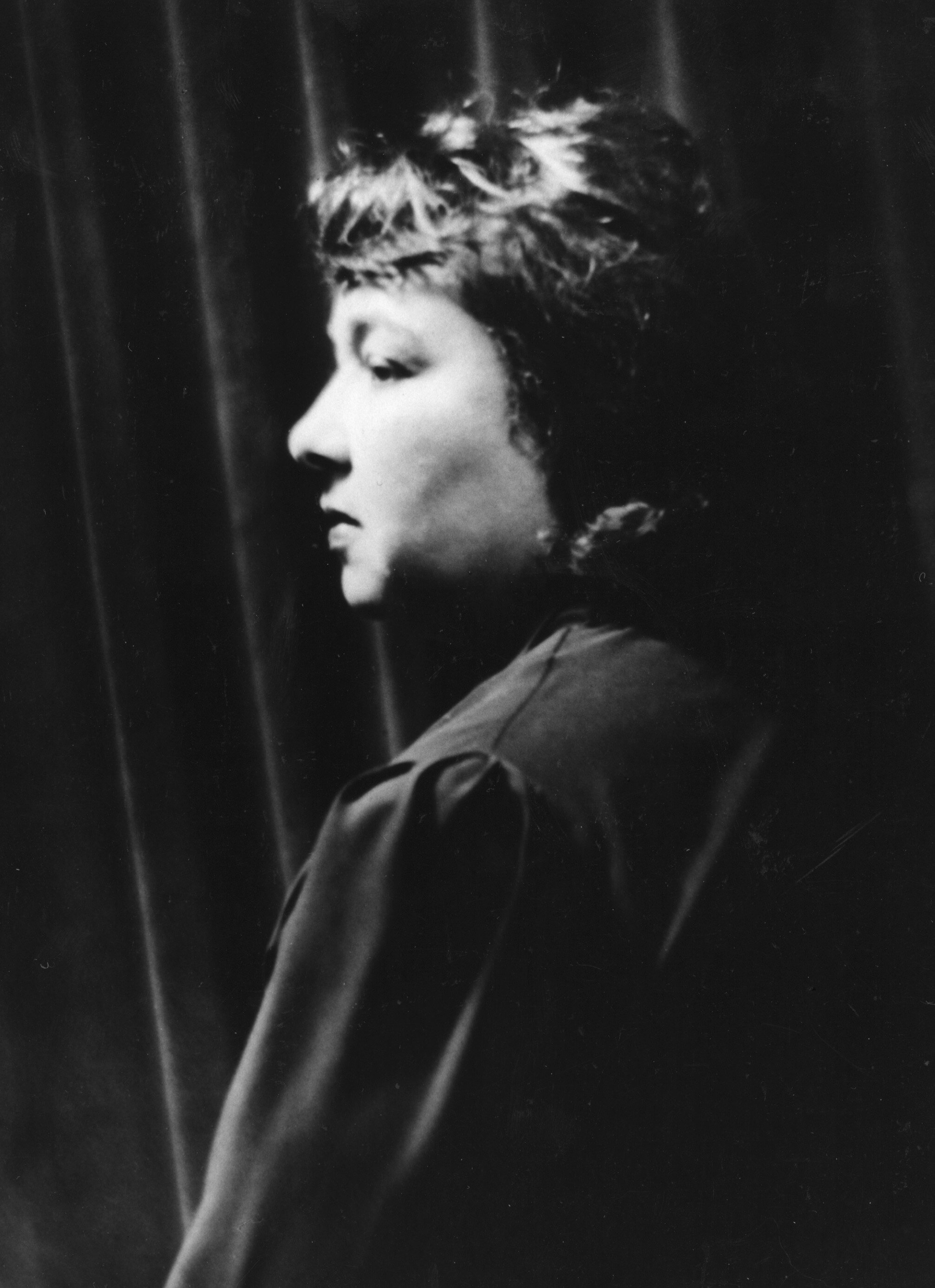
Anna Richards (c.1885)

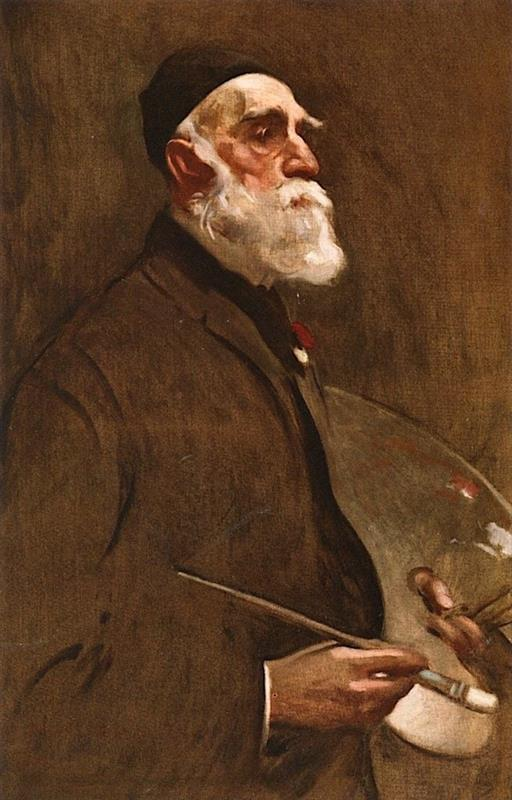
My featured artist today is Anna Richards Brewster, the much-admired American Impressionist painter who was one of the most successful women artists of her time and yet her name has largely been forgotten. Anna was born in the Germantown neighbourhood of Philadelphia in 1870. She was the sixth of eight children of William and Anna Richards.

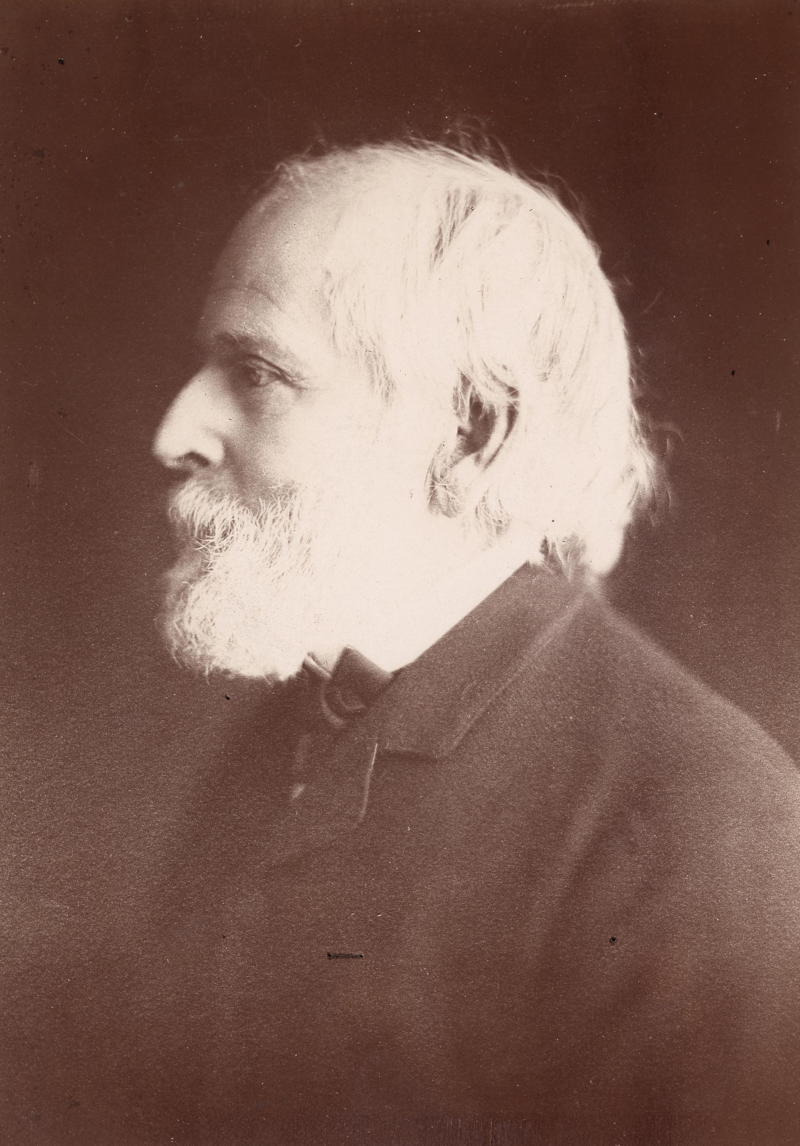
William Trost Richards 

Her father was William Trost Richards, the American landscape artist, who was associated with both the Hudson River School and the American Pre-Raphaelite movement. After living most of his life in Pennsylvania, William Trost Richards rented a summer home in Newport, Rhode Island, and later built a summer home, Gray Cliff, on Conanicut Island in 1881, so as to be closer to the ocean. Richards was recognized by his colleagues as one of America’s foremost marine painters.

A Rocky Coast by William Trost Richards (1877)

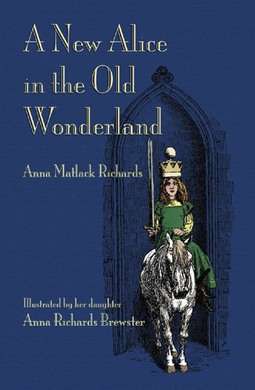
Anna’s mother was Anna Matlack Richards, an intellectual Quaker from a prominent Philadelphia family. She was a children’s author, poet and translator best known for her fantasy novel, A New Alice in the Old Wonderland. Anna Matlack and William Richards married in 1856.

The 2009 edition of Anna Matlack Brewster’s book, A New Alice in the Old Wonderland.

Anna Matlack, as a young woman published fictional works, plays, and poems, including a fictional autobiography by “Mrs. A. M. Richards” with the title Memories of a Grandmother in 1854.  After she married William Trost Richards they spent many years travelling abroad.  In the 1890s, she published comic poems for children in the popular children’s magazines Harper’s Young People and The St. Nicholas Magazine. The success of these comics led her to publish A New Alice in the Old Wonderland in 1895, which featured illustrations by her daughter Anna. It is recognised as one of the more important “Alice imitations”, or novels inspired by Lewis Carroll’s Alice books.

Landscape with a Canal by Anna Richards Brewster (1887)

Anna Matlack Richards educated their children at home to a pre-college level in the arts and sciences and her son-in-law later wrote about his wife and siblings gaining knowledge from their mother’s teachings:

“… Besides the usual subjects, all of them knew something about art, literature and music; each played a musical instrument; and each was encouraged to follow some special interest and to understand and to care for excellence…”
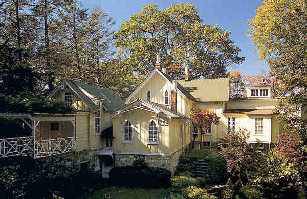
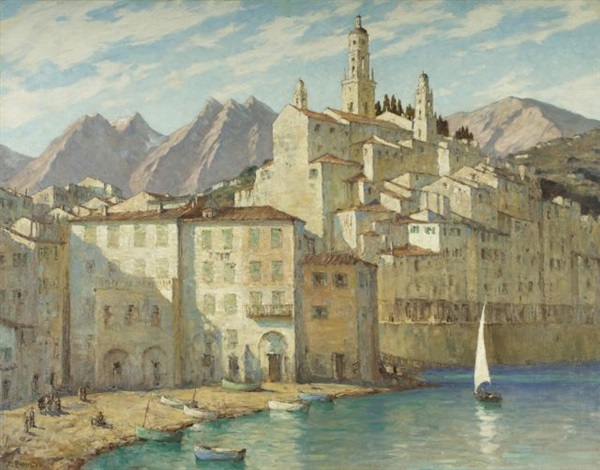
Mentome France by Anna Richards Brewster

Between 1878 and 1880, the family lived in England, mainly in Cornwall and London, and for a short time in Paris, where Anna’s father found subjects for his painting and Anna would often accompany her father during his painting trips. Having returned to America, the family lived in Boston from 1884 to 1888 so that their son, Theodore, was able to attend Harvard University.

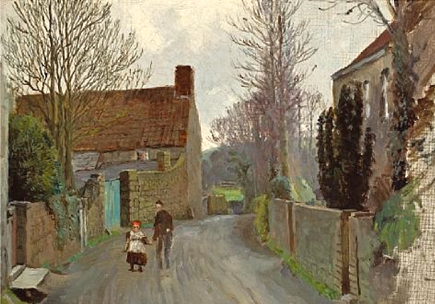
Country House near Exeter, England by Anna Richards Brewster

At the age of fourteen Anna exhibited at the National Academy of Design.  Now living with her family in Boston, she studied with Dennis Miller Bunker at the Cowles Art School where he was the chief instructor of figure and cast drawing, artistic anatomy, and composition. In 1888 the school awarded her the first scholarship in Ladies Life classes.

Langdale Pikes by Anna Richards Brewster (1905)

From there, in 1890, Anna left Boston and went to New York to study at the Art Students League for a few months each winter beginning in 1889 and these annual trips continued until early 1894. Here she was tutored by William Merritt Chase, Henry Siddons Mowbray and John La Farge.  In 1889 she won the Dodge Prize, worth $300, awarded by the National Academy for the best picture painted by an American woman of any age. The winning painting was entitled An Interlude to Chopin.

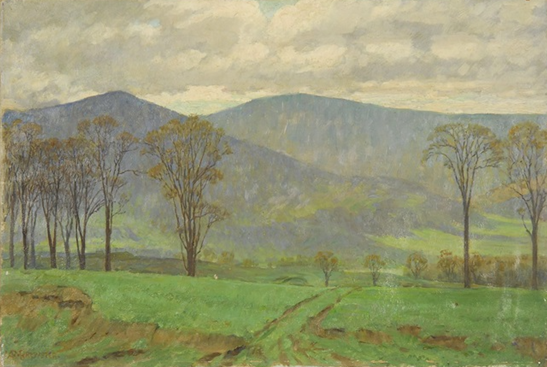
Near Williamstown Ma. by Anna Richards Brewster

Whilst in New York, she rented a room at Mrs. Jacobs’s boarding house, and it was here that one day she met Annie Ware Winsor, who taught at the Brearley School, a private school for girls in New York City. Winsor was five years older than Anna but they became life-long friends and intellectual soulmates. Annie Winsor, through her family’s connections, was able to inroduce Anna to many important and prominent families, such as the Vanderbilts and Schuylers.

Moulin Huet, Guernsey by Anna Richards Brewster

Annie and Anna both became members of the Social Reform Club, an organization for improving the conditions of the poor, and the Louisa May Alcott Literary Circle, where they read books and poetry. This allowed Anna to break away from the insular life of living with her family and the lack of any social interaction when living at home.

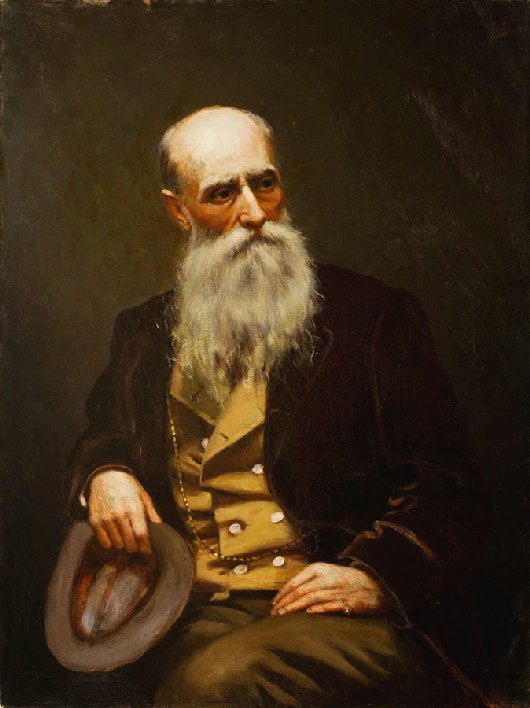
Portrait of the Artist’s Father by Anna Richards Brewster

Between 1890 and 1895, Anna once again went to Europe with her father and, like him, she managed to capture what she saw on canvas and in numerous sketch books.  They travelled to various places in England, Ireland, Scotland and the Channel Islands.  She even went to Paris where she studied at the Académie Julian with the French painters, Jean-Joseph Benjamin-Constant and Jean-Paul Laurens.  Whilst at the family home in Boston she would receive private art lessons from LaFarge who was a friend of the family.  She recounted in a letter to her friend Annie Winsor one such session:

“…The whole afternoon I was wrapped in the pleasure of admiration for Mr. LaFarge. Father and I agree that no mortal could have acted with more perfect courtesy, quietness and charm. I am very glad he came, though it wasn’t much of a lesson…”

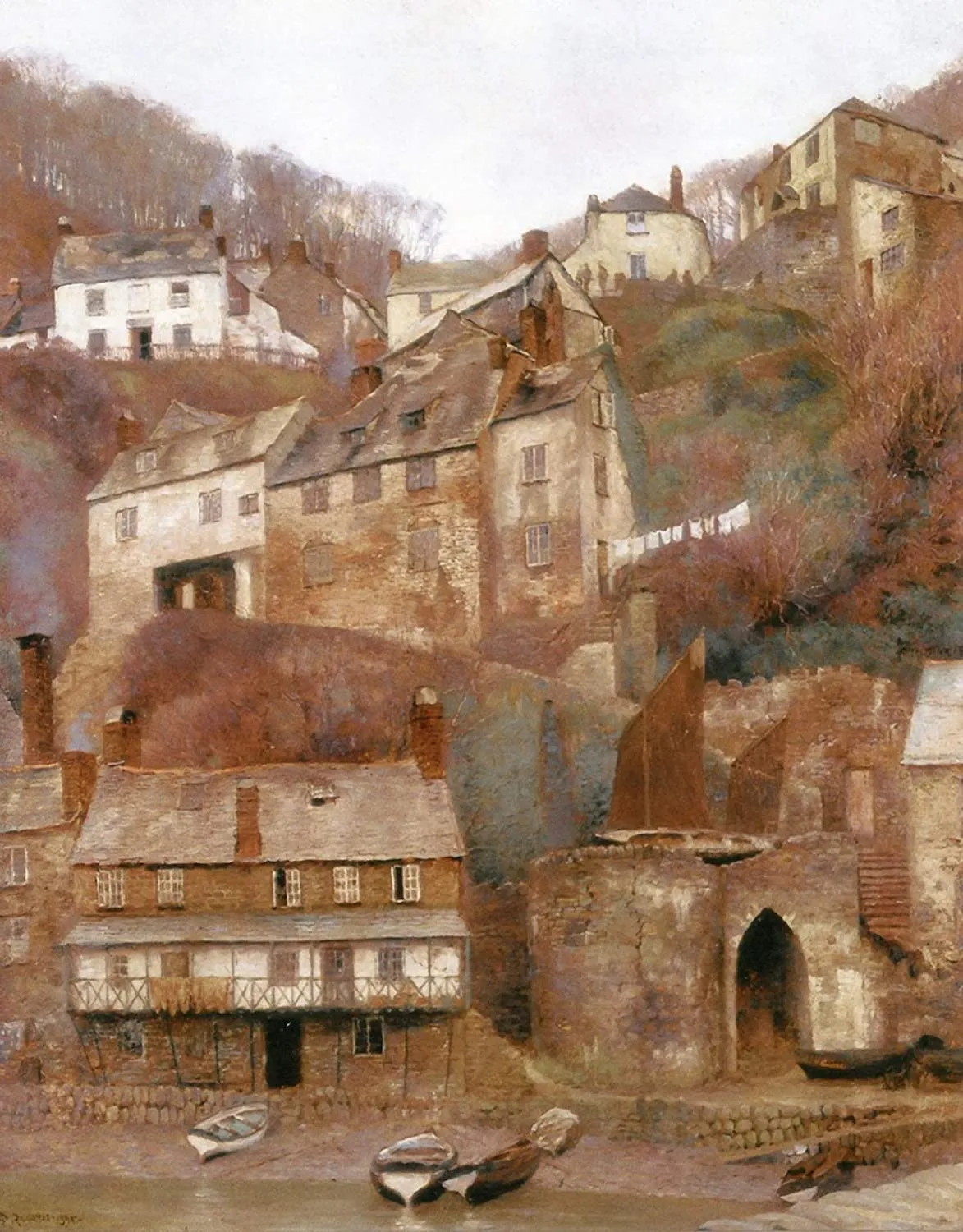
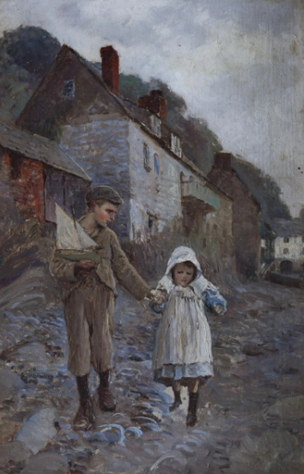
Clovelly by Anna Richards Brewster

Anna was now in her early twenties and both her parents who had been backing her financially began to wonder when she would become a professional painter and earn her own living and they began to pressurise her.   She had always had a difficult relationship with her father and mother.  She was much closer to her father.  Her father had been giving her lessons in art from an early age and had to critique her work which often led to many heated arguments.  Anna would also have heated discussions with her mother who was both a serious scholar and a formidable woman.  Her mother described Anna as “an uneasy household presence” and was tiring of her lack of future plans.  In a letter Anna wrote to her friend Annie Winsor in September 1893 in which she recounted the words of her mother:

“…Mother said that if I was good for anything I should never have a pencil out of my hand, (that I should draw everything, anything) and think of nothing else.  That I ought to read nothing, think nothing, write nothing…..Most people don’t have the physical strength or mental strength to concentrate themselves…….no other thing can attain perfection and perfection is the only thing that exists nothing else counts.  I reject that doctrine but nevertheless it is not without effect but I don’t believe, won’t believe that to be a painter one must be a fanatic…”

Clovelly Village, England by Anna Richards Brewster (1895)

Anna had some exhibiting success during the early 1890s.  She had exhibited and sold four of her paintings at the National Academy of Design in New York and in 1895 she illustrated two books for JD Lippinott, a family friend, who owned his own publication business. A decision was made in 1895 between twenty-five-year-old Anna and her parents.  It was time for her to leave home and make a life for herself as an artist.  She had made a number of trips to England with her father and he believed that it was there that his daughter could make a name for herself and make a living from her art.  It was decided that she should head for the small, picturesque Devon coastal village of Clovelly.

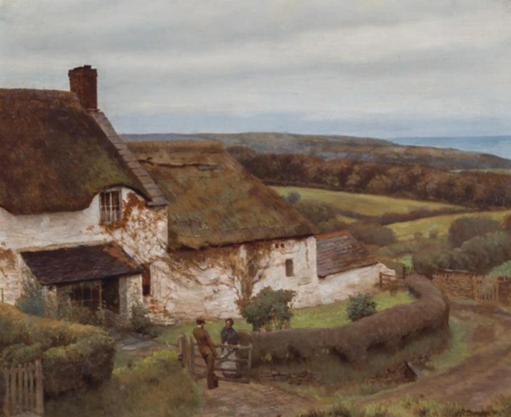
Devonshire Farm House by Anna Richards Brewster

Anna remained in Clovelly for a year and then in 1896 moved to London where she and her parents agreed it would be an ideal place to show and sell her work.  In 1896 she rented a studio and an apartment in Chelsea, where she lived for the next nine years. Whilst living in the English capital she sold a number of her paintings and exhibited four times at the Royal Academy. Thirteen of her paintings featuring life at Clovelly were even exhibited in Baltimore, Maryland.  Her works were also shown at the National Academy of Design and at Knoedler Gallery in New York; and at the Pennsylvania Academy of the Fine Arts in Philadelphia.  In England her work was on show at the Royal Society of Artists, in Birmingham and three times at the Royal Miniature Society.

Battersea Bridge at Twilight by Anna Richards Brewster

On an earlier trip to London, Anna’s parents had become friends with an elderly couple, Mary and Henry Kemp-Welch, who were leading lights in the London art world and Mrs. Kemp-Welch became Anna’s patron and introduced her to many socially prominent families and from these introductions Anna received some portrait commissions.

A Summer Morning in London by Anna Richards Brewster

Anna’s living expenses had been met by her father whose financial situation had been sound due to the sale of his own paintings.  He had also financially helped his other children.  Anna must have been very conscious and somewhat felt guilty, about relying on her  father for money and this is borne out in letter she wrote to her friend, Annie Winsor on August 28th 1900:

“…Money is the one thing I feel I have no control over whatsoever, and whose workings, bearings, laws, and significance I do not understand…”

And in another letter to Annie on November 29th 1900, she wrote:

“…My mind’s much occupied with the question of making money. I must … I shall never get any feeling of self-respect until I can support myself…”
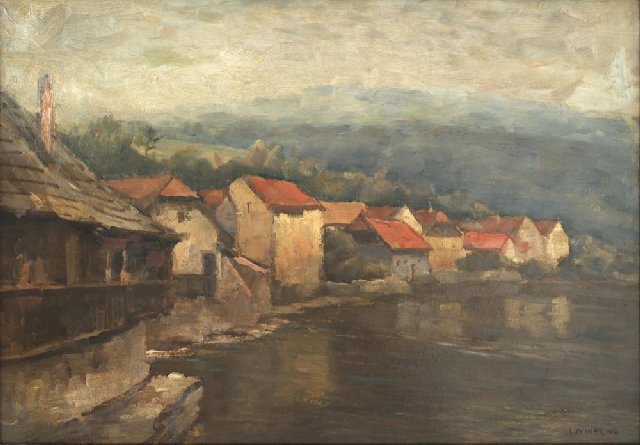
Trafalgar Square London by Anna Richards Brewster

In 1900, Anna’s patron and friend Mrs Kemp Welch, now in old age, had become frail and she was advised by her doctors to leave England during the cold damp winter months and move to a warmer climate.  Anna had a lot to be thankful for the elderly lady’s support and so offered to accompany her to Italy as her chaperone.  She had a lot to do before she could leave London and one can tell the pressure she was under as one notes a letter she sent to Annie Winsor prior to her departure.  She wrote:

“…Next Tuesday, Mrs. K-W (who is far from well) and I start for Italy for her health; and before then I have to rent my flat . . . finish my academy pictures, ditto a portrait, ditto some work for Mr. Holiday [a stained-glass artist], give my five pupils their last lessons…”

Italian Gardens at Mount Vesuvius by Anna Richards Brewster

Anna and Mrs Kemp Welch did get to travel to Italy in December 1900.  That month had been a sad period for Anna as she received news of her mother’s death, aged 66.  It had not been altogether a shock to Anna as her mother had been diagnosed as having breast cancer two years earlier and she was later diagnosed as being terminally ill.  Anna’s mother was adamant that her daughter remained in England and not come back to America.  She had visited her daughter in London in October 1900, two months before her death.  On December 22nd 1900 Anne wrote to her friend Annie Wintor telling her about that last meeting she had with her mother:

“…Yes, it is a great happiness that – just lately, she and I got a restful feeling of mental understanding, more than ever before….I got to say what I had been longing to – that whatever happened I could always feel that now we understand each other, and that all misconceptions were past……She grew so much in those years from the moment when she learned of her mortal malady, and met the knowledge with all the bigness of her soul…. I felt nearer to her than I ever had.  She has grown more human and beautiful to the end…”

……….to be continued.


Some of the information was gleaned from the usual search engines but most came from a 2008 book entitled Anna Richards Brewster, American Impressionist which was a collection of essays edited by Judith Kafka Maxwell with contributions from Wanda Corn, Leigh Culver, Judith Kafka Maxwell, Susan Brewster McClatchy and Kirsten Swinth.

Jasper Francis Cropsey

Among the most vibrant and spectacular works of the nineteenth century, were the sweeping landscape depictions of the Hudson River School which managed to capture the rugged beauty of the American countryside and wildernesses.  The name Hudson River School was first used disparagingly by trendy Europhile critics who preferred the dignified depictions of the realism of L’École de Barbizon.  The beautiful paintings of the Hudson River School compellingly convey the natural grandeur, not just of the Hudson River Valley, as the name would imply, but also the Catskills, Adirondacks, White Mountains, the Maritimes, the American West and South America.  My guest artist was one of the great painters of that School.

Jasper Francis Cropsey

Jasper Francis Cropsey was born at Rossville, Staten Island on February 18th 1823.  He was the eldest of eight children and his ancestors were of Dutch and Huguenot ancestry. His father was Jacob Rezeau Cropsey who had a farm in Rossville and his mother was Elizabeth Hilyer Cropsey (née Cortelyeu).  During his early years, Cropsley suffered many bouts of ill health which resulted in him missing school and forced him to rest up at home.  During those frequent periods of inactivity, he taught himself to draw. Many of his sketches featured architectural drawings and landscapes.  Whilst attending the local country school he would help is father on the farm but in his pre-teen and teenage years he developed his main love, sketching and painting.  Much to the chagrin of his teachers he would often be found doodling on his school books.  In his 1846 unpublished biography, Reminiscences of My Own Time he wrote:

“…I was so disposed to adorn my writing book, on the margin, wherever there was a blank space, with fancy letters, boats, houses, trees, etc., and paint, or color the pictures in my books that I would undergo the reprimand of the teacher, rather than desist from it…”

The Valley of Wyoming, by Jasper Francis Cropsey (1865)

Cropsey as a young teenager was fascinated with architecture and this led him to assemble an elaborate model of a country house which he submitted to the 1837 fair of the Mechanics’ Institute of the City of New York and it won him a diploma.  The model was well received and Joseph Trench, a New York architect who saw it, offered fifteen-year-old Cropsey a five-year apprenticeship in his architectural office. After eighteen months, Cropsey’s proficiency in drawing had earned him the responsibility for nearly all the office’s finished renderings.   Cropsey prospered at the firm and during his penultimate year at the company he began painting the backgrounds of the architectural designs. To improve that skill, Joseph Trench persuaded his young apprentice to study watercolour painting with English-born watercolourist, Edward Maury.  The firm even provided him with paints, canvas, and a space in which to study and hone his artistic skills.

The Narrows from Staten Island, by Jasper Francis Cropsey (1868)

Cropsey left the Trench’s office in 1842 and in 1843 he first exhibited a painting, which was quite well-received.  It was a landscape entitled Italian Composition, probably based on a print he had seen at the National Academy of Design. Jasper Cropsey was elected an associate member of the Academy the following year and became a full member in 1851.

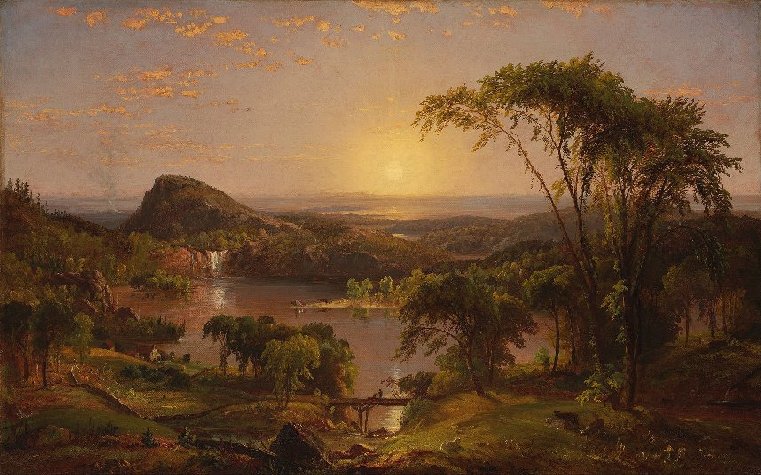
Sunset on Greenwood Lake by Jaasper Francis Cropsey (1877)

Having left the Trench architectural company Cropsey managed to support himself for the next two years by accepting commissions to provide architectural designs.  Although that brought him financial support, his main love was sketching and painting landscapes and he would often take painting trips to New Jersey and Greenwood Lake, which straddles the border of New York and New Jersey.  After one such trip, Cropsey had put together a number of sketches of the area, which on his return home he converted them into two paintings of Greenwood Lake that were accepted at an 1843 exhibition at the American Art Union.

Autumn Foliage in the White Mountains (Mount Chocorua) by Jasper Francis Cropsey (1862)

During one of his trips to Greenwood Lake, Cropsey met Maria Cooley, whom he later married in May 1847. They went on to have two children, Mary Cortelyou Cropsey in 1850 and Lilly Frances Cropsey born in 1859. He and his wife crossed the Atlantic for a two-year European honeymoon and visited England during the summer of 1847, travelled throough France and Switzerland and reached Italy wheree the Cropseys spent a year among the colony of American artists who had settled in Rome. During that lengthy stay in Rome, Cropsey worked out of the former studio of Thomas Cole, the founding father of the Hudson River School. Cropsey became familiar with the works of the Nazarenes and other German artists in Rome and it was their influence which may have reinforced his own liking of detail in his paintings. Like many other American artists who visited Italy, Cropsey made frequent sketching trips to the Roman Campagna and other regions of Italy, such as Sorrento, Capri, Amalfi, and Paestum.

Maria Cooley Cropsy by Daniel Huntingdon (c.1850)

Cropsey and his wife returned to America in 1849 and he made his first trip to the White Mountains, a mountain range covering about a quarter of the state of New Hampshire and a small portion of western Maine.  Cropsey rented studio space in New York which he shared with Edwin White, the Massachusetts-born artist, at 114 White Street in New York City. Here he taught and worked up his European sketches into finished oil paintings. Cropsey and his wife made their base in New York and from there in the summers they would make exploratory trips through New York State, Vermont, and New Hampshire, and he would continually sketch what they saw. Cropsey specialized in autumnal landscape paintings of the northeastern United States. He would convert sketches into finished paintings and sell them but also to supplement the family income he would teach.  

 Bayside, New Rochelle, New York by David Johnson (1886)

One of his pupils was the landscape painter David Johnson, who became a member of the second generation of Hudson River School painters.

Lord Byron’s Dream, by Charles Lock Eastlake (1827)

Cropsey and his wife made a second trip to England in 1856 and rented a studio in London at Kensington Gate.  It was an ideal place to host parties and make friends such as the art critic John Ruskin, John Singleton Copley, 1st Baron Lyndhurst, who was a British lawyer and politician and was three times Lord High Chancellor of Great Britain and Sir Charles Lock Eastlake who was a British painter, gallery director, collector and writer of the 19th century. He became the first director of the National Gallery and from 1850 to 1865 he served as President of the Royal Academy.    

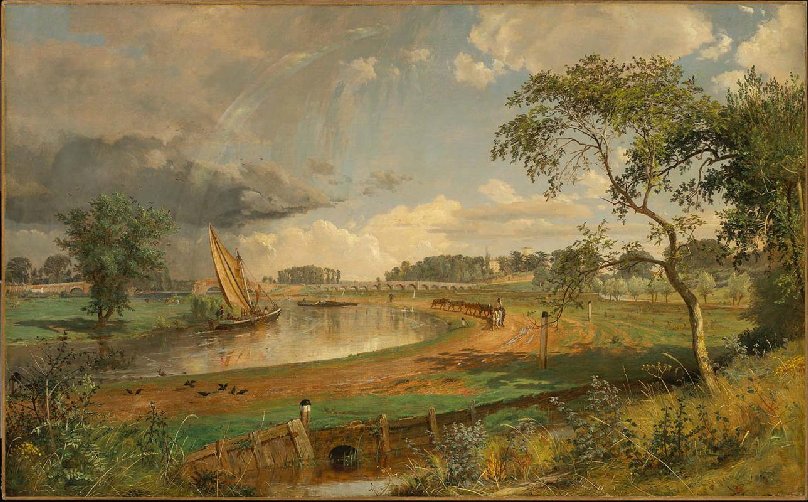
Walton on Thames by Jasper Francis Cropsey (1860)

It was with friends such as these that ensured many English and American landscape painting commissions came Cropsey’s way from both English and American patrons. When Cropsey arrived in England he brought with him many commissions from his American patrons who wanted paintings depicting English castles and abbey ruins. He also found that there was a great interest amongst English clients for his American landscapes. The London printer Gambert and Company commissioned thirty-six views from Cropsey for publication in the American Scenery journal.

Autumn—On the Hudson River , 1860 by Jasper Francis Cropsey

In 1860 Cropsey completed one of his most famous paintings entitled Autumn—On the Hudson River of 1860. This monumental view of the Hudson River Valley was painted from memory and in-situ sketches he had made, in his London studio. Cropsey adopted a high vantage point, looking southeast toward the distant Hudson River and the flank of Storm King Mountain. It is an autumnal scene which would soon become Cropsey’s trademark.  The work was praised by critics and the public alike, including Queen Victoria.  The painting depicts a sweeping panoramic view of the river under a sun-streaked sky in this long, horizontal landscape painting (60 x 108 inches).  The leaves on the trees are fiery autumnal oranges and reds.  In the background we catch a glimpse of the mountains through the haze.  At the bottom of the painting we can see vine-covered, fallen tree trunks and mossy grey boulders.  At the bottom left we can just make out a trickling waterfall and small pool. 

Although not easy to spot, on the bank of the pool, three men and their dogs sit and recline around a blanket and a picnic basket, their rifles leaning against a tree nearby. From our viewpoint, the land stretches down to a grassy meadow which is crossed by a meandering stream at the heart of the painting. 

In the right foreground we see cattle on the riverbank drinking the water close to a wooden bridge. 

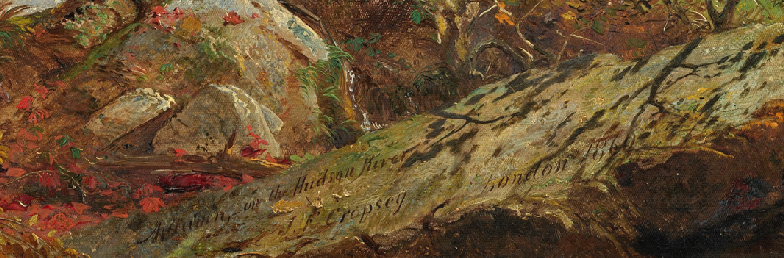
Artist’s signature on flat rock

Cropsey signed the painting as if he had carved it into the flat top of a rock at the centre foreground of the landscape with his name, the title of the painting, and date: “Autumn – on the Hudson River, J.F Cropsey, London 1860.”

Summer, Lake Ontario by Jasper Francis Cropsey (1857)

Besides earning money from the sale of his landscape paintings he also provided illustrations for books of poetry by Edgar Allan Poe and Thomas Moore and did a series of views of American scenery published by Gambert and Company, London.  Cropsy was acclaimed not only for his beautiful autumnal landscapes such as Autumn—On the Hudson River, 1860 which is now part of the National Gallery of Art, Washington, D.C. collection, but for bringing to the untravelled British people the exquisite scenery of the great Western continent.   Queen Victoria was so impressed by Cropsey’s works of art that she appointed him to the American Commission of the 1862 International Exposition in London, and he subsequently received a medal for his services.

Coast of Genoa by Jasper Francis Cropsey (1854)

Cropsey and his wife returned to America in 1863. The 1860s were the most successful time for Cropsey as far as the sales of his work and his ever increasing bank balance. Shortly after their arrival home to America they visited Gettysburg to record the battlefield’s topography in a painting. Cropsey also began to accept architectural commissions once again and produced his best-known designs, such as the ornate cast and wrought iron Queen Anne-style passenger stations of the Gilbert Elevated Railway along New York’s Sixth Avenue.

High Torne Mountain, Rockland County, New York by Jasper Francis Cropsey (1851)

Cropsey’s father-in-law, Isaac P. Cooley was a justice of the peace from 1837 to 1839 and became a judge over the New Jersey Court of Common Pleas in 1840.    Cooley later became a member of New Jersey State House of Assembly from 1860 to 1861.   Cooley offered to build his daughter and son-in-law a studio on his estate but Cropsey declined the  offer and instead, purchased forty-five acres of land near Greenwood Lake in Warwick, New York, where he designed and built a 29-room Gothic Revival mansion with its own studio which he called Aladdin. The family then divided their time between living in New York City, and spending time in Warwick.

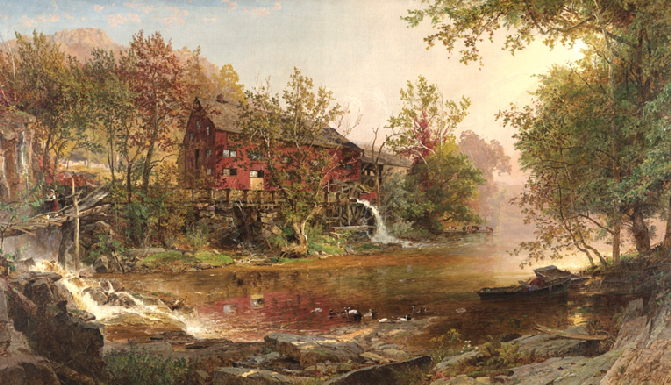
The Old Mill by Jasper Francis Cropsey (1876)

Unfortunately for Cropsey, the art of the Hudson River School began to lose its popularity and by the early 1870’s would be completely out of favour in the art world. In 1876 Cropsey completed his last major work, The Old Mill, which is now part of the Chrysler Museum of Art in Norfolk, VA. Collection.  The painting is a depiction of the Sanford gristmill, which stood on the banks of the Wawayanda Creek near Warwick, New York, and close to where Cropsey had built his palatial estate, Aladdin. The rural water mill was at the heart of the American pre-­industrial economy, but time moved on and in the 1870s, the water mills were quickly being replaced by more efficient steam-powered mills and factories.  This loss of such bygone icons concerned Cropsey.  For him, it was symbolic of the loss of the simple past.  It was a sentimental bereavement.  The depiction was typical of Cropsey’s past output – autumn landscapes that beautifully captured the sunlit atmosphere of autumn in New York and New England.  Cropsey exhibited it at the 1876 Centennial Exposition in Philadelphia, where he was awarded a medal for “excellence” in oils.

Wickham Pond and Sugar Loaf Mountain, Orange County by Jasper Francis Cropsey (1876)

The Hudson River School artwork began to lose its popularity by the mid 1870’s and by the end of the decade would be completely out of favour in the art world. In the early 1880’s the sale of Cropsey’s landscape paintings was dwindling eclipsed in popularity by the smaller scale works which were, softer, mood-evoking landscapes of Barbizon-inspired painters such as George Inness. As a result the Cropsy family’s financial situation became dire and the family was perilously close to having their home, Aladdin, in Warwick, NY, taken from them.   Fortunately, they managed to sell their lavish estate and at the same time, auctioned off many paintings, furniture, and household possessions in preparation to move to a smaller property.

Ever Rest,  49 Washington Avenue, Hastings-on-Hudson

In 1885 the Cropsey family moved from Warwick to Hastings-on-Hudson, a village in Westchester County located in the southwestern part of the town of Greenburgh in the state of New York.  He firstly rented a property then later bought a house at 49 Washington Avenue, which they named Ever Rest. Cropsey and his family lived there for the rest of their lives.  They were content to live a quiet existence there at Ever Rest and did very little travelling.  As far as painting was concerned Cropsey concentrated in depicting local views or views based on the hundreds of sketches he had completed through the years, including studies he did in the two year period spent in Rome. .

Jasper Francis Cropsey by Edward Mooney (1850)

Jasper Francis Cropsey suffered a stroke in 1893 and died at Ever Rest on June 20th 1900 at the age of 77,  and Maria, his wife of 54 years, passed away in 1906.

The Cropsey home, known as Ever Rest,  was built in 1835 and purchased by Jasper F. Cropsey in 1885. Cropsey extended Ever Rest by adding an  artist’s studio to it in 1885. The Homestead is located at 49 Washington Avenue, Hastings-on-Hudson, NY.   On May 17, 1973, both the New York and National Historical Societies declared the Homestead an historical site. The Homestead is listed in the “National Register of Historic Places in New York”.


A great deal of information I needed cam fro some excellent websites:

Newington-Cropsey Foundation

Welcome Autumn with Jasper Cropsey’s Colorful Landscape Paintings

National Gallery of Art

Mark Murray Fine Paintings

Spellman Gallery

Wilhelmina Douglas Hawley

Wilhelmina Douglas Hawley, Self Portrait (1897)

The artist I am featuring today is the American painter and watercolourist Wilhelmina Douglas Hawley.  She was born on July 13th 1860 in the small coastal town of Perth Amboy, New Jersey. Her father, Peter Radcliffe Hawley was an officer in the coast guard and her mother, Isabella Hawley (née Merritt), a Canadian-born dancer. Wilhelmina’s ancestors were English and Scottish migrants, who moved to the east coast of the United States and Canada in the seventeenth and eighteenth century

Birthplace of Wilhelmina Douglas Hawley, Merritt Peck House, 213 High Street, Perth Amboy, New Jersey

Wilhelmina had three siblings: an older sister Jeanne and two younger brothers William and Alan Ramsey.  When Wilhelmina was four-years-old, the family moved to the New York suburb of St Albans, a residential neighbourhood in the southeastern portion of the New York City borough of Queens. Wilhelmina developed two loves during her pre-teen years.  One was a love of sketching and painting thanks to two of her unmarried aunts, Florence and Georgina Agnes Merritt and the other was the love of travel once her grandparents took her to Europe when she was just twelve years of age and it was the excitement of visiting so many new places that encouraged her to start writing a journal.

The Cooper Union

Wilhelmina soon developed a love of art and decided to follow the dream of becoming a professional painter.  In 1879, at the age of nineteen, she enrolled in the Cooper Union Women’s Art School, one of the New York art academies that is open to women.  The Cooper Union for the Advancement of Science and Art was established in 1859 and is among the nation’s oldest and most distinguished institutions of higher education. The college, founded by inventor, industrialist and philanthropist, Peter Cooper, offers a world-class education in art, architecture and engineering as well as an outstanding faculty of humanities and social sciences.  Cooper took the revolutionary step of opening the school to women as well as men. There was no colour bar at Cooper Union. Cooper demanded only a willingness to learn and a commitment to excellence, and in this he manifestly succeeded.

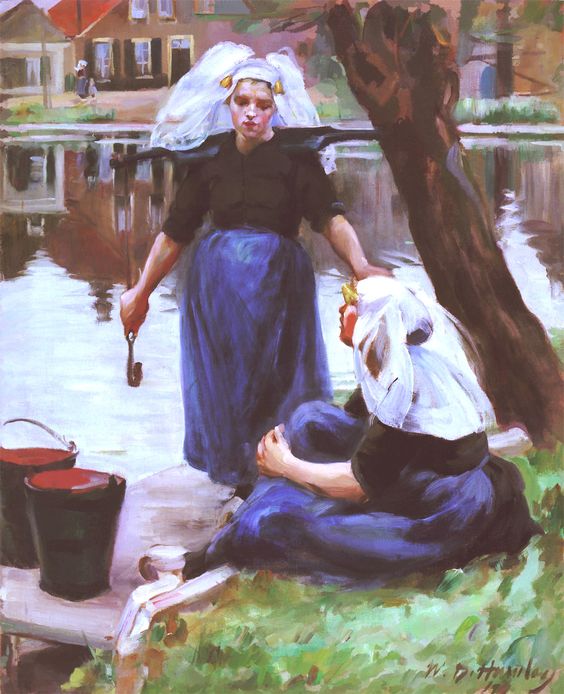
Two Women near the River Waal by Wilhelmina Douglas Hawley (1894)

Wilhelmina remained at the Cooper Union for a year and then enrolled at the Art Students League where she honed her artistic skills eventually becoming the first woman vice-president of this progressive institution. Her tutors included William Merritt Chase, Julian Alden Weir, Charles Yardley Turner and Kenyon Cox. The popularity of the Art Student League was that it was based in New York and the city attracted many European artists, many of whom Wilhelmina met while living and studying at the Arts League.

Young Woman in the Meadow by Wilhelmina Douglas Hawley

To escape the cold climate of New York, Wilhelmina spent the winter of 1891/2 on the island of Bermuda where she fell in and out of love with a mysterious Englishman whom she had agreed to marry.  Fortunately, she realised the error of her judgement and the two split up.  Once again, like so many American artists of the time, who succumbed to the magnetism of Paris, Wilhelmina was drawn towards the French capital to continue with her artistic tuition. On June 18th 1892, just a month before her thirty-second birthday, Wilhelmina once more, set sail for Europe on the Holland-America steamer Veendam.  During her Atlantic voyage, Wilhelmina was accompanied by the Dutch-American artist John Vanderpoel and his wife Jessie Elizabeth Humphreys. Vanderpoel. He was a well-known artist and taught at the Art Institute of Chicago where one of his tudents was Georgia O’Keeffe, and it was he who most likely suggested to Wilhelmina that she should spend the summer months at the charming village of Rijsoord near Dordrecht in the Netherlands, where he had founded an artists’ colony in 1886. 

Interior with Mother, two Children and Cat by Wilhelmina Douglas Hawley

On arriving in Paris Wilhelmina registered at the Académie Julian, one of only two art academies in the city to which women and foreign students were admitted.  Having arrived in the Summer, all the Academies were closed for the summer break and would not re-open until the September.  Wilhelmina used the time to travel throughout Belgium and the Netherlands and on 4 July 1892 she made her first visit to the Dutch flax village and artists’ colony at Rijsoord, where various foreign artists and art students had been living and working since 1888 especially during the summer months.  In 1893, Wilhelmina achieved her first artistic successes at the French Academy where she was awarded a prize for best composition.  Also for the first time, one of Wilhelmina’s paintings was selected for the Paris Salon that year, and success came from across the Atlantic when her painting, Holland Peasant Girl was shown in New York at an exhibition of the National Academy of Design

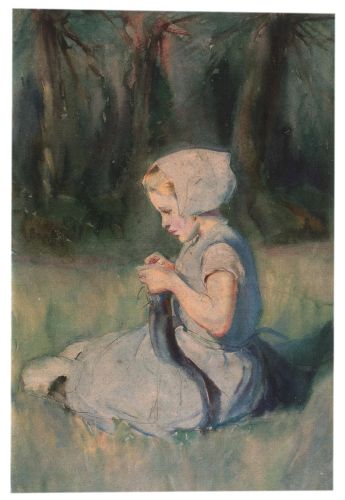
Girl Knitting in a Field by Wilhelmina Douglas Hawley

In 1893, Wilhelmina was appointed as an art teacher at Academy Colarossi and it was around this time that she met English-born Canadian art student, Laura Muntz  A friendship between the two women sprung up and Laura moved in with Wilhelmina at her studio at No. 111 Rue Notre-Dame-des -Champs. Close to the Palais de Luxembourg.  Directly across from their studio was the studio of American artist, James Abbott McNeill Whistler.  Both Laura and Wilhelmina were regular visitor to Whistler’s studio, and he to theirs.

Laura Muntz Lyall

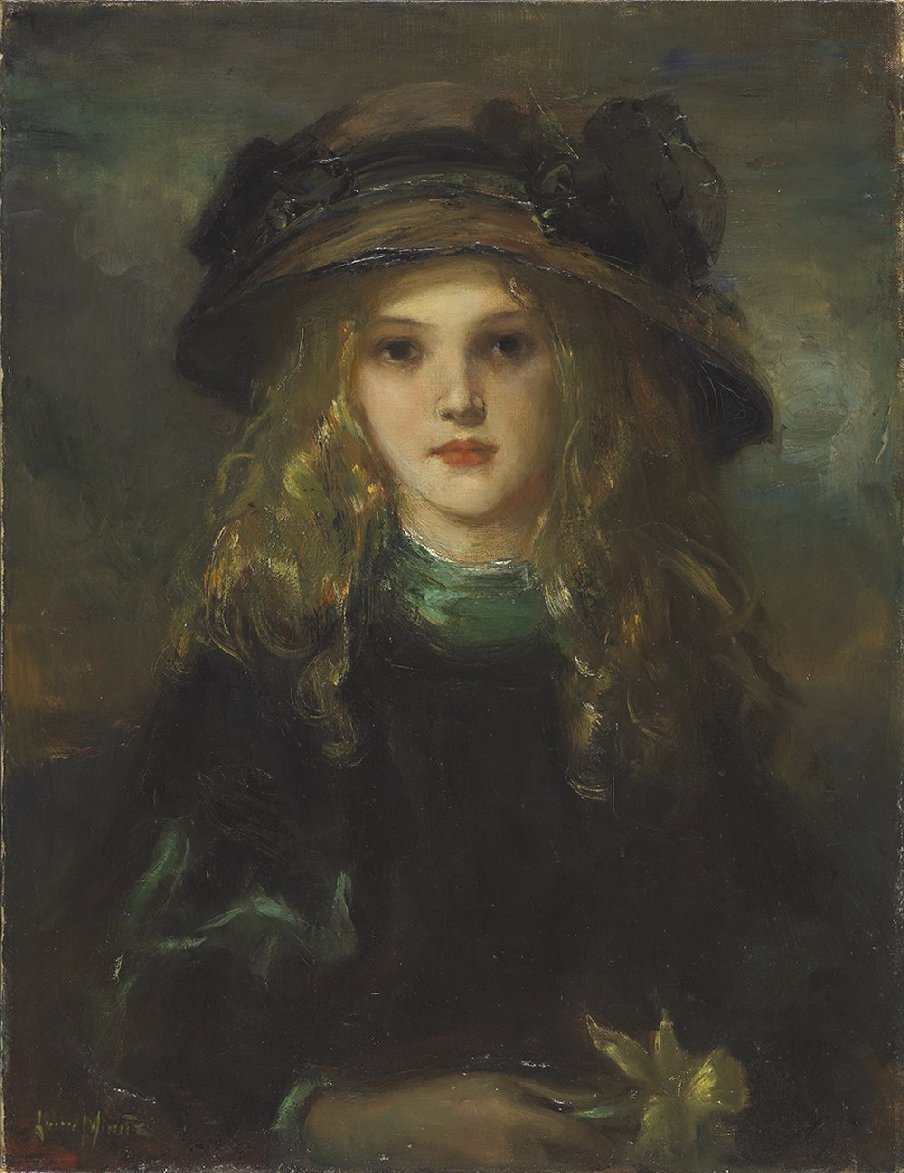
Laura Munz, who was born in 1860 in Radford, Warwickshire, England, was the same age as Wilhelmina and is recognised as one of the most talented painters of her time.  She was an impressionist painter, best known for her depiction of mothers and children. When she was a small child, she emigrated with her family to Canada, where grew up on a farm in the Muskoka District of Ontario. 

A Daffodil by Laura Munz Lyall (1910)

In 1882, Laura began to take classes at the Ontario School of Art in Toronto.   She also studied briefly at the South Kensington School of Art in 1887, then returned to Canada to continue her studies at the Ontario School. She came to Paris in 1891 and before she met Wilhelmina had been living alone and earning money by teaching and administrative work.  She was the first Canadian to receive the distinguished “Honourable Mention” at the Paris Salon exhibition in 1895.

Portrait of Wilhelmina Douglas Hawley by Laura Munz (1897)

In 1896 Laura returned to Canada for a short spell to help look after an ailing relative.  She returned to Paris and the Academy Colarossi and was promoted to the post of  massiere (Studio head) at the Académie Colarossi.  In 1898 she returned to Canada in 1898 and set up a studio in Toronto to teach and paint.  In 1906, she moved to Montreal to continue her career and built up a large clientele that regarded her as the premier Canadian portraitist of children.  Following the death of her sister in 1915, she returned to Toronto and married her brother-in-law Charles W.B. Lyall and cared for his children of her sister’s marriage, eleven in all, but many had left home by then.  She set up a studio in the attic of their home, and started signing her works with her married name. Laura Munz Lyall died in Toronto in 1930, aged 70.

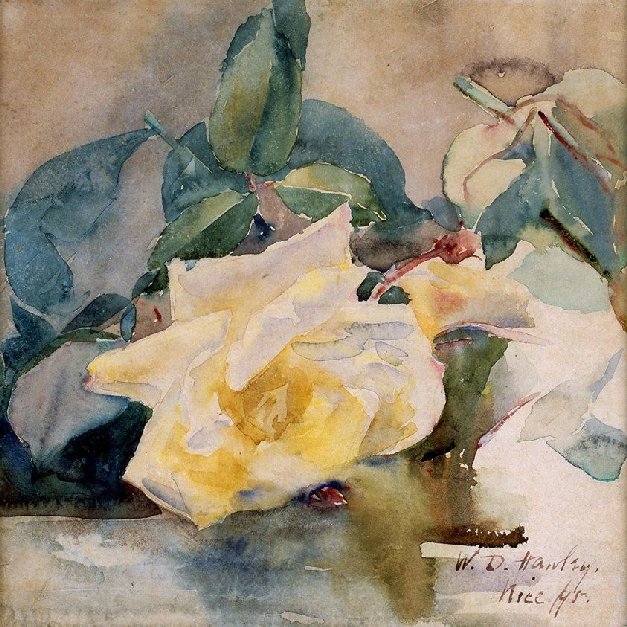
Rose by Wilhelmina Douglas Hawley (1895)

Wilhelmina and Laura spent part of the summers in the French countryside as well as the artists’ colony of Rijsoord in the southern Netherlands. She would often take her international students of the Académie Colarossi with her on these painting trips.   It was here that Wilhelmina captured the villagers in oils and watercolours. The village of Rijsoord was well situated for passing travellers on the Rijksstraatweg (State Highway), an important European road that connected Paris to The Hague.

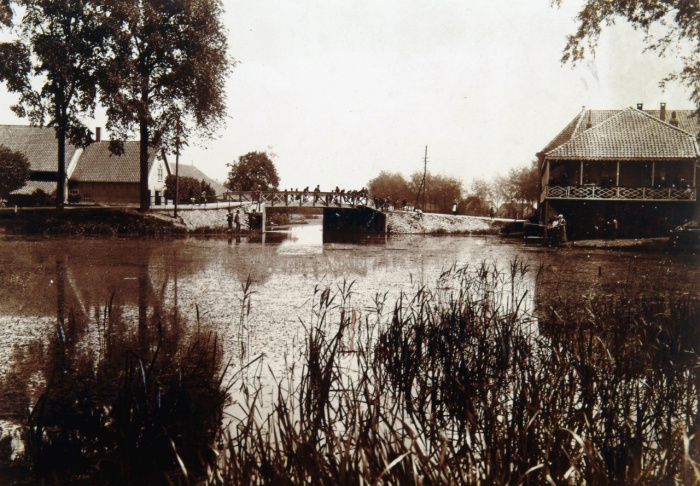
The bridge over the River Waal at Rijsoord, with Hotel Warendorp on the right

An inn was constructed on the spot near the river Waal where the eighteenth-century tollhouse had stood. The building is still standing and for several years had housed the restaurant Hermitage. When Wilhelmina first visited Rijsoord, the inn was called Hotel Warendorp. Hotel Warendorp functioned as the headquarters of the summer academy. The ground floor of the building comprised a livingroom, diningroom and a room for drinking coffee. Most of the guestrooms were also on the ground floor. On the floor above it, the large space under the roof was used as an artists studio, where the artists would hang their most recent paintings and watercolors for discussion. On rainy days, when it was impossible to work en plein air, the artists would actually work in the studio. Wilhelmina’s great granddaughter, Alexandra van Dongen, wrote about how her great grandmother met her husband in her blog: For Two Years, or Perhaps Forever”; Wilhelmina Douglas Hawley and the Artists’ Colony in Rijsoord.  The tale is an instalment in a monthly series of blogs telling stories about the rich history shared by the American and the Dutch peoples.  She wrote:

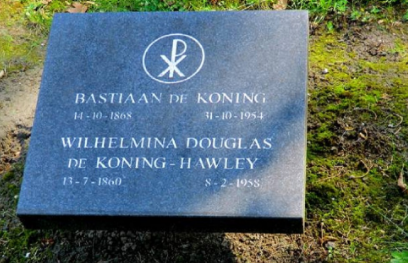
“…In 1899, Wilhelmina apparently first encountered the 31-year-old Rijsoord farmer Bastiaan de Koning (1868-1954). They most likely met during a boat trip on the river Waal, as the story goes, as local villagers including De Koning, regularly rowed the artists to their outdoor painting locations. In the summer of 1900 Wilhelmina returned to Rijsoord again and announced her engagement to Bastiaan. They married a year later on December 5, 1901. Another three years later, when Wilhelmina was 44 years old, she gave birth to a daughter, my grandmother, Georgina Florence de Koning (1904-1973), named after Wilhelmina’s aunts. By that time, Wilhelmina had been active in the art world for twenty-five years. Family life did not prevent her from traveling abroad, visit exhibitions or meet her friends in Paris and New York. In 1915, her family in Rijsoord engaged a young housekeeper, Geertrui van Nielen (1895-1981), who became an important supporter in her life. Trui, or Troy, as she was called by Wilhelmina, took care of household matters and looked after Georgy, as Wilhelmina’s daughter was called, when her mother was traveling abroad …”

Wilhelmina continued to live with her husband and daughter in Rijsoord.  Years later she enjoyed the summer holiday visits from her daughter, Georgy, her husband, Hans van Dongen and their six children.  On February 18th, 1958, Wilhelmina Douglas Hawley passed away at home at the age of 97.


The information I used for this blog came from a number of excellent websites, all of which are worth visiting. They are:

The Society of the Hawley Family

For Two Years, or Perhaps Forever”; Wilhelmina Douglas Hawley and the Artists’ Colony in Rijsoord

Wilhelmina Douglas Hawley

Schildersdorp Rijsoord 1886-1914

New York Almanack


John White Alexander

During the nineteenth century, Paris was considered the art capital of the world.  Once the American Civil War had ended, aspiring American artists, who had the necessary funds, made their way across the Atlantic to the French capital and enrolled in one of the many ateliers there, to learn from the foremost painters of the time.  Many enrolled in the prestigious government-sponsored École des Beaux-Arts and in thriving private academies and studios.  They also had the chance to visit the Louvre and study the works of the Masters of byegone days and be impressed by the modern works on display at the Paris Salons, World’s Fairs, and other exhibitions, including the eight shows staged by the Impressionists.  These young Americans also submitted their own works to the various exhibitions.  Today I am looking at the life of one such American, John White Alexander.

The American photographer and art critic, John Nilson Laurvik, wrote about my featured artist in the December 1909 edition of the Metropolitan Magazine:

“…In the whole history of art one looks in vain for anything approaching his inimitable skill in the arrangement and play of his figures. . . .[He is] pre-eminent as a delineator of feminine beauty and charm…”

John White Alexander

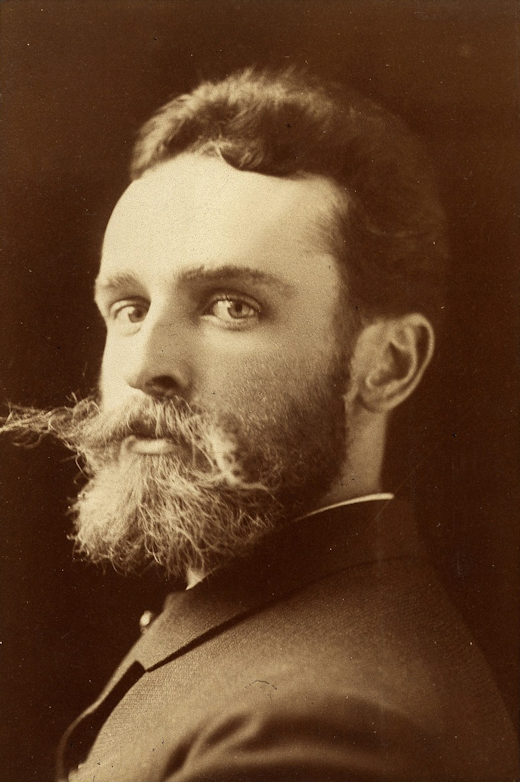
John White Alexander was an illustrator, landscape and still life painter, printmaker, muralist, society portraitist,  and production designer of posters, costumes, scenes, lighting, and tableaux vivants.  Alexander was born on October 7th, 1856, in Allegheny, Pennsylvania, which is now a part of the city of Pittsburgh.  He was orphaned at the age of five and was subsequently raised by his grandparents. When Alexander was 12 years old, he quit school and became a telegraph boy. One of his employers, Colonel Edward Jay Allen, the secretary/treasurer of the Pacific & Atlantic Telegraph Co., noticed Alexander’s aptitude for drawing and began working with him to help him develop that talent. So impressed with Alexander that he assumed guardianship of the young boy and persuaded him to return to the local High School for eighteen months.

Six years later, in December 1874, Alexander and a friend took a trip down the Ohio River,  earning money for food by sketching farmhouses and selling them to the locals.  It is said that Mark Twain read about their trip and a number of incidents on their voyage of exploration were used in his 1884 novel,  Huckleberry Finn.  Soon after his adventure, Alexander relocated to New York and spent three months seeking a job in New York City, visiting a number of publishers, showing his sketchbook.  He was finally employed as an office boy at Harper’s Weekly magazine where he was later promoted to illustrator and political cartoonist in 1875. He remained working for the magazine for three years. 

Alexander then travelled to Paris but found it very expensive and moved on to Germany and the city of Munich where he received his first formal artistic training at the Royal Academy, winning a bronze medal for drawing.    It was in Munich that Alexander first met Kentucky-born German painter, Frank Duveneck.  In 1878, Duveneck had opened a painting school in Munich.

Portrait of John White Alexander by Frank Davenek (1879)

However, like Paris, the cost of living in the city of Munich proved too onerous for Alexander and so he and Duveneck moved to the Bavarian town of Polling, a small town fifty miles east of Munich, where Duvenek set up another painting school and Alexander taught a private watercolour class in Duveneck’s school.  His students were known as the Duveneck Boys and included such aspiring painters as John Twachtman, Otto Henry Bacher, and Julius Rolshoven.  In 1879 Duvenek completed a portrait of John White Alexander.

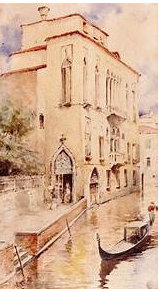
Venice Canal Scene by John White Alexander (1880)

From 1879 to 1881, Alexander travelled and studied with Frank Duveneck in Italy. The pair spent the summer of 1880 in Venice.    One day, Alexander met Whistler by chance as he was painting next to a canal. Alexander returned to America in 1881 and was able to pick up illustrative commissions from various magazines.  One such commission saw him travelling 2,100 miles along the Ohio River in the Spring of 1881 resulting in sixteen sketches of the local coal industry.

Oliver Wendell Holmes by John White Alexander

On his return to America besides returning to his work as an illustrator, he became a very successful portrait artist. Many well-known individuals sat for Alexander such as Oliver Wendell Holmes, an American physician, poet, and humourist notable for his medical research and teaching, and as the author of the “Breakfast-Table” series of essays.

…..also Thomas Worthington Whittredge, an American artist of the Hudson River School.

Walt Whitman by John White Alexander (1889)

….and Walter Whitman Jr. who was an American poet, essayist, and journalist. He is considered one of the most influential poets in American history.

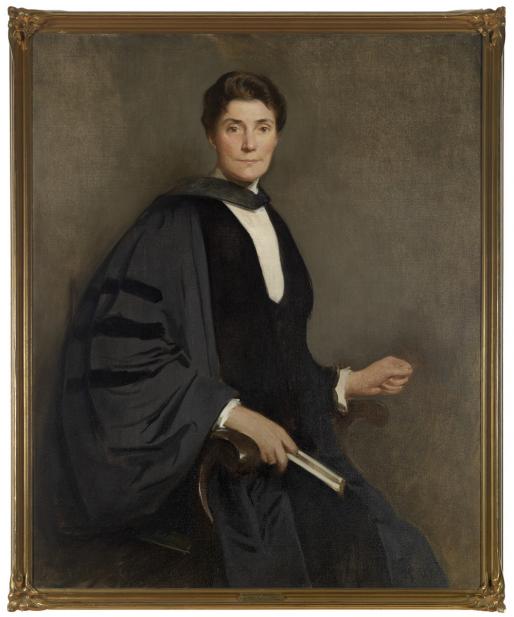
Mary Emma Woolley by John White Alexander

In 1909, Alexander completed the portrait of Mary Emma Woolley, an American educator, peace activist and women’s suffrage supporter. She was the first female student to attend Brown University and served as the 10th President of Mount Holyoke College from 1900 to 1937.  It is a beautiful portrait of the woman, exuding elegance and his brushstrokes along with the delicate shadows depict her as a dignified woman of great importance.  The sitter lightly thumbs a book with one hand while the other is clenched into a fist which was possibly referencing her knowledge and passion.  It is said that the way Alexander portrays Woolley validates a tendency among male artists of this era, who often painted women as domestic, inwardly emotional beings with exquisite exterior refinement.

Owing to the fact that they both had the same surname, John White Alexander was introduced to and later married, Elizabeth Alexander.  She was the daughter of James Waddell Alexander, president of the Equitable Life Assurance Society.   John and Elizabeth had one child, the mathematician James Waddell Alexander II.  In 1881 John White Alexander completed a black and white sketch of Elizabeth.

Portrait of Mrs John White Alexander (1902) by John White Alexander

……….and in 1902 he completed a full-length portrait of his wife.

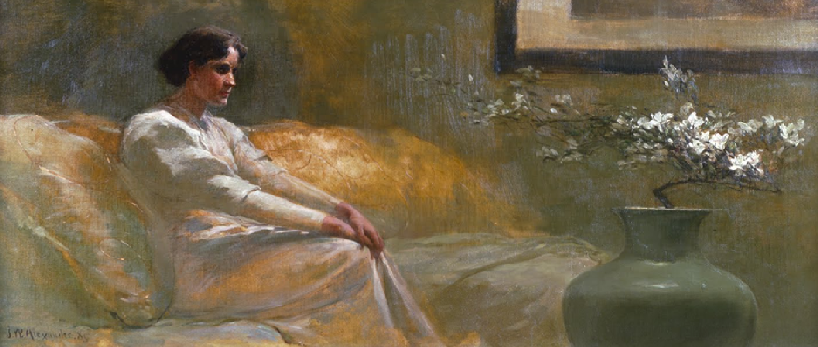
Azalea (Portrait of Helen Abbe Howson) by John White Alexander (1885)

A turning point in Alexander’s artistic career came when, during a summer European holiday in 1884, he wrote to his early mentor, Colonel Allen, telling him of his desire to complete a “subject picture”. The result was his 1885 painting entitled Azalea (Portrait of Helen Abbe Howson). In Alexander’s painting, we see Howson adorned in a white dress seated on a sofa on the left of the horizontally elongated painting.  To counteract that, on the right is a white-flowering azalea branch in a large celadon vase and on the back wall one can see the bottom of a framed image.  The main title of the painting refers to the flowers Helen Howson stares pensively across the room at.  This pose of Howson is one of contemplation and in many of his figurative works Alexander depicts women who avoid the gaze of the viewer.  Some believe that Alexander’s depiction of self-conscious subdued women may be his way of counteracting the growing activism of women in their battle for suffrage and other forms of equality that was manifesting around this time.

Whistler’s Mother by James Mcneil Whistler

Historians believe the depiction was influenced by Whistler’s portrait of his mother which had been exhibited in New York in 1882.  The poses are similar. The “cut-off” picture frame is depicted in both paintings.

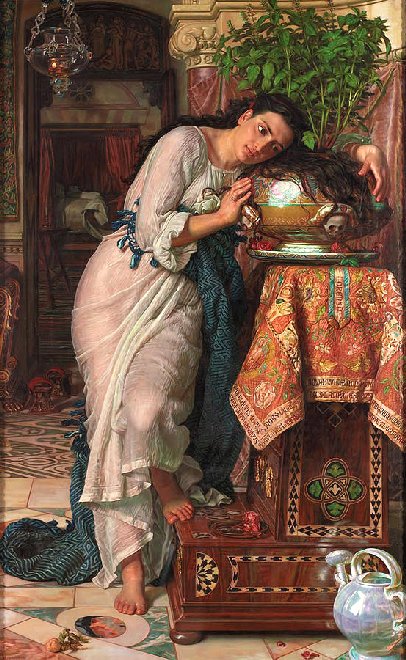
Six years later in 1897 Alexander completed another memorable work featuring a single woman.  It was entitled Isabella and the Pot of Basil and is based on a poem written by the English poet John Keats entitled Isabella, or the Pot of Basil. Keats had actually “borrowed” his tale from the Italian Renaissance poet Giovanni Boccaccio.  The story goes that Isabella was a Florentine merchant’s beautiful daughter whose ambitious brothers disapproved of her romance with the handsome but humbly born Lorenzo, their father’s business manager. The brothers murdered Lorenzo and told their sister that he had travelled abroad. The distraught Isabella began to decline, wasting away from grief and sadness. She saw the crime in a dream and then went to find her lover’s body in the forest. Taking Lorenzo’s head, she bathed it with her tears and finally hid it in a pot in which she planted sweet basil, a plant which is now associated with lovers. 

This scene was made famous by William Holman Hunt’s 1868 version…

 …….and the 1907 one by John Waterhouse,

However Alexander’s pictorial rendition of the scene is so different to the other two.  His depiction has used theatrical effects to depict this gruesome scene.  He has isolated Isabella in a shallow recess and illuminated her from below, almost as if she were an actor on a stage who has been illuminated solely by the footlights.

There is an eeriness about the way Alexander has utilised a cold monochromatic palette, and if we allow are eyes to follow the sensuous curves of Isabella’s gown, they are finally drawn to the loving attention Isabella gives the pot, as she gently caresses it. Isabella seems to be in a world of her own totally oblivious to us, the viewers.  It is a tragic depiction of lost love.

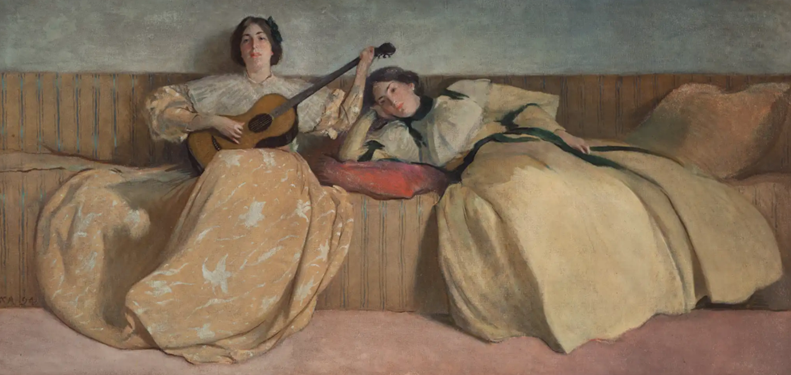
Panel for Music Room, by John White Alexander (1894)

There has always been a connection between fine art paintings and music.  So many famous works of art have depicted people playing musical instruments.  It is the conjoining of two great arts.  Many such paintings depict young ladies playing a musical instrument or intently listening to a musical recital.  Take a look at this beautiful work by John White Alexander as he depicts two young women laying back languorously on a long and plush sofa. 

Look carefully at their facial expressions.  The woman on the left who is playing the guitar is lost in concentration and in some ways seems mesmerised by the sounds coming from her instrument.  The woman on the right lies towards her resting on an ornate cushion.  She seems to be in a dream-like state lost in thought.  It is a frieze-like horizontally elongated depiction which measures 94 x 198cms (33 x 78 inches) portraying a dream-like atmosphere.

Memories by John White Alexander (1903)

Another of Alexander’s paintings featuring the interaction between two women is his 1903 work entitled Memories.

Repose by John White Alexander (1895)

One of Alexander’s most famous works is his 1895 painting entitled Repose. Once again it is a depiction of a woman lying languourously across a large cushion on a long sofa. The curves of her body can be seen despite the voluminous white dress she wears. Her head rests on her hand and she looks out at the viewer. 

The facial expression of the woman, whose lips are slightly parted, gives an added touch of sensuousness to the depiction. This provocative facial expression along with the sinuous curves are a reflection of the then current French taste for sensual images of women as well as the undulant linear rhythms of Art Nouveau.

Murals by John White Alexander on the Grand Staircase of the Art Museum of the Carnegie

Alexander held his first exhibition in the Paris Salon in 1893 and it was held to be a brilliant success.  Immediately following the exhibition, he was elected to the Société Nationale des Beaux Arts.  In 1901 he was named Chevalier of the Legion of Honor, and in 1902 he became a member of the National Academy of Design. He was elected a member of the American Academy of Arts and Letters and in 1900 at the Paris Exhibition he was awarded a gold medal.  Another gold medal was awarded to him in 1904 at the World’s Fair at St. Louis. His works are in museums in both America and Europe.

Grand staircase, Art Museum of the Carnegie Institute in Pittsburgh

In addition, in the entrance hall to the Art Museum of the Carnegie Institute in Pittsburgh, a series of Alexander’s murals entitled Apotheosis of Pittsburgh covers the walls of the three-storey atrium area.

View overlooking Grand Staircase of the murals by John White Alexander

At the top of the Grand Staircase of the Carnegie Art Museum in Pittsburgh, a cultural haven sponsored by industrialist Andrew Carnegie, there is a sweeping mural completed by John White Alexander in 1907.  This total number of murals cover almost 4,000 square feet of wall space of the interior.  The Apotheosis of Pittsburgh is a series of forty-eight murals, all painted by Alexander between 1905 and 1915.  The murals reflect turn of the century Western ideals of progress across three floors of the Grand Staircase. Alexander was given creative freedom for the project, and the resulting murals tell a story of Pittsburgh through the lens of Andrew Carnegie’s vision of the steel industry and the wealth gained through Industrial Capitalism that fuelled his philanthropy. Alexander completed the first elements of the mural in 1907 and the remainder in 1908.

Jonathan Scorch’s blog has a full description of the murals.

John White Alexander died May 31st 1915, aged 58, before finishing the mural panels for the third floor.

Laura Wheeler Waring. Part 2.

Houses at Semur by Laura Wheeler Waring (1925)

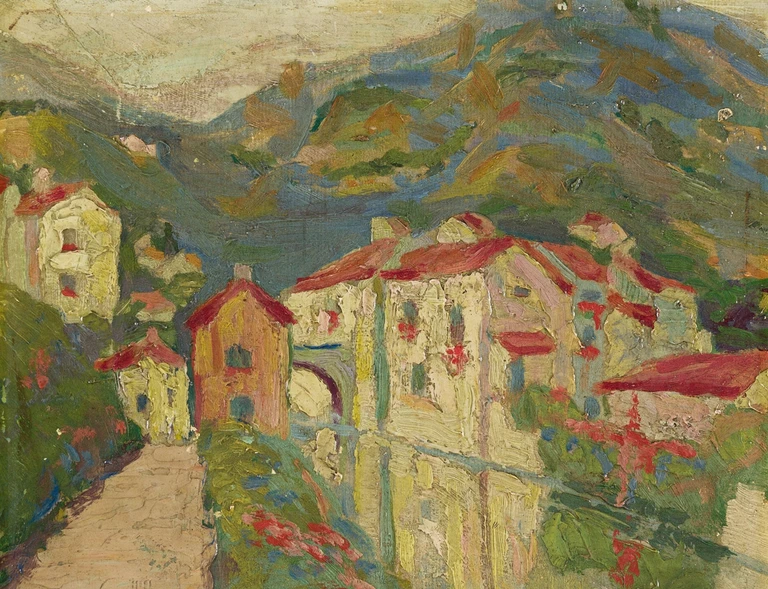
Saint-Jean-Pied-de-Port by Laura Wheeler Waring (1925)

After her short stay in the south of France, Waring returned to Paris in the Spring of 1925 and continued her studies at the Académie de la Grande Chaumiére whilst staying in the Villa de Villiers in Neuilly-sur-Seine.  That year Laura completed her paintings, Houses at Semur, France and Saint-Jean-Pied-de-Port. Critics believed this was a turning point in her artistic style as we see her use of vivid colours in order to express vivid, brilliant atmospheric conditions. Both works enhanced her growing reputation.  The following year, she had works shown at the Corcoran Gallery in Washington, D.C., the Brooklyn Museum, and the Philadelphia Museum of Art. And her standing in the art world was such that she was asked to curate the Negro Art section at the Sesquicentennial Exposition in Philadelphia.  

On June 23rd, 1927, Laura Wheeler was married to the Philadelphian, Walter Waring, a public-school teacher, who was ten years her junior and who was then working as a professor at the all-Black Lincoln University. The couple had no children. That same year, Laura won a gold medal in the annual Harmon Foundation Salon in New York. Laura Waring was actively painting during the Harlem Renaissance.  The Harlem Renaissance was an influential movement in African American literary, artistic, and cultural history from 1918 to the mid-to-late 1930s. The movement was originally referred to as the New Negro Movement, which referred to Alain LeRoy Locke’s 1925 book, The New Negro, which was an anthology that sought to motivate an African-American culture based in pride and self-dependence.

She was also involved with the Harmon Foundation.  It was established in 1921 by wealthy real-estate developer and philanthropist William E. Harmon who was a native of the Midwest, and whose father was an officer in the 10th Cavalry Regiment.  The Foundation originally supported a number of good causes but is best known for having served as a large-scale patron of African-American art and by so doing, helped gain recognition for African-American artists who otherwise would have remained largely unknown.

In 1944 the Harmon Foundation, which was under the direction of Mary Beattie Brady, organized an exhibition Portraits of Outstanding Americans of Negro Origin.  The idea behind the exhibition was to try and counteract racial intolerance, ignorance and bigotry by illustrating the accomplishments of contemporary African Americans. The exhibition featured forty-two oil paintings of leaders in the fields of civil rights, law, education, medicine, the arts, and the military. Betsy Graves Reyneau, Laura Wheeler Waring, and Robert Savon Pious painted the portraits that became known as the Harmon Collection. US Vice President Henry A. Wallace presented the first portrait, which featured scientist George Washington Carver, to the Smithsonian in 1944. The Harmon Foundation donated most of this collection to the Smithsonian’s National Portrait Gallery in 1967.

Anna Washington Derry by Laura Wheeler Waring (1927)

Laura Wheeler Waring will always be remembered for her portraiture and her most acclaimed work was not of the prosperous and famous African Americans which I have highlighted below but of a poor laundress, Anna Washington Derry.  She was one of five children who had moved with her family from Maryland to the eastern Pennsylvanian town of Strodsburgh, a borough in Monroe County.  Monroe was home to a small free Black community who had arrived via the Underground Railroad, a network of secret routes and safe houses used by enslaved African Americans to escape into free states.

The beautiful realistic depiction of the old lady beautifully conveys the lady’s dignity and inner determination through her use of simple, brown-beige tones of her dress, her expressive face, her folded arms and hands.  In the town where she lived Derry was looked upon as that of a community matriarch who was fondly addressed locally as “Annie”. The portrait was unveiled in 1926 at an elite exhibition for Black Philadelphian professionals some of whom may not have identified with Waring’s “ordinary” subject. The art historian Amanda Lampel commented:

“…Although Derry’s portrait did not sell that day, the Philadelphia Tribune, the oldest continuously published African American newspaper in the United States, called it remarkable……… Compared to fellow contemporaries like Aaron Douglas, Waring was much more conservative in her painting style and subject matter. This was in keeping with the types of artists who won the prestigious Harmon Foundation award, which sought to spotlight the up-and-coming Black artists of the Harlem Renaissance. Most of the award winners painted more like Waring and less like Douglas…”

In 1927 Laura exhibited the portrait of Anna Washington Derry at New York’s Harmon Foundation where it received the First Award in Fine Art – Harmon Awards for Distinguished Achievement Among Negroes. From there it was exhibited at Les Galeries du Luxembourg in Paris and across America.  The depiction was often reproduced in magazines and journals. The exhibition had its premiere at the Smithsonian Institution on May 2nd, 1944.  For the next ten years, Portraits of Outstanding Americans of Negro Origin, exhibition, travelled to museums, historical societies, municipal auditoriums, and community centres around the United States.  The public response was overwhelmingly positive in every venue.

James Weldon Johnson by Laura Wheeler Waring

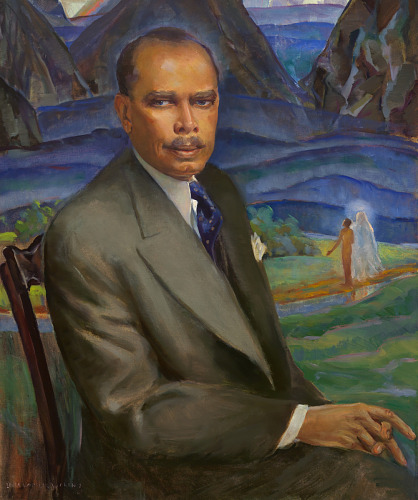
Laura Wheeler Waring will be most remembered for her portraits of successful, upper class Negroes and whites including James Weldon Johnson, the successful Broadway lyricist, poet, novelist, diplomat, and a key figure in the NAACP, National Association for the Advancement of Coloured People.  In 1900, he collaborated with his brother to produce “Lift Every Voice and Sing,” a song that later acquired the subtitle of “The Negro National Anthem.”

William Edward Burghardt Du Bois by Laura Wheeler Waring

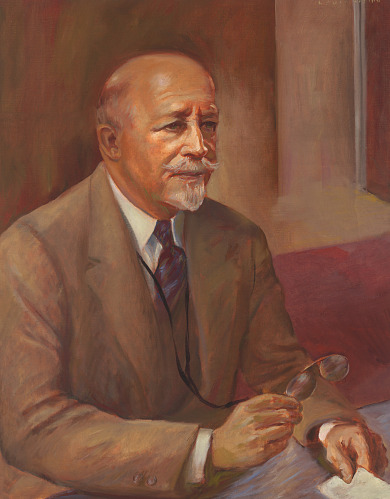
Another sitter for Laura was William Edward Burghardt Du Bois (W.E.B. DuBois), who was the first African-American to earn a doctorate from Harvard University  He then became a professor of history, sociology, and economics at Atlanta University, and  co-founder of the National Association for the Advancement of Coloured People (NAACP), and founder and editor of the NAACP’s magazine The Crisis. Laura Waring had worked for Du Bois, creating several illustrations for The Crisis. Laura depicts Du Bois seated at a wooden desk or table, looking to the right. The spectacles he holds in his right hand, and the small paper he holds in his left, confirm his status as an intellectual and academic.

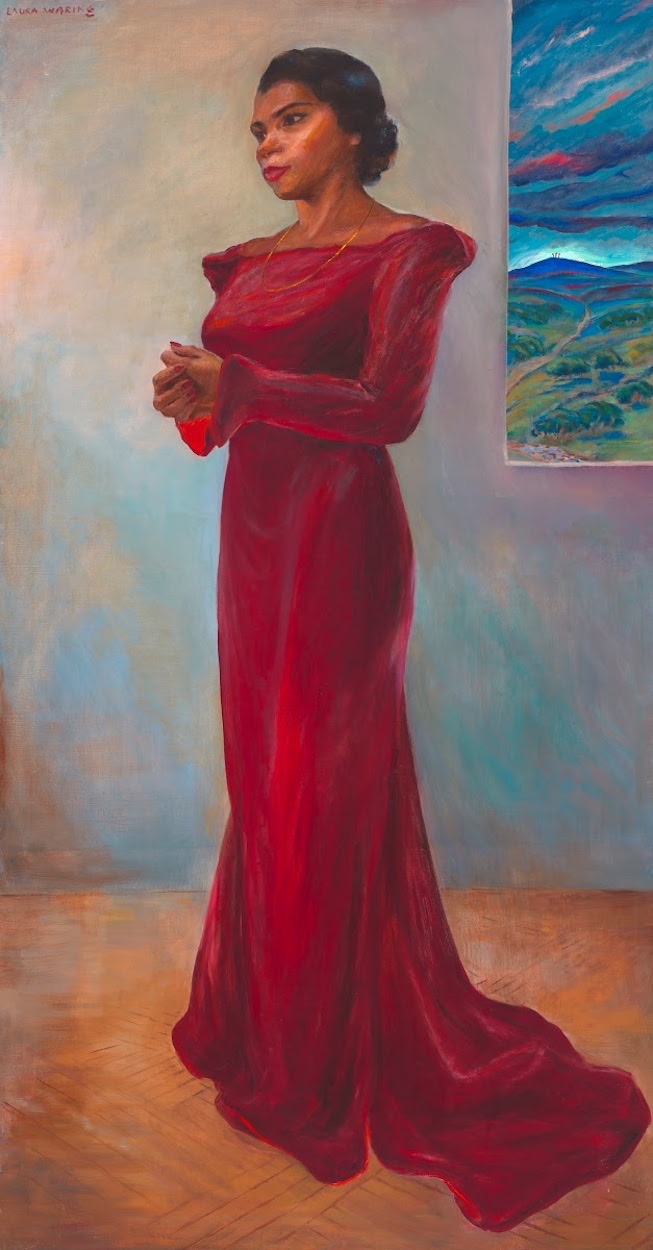
Marian Anderson by Laura Wheeler Waing (1947)

Many women were sitters for Laura’s portraits including Mary White Ovington, an American suffragist, journalist, and co-founder of the National Association for the Advancement of Coloured People (NAACP).  Another of her most famous female portraits was of  the opera singer, Marian Anderson.  This contralto singer, like many African American artists of the time, first achieved success in Europe. She was persuaded to return to America in 1935 and that year had a triumphant concert which secured her standing in the opera world.  In 1939 she became embroiled in a historic event when the Daughters of the American Revolution banned her appearance at its Constitution Hall because she was black. President Roosevelt’s wife, Eleanor, stepped into this controversial banning and arranged for her to take top billing at the Easter Sunday outdoor concert at the Lincoln Memorial, an event which drew in 75,000 opera fans as well as having the event broadcast to a radio audience of millions.

Jessie Redmon Fauset by Laura Wheeler Waring (1945)

Another female to have her portrait painted by Laura Wheeler Waring was Jessie Redmon Fauset, the first African American woman to be accepted into the chapter of Phi Beta Kappa at Cornell University, where she graduated with honours in 1905. Fauset then taught high school at M Street High School (now Dunbar High School) in Washington, D.C., until 1919  She then moved to New York City to serve as the literary editor of the NAACP’s official magazine, The Crisis. In that role, she worked alongside W. E. B. Du Bois to help usher in the Harlem Renaissance of the 1920s.

Alice Dunbar-Nelson by Laura Wheeler Waring (1927)

In the 1890s women formed national women’s club federations, most of which were dominated by upper-middle-class, educated, northern women. Few of these organizations were bi-racial, a legacy of the sometimes uneasy mid-nineteenth-century relationship between socially active African Americans and white women. Rising American prejudice led many white female activists to ban inclusion of their African American sisters. The black women’s club movement rose in answer in the late nineteenth century. The segregation of black women into distinct clubs produced vibrant organizations that promised racial uplift and civil rights for all blacks, as well as equal rights for women. Soon there followed another, more powerful group known as the National Association of Coloured Women in 1896. Women, including Laura Wheeler Waring and Alice Dunbar-Nelson, came together from a variety of backgrounds to combat negative stereotypes and fight for basic rights. Alice Dunbar-Nelson became the subject of Laura Wheeler Waring’s 1927 portrait. By the time the portrait was completed, Dunbar-Nelson was a prominent political activist and journalist and was much in demand as a public speaker. The depiction of her radiates her self-confidence and both artist and sitter were talented, intellectual women whose friendship helped advance the rights of both women and African Americans.

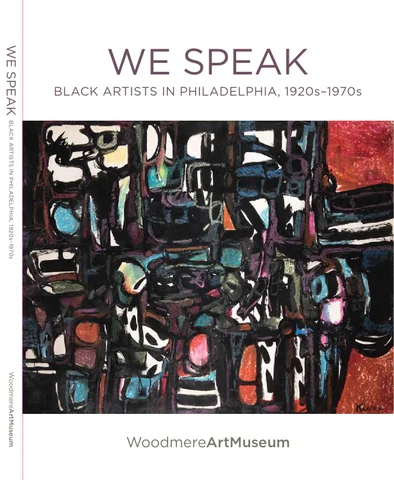
Waring died on February 3rd, 1948, aged 60, in her Philadelphia home after a long illness.  She was buried at Eden Cemetery in Collingdale, Pennsylvania. In 1949, Howard University Gallery of Art in Washington, D.C. held an exhibition of art in her honour.  Her paintings were also included in the 2015 exhibition We Speak: Black Artists in Philadelphia, 1920s-1970s at Philadelphia’s Woodmere Art Museum.

Laura Wheeler Waring (1887-1948)

There is no doubt that although Laura spent most of her life in America she always treasured her three stays in France which played an important role in her artistic progress. During those three periods on French soil she was able to engage in its culture, and associated with famous French, African, and African American intellectuals. Her scholarship, her study at the Academie de la Grande Chaumiere, and her solo exhibition in Paris gave her recognition in the United States in the form of awards, supervisory and teaching positions, and additional exhibitions.  Like many of her colleagues, Waring cherished the freedom she found abroad, declaring in her diary:

“…In my very busy seasons here to come I shall want to relive some of these moments of atmosphere. I record them so that I can never say “I wish I had enjoyed that more” or “I didn’t apprecate all that then but now—[.]” I can never say the above truthfully because am grateful every minute and even the least of things gives me a thrill. . . . The very feeling of freedom is a pleasure and the ride on the bus down will be a joy…”


Much of the information for this blog and many of my other blogs in the past has come from an excellent website entitled The Art Story.

Other sources were:

A CONSTANT STIMULUS AND INSPIRATION”: LAURA WHEELER WARING IN PARIS IN THE 1910s and 1920s by Theresa Lieninger-Miller

BLACKPAST

SPEEDWELL

Laura Wheeler Waring. Part 1.

The art critic Patricia Tilton commented on the artist I am featuring today, Laura Wheeler Waring, writing:

Waring is the perfect role model for little girls who have big dreams. Determined and committed to pursuing her passion, young Laura began to manifest her dreams. She was self-confident, believed in her gift, and welcomed each opportunity that came her way.

Laura Wheeler, later Laura Wheeler Waring, was born in Hartford Connecticut on My 26th 1887.  She was the fourth of six children. 

Her father was Reverend Robert Foster Wheeler, who was the pastor of the first all-Black church in Connecticut, the Talcott Street Faith Congregational Church. It had been built in 1819 as a place for African Americans to worship on their own since they were previously only able to worship in the backs of churches and in church galleries in that city.  Her mother was Mary Wheeler (née Freeman), who was a teacher and amateur artist. Laura’s maternal grandparents were Amos Noë Freeman, who was a Presbyterian minister, and her maternal grandmother, Christiana Williams Freeman, was an anti-slavery activist who worked as part of the Underground Railroad which was the given name to a secret network of escape routes and safe houses run by abolitionists in Portland, Maine, and Brooklyn, New York. Laura’s family were well educated.  Her father studied Theology and graduated from Howard University in 1877 and her mother graduated from Oberlin College.

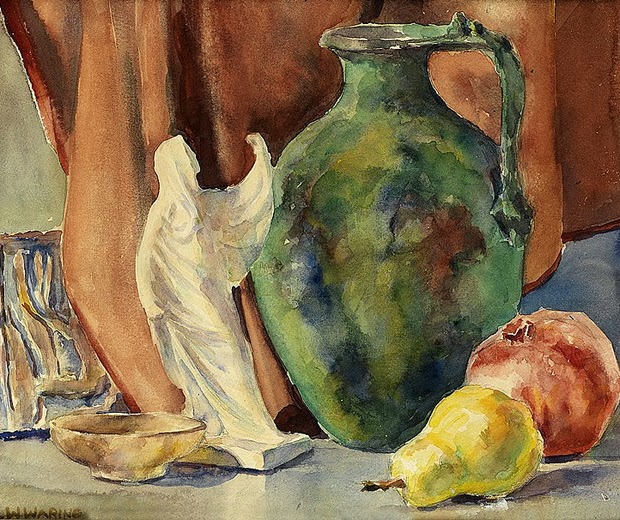
Still life with Heather by Laura Wheeler Waring (1927)

Laura’s parents were determined that their children should learn about African history and were attendees at the local bible classes.  The family would also make regular visits to Hartford’s Wadsworth Atheneum Museum of Art as well as other local art events. The children soon developed a love of art and would frequently sit around their dining room table to sketch and paint together. The American art critic Patricia Campbell Carlson wrote about young Laura:

“…[Waring] would even bribe her brothers and sisters with peppermints to get them to pose for her. And although she knew there were no portraits of African Americans in museums yet, she hung her paintings in her room as a ten-year-old so that her sisters and brothers could see pictures of people with all different shades of brown staring back at them,,,”.

After Sunday Services by Laura Wheeler Waring

Laura Wheeler Waring attended Arsenal Grade School and Hartford High School and was a model student who graduated from Hartford with honours. Whilst at the High School she showed an interest in art and the school fostered this love of hers, encouraging her enthusiasm for drawing and painting with watercolours.  She graduated from Hartford High School in 1906 with honours.

Institute for Colored Youth Building Historical Marker

In the Autumn of 1907, Laura, now a twenty-year-old, through the auspices of her father was offered and accepted a position at the Institute for Coloured Youth, an African Institute, a trade school that taught young Black people necessary skills to retain employment and later became a training institution for teachers. In 1902, the Institute moved to George Cheyney’s farm, 25 miles west of Philadelphia, and afterward the name “Cheyney” became associated with the school and became known as the Cheyney Training School for Teachers. Nowadays and since 1983 it has become the Cheyney University of Pennsylvania.

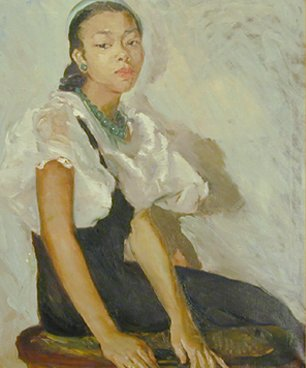
Girl in Green Cap by Laura Wheeler Waring

Times were difficult financially for Laura who was paid just seven dollars a month although room and board were provided. She needed money to pay the train fare to Philadelphia where she attended drawing classes, still life painting, portraiture, and illustration at the Pennsylvania Academy of the Fine Arts.   She remained there for the next six years.  The person who influenced Laura the most at the Academy was Henry Bainbridge McCarter, an American illustrator and painter known for his influence on the modernistic art movements. McCarter had worked as an illustrator in New York before becoming an instructor at the Pennsylvania Academy of the Fine Arts for forty years.  He managed to encourage Waring to take on board and appreciate Impressionism and Post-Impressionism.

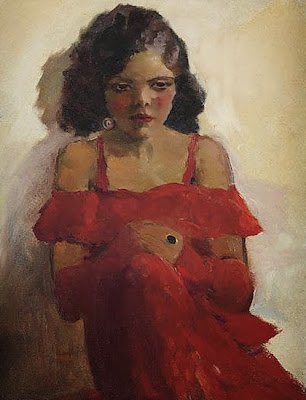
Girl in Red Dress by Laura Wheeler Waring

In 1914, Laura graduated from the Academy, and she was awarded the William Emlen Cresson Memorial Travel Scholarship. The Pennsylvania Academy of the Fine Arts prize was a two-year scholarship for foreign travel awarded annually to their art students.   This award for artistic excellence, which began in 1902, was funded by Emlen and Priscilla Cresson in memory of their son William Emlen Cresson, an Academy alumnus, who died in 1868 at the age of 23. He had been a child prodigy painter who began exhibiting at the Academy at a very young age. The award allowed recipients to study art at the Louvre.  Laura was the first Black woman to receive the award,

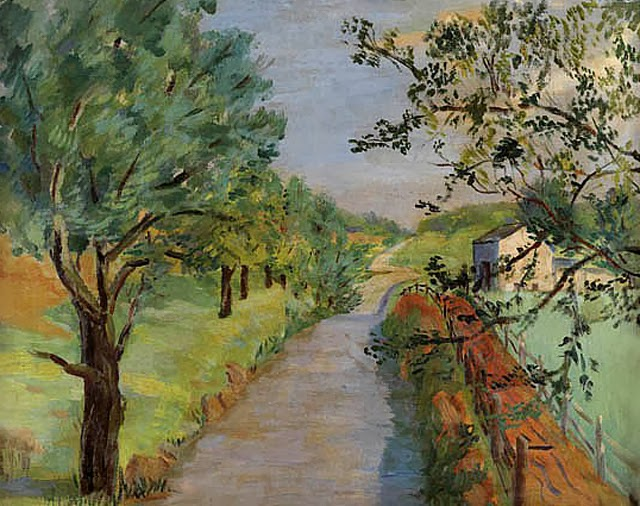
A Rural Landscape by Laura Wheeler Waring

Whilst in Paris Laura studied at the Académie de la Grande Chaumière and travelled throughout Great Britain. During her stay in the French capital, she spent much time in the Louvre Museum studying the works of Monet, Manet, Corot, and Cézanne. In Theresa Leninger-Millerher article:  A constant stimulus and inspiration”: Laura Wheeler Waring in Paris in the 1910s and 1920s, she quotes Laura as saying:

“…I thought again and again how little of the beauty of really great pictures is revealed in the reproductions which we see and how freely and with what ease the great masters paint…”

Still Life with Fruits by Laura Wheeler Waring

Laura Wheeler Waring had originally planned to travel more around Europe visiting Switzerland, Italy, Germany, and the Netherlands, but her trip was cut short when war was declared in Europe and she had to return to America.

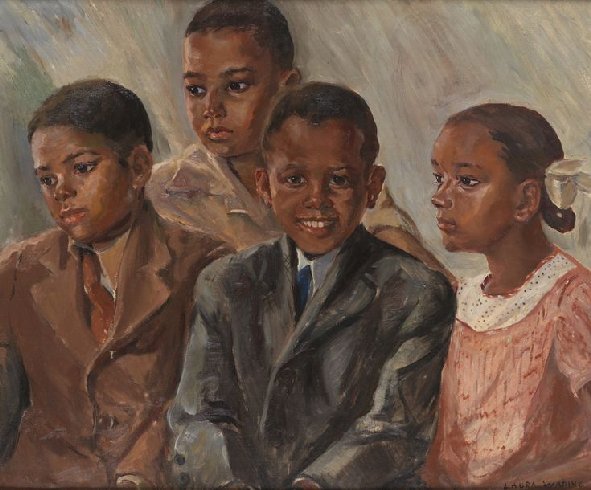
Four Friends by Laura Wheeler Waring

Back in America, Waring returned to teaching at Cheyney, and she played an important role in setting up the school’s new art and music departments. For thirty years she acted as the department’s art director and Chair, and between 1921 and 1934 she conducted the Cheyney Choir, training her students in high-toned spirituals and classical music. The Cheyney College like the local church, the Thornbury African Methodist Episcopal Church, slowly became the community centre for the black residents of Cheyney. Laura took her choir to sing at the church.  It was through her involvement with the church that she first met Annie Washington Derry, who would later become the subject of her most famous portrait which she completed in 1927 and which is owned by the Smithsonian is American Art Collection in Washington DC.

Landscape with River by Laura Wheeler Waring

Laura took a year out from teaching between 1924 and 1925 and returned to Paris.  This time she was accompanied by African-American novelist and poet, Jessie Redmond Fauset. On her arrival at the French capital she enrolled for classes in Expressionism and the Romanticism which were run by French artist and designer Bernard Boutet de Monvel, and the American painter Robert Henri. In October 1924 she enrolled to study at the Académie de la Grande Chaumiére, where she studied painting and it was here that she began her life-long love of portraiture.

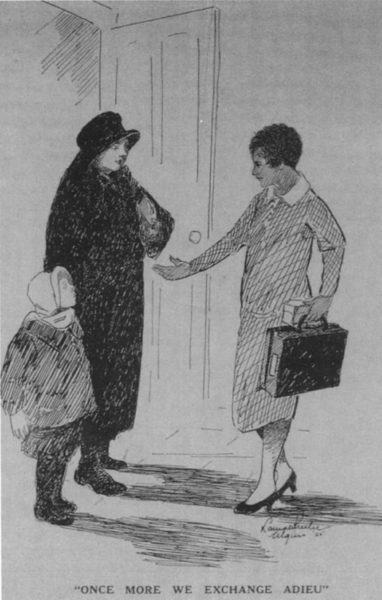
Once More we Exchange Adieu by Laura Waring (1925)

In January 1925, Laura Waring travelled to the South of France where she spent four days in the coastal town of Villefranche-sur-Mer. While living there she began to create illustrations for short travel stories and completed a number of figurative pen and ink drawings for The Crisis magazine. One of these was her pen and ink drawing entitled Once More We Exchange Adieu.  It depicts an African American woman dressed in a modern collared long sleeve dress, with black pumps holding a briefcase and waving goodbye to a white woman and child dressed in winter attire.

Houses at Semur by Laura Waring (1925)

Saint-Jean-Pied-de-Port by Laura Waring (1925)

In the next blog I will be looking at Laura Wheeler Waring’s portraiture, a genre which she is most famous for.

……………………………………………………to be continued.

Ethel Sands and Anna (Nan) Hope Hudson

The blog today is about two talented early twentieth century painters who became lifelong friends and companions despite them having different ideas as to what was a “perfect” life.  Ethel Sands preferred the life of a socialite and enjoyed lavish soirees and was reputed to be one of the most important hostesses in cultured English society in the early twentieth century. However, Nan (Anna Hope) Hudson was more introverted, and craved a quiet rural lifestyle in her beloved France and Sands and Hudson apportioned their time between England and France to accommodate their lifestyle preferences . The art historian Wendy Baron described them as:

“…two independent, individual women with many tastes and interests in common, whose mutual love and understanding rescued them from the loneliness of spinsterhood…”

Ethel Sands (c.1927)

Ethel Sands was born on July 6th 1873 in Newport, Rhode Island.  She was the first-born child of Mary Morton Hartpence and Mahlon Day Sands who married in 1872. It was Mahlon’s second wife.  His first wife Edith Mintum died of typhus in 1868 whilst on a sea voyage.  Mahlon Sands was secretary of the American Free Trade League, as well as being a partner of his deceased father’s pharmaceutical importing firm, A.B. Sands and Company.   Mary and Mahlon also had two young sons, Mahlon Alanson Sands and Morton Harcourt Sands, who were five and eleven years younger respectively than their sister Ethel.  The three children were brought up in a well-to-do upper-class family household.

Still Life with a View over a Cemetery by Ethel Sands (1923)

When Ethel was eleven-years-old the family left America for what was supposed to be a short trip to England but, once there, decided to base themselves in London which they thought was a good base for onward travelling to the European countries.  However, they kept their house in Rhode Island and would return there once every year

Tea with Sickert by Ethel Sands (1912)

Mary and Mahlon moved amongst the wealthy London society, such as the Rothschild family and politicians, such as Gladstone, the writer Henry James and the artist John Singer Sargent.  They were also part of Edward VII, the Prince of Wales’ “Malborough House” social circle. 

Mrs Mahlon Day Sands by John Singer Sargent (1894)

Ethel’s mother Mary was considered to be a famous Society beauty of the day who had her portrait painted by Sargent and Henry James based his heroic character “Madame de Mauves” on her in his novella which centred on the troubled marriage of a scrupulous American wife and a far from scrupulous French husband.  Ethel Sands inherited a taste for socialising from her American parents.

Nan Hudson playing Patience at Chateau d’Auppegarde

Ethel Sands’ happy family life came to a shuddering halt when she was thirteen for in May 1888, her father, whilst out riding through Hyde Park, was thrown from his horse and died, aged 46.  Ethel’s mother was now tasked with bringing up the family on her own.

Nan Hudson c.1908

John Singer Sargent had encouraged Ethel to concentrate on her art and she took his advice for in 1894 when she was twenty-one, she decided to go to spend time in Paris to study painting.  Ethel began her artistic education at the Académie Carrière in Paris. Her early paintings featured highly coloured still-life works and interior depictions. Sands first exhibited her work in an exhibition held at the Salon d’Automne, Paris in 1904.  It was in 1894, whilst an art student that she met her lifelong partner Anna (Nan) Hope Hudson.

The Lamb Inn, Wallingford by Nan Hudson (1912)

Anna Hudson, best known as Nan Hudson, was born on September 10th 1869 in New York City. Her father was Colonel Edward McKenny Hudson, who died in 1892 at the age of sixty-seven; her mother had died in 1878 when Nan was just 9 years old. Having lost both parents, twenty-three year old Nan was left a large inheritance which was the result of her grandfather’s success as a partner of a banknote engraving organization, which later merged to become the American Bank Note Company.  Now, a young woman of independent means, was able to choose her own future. She had developed a love of painting and decided to follow this love and decided that Paris offered the best opportunity to further her artistic knowledge.  In the early days of living in the French capital she met Ethel Sands, a fellow American and art student who became her lifelong friend and companion.

Nan and Ethel studied together in 1896 at the studio of the French painter Eugène Carrière and then from January 1897 Nan also took classes with the Flemish painter Henri Evenepoel.  The friendship between Ethel and Nan, which started as study friends, soon blossomed and before long, they became inseparable.  This closeness is somewhat astonishing as the two women had totally different personalities.  While Ethel Sands found life in London, with all its social distractions, irresistible, Nan Hudson preferred the quieter existence in Paris and the French countryside.  However, they managed to compromise, dividing their time between France and England to satisfy both their yearnings, alternating periods of painting with travelling, socialising and entertaining.

Miss Hudson at Rowlandson House by Walter Sickert (c.1910)

The writer Virginia Woolf, in her diaries, described Nan Hudson as being dour and upstanding who was always stylishly dressed while the artist Walter Sickert, in a letter to the pair, described Nan as being the radiant and dashing horsewoman of a young man’s dreams.  In 1910 Walter Sickert completed a portrait of Nan Hudson, standing hand on hip and looking directly at the viewer, and captures her independent spirit and flair.  The painting was given the title Miss Hudson at Rowlandson House.

Portrait of Ethel Sands by Walter Sickert (1914)

After Nan and Ethel had made a trip to Venice, Nan completed a painting entitled Giudecca Canal and she had it exhibited at the Salon d’Automne in 1906.  It was liked by the critics and greatly admired by Walter Sickert. At first, he did not realise that the work was by her but once he found out he contacted her offering her advice on painting for the future. This initial letter to her resulted in a long-running correspondence between them and genuine friendship that lasted for many years. In 1907 Sickert invited both Nan Hudson and Ethel Sands to join the Fitzroy Street Group, which he had just formed and meetings were held in his studio in Fitzroy Street, to the north of central London.  The reason for this invitation could be because he admired their work or cynics would say it was more to do with their financial and social status both of which Sickert wanted to “explore”.  Both women accepted the invitation. Their main purpose of the group was to explore contemporary styles and methods, which they believed would challenge the conventional traditions of the New England Art Club. It was to be the establishing of the first artists’ collective.

Ethel Sands by Lady Ottoline Morrell vintage snapshot print, 1909 NPG Ax140123 © National Portrait Gallery, London

In 1911 many of the Fitzroy Group Group’s members, including Walter Sickert, formed the nucleus of the new Camden Town Group, and by November 1913 the Fitzroy Street Group had ceased to exist.  Unfortunately for Ethel and Nan the Camden Town Group was only open to male artists and so neither Nan or Ethel were not invited to join this new group. However, in 1913, a new grouping was formed known as the London Group.  The London Group was formed by a merger of the Camden Town Group and the English Cubists, later known as the Vorticists. It was the coming together of radical young artists who were defying the stranglehold which the Royal Academy had on exhibiting new works of art. The group was open to both male and female artists and Ethel Sands and Nan Hudson became founder members.

The Visitor by Nan Hudson

Up till this time Nan Hudson had only exhibited her work in Paris at the Salon d’Automne but through Ethel Sand’s contacts within the London art scene she began to show her work in London and exhibited her work at the New English Art Club, the Allied Artists’ Association and the Leicester Galleries.

Château d’Auppegard by Nan Hudson

At the start of the First World War, Hudson and Sands went to France and helped set up a hospital for wounded soldiers near Dieppe. This was forced to close but Nan Hudson continued to nurse both in England and in France until autumn 1918.  During the spell in Normandy during the war Nan Hudson fell in love with the area and after the war in 1920, she bought the Château d’Auppegard.  It was a seventeenth-century house with a grey slate gabled roof which lay about ten miles inland from Dieppe in the Normandy countryside.  This became their dream home and she and Ethel Sands spent the summers together and devoted much time and energy in its restoration and decoration. The two women renovated the dilapidated dwelling, even commissioning murals from the Bloomsbury artists Vanessa Bell and Duncan Grant for the loggia.

A Dressing Room by Ethel Sands

Nan Hudson completed a painting depicting her beloved chateau which is now part of the Tate collection.  She used a restricted palette of cool tones.  The depiction is typical of her later works when she tended towards landscapes with an element of architectural interest.   From 1926 onwards Nan concentrated on depicting rural landscapes found around the outskirts of Dieppe and the commune of Auppegard.  Many other landscape works came from the extensive touring around France in the Spring and early Autumn done by her and Ethel Sands.

Honfleur Harbour by Nan Hudson

Very few of Ethel Sands and Nan Hudson’s paintings survived the Second World War. Ethel Sands’ house in London was destroyed following a direct hit on it during the Blitz which obliterated much of both of their work. As well as this, Château d’Auppegard itself sustained extensive damage from bombing and looting that followed, when many drawings and paintings, including a collection of works by Sickert and Augustus John, were stolen, never to be seen again. It is very likely that paintings by the Ethel and Nan were therefore lost too.  Ethel and Nan returned to Auppegard in May 1946 and were horrified to witness the devastation of their beloved home.   One visitor to the chateau was Vanessa Bell who visited them in that September and she wrote about what she witnessed first-hnd:

“…The house has been terribly damaged by a flying bomb which exploded near. They have managed to repair the worst things and when one drives up to it [it] is still very lovely. But inside only the dining room is usable, and they have hardly any furniture and just enough for themselves. Poor old things – as they say, they are too old to begin all over again and they certainly do look very aged and decrepit…”

Still Life with Picture of the Madonna by Ethel Sands

However. the two occupants of the chateau, both then in their seventies, would not be defeated by the devastation and set about trying to repair it.  Age finally defeated them as far as renovating the chateau and Nan began to worry about its fate once she and Ethel had died.  In the end they decided to give the house over to a young friend of theirs, an amateur painter, Louis le Breton, on the understanding that it would eventually be bequeathed to the French nation. He, like the two owners of the chateau, shared their passionate love of the house and they felt sure that after they had died, his love of the Auppegard property would be preserved and cherished. Hudson and Sands continued to live at the château within a specially adapted self-contained apartment but their careful planning for the future of the building came to naught when Louis le Breton pre-deceased both of them, dying suddenly in the garden at Auppegard in March 1957.

Still Life with Books and Flowers by Ethel Sands

Nan Hudson became too ill to live there and was cared for initially by her life-long companion, Ethel and latterly at a nursing home in Kilburn, London, dying just a few months later in September 1957 aged eighty-eight.

Auppegard Church from the Chateau by Ethel Sands

Her funeral was held at Auppegard and she was buried in the churchyard facing her beloved château.

Ethel Sands died on March 19th 1962, aged eighty-eight.

Nettie Blanche Lazzell

Blanche Lazell during her time at the Art Student League, New York

Cornelius Carhart Lazzell, a direct descendent of pioneers who settled in Monongolia County, West Virginnia, after the American Revolutionary War, married Mary Prudence Pope and the couple went on to have ten children, three sons and seven daughters.  The ninth child was Nettie Blanche Lazzell who was born on October 10th 1878 and it is she who is the subject of today’s blog. 

The Lazzell family, who were devout Methodists, lived on a large farmstead near Maidsville, West Virginia, which lies close to the Pennsylvania border.  The town was thought to have been named Maidsville on account of there being a large proportion of “old maids” among the first settlers !  Her education during her early days was at the one-room schoolhouse on the property where students from the first through to eighth grades were taught from October through February.

Amarylis by Blanche Lazzell (1930)

In 1891, when Blanche was just twelve years old, her mother died, aged 48. In her early teens Blanche experienced hearing problems and became partially deaf and it was not until a year later that a Baltimore doctor was able to remedy her illness.  In 1893, at the age of fifteen, Blanche enrolled at the West Virginia Conference Seminary, which is now the West Virginia Wesleyan College.  From there, in 1899, she transferred to the South Carolina Co-Educational Institute in Edgefield. Once she graduated from the Institute, she became a teacher at the Red Oaks School in Ramsey, South Carolina. In spring of 1900, she returned to her Maidsville home, where she tutored her younger sister, Bessie.   In 1901, she studied art at West Virginia University and did well, receiving a degree in art history and the fine arts in 1905.  She continued to study at WVU on a part time basis until 1909, allowing her to broaden her knowledge of art and twice substituting as a painting teacher.

West Virginnia Coal Works by Blanche Lazzell (1949)

In 1908, at the age of thirty, she moved to New York and enrolled at the Art Students League.  The League had been formed in 1875 to provide more variety and flexibility in education for artists than it was felt the National Academy of Design provided. This breakaway group of art students included many women, many of whom, in the late 1890s and early 1900s, took on key roles. In Marian Wardle’s book: American Women Modernists: The Legacy of Robert Henri, 1910-1945. She recounts the words of the American artist Edith Dimmock regarding the atmosphere at the Art League:

“…In a room innocent of ventilation, the job was to draw Venus (just the head) and her colleagues. We were not allowed to hitch bodies to the heads——yet. The dead white plaster of Paris was a perfect inducer of eye-strain and was called “The Antique.” One was supposed to work from “The Antique” for two years. The advantage of “The Antique” was that all these gods and athletes were such excellent models: there never was the twitch of an iron-bound muscle. Venus never batted her hard-boiled egg eye, and the Discus-thrower never wearied. They were also cheap models and did not have to be paid union rates…”

During her time at the Art League Blanche studied under Kenyon Cox and William Merritt Chase and one of her fellow students was Georgia O’Keeffe. 

SS. Ivernia

On July 3rd 1912, Lazzell set sail on an American Travel Club cruise on the Cunard liner SS Ivernia, crossing the Atlantic and arriving in England. From there Blanche visited the Netherlands, Belgium and Italy.  She was fascinated by the architecture of the various churches she visited.   

Sailboat by Blanche Lazzell

In August she left the tour party and travelled to Paris.  She then stayed in a pension in Montparnasse on the Left Bank.  She moved into the Students’ Hostel on Boulevard Saint-Michel, one of the two major streets in the Latin Quarter of Paris, running alongside the Luxembourg Gardens.  During her stay in the French capital, she took lessons at the Académie de la Grande Chaumière, Académie Julian, and Académie Delécluse.  She eventually established herself at the Académie Moderne where her tutors were the post-impressionist painters Charles Guérin and David Rosen.  Of all the art tuition she received in Paris she was the most contented with the ideas and techniques behind the Parisian avant-garde art, a genre which pushed the boundaries of ideas and creativity, which she learnt about at the Académie Moderne.

The Monongahela River at Morgantown by Blanche Lazzell (1939)

Blanche returned to America on the White Star passenger liner, SS Arabic, at the end of September 1913.  On her return to America Blanche went to live with her younger sister Bessie in Morgantown.  During her European travels Blanche built up a portfolio of sketches and paintings enough for her to have a solo exhibition in December 1914.  To make ends meet, she rented a studio in town and taught art as well as selling her hand-painted chinaware.

Byrdcliffe Artist Colony

Byrdcliffe Artist Colony

In the summer of 1917, Blanche spent time at the Byrdcliffe Arts Colony, an artists’ colony just outside Woodstock, New York.  The Byrdcliffe Art Colony was founded by Jane Byrd McCall and Ralph Radcliffe Whitehead and colleagues, Bolton Brown, an artist and Hervey White, a writer.  The name of the colony came from an amalgamation of Jane and Ralph’s middle names.  It was founded in 1902 and the complex was formed of a number of Arts and Crafts cottages.  It was there that visual artists, poets, and musicians found their muses and spent time creating works of art, music and poetry. In later times famous people, such as Bob Dylan, writer Thomas Mann, and even famous actors, Helen Hayes, and Chevy Chase, spent time at Byrdcliffe.  Blanche studied under the Belgian-born artist William Schumaker who whilst in Paris had come into contact with European avant-garde artists.  On his return to America he brought with him modernist principles.  The term modernism in art was a rejection of history and conservative values such as realistic depiction of subjects; it was an innovation and experimentation with form, that is to say, the shapes, colours and lines that make up the work have a tendency towards abstraction.  From 1913 to 1931, Schumaker was artist-in-residence at the artists’ colony at Byrdcliffe.

Still Life by Blanche Lazzell

In 1918 Blanche Lazzell left Morganstown and moved permanently to Provincetown, which is situated on the northern tip of Cape Cod, Massachusetts, a place she had previously visited in 1915.   She made the town her summer base while wintering back in Morganstown and Manhatten. 

Blanche Lazzell outside her Fish House studio, Princetown

She purchased an old fish house which overlooked the harbour of Provincetown and converted it into her studio.  She immersed herself into the local art scene and became a member of the Provincetown Art Association and the Sail Loft Club, Provincetown’s women’s art club.  She also became involved with the Provincetown Printers, a group of artists, most of whom were women, who created art using woodblock printing techniques.  It was a refuge for artists and a lively hub of experimentation and innovation. It became known as Princetown Print.  It was a white-line woodcut print, but it differed from woodcut printing as rather than creating separate woodblocks for each colour, one block was made and painted. Small groves between the elements of the design created the white line. In the main the artists often used soft colours, so that the finished product sometimes had the appearance of watercolour paintings.  Recalling her first summer at Provincetown, Blanche Lazzell fondly remembered her time there saying:

“…Hundreds of American artists who had been living in Europe before the first World War flocked to Provincetown. This quaint old seaport town, famous for the first landing place of the Pilgrims, was already an art colony…To be in Provincetown for the first time, in those days, under ordinary conditions was delightful enough, but that summer of 1915, when the whole scene, everything and everybody was new, it was glorious indeed–”

Untitled Abstract work by Blanche Lazzell

Lazzell returned to Paris in 1923 and studied with both Fernand Léger, Andre Lhote and Albert Gleizes, who was said to be one of the founders of cubism. By 1925, Blanche had mastered the static and shuffled planes of Synthetic Cubism, to which she added her own distinctive colour palette and elegant receptivity. Blanche defined Cubism as:

“… the organization of flat planes of colour, with an interplay of space, instead of perspective…”

Princetown Backyards by Blanche Lazzell

This was a style which was excellently suited to her woodcuts and often mirrored the angular patterns of the Provincetown houses, rooftops, and wharves which are depicted in many of her woodcut prints.  It is also interesting to note that Lazzell was a passionate gardener, and images of flowers often featured in her work but even these images, although based on direct observation, were changed into recurrent interactions of abstracted shapes.

The Flaming Bush by Blanche Lazzell (1933) At auction it realized $87,500.

Blanche’s younger sister Bessie gave birth to a son, in August 1924 and Blanche decided to return to Morganstown to help her.  Lazzell also became a mentor and role model for her niece, Frances Reed, the daughter of her sister Myrtle.   Blanche eventually returned to Princeton in 1926 and one of her first tasks was to pull down her previous studio, the Fish House, as it was getting too cold in the winter months due to the numerous drafts.

The Violet Jug by Blanche Lazzell

Trees by Blanche Lazzell (c.1930)

In 1928 she was invited to be on the board of directors of the international art group, Société Anonyme. Lazzell later joined the New York Society of Women Artists and the Society of Independent Artists. In the 1930s, Blanche took part in an exhibition called Fifty Prints of the Year where she exhibited her compositions The Violet Jug and Trees.

Ecuyère (Horsewoman) by Albert Gleizes (c.1923)

Around the same time she produced a number of pure abstract compositions which shows the influence of Albert Gleizes.

In 1934, America was in the midst of the Great Depression and Blanche Lazzell was one of two West Virginian artists who received Federal Art Project grants through the Works Progress Administration.  This was due to the American government which hired hundreds of artists who collectively created more than 100,000 paintings and murals and over 18,000 sculptures to be found in municipal buildings, schools, and hospitals in all of the 48 states. President Franklin Roosevelt sought to put as many unemployed Americans as possible back to work and to buoy the morale of the citizens. Some of the 20th century’s greatest visual artists were employed by the FAP, along with many nascent Abstract Expressionists.

Blanche Lazzell on her porch of her Provincetown studio, 1942

Blanche Lazzell outside Little Church around the Corner, New York

In May 1956, Blanche Lazzell’s health began to fail and she was taken to a hospital with a suspected stroke.  Lazzell died on June 1st 1956 and she is buried next to her father in Bethel Cemetery in Maidsville.  She was aged 77.

Edward Darley Boit and his Daughters

Edward Darley Boit

For this blog I am reverting to my early modus operandi when I concentrated the blog on one painting, rather than, as I do nowadays, focus on the artist(s). Having said that, the blog revolves around two American artists, one who is rightly categorised as one of the great nineteenth century painters and the other, who is less well-known, is now almost forgotten.   One is the artist who painted the work and the other is the father of the four girls who are depicted in the painting.  The artist was John Singer Sargent, the  American expatriate painter, considered the leading portraitist of his generation  and the father  of the girls depicted in the work  is Edward Darley Boit, a watercolour painter from Boston.  The work of art I am featuring is entitled The Daughters of Edward Darley Boit, which was originally titled Portraits d’enfants.

John Singer Sargent – Self-Portrait (1906) 

Edward Darley Boit Jnr., known as Ned, was born in 1840.  His father, also Edward Darley Boit, was a Harvard-educated lawyer and his wife was Jane Parkinson Hubbard whom he married in 1839.  Jane’s family, the Hubbards, were an old New England family who owned sugar plantations in British Guyana.  The couple had three sons, Edward (Ned), Robert (Bob) and John and two daughters, Jane and Elizabeth.  His son, Edwards Darley Boit Jnr. studied at the Boston Latin school and then Harvard where he graduated in 1863.  From there he went on to study at Harvard Law School.

Mrs Edward Darley Boit(Mary Louisa Cushing) by John Singer Sargent (1887)

Edward’s love of legal matters soon waned despite his aptitude in his legal studies.  However it was his love of art which came to the fore in his life but it was not just art that was to enter his life.  There was a woman who would take a leading role in the life of Edward (Ned) Darley Boit junior.  She was Mary Louisa Cushing, known simply as Isa, who was part of the upper-class Bostonian Society.  Her great uncle was Thomas Handasyd Perkins hailed from a wealthy Boston Brahmin family and was an American merchant, slave trader, smuggler, philanthropist and early patron of the Arts. Isa’s father, John Hubbard, worked for his uncle’s merchant’s businesses in China.  He returned to America in 1831, a very wealthy man and a very eligible bachelor.  Isa’s father met and fell in love with her mother, Jane Parkinson, and the couple married in 1839.  In 1840, they moved to their Bellmont estate in Watertown, Massachusetts.  They had five children, four sons and one daughter, Mary Louisa (Isa).  Isa was brought up in a wealthy household and wanted for nothing.

Edward and Isa’s summer home, The Rocks

Despite her wealthy upbringing, tragedy was to strike Isa in 1862 when she was still only sixteen years old.  In April of that year her father died, aged 75 and less than two months later, in early July her mother Mary Louisa Cushing died.  She was 63.  Isa went live with her elder brother Ned who acted as her legal guardian. On June 16th 1864, with the American Civil War still raging, twenty-four-year-old Edward Darley Boit, who was still studying law and was exempt military service, and seventeen-year-old Isabel Louisa Cushing married in an Episcopal ceremony at Christ Church in Harvard Square, Boston.  It was a sumptuous, no-expense spared affair.  The young couple split their time between Boston and Newport, Rhode Island where they had their summer house built.  It was known as The Rocks, and was situated above Bailey Beach and just along from Isa’s brother, Robert’s home.

Biarritz by Edward Darley Boit

In April 1865 Isa Boit gave birth to their first child, named Edward after his father but was known as Neddie.  The following year Edward Darley Boit was admitted to the Massachusetts Bar and once again Isa was pregnant.  That summer Edward Boit, his pregnant wife and their son travelled to Europe visiting Dublin, Paris, Rome before returning to the French capital.  Throughout the European journeys Edward was continually visiting the major city art galleries and absorbing as much as the European art as he could.  In the Autumn of 1886 they returned to London where Isa gave birth to their second child, a son called John.  Neither Isa nor John were well following a problematic birth but their travels continued and they returned to Paris, their favourite city, in mid-December 1866.  However Edward wanted to once again visit Italy to study the works of the Italian Renaissance Masters and so Edward, Isa, Neddie and baby John went to Rome visiting Genoa and Florence en-route.  Five month old baby John was became very ill and never recovered his health. He died in March 1867 and was buried in the Protestant Cemetery in Rome.  Edward, Isa and Neddie returned to Boston where Edward resumed his legal career.

Italian Landscape by Edward Darley Boit

Edward Boit visited an art exhibition at Boston’s Soule and Ward gallery and for him it was a magical visit and he was overwhelmed by the landscape work of Jean-Baptiste-Camille Corot and how the French painter had managed to capture the light, air and atmosphere in his works.  It was an epiphany for Boit who there and then decided that he would give up law and become a painter and furthermore he and the family would leave America and live in Paris.  Edward’s wife Isa supported him both passionately and financially having received a sizeable inheritance from her late parents.  Isa preferred life in Paris to that of life in Boston. 

Poppi in the Casentino, Tuscany by Edward Darley Boit

Whilst in Newport Rhode Island, the size of the Boit family had  increased.  A daughter, Florence, was born on May 6th 1868 and a second daughter, Jane, was born on January 17th  1870.  There was one major problem to the Paris relocation plans.  Their eldest son, now five-years-old, suffered from severe mental retardation and was now living in a “home”.  Edward and Isa had a heartbreaking decision to make as to whether to stay in Boston to be near him, albeit he didnt recognise them and could not communicate or leave their son behind when they emigrated to Paris.  After a lot of soul searching they decided to relocate the family and leave Neddie behind in the specialist home. In the Autumn of 1871, Boit gave up his conventional legal life, and the couple sold their Newport home and moved to Europe with the family, visiting Italy first then travelling around the French countryside before arriving at their ultimate destination, Paris.  One of the first things Boit picked up about French art was the way they cared less for detail and concentrated on overall effect liberation.  Edward Boit and his family split their time between Paris and Rome and enjoyed all that French and Italian society had to offer.  Among the close friends they met were the author,  Henry James and the young artist Frederic Crowninshield both of whom had connections with Boston.  In 1876 Boit decided to make Paris his base and had rented a studio at 139 boulevard Montparnasse in the city’s Left Bank artist quarters.  At the start of his Parisian residency he began to be tutored by the French landscape artist François-Louis Français, who himself had been a pupil of Corot, one of Boit’s favourite painters.

Avenue de Friedland, Paris.

In 1874 the Boit family increased with the birth of a third daughter, Mary Louisa on June 5th in Paris and eighteen months later on November 15th 1878 a fourth daughter, Julia, was born in the northern Paris suburb of Soissy.  Edward and Isa decided that it was now time to return to America for a long stay so as to introduce their daughters to their uncles and grandparents and in mid-June 1879 they, along with European governesses and nurses, boarded SS Bothnia for the Atlantic sea passage.  Great celebrations followed their arrival and Edward’s parents looked forward to Edward and his family remaining over the winter months in Boston, but their hopes were dashed when Edward outlined his plans to return to Paris. The voyage back to France took place in early October 1879. On arriving back in Paris they took a large apartment on the avenue de Friedland, a large boulevard that radiated out from the Place d’Etoile,

Portrait of Robert de Cévrieux with his Pet Dog by John Singer Sargent

There is some doubt as to when Edward and Isa Boit met the artist, John Singer Sargent but it is thought most likely it was in Paris in the late 1870s during one of the many artistic soirees that the Boits and Sargent frequented.  Another possible reason was the meeting came about through the auspices of Edward Boit’s teacher, François-Louis Français, whose close friend was Carolas-Duran, one of Singer Sargent’s tutor.   Sargent was an expert portraitist and a third of them were commissions to paint children.  An example of one such painting is Sargent’s 1879 Portrait of Robert de Cévrieux with his Pet Dog.  We see him standing on an oriental rug in front of a curtained backdrop.

Portrait of Edouard and Marie-Loise Pailleron by John Singer Sargent (1881)

Another child portrait by Sargent was a commission from one of Sargent’s earliest patrons, Edouard Pailleron, the French poet and dramatist.  Sargent had completed a portrait of Edouard and his wife in 1879 and two years later,  a portrait of Edouard’s two children, sixteen-years-old Edouard and his younger sister, Marie-Louise, which was exhibited at the 1881 Salon.  The children’s portrait was time consuming and Marie-Louise, later recorded that there were eighty-three sitting for this painting which might explain why the subjects seem strangely remote from the artist.

The Daughters of Edward Darley Boit by John Singer Sargent (1882)

The painting I am concentrating on in this blog, The Daughters of Edward Darley Boit, is one that Sargent started on in October 1882 after he returned to Paris from Italy.  He completed the work in December, a mere two months later. This was a great achievement as the painting was so large (225 x 255 cms) 87.6 inches square. Sargent titled the painting Portraits of Children and it was then shown at Georges Petit’s Exposition de la Société Internationale and the following year at the Salon.    It is an unusual depiction in as far as, that besides the four girls and two large vases, the location seems empty, even stark.  This would be completely different to the real Boit household which was known to be full of furnishings which they had collected on their travels over the years.  The stylistic interior tastes of the Boits is not reflected in this portrait with the exception of the vases.  Maybe Edward and Isa first approached Sargent tasking him to paint a traditional portrait of their four daughters but subsequently they may have acceded to Sargent’s decision to make the depiction part portraiture and part an interior genre painting.

Mary Louisa (Isa) Boit

The setting for this portrait is one of the rooms in the family’s spacious apartment, possibly the foyer.  Edward and Isa had moved into the apartment on the avenue de Friedland, a large boulevard that radiated out from the Place d’Etoile, Their elegant residence was situated in the eighth arrondissement, a luxurious neighbourhood much preferred by wealthy Americans.  They had lived there since 1879 when they had arrived back from a summer in Newport, Rhode Island.  It was to be home to the Boits until 1886.

Julia Overing Boit

In the painting, the light comes from the left. The two older daughters are shielded from it by the recessed enclave they stand in, a position which they have found for their uneasy refuge. All the girls wear white pinafores, which gives Sargent the opportunity to show off his absolute mastery of a full range of tones created by the folds and creases in the pinafores. It was a dark shadowy space in which Sargent then positioned the Boits’ four daughters.   The youngest daughter, four-year-old Julia sits on the floor, eight-year-old Mary Louisa stands at the left midground of the painting whilst the two older daughters, Jane, aged twelve, and Florence, fourteen, stand in the background, partially obscured by shadow. 

Painting with the vases at the Museum of Fine Arts, Boston.

Besides the four girls the other striking feature of the painting is the inclusion of the two tall vases.  These were not Sargent’s props but two Japanese vases owned by the Boits, which Sargent faithfully depicted, although he subdued the colour allowing the girls to be the more important.  The vases, like their owners, criss-crossed the Atlantic more than a dozen times and only suffered minor damage to their rims.  They were six feet tall giants, the tops of which flared into scalloped ripples of porcelain.  The size of them dwarfed the girls.  They were made in Arita, Japan an area famous for its porcelain, which in the late nineteenth century was specifically made for export to the West. The two oversize Japanese porcelain vases depicted in the work were, along with the painting, also donated by the Boit family to the Boston Museum of Fine Arts and are exhibited beside Sargent’s painting.

Florence Dumaresq and Jane Hubbard Boit

The painting by Sargent is not a conventional group portrait as Sargent has positioned the four girls individually.  There is no connection between the siblings.   The two older sisters are placed in the semi-shade in the background while the youngest is centre stage in the foreground holding her doll and the other girl is standing alone off to the left.  Each of the girls is presented individually, but the features of the two older girls are obscured, by the darkness of the background.  The presence of empty space, and the isolation of the figures all add to the sense of quiet anxiousness. Florence with her back to the vase comes over as being independent and refuses to participate at all and Jane, facing us, is left unsure whether to side with her big sister or to emerge from the shadows and face the artist.

Las Meninas by Velazquez (1656)

Many art historians have likened the position of the girls with way Velazquez set up the figures in his painting, Las Meninas, the famous portrait of the young Spanish infanta with her maids in a great shadowed room.  Sargent had studied and copied this work during his 1879 visit to the Prado in Madrid. 

A composite image of Las Meninas by Diego Rodriguez de Silva y Velazquez and The Daughters of Edward Darley Boit by John Singer Sargent. 

The relationship between these two works was considered so noteworthy that the Museum of Fine Arts in Boston who owned the Boit family portrait loaned it to the Museo del Prado in 2010, so that the paintings could be exhibited together for the first time. 

Malcolm Rogers, the director of Boston’s Museum of Fine Arts at the time of the loan, when asked about the similarity of the two works of art stated;

“…These two great paintings have never been together in one room before……It is Sargent’s greatest painting, one of the great paintings of childhood and for it to hang side by side with arguably the world’s greatest portrait of childhood has to be a historic and iconic moment. I think people will be very moved…”

When the Daughters of Edward Darley Boit was first exhibited in 1883, the depiction of the children was the subject of much discussion. Many art critics were confounded as to why the children were so isolated from each other and also why is one in profile and almost indistinct?  Again Malcolm Rogers postulated:

“…The Boit daughters is just one of those paintings that moves people because of its beauty, but also its mystery.  You don’t quite know what these four girls are thinking; it opens up your own imagination. It’s got a little bit of sadness, a little bit of happiness, a little bit of childishness, great beauty. It is a very intriguing work…”

I will end this blog with a brief summary of what happened to the family. Isa, Edwards wife, was taken ill in the summer of 1894 and by the Autumn she had suffered from increasing paralysis of her limbs and both her heart and lungs began to fail. She died in Dinard, France on September 29th 1894 aged forty-eight and was buried in Paris, the city she loved so much. Edward refused to return to Boston in deference to Isa who had hated living in the American city.

In Biarritz, in the summer of 1895, Edward became re-aquainted with a young girl, Florence McCarty Little, who he had first met in Boston and was a firend of his twenty-one year-old daughter Isa. To everybody’s shock and his daughters’ horror Edward and Florence became very close and and they announced their impending marriage. Florence was thirty-six years younger than Edward.

Edward Darley Boit and F lorence set June 1896 for the marriage ceremony but it was postponed until October. His four daughters were sent back to Boston to stay with their aunt, Jane Boit Hunnewell in Wellesley. Edward’s brother Bob tried to dissuade his brother from marrying such a young girl saying that he was acting like a selfish, infatuated, silly school-boy and that he was appalled by his brother’s “abandonment” of his children. His daughters’ cousin Mary Boit returned to Paris with the four girls in October and wrote about the atmosphere at her cousins’ home:

“…I think he seems quite pre-occupied and now we are over hereUncle Ned says he is going to marry Florence Little next month. Well it is a very strange thing and I am more sorry for the girls than anything. poor dears, it seems so queer to look at Uncle Ned then think he is in love with somebody my age…”

Edward Darley with his sons, Julian and Edward.

The marriage finally took place in Biarritz on January 5th 1897 and on June 21st 1900 Florence gave birth to their first child, a son, Julian. Two years later, on April 12th 1902 she gave birth to their second son, Edward. Sadly, two weeks after the birth of Edward, Florence contracted a fever and died on April 24th, aged 25. Edward Darley Boit died of arteriosclerosis in Rome on April 21st 1915, three weeks before his 75th birthday.

None of the four daughters, depicted in the painting, married. The eldest, Florence Dumaresq died in 1919, aged 51. The second born daughter, Jane Hubbard Boit had suffered a nervous breakdown and never completely recovered. Her father was concerned that she would end up in a mental asylum like his first-born, Neddie. She improved and in fact, went to live on her own in a Paris apartment. She died in New York State in November 1955, aged 85. Mary Louisa Boit, the girl who stood alone on the left of Sargent’s painting, and who was looked upon as the prettiest of the four girls, died in New York in June 1945, aged 71.

Woman in Blue, Apartment in Paris by Julia Overing Boit (1921)

The youngest aughter, Julia Overing Boit, became a talented watercolour painter and often her letters contained small watercolour sketches. Her work was exhibited in many exhibitions and in March 1929 at the Copley Gallery in Boston, sixty-six of her watercolours were exhibited. She died in February 1969, aged 91.


Most of the information for this blog came from an excellent book which I bought from Amazon. It is entitled Sargent’s Daughters, The biography of a portrait, by Erica E Hirshler. If you would like a greater in-depth read about the Boit family and the painting, this is a must-have book.

Susan Greenough Hinckley and Reverend Leverett Bradley

Susan Greenough Hinckley was born in the Beacon Hill area of Boston, Massachusetts on May 15th 1851. Her father was Samuel Lyman Hinckley, of the well-known family of Northampton Lymans, and her mother was Anne Cutler Parker whom he married in 1849, nine years after his first wife had died.  Susan had three siblings, an older brother Samuel Lyman Hinckley and a younger brother, Robert Cutler Hinckley.  She had a younger sister, Anna who died when she was eight years old. She also had a half-brother Henry Rose Hinckley who was the son of Samuel Hinckley and his first wife Henrietta who died at the age of twenty in 1838.

Oriental Still Life by Susan Bradley

From a young age Susan and her brother Robert showed an interest in, and a talent for, sketching and painting.  She attended Miss Wilby’s local school, where she was taught the history of painting.  In 1871, aged twenty, Susan made her first trip to Europe and this ignited her love of art.  Sadly, that December, while the family were in Paris her father died.  When the family returned to America, Susan decided to learn about watercolour painting and read the books written by John Ruskin.

Eagle Lake, Acadia, Maine by Susan Bradley

Four years later in 1875 she returned to Europe with her mother and visited Rome where she studied under Edward Darley Boit, a fellow Bostonian who at the time was living and teaching in the Italian capital.  On returning to Boston she enrolled at the Museum of Fine Arts’ School of Drawing and Painting, in Boston where one of her tutors was the Bostonian artist, Frederic Crowninshield.  Here, she was in the first life class for women under his tutelage.  In 1878 she began to exhibit her work at the American Watercolor Society and a year later, she enrolled in the Boston Museum of Fine Arts’ School of Drawing.

Reverend Leverett Bradley

A young man came into Susan’s life in 1878.  He was Reverend Leverett Bradley a theology student at Hartford Theological Institute.  Leverett Bradley was born in 1846 and was brought up on the family farm in Methuen, Massachusetts.  In April 1861 the American Civil War began and aged only fourteen, Leverett left home and enlisted as a soldier in the Fourteenth Regiment of the Infantry which was under the command of his father.  Leverett would write numerous letters to his family whilst away at war and they were later collated into a book, A Soldier Boy’s Letters (1862-1865).  At the end of the war, Leverett returned to his family in Massachusetts and decided to dedicate the rest of his life to the church.  In 1867, he enrolled at the Phillips Academy Andover to complete his education which had been cut short by the war.  Two years later he attended the prestigious Amherst College where he studied for a theology degree.  Having completed his degree, he studied at the Hartford Theological Institute and in the Spring of 1878 he was ordained and went to work at Boston’s Trinity Church, a church where Susan often went to worship. 

The couple had much in common as they both loved art and music.  Susan and Leverett became engaged in the summer 1879 and the couple married on December 3rd that year.  Soon after the marriage Leverett was assigned a new post and he and Susan relocated to Maine where Leverett took on the role of rector at Christ Church Episcopal in the town of Gardiner. He was remembered there for the passion and enthusiasm he gave to his role.

Leverett and Susan with their four children

In 1880, Susan gave birth to their first child, a son, Leverett Jnr., and two years later a second son, Walter, was born.  Susan and Leverett’s remained in Maine until the Autumn of 1884 when he accepted the position of rector of Christ Church in Andover, a town in Essex County, Massachusetts. Leverett and his wife Susan, now pregnant with their third child, a daughter Margaret, and their two young boys moved into the rectory of Christ Church.

Italian Landscape by Susan Bradley

Susan Hinckley Bradley faced, like so many female artists at the time, the fact that they did not have equal rights with male artists.  In the 1880’s, the best-known art societies such as the Boston Water Color Society, which was organized in 1885 by Childe Hassam, refused membership to women until 1918.  Other societies with similar discriminatory rules were the Art Club of Boston and St. Botolph Club, a dining club which was popular with many artists but which would not relax the all-male membership rule until 1988.  However, Susan had a very supportive husband who was equally horrified by the fewer opportunities for women artists to meet and exhibit their work, and together they decided to rectify the situation.

Rome by Susan Bradley (1899)

In 1887, Susan together with fifteen other women such as Sarah Wyman Whitman, Sarah Choate Sears, Martha Silsbee, and Helen Bigelow Merriman came together to form the Boston Water Color Club in response to the exclusive membership rules of the all-male Boston Water-Color Society.  The inaugural exhibition of the Water Color Club included forty-seven works by sixteen women artists; and ten years on, the membership had doubled.  Ironically it was not until nine years later that men were allowed to join the club.

Concord River by Susan Bradley (c.1928)

In the Autumn of 1889 Susan and her husband were once again on the move, relocating to Philadelphia, when he was offered the rectorship at St. Luke’s Church. This church had a large, urban congregation and Leverett set to work and soon made a positive impact on the local community. He kept up the role of army chaplain of the Third Regiment for many years and during the miner’s strike of 1902 was called into active duty. Leverett’s health had been deteriorating for some time and on December 31st 1902 he died of heart complications, aged 56.

Evening near the Red Village, Algeria by Susan Bradley (c.1907)

Susan Bradley had to reduce her painting time when she was bringing up her four children and looking after her husband and their home.   She did get back to it eventually studying with William Merritt Chase, and spent time once again in Rome being tutored by Boit.  She travelled extensively to Egypt, Greece, Tunisia, Italy, Switzerland, France and Ireland, as well as exploring her own country and was known for not only the wilderness locations in Western Canada and Arizona but her depictions of the New York streets and the seascapes of the Maine and Massachusetts coasts.  Her work was shown at many exhibitions including the Panama Pacific International Exposition in 1915, Louisiana Purchase Exposition in 1904, and the American Watercolor Society in 1902 and her works form part of many of the collections of the major American museums.  Susan was a prolific painter whose career spanned five decades.

A Rose by Susan Bradley {1928)

She died on 11 June 1929, in Boston, Suffolk, Massachusetts, United States, at the age of 78, and was buried in Andover, Essex, Massachusetts, United States.