Gassed by John Singer Sargent

Gassed by John Singer Sargent (1918)

My Daily Art Display painting for today follows the theme of yesterday’s offering.  Once again I am featuring a painting which highlights the savagery of war.  This is another realistic depiction of the horrors of war which are often badly received by people who prefer to just see depictions of glorious victories, heroic acts and the happy return of our fighting men.  Sadly these kinds of pictures give one a false impression of the reality of war and it is sad to think that some of us want to close our eyes to what a war really is about and the terrifying effect it has on those who have to fight for somebody’s cause.   My painting today is entitled Gassed and is by the American artist John Singer Sargent which depicts the horrors of the trench fighting in the First World War.  It is a massive painting measuring 231cms high and 611 cms wide (91 inches x 240 inches) and can be seen in the Imperial War Museum in London.

John Singer Sargent was an American painter.  His parents were Americans but he was actually born in Florence where the family had moved to as an aid to his mother’s health.   The family travelled extensively throughout Europe.   Sargent loved his country yet he spent most of his life in Europe.   He became one of the most celebrated portraitists of his time but at the very height of his fame as a portrait painter he decided to devote full time to landscape painting, water colours and public art.

In the early days he was schooled as a French artist, and was greatly influenced by the Impressionist movement, the Spanish master Velazquez, the Dutch master Frans Hals, and his art tutor, the French painter, Carolus-Duran.   He was the toast of Paris until the scandal of his Madame X painting at the 1884 Salon.    Sargent painted the portrait of Madame Pierre Gautreau, entitled Madame X, wearing a very risqué off the shoulder gown. It was also shockingly low-cut. Her mother asked him to withdraw the painting but he refused. Although, now it is acclaimed as his best work of art, it scandalised Paris society and he was widely criticised in Paris art circles for being improper. Sargent found the criticism unjustified and at the age of 28 he left Paris disillusioned by the incident and the fall off of sales of his paintings and moved to London where he remained for the rest of his life.  It was here that he reached the pinnacle of his fame.  It was thought that to have one’s portrait painted by Sargent was to have it painted by the best portraitist of the time.

In some ways it is disappointing to realise that as an artist he has sometimes been dismissed as he was never looked upon as being radical or a trend setter.  He was an artist who worked within known and accepted styles. He was a prolific painter, painting over 2000 watercolours. He was a very successful portraitist but labelled portraiture as “a pimp’s profession” and in 1907 he announced that he would paint “no more mugs” and with a few exceptions kept to his word. His new love was to paint landscape watercolours.

So today’s featured painting was very different to his normal works.  It is a scene Sargent witnessed in August 1918 at Le Bac du Sud on the road between the French towns of Arras and Doullens in the Somme area of Northern France.  We see a line of nine soldiers, blinded by mustard gas, being helped along a boarded path by two orderlies towards a medical station.  The medical post is out of sight to the right of the scene but we can make out the guy ropes which support the tent-like structure.   The line of men who struggle to make their way towards the tent are silhouetted against the golden sunset sky.  In the left background we can just make out some bivouacs and to the right we see another line of wounded men being led towards the medical facility.  The foreground of the painting is littered with the wounded lying at rest, many with their heads bandaged.

The setting of the painting reminds me of the war poem dealing with the horrors of mustard gas in the World War 1 trenches.  It was entitled Dulce et Decorum Est and was composed by the Great War poet Wilfred Owen:

Bent double, like old beggars under sacks,
Knock-kneed, coughing like hags, we cursed through sludge,
Till on the haunting flares we turned our backs,
And towards our distant rest began to trudge.
Men marched asleep. Many had lost their boots,
But limped on, blood-shod. All went lame, all blind;
Drunk with fatigue; deaf even to the hoots
Of gas-shells dropping softly behind.

Gas! Gas! Quick, boys! An ecstasy of fumbling,
Fitting the clumsy helmets just in time,
But someone still was yelling out and stumbling
And floundering like a man in fire or lime.
Dim through the misty panes and thick green light,
As under a green sea, I saw him drowning.
In all my dreams, before my helpless sight,
He plunges at me, guttering, choking, drowning.

If in some smothering dreams, you too could pace
Behind the wagon that we flung him in.
And watch the white eyes writhing in his face,
His hanging face, like a devil’s sick of sin;
If you could hear, at every jolt, the blood
Come gargling from the froth-corrupted lungs,
Obscene as cancer, bitter as the cud
Of vile, incurable sores on innocent tongues,
My friend, you would not tell with such high zest
To children ardent for some desperate glory,
The old Lie: Dulce et decorum est
Pro patria mori.

Dulce et Decorum est, the title of the poem, are the first words of a Latin saying taken from an ode by Horace:

Dulce et decorum est pro patria mori:
mors et fugacem persequitur virum
nec parcit inbellis iuventae
poplitibus timidove tergo.

“How sweet and fitting it is to die for one’s country:
Death pursues the man who flees,
spares not the hamstrings or cowardly backs
Of battle-shy youths.”

 The full saying ends the poem:

Dulce et decorum est pro patria mori

(It is sweet and right to die for your country).

In other words, it is a wonderful and great honour to fight and die for your country.    Sadly as the young men sang joyfully as they marched towards the trenches in Northern France, little did they know of their impending fate.  Ironically, for many people of the time who supported Britain and France’s war against the Germans the words had specific relevance.  The first line of Owen’s poem is inscribed on the wall of the chapel of the Royal Military Academy of Sandhurst.

Sir Joseph Banks by Benjamin West

Sir Joseph Banks by Benjamin West (1773)

My Daily Art Display today features two celebrated men, one the American artist, Benjamin West and the other his English sitter, the naturalist and botanist Sir Joseph Banks.

Benjamin West was born in Springfield Pennsylvania in 1738.  He came from a large family, being the tenth child.  His father was an innkeeper and ran different inns during Benjamin’s early life.  Being one of such a large family he had to look after himself a lot of the time, had little formal education and as far as his art was concerned he told his biographer, John Galt,  that he was taught how to make paint by the native Indians.  During his teenage years he began to paint, mainly portraits.  The provost of the College of Philadelphia, Doctor William Smith saw one of his works and was so impressed, he offered the twenty year old West an education which up to then had been sadly lacking but maybe more importantly he offered West the chance to meet members of the affluent society of Pennsylvania and in some cases, ones with political connections.

In 1760 these newly-found connections were to prove fortuitous as with the help of financial support from William Allen, a very wealthy merchant and mayor of Philadelphia, he travelled to Italy where he spent time copying the works of the Italian Masters such as Titian and Raphael.  Three years later he moved from Italy to England where he established himself as a portrait painter.  His works were well received and he soon built up a rich cliental including the prestigious patronage of the monarch, King George III, who appointed West the court’s historical painter.  He retained the monarch’s patronage until the turn of the century.   Whilst in England he met the great English portraitist, Sir Joshua Reynolds, and together, with the help of the monarch, founded the Royal Academy of Arts in 1768.  Reynolds was made the inaugural president and West became the second president of the Academy in 1792, a position he held until 1802.  Four years later he became Academy president again and retained that position until his death in 1820 aged 82.

The sitter for today’s portrait was Sir Joseph Banks.  Born in 1773 in London, Banks was to become the outstanding botanist of his generation.   The son of a Lincolnshire country squire and Member of Parliament, he unlike Benjamin West, received the best education possible passing through the finest educational establishments such as Eton, Harrow and Christ College, Oxford.  On the death of his father, Joseph Banks inherited the family estate of Revesby Abbey in Lincolnshire.  He had always retained his interest in science and botany and soon he began to move in the top scientific circles of London.  In 1776 he became a member of the Royal Society of London for Improving Natural Knowledge, better known simply as the Royal Society.   He was to hold the position of president of the Society from 1778 until his death.  He became a scientific adviser to King George III and through this managed to persuade the monarch to fund expeditions to the “new territories”.  In 1768 Banks was made the leading scientist on Captain James Cook’s first expedition which lasted three years, journeying to the southern hemisphere on HMS Endeavour.  On his return home from this epic voyage he was received by the public as a “returning hero” and many portraits were made of the “man of the moment” including one by Reynolds and one by today’s featured artist.

Joseph Banks by Sir Joshua Reynolds (1773)

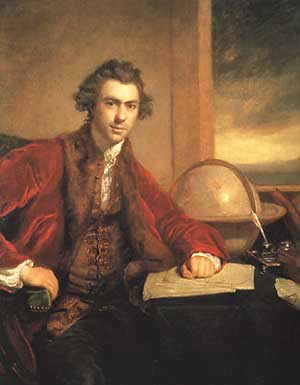
My Daily Art Display’s featured painting is the portrait painted of our hero by Benjamin West in 1773, simply entitled, Sir Joseph Banks.  His depiction of Banks differed somewhat from the Reynold’s portrait, which was completed the same year.  In Reynolds’ portrait we see the well-groomed and charming explorer and botanist smiling at us.  He is completely at ease, sitting forward in his armchair, with his arm resting on a table strewn with pages of a letter, quill pen and ink stand and a freestanding globe.

Benjamin West’s work is a full length portrait of Banks standing amongst a selection of artefacts that the explorer had brought back home.  He is wrapped in a Tahitian cape and by him is a native headdress, a paddle from a canoe and a carved fighting staff.  If we look down at his feet we can a Polynesian adze, which was a tool used for carving and smoothing wood and by it are pages of a notebook which was a reference to the myriad of notes Banks made during his expedition with regards to all the flora and fauna he had come across during the three-year journey of discovery around the South Pacific territories.  The painting with its accoutrements even has a hint of the American Wild West, which of course the artist, West, would have seen in paintings back home.  There is also a classical element to this picture with its column and tied-back curtain in the background.  West may have picked up this type of detail when he was studying works of art during his Italian sojourn.

So there you have it, two men of completely differing backgrounds, upbringing and education, Benjamin West the artist and Joseph Banks the explorer, both of whom went on to head up prestigious London societies, and were connected through this painting and their dealings with King George III of England.

Nocturne in Black and Gold: The Falling Rocket by James Whistler

Nocturne in Black and Gold: The Falling Rocket by Whistler (1874-7)

My featured painting today has the unusual title of Nocturne in Black and Gold – The Falling Rocket.   This oil on canvas painting was by the American-born artist, James Abbott McNeill Whistler in the 1870’s and now hangs in the Detroit Institute of Arts.  The artist believed strongly that there was a parallel between painting and music, and many of the titles of his paintings include the words “arrangements”, “harmonies” and “nocturnes” in their titles, highlighting the dominance of tonal harmony.   Another reason for these titles with a musical connotation was that one of Whistler’s patrons at the time was Fredrick Leyland, a wealthy Liverpool ship-owner and amateur musician, who loved the music of Chopin, and Whistler credited him, for his musically inspired titles.

This painting may not be his most famous painting but was one which was to become very controversial and has an interesting story attached to it – and you know how I like paintings with a story!

James Whistler was born in 1834 in Lowell, Massachusetts.  He was brought up by his mother, Anna Matilda McNeill and his father, George Washington Whistler who was an important railroad engineer.  Reports of Whistler’s childhood often concentrated on his unruly and disruptive nature and that his parents only way of calming him down was to allow him time to draw which seemed to soothe the young boy.  When he was almost eight years of age his father was contracted to work on a railroad in Russia and a year later, the rest of the family moved to St Petersburg.  When he was eleven years old Whistler was enrolled in the Imperial Academy of Fine Arts in St Petersburg and it was there that his artistic talent flourished.  When he was thirteen Whistler and his mother visited London and stayed with relatives.  Whistler had by the age of fifteen decided that he wanted to become an artist and he wrote with some trepidation to his father telling him of his desire, saying:

“…I hope, dear father, you will not object to my choice….”

Sadly, his father died that year of cholera whilst still working on the Russian railroad and his wife had to return to America, to her hometown of Pomfret, Connecticut, with her sons.  His mother had wanted Whistler to become a minister in the church but she soon realised that this was not going to happen.  He eventually was admitted to the West Point Military Academy not because of academic qualifications nor because of his physical prowess but because of his name as his father had taught there and also some of his relatives had been former students.  However his lack of academic ability, his bucking of authority and his ill discipline forced his departure after just three years.

After a short time as a military draughtsman he decided to continue with his dream of becoming an artist.  He moved to Baltimore and with the help of a wealthy friend, Tom Winans, set himself up in a studio and started selling some of his paintings.  He made enough money to go to Paris to study art, and got himself a small studio in the Latin Quarter.  He was never to return to America.  Whistler remained in France until 1859 at which time he decided to move to London where he remained for the rest of his life.  Whistler died in London in 1903, aged 69.

So to today’s featured painting.   In 1874, whilst in London, Whistler started his painting entitled Nocturne in Black and Gold – The Falling Rocket, which depicted a firework display in the night sky of London.  This was the last of his series of London Nocturnes.  Whistler inspiration for this painting was his love of Japanese prints.   The painting was to prove controversial when it was completed in 1877 and was exhibited at the newly-opened Grosvenor Gallery in London founded by Sir Coutts Lindsay.   At this time one of the foremost art critics was the English art critic and social thinker, John Ruskin.  Ruskin was a wealthy and powerful man within the art world, who had come to prominence with his support for the works of Turner and later his backing for the Pre-Raphaelite Movement.  On seeing Whistler’s painting, Ruskin was horrified and, according to Ronald Anderson a co-author with Anne Koval of the Whistler biography James McNeill Whistler: Beyond the Myth, Ruskin wrote in his journal, Fors Clavigera in July 1877:

“…For Mr. Whistler’s own sake, no less than for the protection of the purchaser, Sir Coutts Lindsay ought not to have admitted works into the gallery in which the ill-educated conceit of the artist so nearly approached the aspect of wilful imposture. I have seen, and heard, much of cockney impudence before now; but never expected a coxcomb to ask two hundred guineas for flinging a pot of paint in the public’s face…”

Whistler when he heard of these comments was outraged and sued Ruskin accusing of libel and demanded £1000 plus legal costs in reparations.  This, to Whistler, was a matter of artistic pride.  This legal battle was a great risk for Whistler whose wealth had declined rapidly and was facing financial hardship but he believed he had been wronged by Ruskin and was determined to right the wrong.  Whistler believed that he and other artists must assert the primacy of artistic vision in other words Whistler believed that an artist should be allowed to create unfettered by the bonds of the critics.  This was a battle between “brush and pen”, the artist and the critic.  Whistler with ever-deteriorating finances hoped for a quick trial and a successful outcome but his hopes were dashed as the trial kept being postponed due to Ruskin’s bouts of mental illness.  The trial was eventually held, a year later in November 1878.  Reports of the trial commented on Whistler’s well-rehearsed answers to his counsel’s questions and he used the trial as a way to convey his artistic views.  At one point, Whistler was cross-examined about the time it took to complete the painting and the justification of the 200 guineas price tag.  Commenting on the two days it took him to complete the work he justified it by saying that the money was not for the actual two days of physical painting but it was payment for his lifetime of artistic knowledge.  Whistler had trouble in getting fellow artists to take his side publicly at the trial as they feared they would be besmirched by the sordid affair.  Ruskin’s counsel performed well and his arguments seemed to find favour with the jurors.  Ruskin himself was not in court due to his on-going illness but the Pre-Raphelite painter Edward Burne-Jones proved a very impressive witness for the Ruskin side.

The jury found in favour of Whistler but awarded him just one farthing in nominal damages and the court costs were split.  This financially ruined Whistler who had to sell his house, his works of art and the art he had collected.  A month after the trial Whistler wrote his account of the trial in a pamphlet entitled Whistler v Ruskin: Art and Art Critics which was sold at six pence per copy.  This proved highly successful and went through six editions.

After the trial Whistler’s hopes that there was no such thing as publicity and that the trial would enhance his standing as an artist proved fanciful as patrons steered clear of him for many years to come.   He did eventually get a commission to Venice from one of his supporters.  This helped him to start on the road of financial recovery and in fact led to, some would say, his best paintings, the “moonlights” such as Nocturne in Blue and Silver: The Lagoon, Venice.   For Ruskin, the trial brought him no glory and in many ways tarnished his image as a critic and almost certainly caused deterioration in his mental health.

So who really won this legal battle?  In some ways they both won and they both lost!

Automat by Edward Hopper

Automat by Edward Hopper (1927)

“All the lonely people, where do they all belong? “

I am sure the words from the Beatles song Eleanor Rigby are known by most people.  Loneliness can be a terrible burden to have to bear and its often associated with the impersonality of a large city, which although teeming with people, they seem to remain as strangers, whereas within small village communities there is a sense of camaraderie and friendliness which ensures that with a minimum of effort your loneliness can be banished. 

 My Daily Art Display featured painting for today is entitled Automat by the American artist Edward Hopper, which he completed in 1927.  His theme of loneliness and the loneliness of city life was a constant theme in a number of his paintings.  Look back to My Daily Art Display of January 23rd when I featured his famous work entitled Nighthawks. 

In today’s painting we see a woman, with her cloche hat pulled low down over her forehead, staring into her coffee cup as she sits by herself, in what Hopper terms as an Automat.  I have to admit I had never heard of this term before  but I believe they were what we would now call fast food outlets,  which served simple food or drinks,  and which were served by coin-operated and bill-operated vending machines but I guess the machines have been removed an there is waitress service nowadays.   There is a starkness about the setting, almost but not quite minimalist.  Like the scene in Nighthawks there are just windows but no doors on view, giving a slight sense of entrapment.  Her look of preoccupation would suggest she may be, for some reason unknown to us, mentally entrapped.

The woman we see before us is pensive, her eyes are downcast and to my mind she seems a little sad.  She is well dressed with her warm winter coat with its fur collar and cuffs.  She wears makeup so maybe she is on her way for an evening out or looking how dark it is outside, maybe she is on her way back home.  Of course we are not really sure whether she is on her own or whether the empty chair at her table is for somebody else.  Maybe she is awaiting her companion or is her despondency due to the companion’s non-arrival.

Another strange thing about the woman is that she has only one glove on.  Could it be that this café is not only a lonely place but also a cold one and the one glove is all she wanted to remove so that she could hold the cup and yet still retain some warmth?  The dark window takes up a lot of space in the painting and its darkness adds to the atmosphere of the painting.  It is pitch-black outside and, along with the way the woman is dressed, gives us the feeling that this scene takes place on a cold autumn or winter night.  There is no sign of life outside, no people, no lights from other buildings and no headlights from cars.  This lack of outside lights works well and allows just the penetration of the blackness by the reflection of the café lights to be more effective and in so doing adds to the feeling of isolation. Does Hopper want to liken the woman’s mood and her life to this view of the window – dark with little going on in it?  She is in the middle of a deserted town which adds to the sense of her isolation and solitude.  Note how Hopper has painted the woman’s legs.  The brightness of his colouring of them draws our eyes to them even though they are under the table.  It adds a little bit of overt sensuality to the painting and makes us wonder how such a woman could feel sad and lonely.  We are now concerned about her vulnerability.  Is her pensiveness also due to her feeling vulnerable as she sits alone in this café?

Time Magazine, August 1995

Hopper’s painting and ones of a similar theme are linked with the perception of urban alienation, which by definition is the state of being withdrawn or isolated from the urban world, as through indifference or disaffection.  It is interesting to note that in August 1995 Time magazine used this painting on its front cover with its lead article dedicated to stress, anxiety and depression.

Loneliness is often the central subject matter in Hopper’s art. The people he depicts look as though they are far from the comfort and reassurance of home. We see clues as to their isolation in the way they stand reading a letter beside a hotel bed or drinking in a bar. They stare out of the window of a moving train or read a book in a hotel lobby. Their faces often have the look of vulnerability and introspection. They look like they may have just been jilted or have just broken up with someone. They often seem to be mentally searching for something or someone and have been cast adrift in transient settings. His paintings are often set at night, as this adds to the mood and evocatively all we see through the window is darkness.

Yet despite this bleakness we witness in Hopper’s paintings, they are not themselves bleak to look at – perhaps because they allow us, the viewer, to witness some of the artist’s grief and disappointments, and from that we feel less personally persecuted and beset by them.  It is as if we suddenly realise we are not the only person to feel sad or depressed, for isn’t it true that sometimes a sad book consoles us more when we feel sad.  Maybe we just need to realise we are not alone in our sufferings. 

In some ways Hopper has challenged us to make up our own mind about the story behind the painting.  There is no action going on to give us any clues.  Maybe the story we come up with will depend on our own state of mind.  If we are happy, we may well believe that the woman is thinking about the coming to the café of her beloved.  If we ourselves are feeling lonely and slightly depressed then maybe we empathize with the woman and share her isolation and vulnerability.  So what is to be?  What is your take on the scene in the painting?  Maybe it is at times like this, when we look at the painting and we perceive the loneliness and unhappiness of the woman that we should take time to be grateful for what we have.  Maybe we should not always desire something else.  Maybe we should want what we have.

The Young Bull by Paulus Potter

The Young Bull by Paulus Potter (c.1647)

After yesterday’s controversial and somewhat depressing painting by Klimt I thought I would lighten spirits with not one but two paintings which have a connection to each other.   I don’t really have a forward plan of what my next featured painting will be, the choice is often coincidental.  For example, today I received in the mail a long awaited catalogue which goes with the Dutch Landscapes exhibition at the Queen’s Gallery, Buckingham Palace.  A couple of weeks ago I had intended to visit the exhibition and was not best pleased that the catalogue had not arrived before my trip to London.  However if you read my blog on that day you will know I never made the exhibition as the Gallery was closed owing to the state visit of Barrack Obama.

So I was looking through the catalogue this morning and came across a work that is on display in the exhibition by Paulus Potter.  I had intended to feature that painting but when I was researching the artists and his paintings I changed my mind and My Daily Art Display features his most famous painting entitled The Young Bull.  The reason I changed my mind was because of an interesting connection his painting has with one by a American Modernist painter, Mark Tansey – but more about that later.

Paulus Potter was born in 1625, in Enkhuizen, a harbour town in Northern Netherlands.  His painting speciality was that of animals, especially cows, horses and sheep in landscape settings.  From Enkhuizen he and his family moved to Leiden and later Amsterdam.  His father, an artist, taught his son the basics of painting.  We know that Paulus eventually arrived in Delft because it is recorded that when he was in his early twenties he became a member of the Guild Of St Luke in Delft. In 1649 he  moved on to The Hague where he married.  His father-in-law was a wealthy builder and through him Paulus was introduced to the rich and privileged of Dutch society and with this fortuitous turn of events Paulus had a market for his paintings.  He wasn’t to capitalise on that for long as his life was cut short by tuberculosis in 1654 at the young age of 28.

Today’s painting, an early example of Romanticism, entitled The Bull, was painted by the twenty-one year old Paulus Potter around 1647  and can now be found at the Mauritshuis in The Hague.  This remarkable life-sized painting was, in the early nineteenth century, as popular with the Dutch people as Rembrandt’s Nightwatch.  Paintings featuring cattle were de rigueur in Holland at this time.  The scene of a bull in the meadow in itself is unremarkable but what makes it so special is the amount of detail in the painting.  Look at the flies hovering around the back of the bull which stands in the shade of the tree.   Look too on the ground by the feet of the cow and you can just make out a small frog which is being watched closely by the cow which is lying on the ground.    The standing bull takes centre stage in the picture and the artist has added a cow, three sheep and a farmer.  To the right we see a low-lying meadow with some cattle grazing and in the distance, just visible on the horizon sheltering below a low dark threatening sky is a church spire.  This has been identified as the church spire of Rijswijk which is now a suburb of The Hague.

The Innocent Eye Test by Mark Tansey (1981)

So now to the second painting I promised.  This is a much more modern painting.  The painting entitled The Innocent Eye Test is by the American Postmodernist painter Mark Tansey.  His forte is monochromatic paintings, which are often amusing, sometimes mocking and often touch on the subject of art critics and their critiques.   The picture (above) which he painted in 1981 depicts a group of officials looking at a cow who in turn is staring at a painting.  They are wanting to take note of the cow’s reaction to seeing a life-sized painting of a cow and a bull .  The painting which is being observed closely by the bull is the Paulus Potter painting The Young Bull.  I am amused to see all the bespectacled officials in business suits or lab coats especially the one holding the mop which one must presume is in case the bull gets too excited by the painting and has an “accident”!!!

……….and finally another twist to the story of the paintings, below is a recent article from the  New York Times newspaper dated May 11th 2011, regarding Mark Tansey’s painting The Innocent Eye Test…….

“..British collector Robert Wylde filed federal suit against the Gagosian Gallery on Thursday over a Mark Tansey painting, “The Innocent Eye Test.” Wylde alleges that the Manhattan gallery concealed the Metropolitan Museum of Art’s 31 percent partial ownership of the work, and the fact that the museum planned to eventually to reclaim the painting altogether.

The Innocent Eye Test was originally owned by Artforum publisher and established art dealer Charles Cowles, then partially owned and promised to the Metropolitan Museum in 1988.  In 2009, collector Robert Wylde was shown the Mark Tansey painting at Cowles’ SoHo apartment, when Cowles was closing his Chelsea Gallery after 30 years.

Wylde, who lives in Monaco, purchased the Tansey through the Gagosian Gallery for $2.5 million on August 5th, 2009. In spring of 2010, a Gagosian lawyer contacted Wylde, when the gallery learned of the Metropolitan Museum’s partial ownership.

Gagosian Gallery is internationally renowned as a foremost art market institution, and rarely discloses transactions on the basis of client confidentiality and business discretion. Although this is not the first suit against the gallery – most recently, misidentified protester Ingrid Homberg filed after being removed from an Anselm Keifer show in February–the Tansey suit is uniquely sale-related.  Robert Wylde additionally contends that Gagosian Gallery canceled his Richard Prince sale when a higher offer was received.

Gagosian Gallery spokeswoman Virginia Coleman told the New York Times that Charles Cowles claimed clear title to the painting, and that, “the gallery acted in good faith.”

In lieu of the lawsuit, Cowles himself told the New York Times he considered the 2009 sale his mistake. He “didn’t think about” the Metropolitan Museum’s stake in the painting once it was returned from its initial showcase, and sold it through Gagosian in 2009 for financial reasons.

The Beverly Hills  Gagosian Gallery is set to show its latest Mark Tansey works in an upcoming exhibition from April 19th to May 28th. The gallery’s artist summary alludes to complex uncertainty, inviting the viewer to engage in the metaphorical aesthetic disorientation during exhibition..”

….and all this because my gallery catalogue arrived in today’s mail !!!


The Art Student (Miss Josephine Nivison) by Robert Henri

The Art Student (Miss Josephine Nivison) by Robert Henri (1906)

Robert Henri, a leading figure of the Ashcan School in art, was born Robert Henri Cozad in Cincinnati, Ohio in 1865.  His father John Cozad was a real estate developer and founded the town of Cozaddale, Ohio and later when the family moved west, he founded the Dawson County town of Cozad in the state of Nebraska.  Robert had one brother, also named John, and was a distant cousin of Mary Cassatt, the much admired artist and printmaker.  In October 1882, Henri’s father became embroiled in a dispute with a rancher over the right to pasture cattle on land claimed by the family. When the dispute turned physical, Cozad shot Pearson fatally with a pistol. Cozad was eventually cleared of wrongdoing, but the mood of the town turned against him. He fled to Denver, Colorado, and the rest of the family followed shortly afterwards.  In order to disassociate themselves from the scandal, family members changed their names. The father became known as Richard Henry Lee, and his sons posed as adopted children under the names Frank Southern and Robert Earl Henri.  In 1883 the family moved again, first to New York City and then on to Atlantic City, New Jersey.

At the age of  twenty-one, Robert began studying art at the Pennsylvania Academy of Fine Art in Philadelphia under the tutelage of  Robert Anschutz, the painter who also taught several well-known painters including Everett Shin, George Luks and George Bellows who along with Henri would become known as the Ashcan School.  Two years later in 1888 Robert Henri travelled to Paris and studied at the Académie Julian and later he was admitted to École des Beaux Arts.  It was during this time that he embraced Impressionism.

In 1891 he returned to America and settled down in Philadelphia and began teaching at the Philadelphia School of Design for Women.  He became friendly with a group of artists and newspaper illustrators and they, William Glackens, George Luks, Everett Shin and John French Sloan, became known in artistic circles as the Philadelphia Four.  In 1898 he married Linda Craige who was a student attending one of his private art classes, and they set off on a two-year long honeymoon/vacation in France.

In 1902 he started teaching at the New York School of Art and many “soon to be famous” artists were taught by him, including Joseph Stella, Edward Hopper, Rockwell Kent, George Bellows, Louis Fancher, Stuart Davis and Norman Raeburn.  Sadly in 1905 after a long period of poor health his wife Linda died.

A year later in 1906 Robert Henri was elected to the National Academy of Design which would later be known as The National Academy Museum and School of Fine Arts but his tenure at this establishment was short lived for when works of art by his painter friends were rejected for the Academy’s 1907 exhibition, he resigned labelling the Academy as a “cemetery of art” and threatened to stage his own art exhibition.

He carried out his threat the next year, 1908, when he and his friends staged a landmark exhibition at the Macbeth Gallery in New York entitled The Eight after the eight artists who displayed their works).  Besides his own works and those of the Philadelphia Four who had moved from Philadelphia to be with Henri, the other exhibitors were Maurice Prendegast, Ernest Lawson and Arthur B Davies.  The exhibition was a sensation and these painters would soon become associated with the Ashcan School, which was a realist artistic movement and was best known for its portrayal scenes of daily life in the city of New York.  The name “Ashcan” was first used to describe the artistic movement some years later by the American cartoonist and writer, Art Young.

In May 1908 Henri married for a second time, this time to Marjorie Organ a twenty-two year old Irish immigrant.  Henri continued to paint and teach art  in various establishments and when he was sixty-four he was chosen, by the Arts Council of New York, as one of the top three living American artists.  A year later in 1929 Robert Henri died of cancer aged 65 and in 1931 the Metropolitan Museum of Art staged a Memorial exhibition of his work to honour this giant of American Art.

My Daily Art Display for today is a work by Robert Henri called The Art Student (Miss Josephine Nivison) which he completed in 1906 and was one of the paintings I saw at the National Gallery this week at their small exhibition entitled An American Experiment.   It is a life-sized oil on canvas painting (196cms x 98cms) and is quite dark.  The model for the painting was Josephine Nivison who studied with Robert Henri at the New York School of Art the previous year.  After Henri befriended her, she and some other students from his class travelled with him to Europe.  Miss Nivison later married another influential painter, Edward Hopper (see my blog Nighthawks on Jan 23rd) and she helped promote his work and acted as his model.

In the picture her body is undefined due to the all-encompassing heavy black artist’s smock she is wearing which reaches down to her feet.  We are just able to glimpse the white collar and the red patterned shoulder of her dress she wears under the smock.  Against a plain brown background, she clutches hold of her paintbrushes in her left hand as she looks out at us with a very determined expression.

This painting was one of only a few Robert Henri painted in 1906, the year after his wife’s death.

Blue Snow, The Battery by George Bellows

Blue Snow, The Battery by George Bellows (1910)

A few days ago I featured the art of Samuel Luke Fildes who in his early artistic days was a Social Realist painter.  His paintings and illustrations for The Graphic magazine dwelled on the plight of the poor in his native England and what they had to endure.  Today I am featuring an American artist of around the same era who wanted to paint pictures of real life in New York City.  He is George Wesley Bellows, the American realist painter.

George Bellows was born in Columbus, Ohio in 1882 and after passing through the various school years arrived at Ohio State University at the age of nineteen.  It was here that his sports prowess came to the fore and at one time it was thought that he may take up baseball professionally.  During his time at the university he funded himself by working as a commercial illustrator.  However Bellows had one aim in life and that was to become an artist, so much so, that he quit the university just before he was due to graduate and moved to New York to study art.

He enrolled in the New York School of Art and became a student of Robert Henri.  It was through Henri that Bellows came into contact with a group of artists known as The Eight and later became paert of  The Ashcan School.  The Eight was a group of artists whose fame derives from, and for what they will always be remembered for, their one and only joint exhibition in 1908 at the Macbeth Gallery in New York.  The exhibition was a sensation and it is now looked upon as one of the most important events in the development of twentieth-century American art

The Aschcan School was a loose collection of realist painters associated with Robert Henri.  The term “Ashcan” was first used by Art Young the American socialist writer and cartoonist when he was writing about this art movement.  They were however unified with their desire to be truthful with their art and depict the city of New York and its working-class neighbourhoods as it was and not just an idealised and formal portrayal of these suburbs.  They wanted us to see life in the raw.  The scenes of the city painted by Bellows highlighted the crudity and disorder of life amongst the working class.  This was American Realism, and he and his fellow Ashcan artists believed that their art should be similar to journalism showing the city as it was, “warts and all”.  In a way this group, including Bellows was determined to rebel against American Impressionism which was so popular at the time.  Their art did not focus on light but in general their art was darker in tone and brought the seamier side of life to the fore with subjects such as prostitution, drunks and overcrowded tenements cluttered with lines of washing.  Bellows also painted pictures of boxing matches which with their dark and atmospheric backgrounds brought out the bloody savagery of the sport.  In some of their works they depicted the poor and their struggle with everyday life.  These were the equivalent to the English Social Realism genre of art of which Samuel Luke Fildes was a leading figure.

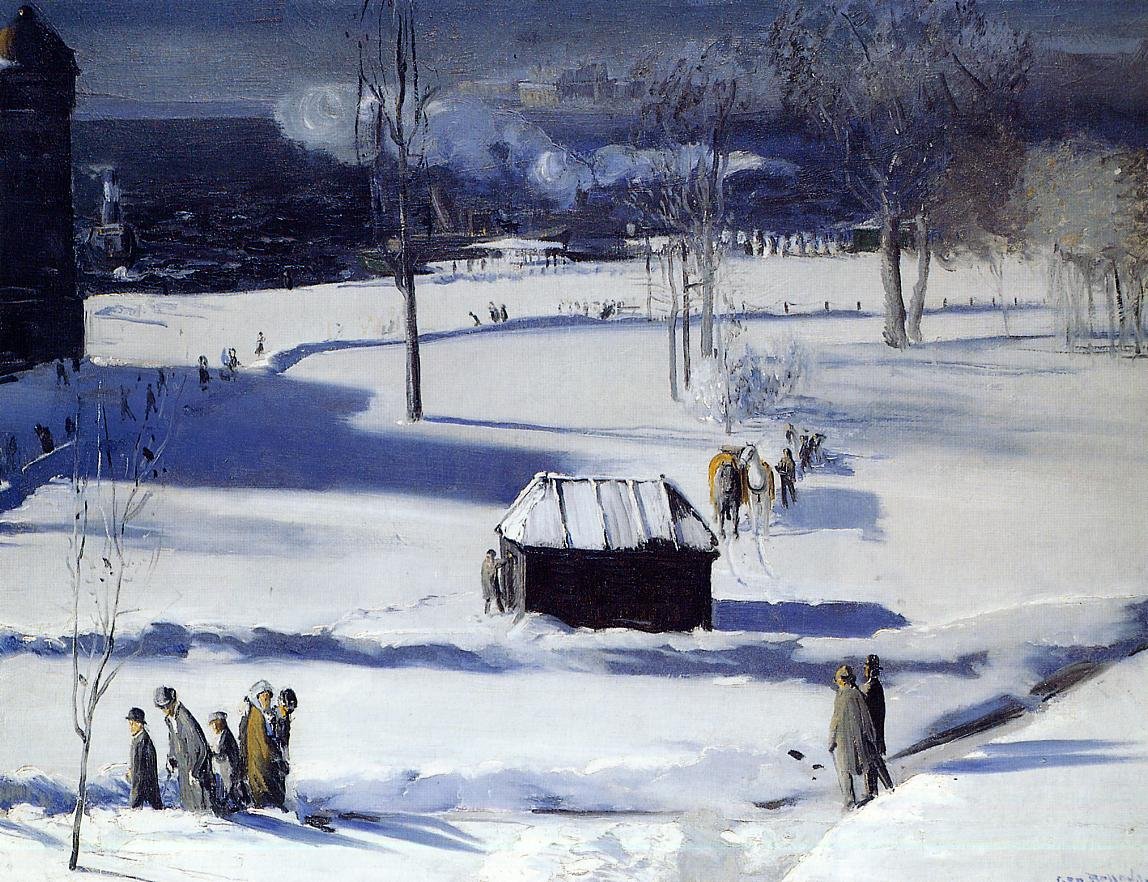
The painting of George Bellows I am featuring today is not one of his Social Realism paintings.   My featured painting of George Bellows is entitled Blue Snow, The Battery which he completed in 1910The setting for the painting is Battery Park which lies adjacent to the financial district of the city.  There is a breathtaking beauty about this work of art.  His imaginative and powerful use of blue energizes the scene of the southern tip of Manhattan.  Bellows painted a number of scenes with New York City under snowfall and as with my featured painting it is amazing how he has developed a strong sense of light and visual texture contrasting the white and blue of the snow and the dark grimy outline of the old buildings.  It is a beautiful strong composition which is normally housed at the Columbus Museum of Art.

Bellows went on to teach at the Art Institute of Chicago but spent half the year at the home he built in Woodstock, New York. He illustrated novels including a number for H G Wells.   In 1925, at the young age of 42 he died of peritonitis after failing to tend to a ruptured appendix.

I hope to see some of his art when I visit the National Gallery in London tomorrow where thay have a small exhibition of works by George Bellows and the Ashcan painters, entitled An American Experiment.

The Rocky Mountains, Lander’s Peak by Albert Bierstadt

The Rocky Mountains, Lander's Peak by Albert Bierstadt (1863)

My Daily Art Display today features two Americans and a mountain.  The two Americans are the landscape artist Albert Bierstadt and the US Army brigadier general and explorer Frederick West Lander.  The mountain in question is Lander’s Peak, named after the explorer.

Albert Bierstadt was a German-American painter and his main contribution to American art was his landscapes of the newly discovered American West.  He was born in Solingen, Germany in 1830 and three years later he and his family emigrated to America establishing their first American home in New Bedford Massachusetts. As a teenager he acquired a love for art.  In his early twenties he returned to his homeland and studied art at the Düsseldorf School in Düsseldorf.  On his return to America in 1857 he turned his artistic attention to the landscape of New England and upstate New York and became part of the Hudson River School of painters.  This group of 19th century artists was influenced by the Romanticism movement and their landscape paintings concentrated on the lands around the Hudson River Valley which included the Catskill, Adirondack and White mountains.   It was from within this group that another painting genre evolved.  It was called luminism, which was an American landscape painting style of the 1850’s – 1870’s which was characterised by effects of light in landscapes. The use of aerial perspective and a hiding of visible brushstrokes were also characters of this style of painting.   These luminist landscapes accentuated an aura of tranquillity and often depicted stretches of calm water above which were soft hazy skies.

It was two years later in 1859 that Bierstadt met up with Frederick West Lander who at the time was working for the US government as a land surveyor.  Lander, who was ten years older than Bierstadt, was a military man, who after having studied in various military academies became a civil engineer and an army officer.  The American government employed him to survey the land out to the west so as to find a suitable route for the Pacific railroad.   This was a hazardous occupation for he and his team of surveyors had not only to contend with the often inhospitable climate but they had to deal with the Native Indians, who fought against the incursion into their homeland.

Bierstadt accompanied Lander on one of these transcontinental surveys which was to forge a passage west and which would become known as Lander Road.  This became a popular route for future wagon trains crossing Wyoming and Oregon.  It was during this journey of discovery that Bierstadt made many sketches of the landscapes he encountered and on his return home he would convert his rough sketches into many majestic landscape paintings.  These were very popular with collectors in the American East who were willing to pay high prices for his works of art as there was a great desire to learn more about their newly-discovered lands to the West. 

My Daily Art Display today is one Bierstadt completed in 1863 shortly before he returned back to the West on another journey of discovery.  The oil on canvas painting is entitled The Rocky Mountains, Lander’s Peak.  It was a very large painting, measuring 187cms x 307cms (approximately 6ft by 10ft).  Bierstadt’s works were often of this size and some of his contemporaries believed this was solely due to his egotistical manner.  It was probably more to do with their jealousy and the fact that his large works dwarfed their smaller offerings.

The setting for this landscape painting is of the Wind River Range of the Rocky Mountains of west Wyoming.   The mountain, seen in the central background of the painting, was given the name Lander’s Peak by Bierstadt in honour of  Lander, who had died on the Civil War battlefield the previous year. This major work of Bierstadt received great acclaim.  This wonderful painting manages to capture the vastness of the American landscape and the nature of the undeveloped lands that he and Lander’s survey party encountered.   Bierstadt in this painting, by the careful use of brushstrokes, manages to convey to us a sense of awe of the untainted landscape as it was at that time.     Like many of his fellow Hudson River Valley artists, Bierstadt believed that through art, moral and spiritual change could be achieved. 

The beauty of this painting is breath-taking with its high snow-covered peaks soaring upwards into the sky.  In the middle-ground we see a waterfall gushing water into the mirror-smooth lake.  I love how the sunlight streams through the clouds to light up this cascading torrent.  It is the effective use of luminism which gives this painting the “wow factor”.   It adds a mood of tranquillity, peace and calmness to the work.  The vegetation around the lake is lush and green and the location was an ideal stop-over place.  In the foreground we see a Shoshone Indian encampment with its warriors and their horses.

The painting was sold to a private collector James McHenry in 1865 for $25,000, which was an enormous sum of money in those days. The artist later bought back the work of art and gave it to his brother Edward.  Bierstadt was a prolific painter completing over five hundred works.  Sadly a large number of them were lost when his Irvington studio was destroyed by fire.  Bierstadt died in New York in 1902 aged 72.

Peaceable Kingdom by Edward Hicks

Peaceable Kingdom by Edward Hicks (c.1836)

Sometimes artists paint a number of versions of a work of art and I often wonder the reason for this.  Are they dissatisfied with their original work or are they just fascinated with the subject of the painting and they wish to add some symbolic aspect so as to give a meaning, whether obvious or hidden that they had not considered when painting the original?

The artist featured in My Daily Art Display today painted over sixty versions of a picture.  I wonder why he dedicated almost thirty years of his life on this one theme, continually churning out revised versions.  The featured artist today is the American Folk painter, Edward Hicks.  Hicks was born in Attelboro, in Bucks County, Pennsylvania in 1780.  He was brought up in his grandfather’s mansion.  His father, Isaac was a Loyalist, an American Colonist, who sided with the British during the American Revolutionary War, which lasted from 1775 to 1783. Edward Hicks’ mother died when he was only a year and a half old and he was brought up by Elizabeth Twining, a friend of his late mother.  She was a Quaker and brought up Edward in that faith and it was to have a great effect on him for the rest of his life.

When he was thirteen years of age Hicks was apprenticed to coach maker William and Henry Tomlinson with whom he learnt the art of coach painting.  When he was twenty he set himself up in his own business as a house and coach painter.  At that time he had not fully taken on board the Quaker religion or their ways and was just a happy-go-lucky young man.  Later in life he was to look back on those days with some self-reproof, writing:

“…in my own estimation a weak, wayward young man … exceedingly fond of singing, dancing, vain amusements, and the company of young people, and too often profanely swearing”…”

Hicks decided to renew his interest in the Quaker faith and in 1803, the twenty-three year old, became a member of the Society of Friends.  It was in that same year that he met and married a Quaker woman, Sarah Worstall.  In 1812 he became a Quaker minister and the following year travelled around the state preaching the Quaker faith.  At the same time as his preaching tours, he had to keep money flowing into his household so he carried on his painting career, concentrating on farm and household items as well as tavern signs.  His business was quite profitable but it was that very fact that to some of his fellow Quakers, fell foul of the Quaker principles.  For a time he gave up his painting and tried to follow the Quaker traditions of farming but he lacked experience and was soon losing money.   His commissions for house and equipment painting was also starting to dry up and financial disaster stared Hicks in the face.  He was also now a father of five young children who had to be fed.

A life-line was thrown to him when somebody suggested that he should become a Quaker artist and by his works of art, spread the “word”.  It was at this time, in 1820, that Edward Hicks made the first of his paintings entitled The Peaceful Kingdom which he revised many times.   Today’s painting for My Daily Art Display’s features the 1833 version of the painting which is hanging in the Worcester Art Museum, Massachusetts.  This painting was not looked upon as a religious painting but in some ways illustrates the Quaker principles.  The subject of the painting was taken from the Old Testament, Book of Isaiah 11: 6-8

The wolf will live with the lamb,
   the leopard will lie down with the goat,
the calf and the lion and the yearling together;
   and a little child will lead them.
The cow will feed with the bear,
   their young will lie down together,
   and the lion will eat straw like the ox.
The infant will play near the cobra’s den,
   the young child will put its hand into the viper’s nest.

There is a peaceful interaction between the domestic and wild animals, which in real life would be the “predator and prey”.  We see the lion happily eating straw with the bull.  We see a black bear sharing its food with an ox.  We see a lamb and a wolf lying contentedly, side by side.   We observe humans and animals interfacing peacefully which in some ways suggests an impression of unity.  A child has her arm wrapped round the neck of a tiger, whilst another strokes the nose of a leopard.  In the background, to the left, we see a group of people.  In this later version of the painting we see a ravine dividing these characters in the middle ground from the animals in the foreground.  

William Penn and the Peace Treaty

In the middle ground these are settlers symbolizing the founders of American Quaker movement, led by William Penn, and native Indians who are signing a treaty, which would allow both groups to live in peace and harmony.   Theirs would be a Peaceable Kingdom.  Harmonious living was tantamount in the teaching of the Quakers.  They believed that barriers should be removed that prevented people working and living together in peace.  It is all about living peacefully together and by doing so having a happy and fruitful life.

There is warmth to this picture in the way Hicks uses his colours.  The scene is lit up by the sunlight streaming down the valley.  There is a great depth to the painting with the animals in the foreground the people in the middle ground and the sunlit river running through the deep-sided valley in the background.

Peaceable Kingdom of the Branch by Edward Hicks (c.1826)

In the1826 version (above)  entitled Peaceable Kingdom of the Branch the words of Isaiah were lettered on the false frame of the picture which surrounds the painting.

In later versions Hicks’ technique became more adept.  The figures depicted were spread more and lessened in number.  The animals seemed to become more restless and showed a greater ferocity and there were signs of a split between the predators and their prey.  They looked older with greying whiskers and sunken eyes.  It could well have come about as a result of Hicks’ uneasiness with Quakerism.

Elijah in the Desert by Washington Allston

Elijah in the Desert by Washington Allston (1818)

Today my featured artist was considered to be the first American Romantic landscape painter.  Washington Allston was born on the family plantation in Georgetown, South Carolina in 1779.    His father, William Allston, was a captain in the army and who died shortly after the Battle of Cowpens in the American Revolutionary War when Washington was only two years of age.  After his father’s death, his mother, Rachel re-married, this time to the son of a wealthy shipping merchant Doctor Henry Flag.  Washington Allston graduated from Harvard in 1800 and for a short period settled down in Charleston, South Carolina.  A year later he went to England and was accepted into the Royal Academy of Art in London.  At that time Benjamin West, the Anglo-American painter was president of the Academy and Washington learnt much from the “Master”.

He spent the next decade travelling around Europe visiting all the major art galleries and museums. He met and became great friends with the English Romantic poet Samuel Taylor Coleridge whose portrait he painted and now hangs in London’s National Portrait Gallery.   In 1809, aged thirty, he married Ann Channing, the daughter of the great American Unitarian preacher William Ellery Channing.  After further travels around Europe the couple settled down in London where his artistic career blossomed and he won many prizes for his paintings.   Besides being a great artist, Washington Allston was an accomplished writer and many of his books were published.  His first major work of art, which established him as a great artist was painted in 1814, entitled Dead Man Revived by Touching the Bones of the Prophet Elisha.  Sadly, in 1815, after just six years of marriage, his wife Ann died.  Her death devastated Washington and he beacme homesick for his country of birth.  He moved back to America in 1818 and went to live in Cambridge, Massachusetts.  He remained there for the rest of his life, dying in 1843 at the age of 63.  He is buried in Harvard Square, in “the Old Burying Ground” between the First Parish Church and Christ Church.

Samuel Taylor Coleridge said of his friend:

“…I consider him a man of high and rare genius, whether I contemplate him in character of a Poet, a Painter or a Philosophic Analyst…”

My Daily Art Display for today is a painting which Washington Allston completed in 1818 and which now hangs in the Museum of Fine Arts in Boston.  It is entitled Elijah in the Desert.  The subject of this painting comes from the Old Testament (1Kings 17:1-7) story in which God ordered the prophet Elijah into the desert and where he managed to stay alive with the help of the ravens who fed him with bread and meat.  The painting vividly depicts the vast and unwelcoming landscape of the wilderness, using a sober palette of browns, grays and steely blues.  The prophet Elijah, dressed in rags can be seen on his hands and knees pitifully crawling to reach a piece of meat the raven has just dropped on the ground in front of him.  It is a poignant and distressing depiction.  The size of the tiny figure of the prophet against this eerie setting adds to a sense of wretchedness and rejection and the observer experiences the tragedy of Elijah’s circumstances.

The painting was owned by Mrs Samuel and Miss Alice Hooper, who donated it to the “yet to be built” Boston museum.  It was actually the first painting which was acquired for the museum and entered the collection in 1870.  Of Washington Allston and his painting, the donors said:

“..We thought we couldn’t better testify our interest in this new art movement [American Romanticism] at home than by adding a really fine Allston to our public collection..”The donors went on to suggest that the museum, when completed, should be named after the artist but in the end it was simply known as the Museum of Fine Arts but a western suburb of Boston was named Allston..

This great American artist not only gained fame with his works of art but was a much heralded poet and author.   His works were appreciated and loved by many including the great English novelist Charles Dickins, who called him “a fine specimen of old genius.  

Great praise indeed.