George Bellows, his wife and children

Emma at the Piano by George Bellows (1914)

George Bellow’s depiction of his wife sitting at the piano entitled Emma at the Piano was completed in 1914.  It is a beautiful portrayal of his wife, dressed in a rich blue coloured coat which along with the dark background adds to our awareness of the sense of intimacy of the scene.  The depiction captures the moment when Emma has stopped playing and turns her gaze towards her husband as he paints her image.  The painting belongs to the Chrysler Museum of Art, Norfolk.

Just recently I have looked at paintings done by Rubens and Rembrandt of their wives.  Thinking about it as a non-artist, I suppose there is logic behind an artist portraying his or her partner.  In most cases the portrait done by the artist would be a labour of love and pride.  I am returning to this theme in My Daily Art Display today when I look at the portraits George Bellows did of his wife Emma and their children.

George Wesley Bellows was an only child, born in Columbus, Ohio on August 12th 1882 to Anna and George Bellows.  He was brought up in a conservative Methodist household with his mother’s sister Elinor, whom he called Aunt Fanny, and who would leave the family home to get married when George was eight years of age.    Also living at home was his eighteen year old half-sister Laura, from his father’s first marriage.  Laura would also leave to get married, when George was two years of age.  This left him as the only child of the household.  At the age of fifteen he attended the Central High School in Columbus where he excelled at sport.  In the summer of 1900 George worked as an illustrator at the local Columbus Dispatch newspaper.  The following fall, he enrols at Ohio State University where he studied English.  It was here that his English professor, Joseph Taylor got him interested in the arts.  Throughout his time at the university he continued his love of sport, playing both basketball and baseball.   He regularly contributed drawings to the college publications and in his second year began to take art classes.  In 1903 he receives a cash prize for his still life painting which was on display at the Ohio State Fair.  The following year, 1904 was his graduation year but George failed to sit his final exams and left the university in the spring.  During that summer he gains employment as a sports writer at two local newspapers, the Ohio State Journal and the Columbus Dispatch and again that year wins himself more money from his works of art which were displayed at that year’s Ohio State Fair.  Although his mother who was devoutly religious and had always wanted George to become a minister in the church, he told his father that he wanted to go to New York, study art at the New York School of Art and become a professional artist.  He even turned down the opportunity to become a professional baseball player.  His father was supportive and gave him a $50 monthly allowance.

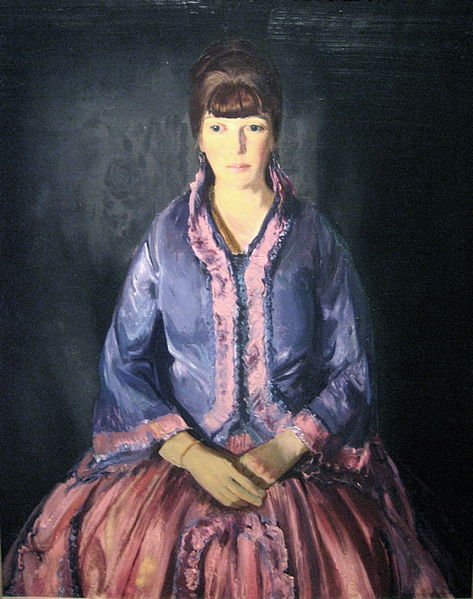
Emma in a Purple Dress by George Bellows (1919)

Emma in the Purple Dress was completed by Bellows in 1919 and can be found at the Los Angeles County Museum of Art

George Belows arrived in New York in September 1904 and took lodgings at the YMCA.   He enrolled at the New York School of Art, which had originally been known as the Chase School of Art, so named after its director and founder was William Merritt Chase, the American Impressionist painter.   It was at this establishment he first met his charismatic art tutor and one of the most influential teachers of the time, the painter, Robert Henri.  Henri would become the leading figure of the artistic group known as The Eight and a prominent member of the Ashcan School of American Realist painters.  It was Henri that roused his students to move away from the genteel scenes which were common in art and favoured by the establishment, such as the National Academy of Design.  Henri urged them to look towards depicting more rugged and harsh cityscapes in their paintings.  It was a plea for them to look towards modernity and realism in their art.  Bellows took up the challenge and many of his works at the time depicted vast public transportation projects such as the building of the Pennsylvania Railroad Station and the Queensboro Bridge which spans the East River in New York.

However the most important person George Bellows met when he arrived at the art school was a fellow student, Emma Louise Story.  Emma was two years younger than George and was the daughter of William Edward Story, a successful New Jersey linen and lace merchant, and Catherine Elizabeth Story (née Anderson).  George and Emma soon became great friends and that Christmas George spent Christmas in the Story household in Upper Montclair, New Jersey.  George Bellows continued to love playing sport and in the summer of 1905 played semi-professional baseball in Brooklyn.

George Wesley Bellows and Emma Louise Story married on September 23rd 1910 at St George’s Episcopal Church in the Bronx.  This close and loving partnership brought Bellows a renewed interest in portraiture, especially family portraiture and this love would remain with him for the rest of his life.  Bellows was very much in love with his wife and in a letter to her, he wrote:

“…Can I tell you that your heart is in me and your portrait is in all my work?   What can a man say to a woman who absorbs his whole life?…”

Anne in White by George Bellows (1920)

His love for his wife was equalled by his love for his children.  George and Emma had two daughters, Anne and Jean.  Anne was born on September 8th 1911 and Jean was born on April 23rd 1915.  For an artist who gave the world paintings depicting the harshness of city life, the brutality of the boxing ring and the atrocities of war, he could also depict a charming tenderness in his portraiture, especially those featuring his children as he witnessed their journey through youth.  One such work was completed in 1920 entitled Anne in White, which featured his eight year old daughter Anne, and is housed in the Carnegie Museum of Art in Pittsburgh.  This painting measuring 134cms x 109cms has the young girl sitting in a small rocking chair.  Her left hand falls to her side clutching the brim of her dark blue hat with its long ribbon trailing out before her.  Her young face is framed by the thick locks of her hair.  Her posture is one of grace and elegance.  Her eyes have the darkness which Bellows frequently used in his portraiture.  Bellows had delightfully and skilfully captured his young daughter’s look of innocence.   In her right hand she holds a highly-coloured fan on her lap.  Her position in the painting is midway between a background consisting of a heavy curtain on the left and a window through which we observe a verdant spectacle of nature on the right.  It is a juxtaposition of domesticity as denoted by the drapery and liberty offered by the outside world.

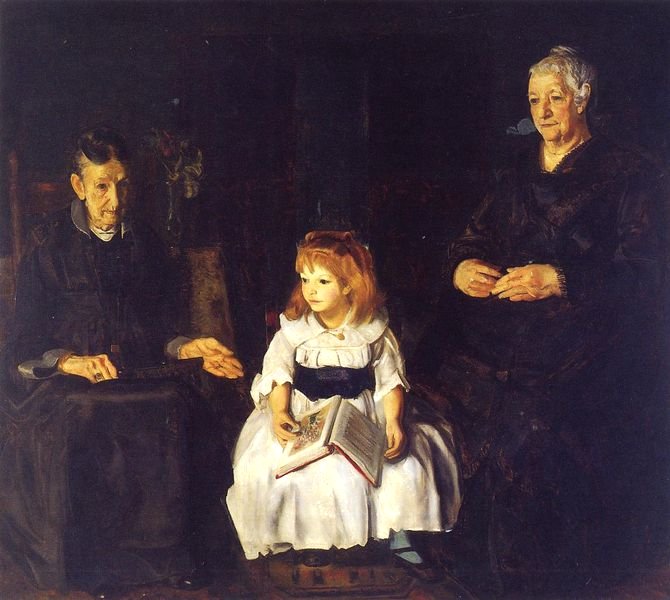
Elinor, Jean and Anna by George Bellows  (1920)
Elinor, Jean and Anna by George Bellows (1920)

In that same year, 1920, Bellows completed another portrait which featured his daughter Anna.  It was group family portrait entitled Elinor, Jean and Anna.   This work by Bellows is now considered to be one of the most accomplished group portraits in modern art.  In Charles Hill Morgan’s 1965 book George Bellows, Painter of America,  he quotes art critics as saying:

“…[Bellows] has lifted portraiture out of the status of a mere profession, and conferred upon it a genuinely aesthetic distinction…”

At the centre of the group sits the petite figure of his eight year old daughter, Anna in her white dress with its starkly contrasting wide black sash wrapped tightly around her waist.  In front of her, open on her lap, is an art book.  On either side of her, and in total contrast to this diminutive figure of his daughter, sits monumental figures dressed in black.  These two elderly ladies are attired in widows’ garb.  On the left is Elinor, Bellows’ Aunt Fanny, who was at the time was in her early eighties.   She had lived with Bellows and his parents when he was young and had fostered in him an interest in art.  Bellows always remembered those early years living with Elinor.   Her left hand lies palm-upwards , laid out directing us to look at the young girl and the art book with its still-life picture of a flower.   It is as if Elinor is inviting us to join the group or it could be that Bellows wanted there to be a connection in the painting between Elinor and the art book to remind himself that it was Elinor who had first nurtured in him his love for art.    Bellows always remembered with great fondness his early days living at home with Elinor.  In a letter to his cousin, Laura Daggett, he wrote:

“…Aunt Fanny will always remain to me a beautiful and important vision of my babyhood.  It gives me a great sensation to have her bring to me a drawing which I had made as a little kid…”

On the right of the portrait is Anna, George Bellows’ mother, who was in her late seventies.  The work is in some ways a connection between the old and young of Bellows generation with the artist being the conduit between the two generations.

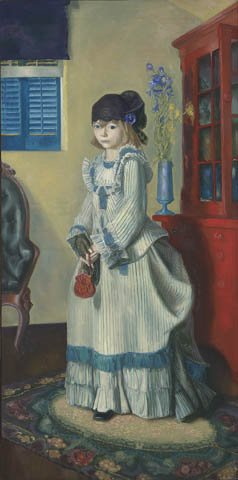
Lady Jean by George Bellows (1924)

My final offering is Bellows’ portrait of his younger daughter, Jean which he completed in 1924 entitled Lady Jean, and which is now housed in the Yale University Art Gallery, New Haven.   This was to be Bellows’ last major portrait of a family member.  In the work we see his nine year old daughter Jean dressed in a nineteenth century Southern costume with its long frilled skirt that forms a slight train.  The dress had been given to her mother, who used to lend it to her children when they wanted to dress up.   The neckline and cuffs of the old-fashioned pale-blue dress are enhanced by ribbons.  On her head Jean wears a  black hat with its veil retracted.  Her right hand is covered with a lace mitt, whilst the other mitt dangles from her left hand which also clutches a small purse.  Jean’s love of dressing up and performing before her parents led her to eventually become an actress, appearing on Broadway opposite such stars as the great Helen Hayes.

George Bellows was suddenly taken ill at his studio in New York on January 2nd 1925.  He was rushed to hospital where it was diagnosed that he was suffering from a ruptured appendix and he was immediately operated on.  Sadly on January 8th he died of peritonitis, aged forty-two.   It was said that he died at the height of his fame and prowess as a painter but this, in some ways, is demeaning and suggests he had reached his best but who is to know to what artistic heights he would have risen to had he lived longer.  I recently returned for a second visit to an exhibition of his work at London’s Royal Academy and I was taken by his words which were printed in large letters on the wall at the exit.  They came from motivational words he had once offered his students just a few years before his death.  To them he said:

Try it every possible way.

Be deliberate.  Be spontaneous.

Be thoughtful and painstaking.

Be abandoned and Impulsive intellectual and inspired, calm and temperamental.

Learn your own Possibilities

The War Series by George Bellows

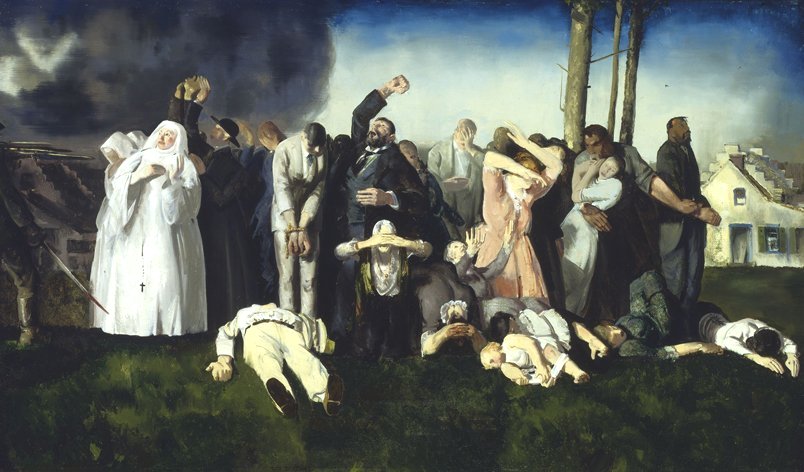
Massacre at Dinant by George Bellows (1918)

Another exhibition I recently attended whilst in London was one which showcased some of the works by the influential American realist painter, George Bellows.  To me, before I saw this collection of his work, the art of George Bellows was all about his wonderful boxing match scenes and the haunting look at the Pennsylvania Station excavation in New York so I was delightfully surprised by the amazing variety of his works, which were on view.  Today I want to look at a series of paintings and lithographs he completed in 1918, which highlighted German atrocities in the First World War.   Some of these works were on display at the Royal Academy exhibition.  The paintings, when they were first exhibited, shocked the people who saw them and the series caused some controversy, which I will talk about later.

The story behind his War Series paintings was of the German invasion of Belgium during the First World War and depicted some of the atrocities carried out by the invading German troops.  The Belgian town of Dinant, which lies on the Meuse River, was overrun by the German Third Army, led by Lieutenant General Baron Max Klemens von Hausen on August 23rd 1914.  Dinant fell to the German invaders but according to German reports some of the German soldiers, whilst repairing a bridge in the town, were fired upon by locals.  A swift and bloody retribution followed.  The German troops rounded up 612 local residents in the main town square.  This group consisted of men women and children.  In the double Pullitzer Prize Winner, Barbara Tuchman’s 1963 book The Guns of August, she wrote that among those executed that day was Felix Fivet, aged just three weeksold.  The town was then ransacked by the occupying army.

Unlike how it is nowadays, there were no television crews following the battle to send back live feeds of the war with all its brutality.  There were no newspaper pictures of the massacre of Dinant, so how did Bellows and the world hear about this horrific event?  A month after the atrocities in Dinant, the Belgian Government put out three reports on German war crimes committed during the invasion of their country.   The contents of these reports shocked all those who read them and in Britain both Parliament and the newspapers clamoured for an independent British commission to be set up to investigate the atrocities.  The British Prime Minister at the time, Herbert Asquith, bowed to public opinion and set up an inquiry.  In December 1914, James Bryce was asked to chair what was termed, the “German Outrages Inquiry Committee”, which would look into all material and take witness statements appertaining to the massacre of Belgium citizens and to the complicity of the German officers into the behaviour of their troops during the summary executions of civilians.  James Bryce, 1st Viscount Bryce, was a British academic, historian and Liberal politician and had been, from 1907 to 1913, the British Ambassador to the United States of America and was on friendly terms with the then Presidents, Theodore Roosevelt and Woodrow Wilson.

The report of the Committee was published on May 12th 1915 and the conclusion was that atrocities had been committed by the German army in order to strike terror into the civil population which would, in turn, dishearten the Belgian troops.  The Germans believed that it would quash resistance and extinguish the very spirit of self-defence. The Commission also stated that the German report of the townsfolk firing on German troops was simply used to justify the murder of large numbers of innocent civilians.   However, there was one problem with the compiling of the Commission’s report and this was the documenting of the 1200 eye witness accounts which had been correlated by a team of English lawyers.  A large number of these were excluded as the committee were mindful that their findings had to be reliable, credible and truthful.   For that to happen, the Committee stated that many of the depositions collected had to be omitted, although they were probably true, as they believed that it was much safer not to place reliance on them.   The committee ended their report by concluding:

“…Our function is ended when we have stated what the evidence establishes, but we may be permitted to express our belief that these disclosures will not have been made in vain if they touch and rouse the conscience of mankind, and we venture to hope that as soon as the present war is over, the nations of the world in council will consider what means can be provided and sanctions devised to prevent the recurrence of such horrors as our generation is now witnessing…”

The report was translated into many languages and circulated throughout the world.   Some later historians believed that the Bryce Commission report was a piece of propaganda and that the lurid accounts of German atrocities were designed to bolster the resolve of those already fighting in the war and to encourage those countries, including the powerful USA, to end their neutrality.

America had declared its neutrality in 1914 with Woodrow Wilson making his speech to the nation on August 18th 1914.  In the speech he said:

“…I venture therefore my fellow countrymen to speak a solemn word of warning to you against that deepest, most subtle, most essential breach of neutrality which may spring out of partisanship, out of passionately taking sides.   The United States must be neutral in fact as well as in name during these days that are to try men’s souls.  We must be impartial in thought as well as action, must put a curb on our sentiments as well as upon every transaction that might be construed as a preference of one party to the struggle before another…”

The United States of America finally gave up its stance of neutrality in April 1917.

So what has this report to do with the George Bellow paintings?  The answer is that Bellows based the depictions in his paintings on the Bryce Commission report.   In 1918 Bellows created a series of works, known as his War Series, depicting German war atrocities in order to stir outrage and embolden America in World War I.   The set consisted of five large paintings, which were his largest works ever completed.   Besides these oil paintings he also completed 20 lithographs and 42 drawings about the Great War.   At the time war paintings tended to focus on the heroic victors and glory in battles won and so Bellow’s War Series was a complete turnaround and many found them offensive.

Another artist, Francisco de Goya, a century earlier, had produced works highlighting the brutality of war.  In all he completed eighty-two etchings between 1810 and 1820 but,for political reasons, they were never exhibited until 1863, some thirty-five years after Goya’s death.  They depicted not only the atrocities of the French army which had invaded Spain but the inhuman treatment men inflicted on their fellow men.  Prints of these works by Goya would have been on display at galleries in New York and it is very likely that George Bellows would have seen them.

One Can't Look by Francisco de Goya (1863)
One Can’t Look by Francisco de Goya (1863)

In Bellow’s work, Massacre at Dinant, we see the foreground is littered with the dead bodies of women and children.  In the background we see the skies darken at the moment of death.  In the centre of the painting we see the clergy with their arms stretched aloft beseeching an end to the killings.  Their pleas fall on deaf ears and they are powerless to prevent the massacre.  It is a brutal depiction and horrifies all who stand before it. Although Bellows has not depicted any German soldiers in the painting, if one looks to the far left of the work one can see their bloody bayonets and rifles appearing on the scene.   This depiction of the “approaching” rifles could be taken directly from one of Goya’s lithographs entitled One Can’t Look (No se puede mirar), in which we see the bayoneted rifles just coming into the right hand side of the etching.

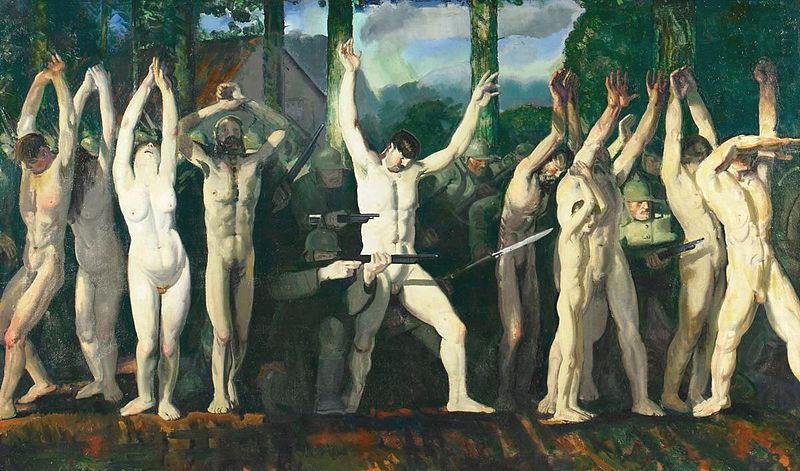
The Barricade by George Bellows (1918)

Another painting from his War Series was entitled The Barricade, in which we see a line of naked human beings, arms held aloft, acting as human shields for the uniformed German soldiers, with their guns raised, who stand and crouch behind them.   As a propaganda piece it worked well evoking both pity and rage in the mind of the viewer.  The message to the American public was clear – can we stand by and let this kind of thing happen or should we join the battle and end such atrocities.

Return of the Useless by George Bellows (1918)

In his painting Return of the Useless, Bellows depicted Germans soldiers unloading sick and disabled labour-camp prisoners from a rust-red boxcar.   These were Belgian citizens who were being returned home as they were no longer physically fit to work for the Germans.   Box-cars were familiar sights on the American railroads but this work depicted the box-car as a transport system for German prisoners.    Look how Bellows has cleverly used the same colour, red, for the rusty box-car as he used for the flushed face of the German soldier who is venting his anger on the fallen and cowering man and the bloodied skin of some of the prisoners.  Cast your eyes towards the interior of the box car.  Here we see an elderly man supporting a young female who is on the point of collapse.  Another woman sits on the floor her arms wrapped around a child.  A young woman is stepping out of the boxcar and her arms are raised in horror as she watches the German guard bring down the butt of his rifle on to the fallen man, who pathetically looks up and begs for mercy.

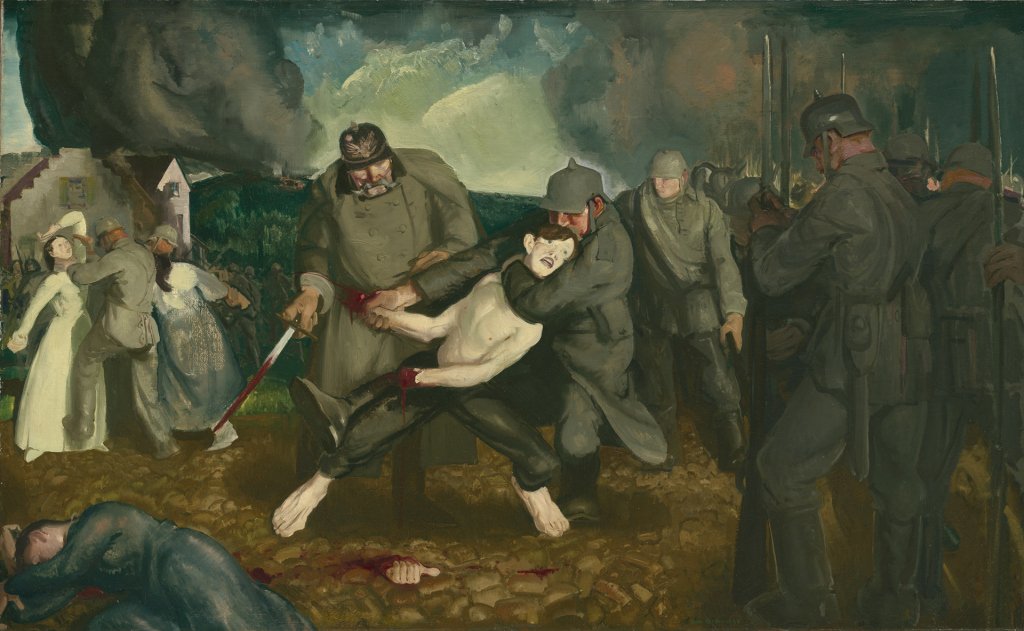
The Germans Arrive by George Bellows (1918)

The Germans Arrive, another painting in the series, was based on an actual account from the Bryce Commission and gruesomely illustrated  a German soldier restraining a young Belgian teenager whose hands had just been severed.   This and the other paintings in the series suffered much criticism accusing Bellows of taking liberties when capturing on canvas, the horrific scenes of war. One notable detractor was the American artist and author,  Joseph Pennell, who argued that because Bellows had never been at the battlefront and therefore had not witnessed at first hand the events he painted, he forfeited the right to paint them. Bellows responded sarcastically that he had not been aware that the great Leonardo da Vinci “had a ticket of admission to the Last Supper”.

The final painting in his War Series is entitled Murder of Edith Cavell.   Edith Cavell was head of the Training School for Nurses in occupied Brussels.

Murder of Edith Cavell by George Bellows (1918)

On August 5th 1915, she was arrested for assisting Belgian, British, and French soldiers to escape from the country. Two months later, she was shot by the German authorities. News of her execution spread round the world, and in October of that year, The New York Times published 41 stories and her case became a cause célèbre.   George Bellows included this incident in a series of 12 lithographs and one full scale painting for his War Series.    In 1959 the Princeton University Art Museum found and acquired Bellow’s finished, full-size drawing (53.5 x 68.5 cm.) for this print. It is interesting to note that Bellows did not complete the oil painting of the scene until after he had finished the full scale drawing and lithograph print.  The painting now belongs to the Springfield Art Museum in Springfield, Massachusetts.

The work depicts a dark and somewhat chaotic prison cell with its grates and bars covering the windows and door.   We see on the flight of stairs leading down to the room the angelic figure of Cavell, dressed in white with her hand to her breast, enacting the classic gesture of humility.  Behind her and to the left, on a landing, we can see some soldiers and a priest clutching his bible. At the foot of the stairs there are more soldiers, one of whom holds a sword.   On the floor in the foreground we see some wounded prisoners lying on the floor guarded by soldiers in the left foreground.

George Bellow’s War Series paintings and lithographs, which he completed in the summer of 1918 whilst he was residing at his home in Middletown, Rhode Island, were ambitious in nature in the beloved tradition of grand manner history works.  His intention was to stir up both the public’s outrage and sympathy.  However the credibility of the images depicted in these paintings went hand in hand with the credibility of the Bryce Commission Report and that was to be called into question after the war had ended.  Many of the reports of German atrocities were then looked upon as merely Allied propaganda, simply designed to bolster the resolve of those Allied nations which were participating in the war and to encourage those nations to commit to the war effort , which up until then, had preferred to remain neutral,   Later, many Americans believed that their country had been tricked and manipulated into joining the conflict and unfortunately for George Bellows he and his War Series were regarded as part of this deception.  In 1925, the American art critic and historian, Virgil Barker commented on the series saying:

“…[they were] ill-judged in their appeal to the passion of hatred as anything produced in America’s most hysterical war years…”

However I will close with a more favourable comment on the War Series.  The art critic G.D.Cotton saw the initial exhibition and wrote about the works in the American Art News in September 1918.  He commented:

“…[the works] are brutal, full of horror, but reeking with truth, which adds to their poignancy.   After one has recovered from the shock of the subject themselves one sees that the pictures are full of strange beauty, conceived in bigness of vision that is rare and inspiring.  The whole exhibition is one to stiffen the spines of the enlisted men who are here and make them realize what they face ‘Over There’…

I can sincerely recommend you go and see the George Bellows exhibition at the Royal Academy of Arts, London which runs until June 9th 2013.  See what you make of these War Series paintings and lithographs and at the same time, take in many of Bellow’s other beautiful works.

Frederic Edwin Church, Part 2

For those of you who have just landed on this page I suggest you go back to my previous blog which looks at Frederic Church’s early life and talks a little about his exhibition at the National Gallery, London which I visited last week.

Our Banner in the Sky by Frederic Edwin Church (1861)

Another beautiful and moving historical painting by Frederic Church which was on display at the exhibition and which I found very moving was a small oil painting entitled Our Banner in the Sky which Frederic Church completed in 1861.  I stood before this work, fascinated by the way in which Church had cleverly depicted the image of the Stars and Stripes American flag in tatters against an amazing daybreak landscape with its red and white bands of clouds.  Church had painted this shortly after the attack on Fort Sumter by General Beauregard and his Confederate troops in January 1861 , which signalled the start of the American Civil War, which tragically went on to cost so many American lives.   In the work we see a bare and tall tree slightly leaning over, which acts as a flagpole for the flag which blends in with the early morning sky.  In it, we see the North Star depicted through a patch of blue sky.  Church has cleverly managed to create a highly patriotic scene which in some ways connects the American landscape with the Northern cause.  It was a heartfelt cry for unity which sadly was not listened to. It was such a popular work that the Manhattan art dealer, Goupil & Co. commissioned Church to produce a chromolithograph of the work and, within a few months, hundreds of copies were bought up by the public.

Isabel Carnes Church by Frederic Church (1860)

It was during the New York exhibition of his Andes painting that Frederic Church met Isabel Carnes.  In 1860 just three months before his marriage to Isabel, Church bought some 126 acres of farmland, close to the towns of Hudson and Catskill and situated on a south sloping hill, overlooking the Hudson River.  He was familiar with this site as he had visited the area whilst on a painting trip with Thomas Cole in 1845.   As he still lived in New York, this new acquisition would be the family country get-away.   Church employed the foremost architect of the time, Richard Morris Hunt, to construct a cottage and design this ferme ornée.  The term means an ‘ornamented farm’, and describes a country estate laid out partly according to aesthetic principles and partly for farming.  Church and his wife referred to the small cottgae on the estate as their Cosy Cottage and it was surrounded by gardens and orchards and Church even had a section of marshland drained so as to build his own expansive ten acre lake.  Over time he bought up more of the adjoining land and eventually his estate encompassed 250 acres.

Fern Walk, Jamaica by Frederic Church (1865)

He and his wife lead a settled and happy life and he spent most of his time tending to his farm but his happiness was shattered in March 1865 when both his young children contracted diphtheria and died a week apart.  In an attempt to counteract the intense grief suffered after their children’s death, he and his wife along with some friends travelled to Jamaica where, for five months, Frederic immersed himself in a painting frenzy whilst his wife collected numerous species of ferns which she would later bring back home and which would form part of her fern garden.  Isabel’s interest in ferns and Frederic’s love of depicting nature in his painting were combined in his 1865 work entitled Fern Walk, Jamaica in which Church depicts a narrow path winding through luxuriant plants and ferns.  The shades of greens and browns which he used in depicting the native flora is breathtaking.  Frederic Church loved his stay in Jamaica.  He loved sketching plein air in the tropical light and, on his return to America, would often encourage other landscape artists to venture on painting trips to the Caribbean island.  In a letter he wrote to the landscape artist, Charles de Wolf Bramwell, he extolled the Fern Walk area of the island, writing:

“…the vegetation, next to that on the Magdalena River, the finest I ever saw –– The ferns, especially in the region known as Fern Walk — excelled every place…”

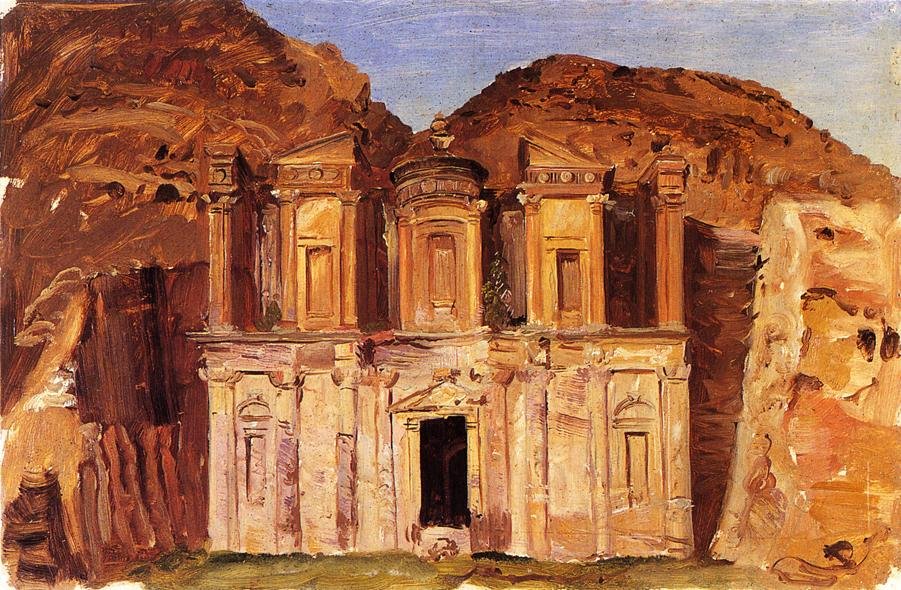
Ed Deir, Petra Jordan by Frederic Church (1868)

The couple returned home from Jamaica and in 1866 Isabel Church gave birth to a son, Frederic Junior.   The following year Frederic and Isabel, along with their son and Isabel’s mother, set off on a two-year long journey of Europe and the Holy Land.   They visited Jerusalem and from there headed to Jordan where Church, after an arduous ten day journey by mule, arrived at the ancient city of Petra.  During the long trip Church continually sketched and painted.  It was a trip which was fraught with danger from not only local bandits, but from the native porters which were helping Church’s party get to their destination.  These Arabs were very superstitious about his sketching but were eventually won over by his skill.  He finally arrived at Petra and made the long climb up above the city to the monastery of Ed Deir, which in the first century AD was a Nabatean temple.   Frederic Church completed his beautiful oil and graphite painting entitled Ed Dier, Petra, Jordan,   Unbelievable at it may sound but Church completed the work in just one sitting, in 1868.

Königsee by Frederic Church (1868)

From the Holy Land, Frederic Church returned to Europe visiting Rome and Athens and also the Bavarian Alpine region, Switzerland and Austria which had always been a popular venue for landscape painters.  Church was drawn to this area as he was always searching for beautiful vistas to paint.   He liked the area as he believed there was a marked similarity between the geography of the area and that of the rugged American landscapes which he knew so well.  In July 1868 he visited the Königsee, the beautiful Upper Bavarian lake which nestles amongst steep-sided cliffs.  Sheltered from the weather,  the surface of the lake is often mirror-like reflecting the surrounding mountains.   He completed a beautiful work entitled Königsee that month and it is a poignant reminder to me of the times I have visited the lake and stood in awe before it, mesmerised by its beauty.

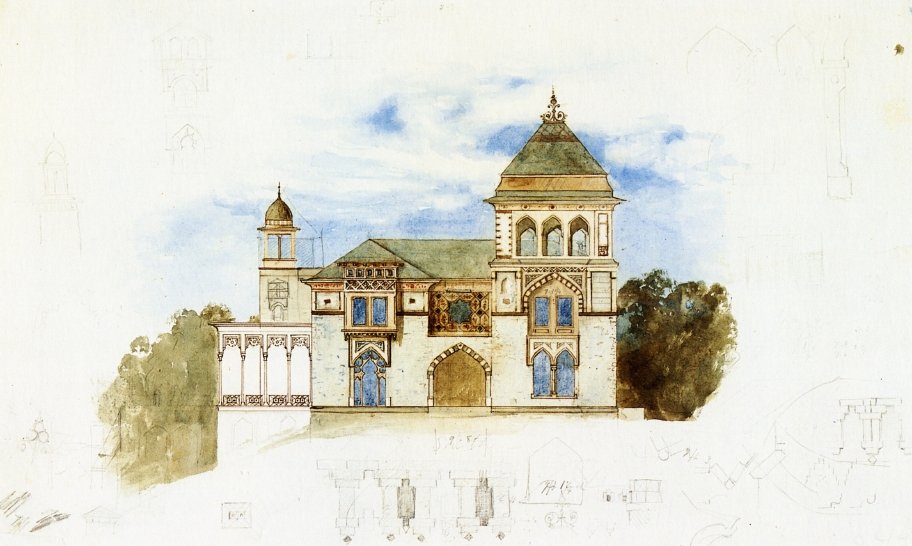
South West Facade of Olana by Frederic Church (1870)
South West Facade of Olana
A watercolour by Frederic Church (1870)

Frederic Church in 1867 was becoming homesick and wanted to return to America and his country estate.  Since he bought it seven years earlier he had been constantly planning the landscape design for the land and the architectural design for a large house on the top of the hill.  Richard Morris Hunt, his architect, had submitted plans for a large French chateau-style house and Church had liked the idea and agreed to the design.   However having returned from his tour of the Levant and studied the architecture of the area, he changed his mind.  He decided to discharge Hunt and take on the British-born American architect and landscape designer Calvert Vaux who was based in Manhattan and had in 1858, along with Frank Law Olmstead had won a design competition to improve and expand New York’s Central Park.

Olana Historic Site
Olana Historic Site

Frederic Church and Vaux worked on the plans for the design of the house which was to be the centrepiece of  Church’s estate, which he and his wife Isabel named Olana after a fortress-treasure house in ancient Persia which like Church’s estate also overlooked a river valley.  The building project was completed in 1872.

As Church got older he spent more and more time on his farm and concentrated his time running the estate.  From the 1870’s onwards Church suffered badly from rheumatoid arthritis which badly affected his right arm curtailing much of his art work although he did teach himself to paint with his left hand.  Frederic Church died in 1900, aged 74 and is buried in Spring Grove Cemetery in Hartford, Connecticut.

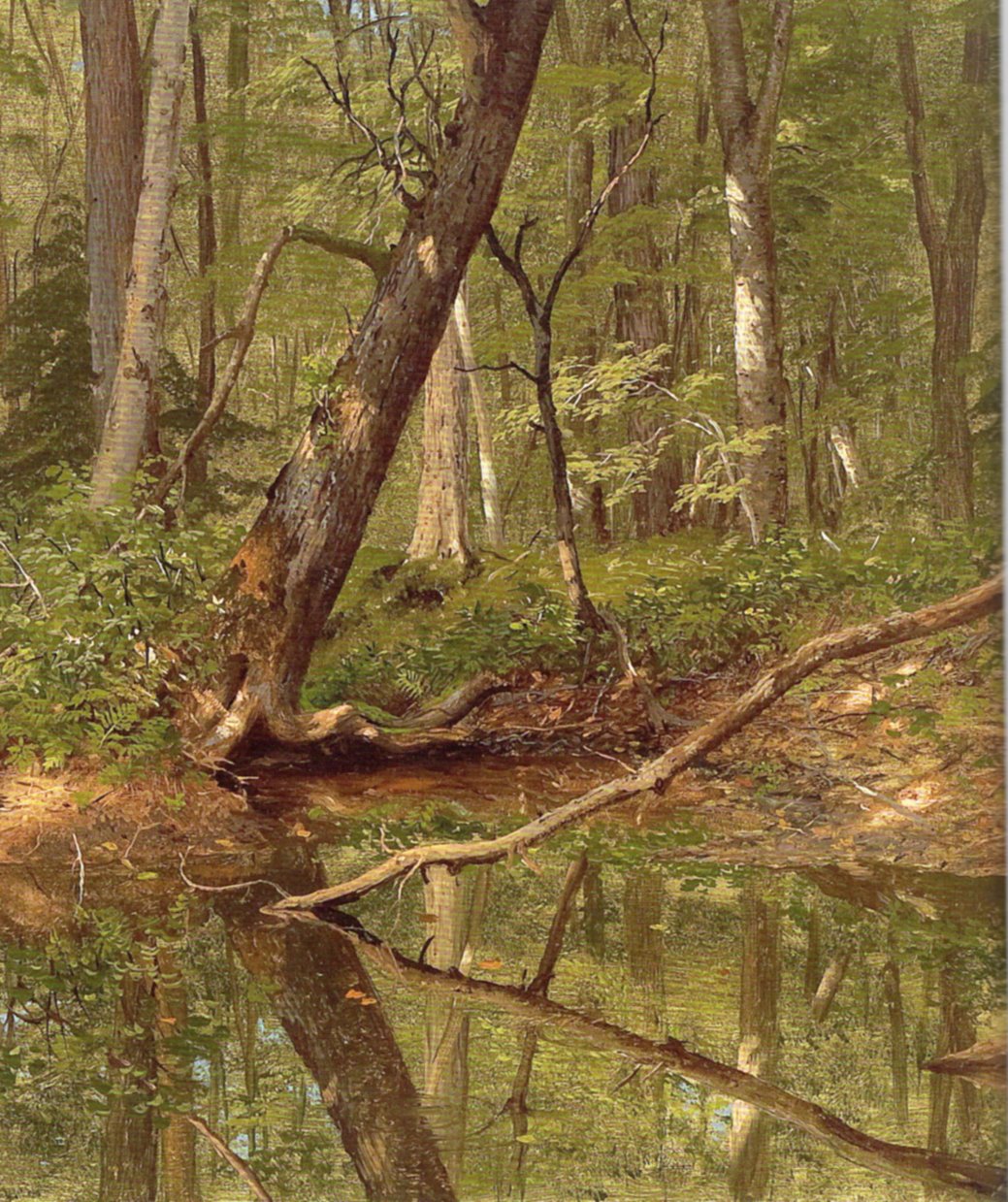
Forest Pool by Frederic Church (1860)

I will finish this blog with a look at the painting by Frederic Church, which most impressed me at the exhibition.  It is entitled Forest Pool and was completed by Frederic Church around 1860.  It was almost the first work I came across as I entered the exhibition room and I had to keep coming back to it in order to savour its beauty.   I stood before it and could not believe the quality of the painting.  Such beautifully drawn details.  Such beautiful colour and tones.  The work was a close-up view of a dense forest and a small forest pool.   Every square inch of the work is covered in rich shades of green and brown and although it was a study for a larger painting, it seems as if it is a finished work.  The artist has delightfully depicted the tranquillity of the forest scene with the calm surface of the pond offering up reflections of the trees and their branches and spots of sunlight.  If you look closely at the upper middle part of the composition you will just be able to make out a hint of blue sky which is otherwise blocked by the screen of trees.

The Frederic Church exhibition at the National Gallery is worth going to see for this painting alone.

Frederic Edwin Church, Part 1

Last weekend I spent a two day break in London attending the christening of my grandson and pottering around a couple of galleries visiting their current exhibitions.   I had tickets for the Boccacio exhibition at the National Gallery and whilst there I decided to call in to their small but excellent Frederic Church exhibition, Through American Eyes: Frederic Church and the Landscape Oil Sketch, which is running until April 28th.   It was a veritable gem of a show and as the publicity stated,

 “…[ it was an invitation to] step into a world of wild natural phenomena with the landscape oil sketches of celebrated American landscape painter, Frederic Church…

 It is a free-to-enter exhibition and one you should try and visit.   I want to dedicate the next two blogs to the nineteenth century American painter Frederic Church, and look at some of his paintings, some of which were at the exhibition.  Church was a master of the plein-air oil sketch and I ask you to accompany me on a journey looking at his life and sampling some of his exquisite artistic gems.

Frederic Church was born in Hartford, the state capital of Connecticut, in May 1826.  He came from a privileged background.  His father, Joseph, who came from a very prosperous family, was a jeweller, silversmith and a Hartford insurance adjuster and the Church household lived an affluent lifestyle.  Frederic, who was brought up in a devout Protestant Congregationalist household, showed a propensity for art whilst at school and through a family neighbour, Daniel Wadsworth, was fortunate enough to be introduced to Thomas Cole, the English-born American landscape artist, who is regarded as the founder of the Hudson River School.  Thomas Cole, who up until then had never taken a pupil under his wing, agreed to take Frederic on as his pupil.   Frederic studied under Thomas Cole in his Catskill studio between 1844 and 1846 during which time he and his tutor would go off on painting trips to the Catskill Mountains and the Berkshires, a highland region in western Massachusetts, west of the Connecticut and lower Westfield Rivers .

Hooker and Company journeying through the Wilderness in 1636  from Plymouth to Hartford by Frederic Church (1846)
Hooker and Company journeying through the Wilderness in 1636 from Plymouth to Hartford
by Frederic Church (1846)

Frederic flourished under Cole’s guidance and, within a year, he had his painting, a scene from early New England history, Hooker and Company journeying through the Wilderness in 1636 from Plymouth to Hartford shown at New York’s National Academy of Design annual exhibition.  The scene recounts the June 1636 journey made by the prominent Puritan religious leader, Reverend Thomas Hooker as he left the Boston area with one hundred men, women, and children and set out for the Connecticut valley. The group traveled over one hundred miles through the wilderness and reached their destination in early July. Many members of the Hooker party settled in Hartford, while some located to nearby Wethersfield and Windsor, and others traveled north and settled Springfield, Massachusetts.    It was through this painting that Church combined his love for ancient landscapes with an acknowledgement of his cultural origins.  The following year Church was elected as the youngest Associate of the National Academy of Design and was promoted to Academician the following year.  That year he sold his first major oil painting to the Wadsworth Atheneum in Hartford, an art museum which had been founded by Daniel Wadsworth.

 After completing his apprenticeship with Cole, Frederic Church moved to New York and set up his own studio in a space which he rented in the Art-Union Building, which was at the centre of the city’s art world, and he began to teach art.   During the spring and autumn months he would leave the city and set out on painting trips throughout New England, particularly Vermont.  Over the months he would build up a large collection of sketches of the beautiful scenery he witnessed, which he would then bring back to his New York studio and during the dark and cold months of winter he would convert them into beautiful landscape paintings.    His landscape artistry was much admired and his landscape works featuring New York and New England vistas sold well.  Frederic Church’s landscape paintings differed from the moral and religious allegorical ones which had been the hallmark of his tutor, Thomas Cole’s landscape works,  for Church wanted to concentrate on the true beauty of nature.  His depictions of storms, sunsets and waterfalls in the Catskill Mountains encapsulated the beauty and spirituality of the American wilderness.  It could well be the case that Frederic Church had read the words of the great English art critic John Ruskin who laid out his ideas of what a young artist should seek to achieve in their landscape works.  Ruskin wrote:

 “…For young artists nothing ought to be tolerated but simple bona fide imitation of nature….. Their duty is neither to choose, nor compose, nor imagine, nor experimentalize; but to be humble and earnest in following the steps of nature, and tracing the finger of God…”

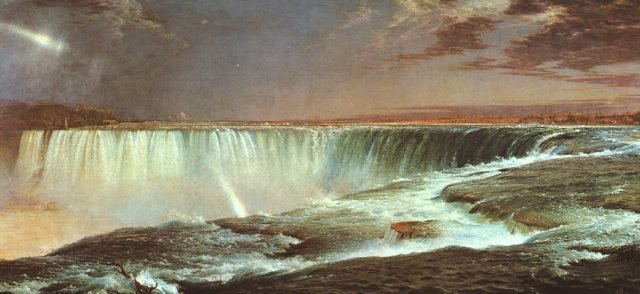
Niagara by Frederic Church (1857)

During a two year period, 1854 to 1856, Frederic Church travelled extensively visiting Nova Scotia, and journeying throughout Maine, New Hampshire, and Vermont, and it was around this time that he visited the Niagara Falls.   The Falls, by this time, had become a great tourist attraction and a favourite destination for artists.  Whilst at the Falls he completed a number of oil sketches which he would utilise when he painted his large-scale works of the Falls in 1857 and 1867.   Frederic Church’s great breakthrough came when, in 1857, he exhibited his painting Niagara It was a large work measuring 107cms x 230cms (see My Daily Art Display Sept 9th 2011) and it visually stunned all who saw it.   Without doubt, the late 1850’s were the high point of Church’s career.  Artistic triumph followed artistic triumph.
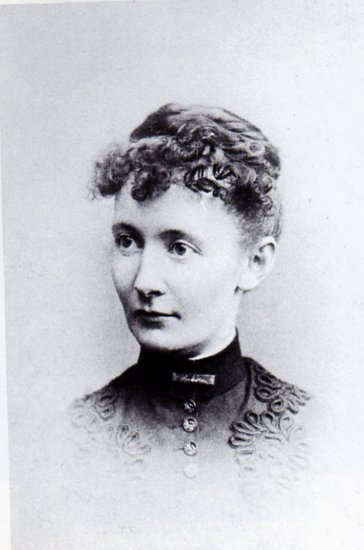
 Frederic Church had, like many others,  become fascinated with the translated writings of the celebrated Prussian naturalist and explorer Alexander von Humboldt, which were based on his five-year expedition in the New World at the start of the nineteenth century.  It was in one of his works, Kosmos  that Von Humboldt implored artists to travel and paint equatorial South America.   In 1853, along with his friend, the young entrepreneur Cyrus West Field, who had financed the trip, Church set off on the first of two expeditions following Humboldt’s footsteps, chiefly in Colombia;  the second trip, in 1857, in company with the American Creole landscape painter, Louis Remy Mignot.   Together, the artists travelled from Panama to Ecuador, where they spent 10 weeks painting village and mountain scenes.

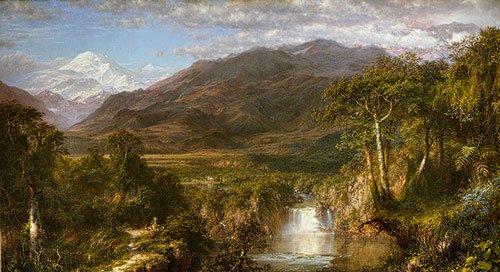
The Heart of the Andes by Frederic Church (1859)

From his trips to South and Central America, Frederic Church amassed a large collection of sketches from which, on his return home, he completed large and spectacular oil paintings.  One of these works was his ten-foot wide work entitled The Heart of the Andes which he completed in 1859.   This elaborate and highly structured painting was his most ambitious work.  In this painting Church managed to depict the variety of earthly life as seen by the lush green foreground.   The painting took pride of place in a New York exhibition, housed in an elaborate window-like frame and illuminated in a darkened room by concealed skylights.  Can you just imagine what nineteenth century viewers made of this extraordinary painting exhibited in such an extraordinary setting?   People thronged to see the painting and it was estimated that more than twelve thousand people visited the exhibition in three weeks and were happy to part with a quarter each to see it.  For that admission fee, the public were provided with opera glasses so that they could examine the painting in detail.  The painting was then shipped to England where once again people flocked to see it.  Church eventually sold it for $10,000, at that time the highest price ever paid for a work by a living American artist.

Iceberg Flotante by Frederic Church (1859)

In 1859 Church took a voyage north along the coast of Newfoundland and Labrador in search of icebergs.  On this trip he was accompanied by the Reverend Louis L. Noble, an author who was to write about their trip together in his 1861 book, After Icebergs with a Painter: A Summer Voyage to Labrador and Around Newfoundland.  During their voyage of discovery Frederic Church and Noble would hire a boat to take them up close to these awe-inspiring floating icebergs to allow Church to sketch these remarkable and majestic floating white giants.  Frederic Church managed to capture the breath-taking beauty of these white giants in a number of his paintings, one of which was his work entitled Iceberg Flotante which he completed in 1859

The Icebergs by Frederic Church (1861)

I particularly like his 1861 painting entitled The Icebergs, in the foreground of which we see a broken masthead lying cross-like on the ice.  Not only is this a beautiful landscape work but it is a kind of historical painting as the inclusion of the masthead is a reference to the tragic loss of Sir John Franklin’s doomed British expedition party which had been attempting to cross the last un-navigated section of the North-West Passage in 1847.  Sadly, the two ships of the expedition became icebound in Victoria Strait, close to King William Island in the Canadian Arctic.  Despite the British Admiralty’s sending numerous search parties to find the ships, the entire expedition party, including Franklin himself and his 128 men, was lost.

……………………………………………….to be continued in my next blog.

Lighthouses and Buildings, Portland Head, Cape Elizabeth, Maine by Edward Hopper

Lighthouse and Buildings, Portland Head, Cape Eizabeth, Maine by Edward Hopper (1927)

The Lighthouse
by Becky Jennings

The mighty lighthouse stands secure,
Undaunted by the restless sea;
Ravaged by the changing tides
And buffeted by winds blown free.

Yet, it sheds its beacon straight and true,
Unfaltering in the bleakest night,
Guiding every passing ship
Uncertain of the course that’s right.

May we be diligent and true,
Dedicated to the right
And like the stalwart lighthouse stand
A beacon in the darkest night.

Having spent my early working life on ships travelling around the world I have an affinity for lighthouses which would often signal landfall after many days and sometimes weeks without seeing land.   There is something very majestic and imperious, dare I say, even romantic about lighthouses as they rise skyward on rocky headlands guiding ships  carrying seafarers homeward bound to the arms of their loved ones.

Time magazine cover  December 24th 1956
Time magazine cover
December 24th 1956

Today I am featuring a beautiful watercolour featuring a lighthouse by one of my favourite American artists, Edward Hopper.   Although he was not alone in depicting lighthouses in his paintings, nevertheless Hopper was one of the few artists who made the tall structures the focus of his compositions and by doing so gave them an iconic presence.  For Hopper, lighthouses were majestic architectural structures and things of beauty.  His name was synonymous with depictions of lighthouses so much so that when Time magazine did a story about his life in their 1956 Christmas issue, the James Chapin portrait of Hopper on the cover included a lighthouse in the background.

During the early days of his career  Hopper would often spend the summers in Cape Elizabeth, Maine, and he had become fascinated with lighthouses and went on to depict these tall structures in several media.   It was in the summer of 1927 that he painted the watercolour depicting the Portland Head Light entitled Lighthouses and Buildings, Portland Head, Cape Elizabeth, Maine which I am featuring today.  The painting resides in the Museum of Fine Arts, Boston.  This lighthouse was the first one to be built in the state of Maine, which at the time was still part of Massachusetts.  It sits on the headland overlooking the main shipping route for vessels, which are approaching from the south, prior to entering Portland harbour.   Up until this time there were no lighthouses on this part of the coast and the local merchants continually petitioned that one should be built so as to avoid ships and their cargoes being lost due to going on the rocks whilst approaching the busy port.   In 1787, two more people were killed when a vessel went aground on Bangs Island (now known as Cushing Island) close to Portland Head and this disaster and loss of life resulted in George Washington authorising the building of a lighthouse on the headland so as to avert any further shipping disasters.  Washington arranged that the lighthouse was to be built by two local Portland stonemasons Jonathan Bryant and John Nichols.  As the State was not awash with money he stipulated that the materials used to build the lighthouse should be “taken from the fields and shores, which could be handled nicely when hauled by oxen on a drag”.  The tower was built of rubble stone and Washington set a deadline for the build telling the two masons that he wanted it completed within four years.  It is interesting to note that the original plans for the build was for a fifty-eight foot tall structure but on completion it was realised that, at that height, the light would not be seen by ships approaching from the south and so the tower had to be raised to a height of seventy-two feet.  The tower was completed during 1790 and first lit January 10, 1791.

Portland Head   Lighthouse (as seen today)
Portland Head
Lighthouse
(as seen today)

Hopper’s watercolour of the Portland Head lighthouse is one of the most picturesque, and by far the most reproduced of his works.  In the painting we see the lighthouse and to the right are the lighthouse keeper’s house and garage which, as the light is now fully automated and does not need the presence of a lighthouse keeper, since 1992 has become the Portland Head Light Museum.  Hopper decided to use some artistic licence in his depiction of the lighthouse and the surrounding area for he omitted from his watercolour a number of fences and paths which he believed would detract from the finished work.   It is interesting to note the limited palette used by Hopper for this work which enhances it.  He used light blue for the sky and a darker blue for the ocean.  The roofs of the buildings are of a reddish-brown and the grass in the foreground is gold and light green.

 In Edward Rowe Snow’s book The Lighthouses of New England, he described the lighthouse and its surroundings as:

“…Portland Head and its light seem to symbolize the state of Maine – rocky coast, breaking waves, sparkling water and clear, pure sea air…”

Gail Levin, art critic and author of the Hopper biography, Edward Hopper, An Intimate Biography, suggests that there was a personal and physical relationship between Hopper and lighthouses.  She wrote:

“…He [Hopper] was nearly six feet five inches tall and perhaps felt a special affinity to this genre of architecture, which like him, stood apart from the rest of the world…”

 Other art critics look upon Hopper’s passion for lighthouses as an architectural manifestation of the theme of loneliness which can be found in much of Hopper’s art.

 I started this blog with a poem written about lighthouses and I conclude today with a longer one on that same subject, written by the famous American poet, Henry Wadsworth Longfellow.

The Lighthouse

The rocky ledge runs far into the sea,
and on its outer point, some miles away,
the lighthouse lifts its massive masonry,
A pillar of fire by night, of cloud by day.

Even at this distance I can see the tides,
Upheaving, break unheard along its base,
A speechless wrath, that rises and subsides
in the white tip and tremor of the face.

And as the evening darkens, lo! how bright,
through the deep purple of the twilight air,
Beams forth the sudden radiance of its light,
with strange, unearthly splendor in the glare!

No one alone: from each projecting cape
And perilous reef along the ocean’s verge,
Starts into life a dim, gigantic shape,
Holding its lantern o’er the restless surge.

Like the great giant Christopher it stands
Upon the brink of the tempestuous wave,
Wading far out among the rocks and sands,
The night o’er taken mariner to save.

And the great ships sail outward and return
Bending and bowing o’er the billowy swells,
And ever joyful, as they see it burn
They wave their silent welcome and farewells.

They come forth from the darkness, and their sails
Gleam for a moment only in the blaze,
And eager faces, as the light unveils
Gaze at the tower, and vanish while they gaze.

The mariner remembers when a child,
on his first voyage, he saw it fade and sink
And when returning from adventures wild,
He saw it rise again o’er ocean’s brink.

Steadfast, serene, immovable, the same,
Year after year, through all the silent night
Burns on forevermore that quenchless flame,
Shines on that inextinguishable light!

It sees the ocean to its bosom clasp
The rocks and sea-sand with the kiss of peace:
It sees the wild winds lift it in their grasp,
And hold it up, and shake it like a fleece.

The startled waves leap over it; the storm
Smites it with all the scourges of the rain,
And steadily against its solid form
press the great shoulders of the hurricane.

The sea-bird wheeling round it, with the din
of wings and winds and solitary cries,
Blinded and maddened by the light within,
Dashes himself against the glare, and dies.

A new Prometheus, chained upon the rock,
Still grasping in his hand the fire of love,
it does not hear the cry, nor heed the shock,
but hails the mariner with words of love.

Sail on!” it says: “sail on, ye stately ships!”
And with your floating bridge the ocean span;
Be mine to guard this light from all eclipse.
Be yours to bring man nearer unto man.

July Fourth by Grandma Moses

July Fourth by Grandma Moses (1951)

Grandma Moses – Part 3

This is my third and final instalment of the life and times of Grandma Moses, the great American Folk artist.  If you have just landed on this page I suggest, before reading this blog, you first go back and look at the earlier blogs covering the early and middle part of her life (My Daily Art Display November 6th and 9th)

I ended the last blog talking about Grandma Moses successful one-man exhibition at Otto Kallir’s Manhattan Galerie St Etienne in October 1940.  At the time of her exhibition she was eighty years of age.  Before the exhibition had finished its one-month run the large Manhattan department store, Gimbels, asked that Grandma Moses’ artwork be exhibited in their store’s large auditorium in time for the Thanksgiving Festival the following month and they invited the artist to be in attendance to talk to the shoppers.  Grandma Moses, who had not attended her one-woman show, agreed to Gimbels’ “meet and greet” request and arrived accompanied by Carolyn Thomas, the owner of the Hoosick Falls drugstore, where the artist’s work was first put on display and her artistic journey had begun.

After the success of the Galerie St Etienne exhibition Grandma Moses works were put on display at other exhibitions in New York and Washington.  In 1941 she exhibited some of her works at the Syracuse Museum of Fine Arts and for her painting The Old Oaken Bucket, she was awarded the New York State Prize.  Over the years Grandma Moses received numerous requests from people for copies of her work, which they had seen at various exhibitions.  She rarely refused and this would explain why titles of her works often recurred.   It should also be noted that although she provided copies of specific works for people, she would often deviate slightly from the original.  In some cases the scene would be the same but the time of year and thus the weather conditions were changed and thus the tonal quality of the painting was adjusted.

When one looks at the many winter scenes depicted in Grandma Moses’ paintings one can understand why a greetings card company would be interested in her work.  The Brundage Greeting Card Company arranged for a number of her paintings to be part of their 1946 Christmas card selection and the following year, 1947, Hallmark acquired the right to reproduce Grandma Moses paintings and they went on to appear for many years on their Christmas and Greetings cards.

In 1849, aged 89, Grandma Moses attended the Women’s National Press Club Awards held at the Statler Hotel in Washington.  Over seven hundred guests and dignitaries attended and watch President Truman hand out the six awards to women who had made substantial contribution in their field.  Grandma Moses’ received her award for her outstanding accomplishment in Art.  Other award winners were Franklin Delano Roosevelt’s widow, Eleanor for her work as Chairman of the UN Human Rights Commission, Madeleine Carroll, the actress and America’s first female elected mayor of a large city (Portland, Oregon), Dorothy McCullough.  The day after the Awards ceremony Grandma Moses was invited by President Truman and his wife to take tea with them at their Blair House residence (The White House was closed between 1949 and 1951 while the building, which had been found to have serious structural faults, was completely gutted and rebuilt and refurbished).

At the end of May 1949, Grandma Moses returned home to Eagle Bridge in triumph and was met and serenaded by an estimated eight hundred people.  Eagle Bridge had never seen the like before.  She remembered that day well and despite all the homecoming celebrations, she wrote of the time in a letter, simply stating:

“…In a way I was glad to get back and go to bed that night…”

In February 1949, Grandma Moses’ youngest son Hugh, who, along with his wife Dorothy, had been living with her and helping run the Mount Nebo farm died suddenly.  She remained at the farmhouse but two years later in 1951 she moved across the road to a new ranch-style house, which her sons, Forrest and Lloyd had built for her.  Now aged 91, she was not to be left to live alone as her daughter Winona returned from California to be with her.

In March 1952 when President Truman was finally allowed to go back with his wife to live at the White House after its extensive refurbishment, Grandma Moses wrote to his wife:

 “…As I have seen in the papers, the White House will be reopened on April 1st.  It would be a great pleasure to me to dedicate on this occasion an original painting by Grandma Moses to the White House and to the American people, if the President and you would approve of my intention, and if there is a place for it…”

Her offer was accepted and her painting entitled July Fourth has been hanging in the White House ever since.   This is My Daily Art Display featured painting for today.   In 1955 she completed another painting for a US President – this time it was a work of art for President Dwight Eisenhower, entitled The Eisenhower Farm, which was presented to him in January 1956, by Vice President Richard Nixon to mark the third anniversary of his inauguration.  Eisenhower was delighted with the painting but did comment that he wished his farm was as big as the one depicted in Grandma Moses’s painting.

Following the end of World War II Grandma Moses fame spread to Europe.  They had already seen illustrations of her work in magazines but there was now a hunger to see the originals.   In 1950 a collection of fifty of her works was sent to Europe and were shown at exhibitions in all the major European art capitals such as Vienna, Munich, Salzburg, Paris, Berne and The Hague.   The attitude to her artwork changed after these exhibitions.  The art critic for the London journal, Art News and Review wrote:

“…Grandma Moses is one of the key symbols of our time…….She is clearly an artist, whose paintings reveal a quality identical with genius…”

High praise indeed !!

In 1955 she took part in a famous TV programme with the legendry radio and TV commentator Edward Murrow and in May 1960 Governor of the New York State, Nelson Rockefeller issued a proclamation declaring September 7th that year to be “Grandma Moses Day”, which was the day of her one hundredth birthday.

By this time Grandma Moses’ health was starting to decline.  Her strength was waning and she was having severe difficulty with walking.   After a number of falls her son Forrest took her to the Health Centre at Hoosick Falls.  Sadly for Grandma Moses it was decided that she could not continue to live in her home as she needed constant care and so she was admitted to the nursing home.  Away from her own home she was unable to paint and this saddened her.  She never made it back home and although she celebrated her 101st birthday at the Hoosick Falls Health Centre she passed away three months later on December 13th 1961 and was buried at the Maple Grove Cemetery.

News of her death spread far and wide and tributes poured in.  President Kennedy issued the following statement:

“…The death of Grandma Moses removes a beloved figure from American life.  The directness and vividness of her paintings restored a primitive freshness to our perception of the American scene.  All Americans mourn her loss.  Both her work and her life helped our nation renew its pioneer heritage and recalled its roots in the countryside and on the frontier…”

I hope you have enjoyed this look at an astounding female artist.  I have trawled through reams of information to try and get a true picture of the great lady’s life.  I have come across numerous factual contradictions, which I have tried to sort out.   My main source of information was a book I bought myself entitled Grandma Moses by Otto Kallir.  It is a wonderful book and one I recommend you buy.

Bringing in the Maple Sugar by Grandma Moses

Bringing in the Maple Sugar by Grandma Moses (1939)

Grandma Moses – Part 2

This is the second part of my story about Grandma Moses and if you have just alighted on this page, you should go back to my last blog in which I looked at her early life.

I ended my last blog about Grandma Moses in the year 1927.  This was the year when her husband of almost forty years, Thomas Salmon Moses, died and Anna May Robertson Moses became a sixty-seven year old widow.  Following her husband’s death, she remained on her Mount Nebo farmstead along with her youngest son Hugh, who took over the running of the farm along with his wife Dorothy.  One of Grandma Moses’ other daughters, Anna, lived close by in the town of Bennington with her husband Frank, who was her first cousin, and their two children Walter and Thomas.   Anna had contracted tuberculosis and had become very ill.  Grandma Moses spent a lot of time with her and her family taking care of her two grandchildren.  Anna Moses died in 1933 and Grandma Moses stayed on at their Bennington home for the next two years looking after her son-in-law and his children.  This arrangement continued until 1935, at which time Frank Moses remarried and Grandma Moses was then able to return to her home.

Over those past years Grandma Moses found more time to carry on with her embroidery and needlepoint work.  Once when her sister Celestia came to Mount Nebo for a visit she saw some of her sister’s work and suggested that she should concentrate more on painting rather than embroidery.  This advice, together with the fact that Grandma Moses was suffering badly from arthritis of the hands, persuaded her to heed her sister’s advice and she began to concentrate all her artistic efforts, not in yarn but in oils.

I ended my last blog by mentioning Grandma Moses “big break” as far as her artistic opportunities were concerned.   This came in 1938 when her daughter-in-law, Dorothy persuaded her to let her take some of her embroidered work and painted pictures down to the Woman’s Exchange in the W.D. Thomas drugstore in Hoosick Falls and it was at this point that fate stepped in and took a hand,  for passing through the town during his Easter vacation was Louis Calder, a New York amateur art collector and engineer.  He spotted Grandma Moses’ works displayed in the drugstore window, priced between $3 and $5 and he bought them all.  He then enquired about the artist of his recent acquisitions and went to visit her.  He then bought a further ten of her works.

Louis Calder returned to New York and tried to interest people in Grandma Moses’ works.  There was little interest.  Somewhat despondent Calder had virtually given up hope of re-selling his newly bought acquisitions.  However the following year, 1939, he got to hear about an exhibition being held in the Members Room of the city’s Museum of Modern Art that was to open on October 18th and run for a month.  The exhibition was to be entitled Contemporary Unknown American Painters.  Calder went to the organiser of the show, Sidney Janis and showed him the works of Grandma Moses which he had just bought the previous year.   Janis agreed to exhibit three of the paintings, Home,  Maple Sugar Days and The First Automobile.   None of the paintings sold but Calder was not disheartened and contacted Grandma Moses urging her to produce further works for him.

In the meantime Louis Calder went on searching for prospective buyers for the paintings.  It was at the end of 1939 that he heard of a new gallery, Galerie St Etienne, which had recently been opened by Otto Kallir on Manhattan’s West 57th Street.   In 1938, Otto Kallir, then known as Otto Nierenstein, was one of Vienna’s most prominent Jewish art dealers but had fled the Nazi regime and emigrated to the United States.  He then, in 1939, established his gallery and helped to introduce Expressionism to America.   Later in the 1940’s and 1950’s, Kallir would give numerous important Austrian and German modernists, including Gustav Klimt, Oskar Kokoschka, Alfred Kubin, Paula Modersohn-Becker and Egon Schiele their first American exhibitions in his gallery.   Otto Kallir was known to be interested in folk art and primitive art and so Louis Calder arranged for him to see some of Grandma Moses’ art work.

One of the paintings which Kallir really liked was entitled Bringing in the Maple Sugar and it is this painting which I have featured in My Daily Art Display blog today.   Grandma Moses completed the work in 1839 and it depicts a sugaring-off scene in which people are collecting sap from the maple trees.  It is a winter scene set in a snow-covered clearing and we can see people busying themselves with the task in hand of collecting the precious tree sap to be used in making maple syrup.  Once the sap is collected in the buckets it is carried over and poured into kettles which dangle over fires.  Besides the hard-working adults in the scene, Grandma Moses has added the figures of children happily playing in the snow and waiting for some maple syrup candy which is being prepared by a man on the left who is busily stirring the pot.   To the right of the picture we can see a horse-driven sleigh loaded with timber which will be used to keep the fires burning.  In the left mid-ground we see a team of oxen approaching, pulling their sleigh full of wood.  It is a painting full of activity but what impressed Kallir most of all was not the way the artist had painted the figures, which he considered rather clumsy, but the way she had painted the landscape background.  He commented that although he believed Grandma Moses had never heard of any rules of perspective, she had managed to achieve an impression of depth in the way she had depicted the tall bare trees in the foreground to smaller ones in the background and the clearly outlined larger figures in the foreground to the smaller, hazy-detailed figures in the background.   He also liked how she had almost merged the smoke which billowed and rose from the chimney of the hut and the bluish gray sky of an early morning in winter.  For Kallir it was Grandma Moses’ ability to convey a true atmosphere and a oneness with nature that appealed to him.

Otto Kallir agreed to exhibit Grandma Moses’ works in a “one-man show” at his gallery.  It opened on October 9th 1940 and was entitled What a Farm Wife Painted and consisted of thirty-three of her paintings and one of her embroidered works.  The New York Times of October 8th previewed the exhibition and part of the article read:

“…Mrs Anna May Robertson Moses, known to the countryside around Greenwich, New York, as Grandma Moses, began painting three years ago, when she was approaching 80…”

From that day on Anna Mary Robertson Moses became known as Grandma Moses.

The Old Hoosick Bridge by Grandma Moses

The Old Hoosick Bridge by Grandma Moses (1847)

For the last few blogs I have been looking at the lives of artists who were taken from us at a very young age, and in very sad circumstances.   I looked at the lives and works of the French artist Fréderic Bazille and the English painter Brian Hatton both of whom gave up their lives for their country on the battlefield at the age of twenty-nine and in my last two blogs I showcased the life and work of the German Expressionist Paula Modersohn-Becker who died suddenly after giving birth to her first and only child at the young and tender age of thirty-one.  The three painters promised so much and we were cruelly robbed of their artistic talents.  For my next three blogs I wanted to lift spirits and talk about an artist who did not die young, in fact lived to the age of 101.  She is probably far better known in her native America than in the rest of the world.  Let me introduce you to Anna Mary Robertson Moses who became better known as Grandma Moses, the most famous of American naive painters.  Naive art is defined as art produced in more or less sophisticated societies but lacking or rejecting conventional expertise in representational skills.  It is art that is often typified by a childlike simplicity in the subjects it depicts and in its methodology.   There is often a lack of perspective, with objects being depicted the same size notwithstanding whether they are in the foreground or background.  Again, there is no diminishment in detail or strength of colour between objects in the foreground and the background.  There is a simplicity about this type of art and it has become ever more popular.

Anna Mary Robertson was born on September 7th 1860, on a farm in Greenwich, upstate New York.  She was the third of ten children born to Russell King Robertson, a flax grower, and Margaret Shannahan.    She had a simple and happy early life and she recalled those happy days some eighty-five years later in an autobiographical sketch of her early life which she wrote in 1945:

“…I Anna Mary Robertson was born back in the green meadow and wild woods, on a Farm in washington, Co., in the year of 1860, Sept 7, of Scotch Irish Paternal ancestry.   Here I spent my life with mother Father and Sisters and Brothers, those were my Happy days, free from care or worry, helping mother, rocking Sisters cradle taking sewing lessons from mother sporting with my Brothers, making rafts to float over the mill-pond, Roam the wild woods gathering Flowers, and building air castles…”

Her schooling was limited.  She attended a one-room schoolhouse with her brothers and sisters.  She said that schooling was just confined to three months in the summer and three months in the winter but few young girls went to school in the winter as it was so cold and they did not have enough warm clothing.   When she was twelve years of age, she left home and for the next fifteen years she earned a living as a “hired girl”, working at neighbourhood farms.  The work was often hard but she recounted how she benefited from the experience:

“….I left home to earn my own living as then was called a hired girl.   This was a grand education for me, in cooking, House Keeping, in moralizeing and mingleing with the outside world…”

Anna Mary Robertson
the bride (1887)

She spent time living with the Whitesides family who she liked and they looked upon her as one of their own.  They were an elderly couple, devout Presbyterians and every Sunday she would drive them to church in their horse and carriage.  The wife, who was an invalid, was quite ill and Anna for three years cared for her.   When she died she stayed and looked after the husband and his nephew and wife moved in to run the farm.  Anna stayed until Mr Whiteside died and after that just drifted away from the neighbourhood still working as a “hired girl”.

Thomas Salomon Moses
the bridegroom (1887)

In 1887, at the age of 27, she married Thomas Salmon Moses, a farmer by occupation, and the couple left the area for North Carolina, where they were going to run a horse ranch.  However they never made it to North Carolina as once they arrived in Staunton Virginnia, they were offered the chance to run a farm.  The farm had lost all its coloured workers after the war and people were desperate to employ others to fill their places They accepted the offer and lived there for a year before moving on to live and work on a six hundred acre dairy farm.  She wrote about her life there:

“… Here I commenced to make Butter in pound prints and ship to the White Sulphur Springs, W, Va.   I also made potato chips, which was a novelty in tho days, this we continued for several years…”

She gave birth to ten children, five of whom died in infancy. In a letter she looked back at that time with the birth and death of her children, writing:

“… Here our ten children were Born and there I left five little graves in that beautiful Shenadoah Valley…”

She, along with her husband and their five surviving children, Winona, Forrest, Lloyd, Anna and Hugh, left Virginia at the end of 1905 and moved north to the hamlet of Eagle Bridge in Rensselaer County, New York State which was not far from her birthplace.  The couple bought a farm, which was known locally as Mount Nebo, named after Moses’ biblical resting place and went into the dairy business, selling milk.  Over the years one of her daughters, Anna, got married and left home and two of her sons, Forrest and Lloyd, went to live on a farm which they had bought themselves.   In 1927 Anna’s husband Thomas died and their youngest son Hugh and his wife Dorothy took over the running of the farm.  Anna Mary Moses was then sixty-seven years of age.

You may find it strange that up to this point in my account of Anna’s life I have never mentioned her art.  I haven’t mentioned drawing lessons or her desire to be an artist.  The reason is quite simple – art never became a serious part of her life although her father, whol liked to draw,  would give her and her brothers paper and he would like to watch them all draw pictures and she would often colour her drawings using grape juice or juice from other berries.  However with all her work as a “hired girl” and later as a young wife she never had time on her hands to continue with her painting.  However, soon after her husband died  and she was becoming too fragile to carry on with her housework, she needed something to occupy her time, as she wrote in her autobiographical sketch:

“…Here Jan 15, 1927, my Husband died, my youngest son and wife taking over the farm,

Leaving me unoccupied, I had to do something, so took up painting pictures in worsted, then in oil…”

The Old Hoosick Bridge 1818
Embroidery by Grandma Moses

My Daily Art Display featured painting today is entitled The Old Hoosick Bridge which Grandma Moses painted in 1947.  The reason for featuring this work, although she painted it when she was 87 years of age, was that she had in her early days depicted a similar scene, but as a work of embroidery, which was entitled, The Old Hoosick Bridge, 1818. (above)   Initially Anna started making pictures out of worsted wool which she designed herself and were awash with very bright colours.  This scene was typical of her early works which were from memories of her early childhood and as a farmer’s wife.  The old covered bridges were landmarks in her early days but at the time she painted this picture the bridge had well gone.

In my next blog I will continue with her life story and recall how she got her big “break” as far as her art was concerned.

Maga’s Daughter by Andrew Wyeth

Maga’s Daughter by Andrew Wyeth (1966)

Today I am returning to an artist I first featured almost twenty months ago.  The artist in question is Andrew Wyeth and in My Daily Art Display of January 3rd 2011 I looked at his famous work entitled Christina’s World.  It is an extremely poignant painting and one which will always linger in my memory.  I do recommend you go and have a look at it and see what you think.  My featured painting today is a beautiful portrait which Andrew Wyeth completed in 1966 and is entitled Maga’s Daughter.   The reason for the title will become apparent when you read the life story of Andrew and his wife Betsy.

Andrew Wyeth was born in 1917 in the town of Chadds Ford, Delaware County Pennsylvania.  His mother was Carolyn Brenneman Wyeth (née Bockius), a lady from Wilmington.  His father was Newell Convers (N.C.)Wyeth, an artist and one of America’s greatest illustrators.  N.C. Wyeth had moved from Massachusetts as a young man to study with the illustrator Howard Pyle in Chadds Ford and it was here in 1908 that he and Carolyn married.  He then built his home and studio on an eighteen acre homestead close to the site of the Brandywine battlefield, where in 1777 the Continental army led by George Washington fought the British army in the American Revolutionary War.  The couple went on to have three daughters and two sons of which,  Andrew was the youngest.   All the children were extremely talented. The eldest child, Henrietta is considered by many art scholars to be one of the great women painters of the 20th century.  Carolyn Wyeth, the second daughter was also an artist whilst the youngest daughter, Ann, was a talented musician.  Andrew Wyeth’s elder brother, Nathaniel, was a mechanical engineer and inventor.

Andrew Wyeth’s father although wanting to devote his time to painting had to, for financial reasons, concentrate on his work as an illustrator.   It was a well paid profession and the family lived a comfortable lifestyle.  As a child, Andrew never kept well, one illness followed another and consequently he spent a lot of time at home and his father had to provide him with home tutoring.   There was a marked difference between father and son.  His father was a big man and had boundless energy which was in marked contrast to his frail and delicate son.   Later in life Andrew Wyeth remembered those days closeted at home with his father.  He wrote:

“…Pa kept me almost in a jail,” Wyeth recalled, “just kept me to himself in my own world, and he wouldn’t let anyone in on it. I was almost made to stay in Sherwood Forest with Maid Marion and the rebels…”

Before Andrew Wyeth had reached his teenage years his father had achieved celebrity status as an illustrator having illustrated Robert Louis Stevenson’s famous book, Treasure Island.  Following on from this success he illustrated other famous novels such as James Fenimore Cooper’s Last of the Mohicans and Daniel Defoe’s Robinson Crusoe.   Andrew Wyeth was taught art by his father, who inspired his son’s love of rural landscapes, sense of romance, and instilled in him a feeling for the Wyeth family artistic traditions. From an early age, the youngster soon began to enjoy drawing and with his father’s guidance, he quickly mastered figure study and watercolour techniques. Andrew soon became fascinated by art history and loved to look at works by not only the Renaissance Masters but native born American artists, such as Winslow Homer.  In 1937, when he was twenty years of age, Andrew had his first one-man exhibition of watercolours at the Macbeth Gallery in New York City. It was a resounding success and all the works exhibited were sold.  It was now that he was certain in his own mind that a career as an artist was all he wanted.  This immediate success which he achieved did not reassure him as like many talented people he was exceedingly self-critical.  He was irritated by some of his work believing it to be too facile.

It was in 1939 that Andrew Wyeth met Betsy Merle James.  Betsy James was born in the village of East Aurora in New York State in 1922.  Her father, Merle James, a trained artist, worked as a printer for the newspaper, Buffalo Courier-Express.  Her mother was Elizabeth “Maga” Browning (hence the title of today’s featured painting).   Betsy grew up as the youngest of three girls.  In the 1930’s the family spent their summers with their friends on Bird Point, a promontory jutting out into the Atlantic Ocean, close to the town of Cushing, Maine.   The next door neighbours were Alvaro Olson, a blueberry farmer and his sister Christina .  This was the Christina of Wyeth’s famous painting Christina’s World. As a young girl Betsy became great friends with Christina.  In 1939, on Andrew Wyeth’s twenty-second birthday, while spending the summer in Maine, the seventeen year old Betsy James and the twenty-two year old Andrew Wyeth met.  At this initial meeting Betsy James took Andrew to Cushing to introduce him to her long-time friend Christina, who had been crippled by polio in childhood.   Strangely, at this first meeting, it was not Christina who made the greatest impression on Andrew Wyeth but the weather-beaten, three-story, steep-roofed, clapboard house, built on a coastal promontory which was her home.  However later Christina and Andrew became good friends and she featured in many of his paintings including three beautiful portraits entitled, Christina Olson (1947), Miss Olson (1952), and Anna Christina (1967). Christina even allowed him to convert one of the rooms in their farmhouse into a studio.

Betsy and Andrew’s wedding day (1940)

Andrew and Betsy dated all that summer and in the fall, when Betsy went off to the Colby Junior College in New Hampshire, they faithfully corresponded with each other.  They were in love and the following year they married and set up home in an old schoolhouse which lay on the Wyeth family land.  Although Betsy was not an artist, Andrew continually sought her judgement on his work.  Sales of Andrew Wyeth’s works of art grew steadily and Betsy managed the business side leaving her husband to concentrate solely on his art.  Betsy had a strong character and exerted almost as much influence on her husband as his father.  In the early days of her marriage, she believed that she had to battle with Andrew’s father to gain her husband’s  attention.  She once commented to Richard Meryman, Andrew Wyeth’s biographer, on her battle with her father-in-law:

“I was part of a conspiracy to dethrone the king — the usurper of the throne. And I did. I put Andrew on the throne…”

In 1943 the couple had their first child, a son Nicholas.  A second son, James followed three years later and would become a renowned artist in his own right.  Eighteen years after the couple married and settled in to life in the school house, they moved and bought an old 18th century gristmill on the banks of the Brandywine River in Pennsylvania.  Whilst her husband spent days on end painting, Betsy set about restoring the old mill, converting it into a home and a studio.

The featured painting today is Maga’s Daughter by Andrew Wyeth, which he completed in 1966.  It is a portrait of his beloved wife Betsy, whose mother was Elizabeth “Maga” James .  She posed in a three-quarter view.  She stands erect.  Her bearing is one of dignified pride as she averts her eyes away from the viewer.  Atop her head is an antique riding hat with its drawstrings dangling freely on either side of her face, almost if they were acting as a frame of a picture.  She wears a drab-coloured, high collared dress which almost blends in with the slightly lighter coloured background.  There is a faint flush of colour to her cheeks and a smile is forming on her lips.  What beautiful eyes she has, lit by the unseen light source to the left of the painting.

What was Andrew Wyeth thinking as he painted this portrait?  Actually we know,  for he told us:

 “…It’s my wife, Betsy. I had worked a long time on this and knew it wasn’t working. At the time I was on board of trustees of the Smithsonian Institution – quite prestigious. But Betsy didn’t like it, telling me that my work would suffer because of all these boards. I left for Washington one morning, and Betsy got furious, really flew into a rage. All the way down I kept thinking of that colour rising up high into her cheeks. I knew I had captured her. The colour of those cheeks under her coal black hair and that hat gives the portrait a real edge. Really caught her. It’s more than a picture of a lovely looking woman. It’s blood rushing up. Portraits live or not on such fine lines! What makes this, is that odd, flat Quaker hat and the wonderful teardrop ribbons and those flushed cheeks. She could be a Quaker girl who’s just come in from riding… ”

Andrew & Betsy Wyeth, October 15, 2008

On January 16, 2009, Andrew Wyeth died in his sleep at his home in Chadds Ford, Pennsylvania, after a brief illness. He was 91 years old.  Andrew and Betsy Wyeth had been married sixty nine years

Portrait of Maud Cook by Thomas Eakins

Portrait of Maud Cook by Thomas Eakins (1895)

As promised in my last blog, today I will complete the life story of the great American artist Thomas Eakins and look at another of his paintings, this time a portrait.  If you have just landed on this page maybe you would like to go back to my previous blog in which I started talking about Eakins’ early life and had a look at his famous painting entitled The Champion Single Sculls, a perfectly rendered quiet picture of a rower on the Schuylkill River which he completed in 1871.

After his four year stay in Europe, Eakins had returned to America and the city of Philadelphia where he remained to the end of his life.    He once again attended the Jefferson Medical College and resumed his anatomical studies and in 1878 he took up a teaching post as a volunteer at the Pennsylvania Academy of the Fine Arts.  The following year he was appointed Professor of Painting and Drawing and in 1882 he became director of the artistic establishment.  On January 19, 1884, he married Susan Hannah Macdowell, a student at the academy.   She was, well known in the artistic community.  She was 25 when Eakins met her at the Hazeltine Gallery in Philadelphia, where his painting, The Gross Clinic was being exhibited in 1875.  This was to be his most famous picture and at the time aroused controversy because of its detailed depiction of a surgical operation.     Unlike many, Susan MacDowell was impressed by the controversial painting and she decided to study with him at the Academy, which she attended for 6 years.   Her own artwork became more sober and her painting style became of a more realistic style similar to Eakins. She was an outstanding student and winner of the Mary Smith prize for the best painting by a matriculating woman artist.

Once she married Eakins she all but gave up her art as most of her time was spent in supporting her husband’s career, being the perfect hostess when they entertained and during the difficult times after Eakins left the Academy she never wavered in her support for him, unlike some of his family and so-called friends.  The couple did not have children but it was thought they lived a happy and contented life.  She and Eakins both shared a passion for photography, both as photographers and subjects, and employed it as a tool for their art. She also posed nude for many of his photos and took images of him. Both had separate studios in their home.

In the previous blog I talked about Eakins disenchantment with the École des Beaux-Arts and their treatment of nudity.  He had definite views on the subject and once wrote:

“…She [the female nude] is the most beautiful thing there is in the world except a naked man, but I never yet saw a study of one exhibited… It would be a godsend to see a fine man model painted in the studio with the bare walls, alongside of the smiling smirking goddesses of waxy complexion amidst the delicious arsenic green trees and gentle wax flowers & purling streams running melodious up & down the hills especially up. I hate affectation…”

Eakins was a fervent believer that the male and female nude were things of beauty and nude models should be available to his students for them to complete their life drawing studies.  He was attacked for his radical ideas, particularly his insistence on working from nude models.  Eakins’s work photographing and painting nudes made him something of a liability for the Pennsylvania Academy of the Fine Arts where he taught and it all came to a head in 1886 when he was forced to resign after allowing a class of both male and female students to draw from a completely nude male model.

The Concert Singer by Thomas Eakins

Thomas Eakins, who by the 1880s had only managed to sell nine pictures for a total of $2,000 now decided to concentrate on portraiture.   However, portraiture commissions were equally hard to come by and most of his portraiture works were of his friends and individuals who he admired and offered to paint them without payment.   My Daily Art Display painting today is an example of this.  My featured painting today is entitled Portrait of Maud Cook.  It is such a beautifully haunting portrait which Thomas Eakins completed in 1895 and is looked upon as one of his finest work of portraiture.  In 1892, Eakins had already completed portraits of Maud’s sister Weda Cook, the operatic contralto singer, one of which was entitled The Concert Singer.

Thomas Eakins’ paintings were known for being both scientifically and philosophically accurate.   For Eakins, portraiture held little interest as a means of fashionable idealization.  There was to be no glorification of how people looked.  There was to be no hint of making the person look more beautiful or younger than they actually were.   Unlike most other portrait painters of the time,  Eakins had little concern for flattering his sitters and instead demanded from himself the most precise objective images. The results were comprehensive and revealing portraits that seemed to carry with them the souls of their subjects.  Eakins refused to compromise and painted his subjects as they really were, and not as they wished to be seen.  However, it was precisely for this reason that his portraits were often rejected by the sitters or their families.

Eakins having studied anatomy and later taught it to his students applied this knowledge to the proportions of the human form in his work. He also had a certain gift for capturing the real embodiment of the person, which many artists strove for but often failed to achieve.

In this portrait of the twenty-five year old Maud Cook we see her wearing a pink dress the fabric of which flows from her shoulders and is pinned between her breasts.  Her hair is long and lies, tied with a ribbon, at the back of her neck.  Her face is tilted slightly towards the source of light which comes from the left of the painting.  Such light casts deep shadows across her face and reveals her facial structure.  There is a warmth in the light which illuminates the exposed skin of her neck and upper chest bringing to the painting a demure sensuality.  The expression on the young woman’s face is both captivating and haunting.  Is it a look of sadness or thoughtfulness?  In many of Eakins’ portraits of women he focused on their susceptibility and emotional sensitivity. Is this what he has achieved with this work?   Eakins gave the painting to Maud Cook and inscribed it on the back and carved frame:
“To his friend/Maude Cook/Thomas Eakins/1895”

Years later, Maud Cook described the portrait to the artist’s biographer:

“…As I was just a young girl my hair is done low in the neck and tied with a ribbon. Mr. Eakins never gave the painting a name but said to himself it was like ‘a big rosebud…'”

The painting was later bought by the newspaper publisher and art collector, Stephen Carlton Clark, who on his death bequeathed the painting to Yale University Art Gallery where it remains today.

The American artist Robert Henri, who had studied at the Pennsylvania Academy of the Fine Arts from 1886 to 1888 and knew Eakins, wrote an open letter about him to the Art Students League a year after the artist’s death.    In it he described the great man:

 “…Thomas Eakins was a man of great character. He was a man of iron will and his will to paint and to carry out his life as he thought it should go. This he did. It cost him heavily but in his works we have the precious result of his independence, his generous heart and his big mind. Eakins was a deep student of life, and with a great love he studied humanity frankly. He was not afraid of what his study revealed to him. In the matter of ways and means of expression, the science of technique, he studied most profoundly, as only a great master would have the will to study. His vision was not touched by fashion. He struggled to apprehend the constructive force in nature and to employ in his works the principles found. His quality was honesty. Integrity is the word which seems best to fit him. Personally I consider him the greatest portrait painter America has produced…”

It was only during the final years of his life that Eakins began to receive a little bit of the recognition he deserved. He died in 1916 in the Philadelphia home in which he was born. As is the case with many great artists, Eakins’ fame is almost entirely posthumous.  Eakins had struggled to make a living from his work which is somewhat ironic as his painting The Gross Clinic fetched US$ 68 million in 2006.  Today Thomas Eakins is regarded as one of the most important American artists of any period.

After his death in 1916, his wife returned to painting, adding considerably to her output right up to the 1930s.  Her artistic style changed becoming much warmer, looser, and brighter in tone.   She died in 1938.