Thérèse Schwartze

Thérèse Schwartze – self portrait (1917)

Therese Schwartze was a Dutch 20th century painter.  Such was a hugely talented portrait artist that was one of only a few females who had been honoured by receiving an invitation to contribute her self-portrait to the hall of painters at the Uffizi Gallery in Florence.  This genius of portraiture completed around a thousand works during her forty-year career, which means that she completed more than twenty paintings a year. Because many of her portraits were created to be treasured by family members, most of her work has remained in private collections.  About one hundred and fifteen of her paintings are in public collections in the Netherlands, and twelve are part of foreign public collections, which leaves the locations of nearly four hundred paintings still unknown. She became a millionaire in the process. Schwartze also established an international reputation, with countless exhibitions and commissions throughout Europe and the United States. 
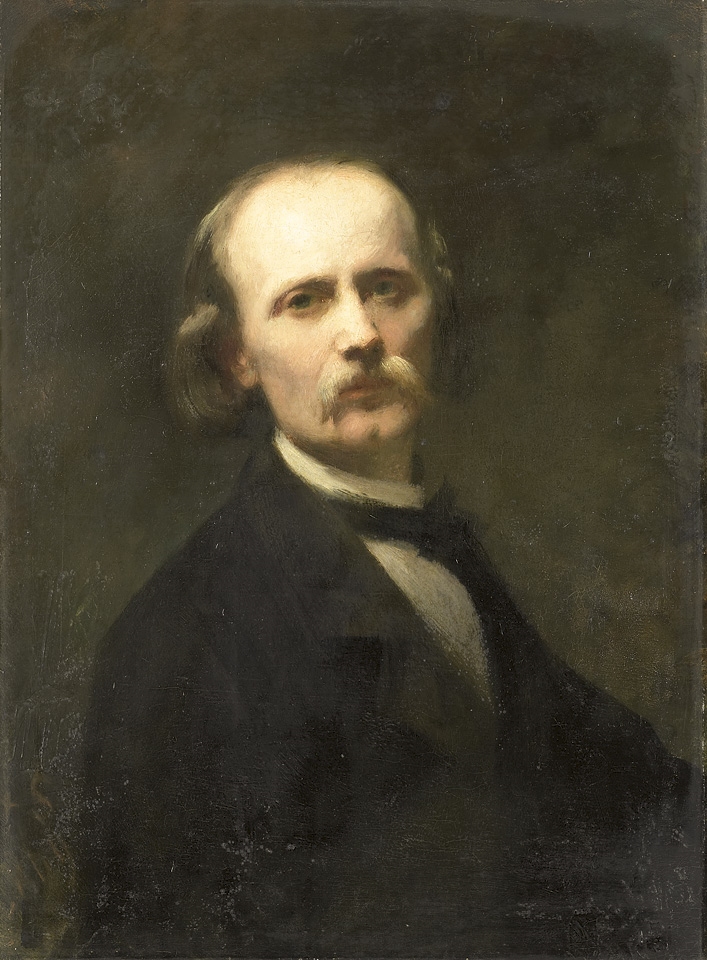
Self Portrait by Johan Georg Schwartze

Thérèse was born on December 20th 1852 in Amsterdam.  She was the daughter of Johan Georg Schwartze and Maria Elisabeth Therese Herrmann.  She was one of five children and had four sisters including Georgine, a sculptor, Clara Theresia, a painter and one brother, George Washington Schwartze, also a painter. 
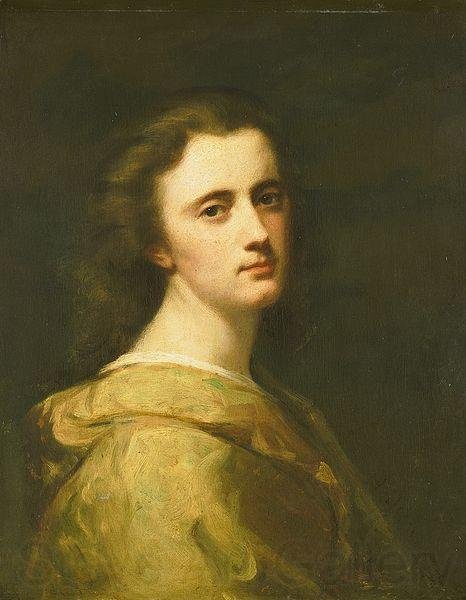
Portrait of Thérèse aged 16 by her father, Johan Georg Schwartze (1869)

Her father was a well-respected portrait painter and it was he who provided Thérèse with her first artistic training.   In 1869 her father completed a portrait of his daughter, Thérèse.

Three girls of the orphanage in Amsterdam by Thérèse Schwartze (1885)

At that time, there was the perception that teaching girls and young ladies to paint was seen simply as a part of a cultured upbringing rather than a profession for earning money which was viewed as the role of the man. But for Johann Schwartze he couldn’t care less about such conventions. He trained his daughter in painting and drawing from a very young age and intended that Thérèse would become his worthy successor. She started her professional career at the age of sixteen, working in her father’s studio which she eventually took over when she was twenty-one after his death in 1874. Schwartze wrote to her father in a birthday letter, writing:

“…I will apply myself more to everything, so as, with God’s blessing, to be able to earn my living by painting…”

Because the art academies were not yet open to girls, her father sent her to Munich for expensive private lessons for a year under Gabriel Max and Franz von Lenbach who was regarded as the leading German portraitist of his era. In 1879 she moved to Paris and continued her artistic studies under Jean-Jacques Henner, the Alsace-born portrait artist.
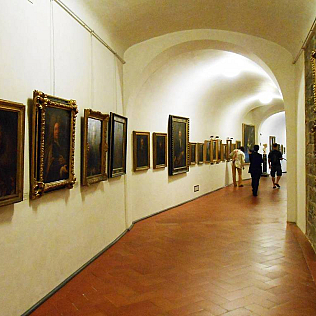
The Vasari Corridor at the Uffizi Gallery, Florence

Thérèse Schwartze’s portraits are truly remarkable and she was one of the few women painters, who had been honoured by an invitation to contribute her self-portrait to the Hall of Painters, the Vasari Corridor, at the Uffizi Gallery in Florence. The Uffizi collection is one of the most complete in all Europe, first started by Cardinal Leopoldo de’ Medici in the 17th century.  The passageway was designed and built in 1564 by Giorgio Vasari to allow Cosimo de’ Medici and other Florentine elite to walk safely through the city, from the seat of power in Palazzo Vecchio to their private residence, Palazzo Pitti.   The passageway used to contain over a thousand paintings, dating from the 17th and 18th centuries, including the largest and very important collection of self-portraits by some of the most famous masters of painting from the 16th to the 20th century, including Filippo Lippi, Rembrandt, Velazquez, Delacroix and Ensor.   While the Medici family bought the first paintings, after the collection started, the family started receiving the paintings as donations from the painters themselves. This has continued over the centuries and there were more paintings in the collection that did not have space to be exposed.  Things have now changed as from 1973 to 2016, some of the self-portraits which had been hung in the Vasari Corridor, were, however only visible during restricted and occasional visits because of the confined space, which, also lacked air conditioning and adequate lighting.  Most of the self portraits have been moved to other rooms at the Uffizi.
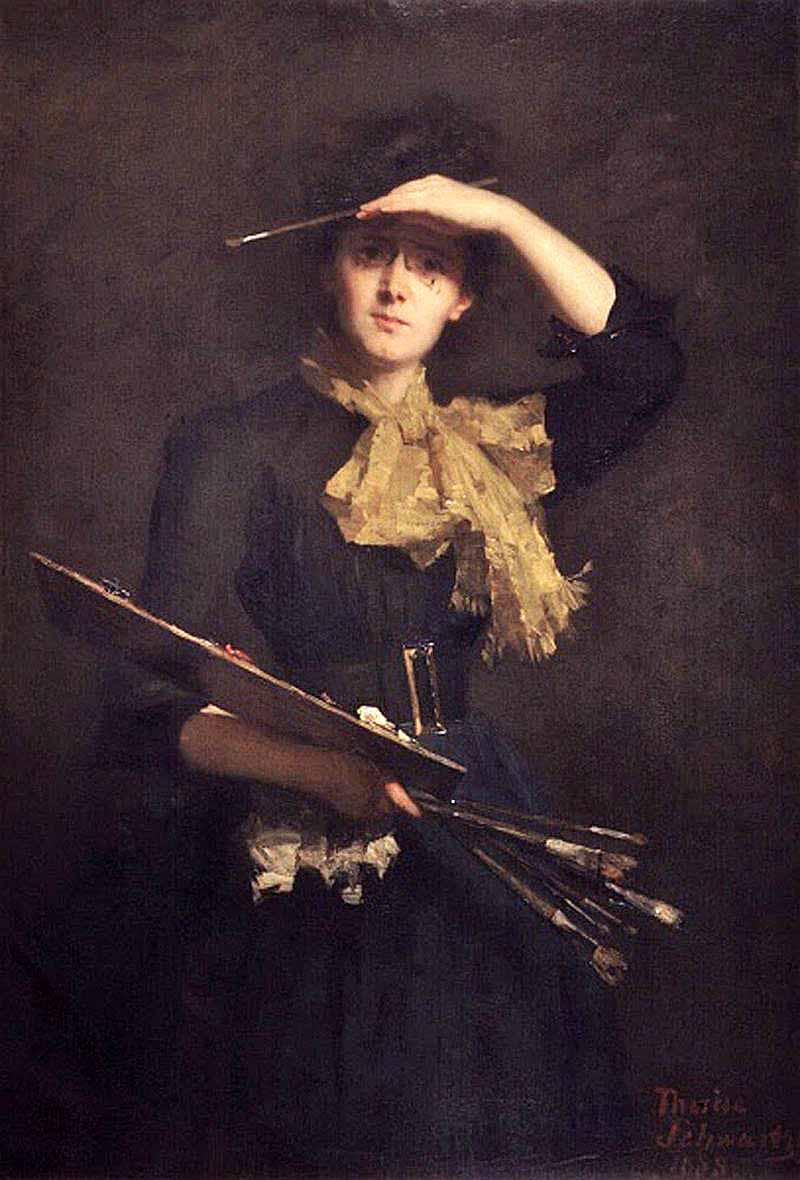
Self-portrait with Palette by Thérèse Scwartze (1888)

Only a handful of female portrait painters were active professionally in the 19th century, one of whom was Schwartze, who was nicknamed the ‘Queen of Dutch Painting’.  In the self portrait she contributed to the Uffizi entitled Self-portrait with Palette, she depicts herself staring out at us with a haunted look, paintbrush in one hand with the other looped through a paint-laden palette. The background of this canvas is bare, and our eyes are drawn to the painter’s tools: eyes, brush, pigments, and a rag at the ready. The painting was exhibited at the 1888 Paris Salon before being given to the Uffizi gallery in Florence.
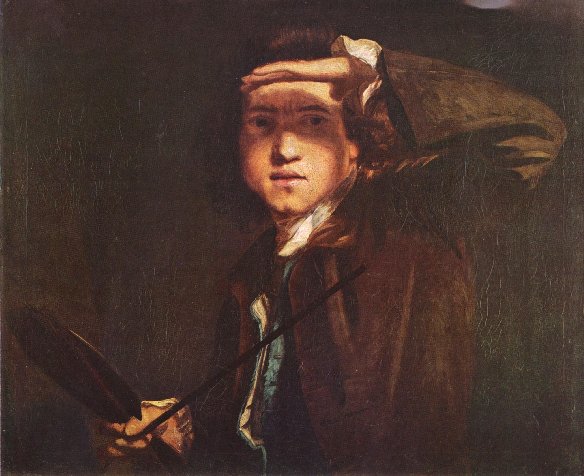
Sir Joshua Reynolds self portrait (c.1748)

Thérèse’s depiction of herself in her self-portrait could well have been inspired by Sir Joshua Reynold’s self-portrait which shows him similarly with his hand raised shielding his eyes from the bright light.
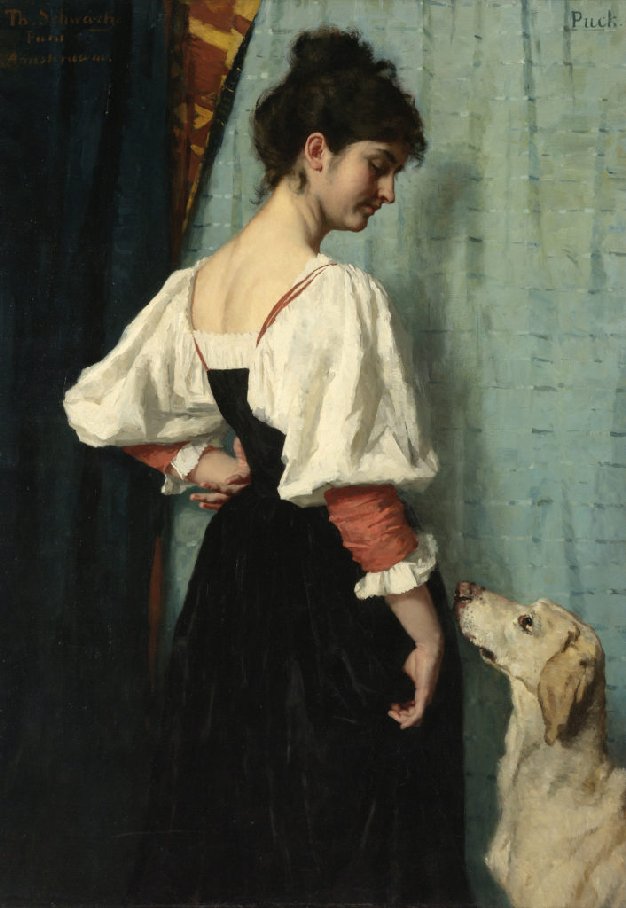
Young Italian Woman, with ‘Puck’ the Dog by Thérèse Schwartze, c. 1885)

Whilst living and studying in Paris, Thérèse completed her painting, Young Italian Woman, with ‘Puck’ the Dog.  The model she used for this painting was known as Fortunata.  She was one of the many professional Italian models working in Paris in the late 19th century. Schwartze started this painting in 1884 and exhibited it a year later in Amsterdam, having added the dog in the meanwhile.
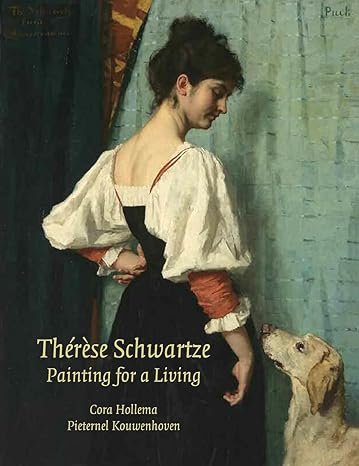
According the 2021 biography by Cora Hollema and Pieternel Kouwenhoven entitled Thérèse Schwartze: painting for a living. Thérèse’s career took off at a time when a new, wealthy Dutch class wanted to flaunt its status and what better way to achieve this than with a flattering portrait. Her biographer wrote:

“She was in demand because she produced a new elegant, un-Dutch, extravagant, flattering style of portraiture which was in demand by the upcoming ‘new money…….. The new entrepreneurs and industrialists in the second half of the 19th century…”

Portrait of Aleida Gijsberta van Ogtrop-Hanlo with her five children by Thérèse Schwartze (1906).

Schwartze was one of the leading society painters in the Netherlands around 1900. Her clientele came from the nobility and the bourgeois elite in Amsterdam and The Hague. Members of the royal family also sat for her.   A good example of her excellent portraiture is her 1906 group portrait of Aleida Gijsberta van Ogtrop-Hanlo with her five children.  In this work, Aleida van Ogtrop-Hanlo is surrounded by, from left to right: Adriënne (Zus), Pieter (Piet), Maria (Misel), Eugènie (Toetie) and Adèle (Kees). The youngest and sixth child, Joanna (Jennie) was not yet born.  Her husband was a wealthy stockbroker and founder of Amsterdam Royal Concertgebouw. The portrait of his wife and children has a dreamy quality, with rich clothing and poetic colours. It gives an excellent impression of the self-image of the Dutch upper classes at the beginning of the twentieth century.  Stylistically Thérèse Schwartze followed in the footsteps of the famous eighteenth-century English portrait painter, Thomas Gainsborough. 

 Portrait of the six Boissevain daughters by Thérèse Schwartze (1916)

An equally great group portrait by Thérèse Schwartze was her Boissevinfamily portrait but this a more decorous depiction.  It is entitled Portrait of the Six Boissevain Daughters and she completed it in 1916. According to Schwartze’s biography by art historian, Cora Hollema, this difference in style was not due to a development of the artist, but more to do with the wishes of her client. Mr. & Mrs. Boissevain, who were wealthy members of the Amsterdam upper class had ten children, six daughters and four sons. They were aware of the portrait of Aleida and her children by Thérèse but believed it to be far too modern.   So, when they commissioned Thérèse to paint the portrait in 1916 they asked her to produce a more time-honoured portrait of their daughters. Thérèse was now the breadwinner of the family and so sensibly adapted her style according to her client’s demands bearing in mind the adage: The client was king.

Thérèse Schwartze in her studio, Prinsengracht 1021, Amsterdam, 1903.

Thérèse’s great success as an artist became a point of reference for the young Dutch women painters who founded the Amsterdamse Joffers, a group of women artists who met weekly in Amsterdam at the end of the 19th and beginning of the 20th century. These “ladies of Amsterdam” met weekly, often at the Schwartze home, to update the glorious Dutch tradition of painting based on French Impressionist innovations.  They supported each other in their professional careers. Most of them were students of the Rijksakademie van beeldende kunsten and belonged to the movement of the Amsterdam Impressionists.

Woman wearing a hat (Portrait of Theresia Ansingh (Sorella)), by Thérèse Schwartze (after 1906).

Besides Schwartze’s commissioned portraits, which made her very wealthy, she still had time to complete portraits of her friends and relatives which were not commissioned and were often given as gifts.  A fine example in this regard is the portrait of Schwartze’s niece, Theresia Ansingh, who later became a member of the Amsterdam school of female painters known as The Joffers, many of them were inspired by Schwartze’s professional success. 
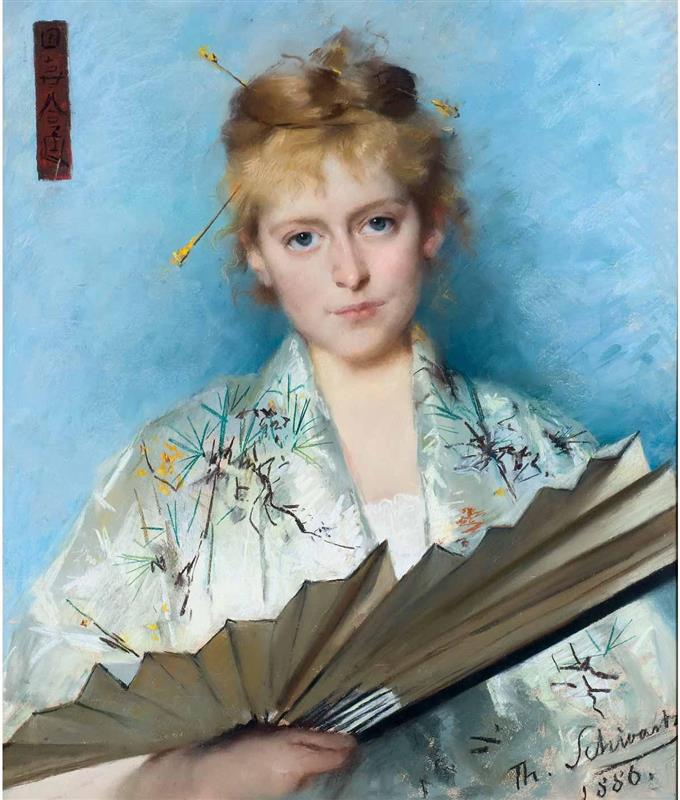
Maria Catharina Ursula (Mia) Cuypers by Thérèse Schwartze (1886)

One of my favourite portraits by Schwartze was her fascinating portrait of one of her friends, which is an amalgam of formal and informal portraiture and is entitled Portrait of Mia Cuypers.  She was a daughter of the architect Pierre Cuypers, who designed such famous buildings as the Rijksmuseum and Amsterdam’s Central Station. In 1883, she fell in love, to the dismay of her family and the astonishment of “high society,” with the Chinese-British merchant Frederick Taen-Err Toung from Berlin, who was in Amsterdam selling his Oriental merchandise at the International Colonial Exposition. Mia managed to overcome the social uproar and married Toung in 1886.  Being a close acquaintance of the Cuypers family, Thérèse was commissioned by the groom-to-be to make this wedding portrait, which is said to have only taken her one and a half days to complete.  There are Chinese characters in the upper left corner, which are not clear in my attached photo, which mean “rice field,” “longevity”/”delighted,” and “coming together.”
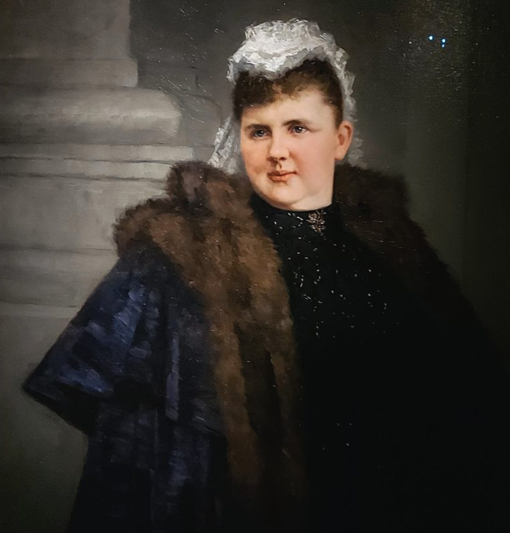
Portrait of Queen Emma by Thérèsa Schwartze (ca. 1881)

Soon after, she received a commission for a portrait of Queen Emma and the little princess Wilhelmina, who was born in 1880. In the single portrait of the young queen, she is dressed in dark colours against a neutral background, all is dark except her face. In this painting, one can already see the fine art of portraiture and the depicting of differing textures that Thérèse fully mastered. The fur stole, the lace cap on her head, as well as the brocade of the queen’s robe.
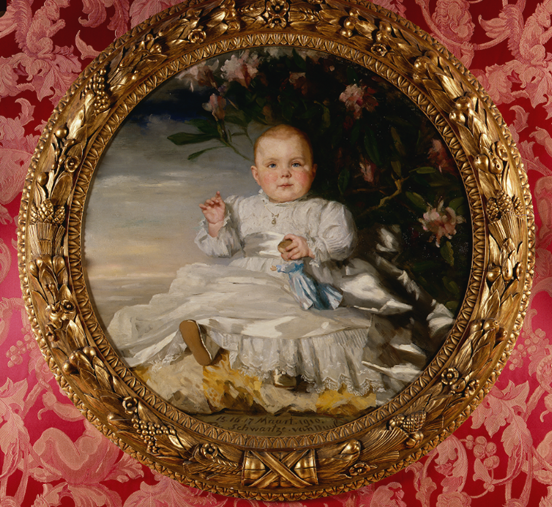
Portrait of Princess Juliana by Thérèsa Schwartze (1910)

Thérèse’s worked with the royal family of the Netherlands through a period of thirty-five years and in all they gave her six commissions that contributed greatly towards her fame and wealth. Most royal portraits were of Queen Wilhelmina.
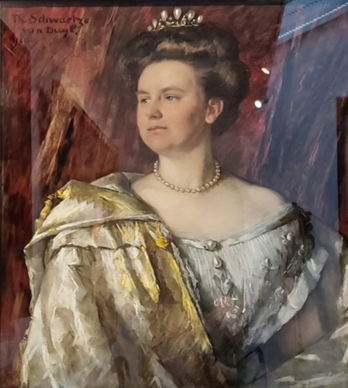
Portrait of Queen Wilhelmina by Thérèse Schwartze (1910)

The royal court had a habit of paying a little more than the average client, which meant that 1910 was a particularly profitable year for Thérèse.  She painted so many members of the royal family that she was almost deemed a member of their household.
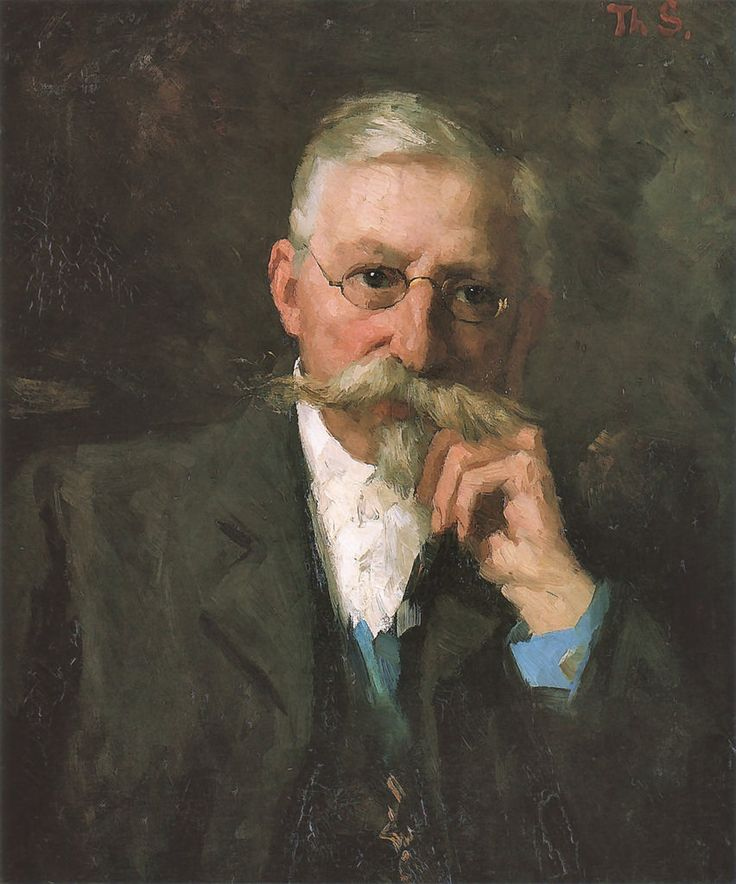
Portrait of Anton van Duyl by Thérèse Schwartze

In 1906, Thérèse Schwartze married the editor-in-chief of the Algemeen Handelsblad, Anton van Duyl. Twelve years after they married, Thérèse’s husband died on July 22nd 1918.  It was double blow for Thérèse as she herself had been very ill at the time and five months later, on December 23rd 1918, three days after her sixty-seventh birthday, she died in Amsterdam.  
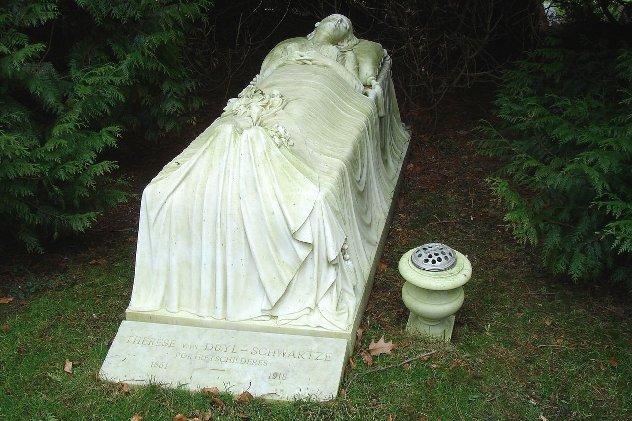
Grave of Thérèse Schwartze at the Nieuwe Ooster cemetery, Amsterdam.

She was buried at Zorgvlied cemetery in Amsterdam but was later reburied at the Nieuwe Ooster cemetery in Amsterdam, where her sister created a memorial to her, modelled after her death mask, which is now a rijksmonument.
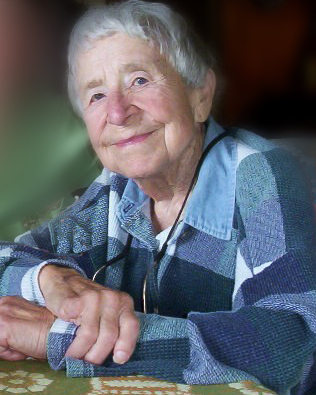
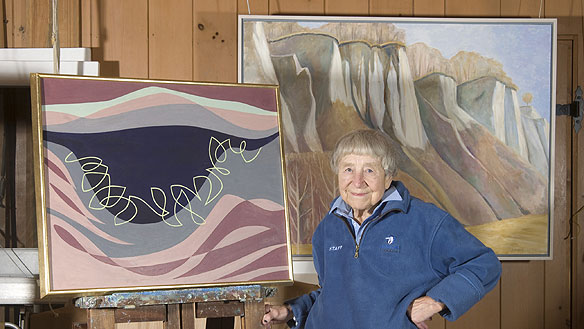
Doris McCarthy-beautiful simplicity.

Doris McCarthy aged 96.

When I first saw the artwork of today’s featured artist, the phrase that first came to mind was “beautiful simplicity”.  I hope you will feel the same when you peruse this blog.  The artist I am showcasing today is Doris McCarthy, a Canadian painter, writer and educator and who is best known for her abstract landscapes.

Doris McCarthy was born on July 7th 1910 in Calgary, Alberta.  She was the youngest child of George Arnold McCarthy, an engineer, and Jennie McCarthy (née Moffatt).  Doris had two older brothers, Kenneth and Douglas. Because of her father’s job the family had to make many house moves.  In the Summer of 1912 the family moved to Vancouver, then Boise, Idaho that December.  The following Spring they lived in Berkeley, California and in the Summer of that year they had re-located to Moncton in New Brunswick, where Doris’ paternal grandparents lived. Finally in the Autumn of 1913, at the age of three, Doris and her family moved to Toronto where she spent her youth living in the east end of the city, in a neighbourhood known as The Beaches, on the shores of Lake Ontario.

Doris’ schooling started when she was five-years-old at which time she was a pupil at Williamson Road Public School in Toronto.  She remained there until she was eleven years of age.  She then transferred to the middle-school of the Malvern Collegiate Institute in 1921.  She remained at the Institute until she graduated in 1926.  As she began to enjoy sketching and painting, whilst attending the Institute, she also enrolled in Saturday Junior courses at the Ontario College of Art (OCA).  She showed such artistic aptitude during her time on these Saturday sessions that she was awarded a full scholarship to the college and started a three-year course in the Autumn of 1926. This was the start of her formal artistic training.

Hills at Dagmar, Ontario by Doris McCarthy (1948)

During her three-year stint at the college, she was mentored by some of the great Canadian artists such as Arthur Lismer, James McDonald and Lauren Harris who were founder members of the Group of Seven, also known as the Algonquin School of landscape painters, a group which was formed in 1920. These Impressionist painters loved to explore the uncharted areas of Canada continually recording through plein air sketches and paintings the beauty of their own country.  It was from their works that other artists realised what was on offer to those who would make the effort to discover the history, culture and geography of their fine nation and question the reasoning behind going to Europe in search of inspirational beautiful scenery.  Doris graduated from the college in 1930 and the following year she began to exhibit her work at the Ontario Society of Artists (OSA).  She was accepted as a member of the OSA in 1945 and later went on to become OSA Vice President from 1961 to 1964 and later, President from 1964 to 1967. 

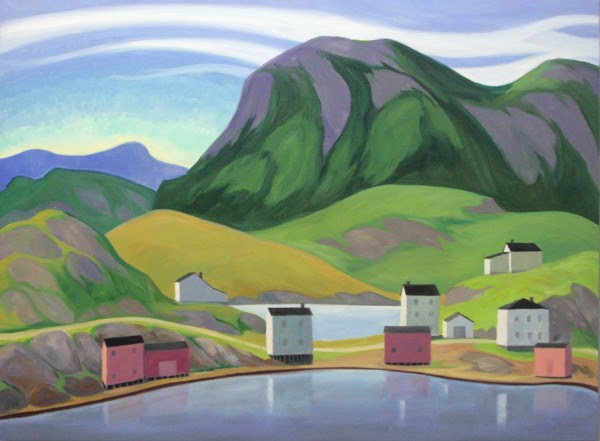
Village Under Big Hills by Doris McCarthy

Was she influenced by these artistic luminaries?  In an interview in 2004 she cast doubt on that assertion, saying:

“…I don’t think I was ever influenced by the Group of Seven’s actual paintings.  I was influenced very strongly by the tradition of going out into nature and painting what was there. I bought it. And I still buy it…”

Sutton Village, Quebec Province by Doris McCarthy

Whilst at the OCA, Doris met and became great friends with a fellow student, Ethel Curry and the two would often go off together on painting trips together they spent many holidays painting in Haliburton Ontario.  Haliburton, to the north-east of Toronto, was very popular with tourists with its beautiful lakes and old cottages. It was also referred to as the Haliburton Highlands, due to its geographical similarity to the Scottish Highlands.  It was an ideal location for landscape painters such as Doris and Ethel.

Houses on the Neck, Salvage, Newfoundland by Doris McCarthy (1999)

Doris graduated from OCA in 1930 and worked for very low wages at Grip, an advertising agency where many of the Group of Seven had previously been employed. However, her future pathway outside academia was given to her by one of her tutors, Arthur Lismer, who offered her an opportunity to teach children’s art classes at the Art Gallery of Toronto, which she accepted and thus began her career as an educator. Doris also worked part-time as a teacher with Moulton College from 1931 to 1932, and that year enrolled on a twelve-month teacher training course at the Ontario Training College for Technical Teachers in Hamilton during the years 1932 to 1933.

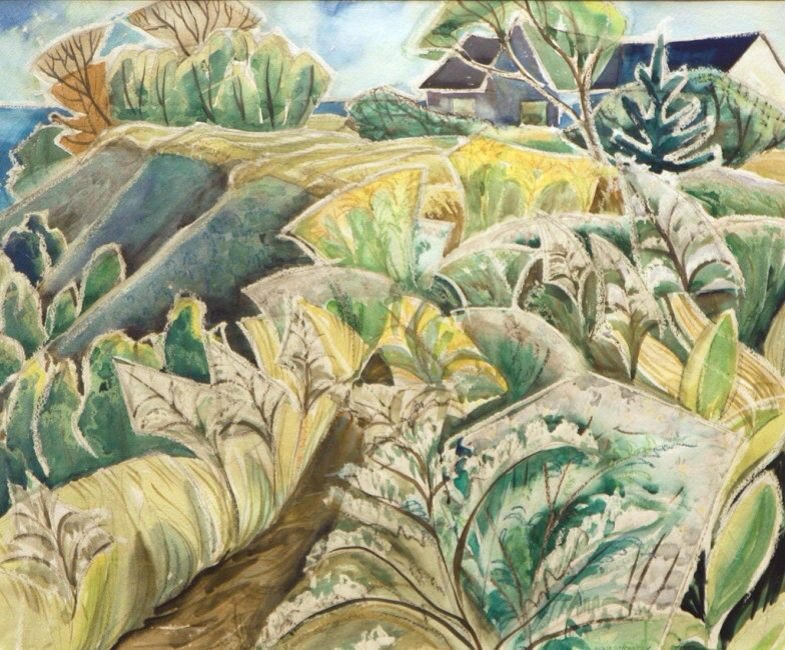
 Asters in the Field at Fool’s Paradise by Doris McCarthy (1953)

In 1932 Doris, aged twenty-two, began teaching art at the Central Technical School in Toronto, and this began her forty-year period of teaching at this institute.  In her forties, Doris McCarthy’s reputation as a landscape painter had blossomed.   She had faithfully kept faith with the Group of Seven’s premise of “going out into nature and painting what was there” and it was on her many painting trips into the Canadian wilderness that she built up her work.  Some of the places she visited looking for inspiration were Haliburton, Muskoka, Georgian Bay, the Badlands of Alberta, and the Arctic. 

Fool’s Paradise

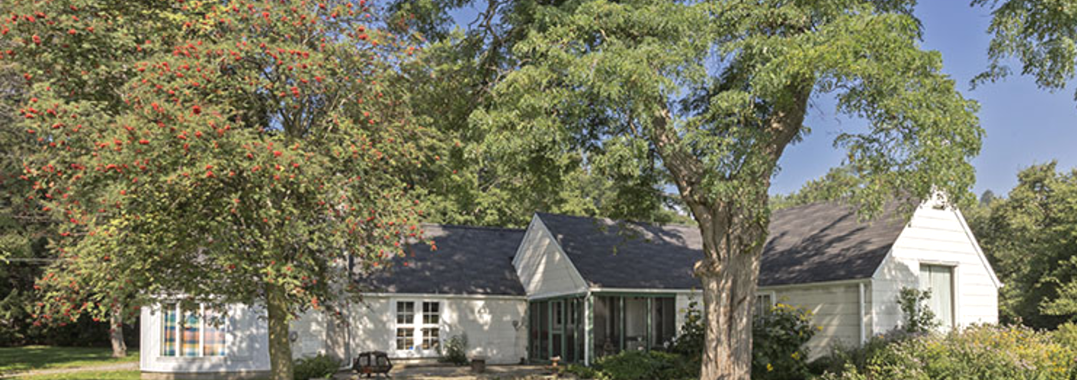
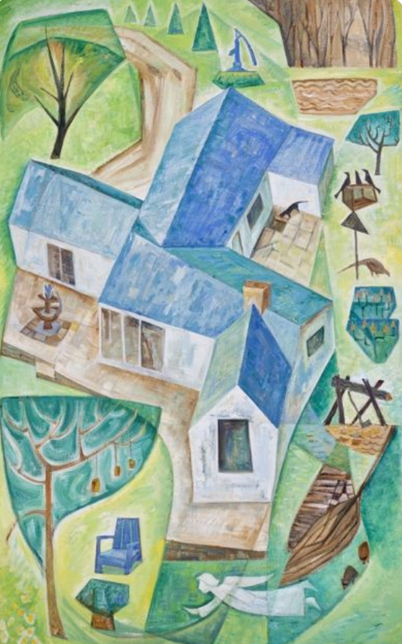
In 1939, whilst on a painting trip along Scarborough Bluffs she came across an abandoned property set high on top of a sheer section of the bluffs and along Gates Gully, a deep ravine at the end of Bellamy Rd.  The property was derelict and covered in poison ivy. However, it was the position looking out over Lake Ontario and other views over the tree-less farmland which appealed to her, and she decided to buy the plot of land.  It cost her $1,250 which was a “fortune” considering her teacher’s salary.  Her mother was horrified with her daughter’s purchase and referred to it as a “fool’s paradise”.  Doris was not deterred by her mother’s negative comments and designed a small single-storey cabin for the developed site.  During the following years she expanded the building and protected it against the harsh winter weather.   The State’s conservation authorities, wary of possible erosion of the land around her cabin, had trees planted around it but left the view of the lake unaffected.  The adjacent land was later subdivided into lots and a residential neighbourhood now surrounds McCarthy’s Fool’s Paradise.

Home – a painting of her home – Fool’s Paradise on the Scarborough Bluffs, Toronto, Canada by Doris McCarthy

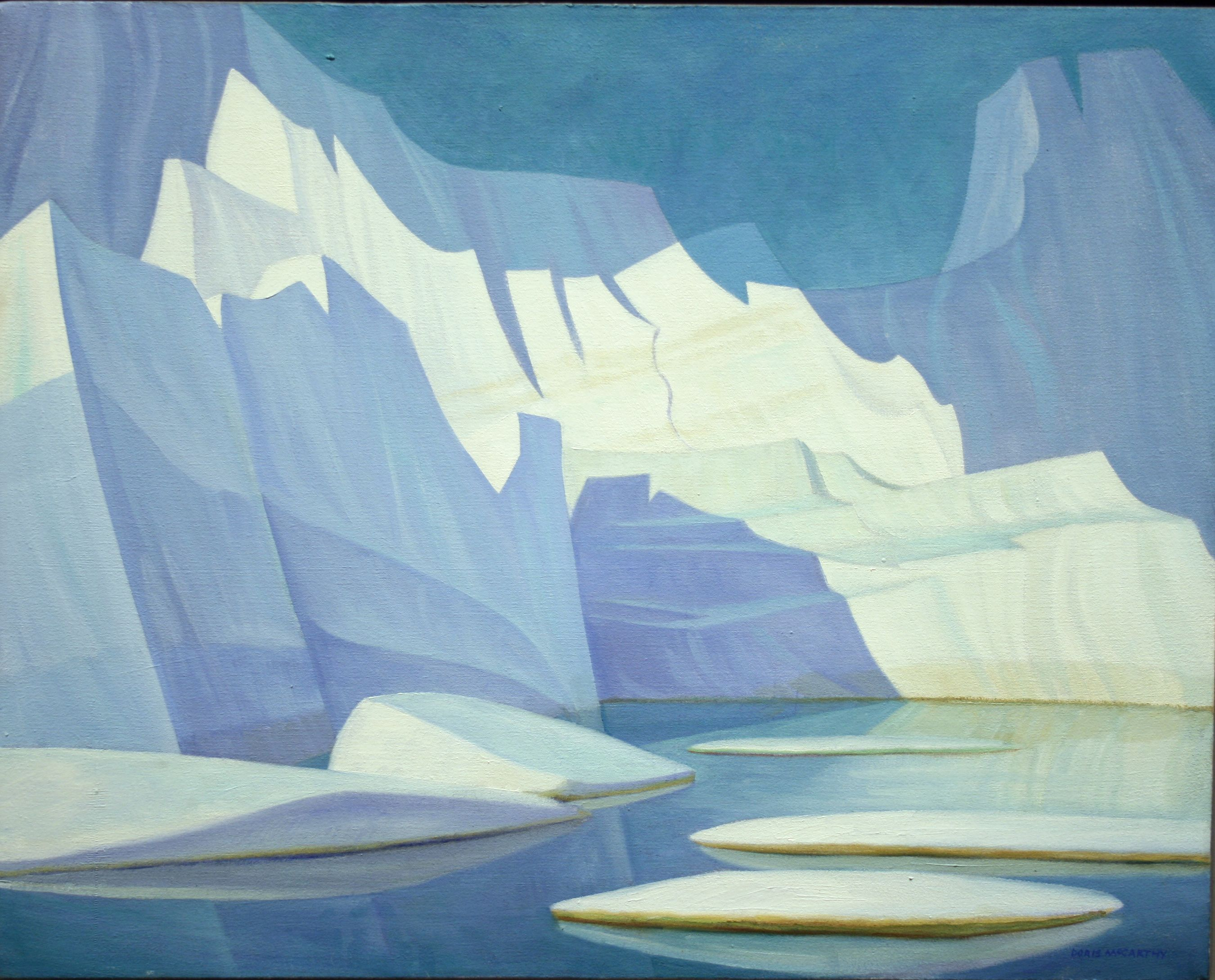
Doris ventured further afield when she went on a year-long sabbatical to Europe in 1951 and ten years later another twelve-month sabbatical had her travelling through the Middle East and Asia, visiting far-off places such as Afghanistan, Iraq, Cambodia, just to mention a few.  McCarthy worked in both oils and watercolour and she cultivated a recognisable style of hard-edged angles, form and colour depictions.

Holman Island, Western Artic by Doris McCarthy (1977)

Using primarily thick oils and watercolours, McCarthy developed a style, often verging on abstraction, that was consistently praised for its vitality, boldness and skillful explorations of hard-edged angles, form and colour. In 1972, at the age of sixty-two, she retired from the Central Technical School.  She was interviewed by a journalist from the Huffington Post as to her life in retirement and she said:

“…When I retired from teaching, I thought that the next major event of my life would be dying.  There was no imagining that the best years were still ahead of me…”

For Doris McCarthy, retirement did not mean slowing down, for the following year after she retired, she enrolled at the University of Toronto Scarborough Campus as a part-time student. Sixteen years later, at the age of seventy-nine she was awarded an Honours Bachelor of Arts in Literature on June 6th, 1989.

Iceberg Fantasy by Doris McCarthy

Dennis Reid is the author of The Concise History of Canadian Painting, which is considered the definitive volume on Canadian art.  He was also a curator at the Art Gallery of Ontario for over 30 years.  In his book of Canadian art he wrote about Doris McCarthy:

“…Following her retirement in 1972 from [teaching at] Central Technical School, Toronto, she began exhibiting commercially on a more regular basis, not just in Toronto but in Ottawa, Calgary and later Winnipeg, showing work that some saw as a fresh take on the Canadian landscape tradition. She made the first of a number of trips to the Arctic in 1972, and that encouraged greater boldness with light, colour and pattern, and in 1977 she began painting larger canvases that emphasized this confident command of formal issues even more.  She began showing with Aggregation Gallery in Toronto in 1979 (which became Wynick/Tuck Galley in 1982), and her subsequent regular showings there assured close critical attention to both the work of the half century already accomplished and the new, always fresh work that continued through the nineties and beyond…”

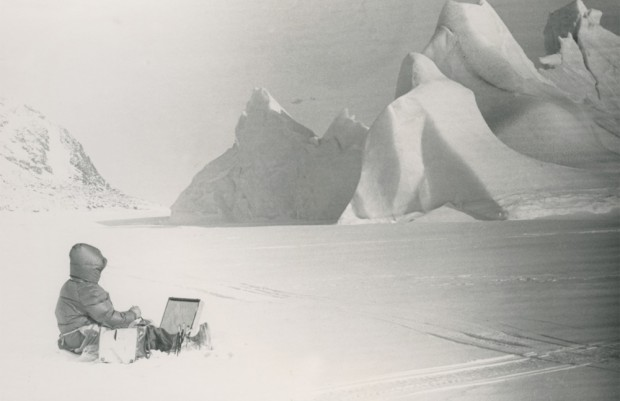
McCarthy painting at Grise Fjord, Nunavut 1976

Nunavut is the vast territory of northern Canada that stretches across most of the Canadian Arctic. It was created in 1999 out of the eastern portion of the Northwest Territories, Nunavut encompasses the traditional lands of the Inuit, the indigenous peoples of Arctic Canada.  Its name means “Our Land” in Inuktitut, the language of the Inuit. The capital is Iqaluit, at the head of Frobisher Bay on southern Baffin Island.

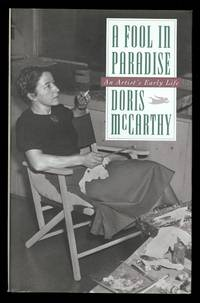
Doris McCarthy, besides painting numerous works, also wrote three autobiographies during various times in her life.  In 1990 she wrote A Fool in Paradise a fascinating memoir of her early years. It describes the fortunes of an artist who was striving to establish herself in the art world of the thirties and forties and the journey made by a spirited girl searching for her own path to fulfilment. Against the backdrop of those early years, Doris writes of studying art in pre-war London, winning a teaching position in the depths of the Depression and roughing it on painting expeditions to northern Ontario, the Maritimes and the Rockies. She reveals stories of her personal life: of breaking loose from a disapproving mother, building her own home on the bluffs above Lake Ontario, and of finding love in unexpected places.

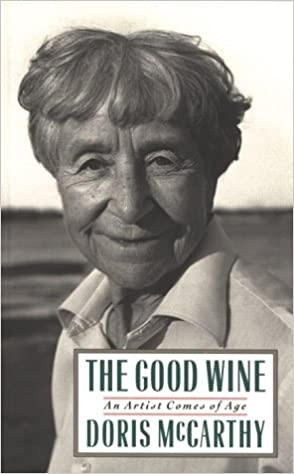
Her second autobiography entitled The Good Wine: An Artist Comes of Age describes her life from 1950 to 1991. It tells of the time at the age of forty, she broke free of her teaching responsibilities to take a year’s sabbatical in Europe as a full-time painter. It was to be the first of many adventures around the world which included a solitary round-the- world odyssey from Japan to Australia, India to the Middle East. She also discovered the Arctic and in 1991, Antarctica, drawing inspiration for her art and her life in the far-flung corners she visited and in the beloved landscape of her own country.  It recounts her meetings with Dorothy Sayers and Arnold Toynbee, and all the controversies associated with the fledgling Canadian art community.

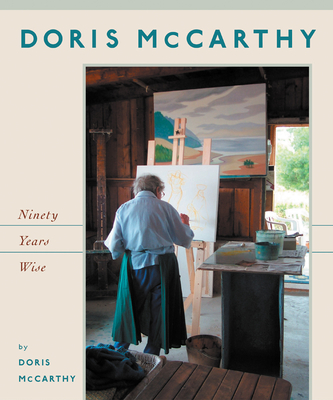
In 2004, at the age of 94, Doris McCarthy published her third and final autobiography.  In this final autobiography, Ninety Years Wise, she focuses on her 92nd summer and she tells of the summer ritual of heading to her summer home, her cottage on Georgian Bay, painting and entertaining friends.

During her long life, Doris McCarthy received many awards.  She was the recipient of the Order of Ontario, the Order of Canada, honorary degrees from the University of Calgary, the University of Toronto, Trent University, the University of Alberta, and Nipissing University, an honorary fellowship from the Ontario College of Art and Design and also had a gallery named in her honour on the Scarborough campus at the University of Toronto. 

Doris McCarthy died at her Fool’s Paradise home on November 25, 2010, aged 100. She is buried at Mount Pleasant Cemetery. Her Fool’s Paradise property now functions as an artist’s residence, the Doris McCarthy Artist-in-Residence Centre, and is in part funded by the Ontario Heritage Trust.


Some of the information for this blog came from the following websites:

The Life of Doris McCarthy. University of Toronto

https://doris.digital.utsc.utoronto.ca/content/life-doris-mccarthy

American Women Artists

https://americanwomenartists.org/rediscovered-women-artists-doris-mccarthy/

Fool’s Paradise Guided Tour

Doris McCarthy Gallery – Fool’s Paradise Guided Tour (utoronto.ca)

Georgia O’Keefe. Part 1 – The early years and the “Specials”

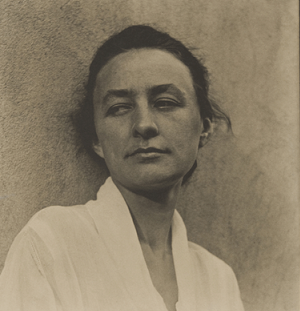
Georgia Totto O'Keefe photograph by Alfred Stieglitz (1918)
Georgia Totto O’Keefe
photograph by Alfred Stieglitz (1918)

If I was to ask you who was the most quintessential American artist, I wonder whom you would choose. Would you go for one of the nineteenth century Hudson River School artists such as Frederic Church, Asher Durand and Thomas Cole or would you select one of the pioneering and tenacious American female painters who fought hard to gain a foothold in the male dominated world of art, such as Mary Cassatt and Elizabeth Jane Gardner. Perhaps you would decide on one of the great twentieth century painters such as Andrew Wyeth or Edward Hopper or the folk artist Grandma Moses. Then of course, let us not forget, there is John Singer Sargent and James McNeill Whistler and naturally there are the modern greats of American art such as Rofko, Warhol, Pollock and de Kooning. I suppose it is impossible to single out one from the list of artists who paint in so many different genres. However, for me, the painter who symbolises America is Georgia O’Keefe and in my next blogs I will look at her life and feature some of her best-loved paintings.

The O'Keefe farmhouse. outside Sun Prairie, near Madison, Wisconsin
The O’Keefe farmhouse.
outside Sun Prairie, near Madison, Wisconsin

Georgia Totto O’Keeffe was born on November 15, 1887, the second of seven children. She was the eldest of five girls and had a younger and elder brother. Her father, who was of Irish descent, was Francis Calyxtus O’Keefe, who ran a successful farmstead on the outskirts of the village of Sun Prairie, Wisconsin, along with his wife Ida Ten O’Keefe (née Totto), whose maternal grandfather was a Hungarian count. The farm was spread over 1700 acres of land on which they raised cattle, horses and grew crops. When Georgia was five years of age she attended the small one-roomed South Prairie Town Hall school. She progressed well and she and her siblings were constantly being pushed to learn by their mother, who would read stories to her children and play the piano for them. In fact Georgia went on to play both piano and violin.

At the age of eleven Georgia developed an interest in drawing and painting and so her mother arranged private art tuition for her and two of her sisters, Ida and Anita. Georgia revelled in what she learnt, She then attended the Sacred Heart Academy in nearby Madison as a boarder and in a conversation with a friend and fellow 8th grade pupil she talked about her future dreams:

“…I am going to be an artist!…..I don’t really know where I got my artist idea…I only know that by that time it was definitely settled in my mind…”

The O'Keefe's house in Williamsburg
The O’Keefe’s house in Williamsburg

In 1902 her family moved to Williamsburg, Virginia but Georgia, who was fifteen years old, stayed behind for a short time with her aunt. Soon after she re-joined her parents in Peacock Hill, a suburb of Williamsburg and enrolled as a boarder at the private Chatham Episcopal Institute for Girls. She continued to love art and her artistic talent was recognised by all and her fellow students elected her art editor of the school yearbook. In her yearbook was written the telling verse:

“…O is for O’Keefe.

an artist divine.

Her paintings

are perfect and

drawings are fine…”

In 1905, Georgia, now seventeen years of age, graduated from high school and enrolled at the Art Institute of Chicago. It was here that she honed her skills as an artist and studied composition, anatomy and life drawing. Her anatomical drawing class tutor was John Vanderpoel, the Dutch-American artist and teacher, who was best known as an instructor of figure drawing and whose 1907 book, The Human Figure, became a standard art school resource. Georgia O’Keefe excelled at the Academy and all was going well until the summer of the following year when she went home and contracted typhoid and was so ill that she was unable to rejoin the Academy. She had to remain at home to recuperate for more than twelve months.

Dead Rabbit with Copper Pot by Georgia O'Keefe (1908)
Dead Rabbit with Copper Pot by Georgia O’Keefe (1908)

When she finally got her health back in 1907, she decided to resume her art career but instead of returning to Chicago she enrolled at the Arts Student League of New York which was one of the top art colleges of the time. One of her tutors was William Merritt Chase, who was one of the foremost art teachers of his generation. At this institution aspiring young artists were trained in the European tradition, namely, learning to paint portraits and still-lifes. Once again her artistic talent shone through and the following year she won the League’s William Merritt Chase still-life prize for her oil painting Untitled (Dead Rabbit with Copper Pot). Her prize was a scholarship to attend the League’s outdoor summer school at Lake George, in upstate New York, east of the Adirondack Mountains.

In 1908 things changed for Georgia. The Arts Student League of New York wanted to keep to the European tradition of art tuition, copying in the style of the Old Masters. It was a conservative formula and one will never know whether it was this rigid mimetic way of teaching art that disillusioned Georgia, but at the end of her year’s tuition in the autumn of 1908, she decided that she no longer wanted to become a professional artist. Another reason for giving up on her art studies was that her father’s business had collapsed and the family was in need of an extra income and so Georgia gave up her studies and embarked on a career as a commercial artist in Chicago where she spent her time designing adverts and company logos. She did not paint another picture for four years.

Georgia O'Keeffe, aged 30
Georgia O’Keeffe, aged 30

This artistic drought ended in 1912 when she attended a summer course at the University of Virginia in Charlottesville where one of the classes was run by Alon Bement of the Teachers College, Columbia University, in New York City. It was Bement who introduced O’Keefe to the radical thinking of his colleague, Arthur Wesley Dow, the head of the Faculty of Fine Arts at New York’s Columbia University Teachers College. Dow believed in the Modernist approach to art and postulated that rather than just copying nature, art should be created by the various elements of composition such as line, mass and colour. He put his thoughts into words in his 1899 book entitled Composition: A Series of Exercises in Art Structure for the Use of Students and Teachers. He summed his thoughts up in the introduction to the second edition of the work which came out in 1912. He wrote:

“…Composition … expresses the idea upon which the method here presented is founded – the “putting together” of lines, masses and colors to make a harmony. … Composition, building up of harmony, is the fundamental process in all the fine arts. … A natural method is of exercises in progressive order, first building up very simple harmonies … Such a method of study includes all kinds of drawing, design and painting. It offers a means of training for the creative artist, the teacher or one who studies art for the sake of culture…”

Georgia O’Keefe who had tired of the mimetic teachings of the academy was enthralled by Dow’s ideas and her love for art was rekindled. In 1912, she moved to Amarillo, Texas, where she had accepted a position as supervisor of art in the city’s public schools. She took up a post in the August of 1912 as an art teacher at City Public School of Amarillo but she returned to the University of Virginia’s to attend the summer course the following year; this time as an assistant to Bement and in the autumn of 1914 she went back to New York and enrolled for two semesters at Columbia University Teachers’ College where she studied under Dow himself. It was around this time that she discovered the work of Arthur Garfield Dove. Dove, an American modernist painter, who has often been labelled as the first American abstract artist. He placed great emphasis on the artist’s subjective experience of his surroundings and on the intrinsic emotional power of colour and line rather than just copying from nature. To Georgia this was not just a revelation but it was the kind of art, which she believed in and it was to influence her art for the rest of her life. For her, it was inspirational, and she happily set off on a new artistic journey. She was excited at the new ideas which flooded her brain and described how she felt:

“…I said to myself ‘I have things in my head that are not like what anyone has taught me – shapes and ideas so near to me – so natural to my way of thinking that it hasn’t occurred to me to put them down.’ I decided to start anew – to strip away what I had been taught – to accept as true my own thinking……. I was alone and singularly free, working into my own, unknown – no one to satisfy but myself…”

You can sense her joy. You can sense her feeling of casting off the shackles of rigid academic teaching. You can sense the elation in the way she saw her future.

Drawing XIII by Georgia O’Keeffe, 1915

In September 1915, she accepted a teaching post at Columbia College, South Carolina and it is around this time she begins to experiment with her art, producing a series of amazing cutting-edge charcoal abstract drawings. One such drawing was entitled Drawing XIII which was completed in 1915. In this work we see that the image is sub-divided into three parallel sections. The left hand section has wavy vertical lines which reminds one of a meandering river although some say it is more like a vertical flickering flame reaching upwards. The central part of the work consists of four rounded bulbs which if we continue with our thoughts of nature could then be construed as round top hills. An alternative to this premise is that they are four densely foliated trees. The right hand section comprises of a series of jagged lines which could be a representation of mountains and so in a way this drawing may be a bird’s eye view of a range of mountains and a flowing river with trees separating the two.

Early No. 2 by Georgia O'Keefe (1915)
Early No. 2 by Georgia O’Keefe (1915)

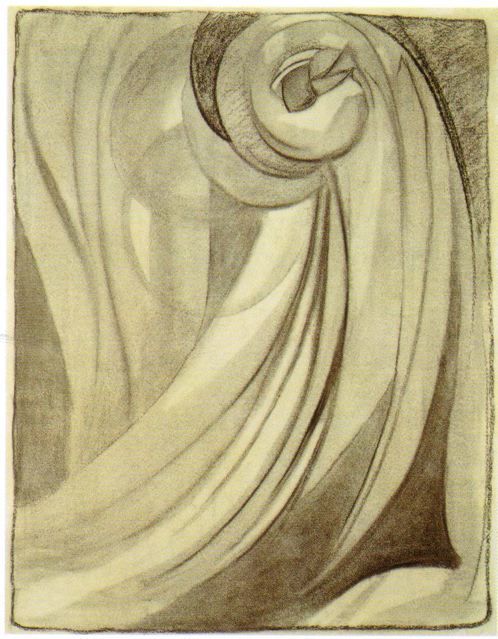
Another of her charcoal works was entitled Early No. 2 which she also completed in 1915. O’Keefe has followed the advice of Arthur Dow and focused on the lines, shapes and tonal values which she, like Dow, believed were the fundamentals of the picture. Her reasoning behind these early drawings being in black and white and devoid of colour was her belief that colour would distract viewers from what she had hoped to create. It was all about curves and geometrical shapes and the clever balance between areas of the work which were light and shaded.

No. 12 Special by Georgia O'Keefe (1916)
No. 12 Special by Georgia O’Keefe (1916)

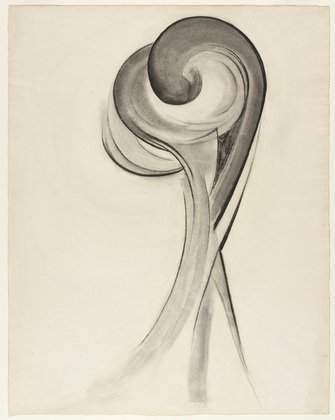
Georgia O’Keefe was proud of her first foray into this new world of art and she would often refer to these early drawings as “Specials” indicating how much they meant to her. She mailed some of these drawings to her friend, Anita Pollitzer, who had been a Columbia classmate of hers. Pollitzer, who was now a photographer in May 1916, took them to show the internationally reknowned photographer and art impresario, Alfred Stieglitz, who had his gallery, 291, at 291 Fifth Avenue, New York. Stieglitz was impressed with what he saw and described them as:

“…the purest, finest sincerest things that have entered ‘291’ in a long while…”

Special No. 15 by Georgia O'Keefe (1916)
Special No. 15 by Georgia O’Keefe (1916)

Unbeknown to O’Keefe, Stieglitz exhibited her drawings at his gallery alongside works by other artists. When O’Keefe found out about this, she was not best pleased but later forgave him. This initial collaboration between artist and gallery owner was to be a turning point in Georgia O’Keefe’s artistic life.

…………….to be continued.


Compositions, Impressions and Improvisations by Kandinsky

Impression III (Concert) by Kandinsky (1911)

Impressions III (Concert) was painted by Kandinsky soon after he had attended a concert by Arnold Schonberg in Munich in 1911 and according to the exhibition catalogue notes the painting should be looked upon as:

 “…one of modern art’s most outstanding examples of synaesthesia, correspondences between music and painting that other early twentieth-century artists sought. A dynamic wave of yellow paint flows across the painting from left to right like a great swell of sound that seemingly reverberates to and fro. Above it in the upper half of the painting is an energetic black in a diagonal position. In the preparatory pencil sketches one can clearly decipher the scene with the open, black grand piano as well as the curved backs of the seated listeners and those standing along the wall…”

—————————————————————————————————————————————-

This is my final look at the later life of Wassily Kandinsky and some of his more abstract works of art.   In this blog I am featuring three of his these works, one from each of his three self-classified categories.   After 1910, Kandinsky decided to compartmentalise his work into three groups. The first he called Impressions and these paintings would still retain an element of naturalistic representation. They would be direct impressions of nature. The second category he deemed would be Improvisations and these paintings would convey spontaneous emotional reactions inspired by events of a spiritual type. The last category he termed Compositions. These were paintings which were not done spontaneously but put together carefully, over a period of time, following a number of preliminary studies. These were to be his most complicated works. Although the titles he gave to the three categories seems somewhat arbitrary in fact they harked back to his love of music and in the way he connected, in his own mind, art and music.  He would often add musical titles to his individual works such as Fugue, Opposing Chords or Funeral March.  By doing this, he wanted to evoke sound through sight and create the painterly equivalent of a symphony that would stimulate not just the eyes but the ears as well.

Kandinsky is believed to have had synaesthesia.   Synaesthesia comes from two Greek words Syn which means together and Aesthesis which means sensation.   It is a condition that allows a person to appreciate sounds, colours or words with two or more senses simultaneously. Kandinsky believed that colours and painted marks triggered particular sounds or musical notes and vice versa. Did Kandinsky have synaesthesia?  Maybe we will never know for sure but what we do know is that he was preoccupied all his life with the correlation between sound and colour. Following a performance of Wagner’s great opera Lohengrin in Moscow Kandinsky recalled:

“…I saw all my colours in spirit, before my eyes. Wild, almost crazy lines were sketched in front of me…”

Let me now return to his life story.  In my last blog we had reached the point when Kandinsky and some of his artist friends had set up Der Blaue Reiter group as a rival to their previous exhibiting association the NKVM (The Neue Künstlervereinigung München).    In the first exhibition held by the Der Blaue Reiter group, Kandinsky exhibited three of his works, entitled, Impression-Moscow, Improvisation 22 andthe painting which had been rejected by the NKVM jury, Composition V.  The exhibition came with a small almanac that Kandinsky and Franz Marc had been working on and the foreword of which set out to explain what visitors to the exhibition would see.  They wrote:

“…We are not seeking to propagate any precise or special form in this small exhibition.  Our purpose is to show, in the variety of forms here represented, how the inner wish of the artist takes shape in manifold forms…”

The exhibition which besides including works from artists, Kandinsky and Münter, included works from Franz Marc, Auguste Macke, Henri Rousseau to name but a few.  It also included strange sketches by the Austrian composer Arnold Schoenberg.  It was a confusing mish-mash of works, and artistic styles, which totally baffled and stunned both viewers and art critics alike. Even the most benevolent critics found great difficulty in finding some sort of common ground between the various artistic styles on show.   It was also around the time of this first exhibition that Kandinsky published his book Uber das Gestige in Kunst (Concerning the Spiritual in Art) in which he presented the reader with his thoughts about what he envisioned was the new purpose of art and his writing showed the great diversity of Kandinsky’s intellectual and artistic awareness.  In his book he discussed the spiritual foundations of art and the nature of artistic creation.  He also wrote an analysis of colour, form and the role of the object in art, as well as the question of abstraction.

Improvisation 19 by Kandinsky (1911)

Improvisation 19 was completed by Kandinsky in 1911.  Annegret Hoberg, the curator at the Städtische Galerie, Lenbachhaus, Munich, which houses many of Kandinsky’s paintings, including this one, wrote about the painting in the exhibition catalogue:

“…It seems as if an unknown ritual occurs in Improvisation 19, a kind of initiation and enlightenment of figures who can be understood as novices. One sees translucent figures outlined only in black. On the left is a procession of smaller form presses forward to the front, followed by shades of colour. The largest part of the painting, however, is filled with a wonderful, supernatural blue, which also shines through the group of figures shown in profile on the right, who seem to move toward a goal outside the painting. The spiritual impact of these long, totally incorporeal figures draws both on the uniformity (that is, they are all the same height, as in Byzantine pictures of saints) and on the fact that deep blue, almost violet shade in their heads may symbolize extinction or transition….This work underscores Kandinsky’s almost messianic expectation of salvation through painting…”

—————————————————————————————————————————————–

The onset of World War I in 1914 affected Kandinsky, as being a Russian citizen, he had to leave Munich immediately.  He along with Gabriele Münter left and went to Goldach in Switzerland, a small town on Lake Konstanz.  They remained there until December of that year when Kandinsky went to Moscow and Münter travelled to Stockholm where she would remain and wait for him.  Kandinsky did go to Stockholm and met with Münter for the last time.  Their close relationship which had started back in 1902 had recently being deteriorating and by March 1916, it had run its course and the one-time lovers parted for the final time.  Kandinsky returned to Moscow and soon after his arrival in the Russian capital he met a young woman, Nina von Andreyevskaya, the daughter of a Russian general, and in February 1917 the two were married.

Whilst in Moscow Kandinsky spent much of his time not only painting but working as a teacher, writer and administrator.  He immersed himself in the cultural politics of Russia and collaborated in the new reforms in art education. He was director of the theatre and film section of Narkompros, which was the Peoples Commissariat for Enlightenment.  In February 1919 the Museums of Painterly Culture were established in Moscow and St Petersburg and Kandinsky became the first director of the institutions and worked hard to expand the organization by setting up a further twenty-two museums in the Russian provinces.    In May 1920 Kandinsky helped set up Inkhuk, the Institute for Artistic Culture and he formulated a curriculum for the teaching of art which was based on his strongly held belief that there was an inter-relationship between art and music and looked closely at fundamental forms and colours.  His theories did not go down with many of the Russian avant-garde artists on the staff of the institute.  They firmly rejected any kind of irrationality in the creative process and because of such differing views between these leading artists and himself Kandinsky found his position weakened and ultimately untenable.

In the autumn of 1921 a road to salvation was offered to him by Walter Gropius, a German architect and founder of the Bauhaus School in Berlin, who invited Kandinsky and his wife to visit the school.  This was a different Germany from the one he left at the outbreak of war.  Many of his artist friends, such as Franz Marc and Auguste Macke, had been killed fighting in the war, whilst others had moved away.  The Berlin art scene had changed.  The Neue Sachlichkeit (New Objectivity) movement was now to the fore.   This grouping of German artists executed works in a realistic style, and they reflected what was characterized as the resignation and cynicism of the post-World War I period in Germany.   Leading protagonists of this style of art were George Grosz, Otto Dix and Max Beckman.  Also popular at the time were the works of the Expressionists and the cultural movement known as Dadaism.  This movement was, in the main, a protest against the brutality of the War and the members were also against what they believed was an oppressive intellectual rigidity in both German art and its everyday society. All of these artistic genres were diametrically opposed to all forms of abstract art, and so when, on arrival in Berlin, Gropius offered him a professorship in the Bauhaus in Weimar, Kandinsky jumped at the chance to start a new life in a new city.

In 1924, an artist friend from his Munich days, Paul Jawlensky, introduced Kandinsky to the German art collector and art dealer, Emmy Scheyer.  At that meeting she also met Kandinsky’s fellow Bauhaus faculty members, Lyonel Feininger and Paul Klee.   She formed the four artists into an exhibition group called Blaue Vier (The Blue Four) and Scheyer became their representative in America.  The four artists often toured, sometimes as far as America, giving lectures and staging Blaue Vier art exhibitions.

When Kandinsky left Russia he had to leave the majority of his paintings behind. They were sold but the return on them was poor due to the falling value of the Russian currency.   However during his eleven years at the Bauhaus he completed over three hundred paintings and several hundred watercolours, all of which he catalogued.  His time at the Bauhaus ended in 1932.  The previous year had marked the start of a vitriolic campaign against the Bauhaus by the Nazi party and the following year they had it shut down.  Kandinsky and his wife fled from Germany and went to Paris and settled in a new apartment in Neuilly-sur-Seine.  Kandinsky continued to paint and within twelve months living in Paris his output totaled an amazing 144 oil paintings and approximately 250 watercolours.   Kandinsky, although born in Russia, had been granted German citizenship in 1928 but when he tried to renew his passport in 1939, his request was declined.  That year, just before the start of World War II, Kandinsky managed to obtain French citizenship.

Composition IX by Kandinsky (1936)

Composition IX was completed by Kandinsky in 1936.  In the work we can make out multiple diagonal bands of colours and small shapes that resemble embryos as much as crustaceans.  This canvas earned Kandinsky criticism for not sufficiently articulating the background and the shapes. Nevertheless, it is one of the rare large format canvasses to which Kandinsky once again applied the name of Composition.  In his book, Concerning the Spiritual in art, he said that this one, of all his “Compositions”, was his most accomplished painting. In total, he completed only ten in all throughout his entire career. Sadly, when the French government purchased it for just 5000 francs rather than the 100,000 he had demanded, he felt quite humiliated.  This complex canvas is in fact one of the two works that the French State bought from Kandinsky during his lifetime.

—————————————————————————————————————————————–

His last known watercolours and drawings were completed in the summer of 1944 and he held his last exhibition at the Parisian gallery, Galerie L’Esquisse that same year.  Wassily Kandinsky died of arteriosclerosis in December 1944, aged 78.

I have to admit I have struggled with this blog, the third covering the life and times of Wassily Kandinsky.  I struggle to understand abstract art even though leading up to this offering I have read reams of information with regards this type of art.  I have included three of Kandinsky’s paintings, one from each of his designated “types”.   I will not insult those of you who are very knowledgeable about this form of art by trying to explain, interpret and analyse the works but have relied on exhibition catalogue descriptions of the works.   I would like to have ended this blog by saying how much I like the works of Kandinsky but to do so, would be extremely economic with the truth.  I will conclude this look at the life and works of Wassily Kandinsky with one of his quotes:

“…Lend your ears to music, open your eyes to painting, and… stop thinking! Just ask yourself whether the work has enabled you to ‘walk about’ into a hitherto unknown world. If the answer is yes, what more do you want?…”

Have you managed the “walk about” ?

Grüngasse in Murmau by Wassily Kandinsky

Grüngasse in Murnau by Kandinsky (1909)

In my last blog I was following the life story of Wassily Kandinsky and had reached the juncture in his life, 1901, when he had opened up his own art school, Phalanxschule, in Munich.  The previous winter, along with help from some of his like-minded artist friends, he had launched the exhibiting association, known as the Phalanx, and they had held their first exhibition in August 1901.

First Phalanx Exhibition in 1901

Kandinsky designed the Art Nouveau styled poster advertising its opening.  In all the Phalanx held twelve exhibitions during its ten years in existence and it was in the seventh one in 1903 that works by Claude Monet were exhibited.  The tenth exhibition included a number of works by post-Impressionists such as Paul Signac, Felix Vallotton and Henri Toulouse-Lautrec.

Jugend magazine cover

In the final years of the nineteenth century and at the beginning of the twentieth century, the in-vogue artistic style in southern Germany was Jugendstil or as we may better know it, Art Nouveau.  The German word, Jugendstil means “youth style” and derives from the German cultural weekly publication Jugend.  The style-setting iconic magazine, founded by George Hirth, promoted the Art Nouveau style.  This up-and-coming art form was both artistically graceful and stylistically revolutionary. The Jugendstil artists and designers had their base around Munich, and while their work stylistically was likened to that of the French Art Nouveau of the fin de siècle era, the Jugendstil art depicted many Teutonic and mythological themes.  Probably due to this, many of Kandinsky’s works at that time consisted of figure studies, scenes of knights on horseback, scenes from romantic fairytales and some fanciful reminiscences that he clung to of his beloved Moscow.  The second Phalanx exhibition contained many Jugendstil works.

Kandinsky and his wife Anya Chimiakin separated by mutual consent in 1904 and he and his former Phalanxschule art student Gabriele Münter, who had become his lover, set off on a number of trips around Europe.  They travelled to the Netherlands and Tunisia in 1904.  The following year was spent in Italy and for a year between 1906 and 1907 the pair settled down Sèvres, a town in the outer suburbs of Paris.  During this stay he exhibited works at the avant-garde Salon d’Automne and the Salon des Indépendants.   At this time in Paris the art work of Gauguin, the Nabis, who were a group of Post-Impressionist avant-garde artists, Matisse and other Fauves were being exhibited.  Fauvism was the first of the major avant-garde movements in European twentieth century art, and was characterised by paintings that used powerfully vivid, non-naturalistic and exuberant colours.   This exposure to fauvism resulted in Kandinsky starting to paint fauvist-inspired landscapes in which the manner he used colour quickly departed from the naturalistic and descriptive.  His use of colour was for reasons of expression, and in a lot of cases, non-naturalistic, motivations.  Colour to Kandinsky now became ever more important and as this importance grew in his mind, the less he painted post-Impressionist type landscapes. Kandinsky’s colours became more brilliant and vibrant.  Often his paintings around this time were large areas of solid bright colours set in sharp contrasts of light and dark and warm and cold.

Although travelling around Europe, Kandinsky always found time to return to Russia and exhibited some of his works at Moscow and St Petersburg exhibitions.   In 1908 Kandinsky and Münter returned to Munich.   From there, they often took painting trips to southern Germany, during which they visited the small town of Murnau, which nestled in the foothills of the Bavarian Alps.  Both Kandinsky and Münter fell in love with the sprawling landscape of this area and found great inspiration from the scenic views with its kaleidoscope of colours with the high Bavarian Alps acting as an awe-inspiring background.  The following year, the couple bought a house in the town and their two artist friends from Munich, Jawlensky and Werefkin often stayed with Kandinsky and Münter and together the group produced a number of wonderful landscape paintings and works depicting the town of Murnau itself.   One of these works was one done by Kandinsky in 1909 and is today’s featured painting.  It was an oil on cardboard painting entitled Grüngasse in Murmau which depicted one of the local streets in the town where he was living.

It was during the time the four artists lived under the same roof that conversation often turned to art and new forms of art.  The most important result of these artistic discussions was that gradually Kandinsky’s became more interested in abstraction in art,  in which representational forms, whether people or places, would increasingly melt away and be replaced by colours and basic shapes.  In this Abstract art, the painting did not depict a person, place or a thing in the natural world, even in an extremely distorted or exaggerated way.   So the subject of the painting was based on what you saw, such as colours, shapes, and simple brushstrokes.  Kandinsky believed that different colours provoked different emotions. He believed that the colour red was lively and confident; green was peaceful with inner strength; blue was deep and supernatural; yellow could be warm, exciting, and disturbing and white seemed silent but full of possibilities. Kandinsky had now also decided to compartmentalise his work into three categories.  The first he called Impressions and these paintings would still retain an element of naturalistic representation.  They would be direct impressions of nature.  The second category he deemed would be Improvisations and these paintings would convey  spontaneous emotional reactions inspired by events of a spiritual type.  The last category he termed Compositions.  These were paintings which were not done spontaneously but put together carefully over a period of time, following a number of preliminary studies.  These were to be his most complicated works.  Although the titles he gave to the three categories seems somewhat arbitrary in fact they harked back to his love of music and in the way he connected, in his own mind, art and music.  Kandinsky said of the connection between colour and music and of the connection between an artist and a musician:

“…Colour is the keyboard, the eyes are the harmonies, and the soul is the piano with many strings. The artist is the hand that plays, touching one key or another, to cause vibrations in the soul…”

In the spring of 1909, the four artist friends from the house in Murnau, Kandinsky, Münter, Jawlensky and Werefkin along with Adolf Erbslöh and Alexander Kanoldt, all of who had studied art in Munich, formed an exhibiting society known as The Neue Künstlervereinigung München (NKVM)    (New Artists’ Association of Munich).  Their exhibitions were to be an alternative to established exhibitions. The aims of this newly formed group were laid out in the preamble to the founding circular of the Neue Künstlervereinigung München.  It stated aims were:


“…We believe that the artist is continuously collecting both impressions from the outer world of nature and experiences from an inner world. And that he is searching for artistic forms to express the interaction between these types of impressions, forms which must be free of all irrelevant detail in order to express only what is necessary in a powerful way – in short, the pursuit of an artistic synthesis. This seems to us to be a solution that currently unites increasing numbers of artists. In founding this association, we hope to create a physical form for intellectual relationships between artists and to make it possible to speak to the public with a single voice…”

The NKVM mounted their annual group exhibitions at Galerie Thannhauser in Munich. The first NKVM show at the Thannhauser Gallery was held in December 1909 and a total of 128 works of art were put on display.  The second exhibition followed in September 2010 and this was opened up to French and Russian avant-garde artists, such as Georges Braque, Picasso, André Derain, Maurice de Vlaminck and Alexander Mogilevsky.

Suddenly with these exhibitions Munich became the centre of avant-garde art.  These exhibitions of avant-garde and abstract art were not universally popular with the Munich art critics of the time.  They were very forthright in their condemnation of one of Kandinsky’s entries, Composition II, unanimously agreeing that the painting was simply the work of a madman or somebody high on drugs.

The third exhibition of the NKVM was set for December 2011 and artists were asked to submit their painting to the exhibition jury so they could be considered as suitable or not for inclusion in their third exhibition.  By 1911 Kandinsky’s work was becoming more abstract in nature and some of the groups fellow artists were starting to criticise his style.   One of his main submissions, Composition V, was rejected by the jury as being too big and not in accordance with their Society rules on size but it was thought that it was also considered to be too abstract.  This decision pleased some of the artists in the group and annoyed others, such as his close friends, Münter, Jawlensky and Werefkin and the German painters Franz Marc and August Mack, and a schism in the NKVM occurred.  Kandinsky immediately resigned and along with his supporters formed a new exhibition group to rival the NKVM.  The group was called Der Blaue Reiter (The Blue Rider).  The origin of the name of this new group was once thought to have come from Kandinsky’s own painting which he completed in 1903 entitled Der Blaue Reiter but in Annette Vezin’s 1992 book, Kandinsky and the Blue Rider, she wrote that Kandinsky wrote 20 year later that the name of the society came from Franz Marc’s enthusiasm for horses and his own love of riders, combined with the fact that he and Marc both loved the colour blue.  To further annoy the NKVM group, Kandinsky’s Blue Rider group decided to hold their first exhibition at the same time as the third exhibition of the NKVM and in a room next to theirs!

I will pause my story on the life of Kandinsky and in my next blog delve into his later life and the works he produced.