Henri-Jean Guillaume Martin.

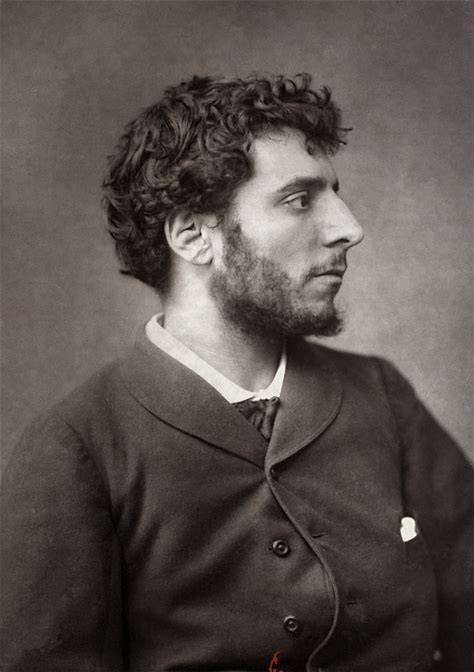
Henri Martin in 1882

The artist whose life and works I am looking at today is the Post-Impressionist painter Henri-Jean Guillaume “Henri” Martin.  He was born on August 5th, 1860, at 127 Grande-Rue Saint-Michel in Toulouse.  His father was a French cabinet maker, and his mother was of Italian descent.

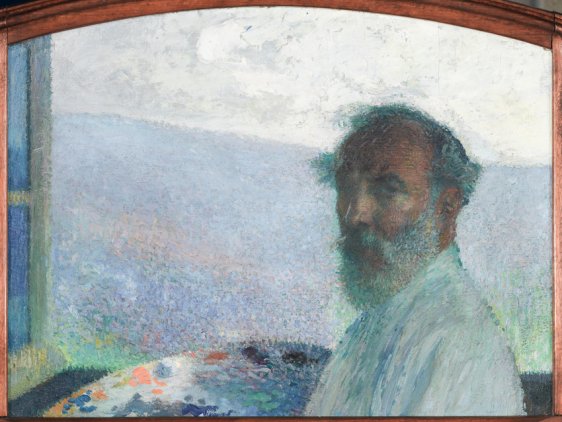
Self portrait by Henri Martin (1910)

The self-portrait hangs in the Musée d’Orsay and their commentary on this work is:

“…In this self-portrait dated just after 1910, Henri Martin makes reference to both the new techniques introduced by the Neo-Impressionists and to the grand pictorial tradition. Thus, there are many borrowings from a re-reading of the past, starting with the arched shape of the painting. This recalls basket-handle arches typical of the Middle Ages.
The palette the artist is holding clearly has an expressive role, symbolising his profession. Martin explicitly quotes primitive painting. Finally, it follows in a long tradition of interior portraits.
On the other hand, the technique of this painting links this work with Neo-Impressionism. By adopting the division of colours, Martin tries to capture the vibrating light of the south of France. He uses dots and stripes of colour, placed close together on an already thick layer, recalling a technique much favoured by Albert Dubois-Pillet, one of the founders of the movement.
Applied to a rigorous but fluid drawing style and to a skilful but seemingly quite natural composition, this technique which surprised in 1884 and shocked in 1886, in 1912 found itself, in this painting, harmoniously integrated into the great French pictorial tradition…”

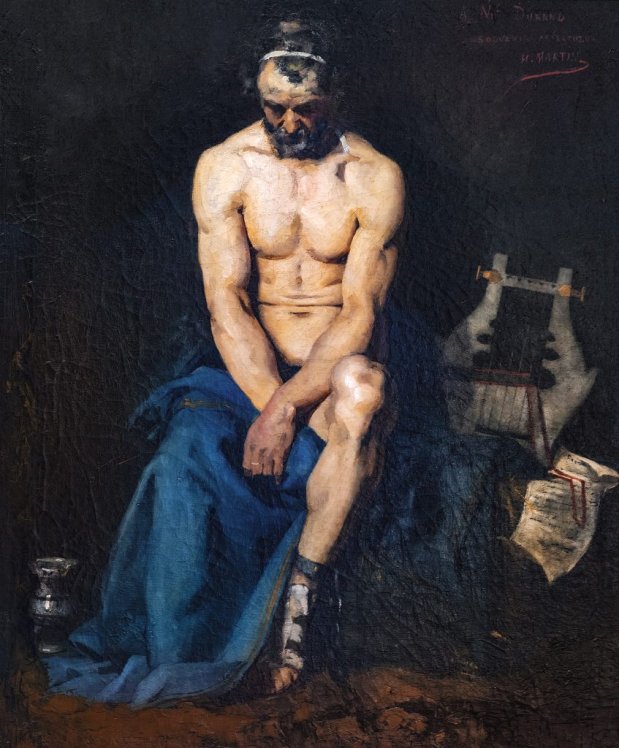
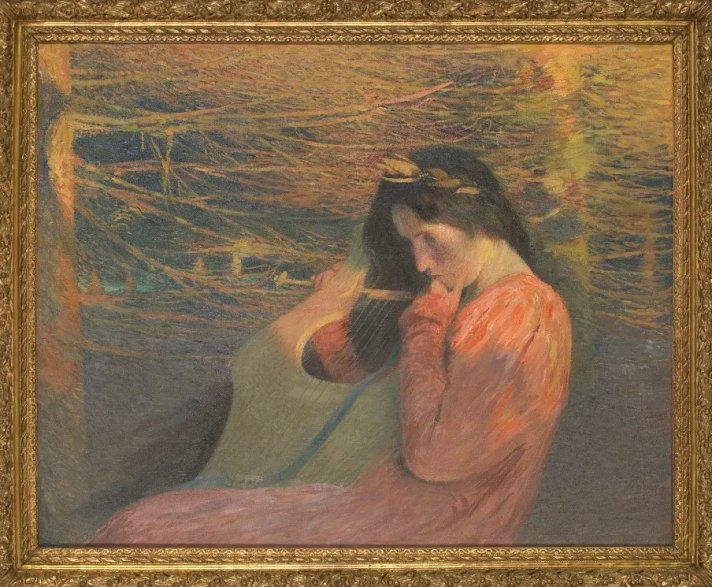
Orephée by Henri Martin (1878) One of Martin’s early mythological work inspired by the tragic Greek figure Orpheus.

Henri Martin, after completing his schooling, managed to persuade his father to permit him to study to become an artist. His artistic career began in 1877 at the Toulouse School of the Fine Arts, where his tutor was Jules Garipuy, a French painter and educator who would later become director of the city’s Beaux-Arts Academy in 1885.

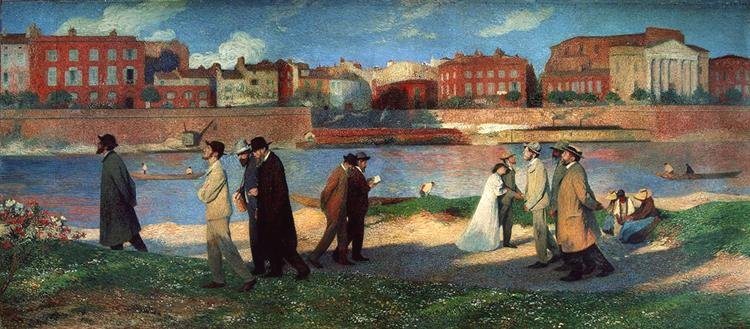
Les Bords de la Garonne, le poète, by Henri Martin (1906)

In 1879, Martin moved to Paris and where, with the help of a municipal scholarship, he was able to study in Jean-Paul Laurens’s studio.

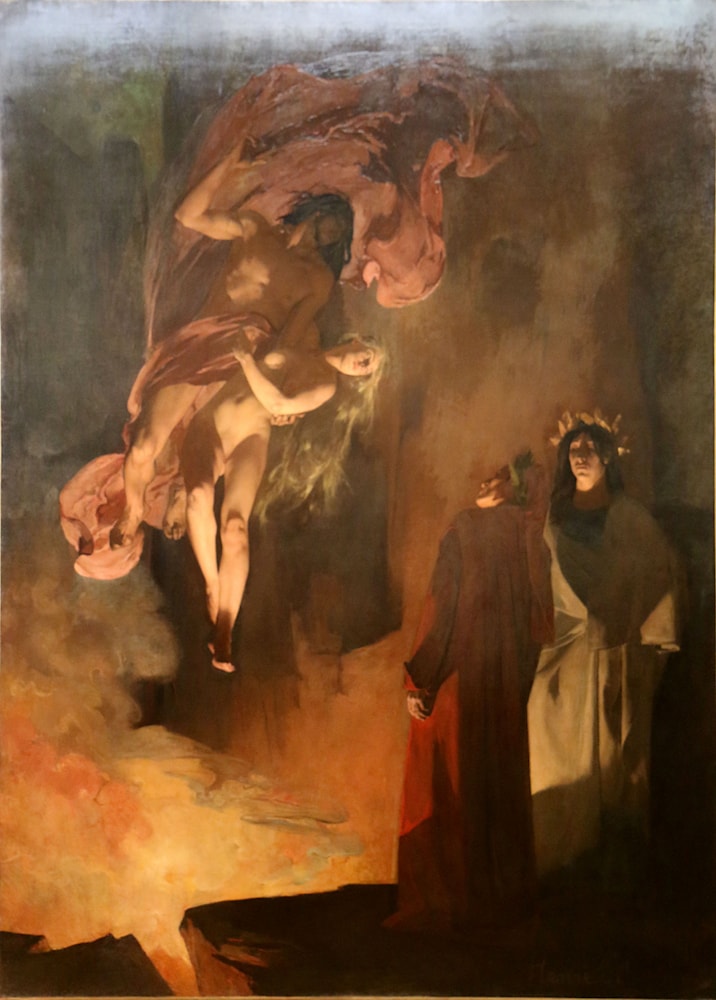
Paolo Malatesta et Francesca da Rimini aux enfers by Henri Martin

Four years later, in 1883, he received his first medal at the Paris Salon for his painting, Paolo Malatesta et Francesca da Rimini aux enfers.   The depiction comes from a character in The Divine Comedy by Danti Aligheri.   Francesca da Rimini was a contemporary of Dante Alighieri and he used her as a character in his book The Divine Comedy. The Lord of Rimini was at war with Francesca’s father Guido I da Polenta of Ravenna, and so to broker peace between the two families, Francesca was married to the Lord’s cripple son Giovanni Malatesta. It wasn’t a match made in heaven. Francesca ended up having a long-standing affair with Giovanni’s brother Paolo, who was also married. That all ended when Giovanni walked in on Francesca and Paolo and killed them both. In The Divine Comedy, Dante and Virgil enter the second circle of hell (the circle for the lustful) to find Francesca and Paolo swirling in a whirlwind.

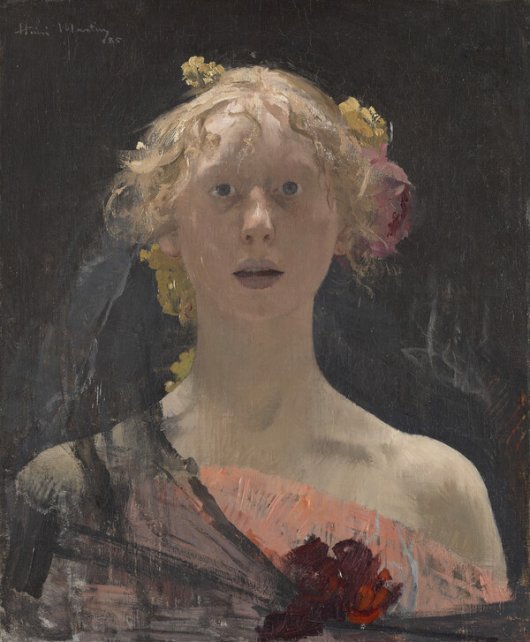
Berenice by Henri Martin (1889)

Whilst he had been studying at the School of Fine Arts in Toulouse, he met fellow student Marie-Charlotte Barbaroux, whom he married in 1881. It was thought that Barbaroux modelled for her husband’s mesmeric 1889 painting entitled Berenice.  The depiction of the woman was based upon a short story by the American author Edgar Allan Poe which was first published in 1835.  The story tells of  Egaeus, the narrator, who falls in love with his beautiful cousin Berenice. She suffers from a mysterious debilitating illness, causing her to fall into a trance-like state. As Berenice’s health deteriorates, Egaeus develops intense obsessions, focusing latterly on her teeth. The girl eventually dies and Egaeus is grief-stricken. He visits her grave, as if in a dream, and later discovers her extracted teeth in a box beside him. Henri Martin appears to have been inspired by this passage from Berenice:

‘…The forehead was high, and very pale … and the once jet-black hair fell partially over it, and overshadowed the hollow temples with innumerable ringlets, now of a vivid yellow, and jarring discordantly … with the reigning melancholy of her countenance…”

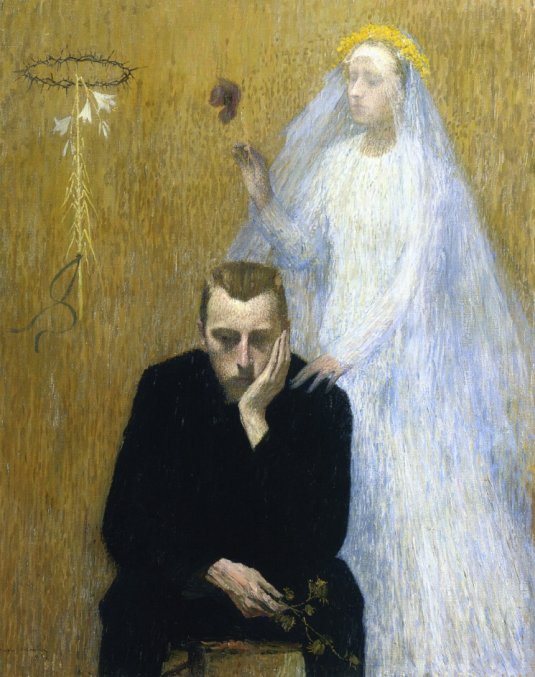
Mystic Scene by Henri Martin (1895)

In 1885, the year after he won his first medal at the Paris Salon, Martin was awarded a travel scholarship for his painting, Titans Scaling the Sky. The scholarship allowed him to travel to Italy and tour the country, where he was able to study the work of the Italian Masters as well as works by some of  his contemporaries such as the French symbolist painter Edmond Aman-Jean and the French painter and printmaker, Ernest Joseph Laurent, a well regarded figure in the academic art establishment, known for his large-scale historical and religious paintings. 

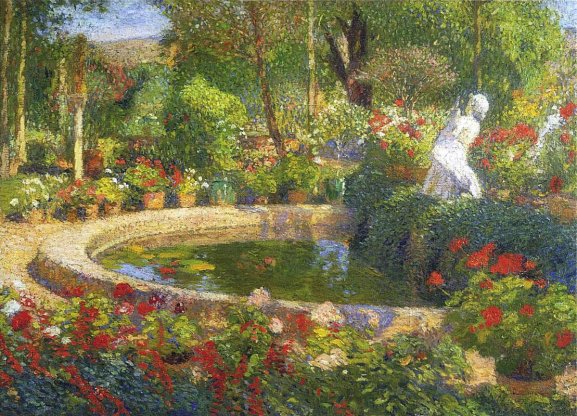
Le Marquayrol at Labastide-du-Vert by Henri Martin (1905)

Once Henri Martin had left the world of academia, he became interested in Neo-Impressionism but in a more casual style. His style was close to the divisionism of Seurat.  When he was in Italy Martin developed his own particular style, known as Divisionism, which is an artistic technique characterized by the separation of colours into individual dots or patches that interact optically.  It formed the technical basis for Neo-Impressionism.   The difference between divisionism and pointalism is that whereas the term divisionism refers to this separation of colour and its optical effects, the term pointillism refers specifically to the technique of applying dots. Henri Martin’s method was typically softer, less rigid, and more intuitive. He used divided brushstrokes – often short, comma-like marks rather than precise dots as seen in the works of Seurat.  Henri Martin was awarded the Gold Medal for a work he submitted to the Paris Salon in 1889.  The art critics identified it as pointillism.  Also in 1889 Martin became a member of the Legion of Honor.   He was commissioned to execute some important frescoes in the Paris city hall in 1895, and the new huge building of the Capitol of Toulouse.   

Fête de la Fédération au Champs de Mars, le 14 juillet 1790 by Henri Martin

In 1900 at the the Exposition Universelle of 1900 in Paris he was awarded the Grand Prix for his work, Fête de la Fédération au Champs de Mars, le 14 juillet 1790, which is now housed in the Musée des Augustins in Toulouse. It depicts the celebration of the centenary of the French Revolution and this work brought him considerable public and critical attention.

The Muse by Henri Martin (c.1896) The painting was presented at the Salon of the Société des Artistes Français in Paris in 1898.

His journey around Italy opened Martin’s eyes to a new way of painting. Prior to his trip his artwork conformed to the old Classicism style, a style which held a high respect for a classical period, classical antiquity in the Western tradition.  Maybe he was swayed by the clear bright light of the skies in Italy which he encountered.  The change of style could also be due to the influence of the artwork of the Italian Primitives.  In the mid-19th century, the term Primitive Art, was primarily applied to 14th and 15th century Italian and Flemish art, which at the time of Henri Martin, was appreciated for what was looked upon as its simplicity, sincerity, and expressive power which awoke in Martin intense poetic sentiments which he would  bring to his newly found style of painting. A more poetic approach to his painting style.

Banks of the Garonne by Henri Martin

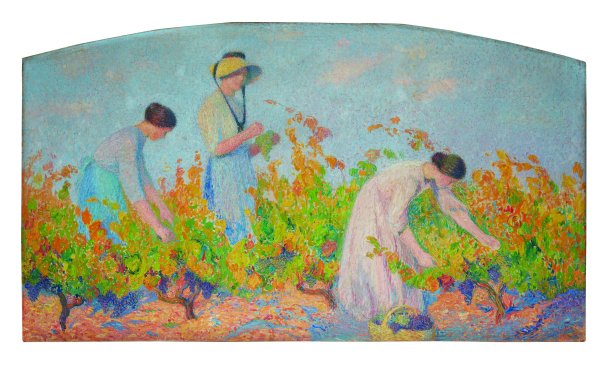
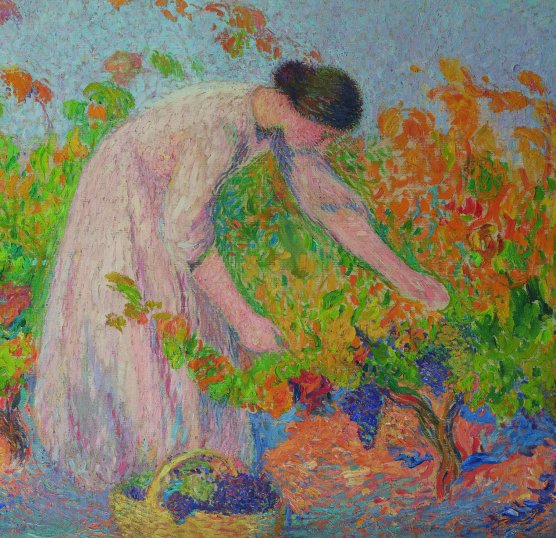
Les Vendangeuses  (The Grape Pickers) by Henri Martin (1920)

A painting by Henri Martin entitled, Les Vendangeuses  (The Grape Pickers) came up for auction at Christies in April 2021 and sold for EUR 218,750.  It was a work commissioned by Martin’s doctor, Dr. Henri Tissier, and remained on the wall of his Art Deco salon for a hundred years.  The Tissier’s home was located on Boulevard Raspail, in the 6th arrondissement of Paris.  It was a true Art Deco architectural jewel and had been built by Léon Tissier (Henri’s brother) in 1913.  Henri Martin, who was also the Tissier’s neighbour. Dr. Tissier and his wife were close to many artists, including the sculptor Bouchard and the interior designer Henri Bellery-Desfontaines.   Both contributed to the decoration of the Tissier’s apartment, whose exceptional furniture was presented at the 1900 Universal Exhibition in Paris.  Les Vendangeuses, which Henri Martin completed in 1921, is a depiction of a tranquil, bright rural scene showing women picking grapes.  It is a remarkable example of Henri Martin’s refreshing approach to pointillism.  It is a work with strong post-impressionist accents and is also a tribute to the artist’s native land and a pledge of the friendship that bound him to the Tissier couple.

It is thought that the woman to the right dressed in a pale pink dress that contrasts with the blue of the other clothes, stands out particularly and could well represent Marie-Charlotte Barbaroux, Martin’s wife.

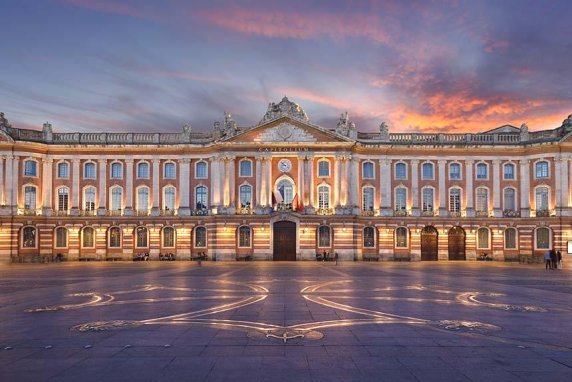
The Capitole of Toulouse

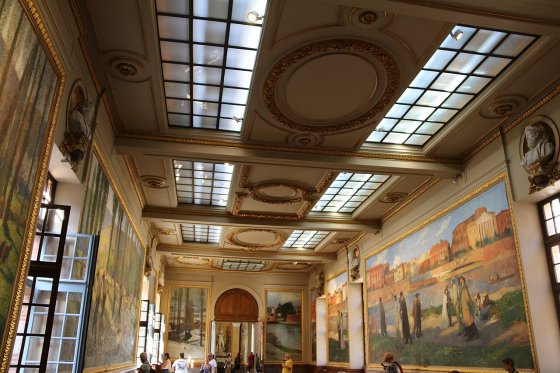
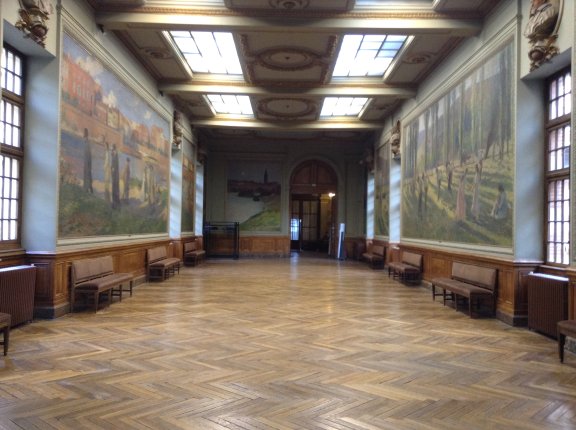
In Toulouse there is no Mairie, but rather a majestic Capitole. An emblematic building which is home to the town hall, a theatre and rooms of state. On the first floor, there are magnificent reception rooms that are decorated with art including ten giant canvases by Henri Martin and, notably, the Salle des Illustres where his paintings retrace the history of Toulouse.

Salle Henri Martin, Capitole de Toulouse.

Salle Henri Martin, Capitole de Toulouse.

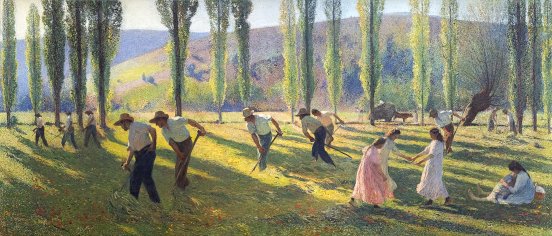
 L’été ou les faucheurs (Summer or The Reapers) by Henri Martin (1903) In the Henri Martin Hall, The Capitole Toulouse.

Henri Martin completed many prestigious public commissions, which can be found at the Capitol of Toulouse, the prefecture of the Lot in Cahors, the Sorbonne in 1908, the Paris City Hall, a cabinet of the Élysée in 1908, the Council of State in 1914-1922, the Town Hall of the Fifth arrondissement in 1935.

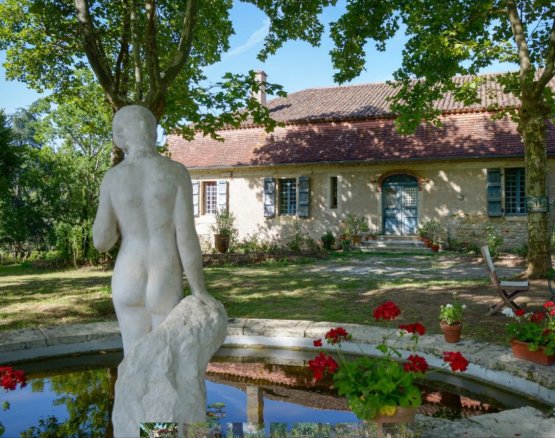
Henri Martin’s final home at Domaine de Marquayrol at Labastide-du-Vert

Henri Martin was quite an introvert and later in life began to hate living in Paris and hanker after a return to his beloved south-west France.  He moved away from the French capital around 1900 and after a number of years trying to find the perfect place to live, settled on a house, the Domaine de Marquayrol, which overlooked the village of  Labastide-du-Vert, a commune in the Lot department in the Occitania region in Southwestern France. near to the town of Cahors.

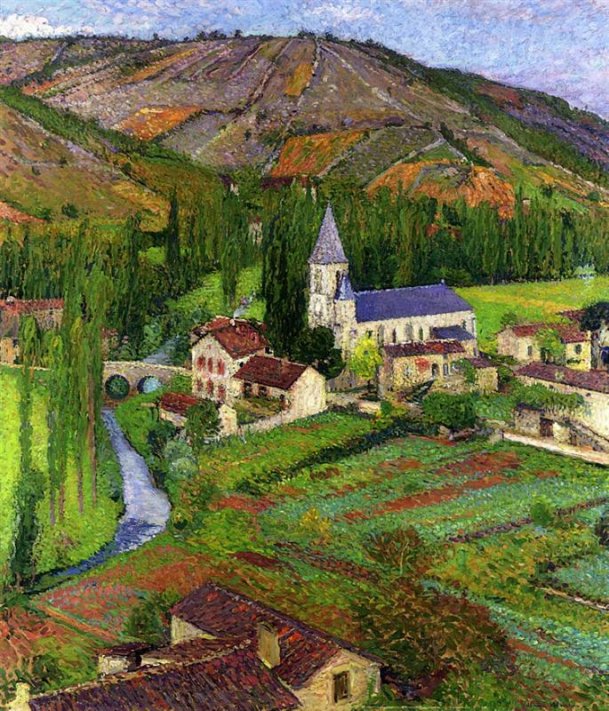
The Church at Labastide by Henri Martin (1920)

Labastide du vert village by Henri Martin

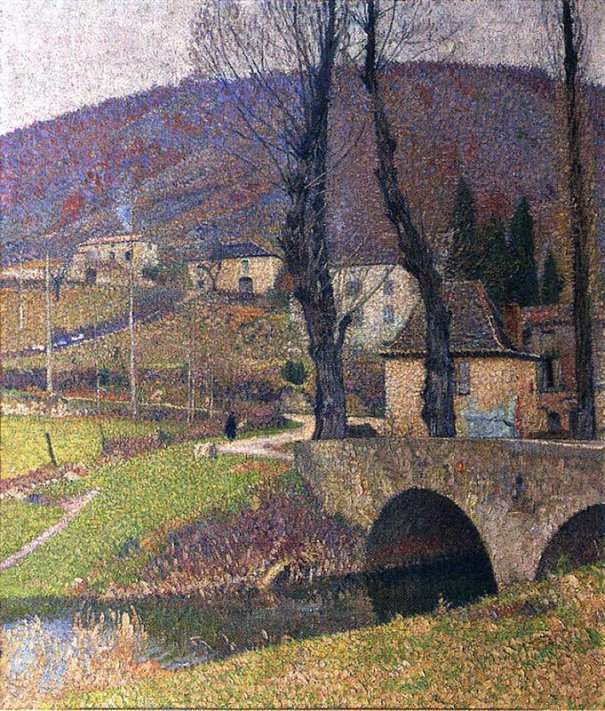
It was an area of great natural beauty, a region characterized by rolling hills, vineyards, and the winding Lot River valley. Marquayrol became his primary residence and his artistic sanctuary for the rest of his life. He lived there with his wife, Marie-Charlotte Barbaroux, and their four sons Many art historians believe that Martin performed some of his best work in this new tranquil environment. His mature output depicted tranquil landscapes and village scenes and these canvases, which were rich in soft light and rhythmic brushwork, remain the trademark of his oeuvre.

 Henri Martin died at Labastide-du-Vert on November 12th, 1943, aged 83.


Below are some of the websites I used to get information for this blog:

France info

Le Monde

Outre Journal

Arthive

ArtFund

NICEARTGALLERY

Wilhelm Ferdinand Bendz

Somebody just asked me how I came to write about a certain artist.  In the case of today’s blog it was just a strange coincidence………

In November 2012 I wrote a blog about the Barber Institute, an English art museum on the Birmingham University campus.  The reason for visiting this gallery was to take in the exhibition of the Norwegian painter, with the English-sounding name, Thomas Fearnley. 

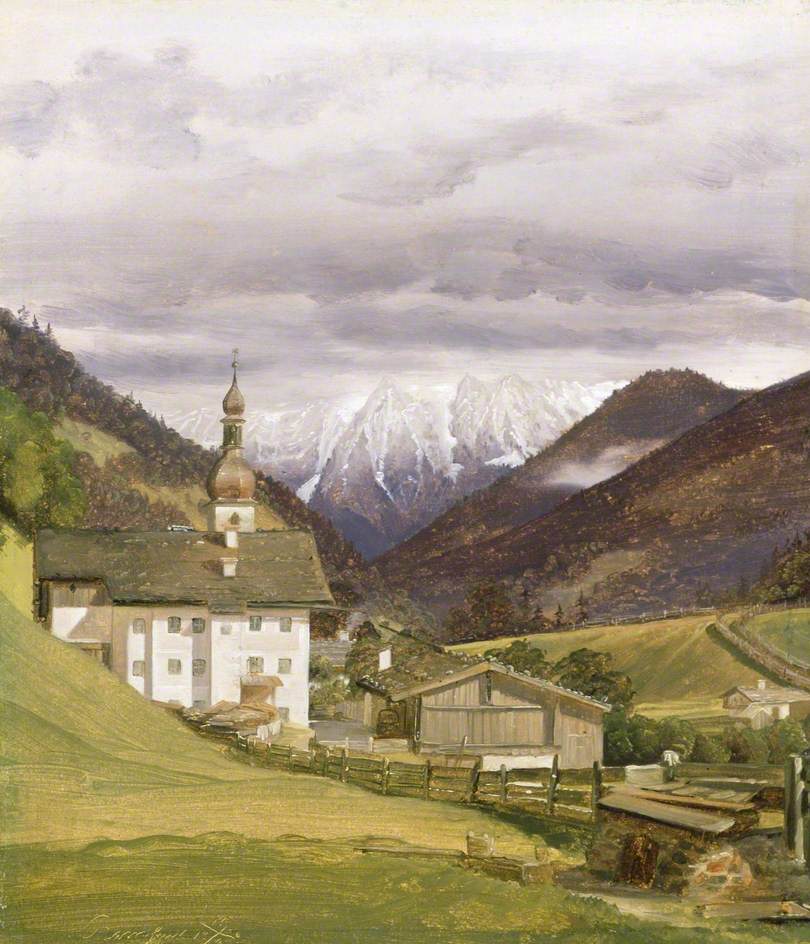
Church at Ramsau by Thomas Fearnley (1832)

As I walked into the exhibition that day, the first painting I saw was a plein air oil on paper, laid on canvas work which Fearnley completed in 1832 while on his trek from Germany to Italy. Fearnley painted this finished composition from nature in September 1832. The artist was travelling to Italy when he stopped at the village of Ramsau. The title of the work was simply Ramsau.  This was a town I knew well from the days I travelled around southern Bavaria.  It was a beautiful painting, and I vividly remember the beautiful depiction as if I had just seen it today.  It is a truly magnificent landscape work.

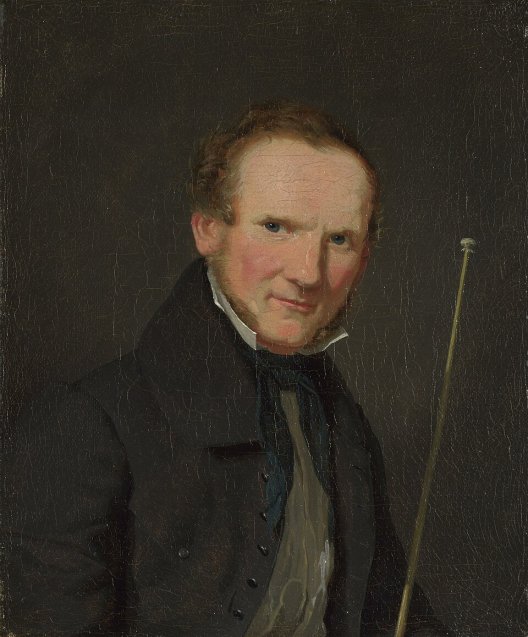
Wilhelm Bendz by Christen Kobke (c.1830)

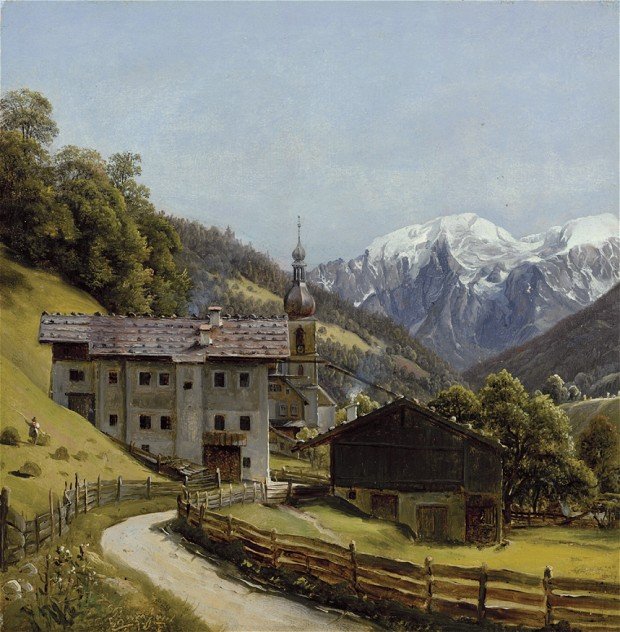
The reason I mention this work is because the artist I am looking at today, Wilhelm Ferdinand Bendz, also produced an artwork featuring that same church with its mountainous background.  Bendz was principally a painter of figure subjects and his landscapes are rare. This view was painted in September 1832 when he too was making his way from Munich to Rome. He stopped briefly at Ramsau in Austria and made several lively sketches of the church and mountains. His painting was dated the same month and same year as Fernley’s painting !   More about that coincidence later.

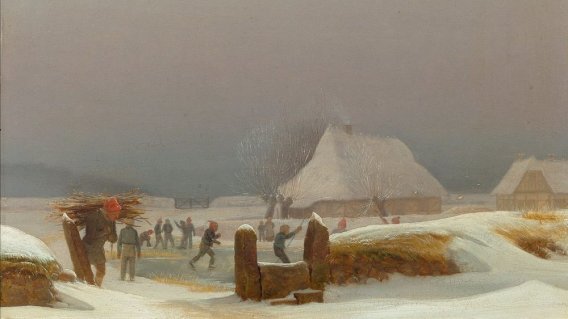
Winter Landscape from Funnen by Wilhelm Bendz (1831)

Wilhelm Ferdinand Bendz was born in the Danish town of Odense on the island of Funen on March 20th 1804 His father was Lauritz Martin Bendz, at one time, chief of police in Odense and High Court Judge in Funen and Langeland.  His mother, his father’s second wife, was Regine Christence Bang.  Wilhelm had four brothers and four sisters as well as three stepsisters and one stepbrother from his father’s first marriage.

A Smoking Party by Wilhelm Bendz

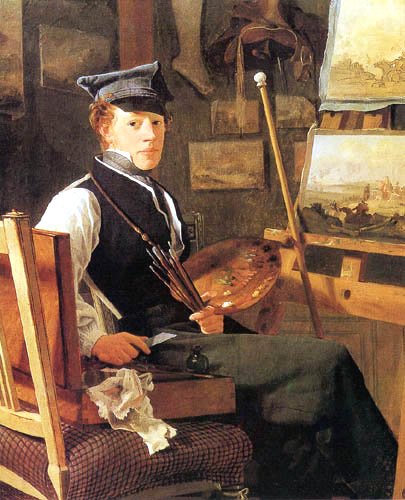
Wilhelm Bendz, at the age of sixteen, having completed his schooling in Odense, travelled to Copenhagen where he enrolled at the Royal Danish Academy of Fine Arts and studied there from 1820 to 1825.  Here he studied under Christoffer Wilhelm Eckersberg, whowent on to lay the foundation for the period of art known as the Golden Age of Danish Painting, and is referred to as the “Father of Danish painting”. In his final year at the academy, he submitted work in an attempt to win the Academy’s prestigious gold medal prize which came with a travel scholarship.  However, at the time, the Academy only awarded the Gold Medal to history paintings, which at the time was considered to be the most respected painting genre.   Bendz, however, decided to concentrate on portraiture and genre works and his early paintings would often portray his artist colleagues and their daily lives.

A Young Artist  (Ditlev Blunck) Examining a Sketch in a Mirror by Wilhelm Bendz

One such work was his 1826 painting entitled A Young Artist (Ditlev Blunck) Examining a Sketch in a Mirror.  Wilhelm Bendz was a great believer in artists’ new role in life.  He believed they were no longer simply specialist craftsmen but, for him, artists should be viewed as intellectual workers.   The artist in this picture is Bendz’s fellow Academy student, Ditlev Blunck, who is engaged in painting a portrait of fellow student, Jørgen Sonne, a painter who would become known for his battle scenes.   The painting which Bendz completed in 1826 depicts young Ditlev Blunck, a fellow Academy student of Bendz, taking a break from painting to examine a sketch he has made for the portrait.  The artist is standing in a crowded room surrounded by his tools and paraphernalia: a paintbox, palette, and easel as well as a skull and a sketchbook suggesting that careful studies had preceded the final painting.  Only the back of the painting can be seen with the front seen only in the mirror. It is believed that the depiction is indicative of the era’s view of art as a mirror held up to life and signals that his work is serious, and requires thorough study before execution.

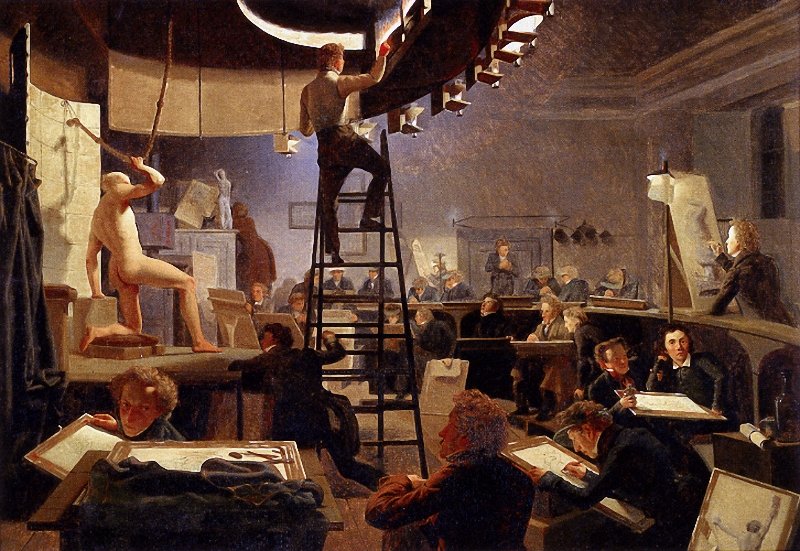
Model Class at the Copenhagen Academy by Wilhelm Bendz (1826)

Bendz completed Model Class at the Copenhagen Academy in 1826 and it is considered to be one of his greatest works.

Christian Holm by William Bendz (1826)

Another of Bendz’s works which focused on artists at work was one he completed in 1826 – a portrait of his fellow Academy student, Christian Holm, at work on his painting. Christian Holm became a well-known Danish painter known primarily for his animal and hunting scenes.

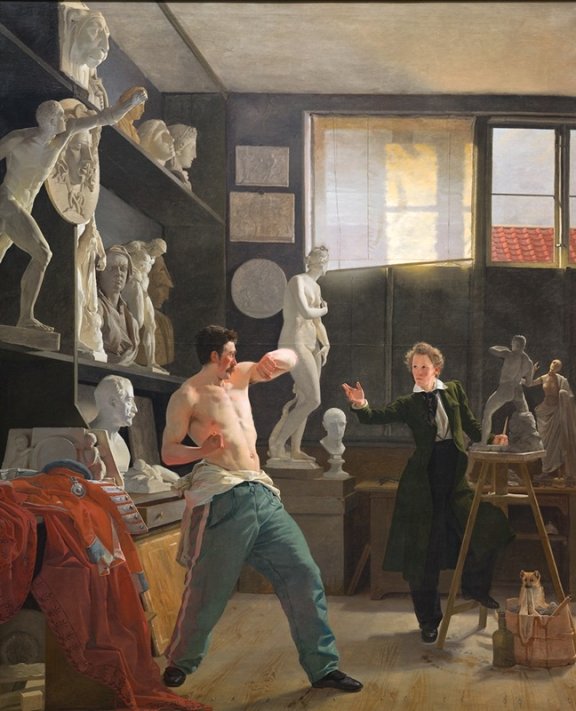
A Sculptor in his Studio Working from Life by Wilhelm Bendz (1827)

A Sculptor in His Studio which he completed in 1827 is one of Bendz’s masterpieces.  It depicts the working environment of a sculptor with meticulous attention to tools, materials, and the creative process. The painting demonstrates his skill with complex interior lighting.  The depiction is of sculptor, Christen Christensen, at work.  Christensen was a Danish sculptor and medallist, who studied at the Royal Danish Academy of Fine Arts and was at the same time articled to the sculptor Nicolai Dajon. He won the Academy’s small and large silver medals in 1824, the small gold medal in 1825 and finally the large gold medal in 1827.

Interior from Amaliegade, Captain Carl Ludvig Bendz Standing and Dr. Jacob Christian Bendz Seated by Wilhelm Bendz (ca. 1829)

Bendz’s two brothers featured in an internal scene, in Bendz’s genre work entitled Interior from Amaliegade.

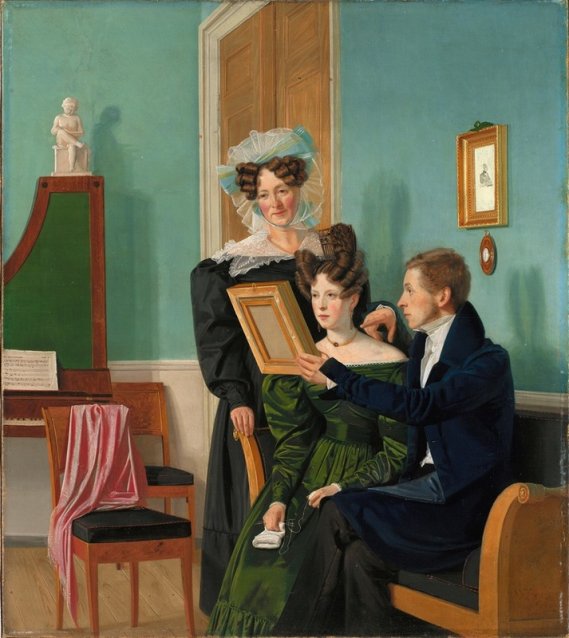
The Raffenberg Family by Wilhelm Bendz (1830)

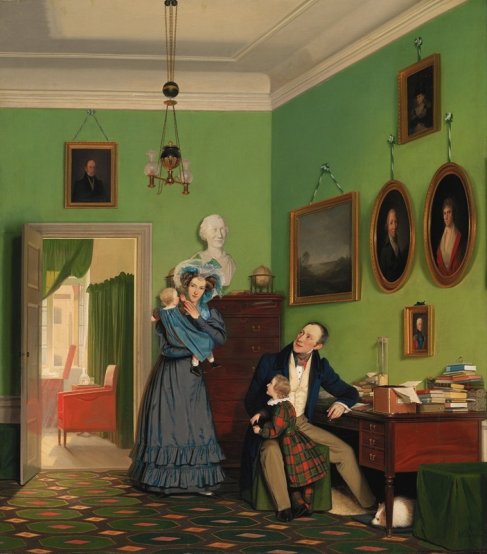
The Waagepetersen Family by Wilhelm Bendz

Bendz often received lucrative commissions for family portraits.

Artist in the Evening at Finck’s Coffee House in Munich by Wilhelm Bendz (1832)

After leaving the Academy, Bendz was employed as an assistant at Christoffer Eckersberg’s studio.  In late 1830 Bendz won an award which granted him a travel scholarship allowing him to leave Denmark and travel to southern Europe. After short stop-overs at Dresden and Berlin, he settled for a year in Munich, a city which had developed into a vibrant centre for the arts.  This opportunity exposed Wilhelm to new artistic influences and techniques as well as knowledge of contemporary German painting, known as the Munich School, which seems to have influenced his style.   It was here that he completed one of his most valued paintings, a composed group portrait entitled Artist in the Evening at Finck’s Coffee House in Munich.

The Church at Ramsau by Wilhelm Bendz (1832)

In the autumn of 1832, twenty-eight-year-old Bendz left Munich and continued his exhausting journey over the Alps towards Rome.  On this journey he was accompanied by Joseph Petzl, a German genre painter and Thomas Fearnley, a Norwegian romantic painter. It is here that I return to the start of the blog and the two similar depictions by Fearnley and Bendz of the church at Ramsau.  The answer as to how Bendz and Fearnley completed paintings depicting similar views of the church in the mountains at the same time is now clear.  They were fellow travellers and both had decided to record the beautiful scene.

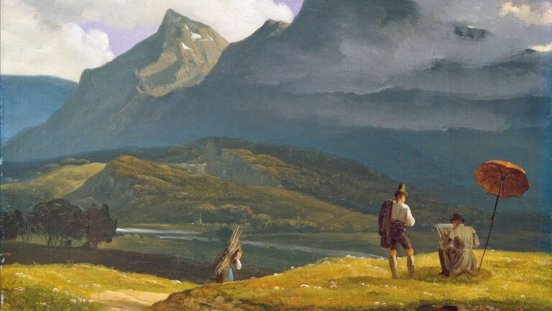
Mountain Landscape by Wilhelm Bendz (1831)

The three men finally crossed the Alps and made their way to Venice.  The extremely difficult journey took its toll on Bendz and after moving from Venice to Vicenza to stay with a friend before heading to Rome, he collapsed and died of a lung infection on November 14th 1832 aged 28. Wilhelm Bendz’s artistic contribution was not appreciated during his short lifetime but his legacy grew significantly in the decades following, as art historians recognized his technical skill and unique perspective on the Danish Golden Age. Bendz’s technical skill was in the way he handled light, especially in interior scenes and how he enhanced the artistic achievements of the Danish Golden Age. His works displayed both academic precision and personal expression.  He was a master at depicting the social life of artists and intellectuals, and this artwork provided valuable visual documentation of cultural circles in Copenhagen during the 1820s and early 1830s.