

Groeningemuseum, Bruges
If you ever manage to travel to Belgium and visit the city of Brugge (Bruges) then I entreat you to drop in at the Groeninge Museum which lies in the heart of the historic city. It is at this establishment that you will be able to see works of art by Jan van Eyck, Hans Memling, Hugo van der Goes, Gerard David, Hieronymus Bosch, Ambrosius Benson, Lancelot Blondeel, father Pourbus and his sons and their contemporaries. These Masters came from the Low Countries and often worked in Bruges and completed assignments there in the late 15th and early 16th centuries. This museum is a home for many beautiful pieces of art produced by the Flemish Primitives. The painting of the 15th and early 16th centuries in the Southern Netherlands is an important highlight in the history of art. These painters are commonly referred to as Flemish primitives. The Flemish Primitive period flourished especially in the cities of Bruges, Ghent, Mechelen, Leuven, Tournai and Brussels, all of which are in present day Belgium. The period began around the 1420s with painters such as Robert Campin and Jan van Eyck and lasted until the death of Gerard David in 1523, although many art historians believe it did not end until around 1566 or 1568 with the advent of the Dutch Revolt. Moreover, the Flemish primitives emphasise a previously unseen religious eloquence that accompanies a new tradition in painting. The painting commissions of the time not only came from the various courts and religious institutions, but also from the towns and cities and their citizens. It was a time when artists, for the first time, had attained a very important standing in the society. Several of their works are looked upon as highpoints in the history of European art. In this blog I will introduce you to some of these fabulous paintings which can be found in this wonderful museum.
Virgin and Child with Canon Joris van der Paele by Jan van Eyck
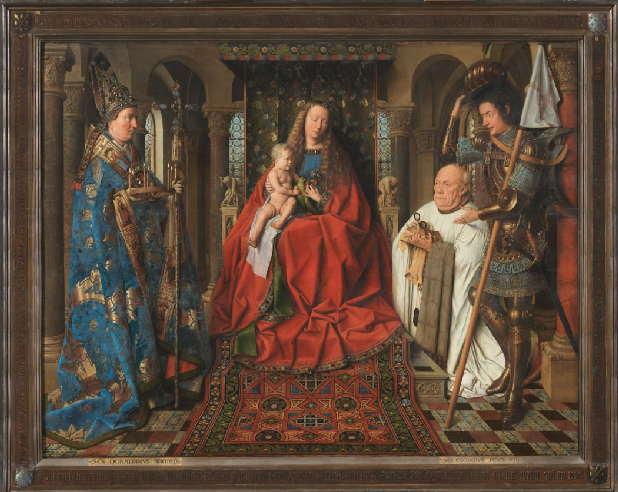
The Virgin and Child with Canon Joris van der Paele by Jan van Eyck (c.1436)
One of the great examples of early Netherlandish painting is the body of work by artists who were active in the Burgundian and Habsburg Netherlands during the 15th and 16th century Northern Renaissance period. The first work of art I am featuring is the large (122 x 158cms) oil on oak panel by Jan van Eyck entitled Virgin and Child with Canon Joris van der Paele which he completed around 1436. The painting depicts the the Virgin Mary enthroned at the centre of the semicircular space, which most likely represents a church interior, with the Christ Child on her lap. The Virgin’s throne is decorated with carved representations of Adam and Eve, Cain and Abel, prefigurations of the Crucifixion and Resurrection of Jesus, and scenes from the Old Testament. To the left in dark blue robes is Saint Donatian the patron saint of the church for which the panel was painted. The saint is dressed in brightly coloured vestments. This work is noted for the fine attire, including wonderful representations of furs, silks and brocades, and the detailed religious iconography. Kneeling down, as he piously reads from a book of hours, is Canon Joris van der Paele and standing behind him is St George, the canon’s patron saint.

Canon Joris van der Paele
Van der Paele had worked as a scriptor in the papal chancery in Rome. From there he took up various posts in the Church before relocating to Bruges, his birthplace, in 1425.
Around the frame of the painting is a Latin inscription which once translated states:
“…Master Joris van der Paele, canon of this church, had the painting made by Johannes van Eyck, painter; and he founded two chantries, to be tended by the canons, 1434; the painting was, however, completed in 1436…”
The word “chantry” derives from Old French chanter and from the Latin cantare (to sing). Its medieval derivative cantaria means “licence to sing mass”. It is the prayer and liturgy in the Christian church for the benefit of the dead, as part of the search for atonement for sins committed during their lives. In this case it indicates that Joris van der Paele donated a substantial amount of money to the authorities of St Donation’s Church in Bruges for them to dedicate an annual mass to his memory in perpetuity. The painting would then have been hung alongside or above the church altar.
Death of the Virgin by Hugo van der Goes

Death of the Virgin by Hugo van der Goes (c.1481)
The painting The Death of the Virgin is thought to have been the last work painted by Hugo van Goes before he died around 1482/1483. It is thought that van der Goes was born in Ghent around 1442. He enrolled in the city’s painter’s guild in 1467 and worked in the city for ten years during which time he received many lucrative commissions from the city, the Church and the Burgundian court. In 1477 he left Ghent and went to live in Rouge-CloÎtre in the Forest of Soignes near Brussels. Sadly, he suffered from many bouts of depression which culminated in a mental breakdown in 1481. Following convalescence he returned to painting and completed this exquisite work of art which is believed to have been for Ter Duinen Abbey, a Cistercian monastery at Koksijde, in what is now Belgium.

Detail from Death of the Virgin by Hugo van der Goes
The depiction is the artist’s interpretation of the event with the vision of heaven above Mary’s deathbed. The figures we see in the main picture are those filled with sorrow and the sense of despair at the death of the Virgin Mary. Hugo van der Goes was looked upon as the most “modern” of the Flemish Primitive painters and this is borne out in this painting in which he has produced such realistic and expressive rendering of the figures and the movement and intensified feelings that pervade the composition. The mystical, religious spirit along with the strong sense of emotion make this work one of the great masterpieces of 15th century painting.
The Triptych of Willem Moreel by Hans Memling
Hans Memling was born in Germany, at Seligenstadt near Aschaffenburg, and it is thought that he received his first art education in Cologne. He then travelled to the Netherlands but probably spent his early life in Mainz. By 1465 he had moved to Bruges and was the leading artist there for the rest of his life. By 1480 he had bought himself a large stone house in the city and was taking on pupils. Memling was listed among the wealthiest citizens on the city tax accounts. Sometime between 1470 and 1480 Memling married Anna de Valkenaere who bore him three children.

Portrait of the family Moreel, 1482 by Hans Memling (Royal Museums of Fine Arts of Belgium, Brussels)
It is in the area of portraiture that Hans Memling appears to have been the most successful and had gained a vast number of aristocratic clientele who lived in Bruges. One of his lucrative commissions came from Willem Moreel, a prominent Bruges politician, merchant and banker and his wife Barbara van Vlaenderberch. He had painted their portraits in 1482. His figurative depictions are painted with an exactness, a precision and a concern for detail which bring them strongly to life.

The Triptych of Willem Moreel by Hans Memling (1484)
One such commissioned work of art was the Triptych of Willem Moreel. Moreel and his wife had commissioned Memling to paint a triptych altarpiece for the altar of the Saints Maurus and Giles in the Church of St. James in Bruges, a church in which Moreel and his wife wished eventually to be buried.

Central panel of the Moreel Triptych
The central panel of the triptych depicts the large figure of St. Christopher, who according to medieval legend, carried the Christ Child across a river on his shoulder. In the distance, up in the rocks in the left background we see the light from the hermit’s lamp guiding the saint. The two figures on either side of St Christopher do not belong in the legend but may have been added by Memling to balance the composition. To the left we see the former monk, St Maurus, holding his crook and open book and to the right is St Giles, a Benedictine hermit with an arrow in his arm and a deer at his side. It is interesting to note that the inclusion of the deer and the arrow which is in most depictions of the saint, as it harks back to the legend that Giles finally withdrew deep into the forest near Nîmes, where, in the greatest solitude, he spent many years, his sole companion being his beloved deer, which in some stories sustained him on her milk. His retreat was finally discovered by the king’s hunters, who had pursued the deer to its place of refuge. An arrow shot at the deer wounded the saint instead, who afterwards became a patron of the physically disabled.
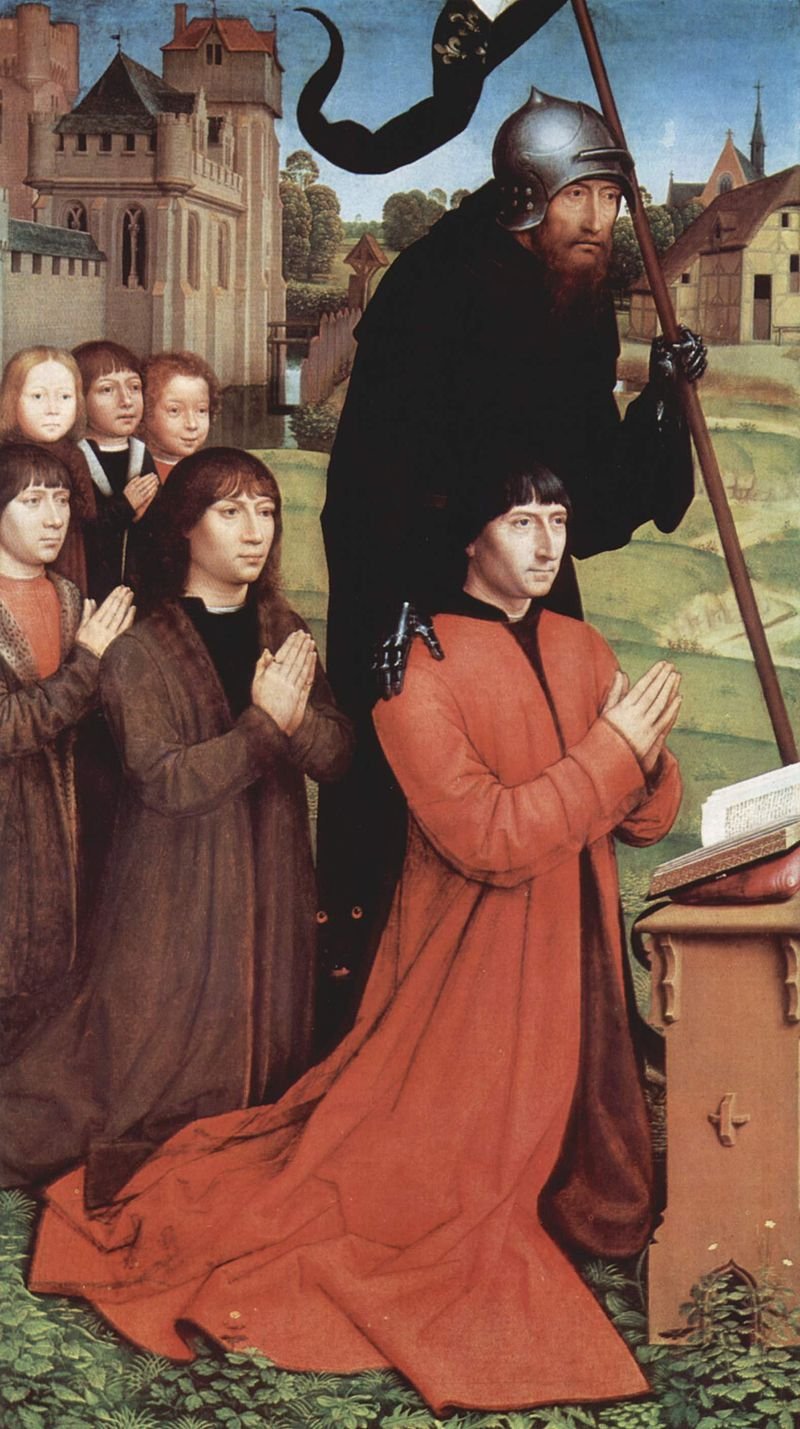
The left hand panel of the Moreel Triptych
The left hand panel of the triptych continues with the magnificent landscape background. The depiction of the left hand panel has multiple figures. It depicts the Willem Moreel kneeling, hands clasped in prayer. His hair is short in a “bowl cut” and over his black jerkin, he wears a fur-lined tabard which is without a belt or fastenings, which was very fashionable in the 1480s. Behind him are his five male children, who are also shown kneeling. Of Moreel’s sons, two are known to have died in infancy leaving Willem the oldest, with his two remaining siblings, John and George. Moreel and his sons are being presented by Saint Wilhemus van Maleval, who stands among them, dressed in a fur-lined black coat over army clothing. He places his hand on Willem’s shoulder as he directs and presents him to St.Christopher in the centre panel.

Right hand panel of the Moreel Triptych
On the right interior wing of the triptych is the depiction of Barbara Moreel with eleven of her thirteen daughters, who all kneel in prayer before an open book. Barbara wears an hennin, a headdress in the shape of a truncated cone, which was worn in the Late Middle Ages by European women of the nobility, a damask silk dress with a white collar, and a wide red belt with a golden buckle. The women are being presented by Saint Barbara, who was the patron saint of Moreel’s wife. The saint is depicted standing before the tower where she was, according to legend, imprisoned and executed.
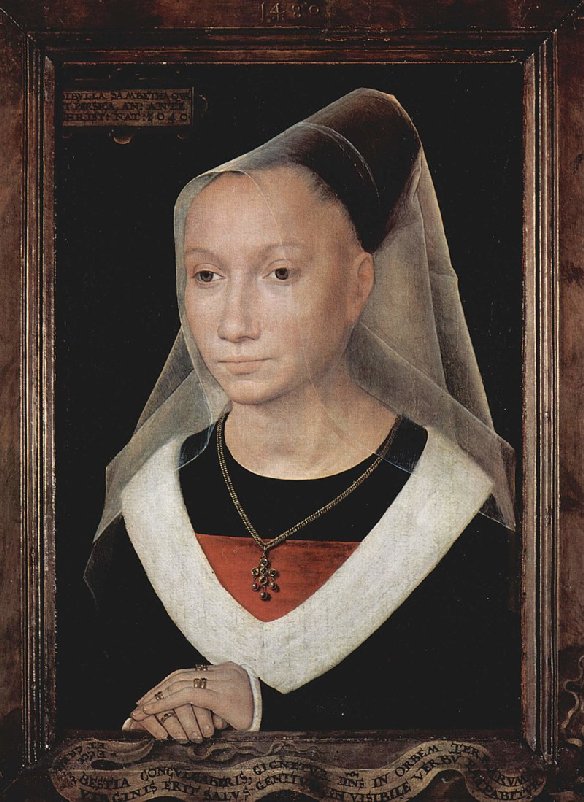
Sibylla Sambetha (Catherine Moreel ?) by Hans Memling (1480)
Barbara Moreel’s eldest daughter, Catherine, kneels directly behind her mother. She also wears a black dress and it is known that later in her life she became a Dominican nun. Besides completing portraits of Moreel and his wife, he had also painted a small oil on oak panel portrait entitled Sibyla Sambetha, in 1480. The painting is now in the Hans Memling Museum at the Old St. John’s Hospital in Bruges. The girl in the light brown clothing, black V-neck and transparent veil has been identified as Maria from her name written in her headband, and is their second-born daughter, given her linear position in the painting.

Exterior panels of the Moreel Triptych when closed
The outer part of the two wings, seen when the triptych is closed has grisaille depictions of John the Baptist with his lamb and staff. On the other wing we have Saint George in his full armour, slaying the dragon with a lance depicted on the right outer wing. It is believed that these two panel paintings may have been completed much later around the time of the deaths of Willem and Barbara Moreel and dated as around 1504 by a number of art historians. It was thought that Moreel’s sons, Jan (John) and Jaris (George), probably commissioned them as the final, successful, effort to have their parents interred within the chapel space.
One strange aspect to the Moreel Triptych is the fact that not all of the daughters depicted in the right hand panel were painted by Memling. The art historian and former curator of the Groeningemuseum, Dirk De Vos, has identified at least six females who are later additions, layered over the original landscape. The explanation for these additions, which were probably added by members of Memling’s workshop, were that the daughters were born after the 1484 completion date of the triptych. The left-hand panel depicting Moreel and his sons underwent a similar update.
………to be continued.

 my daily art display
The Lowlands provided a market for the most amazing artists, especially as you noted works by Jan van Eyck, Hans Memling, Hugo van der Goes, Gerard David, Hieronymus Bosch, father Pourbus and his sons and their contemporaries. So how did Netherlands museums and Belgian galleries decide how to divide up their treasures? Did Bruges opt for the religious themes (as seen above) while Dutch galleries preferred secular portraits and domestic scenes?
Thank you for sharing these, this is my favourite kind of art.