
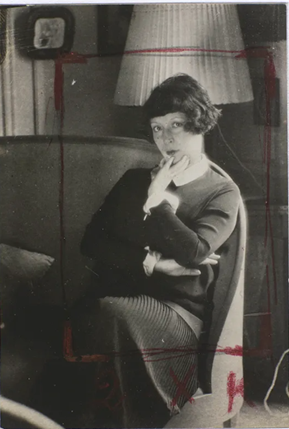
Marie Laurencin photographed by Man Ray (c.1925)
My blog today features the life and artwork of the nineteenth century French painter, Marie Laurencin. She played an important role in the bringing out the female and lesbian identity in early-20th century modern art movements which at the time was dominated by men. Her depictions were mainly of females, including many self-portraits but also many also accompanied by animals. She prided herself with her choice of subjects famously stating:
“…Why should I paint dead fish, onions and beer glasses? Girls are much prettier…”
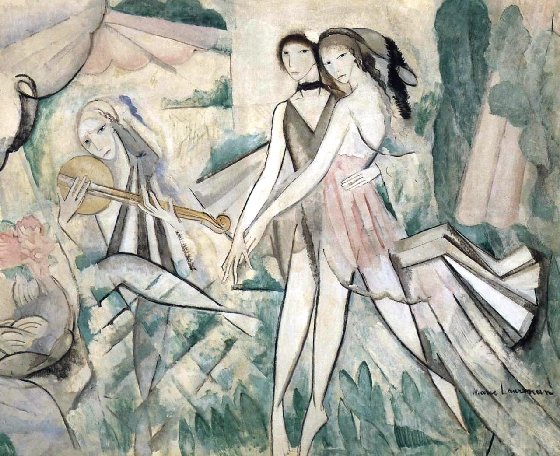
Le Bal élégant, La Danse à la campagne by Marie Laurencin (1913)
From early in life, Laurencin was predominantly interested in worlds in which women moved independently and peacefully, creating self-portraits and scenes featuring animals and women which were striking in their thematic consistency. Her fame came through her association with Cubism and she exhibited her work with the Section d’Or, (“Golden Section”), which was also known as Groupe de Puteaux or Puteaux Group, a collective of painters, sculptors, poets and critics associated with Cubism and Orphism. Her work was also exhibited in America at the Armory Show, but later in her life she fought against her art being compartmentalised in a specific art movement. She concentrated on her own aesthetic, favouring escapist imagery in pastel hues, that was at once decorative and radical in its embrace of feminine images.
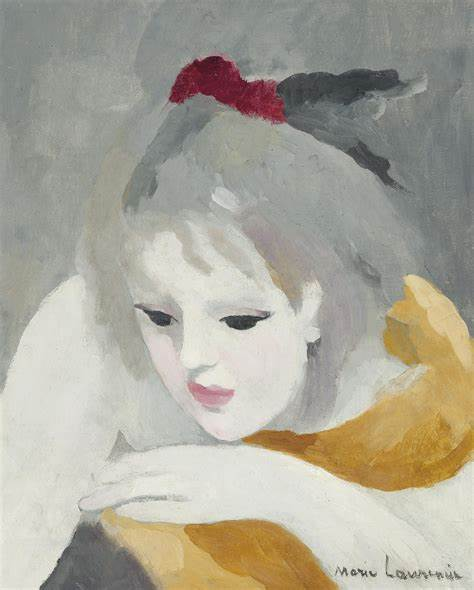
Tête pensive by Marie Laurencin
Marie Laurencin was born in Paris on October 31st, 1883, and lived in an apartment with her mother, Pauline Mélanie Laurencin, a seamstress. Laurencin was an illegitimate child but did not have the courage to question her mother about her absent father. However, when she was twenty-one-years-old her mother disclosed that her father was the politician Alfred Toulet. Marie Laurencin’s achievements at school were limited although she w an avid reader and enjoyed sketching. He failings at school precluded her from becoming a teacher, a profession favoured by her mother. As a teenager, Marie found life difficult and this was presumably due to her classroom failings. She became introverted and began to paint self-portraits which she carried on doing for most of her life. After leaving school she studied the art of porcelain painting at the École de Sèvres with the flower painter Madeleine Lemaire. In 1903 when she was twenty, she enrolled at the Académie Humbert where she worked on drawing, painting and printmaking.
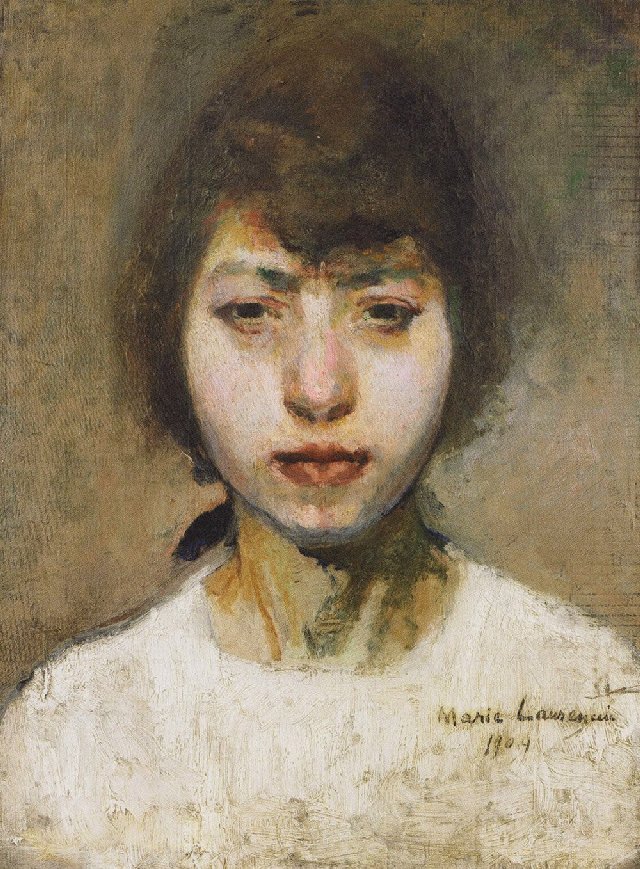
Self-portrait by Marie Laurencin (1904)
She completed one of early self-portraits in 1904 whilst studying at Académie Humbert. Laurencin depicts herself wearing a white painter’s smock and her hair is tucked behind her face. She stares out at us with calm confidence and yet serious expression and yet she has a piercing questioning stare. The palette Laurençin has used is dominated by browns, whites and pinks and she has cleverly used colour to model her face, with pinks shaping the sides of the nose and the eyelids and browns and greys indicating shadows around her cheeks. Her lips, at the centre of the canvas, are red and full. It was this love of self-portraiture throughout her artistic career that indicated her interest in depicting herself as the subject of her work which ties in closely to her concentration on female independence and self-fashioning. Laurencin always depicted herself as both an independent artist and as a modern woman. The painting is part of the Musée Marie Laurencin, Nagano collection in Japan.

Portrait de jeune femme by Marie Laurencin
It was at the Académie Humbert that she first encountered fellow French students Georges Braque and Francis Picabia who would become famous artists of the twentieth century. It was through her friendship with Braque that she soon became part of a group that included Picasso.

Natalie Clifford Barney
It was around this time that Marie first encountered Natalie Barney, an American writer born in Dayton, Ohio and after coming to Paris to live, hosted a literary salon at her Rue Jacob home, in Paris that attracted French and international writers. Although the guests included some of the most prominent male writers of her time, Natalie Barney attempted to showcase female writers and their work. For her, the events were celebrations inspired by the archaic Greek poet Sappho’s group on the island of Lesbos. Many of these soirees were neo-Sapphic get-togethers, at which a crowd mainly comprised of lesbian and bisexual women would mingle and discuss links between female desire and creative production. It was these events that were to influence Laurencin’s creative production which can be seen throughout her artwork.

Aléoutiennes by Marie Laurencin
Laurencin’s first print-making efforts came in 1904 with her illustrations of Pierre Louÿs’s The Songs of Bilitis, a collection of erotica, which basically was a set of lesbian poems celebrating erotic love between women. It was around this time that Marie Laurençin indicated her own preference for women. In 1907, twenty-four-year-old Laurencin had her work shown at her exhibition debut at the Salon des Indépendants, which was held at the Gallery Clovis Sagot in Montmartre. Many of the Cubists painters had their artwork displayed at this event and they wanted to claim Laurencin as one of their own. However, she refused to be compartmentalised with any one genre.
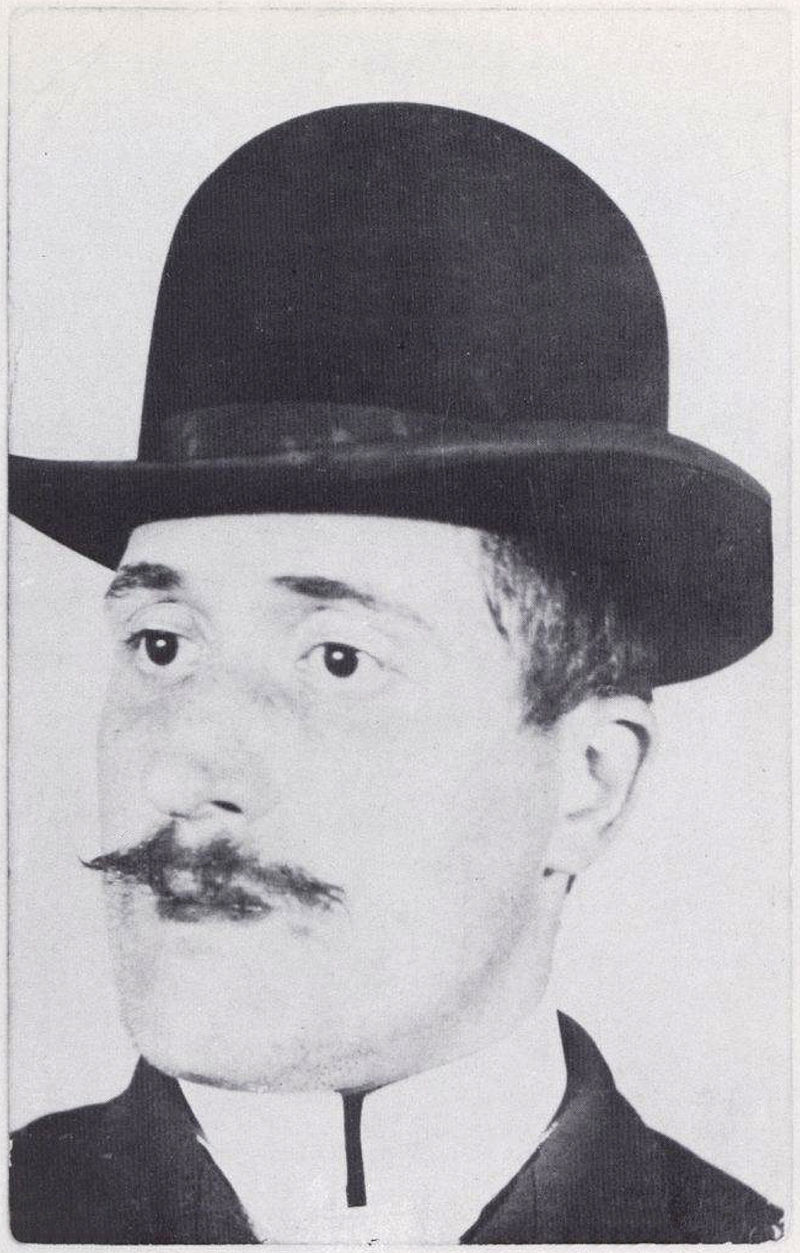
Guillaume Apollinaire,
Whilst attending the exhibition Pablo Picasso introduced her to Guillaume Apollinaire, the French poet, playwright, short story writer, novelist and art critic of Polish descent. Laurençin and Apollinaire had a relationship that lasted for six years, during which Apollinaire wrote often about his lover and would refer to her as “Our Lady of Cubism” which of course led more people to associate her with the Cubism movement.

The Muse Inspires the Poet by Henri Rousseau (1909)
The relationship between the two lovers was a strange one. Both were illegitimate children of a single mother and whether this had something to do with it but they lived apart throughout their relationship. The pair never married, and it is thought that this was to the disapproval of their mothers and also they both believed in the modern lifestyle which reject the bourgeois convention of marriage. The “partnership” was depicted in Henri Rousseau’s 1909 portrait of Laurencin and Apollinaire, in 1909, entitled The Muse Inspires the Poet. The two were great influence on each other and their artistic vision so much so that Apollinaire referred to Laurençin as “a female version of himself” and his literary works inspired her dreamy imagery and the symbolism of her work.
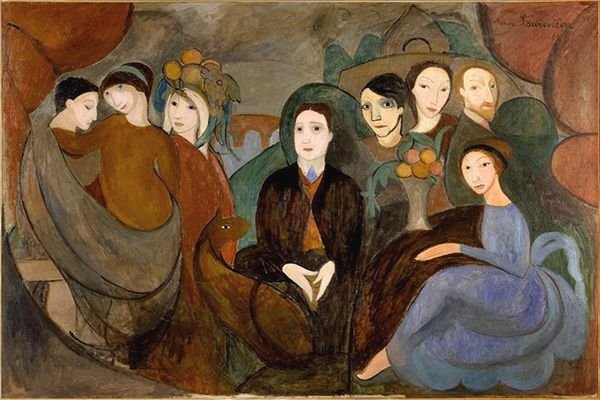
Apollinaire and his Friends by Marie Laurencin (1909)
Laurencin completed an interesting painting in 1909 entitled Apollinaire and his Friends. The painting depicts a gathering of intellectuals, artists, and bohemians, with their host, Guillaume Apollinaire, the celebrated poet and art critic, in the centre of the painting. He is surrounded by a group of friends. Before him sits a dog who is depicted with its head turned in loving admiration of the poet ! On the left of Apollinaire are Gertrude Stein, the novelist and art collector, Fernande Olivier, a French artist and model known primarily for having been the model and first muse of painter Pablo Picasso, and for her written accounts of her relationship with him and an unknown woman with a lavish headdress. To the right of Apollinaire, behind a vase of flowers, are the poets, Maurice Cremnitz, Marguerite Gillot, and Picasso. Laurencin is seated on the ground wearing a pale blue dress. She has turned her body turned toward Apollinaire while she looks out at us. The colour of her dress and the colour of Apollinaire’s tie are similar and she has probably consciously did this to serve as a pictorially connection between her and him. Laurencin gave the portrait to Apollinaire as a gift and she sold a smaller version to Gertrude Stein. Apollinaire had the painting placed above his bed in his apartment on the Boulevard Saint-Germain, and it remained there throughout his life and after his death was preserved by his family. The painting can now be seen in the collection of the Musée Picasso in Paris

Laurencin’s paintings dating from around 1910 have a strong flavour of cubism. However, she once again stated that although the experiments of cubism fascinated her, she was adamant that she would never become a cubist painter because she was not capable of it.
…………to be continued.

 my daily art display
So interesting, thank you
I love reading about all those you present who I would otherwise have missed! TY!