Jessie and Aniza McGeehan

Jessie Mary McGeehan

Jessie Mary McGeehan was born to Patrick and Mary McGeehan in 1872 in Rawyards, Airdrie, about twenty miles east of Glasgow.  She had four younger sisters, Annie Louise, known as Aniza, born on December 24th 1874, Mary Catherine born March 6th 1877, who in September 1904 entered the Order of Sisters of Notre Dame, taking her final vows in December 1914 and becoming Sister Callista. Agnes McGeehan was born April 26th 1882 and she was the one daughter who helped the mother with the running of household affairs.  Agnes was the only one of the McGeehan sisters who never went for art training. The youngest sister was Lizzie who was born on May 20th 1883. Lizzie was eighteen when she attended the Glasgow School and remained there for for five years.  Lizzie exhibited her watercolours, signing them Phil Winsloe, from 1908 to 1918, the year she died of pneumonia, just thirty-five years old.   There was also two brothers Charles Vincent born in 1882 and William born in 1884. However this is the story of the two eldest sisters, Jessie and Aniza, who made names for themselves in the world of art.

Jessie and Aniza’s father was Patrick McGeehan, whose own parents had emigrated from Ireland in the 1820s. He was a grocer and spirit dealer in Black Street, Rawyards, who later became a carriage hirer.  Patrick was also a talented musician and amateur artist who must have reached a high standard as his painting The Blasted Oak, Cadzow was accepted by the Royal Scottish Academy in 1879.  He was very involved in the town’s community and church life.  There can be no doubt that Patrick encouraged his children to progress with their own artistic ambitions.
Good Morning by Jessie McGeehan

In the March of 1888, Patrick’s eldest daughter Jessie, still only fifteen years of age, enrolled at the Glasgow School of Art.   That September, two of her younger sisters, Annie Louise, known as Aniza, aged thirteen, and nine-year-old Mary Catherine joined her.  One would have thought that they would have been too young to study at the Art School but when examining the attendance register of the School it can be seen that there were many other students of that age.  It is thought that the deciding factor for their admission was down to them having an older sibling or family member at the school.  Jessie and Aniza studied there for seven years but Mary Catherine McGeehan, according to the Art School register, only completed one year before leaving.   While studying at the art college the girls won a number of prizes in local competitions and gained free studentships to the school.
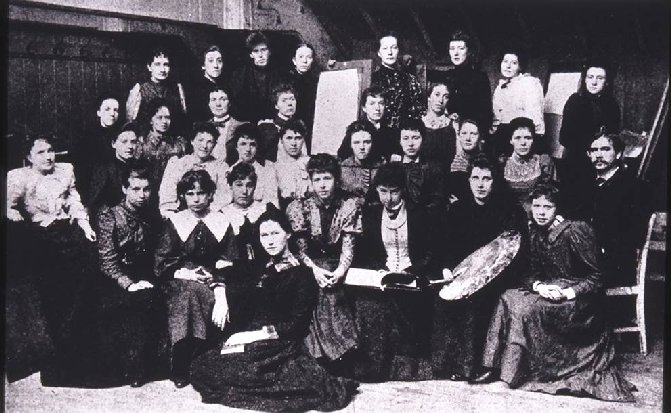
The photograph above shows the female students who were attending the 1894/95 session at Glasgow School of Art Archives.  Aniza McGeehan is standing immediately above the seated gentleman, Francis Newbery, who was head of the Art School, and her sister, Jessie, is the third lady on the right of Newbery.
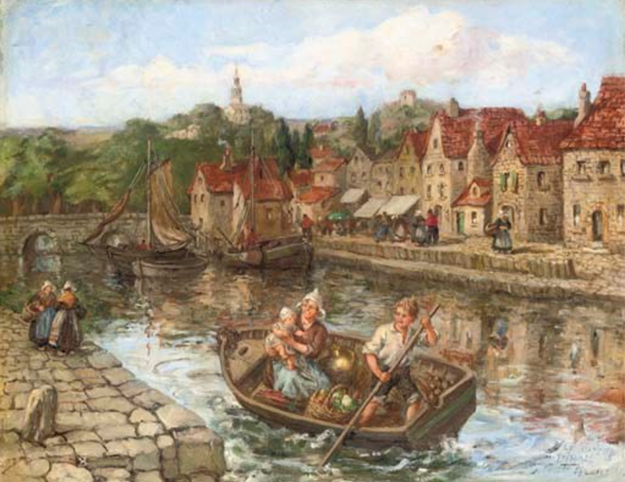
Dinan by Jessie McGeehan

After leaving the Glasgow School of Art in 1895 Jessie continued her studies in Paris. It was around this time that Jessie’s paintings had a “flavour” of France as can be seen in her work entitled Dinan, depicting the Breton riverside town with a view of the river, bridge and buildings.  Other paintings of hers depicting the French way of life were entitled Un Bon Coin and Flower Sellers, Paris which were exhibited at the Exhibition of the Royal Glasgow Institute of Fine Arts (RGI).  From the last decade of the nineteenth century Jessie’s work, both oil and watercolours, were shown at exhibitions at the Royal Glasgow Institute of Fine Arts, the Royal Scottish Academy and the Walker Art Gallery, Liverpool and in 1901 her work was shown at the Royal Academy, London.

Harvesting Plums by Jessie McGeehan (1932)

In 1897 Jessie set up her own studio at 134 Bath Street, Glasgow which for a time she shared with her sister Aniza.  Shortly after the turn of the century Jessie’s artwork was being appreciated throughout Britain and abroad.  In the art magazine, The Studio, there was an article about female artists and part of which was dedicated to Jessie:

“…In any notice of the lady painters of Glasgow, mention must also be made of Miss McGeehan’s bold and striking work. She is an ambitious artist whose pictures improve steadily from year to year; she evinces considerable skill in brushwork, and much that is fine and poetic in the inspiration of her work…”
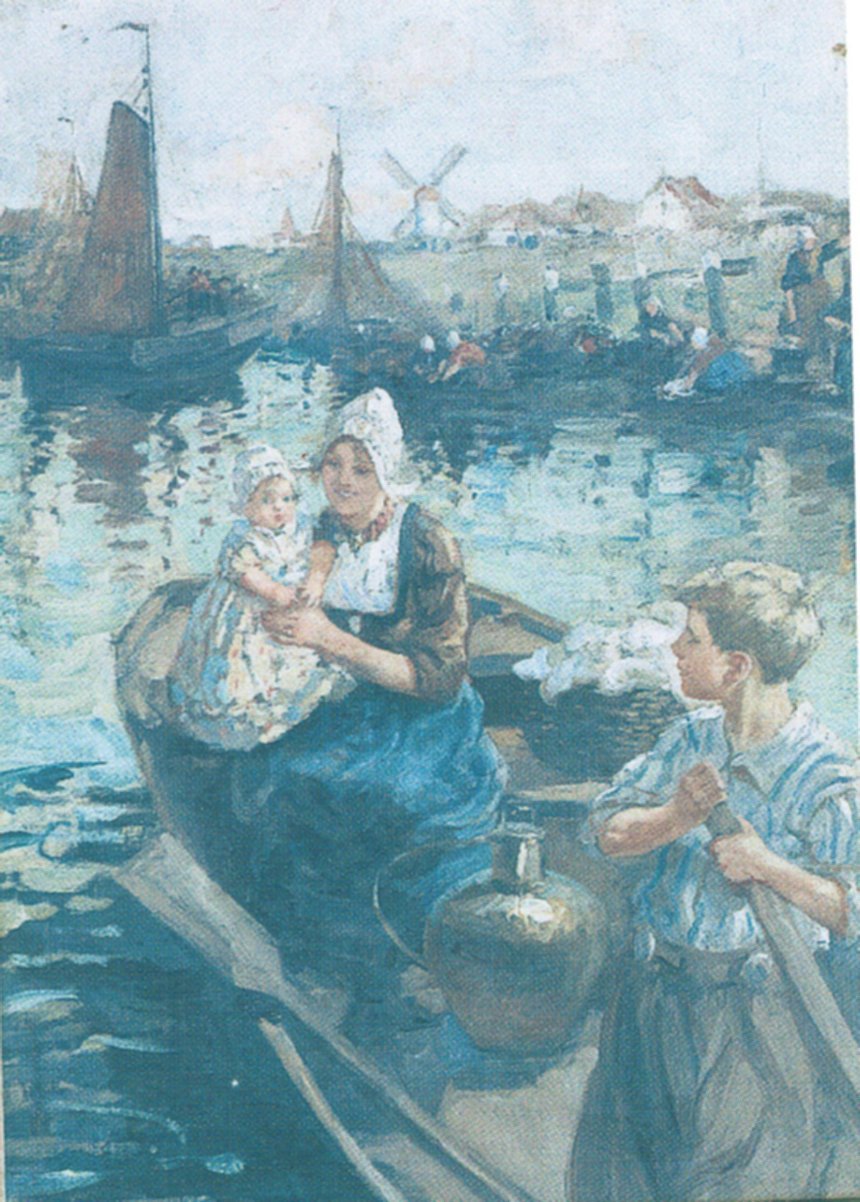
On a Dutch Canal by Jessie McGeehan

During the early 1900s, Jessie spent time in Holland as many of her works, which appeared in exhibitions between 1906 to 1913, featured Dutch subjects. Her reputation as a talented young artist grew and the Scottish newspaper, the Scots Pictorial wrote about her growing reputation in the art world by 1919:

“… Jessie McGeehan – ‘One of our youngest Painters whose work has earned for her a high place among British Artists. Trained at the Glasgow School of Art, and in Paris, where she enjoyed the friendship of some of the greatest painters and sculptors of the age, she has added to this training by travel and an exhaustive study of the treasures in the great European galleries. Miss McGeehan contributes to the Royal Academy and other important art exhibitions…”
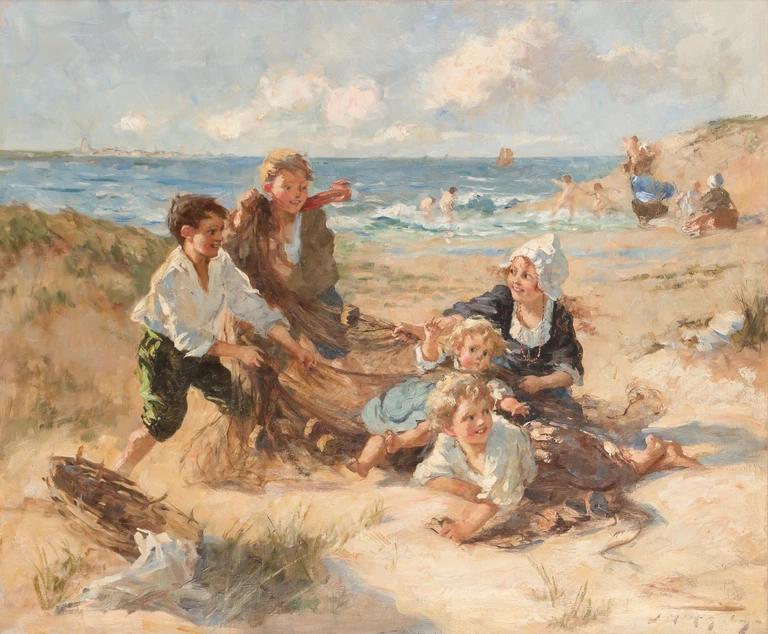
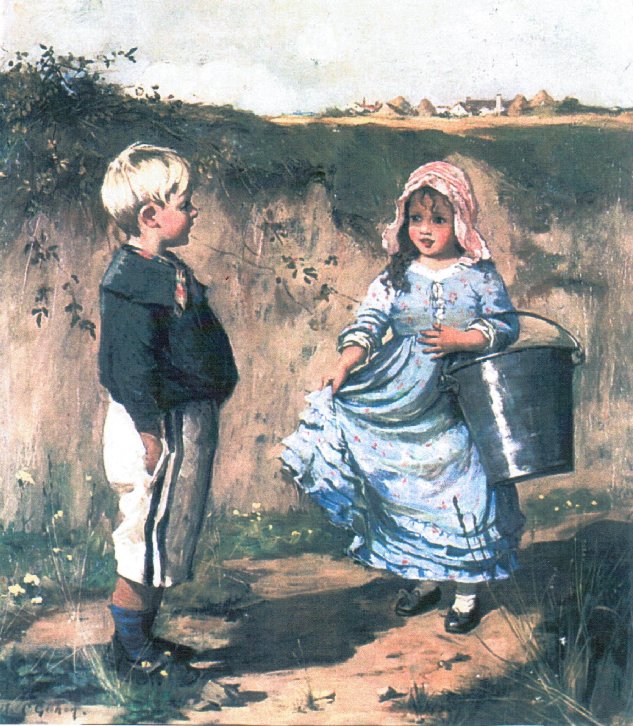
Children playing on the Beach by Jessie McGeehan

The year 1915 was the beginning of a sad time for the McGeehan family. That year their son, William who was just thirty-one years-old was reported missing presumed dead, while serving in France with the King’s Own Scottish Borderers. Three years later in 1918 his brother, Charles Vincent, a joiner who was only thirty-six, died in the Western Infirmary, Glasgow and his younger sister Lizzie died of pneumonia, aged 35.  One year after their deaths and after forty-eight years of marriage, Patrick’s wife Mary died at their home in Montgomerie Street, Maryhill, Glasgow. Jessie’s father Patrick died on May 3rd 1924.

Glass mosaic in St. Augustine’s Church by Jessie McGeehan

Jessie McGeehan created a glass mosaic panel for St Augustine’s Church in Langloan, Coatbridge. She also created a glass mosaic in fourteen panels depicting the Stations of the Cross for St Aloysius Church in Garnethill as well as undertaking work for St Mary’s Church in Lancashire.

Aniza McGeehan by Jessie McGeehan (1929)

Jessie McGeehan’s 1929 oil portrait of her sister Aniza is in the North Lanarkshire Museums collections. This was one of two oil paintings exhibited in the 1929 Walker Art Gallery Autumn Exhibition. At the same exhibition Aniza exhibited a bronze bust of her sister, Jessie.

Running parallel to Jessie’s artistic life was her sister Annie Louisa (Aniza) artistic journey.  Aniza was the second of eight children, born on December 24th 1874.   She was two years younger than Jessie but, like her and her younger sister Mary, she attended Glasgow Haldane Academy Society of Arts, better known simply as the Glasgow Art School.  Aniza’s time at the art school was one of great success, winning a local art scholarship, and in 1895 she was joint winner of the Haldane Travelling Scholarship which came with a £50 prize and with this she was able to afford a trip to Paris in 1896, where she established her own studio and enrolled at the Colorossi Academy.   She began to exhibit her work, paintings and sculptures, and in 1897 she had her sculptured bust of Lizzie Bell shown at that year’s Glasgow Fine Art Institute exhibition.
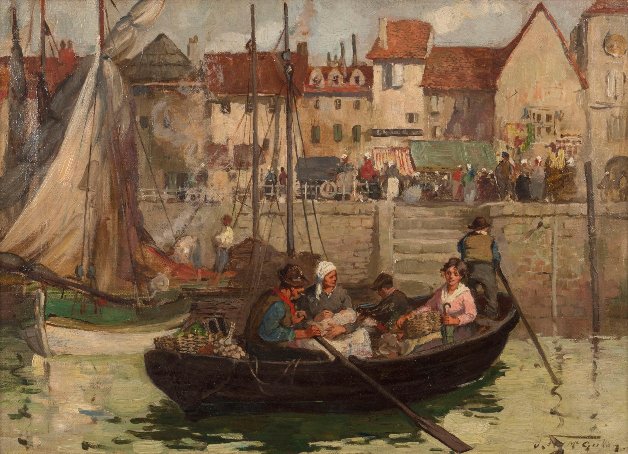
Ferry on the River Dordogne by Jessie McGeehan

Around this time, her father sold his licenced grocery business in Coatbridge and moved to Glasgow.  Aniza left Paris and returned home to Glasgow where she shared a studio at 134 Bath Street with her sister, Jessie. She had her portrait of school inspector Dr Smith shown at two exhibitions in 1899.  The art critics stating that the portrait was one that evoked “masculine strength” which was in complete contrast to her sculpture work, a bust of Mrs D. Campbell Rowat, which was hailed by the critics as “delicate and refined”.

A Day at the Dunes by Jessie McGeehan

Towards the late 1890s, Aniza received the commission for ten sculptures for Pettigrew and Stephens’ Store, Sauchiehall Street, Glasgow and according to her family she barely had time to finish the commission before her marriage in St Aloysius Church, Garnethill on June 12th 1900 to Vincent Murphy, a timber merchant from Liverpool.  The service was conducted by her uncle, Father Charles Brown.  Clearly Aniza’s talent had been recognized by many of the leading figures in the Glasgow Art World.
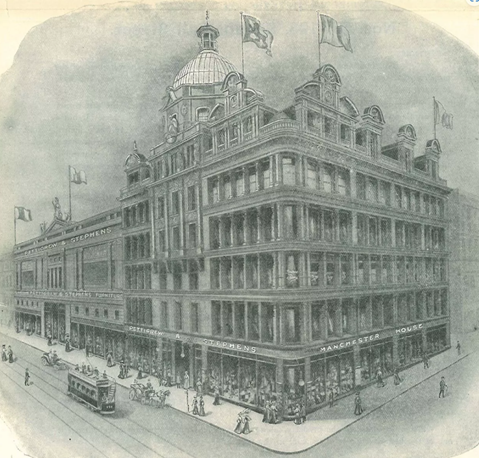
Pettigrew and Stephens’ Store, Sauchiehall Street, Glasgow .

Sadly, this magnificent building, which encompassed many of the outstanding talents in Glasgow, was demolished in 1974. Fortunately, Roger Guthrie, a leading member of the Glasgow conservation movement,managed to save two of Aniza’s sculptures. One was gifted to The Hunterian Museum and the other to the Scottish Amicable Building Society in Stirling. Aniza moved to Waterloo Park in Liverpool which at the time had a number of Scottish families living there.  Vincent and Aniza went on to have four children, but only John Vincernt and Marie Louise (Marielle) survived childbirth. Despite the work involved in raising a family she continued with her sculpture work and in 1903 had one her bronze works, Monsignor Nugent, exhibited at the Royal Academy, London. 
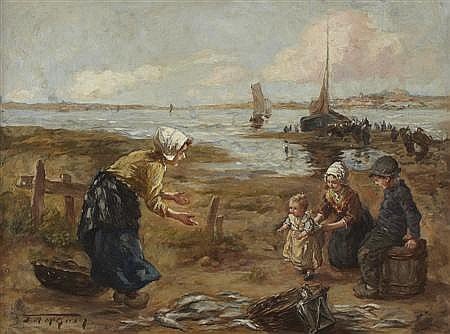
Learning to Walk by Jessie McGeehan

In the mid-1930s, Jessie had moved to 152a Renfrew Street, which was to remain her studio and home for the rest of her life.
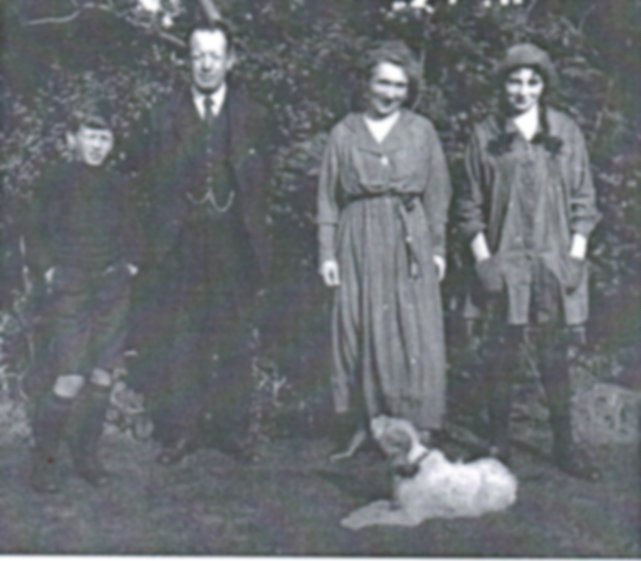
Vincent and Aniza flanked by their son John Vincent and their daughter Mariella

Sadly, Aniza’s daughter Marielle died of pneumonia, when she was only nineteen years of age. Following her marriage Aniza continued to exhibit and take commission work, but soon this became too much due to family commitments resulting in her exhibiting less frequently than Jessie.
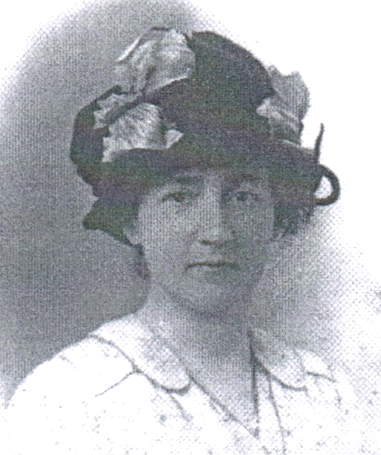
Annie Louise (Anzia) McGeehan

Anzia McGeehan died in September 2nd 1962, aged 87.

Jessie McGeehan died in Glasgow in 1950, aged 78


Information for this blog came from the usual internet sources plus:

The Parish of St Augustine Coatbridge website – A Family of Artists.
The Glasgow School of Art

Jean-Baptiste Armand Guillaumin

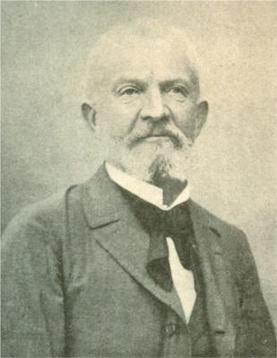
Jean-Baptiste Armand Guillaumin, the French impressionist painter and lithographer, was born on February 16th 1841 in Paris.  He was brought up in a working-class family, the grandson of Jean Joseph Guillaumin who was a notary by trade.  He was sent to school in Moulins, where his family came from, and this period in central France, made him take note of the beautiful surroundings and the mountainous landscape which stimulated his interest in art and it was also in Moulins that he first met Eugéne Murer, a pastry chef, author, self-taught painter and collector of impressionist paintings, who became his life-long friend.

Farms in Janville by Armand Guillaumin (1878)

By 1857, at the age of sixteen, Guillaumin returned to Paris and began working as a clerk in his uncle’s lingerie shop awhile also studying art under the sculptor Louis Caillouet.  His interest in art and the time he spent studying it caused friction with his family and he left to hold a position in the French government railways. He then continued his art training at the Académie Suisse where he trained to draw from the models, in the mornings and evenings.  It was here that he first met with Courbet, and began more lasting friendships with painters such as Cézanne, Pissarro and Francisco Oller, a Puerto Rican Impressionist painter.

Garden in Janville in June by Armand Guillaumin (1886)

Now friendly with the artists associated with the Anonymous Society of Painters, Sculptors, Engravers, (later dubbed The Impressionists) he was able to exhibit with them at the first Salon des Refusés in 1863 and their first joint Impressionist Exhibitions in 1874 at the former studio of the photographer Nadar (at 35 Boulevard des Capucines) in Paris, and in total he submitted work to six of their eight annual exhibitions.  Still young, the art critics of the time judged him to be an accomplished draughtsman who completed amazing mature compositions.  He developed connections with Emile Zola and his circle of friends and was greatly influenced by the artwork of Manet and Courbet.

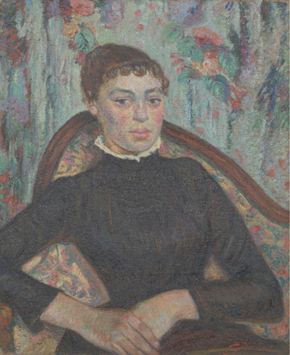
Portrait of a Young Woman by Armand Guillaumin (1876)

One of the problems Guillaumin soon encountered was financial as he had no private income to turn to and so he had to continue holding down a job to survive.  This situation was further exacerbated with the advent of the Franco-Prussian War in 1870.  Once the War and the Paris Commune fighting had ended there was some hope for Guillaumin who had managed to have himself included with the popular Impressionist movement.  Guillaumin and fellow Impressionist, Cézanne had met up with Dr Paul-Ferdinand Gachet, a French physician most famous for treating the painter Vincent van Gogh during his last weeks in Auvers-sur-Oise, and he bought a number of their works.  Guillaumin also sold a number of his works to his friend, Eugéne Murer who had recently established a successful café in Paris. Guillaumin and Cézanne began sharing a studio but both found themselves in precarious financial positions despite the sales of their work to Gachet and Murer who continued to be close friends of the pair.

Cottages in a Landscape by Armand Guillaumin (1896)

At the start of the 1880s the Impressionist group was beginning to break apart and it split into two camps.  One headed by Pissarro and the other by Degas.  Gaugin had vociferously supported Pissarro and he had allied himself with Guillaumin.  Although not initially supportive of the Impressionist group having misgivings about what its intentions were, Renoir and Monet joined the Impressionist Exhibition of 1882 with Guillaumin, Gauguin and Pissarro as well as Sisley, Morisot, Vignon and Caillebotte.  However, Degas was noticeably absent.

Moulins en Hollandee by Armand Guillaumin (1904)

It was somewhat surprising that Paul Gaugin, known for his irrational behaviour towards his fellow painters, continued to befriend Guillaumin and keep him in the Impressionist group despite its continued disintegration.  It was through Gaugin, that Guillaumin met many new young artists who had arrived on the Paris art scene such as the Symbolist painter, Odile Redon, and the Pointillists, Georges Seurat and Paul Signac. In the mid 1880s Guillaumin’ s studio had become a meeting place for the young group of painters.  By 1885, new styles of painting had come to the fore and this resulted in further rifts between the old guard of Impressionism resulting in the disintegration of the Impressionist Group. The other factor for the break-up of the Group was its leading man, Gaugin, became more and more temperamental and intolerant and was destroying the Movement from the inside.  Guillaumin decided it was time for him to exit the movement which he had been part of from the very start.  Guillaumin’s reputation had grown over the last decade and Paul Adam wrote in La Revue Contemporaine:

“…I was not aware of any other painter who has so correctly noted the corresponding values of the lights of the firmament and of the ground…. their unification in colour appears to be perfect…”

Again, Felix Feneon, the French art critic, gallery director, and writer reiterated this, writing about the same show Immense Skies and commented on Guillaumin’s work:

“… superheated skies where clouds jostle each other in a battle of greens and purples, of mauves and of yellows…”

Vue de Port by Armand Guillaumin (1880)

t was in 1886 that Guillaumin married.  His wife was his cousin Marie-Joséphine Charreton, a schoolteacher, who was able to support him financially.  They settled down at 13 quai d’Anjou in the Saint-Sulpice area of the 6th arrondissement of Paris. It had previously been the studio of the painter Charles-François Daubigny. Guillaumin’s relationship with Pissarro eventually ended with the latter beginning to concentrate on experimentation with pointillism while Guillaumin became progressively interested in romantic art. Guillaumin’s relationship with Gaugin also in due course ended as the latter being constantly away on his travels.

Agay Bay by Armand Guillaumin (1910)

From 1875 to 1880, Guillaumin was a frequent guest of Dr Gachet at Auvers, at a time when he was travelling in that area searching for views of the rural scenery of the Yonne valley to paint and, later, the Creuse valley and the countryside around the farming village of Crozant, where he spent most of his life. Around 1887 Guillaumin became a good friend and mentor to Vincent Van Gogh, who was twelve years his junior. Vincent’s letter to fellow painter Ermil Bernard in December 1887 shows how highly he thought of Guillaumin:

“… I believe that, as a man, Guillaumin has sounder ideas than the others [the Impressionists], and that if we were all like him we’d produce more good things and would have less time and inclination to be at each other’s throats.
Again in a letter to his brother Theo in June 1888, Van Gogh writes about a visit he made to Guillaumin’s house and how he was inspired by him:

“…Wasn’t it pleasant at Guillaumin’s last winter — finding the landing and even the stairs, not to mention the studio — chock-full of canvases? You understand since then that I have a certain ambition, not about the number of canvases, but that these canvases as a whole should, after all, represent a real labour on your part as well as mine…”

Neige by Armand Guillaumin (1876)

In the last decade of the nineteenth century Guillaumin’s circle of artist friends was dwindling.  Vincent van Gogh died in July 1890 and his brother Theo, the art dealer, died in the January of the following year.  Gaugin and Cézanne had left Paris and Guillaumin and Pissarro’s views on art had diverged so much that their friendship had gradually faded.  Despite all this Guillaumin’s life was to change rapidly when won he won the sum of 100,000 francs (about 400,000 euros in today’s money) in a state lottery.  This completely changed his life.  He no longer had to rely on commissions.  He no longer had to exude a subservience towards patrons.  He was now able to paint what he liked and strive for his own artistic goals.
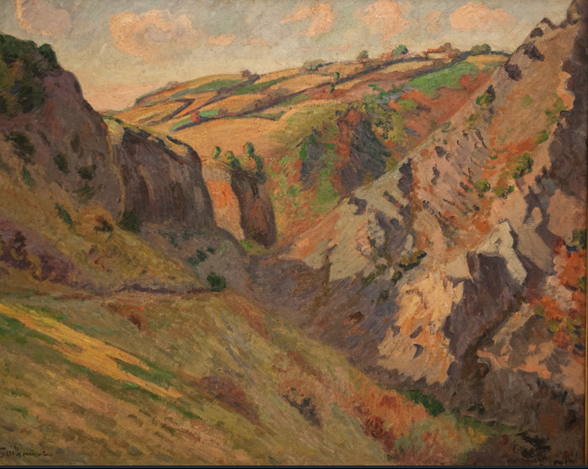
Caves Prunal near Pontgibaud by Armand Guillaumin

With this newly found wealth Guillaumin set off travelling around France capturing on his canvases the beautiful views of the countryside, mountains and the coast, often during sunrise and sunset.  His continuous journeying around was brought to an end with the onset of The Great War of 1914.  Once the war came to an end he once again set off on his travels but by then he was seventy-seven and he, like his artistic output, was declining.   In 1926 a retrospective exhibition was held at the Salon d’Automne.  He died at the Chateau de Grignon in Orly, Val-de-Marne, just south of Paris, on June 26th 1927 aged 86. He was the last survivor of the Impressionist Group.

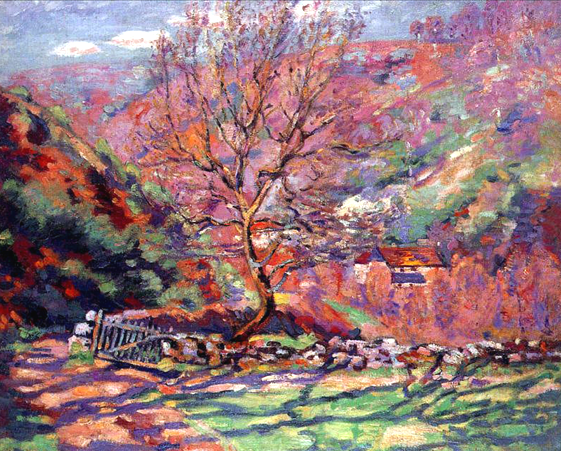
Crozant, Solitude by Armand Guillaumin (1915)

Guillaumin’s paintings are renowned  for their intense colours and can be found in major museums around the world. Most of all he is best remembered for his landscapes of Paris, the Creuse département, and the area around Les Adrets-de-l’Estérel near the Mediterranean coast in the Provence-Alpes-Côte d’Azur region of France. Guillaumin became known as the leader of the École de Crozant, a disparate group of painters who came to portray the landscape in the region of the Creuse around the village of Crozant.

Paysage à Crozant (1917)

One such depiction is entitled Landscape in Crozant, is part of the Art Institute of Chicago collection.

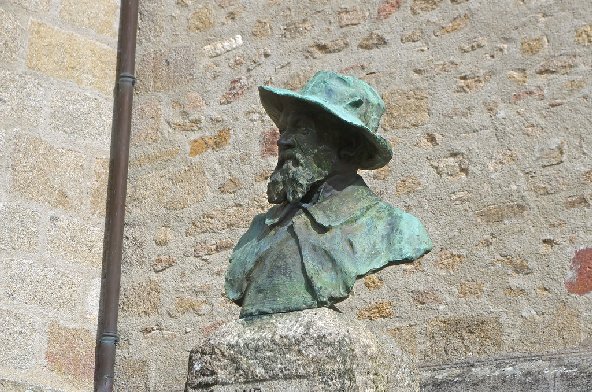
His bust is in the square near the village church in Crozant.

Walasse Ting

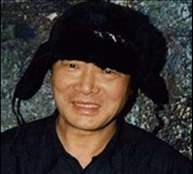
Walasse Ting (1929-2010)

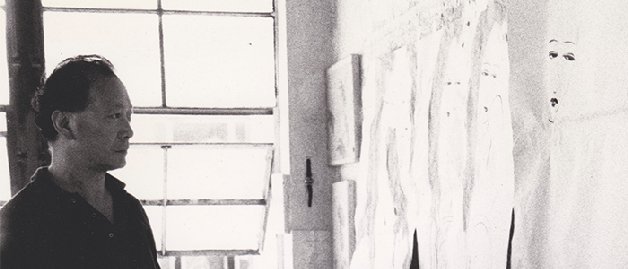
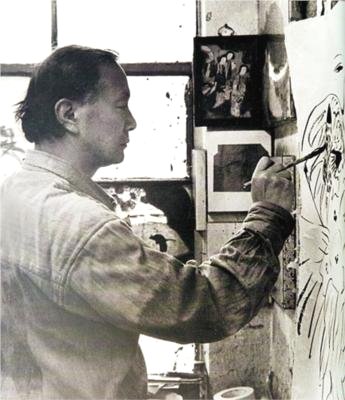
Walasse Ting at work in his studio

I have just returned from another stay in the Algarve where I could finally see some sun and experience warm weather.  Whenever I visit the Algarve, I always visit the Art Catto gallery in Loule which I have often written about.  This time I not only got a chance to return to the excellent small gallery in the centre of town,but take up their invitation to the opening of an exhibition at the Conrad Hotel in Quinta do Lago.

Conrad Hotel, Quinta do Lago, Algarve

The Conrad Hotel is, to say the least, a spectacularly lavish hotel, and the entrance foyer rooms where fine places to exhibit the expensive works of Walasse Ting.  Seven years after his death, Walasse Ting’s has been given a place as a giant of 20th century paintings. He is such a captivating figure and the art he has produced over his 50-year career reveals many influences.   Today, his artwork is in public collections which include MOMA, New York; Guggenheim Museum, New York; National Gallery of Chicago, Chicago; Tate Modern Museum, London; Centre Pompidou, Paris; Hong Kong Museum of Art, and the Shanghai Art Museum. 

Beautiful Ladies by Walasse Ting

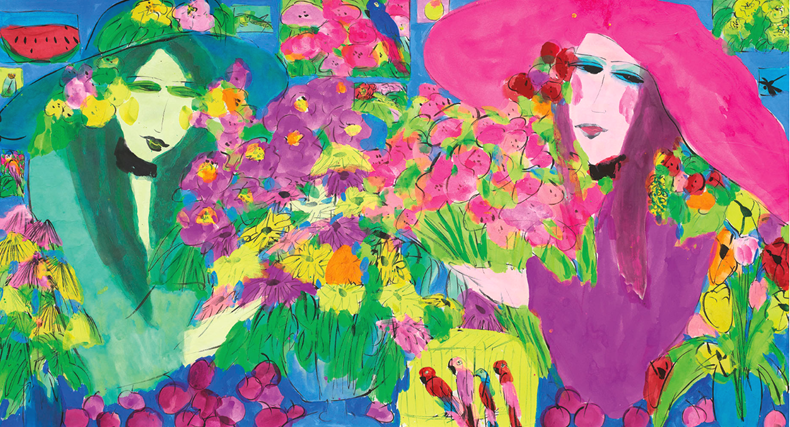
Many devoted private collectors also own his artwork. The latter group is growing especially fast, thanks in part to the rise of China as an economic and cultural force.  From the very early works, Walasse Ting’s paintings have charmed viewers with his use of vivid colours and light-hearted mood.

Ladies with Parrots by Walasse Ting

Walassi Ting is a Chinese artist who was born in Wuxi, China in 1929 but in fact was raised in Shanghai.  Ting is primarily a self-taught painter, sculptor, graphic artist, lithographer and poet, who began his life as an artist at a very young age. Ting studied at the Shanghai Art Academy before he left China in 1946 and after living briefly in Hong Kong set sail for France in 1950.   Times were hard for the young aspiring artist continually battling against poverty.  His stay in Paris coincided with the rise of the avant-garde artistic group known as CoBRA.   The word Cobra is derived from the French names of the cities of Copenhagen, Brussels and Amsterdam.

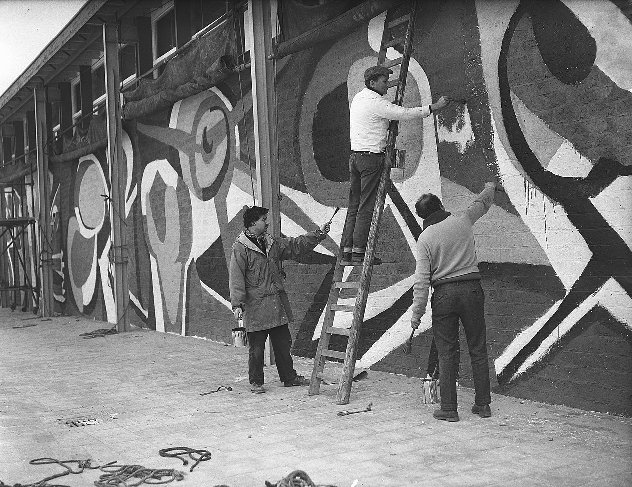
CoBra member Karel Appel working on a mural in Rotterdam for the Manifestation E55

The artists had founded the CoBRA group during a major international conference held in Paris in 1948 and they came from these three European capitals.  Ting became acquainted with all the members of the avant-garde group, most notably Pierre Alechinsky and Asger Jorn.

Women with Flowers by Walasse Ting

Walassi Ting left Paris and arrived in New York in 1959 and participated in the Pop Art and Abstract Expressionism movement where his closest associates were artists Sam Francis and Joan Mitchell, members of the second generation of Abstract Expressionist painters.  He sold many paintings which often featured bold dripping strokes.  It was just over a decade later in 1970 that Walassi Ting created a distinctive style using calligraphic brushstrokes to define outlines and filling flat areas of colour with vivid paint. After 15 years of abstract painting, Walasse Ting’s interest in the body and his exploration of sexuality led him back to figuration in the 1970’s.  Like the colour master, Gauguin, Ting made a number of journeys to Tahiti continually on the lookout for the exotic colours that he loved. The subject of his paintings often contained women, cats, birds and peacocks. 

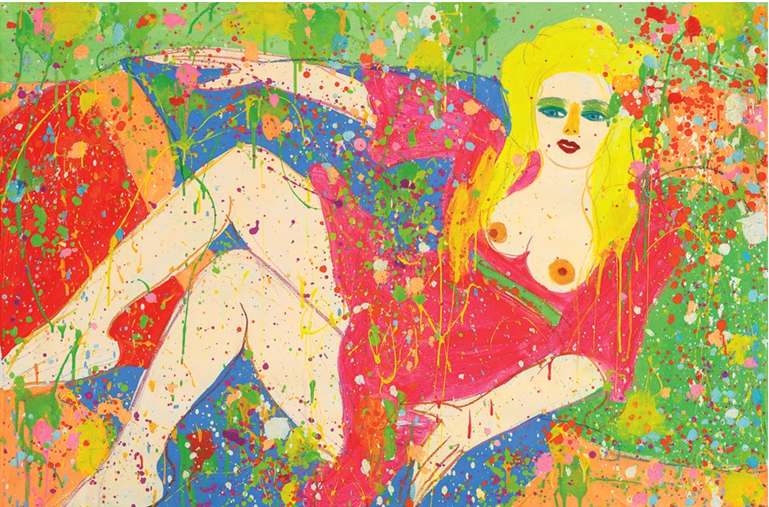
Kiss me, Kiss me by Walasse Ting

Ting embraced sexual desire through his art, as he conveyed his inner emotions through the fluent and expressive brushstrokes as he captured the alluring beauties set against a background of uncontrolled vibrant acrylic colours that break free into a dreamscape of sensual pleasure. In his 1974 acrylic on paper work entitled Kiss Me, Kiss Me, the title of the work and the bare-breasted model conjure up the emotions of sexual passion.   The work comprises of flat planes of colour and simplified lines, and the woman exposes herself to us, and is drenched in a tumult of multicoloured drips as if she was incorporated into an abstract expressionist canvas.

Come Talk to Us by Walasse Ting

In the summer of 1976 Ting produced his acrylic on canvas work entitled Come Talk to Us which depicted two half-length female figures who stare at a plant-like bouquet of colours at the centre of the image, an image which divides the image in two. The mirror-image like effect creates a sense of calm and balance, and the dabs of green, blue, and red paint trickle slowly along the canvas, exuding a melancholic beauty like that of gazing through a window on a rainy day. The title of the painting, Come Talk to Us, questions the viewer and echoes a lonely yet tantalizing longing. Ting has once again used the depiction of his figures to express the feelings inspired in him by objects of beauty.  Ting explained:

“…When I see a beautiful woman [and] I see flowers, its beauty makes me feel intangible, melancholy, love, refreshed, different, and reborn. I want to use different colours to express my inner feelings and emotions in my paintings.”

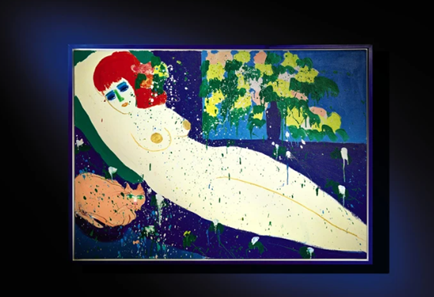
Eat me, I’m a Fish b y Walasse Ting

His 1978 work, with the strange title, Eat Me, I’m a Fish, Ting has splattered the paint over the entire canvas giving it the impression of a faint effervescence. This oblong depiction of the woman suggests the shape of a fish and the title boldly summons the viewer to come and consume its imagery, once again arousing the viewer’s culture’s sexual drive. The figure transects the diagonal of the picture plane while a cyan blue rectangle slices off the upper right quadrant of the image, giving the impression of a window.  Eat Me, I’m a Fish is Walasse Ting’s vivid interpretation of everyday life, and yet the composition is an obvious reference to Édouard Manet’s masterpiece Olympia. This painting could be thought of as Ting’s homage to a modern master, reinterpreting the essence of this classic painting and challenging the earlier artist’s greatness.

At the Conrad exhibition, many of his paintings were watercolours on rice paper.  They were both delicate and ornate, rendered with detail and repetitive patterns.

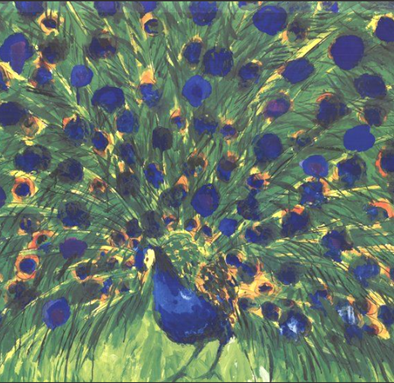
Peacock by Walasse Ting

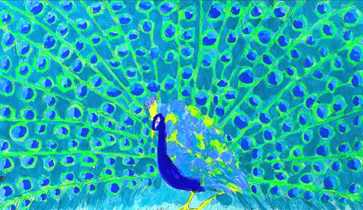
Peacock II by Walasse Ting

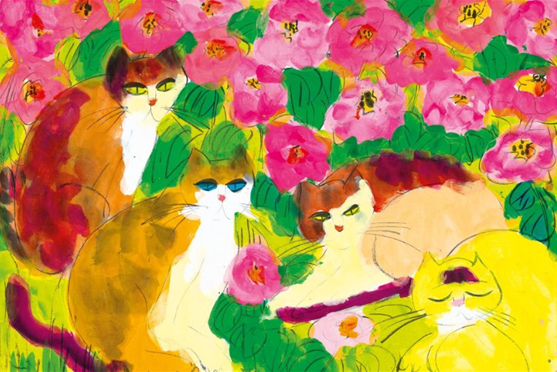
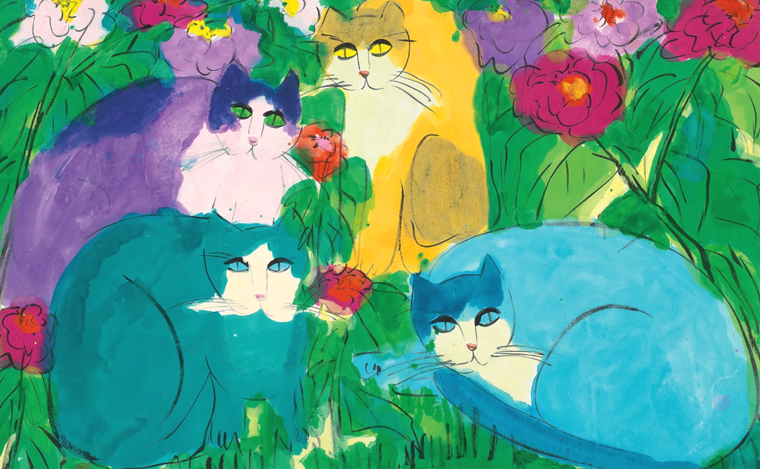
Ting frequently depicted cats, flowers and birds as in his painting, Peacock, in which the ‘eyes’ of the bird’s plumage radiate outwards across the large surface of the painting, creating a striking wallpaper of electric blue, yellow and green. The controlled circles, tightly arranged, create an arresting optical vibration.

Cat Series by Walasse Ting

Cat Series by Walasse Ting

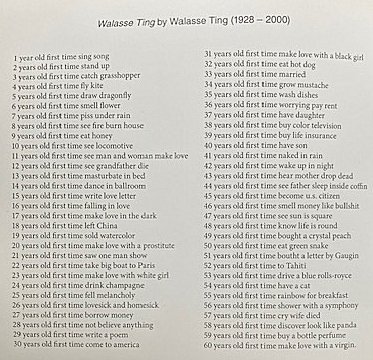
One very unusual thing at the exhibition was a display board giving a brief bio. by Ting himself It was also in the exhibition brochure. That is not strange in itself but what was unusual and some may say inappropriate, was his summary of his life “achievements”, year by year.

In the mid-1980s, he set up a studio in Amsterdam and in 2001 he permanently settled in that city. He was unable to create after a stroke in 2002. Ting died on May 17, 2010, at the age of 81 in New York.

Graham Clarke

What is the reason behind you placing a paintings or prints on your walls at home?  Is it because it reminds you of somewhere you have visited or maybe it is a depiction of somewhere nearby?  Maybe it is a portrait of a loved one or somebody famous whom you admire.  In this period of our lives when there is so much suffering going on around us then sometimes the painting is a depiction which simply lifts our spirits and makes us smile.   Today I am looking at an artist and his work which fulfils that category.  Let me introduce you to the English author, illustrator and humourist Graham Clarke. He has created over five hundred images of his beloved English rural life. He has focused on how the ordinary Englishman viewed Europe. Through his quirky depictions, he brings his own unique brand of humour to his interpretation of past and present history through the eyes of the common man.

Graham Clarke

Graham Clarke was born on February 27th 1941 in a village in Oxfordshire during the Second World War.  His father Maurice was a Midland Bank employee.  He, his mother and his elder brother, Anthony, were evacuated there from their three-bedroomed semi-detached home in Hayes, Kent.  When Graham was two years old the family spent a couple of months at the Cornish village of Denabole, which lies close to Trebarwith with its large expanse of sandy beaches which was always remembered fondly by Graham.  In his teenage years Graham and the family would spend time at the coastal towns of Broadstairs and Looe and it was those holiday times on the coast that made a great impression on him. 

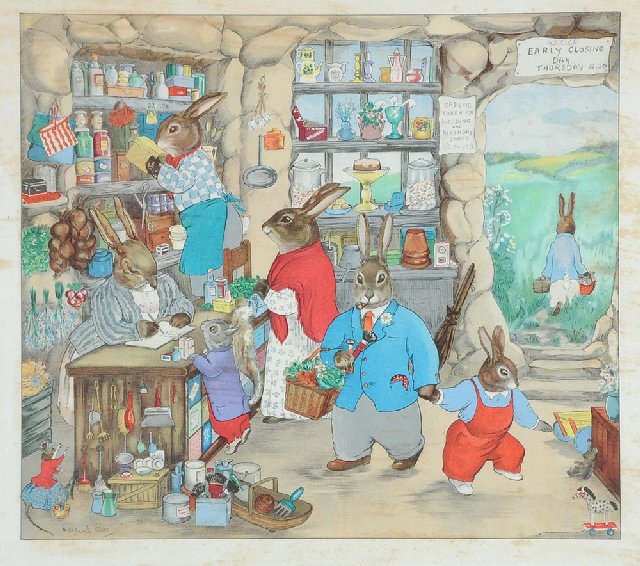
The Flippits.  A Story of the Rabbit, Fox and Badger by Margaret Ross.

On his fourth birthday in 1945, with the war at an end, back living in Kent, Graham received a birthday present which was to remain in his memory in the years that followed.  It was the children’s book, The Flippits.  A Story of the Rabbit, Fox and Badger by Margaret Ross.  It was a make-believe world, a world of peace unlike the threatening years that he and his family had experienced during the war.   It was an underground world of a warren with its cottagey interiors.  It was a book with illustrations which fuelled the imagination of four-year-old Graham.  Looking at many of Graham’s multi-figured depictions one can look back at the multi-figured illustrations from this book and realise the connection.

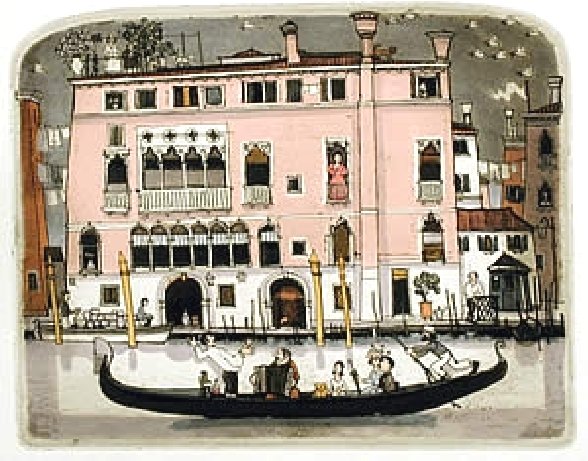
A la Carte by Graham Clarke

In 1949, when Graham was eight years old, the family left their home in Hayes and moved to a larger three-bedroomed semi-detached house. large enough to also accommodate Graham’s paternal grandfather  who had been widowed.  As a teenager, Graham was described as being an observant and sensitive child by his mother who would spend his free time cycling and exploring Hayes Common.  He and his brother would also help their parents with their love of amateur dramatics and their AmDram group, The Hayes Players.  Graham’s brother Anthony would help his parents by aiding with set building jobs and Graham would assist with painting stage portraits and stained glass windows.

Miss Jay’s Wood by Graham Clarke (1952)

One day Graham’s father came home and presented his son with a box of felt-tipped brushes and spirit-based inks and after the usual child-like sketches his artwork improved and he began to use watercolours for his countryside depictions.  The box of watercolour paints with sable brushes and a set of oils had been a Christmas gift from his aunt and uncle in 1952 and on that Boxing Day he completed his first oil painting entitled Misses Jay’s Wood, which was owned by a close-by neighbour.  The painting was bought by one of the neighbours for ten shillings.  Graham could immediately envision himself as becoming a professional artist !

Close Up Please by Graham Clarke

Meanwhile, Graham attended a small private school who fast-tracked their pupils’ education to be of a standard which would allow them to pass their 11+ exams.  Whilst attending this school Graham let it be known of his future aspirations as a professional artist.  However, he received no encouragement from his teachers, in fact, they told him it would be a pauper’s life for him if he were to realise his artistic dream.  Notwithstanding this, he clung to his ideas and passed the 11+ exams and entered the Beckenham and Penge Grammar School in 1952.  During his time there he enjoyed the geography and history lesson through his love of map-making and his fascination with castles and life for the working-class people of those times. 

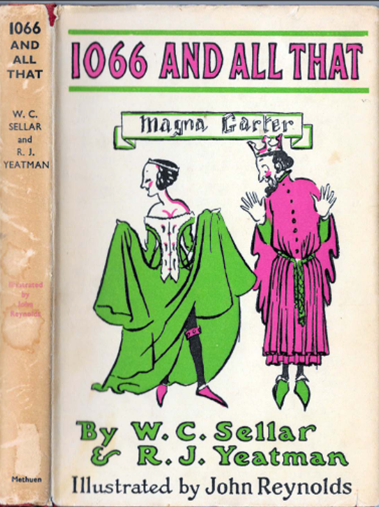
A book at the time which fascinated Graham was 1066 and All That, a tongue-in-cheek reworking of the history of England, written by W. C. Sellar and R. J. Yeatman and illustrated by John Reynolds.

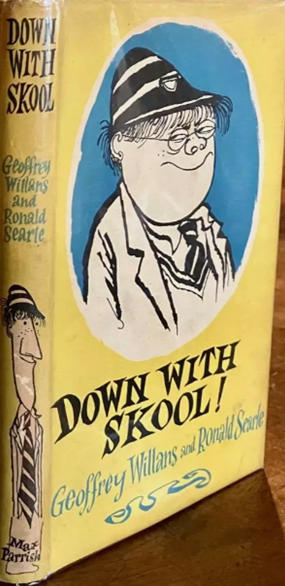
Another book which Graham loved was Down with Skool, by Ronald Searle which was one of his 1953 Christmas presents.  He became interested in caricature.  He excelled at art under Ronald Jewry, his art teacher who encouraged his students to use their imaginations when they painted.  Graham Clarke enjoyed his time in the art class.

Graham received an excellent grade for his GCSE ‘O’ level Art and managed to scrape through Maths and Science sufficient enough to enter the sixth form ‘A’ level on a Science course but he hated it.  His former art teacher, Jewry, approached his father and suggested that his son should abandon his A-level Science course and take up art instead.  No doubt Graham had already spoken with his father over his future.

Graham’s favourite artist at this time was Samuel Palmer, born in 1805, a British landscape painter, etcher and printmaker who was also a prolific writer. Palmer was a key figure in Romanticism in Britain and produced visionary pastoral paintings.  Graham believed that although he knew about the works of Palmer he realised that to get to really know him he had to visit the countryside around Shoreham, in west Kent, where Palmer had been so inspired.  During his studies at the Art College Graham had enrolled in the History of Art Course and went on a short train journey to Shoreham.  Graham was mesmerised by what he observed.  He later wrote:

“…Palmer loved this place and love it is that makes me walk here too.  Every lane is climbing up its hill [and] down again to the river, over the bridge and up and on again climbing and twisting. These are not mountains here there is no raging torrent, the trees are not giants and all is on a small scale, quiet and complete, Palmer decided God (and Nature) was at its best in this little valley of vision. Twenty miles from here is peace…”

Round and Round by Graham Clarke

One of his tutors as the Beckenham Art School was Wolf Cohen who Graham described as “small, fiercely energetic and a model of dedication” and it was he who instilled in Graham that art should be life-absorbing.  Although Graham’s figure drawing was not the best he managed to improve that during the time he spent in Susan Einzig’s life classes.  She introduced Graham to the Laurie Lees’ book Cider with Rosie, illustrated by John Ward.   It was these delicate and sensitive drawings that appealed to Graham.

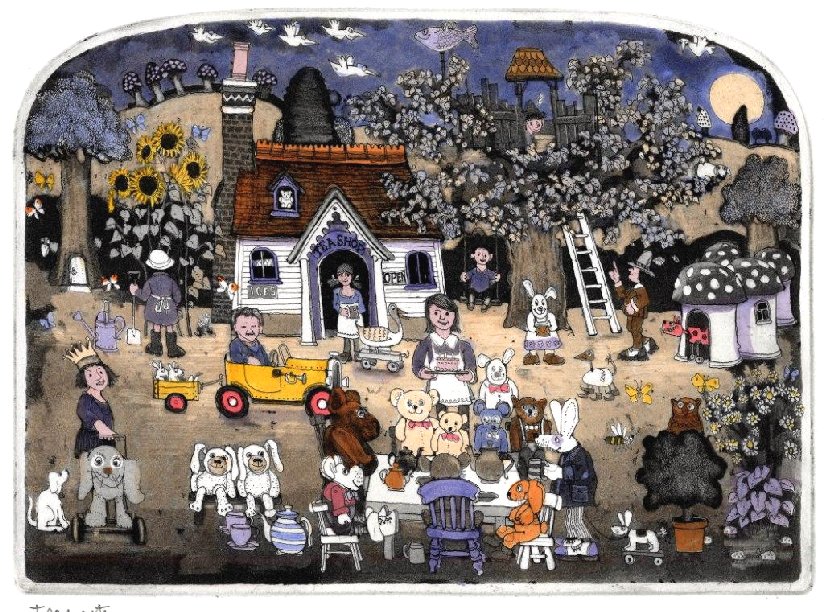
Tea Party by Graham Clarke

At the start of his final year at the art college, Graham Clarke had to make a decision about his future.  His tutor Wolf Cohen persuaded him to apply for a post-graduate position at The Royal College of Art and along with half a dozen of his fellow students he would spend weekends at Cohen’s studio building up his portfolio which would be needed when he applied to the college.  Graham succeeded in his entry interviews and portfolio submission and in 1961 he became a student at the prestigious Royal College of Art.

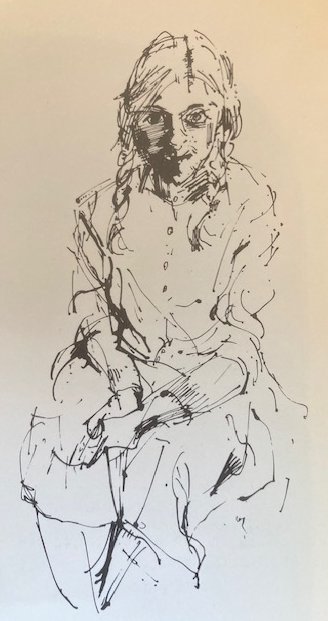
Wendy by Graham Clarke. Pen and ink drawing from his sketchbook.

In his late teens Graham had been a member of various Youth Clubs, one of which was the Bromley High Street Methodist Youth Club and it was here that eighteen year old Graham first met fifteen year old Wendy Hudd and the two of them became involved with the organising of plays, pageants and parties.

The Four Seasons by Graham Clarke

Graham’s first year at the Royal College of Art was a disaster.  He felt totally isolated from his fellow students and their interests in art.  Whereas they looked for their inspiration by studying modern American magazine depictions of pop stars and flashy cars and motorcycles, Graham clung to his love of all things rural or historical and soon realised that he was going to be isolated by such loves.  As he said, he was destined to “plough a lone furrow”.  He decided to stay with what he loved and he was proud of this sincere decision and when challenged about it, would just say that he did not need to “ride another horse”.  Graham described his first year as being a dark tunnel and yet he added he could just make out a light at the end of it.  Graham was fortunate to have the support of Wendy and her family during those difficult twelve months.

Serenata by Graham Clarke

At the Royal College of Art Graham specialised in illustration and printmaking and had the chance to follow his interest in calligraphy.

Billingsgate Market by Edward Bawden (1967)

During his time at the Royal College of Art he was greatly influenced by one of his tutors, Edward Bawden, an English painter, illustrator and graphic artist, who was known for his prints, book covers, posters, and garden metalwork furniture. 

Yeomans by Graham Clarke

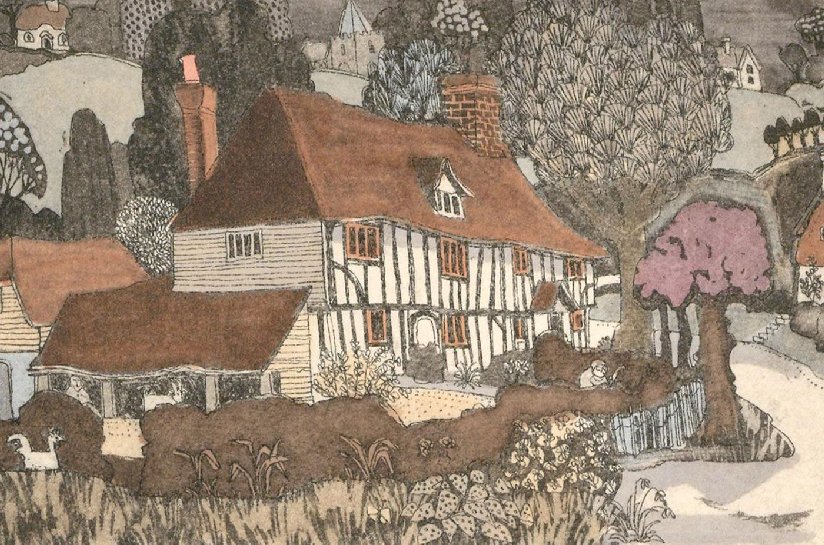
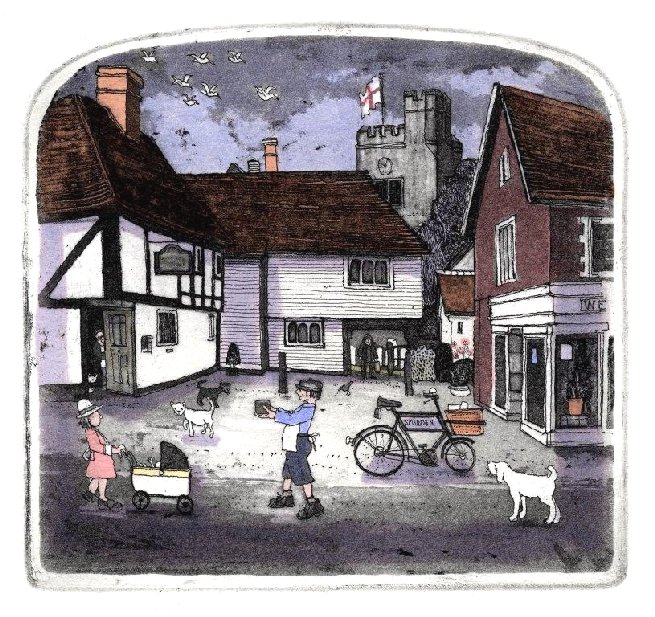
It was through Bawden’s influence that Graham took an interest in producing prints of traditional landscapes, the depictions of which highlighted local areas.  One such print featuring a rural scene was Yeomans which depicted a quaint English street scene featuring cottages and trees. 

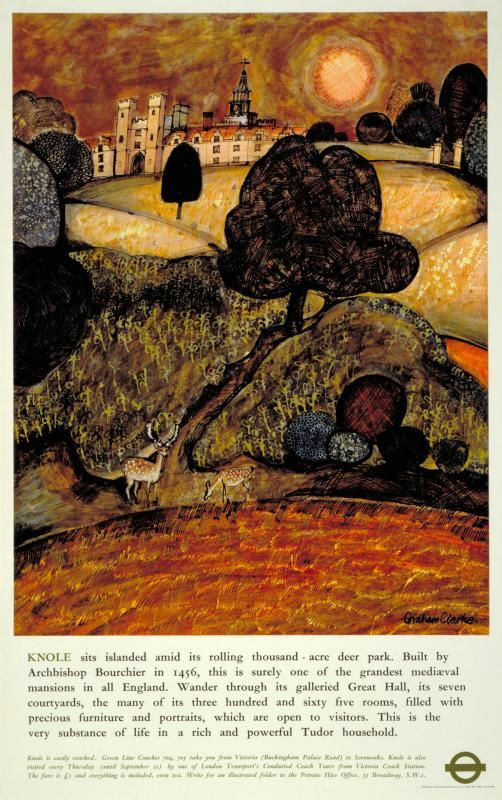
Graham finally graduated in 1964, which, fortunately for him, coincided with peoples’ interest in buying prints which resulted in a flourishing sale of them.  His artwork was admired and he soon received commissions for his depictions from the likes of Editions Alecto and London Transport Publicity Department and so a bright career for him began.

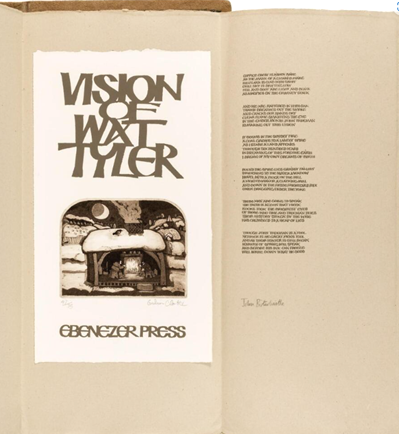
Vision of Wat Tyler by Graham Clarke

In 1969 Graham’s first hand-printed “livre d’artiste”, Balyn and Balan was published.  Another of his books was Vision of Wat Tyler which won recognition from the most influential patron and connoisseur of the day, Kenneth Clark. Lord Clark wrote enthusiastically in praise of Vision of Wat Tyler:

“…the whole book is a splendid assertion that craftsmen still exist and cannot be killed by materialism. A few idealists are the only hope for decent values…”

Dance by the Light of the Moon by Graham Clarke

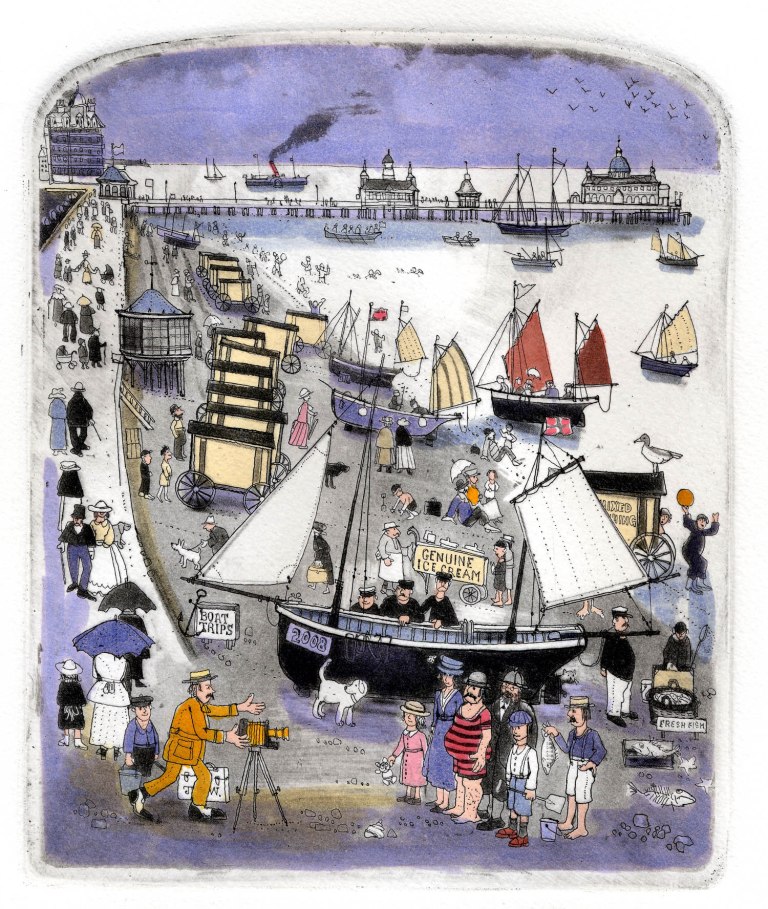
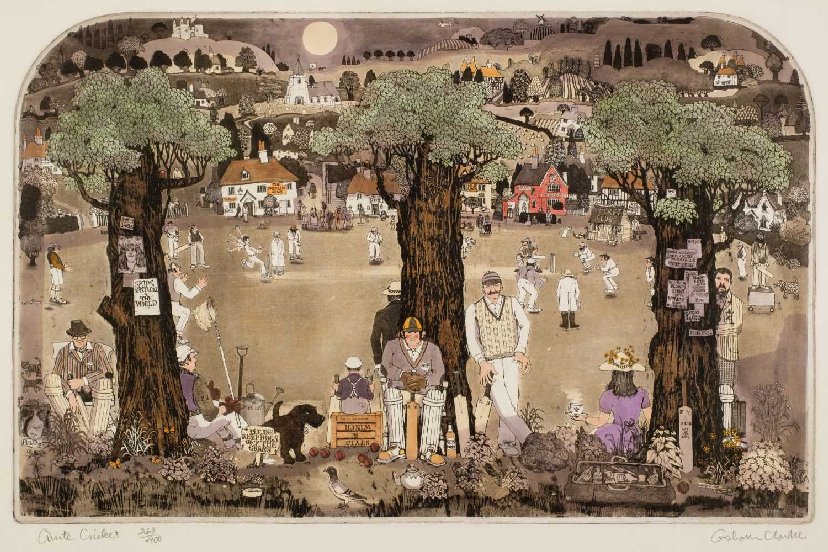
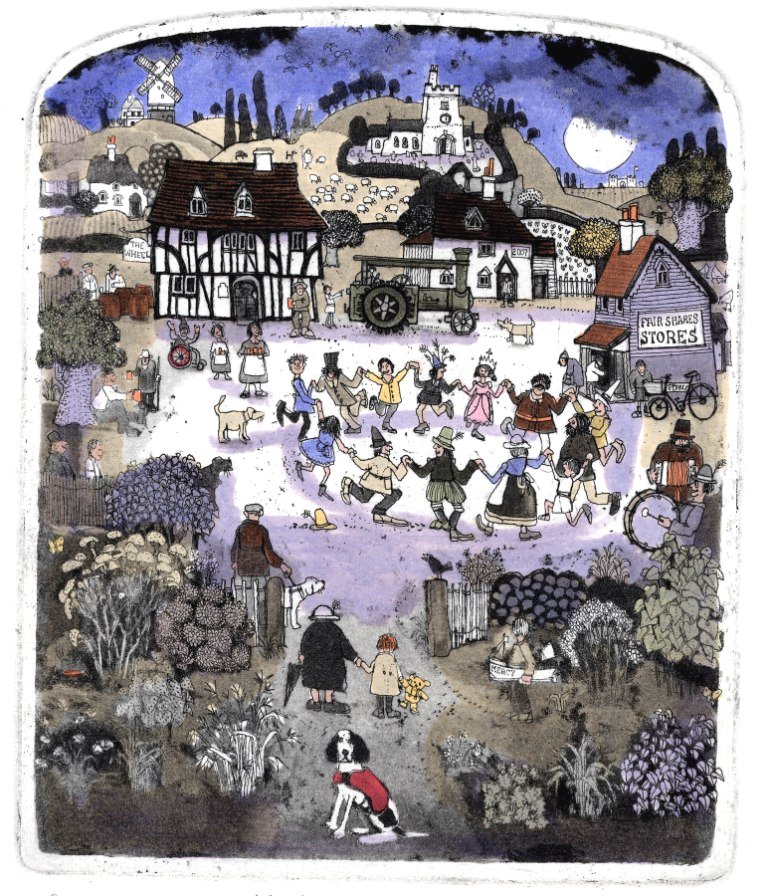
Graham’s famous ‘arched top’ etchings has established his widely successful reputation in Britain and overseas, and came to public attention in 1973 when the first of these, Dance by the Light of the Moon, was exhibited and sold in London at the Royal Academy of Arts Summer Show.

For you Madam by Graham Clarke

Examples of his work are held by Royal and public collections, including the Victoria and Albert Museum, the British Museum, the Tate Gallery and the National Library of Scotland in the United Kingdom, as well as by Trinity College, Dublin, the Library of Congress in Washington, D.C., the New York Public Library and the Hiroshima Peace Museum. Many more are to be found on the walls of private homes all over the world, collected systematically by devotees, as well as singly by ordinary art lovers who “know what they like”

Quite Cricket by Graham Clarke

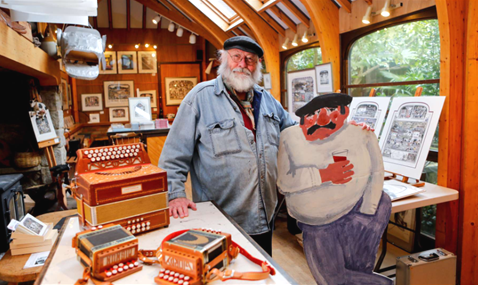
Graham Clarke, who prides himself as being a “Man of Kent” lives with his wife Wendy, four children, his animals and friends, in the village of Boughton Monchelsea in the county of Kent where he also has his studio. 

He offers open-days at his studio which gives visitors an opportunity to view his work including hand coloured limited edition etchings, watercolours, posters and greetings cards depicting English rural life and history, the Bible and the Englishman’s view of Europe, all of which are available for sale.


My blog has only scratched the surface of the life of this talented artist. The information for this blog came from two main sources:

Clare Sydneys’ 1985 book entitled Graham Clarke

and

Graham Clarke’s website