
The artistic road ahead.
“…I consider Clara Klinghoffer an artist of great talent, a painter of the first order…
Her understanding of form places her in the very first rank of draughtsmen in the world…”
Sir Jacob Epstein, London, March 30, 1939

Self portrait by Clara Klinghoffer
Fourteen year old Clara was just about to leave St Mark’s School and it is thought that it could have been the head teacher of the school, Mrs Sinock, who suggested that Clara should enrol at Sir John Cass Institute in Aldgate. Once there she was set the task to make sketches of statues such as Michelangelo’s David concentrating on the various facial attributes. Soon the tutors realised she had a natural aptitude for sketching. A talent which she achieved with little effort, one that amazed her tutors. Clara was happy at the Institute but that all ended when one of the young tutors acted towards her in a sexually inappropriate manner which frightened her. The pleasure she once had attending the classes vanished and she left the Institute suddenly without giving a reason for her departure. For a fourteen year old girl this must have been a shocking moment in her life.
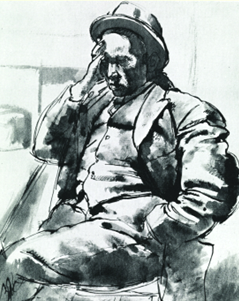
Salman Klinghoffer -Man In A Felt Hat (‘Daddy’) by Clara Klinghoffer (1929)
Clara’s father was disappointed that his daughter had given up her art studies and one day whilst travelling home on a tram he caught sight of an advert for the Central School of Arts and Crafts which was situated in Southampton Row in the West End of London He then managed to persuade his daughter to come with him to the art school and enrol. She agreed and took with her a portfolio of her sketches. The principal took a look at her work and immediately offered her a place, starting that next Monday. On the Monday, Clara, who was still very small, arrived at her classroom carrying her huge portfolio case much to the amusement of the two tutors who were overseeing the students. One was Douglas Grant a British painter who became part of the Bloomsbury Set and the other was Bernard Meninsky, the British figurative and landscape painter who had immigrated from Ukraine with his family when he was three weeks old. On looking at Clara’s portfolio, Meninsky was astounded by the quality of her work and set her the task of sketching a cast of a hand. He was astounded by the result and likened it to that of Da Vinci drawings. Both Meninsky and Grant had witnessed such talent in a person so young as Clara and often her sketches were hung on the walls of the classroom. Also on the wall was a print of Botticelli’s Primavera which Clara said that she loved above any other work she had seen. Another of her favourite works was a black and white reproduction of Titian’s Bacchus and Ariadne which she had seen a few years ago in the local library. More and more, she became influenced by Italian art.

East End Girl with Dark Hair by Clara Klinghoffer
Meninsky went on to tutor Clara in life drawing and became an important influence on her work. He also introduced her to a number of luminaries of the art world such as Walter Sickert’s third wife, Thérèse Lessore, a British artist who worked in oil and watercolour and was a founder member of the London Group, the English writer and painter, Wyndham Lewis, and the New York born sculptor, Jacob Epstein and his publicist wife, Peggy, who became her close friends.
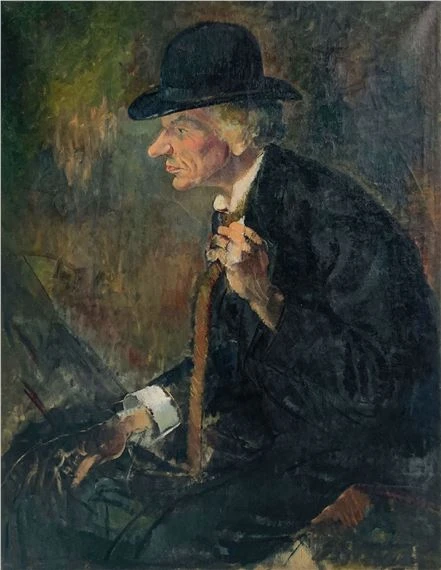
Harry, Old London Man by Clara Klinghoff (c.1920)
Clara remained at the Central School of Arts and Crafts for two years and during this period would often spend time at her easel, sketching at the Victoria and Albert Museum and her favourite venue, the British Museum, where she became a regular and was well known to the security guards, staff and regular visitors.
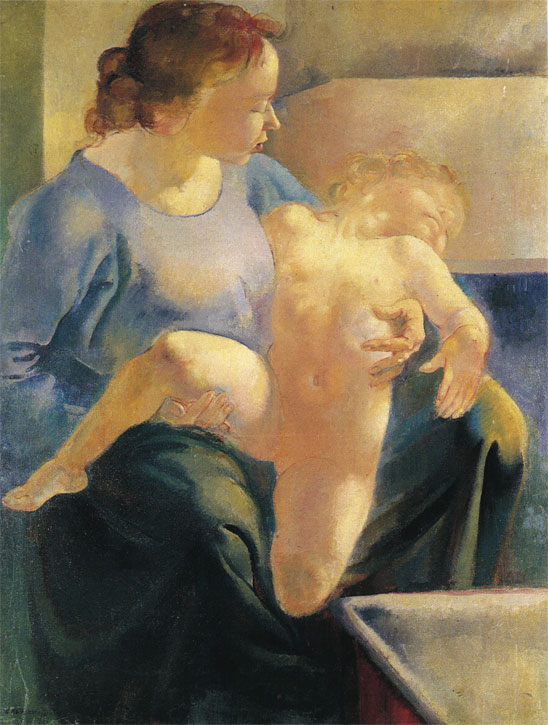
Mother and Child by Clara Klinghoffer. Modelled by Clara’s eldest sister Fanny and her youngest sister Hilda (1918)
One of Clara’s fellow students at the Central School of Arts & Crafts was a young man called Seidenfeld, who was besotted with Clara but she alas did not return his amour. He, like Meninsky, praised Clara’s work and would tell everybody who would listen, about Clara’s work and her extraordinary talent. Word of this young artistic genius reached the ears of a journalist, Joseph Leftwich and he was so impressed by her artistic talent that he spoke of it to the post-Impressionist painter, Alfred Wolmark, Wolmark had some of his work shown at the Hamstead Art Gallery in London and he persuaded Clara to put together a portfolio of her work which would be used in her “one-man” show at the gallery in May 1920. That gave her twelve months to complete a collection which was good enough to be exhibited and this entailed a period of non-stop painting. The painting Mother and Child was one which was exhibited at Clara solo show at the Harpenden Gallery in May 1920. The show received rave reviews and of this work, The Sunday Times art critic wrote:
“…Clara Klinghoffer’s ‘ Mother and Child’ will appeal to ‘many as having more sheer beauty than any work in the exhibition. While exceedingly able in point of drawing, this moving painting of a mother just lifting her child “out of the bath delights one by the piquancy of its colour, the shimmer of light on the bare flesh being rendered with the tenderness of a Renoir and the dexterity of a Besnard. In its dazzling radiance it is a joy of pure colour…”

Portrait of a girl in a fur hat, with red background by Clara Klinghoffer
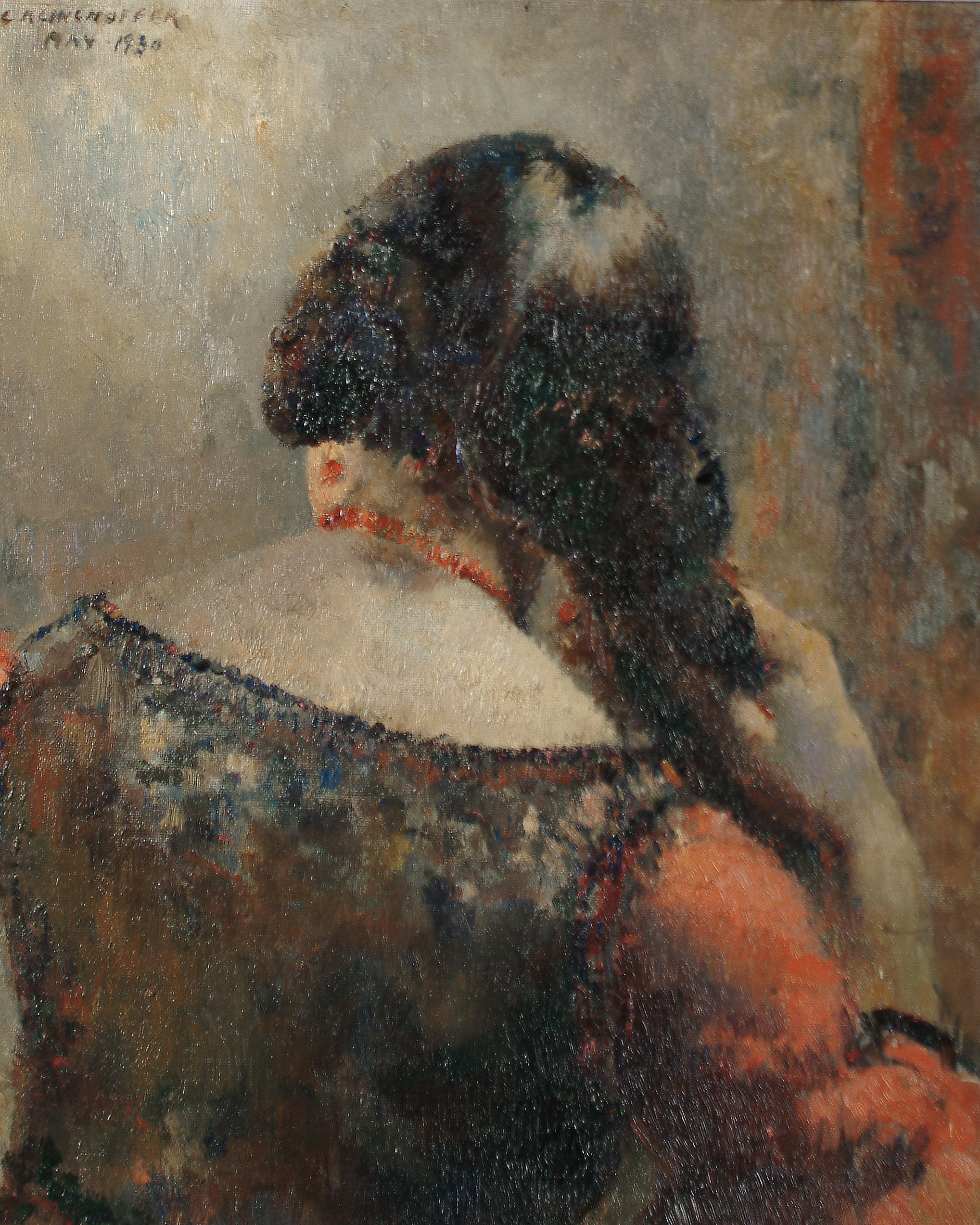
Portrait of Woman Plaiting her Hair by Clara Klinghoffer
In the end Clara submitted twenty-one paintings and thirty-two framed and glazed drawings. On May 3rd 1920 the solo exhibition opened. The London Evening Standard stressed the brilliant future this 19-year-old painter is destined to have. and it continued:
“…One of the most encouraging things about her work is that it gives frank and full expression to what may be supposed to be her racial instincts and interests. She likes exuberant forms and bright colours and says so when painting with commendable frankness. Her strongest point at present is the ease with which she can fill her canvas. Evidently, she has studied the Old Masters, particularly Leonardo da Vinci, to good purpose…”
In 1920, an edition of the The Jewish Chronicle sang the praises of Clara’s work at the exhibition writing:
“…Clara Klinghoffer, in her exhibition at the Hampstead Art Gallery, has clearly proved to be a truly great artist. Her drawings are very beautiful and quite remarkable for an artist scarcely out of her teens. One feels how very much she has been influenced by the Great Masters–by Raphael and by Leonardo for example. And yet, her outlook is entirely modern; she has absorbed the past and expresses herself freely, inspired but never enslaved thereby. Her paintings are always well composed and this is so whether a single portrait or a group is considered. She has a peculiar sense of colour and makes no attempt to get the correct tone, which fact accounts for the unreal appearance of all save one or two portraits. She apparently paints without much effort, and the spontaneity of her work is charming……. There is nothing shallow in Miss Klinghoffer’s genius. She is perfectly sincere and employs her extraordinary gifts for a definite artistic purpose, simply and beautifully, without the slightest trace of affectation…”
The painting Mother and Child was then put on display at the New English Art Club that summer and the press was full of praise for the work
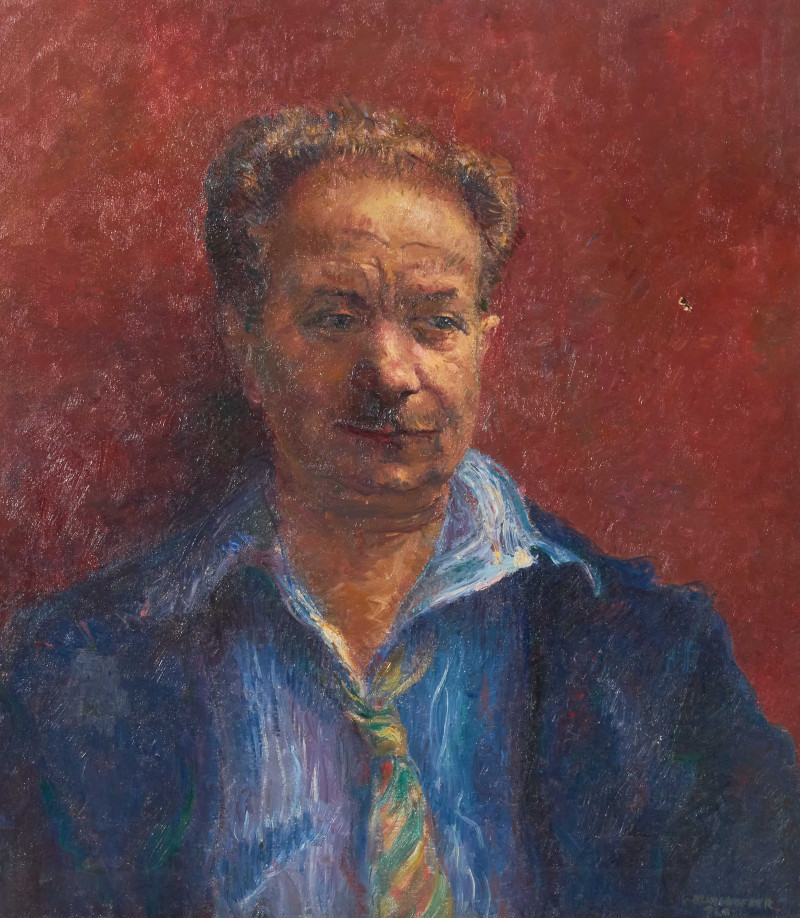
Portrait of a Man (on Red) by Clara Klinghoffer
Meanwhile, her father’s “mill end” business was flourishing, so too was her mother’s clothes shop, so much so, the family moved to a large Victorian House in King Edward Road, Hackney. Compared to their previous London homes, this was paradise. It was large with a basement kitchen, large first floor living rooms and several bedrooms on the upper floors. The increase in the size of their home was fortuitous as Clara’s mother gave birth to a three further children, all daughters, which meant the house was home to mother, father and seven daughters ! Business success for her father meant that he could afford to buy Clara all the materials she needed for her paintings. He and his wife were convinced their daughter would one day become a famous painter.
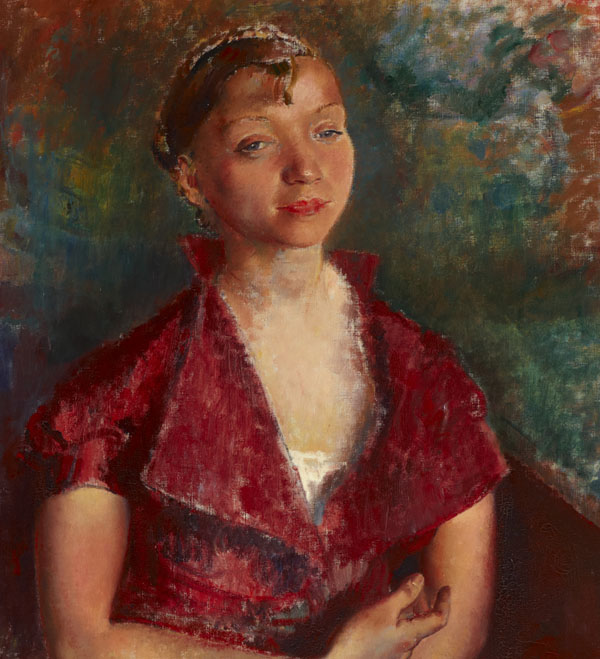
Portrait of the Artist’s Sister Rachel (Rachel in a Red Dress) by Clara Klinghoffer
Clara would complete small paintings of the neighbourhood children but realised that for her own exhibition at the Hampstead Gallery she would need to complete larger works and so she turned to her sisters, (Fanny, Rose, Rachel, Bertha, Leah, and Hilda), whose ages ranged from four to twenty-one, to act as models, but most frequently Rose (who also sat as a model for the sculptor Jacob Epstein), and Rachel. This shimmering portrait of Rachel is made from delicate brushstrokes and this was a recognisable style of Clara’s portraits and establish her renowned warmth and understanding in the way she depicts her sitters.
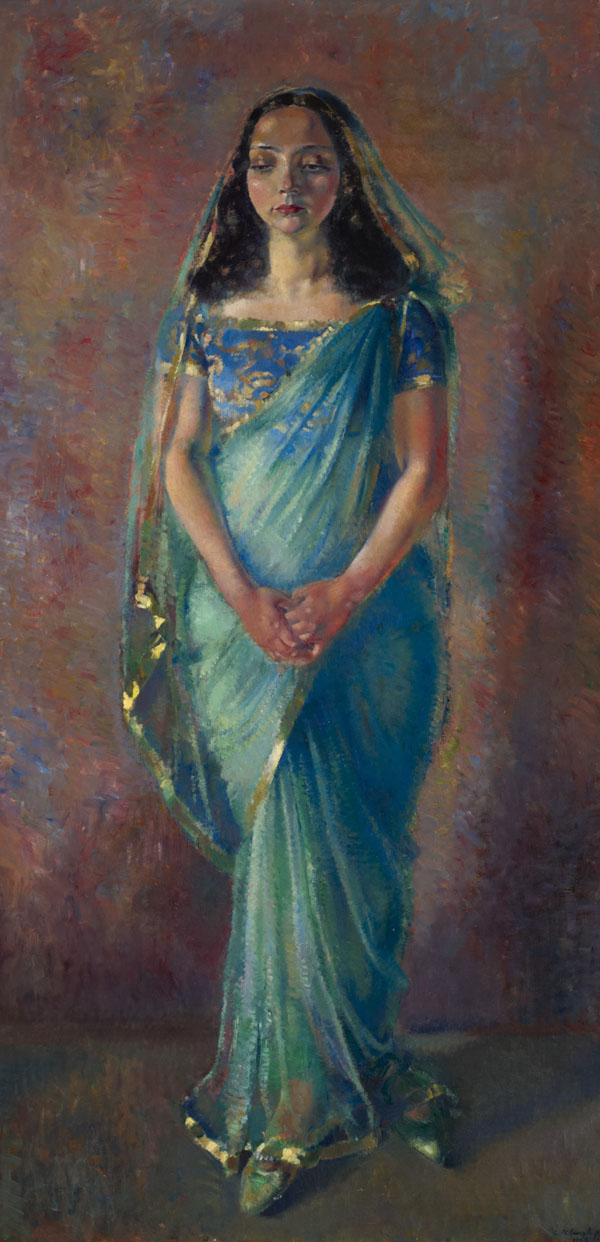
Girl in the Green Sari by Clara Klinghoffer (1926)
This portrait, Girl in the Green Sari, by Klinghoffer was that of the Bengali artist Pratima Devi, the daughter-in-law of the famous Bengali poet and philosopher Rabindranath Tagore. Pratima often travelled abroad with him and they often visited Klinghoffer in her London studio. In all, she completed at least three portraits of Pratima: the first, in oils, around 1919-20; the second, a pencil head, which The Times, in 1924, considered it remarkable for the sensitive drawing and the suggestion of light. This later full-length painting was carried out in 1926, which was the year Clara married and her husband remembers Pratima’s visit and sitting for her portrait. She wore the blue sari and was adorned with dazzling jewellery. Clara had Pratima remove all the jewellery, maybe as she believed it would detract from the woman’s depiction. We observe Pratima as a demure, maybe shy, woman with her eyes downcast, dressed in a translucent sari standing in front of a glistening backdrop.
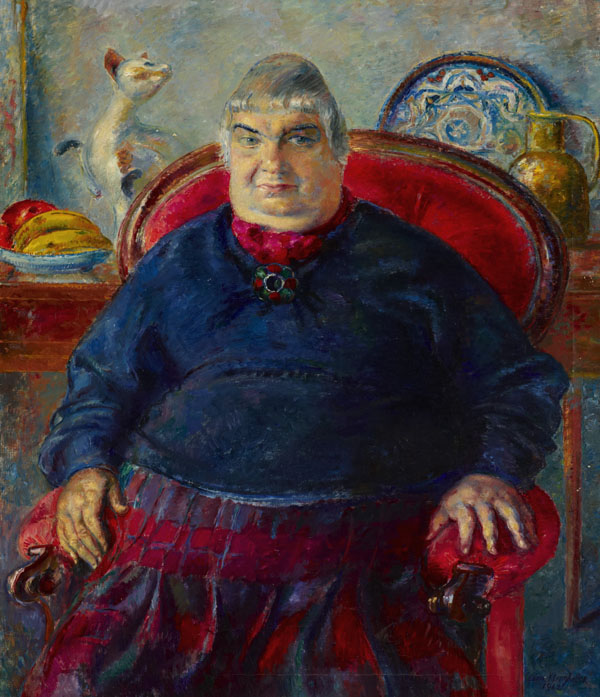
Portrait of Orovida Pissarro by Clara Klinghoffer
Clara’s arresting portrait of her friend and fellow artist Orovida Pissarro was completed in 1962. Orovida was born in Epping, Essex, in 1893, and was the only child of Lucien and Esther Pissarro. Her father, Lucien Pissarro was an acclaimed artist and graphic illustrator, while Lucien’s father, Orovida’s grandfather, was the renowned Danish-French painter Camille Pissarro who was a founder of the Impressionist movement. Much to her father’s horror, Orovida turned her back on Impressionism – and even dropped her famous surname, wanting to be simply known as ‘Orovida’. Her reason for this was not because she wanted to cut herself off from her family ties but because she wanted to make her own way in life, on her own terms. Clara has depicted the form of her sitter including her rounded belly and full face framed by her cropped hairstyle, which is copied in the curves of the chair. Behind her we see a collection of inanimate objects which probably referred to items which often appeared in Orovida’s portraiture.
……to be continued.
Information for this blog was found in many sources but the most important ones were:
Clara Klinghoffer- 20th century English artist
Clara Klinghoffer: the girl who drew like Raphael and Leonardo
 my daily art display