Esau Sells his Birthright by Hendrick ter Brugghen

Esau Sells his Birthright by Hendrick ter Brugghen (c.1626)

In the book of Genesis (25:29-34) we learn about the twin brothers of Isaac and Rebecca.  Esau was the first-born followed by Jacob.  In those ancient times, the birthright belonged to the first born child and thus the birthright belonged to Esau as well as his right to have the chief portion of the inheritance.   But it was more than just a title to the physical assets of a family; it was also a spiritual position.  However Esau did not appreciate what he had as the tale unfurls:

“…When Jacob had cooked stew, Esau came in from the field and he was famished; and Esau said to Jacob, ‘Please let me have a swallow of that red stuff there, for I am famished.’ Therefore his name was called Edom. But Jacob said, ‘First sell me your birthright.’ Esau said, ‘Behold, I am about to die; so of what use then is the birthright to me?’ And Jacob said, ‘First swear to me”; so he swore to him, and sold his birthright to Jacob. Then Jacob gave Esau bread and lentil stew; and he ate and drank, and rose and went on his way. Thus Esau despised his birthright.”

It is this biblical tale which is depicted in today’s painting, Esau Sells his Birthright by Dutch artist, Hendrick Jansz ter Brugghen.   He completed the painting around 1627 and is now part of a collection of his work in the Gemäldegalerie Berlin.  Ter Brugghen or Terbrugghen was born in The Hague in 1588 but shortly after the family move to the predominantly Catholic Utrecht.  Hendrick was apprenticed to Abraham Bloemaert, the Dutch painter and printmaker.  Terbrugghen spent time in Italy in his late teens to gain some artistic experience and was in Rome during the time of Caravaggio and would have come under his artistic influence and other Italian Caravaggisti such as Gentileschi, Carracci and Reni.

He returned to Utrecht around 1616 where he and fellow artist and friend, the Utrecht painter Thijman van Galen, whom he had lodged with whilst in Milan, were registered as master painters.  In that same year Ter Brugghen married Jacomijna Verbeeck, the stepdaughter of his elder brother who was an innkeeper.  They went on to have eight children.  Neither he nor his wife were active churchgoers.  He considered himself to be a Protestant but rejected the hard-line Calvanist approach to religion.   He must have had some sympathy towards the Catholic cause by the way he treated Catholic subjects in his paintings.  

Today’s painting in which Esau returns hungry from hunting and sells his birthright to his brother Jacob for a dish of lentils draws life entirely from the expressive, but silent dialogue between the brothers.   The fateful deal is concentrated on their hands, which are holding the bowl of lentils.  Directly above this gesture, whitish-yellow candlelight forms the centre of the picture and illuminates the beautifully formed profiles of the boys, turned eloquently towards each other.  The parents, Isaac and Rebecca are present in the room but seem untouched by this bargain.  To the left, Isaac is bending over the table spooning up his soup whilst Rebecca, whose shadow is reflected on the side wall, busy but restrained, is behind the table carrying a copper plate.  She is holding herself stiffly but with a positively dignified expression.

Hendrick ter Brugghen died in 1629 three years after completing this painting, aged 41.

Peasant Couple Eating by Georges de la Tour

Peasant Couple Eating by Georges de la Tour (c.1623)

Georges de la Tour was born in 1593 in Vic-sur-Seille a small town in the department of Lorraine in north-eastern France which, at the time, was part of the Holy Roman Empire  He was one of seven children born to father Jean, a baker and mother Sybille.  Little is known of his early upbringing but we know he married Diane le Nerf at the age of twenty four and they went on to have ten children.  Three years after marrying, the couple moved to Lunéville, his wife’s home town, a short distance from Georges’ birthplace, where he spent the rest of his life.    He had quite a successful career and his paintings were bought by the likes of King Louis XIII, Cardinal Richelieu and the Duke of Lorraine whom he worked for between 1639 and 1642. He died in 1652 just short of his fifty-ninth birthday.

    The style of Georges de la Tour is incredibly unique in its depiction of common subject matter as well as in the design and composition of the works themselves.  De la Tour devoted himself mainly to the representation of genre and religious subjects, both in day scenes as well as nocturnal ones.  On the whole, the paintings are generally small, and thus it can be assumed that he was patronised by mostly private clients from the bourgeoisie or for small religious houses.

My Daily Art Display today is the Peasant Couple Eating painted by Georges de la Tour around 1623 at the early part of his artistic career.   The two half length figures which are almost life-size are tightly framed in the pictorial space.  They face us as if we have interrupted them during their meagre meal of dried peas.  The man exhibits a sour and resentful look as he looks down.  The woman stares fixedly at us with her deep-set almost dead eyes as she raises a spoon to her mouth.  As the background is a simple grey we have no idea where the event is taking place.  However, this background enhances the old couple.  The painting of half-length figures like this one was a characteristic of Caravaggio’s style, an artist who influenced de la Tour in his early works.  This painting proved very popular and there are records of three 17th century copies.

In the book, Georges de la Tour of Lorraine, 1593-1652, by Furness, the author wrote of the artist:

“……Georges de la Tour is classed as a realist.  Realist he is in that his subjects, predominantly if not exclusively religious, are represented in terms of “real” life, often the life of his own country-town and surroundings in Lorraine.  But he avoided naturalism; rather, he chose to simplify, modelling his forms by marked contrasts of light and shade, and using large volumes and severe lines, with great selective economy of detail…”

Georges de la Tour’s use of light in his paintings of people, including this one, bestows them with a sharp eye to detail and clearness within the scene depicted.  He wants us to react to the figures and in some way believes an elaborate background would detract from that scenario.  Grove Art OnLine comments about his lack of backgrounds in his paintings and states:

“…..La Tour’s sparsely populated pictures almost always represent scenes that take place nowhere, if they are judged by the almost complete absence of scenery. The boundaries of the settings are, nevertheless, delineated. There appear to be walls, but they have no texture and the colour is not descriptive….”

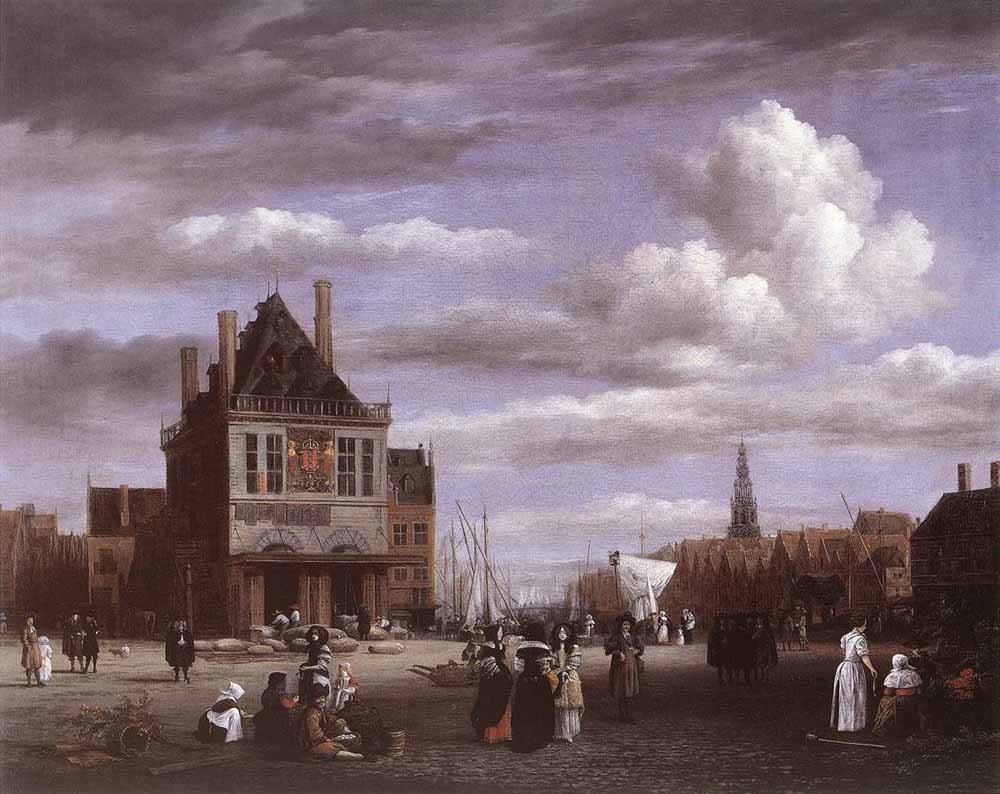
Dam Square in Amsterdam by Jacob van Ruisdael

Dam Square Amsterdam by Jacob van Ruisdael (1670)

Today, Jacob van Ruisdael is my featured artist in My Daily Art Display.   He was born in Haarlem in 1628 and was brought up in an artistic household.  His father, Isaak van Ruysdael and his uncle, Salomon van Ruysdael were both landscape painters.  Little is known about Jacob’s early artistic training but it is thought that his father probably taught him with guidance from his uncle.  At the age of twenty he was admitted as a member of the Guild of St Luke in Haarlem.  The Guild of Saint Luke was the most common name for a city guild for painters and other artists especially in the Low Countries.   They were named in honor of the Evangelist Luke, who was the patron saint of artists.

Unfortunately during his lifetime Jacob van Ruisdael’s artistic talent was not appreciated and by all accounts he led a poverty-stricken existence.  At the age of fifty three the Haarlem council was petitioned for his admission into the town’s almshouse.  He died in Amsterdam a year later in 1682 and his body was brought back to be buried in Haarlem

Jacob van Ruisdael travelled considerably during his lifetime but seldom went outside his own country.   He was a prolific painter with over seven hundred paintings and a hundred drawings attributed to him.  His great love was to paint countryside scenes showing fields of corn and windmills as well as woodland scenes.  He was also a renowned painter of trees and their foliage.    Another favourite subject of his was seascapes and the neighbouring dune lands.  He also liked to paint waterfalls based on the work of Allart van Everdingen, the Dutch painter, who had travelled extensively in Scandinavia.

Today’s painting, The Dam Square in Amsterdam, completed in 1670 is neither a landscape nor a seascape.  The subject is Dam Square in Amsterdam, a place which he was very familiar with as he lived on the south side of the square at this time.   The square was dominated by the old Amsterdam municipal weighbridge and one can see several bales of goods under the canopy waiting to be weighed.   On the right of the building one can see the Damark with its sailing boats and the tower of Oude Kerk.  In the foreground of the painting there are a large number of figures.  It is not thought that Ruisdael actually painted these as he was not an established figure specialist.  Experts believe they may have been painted by the Rotterdam artist Gerard van Battem.  The pale light from the left of the painting casting long shadows across the square suggests that it is daybreak.

 His artistic works although not fully appreciated during his lifetime have since his death been highly praised and he is now often considered the greatest Dutch landscape painter of all time.

The Lute Player by Orazio Gentileschi

The Lute Player by Orazio Gentileschi

My Daily Art Display offering today is The Lute Player and is one of the most famous works by the Italian artist, Orazio Gentileschi.

 Gentileschi was born in Pisa in 1563.  At the age of thirteen he moved to Rome.  The first word we have of him is when, along with a large number of artistic collaborators, he decorated the Vatican Library in 1588.  His collaboration on works of art continued but remained unheralded.  It was around this time in Rome that the young Caravaggio came to the forefront of the Art scene with his revolutionary new style of painting.  It was from around the early 1600’s that we find that Gentileschi is influenced by him and became one of the few Caravaggisti who was also one of his inner circle of friends.  After Caravaggio fled from Rome, Gentileschi’s style changed somewhat and his pictures became lighter in colour and more precise in subject detail.  In 1621 he moved Genoa where he received commissions from Giovanni Battista Sauli, a Genoese nobleman.   He stayed for two years and thereafter went to Paris where he carried out commissions for Marie de Médici and other royal and noble patrons.  At the time he was regarded as one of the leading Italian painters residing in France.   In 1623 he travelled to England and became court painter to Charles I.  He died in London in 1639.

 It was in 1626, whilst in London that he painted The Lute Player.  As a Caravaggisti, he would have been aware of Caravaggio’s own painting of The Lute Player (c.1596).  In Gentileschi’s painting we see a graceful young woman with her back to us.  Dressed in a white blouse and a flowery yellow dress with her hair in braids, she sits with her face turned towards us.  She is sitting at a table with the pear-shaped body of the lute almost touching her ear as she listens intently to the resonance of a note.  She appears totally immersed in her work.  At this time she maybe in the process of tuning the instrument before a musical performance.   On the table, covered by a velvet cloth, we can see a songbook and other instruments including a shawm and a violin.  The way in which Gentileschi paints the textures of her dress and the cloths covering the table and her stool is masterful and it is said that Dutch painters famous for their reproduction of fabrics in their works improved by scrutinising the works of Gentileschi.

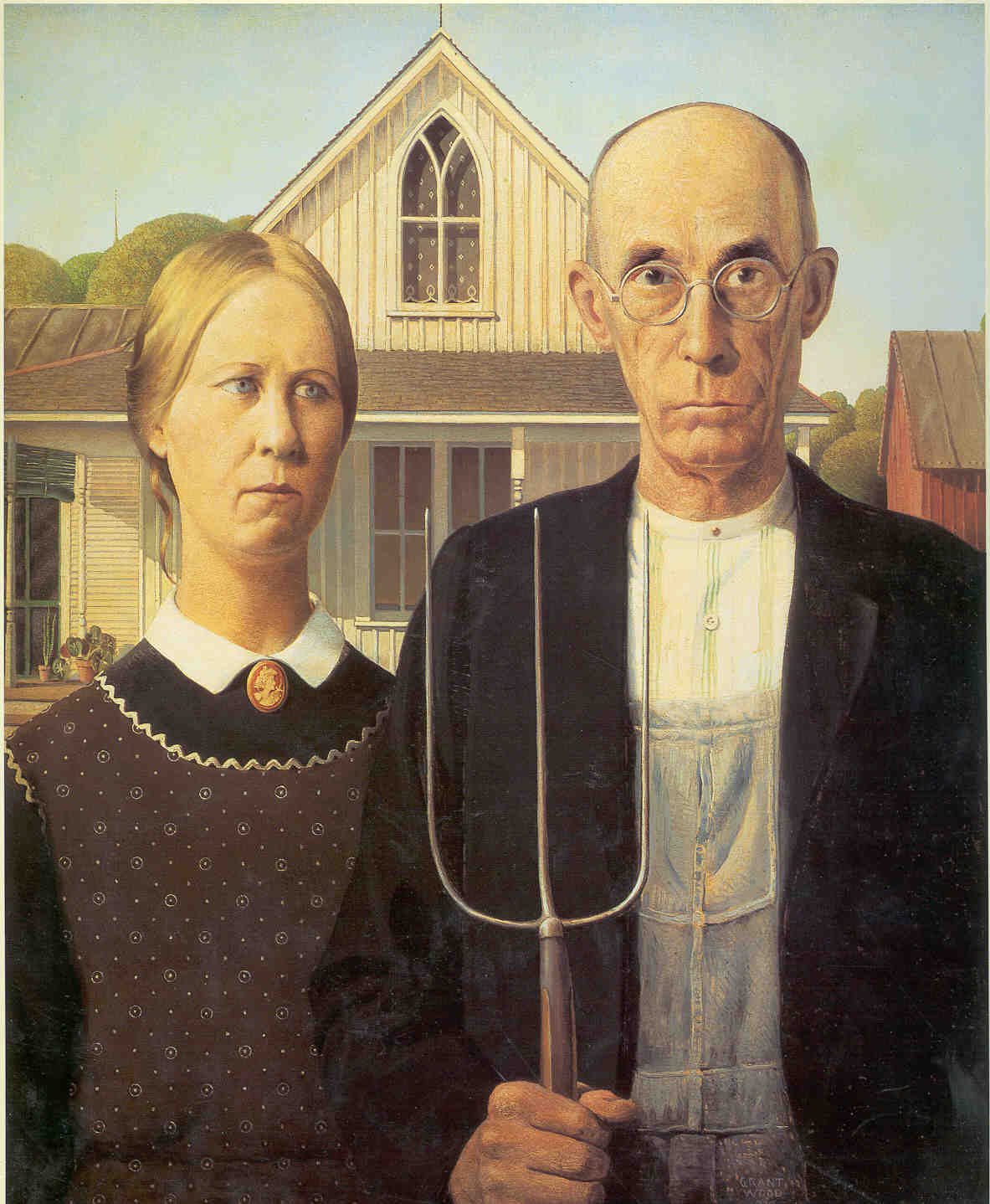
American Gothic by Grant Wood

American Gothic by Grant Wood (1930)

My Daily Art Display offering today is the oil on beaverboard painting by American artist Grant Wood entitled American Gothic which hangs in the Art Institute of Chicago.  This is said to be one of the most famous paintings in the history of American art.

Grant Wood was born in small town America, in Anamosa, Iowa in 1892.  During his early artistic life his works of art showed no one distinguishable style but he enjoyed painting the “niceties” of American Midwestern life with all its small villages and their white-painted churches.  That all changed in 1927 after he spent some time in Munich on a commission supervising the putting together of stained glass windows for the Cedar Rapids Veterans Memorial Building.  Whilst in Munich he visited the large art gallery, Alte Pinakothek and was introduced to the Early Netherlandish works of art and witnessed first hand the Neue Sachlichkeit (New Objectivity) movement in German paintings which reflected the resignation and cynicism of the post-war period.  In all he made four trips to Europe and after each journey he returned home with a much greater appreciation of the Midwest lifestyle, culture and its traditions and this love of Midwest America was transformed into his paintings.

On his return home his painting style changed and his paintings took on a more painstaking and sharply detailed style.  As is the case in today’s painting Wood liked to paint ordinary every day people and their commonplace lifestyle in the Midwest of America.  His style of painting was often termed Regionalism and exuded a sense of patriotism and nostalgia and in some ways was an artistic record of the history of small town America.  He hoped that this style of his art and the subjects he displayed would, in some way, act as  a boost to the morale of people who were suffering badly during the Great Depression, reminding them that they should retain their self belief and steadfast American pioneer spirit.  American Regionalism opposed the European abstract art and the art which was very popular at the time on the East Coast of America and California and preferred depictions of homely rural America and its people

In American Gothic we see a farmer and his spinster daughter standing in front of their late nineteenth century Gothic Revival styled house with its distinctive upper window.  The actual building in Eldon, Iowa, is still standing and is a popular tourist attraction.  The figures were modelled by the artist’s dentist, Doctor Byron McKeeby and Wood’s sister, Nan.  They are both dressed in clothes dating from the 1890’s.  The man, because of the way he is dressed, and the fact he is holding a three-pronged pitchfork , one believes him to be a farmer but he also has the studious look of a banker’s clerk.  Maybe the pitchfork is there to signify man’s traditional role as hard working but it also gives him a slight air of hostility and someone who has a bad temper.   There is something puritanical in his look.  In contrast, the woman exhibiting a side-long glance seems more prim and dowdy with her colonial-print apron with its white collar.  She conveys an air of domesticity.   The precise realism of the rigid frontal arrangement of the man and woman was probably inspired by the Northern Renaissance Art Wood saw when he was in Europe.  There is a definite similarity with van Eyck’s double portrait, The Arnolfini Portrait, (see Nov 27th) and also the way mystery surrounds the symbolic meaning and interpretation of both works.

However with regards symbolism and interpretation maybe we should leave the last word to the artist for when asked about the satirical nature of his painting and the two characters he merely replied that “they were the kind of people I fancied should live in that house”.

Wood entered the painting in a competition at the Art Institute of Chicago and although it was not liked by all the judges, it achieved a bronze medal and the Institute bought the work of art.  Copies of the painting were published nationwide in many newspapers and all was well until the local newspaper in Cedar Rapids, Iowa published it.   The locals were up in arms at the depiction of the couple as “pinched, grim-faced Bible-thumpers”.   Woods’ sister was embarrassed and horrified as being portrayed as the wife of somebody old enough to be her father and was quick to state that the couple were indeed father and daughter.

It is a strange painting but one, like the Arnolfini Portrait, which may hold symbolic messages and is open to many interpretations despite the artist himself denying any hidden meaning to his famous work of art.

The Kiss by Francesco Hayez

The Kiss by Francesco Hayez (1859)

“……….A kiss is a lovely trick, designed by nature, to stop words when speech becomes unnecessary……”

                       Ingrid Bergman Swedish movie actress (1915 – 1982)

With the possible exception of Gustav Klimt’s The Kiss, the most famous painting featuring a kiss is Il Bacio by Francesco Hayez, as it is entitled in the Pinacoteca Brera in Milan, but to most of us, is known simply as The Kiss.  This masterpiece, painted by the Italian artist in 1859, is his most famous work and a prime example of Italian Romanticism. 

Francesco Hayez was born in Venice in 1791.  He was the youngest of five sons and was brought up by his maternal aunt who was married to Giovanni Binascoa a prosperous ship-owner and an avid art collector.  Living in this household the young Francesco showed a love for drawing and so his uncle arranged an apprenticeship for him with an art restorer.  At the age of eighteen, after studying under the Venetian artist Francisco Magiotto and the Italian artist Teodoro Matteini, he won a competition, the prize for which was a one year placement at the Academia di San Lucia in Rome.  He lived in Rome until 1814 and then moved to Naples.  In the mid 1830’s he moved once again, this time to Milan where in 1850 he was appointed director of the Academy of Brera.  For many years he taught at the Brera and he exercised great influence on his pupils.  The Academy of Brera has a large collection of his paintings including My Daily Art Display’s featured painting, The Kiss.  Francesco Hayez died in Milan in 1882 aged 91.

Although the two characters in the painting are dressed in 14th century costumes the painting was intended to celebrate the Risorgimento (resurgence), which was the nineteenth century movement that brought together all the separate Italian states and by so doing, bring about the unification of Italy. The red and green of the man’s clothes along with the white of the cuffs of the woman’s dress are the three colours of the Italian tricoloured flag (il Tricolore).  The man supporting the woman passionately kisses her.  It is not known who the characters are as the artist wanted the main focus of attention to be on the kiss itself rather than who were doing the kissing.

All in all it is probably the most sensual and spell-binding kiss ever to grace a canvas.

The Island of the Dead by Arnold Böcklin

The Island of the Dead by Arnold Bocklin (1880-1886)

My Daily Art Display today is The Island of the Dead, a painting by the Swiss artist Arnold Böcklin.  He painted five versions of this work between 1880 and 1886 but curiously never gave any a title.  It was his Berlin art dealer Fritz Gurlitt who invented the name for the painting.  For me, today’s offering exudes a sinister air of menace.   For some reason, it reminds me of death and it permeates a feeling of foreboding.  It is believed that the English Cemetery in Florence, where his baby daughter was buried, and which was close to Böcklin’s studio was part of the inspiration for this painting.

The earliest version of this picture was commissioned by Marie Berna whose husband had recently died.  The predominate feature of the painting is the high-cliffed rocky island, viewed at night across an expanse of water.  The centre of this island is dominated by cypress trees which were customarily associated with graveyards.  Dark storm-like clouds gather in the background.  Approaching, and almost at the island, is a small row boat carrying a white figure who is standing ready to alight from the craft.

Should we look for an interpretation of this picture?  Should we seek some symbolism for various facets of the painting?  According to the artist himself there is no need, as this, as he termed it, was simply “a dream picture”.  Böcklin liked people to find their own meanings in his paintings.  A number of themes used in his paintings stemmed from classical literature and many believe the upright figure dressed in white in today’s painting resembled Charon the boatman who ferried the souls of the dead across the river Styx to Hades.

Arnold Böcklin was born in 1827 in Basel.  He studied in Dusseldorf.  At the start of his artistic career he concentrated on landscapes and travelled extensively through Europe where he studied Renaissance art and discovered the wonders of Mediterranean landscapes.  He returned to his homeland in 1871 but spent the last days of his life in Fiesole a town near Florence where he died in 1901 at the age of 73.

Today’s painting inspired many people.  Rachmaninoff after seeing the painting in Paris in 1907 composed a symphonic poem (Op.29) as did Heinrich Schulz-Beuthen and Max Reger.  The artist and his works were a favourite of Adolf Hitler who at one time owned eleven of Böcklin’s paintings.  I have also read that in the series finale of the TV drama series Lost a driver from Oceanic Airways wears a uniform with the name tag ‘Bocklin,’ presumably referencing this painting.

Wanderer above the Sea of Fog by Casper David Friedrich

Wanderer above the Sea of Fog by Caspar David Friedrich (1818)

My Daily Art Display painting today is a mesmerising scene of a young man, believed to be a portrait of the artist himself,  with his back to us perched on a rocky outcrop gazing out reverentially over a landscape which is almost hidden by thick swirls of fog and clouds.  He is bedecked in a green frock-coat, leaning slightly on his walking stick, his curly blonde hair caught by the wind.  We, the viewer, look with the eyes of this young man and can just make out, through the thick pervading grey fog, a middle ground with its small clumps of trees which stand atop a rocky escarpment.  Further into the background one can see the tall greyish-blue toned mountains, lightly shrouded by the clouds, above which we are able to observe the sky with its slight glowing hue indicating that we  are witnessing either the start or end of the day.

Casper David Friedrich, the German Romantic artist, painted Wanderer above the Sea of Fog in 1818 and it can be found in the Kunsthalle in Hamburg.  It is one of the great Romantic landscape paintings of its time.  The setting for his painting is a fusion of various mountains in the Saxony and Bohemia region.  The outcrop of rocks on which the man stands is on the Kaiserkrone.  The painting draws attention to the smallness and insignificance of an individual in comparison to the untamed and possibly hostile natural setting.  Many of Friedrich’s paintings let people share his captivation with encountering nature in solitude whether it be from a rocky outcrop as in today’s painting or the frozen arctic as depicted in his painting The Arctic Sea.  He was a Romantic artists and their belief was that any artist who wanted to explore his own emotions, had necessarily to stand outside of the throng of money-making, political gimmickry, and urban noise in order to assert and maintain their positions.

Caspar David Friedrich was born in Greifswald, Germany in 1774.   At the age of twenty, he began his studies at the Academy in Copenhagen.  In 1798 he moved and settled down in Dresden but travelled extensively throughout Germany.  His landscapes, like that of his painting today, were based entirely of those of northern Germany and show in detail the breathtaking magnificence of the hills, harbours and weather conditions of that area which Friedich had observed.  Many of his scenes are devoid of people and concentrate on menacing ravines, intimidating cliffs and terrifying seas of ice.  One can see that in his landscape paintings, Friedrich gave more emphasis to threatening landscapes rather than the benign beautiful ones often painted by other artists.

David d’Angers, the French sculptor and contemporary of Friedrich said of Caspar David Friedrich, “Here is a man who has discovered the tragedy of landscape.”

Christina’s World by Andrew Wyeth

Christina's World by Andrew Wyeth (1948)

The other day I came across what I thought was a simple landscape painting, which at first glance was a simple rural scene with a solitary figure, seemingly resting, in the foreground.  I had guessed it was an American landscape.  My mind went back to the photographs of the Mid-West plains.  I was half right in as much as it was an American landscape but not of the Mid West but of Maine. The female figure in the foreground was of a young woman, and my perception was that she was just raising herself from the ground after a pleasant lie in the meadow-like surroundings.  Maybe I should be forgiven for jumping to conclusions from just a fleeting glance but it was simply my first impression.  Look and see what you make of it after you have taken that first momentary look.

In fact this is not as simple a painting as one might have first believed.  Christina’s World was painted in 1948 by the American artist Andrew Wyeth and despite me having never seen it before, it is said to be one of the best known American paintings of the mid twentieth century and is presently hanging at the Museum of Modern Art in New York.  The girl whom I took to be just simply raising herself from the ground after a period of relaxation is in fact a young woman afflicted with polio from early childhood which had paralysed her lower body and is actually crawling across a field to her home which can be seen in the distance.

The artist was inspired to create this painting when looking through a window of his summer house in Cushing Maine and he saw his young neighbour, Anna Christina Olson, who suffered from infantile paralysis, which resulted in her inability to walk, gazing up at her house from the large tree-less field in front of it.  The model he used for the picture of the girl was not Christina herself, who was in her mid-fifties at the time of the painting, but Andrew Wyeth’s young wife Betsy who was in her mid-twenties.  The painting of the young woman in a pink dress with wasted limbs has a haunting quality to it.   The landscape and the rural house are all painted in great detail.  Wyeth’s attention to detail is amazing.  Each blade of grass and each strand of the woman’s hair is painted individually. The style of the painting has been termed “magic realism”which is defined as an artistic genre in which meticulously realistic painting is combined with surreal elements of fantasy or dreams.  Wyeth commenting on his artistic style said:

“I search for the realness, the real feeling of a subject, all the texture around it…I always want to see the third dimension of something…I want to come alive with the object.”

Of the picture in general, Wyeth commented:

“The challenge to me was to do justice to her extraordinary conquest of a life which most people would consider hopeless.”

Have you a favourite painting which you would like to see on My Daily Art Display?  

If so, let me know and tell me why it is a favourite of yours and I will include it in a future offering.

The Moneychanger and his Wife by Marinus Claeszoon van Reymerswaele

The Moneychanger and his Wife by Marinus Claesz van Reymerswaele (1539)

Yesterday’s painting by Jan Gossaert was termed an “occupational portrait” and today I offer you another one.  This painting entitled The Moneychanger and his Wife was painted by the Dutch artist Marinus Claeszoon van Reymerswaele in 1539.  It is almost certainly an adaption of a painting of a similar name painted in 1514 by the Dutch painter Quentin Massys whom he met whilst in Antwerp,.   Marinus was born in 1490 in the “lost coastal city” of  Reimerswaal , which was flooded in 1530 and totally lost to the sea in 1634.  He studied at the University of Leuven in 1504 and trained as a painter in Antwerp in 1509.  He was known for his satirical paintings.

It is interesting to note that the Spanish Association of Accounting and Business Administration (Associatión  Española de Contabilidad y Administración) (AECA) adopted a section of this painting as a symbol of their association. 

The reason they wanted to use it was given as:

“The painting which has inspired our logotype is internationally famous as an image of financial activity during the Renaissance: it shows a scene typical of the counting house of a banker of the period. The subject of the pair of moneychangers shows us a new profession which has appeared in the period, a profession related to the world of finance, taxes and commercial accounts. Reymerswaele adapts the subject of the banker and his wife from Massys’s painting now in the Louvre in Paris. In Reymerswaele’s painting, the bourgeois married couple are seen counting out gold and silver coins, and the husband is weighing them with great care in a small set of scales, since most of them would be clipped or scraped. The coins are probably the product of tax-collection, an exchange of foreign currency or the repaying of a loan. This would imply the use of the abacus which the banker has at his right on the table, and then the setting out of accounts in the accounts book which the wife is holding in her delicate fine hands.”

Take a close look at the two figures in the painting.  They both exude an air of elegance in their wearing of expensive and lavish clothes.  There is a definite air of opulence.  Puyvelde, the Flemish art historian, wrote that the realist portrait of the Moneychanger and his Wife is a caricature of  rapacious and greedy business people commenting that “the profit motive is more clearly marked in the faces and thin fingers”  In sixteenth century painting, long curved fingers was a sign of greed or even avarice.  Long fingers and long noses were also used to represent Jews.  The male person in this painting could well be Jewish and at this time, as it is nowadays, the Jews played a very important part in the economic activity of Flanders.  In those days the main bankers were Italian Lombards but the Jews acted as money lenders to the less wealthy members of the public such as butchers and bakers.  Unfortunately, many of those who borrowed the money had trouble repaying their loans and this probably reinforced the strong anti-Semitic feeling which was prevalent at the time.

The Prado museum guide comments on the painting:

“In this painting we find all the characteristics of Northern European painters: minute detail, fine quality raw material, an empirical approach to reality, and above all, the naked sordidness with which Van Reymerswaele approaches one of the principal evils of his time: usury, the greater of all possible sins in a commercial society such as Flanders. Corruption and fraud affected all levels of society, even the clergy, producing a critical reaction on the part of writers, theologians and artists”.

Most art historians have seen in Reymerswaele’s paintings a satirical and moralising symbolism, The Money Changer and his Wife being the representation of greed. Others think that the picture shows economic activity in a respectable way.  Flanders at that time was the centre of a flourishing industrial and commercial activity, and also was the centre of a mercantile trade in works of art. Both things led to a representation of the professional activity of moneychangers, goldsmiths, and bankers in a way that shows those activities as respectable professions. The second view is the one implicitly shared by economists when choosing this picture to illustrate many books on economics or business

So, what do you make of the picture?