
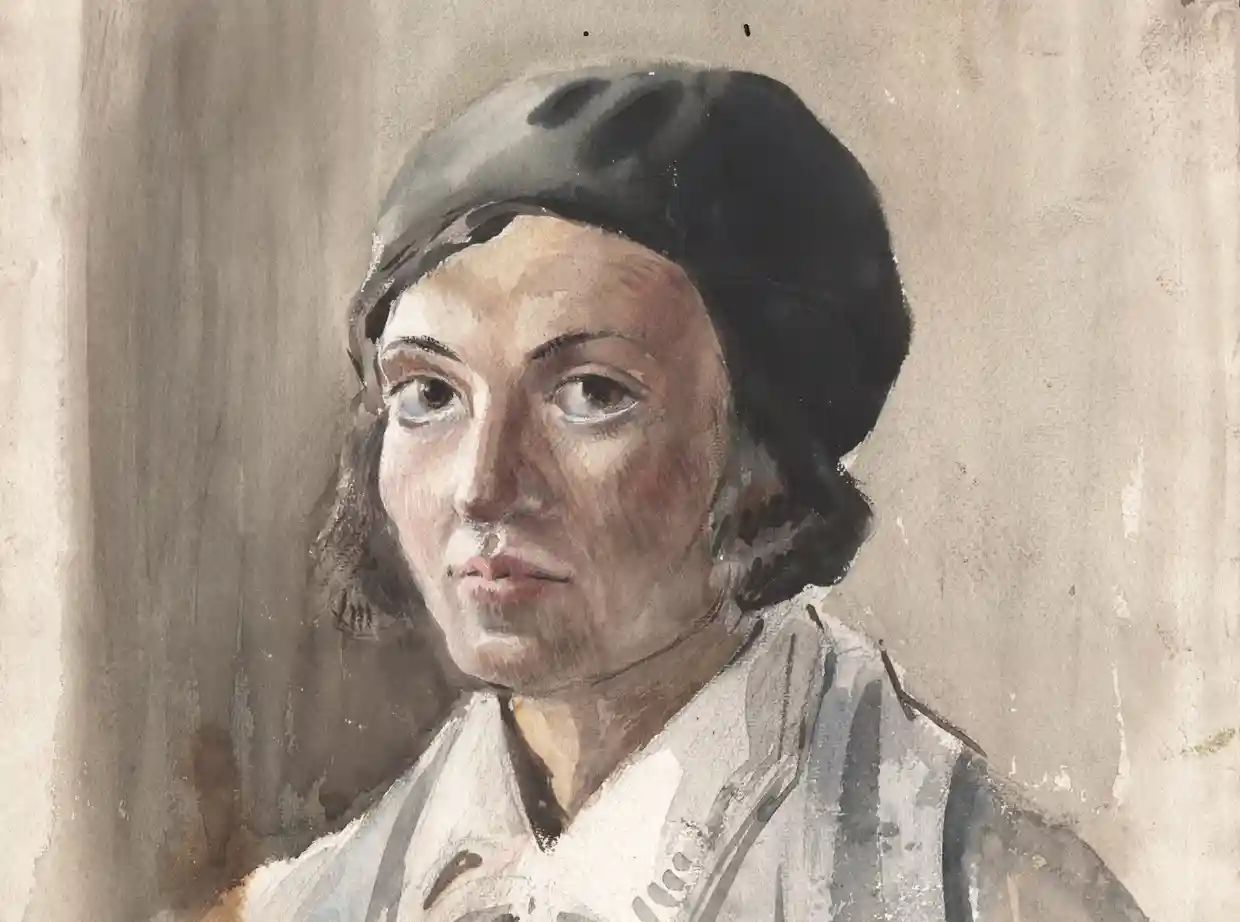
Detail from Self portrait by Evelyn Dunbar (1930)
Evelyn Dunbar was born in Reading on December 18th, 1906. She was the fifth and youngest child of William Dunbar and Florence Dunbar (née Murgatroyd). William Dunbar was a Scotsman who originally came from Cromdale, Morayshire. In 1913, when Evelyn was seven-years-old the family moved to Rochester in Kent where her father established himself as a draper and bespoke tailor. Evelyn’s mother Florence was a keen gardener and amateur still-life artist and a Christian Scientist and soon Evelyn became one and remained one throughout her life.

Portrait of the artists mother, Florence, on a bentwood rocking chair, by Evelyn Dunbar (c.1930)
Evelyn Dunbar won a scholarship to attend the Rochester Grammar School for Girls. From there she enrolled on a two-year art course at the Rochester School of Art, in 1925 and in 1927 attended the Chelsea School of Art remaining there until 1929. That year, she won a scholarship to attend the Royal College of Art where she studied until 1933 at which time she graduated as an ARCA (Associate of the Royal College of Art). Students at the Royal College of Art were encouraged by Sir William Rothenstein, College Principal and Professor of Painting, to find commissions for their work and engage socially with influential art world figures.

Compositional Study for The Pleasures of Life at Morley College by Charles Mahoney (1930)
Cyril Mahoney, known as Charles Mahoney, had been Visiting Painting Tutor at the RCA since 1928 and had carried out a commission to paint a thirty-foot long mural, entitled The Pleasures of Life, at the Morley College for Working Men which he and colleagues completed two years later. In his memoir Since 50, Men & Memories 1922-1938, the first two names that appear on William Rothenstein list of top Royal College of Art students were Henry Moore and Charles Mahoney – the list continues with the names of other leading lights such as Eric Ravilious, Edward Bawden, Barnett Freedman Edward Le Bas, and Evelyn Dunbar.
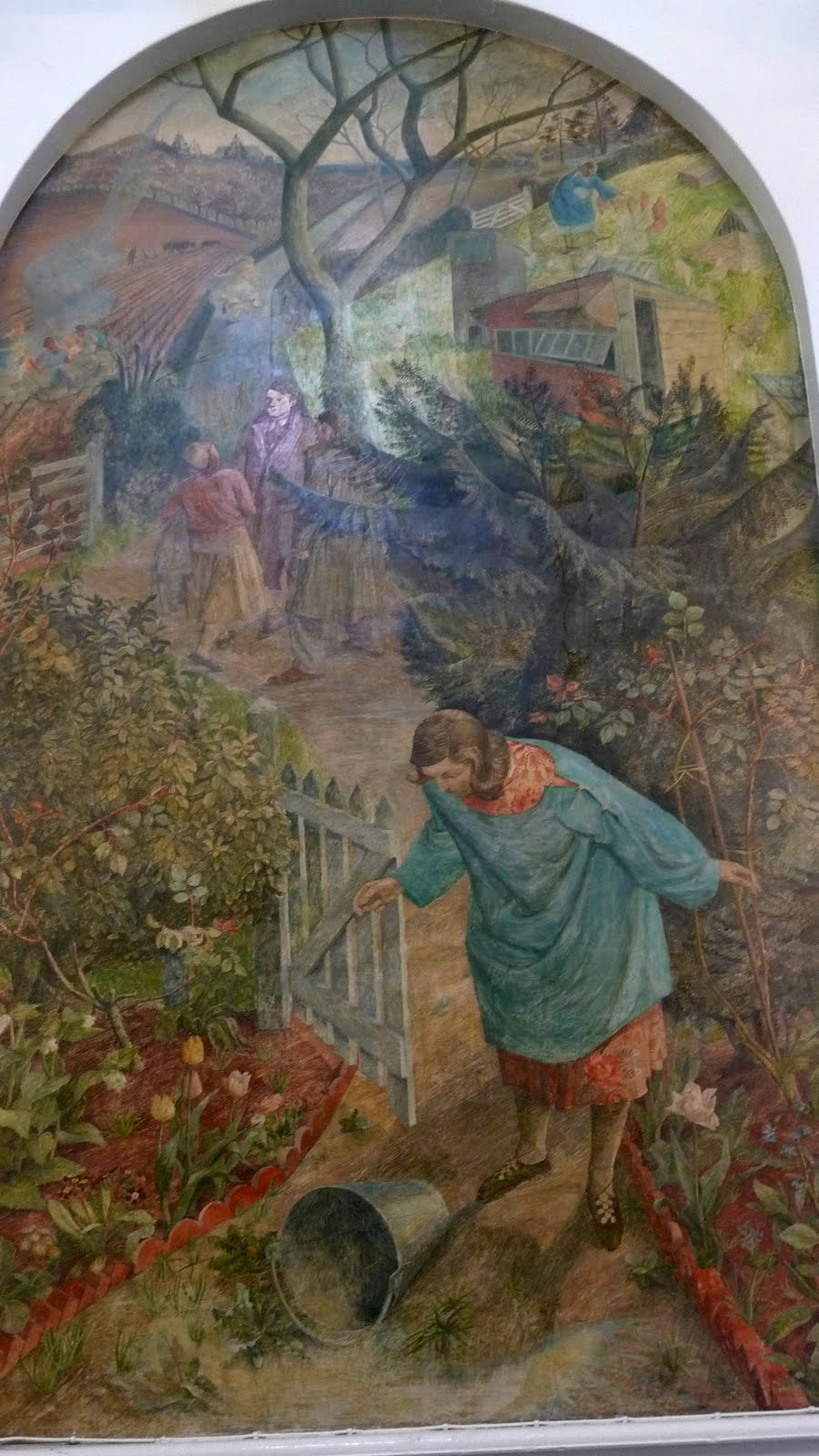
Mural by Evelyn Dunbar at Brockley County School for Boys
In 1932, Mahoney was offered a commission to decorate Brockley County School for Boys (which is now the Prendergast School for Girls) in South London, and following an appeal from Rothenstein for students to experiment further with mural painting, Mahoney chose three of his senior students to assist in the project, Evelyn Dunbar, Mildred Eldridge and Violet Martin. The subjects of these proposed five arched-top panel murals were to illustrate tales from Aesop’s Fables. The painting of this set of murals was not completed until 1936.
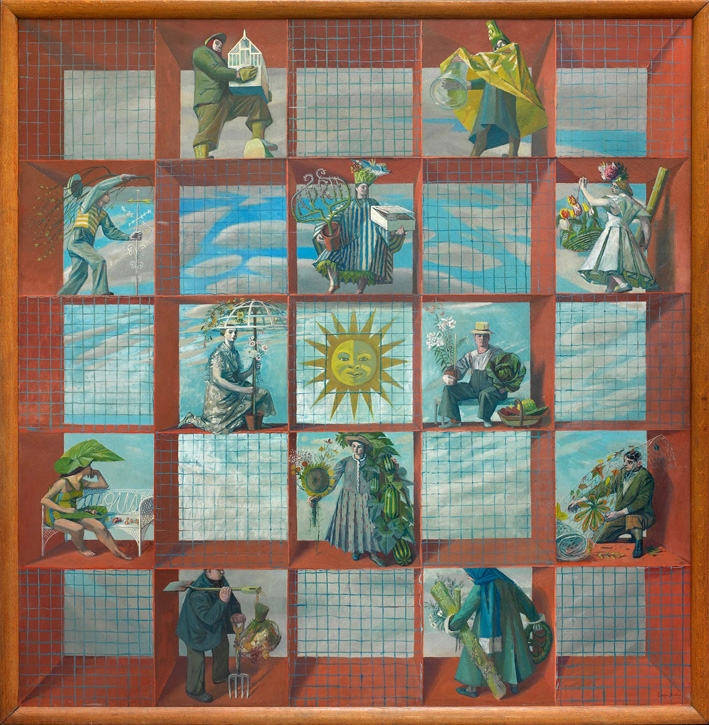
An English Calendar by Evelyn Dunbar (1938)
During Mahoney’s work with Evelyn on the mural their relationship intensified and he became her lover. Mahoney and Evelyn shared a studio in South End Road, at the southern end of Hampstead Heath. Besides painting and sketching, they had another shared interest, that of plants and horticulture. Mahoney’s love of horticulture resulted in an amusing warning from Evelyn who wrote to him:
“…Don’t ever have too big a garden, or with your avidity for making the names in the catalogue come true, you’ll never touch a brush or a pencil…”

Whilst working on the Brockley murals Evelyn accepted another commission. Near neighbours to Evelyn Dunbar and Charles Mahoney were Catherine and Donald Carswell, authors and journalists. Donald Carswell had put together a series of short travel stories, to be published by Routledge & Sons, under the title, The Scots Week-End and Caledonian Vade-Mecum for Host, Guest and Wayfarer and needed an illustrator to produce accompanying illustrations.
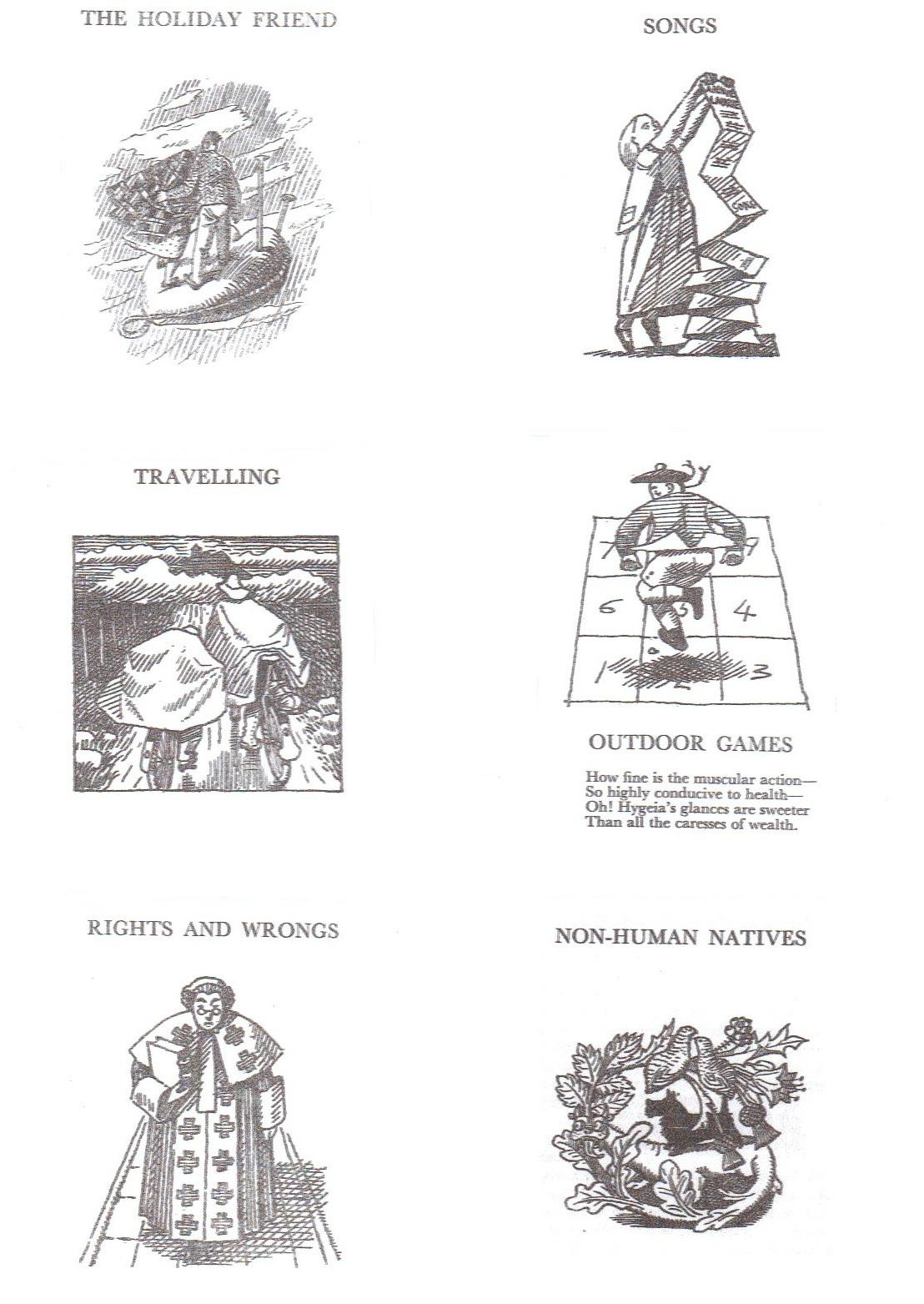
Evelyn Dunbar: Pen and ink vignettes from The Scots Week-End and Caledonian Vade-Mecum for Host, Guest and Wayfarer (1936)
They approached Charles Mahoney who recommended Evelyn. She agreed to the commission and produced twenty-five pen and ink vignettes, the frontispiece and dust jacket for the miscellany.

Evelyn Dunbar: Pen and Ink frontispiece to The Scots Week-End and Caledonian Vade Mecum for Host, Guest and Wayfarer (1936)
For Evelyn, it was not a labour of love and she wrote to Mahoney about her struggle to complete the commission asking for some moral support:
“…can you tell me why it is that whenever I get going on these blooming Scotch illustrations with vigour and spontaneity all my spontaneous and lively feelings completely desert me, and I am left clutching an unwilling, unwieldy pen, scratching at laborious and second-rate expressions of stereotyped and 5th rate (so it seems to me) ideas? I’m trying my best and I mean to get over it, but jobs of that kind seem to mesmerise me into a kind of stupidity and inability. Write me a few comforting and inspiring lines…”

With the success of the travel book more commissions came from the Routledge publishing house. One of them was for the book, Gardeners’ Choice which comprised of the history, characteristics and cultivation advice for forty garden plants. The book was illustrated in pen and ink, and was jointly written and illustrated by Dunbar and Mahoney.
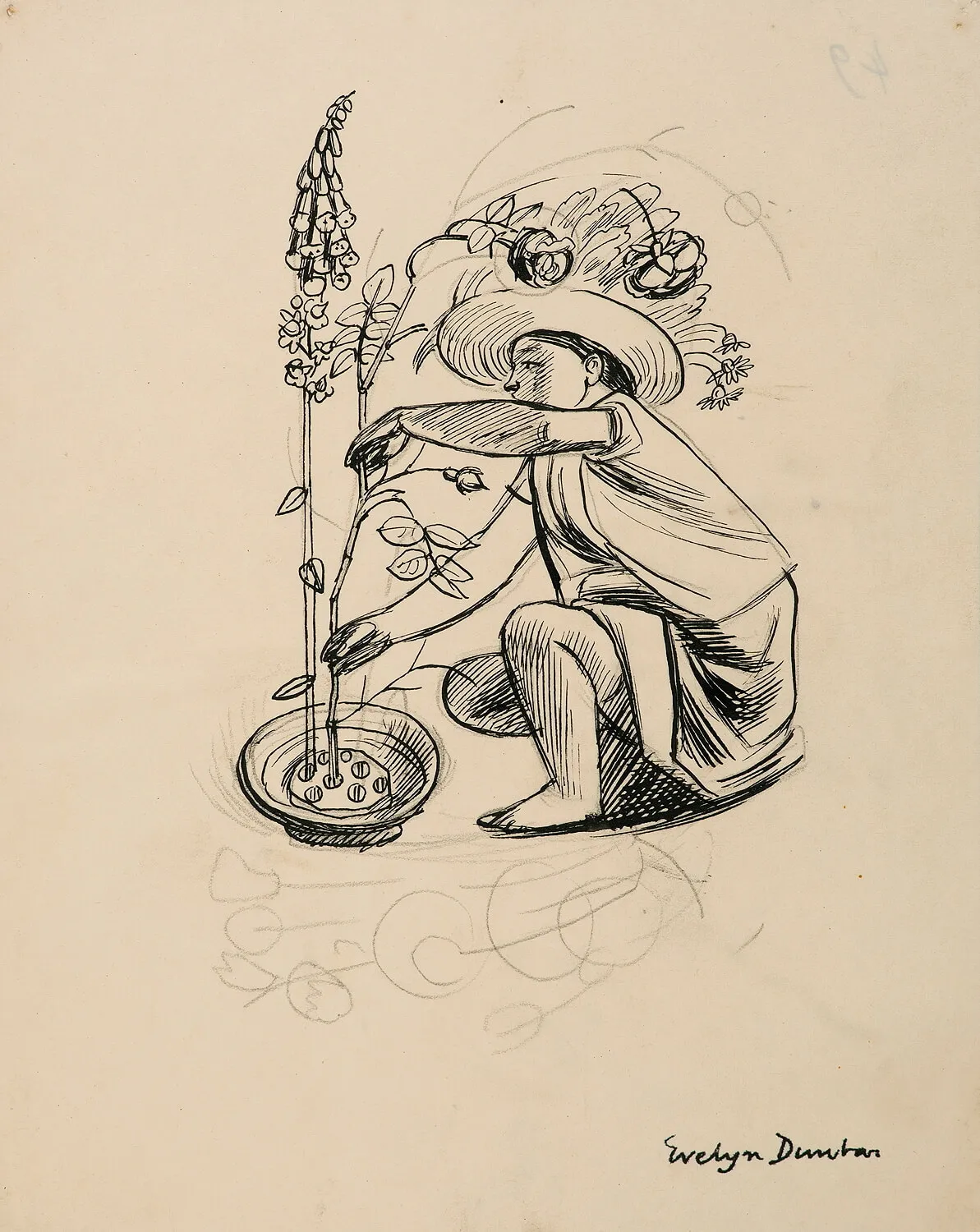
Design for June for the Country Life 1938 Gardeners Diary by Evelyn Dunbar
More work came their way when the magazine, Country Life, commissioned Dunbar to compose their Gardener’s Diary 1938, a monthly journal and appointments book which contained literary texts chosen by Evelyn and illustrated with her pen and ink drawings.
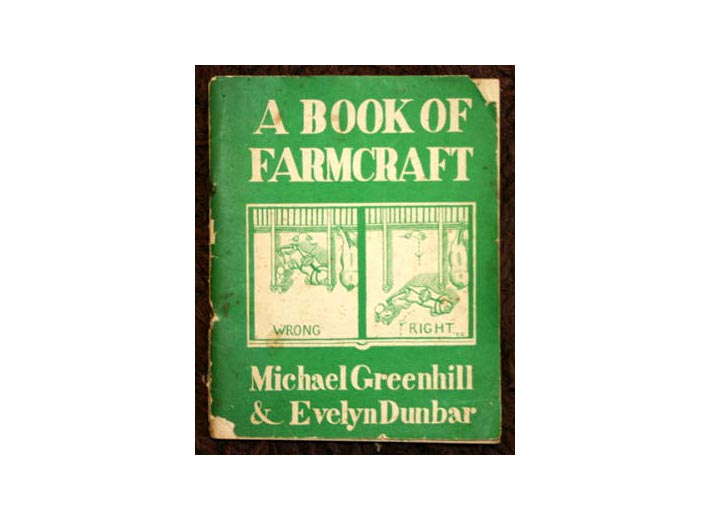
In 1941 Dunbar collaborated with author, Michael Greenhill by providing pen-and-ink illustrations for his book, A Book of Farmcraft. It was a basic primer of husbandry for those who had little or no knowledge of farming. Michael Greenhill was an instructor of recruits to the Women’s Land Army at Sparsholt Farm Institute, near Winchester, Hampshire. Many of Evelyn’s illustrations, differentiated between the right way of undertaking some agricultural task and the wrong way. For the illustrations, Evelyn used Sparsholt recruits as her models.

Putting on Anti-gas Protective Clothing by Evelyn Dunbar (1940) Composite image of a woman being assisted into an anti-gas suit by another woman
Having looked at Evelyn Dunbar’s mural work and her interest in horticulture, floral paintings and illustrations, one has to remember that she is best known for her depictions of the activities of the Women’s Voluntary Service and the Women’s Land Army during the Second World War. In April 1940 Evelyn was appointed by the War Artists’ Advisory Committee, (WAAC), as an official war artist and later was the only woman artist to receive successive and continuous salaried commissions throughout the war. The WAAC tasked her with pictorially documenting civilian contributions to the war effort on the home front.
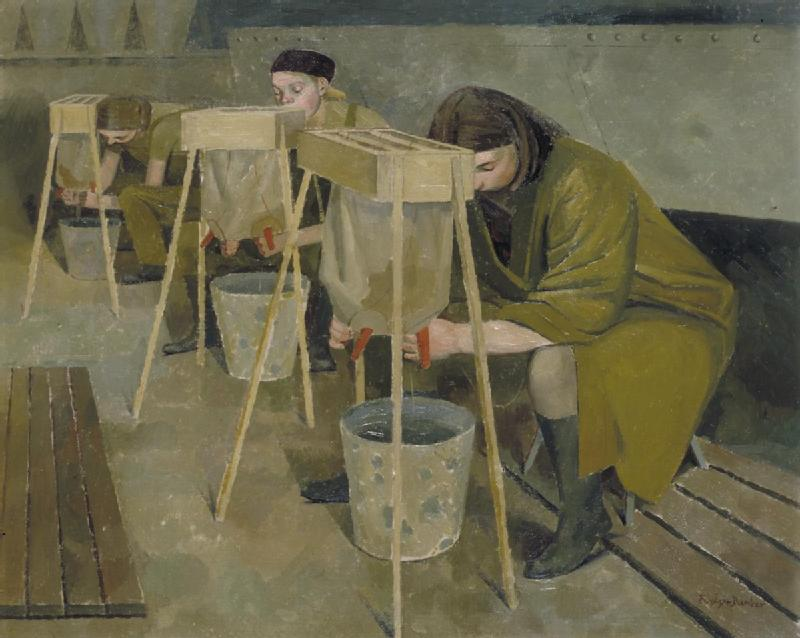
Milking Practice with Artificial Udders by Evelyn Dunbar
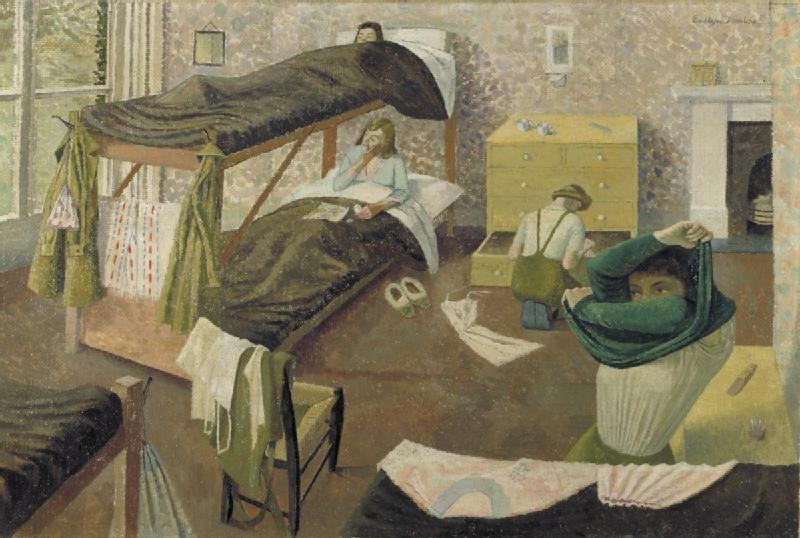
Land Army Girls going to Bed by Evelyn Dunbar
One of the most important tasks for women besides working in munitions factory was tending the land as so many male farm workers had gone to fight in the war. The first harvest which the Women’s Land Army was largely responsible for bringing in during the summer/autumn of 1940 led to Evelyn’s painting entitled Men Stooking and Girls Learning to Stook.

Men Stooking and Girls Learning to Stook by Evelyn Dunbar (1940)
One of Evelyn’s paintings, A Canning Demonstration, depicted some members of the Women’s Voluntary Service learning how to can and preserve the fruit which had been harvested that summer.

A Canning Demonstration by Evelyn Dunbar
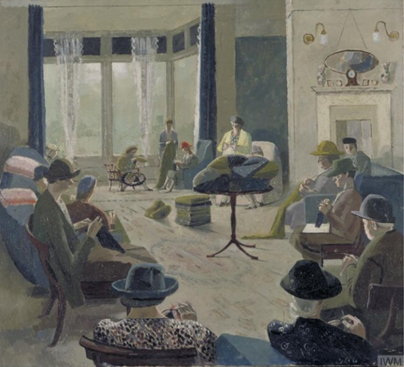
A Knitting Party by Evelyn Dunbar (1940)
Another important task for the women, who volunteered their services, was to organise knitting “gatherings” at which the women would make blankets and comforters which could be sent to the troops. In her 1940 work entitled, A Knitting Party we see one such gathering. The setting is the drawing room of the Dunbar family home in Rochester, Kent, and it depicts some fifteen women, one of whom is Evelyn’s mother, Florence.

Portrait of Flying Officer Roger Folley in Flying Kit by Evelyn Dunbar
Whilst working for the War Artists’ Advisory Committee she encountered Roger Folley, who came from Lancashire and who had graduated from Leeds University. Roger was an “outdoor person” and spent his holidays and time after university working on farms and enjoying life outdoors hiking around the countryside. Having gained some experience working on farms combined with his two university degrees (B.Sc and B.Comm.) it qualified him to work as an agricultural economist and his first job was as Costing Officer at Sparsholt Farm Institute, near Winchester, where he first met Evelyn who had been posted there in 1940 to paint Women’s Land Army recruits at work.
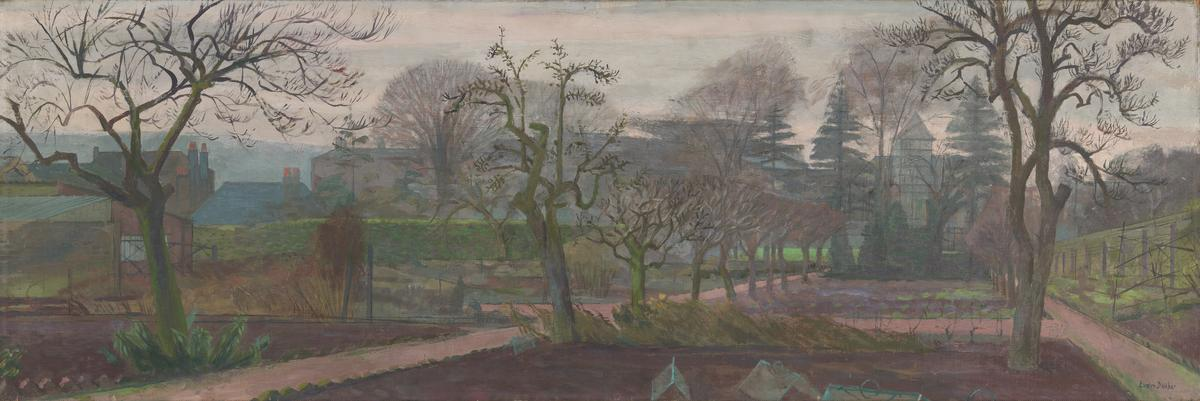
Winter Garden by Evelyn Dunbar (1929-37)
Roger was a Royal Auxiliary Air Force volunteer and at the outbreak of war, was called up to serve in the RAF. He received his Flying Officer commission in 1941 and transferred from the Voluntary Reserve and became Flight Lieutenant Roger Folley RAF, serving as a navigator with 488 (NZ) Squadron. Friendship between Evelyn and Roger blossomed into love and the couple were engaged in February 1942 and married the following August
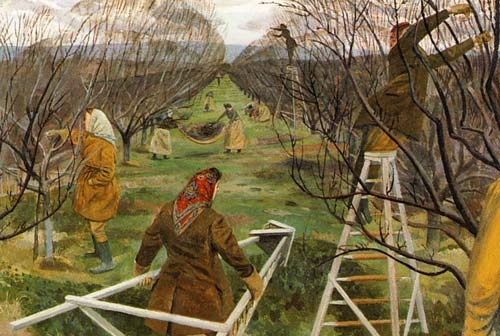
Pastoral, Land Girls Pruning at East Malling by Evelyn Dunbar (1944)
One of Evelyn’s and Roger’s great mutual loves was their commitment to the land and the careful management of its productivity. For Evelyn this premise was in line with her Christian Science beliefs which she continued to follow. She believed in the texts of the Old Testament that talked about a covenant between God and encompassed a covenant, frequently mentioned in the Old Testament, between God the Creator and mankind whereby the creator guaranteed the means of subsistence to mankind in return for mankind’s undertaking to cherish the land with love, intelligence and industry.
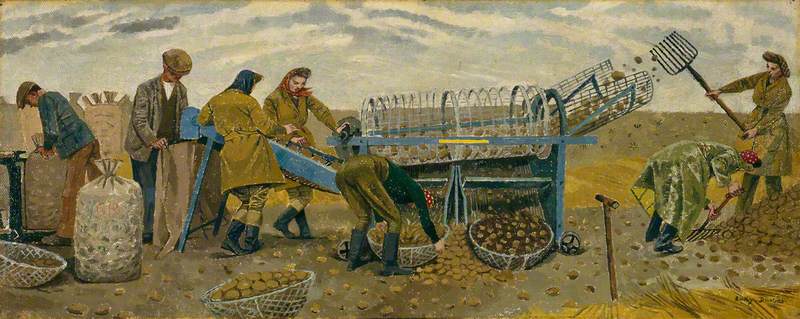
Evelyn often followed her husband when he was transferred to another military base and once he was stationed at RAF Charter Hall in Berwick. Whilst staying at the Scottish Borders, Evelyn made a sketch of women from the Women’s Land Army sorting newly dug-up potatoes.

Sprout Picking by Evelyn Dunbar
Much of the Land Girls’ work on the farm was back-breaking as can be seen by Evelyn’s painting entitled Sprout Picking.

Singling Turnips by Evelyn Dunbar
Turnip seeds are minute and they are scattered in ridges by seed-drill. However a few weeks after the seeds have been “mechanically” sowed, the seedlings will shoot up in their masses along with a profusion of weeds. To avoid the turnip shoots being choked by the weeds they have to be thinned out by hand and re-planted, known as “singling” – hence the title of the painting.

A Land Girl and the Bail Bull by Evelyn Dunbar (1945)
One of the last paintings Evelyn completed for the War Artists’ Advisory Committee, depicting the Land Girls was entitled A Land Girl and the Bail Bull. It is a depiction of a Land Girl’s work with an outdoor dairy herd on the Hampshire Downs. The name “bail” in the painting’s title refers to the moveable shed, which can be seen in the centre of the middle-ground and is where the milking is done. The girl has to catch and tether the bull and we see her enticing the animal with a bucket of fodder whilst she hides the chain behind her, ready to snap on to the ring in its nose as soon as it is within her reach. The girl in the painting is modelled by Evelyn’s sister, Jessie .

Once the Second World War had ended Evelyn and her husband went to live in Long Compton, Warwickshire, and they remained there for fifteen months. In 1946 The Oxford School of Art welcomed Evelyn as a part-time tutor and she combined this with her role as a visiting teacher at the Ruskin School of Drawing and Fine Art. Having these two teaching posts in Oxford and with her husband, Roger Folley, obtaining a position in the nearby University Agricultural Economics Research Institute, the couple decided to move home from Long Compton and re-locate to Enstone, Oxfordshire, in the spring of 1947. They made the Manor House at Enstone their home for next three years. In 1948, whilst living at Enstone, Evelyn completed a portrait of her thirty-five year-old husband Roger, entitled The Cerebrant. The setting for the work was his study on the top floor of The Manor House. It is a peaceful and relaxed portrait of her husband. He is depicted sitting down at a small table, which has various coloured books on it. One of the books is open and he is holding one of the pages in his right hand. He is looking towards his right, which is the direction the light is coming from. Folley is dressed casually in a green, short-sleeved, collared shirt. The painting was given that title by Roger Folley some fifty-seven years later when he presented it to Manchester Art Gallery in 2005. He had told one of his wife’s biographers that It was a celebration of Thinking.
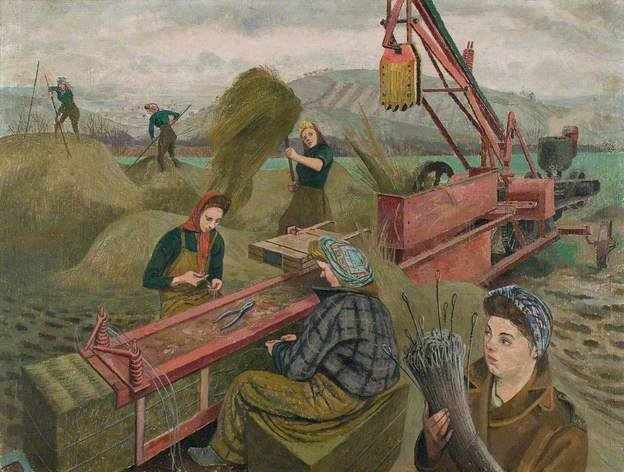
Bailing Hay by Evelyn Dunbar (1943)
Roger Folley changed jobs in 1950 when he was appointed to the Department of Economics at Wye College, Kent. The new position meant Folley and Eveleyn had to move home and they leased an isolated house, The Elms, four miles from the Kent village of Wye, nestled in the hills of the Kent Downs. Dunbar would run informal art classes but still managed to travel once a year to Oxford to give an annual lecture at the Ruskin School. In 1953 a solo exhibition of her paintings was held at Withersdane Hall on the Wye campus.
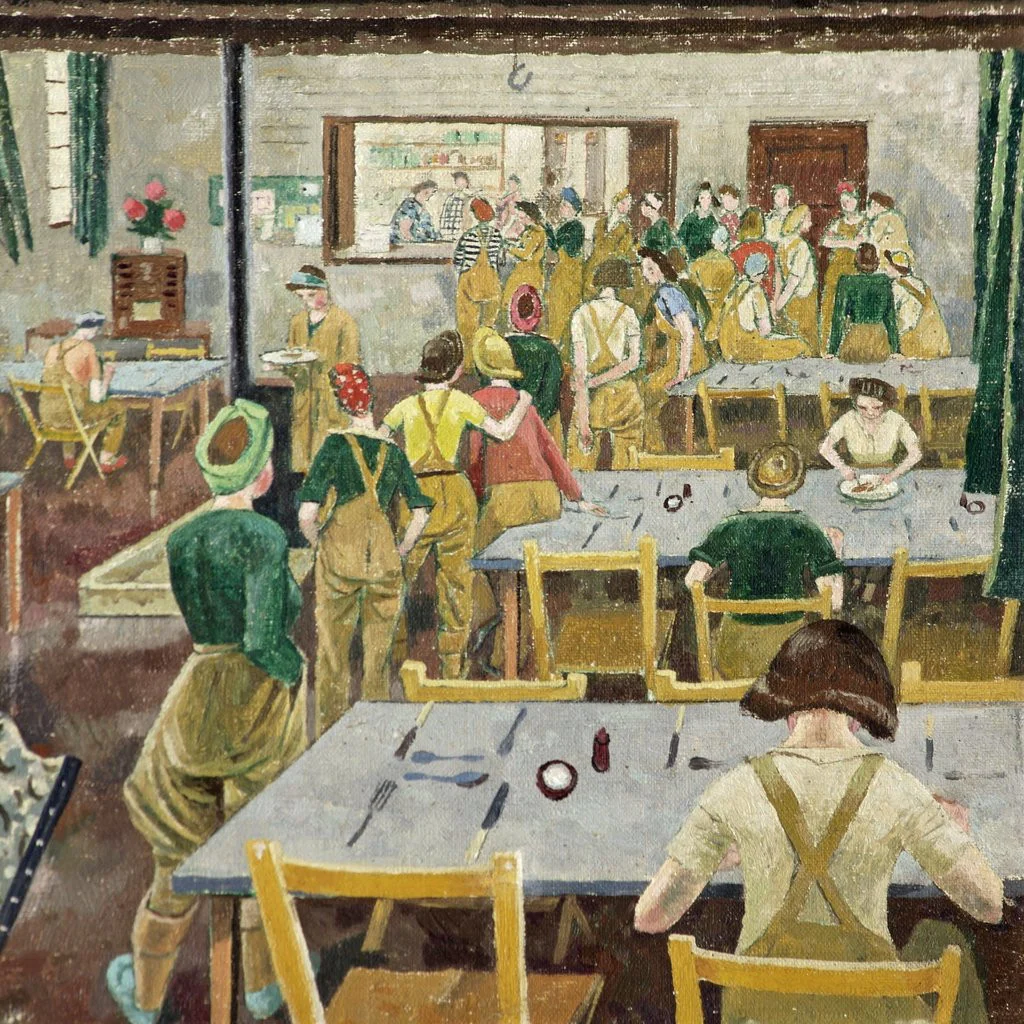
Women’s Land Army Hostel by Evelyn Dunbar
Roger Folley was away in the Caribbean working for the government whilst Evelyn remained at The Elms. However their lease on the property was coming to an end and she had to organise a new home for her and her husband. Evelyn chose a more modern property in the village of Wye, which had once been a vicarage. She named it Tan House. It did not prove a good move and the couple were never happy there. It was smaller than they were used to and did not have a studio space for Evelyn. In 1958 Roger and Evelyn, could no longer endure the limitations of Tan House and moved to a farmhouse called Staple Farm, close to the village of Etchinghill, on the North Downs and in this home Evelyn had her own studio.
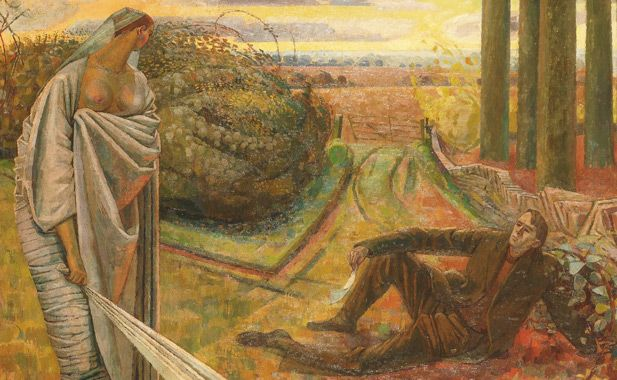
August and the Poet by Evelyn Dunbar (1960)
On the evening of May 12th 1960, whilst out walking in the woods around Staple Farm, Dunbar suddenly collapsed and died. One of Evelyn’s last paintings was Autumn and the Poet which she had started to paint ten years earlier and was still on one of her easels when she died. The figure of the poet, half-seated on the ground, was modelled by her husband. Unfortunately the painting was slightly smoke-damaged in a house fire in 2004, but was restored in time for the 2006 exhibition marking the centenary of Dunbar’s birth.
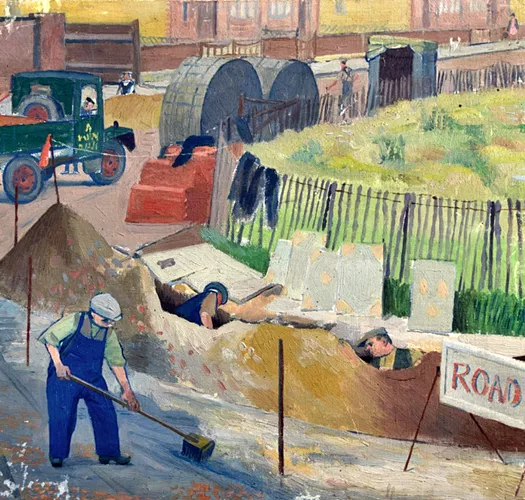
Roadworks by Evelyn Dunbar (Thought to have been produced while studying at Rochester School of Art in c.1926) sold in 2018 for £19,000.
Her main works were her oil paintings but she also left behind many portfolios of watercolours, drawings, pastels, sketches and other secondary work, most of which were not seen for many years after disappearing shortly after her death. The Times newspaper in its obituary of Evelyn Dunbar wrote:
“…Living a retired life in Kent, absorbed in country pursuits, Miss Dunbar did not often come before the public in mixed exhibitions, but her mural paintings and illustrations, with their peculiar authenticity of work inspired by the ruling passion, appealed strongly to those who knew it…”
Roger Folley remarried in 1961, and Evelyn’s works of art were distributed among family and friends.
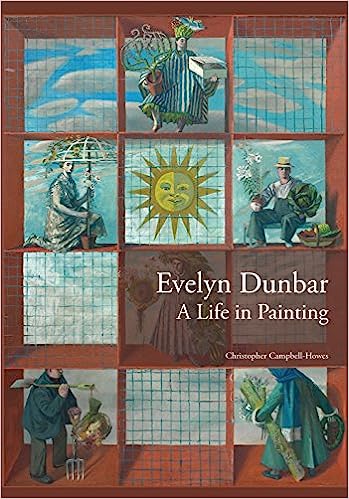
I have only scratched the surface of Evelyn Dunbar’s life and the majority of the information was gleaned from a beautifully written series of blogs regarding this wonderful artist written by her nephew, Christopher Campbell-Howes, who has also published a book on her life an art work.
 my daily art display