New Hope Artist Colony. Part 2.

The second artist I am looking at who was an early member of the New Hope Artists Colony was Edward Redfield

Edward Willis Redfield

Edward Willis Redfield was born on December 18th 1869 in Bridgeville, Delaware, before moving to Philadelphia as a young child. He was the youngest son of Bradley Redfield, who owned plant nurseries and sold fruit and flowers, and Frances Gale Phillips. He had two older brothers, Eugene and Elma, an older sister Ada and a younger sister May. Even at the age of seven he showed a love and talent for art and aged seven he exhibited a drawing of a cow in a competition for school children at the Centennial Exposition in 1876. From an early age, he studied at the Spring Garden Institute and the Franklin Institute and continued to show artistic talent. It was Redfield’s aim to be accepted into the Pennsylvania Academy, so in preparation for studying there, he received training from a commercial artist, Henry Rolfe. In 1887 Edward’s dream came true when he was accepted on a two-year course at the Pennsylvania Academy of the Fine Arts in Philadelphia. At the Academy his tutors were Thomas Anshutz, James Kelly and Thomas Hovenden. Anshutz, like Thomas Eakins, focused on an intense study of the nude as well as on human anatomy. While a student at the Academy Redfield met Robert Henri, who would later become an important American painter and educator and he and Henri became lifelong friends with  Henri often spedingt weekends at the Redfield home.

Village of Equihen, France by Edward Willis Redfield (1908)

Once he had completed his studies at the Academy in 1889, he approached his father for financial support for his proposde trip to study art in Paris. Redfield’s father agreed to send his son fifty dollars per month to finance a period of study in Europe and so Redfield left for Paris with the sculptor and former fellow student, Charles Grafly and they met up with Robert Henri in the French capital. Redfield and Henri attended classes at the Julian Academy, a school which provided art tuition to foreigners who had difficulty gaining entrance to the Ecole des Beaux-Arts. His instructors there were William Adolphe Bouguereau, one of the leading and best-known French academic painters and Tony Robert-Fleury. .Whilst residing in France Redfield became influenced by the work of the Impressionist painters Claude Monet, Camille Pissarro, and the Norwegian artist Fritz Thaulow.

Hotel Deligant in Bois-le-Roi-Brolles

It was while he was living in France that Redfield met Elise Devin Deligant, the daughter of the innkeeper of the Hotel Deligant in the village of Bois-le-Roi, a French commune located on the edge of the forest of Fontainebleau and along the Seine, 6km from Fontainebleau and 60km from Paris. The village inn became a meeting place for Redfield, Henri, Grafly, and they attracted other young artists who would come and the enlarged group would have long discussions about art and aesthetics. It was winter at the inn and Redfield became captivated by local snow scenes. Originally Redfield had set his heart on becoming a portrait artist but he abandoned this idea and decided to concentrate on landscape painting. He stated the reason for his decision:

“…With landscape, if I make it good enough, there are many who will appreciate it. Portrait painting must please the subject as a general thing – or no pay! It’s a hired man’s job…”

Canal en Hiver by Edward Willis Redfield

Many of those artists who used to meet at the inn submitted works to the Paris Salon of 1891. Redfield sent his painting entitled Canal en Hiver, one of his first winter snow scenes and it was accepted.

Redfield left France in 1892 to return to America where his one-man exhibition was being staged in Boston. The following year, 1893, Redfield returned to London where he married Elise Deligant. Sadly their first child died and this tragic event caused his wife to suffer from bouts of depression and mental illness, all her life. However, the couple went on to have five children, three sons, Laurent, Horace and George and two daughters, Louise and Frances.

1898 Historical Map of Center Bridge and Hendrick Island. Red arrow marks position of Redfield’s house.

On returning to America Redfield and his wife settled in Glenside, Pennsylvania but in 1898 they relocated to a home he had renovated in the Pennsylvania town of Center Bridge which was situated alongside the Delaware River towpath and several miles north of New Hope. They purchased a property that was situated between the Delaware River and the Delaware Canal in Center Bridge. The property included an island in the river, known then as Hendrick Island, where his father lived and farmed.

Center Bridge by Edward Willis Redfield (1926)

Redfield was one of the first painters to move to the area and is thought to have been a co-founder of the artist colony at New Hope along with William Langson Lathrop, who had taken up residence in New Hope that same year. Soon after settling in Center Bridge, Redfield began to produce a series of local snow scenes and soon his name became synonymous with the painter of the winter landscapes. Redfield completed his painting entitled Center Bridge in 1904 and it depicts a view of Redfield’s home town from a nearby hill. As expected the scene has changed nowadays since woods and new neighborhoods have grown over these hills. This painting is currently at The Art Institute of Chicago.

The Burning of Center Bridge” by Edward Willis Redfield

The large covered bridge across the river seen on the right of the picture no longer exists as it burned down in 1923 and was captured in Redfield’s painting entitled The Burning of Center Bridge.

New Hope by Edward Willis Redfield (1926)

Redfield’s works were, unlike many of his contemporary landscape painters, monumental in size, in contrast to the often-small sentimental works of the earlier nineteenth-century American landscape painters. He was a fast painter, as he had been taught in his early days, and often completed his 50 x 56 inch winter snow scenes, en plein air, in often harsh freezing conditions, in eight hours. Redfield stated:

“…What I wanted to do was to go outdoors and capture the look of a scene, whether it was a brook or a bridge, as it looked on a certain day…”

Redfield described his modus operandi for the plein air painting sessions saying that he would start by walking to his designated site often trudging through slush and snow with his gear weighing fifty pounds and his huge canvas balanced on his head. He said that he would start with almost no under-drawing and finish his painting in a single session using small brushes to cover the entire canvas with thick paint.

The Rock Garden, Monhegan Island, Maine by Edward Willis Redfield (1928)

Beginning in 1902 the Redfield family spent their summers at Booth Bay Harbor, Maine, due to the generosity of Dr. Samuel Woodward, who financed these annual vacations. In June 1903 the Redfields invited Robert Henri and his wife to spend part of their summer with them. During their stay Henri and Redfield sailed around the neighbouring islands constantly searching out suitable subject matter for their paintings. Henri was especially impressed by the beauty of Monhegan Island, an island in the Gulf of Maine. Redfield’s many paintings depicting New Hope landscapes were now supplemented with Maine seascapes. Other works would focus on the flora found on Monhegan Island, Maine. The Rock Garden, Monhegan Island, Maine by Edward Redfield is a study of peace and tranquillity during a warm summer’s afternoon painted in vibrant colours. In this painting Redfield builds up the paint with multiple layers of thick pigment, creating a rich impasto texture. The lively brushstrokes create a dynamic cross-hatching effect and a pattern of colour that brings the scene to life. In the foreground the vividly coloured and rigorously painted flower beds provide a dynamic contrast to the austere New England clapboard houses. A winding path runs diagonally through the scene, providing a sense of spatial recession to a distant shore. The painting sold for USD 750,000 at a 2015 Christies auction. Redfield was awarded the N. Howard Heinz Prize of $500 for The Rock Garden, Monhegan Island, Maine in 1928 at the Grand Central Art Galleries, New York. Redfield, like Henri, fell in love with the beauty of Monhegen Island so much so that he eventually purchased a house at Boothbay harbour and from then on spent nearly every summer vacation around the area.

Fleecydale Road by Edward Willis Redfield

Redfield completed his painting entitled Fleecydale Road in 1930. This road starts in the town of Lumberville on the Delaware River and ends in Carversville. Lumberville was once the home of another covered bridge across the river which was later replaced with a metal bridge that was restricted to pedestrian traffic. It connected walkers to a state park on the New Jersey side. This picture can be seen at the Michener Art Museum in Doylestown, PA.

Winter Reflections by Edward Willis Redfield (1935)

Another snow scene by Redfield was his 1935 painting, Winter Reflections. The painting depicts a view of the buildings in New Hope near the railroad station. The buildings backed on to the canal and you are still able to stand at this very spot on the towpath. New Hope’s railroad station is now just a tourist attraction which provides short rides on an old steam train. The painting is part of the collection of the Brandywine River Museum of Art in Chadds Ford, Pennsylvania.

The Mill in Winter by Edward Willis Redfield (1921)

Another winter scene painting by Redfield was his The Mill In Winter which he completed in 1921. In the Redfield archive papers it was referred to as the Centreville Mill. Centreville was a small crossroads between New Hope and Doylestown but has since disappeared as such as an officially named location. This painting is at the National Gallery of Art in Washington DC.

Spring in the Harbour by Edward Willis Redfield (c.1927)

As Redfield’s international reputation increased, many young artists were attracted to New Hope as according to James Alterman in his book, New Hope for American Art, Redfield was a great inspiration and an iconic role model, and his work is among the most widely recognized of the Pennsylvania Impressionists.

Sadly, in later years, Redfield became disappointed with his early work. In 1947, the year his wife died, he burned a large number of his early works which he considered to be sub-standard. In 1953, at the age of 84, he gave up painting altogether. Redfield talked about his decision saying:

“…I was outside one day. My insteps started hurting. It was very windy and I had a hard time keeping my easel up. So I quit. The main reason though, was that I wasn’t good as I had been, and I didn’t want to be putting my name on an “old man’s stuff,” just to keep going…”

Redfield died on October 19, 1965. Today his paintings are in many major museums, including the Metropolitan Museum of Art in New York City and the Smithsonian American Art Museum in Washington, DC.

…..to be concluded.


Information for this blog came from numerous sources including:

New Hope Colony Foundation of the Arts

Edward Redfield – Champion of Winter’s Timeless and Seductive Beauty

Hollis Taggart Galleries

William James Glackens

To look at the history of the Ashcan School one has to go back a step and look at a group of painters who became known as The Eight.  These eight artists, with Robert Henri, acknowledged as the leader of the group, were Arthur B. Davies, William Glackens, Ernest Lawson, George Luks, Maurice B. Prendergast, Everett Shinn, and John Sloan.

Ashcan School artists and friends at John French Sloan’s Philadelphia Studio, 1898

Luks, Sloan, Glackens, and Shinn worked as newspaper artist/reporters and illustrator-cartoonists and maybe because of this connection, the many paintings of these artists took on a journalistic quality.  All eight artists utilised the crowded life found on the New York streets as the subject of their paintings.  Their work depicted un-idealized views of life in a big city and focused on the bars and the clientele, dark grubby-coloured tenements, pool halls, and slums. This was the epitome of urban realism.  Realism in art was described by Gustave Courbet in an open letter he wrote on December 25th 1861, now referred to as his Realist Manifesto.  He wrote:

“…To know in order to do, that was my idea. To be in a position to translate the customs, the ideas, the appearance of my time, according to my own estimation; to be not only a painter but a man as well; in short, to create living art – this is my goal…”

 At the high point of their popularity these men were seen as confronting Academia which favoured the genteel tradition of “art for art’s sake, and which had dominated the American art establishment for many decades with works from likes of John Singer Sargent and Abbott Handerson Thayer.

However, on February 3rd, 1908, the MacBeth Galleries, New York, opened an exhibition featuring The Eight artists. It caught the attention of the American art world and although the show remained on view in New York for less than a fortnight, it was taken to several cities including Chicago, Detroit, and Philadelphia.  These exhibitions were lauded as watershed exhibitions of 20th-century vanguard art.   It was a triumph of “American” art.

The name “Ashcan School” was a derisive criticism of The Eight and their works of art, which appeared in an article in The Masses, an American magazine of socialist politics.  The author of the article alleged that there were too many “pictures of ashcans and girls hitching up their skirts on Horatio Street” in their paintings.  The group of artists were amused by the article and the group soon became known as the Ashcan School of painters. The Ashcan School of artists had also been known as “The Apostles of Ugliness”.

William Glackens by Robert Henri (1904)

A few blogs back I looked at the life of George Luks who was an American realist painter connected to the Ashcan School.  Today I am looking at the life and paintings of one of his contemporaries who was also one of the Ashcan School of painters.  He is William James Glackens. William Glackens was born in Philadelphia on March 3rd 1870.  He was the youngest of three children to Samuel Glackens, a cashier for the Pennsylvania Railroad and his wife Elizabeth Glackens.  William’s siblings were an older sister, Ada and an older brother Louis who would later become a cartoonist and illustrator and work on early animation films.

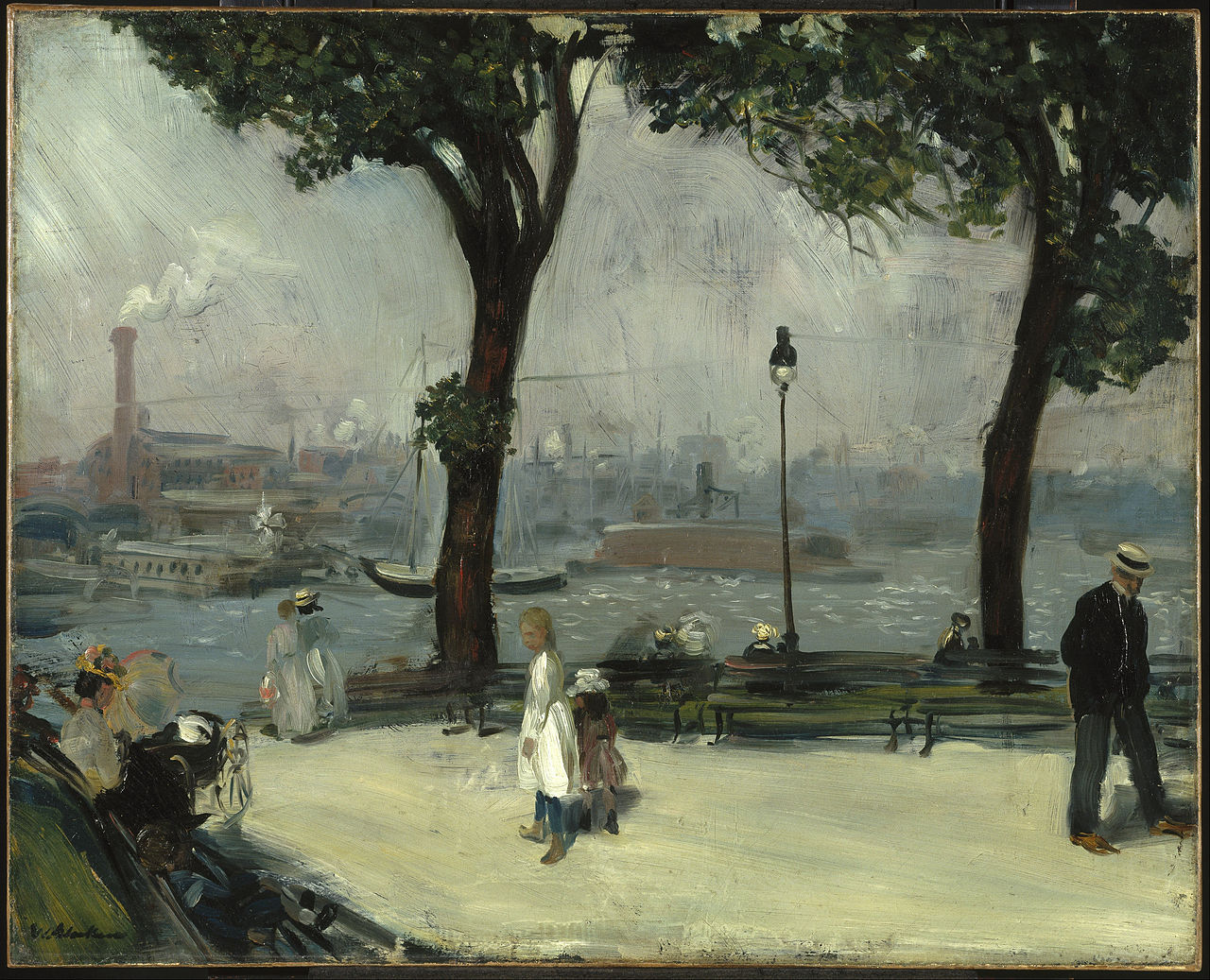
East River Park by William Glackens (1902)

William attended the Central High School where one of his fellow students John Sloan, who would later become a member of The Eight.  Glackens graduated from the Central High School in 1890. Throughout his school days Glackens loved to draw and paint and became a very accomplished artist and in November 1891, aged twenty-one, he and Sloan enrolled at the Pennsylvania Academy of Fine Art. Glackens also worked as an artist reporter for many newspapers, starting at the Philadelphia Record.  His task was to pictorially record news events and had to work to tight deadlines.

Christmas Shoppers by William Glackens (1912)

In October 1894, having completed his studies at the Academy of Fine Art, Glackens started a job as a staff artist/reporter for the Philadelphia Press and worked alongside fellow artists Sloan, Edward Davis, George Luks, and Everett Shinn.  Around this time Glackens was introduced to Robert Henri by Sloan.  Henri was an artist five years older than the pair.  He had returned to study at the Academy for a second stint after spending time in Paris studying at the Académie Julian, under William-Adolphe Bouguereau, where he developed a love for Impressionism and later, he was admitted into the École des Beaux Arts.  Besides befriending Glackens and Sloan two more aspiring artists, George Luks and Everitt Shinn joined the informal group which met at Henri’s apartment to discuss art, philosophy, culture and more, their meetings became known as the Charcoal Club because they would spend time using that medium to produce drawings from life.  This informal group explored art genres not available at the Academy, such as nude figure drawing. They also became interested in the social philosophical writings of Ralph Waldo Emerson, Walt Whitman, Émile Zola, and Henry David Thoreau.  Besides meeting to draw. paint and discuss philosophy, the group led a very sociable life during which alcohol played its part !

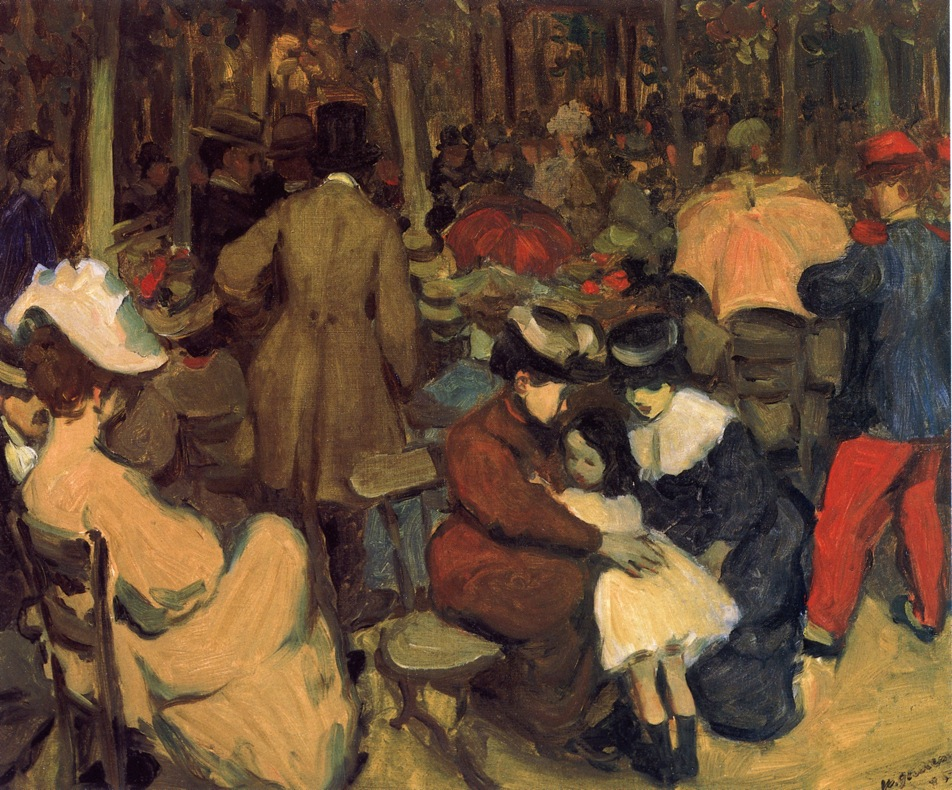
Figures in the Park, Paris by William Glackens (1895)

In 1895, Glackens, along with several other artists, including Robert Henri travelled to Europe so that they could learn more about  European art.  The first country they visited was Holland where Glackens scrutinised the work of the Dutch masters. From there he went on to the French capital where he and Henri rented a studio apartment for a year. For Glackens, staying in Paris, exposed him to the work of the great Impressionists and Post-Impressionists.  His greatest influence was the work of Manet.

Lena (the artist’s daughter) Painting by William Glackens (1918)

Glackens returned to America in 1896 and moved to New York and spent time at Henri’s many social gatherings.  Glackens took up employment at the New York Herald as a reporter and also worked as an illustrator for various magazines.  These two lines of work provided him with a good steady income and over the next decade he produced more than a thousand illustrations.  Although many were comedic in nature, in April 1898 the Spanish-American War broke out in Cuba and the McClure’s Magazine sent him there to collate the news and produce newsworthy illustrations.  It was a difficult assignment and his living conditions were poor.  On his return to New York, he was taken ill and it was discovered that he had contracted malaria which would return time and again during his life.

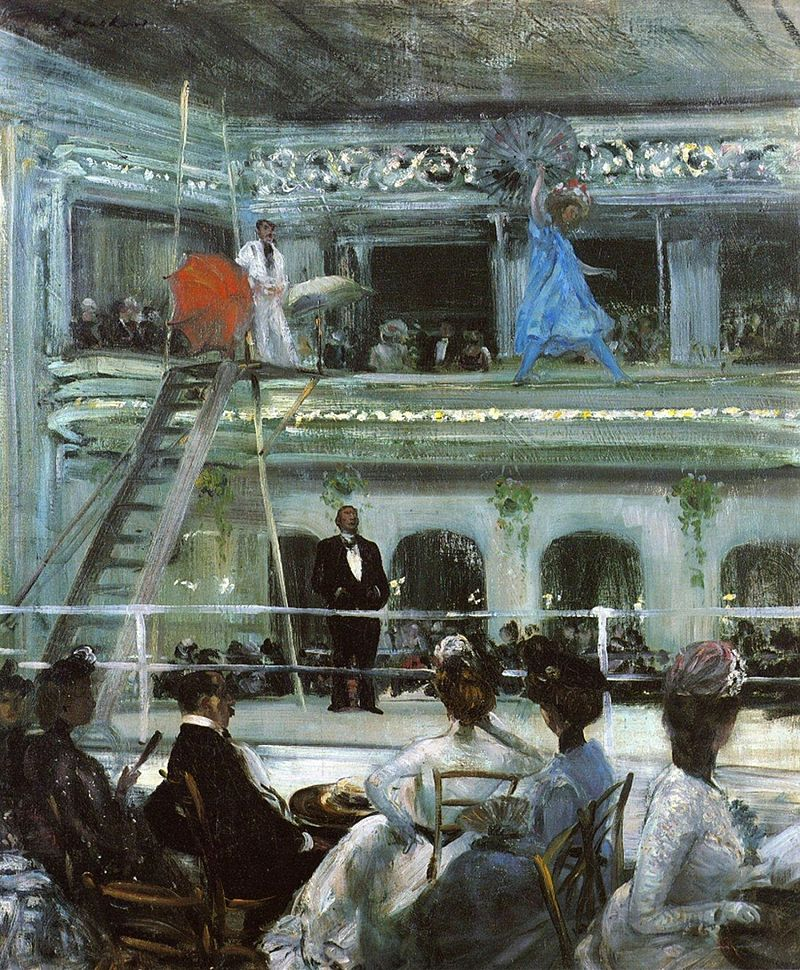
Hammerstein’s Roof Garden by William Glackens (1901)

In 1901 Glackens completed a painting entitled Hammerstein’s Roof Garden.  Hammerstein’s Roof Garden was the official name of the fashionable semi-outdoor vaudeville venue that theatre magnate, Oscar Hammerstein I, built atop the Victoria Theatre and the neighbouring Theatre Republic.  During summer months theatres were often closed due to the suffocating atmosphere inside the venues and so roof garden venues were very popular.  The viewer is placed as if they are part of the audience and in front of us, we see a a colourfully dressed female tightrope walker as she tentatively navigates the rope which is strung across the stage.  In the foreground we see the audience, some of which are unaccompanied females which was something that years ago would have been unheard of.  The painting is now part of the Whitney Museum of American Art collection in New York.

The Artist’s Wife, Edith Dimock Glackens, in her Wedding Dress by William Glackens (1904)

William Glackens’ single status ended in 1904 when he married Edith Dimock.  Edith, who was six years younger than William, came from a wealthy Hartford Connecticut family which made its fortune as silk merchants.  Despite her family’s strong objections but she turned away from business as a career and instead set about becoming a professional artist.  She left home and moved to New York City when, in her early twenties, she enrolled at the Art Students League where she studied with American Impressionist William Merritt Chase.

Sweat Shop Girls in the Country by Edith Dimock (c.1913) 

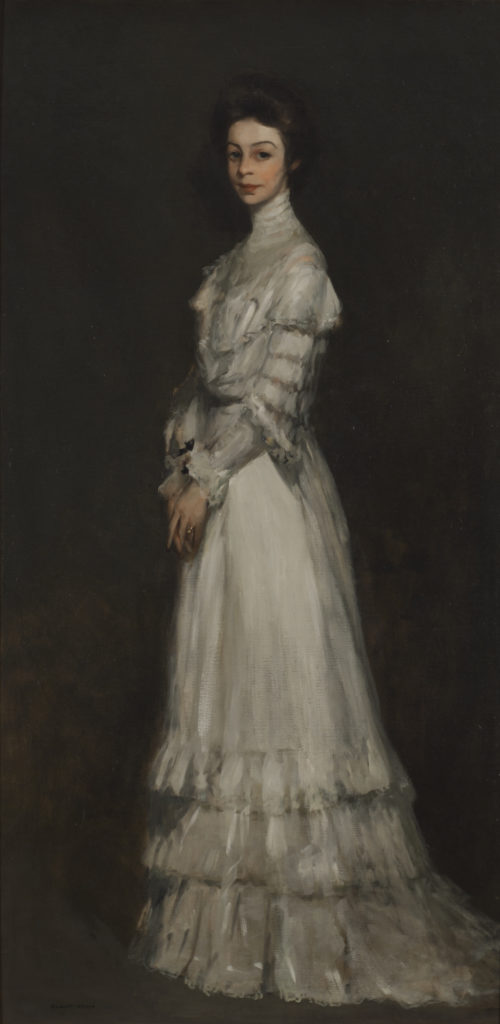
She soon made a name for herself as a talented watercolourist depicting women and children of working- and middle-class backgrounds. Through his wife’s wealth, Glackens could concentrate on his art, and often Edith and later their daughters, Ira and Lenna became his models. His 1901 portrait of his wife is of a classical formal style.  Set against a dark background, Edith is depicted wearing a black coat and hat with a long brown pleated skirt.  As with many of his portraits Glackens wanted his subjects to be seen just as they were, warts and all, and refused to idealize his sitters.   In this portrait Glackens has made no attempt to either make the depiction more modern or beautify the sitter.

Portrait of Edith Dimock Glackens by Robert Henri (c.1902)

His friend Robert Henri also painted a portrait of Edith around the same time which appears more idealized and certainly adds a touch of beauty to the depiction.

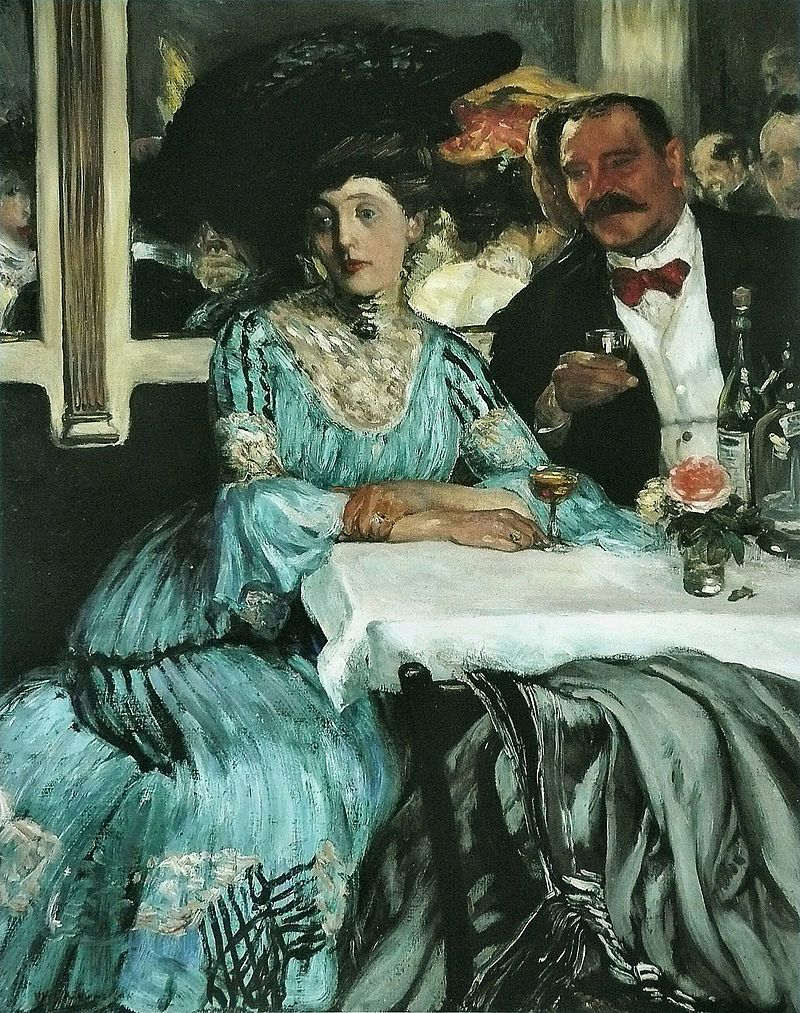
At Mouquin’s by William Glackens (1905)

Artists need to sell their work and to do this their work has to be shown at exhibitions.  However it was not always easy for many artists to have their work accepted by exhibition juries and in 1907, Glackens and many of his contemporaries decided to take the matter into their own hands and split from the National Academy of Design who they felt, for some reason, stopped accepting their work  The Eight, as they had come to be known, led by Robert Henri decided to host their own exhibition at the Macbeth Galleries in New York City and an opening date for the event was set for February 3rd 1908.

May Day in Central Park by William Glackens (1905)

Although part of the Ashcan School of Painters, Glackens preferred to use a lighter palette for his work, unlike the darker palette used by the others who liked to depict the darker and grittier side of life in the city.  For Glackens depictions of family life whilst shopping or relaxing in the park were his favourite subjects for his paintings.   Unlike his colleagues Glackens preferred to focus more on scenes of leisure and entertainment rather than concentrate on the misery of life in the slums of the Lower East Side.

The Green Car by William Glackens (1910)

The consequences of working as an artist/reporter for a number of Philadelphia and New York newspapers taught him to observe the smallest of details of a scene.  In New York Glackens had a studio on Washington Square Park and it was from here he captured a scene for his 1910 painting entitled The Green Car.  The painting depicts a green trolley car as it rounds the corner at the south side of the park and we see it is heading towards a lady who is standing by the snowy curb, waiting to alight.  She is dressed smartly in a long coat, hat, and muff, she signals to the conductor of the trolley car.  Our eyes move from the foreground and the green trolley car across the snow-covered grass, through the trees and finally alight on a row of three-storey brick tenement buildings.

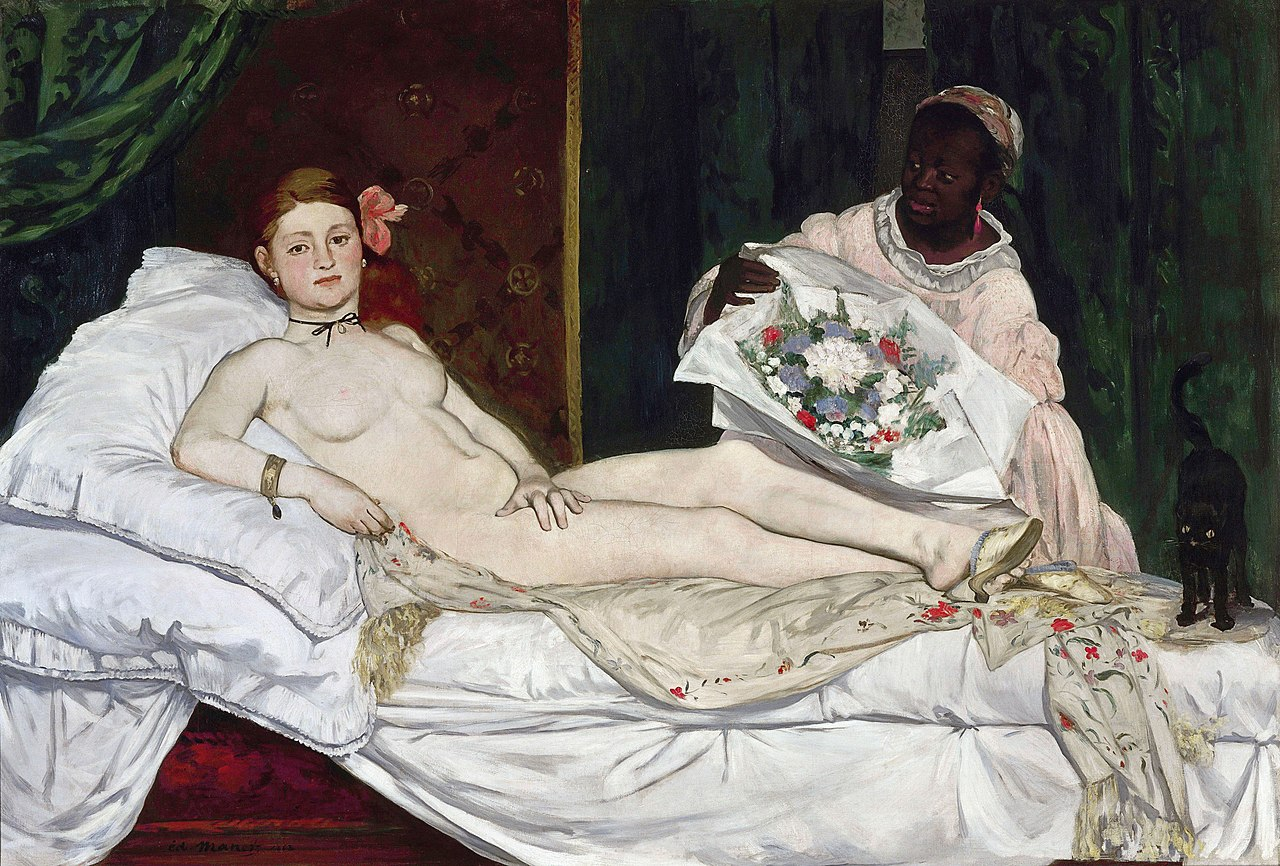
Olympia by Manet (1863)

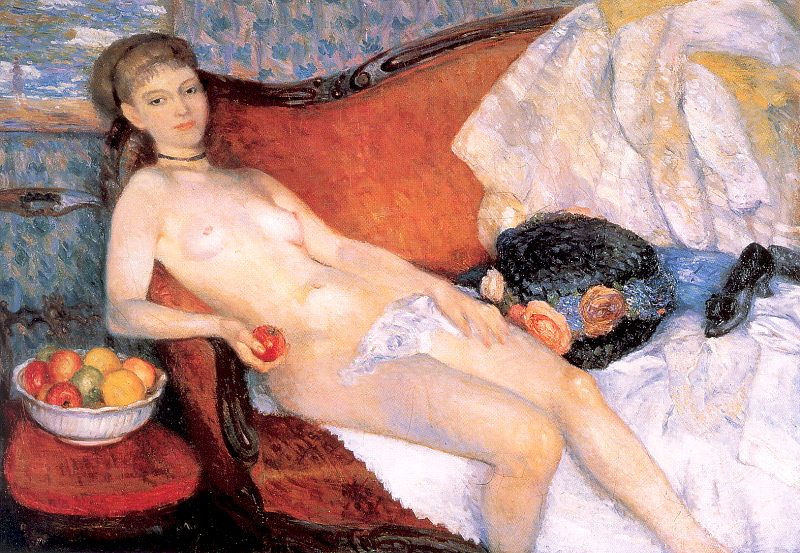
In 1910 Glackens produced what many believe is his homage to Édouard Manet’s Olympia with his painting entitled Nude with Apple

Nude with Apple by William Glackens (1910)

It depicts a reclining nude holding an apple which she has taken from the nearby bowl on her right.  To her left on the sofa there is a large hat and a pile of her discarded clothing including one blue shoe.  She wears a black choker around her neck which harks back to the same accoutrement warn by Manet’s reclining nude, Olympia.  Whereas Manet’s Olympia covered her pubic region with her hand, Glackens has modestly covered his model’s pubic region with a piece of discarded white lingerie.  Glackens’ depiction is another of his typical realist genre.  The model is ordinary.  She could not be termed beautiful.  The depiction alludes to her being simply one of Glackens’ models who has just arrived at his studio wearing a large flowery hat, a gown and blue shoes.  She then hurriedly undressed, abandoning her clothes on the sofa.  The scene seems to have been unscripted.    And yet…..are we to think of the apple in her hand as symbolising Eve?

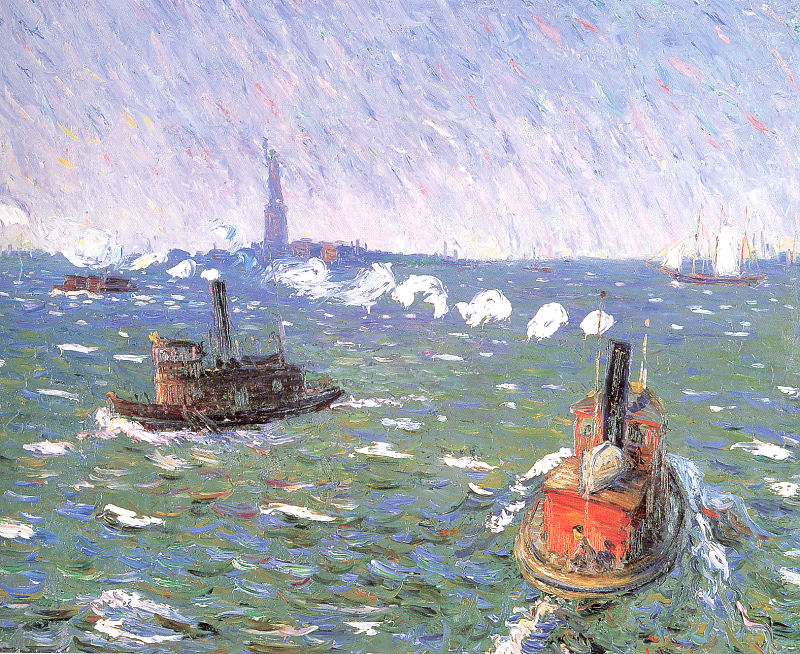
Breezy Day, Tugboats New York by William Glackens (1910)

Glackens extensive knowledge of European art and artistic trends in Europe led him to be commissioned by Albert Barnes, the American chemist, businessman, art collector, writer, and educator, in January 1912 to travel to Europe and buy paintings for him which would then become the foundation for the Barnes Collection in Philadelphia.  Barnes was also a High School classmate of Glackens and gave him twenty thousand dollars to be used for purchasing paintings and Glackens returned with thirty-three works of art.  That December Barnes himself travelled to Paris to buy more works of art.

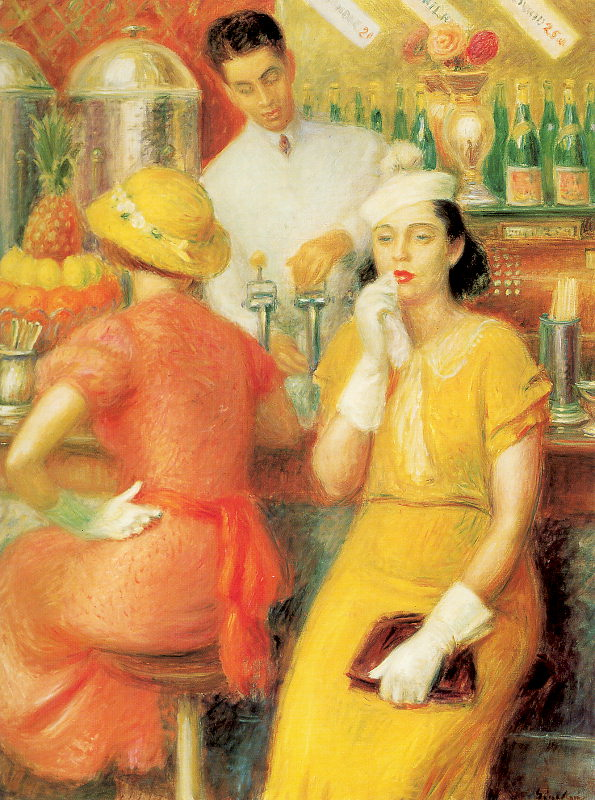
Soda Fountain by William Glackens (1935)

On Feb. 17th, 1913, the International Exhibition of Modern Art opened at the 69th Regiment Armory on Lexington Avenue in New York. The Armory Show, as it came to be known, had a profound effect on American art.  William Glackens helped to organize the American section of this ground-breaking exhibition but later reflected on how the American art was somewhat inferior to the European submissions. He voiced his opinion:

“…Everything worthwhile in our art is due to the influence of French art. We have not yet arrived at a national art […] I am afraid that the American section of this exhibition will seem very tame beside the foreign section. But there is a promise of renaissance in American art…”

William Glackens in his studio (c.1915)

Although he liked the modern and much more abstract European works Glackens maintained his love of painting scenes of everyday life and always remained a realist artist. During the inter-war years Glackens made a number of trips to Europe buying European works to enhance the Barnes collection. Glackens died of a cerebral haemorrhage on May 22nd 1938 while spending a weekend visiting fellow artist Charles Prendergast in Westport, Connecticut. He was 68.