
New Hope Artists. Part 3.

The third artist who was involved in the early days of the New Hope Artists Colony was Daniel Garber.  He has been looked upon as being one of the three most important painters of that group

Daniel Garber

Daniel Garber was born on April 11th, 1880, in North Manchester, Indiana. He was the son of Daniel Garber and Elizabeth Garber (née Blickenstaff). Daniel always had a love of art and the belief he could some day become a professional artist.  In 1897, when he was sixteen years old he enrolled at the Art Academy of Cincinnati.  In that same year he moved to Philadelphia and in 1899 he became a student at the Pennsylvania Academy of the Fine Arts on a six year course.  His instructors at the Academy included Thomas Anshutz, William Merritt Chase, and Cecilia Beaux.  During the summers of 1899 and 1900 he also registered to take summer school classes in Fort Washington, Pennsylvania, at the Darby School of Painting, where he studied under Hugh Breckenridge, an artist and educator who championed the artistic movements from impressionism to modernism and Thomas Anshutz, an artist known for his portraiture and genre scenes, and who, along with Breckenridge, was a co-founder of The Darby School. This summer art school flourished first in Darby, PA, and then in Fort Washington, PA, between 1898 and 1918.  Anshutz and Breckenridge brought a lot of new ideas about painting back to Philadelphia after their European stays, and introduced those ideas to a public that was initially not very responsive to Impressionism, 
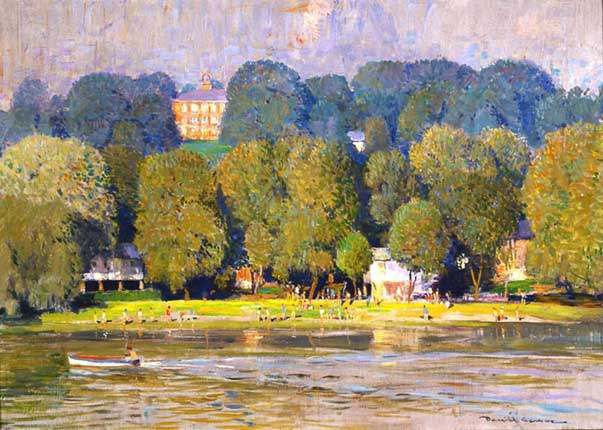
Lambertville Beach by Daniel Garber

During his time as a student at the Pennsylvania Academy, Daniel Garber met fellow artist Mary Ethel Franklin while she was posing as a model for the portrait class of Hugh Breckenridge. Peviously, she had been a student of Howard Pyle when he taught at the Drexel Institute. Following on from a two-year courtship, Garber and Mary were married on June 21st, 1901.
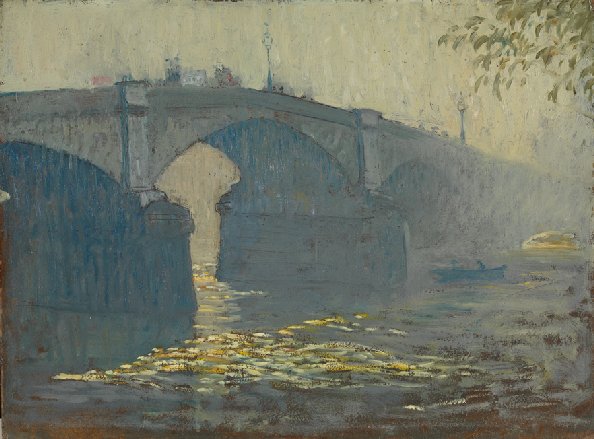
Battersea Bridge by Daniel Garber (1905)

Whilst still studying at the Academy, Daniel opened a studio in Philadelphia in 1901 and set to work as a portraitist and commercial artist. In May 1905, he won a Pennsylvania Academy award, The William Emlen Cresson Traveling Scholarship, which financed him to go to Italy, England and France for two years of independent studies. During his two-year sojourn in Europe he was continually creating paintings which depicted different rural villages and farm scenes and built up a collection of Impressionist landscapes some of which were exhibited at the Paris Salon. One such work was entitled Battersa Bridge.
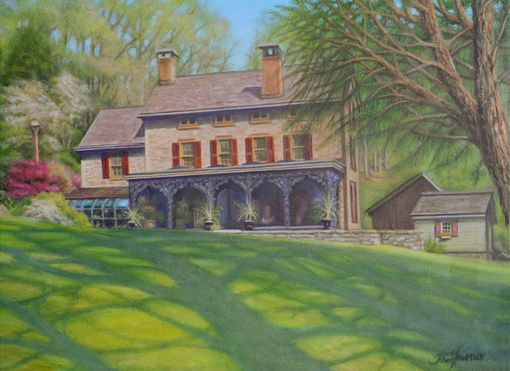
Painting of Daniel Garber’s home, Cuttalossa, by J.C.Turner

Upon his return to America in 1907, Garber began teaching life and antique drawing classes at the Philadelphia School of Design for Women. That summer, Garber, his wife and baby Tanis settled in Lumberville, Pennsylvania, a small town just north of New Hope. Their new summer home came to be known as Cuttalossa, named after the creek which occupied part of the land. The family spent part of their time in Lumberville and part in Philadelphia at their Green Street townhouse which he used as a base when he was teaching.
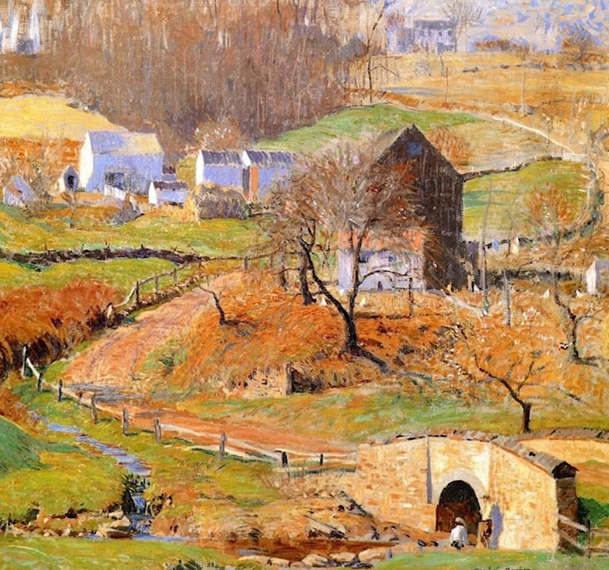
Rural Landscape by Daniel Garber
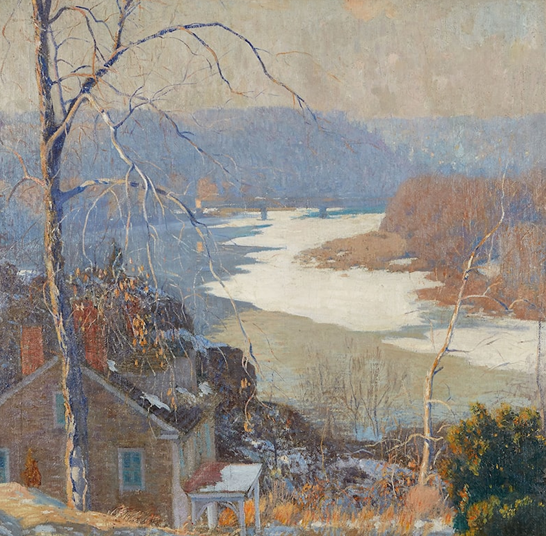
Up the River, Winter by Daniel Garber (1917)

Daniel submitted many of his Pennsylvania landscapes at various exhibitions and received numerous prestigious awards for these works.

Garber teaching at Chester Springs, c. 1935. Image courtesy of the Garber family.

In Autumn 1909, Garber was offered a position at the Pennsylvania Academy as an assistant to Thomas Anshutz. Garber accepted and became an notable instructor of art at the Academy where he taught for the next 41 years. As a lecturer in art, Garber aroused in his students an anxious silence as he passed among them, correcting the mistakes in their work. The brusque severity of his remarks often had his students, especially the women, in tears. He commented to one female student whilst critiquing her artwork:

“…Can you cook?……You sure can’t draw, so you’d better learn how to cook…”

Garber’s students, albeit often fearing his harsh critiques, respected his honest comments, realising the value of his observations and understanding the high expectations and dedicated concern underlying them.
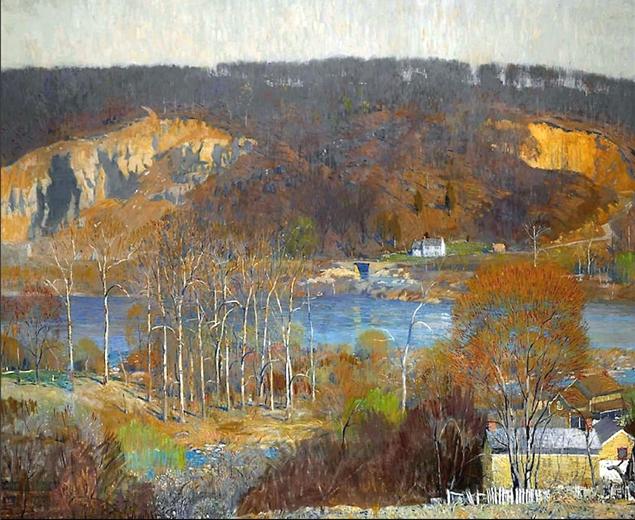
The Valley – Tohickon by Daniel Garber (1914)

Daniel Garber painted consummate landscapes depicting the Pennsylvania and New Jersey countryside which surrounded New Hope. In contrast to fellow New Hope artist, Edward Redfield, Garber delicately painted using a thin paint application technique. His paintings exude both beautiful colour and light, which generate a sensation of endless depth. Garber like Redfield painted large exhibition size works with the intention of submitting them to exhibitions and winning prizes which they were both extremely successful doing so.
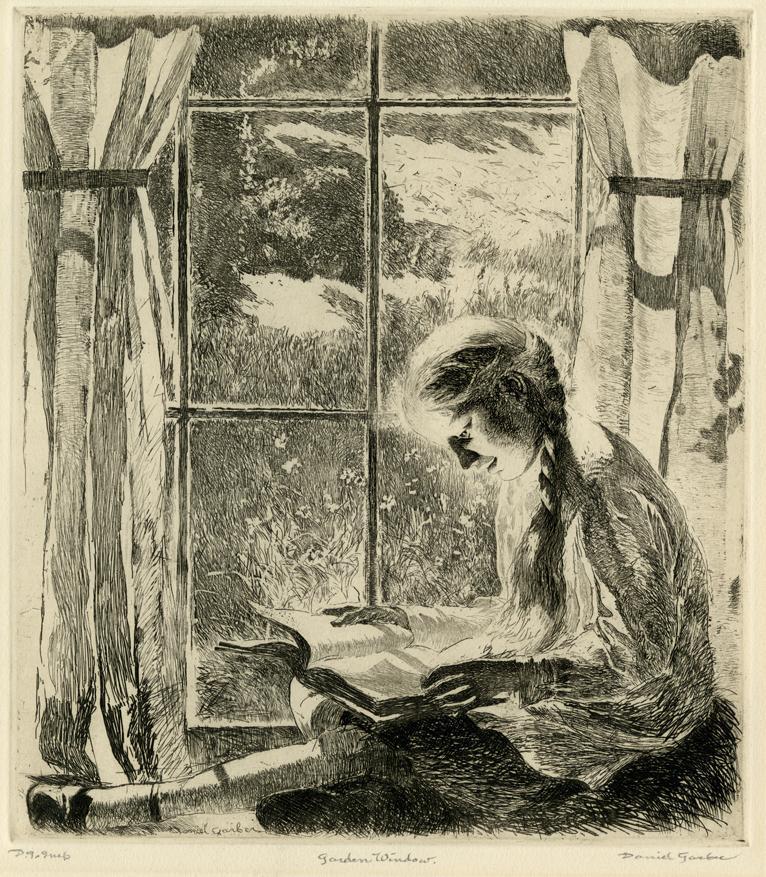
Garden Window, an etching and drypoint on paper by Daniel Garber (1946).

Although, he completed many small delicate paintings he was a fine draftsman, and completed many works on paper, mostly in charcoal but also a few works in pastel. Daniel Garber was also a talented etcher completing a series of about fifty different scenes, most of which run in editions of fifty or fewer etchings per plate.

Stockton Church etching by Daniel Garber (1941)

Daniel Garber loved to sketch. In fact the first jobs he held during his teenage years honed his skills as a draftsman. After working at the Franklin Engraving Company, Daniel Garber illustrated books and magazines, one of which was the collected works of Theodore Roosevelt. In 1917, he went back to his first love, drawing, this time as a printmaker. There was financial sense for Garber in making prints as by doing so he widened his exposure as an artist, exhibiting his work at print venues as well as the usual gallery outlets. He held many one-man exhibitions of his drawings, etchings, and prints and this meant an expansion to his market.
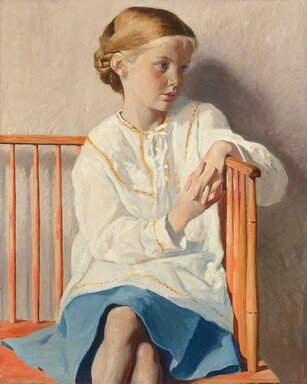
Tanis Garber by Daniel Garber (1914)

Daniel and Mary Garber’s first child Tanis had been born in Paris on December 16th 1906 and when she was seven years old her father completed her portrait. The portrait is part of the National Gallery, Washington’s collection.

Tanis by Daniel Garber (1915) From the Warner Collection of the Westervelt Warner Company, displayed in the Westervelt Warner Museum of American Art, Tuscaloosa, Alabama.

In this depiction (above) of his daughter Tanis he portrays her as if standing in a doorway of his studio at their home, Cuttalossa. In this work Garber began to explore the passage of light through air and objects. Although this might look like an Impressionist-style work, it is not about capturing fleeting light effects or impressions. In fact, Garber said that the painting was worked on over all of the summer months of 1915, with himt apparently returning to the work when his general light effects could be recreated. What Garber had in mind was his desire to simply achieve a Golden Age depiction of childhood; an eternal idealized image, rather than a momentary real one.

The Boys by Daniel Garber (1915) Depicting three of Garber’s students at the Pennsylvania Academy of the Fine Arts, this oil was created in his studio at Cuttalossa

Garber’s second child, John Franklin Garber was born in Pennsylvania on September 25th 1910, three years after his parents had returned to America from France. He grew up on the Garber property Cuttalossa, near Lumberville and he, like his sister Tanis and his mother, posed for many of Garber’s figurative paintings. He attended Penn Charter School and graduated with a degree in chemical engineering from Lehigh University in 1933. John Garber became a keen sponsor and advocate of his father’s work, assisting and corresponding with museums, private collectors, dealers and writers
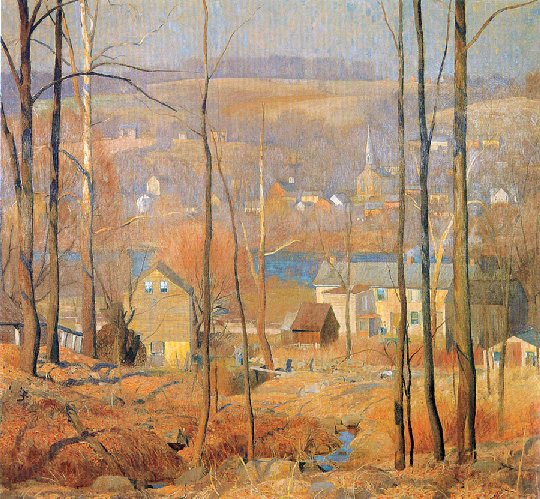
Geddes Run by Daniel Garber (1930)

Daniel Garber’s works were exhibited nationwide and many earned awards, including a gold medal at the Panama-Pacific International Exposition in 1915 in San Francisco, California. He was elected a member of the National Academy of Design in 1913.
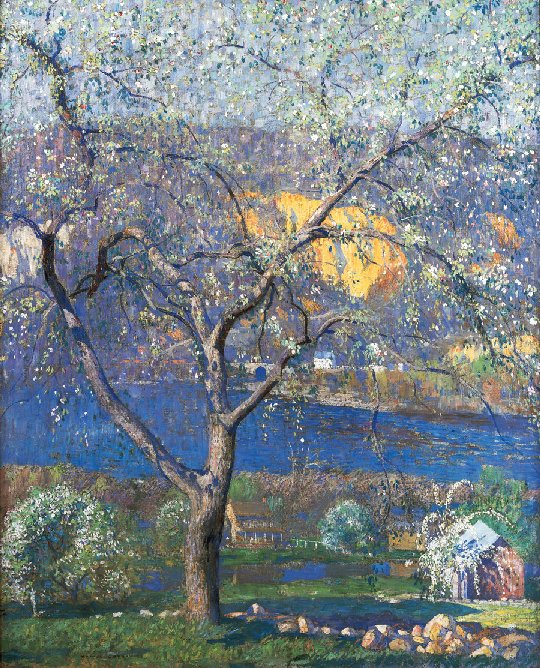
Buds and Blossoms by Daniel Garber (1916)

Daniel Garber died, aged 78, on July 5th, 1958, after falling from a ladder at his studio.

He continued to paint until nearly the end of his life and produced over 2,500 objects which were shown at over 750 exhibitions during the course of his lifetime. It had always been his desire to create and to share his art with the public. This interest in art and educating was also apparent by his forty-one years at the Pennsylvania Academy of Fine Arts, where he taught from 1909 until 1950, where he offered up his knowledge of art and was able to influence succeeding generations of artists. Garber’s paintings today are considered by collectors and art historians to be among the finest works produced from the New Hope art colony. His paintings can be seen in many major museums including the Smithsonian American Art Museum in Washington, DC, the Art Institute of Chicago and Philadelphia Museum of Art.

Was he the greatest of the New Hope painters ? I will let you decide.


Information for this blogs was obtained from a number of sources including:

Incollect

New Hope Colony Foundation of the Arts

Michener Art Museum

Jims at Lambertville

New Hope Artist Colony. Part 2.

The second artist I am looking at who was an early member of the New Hope Artists Colony was Edward Redfield

Edward Willis Redfield

Edward Willis Redfield was born on December 18th 1869 in Bridgeville, Delaware, before moving to Philadelphia as a young child. He was the youngest son of Bradley Redfield, who owned plant nurseries and sold fruit and flowers, and Frances Gale Phillips. He had two older brothers, Eugene and Elma, an older sister Ada and a younger sister May. Even at the age of seven he showed a love and talent for art and aged seven he exhibited a drawing of a cow in a competition for school children at the Centennial Exposition in 1876. From an early age, he studied at the Spring Garden Institute and the Franklin Institute and continued to show artistic talent. It was Redfield’s aim to be accepted into the Pennsylvania Academy, so in preparation for studying there, he received training from a commercial artist, Henry Rolfe. In 1887 Edward’s dream came true when he was accepted on a two-year course at the Pennsylvania Academy of the Fine Arts in Philadelphia. At the Academy his tutors were Thomas Anshutz, James Kelly and Thomas Hovenden. Anshutz, like Thomas Eakins, focused on an intense study of the nude as well as on human anatomy. While a student at the Academy Redfield met Robert Henri, who would later become an important American painter and educator and he and Henri became lifelong friends with  Henri often spedingt weekends at the Redfield home.

Village of Equihen, France by Edward Willis Redfield (1908)

Once he had completed his studies at the Academy in 1889, he approached his father for financial support for his proposde trip to study art in Paris. Redfield’s father agreed to send his son fifty dollars per month to finance a period of study in Europe and so Redfield left for Paris with the sculptor and former fellow student, Charles Grafly and they met up with Robert Henri in the French capital. Redfield and Henri attended classes at the Julian Academy, a school which provided art tuition to foreigners who had difficulty gaining entrance to the Ecole des Beaux-Arts. His instructors there were William Adolphe Bouguereau, one of the leading and best-known French academic painters and Tony Robert-Fleury. .Whilst residing in France Redfield became influenced by the work of the Impressionist painters Claude Monet, Camille Pissarro, and the Norwegian artist Fritz Thaulow.

Hotel Deligant in Bois-le-Roi-Brolles

It was while he was living in France that Redfield met Elise Devin Deligant, the daughter of the innkeeper of the Hotel Deligant in the village of Bois-le-Roi, a French commune located on the edge of the forest of Fontainebleau and along the Seine, 6km from Fontainebleau and 60km from Paris. The village inn became a meeting place for Redfield, Henri, Grafly, and they attracted other young artists who would come and the enlarged group would have long discussions about art and aesthetics. It was winter at the inn and Redfield became captivated by local snow scenes. Originally Redfield had set his heart on becoming a portrait artist but he abandoned this idea and decided to concentrate on landscape painting. He stated the reason for his decision:

“…With landscape, if I make it good enough, there are many who will appreciate it. Portrait painting must please the subject as a general thing – or no pay! It’s a hired man’s job…”

Canal en Hiver by Edward Willis Redfield

Many of those artists who used to meet at the inn submitted works to the Paris Salon of 1891. Redfield sent his painting entitled Canal en Hiver, one of his first winter snow scenes and it was accepted.

Redfield left France in 1892 to return to America where his one-man exhibition was being staged in Boston. The following year, 1893, Redfield returned to London where he married Elise Deligant. Sadly their first child died and this tragic event caused his wife to suffer from bouts of depression and mental illness, all her life. However, the couple went on to have five children, three sons, Laurent, Horace and George and two daughters, Louise and Frances.

1898 Historical Map of Center Bridge and Hendrick Island. Red arrow marks position of Redfield’s house.

On returning to America Redfield and his wife settled in Glenside, Pennsylvania but in 1898 they relocated to a home he had renovated in the Pennsylvania town of Center Bridge which was situated alongside the Delaware River towpath and several miles north of New Hope. They purchased a property that was situated between the Delaware River and the Delaware Canal in Center Bridge. The property included an island in the river, known then as Hendrick Island, where his father lived and farmed.

Center Bridge by Edward Willis Redfield (1926)

Redfield was one of the first painters to move to the area and is thought to have been a co-founder of the artist colony at New Hope along with William Langson Lathrop, who had taken up residence in New Hope that same year. Soon after settling in Center Bridge, Redfield began to produce a series of local snow scenes and soon his name became synonymous with the painter of the winter landscapes. Redfield completed his painting entitled Center Bridge in 1904 and it depicts a view of Redfield’s home town from a nearby hill. As expected the scene has changed nowadays since woods and new neighborhoods have grown over these hills. This painting is currently at The Art Institute of Chicago.

The Burning of Center Bridge” by Edward Willis Redfield

The large covered bridge across the river seen on the right of the picture no longer exists as it burned down in 1923 and was captured in Redfield’s painting entitled The Burning of Center Bridge.

New Hope by Edward Willis Redfield (1926)

Redfield’s works were, unlike many of his contemporary landscape painters, monumental in size, in contrast to the often-small sentimental works of the earlier nineteenth-century American landscape painters. He was a fast painter, as he had been taught in his early days, and often completed his 50 x 56 inch winter snow scenes, en plein air, in often harsh freezing conditions, in eight hours. Redfield stated:

“…What I wanted to do was to go outdoors and capture the look of a scene, whether it was a brook or a bridge, as it looked on a certain day…”

Redfield described his modus operandi for the plein air painting sessions saying that he would start by walking to his designated site often trudging through slush and snow with his gear weighing fifty pounds and his huge canvas balanced on his head. He said that he would start with almost no under-drawing and finish his painting in a single session using small brushes to cover the entire canvas with thick paint.

The Rock Garden, Monhegan Island, Maine by Edward Willis Redfield (1928)

Beginning in 1902 the Redfield family spent their summers at Booth Bay Harbor, Maine, due to the generosity of Dr. Samuel Woodward, who financed these annual vacations. In June 1903 the Redfields invited Robert Henri and his wife to spend part of their summer with them. During their stay Henri and Redfield sailed around the neighbouring islands constantly searching out suitable subject matter for their paintings. Henri was especially impressed by the beauty of Monhegan Island, an island in the Gulf of Maine. Redfield’s many paintings depicting New Hope landscapes were now supplemented with Maine seascapes. Other works would focus on the flora found on Monhegan Island, Maine. The Rock Garden, Monhegan Island, Maine by Edward Redfield is a study of peace and tranquillity during a warm summer’s afternoon painted in vibrant colours. In this painting Redfield builds up the paint with multiple layers of thick pigment, creating a rich impasto texture. The lively brushstrokes create a dynamic cross-hatching effect and a pattern of colour that brings the scene to life. In the foreground the vividly coloured and rigorously painted flower beds provide a dynamic contrast to the austere New England clapboard houses. A winding path runs diagonally through the scene, providing a sense of spatial recession to a distant shore. The painting sold for USD 750,000 at a 2015 Christies auction. Redfield was awarded the N. Howard Heinz Prize of $500 for The Rock Garden, Monhegan Island, Maine in 1928 at the Grand Central Art Galleries, New York. Redfield, like Henri, fell in love with the beauty of Monhegen Island so much so that he eventually purchased a house at Boothbay harbour and from then on spent nearly every summer vacation around the area.

Fleecydale Road by Edward Willis Redfield

Redfield completed his painting entitled Fleecydale Road in 1930. This road starts in the town of Lumberville on the Delaware River and ends in Carversville. Lumberville was once the home of another covered bridge across the river which was later replaced with a metal bridge that was restricted to pedestrian traffic. It connected walkers to a state park on the New Jersey side. This picture can be seen at the Michener Art Museum in Doylestown, PA.

Winter Reflections by Edward Willis Redfield (1935)

Another snow scene by Redfield was his 1935 painting, Winter Reflections. The painting depicts a view of the buildings in New Hope near the railroad station. The buildings backed on to the canal and you are still able to stand at this very spot on the towpath. New Hope’s railroad station is now just a tourist attraction which provides short rides on an old steam train. The painting is part of the collection of the Brandywine River Museum of Art in Chadds Ford, Pennsylvania.

The Mill in Winter by Edward Willis Redfield (1921)

Another winter scene painting by Redfield was his The Mill In Winter which he completed in 1921. In the Redfield archive papers it was referred to as the Centreville Mill. Centreville was a small crossroads between New Hope and Doylestown but has since disappeared as such as an officially named location. This painting is at the National Gallery of Art in Washington DC.

Spring in the Harbour by Edward Willis Redfield (c.1927)

As Redfield’s international reputation increased, many young artists were attracted to New Hope as according to James Alterman in his book, New Hope for American Art, Redfield was a great inspiration and an iconic role model, and his work is among the most widely recognized of the Pennsylvania Impressionists.

Sadly, in later years, Redfield became disappointed with his early work. In 1947, the year his wife died, he burned a large number of his early works which he considered to be sub-standard. In 1953, at the age of 84, he gave up painting altogether. Redfield talked about his decision saying:

“…I was outside one day. My insteps started hurting. It was very windy and I had a hard time keeping my easel up. So I quit. The main reason though, was that I wasn’t good as I had been, and I didn’t want to be putting my name on an “old man’s stuff,” just to keep going…”

Redfield died on October 19, 1965. Today his paintings are in many major museums, including the Metropolitan Museum of Art in New York City and the Smithsonian American Art Museum in Washington, DC.

…..to be concluded.


Information for this blog came from numerous sources including:

New Hope Colony Foundation of the Arts

Edward Redfield – Champion of Winter’s Timeless and Seductive Beauty

Hollis Taggart Galleries

Mary Elizabeth Price

Mary Elizabeth Price

Mary Elizabeth Price, sometimes simply known as M. Elizabeth Price, was born on March 1st 1877 near the town of Martinsburg, West Virginia. Her parents, Reuben Moore Price and Caroline Cooper Paxson Price were Quakers, who lived in Shenandoah, Virginia. She was one of five children, having a sister, Alice Price, and three brothers, Frederick Newlin Price, Rueben Moore Price and Carroll Price. During her early days she lived in Virginnia but the family moved to the Shenandoah Valley and later to New Hope, Pennsylvania where she grew up.

Pennsylvania Museum and School of Industrial Art, Philadelphia. 

Art classrooms at the Pennsylvania Museum and School of Industrial Art, (c. 1891)

According to the Friends Intelligencer and Journal, Elizabeth graduated from her Literary Course at the Friends’ Central School in 1896, aged nineteen, and she enrolled at the Pennsylvania Museum and School of Industrial Art, a museum and teaching institution which later split into the Philadelphia Museum of Art and University of the Arts.

Pennsylvania Academy of the Fine Arts building

In 1904, having completed her course, she enrolled at the Pennsylvania Academy of the Fine Arts and studied under Hugh Breckenridge an artist and educator who advocated the artistic movements from impressionism to modernism. Another of her tutors was Daniel Garber, an American Impressionist landscape painter and member of the art colony at New Hope, Pennsylvania. Elizabeth also took private art lessons from William Langson Lathrop, an American Impressionist landscape painter and who founded the art colony in New Hope, Pennsylvania, where he was an influential founder of Pennsylvania Impressionism.

Picking Flowers by M Elizabeth Price (1916)

In 1917 Elizabeth moved to New York and took part in the “Baby Art School,” which was a pioneering programme funded by Mrs. Harry Payne Whitney (Gertrude Vanderbilt) and previously known as the Neighbourhood Art School of the Greenwich House. Children from nearby public schools were taught the fine arts of drawing, painting, sculpting, pottery, and wood carving. This idea was so successful that Carnegie Institute of Technology in Pittsburgh asked Elizabeth to stage an exhibition of the children’s work in the winter of 1919-1920, in conjunction with an art education campaign for teachers and supervisors in art.

Delphinium Pattern by M Elizabeth Price (1933)

When looking at Elizabeth Price’s work, her floral painting are the ones that are best remembered. She often painted on wooden panels coated with a mixture of gesso and red clay. Then, gold or silver leaf was applied over that, followed by the painted image in oils. One example of this is her 1933 painting entitled Delphinium Pattern.

Summer Bouquet by M Elizabeth Price (c.1933)

Another such work was Summer Bouquet which she completed around 1933.

Elizabeth Price joined a group of female artists known as the Philadelphia Ten. This group exhibited together between 1917 and 1945, at first annually in Philadelphia and later, with traveling exhibitions at major museums and galleries on the east coast and in the Midwest. All the members had studied art in the schools of Philadelphia, most having been graduate students at the Philadelphia School of Design for Women (now Moore College of Art and Design). The aim of the group was to move beyond the perception that they were merely hobbyists, as they were commonly viewed in the early 20th century, and be accepted as professional artists. Price regularly exhibited with the group from 1921 until their last exhibition in 1945.

Pumpkinseed Cottage on the bank of the Delaware Canal

Elizabeth, having been brought up on a farmstead in a rural area around Martinsburg, West Virginnia, had always hoped to one day leave the hustle and bustle of New York city life and return to the quieter countryside. Around 1927 she had finished her teaching contract in New York and decided it was time to make that move. She had fallen in love with Bucks County and the area around the town of New Hope and took up residence in an old stone house on the banks of the Delaware Canal. Her house was known as Pumpkinseed Cottage due to its bold yellow colour and diminutive size. She spent much of her time in her home with its studio. She also had a garden where she grew irises, mallows, peonies, lilies, delphiniums, poppies, hollyhocks, and gladioliflowers which often provided her the focus of her many floral paintings. She loved living here and said of it:

“…When I first saw the original cottage it was painted such a vivid yellow that I instinctively thought of a pumpkin; and it was so small that I named it Pumpkin Seed more in derision than anything else. But the quaintness of the name grew on us so that we’ve learned to love it…”

Christmas Card by M. Elizabeth Price. Inside Reads: Christmas Greetings! Card of her studio in the “Pumpkinseed” she and her brother, Fredric Newlin Price, occupied on the Canal Bank – near Rabbit Run Bridge, New Hope, Pennsylvania

She remained living here for the rest of her life with her brother, Fredric Newlin Price, who owned a house, farm, and property in the New Hope area. Whilst living here, she took the opportunity to give talks on art to the New Hope Women’s Club, where she often exhibited her works of art and at the same time encouraged and inspired local artists.

Cheerful Barge 269 by M Elizabeth Price

Although Elizabeth may be best remembered for her floral art works she painted many other genres. One such painting was entitled Cheerful Barge 269, which depicts a bright orange barge sliding by the canal waters on a sunny day. In the painting we see the blue water of the canal seemingly covered by fallen leaves from the trees along the canal banks but in fact what we see on the water is the reflection of the leaves which remain on the overhanging trees. In the foreground we can see sets of stones, alongside a wooden building, which create a path along the canal bank. Strangely, at the bottom right of the painting, we see a single tall red flower, and wonder what made the artist depict such a solitary item.

Bucks County Landscape by M Elizabeth Price

A Country Lane by M Elizabeth Price

Many of her paintings were inspired by what she saw during her walks in the surrounding countryside.

57th Street Window by M Elizabeth Price

Back when she was living and teaching in New York she produced her urban landscape work entitled 57th Street Window.

Bathing in Yardley, Pennsylvania by M Elizabeth Price

Pennsylvania Impressionism, which the artwork of Elizabeth Price emulated, was an American Impressionist movement of the first half of the 20th century. It was characterised by an interest in the quality of colour, light, and the time of day. It was centred in and around Bucks County, Pennsylvania, and particularly the town of New Hope. The movement is sometimes referred to as the “New Hope School” or the “Pennsylvania School” of landscape painting. It all began when landscape artist, William Langson Lathrop moved to New Hope in 1898 and founded a summer art school. The mill town, New Hope, was located along the Delaware River, about forty miles from Philadelphia and seventy miles from Manhattan. It was a landscape artist’s paradise with its spectacular rolling hills, the picturesque river, its tributaries, and the Delaware Canal. An example of this is her painting, Bathing in Yardley, which is a riverside town about 10 miles southeast of New Hope.

Frederick Price, M. Elizabeth Price, Rae Bredin and Alice Price Bredin aboard ship.

M. Elizabeth Price was an untiring promoter of the arts and shared her passion with her talented siblings. One brother, Frederic Newlin Price, owned the successful Ferargil Art Gallery in New York City; another brother, R. Moore Price, was an art dealer and an accomplished frame maker, while his wife, Elizabeth Freedley Price, was a painter; and her brother-in-law, Rae Sloan Bredin, was a member of the New Hope Group. M. Elizabeth Price distinguished herself for her development of women’s and children’s involvement in the arts.

Mary Elizabeth Price died in Trenton, New Jersey on February 19th, 1965 at Mercer Hospital. At the time of her death, she was a member of the Solebury Friends Meeting and, at the age of 87, had been the last living of the Price children. She was survived by her nieces and nephews. Elizabeth Price was buried in the Solebury Friends Meeting House cemetery, Bucks County, Pennsylvania.


Information for this blog was sourced from

Hellenica World

Art Now and Then

Invaluable

Michener Museum