During a period of very low temperatures and snowy conditions, it might seem appropriate to focus on art depicting sunshine, blue skies, and warm azure-coloured seas. However, today’s blog will start with featuring beautiful depictions of snow and ice and explore how people who experienced these conditions seemed to find enjoyment in them. Many such depictions are conjured up by nineteenth century Dutch artists and today’s blog is all about Fredrik Marinus Kruseman the Dutch painter who specialized in Romantic-style landscapes, and winter scenes, which made up about two thirds of his oeuvre.
Fredrik Kruseman was born in the Netherlands city of Haarlem on July 12th, 1816. He was the fourth son of Jacoba Mooij and her husband Benjamin Philip Kruseman, a Lutheran hat-maker. Fredrik had two older brothers, Hendrik and Jakob and a younger brother Benjamin. He also had two cousins who became famous painters. Cornelis Kruseman a painter of historical and biblical subjects who later became Director of the Royal Academy of Fine Arts of Amsterdam and Jan Adam Kruseman, a historical painter and portraitist.
A Winter’s Scene with Skaters on a Frozen Waterway by Fredrik Kruser (1858)
Fredrik was tutored by many of the great Dutch landscape artists of the nineteenth century school. In 1833, aged seventeen, he was apprenticed to Jan Reekers who taught him the skills required to draw from nature and the intricacies of perspective. Between 1832 and 1833 he also attended classes at the Vocational City Drawing School in Haarlem and studied painting with Nicholas Roosenboom, who had a studio near where Fredrik lived. It was in September 1833 that Fredrik Kruseman first exhibited his landscape work. It was at the Exhibition for Living Masters in The Hague. In 1835, Fredrik moved to the Gooi, an area around Hilversum, in the centre of the Netherlands. Here he took advanced studies with Jan van Ravenswaay. He also studied briefly with the landscape painter, Barend Cornelis Koekkoek.
During his twenties and thirties, Kruseman travelled widely throughout Northern Europe before finally setting up home in Brussels in 1841. He returned to the Netherlands and lived, between 1852 and 1856, on the outskirts of Haarlem. After that four-year sojourn he returned to the Belgian capital where he remained for the rest of his life.
Winter Landscape with Skaters and Wood Gatherers at a Ruinby Fredrik Kruseman
Kruseman’s 1845 painting entitled Winter Landscape with Skaters and Wood Gatherers at a Ruin depicts a frozen canal with skaters, walkers on a path along the shore, a picturesque castle and strange bare trees. Men scavenge for wood for their home fires. Life is hard at this time of year.
A Winter Landscape with Skaters on a Frozen Riverby Fredrik Kruseman (1862)
Kruseman’s painting entitled A Winter Landscape with Skaters on a Frozen River is a beautiful depiction and is a Romantic observance and veneration of nature. The sky dominates the paintingfxf. Before us we have a frozen waterway on which are a number of skaters bordered by snow-covered banks. On the right bank there is a refreshment table. We can also pick out a fallen skater in the left of the foreground and a young couple with their dog crossing the centre of the frozen river close to a wide crack in the ice. In the left middle-ground we can just make out a sailing boat frozen to the riverbank. The colours Kruseman has used are cool blue-grey tonality over the black mirror-like surface of the ice.
Wintry River Landscape with Windmill by Fredrik Kruseman (1844)
Although Kruseman is best known for his Romantic wintry landscape paintings he completed many other landscape works.
Monk Meditating near a Ruin by Moonlight by Fredrik Kruseman (1862)
One notable romantic piece is his 1862 painting titled Monk Meditating near a Ruin by Moonlight. The ruin of the title is the abbey in Villers-la-Ville near Brussels, which used to be one of the most significant Cistercian abbeys in Europe and close to where the painter lived for a while. In the right foreground of this nocturnal scene, we see a monk meditating near the overgrown ruin. The abbey was founded in 1146 and was a former Cistercian Abbey located in the very heart of Walloon Brabant.
Village Street on a Sunny Day by Fredrik Kruseman (ca. 1835)
Landscape with two Farmers by Fredrik Kruseman
In the foreground of this atmospheric work, we see two peasants talking to each other. One holds on to his ox, while the other is accompanied by his dog. The background consists of a wide landscape with a few hills. Once again the sky plays a dominant part of the painting.
Tranquil Landscape with Women Washing by a Stream with Cattle and Sheep by Fredrik Kruseman
A River Landscape with Cows and Sheep by Fredrik Kruseman
In his winter scenes of frozen rivers, Fredrik Kruseman cleverly produced jet-black mirror surface of the ice and the marks left by skaters. Some of his most famous depictions were set in the fading light of early evening and combined the wintry scene with a background glow of a setting sun or a bright light emanating from the interior of a cottage or house.
Fredrik Marinus Kruseman worked well into the late 1870s and died in St Gilles, a suburb of Brussels, on May 25th 1882.
Jean-Baptiste Armand Guillaumin, the French impressionist painter and lithographer, was born on February 16th 1841 in Paris. He was brought up in a working-class family, the grandson of Jean Joseph Guillaumin who was a notary by trade. He was sent to school in Moulins, where his family came from, and this period in central France, made him take note of the beautiful surroundings and the mountainous landscape which stimulated his interest in art and it was also in Moulins that he first met Eugéne Murer, a pastry chef, author, self-taught painter and collector of impressionist paintings, who became his life-long friend.
Farms in Janville by Armand Guillaumin (1878)
By 1857, at the age of sixteen, Guillaumin returned to Paris and began working as a clerk in his uncle’s lingerie shop awhile also studying art under the sculptor Louis Caillouet. His interest in art and the time he spent studying it caused friction with his family and he left to hold a position in the French government railways. He then continued his art training at the Académie Suisse where he trained to draw from the models, in the mornings and evenings. It was here that he first met with Courbet, and began more lasting friendships with painters such as Cézanne, Pissarro and Francisco Oller, a Puerto Rican Impressionist painter.
Garden in Janville in June by Armand Guillaumin (1886)
Now friendly with the artists associated with the Anonymous Society of Painters, Sculptors, Engravers, (later dubbed The Impressionists) he was able to exhibit with them at the first Salon des Refusés in 1863 and their first joint Impressionist Exhibitions in 1874 at the former studio of the photographer Nadar (at 35 Boulevard des Capucines) in Paris, and in total he submitted work to six of their eight annual exhibitions. Still young, the art critics of the time judged him to be an accomplished draughtsman who completed amazing mature compositions. He developed connections with Emile Zola and his circle of friends and was greatly influenced by the artwork of Manet and Courbet.
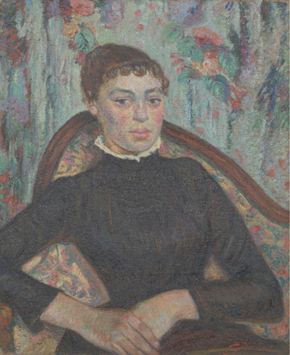
Portrait of a Young Woman by Armand Guillaumin (1876)
One of the problems Guillaumin soon encountered was financial as he had no private income to turn to and so he had to continue holding down a job to survive. This situation was further exacerbated with the advent of the Franco-Prussian War in 1870. Once the War and the Paris Commune fighting had ended there was some hope for Guillaumin who had managed to have himself included with the popular Impressionist movement. Guillaumin and fellow Impressionist, Cézanne had met up with Dr Paul-Ferdinand Gachet, a French physician most famous for treating the painter Vincent van Gogh during his last weeks in Auvers-sur-Oise, and he bought a number of their works. Guillaumin also sold a number of his works to his friend, Eugéne Murer who had recently established a successful café in Paris. Guillaumin and Cézanne began sharing a studio but both found themselves in precarious financial positions despite the sales of their work to Gachet and Murer who continued to be close friends of the pair.
Cottages in a Landscape by Armand Guillaumin (1896)
At the start of the 1880s the Impressionist group was beginning to break apart and it split into two camps. One headed by Pissarro and the other by Degas. Gaugin had vociferously supported Pissarro and he had allied himself with Guillaumin. Although not initially supportive of the Impressionist group having misgivings about what its intentions were, Renoir and Monet joined the Impressionist Exhibition of 1882 with Guillaumin, Gauguin and Pissarro as well as Sisley, Morisot, Vignon and Caillebotte. However, Degas was noticeably absent.
Moulins en Hollandee by Armand Guillaumin (1904)
It was somewhat surprising that Paul Gaugin, known for his irrational behaviour towards his fellow painters, continued to befriend Guillaumin and keep him in the Impressionist group despite its continued disintegration. It was through Gaugin, that Guillaumin met many new young artists who had arrived on the Paris art scene such as the Symbolist painter, Odile Redon, and the Pointillists, Georges Seurat and Paul Signac. In the mid 1880s Guillaumin’ s studio had become a meeting place for the young group of painters. By 1885, new styles of painting had come to the fore and this resulted in further rifts between the old guard of Impressionism resulting in the disintegration of the Impressionist Group. The other factor for the break-up of the Group was its leading man, Gaugin, became more and more temperamental and intolerant and was destroying the Movement from the inside. Guillaumin decided it was time for him to exit the movement which he had been part of from the very start. Guillaumin’s reputation had grown over the last decade and Paul Adam wrote in La Revue Contemporaine:
“…I was not aware of any other painter who has so correctly noted the corresponding values of the lights of the firmament and of the ground…. their unification in colour appears to be perfect…”
Again, Felix Feneon, the French art critic, gallery director, and writer reiterated this, writing about the same show Immense Skies and commented on Guillaumin’s work:
“… superheated skies where clouds jostle each other in a battle of greens and purples, of mauves and of yellows…”
Vue de Port by Armand Guillaumin (1880)
t was in 1886 that Guillaumin married. His wife was his cousin Marie-Joséphine Charreton, a schoolteacher, who was able to support him financially. They settled down at 13 quai d’Anjou in the Saint-Sulpice area of the 6th arrondissement of Paris. It had previously been the studio of the painter Charles-François Daubigny. Guillaumin’s relationship with Pissarro eventually ended with the latter beginning to concentrate on experimentation with pointillism while Guillaumin became progressively interested in romantic art. Guillaumin’s relationship with Gaugin also in due course ended as the latter being constantly away on his travels.
Agay Bay by Armand Guillaumin (1910)
From 1875 to 1880, Guillaumin was a frequent guest of Dr Gachet at Auvers, at a time when he was travelling in that area searching for views of the rural scenery of the Yonne valley to paint and, later, the Creuse valley and the countryside around the farming village of Crozant, where he spent most of his life. Around 1887 Guillaumin became a good friend and mentor to Vincent Van Gogh, who was twelve years his junior. Vincent’s letter to fellow painter Ermil Bernard in December 1887 shows how highly he thought of Guillaumin:
“… I believe that, as a man, Guillaumin has sounder ideas than the others [the Impressionists], and that if we were all like him we’d produce more good things and would have less time and inclination to be at each other’s throats.
Again in a letter to his brother Theo in June 1888, Van Gogh writes about a visit he made to Guillaumin’s house and how he was inspired by him:
“…Wasn’t it pleasant at Guillaumin’s last winter — finding the landing and even the stairs, not to mention the studio — chock-full of canvases? You understand since then that I have a certain ambition, not about the number of canvases, but that these canvases as a whole should, after all, represent a real labour on your part as well as mine…”
Neige by Armand Guillaumin (1876)
In the last decade of the nineteenth century Guillaumin’s circle of artist friends was dwindling. Vincent van Gogh died in July 1890 and his brother Theo, the art dealer, died in the January of the following year. Gaugin and Cézanne had left Paris and Guillaumin and Pissarro’s views on art had diverged so much that their friendship had gradually faded. Despite all this Guillaumin’s life was to change rapidly when won he won the sum of 100,000 francs (about 400,000 euros in today’s money) in a state lottery. This completely changed his life. He no longer had to rely on commissions. He no longer had to exude a subservience towards patrons. He was now able to paint what he liked and strive for his own artistic goals.
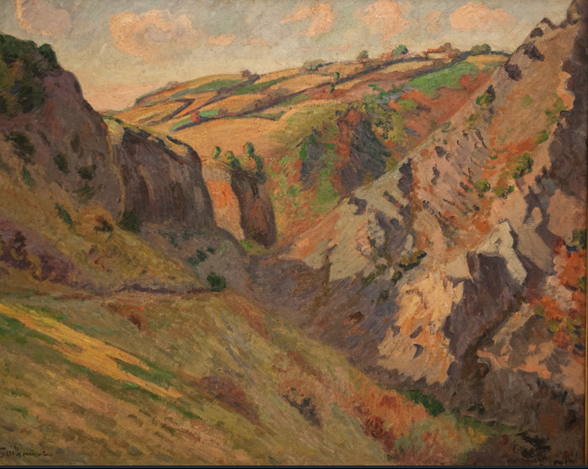
Caves Prunal near Pontgibaud by Armand Guillaumin
With this newly found wealth Guillaumin set off travelling around France capturing on his canvases the beautiful views of the countryside, mountains and the coast, often during sunrise and sunset. His continuous journeying around was brought to an end with the onset of The Great War of 1914. Once the war came to an end he once again set off on his travels but by then he was seventy-seven and he, like his artistic output, was declining. In 1926 a retrospective exhibition was held at the Salon d’Automne. He died at the Chateau de Grignon in Orly, Val-de-Marne, just south of Paris, on June 26th 1927 aged 86. He was the last survivor of the Impressionist Group.
Crozant, Solitude by Armand Guillaumin (1915)
Guillaumin’s paintings are renowned for their intense colours and can be found in major museums around the world. Most of all he is best remembered for his landscapes of Paris, the Creuse département, and the area around Les Adrets-de-l’Estérel near the Mediterranean coast in the Provence-Alpes-Côte d’Azur region of France. Guillaumin became known as the leader of the École de Crozant, a disparate group of painters who came to portray the landscape in the region of the Creuse around the village of Crozant.
Paysage à Crozant (1917)
One such depiction is entitled Landscape in Crozant, is part of the Art Institute of Chicago collection.
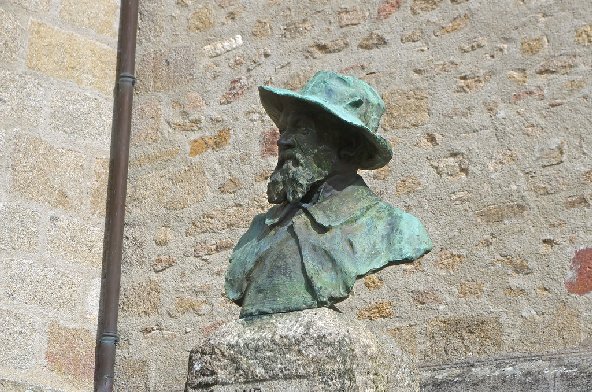
His bust is in the square near the village church in Crozant.
My featured artist today is Walter Frederick Osborne, the Irish impressionist and post-impressionist landscape and portrait painter. He was born on June 17th, 1859 at 5 Castlewood Avenue in Rathmines, an inner suburb on the southside of Dublin, about 3 kilometres south of the city centre. He had two brothers and a sister, Violet. He was the second of three sons of Anne Jane Woods and her husband, William Osborne, an acknowledged animal painter whose speciality was portraits of horses and dogs owned by wealthy landowners. Walter Frederick Osborne, known as Frederick Osborne for the first twenty-five years of his life, attended the local school at Rathmines.
A Glade in the Phoenix Park by Walter Frederick Osborne (1880 )
Having realised that money could be made from painting, Frederick wanted to follow in the footsteps of his father and become an artist. So, once he had completed his schooling in 1876, seventeen-year-old Frederick, enrolled on an art course at the Royal Hibernian Academy School. Osborne made an impact straight away, exhibiting in the RHA annual show in his first year. He won numerous medals and prizes including the Albert prize in 1880 with his painting, A Glade in the Phoenix Park.
In 1881 he attended Koninklijke Academie voor Schone Kunsten van Antwerpen (Royal Academy of Fine Arts Antwerp), where one of his tutors was the Belgian painter Michael Charles Verlat. Whilst studying there he won the Royal Dublin Society Taylor Art Award in 1881 and 1882, which awarded him an annual bursary. This was the highest student honour in Ireland of the time and given annually to a graduate of an Irish art college or an Irish art student graduating from an art college abroad to assist them with the development of their career as a visual artist.
A Flemish Farmstead by Walter Frederick Osborne (1882)
Osborne sent back to the Royal Hibernian Academy a number of paintings he completed whilst attending the Royal Academy of Fine Arts in Antwerp. One was his 1882 work, A Flemish Farmstead, and this exhibited by the Academy the following year, just after Osborne had been elected an Associate Member. From his earliest days, Osborne was interested in painting farmyards such as the one above. His scenes usually included one or two figures. However, this work is slightly subtler for he merely suggests that the farmyard is a working one by including the jacket that hangs on the open door and the clogs that stand against the wall. Being a great believer that detail is important, he has even depicted the clogs standing on end, suggesting that they are that way so as to allow them to drain after a wet morning in the fields.
Apple Gathering by Walter Frederick Osborne (1883)
He completed his studies in Antwerp in 1883 and travelled to the Breton artists’ colony at Quimperlé. Osborne soon realised that the most noteworthy modern painters were painting en plein air and were using ordinary local people as their models and the Breton fishing villages had a plethora of such willing characters. It was at Quimperlé that he completed his famous Apple Gathering painting which is now housed in the National Gallery of Ireland. The painting depicts a young girl dressed in a peasant costume holding a long stick, busily shaking branches of an apple tree to loosen the ripe fruit. Looking behind her, we see another young girl picking up the fallen apples which are scattered around the orchard. In the background we see the church of Quimperlé which was the subject of many of the artists residing at the town’s artist colony. The painting can now be found in the National Gallery of Ireland in Dublin.
Estuary at Walberswick by Walter Frederick Osborne (c.1885)
Walter Osborne along with two fellow Irish artists, who were part of the Quimperlé artist’s colony, Drogedha-born Nathaniel Hill and Galway-born Augustus Nicholas Burke eventually left the Breton town and returned to England and headed for another artist’s colony at the Suffolk coastal village of Walberswick, where one of the artists was Philip Wilson Steer, who had studied at the École des Beaux Arts under Alexandre Cabanel, during which time he became a follower of the Impressionist school. Steer would become a leading figure in the Impressionist movement in Britain.
Feeding the Chickens by Walter Frederick Osborne (1885)
At the start of 1884, Walter Osborne’s early paintings often featured young children accompanied by animals, often their pets. One of his most famous works of this genre came about whilst Walter Osborne along with his fellow young artists Nathaniel Hill and Edward Stott, another former École des Beaux Arts student, travelled through the English countryside, on sketching trips. That October, the trio had arrived at North Littleton, near Evesham, Worcestershire and the painting which evolved from his visit here was the work entitled Feeding the Chickens. The oil on canvas painting measured 36 x 28 inches (92 x 71cms). In the work, we see a young but confident girl, with her earnest expression, scattering corn for the chickens. She is Bessie Osborne, (no relation to the artist), the daughter or maybe a servant in the substantial house which we see in the background. In Osborne’s preparatory sketch for this work, there was another figure, a gardener with his wheelbarrow, but he was not transferred to the finished painting. Presumably Osborne thought his inclusion would detract from the main focus of the work, the girl.
The Irish art historian Jeanne Sheehy’s biography of Osborne quotes from his letter to his father, dated October 12th, 1884, about the details of the work. In a letter to his father he set the scene for the painting:
“…’The weather, I am sorry to say has been bitterly cold the last week, so much so that my model nearly fainted and I had to send her home … It will probably seem funny to you all that my model’s name should be Bessie Osborne …”
The young girl is wearing an embroidered bonnet and holding a basket of grain, surrounded by a brood of hens. A further insight into the making of this painting can be found in the letter:
“…Now I am pretty far advanced on a kit-kat of a girl in a sort of farmyard, a rough sketch on the opposite page will indicate the composition. The figure of the girl which is a little over two feet high is coming towards finish, but the immediate foreground with poultry is merely sketched in as yet. The fowl are very troublesome, and I have made some sketches but will have to do a lot more as they form rather an important part of the composition…”
Also, in the letter to his father Walter asks him to look through his sketches he had done whilst at Quimperlé and find any of chickens which may help with this painting.
Winter Work by George Clausen (1883)
During his travels around the English countryside, Rural Naturalism became his favoured genre. He had been influenced by the works of the French painter, Jules Bastien-Lepage, whose works were dominating the Paris Salon and it was this type of work which Osborne preferred to the themes from history or mythology which were taught in the Academies of Europe. Another influence on Osborne was another Naturalist painter, the English artist George Clausen.
The Return Of The Flock by Walter Frederick Osborne (1885)
From 1883 and for the next fifteen years Osborne spent the summers wandering around the South of England often visiting the area of the beautiful Berkshire Downs or the area around the Hampshire market town of Romsey or the Suffolk coastal villages. Once asked why he did not spend his summers in Ireland he said that it was cheaper to live in England and it rained less which was important as he wanted to paint en plein air. Osborne was not looking for spectacular landscape which he could have found in the West of Ireland, the Lake District or Scotland. His preference was for the sedate beauty of rural villages with their well-stocked picturesque cottage gardens, often his paintings would include farmyard animals such as sheep. Like the French Impressionists, Osborne was fascinated by the effect of light and how it changes during every hour of the day.
Portrait of Mrs Chadwyck-Healey and her Daughter by Walter Frederick Osborne (1900)
Walter Osborne was elected an associate of the Royal Hibernian Academy in 1883 and became a full member in 1886. Although Osborne spent the summers travelling around the southern English countryside he would return to the family home in Dublin during the winter months. In 1886, following his election to the Royal Hibernian Academy he received many commissions for portraits and from 1892 onwards, Osborne’s main output changed from landscape work to portraiture. These portraiture commissions were essential to Osborne for his financial survival and that of his parents who relied heavily upon him. Osborne’s permanent move to Dublin in 1892 was prompted by the death of his sister Violet whose newly-born baby was given into the care of Osborne’s aged parents and he had to take on the task of looking after her daughter. His portraiture and landscape works had become so popular and because he received more and more commissions he decided that working from home was not feasible and so acquired his own studio in St Stephens Green in 1895.
Mrs. Noel Guinness And Her Daughter Margaret by Walter Frederick Osborne (1900)
One of his best-known portraits was entitled Mrs Noel Guinness and her Daughter Margaret and this was exhibited at the Paris Exposition Universelle in 1900 and which received the bronze medal. The painting depicts Mary Guinness (née Stokes), the wife of Richard Noel Guinness, and her four-year-old daughter Margaret.
The Old Fountain, Madrid by Walter Frederick Osborne (1895)
In 1895 he and his friend, the art historian and writer, Walter Armstrong, toured around Spain, where Walter completed a number of watercolour drawings and oil sketches. The following year the two men travelled to Holland where he completed a number of Amsterdam canal scenes.
Dublin Streets a Vendor of Book by Walter Frederick Osborne (1889)
During this time Walter Osborne put together a series of paintings depicting Dublin street scenes, which some time later were exhibited at the Royal Academy. Osborne made pencil sketches and took photographs of the street scenes and then completed the series in oils in his studio. Probably the most famous of the paintings in this series was Dublin Streets: A Vendor of Books which he completed in 1898. The painting depicts a bookseller’s stall, set up on Eden Quay, looking eastwards towards the O’Connell Bridge. We see a mother leaning against the wall holding a very young child in her arms. She has a fatigued and nervous look about her. By her side, on the floor, there is a basket of daffodils. What is her story? Is she in any way connected to the bare-footed girl who has moved towards the customers who are perusing the books at the vendor’s stall? The little girl has a small bunch of daffodils in her hand which she is holding up to the customers. She has been sent by the lady, maybe her mother, to try and get a few pence for the flowers. It is a painting full of movement from the horse drawn carriages we see crossing the bridge to the barge making its way down the River Liffey about to pass under the bridge. These realistic paintings of street life in Dublin, although in great demand now and a good historical record of the times past, were not as successful then as his portraiture.
Greystones by Walter Frederick Osborne (1884)
Osborne did not forsake his landscape work completely and one his Impressionist-style works, completed around 1898, was entitled Greystones. It is a somewhat moody study 0f the quayside of Greystones, a small coastal fishing village in County Wicklow. In the painting we see a number of fishing boats tied up to the harbour quayside, some of which have the sails unfurled. In the background there are a number of cottages. His use of muted colours and tones such as his mauves, pinks, pale greys and browns induce a sense of soft light. Look how Osborne has cleverly depicted the diffused sunlight on the gable ends of the cottages and again with the way he has represented it with the silvery flickering of the water with its reflections.
Tea In The Garden by Walter Frederick Osborne (1902)
In 1900 Osborne was offered a Knighthood in recognition of his services to art and his distinction as a painter, but he refused the honour. His mother became ill in the early 1900s, and Walter spent long periods looking after her. In 1902 he started to paint what was to be his last picture, Tea in the Garden, which remained unfinished at the time of his death. It was a beautiful work, a juxtaposition of his favoured Impressionism and Naturalism.
Self-portrait by Walter Frederick Osborne
In 1903, after a strenuous time gardening, he became ill, which he tried to ignore but which developed into double pneumonia. He died aged forty-three, at the family home in Castlewood Avenue, Rathmines, Dublin, on April 24th 1903, and was buried in Mount Jerome cemetery. Walter Frederick Osborne never married and left considerable savings behind him. He was one of the most sought after and talented Irish artists of his time.
To start My Daily Art Display blog today I want to first look at the fascinating happening which occurred during the late seventeenth century to early eighteenth century and which was known as the Grand Tour. It was a journey which would see travellers visit places such as Paris, Venice, Florence and culminate with the arrival at the cultural Mecca which was Rome, where they would visit the sites of ancient ruins such as the Forum and the Coliseum. It was also to be a journey of artistic enlightenment. The seasoned 18th century British traveller, Charles Thompson, put it succinctly when he extolled the virtue of the Grand Tour and the expectation of what would be savoured by the Grand Tourists:
“…being impatiently desirous of viewing a country so famous in history, which once gave laws to the world; which is at present the greatest school of music and painting, contains the noblest productions of statuary and architecture, and abounds with cabinets of rarities, and collections of all kinds of antiquities…”
For some, such as artists and art scholars, it was a chance to revel in the art history of past times. For others who were “art virgins” they would be accompanied by teachers who would give them an understanding of art and architecture. For most it was a chance to return home with souvenirs and the ability to regale tales about their journey at fashionable dinner parties. It was a sort of “gap year finishing school” for young gentlemen. They would receive an all-round full cultural education. There would be opportunities for them to hone their dancing and fencing skills and polish up on their foreign languages. For the travellers on the Grand Tour, and it was usually young men who made the trip as the journey would be physically demanding, there were a few prerequisites. They had to be wealthy as the Tour would last many months, even years, and the cost of their travel plus that of any accompanying teachers had to be paid for as well as the cost of the many souvenirs they would accumulate during the journey which would enhance the family’s collection back home. By souvenirs, I am not talking about a plastic effigy of a famous building, but a landscape painting from a great artist of the time or a piece of antiquity that the dealer had probably pillaged from one of the many historical sites. This then meant that most of the travellers came from the privileged classes. It would have been expected that the traveller would also have a thorough grounding in Greek and Latin literature although they would often be accompanied by their tutors and have been taught the basics en route.
Like you and I, when we go on holiday we like to bring back mementos of our travels but more importantly we want to bring back photos of the places we visited and people we were with or whom we met. Of course in the Grand Tour days of the 17th and 18th century there were no cameras to record the Tourists’ travels and so artists benefited from the patronage of Grand Tourists eager to procure mementos of their travels. Some Grand Tourists even invited artists from home to accompany them throughout their travels, and by so doing, they could orchestrate exactly what scenes they wanted painting, whether it be ancient ruins or grand palaces, or people, who were part of their party, or just interesting people they met have met en route.
It is with this long preamble that I move closer to my featured artist. I attended a talk at a small local museum last week which was all about a very rich and privileged young man, Sir Watkin Williams Wynn, 4th Baronet, who set forth at the age of 19, on his Grand Tour in 1768. He returned home the following year and the total cost of his tour, including all the items he had purchased, came to £8643 and to put this into context a very good annual wage at the time was considered to be £100. The year Sir Watkins Williams Wynn had his twenty-first birthday he asked the fashionable landscape painter, Richard Wilson, to become artist-in-residence at the Wynstay estate and Wynn had a large pavilion erected which overlooked the River Dee so as to allow Richard Wilson to paint the beautiful scenes featuring the Welsh hills which could be seen in the distance.
I am sorry to drag you through this sort of “seven degrees of separation” formula but trust me, I am getting closer to my featured artist. Just hang in there a little longer ! My featured artist today is not Richard Wilson but one of his pupils, Thomas Jones who spent some time in Italy and who completed a series of unusual (for that time) paintings of the city. It was a copy of one of these works which I saw as I walked around the Sir Watkins Williams Wynn’s Grand Tour exhibition which I found fascinating and as it was such an unusual depiction for its time, I had to find out more about the painter, hence today’s blog.
Thomas Jones was born at Trefonnen, a small township in the Radnorshire parish of Cefnllys in 1742. He was the second of sixteen children, seven of whom died in childhood, to Thomas and Hannah Jones. His father was a land owner in Trefonnen and his wife inherited a house and an estate at Pencerrig, near Builith Wells, where the family went to live. Thomas Jones went to school at Christ College, Brecon when he was eleven years old and it was here he developed his love for pictures and drawing. In 1758, at the age of sixteen he moved to one of Dr. Daniel William’s schools at Llanfyllin in Montgomeryshire, where he was taught by the well-known master Jenkin Jenkins. The following year Thomas Jones was accepted as a student at Jesus College, Oxford. The fees for attending Oxford University were funded by Jones’ maternal uncle, John Hope, who believed that a university education would lead to his nephew entering the church. His stay at the university was cut short with the death of his uncle at the end of 1761 and Thomas Jones decided that his future did not lie in religion nor a life at sea which was often a chosen profession for the younger sons of the landed gentry. He believed his future was in art.
Buildings in Naples with the North-East Side by Thomas Jones (1782)
In November 1761, Thomas Jones left Wales and moved to London where he enrolled at the William Shipley’s Drawing School. This was an establishment named after the great artist and social reformer, William Shipley,who some years earlier had founded a London arts society that would become The Royal Society of Arts, or to give it its full name, the Royal Society for the encouragement of Arts, Manufactures & Commerce, (RSA). It was at this school that Jones was taught by the draughtsman and drawing tutor Henry Pars. During this period in London, Jones also attended the St Martin’s Lane Academy where he studied life drawing. Reluctantly he realised that his ability at painting figures was not good enough and he decided to concentrate on landscape painting. All he needed now was a good landscape painter to tutor him. As far as Thomas Jones was concerned, the best landscape painter of the time was his fellow countryman, the Welsh landscape painter, Richard Wilson. Wilson, who is now considered the father of British landscape painting, had himself started off studying to become a portraitist in London but had switched to the landscape genre of painting on the advice of the Italian painter, Francesco Zuccarelli, whom he met whilst living and working in Italy between 1750 and 1757.
In March 1763 Thomas Jones managed to persuade Richard Wilson to take him on as a student. Wilson agreed to tutor him for two years for a fee of fifty guineas. Once his tuition period with Wilson was over, he dedicated the next ten years to landscape painting in Wales and around London. In 1765 Jones began to submit some of his works to the Society of Artists exhibitions. This society would eventually become the Royal Academy. In the late 1760’s a change in style in his landscape work could be detected. At this time he began to adopt what we now term the “grand manner” by which we mean his landscape works incorporated mythological scenes or scenes from history or literature à la Claude Lorrain. As Jones was not an accomplished figure painter he often relied on the help and collaboration from artists such as John Hamilton Mortimer, who was a British figure and landscape painter and known for his romantic paintings set in Italy. Thomas Jones had by 1776 exhausted all his commissions and the sales of his work were falling so he decided that September to embark on his keenly anticipated journey to Italy. He first visited and settled in Rome and stayed there for two years carrying out a number of lucrative commissions, often for wealthy English men who were on their Grand Tour. His reputation as a landscape artist grew and he was part of the city’s hectic cosmopolitan art-scene. Following a dispute over commission with an art dealer he decided to leave the Eternal city in September 1778 and travel south to the capital of the Kingdom of the two Sicilies, Naples. His first stay in the city lasted five months before he returned to Rome. It was during his sojourn in Rome that he met a Danish widow called Maria Moncke who became his lover, although for the sake of respectability he always referred to her as his “maid servant”. The couple moved back to Naples in April 1779, where Jones believed there was more scope for painting commissions. Later, Maria gave birth to two daughters in Naples, Anna Maria in 1780 and Elizabetha in 1781.
In Naples, Jones found lodgings in a house close to the harbour which had the advantage of having a roof terrace opposite the Dogana Del Sale. It is from this very vantage-point, and from the window of his studio that he made a set of small beautifully, highly finished oil studies of the neighbouring buildings and it is these cityscape views I am featuring today. At first glance they may seem mundane and just uninteresting views from out of his window, but I love them. They are so different to his other works and those of many artists of that time, so much so, I felt I had to make them known to you. These works were done by Jones for his own pleasure and were never intended for exhibition or sale. However, today they are looked upon as some of the most ground-breaking pictures of their time. In some ways they have a modern look about them. They could have been contemporary cityscapes but remember, he painted these works almost two hundred and fifty years ago. It was this Naples series, which he completed just before his return to Britain in 1783, on which Thomas Jones’ modern reputation is based.
The Cappella Nuova outside the Porta di Chiaia, Naples, by Thomas Jones (1782)
The Cappella Nova outside the Porte did Chiai, Naples was a small oil on hand-made laid paper, measuring just 20cms x 23cms which Thomas Jones painted in May 1782. In his diary/memoirs of May 12th 1782 he wrote about the new lodging he had temporarily moved into and from where he painted this work:
“…The Room which I was in possession of at the Convent, was large and commodious for such a place, and as it was on the ground floor and vaulted above, very cool and pleasant at this Season of the Year – The only window it had, looked into a Small Garden, and over a part of the Suburbs, particularly the Capella nuova, another Convent, the Porta di Chaja, Palace of Villa Franca, and part of the Hill of Pusilippo, with the Castle of S. Elmo & convent of S. Martini &c all of which Objects, I did not omit making finished of in Oil upon primed paper…”
This compelling view was painted from the roof terrace of the artist’s lodgings opposite the Dogana del Sale in Naples. It shows a rooftop view of the city, but the painting is dominated by the humble Neapolitan house opposite – the real subject of this work.
Jones has captured in minute detail the texture of the crumbling wall, the half-shuttered windows and doorway, all bathed in sunlight. This is one of a number of oil sketches that surfaced on the art market in 1954 and completely changed Jones’s reputation. The sketches are characterized by their humble subjects and compositional cropping, and it is this which give them a startlingly modern appearance. These works show the artist painting his daily surroundings. They were not for exhibition or sale, but simply personal works, made for his own enjoyment. Today they are prized as some of the most innovative pictures of their time.
A Wall in Naples by Thomas Jones (1782)
Another small oil sketch Thomas Jones completed in 1782 was entitled A Wall in Naples, which measured just 11.2cm x 15.8cm. It is about the size of a postcard and is dwarfed by larger works in the room in which it hangs in the National Gallery of London. It is a strange work which just depicts a decaying expanse of late 18th century Neapolitan house wall, broken up by a closed wooden balcony door, a glazed and dust covered window which allows us no view of the interior. There is a short washing line hanging over the balcony, on which there seems to hang various coloured items of undergarments. The wall we see before us almost blocks out the entire view, except for a small rectangle of blue sky in the top right of the painting. One can only wonder what made Thomas Jones depict such an uninspiring view and one can understand why this work like the others were simply for his own edification and would never, in the artist’s mind, be destined for an exhibition. We can only wonder why Jones chose this wall for his painting. Was it because of the various textures of the pitted and pock-marked surface or maybe its decrepit state having been battered by weather appealed to him. What are the square holes dotted around the surface of the wall? Are they places where once there had been beams which had supported floors?
During the same year Thomas Jones painted his Naples series he received news that his father had died and so feeling slightly homesick, he decided the following year to end his six year stay in Italy and return by ship to England with his lover Maria and their two daughters. On returning to London in November 1783, he was horrified to discover that much of his possessions and paintings he had left behind in London had been destroyed or ruined by damp. Jones once again set about painting but now as he was receiving an annual income from his father’s estate, he did not need the money from the sale of his works and his artistic output slowly decreased.
Since returning to England, he made a number of journeys back to Wales and the Pencerrig estate where he was brought up and which was now owned by his elder brother, Major John Jones. In 1787 his brother died and having no descendents the estate passed to Thomas Jones. Thomas eventually married Maria in September 1789 in London. By all accounts the decision to marry his lover and “maid servant” was not solely his decision for it is believed that his mother “laid down the law”. Thomas Jones painted less and less in the latter years of his life as so much time was taken up looking after his beloved Pencerrig estate. In 1791 he was elected High Sheriff of Radnorshire. Thomas Jones died in 1803 and was buried at the family chapel at Caebach, Llandrindod Wells
His autobiography, Memoirs of Thomas Jones of Penkerrig, went unpublished until 1951 but it is now recognised as an valuable source of information on the 18th-century art world.










 my daily art display