
Károly Ferenczy and the family
In this blog I am looking at the lives and works of a talented Hungarian family of painters.
Károly Ferenczy
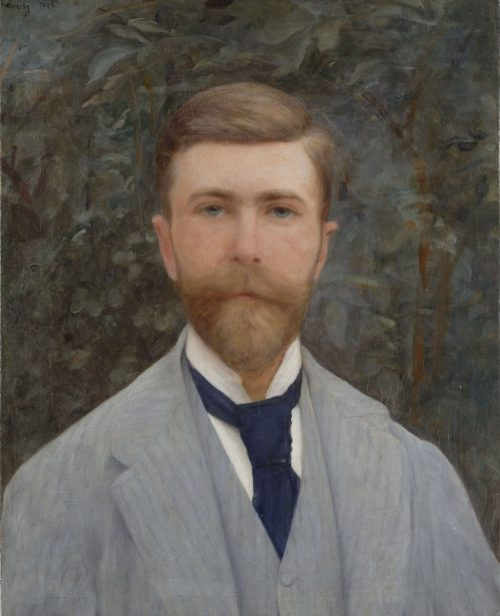
Károly Ferenczy
Károly Ferenczy is considered one of the most important pioneers of Hungarian Modernism, He was the son of Ida Graenzenstein and the Austrian railway construction official Karel Freund, who moved to Budapest with the construction company. Ferenczy was born in Vienna on February 8th 1862 and soon after his birth, his mother died.
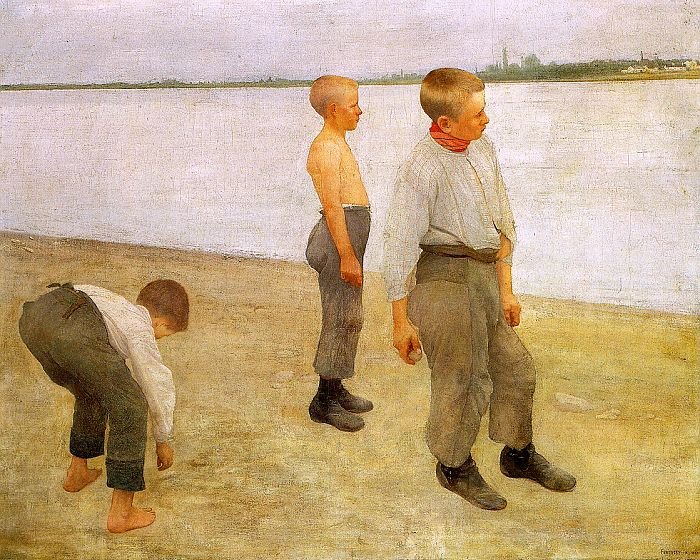
Boys throwing Stones by Károly Ferenczy (1890)
Boys Throwing Stones was a major work completed by Ferenczy in 1890, whilst he was living in the River Danube town of Szentendre, having returned from Paris and his studies at the Académie Julian. The setting is a barren landscape which had a sense of melancholia to the work and adds a gloomy backdrop to the three boys throwing stones into the river. There is not one bright spot of colour and it is the shades of the pearly grey which he used for the water that lightens the rest of the dull earthly colours.

In Front of the Posters by Károly Ferenczy (1891)
Károly Ferenczy first studied law and completed his economics degree at the University of Vienna. In 1885 Ferencszy married a fellow artist and distant cousin, Olga Fialka who was twelve years older than him. She studied painting under Jan Matejko in Kraków and went on to study under August Eisenmenger in Vienna. She was known for her paintings and book illustrations.
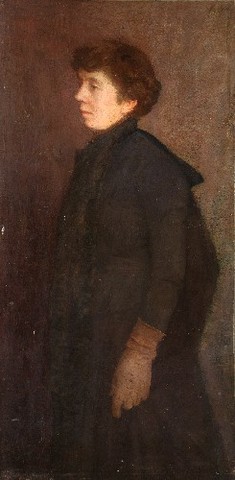
Portrait of Artist’s Wife by Károly Ferenczy (1891)
After she married Károly Ferenczy, the couple went on to have three children. With the birth of the children, Fialka turned her attention away from her art and focused on looking after the family. The couple’s first child Valér Ferenczy, who was born in 1885, became a painter and printmaker. In 1890 Olga gave birth to twins, Béni Ferenczy, who went on to became a famous sculptor and Noémi Ferenczy, who became an equally well-known textile artist.
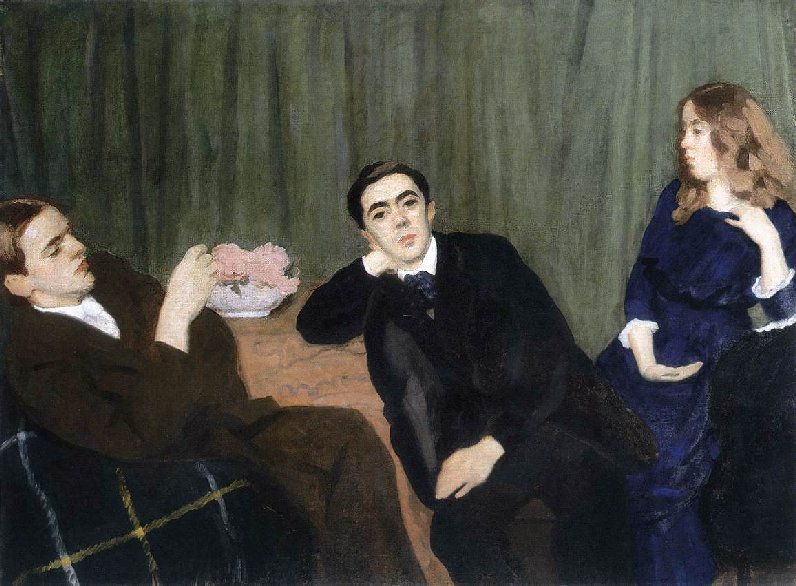
Triple Portrait by Károly Ferenczy (1911)
Károly Ferenczy‘s three children, his son Valér, painter and graphic artist, and the twins Béni , painter and graphic artist and Noémi, a painter who established tapestry in Hungary.
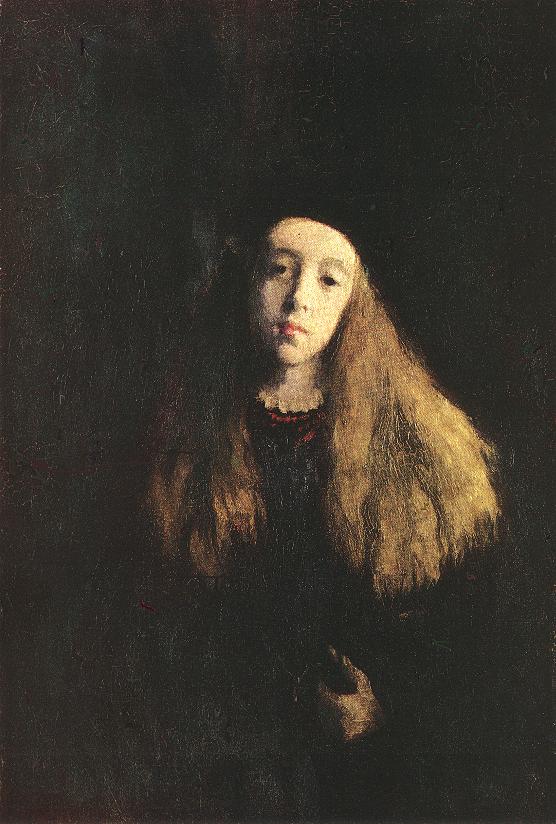
Noémi with Let-down Hair by Károly Ferenczy (1903)
In 1885 Károly enrolled at the Art Academy of Naples (Accademia di Belle Arti), but the following year moved to Munich. Ferenczy studied art in Budapest at the Academy of Fine Arts where his Hungarian tutors were Bertalan Székely the history and portrait painter who worked in the Romantic and Academic styles. and Gyula Benczúr who specialized in portraits and historical scenes. Benczúr is now looked upon as the greatest Hungarian masters of “historicism”, a term used to encompass artistic styles that draw their inspiration from recreating historic styles or imitating the work of historic artists and artisans. Ferencszy was living in Hungry at a period when the country was undergoing a cultural renaissance, and Ferenczy became part of a generation of artists eager to explore new artistic ideas and break away from academic conventions.
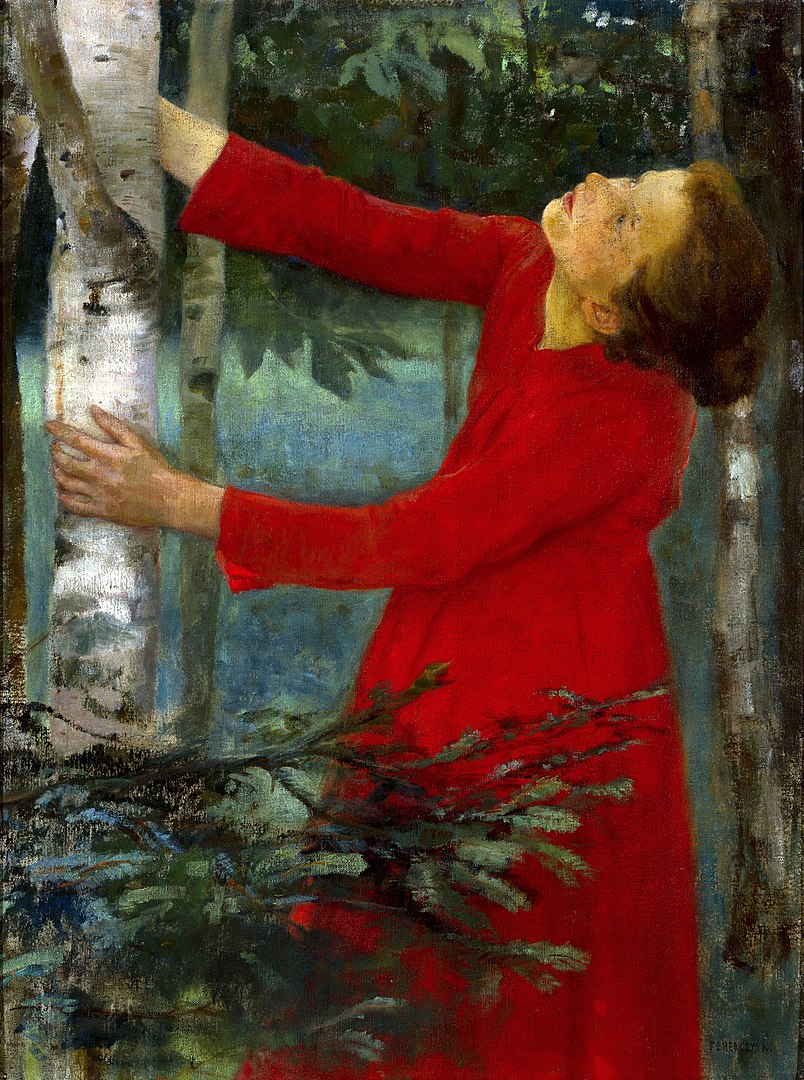
Birdsong by Károly Ferenczy (1893)
Károly Ferenczy became interested in plein air painting when he was studying in Munich. One of is most famous works at that time was entitled Birdsong which he completed in 1893. Unlike other realist depiction Ferenczy’s depiction is free from details. The random appearance of impressionism in details of nature and capturing atmospheres, lights and colours hastily painted could not be more unusual for him. He spent much time working out the composition of the work and the solitary figure in the depiction is a woman, dressed in red, embracing the trunk of the tree, gazing upwards as she listens to the melodic tones of a bird in full song. The forest is symbolized by white trunks of birch-trees and the green of the leaves.

On the Hill Top by Károly Ferenczy (1901)
In 1889, at the age of twenty-seven, Ferenczy travelled to Munich, where he first came aware of western European artistic styles such as Impressionism and the plein air works of the Barbizon School artists. It was the works of this latter group which led Ferencszy to explore plein air painting and the effects of light on the landscape. His greatest influences were that of the French painters, particularly Édouard Manet and Camille Pissarro, and they stimulated his change of artistic direction towards a more liberated and expressive style.
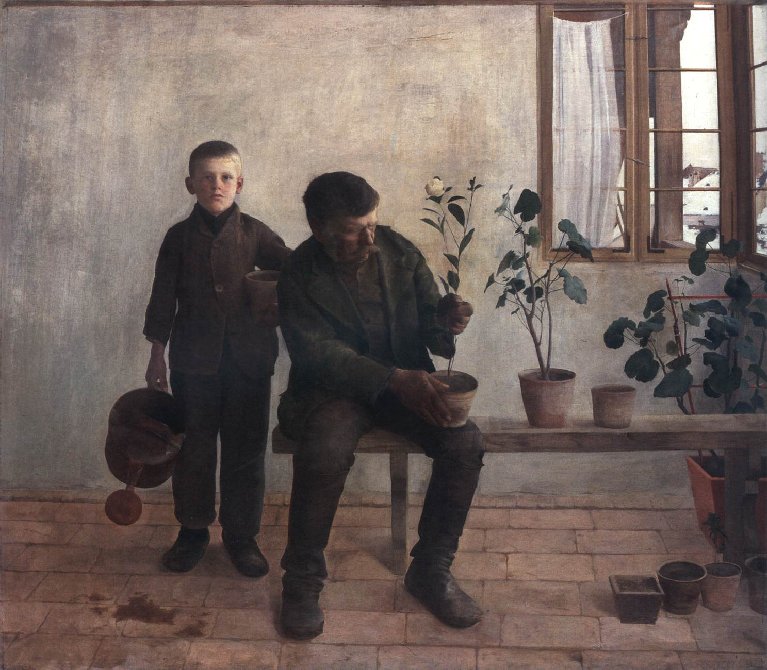
Gardeners by Károly Ferenczy (1891)
Ferenczy completed Gardeners whilst living at Szentendre. The way he puts the painting together with the use of lighting, colours and details follow the ethos of Naturalism. It is typical of him to see that the space is limited. There are two figures, one of the old gardener and the other the young boy who is standing next to him in front of a light background. How Ferenczy managed the arrangement of his two figures and the balance between light and dark colours demonstrate his appreciation of decoration which were a constant throughout his career as a painter. Gardeners is considered to be a major picture of Ferenczy’s early period and highlights his skills as an artist at the beginning of his career.

Simon Hollósy. Self-portrait, 1916
Between 1893 and 1896 he lived in Munich with his family. There he joined the circle of Simon Hollósy, a Hungarian painter who, as a young man, had moved to the German city because there was no academy of fine arts in Hungary at that time. However, he was critical of the way art was taught at the German Academy which was strongly based on copying classical models. He left the Munich Academy and set up his own private school where he gave free classes. His way of teaching art appealed to many young talents who were interested in realistic portrayal of their subjects. Simon Hollósy was persuaded by some of his friends and pupils to re-locate his class in the summer of 1896 to Nagybánya, which is now Baia Mare, Romania. He agreed and it was that new location that led to the founding of the Nagybánya artists’ colony, of which, Károly Ferenczy was one of the founding members. Nagybánya was an idyllic rural location and was the perfect place for plein air painting. It was the artists at this colony who played an important role in introducing Impressionism and Post-impressionism.

Sermon on the Mount by Károly Ferenczy (1896)
In his later years, Ferenczy painted subjects ranging from portraits, to nudes, and Biblical scenes. Ferenczy was highly productive, and he worked in a variety of materials and genres. In November 2011, a major retrospective exhibition opened for six months at the Hungarian National Gallery, featuring nearly 150 paintings and 80 prints and drawings, together with about 50 documents (photographs, letters, catalogues and books) related to his art and life. Sadly, Károly Ferenczy’s life and prolific career were cut short by illness. He succumbed to pneumonia on March 18th, 1917, at the age of 55.
Olga Fialka
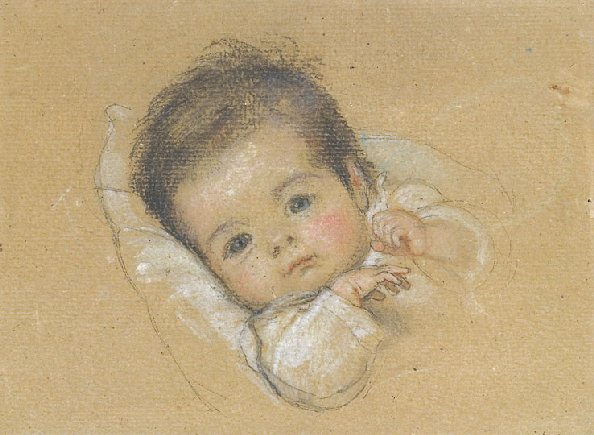
Béni Ferenczy by his mother, Olga Fialka (1892)
Károly Ferenczy was just one part of a talented artistic family. In 1885 he married Olga Fialka, who on her mother’s side was a relative of his, whom he met for the second time in 1884. Olga had developed a love of art as a teenager and had family support for her desire to become a professional artist. She studied art in Krakow under Jan Matejko, a Polish painter, and leading 19th-century exponent of history painting, known for his depictions of events from Polish history. She then went to Vienna and attended the Academy of Fine Arts under the tutelage of August Eisenmenger, a portrait and historical painter.
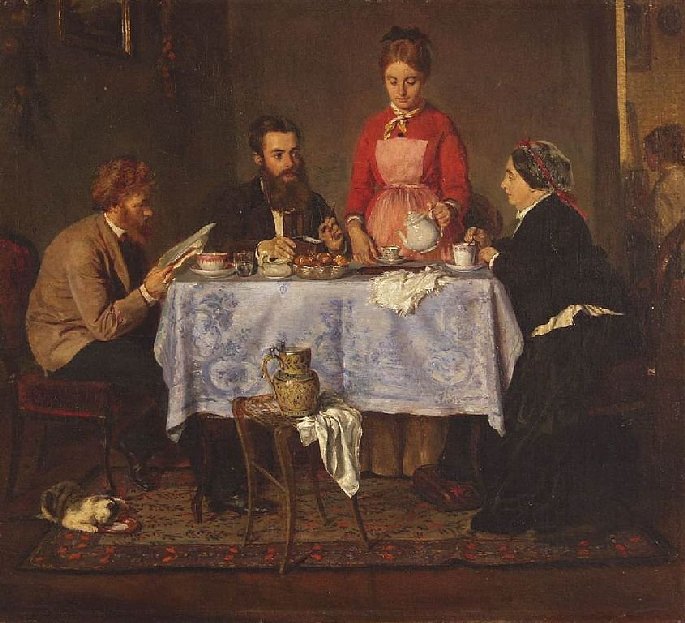
The Fialka Family by Olga Fialka (1874)
In the painting entitled The Fialka Family, Olga depicts her family taking coffee in a simple, bourgeois interior. At the head of the table is her mother, Karoline, and beside her stands her younger sister, Milada von Fialka. One of the two male family members is perhaps Károly Fialka. If you look carefully at the right background, you can just make out a woman painting and this is thought to be Olga herself. The picture is a combination of the common interior genre and the group portrait. What differentiates this work from other contemporary genre painting of the time is that the interrelationship of the four figures comes not from a purported story line, but from a simple everyday conversation between family members and does not have the sense of a rigid group portrait. One can believe that Olga has simply conjured up a snapshot of an everyday scene.
Valér Ferenczy

Self Portrait by Valér Ferenczy
Valér Ferenczy was born on November 22nd 1885 in Kremnica, Slovakia. He was the eldest son of Károly Ferenczy and Olga Fialka Ferenczy. The family moved to Baia Mare in 1898, where Valér began his artistic tuition given to him by his parents in his father’s studio. Between 1896 and 1901 he was enrolled at the Hollósy School in Baia Mare. Between 1902 and 1906 he attended the drawing and painting courses held in the Free School of Painting and at the same time he also travelled abroad and attended various European academies of art. In 1903 he studied at the Munich Academy before going on to the private school of the German secessionist painter, Lovis Corinth, in Berlin through 1904 and 1905. From Munich he travelled to Paris where he attended the Colarossi School and later the Julian Academy in 1906.Between 1911 and 1912 he returned home and studied at the Hungarian Academy of Fine Arts.
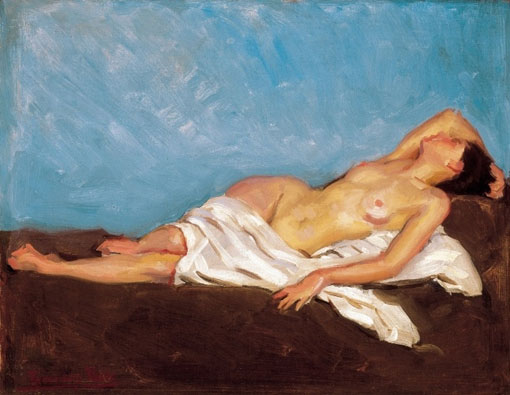
Nude by Valér Ferenczy
In 1914 Valér returned to the French capital to study the technique of engraving with Orville Houghton Peets, the American painter and printmaker.

The Artist’s Mother by Valér Ferenczy
Valér applied for and was granted Romanian citizenship in 1919 and two years later married painter Eta Sárossy in 1921.
Valér Ferenczy died in Budapest on December 23rd 1954, aged 69.
Eta Sárossy

Eta Sárossy in her studio (1923)
Her father was Barnabás Sárosi, who was a sergeant in the Imperial and Royal 15th Hussar Regiment, and her mother Maria (Irma) was from Moldova. She grew up in Szilágysomlyó and graduated from high school there. From 1920 she studied painting at the free school in Baia Mare, for three years.

Fire Flowers by Eta Sárossy

Young Man with a Tennis Racket by Eta Sárossy (1933)
Eta’s marriage to Valér ended in 1929 and she remarried the following year. She regularly exhibited her work and was a founding member of the National Salon. Initially she painted landscapes, then studied portrait painting with the Hungarian painter, Oszkar Glatz, at the Hungarian Academy of Fine Arts.
Béni Ferenczy

Béni Ferenczy by Kaoly Ferenczy (1912)
On June 18th 1890 Karoly Ferenczy’s wife Olga gave birth to twins, Béni and Noémi. Béni was the second son of Karoly and Olga Ferenczy. As a young man, Béni followed in the footsteps of his elder brother Valér and father Karoly and went to study art in both Munich and Paris. During his stay in the French capital, he studied under both the French sculptor, Antoine Bourdelle at the Académie de la Grande Chaumière, and the Ukranian sculptor Alexander Archipenko, a resident in La Ruche, an artist’s residence in the Montparnasse district of Paris.
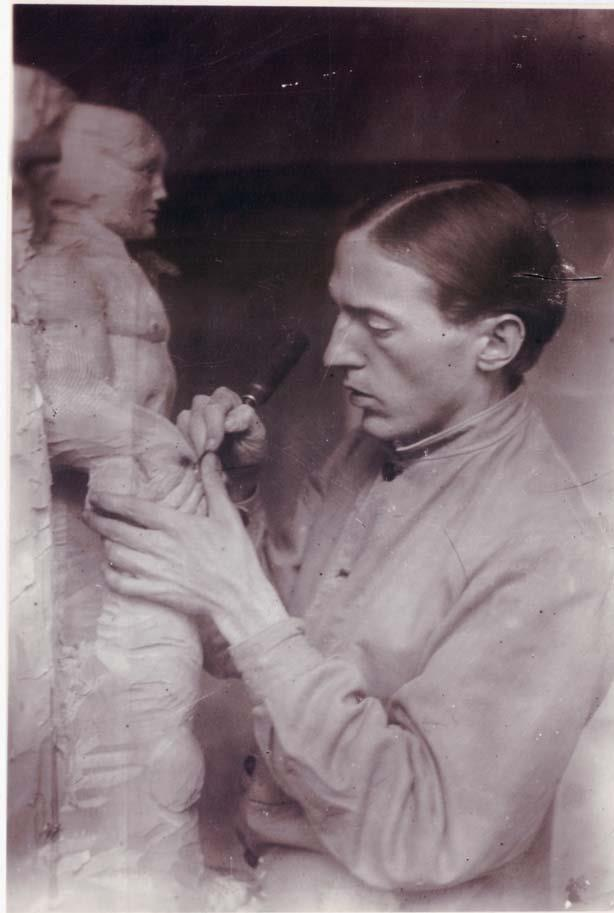
Béni Ferenczy carving his statue Hercules. (Nagybánya, 1916)
Once he had completed his studies abroad, he returned to Hungary and lived in Budapest. Béni was swept up by the short-lived (March to August 1919) Hungarian Commune described as a “genuine, grandiose, albeit unfinished revolution”. He played his part in it by becoming one of the leading artists to instigate a reform of the national art scene and the setting up of a new art programme for the Hungarian nation. After the fall of the Hungarian Commune in 1919 which only lasted 133 days, Béni exiled himself to Nagybánya in annexed Transylvania, and from there, in 1921, travelled via Czechoslovakia to Vienna and that summer he settled down in the Austrian capital.

Danae by Béni Ferenczy (1934)

The Pair by Béni Ferenczy
Béni arrived in Vienna in 1921 and married an Austrian lady and the couple had a son and daughter. He and his wife went to live in Berlin and Potsdam but found the cost of living too high and so returned to Vienna. His marriage ended in divorce and in 1932, he moved to Moscow, where he married a second time. His bride was Erzsi (Elizabeth), a Hungarian, who had also spent her childhood in Nagybánya. From Moscow they moved to Vienna in 1936 and on to Budapest in 1938. Erzsi, beautiful, strong, full-bodied, and full of life, became the model for many of his sculptures, drawings and watercolours. Erzsi became his close companion, an inspiration for his work. After her husband’s death in 1967, Erzsi Ferenczy worked to preserve his work and memory.
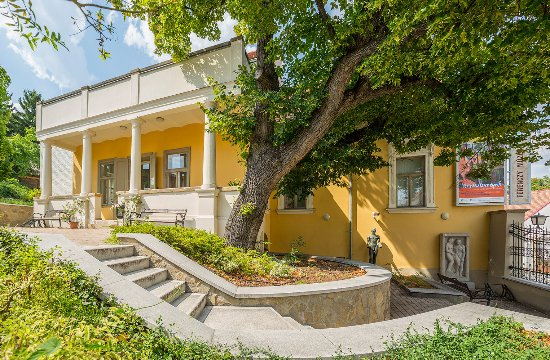
The Ferenczy Museum in Szentendre
In 1972, Erzsi Ferenczy founded the Ferenczy Museum in Szentendre, with a large art collection that included works by each member of the family. In 1993, Erzsi established the Ferenczy Family Foundation. She died in 2000 at the age of 96.
Noémi Ferenczy
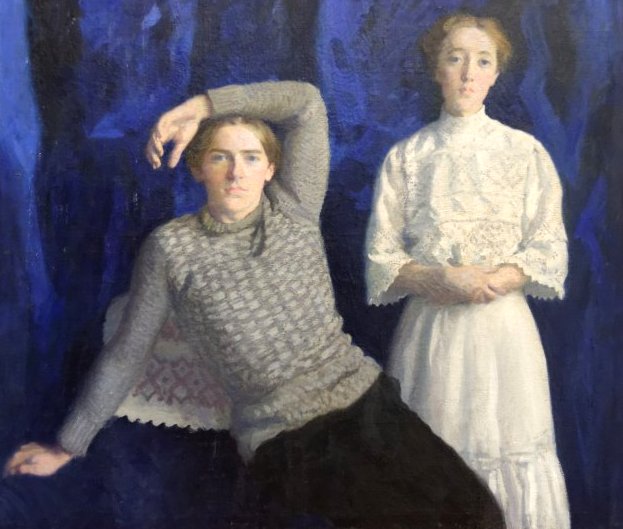
Béni and Noémi Ferenczy
Noémi and her twin brother Béni were born to Karoly and Olga Ferenczy on June 18th 1890. Noémi, like her twin brother, first began to practice art in her father’s studio and often visited the artists’ colony in Baia Mare. In 1911 she went to Paris and learned tapestry weaving at the Manufacture des Gobelins but was largely self-taught. Contrary to common practice, she not only designed her creations, but also made them herself. She wove her paintings on cardboard using woollen yarns that she had dyed with plant paint. Her first works were designed and woven in Baia Mare, where she exhibited for the first time in 1916 at the Ernst Museum in a joint exhibition with her father Károly and her brother Béni. The title of the exhibition was Károly Ferenczy and his children.
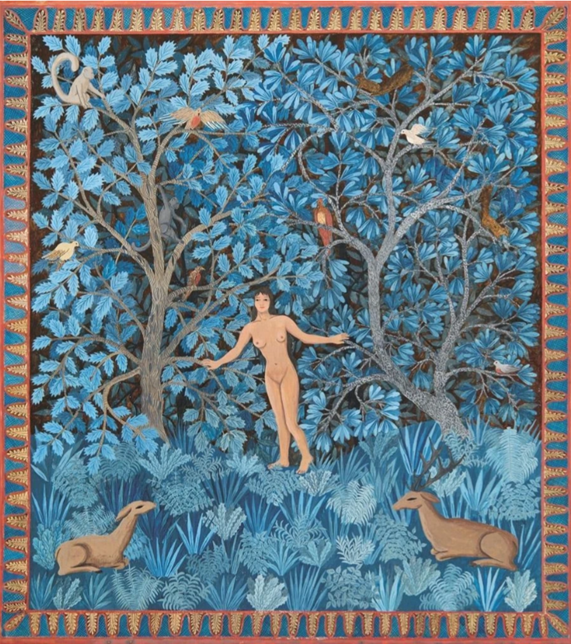
State of Innocence by Noémi Ferenczy
At the age of 23, however, she started working on an early masterpiece entitled Teremtés (Creation). She chose to remain responsible for the creative process from the beginning to the end, from the numerous pencil drawings, colour sketches and cartoons, to the weaving itself.

She recalled the inspiration for this tapestry:
“… My mother and I travelled a great deal and once we went to Chartres, the cathedral of those famous 13th century glass paintings. Brilliant in the shafts of light, the beautiful, artistic glass paintings were spellbinding. This was where I first felt the uncontrollably inspiring force of the desire to create, which has not abandoned me throughout my career. Creation is my first truly large-scale work. But even that stemmed from the magic of Chartres…”

In 1920, Following the collapse of the Hungarian Commune the year before, Noémi Ferenczy moved back to Nagybánya/Baia Mare, which had become part of Romania. There she helped organise a general workers’ strike, for which she was arrested and spent a few weeks in prison. She remained active in the Communist movement, taking part at the Fifth Congress of the Communist International in Moscow in 1924.
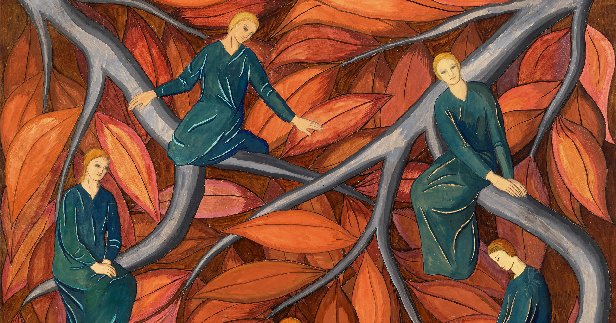
Her works were regularly displayed in Hungary, as well as in Romania and abroad. In 1932 she moved to Budapest. By this time, her style had changed: her compositions became more monumental, with fewer, but larger figures. From 1945 she taught at the Hungarian Academy of Applied Arts. She received the Kossuth Prize in 1948 and the title of Meritorious Artist in 1952. She died on December 20th 1957, aged 67, in Budapest, and is buried in Kerepesi Cemetery.



 my daily art display