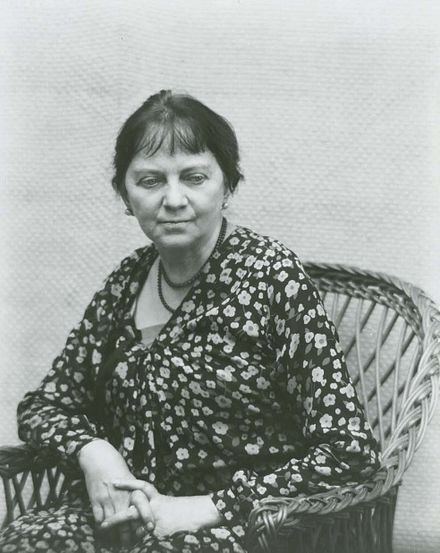
Marie Laurencin. Part 3.

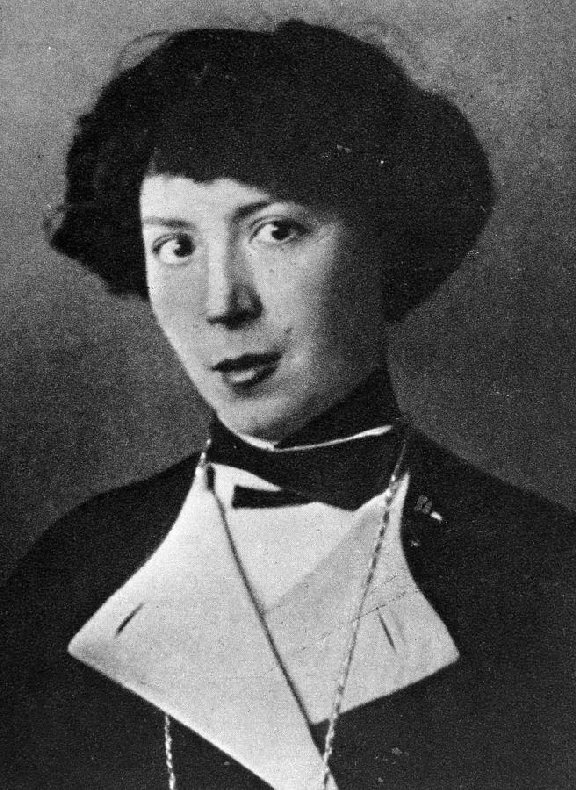
Marie Laurencin – a photograph by Granger (1913)

Marie Laurencin left Spain and returned to Düsseldorf via Switzerland in 1919. She was very unhappy with her life.  She was depressed and felt unstable with her marriage failing.   Laurençin filed for a divorce from her husband telling friends that the reason for the marital split was because her husband had become an alcoholic. In 1921 Laurençin returned to Paris, knowing that her marriage was finished and she divorced von Wätjen.   However, despite the divorce, they remained on good terms, and Marie kept in touch with van Wätjen’s until his death in 1942.

The Spanish Dancers by Marie Laurencin (1921)

Now having returned to the French capital Marie realised that she had been greatly affected by her separation from Paris which she looked upon as the unrivalled centre of artistic creativity. After her return, she developed a new style of painting which is reflected in her 1921 work, The Spanish Dancers.   Gone are the muted colours and the geometric patterns she had inherited from Cubism and these are replaced by light tones and undulating compositions. Once again, we note the coming together of the feminine world and the animal world, which became her favourite theme.  In the work we see three young women spinning around a small bounding dog, in front of a large grey horse. Marie has portrayed herself kneeling in the foreground wearing a pink tutu, which happens to be the only warm tone in the painting. Her hands are entwined with those of the young woman on the right, who is wearing a light grey dress with a light blue headscarf.  The woman on the left, wearing a light blue dress, is executing a dance step whilst holding a hat in place on her head.  Her eyes lead almost seamlessly into the large almond-shaped eye of the horse. The animals would appear to be the dancers’ confidantes in this strange setting.
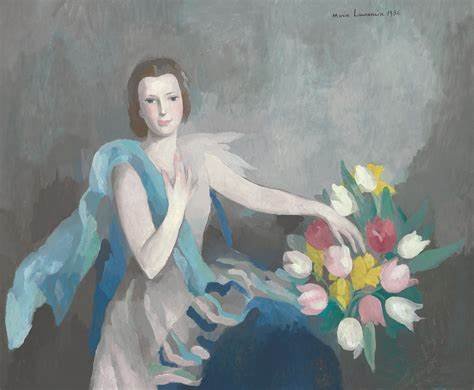
Femme aux tulipes by Marie Laurencin (1936)

Now back in Paris, Paul Rosenberg began to act as Marie Laurencin’s dealer which afforded her enhanced financial security and he also provided her with sound business advice.  Unfortunately, she did not always take Rosenberg’s advice and he was horrified to find that Marie often gave her work as a gift to those she liked. She also set higher prices for work which she found dull and often discounted some of her favourite works.  Curiously she often charged men double what she asked of women, and even charged brunettes more than blondes and furthermore she had a reputation for painting only children whom she liked.
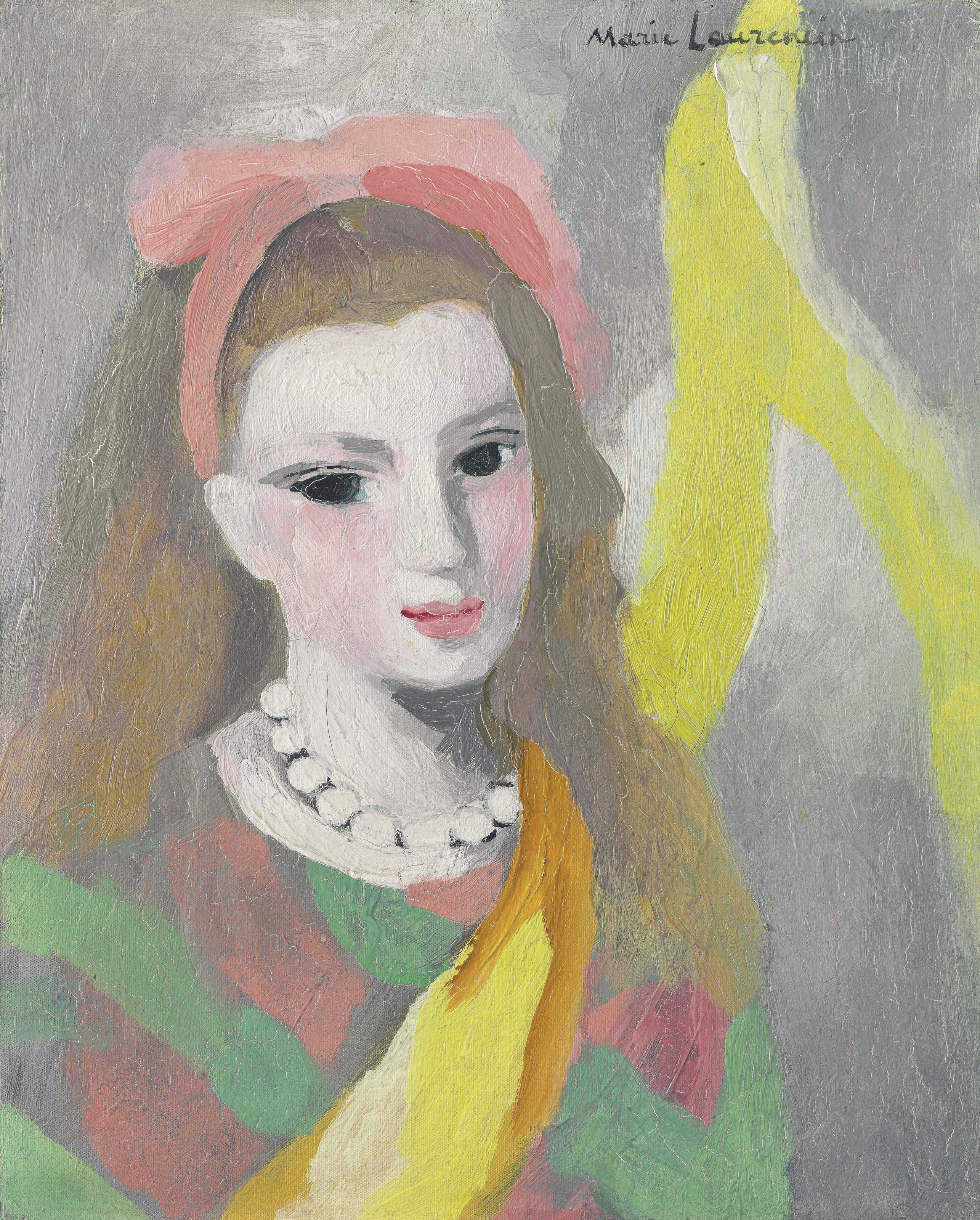
Jeunesse by Marie Laurencin (c.1946)

In her private life, while Marie Laurençin had a succession of male lovers, she also had close female friendships and lesbian relationships. She became part of the female expatriate community in Paris that searched for both artistic and sexual liberation. Lesbianism, for many of these women, was a crucial element of their resistance to bourgeois social conventions.

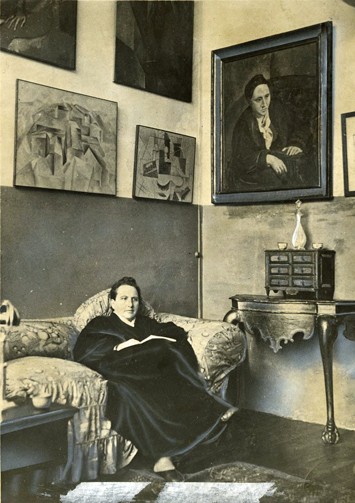
Gertrude Stein at 27 rue de Fleurus with her portrait by Picasso on the wall, May 1930

Now, based in the French capital, Marie was alone.  The first American who befriended her and bought her paintings was Gertrude Stein, an American novelist, poet, playwright, and art collector who had been born in Pennsylvania.  She had moved to Paris in 1903 and made France her home for the remainder of her life. She hosted a Paris salon, where the leading figures of modernism in literature and art, such as Pablo Picasso, Ernest Hemingway, F. Scott Fitzgerald, Sinclair Lewis, Ezra Pound, Sherwood Anderson and Henri Matisse, would meet for conversation and inspiration.  Laurençin soon became part of the Stein salon on rue de Fleurus.  Marie remained in contact with Gertrude Stein and Alice B. Toklas until Stein’s death in 1946 and continued to see Toklas until her own death.
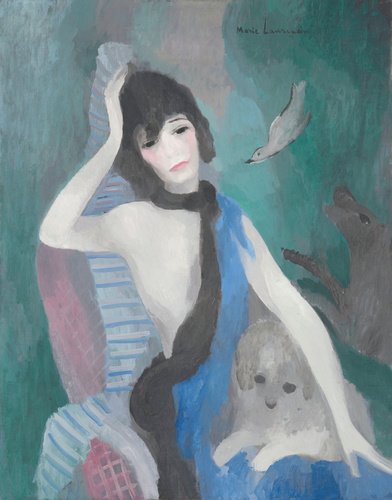
Portrait of Coco Chanel by Marie Laurencin (1923)

Laurencin held an exhibition of her work in 1921 at the Rosenberg Gallery in Paris. She had now built up her reputation as a talented portraitist, especially of celebrities, one of whom was Coco Chanel.  The commission to paint Chanel’s portrait came about in the autumn of 1923 when Marie Laurencin was working for Sergei Diaghilev’s Ballets Russes which was established in Paris, Monte-Carlo and London, and Marie was designing the costumes and sets for the ballet Les Biches [The Does]. At the same time, Coco Chanel was creating the costumes for the same company’s Le Train Bleu [The Blue Train] operetta .   At that time, Coco Chanel was both very rich and famous, and she commissioned Marie Laurencin to paint her portrait.  This was one of Laurencin’s early portrait commissions. Laurencin depicted Chanel face-on, seated in a relaxed, somewhat dreamy pose, with her head resting on her right arm. She appears relaxed and her eyes and mouth, neutral and expressionless, suggest that she is daydreaming or preoccupied by her thoughts. Marie Laurencin’s painting style was to incorporate animals in her works and here she depicts a white poodle sitting on the Coco Chanel’s knees. It is unclear where Chanel’s flesh ends and her dress begins; her pale outfit is accented with dark black and blue scarves, while the seat behind her is a textured pink and blue. On the right-hand side of the painting, we can see another dog leaping upwards towards a turtle dove which appears to be descending from the sky towards Coco Chanel, like the dove of the Holy Spirit, and thus Laurencin’s symbolising it as a sort of freedom. The colour palette is of a soft harmony of the colours – green, blue and pink, which is reinforced by the long black line of the scarf draped around the model’s neck.  The finished painting was so like Laurencin’s earlier works but did it capture the likeness of Coco Chanel.  The sitter did not think so and the artist did not deny it, but claimed that physical likeness was unimportant.  Chanel refused to pay for it and Laurencin was so annoyed by Chanel’s attitude that she refused to execute a second portrait and decided to keep the original herself.  Despite Chanel’s rejection of the painting, the success of Laurencin’s approach to portraiture was such that she continued to receive and execute portrait commissions in this style until the 1940s. The painting can now be found at the Musée de l’Orangerie in Paris.
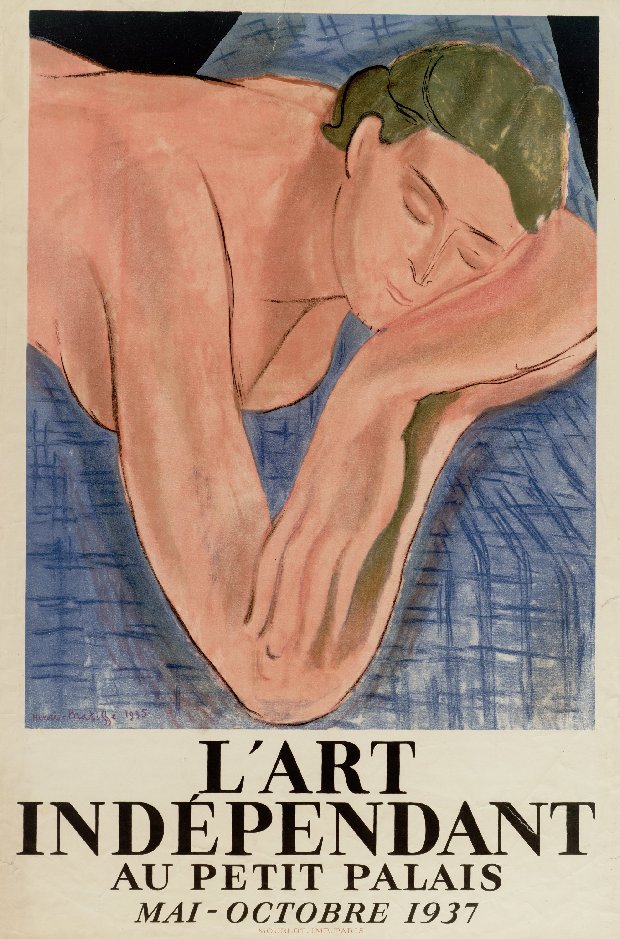
In 1931, Laurencin was one of the founding members of La Société des femmes artistes modernes, and took part in their annual exhibitions until the outbreak of World War II. During the period from 1932 to 1935, she tutored at the Villa Malakoff, a private art school.  In 1937, which art historians believe was the height of her career, a retrospective of Laurencin’s work was held in conjunction with the Great Exhibition of Independent Art Masters at the Petit Palais, which sought to promote the superiority of the contemporary French artistic school, extended to foreign artists “living or having lived in France for many years”. The year 1937 saw a change in Laurencin’s appearance when she finally acquired glasses, which changed her life considerably as she had been extremely short-sighted since childhood and had had difficulty negotiating staircases since the 1920s.
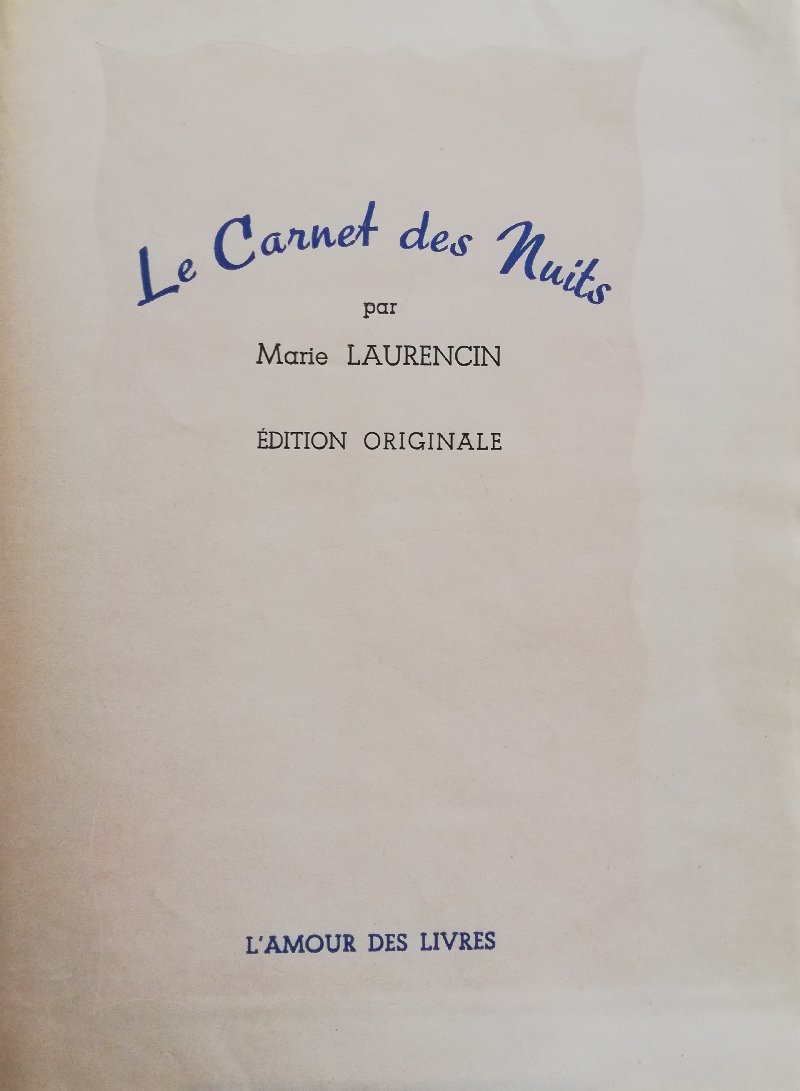
During World War II, Laurencin remained in Paris painting and working on designs for the ballet, and in 1942 she published Le Carnet des Nuits – a collection of poetry with short memoir pieces in prose.  Although Laurencin will be remembered as an artist and the grace and the elegance of her artworks; she is also the author of a diary, Le Carnet des Nuits, an important witness of her time. It tells of her early years she spent in Bateau-Lavoir.  Her writing is of the same delicate style used for her artworks. 

Head of a Woman by Marie Laurencin (1909)

In later years, Laurencin became withdrawn and increasingly isolated and sadly suffered from periods of depression and other health complaints, albeit, she continued to paint throughout this troubling passage of time. Her main companion was her maid, Suzanne Moreau, who had lived with her since 1925. Whether there was more to the mistress/servant relationship is unclear but it is thought that they were romantically linked.    In 1954, Laurencin made Moreau the beneficiary of her estate. It is thought this came about due to Laurencin’s legal struggle, resolved the following year, with tenants living in the apartment that she owned.
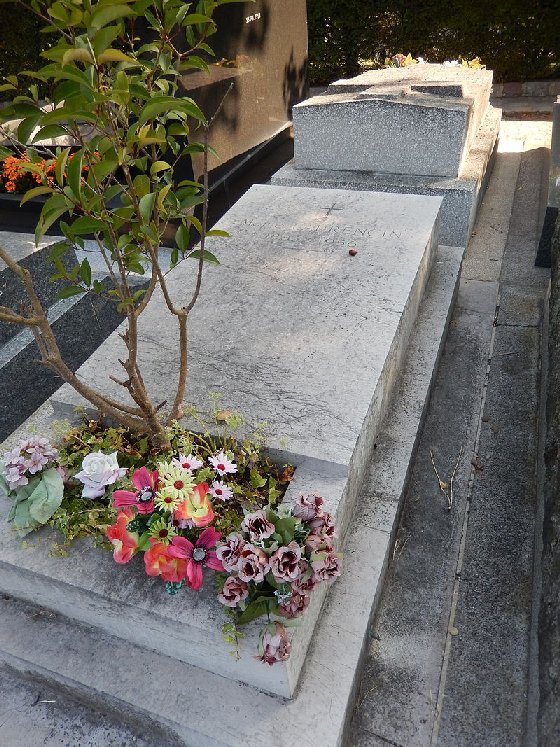
The tomb of Marie Laurencin in Père Lachaise Cemetery, Paris.

Laurencin died of a heart attack on June 8th, 1956, aged 72.  She was buried wearing a white dress in Père-Lachaise cemetery in Paris, as per her wishes, with Apollinaire’s love letters and a rose in her hand.


The main source of information for the three blogs about Marie Laurencin came from the excellent The Art Story website.

Marie Laurencin Part 2.

Marie Laurencin, Paris (c.1912.)

Marie Laurençin’s paintings dating from around 1910 have a strong flavour of cubism. However, she once again stated that although the experiments of cubism fascinated her, she was adamant that she would never become a cubist painter because she was not capable of it.

Bateau-Lavoir c. 1910

Laurençin spent a lot of time at Picasso’s open studio at the Bateau-Lavoir, (Laundry Boat) building at 13 Rue Ravignan at Place Emile Goudeau in Montmartre in the 18th arrondissement of Paris.  The building was so nicknamed as it was said to resemble the public clothes-washing boats moored on the Seine in the early years of the twentieth century. The ramshakle building was said to strain and groan when it was windy—just like the those laundry boats on the Seine. Here, Laurençin exhibited her work along with a group of artists known as the Bateau-Lavoir, which was the residence and meeting place for a group of outstanding artists and men of literature.  It was here that she met Max Jacob, the French poet, painter, writer, and critic, and André Derain, the French artist, painter, sculptor and co-founder of Fauvism.  She was also introduced to Gertrude Stein, the American novelist, poet, playwright, and art collector to whom she made her first sale in 1908.

Les jeunes filles (Jeune Femmes, The Young Girls) by Marie Laurençin (1911)

In 1911 Laurençin completed her painting entitled The Young Girls.  Marie Laurencin showed The Young Women at the Salon des Indépendants in Paris in 1911, alongside works by other artists painting in a similar style. The exhibition, which gave rise to the term “cubism”, caused a scandal but was also the breakthrough for Cubist art.  This work depicts four pale-skinned dark-eyed women with dark hair, independent of each other and yet overlapping.  They are all wearing  grey robes and stand against an abstracted pastoral backdrop. The female on the left is a violinist, playing music for the figure beside her, who dances. At the centre of the depiction we see a woman seated facing the dancer, but she turns her head to look back at us.  On the right, another woman appears in motion, carrying a bowl of fruit under her right arm and reaching down with her left hand to stroke the nose of a doe. All the limbs of the women have a fluidity which mirrors the drape of their dresses.   Their bodies are outlined with heavy black lines.  Laurençin has experimented with this depiction and artistic style. 

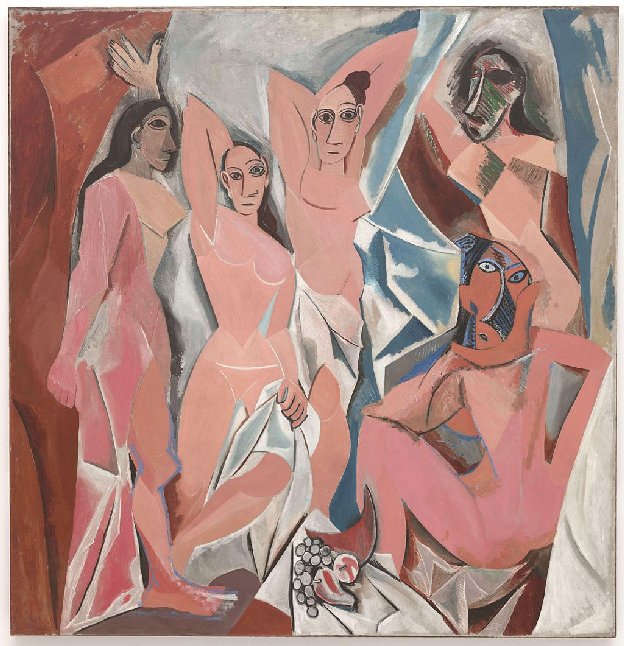
Les Demoiselles d’Avignon by Picasso (1907)

The posture of the four women with their flat, mask-like faces seems to have been influenced by her friend, Picasso’s 1907 painting Les Demoiselles d’Avignon.  In a way the work can be considered as a suggestion that the four women represent a fertile sphere of feminine creativity.  The presence of the doe is symbolic of femininity and naturalness that was a common theme in Laurencin’s work.  Critics believe the painting alludes to the of lesbian self-fashioning and as a celebration of an independent female realm.  The painting can be viewed at the Moderna Museet in Stockholm.

Portrait de jeune femme by Marie Laurencin

In 1913, Marie Laurençin’s mother died and this sad event coincided with her ending her relationship with Apollinaire, but this ending could have something to do with his reputation as a philanderer.   However, she would remain close to Apollinaire until his death, aged 38, in 1918. Her split from Apollinaire freed Laurencin of his Cubist influence, but at the same time, isolating her. On June 24th 1914, in Paris, Marie married Baron Otto van Wätjen, a German Impressionist and Modern painter whom she had first met as fellow students at the Académie Humbert.  

Marie Laurencin, Cecilia de Madrazo and the Dog, Coco by Marie Laurençin (1915)

In the Tate Britain, London, one can see the 1915 work by Laurençin entitled Marie Laurencin and Cecilia de Madrazo and the Dog, Coco.  Cecilia was an art collector friend of Maria.  Laurençin told a fellow artist that the painting was completed in 1915 while she and her husband were exiled in Madrid.  The girl wearing the hat is Cecilia de Madrazo, a young Spaniard, and the other figure is Marie herself wearing a pink dress with her dog poking up between them.  She had bought the dog from an English sailor at Malaga. Marie Laurencin was staying in Madrid with the Madrazos at the time.  Marie has depicted herself with short hair which covers her ears and forehead.  Although her skin is grey it is sharply in contrast with pink cheeks and lips and black eyes which are focused downwards.  Cecilia is fascinated by the dog.  She stares down at it and pushes a finger towards its very long snout. Cecilia’s skin is almost white, with pink lips and cheeks.  She is wearing a grey dress and has a white hat, with a large blue bow, atop her dark hair. The backdrop, almost without detail, is grey and there is a pink curtain at the right edge of the painting; the colour scheme is very limited, with Laurencin utilising only grey, pink, blue and very small amounts of beige. This painting is representative of Laurencin’s work, which has been both appreciated and criticised for its deliberately feminine aesthetic.  Marie’s palette concentrated on  pastel colours. The two figures depicted add a sense of peace and charm and they own the conventional female virtues of loveliness, sophistication and meekness. Laurencin’s unapologetic embrace of visual pleasure and the way she developed an aesthetic that acclaimed female softness, elegance and sweetness was itself a radical position. Laurencin’s painting has depicted such qualities as part of a creative process in which a masculine form is utterly unnecessary, and in a way it is a presentation of a work in which both artist and subject are female.   

The Fan by Marie Laurencin (1919)

In 1919 Laurencin completed her painting entitled The Fan and this, like the previous work, is part of the Tate Britain, London collection.  The painting was purchased by Gustav Kahnweiler, an art dealer, as a gift for his wife, Elly.  He and his wife amassed a modest art collection focused on Cubist paintings, sculptures, and works on paper. After the couple moved to England in the 1930s to escape Nazi persecution, Gustav and Elly loaned and gifted works from their collection to the Tate.  It is believed that the woman in the oval frame is Laurencin herself but the identity of the other woman is unknown.  The fan, which was a symbol of vanity, was one of Laurencin’s favourite accessories. The painting depicts a pink shelf that holds two images of women, one in a rectangular frame and the other in a round frame, against a pink and grey background. The portrait to the left, in the larger, rectangular frame, shows a woman and a dog in greyscale, accentuated by a pale blue ribbon, hat and curtains.  Next to it is an oval frame at the centre of the painting depicting a woman reputed to be Marie Laurencin herself, though it is unclear if this is a portrait or indeed a mirror. The lower right corner of the painting is dominated by the folds of a fan, painted in grey and white, that is cut off at the canvas’s edge.  Laurencin has cleverly depicted the fan in a position that could be seen as being held by someone who is staring at the two frames on the shelf.  The two portraits in the frames on the shelf are positioned such that the figures appear to look out towards us but also towards the person holding the fan.  There is an air of mystery about the depiction and the identities of the figures.  Some believe that the woman in the rectangular frame is Nicole Groult, a dressmaker with whom Laurencin is likely to have had a romantic relationship.

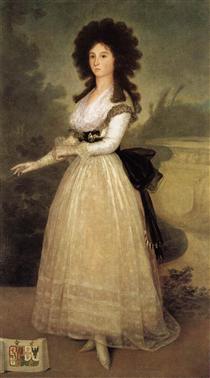
Dona Tadea Arias de Enriquez by Goya (1793)

Once married to Otto van Wätjen, Laurencin automatically lost her French citizenship and so took up German citizenship. She and her husband moved to neutral Spain at the beginning of the First World War in order to avoid France’s anti-German sentiment.  Here, Laurencin became involved with the Dada movement, editing the art and literary magazine 391, a Dada-affiliated arts and literary magazine created by Francis Picabia.  She also spent time looking closely at the work of Francisco Goya, whose dignified, dark-eyed women captivated her.

Simultaneous Windows on the City by Robert Delaunay (1912)

During this period in Spain she became great friends with Sonia Delaunay and Robert Delaunay, who had similarly left France to avoid the War.   Robert was an artist of the School of Paris movement, who, with his wife Sonia Delaunay and others, co-founded the Orphism art movement, noted for its use of strong colours and geometric shapes.

……to be continued.

Anne Goldthwaite

Anna Goldthwaite Self Portrait

The artist I am showcasing today is a lady who hailed from the American Deep South.  Anne Wilson Goldthwaite was born into a genteel Montgomery, Alabama family on June 28th, 1869.  She was a true daughter of the South and the oldest of four siblings. Her father was Richard Wallach Goldthwaite, who served as an artillery captain for the Confederacy during the Civil War and the son of Alabama senator George Goldthwaite.

Portrait of a Young Man by Anna Goldthwaite (1913)

Her family moved to Dallas,Texas when she was young and remained there for the majority of her childhood while her father looked for work.  After her parents both died, in the early 1880s, she and her siblings were taken back to Alabama where they lived with different relations. Anne went to live with her aunt Molly Arrington and her aunt’s nine children.  Her aunt presented her to society as a promising young debutante who was destined to become a southern belle. However this ended when her fiancé was killed in a duel.


As a teenager Anne liked to sketch and paint and soon developed into a talented artist, so much so, that in 1898, one of her uncles, Henry Goldthwaite, who was so impressed by her artistic talent, he offered to pay for her to have private art tuition.  He offered to support her financially for up to ten years if she relocated to New York City to study art. Anne Goldthwaite accepted his offer and arrived in New York around 1898.  She then enrolled at the National Academy of Design, where she studied etching with the German-born immigrant, Charles Mielatz and was tutored in painting by the Scottish-American painter and illustrator, Walter Shirlaw and American artist, Francis Coates Jones.

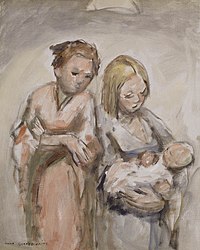
Young Mother by Anne Goldthwaite

She also spent one summer in Princeton, New Jersey, in the 1890’s, where she met then-professor Woodrow Wilson who had been appointed by Princeton to the Chair of Jurisprudence and Political Economy.  Two decades later he would become the twenty-eighth President of the United States.  He commissioned her to paint a portrait of his wife.

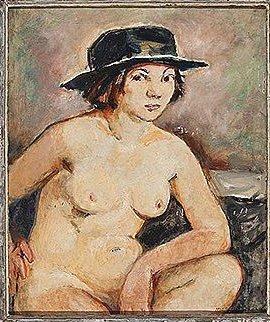
Young Nude Woman in a Hat by Anne Goldthwaite

In 1906, Anne Goldthwaite decided to travel to Paris to further her interest in the early modern painting styles of Fauvism and Cubism.

4 Rue de Chevreuse, Paris by Anne Goldthwaite (1908)

On her arrival in Paris Anne headed for the American Girls Art Club at 4 rue de Chevreuse, on the Left Bank.   The property was built by the Duc de Chevreuse and back in the 18th century it was the Dagoty porcelain factory. Later, in 1834,  it was turned into a Protestant school for boys called the Keller Institute.  It was in the 1890’s that Elisabeth Mills Reid, a wealthy American philanthropist and wife of the American ambassador, had the idea to turn it into a residential club for American women artists in Paris.  Anne Goldthwaite made this her base for the next six years.  According to Mariea Caudill Dennison’s article in the Woman’s Art Journal (2005) entitled The American Girls’ Club in Paris: The Propriety and Imprudence of Art Students, 1890-1914, Anne viewed the Club as a “chateau that was not a club at all, but a glorified pension for American women art students. We paid little board and lived in the midst of luxury and romance”

One day, while she was at the Luxembourg Gardens sketching, she met American writer Gertrude Stein. After a long conversation, Stein invited Anne to visit her apartment, but Anne was somewhat wary due to Stein’s scruffy appearance but eventually she agreed. Goldthwaite recalls Stein describing her as

“…a large, dark woman…who looked something like an immense brown egg. She wore, wrapped tight around her, a brown kimono-like garment and a large flat black hat, and stood on feet covered with wide sandals…”

Gertrude Stein’s legendary Montparnasse apartment at 27 rue de Fleurus

Despite Anne having doubts about Gertrude Stein, she was impressed with what she saw in Stein’s apartment.  A large collection of contemporary paintings hung on the walls.  Little did Anne realise that this chance meeting with Gertrude Stein, the most influential pre-war and avant-garde person of the time, would provide her with an opportunity to join the art circle of Henri Matisse and Pablo Picasso. In her memoirs, Goldthwaite wrote about he visit to Stein’s apartment:

“…Crossing a little pebbled court, we went into a beautiful large studio filled with antique Italian furniture. The walls were covered with the most remarkable pictures I had ever seen. I knew they must be pictures because they were framed and hanging on the walls […] There was what I know now was a head by Picasso, looking like a design made of the backbones of fish; “Le Joie de Vivre [sic] ” by Matisse; a small grey canvas by Cezanne, and a yellow nude on a peach-colored background, the feet hanging down as in an ascension […] This was my introduction to what we now call Modern Art, made some six days after my arrival in Paris. It was with surprise, later, that I saw American students who had been in Paris a long time, yet had not heard the names of Matisse, Picasso, et. al., and had never heard of l’Art Moderne, or if they had, thought it completely negligible …”

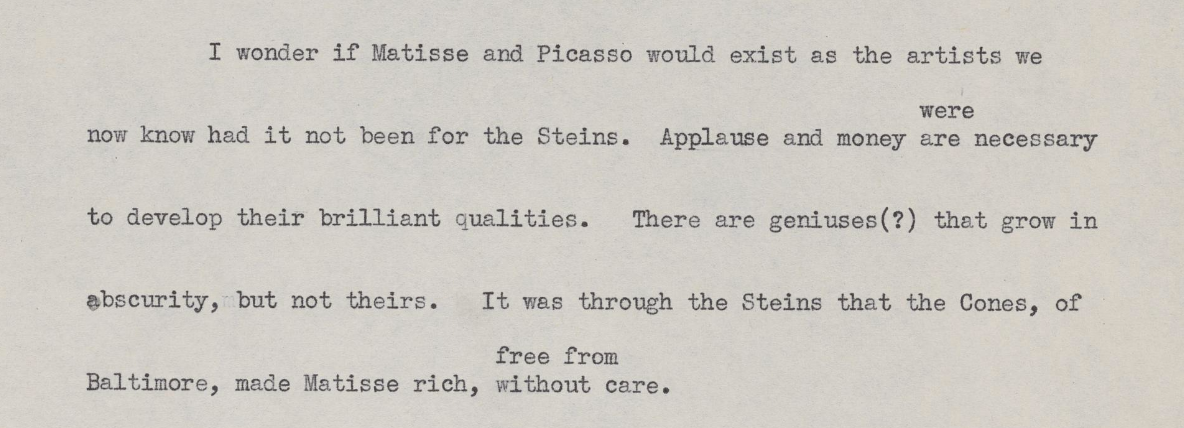
Anne was adamant that but for Gertrude Stein, Modernism would not have arrived in America. A page from her unpublished memoirs testifies to this belief. She wrote:

Page from the memoirs of Anne Goldthwaite

“Cones” refers to the Baltimore Cone sister, Dr Claribel and Etta Cone, who from 1898 to 1949 amassed a collection of primarily post-impressionist and modern French masterpieces.

Anne Goldthwaite later recalled her time in Paris and wrote:

“…Fate gave me several years in Paris at the most exciting time: during the great reconstruction from art to modern art…”

During her stay in Paris Anne moved from one atelier to another searching for a teacher that she could work with.  Eventually, she joined a small group of young artists called Académie Moderne.  This was a free art school in Paris, founded by Fernand Léger and Amédée Ozenfant who also taught at the academy.  The school attracted students from Europe and America.  They also held an exhibition each spring and their work was periodically critiqued by the post-impressionist painter, Charles Guerin.

The House on the Hill by Anne Goldthwaite (1911)

According to an article in the American Art Annual published in 1911, Anne served as president of the American Woman’s Art Association (AWAA) which was based at the The American Girl’s Club, from 1910-1911.

Cottage in Alabama by Anne Goldthwaite (c.1920)

In 1913, the Association of American Painters and Sculptors, also known as the International Exhibition of Modern Art organised a grand art exhibition.  It was the first large exhibition of modern art in America, and a shocking introduction of Modernism to an American audience. It was an exhibition that had been held in the vast spaces of U.S. National Guard armories.  It was a three-city exhibition which started in New York City’s 69th Regiment Armory, on Lexington Avenue between 25th and 26th Streets, on February 17th and ran until March 15th.   The exhibition then moved to the Art Institute of Chicago and finally arrived at The Copley Society of Art in Boston.  The Armory exhibition, as it became known, was an important event in the history of American art for it introduced Americans, who were accustomed to realistic art, to the experimental styles of the European avant-garde, which included Fauvism and Cubism. The show acted as a catalyst for American artists, who wanted to become more independent and by so doing, create their own artistic language.  Upon her return to America in 1913, Anne Goldthwaite exhibited two of her works at the New York Armory exhibition.  One was entitled The Church on the Hill, now known as The House on the Hill which she had completed around 1911.  The other painting was entitled Prince’s Feathers.

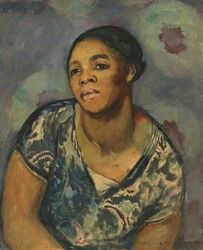
Rebecca by Anne Goldthwaite (c.1925)

Now back in America, Anne lived most of her adult years in New York but travelled south during the summer months to spend time with her family.  She became a member of the Dixie Art Colony in Wetumpka, Alabama, which was thought to be one of the Deep South’s first art colonies. These summers she spent in and around Montgomery established Anne Goldthwaite as one of the South’s most important regional artists for the period.  During this time she often depicted rural African Americans in their post-slavery contexts in oil paintings, watercolours, and etchings.

Women’s suffrage march on New York’s Fifth Ave. in 1915

Anne Goldthwaite’s politics were said to be progressive and she was a staunch supporter of women’s suffrage, serving on the organizing committee for the 1915 Exhibition of Painting and Sculpture by Women Artists for the Benefit of the Women’s Suffrage Campaign, open from September 27-October 18, 1915 at the Macbeth Gallery in New York which coincided with the Women’s Suffrage March held that year in New York during which it was said that 20,000 supporters attended.

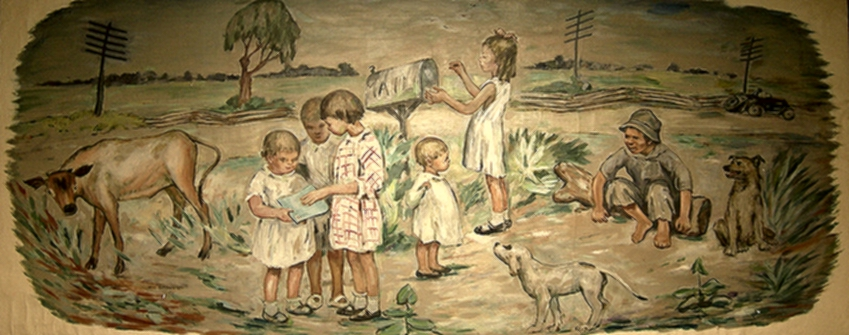
The Atmore Post Office mural: The Letter Box, by Anne Goldthwaite, 1938

The Atmore, Alabama Post Office

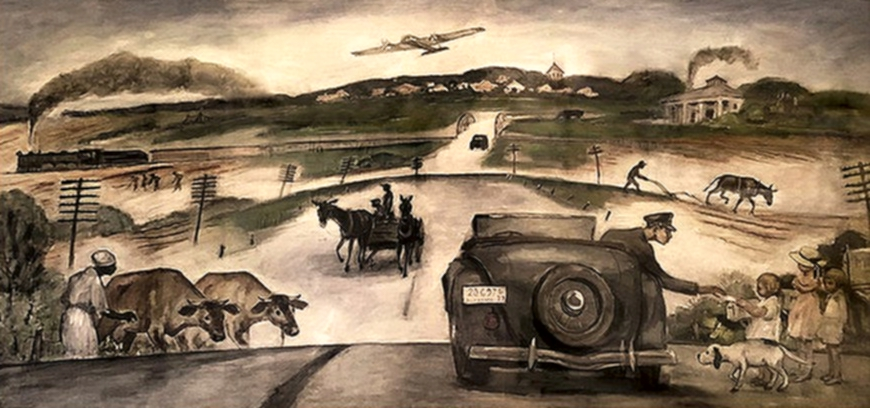
The Great Depression hit America at the end of 1929 and lasted almost ten years.  It was both a financial depression and a mental depression which affected many American citizens.  The American government thought that cheering people up during these hard times was something they needed to achieve.  It was part of the New Deal, a series of programs, public works projects, financial reforms, and regulations enacted by President Franklin D. Roosevelt in the United States between 1933 and 1939.  One of the projects in the New Deal was the Public Works of Art Project which was developed to bring artist workers back into the job market and assure the American public that better financial times were on the way. The idea was to employ artists to beautify American government buildings.  The mission of the post office murals was multifaceted – to boost morale in communities, employ artists by the thousands and create world-class art that was accessible to everyone. The murals revolved around local folklore, landscapes, industry and, unsurprisingly, mail delivery. They told the story of life across the United States.

Tuskegee Post Office mural: The Road to Tuskegee, by Anne Goldthwaite, 1937

Anne Goldthwaite had two of her murals accepted for Alabama post offices.  One was in the town of Atmore, the other was in the town of Tuskegee. The Road to Tuskegee mural painted in 1937 by Anne Goldthwaite was restored and moved to the new Tuskegee post office in 1996.

Portrait of Frances Greene Nix by Anne Goldthwaite (c.1940)

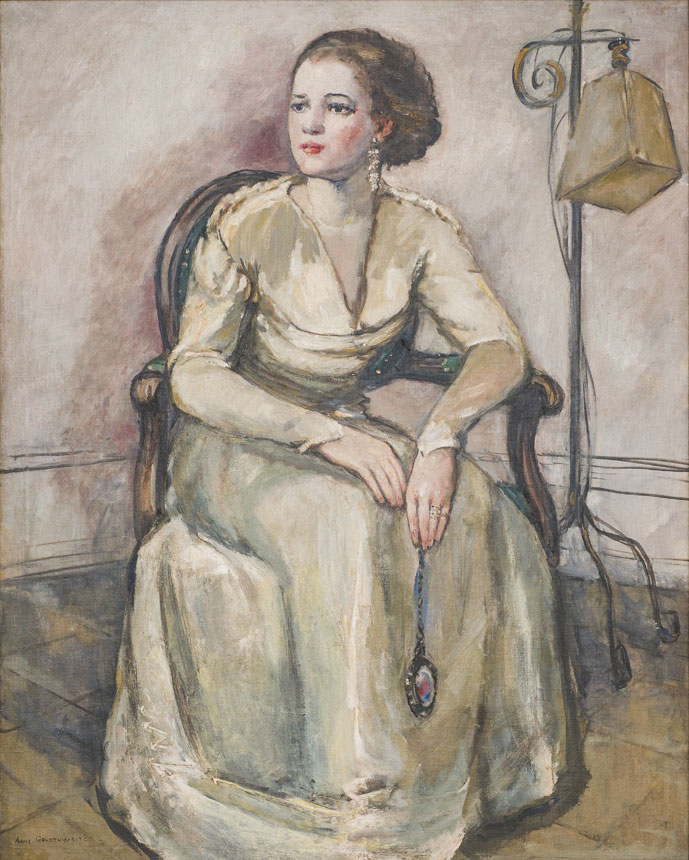
Anne Goldthwaite executed a number of portrait commissions, one being that of Frances Nimmo Greene Nix, the Museum Director, Artist, Portrait Painter, and Writer.  Frances was clerk, director, and curator of the Montgomery Museum of Fine Arts and studied with Anne Goldthwaite.

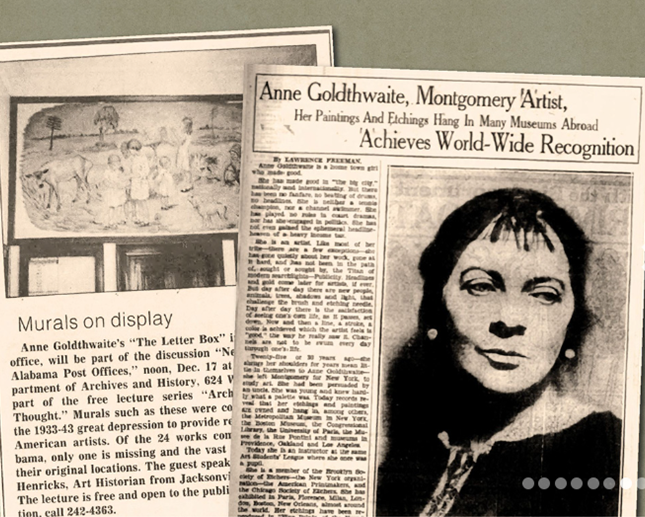
Goldthwaite’s work is included in the permanent collections of The Metropolitan Museum, Whitney Museum, Montgomery Museum, Montgomery Alabama, Greenville County Museum of Art and History, Greenville, South Carolina.  She was a member of the National Association of Women Artist, New York (Co-founder), Watercolor Society, Salons of America and the Society American Etchers/Brooklyn Society of Etchers.  Goldthwaite began teaching at the Art Students League, where she was a very popular teacher until her death in 1944.

Anne Goldthwaite (1869-1944)

Anne Goldthwaite died in New York City on January 29th 1944, aged 74.