Cézanne, Jas de Bouffan and the peasant workers

Paul Cézanne aged 22

Four years ago I visited the Courtauld Gallery in London to see the Cezanne exhibition which featured three of his five Card Players paintings. I was fascinated by the figures depicted in these works of art, the same fascination the artist must have had for these rustic characters as they featured in many of his paintings. From around 1887, Cézanne began to paint single figures again and, in his early works, he would used his wife and son as models, later he would get some of the peasant workers to model for him at the family’s estate, Le Jas de Bouffan, (“home of the winds” in the language of Provencal). In this blog I want to have a look at some of his paintings which featured these peasants and the estate where it all happened.

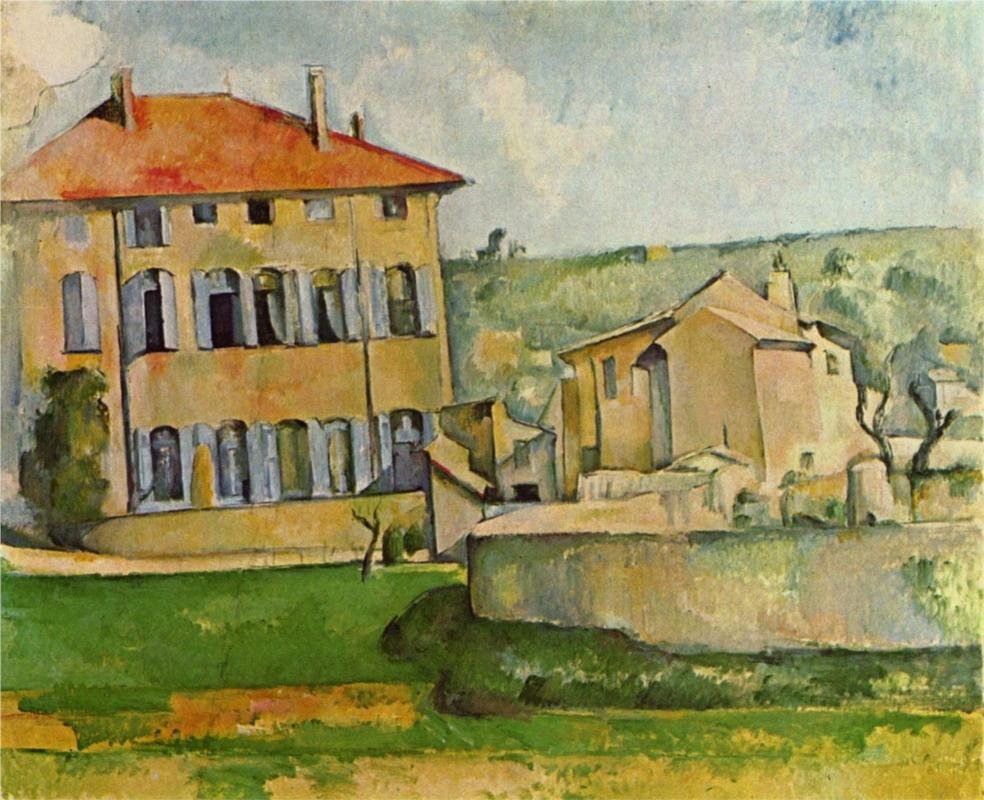
The House and Farm at Jas de bouffan by Cézanne (1887)

Paul Cézanne’s father, Louis-Auguste Cézanne, was a banker and in September 1859, when Cézanne was twenty years old, his father acquired the Le Jas de Bouffan estate from its then present owner, Gabriel Joursin, who was heavily in debt to the bank. It was a spectacularly beautiful estate, located on the outskirts of Aix-en-Provence, with its long avenue, lined with chestnut trees, leading to the large manor house. The family moved into the large estate house, which was run-down, some of the rooms were in such poor condition that they could not be lived in and were permanently locked up. Initially the family just lived on the first floor with the ground floor rooms set aside for storage. Cézanne, who much to his father’s dismay, wanted to become a professional artist but had placated his father by agreeing to study law at the Law faculty at Aix. His father allowed him to paint murals on the high walls of the grand salon on the ground floor, a room which he was eventually allowed to turn it into his temporary studio.

Spring, Summer, Autumn, Winter by Cézanne (1860-2)

It could have been that as the surface of the walls was in such a poor condition his father allowed his son to exercise his artistic ability on them. Cézanne decorated the walls with four large panels of the Seasons. The odd thing about his four murals was that he signed them, not with his own name, but with the name “INGRES” and added the date 1811 on the bottom left of the panel representing Winter. So, why sign the painting “Ingres” and why the date, which was almost fifty years in the past? It is thought that the young Cézanne wanted to prove to his father that he was as good an artist as the legendary Ingres and the date probably referred to Ingres’ famous work Jupiter and Thétis, which Ingres completed in 1811 and was in the collection of Cézanne’s local museum, Musée Granet, in Aix-en Provence.

The Artist's Father, Reading L'Événement by Cézanne (1866)
The Artist’s Father, Reading L’Événement by Cézanne (1866)

In all, between 1860 and 1870, Cézanne painted twelve large works of art directly on to the walls of the large salon and which remained in situ until 1912. One of these works was entitled The Artist’s Father, Reading “L’Événement” which can be seen at the National Gallery of Art, Washington. Cézanne completed the work in 1866 and depicts Louis-Auguste Cézanne reading the newspaper L’Evénement. The newspaper is a reference to Cézanne’s great friend from his childhood days, the novelist Émile Zola, who was one of the people who urged Cézanne to overcome his father’s demands to have him study law and instead, go to Paris and study art. Zola had become the art critic for the L’Evénement in 1866. It was certainly not the paper Cézanne’s father would have read !

The House of the Jas de Bouffan by Cézanne (1874)

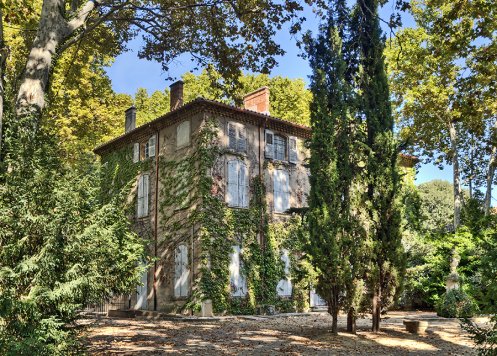
Although often working in his indoor studio, Cézanne also enjoyed painting en plein air in the vast grounds of the estate, which contained a farm, as well as a number of vineyards. He painted a number of views of the manor house, one of which was completed around 1874 and was entitled The House of the Jas de Bouffan. In this work we see the great old ochre-coloured building, with its ivy- clad walls nestled amongst a thriving mix of tall, well-established trees and greenery. It is a beautiful sunlit scene which captures the myriad of visual wonders offered up by nature. Cézanne despite moving around the country, including Paris, where he exhibited works at the first Impressionism exhibition in April 1874, often returned to Jas de Bouffan to relax and paint. The roof of the house had to be replaced in the early 1880’s and it was then that Cézanne’s father made a little studio in the attic for his son. In 1886 when his father died, Cézanne came into a large inheritance which included the family’s beloved estate. This was the same year he married his lover and artist’s model of seventeen years, Hortense. In September 1899, two years after the death of his mother, Cézanne and his two sisters sold Jas de Bouffan to Louis Granel, an agricultural engineer.

House in the Jas de Bouffan

Much later, the house and a portion of the grounds were sold to the city of Aix. The house has been open to the public since 2006 for visits in connection with the tours organized by the Office de Tourisme with regards to the life of Cézanne.

Man in Blue Smock by Cézanne (1897)

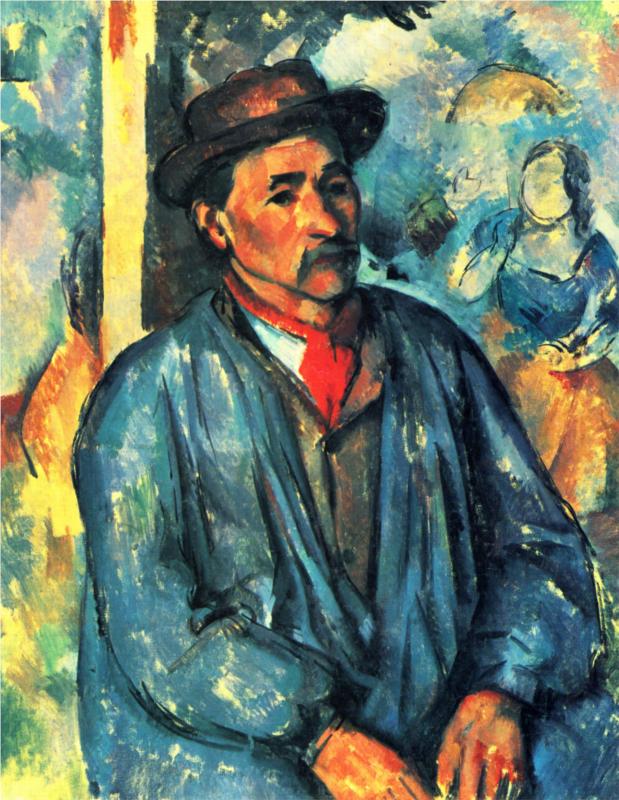
As I wrote before, in the late 1880’s Cézanne began to concentrate once again on single portraits and used his wife Hortense and son Paul as models. Later, in the 1890’s he started to paint a number of pictures which featured some of the workers of the estate. Using actual peasant workers that he knew added that little bit extra realism to the depictions. One such work was entitled Man in a Blue Smock which he completed around 1897 which is now housed in the Kimbell Art Museum, Fort Worth. The worker who sat for Cézanne in this painting was also one of the models used for the famous Card Players series. It is an interesting work which needs to be carefully studied. The man, with a large moustache, shows little expression as he sits before Cézanne, the artist and his boss! It appears that he has been asked to put on a painter’s blue smock over his ordinary working clothes, which includes a red bandanna

The painting of the peasant is awash with muted blues and browns but the red used for the bandanna, the man’s cheeks and the backs of the hands draw our eyes to these very points in the painting. The background of the work is predominately filled with pastel colours but what is most interesting is what is behind the left shoulder of the main character. One can make out a faceless lady carrying a parasol. The museum curator believes that this faceless woman perhaps suggests some mute dialogue between opposite sexes, differing social classes, or even between the artist’s earliest and most fully evolved efforts as a painter. This latter reason falls in well with the fact that the lady with the parasol is a copy of one of Cézanne’s first works which he completed in 1859, when he was twenty years of age, and which can now be found in the Musée Granet in Aix.

Seated Peasant by Cézanne (c.1896)

Another painting featuring one of his peasant workers is entitled Seated Peasant which he completed around 1896 and is part of the Annenberg Collection at the Metropolitan Museum of Art in New York The peasant in the painting is young and is seated cross-legged on a cane chair. The setting for the painting is inside one of the rooms in the big house. It is “L-shaped” in design. The background is once again a simple plastered wall with its dado rail. Cézanne has restricted his palette to a small number of colours – greys, blues, browns, yellows and grey greens which are only replaced by the odd small splash of purple and red. Although there is a similarity between him and the peasants in the various Card Players works he has never been identified as being in any of those five famous paintings. The man seems lost in thought. His mouth is drawn down on each side giving his facial expression an air of melancholia. He wears a baggy dark brown coat over a grey jacket and a yellow waistcoat or vest. He wears striped trousers. Look at the way Cézanne has painted his hand which rest on his thigh. It is very large in comparison to the rest of his body and could almost be described it as being “ham-fisted”. As in some other portraits by Cézanne, he has introduced a still-life element into the work. On the floor in the bottom left of the painting he has added two green-bound books, two small boxes, a small bottle and a stick all of which have been placed on a cloth. Only the artist knows why he included these inanimate objects into this portrait! Maybe he was asserting his ability to paint still-life objects.

Peasant Standing with Arms Crossed (Paysan debout, les bras croisés) by Cézanne (1895)

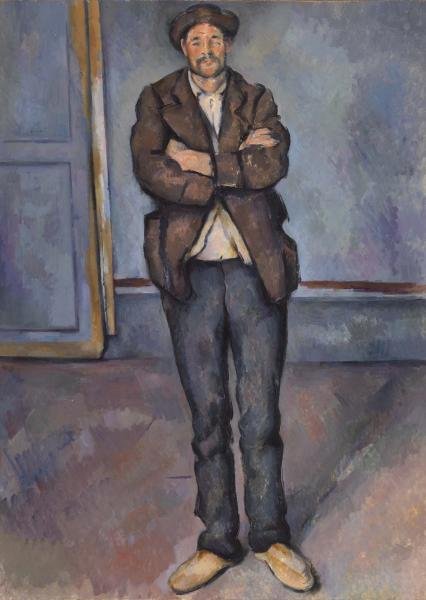
Around the same time, Cézanne painted another portrait of a peasant in a standing position. It looks very much like the setting for the portrait was in the same room as the previous work. It was entitled Paysan debout, les bras croisés, (Peasant Standing with Arms Crossed) and was completed around 1896.

Peasant by Cézanne (c.1891)

My final work I am showcasing is a head and shoulder depiction simply entitled Le paysan (Peasant) which Cézanne completed around 1891. Again we have this peasant with a most unhappy countenance as he stares downwards. Again his mouth is turned down in an expression of sadness. One has to believe that this is the pose Cézanne wanted his sitter to exhibit. Was the artist trying, by this posed facial expression of his sitter, to get over to us that the life of a peasant was not a happy one. Maybe Cézanne want us to empathize with the man. Maybe Cézanne was determined to depict the inequalities of life in this portrait. Once again the background is plain and in no way detracts from the sitter. The work is a mass of greys and blues but the careful splashes of red on the peasant’s face make us focus on the man’s expression and by doing so poses the question to us as to what we think about is his lot in life.

Théodore Roussel and Hetty Pettigrew

 Theodore Roussel  Self Portrait (1901)
Theodore Roussel
Self Portrait (1901)

I went to the Summer Exhibition at the Royal Academy one afternoon, a couple of weeks ago and frankly I was a little disappointed in the majority of the works.  Yes they were quirky and often bizarre but I like beauty in paintings.  Maybe part of the problem was that in the morning I had just visited the National Portrait Gallery and perused their permanent collection as well as the BP 2014 Awards exhibition.  There were so many beautiful works of art.  There was a “chalk and cheese” difference between the paintings I stood before at the Portrait Gallery and those in the many rooms housing the Royal Academy’s summer exhibition.  You see, I like to stand back from a work of art and be amazed at what I see before me.    I especially like to be stunned by the beauty depicted by the artist whether it is a landscape or a portrait.  I am never impressed by a few random blobs of colour on a canvas and to be told to just imagine something.  Yes, I do need to be led by the nose and have everything explained to me through a realistic depiction.   The artist I am featuring today was also an admirer of beauty, to be more precise, feminine beauty and I was utterly seduced by a painting he completed featuring his lover, a work which the establishment at the time found a little too much to countenance.  Today I am going to look at the life of Théodore Casimir Roussel, and explore some of his paintings and prints and feature his sitter, studio assistant and lover, Hetty Pettigrew who featured in many of his works.

Roussel was born in the French town of Lorient in Brittany in March 1847 and was educated in France.   He was called to arms by his country during the Franco-Prussian War of 1870 but in 1878 he moved to England and settled in London. Two years later he married an English lady, Frances Amelia Smithson Bull.  Roussel had always loved to sketch and paint and was, for the most part, self taught.  When he settled in the English capital he managed to secure studio space in Chelsea with two English artists, George Percy Jacomb-Hood and Thomas Henry.  A couple of years after working in his Chelsea studio, Roussel began to exhibit some of his paintings.  His breakthrough came in 1885 when he was introduced to one of his neighbours, the successful artist, James McNeil Whistler, who had seen Roussel’s paintings and had been very impressed by the standard of his work.  Despite Whistler being thirteen years older than Roussel, it was not long before the two became firm friends, probably because some of their works of art centred around the same subject matter – London and the Thames river.  They also shared similar artistic tastes and had similar views with regards the art establishment.  Roussel now became one of Whistler’s London circle of friends which included Walter Sickert, Paul Maitland and Wilson Steer.  Like Whistler, Théodore Roussel became a member of the Royal Society of British Artists in 1887 but both resigned from the Society the following year.

Blue Thames End of a Summer Afternoon Chelsea by Théodore Roussel (1889)

Some of Roussel’s early work, when he was in London, depicted the river Thames around Chelsea.  One such painting was Blue Thames.  End of a Summer Afternoon, Chelsea  received excellent reviews when it was exhibited at the London Impressionist exhibition.  In December 1888 he exhibited seven such oil paintings of “Impressions of the Thames and Chelsea” at the London Impressionist Exhibition at the Goupil Gallery.

The Thames at Hurlingham by Théodore Roussel

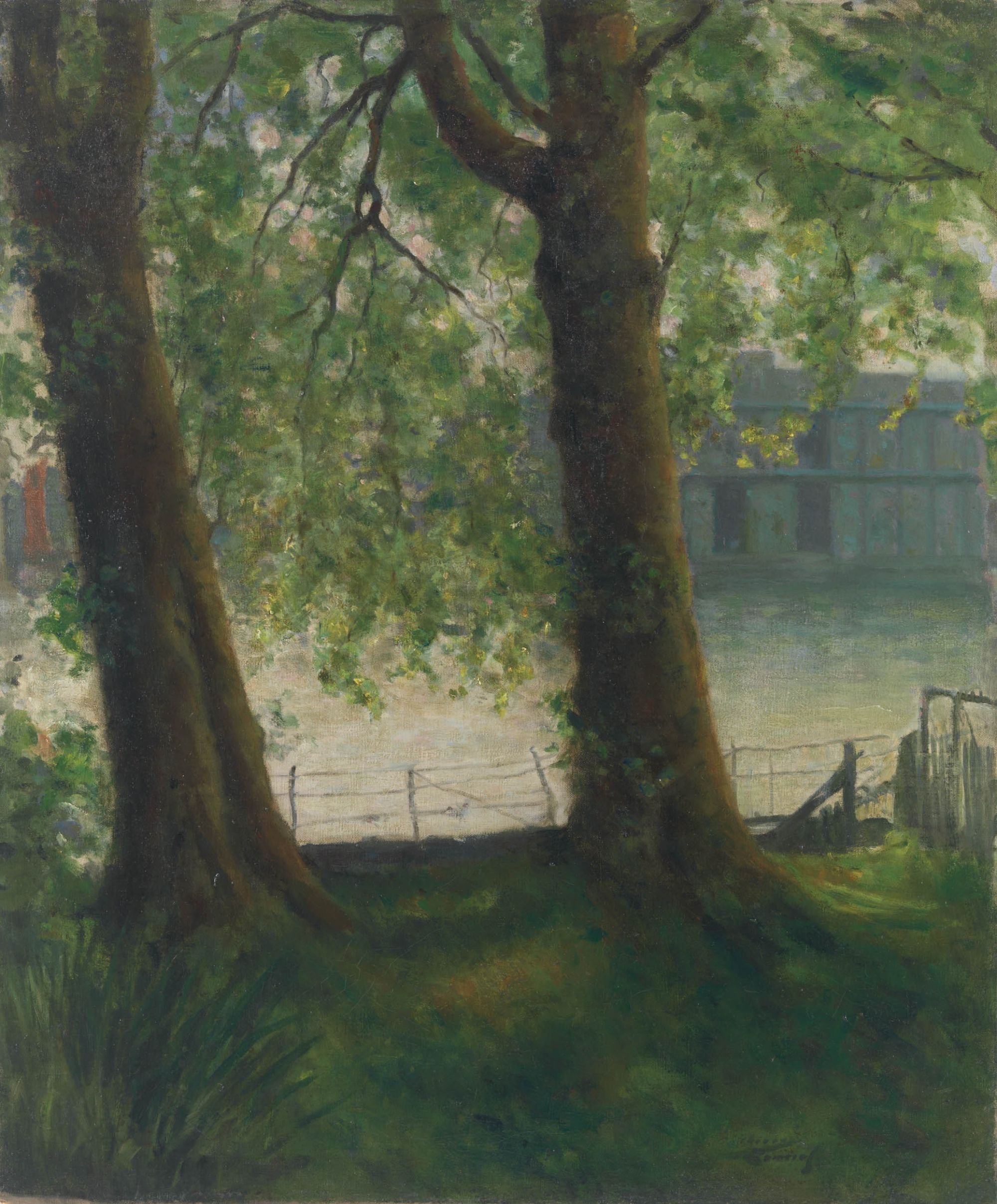
Another work featuring the Thames is a work Roussel completed later in his career was a work entitled The Thames at Hurlingham.  This atmospheric work has all the characteristics of a Whistler painting.  When Roussel made preliminary sketches for this work he was probably in the grounds of the famous Hurlingham Club, one of Britain’s greatest private members’ club which borders the Thames at Fulham.  In the painting we are treated to the merest glimpse of the river and the house on the opposite bank as we peer between the two mature lime trees whose size has cast the bank in deep shadow.

The Reading Girl by Théodore Roussel         (1886–7)
The Reading Girl by Théodore Roussel
(1886–7)

However my lead in to this blog was all about Roussel’s depictions of female beauty and one particular painting which had caught my attention and so let me feature this absolute gem.  The painting I am referring to was completed by Roussel in 1887 and was entitled The Reading Girl.  It measures 152 x 161cms (60 x 64 inches) and now hangs in the Tate Britain in London and I urge you to feast your eyes on this beautiful work.

 Roussel decided to by-pass the Royal Academy and exhibited this work in April 1887 at The New English Art Club, which had been founded in London in 1885 as an alternate venue to the Royal Academy for artists to exhibit their works.    Maybe the reason for the painting being accepted into the exhibition was that this art club was, at that time, promoting the French style of painting.  Maybe another reason for Roussel’s decision not to submit it to the Royal Academy was that he was well aware that the Royal Academy would be very critical of his depiction of a nude woman, not as a mythological, classical or historical character, but simply as a present day female.  This was Roussel pushing the boundaries.  This was a step too far for many and the art critic for the Spectator newspaper in the April 16th edition of the journal wrote a highly critical article.  He wrote:

 “…Our imagination fails to conceive any adequate reason for a picture of this sort.  It is realism of the worst kind, the artist’s eye seeing only the vulgar outside of his model, and reproducing that callously and brutally.  No human being, we should imagine, could take any pleasure in such a picture as this;  it is a degradation of Art…”

 It could well be that Roussel was making a stand with regards female nudity and would have been well aware of the furore which followed Edouard Manet exhibiting his famous but rebellious nude work, Olympia, at the Paris Salon twenty-two years earlier (see My Daily Art Display October 12th 2011).

 What I suppose strikes you at first glance is how relaxed the sitter is for the artist, how comfortable and at ease she was to sit before Roussel without any vestiges of clothing.  The female is Harriet (Hetty) Selina Pettigrew, a nineteen year old professional model, Roussel’s studio assistant and possibly a student of his.  She was born in 1867 in Portsmouth, one of twelve children, nine brothers and three sisters.  She was Roussel’s favourite model and also modelled along with her sisters Rose and Lily, for James McNeil Whistler, John Everett Millais and other Pre-Raphaelite artists. Hetty had met Roussel in 1884 and from becoming his model, then, despite Roussel being married, became his mistress and gave birth to their daughter, Iris around 1900.   When Roussel’s wife died, instead of legalising his relationship with Hetty and their child, he married Ethel Melville, the widow of the Scottish watercolour painter, Arthur Melville. Once Roussel re-married in 1914,  Hetty never sat for him again. Their close bond was over.

 Look how Roussel has used an almost black background so that nothing detracts from the female form.  This is not a pulchritudinous depiction of a classical woman à la Rubens.  This is simply a modern beautifully proportioned young woman.  Hanging from the back of her chair is a kimono which harks back to Roussel and Whistler’s love of all things Japanese which were sweeping through Europe.  The female reads a newspaper giving the impression that before us, we have a well educated young woman.  This is no Rococo-style air-head !!  The art critic Frederick Wedmore’s view of the painting was completely at odds to that of the Spectator’s art critic.  Of the painting he compared the work with many previous classics and wrote in the Art Journal of 1909:

 “…the most health-suggesting, health-breathing of Courbets, with the most rosily robust of Caro Delvaille’s (Le Sommeil fleuri), with the dreamiest Henner, with the slimmest and least material of Raphael Collin’s (Floréal)… a high masterpiece… austere in its performance, restful in its effect…”

Eva Mongi-Vollmer an art historian and curator at the Städel Museum in Frankfurt commented on the pose of the woman in Roussel’s painting in her book, Naked!Woman views. Painters intentions departure to modernity.  She wrote:

 “…It is the reading of an intellectual, modern woman who is not sexually available, despite the nudity…”


Study From the Nude of a Girl Lying Down by Théodore Roussel (1890)

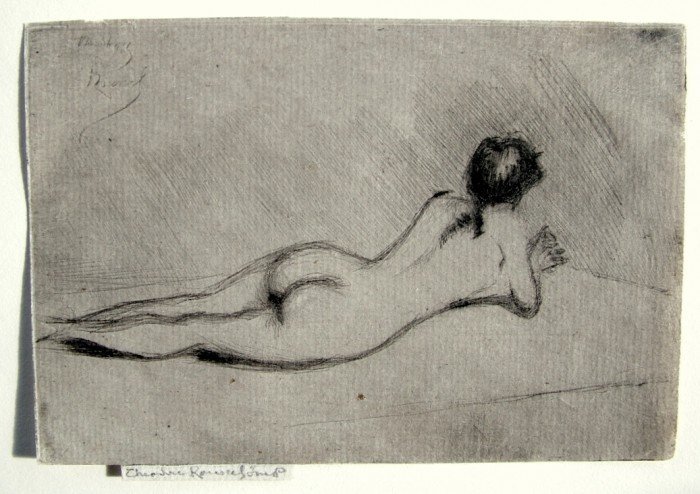
Another of Roussel’s works which is believed to have featured Hetty is Study From the Nude of a Girl Lying Down, a drypoint completed around 1890 which is part of the collection at the Art Institute of Chicago with a print of it held at the British Museum.

Chiaroscuro, A Profile, the Golden Scarf by Théodore Roussel (1900)

My third and final featured work by Théodore Roussel which featured Hetty is Chiaroscuro, A Profile, the Golden Scarf, which he completed around 1900.

Théodore Roussel died at St Leonards on Sea, a coastal town in East Sussex in 1926, aged 79.

Marie Bracquemond

        Self Portrait  by Marie Bracquemond             (1870)
Self Portrait
by Marie Bracquemond
(1870)

I was reading the other day about the short list for the National Portrait Gallery – 2014 BP Award.  Apparently the judges, who decide on which works should be shortlisted, are not aware of the names of the artists when they make their selections.  For the first time in the twenty-five years of the competition, two of the portraits selected for the exhibition were works by a husband and wife, Henrietta Graham and Tim Hall and it made me wonder how well husband and wife artists co-exist and whether they were supportive of each other’s artistic efforts and style or were they occasionally critical and somewhat jealous of each other’s success.  My featured artist today was one half of a husband and wife duo but it is thought that the husband became so critical of his wife’s works and her style of painting that she eventually gave up art altogether.

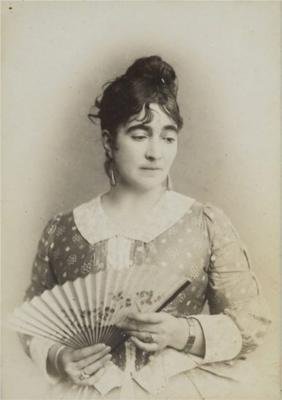
Marie Bracquemond        (1840-1916)
Marie Bracquemond
(1840-1916)

The lady in question was born Marie Anne Caroline Quivoron in December 1840 in the small picturesque coastal village of Argenton-en-Landunvez, on the Brittany coast. She was of the same era as her female Impressionist contemporaries, Berthe Morisot, Mary Cassatt and Eva Gonzalez but her background was very unlike their more privileged and cultured upbringing.  Her mother’s first marriage was an arranged one to a sea captain.  It was neither a successful nor happy union.  However, it did not last long as he died shortly after the birth of his daughter, Marie Anne. Her mother was only a widow for a short period before marrying for a second time.  Her husband was a Monsieur Pasquiou.   Shortly after this second marriage, Marie, her mother and her mother’s new husband moved away from Britanny and went to live in the Jura, a mountainous region in the east of the country.  Then, soon after, they crossed over the border to take up residence in Switzerland.  Again their stay was short-lived and before long they moved back to central France and settled in Corrèze in the Auvergne, where Marie’s sister, Louise, was born.  According to what she told her son in later life, this was the happiest time of her childhood. They lived in a area surrounded by mysterious forests, fast-flowing streams and ancient ruined abbeys.  Living there was a truly magical time for her.  The family finally moved north and settled in Paris but later because of Marie’s health problems they were advised by the family physician, Doctor Hache, to move out of the polluted atmosphere of the city and settle in Étampes, a small town south-west of the capital where the air would be purer.

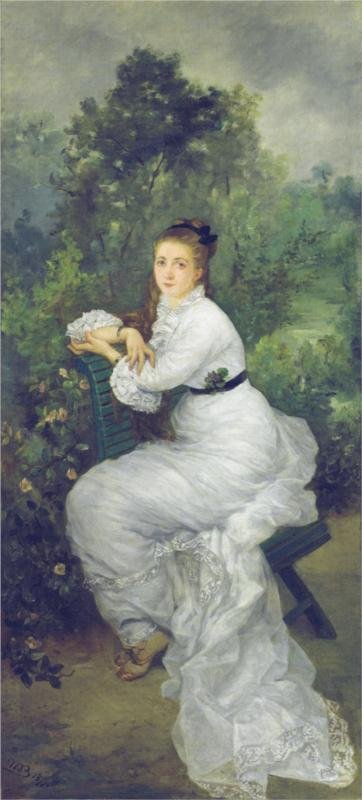
Woman in the Garden  (a portrait of her sister Louise)  by Marie Bracquemond
Detail from Woman in the Garden (a portrait of her sister Louise) by Marie Bracquemond
Woman in the Garden (Portrait of her sister Louise Quivoron) by Marie Bracquemond (1877)

Now a teenager, Marie developed a love for art and it was whilst living in Étampes that she received her first artistic tuition.  Her teacher was a Monsieur Wassor, an elderly man who gave art lessons to the young women of Étampes as well as earning money as an art restorer.  He got Marie to make copies of reliefs and plaster casts which he had scattered around his studio and he also got her to make copies of paintings he had accumulated.  When the summer came and the weather improved he would take Marie and other students outside to paint en plein air.  Her progress as an accomplished artist was swift and a measure of that is the fact at the age of seventeen she submitted a family portrait, which included her mother, her sister Louise and one of her elderly teachers, for inclusion at the 1857 Salon and it was accepted.

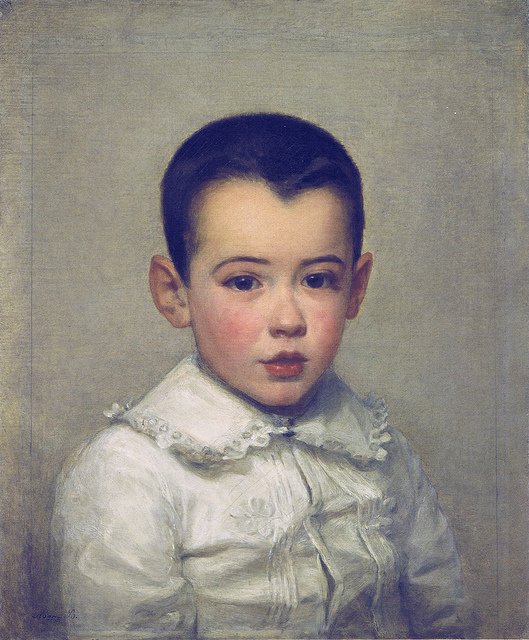
Pierre Bracquemond as child by Marie Bracquemond (1878)

Fate now took a hand in Marie’s future as the sister-in-law of the family doctor, Doctor Hache, was married to the Neoclassical painter, Jean-Auguste-Dominique Ingres and she arranged for Marie to meet her husband.  Ingres arranged for her to work with two of his students, Jean-Hippolyte Flandrin and Émile Signol and she learnt much from them.  Although grateful for Ingres’ help she was unhappy with the elderly artist’s disdain with regard female artists.  In a letter she wrote about Ingres’ contempt:

“…The severity of Monsieur Ingres frightened me.  I tell you, because he doubted the courage and perseverance of a woman in the field of painting.  He wished to impose limits.  He would assign to them only the painting of flowers, of fruits, of still lifes, portraits and genre scenes…”

For Marie, Ingres view on female artists was unacceptable.  Her determination to rail against Ingres’ criticism of female artists and his compartmentalising of the artistic genres suitable for female artists, materialised when she wrote of her split with the elderly painter:

“…There is in me a strong determination to overcome all obstacles.  I wish to work at painting, not to paint some flowers, but to express those feelings that art inspires in me…..All this will not come to pass in a year, but in any event, I do not wish to return to Monsieur Ingres…”

The Lady in White by Marie Bracquemond (1880)

Her artistic ability must have been well known as she soon received commissions including one from the court of Empress Eugenie, the Empress of France and wife of Napoleon III, which commissioned a depiction Cervantes in prison.   Following the successful conclusion of this commission she was approached by the Director-General of French Museums, Count de Nieuwerkerke, to work at the Louvre, making copies of the most famous paintings in the collection.   It was in 1867, whilst Marie was working in the Louvre copying a painting by Rembrandt, that a young man, Félix Bracquemond, an engraver and etcher, first caught sight and fell in love with this dark-haired beauty.  Félix, through his friend, Eugène Montrosier, was introduced to Marie.  A two-year courtship followed during which time Félix introduced Marie to all his artist friends, such as Millet, Corot, Degas, Rodin and Fantin-Latour and art critics and writers such as Edmond de Goncourt and Gustave Geffroy, and through them she received more and more commissions.   Unfortunately for Marie there was a problematic downside to this relationship.  Félix was not a particularly nice man.  He had a very off-hand brusque demeanour.  He was self-opinionated and later became über-critical of Marie’s artistic talent but despite Marie’s mother’s voiced concern over the relationship between Félix and her daughter, the couple were married in August 1869 and went to live in the rue de l’Université in Paris.  Marie was well aware of her husband’s unacceptable characteristics but presumably believed that all that would change when they were married.  It didn’t!  In 1870 Marie gave birth to their only child, Pierre.  Despite his uncompromising and offhand attitude Marie learnt a great deal from her husband and she exhibited works at the 1874 and 1875 Salon.

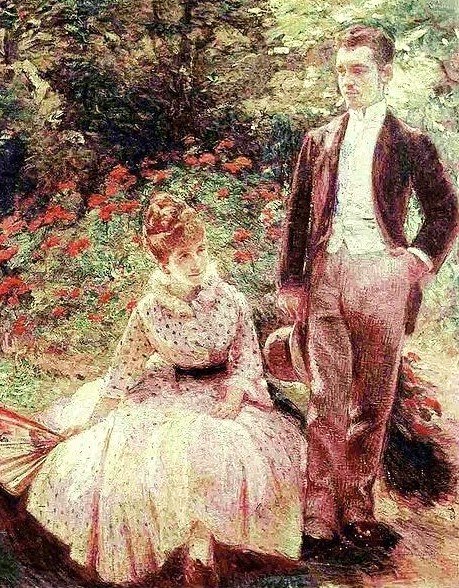
The Artist's Son and Sister in the Garden at Sèvres by Marie Bracquemond (1890
The Artist’s Son and Sister in the Garden at Sèvres by Marie Bracquemond (1890)

Haviland China was a factory set up in Limoges, France, by the American entrepreneur David Haviland and later was aided by his sons, Charles and Theodore.  The factory produced the finest china tableware.  In 1872 David’s son Charles, opened the Auteuil Studio in Paris, which attracted many of the great artists of the day, including Manet, Monet, and the Damousse brothers, all of whom greatly influenced Haviland’s floral designs.  It became known as the “French School”.   Félix Bracquemond, who had a reputation as a great ceramics decorator, was, in 1878, employed in the studio as the artistic director and Marie also worked there designing plates for dinner services.  In an article in the 1904 magazine Women in the Fine Arts, the writer, Clara Erskine Clement who was the author of Women in the Fine Arts from the Seventh Century to the Twentieth Century AD,wrote about Marie Bracquemond’s amazing ability:

“…Madame Bracquemond had the facility of employing the faience colours so well that she produced a clearness and richness not achieved by other artists.  The progress made in the Haviland faience in the 70’s was very largely due to Madame Bracquemond, whose pieces were almost always sold from the atelier before being fired, so great was her success…”

Faience is the conventional name in English for a tin-glazed earthenware.

One of Marie’s great accomplishments was to design and produce several dishes and a wide Faience panel of ceramic tiles entitled the Muses, all of which were exhibited at the Exposition Universelle in Paris in 1878; the preliminary sketch used for the design was shown at the Impressionist Exhibition of 1879 and among its greatest admirers was Edgar Degas.

On the Terrace at Sèvres by Marie Bracquemond (1880)

It was around 1880 that there was a change in Marie’s artistic style.  Gone were the small muted works of art and in their place came larger works with a greater intensity of colour and more of her paintings were carried out en plein air allowing her to catch the nuances of the daylight which constantly changed..  This was the era of the Impressionists and Marie Bracquemond had become great friends of Edgar Degas, Claude Monet, Renoir and Gaugin these artists had become her artistic mentors.  She had been welcomed into the Impressionists’ fold and she exhibited works at three of their annual exhibitions, in 1879, 1880 and the final Impressionist Exhibition in 1886.  Three of her works completed in 1880 which clearly demonstrate her alteration of style to a noticeable Impressionist style, were The Lady in White, On the Terrace at Sèvres and Le Gouter (Afternoon Tea).

Le Gouter or Afternoon Tea by Marie Bracquemond (1880)

She was delighted with her art and its popularity but this delight was not shared by her husband, Félix, who resented her success and her close liaison with the Impressionists.   Their son Pierre, who loved his mother and was the No.1 fan of her work, later wrote about his father’s resentment.  According to Pierre, Félix was jealous of her achievement and rarely showed her works to visiting artists and friends.  He said that Félix now resented any criticisms Marie might venture about his paintings.  It appeared that the once close artistic relationship between Marie and Félix, with each offering constructive critiques regarding their works, was over.  Félix would often hide his new works from his wife but at the same time was openly critical with regards to her artistic efforts.  This uncomfortable atmosphere in the marital home and the constant friction between her and Félix finally took its toll in 1890 when Marie could not stand her husband’s attitude to her work any longer and except for a few examples completely gave up her painting.  One of her last works was the Impressionist-style work entitled The Artist’s Son and Sister in the Garden at Sèvres which she completed in 1890.  At the time of this painting the constant battle with her husband had made her become introverted and she became a virtual recluse, rarely leaving their Sèvres home. Her sister Louise did not like her brother-in-law finding him overbearing and boorish in the way he treated her sister.

Pierre Bracquemond painting a bouquet of flowers by Marie Bracquemond (1887)

Pierre Bracquemond who was taught by his father later became involved in works for Gobelin, a Parisian tapestry factory.  He then worked at a career as an interior decorator specialising in the designs of carpets and tapestries.  He also carried on his love of art concentrating on seascapes and nudes, chiefly employing the technique of encaustic paintiing, which was also known as hot wax painting, as it involved using heated beeswax to which colored pigments were added.   He also wrote many critiques with regards art and the teachings of his father on the subject.  There were also many manuscripts he had written about his parents Marie and Félix, some of which were never published.

Marie Bracquemond died in Paris on January 17, 1916.

Georges de la Tour. Part 2. Religious works and tenebrism

My featured artist today would often bring into play the tenebrism style in his works of art.  The term tenebrism comes from the Italian word tenebroso, meaning dark or gloomy and figuratively can be translated as “mysterious” and is a word used to primarily describe dark tonality in a work of art.  Tenebrism was developed to add a sense of drama to an image through a spotlight effect.  Tenebrist works of art first came on the scene in Rome around 1600 and some of the earliest examples were by Caravaggio.  The dark backgrounds to his works and the shadows cast across the subjects of his painting where in complete contrast to small areas of light, often from an unidentified source, which lit up part of the main depiction.  Caravaggio’s tenebrist style was taken up by a number of his Italian contemporaries such as the father and daughter painters Orazio and Artemisia Gentileschi and the great Dutch Master, Rembrandt von Rijn.  Many of the artists from outside Italy who came to Rome and Naples to study art also experimented with tenebrism.  Georges de la Tour was a masterful exponent of this style of painting.  In some ways his tenebrist style was slightly different from that of Caravaggio in as much as he would often include the source of light in his painting.  Although Georges de La Tour spent his entire artistic career in provincial France, far from cosmopolitan centers and artistic influences, he developed a poignant style as profound as the most illustrious painters of his day. In his lifetime his work appeared in the prominent royal collections of Europe. La Tour’s early training is still a matter for speculation, but in the province of Lorraine he encountered the artist Jean Le Clerc, a follower of the Italian painter Caravaggio.

Magdalen with the Smoking Flame by Georges De La Tour (1640)

One great example of Georges de la Tour’s tenebrist style can be seen in his work entitled Magdalene with the Smoking Flame which Georges De La Tour, completed in 1640 and which can now be found in the Los Angeles County Museum of Art.  In this work we see a depiction of Mary Magdalen, not as an aged woman living a hermit-style life in her grotto, but as a contemplative young woman.  This is a depiction of a vivacious young woman who sought the pleasures of the flesh in her early days.  Her arms and legs are bare.  There is a sense of melancholia and loneliness about her demeanour.  She sits with her left elbow resting on the table with her hand supporting her chin as she gazes fixedly at the burning flame.  Maybe she is mentally examining her past life.   Look how the artist has managed to achieve differing textures which have been brought to life by the light of the candle.  Observe the textural difference between her heavy red skirt and thin white, wrinkled blouse which contrasts with the blemish-free smoothness of Magdalene’s flesh.  On her knees rests a skull which is always looked upon as symbolising our own mortality and the inevitability of death.  On the table there are books of Scripture, a wooden cross and a leather scourge which alludes to Christ’s suffering and his eventual crucifixion.  These latter two items add to the sombre mood of the work.  However, besides Magdalene, the main subject of the work is the oil lamp which smokes and emits the light that brings a modicum of luminosity to the dark painting.  Flame from a candle is often looked upon as symbolising enlightenment and purification but in this depiction there is a smoky element to the flame which may lead us to believe that enlightenment and purification of Magdalene’s mind and soul are not yet complete.     Although our eyes too are drawn to the candle we should look at other aspects of the work and see the mastery of the artist in the way he depicts the various textures.   We have the well-polished skull and the leather cover of the books both of which reflect the candlelight.

Christ in the Carpenter's Shop by Georges de la Tour (1645)
Christ in the Carpenter’s Shop by Georges de la Tour (1645)

Another haunting work of Georges de la Tour in his tenebrist style is Christ in the Carpenters Shop, completed in 1645 and which hangs in the Musée du Louvre, Paris.  It is a depiction of Joseph, a descendant of the house of David, husband of Mary and “foster father” to Christ, who was a carpenter in Jerusalem. In Georges de la Tour’s depiction we see Joseph leaning forward, busy drilling a hole in a block of wood with his auger, the shape of which mirrors the shape of a cross.  He is in his workshop watched over by Jesus whose face radiates in the large frame.  Once again the depiction of the two characters is swathed in darkness with only their faces and upper bodies lit up by the flame of the candle held by the boy.

Jesus holding the candle

 Jesus is seated and holds a candle to illuminate what Joseph is doing.  It almost seems that it is the face of Jesus which is illuminating the scene and not the light of the candle.  The act of holding up the light for Joseph to see by has an allegorical reference to Jesus Christ being the Light of the World as mentioned in the New Testament (John 8:12):

“…I am the light of the world. Whoever follows me will never walk in darkness, but will have the light of life…”

The contrast between the two figures is striking.  The bearded Joseph, a large hulk of a man, is bent over towards his young helper in an almost threatening stance brought upon by the physical exertion of working the auger.   In total contrast Jesus is depicted as gentle youngster watching Joseph’s every move.  The candlelight illuminates the young face of Jesus.  There is purity and innocence in the way the artist has depicted the face of Jesus.  What is also fascinating about the depiction of the young Christ is the way de la Tour has depicted the luminescence of Jesus’ left hand which is shielding the flame. Although this is probably looked upon as a religious work because of its title, it could well have been a simple genre piece looking with strong realism at a young boy watching his father at work.  If we look at the floor, on which we see carpenter’s tools, a wooden ladle and a curled wood shaving.  It could almost be deemed as an excellent still-life work.

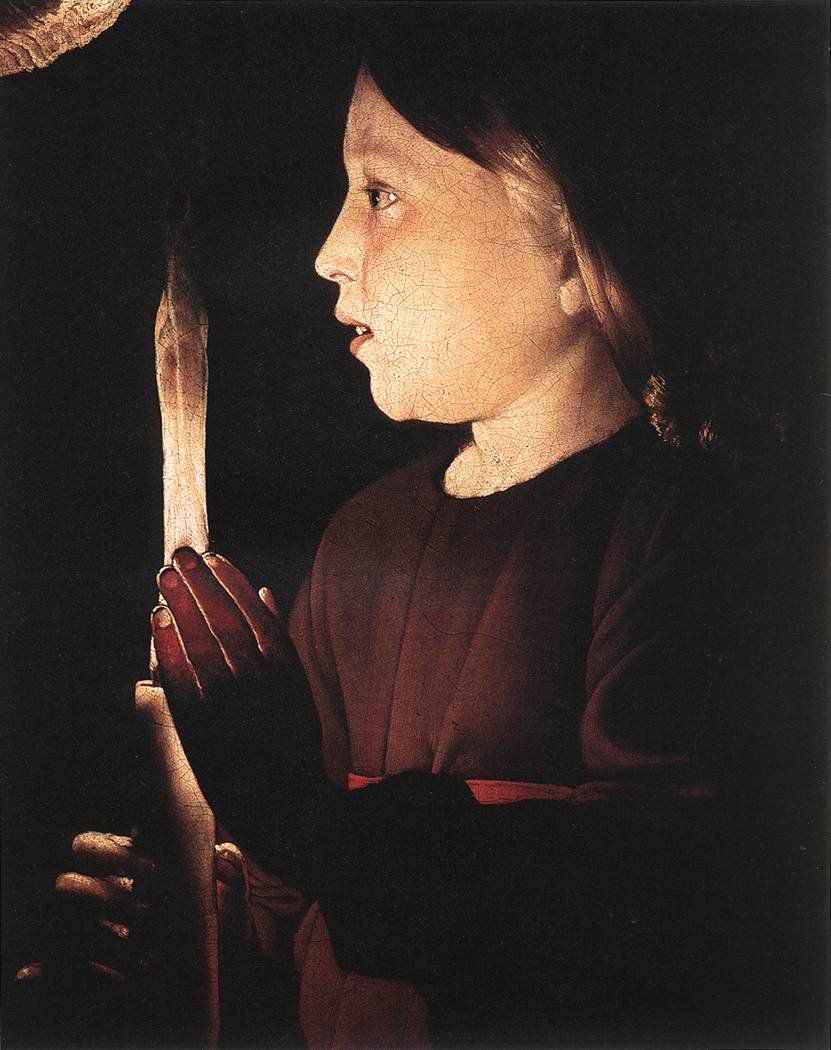
The Dream of St Joseph by Georges de la Tour (c. 1640)

The Dream of St Joseph was a work completed by Georges de la Tour around 1640.   The work was based on a dream that Saint Joseph had, as recounted in Matthew’s New Testament gospels.   According to Matthew, Joseph had three dreams.  One was to tell him he was to be Mary’s husband and the father of the Christ Child.  The second dream was to warn Joseph that he must take Mary and Jesus, leave Bethlehem and go to Egypt and the third and final dream the angel told Joseph to take his family back to Nazareth as all was now safe.  :

Matthew 1:20-21

 But after he had considered this, an angel of the Lord appeared to him in a dream and said, “Joseph son of David, do not be afraid to take Mary home as your wife, because what is conceived in her is from the Holy Spirit.  She will give birth to a son, and you are to give him the name Jesus, because he will save his people from their sins.”

Matthew 2:13

 “…When they had gone, an angel of the Lord appeared to Joseph in a dream. “Get up,” he said, “take the child and his mother and escape to Egypt. Stay there until I tell you, for Herod is going to search for the child to kill him…”

Matthew 2:19-20

 “…After Herod died, an angel of the Lord appeared in a dream to Joseph in Egypt  and said, “Get up, take the child and his mother and go to the land of Israel, for those who were trying to take the child’s life are dead…”

We are not sure as to which of the dreams is depicted in this painting and it matters not.  However some art historians who have researched the works of de la Tour have offered a different reasoning behind the work claiming that in early art catalogues the painting had a much simpler title, An Old Man Asleep, Woken by a Girl Carrying a Candle.  So is this a religious or secular work?  In the painting we see two people, an old man and a child.  The old man on the right is seated next to a small table.  His eyes are closed.  His mouth is slightly open.  He is asleep and possibly lost in a dream world.  His right elbow rests on the table and his head is resting in his right hand.  On his lap we see an open book with the fingers of his left hand still lightly gripping a page.   Standing in front of him is a child, probably a girl, dressed in the garb of a biblical character.

Dream-like apparition appearing to St Joseph

She stares at the sleeping man and has her arms outstretched in a prayer-like manner. There is something strange about her posture.  It is almost as if she is casting a spell over the sleeping man.   It is simply a depiction of a man and a child.  There are no sign of halos on the head of the child signifying her as an angel and so one can understand why some people cast doubts on the biblical connotation of the work.

What fascinates me about this work of art is the tenebrist style Georges de la Tour has used in his lighting of the depiction.  The light from the candle flickers and is partially hidden by the one of the girl’s outstretched arms but it still manages to light up her face in a haunting manner.  She becomes apparition-like which of course lends to the idea that she is in the old man’s dream.  Once again, as in the last painting the girl’s fingertips become translucent and the page held in the man’s hand is illuminated.   It is a fascinating work and I will leave you to decide whether you believe it is a religious work and hence it’s current title or whether it is simply a secular work of art and hence its original title.

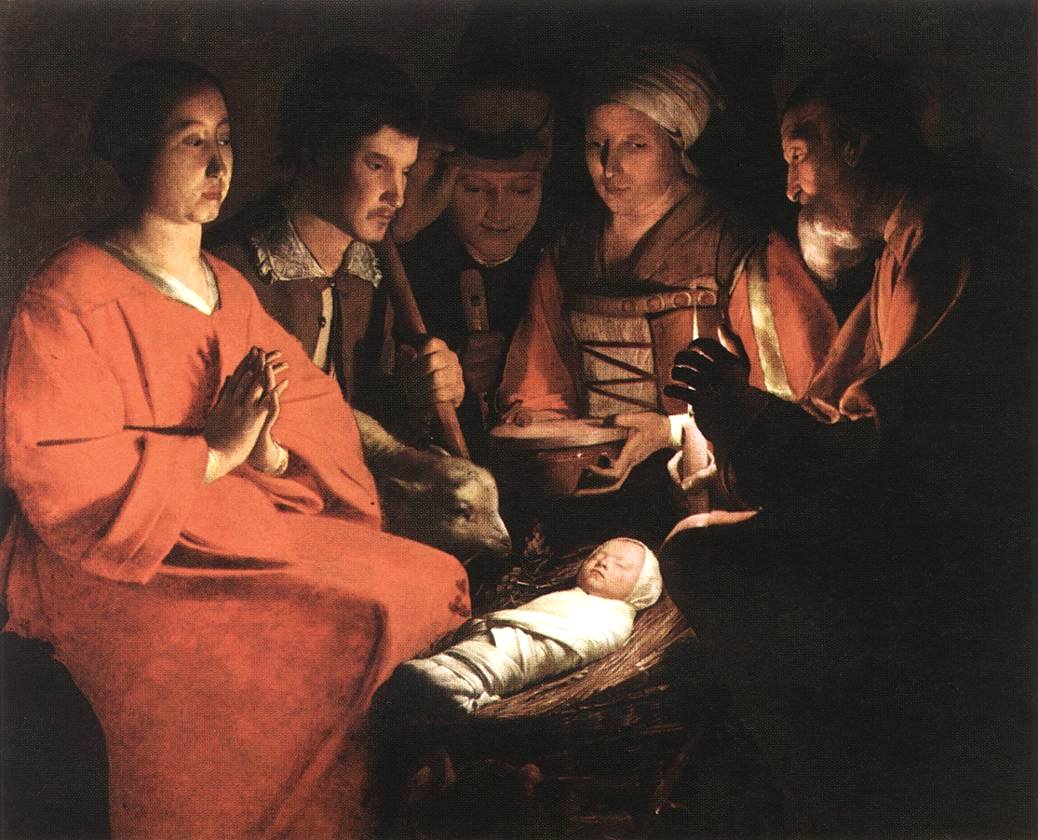
Adoration of the Shepherds by Georges de la Tour (1644)

There can be no such doubt with regards to my final featured work by Georges de la Tour.  The birth of Jesus and the presence of shepherds is a religious scene which has been depicted numerous times by different artists.   This painting, Adoration of the Shepherds, was completed by Georges de la Tour around 1644 and can now be found in the Louvre. The first thing we notice about this work is the amazing candlelight illumination which is associated with tenebrism.  As we look at the work we feel the tranquillity and contemplative mood of those around the newborn baby.   Mary is to the left of the painting, her hands clasped in prayer.   Opposite her is the elderly bearded figure of Joseph.  He holds a lit candle in his right hand whilst his left hand guards the flame from being extinguished.  Once again, as seen in previous works, the light from the candle filters through between the fingers of his hand.  His depiction of the visiting shepherds is a triumph of realism.  They crowd around the crib with their presents.  The one holding a staff has brought a sheep.  The one next to him, slightly in the background has brought a flute, which he clutches to his chest and the shepherdess, or it could be a serving girl, has come with food in the shape of a covered terrine.  Next to the crib the lamb chews at an ear of corn which is providing bedding for the infant.  There is a simplicity to this scene and this could well be due to the omission of the wealthy trio of visiting kings, dressed in their fine clothes, and holding their expensive gifts which are often included in depictions of the baby in the manger paintings.  It is thought that Georges de la Tour’s depiction emanates from the Christmas tradition when villagers dressed up as shepherds and shepherdesses to re-enact the Nativity scene and this premise is borne out by the way he has depicted the shepherds in fine contemporary clothing which is in contrast to the plain red gown worn by Mary.  Note the small shadow cast by the candlelight on her gown.  It is of a trèfle or trefoil, a three-leaved plant, which is part of the crib bedding and is probably a symbolic reference to the Holy Trinity.

In this and my previous blog I have featured two distinct types of paintings by Georges de la Tour and I will leave you decide which you prefer.

Adélaïde Labille-Guiard

Self portrait of Adélaïde Labille-Guiard )

In my last blog I looked at the life of the eighteenth century French artist, Anne Vallayer-Coster and featured a number of her exquisitely painted floral still-life works.   In today´s blog I am looking at the life and works of a contemporary of hers, the talented French miniaturist and portrait painter, Adélaide Labille-Guiard.

Adélaïde Labille was born in Paris in April 1749, the youngest of eight children, to Marie-Anne Saint-Martin and Claude-Edme Labille.  Her father was a marchand du corps de la mercerize (a haberdasher) and he and his wife owned a haberdashery shop, La Toilette, in the rue Neuve des Petits-Champs, at the heart of the capital.  Their home was also situated on this street.   The shop became very popular and by the 1760’s it had built up an élite clientele.  One interesting fact about the family shop was that in 1761 a young girl, Jeanne Antoinette Bécu, applied to work in it, was taken on and became friends with Adélaïde.  Whilst there she met the comte du Barry, became his mistress, left the shop and would later become la maitresse-en-titre, the chief mistress of Louis XV.

Giving birth to eight children took its toll on Adélaïde´s mother and she was often laid low with one illness after another.  In 1768, when Adélaïde was nineteen years old, her mother died.  Little is known about Adélaïde’s siblings except that one of her older sisters, Félicité, married the painter and art collector, Jean Antoine Gros in 1764.  However in a letter Adélaïde wrote to Comtesse d´Angiviller in 1783, she said she was the only surviving member of the family.

The Sculptor Augustin Pajou by Adélaïde Labille-Guiard (1783)

So what made Adélaïde want to become an artist?  One reason could be the location of the family home, which was close to the Palais Royale and had become the hub of theatres, music halls and dance halls but was also home to a large collection of professional artists as it was close to the Louvre, which at the time was the headquarters of the Académie Royale.  The most talented artists of the time, who were willing to comply with the strict guidelines of the Académie, had become members of this august establishment but many others painters who failed to be accepted into the halls of the institution had become members of the city’s trade guild, the Academy of Saint Luke.  It is thought that Adélaïde may have got her earliest artistic tuition from some of her artistic neighbours, one of whom was the Swiss-born painter of portrait miniatures, François-Élie Vincent, a member of the Guild of Saint Luke, who also lived in rue Neuve des Petits-Champs.  In 1769, Adélaïde, aged twenty, joined his classes and it was during this time as Vincent’s apprentice that she was able to exhibit some of her work at the Académie de Saint-Luc.   This was also the year she married.  Her husband was Louis-Nicolas Guiard who was an official in the Treasury of the Clergy and who lived on the same street as Adélaïde.  The ceremony took place at the local church of St Eustace on August 25th 1769.  The marriage contract recorded that Adélaïde was a professional painter at the Académie de Saint-Luc.

Madame de Genlis by Adelaide Labille-Guiard (1780)

Five years on, in 1774, Adélaïde had moved on artistically to work with pastels under the tutelage of the distinguished seventy year old French pastelist, Maurice-Quentin de la Tour who had his studio a few blocks away from Adélaïde’s home.  It is believed that Adélaïde had been introduced to him by one of his former students and a neighbour of hers, the Swedish portraitist Alexander Roslin.  Roslin, an Academician since 1753, was married to the painter, Marie Suzanne Giroud, and was a great believer in women’s right to become artists and was aware of the problems they had in trying to progress as professional painters.  Art historians believe that Roslin was the person who would later put forward Adélaïde’s name to become a member of the Académie Royale.

Three years on, around 1777, she started to work in oils and her introduction to, and tuition in this painting media came from François-André Vincent the son of her former tutor.  He was to become a leader of the neoclassical and historical movement in French art.  They became very close and such closeness fuelled rumours of a romantic tryst between the two artists.  Whether such rumours damaged her marriage or whether there were other reasons, the couple went their own separate ways in 1777 and her child-less marriage to Guiard ended in legal separation in 1779.  Adélaïde however kept signing her work Labille-Guiard. The relationship between Adélaïde and Vincent is examined in the 2012 book by Elizabeth Mansfield, entitled The Perfect Foil: François-André Vincent and the Revolution in French Painting and in it she suggests that the pair had been very close as far back as 1769 when she worked in his father’s studio, but the fact that he was a Protestant found little favour with Adélaïde’s father and so marriage was not a possibility.  However following the separation from her husband and after the reformation of divorce laws, the couple were able to marry in 1800. 


Portrait of François André Vincent by  Adélaïde Labille-Guiard (1795) Louvre, Paris
Portrait of François André Vincent by Adélaïde Labille-Guiard (1795)
Louvre, Paris

Adélaïde’s second husband François-André Vincent, being a talented artist and having the right connections, became a student at the Académie Royal in 1765, three years later won the prestigious Académie prize, Prix de Rome and was awarded a four-year scholarship at the Palazzo Mancini, the French Academy school in Rome.  On his return to Paris in 1782 he was made a full Academician.   For Adélaïde, her artistic journey was far more difficult.  Females wishing to become artists struggled to receive artistic training unless they had family members who were artists and who had their own studios but this was not the case for Adélaïde whose father was a merchant.  However as I said earlier she did eventually secure artistic tuition and with the support of Roslin she became a member of the Académie Royale on May 31st 1783, the same day in which Élizabeth Vigée-Lebrun was received into the Academy.  The addition of these two females to the Academy brought the number of female Academicians to four.  Anne Vallayer-Coster, the floral and still life painter and the miniaturist, Marie-Thérèse Réboul, also known as Madame Vien being the other two Academicians.  A royal decree had set a cap of four female Academicians at any one time.  The French Arts Minister, comte d’Angiviller, had obtained the royal ruling and had stated that such a cap would be sufficient to honour the talent of female artists but added condescendingly that they could never be useful to the progress of the arts!

Self-Portrait with Two Pupils, Mademoiselle Marie Gabrielle Capet and Mademoiselle Carreaux de Rosemond by Adélaïde Labille-Guiard (1785)

In 1780 Adélaïde had set up her own studio and had accepted a group of women pupils, several of whom went on to become successful portraitists. By 1784, her reputation as a gifted art teacher was firmly established and one of her most famous works, which is now housed in the Metropolitan Museum of Art in New York, is her 1785 work entitled Self–Portrait with Two Pupils, Mademoiselle Marie Gabrielle Capet and Mademoiselle Carreaux de Rosemond, which highlights her role as a tutor. The work has often been construed as a piece of propaganda, symbolising the dispute over the role of women in the Academy. She has portrayed herself in her studio which is richly furnished and this was her way of denoting her favourable financial situation.  She is seated in front of a large canvas and behind her stand two of her students, Marie Gabrielle Capet and Mademoiselle Carreaux de Rosemond, who have been depicted in much plainer clothes.  Adélaïde wears a sumptuous and expensive low cut gown and large plumed hat neither of which would have been worn by an artist at work but is more likely to be a declaration of her femininity, and the fact that she is an artist who moved in high society.  The feminist stand on art education was further enhanced by the inclusion of her two female students both of whom would become great artists in their own right.  In the background she has included the bust of the Vestal Virgin as an additional emphasis of the feminist mood of the time.  One can tell by this work that she had a great belief in herself as an artist.  So if she wanted to paint a self-portrait, why include two other people in the work?  The reason for their inclusion is probably two-fold.  First of all, because she was a strong proponent of the education of women artists, it is her statement of belief that females should receive artistic tuition and secondly she is demonstrating her ability as a group portraitist and this painting received critical acclaim when it was exhibited which led to many commissions for family group portraits.  This was indeed a clever self advertisement by the artist.  One of the pupils in the painting, Marie Gabrielle Capet, became Adélaïde’s close friend and her favourite student.  She became a miniaturist and pastel portraitist in her own right and lived with Adélaïde Labille-Guiard before and after the artist’s marriage to Vincent.  After Adélaïde died Marie Gabrielle Capet remained in the house and continued to care for Adélaïde’s husband.

Marie Adélaïde de France, Known as Madame Adélaïde daughter of Louis XV and Marie Leszczyńska by Adélaïde Labille-Guiard (1787)

Labille-Guillard was an extremely talented portraitist and unlike her fellow Academician, Lebrun, she received portrait commissions from both sides of society, members of the aristocracy as well as revolutionary figures.  She also received royal commissions and one of her royal patrons was Princess Marie Adélaïde, the aunt of Louis XVI and through this received an annual government pension of 1000 livres.  Labille-Guiard painted the portrait of the princess and her sister, Princess Victoire-Louise, as well as a portrait of the sister of Louis XVI, Princess Élisabeth. Because of these royal commissions to paint portraits of female family members of Louis XVI, she came to be known as Peintre des Mesdames.  She would normally have been also allowed a studio at the royal court but because her pupils were female that was not to be.  However such royal patronage, in some ways, made Labille-Guiard politically vulnerable at the time of the French Revolution of 1789 and she was made to destroy a number of her portraits of court members of the fallen monarchy and for a time she decided, for her own safety, to leave Paris.   At the Salon exhibition of 1791 she exhibited portraits of two prominent members of the French National Assembly, Maximilien Robespierre and Armand, duc d’Aiguillon.

In 1795 Adélaïde was granted artists’ lodgings at the Louvre and had her government pension enhanced to 2000 livres.  As a member of the Académie Royale she continued to regularly exhibit her portraits at the Salon until 1800.   Adélaïde Labille-Guiard died in April 1803, aged 54.

Whilst researching the life of Adélaïde Labille-Guiard I came across a book entitled Adélaïde Labille-Guiard – Artist in the Age of Revolution by Laura Auricchio.  It is from this literary work that I gleaned most of the information regarding her life.   I can highly recommend the book if you want to find out more about the artist and study some of her exquisite works.

Anne Vallayer-Coster. The Queen of Floral Still-Life works

Anne Vallayer-Coster

At the end of 1362 the Florentine writer, Giuseppe Boccaccio, he of The Decameron fame, (see my Daily Art Display Feb 21st 2012), had completed his book, De mulieribus claris (Of Famous Women), a biography of famous (and infamous) women, some real, some mythological.  In it he wrote about three female artists and commented:

“…Art is Alien to the mind of women, and these things cannot be accomplished without a great deal of talent, which in women is usually very scarce…”

In this blog I am returning to look at female artists and I am featuring a highly talented lady whose superb artistic talent rubbishes Boccaccio’s theory.  Today, I am looking at the struggle she, like other female painters of the time, had fighting their way through to success in a male-dominated field.  One of my favourite paintings is by the eighteenth century French female artist Louise Elisabeth Vigée Le Brun (See My Daily Art Display November 21st 2012) and recently I have been reading about a contemporary of hers, the very talented 18th century French painter who, like Le Brun, gained the patronage of Marie-Antoinette, the wife of the French monarch, Louis XVI.   She is Anne Vallayer-Coster.   Such royal patronage was the ultimate prize for aspiring painters as it led to many lucrative commissions.  However, unlike Le Brun, Anne Vallayer was not solely a portraitist but was an exceptional still-life and floral painter.

Anne Vallayer-Coster was born in Paris in December 1744.  She was the second of four daughters.  Her mother was a painter of miniatures.  Her father, Joseph Vallayer, was a goldsmith working at the Gobelins Manufactory Company in Paris, and the family lived on the grounds of the Gobelins Manufacturing complex, which produced the finest tapestries as well as luxury objects, which often adorned the royal palaces.  In 1757 the family moved to another area of Paris and Anne’s father started to trade in jewellery.  His business soon expanded with royal patronage and was granted the right to produce metal products for the military.

Anne Vallayer became interested in sketching and painting at an early age and her mother encouraged her by arranging for her to have private tuition from an art teacher, Madeleine Françoise Basseporte, a one-time pupil of the great French botanical painter, Claude Aubriet, and she, like him, was made the Royal Painter at the court of Louis XV, teaching the royal princesses to paint flowers.  Anne Vallayer learnt well from Basseport and she too was to become a talented botanical artist.  Her next art tutor was the landscape painter Claude Joseph Vernet.  In a short period of time Anne Vallayer became an accomplished artist concentrating on floral still-life works.  Her works were a beautiful juxtaposition of the flowers and inanimate objects such as books, musical instruments, tableware and furnishings.  The inanimate objects Vallayer included in her floral depictions allowed her to highlight her artistry by depicting the various different surfaces, such as glass, pewter, and silver and how the light played differently on each of them.   The still-life works often included aspects of trompe-l’oeil affording depth perception.

Attributs de la musique by Anne Vallayer-Coster (1770)

In 1770, when she was just twenty-six years of age, such was her artistic talent that a number of her tutors and fellow artists suggested that she should apply to become a member of the Académie Royale.  To gain admittance to the Académie Royale de Peinture et de Sculpture she submitted two reception pieces.  They were still life works entitled Les attributs de la peinture, de la sculpture et de l’architecture (The Attributes of Painting), and Attributs de la musique (The Attributes of Music).

Les attributs de la peinture, de la sculpture et de l'architecture by Anne Vallayer-Coster  (1769)
Les attributs de la peinture, de la sculpture et de l’architecture by Anne Vallayer-Coster (1769)

It could be that Anne Valleyer was quite canny when she put forward to the Académie elders her reception piece The Attributes of Painting, as all the objects we see depicted are references to the various arts taught at the academy. The brushes and palette symbolize painting, the bust and torso epitomize sculpture, and the building plans signify architecture. The books and portfolios of drawings symbolize the scholarly facet of the fine arts.  It is thought that the bust is a self-portrait of Anne.

Her works met with great acclaim and the honourable Academicians unanimously elected her.  This was an extraordinary endorsement as there was a “four female artist at any one time cap” on admissions to the Académie at this time.    This achievement was recognised in the twice-weekly gazette and literary magazine Mercure de France of that year, when the journal paid tribute to her achievement, writing:

“…the disadvantages of her sex notwithstanding, she has taken the difficult art of rendering nature to a degree of perfection that enchants and surprises us…”

This should have been the happiest time of her life but the sudden death of her father overshadowed the joyous news.   With the main family breadwinner now gone, her mother had no choice but to take over the family business, whilst Anne helped the family finances with the sale of her paintings.

However, despite her being admitted to the Academy she, unlike the male Academicians, was still not allowed to take part in any of the establishment’s drawing courses which involved nude models, as women drawing nude men was considered indecent.  So with the drawing course out of her reach she was not able to break into the highest genre of art as set down by the Académie, historical paintings, and so she continued with her favoured art genre, still-lifes as well as some portraiture and landscapes and as an Academician she was now allowed to exhibit some of her work at the biennial Paris Salon exhibitions.  This she did starting in 1771 and went on exhibiting regularly there until 1817.  In a review of her work shown at the 1771 exhibition, the prominent French philosopher and art critic Denis Diderot wrote:

“…if all new members of the Royal Academy made a showing like Mademoiselle Vallayer’s, and sustained the same high level of quality, the Salon would look very different…”

Portrait of Marie-Adelaide-Louisa de France, called Madame Adelaide by Anne Vallayer-Coster (1780)

She completed a number of portraits of the royal family including one of Marie-Antoinette.  It is said that the queen disliked her portrait.  The French critics who were complimentary with regards her floral works, were  dismissive of her figurative work.  With this in mind and being aware that she had major rivals in that genre, including two fellow Academicians, Elisabeth Vigée Le Brun and Adelaide Labille-Guiard,  who were the favoured female portraitist of the time,  she decided to concentrate on her still-life painting.

Art was a very important facet in the life of the upper class and nobility.  A thorough knowledge of which artists were in vogue and who were the up-and-coming artists was of great importance.  Soon through word of mouth in Court circles and the glowing evaluations of her artistic ability, the floral still-life work of Anne Valleyer came to the attention of Queen Marie-Antoinette.  Anne Valleyer received a number of painting commissions from Marie-Antoinette and many members of the royal court as well as a number of wealthy art collectors.  As was the case with Elisabeth Vigée Le Brun, the artist and queen became friends and in fact, it was the queen who, at a ceremony at Versailles in 1781, witnessed and signed off the marriage contract between Anne and her betrothed, Jean-Pierre-Silvestre Coster, a wealthy lawyer and respected member of a powerful family from Lorraine.

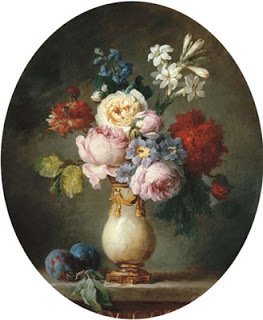
A Vase of Flowers, two Plums on a Marble Table top by Anne Vallayer-Coster (1781)

In total, Anne Valleyer-Coster painted over one hundred and twenty floral still-life works.  One painting which she completed in 1781 entitled A Vase of Flowers and Two Plums on a Marble Tabletop was used as a model by Gobelins for one of their tapestries.

Bouquet of Flowers in a Terracotta Vase, with Peaches and Grapes by Anne Vallayer-Coster (1776)

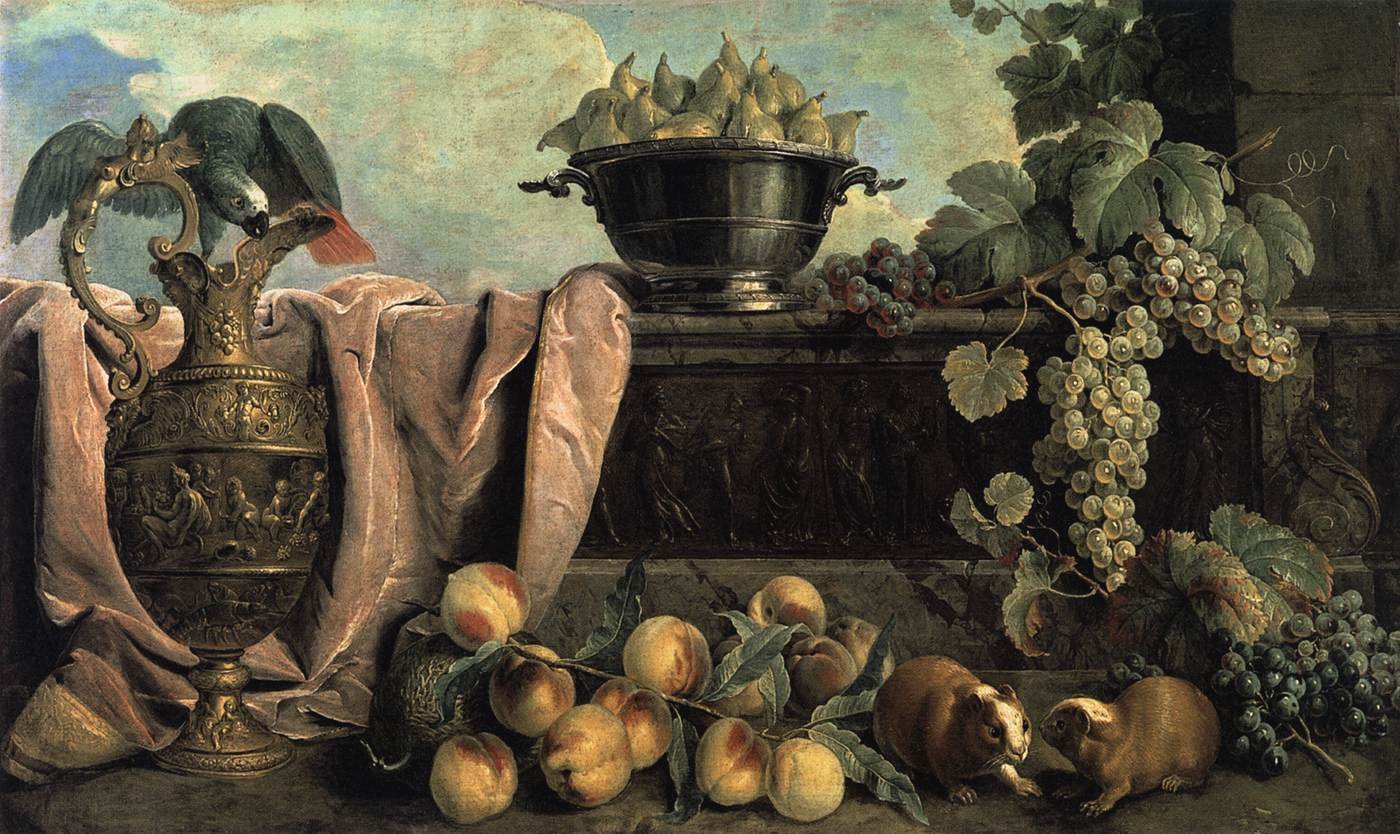
To fully appreciate the talent of Anne Valleyer-Coster as an artist take a look at a work she completed in 1776 entitled Bouquet of Flowers in a Terracotta Vase, with Peaches and GrapesThis still-life painting was one of a pendant pair and was commissioned by a high-ranking official of the entourage of the Queen of France, Marie Antoinette. Both paintings were exhibited at the Salon of 1777, the year after they were completed.  One has come to recognise her expertise in the way she depicts flowers but in this painting we see how accomplished she was when it came to her bas-relief imités.

Detail of bas-relief imités on vase

Look carefully  at the vase and the depicted bas-relief work.  In sculptural terms, Bas-relief is a form of sculpture in which a solid piece of material is carved so that objects project from a background.    This painting combines a number of different elements.  We have the exquisite floral painting.  We have the still-life depiction of the terracotta vase and the various fruit and finally we have the bas-relief imités depicted on the vase.  The skill of the artist in completing such a work is dramatic and totally eye-catching.

Vase of Flowers and Conch Shell by Anne Vallayer-Coster (1780).  Metroppolitan Museum of Art, New York
Vase of Flowers and Conch Shell by Anne Vallayer-Coster (1780).
Metroppolitan Museum of Art, New York

Another famous work of hers is Vase of Flowers and Conch Shell, which she completed in 1780.  This work of art is thought to be one of three small oval paintings of flowers and fruits which she exhibited in the Salon of 1781. The flowers are a selection of anemones and marguerites.  Look carefully how she has depicted the light reflecting on the gilt of the blue porcelain vase and the vase itself and how it shimmers on the multi-coloured conch shell.  She has paid close attention to the various textures of the objects on display and how the light reflects differently on their surfaces.

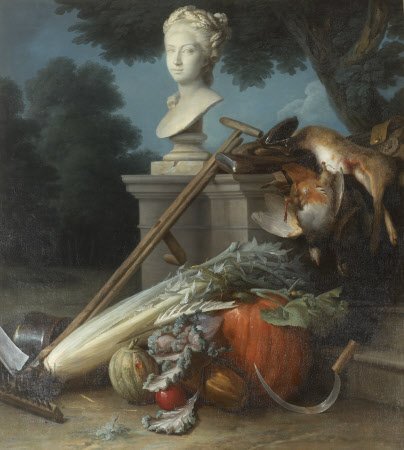
Garden Still Life, with Implements, Vegetables, Dead Game, and a Bust of Ceres (The Attributes of Hunting and Gardening by Anne Valleyer-Coster (1780)

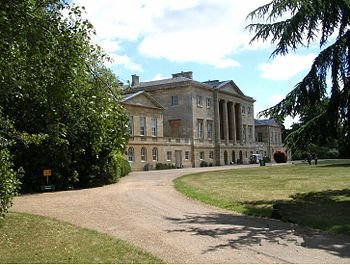
A number of her paintings are in British galleries but her still-life work, Garden Still Life, with Implements, Vegetables, Dead Game, and a Bust of Ceres (The Attributes of Hunting and Gardening) can be found in Basildon Park, Berkshire, a country house run by the National Trust of Great Britain.

BasildonPark
BasildonPark

The Palladin-style house itself is worth a visit.  It was built between 1776 and 1783 for Sir Francis Sykes, a wealth English landowner, Member of Parliament and who was once the Governor of Kasimbazar, India.  Valleyer-Coster received this painting  commission along with its companion piece, A Still Life of a Vase of Flowers, Fruit, and a Bust of Flora, on a Table in an interior from Joseph-Marie Terray, abbé de Molesme,  who was the directeur-général des Bâtiments du Roy and contrôleur–général des finances.   The National Trust came by this work of art when it was allocated to them by the UK Government who, in 2010, had taken it in lieu of inheritance tax from the state of Lord and Lady Iliffe, the previous owners.  The setting is a park and in the work we see a rake and scythe propped up against a plinth.  In the foreground there is a variety of vegetables, a cardoon or wild artichoke, a gourd, a marrow, a melon, a cabbage, a tomato, along with a sickle.  On the plinth itself besides the bust of a young woman with an ear of corn in her hair, we see depicted  a gun, game-bag, two dead partridges and a hare.

When the fall of the ancien régime came during the French revolution all those close to Louis XVI and his wife Marie-Antoinette were in great danger and many of the artists, such as Vigée Le Brun, had to go into exile to save themselves.  Anne Valleyer-Coster was fortunate in as much as, regardless of her closeness to the queen, who along with her husband, Louis XVI, was hated by the common people, she managed to survive the bloodshed of the French Revolution.   However, along with the fall of the French monarchy, went her primary patrons and her lucrative commissions dried up completely.  She, as an artist, was forgotten during these turbulent times.

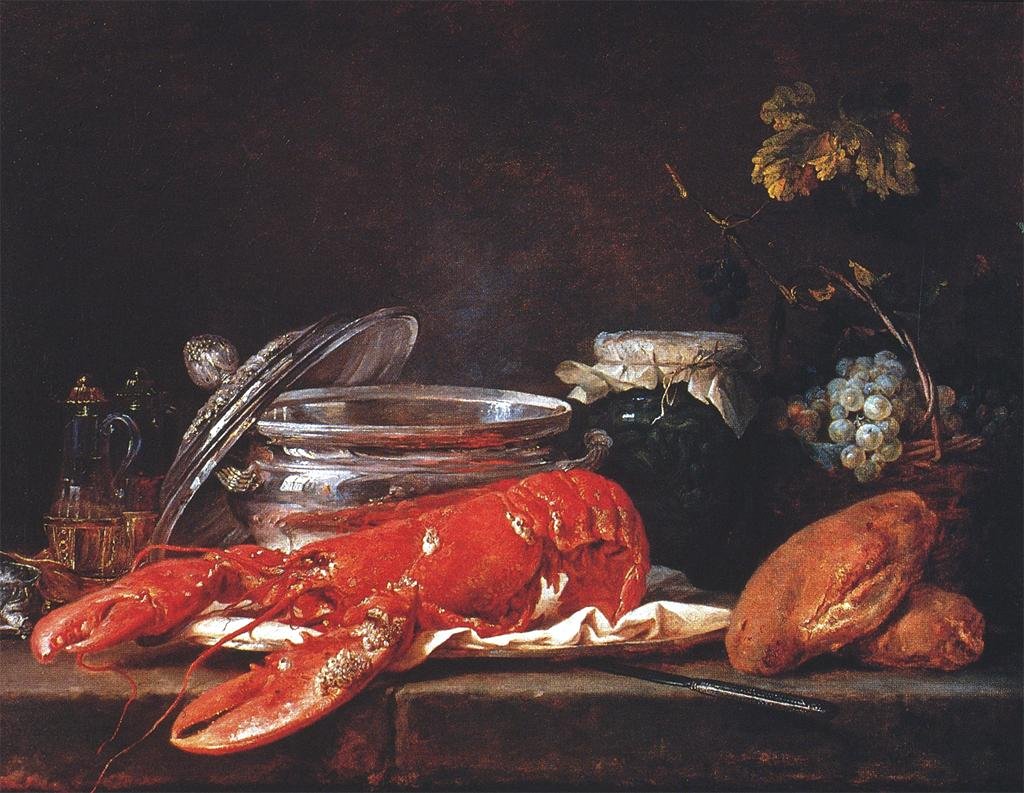
Still Life with Lobster by Anne Vallayer-Coster (1781)

It is interesting to note that a painting, Still Life with Lobster, which she completed in 1781.  Many believe it to be her best still-life work.  In 1817 she exhibited it in that year’s Paris Salon.  This painting came into the hands of Louis XVIII after he had been restored to the French throne in 1814.  Some art historians believe Vallayer-Coster gave it to the king as an expression of her joy as somebody who had remained loyal to the Bourbon cause throughout the turbulent years of the Revolution and the following Napoleonic imperialism. However, it should be noted that she had produced two works of art in 1804 for Napoleon’s Empress Josephine.  In the work, she has included many of the previous objects she had incorporated in earlier still life works. 

Anne Valleyer-Coster was one of the greatest still-life painters of the eighteenth century and art historians believe that her work was influenced by the great Jean-Baptiste-Siméon Chardin who died in 1779 and who is still considered to be one of the greatest French still-life and genre painters. She imitated his dark and shadowy tabletops on which were her arrangements of fruit, bread and dead game. In her later years she turned to a more unrestrained lavishness which was seen in Dutch floral painting.  She died in  Paris in 1818, aged 73 and will always be remembered for her still-life works with their distinctive colouristic brilliance and their almost photographic quality.  If you are lover of still-life and floral paintings, you will love her beautiful works of art.

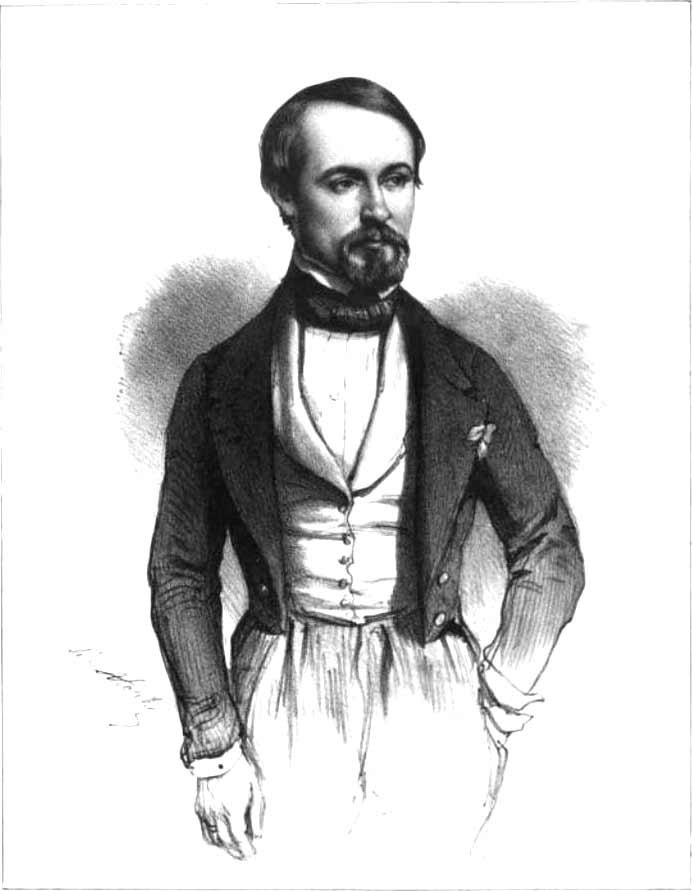
Camille-Joseph-Étienne Roqueplan

Camille-Joseph-Étienne Roqueplan

My featured artist today is the 19th century French Romantic painter and lithographer, Camille-Joseph-Étienne Roqueplan .   He was born in the small town of Mallemort which lies thirty-five kilometres south west of Avignon, but his family moved to Paris when he was still quite young.  He came from a well-to-do and cultured family and his younger brother Louis-Victor-Nestor Roqueplan went on to become a well-known writer, journalist, and co-director of the Paris Opera. Contrary to most young people who want to become artists despite opposition from their parents, Camille Roqueplan was wary about having art as his future profession despite his father’s encouragement that this should be his future path.  Camille liked to paint, but he believed art was just something to do for relaxation and should not be conceived as a future profession for he was adamant that his future lay in medicine.  His foray into studying medicine and anatomy was brief and having failed his first set of exams he went to work in the same office as his father, as a clerk in the Department of Finance.  This bureaucratic career was also short lived as he became bored and so after many career false starts he returned to painting

In February 1818, shortly after Camille’s eighteenth birthday he enrolled at the École des Beaux-Arts in Paris where he received his initial art tuition in the workshop of the French artist, Alexandre-Denis Abel de Pujol, but remained with him for just a short period before working in the studio of Antoine-Jean Gros, the French history and neo-classical painter, where he learnt to paint landscapes, marine paintings, historical subjects and genre scenes.  He used both the mediums of watercolours and oil and was taught the secrets of lithography, which at the time was a new method of printmaking.  He remained in Antoine-Jean Gros’ workshop for three years.

he Pardon Refused by Camille-Joseph-Étienjne Roqueplan (c.1829)

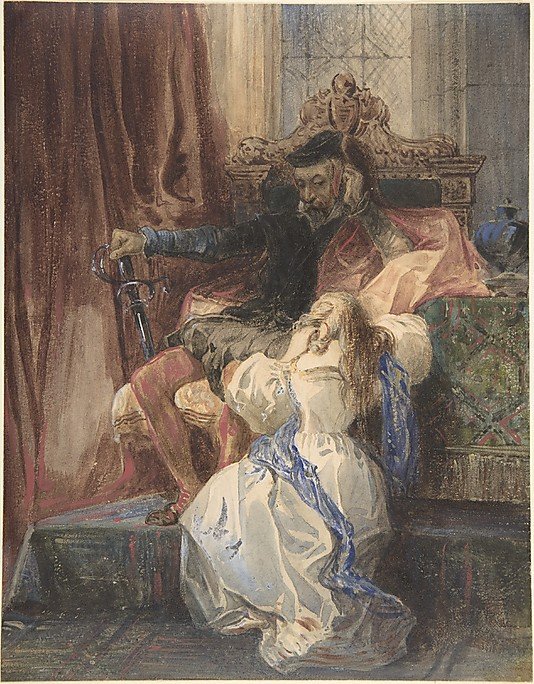
One of Roqueplan’s fellow students at L’ École des Beaux-Arts was the Nottingham-born, English painter Richard Parkes Bonnington, eighteen months younger than Roqueplan, who had moved to Paris when he was fourteen years of age and began studying at the  École des Beaux-Arts in 1820.  Bonnington favoured landscape painting and this no doubt influenced Roqueplan who began to produce small-scale paintings including some landscape works.  Roqueplan was also influenced by the works of the Scottish historical novelist, Sir Walter Scott and in 1824 he completed a work entitled Historical Landscape based on Scott’s novel, Quentin Durward.  Another small painting by Roqueplan, which he completed around 1829,  also featured characters from a Sir Walter Scott romantic tragedy novel, Kenilworth, in which we see the heroine Amy Robsart pleading for forgiveness from her father, Sir Hugh Robsart but he is untouched by her tearful pleadings.  This work, entitled The Pardon Refused, is housed in New York’s Metropolitan Museum of Art.

The Lion in Love by Roqueplan (1836)

Around 1835, Roqueplan changes his painting style from small landscape paintings to large-scale anecdotal works and one of his most famous of these can be seen at the Wallace Collection in London.  It was completed by Roqueplan in 1836, in time to be exhibited at that year’s Salon in Paris.  It is a large painting, measuring 219cms x 174cms and is entitled The Lion in Love.  The work is all about the power of love even if it is at the expense of wisdom.  I am sure many of us know how that feels!    The painting is based on a fable written by the Jean de la Fontaine, who was the most famous French writer of fables and one of the most widely read French poets of the 17th century.   There are 243 of these fables, originally written in French, by the poet in the late 1600’s which have since been translated in to many different languages.   The Lion in Love is a sad tale which tells of a noble lion, which has fallen in love with a shepherdess.  His love for the girl is so strong that he  unwisely consents to her father’s demand that his teeth and claws are clipped lest they should hurt his daughter .  The lion does not see through the father’s trickery and when his teeth and claws are paired down, his defence mechanism is rendered ineffectual, enabling the father to set his dogs on the defenceless lion.  The question of who shaves down the teeth and claws of the lion is not told in the poem but in Roqueplan’s painting he depicts the act being carried out by the shepherdess herself.  Maybe Roqueplan was drawing a parallel with the biblical tale of Delilah shaving off the hair of Samson, which rendered him defenceless.  Below is an English translation of the poem by Jean De La Fontaine which I found on the Aesop’s Fables website.

THE LION IN LOVE


Sévigné, whose attractiveness

Serves as a model to Beauties,

You were born so beautiful,

In case you are indifferent,

Would you be enclined

To an innocent Fable’s games,

And see, without fear,

A lion  tamed by Love?

Love is a strange master.

Happy is he who experiences it

Only through tales, minus its pains!

When it is told in front of you,

If  the truth offends you,

The Fable at least can be endured:

It is bold enough

To come offer itself at your feet,

By zeal or by gratitude.

In the times when animals spoke,

Lions among others wanted

To be accepted in our circles.

Why not? since their   kins

Were worth ours back in those times,

Having courage, intelligence,

And a beautiful head, moreover.

Here is how it happened:

A Lion from highly ranking parents,

While walking through a certain pasture,

Met a Sheperdess to his liking :

He asked for her in marriage.

The father would have preferred

A son-in-law a little less scary.

To give her to him seemed very harsh;

To refuse her was not so wise;

Even a rejection might have  made it possible

That some fine morning we’d have seen

A clandestine marriage.

Furthermore anyway

The beautiful girl was meant for noble people,

-Daughter becomes easily infatuated with

A long  maned lover.

So the father openly

Not daring to dismiss the lover,

Said to him: “My daughter is delicate;

Your claws could wound her

When you’ll wish to caress her.

Allow therefore that each paw of yours

Be declawed, and that your teeth,

Be filed down at the same time.

Your kisses will be less harsh,

And for you more delicious;

Because my daughter will respond to them better,

Being without these worries.

The Lion consented,

His heart was so blinded!

Without teeth or claws here he is,

Like a dismantled room.

A few dogs were turned aloose on him:

He did not resist much.

Love, Love when thou holdest us

One can well say: “Farewell prudence.”

In 1830, on the abdication of Charles X of France, a new king was crowned.  He was Louis Philippe and it was he who decided that some of the palace rooms at Versailles should be set aside for a Museum of the History of France.  These rooms were then filled with a large collection of paintings from the likes of Philippe de Champaigne, Charles Le Brun, Jacques-Louis David, Antoine Jean Gros, Rubens and the great female artist of the time, Elisabeth Vigée Le Brun, and one room was designated as the Galerie des Batailles (Hall of Battles) in which works depicting great French battles could be displayed.  Roqueplan contributed a work entitled  Battle of Elchingem ,which he completed in 1837, and featured a scene from the October 1805 battle between the victorious French forces under Marshal Ney and the Austrian army around the town of Elchingem in south west Bavaria

Peasants of the Béarn by Roqueplan (1846)

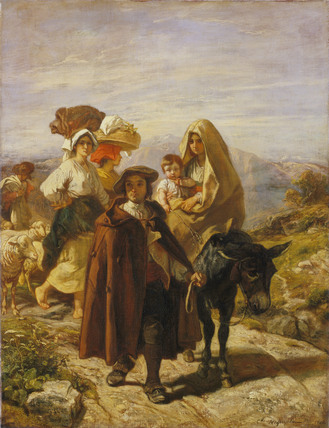
 Roqueplan’s health deteriorated in 1843 and as an aid to recovery he spent time in the foothills of the Pyrennees with its fresher and cleaner air.  He remained there for three years during which time he painted many scenes depicting mountainous landscapes and peasant life.  One such work can be found at the Wallace Collection in London with the title Peasants of the Béarn dated 1846.  Béarn is a French province in the Basse-Pyrenees and one of the geographical features of this province is the Ossau Valley.  It may be more than just a coincidence, but at the 1847 Salon, the year after the completion date given to  Peasants of the Béarn, Roqueplan exhibited a work with the title, Peasants of the Valley of Ossau.  Could these be one and the same painting?

Girl with Flowers by Roqueplan (1843)

Another painting of his which I like was painted around the same time, 1843.  It is an oval work, entitled Girl with Flowers and is now housed in the Hermitage Museum in St. Petersburg.  It is an everyday genre piece in which we see a young girl walking home with a bunch of wild flowers that she has collected, and which are held carefully in the folds of her raised skirt.  She is young and pretty.

Girl with Flowers (detail)

On her head is a wide-brimmed straw-coloured hat adorned with a pink flower and ribbons that seem to flutter down and fly off behind her giving us an impression of motion.  She holds on to the brim of her hat, pulling it downwards affording her more shade from the sun and maybe ensuring it does not fly from her head due to the breeze.  The hat frames her face.  She looks at us enticingly and we cannot help but fall under the spell of her young beauty.  What of course is more haunting is the sight of her left breast which has been uncovered due to lowering the neckline of her white linen blouse.

Rousseau and Mlle. Galley gathering Cherries by Rocqueplan (1851)
Rousseau and Mlle. Galley gathering Cherries by Roqueplan (1851)

My final offering is a work he completed in 1851 entitled Rousseau and Mlle. Galley gathering Cherries and is based on one of the autobiographical tales from The Confessions of Jean-Jacques Rousseau , written by the French philosopher and writer Jean-Jacques Rousseau.  This great work came in twelve volumes and recounted the first thirty-five years of his life.  In Volume IV  he recounts a tale from 1731, when he was nineteen years old, when he met and befriended a lady and her companion who were travelling through the countryside.  He had assisted them with getting their horses across a stream and then they had stopped at a hostelry and were partaking of lunch when they decided to go outside and look for some cherries and it was then that Rousseau tells of his longing for the lady:

“…After dinner, we were economical; instead of drinking the coffee we had reserved at breakfast, we kept it for an afternoon collation, with cream, and some cakes they had brought with them. To keep our appetites in play, we went into the orchard, meaning to finish our dessert with cherries. I got into a tree, throwing them down bunches, from which they returned the stones through the branches. One time, Mademoiselle Galley, holding out her apron, and drawing back her head, stood so fair, and I took such good aim, that I dropped a bunch into her bosom. On her laughing, I said to myself, “Why are not my lips cherries? how gladly would I throw them there likewise!…”

 In the painting we see Rousseau, having climbed a little way up the cherry tree, is dangling the fruit above Madamoiselle Galley.  She stands holding her apron open to catch the fruit but Rousseau has other ideas as to where the cherries should land!  The smile on her slightly flushed face is an indication that she too would like the cherries to be his lips.

Camille-Joseph-Étienne Roqueplan died in Paris in September 1855, aged 55.

 In this and my previous blogs about Gabriel Metsu I have featured paintings which are housed at the Wallace Collection in London.   If you are ever in London and want to visit an art gallery but are spoiled for choice, you must go to this one.  It is right in the centre of town, a five minute walk from the major department stores on Oxford Street.  I can assure you that you will not be disappointed with the collection.

Alexandre-François Desportes. The Animal and Still Life painter.

Alexandre-François Desportes

When I looked at works by Gabriel Metsu in a recent blog I featured a couple of scenes which depicted hunters.  Scenes with hunters were very popular at the time especially with the upper classes and nobility as hunting was a pastime of the rich and so any painting which depicted the hunter alluded to wealth.  Hunting in the eyes of the nobility was one of the last symbols of class distinction.   It was not just the portrayal of the hunter and the hunt which was popular with the wealthy classes but also the portrayal of the hunted – the prey and the hunting dogs.    Today I am featuring the works of the French painter and decorative designer who specialised in animal paintings. Alexandre-François Desportes.

Dog and Wild Duck by Alexandre-François Desportes   (c. 1720)
Dog and Wild Duck by Alexandre-François Desportes (c. 1720)

Alexandre-François Desportes was born in Champigneulle, a small town fifty kilometres south of Reims, on February 24, 1661.   His father was a farm labourer.  When François was twelve years of age his father sent him to Paris to live with his uncle.  Shortly after his arrival at his uncle’s home he took ill and was confined to bed.  To while away his time his uncle gave him an engraving and told his nephew to try and copy it.  François’ effort was so good that his uncle arranged for him to study art under the Flemish painter Nicasius Bernaerts.  Bernaerts was an accomplished artist who had studied with Frans Snyders, the Flemish painter, famous for his depiction of animals and hunting scenes.  Bernaerts carried on the painting tradition of Snyders and had worked at Gobelins, the Parisian tapestry manufacturers, where his cartoons of animals were often used as designs in their tapestries.  He was to greatly influence the future work of François Desportes.  Whilst studying under Bernaerts, Desportes was put to work copying Flemish paintings, particularly those depicting animals and hunting scenes.  He was also encouraged to sketch flowers direct from nature and paint floral still-lifes.  Desportes never found this period of his life very fulfilling as Bernaerts, who although only in his mid-fifties, was often ill and his health was further impaired by his alcoholism and very rarely offered practical advice or assistance to his students.   Bernaerts died in 1678, aged 58.  After the death of Bernaerts, Desportes continued his artistic training at the Académie Royale where he was able to learn about traditional classical drawing but was also able to continue with his favoured painting method – en plein air.  Desportes had to fund his schooling, as well as buy food and pay for his lodgings, and to do this he earned money by designing stage scenery, gained portrait commissions and commissions to paint decorations in Paris hotels

During the 1680’s he assisted the French painter Claude Auran III in supplying paintings for Louis Joseph de Bourbon, Duc de Vendôme’s Chateau d’Anet.  Artists survive on commissions and without commissions they struggle to make ends meet.  France at the end of the seventeenth century struggled financially as it had been a century of costly wars.  France and Spain clashed during the Franco – Spanish war (1635 – 1639) and again between 1683 and 1684 during the War of Reunions.  The French and the Dutch clashed between 1672 and 1678 and France went into battle with most of its neighbours in the War of the Grand Alliance (1688-1697).  Wars cost money – lots of money and in consequence, the French government had no money left for grand artistic endeavours, which meant that lesser known painters, who had yet to establish their reputation, struggled to make a living.  Desportes did struggle but despite his financial hardship, Alexandre-François Desportes married Eléonore-Angélique Baudet.  His wife was a linen and lace maker and through her occupation she was able to support her husband and allow him to search out commissions and carry on with his studies.

Self-Portrait as a Huntsman by Alexandre-François Desportes (1699)

Desportes luck changed when in 1695 he received an invitation from the French ambassador to Poland to come to the court of the Polish king John III Sobieski who was also the Grand Duke of Lithuania.  Desportes was commissioned to paint portraits of the king, his wife Maria Kasimiera and some of the palace courtiers.  His stay at the royal court lasted less than a year as the Polish king died in June 1696.  Desportes was summoned to return to France by Louis XIV.  Desportes had spent a number of years painting portraits of wealthy people and he intended to carry on doing this when he returned to his homeland.  However he soon found that the art establishment was awash with highly skilful portraitists and realised that it would be difficult to obtain portraiture commissions and so he decided to revert back to the training he received from Nicasius Bernaerts – the depiction of animals and still life painting and as a twist to this he would incorporate the two in his artistry.  In August 1699 Desportes was received into the Académie Royale as an animal painter and his reception piece was Self Portrait as a Hunter.  The painting, in which we see the thirty-eight year old artist seated in a landscape with his two hunting dogs and a large array of dead game, was a move away from the normal self-portrait as he has used the setting and what has been included in the work was a tribute to his own skill as a specialist animal painter as well as being a talented landscape artist.  He was advertising his abilities!

Backyard of the royal menagerie of Versailles during the reign of Louis XIV by Pierre Alexandre Aveline
Backyard of the Royal Menagerie of Versailles during the reign of Louis XIV by Pierre Alexandre Aveline

Louis XIV had started to have his palace at Versailles built in 1664 and he decided to incorporate a menagerie within the palace’s park.  The design of his menagerie was in line with other Baroque menageries of the time with its circular layout, in the centre of which was a magnificent pavilion. People were able to walk along the paths which surrounded this central building, and alongside them were the cages which housed the wild animals.  The king had been very impressed with the animal paintings of Desportes and commissioned him to complete five works of art which depicted animals and hunting scenes for the menagerie pavilion.  Desportes, like a present day method actor who immerses himself into his character, often went on hunting trips with Louis XIV so that he could realise the thrill of the hunt.  During the hunt he would carry with him a small notebook in which he would make on-site sketches of the hunt “trophies” – the dead animals, which could then be used later for still-life depictions of the game that resulted from the day’s hunt,  Louis XIV would then choose the best sketches and Desportes would go off and complete an oil on canvas painting of the king’s chosen subject.   Four such paintings, Deer Kill, Boar Hunt, Wolf Hunt and Hounds Guarding a Dead Deer,  still survive and are housed in the private Paris museum, Musée de la Chasse et de la Nature (Museum of Hunting and Nature).

Bonne, Nonne and Ponne by Desportes

Louis XIV was so pleased with these paintings that in 1702, he commissioned Desportes to paint six works, portraying the portraits of the hunting dogs which were his personal favourites.  In one such work entitled Bonne, Nonne and Ponne we see the king’s three favourite hunting dogs chasing and flushing out pheasants and partridges from the long grass.  The king was so pleased with the work Desportes produced for him that he awarded him a pension and two years later he made Desportes a councillor of the Académie Royale.

Dogs, Dead Game and Fruit by Alexandre-François Desportes (1715)

Desportes reputation as an artist spread outside of France and soon he was in high demand.  In 1712 he visited London and stayed for six months working on commissions.  When Louis XIV died in 1715, Desportes carried on working for the Regent of France, Philippe, Duc d’Orleans, who was ruling for the infant Louis XV, the grandson of Louis XIV and over time provided many paintings for the royal residences at Versailles, Marly, Meudon, Compiègne and Choisy.  It was not just hunting scenes that Desportes had mastered for he also spent time painting still-life works featuring the dead “trophies” brought back from the hunt cleverly arranged alongside floral displays or displays of vegetables lying on a table or even in landscape settings.  Two such paintings, Dog, Dead Game and Fruit and Dog with Flowers and Dead Game completed in 1715, can be seen in the Wallace Collection in London.

Dog with Flowers and Dead Game by Alexandre-François Desportes (1715)

These pendant pictures were commented on by the Revue Universelle des Arts in 1857 as being:

“…incontestably the finest which came from the brush of Desportes…”

The two works were bought by Captain Richard Seymour-Conway,  the 4th Marquess of Hertford in 1857 for his country house, Château de Bagatelle,  in France and at the time he commented on his acquisitions saying:

“… a little rubbish for the country…. beautiful of the sort and perfect for my shooting place…”

There is an interesting connection between the buyer of these paintings and where they are housed today for the purchaser of the paintings, Lord Hertford, also owned a house in London known as Manchester House, situated in Manchester Square.    He was an avid art collector and built up a sizeable collection of European art.  On his death in 1870, his illegitimate son, who had acted as his secretary, Sir Richard Wallace, inherited his father’s unentailed estates, and large collection of art in 1871. Wallace added to the collection himself, and in 1897, after his death, the works of art were donated to the nation by his widow. They are now housed in what was his London home, Hertford House, Manchester Square, London, and are part of the Wallace Collection.

Still Life with Silver  by Alexandre-François Desportes (c.1720)
Still Life with Silver
by Alexandre-François Desportes (c.1720)

Several of his still-life paintings which combined game with fruit or flower displays also featured some beautiful pieces of silverware which came from Louis XIV’s collection.  One such painting is entitled Still Life with Silver and was completed around 1720.  Before us is a buffet laid out with an array of objects in silver, porcelain, and semi-precious stone as an array of fruit.  The gold and silver vessels are displayed on a tiered console table which is weighed down with fruit and flowers. The composition is monumental in scale, measuring  262cms x 187cms (almost 8ft x 6ft).  This is what one might have seen as a centrepiece on the table if we had attended a royal banquet.  At the centre we can see the dragon-handled tureen and vermeil salvers both of which are in the Régence style of 1715-23.

Still-Life with Ewer by Alexandre-François Desportes (1734)

Alexandre-François Desportes died in April 1743, aged 82.  He left a legacy of paintings and sketches as well as his cartoons which were used as designs for tapestries made up at the famous Parisian tapestry company, Gobelins.  Many of his designs were also used at the Savonnerie company, the Parisian carpet factory at Chaillot, which manufactured the most prestigious European manufacturer of knotted-pile carpets.

Adolphe-William Bouguerau. Part 3. A change of genre

Rest in Harvest by William Bouguereau (1865)

This is my third and final look at the life and works of the Classical French artist, Adolphe-William Bouguereau.  In Part 1, I looked at his History painting Dante and Virgil and in Part 2 looked at one of his many religious works, The Flagellation of Christ. Today I want to look at a completely different type of work he began to paint at the start of the 1850’s.  Why, if his classical History paintings were so successful, did he want a change of artistic genre?  The simple answer has to be money.  The commissions he once received from the church for his monumental religious works and the private commissions for his large History paintings had dwindled and he had a growing family to support.  He needed to increase his income.

In my last blog I looked at Bougereau’s early life.  I had reached the stage when through the financial backing of his aunt and money he had accrued by painting small portraits of the parishioners, who attended his curate uncle, Eugène’s church, he could head to the art capital of the world, Paris, and continue his studies.  The year was 1846 and Bouguereau was almost twenty-one years of age.  Through the recommendation of his former tutor at L’École Municipale de Dessin et de Peinture in Bordeaux, Jean-Paul Alaux, he was accepted into the studio of François-Edouard Picot at Paris’ École des Beaux Arts.  Picot’s reputation had been built on his mythological, religious and historical paintings and so was the ideal mentor to Bouguereau who had always admired the academic History works of art. His enrolment at the prestigious art school was a dream come true for Bouguereau as such an acceptance into this celebrated art establishment was the ultimate goal of all aspiring artists and it was the beginning of becoming accepted by the official artistic fraternity.

His artistic training at L’École des Beaux Arts was the standard academic type with its rigid tenets regarding the importance of draughtsmanship, life drawing, technical proficiency and ultimately the training to become a classic History painter and Academic portraitist.  Many artists found the strict regimentation of the tuition too authoritarian and suffocating but Bouguereau was a true believer in the academic training and remained so all his life.  In 1850, at his third attempt, Bouguereau was awarded one of the two Premier Grand Prix de Rome for the best Historical painting.  It was entitled Zénobie Retrouvée par les Bergers sur les Bords de l’Araxe  (Zenobia Discovered by Shepherds on the Bank of the River Araxes).  His prize was a three year stay at the Villa Medici, the French Academy in Rome, during which time he also had the opportunity to travel around Italy and its countryside and studied and made copies of the works of the great Renaissance masters.

Fraternal Love by Bouguereau (1851)

One of Bouguereau’s first paintings which saw a change in his style was completed in 1851 and was entitled Fraternal Love which can be found in the Museum of Fine Arts in Boston.  What immediately comes to mind when you look at the scene before you?   Is it a religious or secular work?   We know that Bouguereau was a very religious man and had painted many religious works so is this simply another one?  Is this the Virgin Mary with the blonde-haired Christ Child and maybe St John?  And yet the title is a secular one with no reference to members of the Holy Family.  So let us just contemplate what we are looking at.  We see a mother and her two boys.  The younger child, who sits on his mother’s lap, holds his elder brother’s face between his chubby hands and kisses him.  The mother looks down lovingly at this demonstrative display of filial love.  She is wearing a blue dress which of course makes us immediately think of the colour blue which we see in most portrayals of the Virgin Mary.

The painting was purchased by the Boston merchant and avid art collector, Thomas Wigglesworth and at the time when he purchased the painting it was known as Madonna and Child with John the Baptist but one must remember that Bouguereau’s gave the painting the secular title of Fraternal Love and by doing so transformed the painting from a religious one into a secular genre scene and by doing so enhanced its selling prospect as there were now far more buyers who would purchase a secularized Virgin Mary than the very religious portrayal of her in Christmas Nativity scenes.

Madonna and Child with St John the Baptist by William Bouguereau (1882)

However Bouguereau did paint religious works featuring the Virgin Mary and the Christ Child and it is interesting to compare the secular painting, Fraternal Love, with the one he painted thirty years later, in 1882, entitled Madonna and Child with St John the Baptist, which is housed in the Herbert F Johnson Museum of Art at Cornell University, Ithaca, New York.  The Christ Child in this religious work still has the curly blonde hair and John the Baptist the curly dark hair which we saw in the Fraternal Love painting.  Once again we see the close connection between the two children.  The setting for this painting, in comparison with his secular work, has a more formal setting.  It is an inside setting unlike the outside scene of Fraternal Love.  In this work the Virgin Mary is seated on a white marble throne which almost takes up the full width of the work.  Behind the throne is beautiful ornate tapestry.  The inclusion of such details adds a sense of traditional art of the great Masters which he must have witnessed during his time in Italy.  The painting is a depiction of tenderness between mother and child.  Look at the pose of the Christ child as he looks down at his friend, John the Baptist.  Even at this early age, one recognises a close bond of friendship between the two.  It has to be more than just a mere coincidence that Bouguereau has depicted the Christ child with his arms fully extended outwards in a fashion that reminds us of the crucifixion that will come in the future.

In 1854 Bouguereau returned to Paris.  Two years later, in 1856, aged 31, he married Marie-Nelly Monchablon.  The couple went on to have three sons, Georges, Adolphe-Paul and William-Maurice and two daughters, Henriette and Jeanne-Léontine.   Sadly his younger daughter, Jeanne-Léontine, died in 1866 when she was just five years old, Georges died in July 1875,  aged sixteen, but the saddest of all was that his forty-year old wife Nelly died giving birth to their fifth child, William-Maurice, in 1877 and he died a seven months later.

Pieta by Bouguereau (1876)

Two of Bouguereau’s greatest works derived from the sorrow he suffered at the death of family members.  In both works he has utilised religious themes to present to the world his grief and feeling of loss.  His 1876 work entitled Pietà was thought to be based upon the Virgin and Christ of Michelangelo’s marble Pietà. Bouguereau completed the painting shortly after the death of his son Georges.

Vierge Consolatrice - The Virgin of Consolation by William Bouguereau (1875)
Vierge Consolatrice – The Virgin of Consolation by William Bouguereau (1875)

In 1877 Bouguereau dedicated a painting to his late wife Nelly who died in childbirth and his youngest William-Maurice who was seven months old when he too passed away.  It was entitled Vierge Consolatrice (Virgin of Consolation).  In the work we see the black-clad Virgin of Consolation, once again sitting on a white marble throne behind which is a large colourful tapestry.  Lying across her lap is a young woman who grieves utterly inconsolable at the death of her child, the body of whom we see lying naked at the Virgin’s feet.  The Virgin has raised her hands in prayer.   She is the intermediary between the mother and heaven.  At first glance one would be forgiven if we looked upon this work as being merely an over-sentimental painting but understanding the circumstances surrounding it, one becomes more understanding and less cynical.  It is thought that Bouguereau, who was a staunch Catholic, gained some solace from this work after the death of his wife and baby.

The Elder Sister by William Bouguereau (1869)

In 1869, before the tragic and untimely deaths of his wife and three children, Bouguereau painted a portrait of two children and used his twelve-year old daughter Henriette and her newly born brother Adolphe-Paul as models.   The work was entitled La soeur aînée (The Elder Sister) and hangs in the permanent collection of the Museum of Fine Arts in Houston.  According to the museum, this is one of the highlights of their collection and was an anonymous gift from a lady in memory of her father.  We see Henriette sitting, perched on a rock, cradling a sleeping infant on her lap.  The capped head of the baby lolls slightly in sleep.  Henriette looks directly out at us and smiles.  She, although bare-footed, wears clean clothes.  Her skin is without a single blemish.   Even at such an early age, one knows that she will grow up to become an exquisite beauty.  The painting has a tranquil countryside setting.  Everything is “just perfect” in the depiction of the children and the background.  This portrayal strays from realism.  It is more an idealised depiction.  Bouguereau has cleverly used a various mix of colours and merged them in such a way to create an image which has a softness to it.  There is an earthiness about the work.  The colour of Henriette’s frock/tunic clothes is the brown of the ground.  It seems to almost merge in with the colour of the foreground.
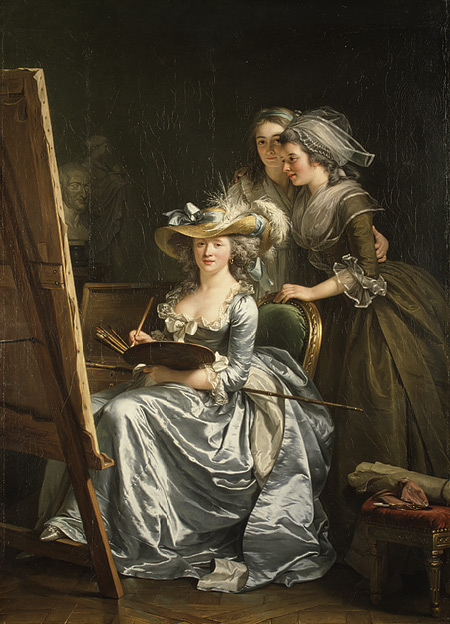
For Bouguereau, the 1870’s were a very sad time in his life with the deaths of his wife and three of his children.  The only high point for him during that decade was his election to the Académie des Beaux-Arts de l’Institut de France.  Throughout his life Bouguereau was a staunch defender of the Academy and all that it stood for and the honour of being elected to become a member of the institute was one he cherished.  He wrote:

“…To become a member of the Institut…is the only public distinction I ever really wanted…” 

The Bohemian by William Bouguereau (1890)

In 1890, Bouguerau completed  a work entitled The Bohemian which is sometimes referred to as Consuelo.   The young girl depicted in the painting almost fills the whole canvas.   She is a young gypsy girl and we see her seated on a stone bench on the Quai de Tournelle, which lies on the left Bank of the Seine.  In the background, across the river, we see Notre Dame cathedral and in the mid-ground we can just make out the Pont de l’Archevêché which straddles the Seine and links up the Left Bank with the Île de la Cité.  The girl looks out at us with a somewhat forlorn expression.  One cannot help but be moved by her dejected appearance.  Her clothes are shabby but the thickness of the fabric serves the purpose of keeping her warm.  Her dress is a dull grey but her multi-coloured shawl lightens up her appearance.   Her feet are uncovered which leads us to believe she is a beggar.  This assertion is further enforced as we see on her lap a violin which is the tool of her trade – begging for money.  This is not simply a painting about poverty.  In this work Bouguereau not only condemns the humiliation brought about by poverty but lauds those who strive to free themselves from destitution by virtues of their own endeavours.

One interesting aspect of this work is that we know it was changed by the artist.  How do we know that?  There is a photograph of this painting when it was “initially completed” by Bouguereau in 1889.  Bouguereau had decided to employ the photographers, Braun & Clement to photograph his complete collection of unsold works.  The photograph of The Bohemian showed a wall of bare stone behind the girl, which completely cut off any view of the River Seine or the bridge spanning it to the Île de la Cité.   It is thought that having not sold the painting that year a prospective buyer in 1890 asked for a “better” background to be added to the scene.   Bouguereau complied with the request and repainted part of the work.  There is also sign that the “8” and the “9” had been altered and over-painted with the numerals “9” and “0”, changing the completion date from 1889 to 1890.

The Young Shepherdess by Bouguereau (1885(Bouguereau painted many works featuring peasant girls.  This was an extremely popular subject in 19th century paintings.  For French artists of the time, including William Bouguereau the country peasant was somebody who lived a simple and honest life and got by through their laudable work ethic.  For the city dwellers who had not rubbed shoulders with a peasant they formed their visual understanding of who peasants were from the shepherds and shepherdesses with their multi-coloured clothes whom they saw depicted in Italian opera and theatre.  Bouguereau’s depiction of peasants was almost all of women and girls.  The setting for his portrayals of them and what they wore was often the same –  simple white blouses, overdresses of muted colours and thick material, set off by multi-coloured and multi-patterned shawls.  The female peasant was depicted bare-footed and  standing, seated or lying in some country scene such as a field or wood.  Bouguereau tended to steer clear of any other countryside indicators such as farming equipment or farm animals such as grazing sheep or cows.

Bouguereau, like all artists, needed to sell his work.  His clients were often middle and upper-middle class Parisians and the one thing the buyers did not want to be reminded of was the inequalities of life.  They did not want to be made to feel guilty about the social realities of their life and those of the peasant classes.   Unlike some of his contemporaries who were social realist painters and wanted to “accuse” through the depiction of the lower classes in their paintings highlighting how they suffered under an unjust economic system, Bouguereau’s depiction of peasant girls was all about their beauty, and little to do with any resentment or  condemnation of the class system.  His depiction of the peasant class was often very moving if, on occasions, heart-rending, but the peasants were never depicted as being threatening.   An artist and contemporary of Bouguereau, René Ménard,  wrote of Bouguereau’s depiction of the female peasants:

“… Rusticity is not with this painter and instinctive sentiment, and he paints a patched petticoat he yet suggests an exquisitely clean figure:  the naked feet he gives peasant-women seem to be made rather for elegant boots than for rude sabots; and, in a word, it is as if the princesses transformed into rustics by the magic wand in fairy tales had come to be models for his pictures, rather than the fat-cheeked lasses whose skin is scorched by the sun and whose shoulders are accustomed to heavy burdens…” 

After the death of his wife Nelly in 1877, Bouguereau lived in his house in Paris with his mother and two surviving children, Henriette and Adolphe-Paul and had taken up a post as professor at the Académie Julian in Paris.   This was a more liberal art establishment which allowed women to attend classes.  He was well thought of by his students, especially the women who idolised him.   The female artists were very appreciative of his training method and the skill he used when working with them in a lead-up to them establishing professional artistic careers.   Many of his female students were Americans and one in particular, Elizabeth Jane Gardner, fell under his spell.  She, as well as being a student of Bouguereau, was also friendly with his late wife.   Elizabeth was twelve years younger than Bouguereau.  Between teacher and student, there developed a mutual admiration which turned to love.  He told his mother and daughter Henriette that he intended to marry Gardner.  The only rock blocking this path of true love was Bouguereau’s mother.  She was a very religious person who had never been happy with the way her son had depicted so many nude figures in his classical works.  When it came to Bouguereau falling for another woman after his wife’s death, she was vociferous in her opposition to Bouguereau and Gardner marrying or living under the same roof as her and his children and so the pair’s courtship had to become more discreet and lasted almost twenty years until Bouguereau’s mother died.  Shortly after her death, in 1896, the couple married.  He was 71 and she was 59.

His daughter Henriette also married around that time, and Bouguereau was happy with her choice of husband.  However in 1900, tragedy was to strike again with his son Adolphe-Paul, who was a lawyer,  suddenly dying.  He was just thirty years old.  Bouguereau was devastated and it precipitated a deterioration of his health.  Despite this, he continued to paint and exhibit his works at the Salon.  He contracted a heart disease which although he fought hard to survive, he died a few months short of his eightieth birthday, in August 1905 at his home in rue Verdière in La Rochelle, the town where he was born.

Near the end of his life he described his love of his art:

“…Each day I go to my studio full of joy; in the evening when obliged to stop because of darkness I can scarcely wait for the next morning to come if I cannot give myself to my dear painting I am miserable…” 

Bouguereau was a workaholic.  He once sent a letter to his first wife in which he wrote:

“…When I cannot work, I am unhappy…”

And in a diary entry he wrote:

“…I rise every day at seven and breakfast then paint all day, with a light lunch at three which doesn’t interrupt my work…” 

He was always a firm believer in Academic art and Academic teaching.  He never wavered and he was often ridiculed for this view of how art should be.  La peinture bouguereauté was the derisory term given to French Salon artists and to students who painted badly!

During his lifetime he painted eight hundred and twenty-six paintings. To many people, Bouguereau was one of the greatest classical painters of his time, and some even compared him to Raphael.   However along with his admirers he had his fair share of detractors who criticized him. One such group of artists were the Impressionists who were hell-bent to rid themselves of  the shackles of traditional schools of painting. To them artists like Bouguereau were a regressive influence and hindered their move towards a new style of art.  To many people Bouguereau’s art was overburdened with sentimentality and that it was over-romanticizing.  To some, however, his art is full of beauty, compassion and piety.  I will leave you to decide which view you subscribe to.

As usual I have collated lots of information from the internet and reference books but most of the information was gleaned from an excellent book I treated myself to and which is yet another addition to my collection.  If you are interested in Bouguereau and his work I do suggest you buy it.  It is not expensive but is a true gem.  The title is Bouguereau and is by Fronia E. Wissman, an author who has written or contributed to a number of books about French artists.

Adolphe-William Bouguereau. Part 2 – The painter of Religious Scenes and his painting The Flagellation of Christ

Photograph of William Bouguereau (c.1870)

My blog today looks at another of Bouguereau’s great history paintings.  This is one of his religious works and has all the ferocity of his painting Dante and Virgil, which I featured in my last blog.  Whether you are a lover of religious historic paintings or not, I defy you to be unmoved by the beauty of this work.  Bouguereau was a devout catholic and looked upon his religious paintings as a form of his worship of both God and mankind.  Bouguereau’s religious belief can be plainly seen in his religious works.  The painting I am featuring today is entitled The Flagellation of Christ, which he completed in 1880. Before I discuss the painting let me tell you a little about his life.

Adolphe-William Bouguereau was born in the French Atlantic coastal town of La Rochelle in November 1825.  His father was Theodore Bouguereau, a seller of wine and olive oil.  His father struggled to make much money from his business and because of the financial hardship and family tensions William was sent to live with his uncle Eugène Bouguereau, who was curate in the town of Montagne, some twenty kilometres from Bordeaux.   This enforced move to his uncles was to prove highly fortuitous for the young boy as it was his uncle who introduced him to the world of Roman and Greek mythology and had him read the stories from the Old and New Testaments.  At the age of thirteen, William’s uncle arranged for him to attend the high school at Pons where he attended his first drawing classes under the guidance of Louis Sage, a young classical painter who had once studied under Ingres.   He remained at the school for three years.  In 1841, he eventually moved to Bordeaux where his father had set up his business and once again William was with his family.  William joined in his father’s business but at the same time, in 1842, he was allowed to enrol on a two-year part-time course at the city’s École Municipale de Dessin et de Peinture.  Here he studied under  Jean-Paul Alaux, the French landscape painter and lithographer.  He could not attend full-time because of his promise to help his father during the day, and so, he only attended art classes in the early morning and in the late evening.  Despite being a part-time student he excelled in what he did and in 1844 he won first prize for the best History painting with his depiction of Saint Roch.     Following this award William Bouguerau realised that his future was indelibly tied to art.  To earn some money for himself he designed lithographic labels for jars of jams and other preserves.

Bouguereau realised that to progress with his art he needed to be in Paris which was, at that time, considered the capital of the art world.   However to live in the French capital required money, a commodity he lacked.  His father’s business was not successful enough for him to give his son the money but fortunately for William, his uncle Eugène, the curate, once again proved to be his salvation.  He arranged for William to paint portraits of his parishioners for a fixed fee and after months of portraiture he had amassed nine hundred francs.  A similar sum was given to him by his aunt and he was all set to head to Paris.

The Flagellation of Christ by William Bouguereau (1880)

In my third and final blog about Bouguereau I will finish his life story but for today I want to focus on another of his great History paintings, his religious work entitled The Flagellation of Christ.   He exhibited this work at the 1880 Paris Salon.  It is a monumental work measuring 390 x 210 cms (almost 13ft high and 7ft wide).  One can easily imagine how it stood out from all the other works on show at the exhibition. This is acknowledged as being one of Bouguereau’s greatest religious works.  In this painting, Bouguereau has depicted Christ, tied to a column.  Christ’s body hangs down almost lifelessly with his feet dragging on the ground.  His head droops backwards.  His eyes are blank and unfocused. He is utterly powerless.  He can do little to stop the ferocious onslaught.  Unlike Bouguereau’s painting Dante and Virgil which I featured in the last blog, he has made no attempt to exaggerate the musculature in his portrayal of Christ’s body.  The body of Christ is that of a normal human being.  It is just like ours and in doing this Bouguereau has allowed us more easily to empathise with Christ’s suffering and pain.

A look of concern
A look of concern

We see Christ’s tormentors, two men, who stand on either side of him, arms raised in mid swing with their knotted rope whips airborne.  In the right foreground we see a third man kneeling.  He is in the process of tying up birch branches which will be used later to flagellate their prisoner.  Look at his facial expression.  It is one of concern.  It appears that maybe he is not convinced that what he sees before him is justified.  It is if he is beginning to question his part in the flogging.    In the background an inquisitive crowd gather to witness the flogging.  This is not a leering and jeering crowd we have seen in many of the crowd scenes in Northern Renaissance works.  This group of people cannot be likened to the snarling mob we have seen in earlier Passion of Christ depictions.

A child looks on
A child looks on

An old man in the crowd, maybe the father, lifts a baby aloft for him or her to get a better view.  There is little sign of compassion on the faces of the crowd.  Maybe they have accepted the charges that have been laid against Christ and feel that he needed to be punished.  However there is one exception.

Look closely at the far left of the background.  We see a young boy in a long green tunic who has turned away in horror of what is happening and has burrowed his head in the clothing of the woman who has wrapped her arm around him in a comforting gesture.  Maybe it is his mother.  Maybe she is horrified by what her young son has witnessed and is trying belatedly to protect him.  In the mid-background, there is a man wearing a white vest and grey headband.  He grips a sheath of birch branches and is readying himself to take part in the flogging.  There are a number of examples where the artist has decided to insert his own image into a work and Bouguereau has done the same in this painting.

The artist looks on
The artist looks on

Look at the face in the background to the right of the man wearing the white top and head band.  There, gazing between the spectators is a man with red hair and a red beard.  His brow is furrowed signifying his unease of what he sees before him.  This is believed to be the face of the artist himself.  He, like us, looks on at the terrible scene.

The size of the work almost certainly precluded the sale of it to a private individual and in 1881 Bouguereau gave it to the Society of Friends of the Arts in his home town of La Rochelle.  This majestic work can now be found at the Baptistery of La Rochelle Cathedral, France. 

Bouguereau never lost his love of Greek and Roman mythology which he had been brought up on from early age by his uncle Eugène.   As I said earlier, Bouguereau was a very religious man and religious imagery was a persistent theme in his paintings.   Often his religious works focused on sad and moving events and it is believed they mirrored the anguish and suffering he endured with the loss of loved ones in his own life, which I will talk about  next time.