

Portrait of Ellen Day Hale by Margaret Lesley Bush-Brown (1944)
The artist I am looking at today is the American painter, Ellen Day Hale. Ellen Day Hale was born on February 11th, 1855 in Worcester, Massachusetts. She was born into an elite Boston Brahmin Hale-Beecher family. The Boston Brahmins, sometimes referred to as the Boston elite, are members of Boston’s historic upper class who were associated with a cultivated New England accent, going to Harvard University, Anglicanism, and traditional British-American customs and clothing. They were considered White Anglo-Saxon Protestants (WASPs).

Edward Everett Hale
Hale’s father was the author and orator Edward Everett Hale, an American historian, and Unitarian minister, who was best known for his writings such as “The Man Without a Country” which was published in Atlantic Monthly in support of the Union during the Civil War. Her father acted as a Unitarian chaplain in the U.S. Senate from 1904 until his death in 1909, and Ellen Hale often assisted her father in his church-related duties. Her mother was Emily Baldwin Perkins. Although the Hale family was looked upon as being part of the Brahmin elite, they were neither wealthy nor were they well respected among the Boston upper class. Emily Hale was one of nine children. Her elder brother died during childbirth and she then became the oldest of eight children with seven younger brothers. She was brought up in an artistic household and her mother encouraged her interest in art, and her father’s sister was watercolourist Susan Hale, and it was thought that Susan gave Ellen her first artistic instruction. Her brother was Philip Leslie Hale who became a celebrated artist and art critic and who married Lilian Westcott Hale, an Impressionist painter.

Plains Indian Girl by Ellen Day Hale
During the 1870s, Ellen Hale decided that she needed to move forward with her art and look for a formal art education. It was a good time to cement this artistic idea as Boston was in the middle of what was known as the Boston Renaissance and new cultural institutions were coming into being in the city. A new and large Boston Public Library had been founded in 1848 and the first large free municipal library in the United States, the first public library to lend books, the first to have a branch library, and the first to have a children’s room. The Boston Museum of Fine Arts (MFA) was founded in 1870 and in 1876, it moved to a highly ornamented brick Gothic Revival building in Copley Square.
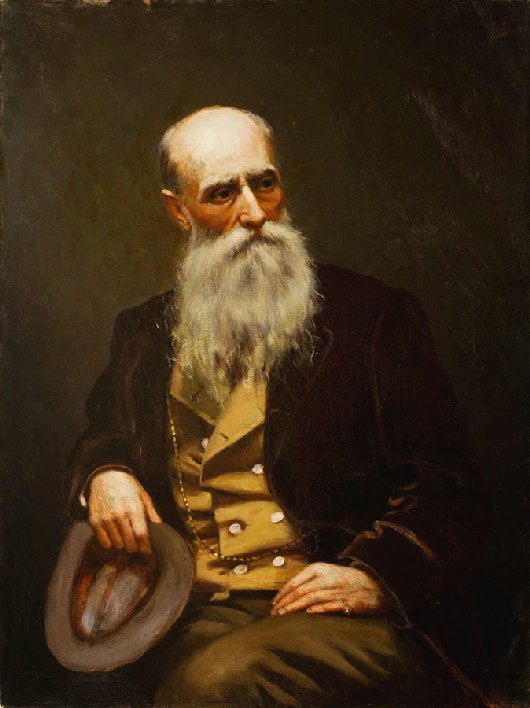
William Morris Hunt by Helen Mary Knowlton (1896)
Starting in 1874, Hale enrolled on a five-year course at William Morris Hunt’s school for painting, where she studied under Helen Mary Knowlton. Helen Mary Knowlton had received art tuition from William Morris Hunt, and she told him that she knew of forty women who would love to study art and so in 1868, despite criticism from those who thought he was wasting his time, Hunt began classes for women. It was not art that he was teaching, he was inspiring his female students and instilling in them a sense of self-worth. When Hunt died in 1879, Knowlton carried on his work of supporting his female students and getting the group of women to rely upon each other for professional and personal support rather than their husbands or other men,

Morning News by Ellen Day Hale (1905)
Having finished her five years at the William Morris Hunt school she moved to Philadelphia and enrolled at a two-year course at Pennsylvania Academy of the Fine Arts (PAFA), where the director was Thomas Eakins. Following this, in 1881, Ellen Day Hale went to Europe with Helen Knowlton and the pair went on to visit Belgium, Holland, Italy and England continually visiting museums of art and taking time to copy some of the paintings. For a brief time whilst in London, Hale studied at the Royal Academy, but she eventually parted company with Knowlton and travelled to Paris where she enrolled with Emmanual Frémiet at the Jardin des Plantes, worked in the atelier of Emile Carolus-Duran, and learned the French academic style at Académie Julian before returning to Boston in 1883.

Self portrait by Ellen Day Hale (1885)
It was whilst back in Boston at her family’s home in Roxbury, Massachusetts, and at the family’s summer home in Matunuck, Rhode Island. that Hale began her self-portrait in 1884. In this work we see Hale gazing out at us with great assurance. Her right arm rests on the arm of a chair. She is dressed completely in black wearing a dress with buttons and a fur collar, covered by a loose jacket. From under the brim of her black hat we can see her fringe. Hale appears to be making a fashion statement with her clothes and youthful hairstyle. Her bold gaze and her fashionable outfit suggest her willingness to push traditional boundaries. Hale exhibited her Self-Portrait in Boston, perhaps for the first time, in 1887. The Museum of Fine Arts, Boston, which owns the work later commented:
“…Hale’s forthright presentation, her strong dark colours, and the direct manner in which she engages the viewer recall the work of one of the French painters she most admired, Edouard Manet. Manet had been known for his confrontational images, strongly painted without subtle nuances of light and shadow…”
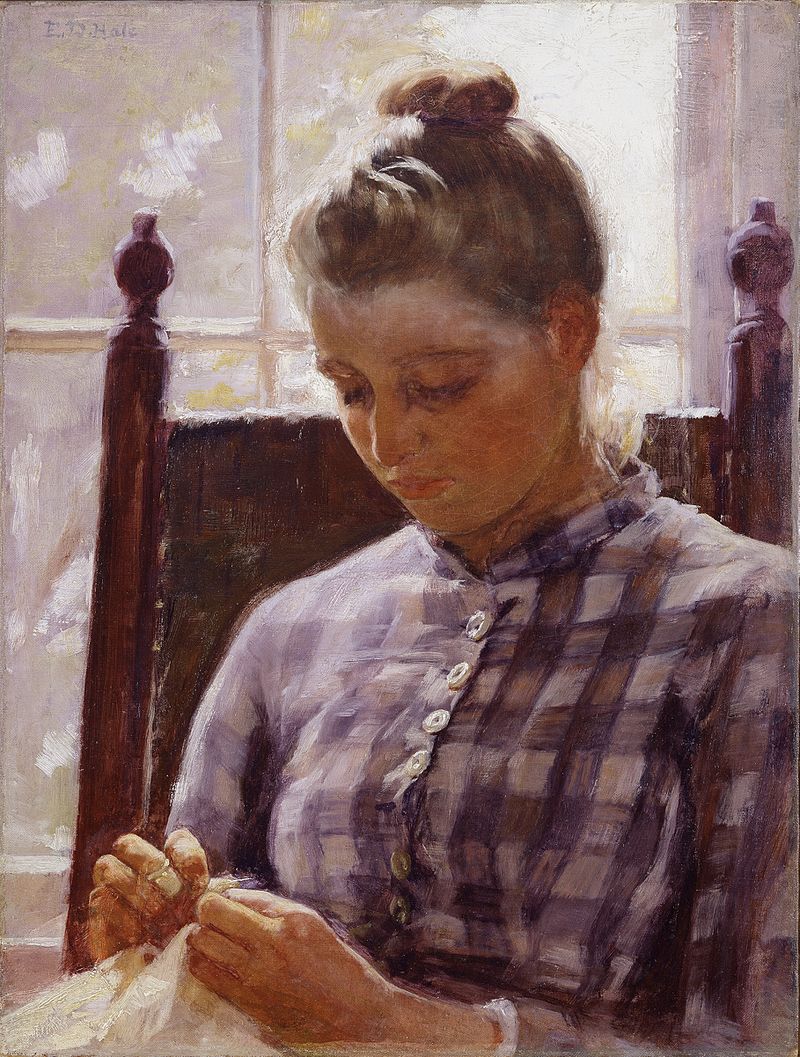
June by Ellen Day Hale (1893)
Now although back living in Boston, Hale still loved to travel and made frequent journeys to Europe, North Africa, and the Middle East. She also spent time exploring her own country especially the American West. Despite her railing against traditional limitations exacted on females by society, the one she concurred with was that women should not travel alone and so she needed to find a like-minded companion for her exploratory journeys. Hale soon lighted on the perfect companion in the guise of the painter Gabrielle de Veaux Clements. Gabrielle had attended several prestigious art schools, studied under notable artists such as Tony Robert-Fleury and William-Adolphe Bouguereau, and exhibited at the Paris Salon in 1885. Clements specialized in landscapes, cityscapes, and harbour vistas capturing the bustling spirit of Paris, Baltimore, Cape Ann, and other cities and towns throughout France, Algiers, Palestine, and along the American East Coast.

Gabrielle de Veaux Clements.by Ellen Day Hale (1883)
Clements became the traveling partner of Ellen Day Hale whom she met in 1883. The two artists became life-long friends and beside their painting trips spent their summers in Folly Cove on Cape Ann, Massachusetts, which was a popular artist destination and an artist’s colony thrived. It was where the artists staying there were able to share models and learn each other’s techniques. Such was their close friendship that in 1893, the two artists established a household together in the small Massachusetts town of Folly Cove, at a house they bought, “The Thickets”. During the winter months Clements and Hale spent their time traveling throughout Europe but sometimes just remained in America in Charleston, South Carolina, where they taught etching. Among their circle of friends and visitors were Cecilia Beaux and Margaret Bush-Brown. Between 1904 and 1909, Hale resided in Washington, DC, serving as hostess in her father’s home while he was chaplain to the U. S. Senate.
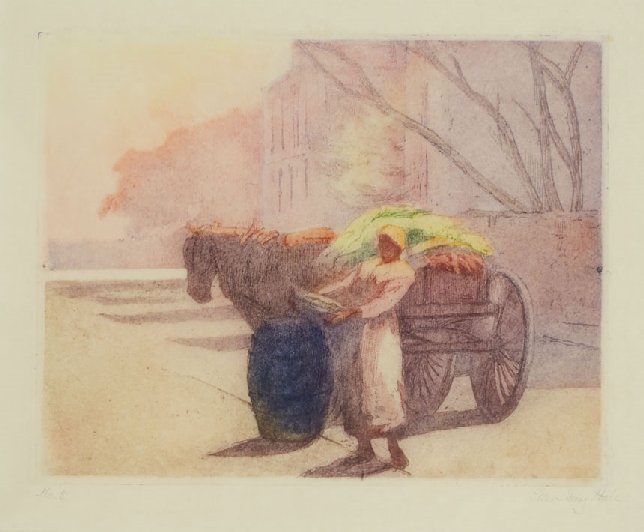
Early Vegetables by Ellen Day Hale (c.1918)
The relationship between Ellen Day Hale and Gabrielle de Veaux Clements was often referred to as a Boston Marriage. A Boston marriage was, historically, the cohabitation of two wealthy women, independent of financial support from a man. The term is said to have been in use in New England in the late 19th and early 20th century. Some of these relationships were romantic in nature and might now be considered a lesbian relationship; others were not. The nature of Ellen and Gabrielle’s type of relationship is simply unknown.
Musical Interlude by Ellen Day Hale
While in Charleston Ellen and Gabrielle immersed themselves in the flourishing arts renaissance which was taking place in the city. They were both accomplished printmakers and they helped organize the Charleston Etchers Club, whose founding members included Elizabeth O’Neill Verner, Alice Ravenel Huger Smith, and Alfred Hutty. It was Verner’s daughter who later recalled the input of Verner and Hale had in Charleston and she recalled Clement’s words:
“…We want to leave Charleston some of our skills . . . Get together a group so you can buy a press and we will show you how to use it . . . We’ll teach you, so you can teach them…”
The Charleston Etchers’ Club was formed in 1923 and it offered instruction on printmaking, encouraged intellectual exchange, art criticism, and exhibition planning.
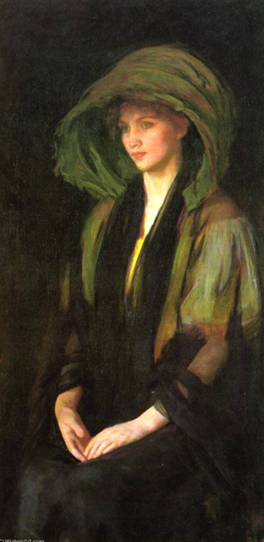
The Green Calash by Ellen Day Hale (1904)
In 1904 Ellen Hale completed a painting entitled The Green Calash. A calash is a large green bonnet or hood and resembles the folding top of an 18th-century carriage known as a calash. It is a three-quarter-view portrait of a young woman who is sitting on a chair with her hands resting together in her lap.

The Green Calash by Ellen Day Hale (1925)
In 1925, twenty-one years later, Hale completed a soft ground colour etching and aquatint after her 1904 painting. The print is again a three-quarter-view portrait of a young woman seated with her hands resting together in her lap and is once again wearing a large green bonnet. The print of this etching was exhibited at the Smithsonian as part of a print exhibition in November 1936. Gabrielle DeVeaux Clements and Ellen Hale experimented extensively with colour printmaking throughout their careers.

The Original Colour Engraving by René Ligeron
Both had been influenced by the French artist René Ligeron’s 1924 treatise on colour intaglio, which Hale translated into English for the Smithsonian exhibition. Gabrielle Clements wrote to curator R.P. Tolman telling him that she and Hale had “been working on an interesting line of experiments in printing etchings in colour” and that they had “lately gained better control of the medium, and greater simplicity.”

This prestigious 1936 exhibition came near the end of Hale’s and Clements’s careers. By that time, they had been producing prints for more than sixty years. It was almost fifty years earlier that their work was showcased at the Women Etchers of America exhibition in 1887 at the Boston Museum of Fine Arts.
Hale died in Brookline, Massachusetts, on February 11, 1940, her 85th birthday. Hale’s legacy is not only in her artwork and etchings but also her struggle to gain in the acceptance of female artists. A member of what is now referred to as the Boston School of Painting, Hale has also been recognized as one of America’s leading women impressionists. She also wrote History of Art (1888). Her artist brother Philip Hale also exhibited at the Chicago World’s Fair.
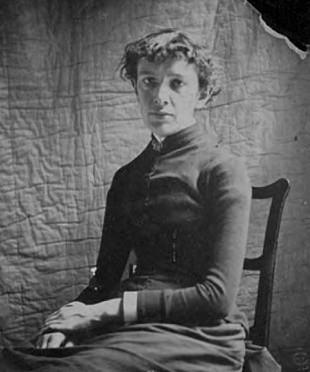
Ellen Day Hale
In his 1997 memoir, A Sculptor’s Fortunes, by Walker Kirtland Hancock an American sculptor and teacher talked about Hale and Clements, and their roles in establishing Folly Cove as a gathering spot for artists, a place he first visited in 1920:
“…Folly Cove…had begun to attract artists at least two generations before I arrived. The first to settle there were Ellen Day Hale and Gabrielle deV. Clements….Their houses were close to each other, overlooking the cove. Miss Clements’ was a large frame structure not far back from the road. Miss Hale’s, a stone building, was on higher ground. Miss Clements had been a mural painter, but because of her age she at that juncture limited her work to etching. She was kind and patient enough to give me lessons in that art. Miss Hale continued with her portrait painting. Both ladies were very much a part of the local community…They were responsible for [sculptor] Charles Grafly’s buying a house and building a large studio nearby, having recommended “the Folly” to him as a healthful place in which to live…
 my daily art display