
The Sea and the Ships
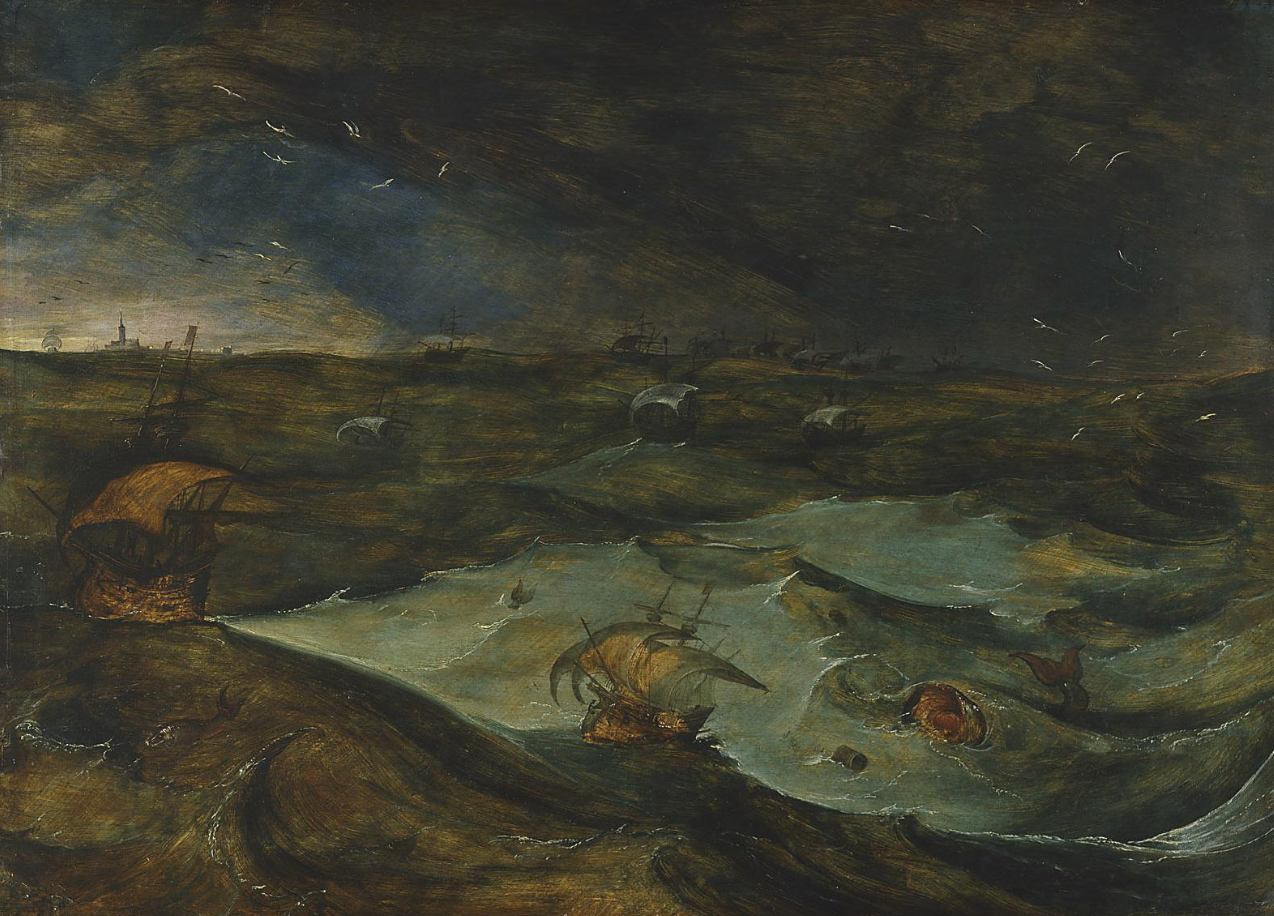
Storm at Sea by Pieter Bruegel the Elder (c.1569)
Maritime painting is an art genre that depicts ships and the sea. Early examples of this genre were found in Greek vase paintings and the wall paintings of Pompeii. Storm at Sea is one of earliest specific seascapes and was painted around 1569 by Pieter Bruegel the Elder’s and thought to be one of his last paintings. It is unfinished and, like so many of his works, defies unambiguous interpretation. On the one hand, we see ships threatened by a storm reminding us that man is not master of Nature, in fact man is often its victim. To try and save themselves from the stormy sea the sailors have poured oil onto the water. They have also sacrificed a barrel from their cargo to distract the mighty whale who is attacking their vessel.

The Battle of Terheide (1657), commemorating the Battle of Scheveningen on 10 August 1653 by Willem van de Velde the Elder.
The greatest marine artists of the 17th century were Willem van de Velde the Elder and his son, Willem van de Velde the Younger. They were best known for their spectacular depictions of storms at sea, and of nautical life, as well as their painstakingly drawn depictions of ships and naval battles. To commemorate the Dutch naval commander Maerten Harpertsz Tromp, his family commissioned a series of pen paintings of Tromp’s best-known battles from Willem van de Velde the Elder. The artist used pen and ink on canvas for these works, which which bear a resemblance to meticulous, accurate engravings. Van de Velde witnessed the Battle of Terheide in 1653 and he used the sketches that he produced on board as studies for this pen painting.

Men O’ War in Action by Willem van de Velde the Elder
Willem van de Velde the Elder was born in Leiden in 1611. He was the son of the captain of a merchant vessel, Willem Willemsz van de Velde. When he was young, he would often accompany his father on sea voyages and this probably shaped his career as a marine artist. Van de Velde married Judith van Leeuwen in Leiden in 1631 and the couple went on to have three children, a daughter, Magdalena, and two sons who would become renowned painters, Willem van de Velde the Younger, a marine artist and Adriaen van de Velde, a landscape painter.
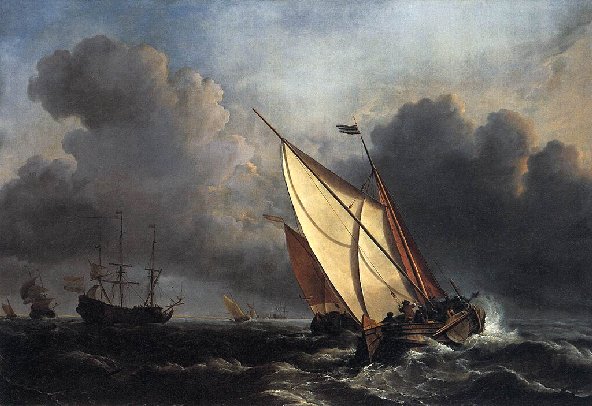
Ships in a Stormy Sea by Willem van de Velde the Younger (c.1672)
The painting entitled Ships in a Stormy Sea by Willem van de Velde the Younger depicts the drama and the excitement of those who braved the seas in the 17th century. Willie van de Velde the Younger had first-hand knowledge of sailing, and his marine paintings were appreciated for their realistic depictions of ships and sailing tactics. In this work the ship in the foreground is a kaag, a light fishing vessel. The artist has depicted it as sailing close-hauled in the strong breeze, which is one of the most difficult sailing manoeuvres, in which the vessel sails into the wind as directly as it can without causing the sails to flap uselessly.
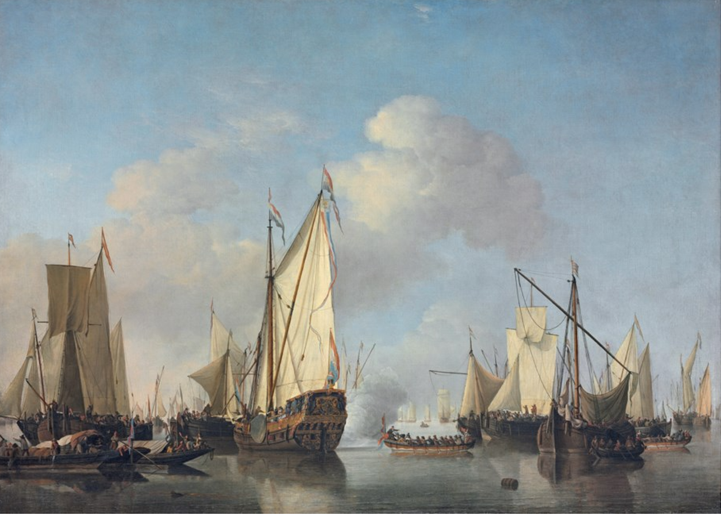
States Yacht and other vessels in a very light air by Willem van de Velde the Younger.
Whereas his father specialised in drawings and pen paintings, Van de Velde the Younger was best known for his oil paintings, which depicted life at sea in full colour. He was born in Amsterdam in 1633 and trained as a painter with the Dutch artist Simon de Vlieger, who was known for his marine paintings, beach scenes, landscapes and genre work. Unlike his father, Willem de Velde the Younger was a trained artist, unlike his father who was self-taught. Van de Velde the Younger worked closely with his father and the pair brought their artistic visions to life. Often, he would use his father’s drawings as a guide to create his own masterpieces. The father was a master of detail whereas his son was a master of light. It was this combination of artistic talents that was to lead to the success of their studio business.

The Home Fleet Saluting the State Barge by Jan van der Capelle (1650)

Shipping in a Calm at Flushing with a States General Yacht Firing a Salute by Jan van de Cappelle (1649)
Jan van de Cappelle was a Dutch Golden Age painter of seascapes and winter landscapes, also notable as an industrialist and art collector. He is now considered the outstanding marine painter of 17th century Holland. Jan van de Cappelle was wealthy and was occupied full-time running his father’s dyeing business. Though he painted some beach scenes and winter landscapes, most of his paintings represent the mouths of wide rivers or quiet inner harbours, where groups of ships at anchor were depicted in glassy calm waters. Many of his marine art works depict full cloud formations which hover over these tranquil waters and are mirrored in colourful reflections, often set in early morning or evening. When he died, aged fifty-three, in 1679, his estate was worth more than 90,000 guilders.

The Ships “Winged Arrow” and “Southern Cross” in Boston Harbour by Fitz Henry Lane (1853)
Fitz Henry Lane was born on December 19, 1804, in Gloucester, Massachusetts. Lane and was christened Nathaniel Rogers Lane three months later and would remain known as such until he was twenty-seven. In March 1832, Lane requested that his name be changed to Fitz Henry Lane. The reasons behind Lane’s decision to change his name, and for choosing the name he did, are still very unclear. Lane and his family lived on the outskirts of Gloucester close to the harbour’s working waterfront and so, growing up, Lane had contact with all the elements of maritime life. Lane’s father, Jonathan Lane was a sailmaker and it was thought that his son would follow him into the business or become a seafarer. Unfortunately, when only eighteen months of age he became ill and suffered a form of paralysis of the legs. Growing up he was unable to join his friends in games and became withdrawn and stayed at home where, for amusement, he began to draw. This developed into an amazing talent and living close to the sea and the harbour he began to sketch the ships and the harbour.
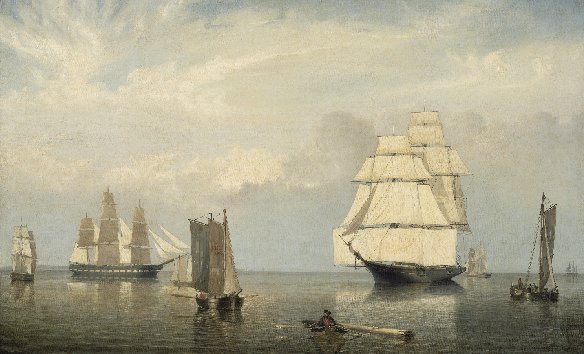
Salem Harbor by Fritz Henry Lane (1853)
For fifteen years, Lane was employed at Pendleton’s Lithography shop in Boston and during those years as a lithographer Lane honed his artistic skills. He produced many works of marine art and was listed as a marine painter in the 1840 edition of the Boston Almanac. His works became extremely popular and were in great demand. Then despite living in Boston, it never prevented him returning on a number of occasions to his birthplace, Gloucester. Aged forty-eight Lane left Boston and moved back to Gloucester where in 1849 he designed and had constructed his own granite house with seven gables and a studio on Duncan’s Point. This house would remain his primary residence to the end of his life. Fitz Henry Lane died on August 14th, 1865, aged 60.

Rainbow at Sea with some cruising Ships by Christoffer Wilhelm Eckersberg (1836)
Christoffer Wilhelm Eckersberg, a Dutch painter, was born in Blåkrog in the Duchy of Schleswig on January 2nd 1783. He was at the forefront of the Golden Age of Danish Painting, a period from 1800 to around 1850 and is often referred to as the “Father of Danish painting”. After 1821 seascapes had become Eckersberg’s favourite subject.

The Russian Ship of the Line “Asow” and a Frigate at Anchor in the Roads of Elsinore by Christoffer Wilhelm Eckersberg (1828)
Eckersberg’s best loved maritime painting is his 1828 work entitled The Russian Ship of the Line “Asow” and a Frigate at Anchor in the Roads of Elsinore. This majestic work is not a true rendition of the scene but an idealised version as the setting of the scene is not Copenhagen where he had studied Russian ships of the line on two occasions. We also know from his diaries that he had also studied the ship’s design from technical drawings he had borrowed from the naval dockyard. However the backdrop is not Copenhagen but Elsinore where we can see Kronborg Castle in the background. Kronborg is the castle and stronghold in the town of Helsingør, Denmark, which was immortalized as Elsinore in William Shakespeare’s play Hamlet. The depiction is what the ship, Asow, would have looked like if viewed from a vantage point on the Øresund.
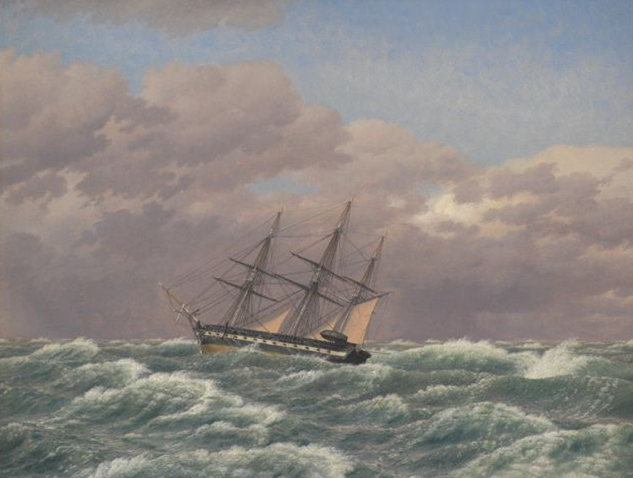
The Corvette Galathea in a Storm in the North Sea by Christoffer Wilhelm Eckersberg (1839)
Although he was known for his portraiture and historical paintings, marine paintings was another genre he developed. Eckersberg developed a passion for ships, and, at the age of fifty-six, sailed around the Skagerrak, the Kattegat, the North Sea, and as far as the English Channel. These sailing trips on the open seas brought home to Eckersberg that sea could be quite threatening and whereas many of his early work focused on cam seas, later works often depicted the ferocity of the sea.
If you would like to read more about the art of Christoffer Wilhelm Eckersberg then have a look at the five blogs I did focusing on his life life and paintings.

Northeaster by Wilmslow Homer (1895)
Winslow Homer was an American landscape painter and illustrator and is renowned for his marine subjects. By many, he is considered one of the leading painters of 19th-century America. His 1895 painting entitled Northeaster can be found in the collection of the Metropolitan Museum of Art, in New York City. It depicts a wave crashing aggressively against a rocky Maine shoreline. Homer loved the East coast of America around Maine and eventually settled down there in 1883, moving from New York to Prouts Neck, Maine where he lived at his family’s estate in the remodelled carriage house seventy-five feet from the ocean. The title of the painting, Northeaster, does not refer to a location in America, but is a name given to a specific type of wind that occurs within the western North Atlantic Ocean. The painting depicts just a small section of rock seen in the lower left corner whilst, in the background, a spectacular section of sea is seen riding relentlessly towards the shore.

Early Morning, After A Storm At Sea By Winslow Homer (1900-1903)
Whilst living at Prouts Neck, Winslow Homer looked out upon the sea and once commented to a friend that painting was all about timing:
“…You must not paint everything you see. You must wait, and wait patiently until the exceptional, the wonderful effect or aspect comes. Then, if you have sense enough to see it—well . . . that is all there is to that…”
Homer began this seascape in 1900 and based it on a watercolour he had completed in 1883. He was proud of the finished work in oils stating that it was the best picture of the sea that he had painted but was totally dismayed when it was poorly received by the critics. He just said of this dismissive reception that no one understood the work and besides that, the people never see the early morning effect. They don’t get up early enough.
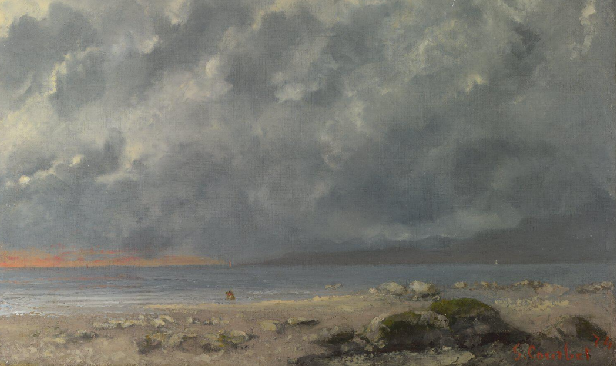
View of Lac Léman by Gustave Courbet (1874)
Threatening grey clouds move across the sky above the calm Swiss lake but the cloud formation threatens an oncoming storm. The depiction is set in the evening and on the horizon against the vivid orange and gold of the setting sun we can just barely make out a tiny boat. Soft red reflections streak the surface of the water. Courbet had left France in 1873 for political reasons and settled on the shores of Lac Léman in Switzerland where he painted a number of scenes featuring the lake at sunset.

Marine by Gustave Courbet
Four years earlier during the late summer of 1869 Courbet travelled to Étretat, a small fishing village which was famous for its towering coastal cliffs with their rock arches carved out by the relentless sea. Courbet was fascinated by the sea and completed twenty-nine works during his stay at Étretat. His depictions of the sea would vary from the quiet tranquillity of the calm sea to the violence of crashing waves upon the rocks. In the above work Courbet shows us the power of the sea with white-capped waves with foam fringes as they approaches us. The painting has captured the feel of motion and the immense power of the relentless waves.
In Part 2, I will be looking at Marine paintings which feature those who enjoy relaxing by the sea and those whose living is connected with the sea.


 With his royal invitation to Greece, he also took the opportunity to depict the ancient sites. The above large-scale work (80 x 137cms) is one of his finest paintings of the last decade of the nineteenth century. It is thought that the two finely-dressed people depicted to the left in the mid-ground are King George I and his wife, Queen Olga of Greece. Further to the left are members of the famous Presidential Guard known as the Evzones. From Greece, Mønsted travelled to Egypt and Spain.


 my daily art display