
My artist today is the German painter Max Liebermann. Liebermann was a key figure in the nineteenth century German art scene, who was well-known for his part in bringing Impressionism to the German art world and was one of the founder members of the Berlin Secession.

Photograph of Max Liebermann by Jacob Hilsdorf (1904)
Max Liebermann was born in Berlin on July 20th 1847. He was the second born child of Louis Liebermann and Philippine Liebermann (née Haller). He had an elder sister, Anna and two younger brothers, Georg and Felix. His father was a wealthy Jewish fabric manufacturer who later became a banker. Max’s paternal grandfather Josef Liebermann was a textile entrepreneur and in 1860, the Liebermann family bought the Dannenberg’sche Kattun-Fabrik, which was one of the foremost companies for the production of cotton in Europe. Max was brought up in a very wealthy family environment.
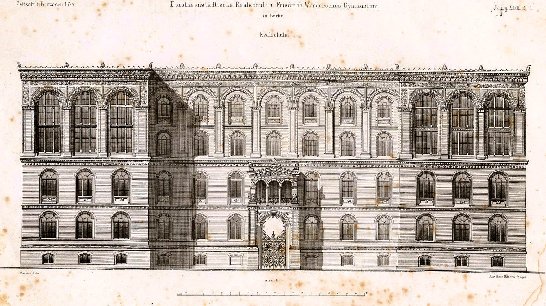
Dorotheenstädtische Realschule, Berlin.
In 1851, aged 4, Max attended the local humanistic nursery school. He was not impressed with the school and throughout his school days, he had an aversion for his teaching establishments. On completion of his time at primary school he attended the Berlin Dorotheenstädtische Realschule. Max was not a great scholar and spent most of his time drawing rather than studying.

Palais Liebermann at Pariser Platz 7, to the right of the Brandenburg Gate (1892)
In 1857, when Max was ten years old, his father Louis bought the impressive Palais Liebermann, located in Berlin-Mitte at Pariser Platz 7, north of the Brandenburg Gate. Although Max’s family were Jewish his parents decided to bring Max up in the Jewish denomination known as Reform Judaism which was a highly liberal strand of Judaism and is characterized by little stress on ritual and personal observance, rather than the stricter orthodox way of life of their grandfather. The family attended church services in the reform community but increasingly turned away from the more orthodox way of life of their ancestors.

The Shoemaker by Max Liebermann (1881)
In 1859 Max’s father commissioned a portrait of his wife by the artist Antonie Volkmar. During one of the sittings Philippine Liebermann had her son Max accompany her to the artist’s studio. The story goes that Max asked the artist for a pen and paper so he could pass the time sketching. Antonie Volkmar was so impressed with Max’s sketching that she told his mother that Max would become a fine artist. Max’s parents, although aware of that prediction, wanted their son to carry on with his normal schooling and a compromise was reached that if he carried on attending school and did well, they would enrol him in private painting lessons from Eduard Holbein and Carl Steffeck. Upon finishing primary school, his father, Louis Liebermann, chose for Max and his brothers. the Friedrichwerdersche Gymnasium, a prestigious humanistic grammar school, where the sons of Bismarck had studied.

Workers on the Beet Field by Max Liebermann (1876)
Max graduated from the Gymnasium in 1866 and carried out his parent’s wishes by enrolling at the Friedrich Wilhelm University in Berlin where he studied chemistry, like his brother before him. However he was still more interested in his painting and would often miss lectures to go off on painting trips or helping out at Carl Steffeck’s studio. Later he attended the University of Berlin and studied law and philosophy but once again his mind was solely on art and in January 1868, following little progress with his studies, he was asked to leave. One can only imagine how his parents took this turn of events. They were furious as to how their son had wasted this golden opportunity. Whether it was the case that they had to make the best of a dire situation and realised that their son was only interested in his art, they arranged for Max to enrol at the Grand Ducal Saxon Art School in Weimar where he studied under the Belgian history painter, Ferdinand Pauwels. Pauwels took his students on a visit to the Fridercianum (Kassel’s Gemaeldegalerie), which has one of the world’s best collections of early German and Flemish paintings, amongst which are nineteen works by Rembrandts. These works were to influence Liebermann for the rest of his life.

Amsterdam Orphanage by Max Liebermann (1876)
The Franco-Prussian War broke out in 1870 and twenty-three-year-old Max was captivated by the general population’s patriotic fury and passion. However, Max was unable to join up for military service on medical grounds and so volunteered as a medic for the Johannitern, the Order of St. John and he witnessed the war at the Siege of Metz. The battlefield carnage during the siege distressed Max and his patriotic war fervour waned rapidly.
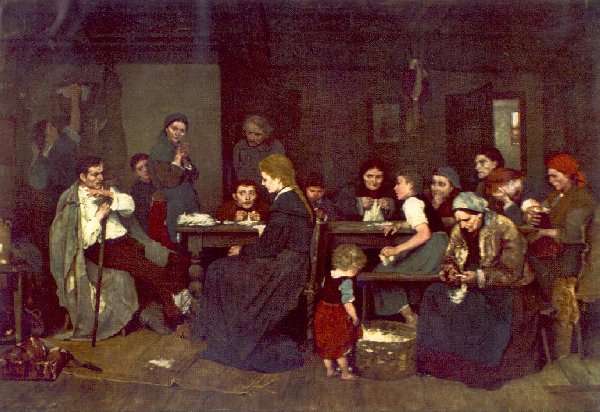
Tépéscsinálók (Tear Makers) by Mihály von Munkácsy (1871)
In the Spring of 1871, Liebermann lived in Düsseldorf, where the influence of French art was greater than in Berlin. Whilst in the city he met Mihály von Munkácsy, a Hungarian painter, who had earned international reputation with his genre pictures and large-scale biblical paintings. His paintings often featured scenes from the daily lives of peasants and poor people. Max saw Mihály von Munkácsy’s recently completed work entitled Tépéscsinálók and this stimulated his interest in genre painting. The subject of Munkácsy’s painting comes from memories of the 1848 Hungarian Revolution also known as the War of Independence and it depicts a wounded soldier, leaning on his crutches in a dark interior, recounting the story of life on the front line and the difficult battles he had experienced. Whilst the men were at war the girls, women, old people, and children remained at home in their villages looking after returning wounded soldiers, their kinfolk, who had suffered mentally and physically on the battle front. In this depiction the villagers listen attentively to the soldier’s emotional story and many cry (hence the painting’s title “Tearing Up”). Mihály von Munkácsy depicted the scene with particularly sympathetic memories, since the War of Independence and the tragic events that followed caused his sad childhood and saw him orphanhood at the age of six.
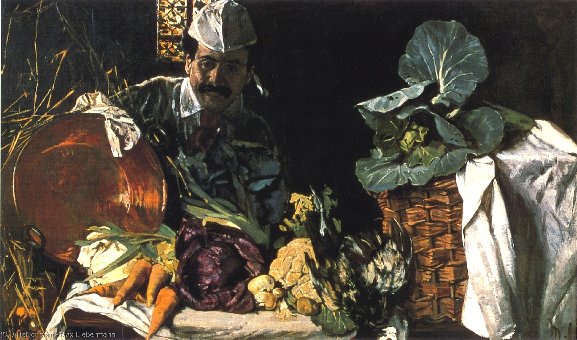
Self portrait in Kitchen with Still Life by Max Liebermann (1873)
Realising that the Netherlands was a place he had to visit to satiate his appetite for genre painting, Max, thanks to financial assistance from his brother, travelled to Amsterdam and Scheveningen. It was the first of many trips he made to the the Netherlands, a country he said inspired him.

Die Gänserupferinnen (Goose Pluckers) by Max Liebermann (1872)
When Max returned home in 1872 to continue with his studies at Weimar, his studio colleague Thomas Herbst had brought back a drawing of geese-plucking women from a study trip. Liebermann decided to use this motif and merge it with the style of Munkácsy and realised that this would be the basis of his next work. He then started on his large (120x170cms) painting entitled Die Gänserupferinnen (Goose Pluckers), which is now part of Berlin’s Alte Nationalgalerie collection. The work is painted in dark tones and depicts the simple task of goose plucking but the scene bears a resemblance to Mihály von Munkácsy’s work, Tépéscsinálók. It was the first painting that the twenty-five-year-old Liebermann exhibited in public at a Hamburg art exhibition. The art critics acknowledged the skilful painting style of Liebermann but were highly critical of the subject calling it distasteful and labelling him as the “painter of the ugly”. The painting was then exhibited that same year in Berlin but the critics were again fervently critical as they had been in Hamburg. However, the work found a buyer in the railway millionaire Bethel Henry Strousberg and with the money from the sale of the painting Liebermann travelled to Paris. His time in Paris was spent looking at the works of French artists such as Millais and Courbet and he was impressed by their style and motifs. Bethel Henry Strousberg’s empire later collapsed and he became bankrupt and had to sell some of the paintings he had collected over the years. Louis Liebermann, Max’s father, bought the Gänserupferinnen (Goose Pluckers) painting from him.

Potato Harvest in Barbizon by Max Liebermann (1875)
Liebermann had now discovered his first and favoured style, one which was both a realistic and unsentimental depiction of working people, and yet a style which avoided disdain, shaming of the subjects but also shied away from false romanticising of the people depicted. It was Realism. Liebermann became disillusioned with the German art scene which he believed had become too old-fashioned and somewhat retrograde and he was even disenchanted with Germany itself, so in December 1873 Liebermann travelled to Paris where he set up home and studio in Montmartre. Once settled in the French capital he sought out the artists who were looked upon as leading Realism artists of the day as well as the plein air Impressionism painters but many refused to meet with him due to the sour taste the Franco-Prussian War had left and the bitterness the defeat by the Prussian forces had caused and it had only ended three years earlier.
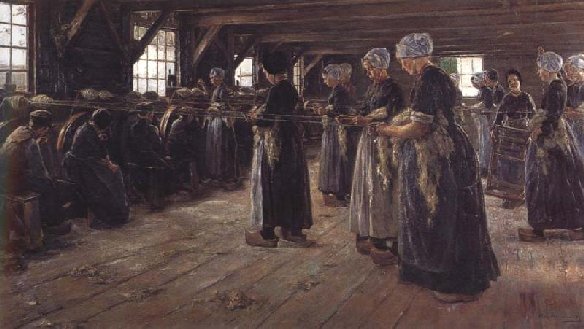
Flax Spinners by Max Liebermann (1889)
Besides still being influenced by Munkácsy, Liebermann had fallen in love with the art of French Barbizon painters Constant Troyon, Charles-François Daubigny, Camille Corot but above all Jean-François Millet. It was in 1874 that he submitted and had accepted his Die Gänserupferinnen (Goose Pluckers) painting to the Salon de Paris. However, this received negative reviews in the Parisian press, especially those newspapers which held nationalist views following the Franco-Prussian war. The first summer Liebermann spent in Paris it saw him travel to Barbizon, situated near the Forest of Fontainebleau, the home of the Barbizon School of artists, whose painters practiced en plein air painting which proved to be of great importance for the development of Impressionism. Liebermann decided to revert from the old-fashioned, heavy painting of Munkácsy, and became more engrossed in the methods used by the artists of the Barbizon School.
From 1874 Max Liebermann continued his studies in Paris and it was during thus time that he became increasingly interested in rural motifs, in “simple” people working on the land.
………to be continued.
Much of the information was found in various Wikipedia sites but also in:
 my daily art display