Max Liebermann

My artist today is the German painter Max Liebermann.  Liebermann was a key figure in the nineteenth century German art scene, who was well-known for his part in bringing Impressionism to the German art world and was one of the founder members of the Berlin Secession.

Photograph of Max Liebermann by Jacob Hilsdorf (1904)

Max Liebermann was born in Berlin on July 20th 1847.  He was the second born child of Louis Liebermann and Philippine Liebermann (née Haller).  He had an elder sister, Anna and two younger brothers, Georg and Felix. His father was a wealthy Jewish fabric manufacturer who later became a banker.  Max’s paternal grandfather Josef Liebermann was a textile entrepreneur and in 1860, the Liebermann family bought the Dannenberg’sche Kattun-Fabrik, which was one of the foremost companies for the production of cotton in Europe. Max was brought up in a very wealthy family environment.
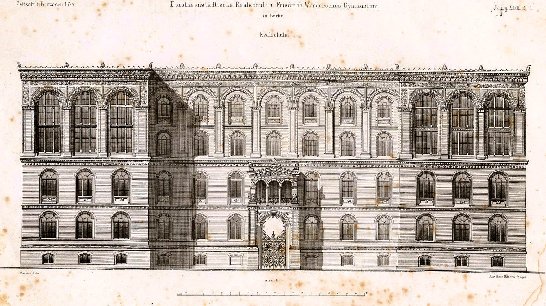
Dorotheenstädtische Realschule, Berlin.

In 1851, aged 4, Max attended the local humanistic nursery school.  He was not impressed with the school and throughout his school days, he had an aversion for his teaching establishments.  On completion of his time at primary school he attended the Berlin Dorotheenstädtische Realschule. Max was not a great scholar and spent most of his time drawing rather than studying. 

Palais Liebermann at Pariser Platz 7, to the right of the Brandenburg Gate (1892)

In 1857, when Max was ten years old, his father Louis bought the impressive Palais Liebermann, located in Berlin-Mitte at Pariser Platz 7, north of the Brandenburg Gate. Although Max’s family were Jewish his parents decided to bring Max up in the Jewish denomination known as Reform Judaism which was a highly liberal strand of Judaism and is characterized by little stress on ritual and personal observance, rather than the stricter orthodox way of life of their grandfather. The family attended church services in the reform community but increasingly turned away from the more orthodox way of life of their ancestors.

The Shoemaker by Max Liebermann (1881)

In 1859 Max’s father commissioned a portrait of his wife by the artist Antonie Volkmar. During one of the sittings Philippine Liebermann had her son Max accompany her to the artist’s studio. The story goes that Max asked the artist for a pen and paper so he could pass the time sketching. Antonie Volkmar was so impressed with Max’s sketching that she told his mother that Max would become a fine artist. Max’s parents, although aware of that prediction, wanted their son to carry on with his normal schooling and a compromise was reached that if he carried on attending school and did well, they would enrol him in private painting lessons from Eduard Holbein and Carl Steffeck. Upon finishing primary school, his father, Louis Liebermann, chose for Max and his brothers. the Friedrichwerdersche Gymnasium, a prestigious humanistic grammar school, where the sons of Bismarck had studied.

Workers on the Beet Field by Max Liebermann (1876)

Max graduated from the Gymnasium in 1866 and carried out his parent’s wishes by enrolling at the Friedrich Wilhelm University in Berlin where he studied chemistry, like his brother before him.  However he was still more interested in his painting and would often miss lectures to go off on painting trips or helping out at Carl Steffeck’s studio.   Later he attended the University of Berlin and studied law and philosophy but once again his mind was solely on art and in January 1868, following little progress with his studies, he was asked to leave.  One can only imagine how his parents took this turn of events. They were furious as to how their son had wasted this golden opportunity.   Whether it was the case that they had to make the best of a dire situation and realised that their son was only interested in his art, they arranged for Max to enrol at the Grand Ducal Saxon Art School in Weimar where he studied under the Belgian history painter, Ferdinand Pauwels.  Pauwels took his students on a visit to the Fridercianum (Kassel’s Gemaeldegalerie), which has one of the world’s best collections of early German and Flemish paintings, amongst which are nineteen works by Rembrandts. These works were to influence Liebermann for the rest of his life. 

Amsterdam Orphanage by Max Liebermann (1876)

The Franco-Prussian War broke out in 1870 and twenty-three-year-old Max was captivated by the general population’s patriotic fury and passion. However, Max was unable to join up for military service on medical grounds and so volunteered as a medic for the Johannitern, the Order of St. John and he witnessed the war at the Siege of Metz. The battlefield carnage during the siege distressed Max and his patriotic war fervour waned rapidly.
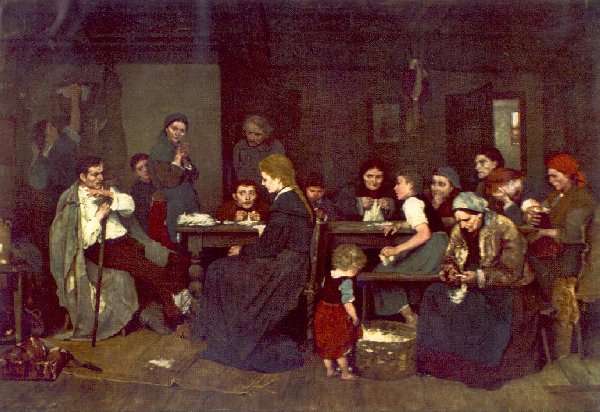
Tépéscsinálók (Tear Makers) by Mihály von Munkácsy (1871)

In the Spring of 1871, Liebermann lived in Düsseldorf, where the influence of French art was greater than in Berlin. Whilst in the city he met Mihály von Munkácsy, a Hungarian painter, who had earned international reputation with his genre pictures and large-scale biblical paintings. His paintings often featured scenes from the daily lives of peasants and poor people. Max saw Mihály von Munkácsy’s recently completed work entitled Tépéscsinálók and this stimulated his interest in genre painting. The subject of Munkácsy’s painting comes from memories of the 1848 Hungarian Revolution also known as the War of Independence and it depicts a wounded soldier, leaning on his crutches in a dark interior, recounting the story of life on the front line and the difficult battles he had experienced. Whilst the men were at war the girls, women, old people, and children remained at home in their villages looking after returning wounded soldiers, their kinfolk, who had suffered mentally and physically on the battle front. In this depiction the villagers listen attentively to the soldier’s emotional story and many cry (hence the painting’s title “Tearing Up”). Mihály von Munkácsy depicted the scene with particularly sympathetic memories, since the War of Independence and the tragic events that followed caused his sad childhood and saw him orphanhood at the age of six.
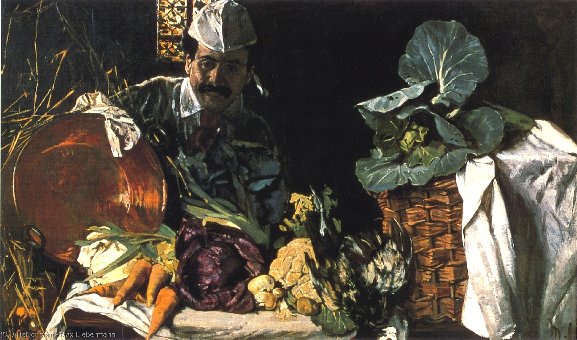
Self portrait in Kitchen with Still Life by Max Liebermann (1873)

Realising that the Netherlands was a place he had to visit to satiate his appetite for genre painting, Max, thanks to financial assistance from his brother, travelled to Amsterdam and Scheveningen. It was the first of many trips he made to the the Netherlands, a country he said inspired him.

Die Gänserupferinnen (Goose Pluckers) by Max Liebermann (1872)

When Max returned home in 1872 to continue with his studies at Weimar, his studio colleague Thomas Herbst had brought back a drawing of geese-plucking women from a study trip. Liebermann decided to use this motif and merge it with the style of Munkácsy and realised that this would be the basis of his next work. He then started on his large (120x170cms) painting entitled Die Gänserupferinnen (Goose Pluckers), which is now part of Berlin’s Alte Nationalgalerie collection. The work is painted in dark tones and depicts the simple task of goose plucking but the scene bears a resemblance to Mihály von Munkácsy’s work, Tépéscsinálók. It was the first painting that the twenty-five-year-old Liebermann exhibited in public at a Hamburg art exhibition. The art critics acknowledged the skilful painting style of Liebermann but were highly critical of the subject calling it distasteful and labelling him as the “painter of the ugly”. The painting was then exhibited that same year in Berlin but the critics were again fervently critical as they had been in Hamburg. However, the work found a buyer in the railway millionaire Bethel Henry Strousberg and with the money from the sale of the painting Liebermann travelled to Paris. His time in Paris was spent looking at the works of French artists such as Millais and Courbet and he was impressed by their style and motifs. Bethel Henry Strousberg’s empire later collapsed and he became bankrupt and had to sell some of the paintings he had collected over the years. Louis Liebermann, Max’s father, bought the Gänserupferinnen (Goose Pluckers) painting from him.

Potato Harvest in Barbizon by Max Liebermann (1875)

Liebermann had now discovered his first and favoured style, one which was both a realistic and unsentimental depiction of working people, and yet a style which avoided disdain, shaming of the subjects but also shied away from false romanticising of the people depicted. It was Realism. Liebermann became disillusioned with the German art scene which he believed had become too old-fashioned and somewhat retrograde and he was even disenchanted with Germany itself, so in December 1873 Liebermann travelled to Paris where he set up home and studio in Montmartre. Once settled in the French capital he sought out the artists who were looked upon as leading Realism artists of the day as well as the plein air Impressionism painters but many refused to meet with him due to the sour taste the Franco-Prussian War had left and the bitterness the defeat by the Prussian forces had caused and it had only ended three years earlier.
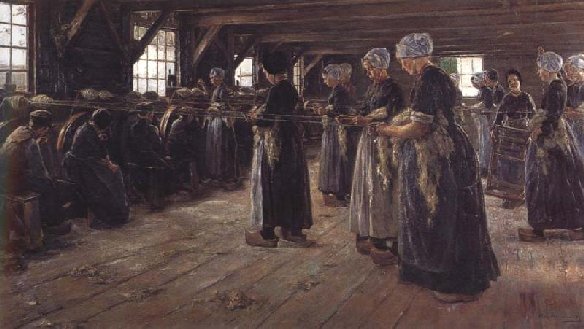
Flax Spinners by Max Liebermann (1889)

Besides still being influenced by Munkácsy, Liebermann had fallen in love with the art of French Barbizon painters Constant Troyon, Charles-François Daubigny, Camille Corot but above all Jean-François Millet. It was in 1874 that he submitted and had accepted his Die Gänserupferinnen (Goose Pluckers) painting to the Salon de Paris. However, this received negative reviews in the Parisian press, especially those newspapers which held nationalist views following the Franco-Prussian war. The first summer Liebermann spent in Paris it saw him travel to Barbizon, situated near the Forest of Fontainebleau, the home of the Barbizon School of artists, whose painters practiced en plein air painting which proved to be of great importance for the development of Impressionism. Liebermann decided to revert from the old-fashioned, heavy painting of Munkácsy, and became more engrossed in the methods used by the artists of the Barbizon School.

From 1874 Max Liebermann continued his studies in Paris and it was during thus time that he became increasingly interested in rural motifs, in “simple” people working on the land.

………to be continued.


Much of the information was found in various Wikipedia sites but also in:
The Art Story

Liebermann Villa am Wansee

Alfred Sisley. Part 1: The early years.

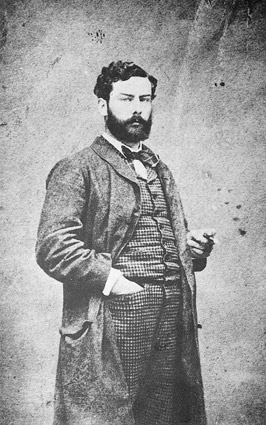
1882 photograph of Alfred Sisley

The artist I am looking at today is not one of my “unknown” painters I often showcase. This artist is well known and his works are in collections all around the world. Today’s featured painter is Alfred Sisley.

Felicity and William Sisley, Alfred’s parents.

Alfred Sisley was born on October 30th 1839 at 19 rue des Trois Bornes which was in what was then the 4th arrondissement of Paris. He was the son of the British couple, William Sisley, and Felicity Sisley (née Sell) and although born in France, he retained his British citizenship. Little is known about his siblings. Some articles say he was one of four children, others say he just had one older sibling who died young. Alfred’s maternal ancestors came from the English county of Kent and were said to have been smugglers and tradesmen. His parents were affluent. His father owned a silk exportation business which he had established in 1839. Little is known about Sisley’s schooling except to say in the Spring of 1857, when he was almost eighteen years old, his father sent him to London to learn how to embark on a career in commerce. It is clear that Sisley had neither an aptitude for, nor a love of, commerce. However, the upside for young Alfred was that being in London he was able to visit museums and exhibitions and began to fall in love with the works of Gainsborough, Turner and Constable as well as the Dutch and Flemish artists, such as Hobbema and Ruisdael, which he saw at the National Gallery.

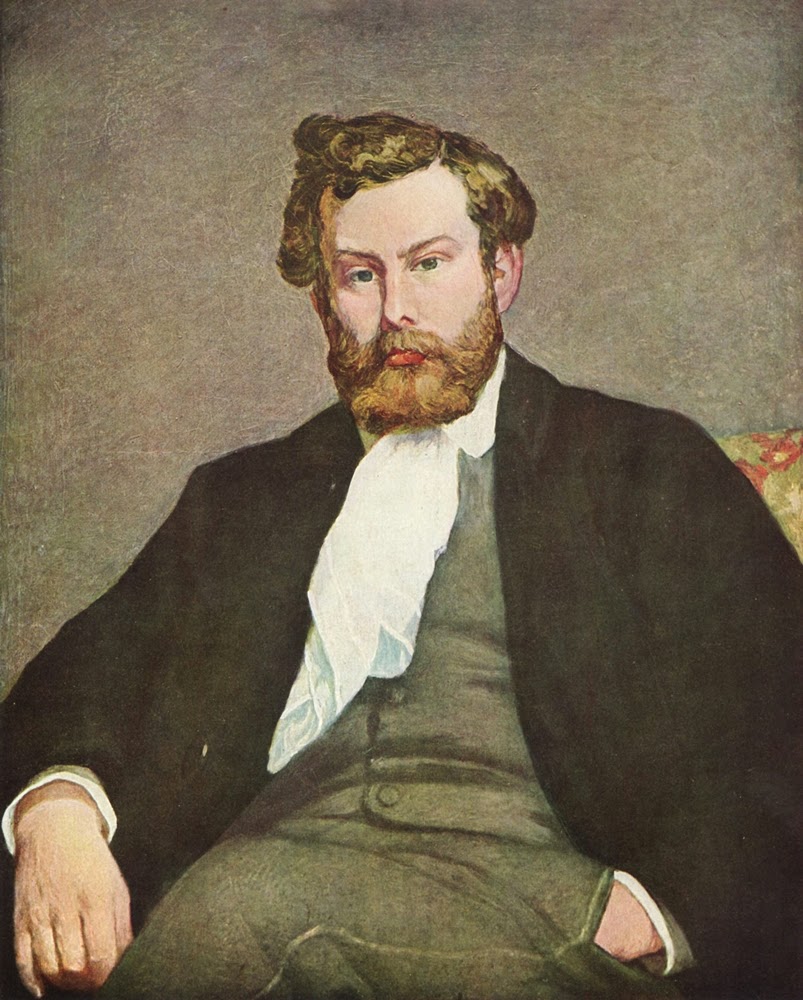
Portrait of Alfred Sisley by Pierre-Auguste Renoir (ca. 1875)

In 1860 Sisley returned home to Paris. Whether his father realised that his son lacked the ability to follow in his footsteps as a tradesman or whether Sisley had bombarded his father with his desire to become an artist, will never be known, but in 1860, Alfred Sisley began studying at the Paris École des Beaux-Arts within the atelier of Swiss artist Marc-Charles-Gabriel Gleyre. Many famous French artists had passed through Gleyere’s studio, such as Claude Monet, Pierre-Auguste Renoir, Frédéric Bazille, James Abbott McNeill Whistler, and Auguste Toulmouche.

Sisley, like his friend Renoir and Monet, left the atelier Gleyre around 1864 when it closed and they decided to move to the rural area of Fontainebleau and the small town of Barbizon. Sisley worked in Chailly-en-Bière and later in Marlotte near Fontainebleau. Renoir recalled the days spent with Sisley. In a letter to the art critic Adolphe Tavernier, Renoir wrote:

“…When I was young, I would take my paintbox and a shirt, Sisley and I would leave Fontainebleau and walked until we reached a village. Sometimes we did not come back until we had run out of money about a week later…”

The Inn of Mother Anthony by Renoir (1866)

Renoir had been sharing Sisley’s Paris studio since July 1865 and in February 1866 the two of them along with Renoir’s friend, the artist Jules Le Coeur set out to walk across the Forest of Fontainebleau passing through the villages of Milly and Courances on their way to Marlotte, a village on the southern edge of the Fontainebleau Forest, close to the River Loing. Renoir immortalised the group in his 1866 painting The Inn of Mère Anthony. In the depiction we see that Renoir has had his friends, Le Coeur, Sisley, Mère Anthony and her daughter pose for the painting in the main room of the inn at Marlotte.

Rue de village à Marlotte (Village Street in Marlotte) by Alfred Sisley (1866). Albright-Knox Art Gallery, Buffalo, New York

One of many paintings completed by Sisley around this time was entitled Village Street in Marlotte. The painting portrays a solitary figure chopping wood. A sombre palette of greens, browns, and grey-blues underscores an overall feeling of isolation. Unlike many of his contemporaries, Sisley seldom travelled and did not feel compelled to depict urban life, industrialization, and the more dramatic aspects of nature, contenting himself with painting the world close at hand.

Women going to the Woods by Alfred Sisley (1866)

Another work by Sisley was entitled Women going to the Woods and depicts three elderly women wrapped up against the cold who are setting out to the forest, probably to collect firewood and is a reminder that people were reliant on the forest for their existence. Both of Sisley paintings were exhibited at the 1866 Paris Salon.

Sisley and his Wife by Renoir (1868)

In 1866 Sisley met a thirty-two-year-old florist named Marie-Louise Eugénie Adelaide Lescouezec. According to Renoir she seemed “exceedingly well bred.” Little is known about her upbringing but reports have it that her family’s financial hardships forced her to become an artist’s model, which often had an unsavoury connotation. Yet another account tells of her early life being difficult after her father, an officer, was killed in a duel when she was a young girl. None of this affected in any way Sisley’s love for her and he was to remain devoted to her until her death in 1898.   On June 17th 1868, a year after they met, the couple’s son Pierre was born, followed by a daughter, Jeanne-Adèle, on January 29th 1869. Renoir painted the couple the year they were married.  She was dressed in a bright-coloured red and yellow gown.

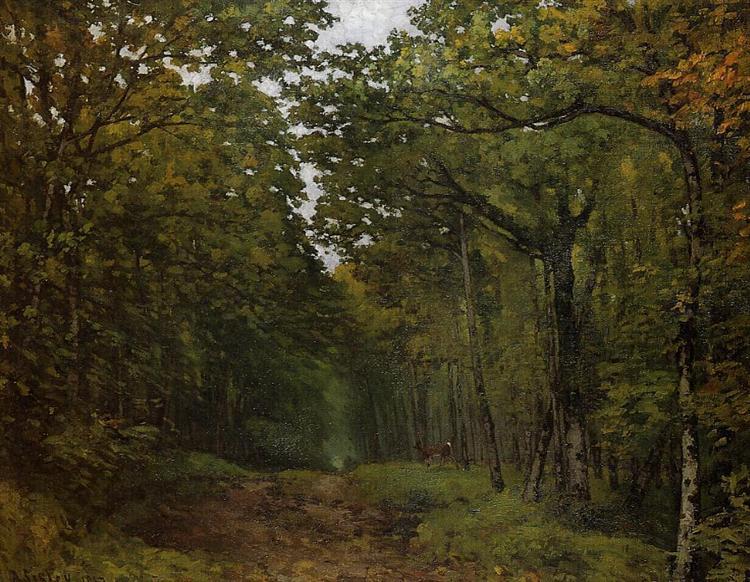
Avenue of Chestnut Trees near La Celle-Saint-Cloud by Alfred Sisley (1867)

At the 1868 Salon, Sisley had just one of his paintings exhibited. It was his Avenue of Chestnut Trees near La Celle-Saint-Cloud which he had completed the previous year. It was a large painting (96 x 122cms) and depicts a verdant view through a densely wooded part of the forest, six kilometres west of the village of La-Celle-Saint-Cloud, located in the western suburbs of Paris, 15 kms from the centre. This was the third time Sisley had depicted the forest in his painting. There had been two earlier works of differing sizes, both entitled Avenue of Chestnut Trees at La-Celle-Saint-Cloud, which he completed in 1865. The forest was very popular with Parisians who wanted to briefly escape city life. Look how Sisley has used a shifting range of greens and browns to bring the picture to life. Note the clever way he has used dappled brushwork on the trunks of the trees. Look how we are led through the avenue of trees which propels us back, penetrating the depth of the canvas. If you look closely at Sisley’s work you will notice a solitary deer on the right mid-ground almost lost from view camouflaged by the dark tree trunks. So why the solitary deer? It could well have something to do with having the painting accepted into the Salon by the jurists. Landscape paintings had an inferior position in the hierarchy of pictorial-subject matter by the art establishment, so maybe Sisley realised that a connection with the monarchy would stand him in good stead of having the Salon jury accept the work as his depiction was of the royal hunting grounds of Napoleon III.

The Avenue at Middelharnis by Meindert Hobbema, (1689)

This view down a majestic avenue of trees harks back to paintings Sisley may have seen whilst in London, such as one of his favourite artist’s works, The Avenue at Middelharnis, by Hobbema which hangs in the National Gallery.

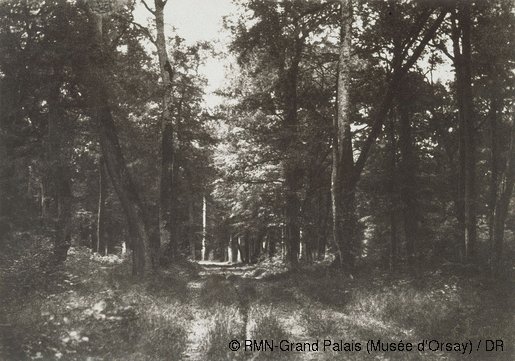
Forest of Fontainebleau, undergrowth at Bas-Bréau by Gustave LeGray (1852) Albumen print from a waxed paper negative

Another work which may have influenced him and which he had probably seen at Musée d’Orsay, was Gustave LeGray’s 1855 photograph Forêt de Fontainebleau, sous-bois au Bas-Bréau [Forest of Fontainebleau, undergrowth at Bas-Bréau]. LeGray had received a commission from the committee for historic monuments to photograph the most noteworthy monuments in France and in 1852 and again in 1857 he produced two large collections of photographs of the Forest of Fontainebleau. It is reported that during his walks around Bas-Bréau, in the heart of the forest, LeGray would place his camera right in the middle of the path, at the exact place where he had been struck by the light shimmering through the foliage and he used the line of the path, in this rich composition, to draw the eye towards the clearing where the tree trunks are bathed in light. In this way he produced the image of a site that was very popular with painters. The depiction is all about the forest. There are no human or animal presence to disturb the natural spectacle.

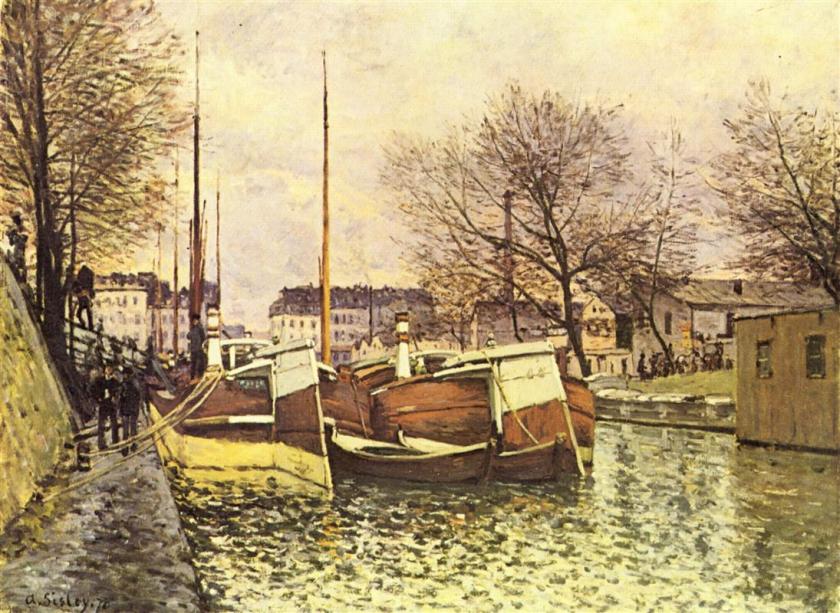
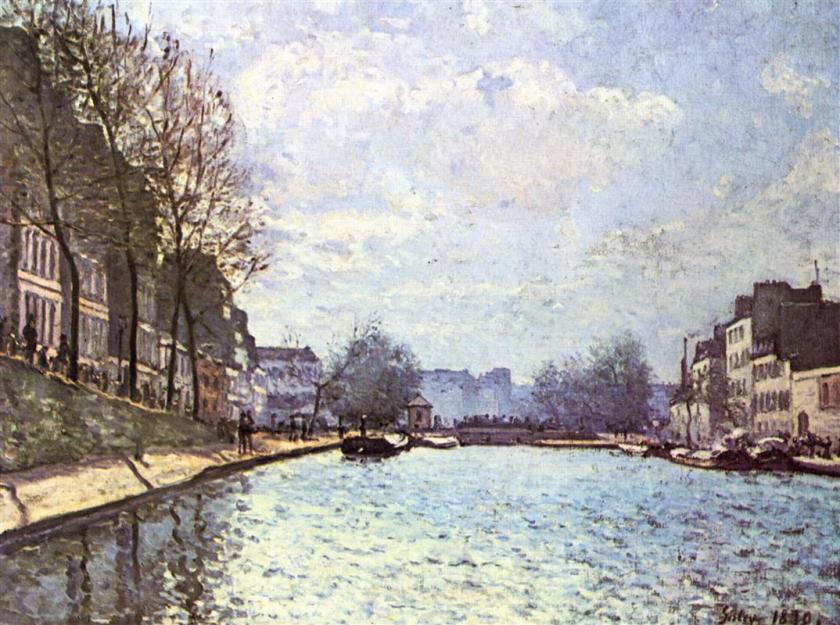
Barges on the Canal Saint Martin in Paris by Alfred Sisley (1870)

Of all the Impressionist, Sisley was the one who loved the countryside the most and liked to paint rural scenes. He was not an urban painter and only completed a smaller number of works which focused on Paris and the Parisian scene favoured by the likes of Renoir and Monet. Indeed, of the very few paintings directly inspired by the French capital, some were depictions of the Canal Saint-Martin in the north-east of the city. It is a 4.6 km long canal in Paris, with nine locks, connecting the Canal de l’Ourcq to the River Seine. Originally built to supply the city with fresh water to support a growing population and help avoid diseases such as dysentery and cholera while also supplying fountains and allowing the streets to be cleaned. Construction of the canal started in 1802 and was completed in 1825. The canal was also used to supply Paris with grain, building materials and other goods, carried on canal boats. It formed part of a continuous network of waterways extending across the city connecting the upper and lower parts of the Seine. One of Sisley’s painting featuring the waterway was his 1870 painting Barges on the Canal Saint-Martin.

A similar work was his 1870 painting Vue du Canal Sint-Martin, which is housed at the Musée d’Orsay. Whereas other artists like Monet and Renoir

The Canal St Martin by Alfred Sisley (1870)

focused on the beauty of the French capital with its spacious sunlit boulevards created by Napoleon III and Baron Haussmann and the newly built apartment blocks. For artists like Renoir and Monet urban life was all about wealth and leisure. For Sisley it was about toil and poverty. He wanted to concentrate on the reality of Paris and life in the capital and not just the picturesque but idealised version of the metropolis and so he focused on the working quays of the Canal Saint-Martin. In the painting we see a wide stretch of the Canal St Martin near the Bassin de la Villette. On either side of the canal, houses and warehouses overlook the waterway and in the central midground is one of the locks. Further back and in the direction of central Paris buildings appear through the haze. Looking at his depiction we know there is a strong breeze which stirs up the water and the time of day deduced by looking at the length of the shadows made by the trees in the water, it must have been around midday. What is also important about Sisley’s painting is the way he has depicted the cloud formations and the nature of the light and its reflections on the water. He captures the moment with his use of a silvery palette of blues and greys, constantly thickening the paint for the highlights on the water. It would be one of the trademarks of his work as an Impressionist.

Alfred Sisley’s finances at this time were said to be at best, perilous and he often had to turn to friends and family for loans. Things were to get worse with the outbreak of the Franco-Prussian war in 1870. From September 1870 to January 1871, the French capital was besieged by Prussian forces and one of the dire consequences for Sisley was that his father’s business collapsed and William Sisley was financially ruined. His father lost everything and died shortly thereafter. Alfred’s money stream from his father was over. Sisley’s sole means of support became the sale of his works. 

..……….to be continued

Jozef Israels. Part 1 – The Plight of the Fisherman

Portrait of Jozef Israels by Jan Veth (1887)

My previous three blogs looked at Russian landscape painters and although they were leading exponents of this 19th century genre they may have been unknown to many people nowadays.  The artist I am looking at today is probably also not known by most people but he had a great influence of the early works of the Dutch master, Vincent van Gogh.   Just before Christmas I went to Amsterdam to visit the newly refurbished Van Gogh Museum and I suggest that it is “must visit” museum for any travellers to the Dutch city.

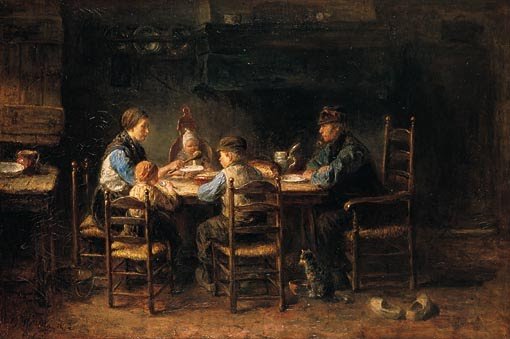
Peasant Family at Table,  by Jozef Israels (1882)
Peasant Family at Table, by Jozef Israels (1882)

The museum was awash with colour from Van Gogh’s landscape paintings but I was fascinated by his darker early works and his fascination with the hard-working peasants and I wanted to know more about what influenced him to spend so much of his early life concentrating on depictions of the peasant class.  It was then I came across Jozef Israels and his 1882 painting entitled Peasant Family at the Table, a work of art which led to a similar depiction, by van Gogh, of peasants sitting around a table having a meal which is entitled The Potato Eaters and I featured this work of art in My Daly Art Display (Feb 7th 2012).  However this blog is not about Van Gogh but the Dutch artist, Jozef Israels who influenced him.  In this first blog about Jozef Israels I want to look at his paintings depicting the harsh life of fishermen and their families.

Josef Israels was a Dutch Jewish painter born in Groningen in January 1824.  His father was to Hartog Abraham Israel, a professional broker and merchant who had married Mathilda Solomon Polack.  Jozef was the third-born of ten children and he had six brothers and three sisters.  As is the case of many young aspiring artists, Jozef’s father did not see his son’s future as an artist but wanted him to carry on the family business and it was only after a long struggle and great determination that Jozef persuaded his father to let him study art.  It was a compromise, as during his artistic studies he worked as a stockbroker’s clerk in his father’s business.   At the age of eleven he received his first drawing lessons from the landscape artist J. Bruggink who worked at Minerva Academy in Groningen and a year later became a pupil of Johan Joeke Gabriel van Wicheren.   In 1838, aged fourteen he was tutored by the Groningen painter, Cornelis Bernudes Buys.

In 1842, shortly after his eighteenth birthday Jozef went to Amsterdam to study drawing under the tutelage of Jan Adam Kruseman and, in 1844, attended art classes at the Amsterdam Royal Academy of Art.  Kruseman had made his name as a painter of historical, biblical and genre scenes but was probably more famous for his portraiture.  In 1845 Jozef Israels left his native Netherlands and travelled to Paris where he worked in the studio of the neo-classical history painter, François-Édouard Picot.  Picot was one of the artists who was favoured by the French rulers of the time.  He was an esteemed artist who taught many of the aspiring artists of the time such as Alexandre Cabanel and William-Adolphe Bouguereau. His romantic historical paintings influenced Israels.  The Romanticism genre of Louis Gallait and Ari Scheffer also left their mark on the twenty-two year old. During his stay in Paris he attended classes at the Ecole des Beaux-Arts presided over by such artistic luminaries as James Pradier, Horace Vernet and Paul Delaroche and he would spend time at the Louvre where he copied the works of the great Masters.

The Academies at the time pushed the genre of paysage historique, historical landscape painting depicting idealised landscape works of art with their historical connotations.   This art genre went back to the 17th century Baroque era of Nicolas Poussin and Claude Lorrain and aspiring landscape painters from the Academies made their way to Italy to paint their landscapes interspersed with historical monuments, the settings of which were favoured by the dazzling Mediterranean sunlight. This favourable Italian climate had given the artists the chance to paint en plein air.

However, Jozef Israels, whilst he was living in the French capital, delved into the alternate world of landscape painting, the world of Realism, and the works of the Barbizon painters some of whom he had the chance to meet.  For them it was the landscape which was the beauty in itself and did not require the addition of mythological or biblical figures.  If figures were to be added it should be those of hard working peasants whose inclusion added reality to the work and dispensed with romanticism.  However Jozef Israels was not sold on their ideas for landscape painting and soon reverted to his painting which were more likely influenced by the painter Ari Scheffer (see My Daily Art Display May 15 2012 and Sept 30th 2014) depicting subjects from Romantic poetry or influenced by the work of the Belgian history painter, Louis Gallait and depicted figures from Dutch national history.

In 1847 Israels returned to Holland and his work concentrated on his portraiture and historical subjects, often with Jewish themes.    The problem for Israels was that by the 1850’s,  the genre of history paintings in the Netherlands was falling from favour and he realised that to sell his art he needed to think of a different painting genre.   Fate took a hand as Jozef was taken ill and in 1855, as a cure for his health problems, he moved out of the city and went to live in the small fishing village of Zandvoort, where he believed the sea air would aid his recovery.   He immersed himself in the local village life and became aware of the hard life endured by the village’s fishing community and he decided to record some of their sufferings in his works of art.   His paintings depicted the hard life of the fishermen and their families and the unforgiving nature of the sea.

Along mother's grave by Jozef Israels (1856)
Passing mother’s grave by Jozef Israels (1856)

In 1856 he painted one of his most famous works featuring Zandvoort fishing folk.  It was a life-size work measuring 224cms x 178cms  entitled Passing Mother’s Grave.  The painting depicts a fisherman passing his wife’s grave.   He walks hand in hand with his son whilst carrying his baby daughter.  The bare-footed trio alluded to the poverty of the fishing folk and for this trio life without the woman had added to their problems.The work is housed in the Stedelijk Museum Amsterdam.

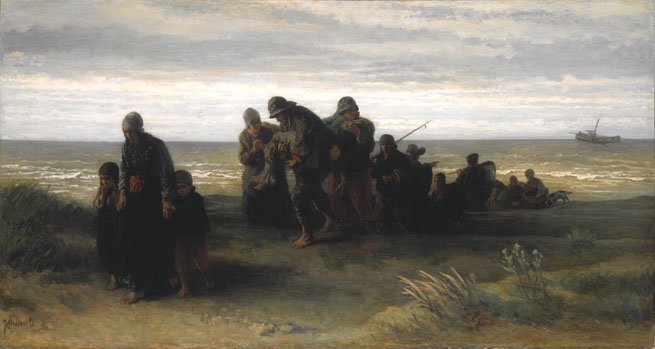
Fishermen carrying drowned man by Jozef Israels (c.1861)

Another work of art featuring the plight of fishermen and their families was Jozef Israels’ painting entitled Fishermen Carry a Drowned Man which is housed in the National Gallery in London.  It is thought that this work was completed around 1861, sometime after Jozef returned to Amsterdam from Zandvoort but used sketches he had made whilst living in the fishing village.  The work is all about suffering and the hard life experienced by fishermen and their families and it was this eking of sympathy from the observer which was so like that of Jean-François Millet and his peasant paintings. Let’s look at this sombre work with its dark grey skies.  A line of fishermen and their family trudge up the dunes from the shore.  A grief-stricken woman leads the way with her two children at her side.  They too are aware of the loss.  Maybe the woman is the widow of the dead fisherman.  She is leading the line of mourners.  Behind her the body of the dead fisherman is carried by two burly men whilst to the left of them is a weeping woman.  The dead man’s companions follow on carrying the fishing equipment from their boat. The work of art was exhibited at the 1861 Salon and in 1862 at the London International Exhibition and was hailed a triumphant success.

Anxiously Waiting by Jozef Israels

The third painting by Jozef Israels with this fishing/sea-going motif is entitled Anxiously Waiting.  Once again observers of this work can empathize with the woman we see sitting on the dunes looking out to sea. On her knee sits her baby child.  She is bare-footed which tells us of her and her family’s financial state.   The sky has an orange hue indicating an oncoming storm.  We see the white crests of the waves which signify the wind is beginning to increase in its ferocity.  Her husband has left home in the fishing boat and has yet to return and she anxiously awaits sight of his boat.

Unloading the Catch by Jozef Israels

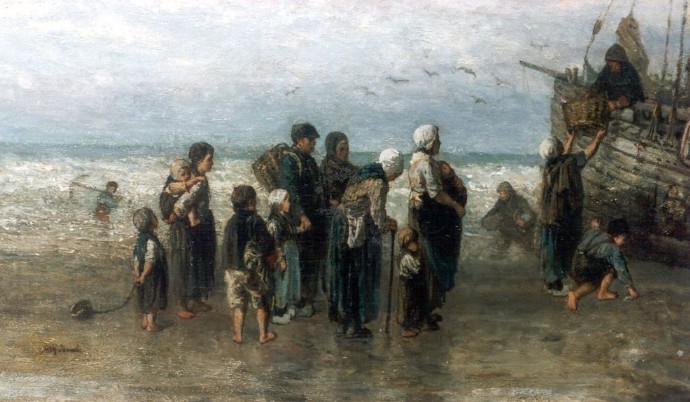
In his painting Unloading the Catch we see that fishing was not just about the men that went to sea but the wives, parents and children who needed to help, notwithstanding their age or their state of health.  Look at the line of helpers.  An elderly woman bent over supporting herself with her cane, a man with a basket over his shoulder holding the hand of his daughter, two mothers carrying their babies , all have to help with the unloading of the day’s catch from the beached fishing boat.

Three Women Knitting by the Sea by Jozef Israels

In a number of his paintings he liked to connect the wives of the fishermen and the sea, the workplace of their husbands and fathers.   In most it was the about the wife, worried about the safety of her husband, and the prospect of him not returning home safely.   A painting by Jozef Israels with a lighter mood was his work entitled Three Women Knitting by the Sea.  In the background we see a fishingboat at sea ,whilst in the foreground, we have the three ladies happily chatting away as they knit.

On the Dunes by Jozef Israels

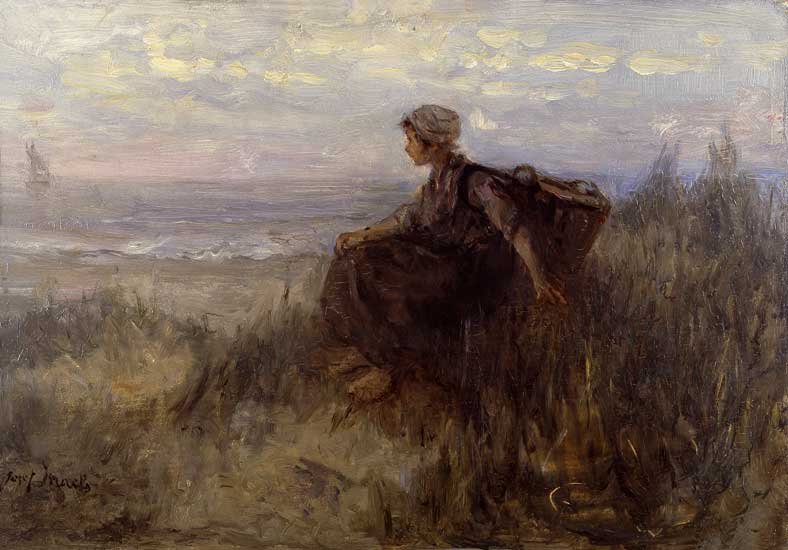
In his work On the Dunes we see a familiar depiction of a woman sitting on the dunes looking out to sea.  On her back is her empty basket which, once the boat has landed with its catch, will be filled with fish which she will have to carry back to the village.  Her wait will not be long as on the horizon we catch sight of the returning fishing boat.  The sky is light and the sea is calm and for this day her beloved will return home safely.

Mending the Nets by Jozef Israels

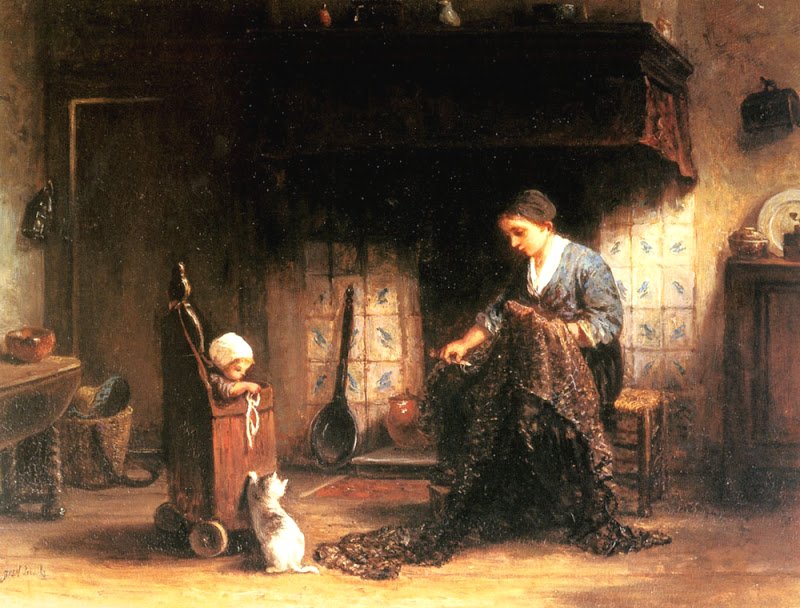
An insight into the domestic life of a fisherman’s wife can be seen in his painting Mending the Nets.  The scene is the interior of a cottage.  A mother sits before a tiled fireplace mending her husband’s fishing nets whilst her young child sits in a wooden forerunner to today’s baby buggy.  The baby looks over the side at the cat which she  tantalises with a strand of wool.

In my next blog I will look at some more of the paintings by Jozef Israels, in which he depicted peasant life and I will conclude his life story.