During a period of very low temperatures and snowy conditions, it might seem appropriate to focus on art depicting sunshine, blue skies, and warm azure-coloured seas. However, today’s blog will start with featuring beautiful depictions of snow and ice and explore how people who experienced these conditions seemed to find enjoyment in them. Many such depictions are conjured up by nineteenth century Dutch artists and today’s blog is all about Fredrik Marinus Kruseman the Dutch painter who specialized in Romantic-style landscapes, and winter scenes, which made up about two thirds of his oeuvre.
Fredrik Kruseman was born in the Netherlands city of Haarlem on July 12th, 1816. He was the fourth son of Jacoba Mooij and her husband Benjamin Philip Kruseman, a Lutheran hat-maker. Fredrik had two older brothers, Hendrik and Jakob and a younger brother Benjamin. He also had two cousins who became famous painters. Cornelis Kruseman a painter of historical and biblical subjects who later became Director of the Royal Academy of Fine Arts of Amsterdam and Jan Adam Kruseman, a historical painter and portraitist.
A Winter’s Scene with Skaters on a Frozen Waterway by Fredrik Kruser (1858)
Fredrik was tutored by many of the great Dutch landscape artists of the nineteenth century school. In 1833, aged seventeen, he was apprenticed to Jan Reekers who taught him the skills required to draw from nature and the intricacies of perspective. Between 1832 and 1833 he also attended classes at the Vocational City Drawing School in Haarlem and studied painting with Nicholas Roosenboom, who had a studio near where Fredrik lived. It was in September 1833 that Fredrik Kruseman first exhibited his landscape work. It was at the Exhibition for Living Masters in The Hague. In 1835, Fredrik moved to the Gooi, an area around Hilversum, in the centre of the Netherlands. Here he took advanced studies with Jan van Ravenswaay. He also studied briefly with the landscape painter, Barend Cornelis Koekkoek.
During his twenties and thirties, Kruseman travelled widely throughout Northern Europe before finally setting up home in Brussels in 1841. He returned to the Netherlands and lived, between 1852 and 1856, on the outskirts of Haarlem. After that four-year sojourn he returned to the Belgian capital where he remained for the rest of his life.
Winter Landscape with Skaters and Wood Gatherers at a Ruinby Fredrik Kruseman
Kruseman’s 1845 painting entitled Winter Landscape with Skaters and Wood Gatherers at a Ruin depicts a frozen canal with skaters, walkers on a path along the shore, a picturesque castle and strange bare trees. Men scavenge for wood for their home fires. Life is hard at this time of year.
A Winter Landscape with Skaters on a Frozen Riverby Fredrik Kruseman (1862)
Kruseman’s painting entitled A Winter Landscape with Skaters on a Frozen River is a beautiful depiction and is a Romantic observance and veneration of nature. The sky dominates the paintingfxf. Before us we have a frozen waterway on which are a number of skaters bordered by snow-covered banks. On the right bank there is a refreshment table. We can also pick out a fallen skater in the left of the foreground and a young couple with their dog crossing the centre of the frozen river close to a wide crack in the ice. In the left middle-ground we can just make out a sailing boat frozen to the riverbank. The colours Kruseman has used are cool blue-grey tonality over the black mirror-like surface of the ice.
Wintry River Landscape with Windmill by Fredrik Kruseman (1844)
Although Kruseman is best known for his Romantic wintry landscape paintings he completed many other landscape works.
Monk Meditating near a Ruin by Moonlight by Fredrik Kruseman (1862)
One notable romantic piece is his 1862 painting titled Monk Meditating near a Ruin by Moonlight. The ruin of the title is the abbey in Villers-la-Ville near Brussels, which used to be one of the most significant Cistercian abbeys in Europe and close to where the painter lived for a while. In the right foreground of this nocturnal scene, we see a monk meditating near the overgrown ruin. The abbey was founded in 1146 and was a former Cistercian Abbey located in the very heart of Walloon Brabant.
Village Street on a Sunny Day by Fredrik Kruseman (ca. 1835)
Landscape with two Farmers by Fredrik Kruseman
In the foreground of this atmospheric work, we see two peasants talking to each other. One holds on to his ox, while the other is accompanied by his dog. The background consists of a wide landscape with a few hills. Once again the sky plays a dominant part of the painting.
Tranquil Landscape with Women Washing by a Stream with Cattle and Sheep by Fredrik Kruseman
A River Landscape with Cows and Sheep by Fredrik Kruseman
In his winter scenes of frozen rivers, Fredrik Kruseman cleverly produced jet-black mirror surface of the ice and the marks left by skaters. Some of his most famous depictions were set in the fading light of early evening and combined the wintry scene with a background glow of a setting sun or a bright light emanating from the interior of a cottage or house.
Fredrik Marinus Kruseman worked well into the late 1870s and died in St Gilles, a suburb of Brussels, on May 25th 1882.
Max Liebermann was Jewish, not a strict Orthodox Jew, but more of a secular Jew who regarded himself through assimilationist eyes. Maybe because of this he avoided painting religious subjects with the exception of a painting he completed in 1879 entitled The 12-Year-Old Jesus in the Temple With the Scholars.
Der zwölfjährige Jesus im Tempel (The Twelve-year-old Jesus in the Temple) by Max Liebermann (1879)
The painting depicts twelve-year-old Jesus in the temple, having been at the Festival of Passover in Jerusalem with his parents, but unbeknown to them, he had stayed behind in the city when they had set off to return home. The story continues as per the biblical tale (Luke 2:43-48):
“…After the festival was over, while his parents were returning home, the boy Jesus stayed behind in Jerusalem, but they were unaware of it. Thinking he was in their company, they travelled on for a day. Then they began looking for him among their relatives and friends. When they did not find him, they went back to Jerusalem to look for him. After three days they found him in the temple courts, sitting among the teachers, listening to them and asking them questions. Everyone who heard him was amazed at his understanding and his answers. When his parents saw him, they were astonished. His mother said to him, “Son, why have you treated us like this? Your father and I have been anxiously searching for you…”
The setting for this painting is derived from Max’s visit to the Jewish quarter of Amsterdam in 1876 when he made architectural sketches of the Portuguese Synagogue of Amsterdam. The curved staircase, which he later depicted as a spiral staircase in the painting, is a reference to the 16th-century Levantine Synagogue in Venice. The paned window on the upper edge of the painting also echoes the windows of the Portuguese Synagogue of Amsterdam.
Liebermann originally depicted Jesus, not as a holy figure, but as a dark-haired boy with Semitic features and mannerisms, arguing the doctrine with his elders. The painting was first exhibited at the First International Art Show in Munich in 1879, at a time when antisemitic activism and propaganda was just starting to break out in Germany. The artwork caused a major outcry with critics terming the depiction blasphemous. The art critic for the Augsburger Allgemeine Zeitung, Friedrich Pecht, asserted that Liebermann had painted “the ugliest, know-it-all Jewish boy imaginable,” and went on to state that the artist had shown the Jewish elders as “a rabble of the filthiest haggling Jews.” More criticism rained down from upon high with the Crown Prince of Bavaria declaring that he was scandalised, and the Bavarian State Parliament even spent time debating the painting and Pecht’s comments. One Catholic MPs criticised the fact that it had been admitted into a State establishment knowing that the country had inhabitants who were overwhelmingly devout Christians. One deputy pronounced that Liebermann, being a Jew, should have known better than to paint such a scene and that the painting was reviled as “a stench in the nostrils of decent people” It seemed that Lieberman’s mistake was simply that as Liebermann was a Jew, he had depicted an overtly Jewish Jesus.
Preliminary Sketch
And yet in the painting we cannot understand the violent criticism of the detractors regarding Liebermann’s Jesus who is depicted as a long-haired, slightly effeminate, blond boy. However, this was not the original depiction as this is because Liebermann, in response to unrelenting criticism, repainted the figure before it was included in a Paris exhibition in 1884. Art historians know this as a sketch of the untouched 1879 version has been preserved, in which it can be seen that Liebermann had originally depicted a barefoot boy with short, unkempt dark hair and a stereotypical Jewish profile. Liebermann changed the young Jesus’s appearance with the figure once described as an “urchin” now appears as a serious, intelligent, perhaps slightly deferential child. However, the changes, did not change the mood of the German critics and the work was not exhibited again in Germany until the Berlin Secession exhibition of 1907.
Sewing School by Max Liebermann (1876)
In 1875 Liebermann left Paris and spent three months in Zandvoort in Holland. It was in this Dutch town that Max acquired a brighter and more less planned style by copying paintings by one of his favourite artists, Frans Hals. Max developed a practice of setting aside time between the idea for a motif coming to him and the implementation of the larger finished painting. When he returned to Paris in the autumn of 1875 he moved into a more spacious studio and began to convert his Dutch sketches into full sized works. He returned to the Netherlands in the summer of 1876 where he remained for several months. During this stay he met the etcher William Unger, who brought him into contact with Jozef Israëls and the Hague School. One example of this change of painting style was Liebermann’s work entitled Sewing School which he completed in 1876. The sewing school depicted in this painting was in an orphanage in Amsterdam. Liebermann had started his career as a realist painter, but by the time of this work, he was already establishing himself as an Impressionist-style painter.
Schusterwerkstatt (Cobbler’s Workshop) by Max Liebermann (1881)
During his visit to the Netherlands in the summer of 1880, Liebermann travelled to the small village of Dongen in North Brabant, in the southern Netherlands. It was here that he made a number of studies that would be used when completing the work in his studio. One example of this was his depiction of a cobbler in his workshop. At the workshop, he created studies that he later used for his 1881 painting Schusterwerkstatt, (Cobbler’s Workshop).
Altmännerhaus (Old Men’s Home) in Amsterdam by Max Liebermann (1881)
Having completed the Cobbler’s Workshop painting he travelled to Amsterdam on his way to returning to Munich. It was whilst in Amsterdam that he came across the Catholic Altmännerhaus (Old Men’s Home). He happened to glance into the garden of the establishment and saw a large group of older gentlemen dressed in black sitting on benches in the dappled sunlight. According to Erich Hancke’s 1914 book, Max Liebermann. Sein Leben und seine Werke:
“…He [Liebermann] had visited a friend at the Rembrandt Hotel, and when he looked out of the corridor window descending the stairs, his gaze fell down into a garden where many old men dressed in black were standing and sitting in a corridor bathed in sunlight […]. He later used a drastic analogy to characterize that moment: ‘It was as if someone were walking on a level path and suddenly stepped on a spiral spring that shot him up…”
Study for Old Men’s Home in Amsterdamby Max Liebermann (1881)
Liebermann immediately began to paint the scene and concentrated on the effect of light which was being filtered through a canopy of leaves and this dappled effect became known as “Liebermann’s sunspots” and would be seen in Liebermann’s later Impressionist depictions. He made two on-site portrait-format studies of the scene, one in oil and one in pastel, after which Liebermann painted the final picture in his Munich studio later that year. The painting was exhibited at the Paris Salon and received an honourable mention. Furthermore, Léon Maître, a well-known collector of Impressionism, acquired several of Liebermann’s paintings.
Recreation Time in the Amsterdam Orphanage by Max Liebermann (1884)
Life in Paris was taking its toll on Liebermann. He needed to sell his artwork to prove to himself and his parents that he had not wasted his life. This continual pressure caused Lieberman to fall into periods of deep depression and his painting output declined, furthermore, the works he put into the Paris Salon were not getting the recognition he believed he had deserved. There was also still the anti-Prussian sentiment amongst the French and this did not help him sell his work. In all, he realised that the Netherlands or Germany were much more acceptable places to work and live. He left Paris and spent a couple of months in Venice before returning to Munich in 1878. It was here that he was able to enhance his status as an important progressive artist. Munich had everything Liebermann required – the artistic culture and patrons who supported him. He spent hours visiting the city’s museums and art galleries and creating everlasting and important friendships. He eventually left Munich and relocated to Berlin, his birthplace, in 1884, where he remained for the rest of his life.
Martha Marckwald by Anders Zorn (1896)
In that same year, 1884, that Max moved to Berlin he married Martha Marckwald, the fourth child of the German Jewish couple Ottilie and Heinrich Benjamin Marckwald, who ran a wool store in Berlin. When Martha’s father died in 1870, Max’s father Louis became the thirteen-year-old Martha’s guardian. The Marckwald and Liebermann families became even closer when Max’s elder brother Georg Liebermann married Martha’s elder sister Elsbeth. On September 14th 1884, thirty-seven-year-old Max Liebermann married twenty-six-year-old Martha. It was a marriage that would last more than fifty years until Max died in 1935. In August 1885 Max and Martha’s only child, Käthe, was born and in 1892.
Max’s mother died on August 12th 1892, aged 70 and his father died two years later on April 29th 1894, aged 75. Although the death of his parents was a sad time for Max, he was finally released from their unrelenting words of warning as to the perilous status of an artist. Max moved into his family’s Berlin home in Pariser Platz where he lived out the remainder of his life.
Liebermann Villa at Wannsee
In 1909, overwhelmed by the noisy life in the German city, the Liebermann family bought a plot of land in the Alsen summer villa colony on the northern shore of the Kleiner and western shore of the Großer Wannsee at Wannsee, some twenty kms south-west of Berlin, close to Potsdam. It was here that they built themselves a summer home, somewhere to retire to during the hot summer months when city life became very oppressive. The Villa was designed by the architect Paul Otto Baumgarten, the garden by Liebermann in collaboration with the then-director of the Hamburger Kunsthalle, Alfred Lichtwark.
Martha Liebermann in the garden at Wannsee
Their summer home was situated amidst the magnificent villas of this impressive Berlin colony, embedded in a park, and represented a unique cultural landscape of the time of the German Empire and the Weimar Republic.
The Villa at Wannsee by Max Liebermann (1930)
Flowering Shrubs by the Gardner’s Cottage by Max Liebermann (1928)
The Flower Terrace at Wannsee by Max Liebermann (1915)
During the following years, Liebermann had designed a beautiful garden at the Villa Wannsee. He was so proud of the finishing results that the garden became the subject of many of Liebermann’s painting.
The Artist in His Studio by Max Liebermann (1932)
During the latter decade of the nineteenth century Liebermann continued living and painting in Berlin and would spend his summers at Wannsee or the Netherlands. Liebermann, like many of his contemporary Berlin artists, were dissatisfied with how they were being treated by the Association of Berlin Artists and the restrictions on contemporary art imposed by Kaiser Wilhelm II, so sixty-five of them seceded as a demonstration against the standards set by the Association and the government endorsed art. This break-away became known as the Berlin Secession and its aim was to form a “free association for the organization of artistic exhibitions”. In 1898, Liebermann became the President of the Berlin Secession, which was simply a group of artists that was formed as an alternative to the conservative arts establishment.
Two Riders on the Beach by Max Liebermann (1901)
The Berlin Secession championed new forms of modern art and were not be tied down to and be dominated by the old-fashioned academic art favoured by the Berlin Academy. These break-away groups from the art establishments were not new occurrences as the same happened with the Munich Secession in 1892 and the Vienna Secession in 1897. The initial breakaway took place in Paris in 1890 when the Société Nationale des Beaux-Arts along with its exhibition arm, the Salon au Champs-de-Mars, was formed as a modern alternative to the official Société des Artistes Français and its exhibition arm, the Salon de Champs-Élysées. These break-away groups all wanted the same thing – the rejection of the official arts governing bodies due to their aversion of avant-garde art such as Impressionism, forms of Post-Impressionist painting and Naturalism, as well as their obstructive exhibition policies, which were inclined to support time-honoured painters and sculptors over their younger, more modernist contemporaries.
Marthe Liebermann with her grand-daughter Maria by Max Liebermann (1922)
In 1920, Liebermann became president of the Prussian Academy of Arts in Berlin, which was the highpoint of his career and signified how the Academy had changed over since the time of the Berlin Secession.
Portrait of President Paul von Hindenburg by Max Liebermann (1927)
Being a Jew, Liebermann had got used to the anti-Semitism in his homeland but by the early 30s with the rise and coming to power of the National Socialists it had noticeably worsened. In a way, it was a good thing that Liebermann died quietly in his sleep at the family home on February 8th 1935 aged 87 as he avoided bearing witness to the atrocities which followed. In 1938, his daughter Käthe her husband Kurt Riezler and their twenty-one-year-old daughter Maria were forced to flee the country and go to America.
The Graves of Max and Martha Liebermann at the Senerfelderplatz Jewish Cemetery, Berlin
They tried to persuade Max’s widow, Martha, to also emigrate but she refused to leave the land where her husband was buried. Martha Liebermann remained in Berlin, ultimately committing suicide in 1943 to escape her impending deportation to a concentration camp.
Most of the information for this blog came from the excellent website Liebermann Villa am Wannsee which goes into detail about his life and works.
I also consulted the informative website on all things art: The Art Story
Information regarding the painting, A Twelve-Year-Old Jewish Boy, came from the website: Art and Faith Matter/s
My artist today is the German painter Max Liebermann. Liebermann was a key figure in the nineteenth century German art scene, who was well-known for his part in bringing Impressionism to the German art world and was one of the founder members of the Berlin Secession.
Photograph ofMax Liebermann by Jacob Hilsdorf (1904)
Max Liebermann was born in Berlin on July 20th 1847. He was the second born child of Louis Liebermann and Philippine Liebermann (née Haller). He had an elder sister, Anna and two younger brothers, Georg and Felix. His father was a wealthy Jewish fabric manufacturer who later became a banker. Max’s paternal grandfather Josef Liebermann was a textile entrepreneur and in 1860, the Liebermann family bought the Dannenberg’sche Kattun-Fabrik, which was one of the foremost companies for the production of cotton in Europe. Max was brought up in a very wealthy family environment.
Dorotheenstädtische Realschule, Berlin.
In 1851, aged 4, Max attended the local humanistic nursery school. He was not impressed with the school and throughout his school days, he had an aversion for his teaching establishments. On completion of his time at primary school he attended the Berlin Dorotheenstädtische Realschule. Max was not a great scholar and spent most of his time drawing rather than studying.
Palais Liebermann at Pariser Platz 7, to the right of the Brandenburg Gate (1892)
In 1857, when Max was ten years old, his father Louis bought the impressive Palais Liebermann, located in Berlin-Mitte at Pariser Platz 7, north of the Brandenburg Gate. Although Max’s family were Jewish his parents decided to bring Max up in the Jewish denomination known as Reform Judaism which was a highly liberal strand of Judaism and is characterized by little stress on ritual and personal observance, rather than the stricter orthodox way of life of their grandfather. The family attended church services in the reform community but increasingly turned away from the more orthodox way of life of their ancestors.
The Shoemaker by Max Liebermann (1881)
In 1859 Max’s father commissioned a portrait of his wife by the artist Antonie Volkmar. During one of the sittings Philippine Liebermann had her son Max accompany her to the artist’s studio. The story goes that Max asked the artist for a pen and paper so he could pass the time sketching. Antonie Volkmar was so impressed with Max’s sketching that she told his mother that Max would become a fine artist. Max’s parents, although aware of that prediction, wanted their son to carry on with his normal schooling and a compromise was reached that if he carried on attending school and did well, they would enrol him in private painting lessons from Eduard Holbein and Carl Steffeck. Upon finishing primary school, his father, Louis Liebermann, chose for Max and his brothers. the Friedrichwerdersche Gymnasium, a prestigious humanistic grammar school, where the sons of Bismarck had studied.
Workers on the Beet Field by Max Liebermann (1876)
Max graduated from the Gymnasium in 1866 and carried out his parent’s wishes by enrolling at the Friedrich Wilhelm University in Berlin where he studied chemistry, like his brother before him. However he was still more interested in his painting and would often miss lectures to go off on painting trips or helping out at Carl Steffeck’s studio. Later he attended the University of Berlin and studied law and philosophy but once again his mind was solely on art and in January 1868, following little progress with his studies, he was asked to leave. One can only imagine how his parents took this turn of events. They were furious as to how their son had wasted this golden opportunity. Whether it was the case that they had to make the best of a dire situation and realised that their son was only interested in his art, they arranged for Max to enrol at the Grand Ducal Saxon Art School in Weimar where he studied under the Belgian history painter, Ferdinand Pauwels. Pauwels took his students on a visit to the Fridercianum (Kassel’s Gemaeldegalerie), which has one of the world’s best collections of early German and Flemish paintings, amongst which are nineteen works by Rembrandts. These works were to influence Liebermann for the rest of his life.
Amsterdam Orphanage by Max Liebermann (1876)
The Franco-Prussian War broke out in 1870 and twenty-three-year-old Max was captivated by the general population’s patriotic fury and passion. However, Max was unable to join up for military service on medical grounds and so volunteered as a medic for the Johannitern, the Order of St. John and he witnessed the war at the Siege of Metz. The battlefield carnage during the siege distressed Max and his patriotic war fervour waned rapidly.
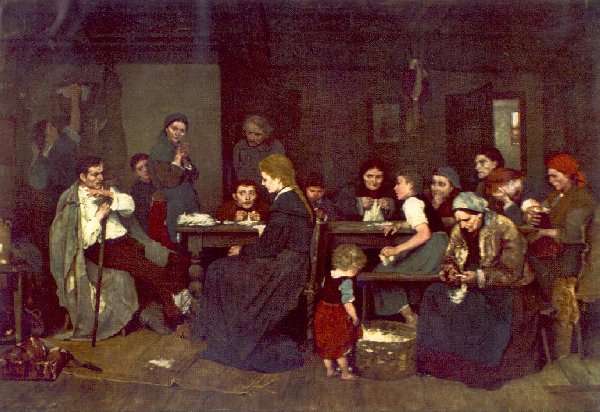
Tépéscsinálók (Tear Makers) by Mihály von Munkácsy (1871)
In the Spring of 1871, Liebermann lived in Düsseldorf, where the influence of French art was greater than in Berlin. Whilst in the city he met Mihály von Munkácsy, a Hungarian painter, who had earned international reputation with his genre pictures and large-scale biblical paintings. His paintings often featured scenes from the daily lives of peasants and poor people. Max saw Mihály von Munkácsy’s recently completed work entitled Tépéscsinálók and this stimulated his interest in genre painting. The subject of Munkácsy’s painting comes from memories of the 1848 Hungarian Revolution also known as the War of Independence and it depicts a wounded soldier, leaning on his crutches in a dark interior, recounting the story of life on the front line and the difficult battles he had experienced. Whilst the men were at war the girls, women, old people, and children remained at home in their villages looking after returning wounded soldiers, their kinfolk, who had suffered mentally and physically on the battle front. In this depiction the villagers listen attentively to the soldier’s emotional story and many cry (hence the painting’s title “Tearing Up”). Mihály von Munkácsy depicted the scene with particularly sympathetic memories, since the War of Independence and the tragic events that followed caused his sad childhood and saw him orphanhood at the age of six.
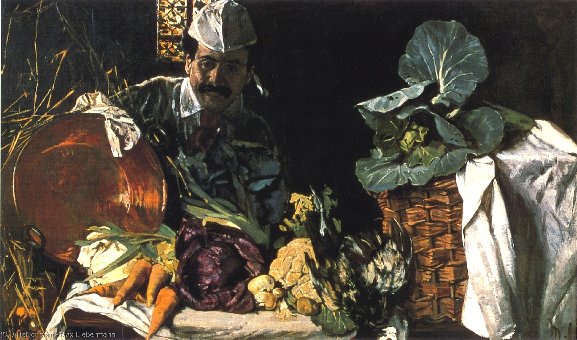
Self portrait in Kitchen with Still Life by Max Liebermann (1873)
Realising that the Netherlands was a place he had to visit to satiate his appetite for genre painting, Max, thanks to financial assistance from his brother, travelled to Amsterdam and Scheveningen. It was the first of many trips he made to the the Netherlands, a country he said inspired him.
Die Gänserupferinnen (Goose Pluckers) by Max Liebermann (1872)
When Max returned home in 1872 to continue with his studies at Weimar, his studio colleague Thomas Herbst had brought back a drawing of geese-plucking women from a study trip. Liebermann decided to use this motif and merge it with the style of Munkácsy and realised that this would be the basis of his next work. He then started on his large (120x170cms) painting entitled Die Gänserupferinnen (Goose Pluckers), which is now part of Berlin’s Alte Nationalgalerie collection. The work is painted in dark tones and depicts the simple task of goose plucking but the scene bears a resemblance to Mihály von Munkácsy’s work, Tépéscsinálók. It was the first painting that the twenty-five-year-old Liebermann exhibited in public at a Hamburg art exhibition. The art critics acknowledged the skilful painting style of Liebermann but were highly critical of the subject calling it distasteful and labelling him as the “painter of the ugly”. The painting was then exhibited that same year in Berlin but the critics were again fervently critical as they had been in Hamburg. However, the work found a buyer in the railway millionaire Bethel Henry Strousberg and with the money from the sale of the painting Liebermann travelled to Paris. His time in Paris was spent looking at the works of French artists such as Millais and Courbet and he was impressed by their style and motifs. Bethel Henry Strousberg’s empire later collapsed and he became bankrupt and had to sell some of the paintings he had collected over the years. Louis Liebermann, Max’s father, bought the Gänserupferinnen (Goose Pluckers) painting from him.
Potato Harvest in Barbizon by Max Liebermann (1875)
Liebermann had now discovered his first and favoured style, one which was both a realistic and unsentimental depiction of working people, and yet a style which avoided disdain, shaming of the subjects but also shied away from false romanticising of the people depicted. It was Realism. Liebermann became disillusioned with the German art scene which he believed had become too old-fashioned and somewhat retrograde and he was even disenchanted with Germany itself, so in December 1873 Liebermann travelled to Paris where he set up home and studio in Montmartre. Once settled in the French capital he sought out the artists who were looked upon as leading Realism artists of the day as well as the plein air Impressionism painters but many refused to meet with him due to the sour taste the Franco-Prussian War had left and the bitterness the defeat by the Prussian forces had caused and it had only ended three years earlier.
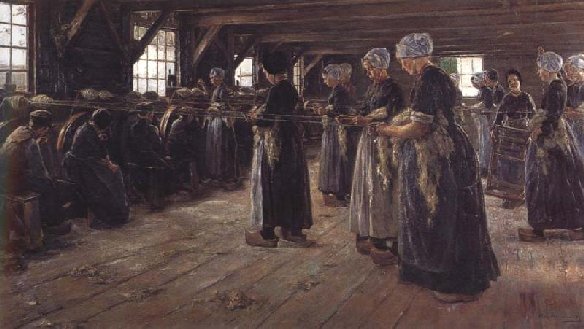
Flax Spinners by Max Liebermann (1889)
Besides still being influenced by Munkácsy, Liebermann had fallen in love with the art of French Barbizon painters Constant Troyon, Charles-François Daubigny, Camille Corot but above all Jean-François Millet. It was in 1874 that he submitted and had accepted his Die Gänserupferinnen (Goose Pluckers) painting to the Salon de Paris. However, this received negative reviews in the Parisian press, especially those newspapers which held nationalist views following the Franco-Prussian war. The first summer Liebermann spent in Paris it saw him travel to Barbizon, situated near the Forest of Fontainebleau, the home of the Barbizon School of artists, whose painters practiced en plein air painting which proved to be of great importance for the development of Impressionism. Liebermann decided to revert from the old-fashioned, heavy painting of Munkácsy, and became more engrossed in the methods used by the artists of the Barbizon School.
From 1874 Max Liebermann continued his studies in Paris and it was during thus time that he became increasingly interested in rural motifs, in “simple” people working on the land.
………to be continued.
Much of the information was found in various Wikipedia sites but also in:
My featured artist today is Louise Emerson Rönnebeck, the twentieth century painter famous for her murals. Louise Emerson was born on August 25th 1901 in the Philadelphia suburb of Germantown but spent her childhood in New York. She was the third child of Mary Crawford Suplee and Harrington Emerson and had two elder sisters, Isabel Mary and Margaret Eleanor. Her father was the son of Edwin Emerson, a Professor of Political science and was an American efficiency engineer and business theorist, who founded the management consultancy firm, the Emerson Institute, in New York City in 1900.
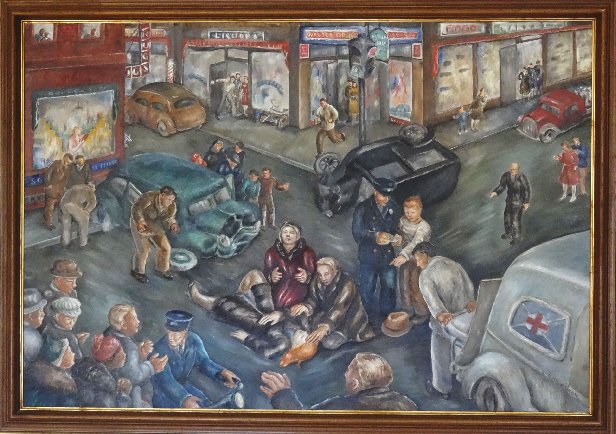
Car Accident at Aylard’s Corner (Denver) by Louise Emerson Rönnebeck ( 1937)
Having completed her regular schooling she attended Barnard College, Columbia University, which was then a private women’s liberal arts college in the New York City borough of Manhattan. In 1922 Louise Emerson graduated from Barnard College and, for the next three years, went on to study at the Art Students League of New York where she studied life drawing and anatomy with Canadian American painter, George Bridgman, sculpture with Leo Lentelli, the Italian sculptor and painting with Kenneth Hayes Miller. The latter had the greatest influence on her art and future career. Miller who taught at the Art Students League from 1911 until 1951 had among his students Edward Hopper and George Bellows.
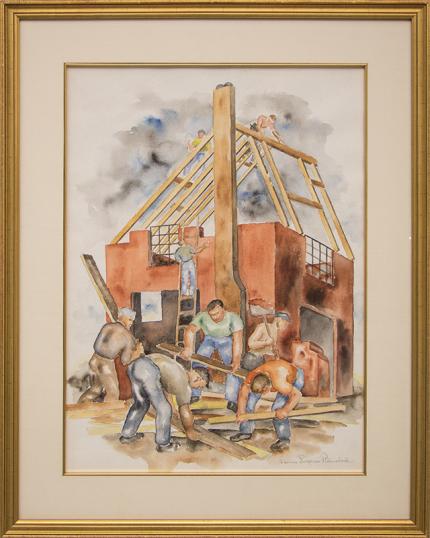
Building Boom by Louise Emerson Rönnebeck (1937)
During the summers of 1923 and 1924 Louise travelled to France and studied fresco painting at the Fontainebleau Schools which had been established in 1921. It was situated in Fontainebleau, thirty-five miles south-east of the centre of the French capital and consisted of two schools: The American Conservatory, and the School of Fine Arts. Here she studied under Paul-Albert Baudouin, a painter of genre, landscapes and decorative panels.
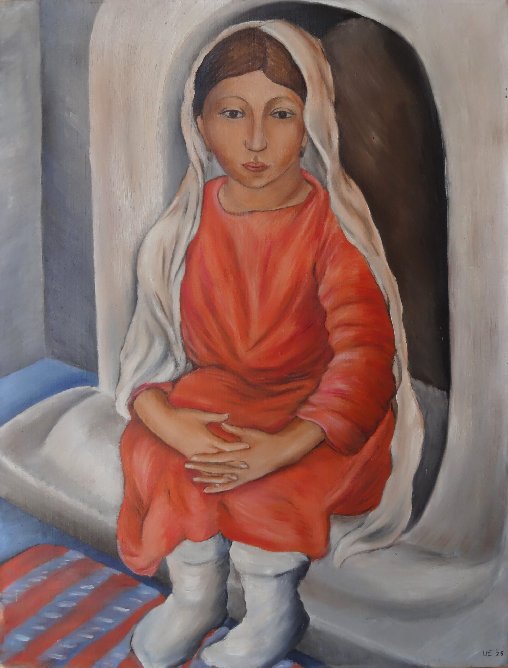
Taos Indian Child by Louise Emerson Rönnebeck (1925)
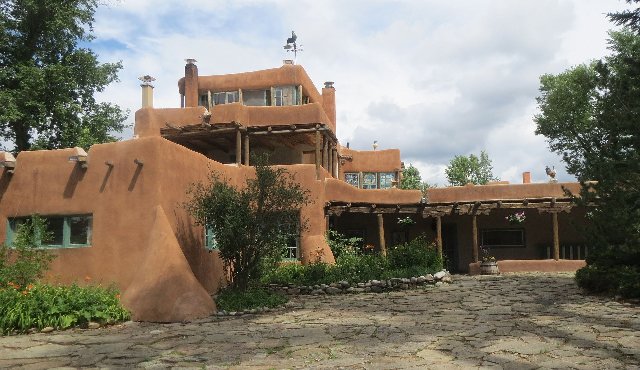
In the Summer of 1925, Louise did not carry on with her tradition of going to Paris to study at the American Conservatory and School of Fine Arts as she and her sister Isabel had been invited to stay at Taos in the New Mexico ranch home, Los Gallos, belonging to Mable Dodge Luhan. The ranch was located near the eastern edge of the town center of Taos. Luhan, the heiress of Charles Ganson, a wealthy banker, was an American patron of the arts, who was particularly associated with the Taos art colony. The ranch was a meeting place for many contemporary artists and writers and Louise Emerson distinctly remembered her visit there:
“…It was a marvellous place, all wild, strange, empty and romantic…”
Mabel Dodge Luhan Ranch House
Other guests at the ranch at the time were the writers D.H. Lawrence and his wife Frieda along with Aldous Huxley. Louise was a great admirer of Lawrence and so she and her sister decided to call on him, albeit they had not been invited by the writer. Louise remembers that visit well. Despite not having been invited, it was perfectly all right. He seemed only too happy to have someone who would listen to him. She remembered that he had a red beard and deep-set eyes which conveyed a surprising intensity. She said she was impressed with this wiry, frail, yet madly gifted person, who talked in a common, ugly voice. He and his wife Frieda seemed very Bohemian and avant-garde. Lawrence fought with his wife and they shouted at each other. Despite looking very ill, he baked his visitors bread, and Frieda made jam. Sensing she had been in the presence of a genius, it remained, as Louise recalled, that it had been one of the most memorable days of my life.
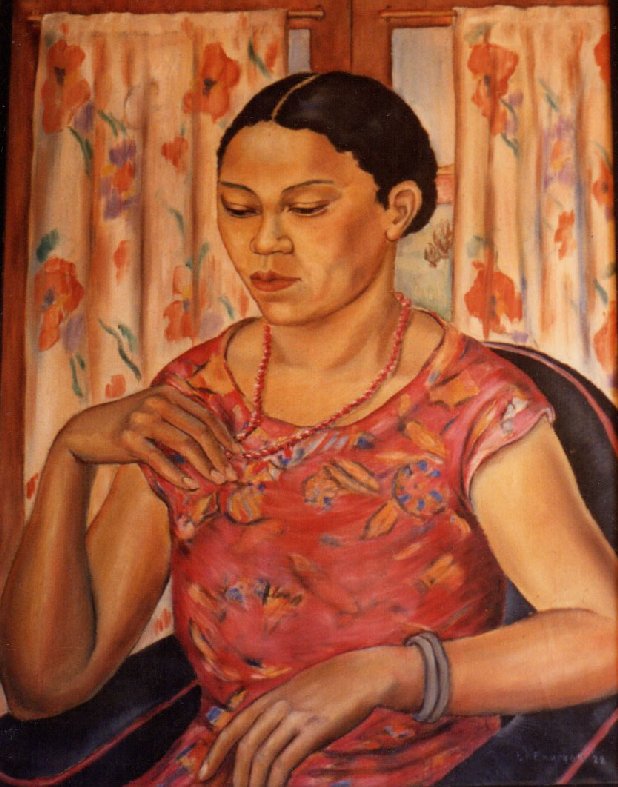
Roberta by Louise Emerson Rönnebeck (1928)
Another of the guests staying at the Taos ranch was Arnold Rönnebeck. He was a German-born American modernist artist and sculptor who had arrived in America two years earlier. He was a good friend of many of the avant-garde writers and artists he had met during his time in Berlin and Paris. In America he had become friends with artist Georgia O’Keefe and photographer Alfred Stieglitz and it was at one of the latter’s gallery, An American Place that Rönnebeck first exhibited some of his artwork in America. The gallery was on the seventeenth floor of a newly constructed skyscraper on Madison Avenue. Arnold was impressed by Louise and wrote about her to his New York friend Stieglitz about his first impressions of this young woman:
“…What a summer! …. The one other person who is doing something about this country is a young girl from New York, Louise Emerson, a pupil of Kenneth Hayes Miller at the league. Still under the influence of Derain, but strong and powerful and with a very personal vision. She lives in one of Mabel’s cottages and is going very good watercolors and oil landscapes…”
Louise and Arnold Rönnebeck’s Wedding Photograph
Soon the friendship between Louise and Rönnebeck turned into love and in New York City, twenty-five-year-old Louise Emerson and Arnold Rönnebeck married despite him being sixteen years older than her. The marriage took place in March 1926 at the All Angels Episcopal Church on the Upper Westside of Manhattan and the reception after the ceremony took place in Louise’s parent’s home close by. Despite her marriage, Louise continued to use her maiden name professionally until 1931.
Arnold Rönnebeck working on his sculpture “Grief” in Omaha, Nebraska (1926)
The couple took an extended honeymoon travelling to Omaha, Santa Fe, and Los Angeles, places which Rönnebeck had to visit to finalise some painting and sculptural commissions and attend the one-man exhibitions of his work in San Diego and Los Angeles . After the honeymoon the couple settled in Denver where Arnold became director of the Denver Art Museum.
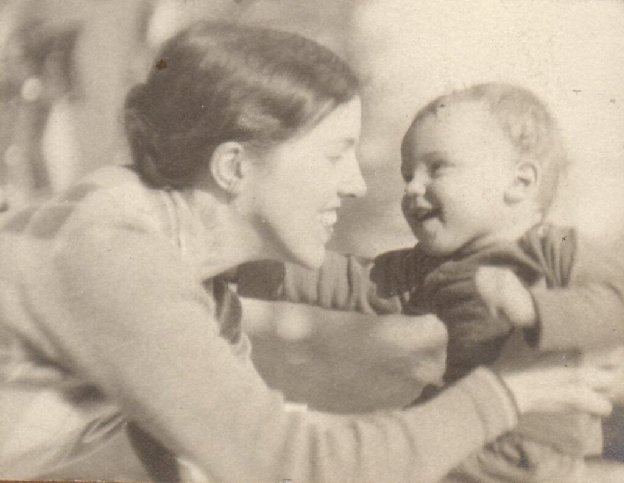
Louise with her son Arnold (1927)
Louise Ronnebeck gave birth to their first child, Arnold Emerson, in 1927 and two years later a second child Anna Maria Ursula was born. The Rönnebeck household with two young children and two working artists was somewhat chaotic and Louise had to balance looking after the family and carrying on with her art. Add to this mix, Louise was just starting her artistic career whereas her husband had passed the high-point of his career and since he arrived in America from Germany he had not reached the level of his European fame. Her struggle to manage all her tasks and family duties was highlighted in a 1946 Denver Post article, in which Louise was described as:
“…a four handed woman – – managing home and children on one side, and teaching and painting on the other…”
In letters and interviews Louise talked about the struggle to have time to be a mother, wife and artist. In a letter to Edward B Rowan, a friend and arts administrator, teacher, artist, writer, lecturer, critic, and gallerist, dated February 1938, she wrote:
“…Being mother of two strenuous children, and the caretaker of a fairly large house, I have to budget my time carefully…”
“… Between the children’s meal time, the mother rests while the artist works…”
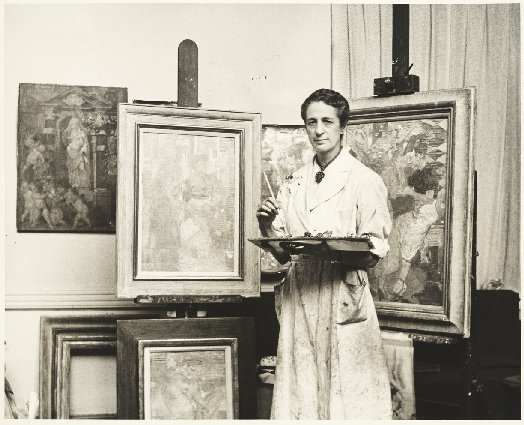
Louise Emerson Rönnebeck
In a February 1930 article in the daily newspaper, Rocky Mountain News, entitled Denverite Out to Prove She Can be Mother and Artist by Margaret Smith, Louise was quoted as saying that she would never encourage her children to become artists as an artist’s life is both unsocial and confining. Although her husband missed the big city lifestyle, Louise was content with her new life in Denver and in a 1934 letter to her former teacher, Kenneth Hayes Miller, she wrote:
“…I have become very attached to life in the west. We rent a charming really spacious house almost in the country for very little money, take frequent weekends in the mountains, and the children are radiant and adorable persons. Arnold, however, misses bitterly the stimulation of a big city and longs very much for a change…”
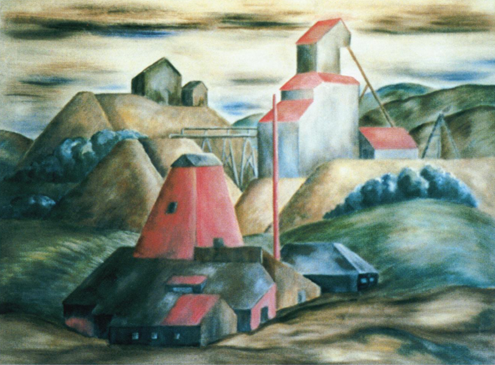
Colorado Minescape by Louise Emerson Rönnerbeck (c.1933)
Louise and Arnold had only been living in Denver for three years when the country was hit by the Great Depression and Louise knew that with their finances being in a poor state she and the family needed some help to survive. She turned to the WPA. The WPA was the Works Progress Administration, later known as the Work Projects Administration. This was an American New Deal agency that employed millions of jobseekers to carry out public works projects. The Federal Art Project was one of the five projects sponsored by the WPA, and the largest of the New Deal art projects. It was not solely created as some cultural activity, but as an assistance measure which would lead to artists and artisans being employed to create murals, easel paintings, sculpture, graphic art, posters, photography, theatre scenic design, and arts and crafts. One of the important things for the artists, besides earning money, was that commissions were essentially free of government pressure to control subject matter, interpretation, or style.
……….to be continued.
I collected information regarding the life and art of Louise Emerson Rönnerbeck from various sources. The main ones were:
“…I hope my work is recognizable as being by a woman, though I certainly would never deliberately make it feminine in any way, in subject or treatment. But if I speak in a voice which is my own, it’s bound to be the voice of a woman…”
-Isabel Bishop
Isabel Bishop, 1959. Photo by Budd ( New York N.Y.).Archives of American Art, Smithsonian Institution.
The Ashcan School of painters was the artistic movement that depicted Urban Realism in America during the late 19th and early 20th century. A few decades later another group of American realist painters, who were also based in New York city, began to focus on everyday life in the city. For these artists, it was all about the bustling area which centred around 14th Street and Union Square in Lower Manhattan during the Depression era. They became known as the Fourteenth Street School of Artists. One of these artists was Isabel Bishop.
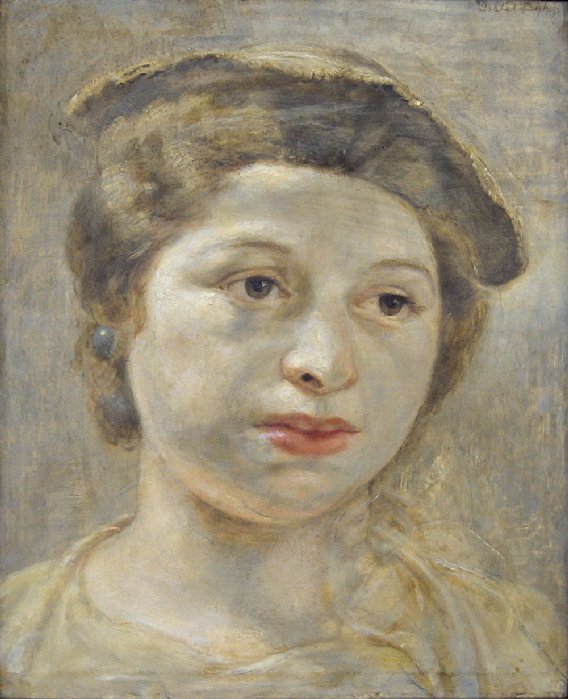
Female Head by Isabel Bishop
Isabel Bishop was the youngest of five children born on March 3rd 1902 in Cincinnati, Ohio, to John Renson Bishop and Anna Newbold Bishop. Her parents were descendants from East coast mercantile families but although they came from “old money” they were considered middle-class and often struggled financially. Isabel’s parents were both highly educated individuals. Her father was a Greek and Latin scholar and had a Ph.D in history. Her mother was a writer and an activist for women’s suffrage. The family frequently moved from town to town for financial reasons and to gain employment. Wherever they set up home, Isabel’s father, John, would find work at the local school where he often rose to become its principal and in some cases took ownership of the school.
Ice Cream Cones by Isabel Bishop
In 1887 the couple had their first children, twins, a boy and a girl, Mildred and Newbold and in 1890 another set of twins, once again a boy and a girl, was born, Remson and Anstice. This enlargement of the family caused financial hardship and her father had to continually look for better paying jobs. Isobel did not remember much about the two sets of twins as by the time she was born they were away at boarding school or college. According to Isabel her parents were very different in temperament. Her mother was a free spirit but very strong-willed and in her 1987 interview she recalls an incident that had repercussions on her father’s life:
“…It was hard on my father that she was strong. For one thing, in Detroit, Michigan, women were not supposed to be strong. She simply liked what she liked and that was it. One time she was asked to go down to the court and testify in some case. She went down, but she wouldn’t swear to be telling the truth. She was asked by the court why she wouldn’t and she said, “I don’t believe in God.” It was in the Detroit papers with the headline:
“SCHOOL PRINCIPAL’S WIFE DOESN’T BELIEVE IN GOD”
I really felt for my father. I mean, a school principal! His life was pretty impossible after that…”
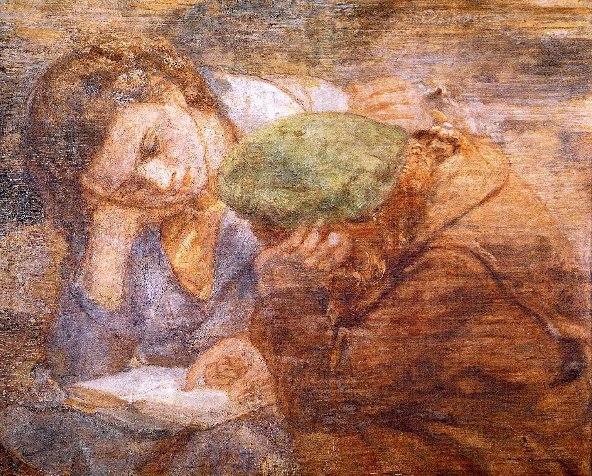
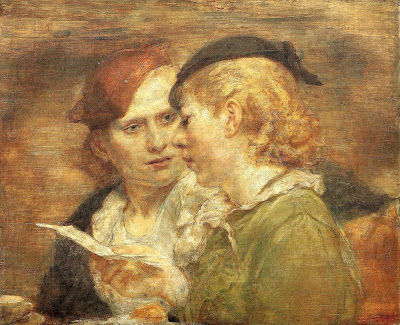
Two Girls with a Book by Isabel Bishop
Although born in Cincinatti Isobel and her parents moved to Detroit a year after she was born. In 1914, when she was twelve years of age, Isabel was enrolled in Saturday morning life drawing classes at the John Wicker Art School in Detroit. From there, at the age of sixteen, and once she had graduated from High School, she left Detroit and went to New York. It was here that she enrolled at the School of Applied Design for Women, where she studied illustration. In 1920, aged eighteen, Isabel, wanting to enhance her artistic knowledge and skills, attended the Art Students League where her first tutor was Max Weber, whom she disliked and who gave her a hard time. Later she was tutored by Kenneth Hayes Miller, another artist associated with the Fourteenth Street School who couldn’t be more different than Weber. Other tutors were Guy Pène du Bois, Robert Henri and Frank Vincent DuMond.
Portrait of Isabel Bishopby Guy Pene du Bois (1924)
According to Helen Yglesias’ 1989 biography Isabel Bishop, although Weber treated Isabel harshly and she felt intimidated by Robert Henri, in Kenneth Hayes Miller she found a mentor who, in her words, was “intellectually stimulating, not stultifying, a fascinating person who presented all sorts of new possibilities, new points of view.”
Isabel Bishop’s 9 West 14th Street Studio (no longer extant) highlighted in red, 14th Street, north side, west from Fifth Avenue. June 11, 1933.
Another friend she made at the Art Students League was Reginald Marsh, who made fleeting visits to the classes at the Art Students League whilst she was student there and this friendship led to her being witness to the working-class life of the city. In 1926, she went to live at 9 West Fourteenth Street, which was a short distance from where Marsh lived and it was in this vicinity that she kept her studio that overlooked Union Square at Broadway and East Fourteenth Street and remained there until 1982. From the windows of her studio she was able to witness the daily activities in Union Square. Fourteenth Street in the 20s and 30s was referred to as “The Poor Man’s Fifth Avenue.” It was a bustling center for bargain shopping and bawdy entertainment in the form of burlesque shows and movie theatres for everyday working-class New Yorkers.
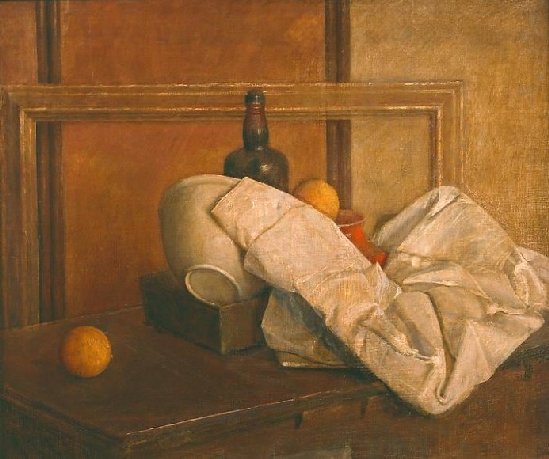
Still Life with Orange #1 by Isabel Bishop
Her friendship with fellow student, Reginald Marsh, encompassed many lunch or dinner dates when they discussed their day’s work. She affectionately recalled that they each paid for their own fifty cent meal and occasionally Marsh would take her to a Coney Island dance marathon or backstage at Minsky’s Burlesque. She recalled that it was great going with Reggie, and whilst there he would sketch the goings-on at the Burlesque show. She said that there were a number of occasions, the owner, Minsky bought Reggie’s work.
The Artist’s Table by Isabel Bishop
Isabel loved the area around Union Square and would regularly visit the Square itself, sketching for hours on end. She remembered those days saying:
“…I adored it. Drawing nourished my spirit; it was like eating. I got ideas there, for drawing is a way of finding out something, even though it might only be the discovery of a simple gesture…”
If she liked one of her sketches, she would turn it into an etching or make a painting from it. She soon became known for depicting urban life and was a leading member of the Fourteenth Street School of artists.
14th Street by Isabel Bishop
The Great Depression began in 1929 and nobody seemed to want to spend money buying the work of an unknown female artist, especially one who had not even had a solo show. Money was tight, people were losing their jobs and America had fallen into the grip of the worst depression in history and most Americans were worried about how they could survive the disaster that had befallen the nation. Isabel went from art gallery to art gallery hoping that they would accept her paintings but with little luck. It was a very depressing and frustrating time in Isabel’s life. A turning point came when Isabel met Alan Gruskin. Gruskin had hoped to become an artist, but while still a student realized that his talents were better suited to art administration than painting. On graduating from Harvard he worked at a New York gallery that specialized in the works of the Old Masters. He left there and returned home hoping to start a career as an author but that never came to fruition so he returned to Manhattan and, in 1932, opened the Midtown Galleries at 559 Fifth Avenue. He specialised in artwork by living American artists and in that year he staged a solo exhibition of Isabel’s paintings.
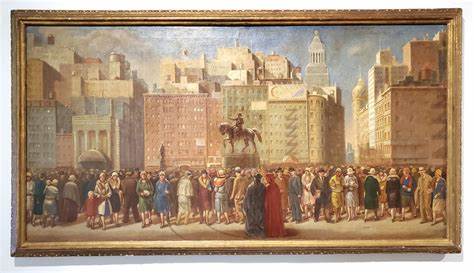
Dante and Virgil in Union Square by Isabel Bishop (1932)
Isabel Bishop’s paintings focused on the ordinary people of New York City, and in particular, those in her neighbourhood around Union Square and 14th Street. However, her 1932 painting entitled Dante and Virgil in Union Square was extraordinary with her inclusion of Dante, in the red cloak, and Virgil, with a laurel wreath on his head, which makes this work memorable. Isabel said she was motivated when she read the translation of Dante’s Inferno, the first part of Italian writer Dante Alighieri’s 14th-century narrative poem The Divine Comedy with its tales of life in the underworld. In her depiction, Isabel likened the hordes of poor souls that confronted Dante and Virgil in the various levels of hell with the hordes of human beings that daily passed through Union Square at rush hour. In the painting we see a crowd of people at Union Square, the equestrian statue of George Washington in the centre framed by the Union Square Savings Bank and other buildings in the background. It is a very busy scene a woman leading her child by the hand, pairs of women walking away from the crowd, and a number of working class men, portrayed in darker colours, facing into the Square seem completely unaware of the classical figures, who stand in the shadowed foreground of the sidewalk, as if embodying the evaluating gaze of another era.
At the Noon Hour by Isabel Bishop (1936)
In Ellen Wiley Todd 1993 book, The “New Woman” Revised: Painting and Gender Politics on Fourteenth Street, she describes the New Woman of the 1920s and 1930s as: “…being a moderate sort, who hoped to capitalize on new job possibilities and to make herself attractive with the mass-produced products of the clothing and cosmetics industry…”
Hearn’s Department Store-Fourteenth Street Shoppers by Isabel Bishop (1927)
The entrance to Hearn’s Department Store was right across the street from Isabel Bishop’s studio and she realised that it was the perfect place to find and observe this “New Woman.” Isabel Bishop’s Hearn’s Department Store—Fourteenth Street Shoppers was completed in 1927, the same year that she enrolled in Kenneth Hayes Miller’s mural painting class at the Art Students League. It depicts the city’s middle-class shoppers who are wearing the latest fashions and who visit the shops around Union Square in order to pick up the latest bargains.
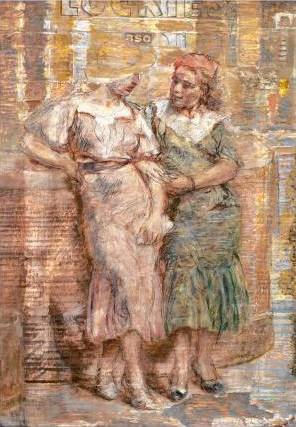
Two Girls by Isabel Bishop (1935)
In 1935 Isabel completed her painting entitled Two Girls. It was yet another of her works which depicted young working women. In this painting we see a close-up of two smartly dressed figures seemingly engaged discussing the contents of a letter. Isabel used two models for this depiction and for this work she used Rose Riggens, a server at a restaurant where Isabel often had breakfast, and Riggens’ friend Anna Abbott. The work exudes both warmth and tranquillity which counters the dire economic circumstances of the Great Depression in the 1930s. This painting which took her twelve months to complete was one of Isobel Bishop’s most well-known works and was originally shown at the Midtown Galleries in New York. It is now part of the city’s Metropolitan Museum of Art.
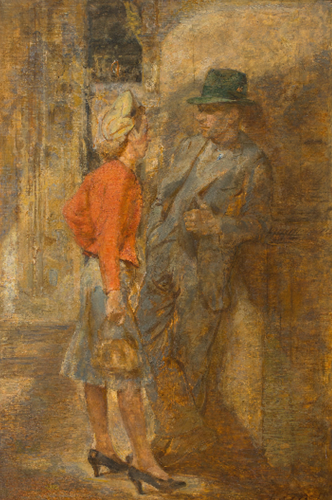
Encounter by Isabel Bishop (1940)
In her 1940 painting entitled Encounter we witness an exchange occurring between a man and a woman though the circumstance of this meeting remains unclear. From many of her paintings we can deduce that Isabel was an insightful observer of everyday activities of young women who visited offices and stores in her neighbourhood. Her works present working women as vivacious subjects for the American Art Scene, which centred on the daily lives of the city’s population. At a time of great unemployment Isabel found it easy to employ young unemployed clerical workers to pose for her. In this work, she depicts a young woman and her boyfriend, with whom she is having a rather stormy romance. The painting can be seen in the St Louis Art Museum.
Tidying Up by Isabel Bishop (1941)
In her 1941 painting Tidying Up, we see a woman, perhaps a secretary or salesperson, using a pocket mirror to check her teeth for lipstick smudges. Isabel liked to depict working-class women during their idle moments away from their jobs. She spent more than a decade depicting secretaries, salesclerks, and blue-collar workers who lived and often worked in and around Union Square. She favoured subjects of women who were simply going about their everyday lives, eating, talking, putting on makeup, and taking off their coats. It was these mundane actions along with facial expressions that Isabel Bishop believed divulged the character and temperament of the people she portrayed. This painting is part of the Indianapolis Museum of Art collection.
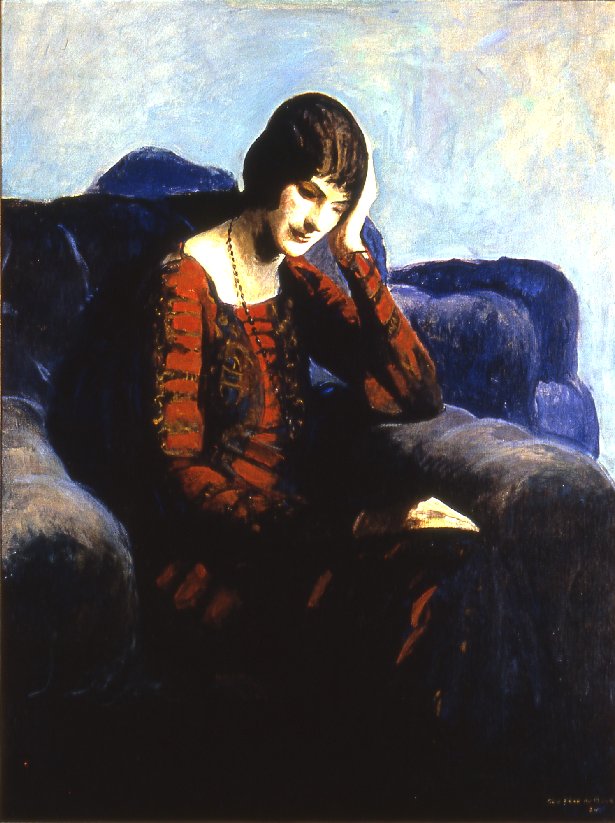
Girl Reading by Isabel Bishop (1935)
Bishop remained on Union Square, where she kept a studio until the end of her life. The area around Fourteenth Street and Union Square remained foremost as the subject matter for her paintings. She received many awards during her life and she was elected an associate member of the National Academy of Design in 1940 later in 1941 she was elevated to full Academician. She received a Benjamin Franklin Fellow at the Royal Society of Arts in London and was also elected a Member of the National Institute of Arts and Letters in 1944 and was the first woman to hold an executive position in the National Institute of Arts and Letters as vice-president. In 1979, she was awarded the Outstanding Achievement in the Arts Award presented to her by President Jimmy Carter.
Self portrait by Isabel Bishop (1927)
Isabel Bishop died on February 19th 1988 two weeks before her eighty-sixth birthday.
Most of the information for this blog came from the following excellent websites:
The artist I am looking at today is the nineteenth century American painter Gertrude Horsford Fiske who was famous for painting people, still life, and landscapes. Gertrude Fiske was born into an established New England family that can trace their family history way back to the Governor of Plymouth Colony, William Bradford an English Puritan Separatist originally from the West Riding of Yorkshire in Northern England who moved to Leiden in Holland in order to escape persecution from King James I of England, and then emigrated to the Plymouth Colony on the Mayflower in 1620. Gertrude, born in 1879, was one of six children born into a wealthy Boston family, her father being an eminent lawyer. She was educated in Boston’s best schools but during her teenage years she showed little interest in art as much of her free time was taken up with horse riding and golf. She proved herself to be an extremely skilled professional golfer.
Woman in White by Gertrude Fiske
It was not until she was twenty-five years old that she took an interest in art and began to look at the possibility that her future could be as a professional artist. In 1904 she enrolled on a seven-year course at the School of the Museum of Fine Arts, Boston, (now the art school of Tufts University), where her tutors included Edmund C. Tarbell, an American Impressionist painter, Frank Weston Benson, known for his Realistic portraits, American Impressionist paintings, watercolours and etchings and Philip Leslie Hale, an American Impressionist artist, writer and teacher.
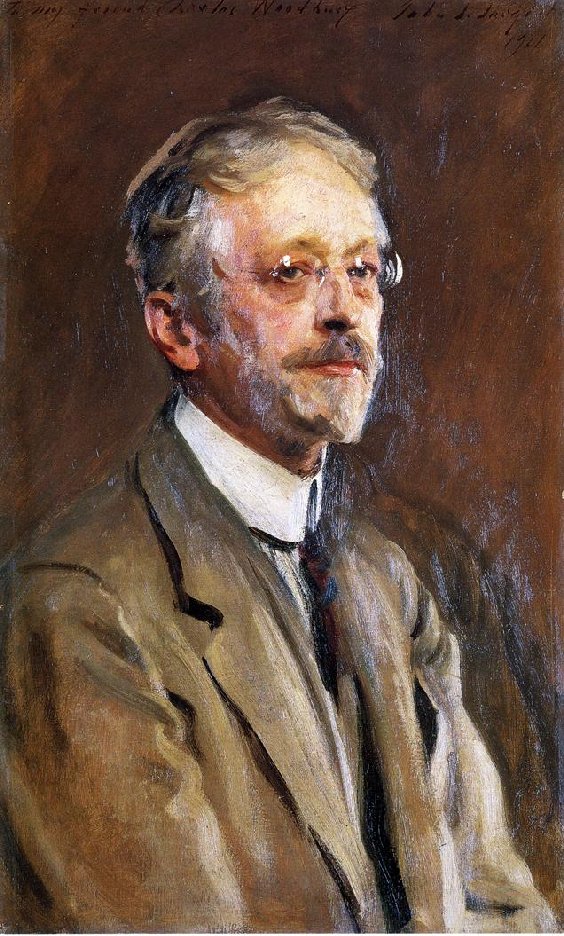
Charles Herbert Woodbury by John Singer Sargent (1921)
During the summers, she attended Charles Herbert Woodbury’s art classes in Ogunquit, Maine. Ogunquit was originally populated by The Abenaki indigenous people of the Northeastern Woodlands of Canada and the United States and in their language the name of the town means “beautiful place by the sea”. In the early years of the twentieth century, it had become a popular destination for artists who wanted to capture the landscape’s natural elegance.
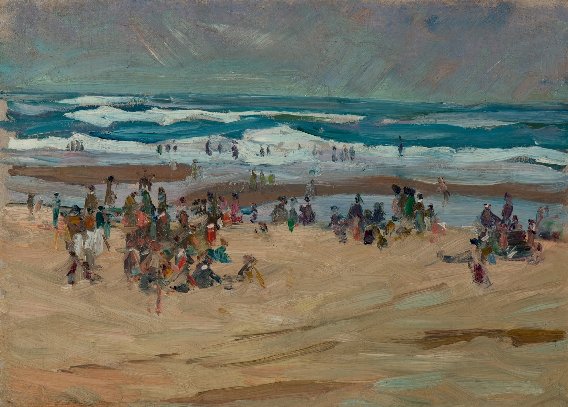
Ogunquit Beach by Gertrude Fiske (1914)
Ogunquit Beach by Gertrude Fiske
Soon, a community of artists formed the Ogunquit Summer School of Drawing and Painting which was founded by Charles Woodbury. Woodbury was a great influence on Gertrude Fiske’s informative years and he encouraged her and her fellow students to “paint in verbs, not in nouns.” By this, he meant that his students should enter into the life of the things they painted. He wanted to inspire them to fresh, “active” seeing and expressive creativity and told them that in seascapes they did not draw what they saw of the wave – you draw what it does. The phrase implied that painting is perceptual and that realism is evidence of the felt and the seen and not just of what’s visible.
Bettina by Gertrude Fiske (1925)
Because of the family’s wealth, Fiske had the financial freedom to pursue her painting career and after she completed her time at the School of the Museum of Fine Arts, Boston in 1912, she spent time in France, continually sketching as she travelled. Her artistic style was a blend of the light-filled, classical, portrait style she had mastered under Edmund C. Tarbell with the freer, inventive, and colour-rich landscapes she had learnt during her summers spent at the Ogunquit school.
Nude in Interior by Gertrude Fiske (c.1922)
Gertrude Fiske painted a number of works featuring nudes. Her painting entitled Nude in Interior was completed around 1922. The subject of this work, the nude female, is shown posing for the artist, the image of whom we see in the background, reflected in a mirror. Gertrude often used this inclusion as a means to put over to the viewers the importance of the painter.
Bird of Paradise, Sleeping Nude by Gertrude Fiske (c.1916)
Another controversial nude work was her 1916 painting entitled Bird of Paradise, Sleeping Nude which received mixed reviews. It was praised for its honesty but more conservative critics said it was a scandalous depiction. Before us we see a foreshortened figure of a naked woman who appears supremely relaxed and unaware of us, the viewers. It is simply an honest depiction of a real woman.
Zinnias by Gertrude Fiske (c.1920)
Gertrude returned to America but tragedy struck her family with the deaths of a sister, brother and mother around the time that the First World War was raging in Europe. Fiske then had to care for her aging father. However, despite the tragic losses and her new role as a carer she continued to be a prolific and much-admired painter. She kept a studio in Boston as well as at her family’s longtime home, Stadhaugh, in the town of Weston, fifteen miles west of Boston. It was at Stadhaugh that she worked in her studio which was located on the top floor of a converted barn. It had a picturesque setting overlooking woods and this vista served as the backdrop for several of her works.
By the Pond by Gertrude Fiske (c.1916)
In 1914, she, along with prominent painters of the day, including Edmund Tarbell, William Paxton and Frank Benson, helped create the Guild of Boston Artists. Its mission was to promote both emerging and established artists who lived in the region. The Guild developed a reputation for excellence in quality and presentation. Later, in 1917, Gertrude was part of setting up the Boston Society of Etchers and in 1918 Fiske became a member of the National Association of Women Artists.
Strollers by Gertrude Fiske (c.1926)
After the end of the First World War, America staged a rapidly growing industrial way of life and along with waves of immigration in the last quarter of the nineteenth century, elements of a new national consciousness arose in the United States. It was considered to be part of the colonial revival, which found expression in architecture, decorative arts, paintings, and all types of material life which represented an effort to regain a sense of an earlier time in America. Boston was in the forefront of colonial revivalism, and it was the Boston School of Painting, led by Edmund C. Tarbell, that is closely identified with the movement. Gertrude Fiske, who had spent seven years there as a full-time student at the School of the Museum of Fine Arts, Boston, was trained in this artistic dream of the future.
Wells, Maine by Gertrude Fiske
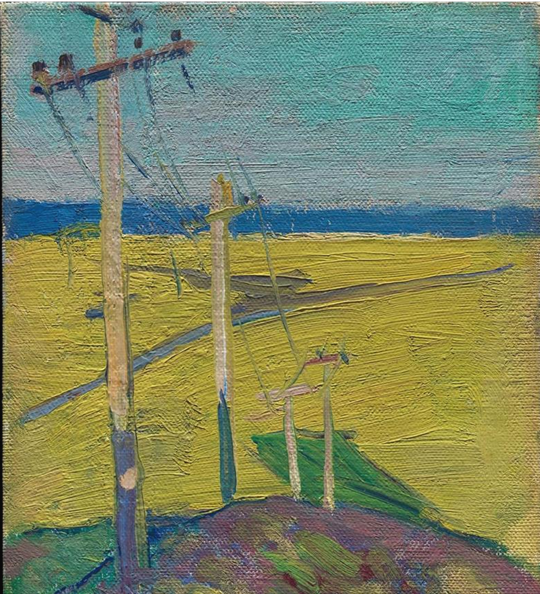
However Fiske was an independently minded and instead of blindly following social convention and the strong direction proposed by the Boston school with its more genteel mannerisms, she ploughed her own furrow and in her landscape depictions instead of removing signs of industry and technology from her work, she made a conscious decision to include them. A good example of this can be seen in her painting entitled Wells, Maine, in which she has retained depictions of a line of utility poles, with a secondary electrical line running across the painting. Her composition with utility poles set against the background of a seascape demonstrates the artist’s interest in juxtaposing signs of modernity with scenes more traditionally considered beautiful.
Portsmouth Burying Ground by Gertrude Fiske (c.1925)
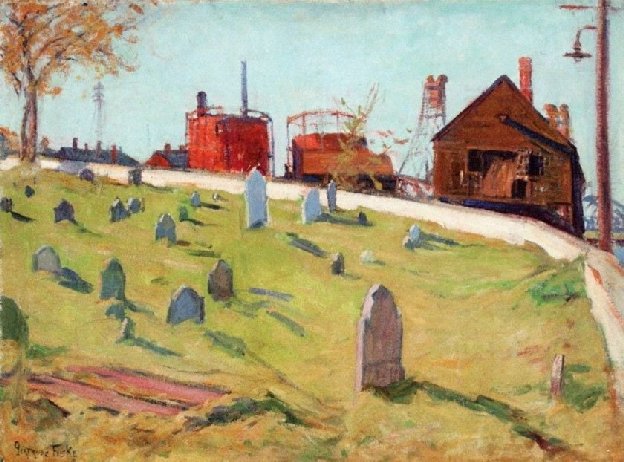
Another example of Fiske’s urban landscape work is one she completed around 1932 entitled Portsmouth Burying Ground which depicts Portsmouth, New Hampshire’s oldest cemetery, known as the Point of Graves, which is situated on the banks of the Piscataqua River in the south end of town. This small historic cemetery dating to the 17th century was the final resting place for many of Portsmouth’s prominent residents. It is the oldest known surviving cemetery in Portsmouth, and one of the oldest in the state, which has about 125 gravestones. Whereas many landscape painters would have spent time amidst the beauty of the countryside Gertrude has chosen this discordant, working waterfront to position her easel to take in the surrounding land. Fiske confounded viewers of this work when she depicted the bright red gasometers and the Sheafe warehouse as a backdrop to the ancient burial ground.
Portrait of William by Gertrude Fiske (1930)
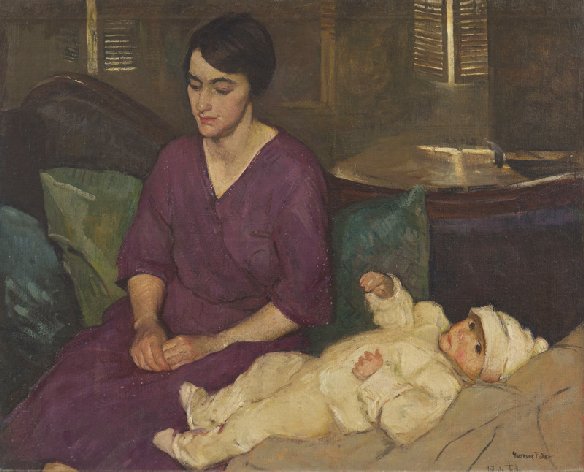
One of her best-known figurative works was one Gertrude completed in 1930 entitled Portrait of William which she exhibited at both the Boston Art Club’s Annual Winter Exhibition of Contemporary American Painting and at the National Academy of Design’s 105th Annual Exhibition. It is part figurative and part an interior depiction which was a popular concept favoured by many of the early Boston School teachers and yet she put her own mark on the composition by her use of colours, such as the juxtaposition of the green of the fabric on the pillows with the dotted Swiss cotton of the woman’s purple dress. She also adopts an unusual placement of figures and objects in the work.
The Carpenter by Gertrude Fiske (1922)
Gertrude Fiske was appointed as the first woman ever to the Massachusetts State Art Commission in January 1930. She was also the the founder of the Concord Art Association. In an article in January 1930’s Boston Globe it was written that she had always had a strong artistic individuality of her own, and there is a note of personal distinction in all of her work—a virile note.
Fiske died in 1961 in Weston, Massachusetts aged 82.
In my previous blog regarding the Dutch painter Thérèse Schwartze I mentioned that one of her early art tutors was Jean-Jacques Henner, the French painter famed for his portraiture. Today I am going to focus on his life and his many artworks.
Jean-Jacques Henner
Henner was born on March 5th 1829 at the Alsatian town of Bernwiller. Henner came from a family of Alsatian farmers who had settled in Bernwiller in the Haut-Rhin. He was the youngest of six siblings of George Guillaume Polycarpe Henner and Madeleine Henner (née Wadel). He had two older sisters, Maria Anne and Madeleine and three older brothers, Séraphin, Grégoire and Ignace. He grew up in this farming community, but despite their modest financial situation, his parents sent him to the College of Altkirch where he studied drawing. His teacher was Charles Goutzwiller who noticed his rapid progress and encouraged him to move to Strasbourg and study at the studio of Gabriel-Christophe Guérin. His artistic studies continued when he enroled at the Ecole des Beaux-Arts in Paris as a pupil of Michel-Martin Drolling, a neoclassic French painter noted especially as a history painter and portraitist. In 1851 he was tutored by another French artist, François-Édouard Picot, famed for his mythological, religious and historical paintings.
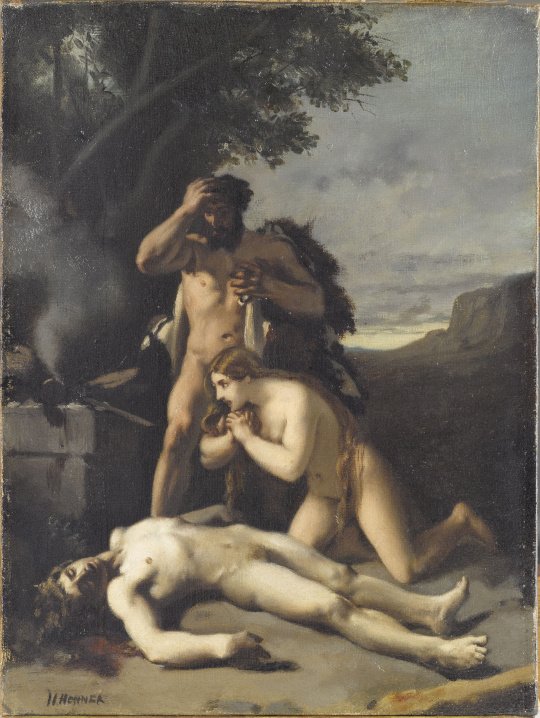
Adam and Eve find the Body of Abel by Jean-Jacques Henner (1858)
In 1848, he entered the École des Beaux Arts in Paris and in 1858 after two failed attempts he won the coveted Grand Prix de Rome award, which was a French scholarship for arts students. His submission was his painting entitled Adam and Eve find the Body of Abel. The prize for the winner was a bursary that allowed them to stay at the Villa Medici in Rome, for three to five years at the expense of the state. The painting can be seen at the Musée d’Orsay.
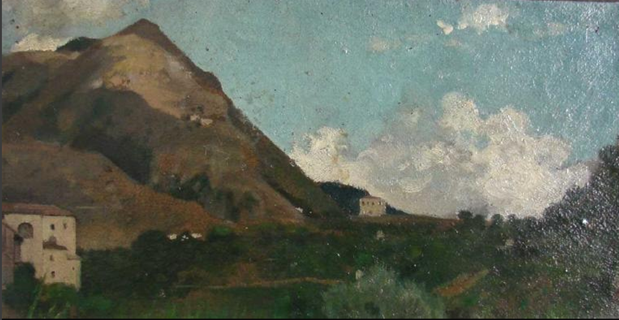
Mountains on the Outskirts of Rome by Jean-Jacques Henner (c.1861)
During his five-year stay in Rome, he was guided by Jean-Hippolyte Flandrin, a French Neoclassical painter. Like many artists, Henner was captivated by Italy and spent many hours in museums reproducing the works of the painters that he respected. He also had plenty of time during his five-year stay to travel around the country, visiting Florence, Venice and Naples in which time he completed a number of small landscape paintings. His works at that time showed his appreciation of past masters and it was Titian and Correggio who influenced him the most. In 1864 Henner returned to Paris and brought back copies of works by masters and a number of luminous landscapes.
Rome from the terrace of the Villa Medici by Jean-Jacques Henner (1860)
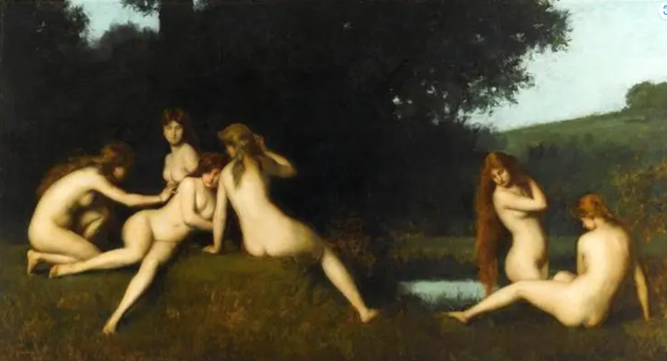
During those five years in Rome Henner painted this work at the Villa Medici where he stayed between 1859 and 1864. This is not simply a view of the Eternal City as observed from the villa. Once he had painted the garden, Henner then populated the terrace with groups of what he believed were “typical” characters, which he had often seen in real life and are simply identifiable by their clothes, monks, peasants, and elegant ladies. All are depicted in front of the classical panorama of the city, in which one can see the silhouette of Saint Peter’s Basilica in the background.
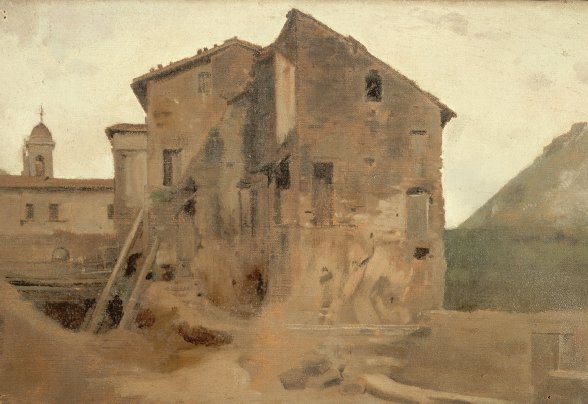
Masure dans la campagne de Rome (Dilapiated House in the Countryside of Rome) by Jean-Jacques Henner (c.1863)
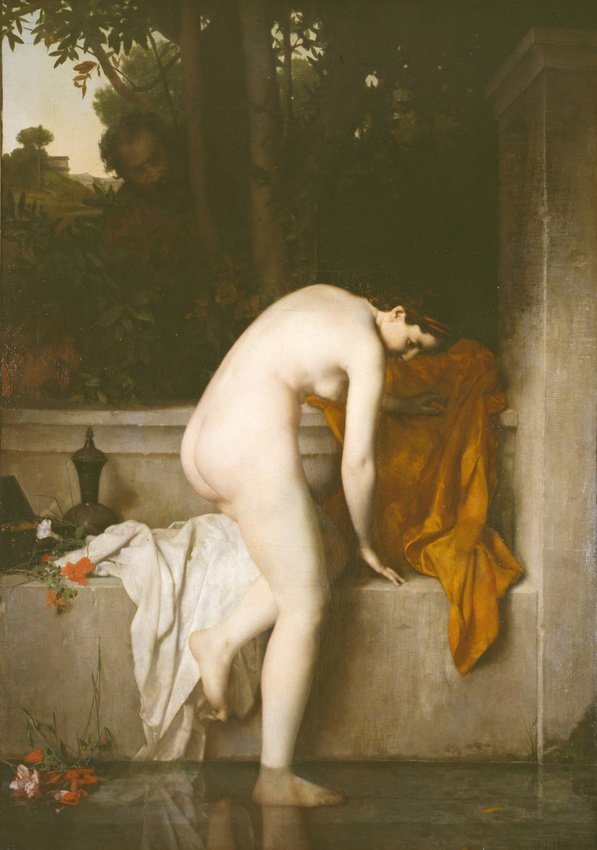
La Chaste Suzanne by Jean-Jacques Henner (1864)
Henner had his painting Bather Asleep exhibited at the Salon in 1863 and at the following year’s Salon his painting La Chaste Suzanne was exhibited. The Biblical episode depicting Suzanne bathing was a popular one for painters and it was above all an opportunity for various artists to paint a beautiful nude. Jean-Jacques Henner sent back his version to the French Academy which he completed whilst in his last year of his residence at the Villa Medici in Rome. For Henner, this was a compulsory exercise, supposed to demonstrate the student’s progress and their skill in execution, and for the Academy to see if their prize winner was advancing artistically.
Sacred Love and Profane Love by Titian (1514)
Henner almost certainly took his inspiration from respected examples left by the great masters’ depiction of nudes which he had seen whilst in the Italian capital. It is thought that Henner was influenced Titian’s 1514 painting entitled Sacred Love and Profane Love which was at the Galleria Borghese in Rome. Henner’s work was not well-received and was harshly criticised for the heaviness and lack of graciousness in the model’s body. It was also criticised for the artificiality of the subject which although being put forward as a history/biblical painting offered little more than a depiction of a bather. However the propensity of ridding any narrative self-justification in painting the nude, and so giving it as a subject in itself, was becoming more common in the work of many contemporary artists, such as Courbet.
Séraphin Henner (brother) by Jean-Jacques Henner (c.1881)
Grégoir Henner (brother) by Jean-Jacques Henner (1889)
While a student in Paris Henner was particularly interested in portraiture, and during his frequent visits home to Alsace he would complete many portraits of his family as well as local dignitaries and scenes of Alsatian peasant life.
Eugénie and Jules Henner by Jean-Jacques Henner (c.1865)
Eugénie and Jules were two of the three children of his brother, Séraphin and his wife, Madeleine. Henner was very close to his nephew and niece and he paid for violin lessons for Jules and piano lessons for Eugenie when they were little. Henner had no children of his own, and on his death, he bequeathed them all that he possessed. Here, Eugénie and Jules are depicted together in their childhood.
Paul Henner by Jean-Jacques Henner (before 1867)
A rather sad portrait. Paul Henner was the third child of Séraphin and Madeleine Henner. He was born in 1860, but sadly died seven years later.
Byblis by Jean-Jacques Henner (c.1870)
In 1864 Henner returned to France and exhibited with great success at the Paris Salon between 1865 and 1903. During his early days back in France his works were of quasi-mythological subjects, such as his 1867 work entitled Byblis, which was exhibited at the 1867 Salon.
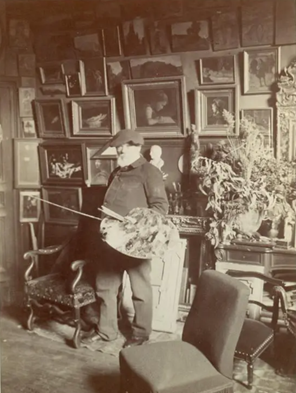
Jean-Jacques Henner in his Paris studio at 11 place Pigalle
Jean-Jacques Henner lived in rue La Bruyère and his studio was at 11 place Pigalle, where he lived from 1867.
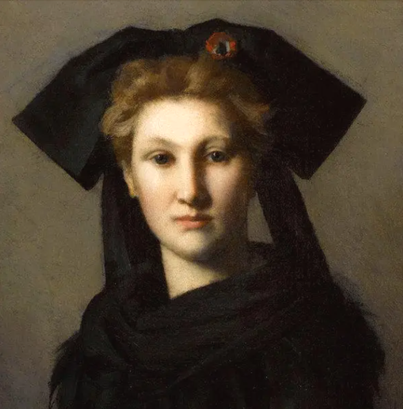
L’Alsace. Elle Attend (Alsace, She Waits) by Jean-Jacques Henner (1871)
Jean-Jacques Henner’s birthplace was the region of Alsace and this north-east area of France borders Germany. With the defeat of France in the Franco-Prussian War in 1871, Alsace and northern Lorraine were annexed to the new German Empire. At the conclusion of the First World War, the defeat of Germany, and the Treaty of Versailles, Alsace once again came under French control. In 1940, during the Second World War Alsace–Lorraine was occupied by Germany during the Second World War. Although it was never formally annexed, Alsace–Lorraine was incorporated into the Greater German Reich. With the defeat of Germany in 1945 Alsace returned to French rule. Henner’s 1871 painting entitled L’Alsace. Elle Attend had political overtones. It depicts a young Alsatian woman in mourning and is a political comment on the German annexation of the province after the Franco-Prussian War. The patriotic image was very popular and achieved a wide circulation when it was engraved by Léopold Flameng. L’Alsace. Elle Attend meaning Alsace, she awaits, was commissioned on the initiative of Eugénie Kestner, a member of the Thann industrial family from Alsace. On completion it was given Léon Gambetta, a French lawyer and republican politician, who was one of the fiercest opponents of the relinquishment of the Alsace-Lorraine region to the new German Empire following the war of 1870. Following the defeat of France by the Prussian armies a sense of fervent and heightened patriotism followed. Henner’s painting quickly became looked upon as a symbol of Alsace’s suffering, a pain shared by the painter who was very attached to the region of his birth. The painting depicts a young Alsatian woman in mourning, unassuming but gracious.
Donna sul divano nero (Woman on Black Divan) by Jean-Jacques Henner (1869)
At that time, Henner had assumed a naturalistic style which can be seen in his painting entitled Woman on a Black Divan, which was exhibited at the Salon of 1869 and now is housed at the Mulhouse, Musée des Beaux-Arts. A smaller version of this painting also included a rosette in the red, white and blue colours of France, pinned onto the traditional black Alsatian bow, gives the painting its patriotic significance without being pompous or anecdotal.
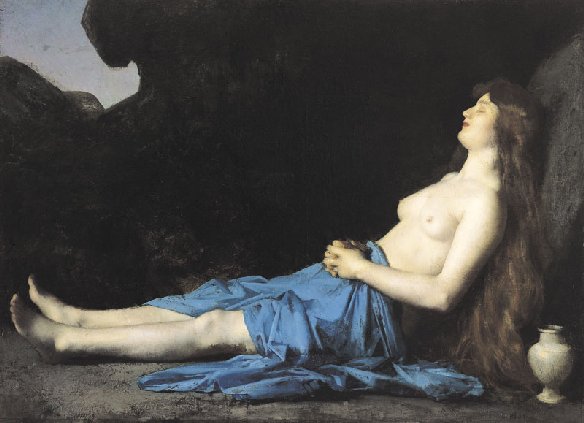
Magdalene in the Desert by Jean-Jacques Henner (1874)
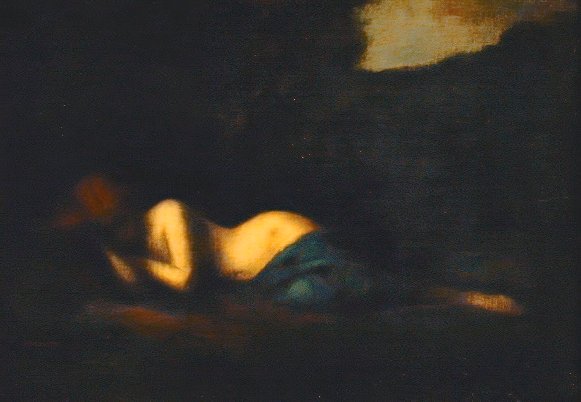
After 1870 Henner’s entire work became a deliberation on the theme of death in various appearances. There were the depictions of Mary Magdalene in what became known as the Magdalene Series, such as Magdalene in the Desert, which was exhibited at the 1874 Salon, and Magdalene Weeping, which he completed in 1885.
Die Magadalena by Jean-Jacques Henner (Exhibited at the 1878 Salon)
La Magdaleine by Jean-Jacques Henner
Henner complted many more Magdalene paintings.
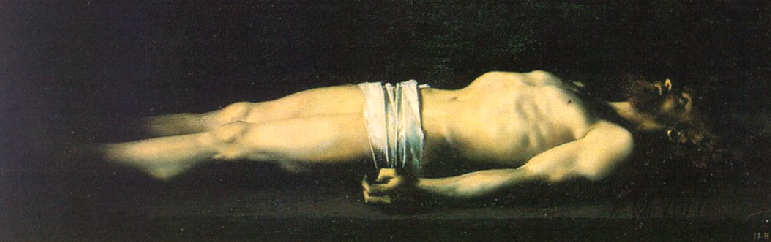
The Dead Christ by Jean-Jacques Henner (c.1884)
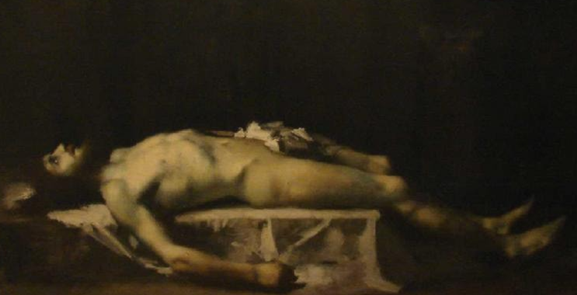
Jesus at the Tomb by Jean-Jacques Henner (c.1879)
There was also a number of works in Henner’s Dead Christ series with paintings such as Jesus at the Tomb, which was exhibited at the 1879 Salon and is now part of the Musée d’Orsay collection and the painting entitled Dead Christ which was exhibited at the 1884 Salon and now hangs at the Musée Beaux-Arts in Lille.
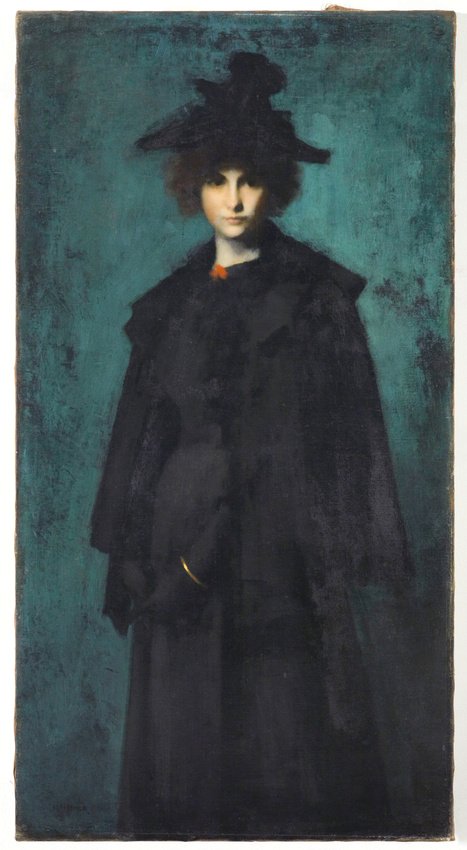
Portrait of Madame Laura Leroux by Jean-Jacques Henner
Jean-Jacques Henner will best be remembered for his portraiture which would provide him with financial stability. During his lifetime he completed many portraits of his family and famous people like his Portrait of Madame Laura Leroux. Laura Leroux-Revault was a French artist and painter. Her first teacher was her father, the painter Louis Hector Leroux and she later trained at the Académie Julian art school in Paris. She also trained under Jules Lefebvre and in Jean-Jacques Henner’s studio. The two artists were friends of her father.
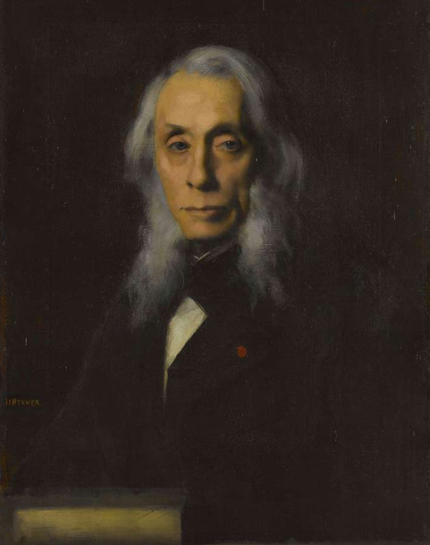
Portrait of Jean-Gaspard-Félix Laché Ravaisson-Mollien by Jean-Jacques Henner (1889)
Another famous person to be immortalised by Henner was Jean-Gaspard-Félix Laché Ravaisson-Mollien, a French philosopher, said to be France’s most influential philosopher in the second half of the nineteenth century.
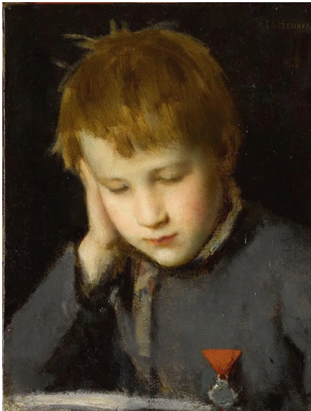
The Reader by Jean-Jacques Henner
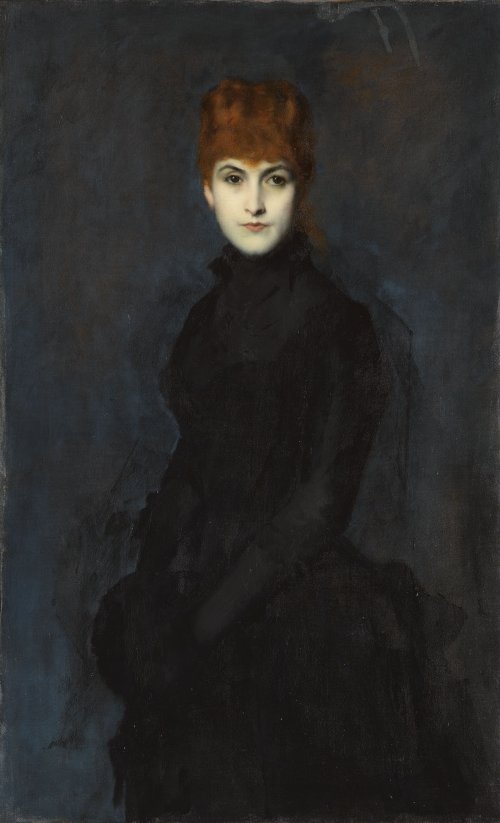
La comtesse Kessler by Jean-Jacques Henner (c.1886)
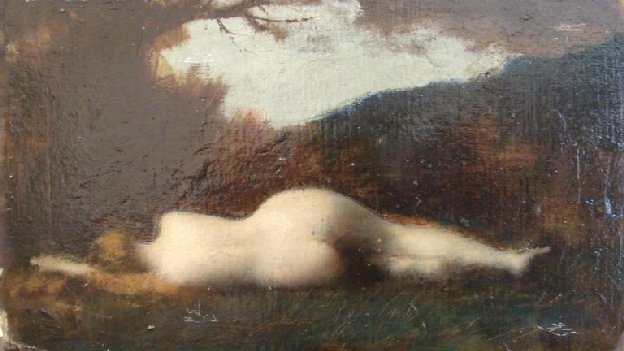
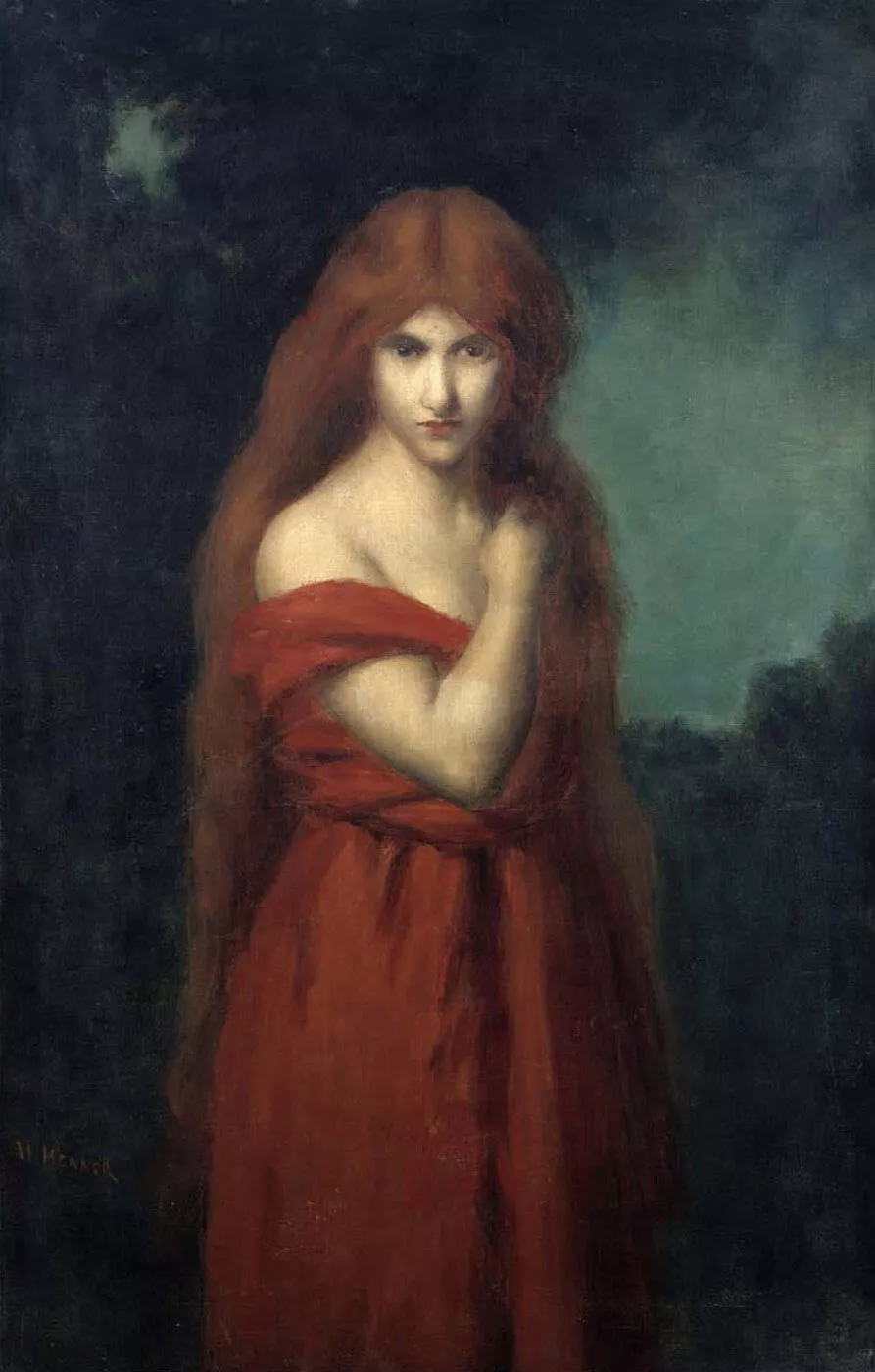
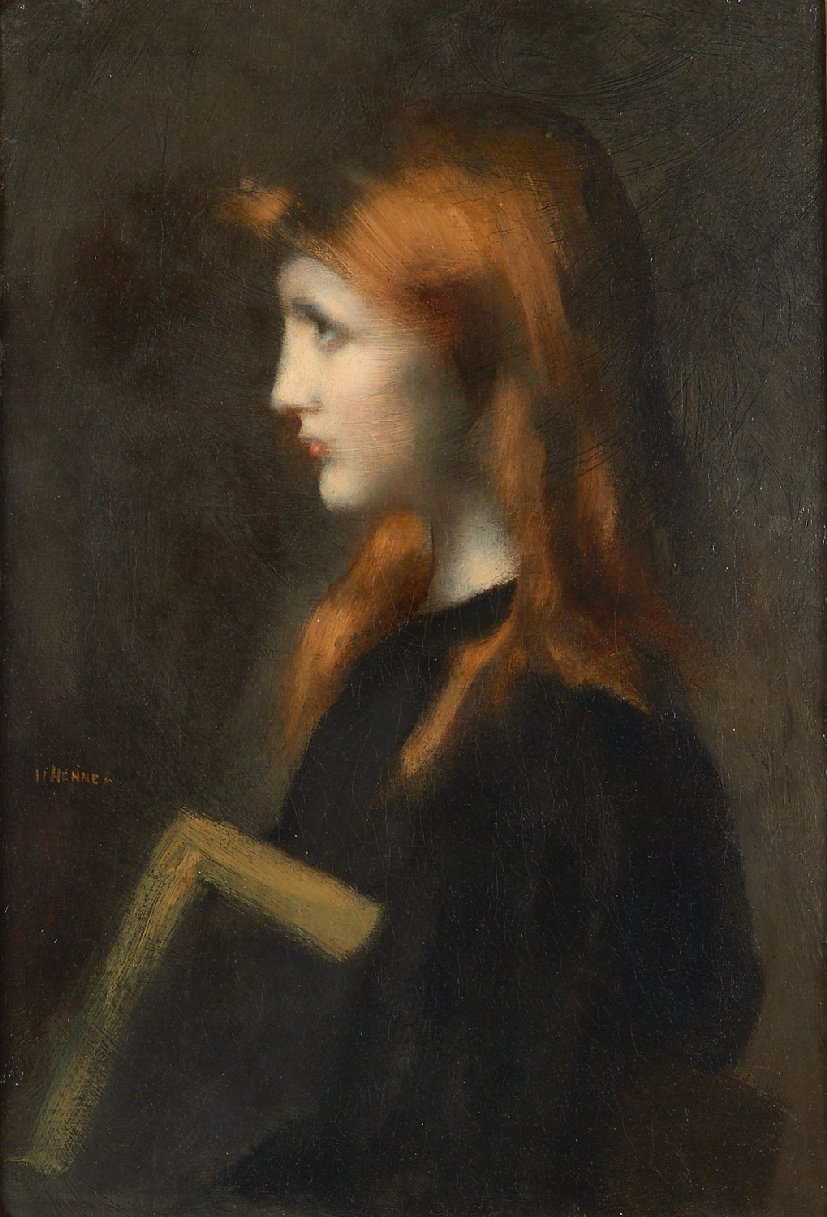
Henner’s love of portraying nudes in historical or mythological settings was not his only love. He had a passion for the colour red and of portraying women with red hair !
Woman in Red by Jean-Jacques Henner
Les Naïades by Jean-Jacques Henner (1861). Painted for the Soyers’ dining room, 43 rue de Fauborg Saint-Honoré. Paris.
Alsatian Girl by Jean-Jacques Henner
L’Ecoliere by Jean-Jacques Henner
Over the years Henner tutored many aspiring painters. Between 1874 and 1889 he taught at what was termed “the studio of the ladies”, which he organized with Carolus-Duran, during the time when women were not allowed entry to the École des Beaux-Arts. Some of these students also served as his models such as Dorothy Tennant, Suzanne Valadon and Laura Leroux-Revault, daughter of his close friend Hector Leroux; Henner’s full-length portrait of Laura Leroux (shown earlier) is now at the Musée d’Orsay having been shown at the Paris Salon of 1898 and purchased by the French State.
Jean-Jacques Henner (Photograph by Nadar c.1900)
Jean-Jacques Henner died in Paris on July 23rd 1905 aged 76.
Therese Schwartze was a Dutch 20th century painter. Such was a hugely talented portrait artist that was one of only a few females who had been honoured by receiving an invitation to contribute her self-portrait to the hall of painters at the Uffizi Gallery in Florence. This genius of portraiture completed around a thousand works during her forty-year career, which means that she completed more than twenty paintings a year. Because many of her portraits were created to be treasured by family members, most of her work has remained in private collections. About one hundred and fifteen of her paintings are in public collections in the Netherlands, and twelve are part of foreign public collections, which leaves the locations of nearly four hundred paintings still unknown. She became a millionaire in the process. Schwartze also established an international reputation, with countless exhibitions and commissions throughout Europe and the United States.
Self Portrait by Johan Georg Schwartze
Thérèse was born on December 20th 1852 in Amsterdam. She was the daughter of Johan Georg Schwartze and Maria Elisabeth Therese Herrmann. She was one of five children and had four sisters including Georgine, a sculptor, Clara Theresia, a painter and one brother, George Washington Schwartze, also a painter.
Portrait of Thérèse aged 16 by her father, Johan Georg Schwartze (1869)
Her father was a well-respected portrait painter and it was he who provided Thérèse with her first artistic training. In 1869 her father completed a portrait of his daughter, Thérèse.
Three girls of the orphanage in Amsterdam by Thérèse Schwartze (1885)
At that time, there was the perception that teaching girls and young ladies to paint was seen simply as a part of a cultured upbringing rather than a profession for earning money which was viewed as the role of the man. But for Johann Schwartze he couldn’t care less about such conventions. He trained his daughter in painting and drawing from a very young age and intended that Thérèse would become his worthy successor. She started her professional career at the age of sixteen, working in her father’s studio which she eventually took over when she was twenty-one after his death in 1874. Schwartze wrote to her father in a birthday letter, writing:
“…I will apply myself more to everything, so as, with God’s blessing, to be able to earn my living by painting…”
Because the art academies were not yet open to girls, her father sent her to Munich for expensive private lessons for a year under Gabriel Max and Franz von Lenbach who was regarded as the leading German portraitist of his era. In 1879 she moved to Paris and continued her artistic studies under Jean-Jacques Henner, the Alsace-born portrait artist.
The Vasari Corridor at the Uffizi Gallery, Florence
Thérèse Schwartze’s portraits are truly remarkable and she was one of the few women painters, who had been honoured by an invitation to contribute her self-portrait to the Hall of Painters, the Vasari Corridor, at the Uffizi Gallery in Florence. The Uffizi collection is one of the most complete in all Europe, first started by Cardinal Leopoldo de’ Medici in the 17th century. The passageway was designed and built in 1564 by Giorgio Vasari to allow Cosimo de’ Medici and other Florentine elite to walk safely through the city, from the seat of power in Palazzo Vecchio to their private residence, Palazzo Pitti. The passageway used to contain over a thousand paintings, dating from the 17th and 18th centuries, including the largest and very important collection of self-portraits by some of the most famous masters of painting from the 16th to the 20th century, including Filippo Lippi, Rembrandt, Velazquez, Delacroix and Ensor. While the Medici family bought the first paintings, after the collection started, the family started receiving the paintings as donations from the painters themselves. This has continued over the centuries and there were more paintings in the collection that did not have space to be exposed. Things have now changed as from 1973 to 2016, some of the self-portraits which had been hung in the Vasari Corridor, were, however only visible during restricted and occasional visits because of the confined space, which, also lacked air conditioning and adequate lighting. Most of the self portraits have been moved to other rooms at the Uffizi.
Self-portrait with Palette by Thérèse Scwartze (1888)
Only a handful of female portrait painters were active professionally in the 19th century, one of whom was Schwartze, who was nicknamed the ‘Queen of Dutch Painting’. In the self portrait she contributed to the Uffizi entitled Self-portrait with Palette, she depicts herself staring out at us with a haunted look, paintbrush in one hand with the other looped through a paint-laden palette. The background of this canvas is bare, and our eyes are drawn to the painter’s tools: eyes, brush, pigments, and a rag at the ready. The painting was exhibited at the 1888 Paris Salon before being given to the Uffizi gallery in Florence.
Sir Joshua Reynolds self portrait (c.1748)
Thérèse’s depiction of herself in her self-portrait could well have been inspired by Sir Joshua Reynold’s self-portrait which shows him similarly with his hand raised shielding his eyes from the bright light.
Young Italian Woman, with ‘Puck’ the Dog by Thérèse Schwartze, c. 1885)
Whilst living and studying in Paris, Thérèse completed her painting, Young Italian Woman, with ‘Puck’ the Dog. The model she used for this painting was known as Fortunata. She was one of the many professional Italian models working in Paris in the late 19th century. Schwartze started this painting in 1884 and exhibited it a year later in Amsterdam, having added the dog in the meanwhile.
According the 2021 biography by Cora Hollema and Pieternel Kouwenhoven entitled Thérèse Schwartze: painting for a living. Thérèse’s career took off at a time when a new, wealthy Dutch class wanted to flaunt its status and what better way to achieve this than with a flattering portrait. Her biographer wrote:
“She was in demand because she produced a new elegant, un-Dutch, extravagant, flattering style of portraiture which was in demand by the upcoming ‘new money…….. The new entrepreneurs and industrialists in the second half of the 19th century…”
Portrait of Aleida Gijsberta van Ogtrop-Hanlo with her five children by Thérèse Schwartze (1906).
Schwartze was one of the leading society painters in the Netherlands around 1900. Her clientele came from the nobility and the bourgeois elite in Amsterdam and The Hague. Members of the royal family also sat for her. A good example of her excellent portraiture is her 1906 group portrait of Aleida Gijsberta van Ogtrop-Hanlo with her five children. In this work, Aleida van Ogtrop-Hanlo is surrounded by, from left to right: Adriënne (Zus), Pieter (Piet), Maria (Misel), Eugènie (Toetie) and Adèle (Kees). The youngest and sixth child, Joanna (Jennie) was not yet born. Her husband was a wealthy stockbroker and founder of Amsterdam Royal Concertgebouw. The portrait of his wife and children has a dreamy quality, with rich clothing and poetic colours. It gives an excellent impression of the self-image of the Dutch upper classes at the beginning of the twentieth century. Stylistically Thérèse Schwartze followed in the footsteps of the famous eighteenth-century English portrait painter, Thomas Gainsborough.
Portrait of the six Boissevain daughters by Thérèse Schwartze (1916)
An equally great group portrait by Thérèse Schwartze was her Boissevinfamily portrait but this a more decorous depiction. It is entitled Portrait of the Six Boissevain Daughters and she completed it in 1916. According to Schwartze’s biography by art historian, Cora Hollema, this difference in style was not due to a development of the artist, but more to do with the wishes of her client. Mr. & Mrs. Boissevain, who were wealthy members of the Amsterdam upper class had ten children, six daughters and four sons. They were aware of the portrait of Aleida and her children by Thérèse but believed it to be far too modern. So, when they commissioned Thérèse to paint the portrait in 1916 they asked her to produce a more time-honoured portrait of their daughters. Thérèse was now the breadwinner of the family and so sensibly adapted her style according to her client’s demands bearing in mind the adage: The client was king.
Thérèse Schwartze in her studio, Prinsengracht 1021, Amsterdam, 1903.
Thérèse’s great success as an artist became a point of reference for the young Dutch women painters who founded the Amsterdamse Joffers, a group of women artists who met weekly in Amsterdam at the end of the 19th and beginning of the 20th century. These “ladies of Amsterdam” met weekly, often at the Schwartze home, to update the glorious Dutch tradition of painting based on French Impressionist innovations. They supported each other in their professional careers. Most of them were students of the Rijksakademie van beeldende kunsten and belonged to the movement of the Amsterdam Impressionists.
Woman wearing a hat (Portrait of Theresia Ansingh (Sorella)), by Thérèse Schwartze (after 1906).
Besides Schwartze’s commissioned portraits, which made her very wealthy, she still had time to complete portraits of her friends and relatives which were not commissioned and were often given as gifts. A fine example in this regard is the portrait of Schwartze’s niece, Theresia Ansingh, who later became a member of the Amsterdam school of female painters known as The Joffers, many of them were inspired by Schwartze’s professional success.
Maria Catharina Ursula (Mia) Cuypers by Thérèse Schwartze (1886)
One of my favourite portraits by Schwartze was her fascinating portrait of one of her friends, which is an amalgam of formal and informal portraiture and is entitled Portrait of Mia Cuypers. She was a daughter of the architect Pierre Cuypers, who designed such famous buildings as the Rijksmuseum and Amsterdam’s Central Station. In 1883, she fell in love, to the dismay of her family and the astonishment of “high society,” with the Chinese-British merchant Frederick Taen-Err Toung from Berlin, who was in Amsterdam selling his Oriental merchandise at the International Colonial Exposition. Mia managed to overcome the social uproar and married Toung in 1886. Being a close acquaintance of the Cuypers family, Thérèse was commissioned by the groom-to-be to make this wedding portrait, which is said to have only taken her one and a half days to complete. There are Chinese characters in the upper left corner, which are not clear in my attached photo, which mean “rice field,” “longevity”/”delighted,” and “coming together.”
Portrait of Queen Emma by Thérèsa Schwartze (ca. 1881)
Soon after, she received a commission for a portrait of Queen Emma and the little princess Wilhelmina, who was born in 1880. In the single portrait of the young queen, she is dressed in dark colours against a neutral background, all is dark except her face. In this painting, one can already see the fine art of portraiture and the depicting of differing textures that Thérèse fully mastered. The fur stole, the lace cap on her head, as well as the brocade of the queen’s robe.
Portrait of Princess Juliana by Thérèsa Schwartze (1910)
Thérèse’s worked with the royal family of the Netherlands through a period of thirty-five years and in all they gave her six commissions that contributed greatly towards her fame and wealth. Most royal portraits were of Queen Wilhelmina.
Portrait of Queen Wilhelmina by Thérèse Schwartze (1910)
The royal court had a habit of paying a little more than the average client, which meant that 1910 was a particularly profitable year for Thérèse. She painted so many members of the royal family that she was almost deemed a member of their household.
Portrait of Anton van Duyl by Thérèse Schwartze
In 1906, Thérèse Schwartze married the editor-in-chief of the Algemeen Handelsblad, Anton van Duyl. Twelve years after they married, Thérèse’s husband died on July 22nd 1918. It was double blow for Thérèse as she herself had been very ill at the time and five months later, on December 23rd 1918, three days after her sixty-seventh birthday, she died in Amsterdam.
Grave of Thérèse Schwartze at the Nieuwe Ooster cemetery, Amsterdam.
She was buried at Zorgvlied cemetery in Amsterdam but was later reburied at the Nieuwe Ooster cemetery in Amsterdam, where her sister created a memorial to her, modelled after her death mask, which is now a rijksmonument.
Maria Slavona was born Marie Dorette Caroline Schorer on March 14th 1865 in the north German town of Lübeck. She was the daughter of the pharmacist Theodor Schorer and his wife Ottilie, (née Steger). Her father owned the Löwenapotheke on the corner of Königstraße, and Johannisstraße in the town, which is now known as Dr.-Julius-Leber-Straße. She was the youngest of five children and had two brothers and two sisters. As a child, she was brought up in a happy household in the old patrician house in Johannisstraße. Her parents’ home was a great meeting place for writers, artists and intellectuals. For Maria life at home was a liberal and cultural experience and, at an early age, she soon developed an intense interest in drawing and painting. Her parents encouraged her love of all things artistic and they hopde that one day she would become a painter and her mother and father supported this future road for her.
Red Gardener’s House with Gardener (Early Spring, Kahlhorst near Lübeck) by Maria Slavona
In 1882, when she was seventeen years of age, Maria went to Berlin to study art. This was an unorthodox move as accordance with the social conventions of the time, it was unseemly for a young, unmarried woman to leave her parents’ home and pursue an education, in her case. studying painting. Her move to Berlin caused a scandal in the Hanseatic city of Lübeck. However, since women in Germany were denied access to art academies, Maria Slavona attended the Eichler private painting school in Berlin and the Deutsches Gewerbe-Museum zu Berlin, (Royal Museum of Decorative Arts) which at the time had a teaching institute. In 1887, aged twenty-two, she moved to the painting school of the Verein der Berliner Künstlerinnen (Association of Women Artists and Friends of Art) in Berlin. It was an informal and free atmosphere, and the women here were allowed to conduct nude studies on living models. A year later she enrolled at the painting school of the Münchner Künstlerinnenverein (Munich Association of Women Artists).
Self portrait by Maria Slavona (1887)
Her self-portrait, created in Berlin in 1887, shows the face of a 22-year-old, extremely pretty young woman, framed by tangled curls. With her head turned to the left, she fixes her gaze firmly on the viewer. Settling in this Bavarian city was fortuitous as the city of Munich had been, since 1850 onwards, deemed the most important centre for artistic creation and painting. At this time, her most important patron and mentor was Ludwig Herterich, a German painter and art teacher, who in 1898 was a professor at the Academy of Fine Arts Munich, where he taught many young artists including Maria Slavona. He introduced Maria to French Impressionism. A painting style that would be influential for her later paintings.
In the Munich Ladies’ Academy: Käthe Kollwitz seated between Maria Slavona (front right) and Rosa Pfäffinger (lying in front right)
Maria loved her time in Munich and made many friends including a fellow aspiring young painter, Käthe Kollwitz, who was also studying art in Munich. During a return home to Lübeck, she met some Scandinavian artists, one of whom was Vilhelm Petersen and, as they became closer friends, they both decided to take assumed names for their artworks. He chose Willy Gretor and she became Maria Slavona. Along with friends Maria and Vilhelm visited Paris in 1890. She recalled her arrival in the French capital:
“…In 1890, I came to Paris. This is where a new world opened up to me. The first visits to the Louvre almost numbed and overwhelmed me. But I was disappointed by the schools I saw, I didn’t like them. I decided to work alone and seek advice and judgment only in the circle of a few young like-minded friends, almost all Danes and Norwegians…”
Sommermorgen am Starnberger Seeby Maria Slavona
That same year, Maria gave birth to an illegitimate daughter, Lilly, but her relationship with the father of the child, Petersen, was over. She had at first looked upon him as a charismatic and educated man but he turned out to be a dubious art dealer, womanizer and bon vivant. Worse still when their daughter Lilly was born Petersen had deserted Maria and she was left to bring up her daughter alone.
Alte Blumenfrau by Maria Slavona (1893)
In 1893, at her first exhibition at the Salon de Champ-de-Mars an annual event organized by the Société Nationale des Beaux-Arts. Maria Slavona submitted her work, Alte Blumenfrau (Old Flower Woman). At this exhibition, ironically she identified herself under the male pseudonym “Carl-Maria Plavona”. The painting depicts an old woman standing in frontal view, holding a large basket of white and yellow flowers in front of her body in her worn-out hands. Placed in front of a simple, ochre-coloured wall, the dark, poor clothing of the woman forms a strong contrast to the light background. The wrinkled face, framed by a headscarf, shows emotionless features. The tired eyes look firmly at the viewer.
St Jurgen-Gang in Lubeck by Maria Slavona (1902)
Maria Slavona who, around 1898 had met the Swiss art connoisseur and collector Otto Ackermann. Their friendship grew over the next two years and in 1900 they married. Maria’s daughter Lilly took the name Ackerman and later she became an actress under the name Lilly Ackermann. Otto Ackermann was a valuable asset in the introduction of French art into Germany in the early 20th Century. Otto and Maria set up home in Paris and it soon became a central meeting place for Parisian bohemianism. Visiting artists such as Münch, Liebermann, Leistikow, along with literary giants and art lovers would often frequent their home and be made most welcome. Maria, who had spent sixteen years in the French capital, had led a happy and artistically productive life. During this period, she had completed many paintings depicting landscapes, portraits, still life and interiors.
View from Studio Window by Maria Slavona (1899)
One of her favourite subjects was the view from the window of their home. All of her work over those years established her reputation as a talented painter.
Houses on Montmartre, around 1900 by Maria Slavona
Häuser am Montmartre by Maria Slavona
In 1906 Maria and her family left Paris and returned to her old hometown of Lübeck. During her stay in Lübeck she completed many paintings depicting the town and the surrounding areas.
Villa entrance in Lübeck by Maria Slavona
Spring Thaw near Lubeck by Maria Slavona (1913)
Unfortunately, the bourgeois, art-hostile atmosphere that pervaded the old Hanseatic city had a negative effect on her husband’s art trade business and sadly this gave them no alternative but leave Lübeck in 1909, and move to Berlin. It was in the German city of Berlin that she was once again artistically active and from 1913 she became a member of the Berlin Secession. This was one of the last art Movements of 19th century German art. It was a breakaway group of artists, who in 1898 ‘seceded’ from the city’s arts establishment, led by the eminent painter Max Liebermann. It was a reaction to the Association of Berlin Artists, and the restrictions on contemporary art imposed by Kaiser Wilhelm II. Sixty-five artists “seceded,” demonstrating against the standards of academic or government-endorsed art. The group established an independent exhibition society, in order to champion new forms of modern art – rather than continue to churn out the old-fashioned academic art favoured by the art establishment.
Bouquet of field flowers by Maria Slavona (c.1900)
Following the end of the First World War Maria’s health began to deteriorate. Added to that with a decrease in the sale of her paintings, the financial circumstances of the family took a substantial dip. To try and rectify both her health and cut back on their financial outgoings the family moved to the countryside village of Munsing in Upper Bavaria. From that time on, Maria mainly created floral still life works.
Self portrait by Maria Slavona (1910)
Maria Slavona died in Berlin on May 10th 1931 aged 66. Unfortunately, a large part of her work was lost during the Second World War, and also, for many years, her remaining works were branded by the Nazi government as Entartete Kunst (Degenerate Art) in 1933 and it was mainly ignored outside of her hometown Lübeck. Slavona is now known and famous as a representative of German Impressionism. Although she was unable to build on the artistic successes of her Paris years in Berlin, she was one of the best-known painters of her time, along with Dora Hitz and Käthe Kollwitz.
On the occasion of the 50th anniversary of her death in 1981, the Hanseatic City of Lübeck honoured its once famous and forgotten citizen with a large exhibition in the St. Anne Museum.
Portrait of Ellen Day Hale by Margaret Lesley Bush-Brown (1944)
The artist I am looking at today is the American painter, Ellen Day Hale. Ellen Day Hale was born on February 11th, 1855 in Worcester, Massachusetts. She was born into an elite Boston Brahmin Hale-Beecher family. The Boston Brahmins, sometimes referred to as the Boston elite, are members of Boston’s historic upper class who were associated with a cultivated New England accent, going to Harvard University, Anglicanism, and traditional British-American customs and clothing. They were considered White Anglo-Saxon Protestants (WASPs).
Edward Everett Hale
Hale’s father was the author and orator Edward Everett Hale, an American historian, and Unitarian minister, who was best known for his writings such as “The Man Without a Country” which was published in Atlantic Monthly in support of the Union during the Civil War. Her father acted as a Unitarian chaplain in the U.S. Senate from 1904 until his death in 1909, and Ellen Hale often assisted her father in his church-related duties. Her mother was Emily Baldwin Perkins. Although the Hale family was looked upon as being part of the Brahmin elite, they were neither wealthy nor were they well respected among the Boston upper class. Emily Hale was one of nine children. Her elder brother died during childbirth and she then became the oldest of eight children with seven younger brothers. She was brought up in an artistic household and her mother encouraged her interest in art, and her father’s sister was watercolourist Susan Hale, and it was thought that Susan gave Ellen her first artistic instruction. Her brother was Philip Leslie Hale who became a celebrated artist and art critic and who married Lilian Westcott Hale, an Impressionist painter.
Plains Indian Girl by Ellen Day Hale
During the 1870s, Ellen Hale decided that she needed to move forward with her art and look for a formal art education. It was a good time to cement this artistic idea as Boston was in the middle of what was known as the Boston Renaissance and new cultural institutions were coming into being in the city. A new and large Boston Public Library had been founded in 1848 and the first large free municipal library in the United States, the first public library to lend books, the first to have a branch library, and the first to have a children’s room. The Boston Museum of Fine Arts (MFA) was founded in 1870 and in 1876, it moved to a highly ornamented brick Gothic Revival building in Copley Square.
William Morris Hunt by Helen Mary Knowlton (1896)
Starting in 1874, Hale enrolled on a five-year course at William Morris Hunt’s school for painting, where she studied under Helen Mary Knowlton. Helen Mary Knowlton had received art tuition from William Morris Hunt, and she told him that she knew of forty women who would love to study art and so in 1868, despite criticism from those who thought he was wasting his time, Hunt began classes for women. It was not art that he was teaching, he was inspiring his female students and instilling in them a sense of self-worth. When Hunt died in 1879, Knowlton carried on his work of supporting his female students and getting the group of women to rely upon each other for professional and personal support rather than their husbands or other men,
Morning News by Ellen Day Hale (1905)
Having finished her five years at the William Morris Hunt school she moved to Philadelphia and enrolled at a two-year course at Pennsylvania Academy of the Fine Arts (PAFA), where the director was Thomas Eakins. Following this, in 1881, Ellen Day Hale went to Europe with Helen Knowlton and the pair went on to visit Belgium, Holland, Italy and England continually visiting museums of art and taking time to copy some of the paintings. For a brief time whilst in London, Hale studied at the Royal Academy, but she eventually parted company with Knowlton and travelled to Paris where she enrolled with Emmanual Frémiet at the Jardin des Plantes, worked in the atelier of Emile Carolus-Duran, and learned the French academic style at Académie Julian before returning to Boston in 1883.
Self portrait by Ellen Day Hale (1885)
It was whilst back in Boston at her family’s home in Roxbury, Massachusetts, and at the family’s summer home in Matunuck, Rhode Island. that Hale began her self-portrait in 1884. In this work we see Hale gazing out at us with great assurance. Her right arm rests on the arm of a chair. She is dressed completely in black wearing a dress with buttons and a fur collar, covered by a loose jacket. From under the brim of her black hat we can see her fringe. Hale appears to be making a fashion statement with her clothes and youthful hairstyle. Her bold gaze and her fashionable outfit suggest her willingness to push traditional boundaries. Hale exhibited her Self-Portrait in Boston, perhaps for the first time, in 1887. The Museum of Fine Arts, Boston, which owns the work later commented:
“…Hale’s forthright presentation, her strong dark colours, and the direct manner in which she engages the viewer recall the work of one of the French painters she most admired, Edouard Manet. Manet had been known for his confrontational images, strongly painted without subtle nuances of light and shadow…”
June by Ellen Day Hale (1893)
Now although back living in Boston, Hale still loved to travel and made frequent journeys to Europe, North Africa, and the Middle East. She also spent time exploring her own country especially the American West. Despite her railing against traditional limitations exacted on females by society, the one she concurred with was that women should not travel alone and so she needed to find a like-minded companion for her exploratory journeys. Hale soon lighted on the perfect companion in the guise of the painter Gabrielle de Veaux Clements. Gabrielle had attended several prestigious art schools, studied under notable artists such as Tony Robert-Fleury and William-Adolphe Bouguereau, and exhibited at the Paris Salon in 1885. Clements specialized in landscapes, cityscapes, and harbour vistas capturing the bustling spirit of Paris, Baltimore, Cape Ann, and other cities and towns throughout France, Algiers, Palestine, and along the American East Coast.
Gabrielle de Veaux Clements.by Ellen Day Hale (1883)
Clements became the traveling partner of Ellen Day Hale whom she met in 1883. The two artists became life-long friends and beside their painting trips spent their summers in Folly Cove on Cape Ann, Massachusetts, which was a popular artist destination and an artist’s colony thrived. It was where the artists staying there were able to share models and learn each other’s techniques. Such was their close friendship that in 1893, the two artists established a household together in the small Massachusetts town of Folly Cove, at a house they bought, “The Thickets”. During the winter months Clements and Hale spent their time traveling throughout Europe but sometimes just remained in America in Charleston, South Carolina, where they taught etching. Among their circle of friends and visitors were Cecilia Beaux and Margaret Bush-Brown. Between 1904 and 1909, Hale resided in Washington, DC, serving as hostess in her father’s home while he was chaplain to the U. S. Senate.
Early Vegetables by Ellen Day Hale (c.1918)
The relationship between Ellen Day Hale and Gabrielle de Veaux Clements was often referred to as a Boston Marriage. A Boston marriage was, historically, the cohabitation of two wealthy women, independent of financial support from a man. The term is said to have been in use in New England in the late 19th and early 20th century. Some of these relationships were romantic in nature and might now be considered a lesbian relationship; others were not. The nature of Ellen and Gabrielle’s type of relationship is simply unknown.
Musical Interlude by Ellen Day Hale
While in Charleston Ellen and Gabrielle immersed themselves in the flourishing arts renaissance which was taking place in the city. They were both accomplished printmakers and they helped organize the Charleston Etchers Club, whose founding members included Elizabeth O’Neill Verner, Alice Ravenel Huger Smith, and Alfred Hutty. It was Verner’s daughter who later recalled the input of Verner and Hale had in Charleston and she recalled Clement’s words:
“…We want to leave Charleston some of our skills . . . Get together a group so you can buy a press and we will show you how to use it . . . We’ll teach you, so you can teach them…”
The Charleston Etchers’ Club was formed in 1923 and it offered instruction on printmaking, encouraged intellectual exchange, art criticism, and exhibition planning.
The Green Calash by Ellen Day Hale (1904)
In 1904 Ellen Hale completed a painting entitled The Green Calash. A calash is a large green bonnet or hood and resembles the folding top of an 18th-century carriage known as a calash. It is a three-quarter-view portrait of a young woman who is sitting on a chair with her hands resting together in her lap.
The Green Calash by Ellen Day Hale (1925)
In 1925, twenty-one years later, Hale completed a soft ground colour etching and aquatint after her 1904 painting. The print is again a three-quarter-view portrait of a young woman seated with her hands resting together in her lap and is once again wearing a large green bonnet. The print of this etching was exhibited at the Smithsonian as part of a print exhibition in November 1936. Gabrielle DeVeaux Clements and Ellen Hale experimented extensively with colour printmaking throughout their careers.
The Original Colour Engraving by René Ligeron
Both had been influenced by the French artist René Ligeron’s 1924 treatise on colour intaglio, which Hale translated into English for the Smithsonian exhibition. Gabrielle Clements wrote to curator R.P. Tolman telling him that she and Hale had “been working on an interesting line of experiments in printing etchings in colour” and that they had “lately gained better control of the medium, and greater simplicity.”
This prestigious 1936 exhibition came near the end of Hale’s and Clements’s careers. By that time, they had been producing prints for more than sixty years. It was almost fifty years earlier that their work was showcased at the Women Etchers of America exhibition in 1887 at the Boston Museum of Fine Arts.
Hale died in Brookline, Massachusetts, on February 11, 1940, her 85th birthday. Hale’s legacy is not only in her artwork and etchings but also her struggle to gain in the acceptance of female artists. A member of what is now referred to as the Boston School of Painting, Hale has also been recognized as one of America’s leading women impressionists. She also wrote History of Art (1888). Her artist brother Philip Hale also exhibited at the Chicago World’s Fair.
Ellen Day Hale
In his 1997 memoir, A Sculptor’s Fortunes, by Walker Kirtland Hancock an American sculptor and teacher talked about Hale and Clements, and their roles in establishing Folly Cove as a gathering spot for artists, a place he first visited in 1920:
“…Folly Cove…had begun to attract artists at least two generations before I arrived. The first to settle there were Ellen Day Hale and Gabrielle deV. Clements….Their houses were close to each other, overlooking the cove. Miss Clements’ was a large frame structure not far back from the road. Miss Hale’s, a stone building, was on higher ground. Miss Clements had been a mural painter, but because of her age she at that juncture limited her work to etching. She was kind and patient enough to give me lessons in that art. Miss Hale continued with her portrait painting. Both ladies were very much a part of the local community…They were responsible for [sculptor] Charles Grafly’s buying a house and building a large studio nearby, having recommended “the Folly” to him as a healthful place in which to live…