River Landscape with Horseman and Peasants by Aelbert Cuyp

River Landscape with Horseman and Peasants by Aelbert Cuypt (Late 1650's)

 My Daily Art Display today is a return to landscape painting and a revisiting of the Dutch artist Aelbert Cuyp.  The last time I offered you a painting by this great artist was over a month ago (February 8th) when I talked about a seascape of his.  Today I want to look at one of his many landscapes entitled River Landscape with Horseman and Peasants, which he completed in the late 1650’s and can now be found in the National Gallery, London.

This talented Dutch Italianate painter was born in 1620 in Dordrecht, a city in the Netherlands. He is one of the country’s most important landscape painters of 17th century.  This was the time of the Dutch Golden Age – a time when the local trade, science and art were recognized throughout the world.   Looking at a number of Cuyp’s landscape paintings, it is thought he may have spent time in Italy or he may simply have mixed with other Dutch Italianate landscape painters who had made the artistic pilgrimage. Throughout the 17th century a steady flow of Dutch painters made the difficult and strenuous journey to Italy, which was recognized as the “home of art.”   Here artists of other nationalities studied the great masters of the Renaissance and the contemporary painters of the Baroque genre.   The Dutch at this time  were enchanted with Italy  and landscapes of the Italian countryside.  They loved everything about the country.

Cuyp painted still lives, animals, portraits, and landscapes and worked in two distinct styles. In his early twenties he came under the influence of other artists and he tended to paint naturalistic, diagonal compositions that show a good sense of space and an almost monochromatic yellowish-gray colour. It wasn’t until he was in his thirties and forties that he exhibited a more individualistic style.  This was considered his best period.   Cuyp’s paintings are sunny and lively in atmosphere, profound in tonalities, simple in outline, well-balanced in composition, and notable for the large, rich foreground masses. His palette tends largely to yellow, pinkish red, warm browns, and olive green rather than blue and silver grey.

Today’s painting by Cuyp is looked upon as one of the greatest 17th century Dutch landscape paintings.   It is also believed to be the largest surviving landscapes of the Dordrecht artist and I believe one of his most beautiful. This river landscape with its distant mountain and town across the river is not topographically accurate.  It is not a painting of an actual location but a work of art which encompasses an evocation of an idyllic pastoral land bathed in sunlight, populated by a hunter, an elegant rider and some peasants tending the sheep and cattle. 

The elegantly dressed horseman surveys his animals and the peasants who are in charge of herding them.  This harks back to the feudal past and it is probable that the painting was for some rich landowner or member of the nobility who liked to be reminded of those “happy” days.  It is a very serene setting.  However, in the foreground to the left we spot a huntsman crouched down behind the reeds taking aim at the ducks, which are on the water, unaware of their coming fate.  Very soon the tranquility of the scene will be shattered by the deafening sound of gun fire.

Look how the riverbank is suffused in soft sunlight.  It lights up the animals and people as well as the fauna.  The cows cool themselves by resting quietly under the shadow of the trees.  The characteristic of this light is symptomatic of the Dutch Italianate artist’s approach to landscape painting where the artist turned to the Italian campagna for their subject matter with their glorious tonal control, mastery of colour and magical handling of light.  These Dutch Italianate artists would trek across the mountains to Italy and spend many days sketching the sun drenched Italian landscapes which were so different to the flat openness of their homeland with its often cloudy skies.   Cuyp’s landscape is truly remarkable.  It was painted at a time when the taste of wealthy Dutch patrons combined with the artist’s imagination and the influence of Italy and the important cultural elements of the Netherlands came together.  This actual painting was acquired by the Earl of Bute in the mid 18th century and it lead to other British collectors wanting to get hold of the artist’s work.

Is this not the type of spring day we dream of after coming through the cold of a prolonged winter?   Could you not lie back on the river bank and let the sun gently kiss your skin.   Can you see why the Dutch wanted to buy this little piece of heaven ?

Portrait of Susanna Lunden by Peter Paul Rubens

Portrait of Susanna Lunden by Peter Paul Rubens (c.1622-5)

My Daily Art Display today is an oil on oak painting by Peter Paul Rubens which he completed around 1625.  It was entitled Portrait of Susanna Lunden (?).   An alternate title Le Chapeau de Paille, meaning straw hat, was first used in connection with this painting in the early 18th century.  However looking at the painting one can see that the lady is not wearing a straw hat which leads some art historians to believe that the alternate title of the painting is more likely to have been Le Chapeau de Poilpoil being the French word for fur.

There is a relaxed attitude to this picture presumably because of the family connection of artist and sitter.  The hat which partly shades the face of the lady is a dominant feature of this painting.   It is believed that the sitter is Susanna Lunden who was the third daughter of the Antwerp tapestry and silk merchant Daniel Fourment for whom Rubens designed.  There was, besides a working connection, a relationship between Fourment and the artist as in 1630, Rubens was to marry Susanna’s younger sister Hélène.  Also his sister-in-law, from his first marriage to Isabella Brunt was married to Susanna’s brother David Fourment.  The picture, which was started by Rubens around 1622, was at the time of Susanna’s second marriage, this time to Arnold Lunden.  Her first marriage ended with the death of her husband when she was still a teenager.  Judging by the ring on Susanna’s right index finger it is quite possible that the painting was a betrothal or marriage portrait.

Strange as it may seem, the painting grew in size as it was being painted as we now know that an extra strip of wood was added to the right-hand side and further strip of wood added to the bottom.  These additional strips allowed Rubens to enlarge his background and create a greater spread of sky to which the artist was then able to add some dark clouds to the right-hand side of the background, which contrasted to the clearer blue sky to the left.  Maybe there was some meaning to this contrast in the skies.  Maybe the dark clouds symbolised the sadness of a young widow and the bright blue skies represented the coming of a new and happy life through her second betrothal.  The light from the left hand side of the painting falls across the lady’s body and hands but the right side of her face is partly in shadow owing to the large brim of the hat.  However even the shadow could not lessen the lustre of her skin and the intensity of her eyes. 

It is a sparkling portrait.  The smiling Susanna seems thoughtful.    Maybe it is a shy smile.  Maybe it is a coy smile.  I wonder if she realises the beauty Rubens has conjured up for this portrait.  I am not even sure she is aware of her loveliness or, if she is, maybe it causes her embarrassment.   Her felt hat, adorned with its downy peacock feathers, is so wide and floppy that it almost borders on the absurd but would, I am sure, be well received on Lady’s Day at Ascot races!  The lady, with her full Rubenesque breasts,  a trademark of the Belgian painter, stands demurely before us but, to some extent, avoids our gaze.  

Rubens portrayal of Susanna presents us with a beautiful and desirable woman.  Look at her eyes.  See how Rubens has made the eyes large and lustrous and note how he has chosen black as the colour of the iris.   This enhances the beauty of the subject and her slightly parted pink lips add to her sensuousness and offer a suggestion of eroticism to the painting.  Her pale skin glistens in the light.  She almost glows.  Her red and grey robes are both opulent and unusual with the detachable red sleeves attached to her bodice with ribboned gold-tipped laces.  The colour of the ribbons match that of her lips, nostrils and eyelids.

Could the artist not help but be seduced by the beauty of his sitter ? 

Are we not beguiled by her beauty?

Pope Julius II by Raphael

Pope Julius II by Raphael Sanzio (1512)

Giuliano della Rovere was born in 1443 in Liguria, Italy.  He came from a noble, but poor family.  He received his schooling from his uncle Francesco who was a member of the Franciscan Order.   In 1471 Francesco became Pope Sixtus IV and was able to further the career of his nephew. At the end of 1471, he made the twenty-eight year old Giuliano a cardinal priest in Rome and this post afforded him many beneficiaries from which he built himself a considerable income.  His uncle died in 1484.  Giuliano was not in the position to become pope himself but his sizeable wealth allowed him to bribe the papal electors so as to have the weak but now indebted Cardinal Cibo made Pope Innocent VIII.  This newly elected pope was merely a puppet of Giuliano for the ensuing eight years.  When Pope Innocent VIII died, Giuliano made his move to become the next pope but during the eight years of being the power behind the late pope he had made enemies of many of the other cardinals and for them it was “pay-back time”.  They ignored Giuliano’s candidacy and instead in 1492 voted in his enemy Cardinal Rodrigo Borgia as Pope Alexander VI.  Giuliano was devastated at being overlooked and fearing for his life fled the country and journeyed to France where he remained until Pope Alexander VI died in 1503.  Once again Giuliano was overlooked when it came to vote in a new pope and the cardinals elected Pius II, who was ill at the time and died twenty-six days after becoming the new pontiff.  Giuliano della Rovere sensed that his time had come at last and with the help of much bribery and promises of high office he persuaded the cardinals to vote for him at the papal elections and so in 1503 Giuliano della Rovere became Pope Julius II.

Unlike the papacy of today in the fifteenth and sixteenth centuries the office of the pope had great temporal power and Julius II, known as “The Fearsome Pope” was a war-like pope who wanted the Papal States to become stronger, more powerful and for it to extend its control and by so doing, enlarging the papal rule.  With his powerful army he recaptured the lands of Romagna and Perugia and brought them under his control.  In 1509 his forces defeated the might of Venice.  Next he turned to ousting the French from Italian lands with the help of the Holy League, an alliance he formed for the purpose of expelling the forces of Louis XII of France from Italy and thereby consolidating his papal power.   Venice, the Swiss cantons, Ferdinand II of Aragón, Henry VIII of England, and Holy Roman Emperor Maximilian I were the chief members of the League.   The Swiss, who did most of the fighting, routed the French at Novara in 1513, but in the same year Julius II died and the league fell apart. Two years after his death the France re-established the French in Lombardy

One of the most important legacies Pope Julius II left was as a patron of the arts.  He persuaded, some historians would say bullied, Michelangelo into re-painting the Sistine Chapel.  It was Julius II who commissioned Raphael to paint four rooms in the Vatican, now known as Stanza di Raffaello and it was Julius who hired the Italian architect Donato Bramante to design and build an impressive new basilica in place of the old Basilica of St Peters , which sadly Pope Julius II never saw completed.
My Daily Art Display today is an oil on panel portrait of Pope Julius II painted by Raphael Sanzio in 1512, two years before the pontiff’s death.  It is an awe-inspiring work of art.  The pontiff doesn’t look at us.  His look is somewhat downcast and there is a definite melancholia about his demeanour.  It is as if he didn’t want to sit for his portrait.  We are almost dismissed by his dejected expression as if he wants desperately to be left alone.  Is this a realistic expression or just Raphael’s slightly unkind take on the pontiff’s mood?  According to the biographer and artist Giorgio Vasari, the contemporaries of the pope found the portrait

“….so true and lifelike that the portrait caused all who saw it to tremble as if it had been the living man himself…”

To be fair, the pontiff was sixty eight years of age and maybe at that age we are all allowed to look grumpy !  There is a feeling that the pope is just too despondent to speak, even too dispirited to look you in the eye.  Maybe he believed he had cause to be downhearted as it was around this time, 1511, that he learnt that Bologna had seceded from the Papal States.  At this loss, he grew a beard as a token of his mortification, which was also an ancient form of mourning.  He let this soft milky-white beard grow and did not shave it off until a year later.

The pontiff sits before us in an armchair on which is carved his own personal emblem, the acorn.  Julius’s family name was della Rovere which is the Italian word for oak.  Raphael has not positioned the pope “face-on” as was the norm for portraits of enthroned rulers of that time.  Raphael has captured in this painting an ageing man with a lined face and its sagging flesh.  Raphael however has given it colour and radiance.  The fingers of his hands bear emerald and ruby rings.  His right hand grips a white handkerchief giving an air of private compassion whilst his left hand grips the arm of the chair.  The white ruched fabric of his robe cascade and billow over his knees and hide his frail body.    We are not approaching the portrait as mere commoners about to kneel before our religious master.   We approach an elderly man from the side as if we are coming up to an elderly relative.   The pope is not wearing his ceremonial triple-crown hat.  He just wears his simple red fur-trimmed cap.

This painting of the somewhat frail and bearded leader of men makes us forget that he was, years earlier, a leader, who rode into battle with his troops.  His fragility belies that image we have of that fierce figurehead.  This was once a powerful man, someone to be reckoned with and  of whom Michelangelo said that on their falling out “he could feel the rope around his neck”.   When we look at this man we know we are in the presence of somebody special, someone who exudes unquestionable authority.  Raphael gave this old man a demeanour, which despite the ravages of time, makes us believe we are in the presence of greatness.

The Marquise de Seignelay and Two of her Children by Pierre Mignard

The Marquise de Seignelay and Two of her Children by Pierre Mignard (1691)

Pierre and Nicolas Mignard were brothers and as aspiring artists.  Both studied under the French painter Simon Vouet in his Paris atelier.  Today, I am looking at the work of the younger brother Pierre who was born in Troyes in 1612.  He remained a pupil of Vouet until 1630 at which time he travelled to Italy and remained there for twenty-two years, residing, in the main,  in Rome although he did visit Venice and some of the northern Italian towns.  For this reason he was known as Mignard le Romain differentiating him from his older brother Nicolas, who was known as Mignard of Avignon.  Whilst there he built up his reputation as an artist and his fame spread.  Many of his works were exhibited in Rome.   In 1655 he married Anna Avolara, the beautiful daughter of an architect who subsequently posed for his Madonnas.  In 1658 he returned to France at the behest of Louis XIV who had inaugurated a system that relied upon the glory of arts for the exaltation of the monarchy and it was thought that Mignard could help with this royal scheme.

Mignard, now back in Paris, set about completing portraits of Louis and his family.  He was awarded the commission to decorate the Hôtel d’Eperon and the cupola of the Val-de-Grâce, the latter, said to be the largest frescoed surface in the world, comprising of two hundred colossal figures, representing Paradise.  However Mignard spent most of his time painting portraits and among his sitters were Molière and Descartes.   In 1690 his great rival Charles le Brun, the French painter and art theorist died and Mignard, at the age of eighty, succeeded to all his offices, and was solemnly received into the Academy, and in one session elected to all its degrees, including that of president.   The French Secretary of War, the Marquis de Louvers consulted him on the project of decorating the cupola of the Invalides.  The veteran painter saw an opportunity of crowning his career with an exceptional performance, but Louvois died, the work was delayed, and the artist lost all hope of realizing his last dream.   Mignard died, it may almost be said, with his brushes in his hand, at the age of eighty-two.   His last work is a picture in which he himself appears as “St. Luke painting the Blessed Virgin“.

My Daily Art Display today is Pierre Mignard’s oil on canvas portrait of Catherine-Thérèse de Matignon, the widow of statesman Jean-Baptiste Colbert de Seignelay and her two sons entitled The Marquise de Seignelay and Two of her Children, which he completed in 1691at the age of 79 and can be found in London’s National Gallery.

Catherine-Thérèse had been widowed a year when Mignard was commissioned to paint her portrait.  Her late husband had been head of the French Admiralty and this could have been  the reason for the aquatic mythology of this painting.  Mignard had little to do with the setting of the painting.  Catherine-Thérèse, the bereaving widow, instructed Mignard on how the painting should be and how she and her sons should be portrayed.  Neil McGregor the art history offers another theory about the aquatic nature of the portrait saying that it has little to do with her late husband’s employment but that she wanted to be depicted as the sea-nymph Thetis.   

The Marquise de Seignelay, of old Norman nobility,  had something else in common with sea-nymph Thetis, as she,  like the Greek goddess, was married off against her will to a “social inferior” as her husband was the son of a lowly draper.  Thesis was married off to the mortal Peleus against her wishes and he had to rape her to “beget” on her the great Achilles.   The story of Thetis tells how she descended into the crater of the volcano, Etna, which can be seen in the background of the painting, to obtain the armour made by the blacksmith and God of fire, Vulcan.   Catherine-Thérèse’s eldest son, the eight year old Marie-Jean-Baptiste de Seignelay, who stands on the right of the painting can be seen wearing this armour.  This was also close to the time that his mother had bought a military commission for her son.   Like Thetis and her beloved son Achilles, maybe this portrait is an affirmation that Catherine-Thérèse would go to any length to protect and help her son succeed.   We may also interpret this portrait as her wish to have it known that she was the power behind the throne (the marriage) and now that her husband was dead her loyalty and support would be transferred to her eldest son.  Was she thinking about the passage in Ovid’s Metamorphoses which said of Thetis:

“..O goddess of the waves, conceive: thou shalt be the mother of a youth who, when to manhood grown, shall outdo his father’s deeds and shall be called greater than he..”

On the left of the painting we have a small cupid offering the woman a valuable nautilus shell on a gold stem, which is overflowing with jewels and pearls.  It is thought that the cupid could be Catherine-Thérèse’s one-year old infant Théodore-Alexandre.  There is a quirkiness about this flamboyant portrait which spurns the dull reality of everyday life and supplants it with a dream-like fantasy.  The Marquise de Seignelay dominates the painting.  She stands looking directly at us.  She is adorned in an ultra-marine cloak and gold chemise.  It should be noted that the pigment ultramarine at the time was very expensive, more so than gold and for this reason it was seldom used in paintings and certainly not in such quantities.  The fact that it has been used in this portrait may be to confound rumours that the noble widow, Catherine-Thérèse, was almost bankrupt.  This combination of colours lends a sense of divinity to her figure.  She is clutching a locket on a string of pearls.  Her hair is decorated with pearls, seaweed and red coral, which contrast vividly with the colour of her cloak and which almost look like tiara fit for a monarch.  The painting has immediately transported her from the misery of widowhood in Paris to that of a mythical goddess in southern Italy.

A half century later, William Hogarth the English painter, who had an aversion for all things French said on being arrested as a suspected spy in Calais, said the French displayed:

“…….. their insolence with an affectation of politeness….”

Maybe Hogarth’s thought could be levelled at the Roman-trained Mignard’s depiction of a mother and her two sons but one should remember it was the widow dictated what she wanted the artist to portray.

Rinaldo and Armida by Nicolas Poussin

Rinaldo and Armida by Nicolas Poussin (1625)

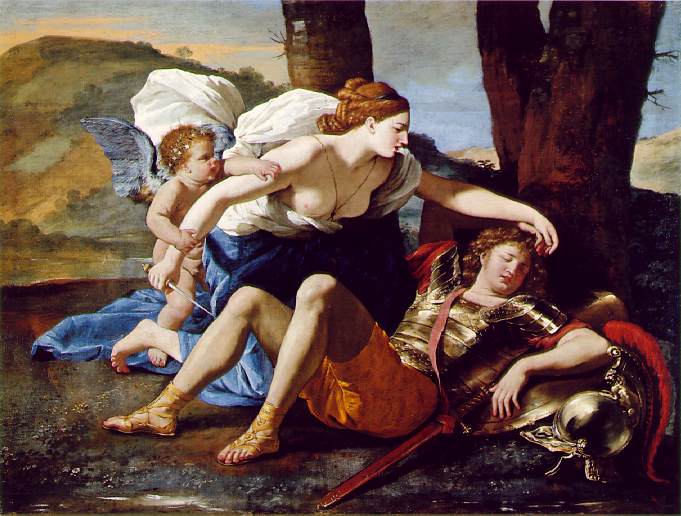
Looking at today’s painting I can see, stretched out on the ground, at the foot of a tree a soldier asleep.  His right arm is behind his head cushioning it against the hard ground.  His left arm rests across his shield and his thumb is just in contact with his unsheathed sword.  His helmet with the curved red feather lies on the ground nearby.  A woman kneeling by his side, leans over him, her left arm almost resting on his arm.  Look at the expression on her face.  It is a look of love and devotion.   There is gentleness to her demeanor.  She gives the impression that she does not want to disturb his sleep.  She just wants to gaze lovingly at him as he rests.   It is a very tender scene.

Or is it ??

Cupid restraining Armida

Look more closely.  Look at her right hand which is holding a dagger.  Now we begin to doubt the tenderness of this scene.  Her arm which holds her dagger is being feverishly dragged back by a small winged child who we believe to be Cupid, and who is the embodiment of love.  He is desperately trying to prevent the young woman from killing the soldier.   Look at the way Poussin has depicted the concentration in Cupid’s face as he struggles to control the woman and prevent her thrusting her dagger into the body of the sleeping man.

So what is it all about ?   Is it a scene of love or vengeance ?  Well, actually it is both.  Nicolas Poussin based his painting on the epic poem written by Torquato Tasso in 1580, entitled La Gerusalemme liberata (Jerusalem delivered).  The subject matter of this poem is the conflict between the Christian and Muslim forces and the siege of Jerusalem and within the main story he tells the story of Rinaldo, a Christian Crusader and Armida, a Saracen sorceress.  It is a poem which has inspired many operas from the likes of Handel, Gluck, Haydn, Rossini and Dvorak to name but a few.   It has motivated artists like Anthony van Dyke, Francois Boucher, Giovanni Tiepolo and Francesco Hayez to base their paintings on elements of this tale.

My featured artist today is the French Classical painter, Nicolas Poussin, and today’s painting is entitled simply Rinaldo and Armida which he painted in 1625 and hangs in the Dulwich Gallery, Lomdon.    Poussin painted a number of pictures illustrating the liaison between Rinaldo and Armida.  In the Pushkin Museum, Moscow, there is a painting featuring the two protaganists.  In this one , painted slightly later than the Dulwich picture, Armida has dropped her dagger and is about to lift Rinaldo up and carry him off with her to her island. A third picture, in the Gemäldegalerie, Berlin, represents the actual carrying off of Rinaldo by Armida and was painted by Poussin in 1637 for his friend and fellow artist, Jacques Stella.  The fourth picture, entitled The Companions of Rinaldo, can be found in New York’s Metropolitan Museum.

The painting is based on the story which which tells a largely fictionalized version of the First Crusade in which Christian knights battle Muslims in order to take Jerusalem. This scene involving Rinaldo and Armida is about hate turned into love. The subjects here are Rinaldo, a captain of the Christian army and the sorceress Armida who sides with the Muslims. To dissuade the armies Armida woos the men with her charms and turns them against each other, thus weakening the troop. Those who followed her were all turned into animals.  On seeing Rinaldo, Armida fell in love with him and kidnapped him. In her Garden of Pleasure and secret Palace she put him under a spell and he grew idle and became infatuated with the sorceress.

The translated verse below from Torquato Tasso’s La Gerusalemme liberata encapsulates what is happening in Poussin’s painting.

Now from the ambush the false sorceress flies,

And looms above him vengeance in her eyes.

But when she fixed those eyes on him to see

His calm face as he drew breath, soft and light,

His eyes that seemed to smile so charmingly,

 Though closed (if they now opened, what delight!)

She halts, transfixed and next him presently

Sits down to gaze, feeling her rage and spite

Stilled as she hangs above him, marvelling

As once Narcissus hung above her spring

Thus (who would credit it?) the slumbering heat

Hid in his eyes melted the ice that made

Her heart harder than adamant, and lo!

She was turned lover who was once his foe.

The Procession to Calvary by Pieter Bruegel the Elder

Procession to Calvary by Pieter Bruegel the Elder (1564)

One of my very first offerings for My Daily Art Display was a painting by one of my favourite artists Pieter Bruegel the Elder.  Today I would like to revisit this artist and show you another of his paintings entitled The Procession to Calvary which he completed in 1564 and which now hangs in the Kunsthistoriches Museum in Vienna.  This was probably the most complex composition of the Flemish painter.

This oil on oak panel painting was the largest known work of art by Bruegel the Elder, measuring 124cms x 170cms.  It is one of sixteen paintings by him which are listed in the inventory, drawn up in 1566, of the wealthy Antwerp collector, Niclaes Jonghelinck.  The composition is in some ways a traditional one.  It is the solemn religious event of Jesus bearing the cross on his way to Calvary where he is to be crucified.  However the story is transported into the time of Bruegel and by doing this the artist has given the subject of the painting an immediacy for his contemporaries as well as making a general valid statement about human actions.   It is not the Roman soldiers of Pontius Pilate that we see escorting Christ, but the mercenaries, in their bright-red tunics, who were in the service of Philip II of Spain, the ruler of Bruegel’s Netherlands. 

 When one first looks at the painting one does not know what to focus upon first.   It is a composition depicting Christ carrying the cross, as a semi-circular procession of incidental scenes set against a wide landscape crowded by tiny and animated figures.  Our eyes dart from scene to scene of this multi-faceted painting.  It is as if the painting invites us to look everywhere at once and not let our eyes loiter on one specific spot.   It is in some ways a chaotic scene, which one finds very bewildering.  It is typical of many of Bruegel’s paintings, which are usually filled with all types of characters.  There is a myriad of tiny figures rushing about, each with a task to be completed.   We are mesmerised as we try to see what each of the hundreds of figures is doing.  As we look at the bedlam we are drawn into it and become part of the crowd.   Some are arguing, some are fighting and as we look on we wonder what it is all about.  Our mind is in a whirl with all this hyper-activity.

The Mourners

So let me try and dissect the painting.   In the foreground, the sorrowful friends of Christ, standing on a small rocky crag, and are deliberately distanced by Bruegel from the hordes below.   These four figures, the Virgin Mary, John the Disciple and the two holy women, are larger in size than the rest and they are perched motionless and distraught above the chaotic goings-on below.  They are grief-stricken at what is going on behind them.  Saint John has moved to Mary, with her large blue veil.  Her face is pale and it seems as if she is about to collapse.  It is interesting to note that these two characters and those of the holy women are dressed in the clothes worn at the time of the crucifixion, whilst the rest of the figures, with the exception of Christ himself, are dressed in Flemish garments of Bruegel’s time.  Bruegel did this to give the painting a particular reference to his own day.

The Fallen Christ

Having let our eyes dart from scene to scene amongst the heaving mass our eyes try to find and focus on the figure of Jesus.  Our attention is drawn to the white horse and rider in the centre of the picture and then we see behind them the figure of Jesus who has fallen under the weight of the cross and is on one knee trying to raise himself up once again.  He is dressed in blue and yet for some reason it was hard for us to pick him out amongst the other characters.  Was that Breugel’s intention?  Did he purposely “hide” the figure of Jesus?  It is interesting to note that although Jesus is at the centre of the painting he is difficult to discern amongst the crowd.  His insignificance amongst the masses of people is a familiar device of Mannerist painting. 

Public executions were quite normal in 16th century life and especially in the troubled land of Flanders where Bruegel lived.  These macabre events were always well attended and had a carnival-type air to them.  I suppose that as such executions were carried out on a regular basis the onlookers became hardened and completely indifferent to the fear and misery of those being led to their death.   It is interesting to see that Bruegel has also added into his painting another regular happening at these events – pick-pocketing, as the crowds, in their excitement of seeing unfortunates being executed, were often oblivious to what was going on around them and were easy targets for the pickpockets.    

The two thieves

We see the two thieves sitting in a horse-driven cart being transported to their place of execution.   Their hands which hold a crucifix are tied in front of them and they look heavenwards beseeching for some divine mercy and at the same time babbling their final confessions to the cowled priests besides them.   The cart which trundles slowly on its way is surrounded by throngs of ghoulish spectators.

Golgotha

If we look to the upper right of the picture we see the mount of Golgotha and the two crosses already erected for the crucifixion of the two thieves.  Between them we can see men digging a hole into which the third cross, from which Christ will hang, is to be placed.  Crowds walk whilst others go on horseback towards this place so as to get a “ring-side” view of the forthcoming crucifixion.    As they move up the hill they pass through a landscape dotted with gallows on which corpses still hang and wheels to which fragments of cloth and remnants of broken bodies, not eaten by the ravens, still cling.

The sky to the left is blue and calm whereas the sky to the right over Golgotha is dark and storm-like and Bruegel’s landscape has us focusing on an impossible sheer rock outcrop atop of which perches a windmill.  Art historians differ on the significance of the windmill on this rocky structure.  However, impossibly sheer outcrops of rock characterize the landscape tradition of the Antwerp School founded by Joachim Patenier.

This is in some ways a moving painting with religious significance of Jesus on his long journey to his ultimate death.  However, as is the case in many of Bruegel’s painting, the animated antics of the numerous peasants depicted brings a smile to your face as you look to see what each individually painted character is doing.

Lamentation of the Dead Christ by Andrea Mantegna

Lamentation of the Dead Christ by Andrea Mantegna (c.1490)

My Daily Art Display today focuses on a painting, the subject of which has many similarities to the Hans Holbein painting The Body of the Dead Christ in the Tomb by Hans Holbein, which was My Daily Art Display of the day on February 20th.  Today’s painting is entitled Lamentation of the Dead Christ and was painted by Andrea Mantegna around 1490.

Andrea Mantegna was born in Isola di Carturo a small village close to Padua which was then within the Republic of Venice.  His father, Biagio, was a carpenter.  When he was eleven years of age he started an apprenticeship with Francesco Squarcione, an Italian painter from Padua.   His school was very popular at the time and over a hundred painters passed through the school.  Padua at the time was looked upon as a great place to be if you were and aspiring artist and the likes of Uccello, Lippi and Donatello spent time in the city.  Mantegna stayed with his tutor for six years.

Mantegna’s first work of art was an altarpiece for the church of Santa Sofia in 1448.  Although he gained a great reputation as an artist and was admired by many, he left Padua and spent most of his life in Verona, Mantua and Rome where he carried on with his paintings.  In 1460 he entered the service of Ludovico Il Gonzaga the Marquis of Mantua as his court artist.  This engagement earned Mantegna a great deal of money which was a sign of the high regard in which his work was held.  Whilst employed by Gonzaga he completed many fresco paintings of the Gonzaga family.

Today’s painting of the Lamentation of the Dead Christ was completed around 1490.  It is one of very few oil on canvas paintings of the period.  It is an almost monochromatic vision of Christ.  The painting has a limited amount of tonal colouring, mainly pink, grey and golden-brown.   The setting of the painting seems to be a morgue-like and claustrophobic space with its cold dark walls.  This poorly lit space intensifies the paleness of the body. 

Feet of Chirst

The forceful image is of the body of Christ laid out on a stark and granulated marble slab.  Mantegna has toyed with the rules of perspective making the head large, whereas if the rules of perspective had been adhered to then the head would be much smaller than the feet.  There is an intense foreshortening of the body which makes it appear heavy and enlarged.   

Christ’s suffering, before death, is plain to see.  Mantegna has given us an unusual vantage point.   It places the observer at the feet of the subject and by doing so, adds to one’s sense of empathy. It could almost be described as a gruesome sight.  The face of Christ is lined.  His head of wavy hair rests upon a pink satin pillow.  The wounds seen on the back of his hands are like torn paper, as is the horizontal cut in his side made by the spear. It is almost blasphemous, as here Christ has not risen from the dead and he is like us mortals.  In the foreground are the feet of Christ each with dried puncture marks made by the crucifixion nails.  Look at the skill in which Mantegna has painted the folds of the shroud.

The Mourners


At the left we have three mourners, Mary, Saint John and perhaps slightly hidden by the other two mourners, Mary Magdalene.  Their tear-stained faces are distorted in grief.  These contorted facial features derive from the masks of classical tragedy.  One cannot help but be moved by their expressions.

Compare this painting with Holbein’s The Body of the Dead Christ in the Tomb and see which you think is the most moving.

The Miracle of St Mark Freeing the Slave by Tintoretto

The Miracle of St Mark Freeing the Slave (1548)

So do you know who is Jacopo Comin ?   Have you heard of Jacopo Robusti ?  Jacopo Comin was born in Venice in 1518.  His father, Giovanni, was a weaver and dyer of cloth, who fought in the War of the League of Cambrai, which was part of the Italian Wars involving, France, the Papal States and Venice.  He put up such a stubborn and robust defence of the gates of Padua that his son, in his youth, became known as Jacopo Robusti.  However the father’s profession, dyer or tintore, gave Jacopo the name we know him by now.  Being the small son of the tintore he was given the nickname “little dyer” or Tintoretto.

Tintoretto was the eldest of twenty one children !   He was always interested in drawing and painting even from an early age.  Although he was to become, along with Bonifacio Veronese, the most successful of Venetian painters after the death of Titian, little is known of his early life although it is thought that he was at one time one of Titian’s pupils.  A lot of his artistic ability was self-taught.  His works were made to be spectacular, in size and quality to attract attention and his style was continuously imaginative.  His output of art works was prolific as he retained a large entourage of assistants. According to his contemporary and biographer, Carlo Ridolfi, the Italian artist and art historian, Tintoretto had inscribed on the wall of his workshop the motto: 

                    “The drawing of Michelangelo and the colour of Titian

These were his idols and  but his drawings were more emotive than those of Michaelangelo and he tried to synthesize the drawings of Michelangelo and the colouring of his old master Titian, but he used more sombre colours than those used by Titian.  For his phenomenal energy in painting he was termed Il Furioso.

His early works were signed “JACOBUS” followed by a drawing of a wheel, which was the symbol of the Dyers Guild, identifying himself as “Jacobus the Dyer’s son”    His first work, and My Daily Art Display painting today, was exhibited in 1548 and entitled The Miracle of St Mark Freeing the Slave.  It was this painting that launched Tintoretto’s career and made him an overnight sensation.   This enormous oil on canvas painting measures 415cms x 541cms (almost 12ft x 18ft).   He painted it at the age of thirty and it was to be the painting which made his reputation.  In this work of art we see Tintoretto’s use of foreshortening, which is a technique for creating the appearance that the object of a drawing is extending into space by shortening the lines with which that object is drawn.  He had an unusual way of coming to a decision about light and shading for his paintings.  He would create wax models and arrange them on a stage and then by training the light from spotlights on them he could see the effects the light would have on them and the shadows they would form.

This painting was one of four pictures he was commissioned to paint in the Scuola di San Marco.  The painting represents the legend of a Christian slave who was condemned by his master to have his legs broken and his eyes put out for worshipping the relics of Saint Mark, the patron saint of Venice, in defiance of his master’s wishes but was saved by the miraculous intervention of the saint who shattered the bone-breaking and blinding implements which were about to be used on the slave.  The naked slave lies face up in a stone courtyard, his torso twisted and his face turned toward the viewer.  His “owner” the slave’s master, dressed in black can be seen leaning into the center from a balcony on the left side of the canvas.   Saint Mark appears high up in the centre of the painting winging down from heaven to save the slave signifying that the latter should not be punished for his faithfulness.  His sharply foreshortened figure is shown in swirling orange and pink robes.  Surrounding the main characters are a myriad of people above and to the sides, more than twenty five in all,  pages, maids, servants etc. Those on the right hand side lean back as they look on whilst those on the left lean in to get a better view of the impending torture and killing.    The artist’s positioning of the figures around the slave and their disposition draws the eye of the observer to what they are all looking at – the slave and his miraculous rescue.  The way in which Tintoretto has depicted the varied reactions of these on-lookers is compelling.  His use of light and shadow add to the mood and aura.  But the most striking is the image of Saint Mark as the divine saviour as he descends.  

It is difficult to summarize the painting.  I believe it to be, in some ways, unsettling but thought-provoking.  Tintoretto’s use of “arrested motion” of the groups of onlookers adds to the aura of the painting.  The omission of a landscape makes us concentrate on the main scene.  The atmosphere of the painting is characterized by sudden and strong contrasts of light and shade.

The Tempest by Giorgione

The Tempest by Giorgione (1506-1508)

I wonder what you, as an observer, do when you stand in front of a painting.   What is it, about the painting, that makes it interesting for you?  Is “interesting” a word you would use when describing your feelings about a work of art?   As far as art is concerned, I guess we are all different and we all have various reasons for liking or disliking something, whether it is a painting or a sculpture, whether it is a piece of modern visual art or it is a Baroque painting.  I like certain types of paintings and dislike others.  I am not an artist and have no artistic background but I reserve the right to say what I like and I may even have the temerity to explain what I don’t like and discuss my reasons even if it exposes my naivety of art.   I have very little knowledge of artistic techniques but find it very interesting to read about them.  However besides the beauty of the actual paintings, what fascinates me most of all is the interpretation of paintings and the symbolism of certain objects within a painting.

My Daily Art Display today is The Tempest by Giorgione and along with the likes of The Arnolfini Portrait , the interpretation of this painting has been written about by many and commented upon in numerous blogs.  It was completed circa 1508 and can now be found hanging in the Gallerie dell’ Accademia in Venice.  What I find intriguing is that some of the interpreters of the painting are convinced that their assumptions are correct.   To my mind, there are a number of problems when one is being dogmatic in an interpretation of a painting.  Firstly, saying one’s theories are correct, by definition automatically discounts the theories of others as being incorrect.  Secondly, unless the artist, long since dead, has written about his or her painting or told somebody verbally about the meaning of their work of art then nobody can be absolutely sure that they are correctly interpreting the mind of the artist as he painted his picture.  Maybe interpreters of paintings should be less rigid about their interpretations.   Surely we should be allowed to look at a painting and put our own interpretation on what we believe was going through the artist’s mind when he was at the design stage of his or her painting.

I am not going to give you my interpretation of the painting for it would probably be just a combination of the various ones on offer from the “experts”.   Why don’t you study the painting yourself and then read the links I have added at the bottom of this blog which give detailed if opposing interpretations and work out what you believe to be the most credible one.  However first, to aid your thoughts, let me quickly go over what we see and what we don’t sees in the painting !   

Giorgione's woman and child

There are three humans in the painting.  On the right in the foreground is a woman almost naked except for a white cloth which she and the baby are sitting upon, the end of which is wrapped around both her shoulders.   She and the baby are sitting on the bank of a small narrow stream.  Sitting on the ground next to her right thigh is a baby suckling on her left breast.  The woman gazes out at us. 

X-Ray of The Tempest

Across the narrow stream on the opposite bank stands a young man.  He is looking across the stream but his gaze does not focus on the woman and baby.  What and who is he –  soldier, shepherd,  gypsy?  Do you think he looks out of place in the picture?  You may be correct as it is believed that Giorgione added him to the picture later.  This is known because an X-Ray of the painting reveals a pentimenti (underpainting) and in the place now occupied by the man, there was a nude woman sitting on the bank of the stream bathing her feet.

Just to the right of the man there is a broken column.  What is the significance of that?   In the middle-ground one can see a bridge over the widening river.  In one of the discussions attached  there is talk of a man crossing the bridge but from the internet copies of the painting and the X-Ray of the painting I cannot detect anybody crossing the bridge – but then my eyesight leaves a lot to be desired !.  To the right of the bridge is a building atop of which sits a large white bird.  What is the significance of the bird?  In the background we see a town above which storm clouds have gathered and there is a flash of lightening.

So make what you will of the painting and take a look at the weblinks I have attached below.  These are blogs of people who have seriously analysed the painting and come up with their interpretation.  However if you go to the end of the blogs you will see the comments from people who have read the blogs and in some cases have completely opposite views to the blogger’s interpretation.   They offer counter-interpretations.  It makes quite amusing reading for how can you politely state that you believe the proposed interpretation is wrong ! 

 Enjoy !!!!!

Blog – The Perplexed Palette

http://www.ginacolliasuzuki.com/the_perplexed_palette/2011/01/the-tempest-by-giorgione.html

Blog – Three Pipe Problem

http://www.3pipe.net/2010/07/unravelling-giorgiones-tempest-zcz.html

An Essay – this is not for the faint hearted as it a very wordy and highly technical thesis

http://www.thefreelibrary.com/Giorgione’s+Tempest,+studiolo+culture,+and+the+Renaissance+Lucretius…-a0102659361

Portrait of a Man (Self Portrait?) by Jan Van Eyck

Portrait of a Man by Jan van Eyck (1433)

My Daily Art Display yesterday featured the painting A Man with a Quilted Sleeve by Titian in which we saw a portrait of a man with a brightly-coloured blue tunic and I discussed what was one’s initial focus of attention, the face of the subject or the blue sleeve of the tunic.   Today’s painting, Portrait of a Man (Self portrait?), poses a similar question, what do we focus on when we first look at the painting, the bright red head gear of the man or the man himself?

Portrait of a Man (Self Portrait?) is a painting by Jan van Eyck which he completed in 1433 and is housed in London’s National Gallery.  The painting is still in its original wooden frame on which are inscriptions that have been painted in such a way that they look like they have been carved into the wood.    Along the bottom the inscription reads:

JOHES DE EYCK ME FECIT ANO MCCCC.33. 21. OCTOBRIS

Which when translated reads “Jan Van Eyck Made me on October 21st 1433”

Across the top of the wooden frame is the motto:

AlC IXH XAN

This is considered to be a punning allusion to the painter’s name “Als Ich Can (as I/Eyck can) which loosely translated reads “I Do as I Can” – a motto which appeared on a number of other paintings by Jan Van Eyck.

And so to the picture itself.  At first glance it is just a simple portrait.  The man stares out at us.  On his head is a red chaperon which was a form of hat that was worn throughout Western Europe in the Middle Ages.  Van Eyck’s painting of the headgear is wonderful.   The hat actually occupies more space in the painting than the face of the sitter.  Look at the multitude of folds and tucks in the chaperon.   One wonders how long it took the artist to master this part of the painting and how many preliminary drawings were made before he was happy.    As was the case of Titian’s A Man with a Quilted Sleeve, Jan Eyck’s man is seen against a plain dark background, which makes the figure stand out.  At first our eyes just register a red headpiece on the head of a pale white-faced man and do not take in the detail.  However careful examination of the face and the chaperon reveals a multitude of subtle shades and it is actually the painting is awash with detail. 

His eyes have a slight bloodshot appearance. In the book by Lorne Campbell, research curator at the National Gallery, London, entitled The Fifteenth-Century Netherlandish Paintings, he wrote of Jan Van Eyck’s depiction of the left eye thus:

 “…The white of the eye is laid in white mixed with minute quantities of red and blue. A very thin scumble of red is brought over the underlayer, which is, however, left exposed in four places to create the secondary highlights. The veins are painted in vermilion into the wet scumble. The iris is ultra-marine, fairly pure at its circumference but mixed with white and black towards the pupil. There are black flecks near the circumference and the pupil is painted in black over the blue of the iris. The principal catchlights are four spots of lead white applied as final touches, one on the iris and three on the white, where they register with the four secondary lights to create the glistening effect…”

 The man’s skin is weather-beaten and wrinkled.  There are signs of stubble on the chin, the texture of which is in contrast with the smoothness of the soft fur collar.   It is hardly a flattering portrait and has a “warts and all” reality to it, which makes one think that it may be a self-portrait of the then thirty-eight year old artist, as if it had been a portrait of a dignitary they may wanted it to be more pictorially agreeable.

 There is a distinct realism to this painting and Jan Van Eyck’s clever use of shadows is a characteristic of Italian Renaissance paintings.

 So there you have it – today and yesterday I have given you two portraits with some similar characteristics, which do you like the most and why?