The Art of Painting by Johannes Vermeer

The Art of Painting by by Johannes Vermeer (1667)

My Daily Art Display starts with a question.  Hands up if you have heard of Théopile Thoré sometimes known as  Théopile Thoré-Burger.  Not too many raised hands.  Second question – hands up if you have heard of Joannes Vermeer.   Hands are shooting up all over the place!   Did you know that but for the French journalist and art critic Théopile Thoré nobody may ever have discovered the artistry of our beloved painter from Delft?

Joannes Vermeer was a rather quiet man who enjoyed painting.  He did not push his work.  He did not need to sell his paintings to survive.  He just wanted to discover new painting techniques and liked to concentrate on how light and shadow could be best represented in paintings.  So here we have a man who didn’t paint profusely and during his time was not well known.  Dutch and Flemish art dealers obviously wanted to get their hands on works of art that they could sell at a profit and thus they were always seeking works of popular artists.  To them, the important thing was to know which artists were popular at the time and thus which paintings would make them the most money for them.   The only way they could find this out was by looking at sales registers and seeing which paintings were fetching the greatest amounts.  So, as Vermeer was not so well known at the time, art dealers who had bought his paintings were known to have erased his signature from the work and substitute it with the name of a more popular artist of the same painting genre and so the name of Vermeer as an artist faded.  That was until Étienne-Joseph-Théophile Thoré came onto the scene, almost two centuries after the death of Vermeer.

Joseph-Théophile Thoré was a French art critic and political journalist who founded the newspaper, La Vraie République,  which was later banned by the government as being subversive.  Thoré eventually had to leave France and went into exile to Brussels where he stayed for ten years until he was granted amnesty in 1859.  Whilst he was in Brussels he became interested in the work of the Dutch artists such as Frans Hals, Fabritius but especially in the works of Vermeer and was mystified at the lack of Vermeer paintings.  He had seen, and was extremely impressed with Vermeer’s painting View of Delft,  which he saw when he visited the Mauritshuis of The Hague and he could not understand why such a great artist was completely unknown at this time.   Thoré researched into Vermeer and his paintings and over time proved that many paintings which had been attributed to other Dutch artists were in fact works by Vermeer.

The painting featured in My Daily Art Display today is The Art of Painting, sometimes known as Painter in His Studio and was painted by Vermeer in 1667.   Until 1860 it was thought to be a painting by the Dutch artist Pieter de Hooch but thanks to the work of Thoré it was eventually attributed to Vermeer.  This painting is alleged to be the artist’s favourite.   He would never sell it even when times got hard.  It was only later, after his death that his widow, Catharina, bequeathed it to her mother to avoid it being taken by creditors. 

In this painting we see the Master at his best with an exquisite style of painting in the way he shows the various effects on the people and the objects of the light which streams through the window.   In the painting we see just two figures, the artist, who some art historians would have us believe is Vermeer himself.  However others disagree and point to the fact that a year after his death his widow referred to the painting as de Schilderkonst (the Art of Painting) rather than referring to it as “My Husband the Artist”.  The other person in the painting is the artist’s subject, a girl dressed as the Muse of History, Clio.  She is wearing a laurel wreath, holds a trumpet and carries a book by Thucydides, the Greek historian.   We know it is her because of Cesar Ripa’s 16th century book entitled Iconologia overo Descrittione Dell’imagini Universali cavate dall’Antichità et da altri luoghi , which was a highly influential book about Egyptian, Greek and Roman emblems and had been translated into Dutch in 1644.

There are other fascinating things about this painting.  We see a heavy curtain pulled to one side like a theatre curtain being drawn allowing us to see the actors on stage.  The addition of the drawn heavy and ornate curtain was a way in which Vermeer was able to achieve perspective.  You can see that the drawn curtain partially covers both the trumpet and map and some of the objects on the table.  Does he want us to come forward and draw the curtain further aside so we can see more?  The curtain is almost real to our eyes and maybe Vermeer learnt this trick when he read the tale of the famous contest of Greek antiquity held between two renowned painters Parrhasius and Zeuxis to see who was the finest. This story was cited by Plinius the Elder from a Greek source in his Naturalis historia, which he wrote in 77 AD.   Zeuxis had produced a still life, so convincing that birds flew down from the sky to peck at the painted grapes. Parrhasius then asked Zeuxis to pull aside the curtain from his painting. When it was discovered that the curtain was a painted one and not a real one, Zeuxis was forced to concede defeat, for while his work had managed to fool the eyes of birds, Parrhasius had deceived the eyes of a human being!

An empty chair stands below the curtain.  Maybe we are being invited to sit down and watch the artist at work.  On the back wall is a map of the Seven United Provinces of the Netherlands which was published in 1636.   Although we have come to accept that north is always at the top of our present day maps, in those days West was at the top of their maps, south was to the left hand-side and north was to the right-hand side.  Look and see how the artist has depicted the map with a heavy vertical crease down the middle and by doing this is highlighting the division between the Protestant Netherlands to the north (right-hand side) and the Habsburg-controlled Flemish Catholic provinces in the south (left-hand side).

Now take a look at the chandelier which is high up at the centre of the painting  It in some ways reminds us of the one shown in van Eyck’s Arnolfini Portrait.  We can see surmounted upon it the double headed eagle which was a symbol of the Catholic Habsburg dynasty of Austria, who had once ruled Holland.  Vermeer was believed to have been a Catholic and some art historians believe that he painted the chandelier without candles as a statement that in Protestant Holland, Catholicism had been suppressed (snuffed out like a candle).   Vermeer paints this chandelier majestically showing in detail the light and shade of the various arms depending on how the light from the window strikes them.  Chandeliers like this one are seen in many paintings and cynics say that they are only there so that artists can demonstrate their painting prowess at being able to show them with various shades of light.

One interesting note with regards its provenance.  In 1940 the painting was bought by Adolf Hitler for his personal collection for 1.65 million Reichsmark.  Fortunately in 1945 it was rescued from the depths of a salt mine where it had been hidden.  Today it can be seen in the Kunsthistoriches Museum in Vienna where it has hung since 1946.

It has been a long and interesting tale of a painting which I was fortunate enough to see when I visited Vienna late last year.  The Kunsthistoriches Museum in Vienna is definitely a place you should add to your “must visit” list.

St George and the Princess of Trebizond by Pisanello

St George and the Princess of Trebizond by Pisanello (1436-38)

When I was travelling around Italy last week the one thing I noticed, which was different from here in Great Britain, was the fact that most of the churches were open to visitors even if some, especially in tourist areas, had admission fees.   In my country most of the churches are locked up unless a service is in progress for fear of vandalism or theft.  The one exception to this open-policy was Milan cathedral which for some reason would not let individuals inside, just admitting pre-booked guided parties.  I have no idea the reason behind this and my lack of ability to speak Italian put me off questioning the very large armed policemen, who stood guard at the door.

The other difference between the churches I visited in Italy and the ones in my country was that the Italian churches seemed to all have frescoes and paintings adorning their walls whereas the churches I have visited here, although often architecturally attractive and have beautiful stained glass windows, one rarely comes across works of art.  Maybe that again is to do with possible vandalism and theft.  During my short vacation I visited Verona and after the obligatory visit to “Juliet’s balcony” I decided to visit a couple of the churches and I am so glad that I did.

I visited the church of Santa Anastasia and it was here I came across a wonderful fresco above the entrance to the Pellegrini Chapel which is just to the right of the main altar and which according to the guide book was done by an artist called Pisanello.  I decided that when I returned home I would find out a little more about the artist and his fresco and feature it in My Daily Art Display.  So here is what I found out.

Antonio di Puccio Pisano is thought to have been born in Pisa around 1395 and was to become one of the great fresco painters of the early Italian Renaissance and the Quattrocento, which was the collective name given to the cultural and artistic events of 15th century Italy and includes the artistic styles of the late Middle Ages and the early Renaissance.  He was educated in Verona and it has been documented that he worked in Pisa, Venice, Florence and Verona.  Pisanello’s subjects include Arthurian legends and other courtly stories. They reflect the chivalric ideals of his noble patrons. The decorative nature of his work comes from the work of early 15th century artists such as Gentile da Fabriano, a leading exponent of the International Gothic genre.  Pisanello and Gentille collaborated on the frescoes of the Palazzo Ducale in Venice and they both worked at the court of the Gonzaga princes in Mantua.  Pisanello returned to Verona around 1436 and started work on the Pelligrini Chapel in the church of Santa Anastasia, which is the work of art I am featuring in My Daily Art Display today.

The fresco is entitled St George and the Princess of Trebizond and was completed in 1438.  It is based on what was a favourite subject of the period, Saint George, the Princess and the Dragon.  The fresco is in the crown and spandrels of the arch at the entrance to the chapel.  Sadly the fresco in the left-side spandrel has deteriorated badly.  It shows a barely discernible scene of the dragon’s lair where the creature had devoured its prey and all that was left were the bones of the victims which are surrounded by hideous animals which are scavenging the remains.

In the right spandrel we see the heroic St George with his curly golden hair, who has just dismounted from his horse after his gallant rescue of the princess.  The rescued damsel stands side on to us.  There is regality about her stance.  Her head is held high and just take a look at the splendour of her dress with its long train.   Both the Princess and her rescuer are dressed in the finest clothes of the day.  Unfortunately the gold and silver used in the fresco has fallen away over time but one can only imagine how spectacular the fresco would have been when Pisanello had completed it. 

It is interesting to note the way he has painted the two horses one of which we see from behind, the other seen head-on.  There is a perspectival foreshortening of the animals and this painting technique was starting to become popular with artists at this time.   The background is dominated by an enchanting city with its Gothic towers and ornate stonework.    In the left-hand background we see two hanged men swinging on the gallows.  Maybe they were thieves or traitors.  In the foreground we have a ram, what looks like a golden-coloured boar and a dog.

Whilst I was looking around the church I came across a girl on some scaffolding meticulously carrying out restoration work on another of the church’s frescos and it brought to mind the age-old argument as to whether frescoes should be restored or should they be left to slowly decay and thus one sees the original and not a “touched-up” offering.

Self Portrait by Rosalba Carriera

My featured artist today is the Venetian portraitist Rosalba Carriera.  I have chosen her because I saw her painting whilst in Venice and I was greatly moved by it.  As I told you yesterday, when I discover a “new” artist I become intrigued and curious to know more about them and so now that I am back home I have delved through my books and have come up with a somewhat sad tale which I will now tell you.

Rosalba Carriera was born in Venice in 1675 and was one of three sisters, one of whom, Angela, was later to marry the great Venetian painter Giovanni Pellegrini.  Rosalba studied art under Giuseppe Diamantini, the notable Baroque painter and printmaker, during which time she would copy oil paintings.  Her own first successes came in 1700 with her tempera portrait miniatures which she painted on ivory.  In 1705 she was made accademico di merito by the Accademia di San Luca in Rome.  This was a great honour and was reserved for non-Roman artists.   Her work was so good that soon her fame spread throughout Europe. 

Here is another question for you.  What do you think the connection was between Rosalba and snuff?

By the 18th century, snuff had become the tobacco product of choice among the elite, prominent users included Napoleon, King George III and his wife Queen Charlotte and even Pope Benedict XIII.   The taking of snuff helped to distinguish the elite members of society from the common populace, which generally smoked its tobacco.   As snuff-taking became popular in Europe so did Rosalba’s commissions.  Why?    Rosalba Carriera was able to paint miniature portraits, often on ivory, which formed the lids of the snuff boxes.  Her talent for these delicately painted snuff-boxes was in great demand.  From that, she progressed to portrait painting but again on a small scale, usually about 30cms x 50 cms.  In 1706 she was invited to the court in Dusseldorf to carry out various commissions and following on from that she was besieged by the nobility of Europe who flocked to her studio in Venice for her to paint their portraits or  portraits of somebody from their family.    

And so to My Daily Art Display painting simply entitled, Self-portrait which she completed around 1746 when she was aged 71.  This was unlike many of her portraits she did of women of the nobility.  Those portraits were of good-looking women, dressed in sumptuous clothes.  Here we have before us a pale faced elderly woman.  She is not smiling and it appears that happiness has passed her by.  She looks tired, drained by her long and arduous life.  I wonder if , in general, we are lulled into believing that somebody who has the ability to paint beautiful things must be happy.  But maybe that is at the crux of her sadness, as it is at about this time that she began to lose  her sight and she must have realised that her ability to produce such beautiful works as she had once done, was rapidly coming to an end.  Can you imagine what she must have been thinking at this time in her life?  Can you imagine her torment when she realised her days of painting were coming to an end? 

Sadly, she became totally blind five years after completing this self portrait and this sent her spiralling into a deep depression and she died six years later in 1757, aged 82.

Landscape with a Marsh by Paul Bril

Landscape with a Marsh by Paul Bril (1590)

My apologies for a lack of a post yesterday but I was touring the Italian Lakes and ended up in a non-WiFi hotel.  This is the last day of my short break and I am at Milan airport awaiting a flight home.

I will start today’s blog with a question.  What do you like best about an art gallery visit?  Maybe that is a kind of obvious question but to many people galleries mean different things.  I will go to a gallery sort of prepared as to what I want to see, especially if it is a large gallery and I have no hope of seeing everything.  I am a great believer in the premise that if you try to see too much, you end up seeing very little.   It is like going on holiday and trying to visit too many places.  You do visit them all but you miss the soul of the places.  You miss the hidden gems of a town and so if you rush around a gallery, you miss their hidden gems and you miss the opportunity of carefully studying great works of art.   So back to my original question, what do you like best about art galleries? 

For me a visit to an art gallery is not complete without visiting the gallery shop.  My bookcase shelves groan at the weight of art books and gallery catalogues I have placed on them over the years.  However to take away a piece of the gallery to read and study at your own convenience is an absolute must.  Unfortunately when I have taken home gallery catalogues and read them I often kick myself for not reading the details of a painting before I actually stood in front of the paintings itself and thus would avoid the realization that I have missed something.

However most of all when I go to a gallery I like to discover a new artist, whom I have never heard of.   To see a beautiful painting by an artist unknown to me is like finding a gold nugget during a walk in the countryside.  You admire the landscape on your walk but then this little extra find makes your day.  At the art gallery it is the same.  You enjoy the paintings of well-known Masters but all of a sudden you come across a new name.   For from that discovery you can then learn about the artist and search for his or her other paintings.   It simply opens up a new window in your world.   When I was looking around the  Biblioteca Ambrosiana in Milan a few days ago, I came across a painting by Paul Bril and artist I had not heard of before.  Yes, I can just imagine some of you groaning at my lack of knowledge, but that is how it is and I, like everybody,  has to build up an artistic knowledge!

Paul Bril was a Flemish landscape painter and was born in Antwerp in 1550.  His brother Matthijs was also a landscape artist.  Paul, who received Papal Favour, a form of Papal patronage, lived and worked mostly in Rome. His brother died when he was quite young and Paul continued with his fresco work.  Paul was also a painter of small cabinet paintings.  These were small paintings, characteristically no larger than about two feet in either dimension, but often much smaller. The expression is especially used of paintings that show full-length figures at a small scale, as opposed to a head painted nearly life-size, and these cabinet pictures are painted very precisely, with a great amount of “finish”.   From the fifteenth century onwards wealthy collectors of art would keep this type of painting in a cabinet, hence the name, in a relatively small and private room to which only those with whom they were on especially intimate terms would be admitted.

The painting on display for My Daily Art Display is one I saw at the Biblioteca Ambrosiana in Milan and is entitled Landscape with a Marsh which he completed in 1590.  It is quite small in size, measuring 26cms x 35cms but its size does not detract from its beauty.   It is a haunting landscape with just a few wading birds or ducks present at the pool.  The water is still but appears crystal clear.  The silvery-green colours add a picturesque tranquility to the scene.  Wouldn’t you like just to sit on the bank of the pool and let the world pass you by?  I know I would.

Feast in the House of Simon by Bernado Strozzi

Feast in the House of Simon by Bernardo Strozzi (c.1630)

Whilst I was wandering around the narrow streets of Venice, crossing over the many quaint little bridges I had a sort of plan of what I wanted to see.  I had to have a look St Mark’s square and cross the Rialto Bridge but I also had two artistic destinations I wanted to visit.  First was the Basilica of Santa Maria della Salute which was the church at the heart of yesterday’s blog but most of all I wanted to visit the Accademia Galleries which houses a collection of the best works of art by Venetian painters.  I finally found the building and I was luck as apparently it was “Cultural Week” and the entrance fee had been waived.  The first room I entered was full of what they termed “The Primatives” and was a large collection of late 14th century and early 15th century altarpieces.

It was when I went into the other rooms that I was taken aback by the paintings.  It was simply breathtaking.    It was the sheer size of them which was overwhelming.  In all the galleries around the world which I have visited, I have never seen such a large collection of gigantic paintings.   Some, including the painting I am featuring today, were in excess of 7 meters in width and there was the Veronese painting Feast in the House of Levi which was in excess of 13 meters in width and almost 6 meters high.   These large paintings simply overpowered you and you sat before them in total shock.  You could only imagine how long the artists had taken to paint them.  One room just had the complete nine painting cycle of the Legend of St Ursula, the fourth I featured in My Daily Art Display on March 22nd.  As each of the nine was so big I spent almost an hour following the tale of St Ursula and studying all the marvelous detail laid out on each canvas.  It was a remarkable experience.  The final room I went through on my way to the exit had amongst its collection the famous and very beautiful Tempest by Giorgione which I featured on March 4th.  This is a lovely painting much smaller than the mammoths I had been admiring earlier but still a gem. I was completely spellbound by this gallery visit and I suggest you add this gallery to your “must visit” list.  You will not be disappointed.

Back to today’s offering in My Daily Art Display.  It was one I saw during my visit.  I could have picked so many from the wonderful collection but for today I have chosen a painting by Bernard Strozzi entitled Feast in the House of Simon which he completed around 1630.

The painting was acquired by the gallery in 1911 and comes from the chapel of Palazzo Gorleri in Genoa.  It is thought that it was painted for the parlour of the Santa Maria in Passione monastery at Diano, Genoa.  The story behind the painting is from the New Testament:

“…When Jesus was on his travels to preach, a Pharisee called Simon invited him to a meal.
When Jesus arrived at the Pharisee’s house and took his place at table, suddenly a woman came in, who had a bad name in the town. She had heard he was dining with the Pharisee and had brought with her an alabaster jar of ointment. She waited behind him at his feet, weeping, and her tears fell on his feet, and she wiped them away with her hair; then she covered his feet with kisses and anointed them with the ointment.
After this scene, Simon the Pharisee wondered whether Jesus was really the prophet everyone told he was, because surely Jesus would have seen that this woman had a bad name and would not have let her touch him. But Jesus retorted with a parable and he showed the difference of welcoming he had received from Simon as compared to the welcome of the woman. Simon had poured no water over Jesus’ feet and Simon had not anointed Jesus’ head.
Jesus said: “For this reason I tell you, Simon, that her sins, many as they are, have been forgiven her, because she has shown such great love. It is someone who is forgiven little who shows little love”. Then he said to the woman: “Your sins are forgiven…..”

The artist has distributed the various characters around the painting, not randomly but with care so as to tell various parts of the story behind the painting.  There is so much going on within the painting which as you know is what fascinates me.  We see Mary Magdalene kneeling at the feet of Christ with her porcelain urn of water in preparation to her washing the feet of Christ.   There is also humour in the painting.  Look how the man behind Christ’s right shoulder is remonstrating with the dog which is about to attack the cat.  It appears the cat has managed to escape the clutches of the dog by jumping upon the table much to the displeasure of a young servant, who has raised a stick and is just about to whack the cat away.  The banquet table lies diagonally across the painting.  Our eyes fix on Jesus who is vociferously defending Mary Magdalene whilst Simon is seen half getting out of his chair as he stares on incredulously at the sight of Mary at the feet of Jesus.  There is a splendor of colour which brings the painting alive.  Look at the servant carrying the tray of fruit – see how he is lit up by the bright background of the sky.

This is an awesome painting and I can only hope that like me, one day you will be able to stand before it and absorb its beauty.

The Entrance to the Grand Canal, looking East, with Santa Maria della Salute by Michele Marieschi

The Entrance to the Grand Canal, looking East with Santa Maria della Salute by Marieschi (c.1735)

I went to Venice today.  It was my first visit to this beautiful place.  I decided that once again My Daily Art Display should be a painting by a Venetian artist depicting this stunning city.  The painter is Michele Marieschi and his work is entitled The Entrance to the Grand Canal, looking East, with Santa Maria della Salute.    Although Venice is associated with the likes of Canaletto and Guardi I decided to select a painting of Venice by a less well-known artist.  Michele Marieschi, the son of an engraver, was born in 1710 and was a contemporary of the two great Venetian artists, Canaletto and Francesco Guardi and in some ways probably suffered from their presence. 

Santa Maria della Salute

What we are looking at in this painting is the entrance to the Grand Canal  which is dominated by the magnificent Basilica of St Mary of Health known locally as Basilica di Santa Maria della Salute.  This Roman Catholic church or basilica is situated on a small tongue of land  between the Grand Canal to the left as we look at the picture and the Bacino di San Marco to the right.    The dome of the basilica was an important addition to the Venetian skyline and was an inspiration to such artists as Guardi, Canaletto, Turner and Singer Sargent.  The basilica was built in the late seventeenth century by the Venetian architect, Baldassare Longhena in thankfulness for the ending of the bubonic plague which killed more than 80,000 Venetians in 1630.  This view has probably been taken from the monastery of San Gregorio which stands on the corner meeting point of the Grand Canal and the Rio della Salute and is on the opposite side of the Rio della Salute to the basilica.  If you follow the way past the steps of the basilica you can just make out the tower of Dogana da Mar the original Customs house which once controlled all movement of boats and their goods in and out of Venice.  On the opposite side of the Grand Canal are the Palazzo Manolesso and Contarini Fasan and if you look closely you can just make out the top of the famous Campanile of San Marco.  As with all Venetian scenes the water is full of boats of various shapes and sizes, some gondolas, others cargo boats.  If you look closely at the cargo boat in the left foreground it is loaded with cases marked “Roma” “Vienna” and “M:S:” the latter thought to be the artists signature.  It is interesting to see how the artist has divided the scene vertically by the long mast of the boat which is tied alongside the quay.  In some ways it balances the composition.  This composition has a two point perspective.   When you look at the basilica and the surrounding quay you get a strange sensation maybe caused by the “V” shape of the quay, that the bottom of the basilica appears to be coming towards you whilst the dome of the basilica seems to be moving away.  Art historians believe that this illusion may be because Marieschi used a camera obscura to paint this picture.

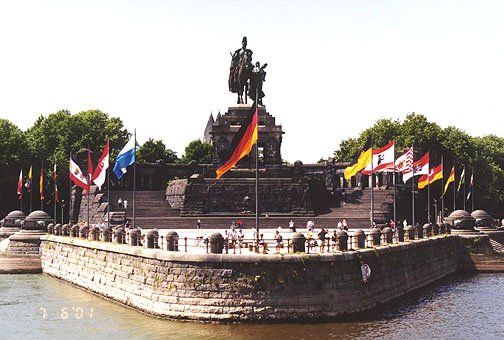
Deutsches Eck, Koblenz Germany


When I first saw this  painting I was immediately reminded of Deutsches Eck at Koblenz, the triangular shaped headland, which is at the confluence of the rivers Rhine and Mosel and on which is the giant equestrian statue in honour of Emperor William I.  It is strange the impression a painting gives you of a place.  You take it that it is almost a photograph and I was very suprised when I arrived at the place shown in the painting.  It was so different.   The distance from the bottom step of the basilica to the quay edge is no more than 10 paces.   I was expecting it to be like the Deutches Eck and the corner would be at least 50 metres away from the quay edgea nd that was based on the number of “small” people in the painting between the steps and the corner point of the quay.  So although the camera doesn’t lie, the painting does!!!

Notwithstanding that the painting like Venice itself is truly magnificent.

A Bowl of Vegeatbles ? by Guiseppe Arcimboldo

The Bowl of Vegetables by Arcimboldo c.1590)

Today I spent a pleasant day lin Milan looking around a couple of art galleries.  I went to the Pinacoteca Ambrosiana which had some marvellous sketches and notes by Leonardo da Vinci and some superb paintings by Jan Bruegel as well as a plethora of Italian Renaissance works of art.   I then went to the Pinacoteca di Brera which has an unbelievable collection of paintings, many of which, like The Kiss by Francesco Hayez and  the Dead Christ by Andrea Mantegna, I have featured in My Daily Art Display.

However for My Daily Art Display today I am going to feature a painting by an artist  whose works were on show at an exhibition in the Palazzo Reale which is almost next door to the awesome Milan Cathedral.  You either love or hate this artist’s work but you can never ignore it.  He is Guiseppe Arcimboldo, born in Milan in 1527.  He is famous for his imaginative portrait heads which are made entirely out of fruits, vegetables, flowers and fish.   His father was also a painter and he and his son  were commissioned to do some stained glass windows for the cathedral.  At the age of thirty-five Arcimboldo became court painter  for Ferdinand I at the Habsburg court in Vienna.  Later he was to work in Prague for Emperor Maximilian II and his son Rudolf II as both a costume designer and decorator.  Although Archimboldo completed many conventional and traditional religious works he will always be remembered for his human heads made up of such unusual thgings, like vegetables.   The jury is out on their merit.  Art historians disagree on whether these painting were just fanciful and quirky or the result of the artist’s disturbed mind.  However it should be remembered that during the Renaissance period, people were mesmerised by the weird and outlandish and maybe all the artist did was to offer up something which was in great demand.

I had seen many of his paintings before in books but I had never been up close to them.  They really are quite amazing.   The painting I am featuring today (above) is not one of his well known “four season” paintings but  is one of his “reversible head” paintings.  I came across it at the exhibition and found it  hung in an alcove in front of which, lying horizontally, was a mirror.   The painting which was entitled Vegetables in a Bowl appeared to be just what it stated – a bowl of mixed vegetables which I took on face value.  

The Vegetable Gardener by Arcimboldo

However when I peered into the mirror it showed me an upside-down image of the painting and above is what I saw…… amazing isn’t it ? 

The alternative title of the painting is The Vegetable Gardener.     I love the chubby cheeks and the long swollen nose which some believe allude to the testicles and an erect penis but maybe that is taking imagination too far!

Like all painting, one can never fully appreciate the artist’s work until one is standing up close to them and taking in their true beauty.  We all know that books try and give us faithful reproductions but there is nothing quite like the genuine article.

I leave Milan today and head east to Verona and Padua and then will go to Venice on Saturday.

Madame Moitessier by Ingres

Madame Moitessier by Ingres (1856)

By now you will have realised that the paintings I like the most are ones that have a story behind them.  My Daily Art Display today has an intriguing tale attached to it which I will now share with you.  The painting is entitled Madame Moitessier and the artist who created this work of art was Jean-Auguste- Dominique Ingres.  This painting which was completed in 1856 is housed at the National Gallery in London.  It is the date which is interesting as Ingres initially started the painting in 1844!

Marie-Clothilde-Inès Moitessier, née de Foucauld, was the daughter of a civil servant.  Born in 1821 she married the wealthy banker, and one time importer of Cuban cigars,  Sigisbert Moitessier.  He was in his forties whilst she was just twenty-one years of age.  Two years later, her husband spoke to a friend of Ingres and asked him to speak to the artist about painting a portrait of  his new wife, Madame Montessiere.   Ingres refused the commission, as to him,  portraiture was a “low” form of art and he preferred to concentrate on “history paintings”.    However his friend Marcotte persevered with the Monsieur Moitessier’s request and finally Ingres agreed to meet the new wife.

Ingres was immediately struck and captivated by her beauty and agreed to paint her portrait.  Ingres then made his first mistake by suggesting that Moitessier should include her young daughter “la charmante Catherine” in the portrait.  If you look at preliminary sketches of this work, which can be seen at the Ingres Museum in Montauban, you can see the head of Catherine under her mother’s arm.  However by 1847 the young child had become so restless, couldn’t sit still for any lengthy period and finally rebelled against any artistic instructions and so, was  banished.

Ingres was a perfectionist.  Everything had to be just right with the work and over a period of time the clothes which Madame Montessier wore were changed to suit the artist and be of the latest fashion.  In the finished painting she wears the latest woven floral fabric with a crinoline, the stiffened petticoat, which had just come into fashion in 1855.  The lady also had little choice on what jewellery she should wear.  Ingres was the Master and told her what to wear and couched his suggestions in terms of flattery.  He was reported to have told her one day when discussing how she should adorn herself:

“……Since you are clearly beautiful all by yourself,  I am abandoning, after mature consideration, the projected grand headdress for a gala.  The portrait will be in even better taste and I fear that it would have distracted the eye too much at the expense of the head.  Same thing for the brooch at your breast;  the style is too old-fashioned and I beg you to replace it with a gold cameo.  However I am not against a long and simple chatelaine, which I could terminate with the pendant of the first one.  Please….bring on Monday your jewel chest, bracelets and the long pearl necklace……

More bad luck for the commission was to follow as in 1849 Ingres’s wife died suddenly and the artist was devastated and didn’t paint for the next seven months.  In 1851, seven years after he started the painting of the seated Madam Moitessier, little progress had been made and the husband became restless at this lack of progress.  So that year, after constant cajoling and support from his friends and the demand of the sitter and her husband,  he went back to the easel.   Ingres started another painting of Moitessier’s wife, dressed in black, this time in a standing position.  He completed this at the end of 1851 and this work can now be found in the National Gallery of Art in Washington.

After completing the standing portrait of Madame Moitessier he reverted back to the one he had begun in 1844.  The lady is sitting in a rather strange pose.  Art historians believe that the pose of the lady, hand touching cheek, captured in Ingres’s painting,  was reminiscent of the fresco Hercules and Telephus from Herculaneum  which Ingres probably saw when he was there in 1814.  It is believed that Ingres had the sitter take up this pose but had to convince her husband that it was in keeping with Classical art and it made his wife look more learned and cultured.  The husband liked this idea as he was of the nouveau riche and liked the idea that the painting may have people believe they were more akin to nobility.  It is also quite amusing to read that Madame Moitessier had gained weight during her pregnancies and had demanded of Ingres that he should re-paint her arms and make them look thinner and thus more flattering!  This painting took over twelve years to complete and there are many preliminary drawings of it in existence. 

Why did it take him so long?   I have told you of some problems he encountered during this epic and I suppose we should also remember that he was 76 years of age when he finally completed the work and age may have played a large part in the agonisingly slowness in his progress.   Still, now we look at the finished article we must admire Ingres’s work. 

By now you will have realised that the paintings I like the most are ones that have a story behind them.  My Daily Art Display today has an intriguing tale attached to it which I will now share with you.  The painting is entitled Madame Moitessier and the artist who created this work of art was Jean-Auguste- Dominique Ingres.  This painting which was completed in 1856 is housed at the National Gallery in London.  It is the date which is interesting as Ingres initially started the painting in 1844!

Marie-Clothilde-Inès Moitessier, née de Foucauld, was the daughter of a civil servant.  Born in 1821 she married the wealthy banker, and one time importer of Cuban cigars Sigisbert Moitessier.  He was in his forties whilst she was just twenty-one years of age.  Two years later, her husband spoke to a friend of Ingres and asked him to speak to the artist about painting a portrait of  his new wife, Madame Montessiere.   Ingres refused the commission as to him portraiture was a “low” form of art and he preferred to concentrate on “history paintings”.    However his friend Marcotte persevered with the Monsieur Moitessier’s request and finally Ingres agreed to meet the new wife.

Ingres was immediately struck by her beauty and agreed to paint her portrait.  Ingres then made his first mistake by suggesting that Moitessier should include her young daughter “la charmante Catherine” in the portrait.  If you look at preliminary sketches of this work, which can be seen at the Ingres Museum in Montauban, you can see the head of Catherine under her mother’s arm.  However by 1847 the young child had become so restless, couldn’t sit still for any lengthy period and finally rebelled against any artistic instructions and was  banished.

Ingres was a perfectionist.  Everything had to be just right with the work and over a period of time the clothes which Madame Montessier wore were changed to suit the artist and be of the latest fashion.  In the finished painting she wears the latest woven floral fabric with a crinoline, the stiffened petticoat, which had just come into fashion in 1855.  The lady also had little choice on what jewellery she should wear.  Ingres was the Master and told her what to wear and couched his suggestions in terms of flattery.  He was reported to have told her one day when discussing how she should adorn herself:

“……Since you are clearly beautiful all by yourself, I am abandoning, after mature consideration, the projected grand headdress for a gala.  The portrait will be in even better taste and I fear that it would have distracted the eye too much at the expense of the head.  Same thing for the brooch at your breast;  the style is too old-fashioned and I beg you to replace it with a gold cameo.  However I am not against a long and simple chatelaine, which I could terminate with the pendant of the first one.  Please….bring on Monday your jewel chest, bracelets and the long pearl necklace……

Madame Moitessier by Ingres (1851)

More bad luck for the commission was to follow as in 1849 Ingres’s wife died suddenly and the artist was devastated and didn’t paint for the next seven months.  In 1851, seven years after he started the painting of the seated Madam Moitessier little progress had been made and the husband became restless at this lack of progress.  So that year after constant cajoling and support from his friends and the demand of the sitter that he produced something, Ingres started another painting of Moitessier’s wife, dressed in black, this time in a standing position.  He completed this at the end of 1851 and this work can now be found in the National Gallery of Art in Washington.

After completing the standing portrait of Madame Moitessier he reverted back to the one he had begun in 1844.  The lady is sitting in a rather strange pose.  Art historians believe that the pose of the lady, hand touching cheek, captured in Ingres’s painting was reminiscent of the fresco Hercules and Telephus from Herculaneum and which Ingres probably saw when he was there in 1814.  It is believed that Ingres had the sitter in this pose, and he had tgo convince her husband that it was in keeping with Classical art and it made his wife look more learned and cultured.  The husband liked this idea as he was of the nouveau riche and liked the idea that the painting may have people believe they were more akin to nobility.  It is also quite amusing to read that Madame Moitessier had gained weight during her pregnancies and had demanded of Ingres that he should re-paint her arms and make them look thinner and thus more flattering!  This painting took over twelve years to complete and there are many preliminary drawings of it in existence. 

Why did it take him so long?   I have told you of some problems he encountered during this epic and I suppose we should also remember that he was 76 years of age when he finally completed the work and age may have played a large part in the agonisingly slowness in his work. Still, now we look at the finished article and must admire Ingres’s work.

Grand Canal: Looking North-East towards the Rialto Bridge by Canaletto

Grand Canal: Looking North-East towards the Rialto Bridge by Canaletto (c.1725)

As today I am setting off for a short break in Milan and Venice, I thought it only right to feature a painting of the beautiful Adriatic city.  I suppose the name one conjures up in one’s mind when one thinks of art and Venice is Giovanni Antonio Canal better known by his nickname Canaletto (meaning little canal).    He was born in Venice in 1697 and was the son of Bernardo Canal, a painter, hence the use of the nickname to differentiate his works from those of his father.    My Daily Art Display for today is Grand Canal: Looking North-East towards the Rialto Bridge which Canaletto completed around 1725 and now hangs in the Gemäldegalerie in Dresden.

This was one of the largest works ever completed by Canaletto, measuring 146cms x 234cms.  We, the viewer, are looking on this scene from first floor of Palazzo Garzoni on the Grand Canal which is situated at the corner of Rio di Sant’Angelo.  If we look across the water to the left we are just able to make out the start of the Rio di San Polo, on the left side of which, in the left corner of the painting is the building, Palazzo Barbarigo della Terazza.  If you look over the top of the building you can just make out the top of the San Polo steeple.  Let your eyes alight on the buildings across the other side of the water and move along to the right to the end of the buildings and you can just see the famous Rialto Bridge

We are looking in a north-easterly direction at a threatening sky and by the dampness on the parapet in the right foreground one must presume there has been rain earlier on in the day and maybe the storm has passed or perhaps the heavens are about topen once again.

Canaletto has added a number of gondolas to the scene and we see them move up and down and criss-cross the Grand Canal.  I am not sure who has the right of way on the canal but if you look closely at the row-boat and the gondola in the left foreground they are about to collide with the men from the row-boat frantically trying to fend off the prow of the gondola.  The passenger of the gondola can be seen standing up gesticulating at his gondolier.  It is thought that Canaletto’s positioning of the various boats in the painting is not based on reality but more to add a picturesque quality to the work.  This is not the only thing which is not true to life as what we see does not exist.  Canaletto actually combined two views into one.  The right side of the painting is a view one would see from the north-east corner of the Palazzo Garzoni but the left hand side of our painting could only be viewed from the north-west corner of the Palazzo so although the two sides look as if they are opposite each other we are in fact looking at a scene which encompasses a ninety degree angle.  However let us not worry about that illusion, let us just take in the exquisite detail of life in 18th century Venice.

As I said at the begining I am about to go catch my flight to Milan and although I promised you a daily art display my output will be totally reliant on the WiFi availability at my hotels

Arrivederci

The Anatomy Lesson of Doctor Tulp by Rembrandt

The Anatomy Lesson of Doctor Tulp by Rembrandt (1632)

A few days ago I featured Rembrandt’s painting Bathsheba at her toilet and to me the interest in the painting was three-fold.  The picture itself, the story of Bathsheba and her moral dilemma and the story behind Hendrickje Stoffels, who was the artist’s model for Bathsheba.   Today’s featured painting is fascinating to me because of what is going on in the painting and of course I just love looking  at Rembrandt’s stunning work of art.

The featured painting today in My Daily Art Display is Rembrandt’s The Anatomy Lesson of Doctor Tulp which he painted in 1632 and now hangs in the Mauritshuis in The Hague.  Rembrandt who was born in 1606 began work as a professional portraitist when he was about twenty five years of age.

We see before us a group of eight men standing around a corpse which is lying on a table.  All are well dressed , which would immediately signify to us that these are gentlemen of some standing.  The man dressed in black, wearing the wide brimmed hat is Doctor Nicolaes Tulp, a Dutch surgeon and, at the time of the painting, was the official City Anatomist of Amsterdam.  The seven men around him who look on and listen intently to what he is saying are members of the Amsterdam Guild of Surgeons and it is more than likely that Rembrandt was commissioned to paint this picture by the Guild so that it could be hung in their offices.   Almost twenty-five years later Rembrandt was commissioned again by the Guild to do a similar painting featuring Tulp’s successor and it was entitled The Anatomy Lesson of Dr Jan Deijman

The law at the time stipulated that the City Anatomist was only allowed to carry out one dissection of a body in a year and furthermore the body must be of a criminal who had been executed for his crimes.  Such anatomy lectures would usually only be carried out in winter time when temperatures were lower as there was no electricity in those days to refrigerate corpses and sometimes this experimentation and these talks would go on for several days.  It is interesting to note that sexual equality had not reached Amsterdam at this time as it would not be for another hundred years that a female body could be dissected ! 

There is hardly any visible background to this painting although I believe if you look at the painting itself you can just make out a stone archway.  Everything retreats into shadows

The lifeless body shown in today’s painting is that of  Aris Kindt, aka Adriaan Adriaanszoon.  It is stiff and still in sharp contrast to the animated observers.  He was a violent criminal and his crime had been one of armed robbery and was sentenced to death by hanging.  His recent demise is seen in the way Rembrandt has partially shaded his face insinuating that umbra mortis, the shadow of death, had started to set in.  In some way the dead body is what we focus upon, probably for its gruesome element, but also by the way the artist has given it a powerful brightness.  The face has an evil look about it or is that just “in our mind” because we are aware that he was an executed criminal.  Although this is an anatomical lecture there is one person missing, namely, the Preparator who was the person whose task was to prepare the body for the lesson.  This was considered somewhat of a menial and bloody task, which the likes of Doctor Tulp would not be expected to carry out.  Tulp was a lecturer and an educator and if you look to the right of the painting you can see an anatomical text book lying open on a lecturn.

Our eyes then move to Doctor Tulp and his onlookers.  The thirty-nine year old Tulp leads the experiment.  His hat remains on his head to signify his standing within the group of men.  The onlookers included just two doctors, the rest being made up of leading citizens who would pay handsomely for the privilege of  being included in this type of official group portrait.    They are all dressed in their finest clothes as if it was a social event.   In reality, that is exactly what it was – a social event of the Guild of  Surgeons and at such events members of the Guild could invite guests or admit paying citizens.   Look at their facial expressions, what do you see?  Fascinated interest or an unease at what they are witnessing for remember the dissection of a human body was not fully accepted for another century.    Note how Rembrandt has positioned them randomly on different levels.  Some looking up, some looking down and some stare straight out at us.  This is very different to the way artists used to paint  Group Portraits in the 17th century when the people stood in rigid symmetry with similar postures to ensure that no one person looked more important than the others.  For us the viewer,  we experience a moral dilemma regarding the experimentation of an executed person for the medical reasons.  However the seven people attending the anatomical experiment are in no doubt with regards its legality and watch avidly as Doctor Tulp, using forceps he is holding in his right hand, raises the muscle and tendons of the dead man’s arm so as to demonstrate the interaction and control they have on the movement of the hand and at the same time we see Tulp with his left hand manipulating his own fingers to demonstrate to his audience the amazing action they are witnessing.  It is not known how Rembrandt  gained the anatomical knowledge but maybe he copied it from textbooks.  Rembrandt has cleverly caught Tulp’s dramatic gesture.  It reminds me of a magician who looks out at his audience with a sense of pride after he has completed his trick and maybe, for some of his on-lookers, that is exactly what Tulp has done.

In the top left hand corner of the painting we can just make out the artist’s signature (unfortunately, not very clear in my attached picture).  He has signed it :

Rembrandt  f[ecit]

This was his usual signature, in fact it is the earliest painting of his that has been signed just using his christian name as normally he signed his works just with his initials:

RHL

which stood for Rembrandt Harmenszoon of Leiden.  Maybe the artist believed he was now famous enough to just be known as “Rembrandt” which of course is how we know him today.

There is an interesting  footnote to this piece.  In 2006 a group of researchers re-enacted this scene with a male cadaver and in so doing revealed many anatomical discrepancies in the way the left arm had been depicted in the painting in comparison to how it was in reality.  Notwithstanding this, I hope you will agree with me that this is an excellent work of art.