Madame Moitessier by Ingres

Madame Moitessier by Ingres (1856)

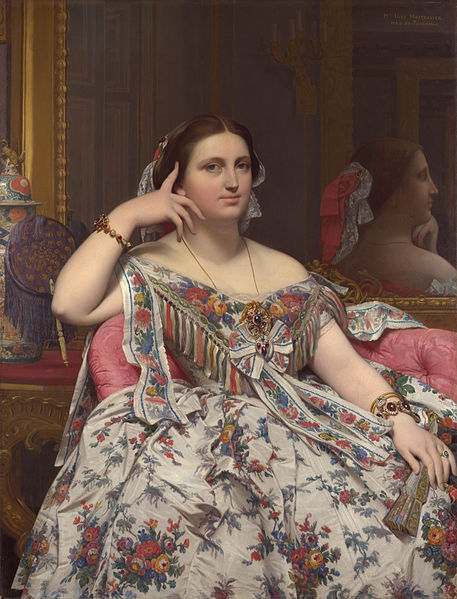
By now you will have realised that the paintings I like the most are ones that have a story behind them.  My Daily Art Display today has an intriguing tale attached to it which I will now share with you.  The painting is entitled Madame Moitessier and the artist who created this work of art was Jean-Auguste- Dominique Ingres.  This painting which was completed in 1856 is housed at the National Gallery in London.  It is the date which is interesting as Ingres initially started the painting in 1844!

Marie-Clothilde-Inès Moitessier, née de Foucauld, was the daughter of a civil servant.  Born in 1821 she married the wealthy banker, and one time importer of Cuban cigars,  Sigisbert Moitessier.  He was in his forties whilst she was just twenty-one years of age.  Two years later, her husband spoke to a friend of Ingres and asked him to speak to the artist about painting a portrait of  his new wife, Madame Montessiere.   Ingres refused the commission, as to him,  portraiture was a “low” form of art and he preferred to concentrate on “history paintings”.    However his friend Marcotte persevered with the Monsieur Moitessier’s request and finally Ingres agreed to meet the new wife.

Ingres was immediately struck and captivated by her beauty and agreed to paint her portrait.  Ingres then made his first mistake by suggesting that Moitessier should include her young daughter “la charmante Catherine” in the portrait.  If you look at preliminary sketches of this work, which can be seen at the Ingres Museum in Montauban, you can see the head of Catherine under her mother’s arm.  However by 1847 the young child had become so restless, couldn’t sit still for any lengthy period and finally rebelled against any artistic instructions and so, was  banished.

Ingres was a perfectionist.  Everything had to be just right with the work and over a period of time the clothes which Madame Montessier wore were changed to suit the artist and be of the latest fashion.  In the finished painting she wears the latest woven floral fabric with a crinoline, the stiffened petticoat, which had just come into fashion in 1855.  The lady also had little choice on what jewellery she should wear.  Ingres was the Master and told her what to wear and couched his suggestions in terms of flattery.  He was reported to have told her one day when discussing how she should adorn herself:

“……Since you are clearly beautiful all by yourself,  I am abandoning, after mature consideration, the projected grand headdress for a gala.  The portrait will be in even better taste and I fear that it would have distracted the eye too much at the expense of the head.  Same thing for the brooch at your breast;  the style is too old-fashioned and I beg you to replace it with a gold cameo.  However I am not against a long and simple chatelaine, which I could terminate with the pendant of the first one.  Please….bring on Monday your jewel chest, bracelets and the long pearl necklace……

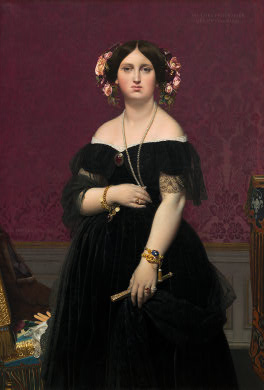
More bad luck for the commission was to follow as in 1849 Ingres’s wife died suddenly and the artist was devastated and didn’t paint for the next seven months.  In 1851, seven years after he started the painting of the seated Madam Moitessier, little progress had been made and the husband became restless at this lack of progress.  So that year, after constant cajoling and support from his friends and the demand of the sitter and her husband,  he went back to the easel.   Ingres started another painting of Moitessier’s wife, dressed in black, this time in a standing position.  He completed this at the end of 1851 and this work can now be found in the National Gallery of Art in Washington.

After completing the standing portrait of Madame Moitessier he reverted back to the one he had begun in 1844.  The lady is sitting in a rather strange pose.  Art historians believe that the pose of the lady, hand touching cheek, captured in Ingres’s painting,  was reminiscent of the fresco Hercules and Telephus from Herculaneum  which Ingres probably saw when he was there in 1814.  It is believed that Ingres had the sitter take up this pose but had to convince her husband that it was in keeping with Classical art and it made his wife look more learned and cultured.  The husband liked this idea as he was of the nouveau riche and liked the idea that the painting may have people believe they were more akin to nobility.  It is also quite amusing to read that Madame Moitessier had gained weight during her pregnancies and had demanded of Ingres that he should re-paint her arms and make them look thinner and thus more flattering!  This painting took over twelve years to complete and there are many preliminary drawings of it in existence. 

Why did it take him so long?   I have told you of some problems he encountered during this epic and I suppose we should also remember that he was 76 years of age when he finally completed the work and age may have played a large part in the agonisingly slowness in his progress.   Still, now we look at the finished article we must admire Ingres’s work. 

By now you will have realised that the paintings I like the most are ones that have a story behind them.  My Daily Art Display today has an intriguing tale attached to it which I will now share with you.  The painting is entitled Madame Moitessier and the artist who created this work of art was Jean-Auguste- Dominique Ingres.  This painting which was completed in 1856 is housed at the National Gallery in London.  It is the date which is interesting as Ingres initially started the painting in 1844!

Marie-Clothilde-Inès Moitessier, née de Foucauld, was the daughter of a civil servant.  Born in 1821 she married the wealthy banker, and one time importer of Cuban cigars Sigisbert Moitessier.  He was in his forties whilst she was just twenty-one years of age.  Two years later, her husband spoke to a friend of Ingres and asked him to speak to the artist about painting a portrait of  his new wife, Madame Montessiere.   Ingres refused the commission as to him portraiture was a “low” form of art and he preferred to concentrate on “history paintings”.    However his friend Marcotte persevered with the Monsieur Moitessier’s request and finally Ingres agreed to meet the new wife.

Ingres was immediately struck by her beauty and agreed to paint her portrait.  Ingres then made his first mistake by suggesting that Moitessier should include her young daughter “la charmante Catherine” in the portrait.  If you look at preliminary sketches of this work, which can be seen at the Ingres Museum in Montauban, you can see the head of Catherine under her mother’s arm.  However by 1847 the young child had become so restless, couldn’t sit still for any lengthy period and finally rebelled against any artistic instructions and was  banished.

Ingres was a perfectionist.  Everything had to be just right with the work and over a period of time the clothes which Madame Montessier wore were changed to suit the artist and be of the latest fashion.  In the finished painting she wears the latest woven floral fabric with a crinoline, the stiffened petticoat, which had just come into fashion in 1855.  The lady also had little choice on what jewellery she should wear.  Ingres was the Master and told her what to wear and couched his suggestions in terms of flattery.  He was reported to have told her one day when discussing how she should adorn herself:

“……Since you are clearly beautiful all by yourself, I am abandoning, after mature consideration, the projected grand headdress for a gala.  The portrait will be in even better taste and I fear that it would have distracted the eye too much at the expense of the head.  Same thing for the brooch at your breast;  the style is too old-fashioned and I beg you to replace it with a gold cameo.  However I am not against a long and simple chatelaine, which I could terminate with the pendant of the first one.  Please….bring on Monday your jewel chest, bracelets and the long pearl necklace……

Madame Moitessier by Ingres (1851)

More bad luck for the commission was to follow as in 1849 Ingres’s wife died suddenly and the artist was devastated and didn’t paint for the next seven months.  In 1851, seven years after he started the painting of the seated Madam Moitessier little progress had been made and the husband became restless at this lack of progress.  So that year after constant cajoling and support from his friends and the demand of the sitter that he produced something, Ingres started another painting of Moitessier’s wife, dressed in black, this time in a standing position.  He completed this at the end of 1851 and this work can now be found in the National Gallery of Art in Washington.

After completing the standing portrait of Madame Moitessier he reverted back to the one he had begun in 1844.  The lady is sitting in a rather strange pose.  Art historians believe that the pose of the lady, hand touching cheek, captured in Ingres’s painting was reminiscent of the fresco Hercules and Telephus from Herculaneum and which Ingres probably saw when he was there in 1814.  It is believed that Ingres had the sitter in this pose, and he had tgo convince her husband that it was in keeping with Classical art and it made his wife look more learned and cultured.  The husband liked this idea as he was of the nouveau riche and liked the idea that the painting may have people believe they were more akin to nobility.  It is also quite amusing to read that Madame Moitessier had gained weight during her pregnancies and had demanded of Ingres that he should re-paint her arms and make them look thinner and thus more flattering!  This painting took over twelve years to complete and there are many preliminary drawings of it in existence. 

Why did it take him so long?   I have told you of some problems he encountered during this epic and I suppose we should also remember that he was 76 years of age when he finally completed the work and age may have played a large part in the agonisingly slowness in his work. Still, now we look at the finished article and must admire Ingres’s work.

An Elderley Couple by Jan Gossaert

An Elderley Couple by Jan Gossaert (C.1520)

Yesterday I told you I had been to London to visit some art galleries and I talked about the Dulwich Picture Gallery.   I also mentioned I had been to the National Gallery to see the Jan Gossaert exhibition.   This was a wonderful exhibition with an exceptional collection of his paintings.  Today and tomorrow I would like to focus on two of the paintings which were on display.

My Daily Art Display today is An Elderley Couple painted by Gossaert circa 1515-1520.  This is an oil on parchment laid down on canvas work.  It is thought that the artist used parchment as this medium is fine and smooth and allows the artist to include fine detailing.  It is the only known double portrait painted by Gossaert.  This painting demonstrates Gossaert’s mature style and combines Italianate fundamentals and Flemish naturalism.  We have before us two people depicted in a bust-length pose against a dark green background.  The light in the painting emanates from the upper left corner and manages to highlight their facial features.   Who are these people?   Nobody seems to have put names to the faces.  By the clothes they wear, we must assume that they are wealthy, not noble but of the merchant-class.  Their heads almost seem too large for their bodies but by doing this Gossaert makes us concentrate on their faces.

Looking at their faces, would you say they looked a happy couple?  I wouldn’t.  To me, they exude more an air of resignation than contentment.   I don’t detect any signs of happiness in their expressions.  I don’t see any suggestion of interaction between the couple.  In many ways it is a sad portrait.  As you look at the couple you hope that your relationship with your partner will not end up like theirs.   The man’s face has an uncompromising look and the woman looks gloomy almost miserable and for my mind exudes an air of acquiescence and subservience which is emphasised by the way she is positioned behind the man.   She seems somewhat downtrodden and I have the feeling that she would walk a few steps behind this man when they were out and about.   Note how her eyes are cast down.  Her mouth curves slightly downwards which gives her the unhappy appearance.   Her white head-dress is reflected on her cheek and chin and casts a shadow across her forehead. 

The man’s face is wrinkled and we can see a  silvery stubble on it.  His neck is scrawny with age and the sinews of the neck seem strained.   His silvery hair rests upon the soft fair of his coat.  The fingers of his left hand are wrapped tightly around the silver top of his cane whilst his left hand grasps the fur collar of his coat.   He wears a black cap, on the front of which is a gold badge with two nude figures and a cornucopia.  The nude couple were probably Mercury, the god of trade and Fortuna the goddess of fortune and prosperity and could be the badge of some merchant society of which the man is a member.  His lips are pressed tightly together.  His face looks sunken.  His skin appears worn and tired.  His cheeks are hollow, which suggests he has lost many of his teeth.  However having noted his physical facial failings, it has to be said that he has a determined look.  I believe he still wields power in his business and probably in his relationship with his wife.

I wonder what the couple made of their portrait.  Have they just accepted that life has almost passed them by or do they believe that they look dignified?   This is almost a vanitas painting in which we are reminded of our own mortality.  Like it or loathe it, if I had been the man in the painting, I don’t think I would have it on prominent display in my house !

Tomorrow I will show you the gem in the Gossaert exhibition which I found totally mesmerising.

Trial by Fire by Dieric Bouts

Justice of Otto III The Trial by Fire panel by Dieiric Bouts (1470-75)

Yesterday we looked at the left hand panel of the Justice of Emperor Otto diptych entitled The Execution of the Innocent Count.  Today I want to show you the right-hand panel which is entitled Trial by Fire.

To follow on from yesterday’s story regarding the execution of the innocent nobleman we delve further into the legendary tale The Golden Legend  written by Jacobus de Voragine in the late Middle Ages to seek out the consequences of that execution and discover the meaning behind Bout’s painting.   The nobleman’s widow, convinced of her dead husband’s innocence, asked for an audience with Emperor Otto so that she be allowed to prove the truth of her husband’s claim of innocence and clear her husband of the stain of adultery by suffering an ordeal of fire.   The Golden Legend tells of the event as follows:

 “…In the year of the Lord 984 Otto III, surnamed the Wonder of the World, succeeded Otto II. According to one chronicle his wife wanted to prostitute herself to a certain count. When the count refused to perpetrate so gross a crime, the woman spitefully denounced him to the emperor, who had him beheaded without a hearing. Before he was executed, the count prayed his wife to undergo the ordeal of the red-hot iron after his death, and thus to prove his innocence. Came the day when the emperor declared that he was about to render justice to widows and orphans, and the count’s widow was present carrying her husband’s head in her arms. She asked the ruler what death anyone who killed a man unjustly was worthy of. He answered that such a one deserved to lose his head. She responded: “You are that man! You believed your wife’s accusation and ordered my husband to be put to death. Now, so that you may be sure that I am speaking the truth, I shall prove it by enduring the ordeal of the burning iron.”

Seeing this done the emperor was overwhelmed and surrendered himself to the woman to be punished. The prelates and princes intervened, however, and the widow agreed to delays of ten, eight, seven, and six days successively. Then the emperor, having examined the case and discovered the truth, condemned his wife to death by fire, and as ransom for himself gave the widow four burgs, naming them Ten, Eight, Seven, and Six after the above-mentioned delays….”

So now look at the painting which depicts the scene described in the passage from the book.  As was the case with yesterday’s left panel, the painting on the right panel is split into two different scenes.  The main scene is featured in the foreground and middle-ground and features the widow kneeling before the emperor with the head of her dead husband, cradled by her right arm. In her left hand she defiantly holds the red-hot iron bar and by this action has, according to the emperor’s dictate, passed the test.    Otto sits on his throne surrounded by six courtiers.  He wears his red and gold brocaded robe with its sumptuous brown ermine lining.  A crown sits upon his head and he holds his sceptre of office in his right hand.  His eyes are transfixed on the poor woman before him as she pleads with him.   He realises with some disconcert that he has ordered the death of an innocent and loyal man.  His left hand is placed over his heart acknowledging his heartfelt contrition.  He is dumbstruck at the realisation he has condemned an innocent man to death and has discovered the truth about his wife’s infidelity and perjury.  He knows he has to try and rectify the wrong and orders the execution of his wife. 

In the second scene we see the burning of his wife at the stake, watched by crowds, and is depicted in the background of the painting.  She is bound to a pole watched over by a white-frocked cleric, who has been with her during her last few moments extending God’s mercy to the hapless woman.  The place of execution appears to be on the hillside in the country, outside the walls of the town.

 The diptych on view for the magistrates of Louvin to see each day was to act as a salutary lesson of the consequences of hasty and ill-thought out judgements and the perils of not hearing both sides in a case.  It also reminds them that no matter how powerful they may be they should not sit in judgement in cases in which they are personally involved for fear of bias.  Some historians believe Bouts was putting forward the idea that such errors of judgement ultimately cause the judges great anguish.

To end on an historical note Emperor Otto III in reality lived a very short life, dying of the plague or malaria at the age of twenty-one in the year 1002 during one of his military campaigns.  So what of his wife?   Actually Otto never married and had never had any children and on his death the great Ottonian Dynasty ended.

Three Women in Church by Wilhelm Leibl

Three Women in Church by Wilhelm Leibl


The artist featured in My Daily Art Display today is Wilhelm Maria Hubertus Leibl.  He was born in Cologne in 1844 and became one of Germany’s greatest Realist painters of that time.

Originally apprenticed as a locksmith and later as a precision instrument maker, Wilhelm decided to follow his love of art, gave up his apprenticeship, and took to studying and training to become an artist.  His first teacher in Cologne was the painter and author, Herman Becker.  When Leibl was nineteen years of age he moved to Munich and became a student at the Academy of Fine Arts.   He studied under many art tutors including Anschutz, Straehuber and von Piloty.  The standards of his works of art fluctuated and every so often he would produce a gem.  The first such treasure was his painting entitled Aunt Josephia which he completed around 1864 and now hangs in the Walter-Richartz Museum in Cologne.   He was praise for his clever depiction of the woman’s hands which added to the expression, mood and the characterisation of the sitter.  Whilst later at the Academy he taught art to the students but a lot of his free time was spent visiting the Alte Pinakothek to study the works of art of the Masters.  His favourite art-genre was the Baroque Period and the works of van Eyck, Rubens and de Vos but also he had an affinity with the great portraiture artists such as Frans Hals and Diego Velazquez.

In 1869 he produced his portrait of Frau Gedon, which hangs in the Neue Pinakothek in Munich.  This work of Leibl was shown at the Grosse International Kunstausstellung and Gustave Courbet, the French Realist painter judged it to be the best exhibit.  So impressed by it, Courbet invited Leibl to join him in Paris.  Whilst in the French capital Leibl spent much time studying the works  of his host Courbet and those of  Édouard Manet and these artists and their paintings inspired Leibl for the rest of his life.

Leibl only remained in Paris for a year as 1870 saw the outbreak of the Franco-Prussian War that July.  Despite returning to Munich, Leibl continued to keep in touch with the French Art world and regularly submitted his own works to the Paris Salon.    In Munich he and his artist friends Carl Schuch, Wilhelm Trübner and Johann Sperl formed an artistic group known as the “Leibl Circle”.  This group’s passion for art was for art’s sake.  Their ethos was simple – art should be convincing exclusively through it formal qualities.  It was at the time of his return to Munich that Leibl started to experiment with etchings but his love of this artistic medium waned after a few years.  In 1873, at the age of twenty nine he left the city life of Munich and moved to Grassling, a countryside suburb of the city.  He enjoyed the country and village lifestyle and spent the rest of his life in various small villages around southern Bavaria and it was during those years that he painted the local peasantry in a sombre realistic style.  Leibl’s standing as an artist was principally dependent on the French critics, since his artistic reputation in Germany fell long before his standing went into decline in France.  Sadly, he never gained the acknowledgement he merited in his homeland .   Leibl died in 1900 in Wurzburg at the age of fifty-six.

My Daily Art Display today is Leibl’s oil on mahogany painting entitled Three Women in Church which took him almost three and a half years to complete and was finally exhibited in 1882, and now hangs in Hamburg’s Kunsthalle.  This was to be Leibl’s greatest masterpiece.  It is a haunting piece by an artist who, at the age of thirty eight, was at the zenith of his career and this work of art enhanced his reputation as one of Germany’s greatest Realist painters.

The three women are painted in great detail, despite, as he told his sister in a letter, the poor lighting inside the church.  The three women, all of different generations, are wearing their local costumes.  Look at their faces as they sit deep in prayer.  See how Leibl, by his attention to facial details, has portrayed their piousness.  They are all dressed in their “Sunday-best” clothes, looking their best for their church visitation.  This is a wonderful example of Realism painting depicting simple Bavarian country folk at prayer.  It emphasizes emotion and individuality and I hope you agree that this painting is a joy to behold.

Venus of Urbino by Titian and the Sleeping (Dresden) Venus by Giorgione

Today I am remaining in Italy for My Daily Art Display but moving from fresco painting to one of the most famous and controversial oil paintings, the Venus of Urbinio by the Italian master Tiziano Vecellio.  Simply known as Titian, he is considered to be the most important member of the sixteenth century Venetian School of painters.  This oil on canvas painting hangs in the Uffizi Gallery in Florence and was completed by Titian in 1538.  The painting was commissioned by Guidobaldo II della Rovere, the Duke of Urbino, a title he inherited that same year, after the assassination of his father.   The painting was more than likely intended for the bridal chambers of the palace.  Titian was almost fifty years old when he painted this picture. 

However this is not a tale about one painting, rather a tale about two paintings of the Roman goddess of love, Venus.  One needs to go back to 1510 to the studio of Giorgione, the Italian High Renaissance artist, who painted, but never completed his painting, the Sleeping Venus, sometimes known as the Dresden Venus, which now hangs in the Gemäldergalerie, Dresden.  Giorgione had worked long and hard at this painting putting great effort into the background details and shadows.  Sadly he died at the young age of 33 and the completion of the landscape and background was left to his assistant Titian

The Dresden Venus by Giorgione (1510)

Giorgione’s painting of a nude woman reclining marked a revolution in art and some art historians believe this painting marked one of the starting points for modern art.   At this time, a nude of this size, as the main focal point of the painting, was unparalleled in Western painting.  Giorgione was actually reviving a tradition of the female nude that can be traced back to ancient Greek art.
 Was this painting erotic?   Maybe that is for the individual observer to decide.  The way she lies with her right arm behind her head exposing her breasts and her left hand on her groin may lead you to the conclusion that there were underlying erotic implications to this work of art.  Giorgione’s nude is painted in an idealized landscape setting. Many believe that she has not been painted for sexual desire, and that the nude is portrayed as a demure goddess asleep and oblivious that we are stealing a look at her.

So one can be certain that Titian had seen this painting for he completed the work of art for his dead colleague.   Titian was no doubt influenced by what he saw and there has to be a correlation between this work and his own Venus of Urbino some twenty eight years later.  Two well known sayings come to mind. An English cleric and writer, Charles Caleb said that “Imitation is the sincerest form of flattery” and Pablo Picasso said “Bad artists copy.  Great artists steal” by which he meant that great artists can draw inspiration from somebody else’s painting while still putting their own touch on it.   There can be no question that there is a definite similarity between the nude figure in the Venus of Urbino and the one in the Dresden Venus.

Venus of Urbino by Titian (1538)

Titian’s oil on canvas painting Venus of Urbino is one of his most celebrated and possibly the most debated of paintings.  Art historians will have us believe that the reason the word “Venus” (the Roman goddess of love and beauty) is in the title of the painting is because of the presence of roses and the myrtle tree in the painting which are traditionally attributed to Venus.   However other historians reason that because the painting shows maidservants searching in the cassone for clothes for the young woman, then this is simply a portrait of a naked mortal rather than a goddess.

Titian’s Venus is in complete contrast to the Venus of Giorgione. The main character in Titian’s painting is a young women reclining on a bed and as was the case with Giorgioni’s Dresden Venus; her left hand covers her groin.  Both women are voluptuous.   However there are some distinct differences between the paintings.  Titian’s Venus is painted in an indoor setting of some opulence, in what looks like a palace, somewhere in Venice whereas Giorgione’s Venus is painted in a landscape.   Titian’s Venus does not present us with any of the characteristics of the goddess she is supposed to symbolize: she is not shy or retiring, she does not give us the belief that she is unattainable, or aloof.  This Venus is a flesh-and-blood mortal, awake and fully conscious of the viewer’s presence

Titian’s young woman has her eyes open whereas Giorgione’s Venus has her eyes closed and may be asleep (hence the alternative title of his painting: Sleeping Venus) which gives her an air of aloofness and one has the feeling that she is unattainable.    With her eyes closed there is a lack of sensuality and seduction in her demeanour.  On the other hand, look at the facial expression of Titian’s Venus – what is she saying to you?  Is she giving you a look of indifference or is it a look of seduction?  Allegorically, is her expression one of lust or of one of marital love?   She appears to be totally at ease with her situation and maybe you, as the viewer, are the ones who are uncomfortable.  Her long chestnut hair falls over her naked shoulders.  Her nipples are erect.  The fingers of her left hand barely cover her groin and the dark shading is almost as if Titian has painted in pubic hair.  Notice how the painting is split in half vertically by the vertical line of the dark curtain behind Venus.  The drape ends just at her left hand which draws the observer’s eye to her loins which her fingers cover

The painting oozes with sensuality which is often played down by art historians but I will leave you to be a judge of that.  She is also wearing jewellery in the form of earrings, a small ring and a bracelet whereas Giorgione’s Venus was devoid of any such man-made accoutrements. 

In her right hand Titian’s Venus is holding a posy of red roses, the symbol of Venus and they give an accentuated tonal contrast against the white bed linen.  This same red is present in the mattress and the dress of one of the maidservants.  The small dog lies asleep nearby and symbolises fidelity, which lends to the theory that the overriding premise of this work of art is one of marital love.  On the window sill we can see a myrtle tree which symbolises undying love and commitment and a Hebrew emblem of marriage.

Titian’s Venus of Urbino will delight some and horrify others, like Mark Twain who saw the painting at the Uffizi, and wrote in his book, Tramp Abroad:

“…You enter [the Uffizi] and proceed to that most-visited little gallery that exists in the world –the Tribune– and there, against the wall, without obstructing rap or leaf, you may look your fill upon the foulest, the vilest, the obscenest picture the world possesses — Titian’s Venus. It isn’t that she is naked and stretched out on a bed –no, it is the attitude of one of her arms and hand. If I ventured to describe that attitude there would be a fine howl –but there the Venus lies for anybody to gloat over that wants to –and there she has a right to lie, for she is a work of art, and art has its privileges. I saw a young girl stealing furtive glances at her; I saw young men gazing long and absorbedly at her, I saw aged infirm men hang upon her charms with a pathetic interest. How I should like to describe her –just to see what a holy indignation I could stir up in the world…yet the world is willing to let its sons and its daughters and itself look at Titian’s beast, but won’t stand a description of it in words….There are pictures of nude women which suggest no impure thought — I am well aware of that. I am not railing at such. What I am trying to emphasize is the fact that Titian’s Venus is very far from being one of that sort. Without any question it was painted for a bagnio and it was probably refused because it was a trifle too strong. In truth, it is a trifle too strong for any place but a public art gallery…”

The Visitation by Jacopo Pontormo

The Visitation by Jacopo Pontormo (1528)

Today’s featured artist is Jacopo Carucci, who because of his birthplace, was usually known as Jacopo Pontormo.  He was an Italian Mannerist painter who was born in 1494 in the small town of Pontormo near Empoli.  Most of his work was carried out in and around Florence where he was recognised as one of the most exceptional painters of his time.  He studied with the likes of Leonardo da Vinci, Albertinelli, and worked in the workshop of Andrea del Sarto, where he served his apprenticeship.

My Daily Art Display today is Pontormo’s painting The Visitation which he completed in 1528 and now adorns the altar of a side chapel in a small church called the Pieve di San Michele in Carmignano, a town west of Florence. 

The setting for this painting is the visitation of the Virgin Mary on her pregnant but aged cousin Elisabeth who was the wife of Zacharias.  The two figures in the painting with their interlinked arms form a lozenge shape.  This intertwining of figures was one of Pontormo’s trademarks as was the way he makes the characters seem to be almost floating.  The two main characters, Elizabeth and Mary, who are painted in profile, gracefully embrace each other as they exchange glances of mutual affection.  They dominate the canvas as they stand on the threshold of Zacharias’s house. 

The two other figures in the background seem quite unbending and statuesque as they look at something outside the picture.  There is a lack of emotion in their faces and they seem to be taking no part in the main event.  They seem older than the main characters and may indeed be servants awaiting their instructions. 

In the middle ground of the picture, on the left hand side, we can just make out two small figures seated on a wall looking on at the greeting scene.  They are just small specks in comparison to the main figures and maybe Pontormo, by doing this, is saying that in comparison to Mary and Elisabeth the onlookers are just mere mortals watching an historic event.

Pontormo set great store, some say he was obsessive, in the portrayal of gestures of the characters in his paintings.  In this picture this factor is emphasised by the tense still gazes of the Mary and Elisabeth as they stare at each other, tight-lipped, with little hint of a smile.

A View of Delft by Carel Fabritius (1652)

On October 12th 1654, a gunpowder store exploded destroying much of the Dutch city of Delft.  More than a hundred people were killed and more than a thousand were injured.   One of the casualties was a thirty-two year old local artist Carel Fabritius, who at the time was painting in his studio close to the gunpowder store.   Many of his paintings were also destroyed .  Fabritius had trained in Rembrandt’s studio in Amsterdam and was a contemporary of Vermeer.

Today’s Art Display is Carel Fabritius’s A View of Delft.  He painted this in 1652 and the view shows part of the Dutch town of Delft.  The actual view is looking north west from the corner of the Oude Langendijk and Oosteinde.  In the centre of the painting is the church, Nieuwe Kerk, behind which is the town hall.  In the foreground is the booth of a musical instrument vendor. It is thought that the painting may have been formed using a perspective box giving rise to an exaggerated perspective.  To the left of the lute one can see the painter’s name “C FABRITIVS 1652” scrawled on the wall