The Art Student (Miss Josephine Nivison) by Robert Henri

The Art Student (Miss Josephine Nivison) by Robert Henri (1906)

Robert Henri, a leading figure of the Ashcan School in art, was born Robert Henri Cozad in Cincinnati, Ohio in 1865.  His father John Cozad was a real estate developer and founded the town of Cozaddale, Ohio and later when the family moved west, he founded the Dawson County town of Cozad in the state of Nebraska.  Robert had one brother, also named John, and was a distant cousin of Mary Cassatt, the much admired artist and printmaker.  In October 1882, Henri’s father became embroiled in a dispute with a rancher over the right to pasture cattle on land claimed by the family. When the dispute turned physical, Cozad shot Pearson fatally with a pistol. Cozad was eventually cleared of wrongdoing, but the mood of the town turned against him. He fled to Denver, Colorado, and the rest of the family followed shortly afterwards.  In order to disassociate themselves from the scandal, family members changed their names. The father became known as Richard Henry Lee, and his sons posed as adopted children under the names Frank Southern and Robert Earl Henri.  In 1883 the family moved again, first to New York City and then on to Atlantic City, New Jersey.

At the age of  twenty-one, Robert began studying art at the Pennsylvania Academy of Fine Art in Philadelphia under the tutelage of  Robert Anschutz, the painter who also taught several well-known painters including Everett Shin, George Luks and George Bellows who along with Henri would become known as the Ashcan School.  Two years later in 1888 Robert Henri travelled to Paris and studied at the Académie Julian and later he was admitted to École des Beaux Arts.  It was during this time that he embraced Impressionism.

In 1891 he returned to America and settled down in Philadelphia and began teaching at the Philadelphia School of Design for Women.  He became friendly with a group of artists and newspaper illustrators and they, William Glackens, George Luks, Everett Shin and John French Sloan, became known in artistic circles as the Philadelphia Four.  In 1898 he married Linda Craige who was a student attending one of his private art classes, and they set off on a two-year long honeymoon/vacation in France.

In 1902 he started teaching at the New York School of Art and many “soon to be famous” artists were taught by him, including Joseph Stella, Edward Hopper, Rockwell Kent, George Bellows, Louis Fancher, Stuart Davis and Norman Raeburn.  Sadly in 1905 after a long period of poor health his wife Linda died.

A year later in 1906 Robert Henri was elected to the National Academy of Design which would later be known as The National Academy Museum and School of Fine Arts but his tenure at this establishment was short lived for when works of art by his painter friends were rejected for the Academy’s 1907 exhibition, he resigned labelling the Academy as a “cemetery of art” and threatened to stage his own art exhibition.

He carried out his threat the next year, 1908, when he and his friends staged a landmark exhibition at the Macbeth Gallery in New York entitled The Eight after the eight artists who displayed their works).  Besides his own works and those of the Philadelphia Four who had moved from Philadelphia to be with Henri, the other exhibitors were Maurice Prendegast, Ernest Lawson and Arthur B Davies.  The exhibition was a sensation and these painters would soon become associated with the Ashcan School, which was a realist artistic movement and was best known for its portrayal scenes of daily life in the city of New York.  The name “Ashcan” was first used to describe the artistic movement some years later by the American cartoonist and writer, Art Young.

In May 1908 Henri married for a second time, this time to Marjorie Organ a twenty-two year old Irish immigrant.  Henri continued to paint and teach art  in various establishments and when he was sixty-four he was chosen, by the Arts Council of New York, as one of the top three living American artists.  A year later in 1929 Robert Henri died of cancer aged 65 and in 1931 the Metropolitan Museum of Art staged a Memorial exhibition of his work to honour this giant of American Art.

My Daily Art Display for today is a work by Robert Henri called The Art Student (Miss Josephine Nivison) which he completed in 1906 and was one of the paintings I saw at the National Gallery this week at their small exhibition entitled An American Experiment.   It is a life-sized oil on canvas painting (196cms x 98cms) and is quite dark.  The model for the painting was Josephine Nivison who studied with Robert Henri at the New York School of Art the previous year.  After Henri befriended her, she and some other students from his class travelled with him to Europe.  Miss Nivison later married another influential painter, Edward Hopper (see my blog Nighthawks on Jan 23rd) and she helped promote his work and acted as his model.

In the picture her body is undefined due to the all-encompassing heavy black artist’s smock she is wearing which reaches down to her feet.  We are just able to glimpse the white collar and the red patterned shoulder of her dress she wears under the smock.  Against a plain brown background, she clutches hold of her paintbrushes in her left hand as she looks out at us with a very determined expression.

This painting was one of only a few Robert Henri painted in 1906, the year after his wife’s death.

Three Women in Church by Wilhelm Leibl

Three Women in Church by Wilhelm Leibl


The artist featured in My Daily Art Display today is Wilhelm Maria Hubertus Leibl.  He was born in Cologne in 1844 and became one of Germany’s greatest Realist painters of that time.

Originally apprenticed as a locksmith and later as a precision instrument maker, Wilhelm decided to follow his love of art, gave up his apprenticeship, and took to studying and training to become an artist.  His first teacher in Cologne was the painter and author, Herman Becker.  When Leibl was nineteen years of age he moved to Munich and became a student at the Academy of Fine Arts.   He studied under many art tutors including Anschutz, Straehuber and von Piloty.  The standards of his works of art fluctuated and every so often he would produce a gem.  The first such treasure was his painting entitled Aunt Josephia which he completed around 1864 and now hangs in the Walter-Richartz Museum in Cologne.   He was praise for his clever depiction of the woman’s hands which added to the expression, mood and the characterisation of the sitter.  Whilst later at the Academy he taught art to the students but a lot of his free time was spent visiting the Alte Pinakothek to study the works of art of the Masters.  His favourite art-genre was the Baroque Period and the works of van Eyck, Rubens and de Vos but also he had an affinity with the great portraiture artists such as Frans Hals and Diego Velazquez.

In 1869 he produced his portrait of Frau Gedon, which hangs in the Neue Pinakothek in Munich.  This work of Leibl was shown at the Grosse International Kunstausstellung and Gustave Courbet, the French Realist painter judged it to be the best exhibit.  So impressed by it, Courbet invited Leibl to join him in Paris.  Whilst in the French capital Leibl spent much time studying the works  of his host Courbet and those of  Édouard Manet and these artists and their paintings inspired Leibl for the rest of his life.

Leibl only remained in Paris for a year as 1870 saw the outbreak of the Franco-Prussian War that July.  Despite returning to Munich, Leibl continued to keep in touch with the French Art world and regularly submitted his own works to the Paris Salon.    In Munich he and his artist friends Carl Schuch, Wilhelm Trübner and Johann Sperl formed an artistic group known as the “Leibl Circle”.  This group’s passion for art was for art’s sake.  Their ethos was simple – art should be convincing exclusively through it formal qualities.  It was at the time of his return to Munich that Leibl started to experiment with etchings but his love of this artistic medium waned after a few years.  In 1873, at the age of twenty nine he left the city life of Munich and moved to Grassling, a countryside suburb of the city.  He enjoyed the country and village lifestyle and spent the rest of his life in various small villages around southern Bavaria and it was during those years that he painted the local peasantry in a sombre realistic style.  Leibl’s standing as an artist was principally dependent on the French critics, since his artistic reputation in Germany fell long before his standing went into decline in France.  Sadly, he never gained the acknowledgement he merited in his homeland .   Leibl died in 1900 in Wurzburg at the age of fifty-six.

My Daily Art Display today is Leibl’s oil on mahogany painting entitled Three Women in Church which took him almost three and a half years to complete and was finally exhibited in 1882, and now hangs in Hamburg’s Kunsthalle.  This was to be Leibl’s greatest masterpiece.  It is a haunting piece by an artist who, at the age of thirty eight, was at the zenith of his career and this work of art enhanced his reputation as one of Germany’s greatest Realist painters.

The three women are painted in great detail, despite, as he told his sister in a letter, the poor lighting inside the church.  The three women, all of different generations, are wearing their local costumes.  Look at their faces as they sit deep in prayer.  See how Leibl, by his attention to facial details, has portrayed their piousness.  They are all dressed in their “Sunday-best” clothes, looking their best for their church visitation.  This is a wonderful example of Realism painting depicting simple Bavarian country folk at prayer.  It emphasizes emotion and individuality and I hope you agree that this painting is a joy to behold.

Portrait of Francesco Giamberti San Gallo, Musician and Portrait of Giuliano da San Gallo, Architect by Piero di Cosimo

Yesterday I offered you a painting by Piero di Cosimo and most of My Daily Art Display was taken up with the story behind the painting and the painting itself without touching on the life of the artist.  Today, to make amends, I am giving you not just one painting by Cosimo but two portraitures ,but first, just a little about the artist himself.

Piero di Cosimo, also known as Piero di Lorenzo was born in Florence in 1462.  His father Lorenzo was a goldsmith.  He was apprenticed to the artist Cosimo Rosseli, his godfather and a painter of the Quattrocento, which takes in the artistic styles and cultural events of the 15th century. It was from Rosseli that Piero di Lorenzo derived his more common name “Cosimo”.   In 1481 Pope Sixtus summoned Rosseli to Rome where he was commissioned to decorate part of the Sistine Chapel.   Rosseli took Cosimo with him and he helped Rosseli with the fresco of the Sermon on the Mount, painting the background landscape.

In Rome Cosimo developed a love for the Renaissance painting genre completing many works appertaining to Greek Mythology, one of which was showcased yesterday in My Daily Art Display.   He is best known for his idiosyncratic paintings featuring fanciful mythological inventions in a world inhabited by satyr, centaurs and primitive men.  He was a superb painter of animals and a master of portraiture as one can see by today’s paintings.

Cosimo was an eccentric.  He was a solitary person, a loner, who preferred his own company.  He didn’t like people to see him at work and would lock himself away for days on end.  He was untidy and his studio rooms were dirty but he seemed oblivious to the chaotic circumstances of his life. He also had an irrational fear of fire and rarely cooked his food and he was terrified of thunderstorms.  Piero di Cosimo died of the plague in 1522, aged sixty.

Portrait of Francesco Giamberti San Gallo, Musician (1482)

My Daily Art Display today is paired portraits painted by Cosimo.  Portraits featuring two people at that time were usually male and female and often man and wife.   This set of paired portraits is a rare example of a portrait pair featuring two men, actually father and son, from different generations.    They are the only surviving portraits, which have been irrefutably accepted as being the work of Cosimo.   Both are wood panel paintings, one is entitled Portrait of Giuliano da San Gallo, Architect  (the son) and the other is Francesco Giamberti San Gallo, Musician  (the father), a cabinet maker, architect and musician in the service of Cosimo de Medici family.  The name “San Gallo” was added later to the family name “Giamberti”.  The name derived from the Porta San Gallo, one of the gates of the city of Florence, near which the Giamberti family had their house.

Portrait of Giuliano da San Gallo, Architect (1482)


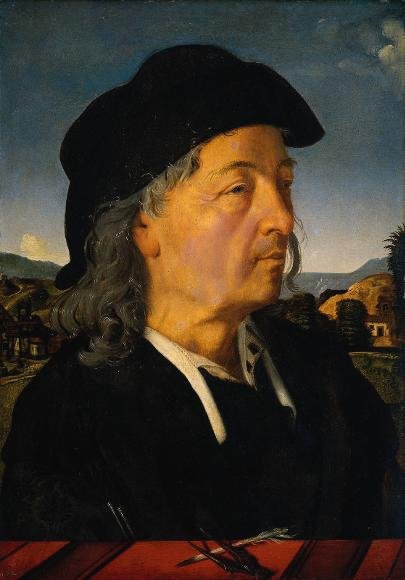
Portrait of Giuliano da San Gallo, Architect  by Cosimo was completed in 1482.  This highly successful architect and master builder to Lorenzo de’ Medici, the Florentine ruler, stands at a balustrade, turned three-quarters towards the observer.  On the balustrade are the tools of his architectural trade, namely a compass and a quill.  In the background there is an undulating Tuscan landscape which abuts a mountain range.  His appearance is formal and dignified.  He looks self-confident and somewhat aloof.  Note the detail reproduction of the cloth on the upper part of his sleeve.  Note also the effort Cosimo has put in with regards his appearance, the wrinkles around the eyes and the silvery tints in his graying hair.

Francesco Giamberti San Gallo, Musician belongs, like the other portrait, belongs to the Rijksmuseum in Amsterdam but has been loaned out to the National Gallery in London.  The painting was completed circa 1482 and was commissioned by the son Giuliano on the death of his father in 1480, the intention being that it would form a portraiture pair with his own earlier portrait carried out by Cosimo.  The father is painted in profile which gives a clear outline of the face offset against the background.   This clear-cut portrait shows an old man with sunken cheeks.  He is formally dressed which makes some art historians believe that the father had already died and the portrait was based on the death mask of the father.  His face has signs of light gray stubble and we can see the veins on his temple and his ear lobe.  His ear is almost bent double by the weight of his hat.  As was the case in the son’s portrait the father is side on to a balustrade on which are the “tools of the father’s trade” – not the tools of a cabinet maker or architect but the “tools” of a musician – a sheet of music for Francesco Giamberti often composed music for the Medicis on special occasions.

The two paintings are outstanding in the way the faces contrast sharply against the background landscape and sky.  Note the silken cover on the balustrade of both portraits.  Observe how the pattern of the striped silken fabric seems to run continuously through both portraits.  It is thought that after Cosimo completed the portrait of the father, Francesco along with the tools of his trade he went back to the portrait of the son, Giuliano and added this ornamentation and his “tools of the trade” to his portrait in order to achieve a commonality between the two paintings .  So why did Giuliano commission the painting of his father?  Was it for him to remember him or is it as some art historians postulate that it was to enhance his own reputation by emphasising his own intellectual heritage and thus improving his own standing as an architect.  Maybe that is an unjustified and a cynical view of the situation.  You must decide !