The Brown Boy by Sir Joshua Reynolds

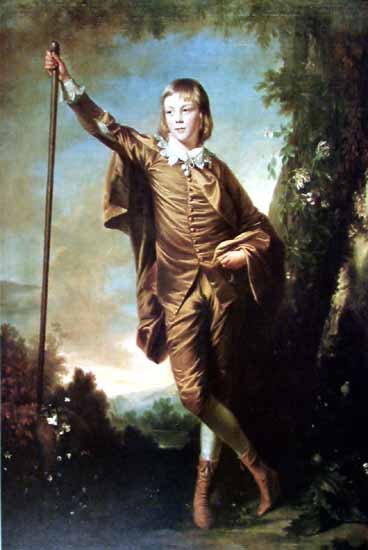
The Brown Boy by Sir Joshua Reynolds (1764)

My Daily Art Display today moves away from symbolism and interpretation and allegorical tales.  Today we have a simple portrait by an artist who was one of the greatest influences on English painting.  His name was Sir Joshua Reynolds.   His portraits were of the lofty and rhetorical manner of history painting a genre which showed figures involved in significantly important or morally enlightening scenes and treated them in a suitably impressive and gallant way.  It was often termed painting in the Grand Manner.   It was an idealized aesthetic style derived from classical art, and the modern “classic art” of the High Renaissance and it depended on the idealization of the imperfect.

Reynolds was born in Plympton St Maurice, Devon in 1723.  At the age of seventeen, he was apprenticed for three years to the prolific English portrait artist, Thomas Hudson.  In 1749 he travelled to Italy where he spent more than two years, mainly in Rome, during which time he studied the Old Masters and it was here that he developed a liking for the “Grand Style” of painting…  He was back in London in 1753 and made friends with the artistic and literary elite of the time including writers Samuel Johnson, Oliver Goldsmith, Edmund Burke and the actor David Garrick.  He became an early member of the Royal Society of Arts and later with Thomas Gainsborough, the great portrait and landscape painter, founded the Royal Academy.  Reynolds and Gainsborough were the dominant portraitists of the late 18th century.  Sadly in 1789 when Reynolds was 62 he lost the sight in his left eye.  Three years later he died and was buried in St Paul’s Cathedral, London.
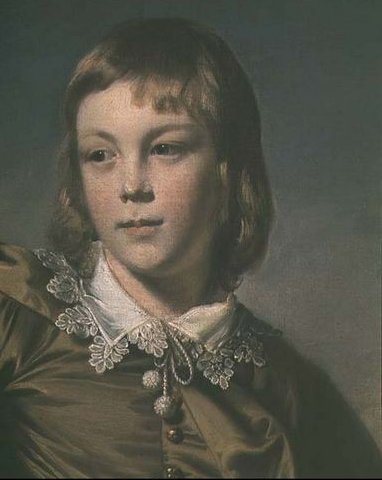
The cherubic face of Master Thomas

The other person featured in My Daily Art Display today is the person depicted in the painting, 12-year old Master Thomas Lister, who would become the 1st Baron Ribblesdale of Gisburn Park in 1797 when he was forty-five years old.  Reynolds has given the young lad’s face a flattering, slightly romantic look.  The young boy looks thoughtful as he stands leaning slightly on his stick.  There are child-like qualities in the way in which he has been portrayed.  He is at an “in-between” age, neither man nor boy he is embarking on a new stage in his life.   His costume is of plush velvet and reminds one of the ways Anthony Van Dyke, a century earlier, painted portraits of aristocrats which gave them a look of both grandeur and poise.  In this picture the colour of Thomas Lister’s clothes blends with the colour Reynolds used for the background which has an Arcadian feel to it is reminiscent of classical landscapes of the Italianate painters. 
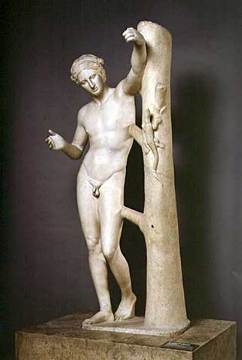
Apollo Sauroctonos


Art historians believe that Reynolds had the boy pose in a similar way to the Apollo Sauroctonos, a sculpture dating back c. 350BC, which Reynolds would have seen when he was in Rome.

In the mid 18th century, history painting was the most favoured of art genres and in this painting Reynolds has managed to intertwine historical references into this painting. 

Reynolds was well loved and admired.  William Makepeace Thackeray said of him:

“…of all the polite men of that age, Joshua Reynolds was the finest gentleman…”

I will close today with part of a poem by Thomas Bernard, who was to become Bishop of Killaloe, and who wrote in his verses on Reynolds:

“ Dear knight of Plympton, teach me how
To suffer, with unruffled brow
And smile serene, like thine,
The jest uncouth or truth severe;
To such I’ll turn my deafest ear
And calmly drink my wine.

Thou say’st not only skill is gained
But genius too may be attained
By studious imitation;
Thy temper mild, thy genius fine
I’ll copy till I make them mine
By constant application.”



Self-portrait at the Easel by Jean-Siméon Chardin

Self-portrait at the Easel by Chardin (c.1776)

Another day, another French painter.  Today I wanted to look at the French painter Jean-Baptiste-Siméon Chardin and My Daily Art Display for the day is his pastel on blue paper Self-portrait at the Easel which he painted around 1776.  It is currently housed in the Louvre, Paris.

Chardin, the son of a cabinet maker, was born in Paris, in 1699.  He lived on the Left Bank of the River Seine, close to the church of Saint Sulpice, which has, along with its “Rose Line”, recently gained notoriety because of the film The Da Vinci Code.    He studied art under the tutelage of the French History painters Pierre-Jacques Cazes and Noél-Nicolas Coypel and in 1724, aged twenty-five he became a master in the Acadèmie de Saint-Luc.  A year earlier, he entered into a marriage contract with Marguerie Saintard but it was not until eight years later that the couple married in 1731 and that year his son Jean-Pierre was born.  Two years later the couple had a daughter, Marguerite-Agnés.  Sadly his wife died in 1735 and two years later his daughter passed away.

In 1728 he presented two of his painting, The Ray, and The Buffet to the prestigious Acadèmie Royale de Peinture et de Sculpture and they were of such quality that he was accepted into this hallowed society.  For fifty years, he regularly attended the Society’s meetings and during which, served as counsellor, secretary and treasurer.  He consistently exhibited at the Salon each year and he proved to be a “dedicated academician.  Chardin earned money from his artistic talents in any way he could.  His paintings were not restricted to any single genre; it just depended on the whims of his clients. 

In 1744 he married for the second time.  His second wife was Françoise-Marguerite Pouget. The following year their daughter, Angèlique-Françoise, was born, but she died in 1746.  In 1752 Chardin was granted a pension of 500 livres by Louis XV.  Beginning in 1761, his responsibilities on behalf of the Salon, simultaneously arranging the exhibitions and acting as treasurer resulted in a slow-down in the productivity of his painting.   In 1763 his services to the Acadèmie were acknowledged with an extra 200 livres in pension. In 1765 he was unanimously elected associate member of the Acadèmie des Sciences, Belles-Lettres et Arts of Rouen, but there is no evidence that he left Paris to accept the honour. By 1770 Chardin was the ‘Premiere peintre du roi’, and his pension of 1,400 livres was the highest in the Academy.

Chardin rarely travelled far from his Left Bank home, just occasionally making the short trips to Versailles and Fontainebleau.   In 1757 he finally moved house as Louis XV granted him a studio and living quarters in the Louvre.  Five years later more tragedy was to enter his life with the death of his artist son, Jean-Pierre, who was found drowned in Venice.  The belief was that he had committed suicide.  Chardon carried on painting and his last known painting was dated 1776, just four years before his death in 1780 at the age of 80.

Chardon was secretive about his methods. No one saw him painting; he had no pupils or followers. He seems to have worked slowly, in a style that is evocative rather than literally descriptive. He made few, if any, preparatory drawings. His contemporaries observed that his still-life paintings, which on close inspection seemed to be just a flurry of strokes, were in fact paintings of a startling immediacy and naturalism.   He portrayed household and family routines and children at play in genre scenes with a touch that was tenderly true to life.  These were engraved and claimed the imagination of a wide public. The subject matter he chose for his paintings was unassuming.  They were also often small in size.  Chardin’s paintings are supremely colourful and his work has long been admired by artists and critics alike.

Throughout the eighteenth century there were two competing hierarchies of painting genres.  On one side, one had the history painting genre and on the other side there was the portraiture and still-life genre paintings.  Chardin,  who painted many still-lifes including many which featured food, never attempted portraiture until 1837 when, according to Nicolas Cochin’s 1737 book Essay on the Life of Chardin1737, wrote of Chardin:

‘….A remarkable occurrence led him to try his hand at this new genre.  Monsieur Avid, a portraitist, was a great friend.  He often asked Monsieur Chardin for advice, which he found beneficial.  However one day when Monsieur Chardin criticised him too keenly, Monsieur Avid sharply retorted: “Do you suppose that it is as easy to paint as your stuffed tongue and saveloys?”  Monsieur Chardin was extremely vexed at this remark…’

Today’s pastel, Self-portrait at the Easel by Chardin sees him standing at his easel.  He stands before us at a time when his eyesight was failing and his health was deteriorating.  He gives us an unflattering and unsentimental vision of himself.  It is, in some ways a disturbing sight.  His enormous prince-nez have slipped down to the end of his nose as he peers over them at us, his viewers.  His eyes do not sparkle.  They look tired and dull.  This was to be one of the last paintings from the artist who seems weary and aware of how the passing years have affected him both physically and mentally.  Although he had many successes in his life, he also experienced many tragedies and one can see that they have taken their toll on him.  His faded skin with its slight ruddy tinge has a look of roughness about it.  His lips have a slight upward turn to them as he forces himself to smile at us.  What is he thinking about?  Around his neck is a multi-coloured scarf, a mixture of warm reds balanced by cool blues and grays.  Such colours can also be seen in his well-worn coat and reflected in his face.

Unfortunately for Chardin, public taste in paintings changed in the mid 18th century and there was a desire to see historical paintings once again come to the fore.  This was not Chardin’s painting genre and he fell from favour with the Academy.  His pension was reduced and slowly his duties at the Academy shrank.  It was not until a hundred years later that the paintings of Chardin came back in vogue and his works are now coveted by the top museums and the wealthy collectors.  Chardin influenced many of the great artists that followed, such as Manet and Cezanne.   Henri Matisse ranked Chardin as one of his most admired painters.

Mademoiselle Rivière by Ingres

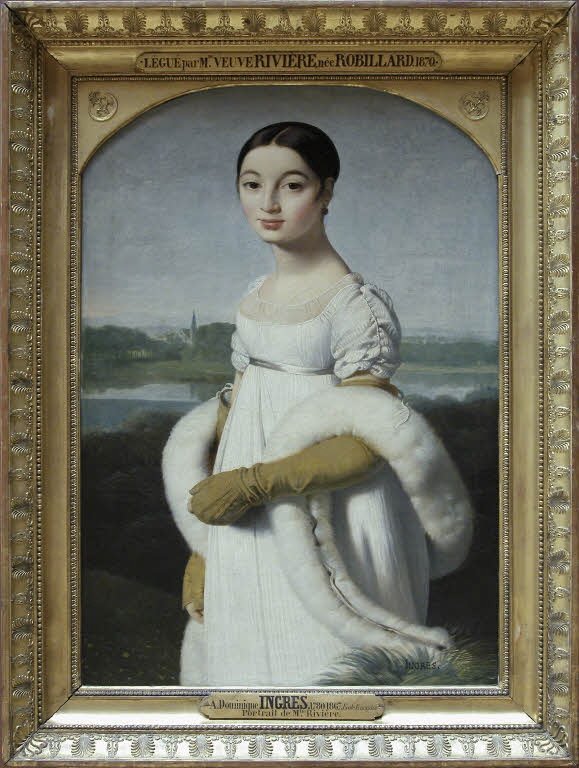
Mademoiselle Caroline Rivière by Ingres (1806)

My Daily Art Display today is a portrait of a fifteen year old French girl, Caroline Rivière, which was painted by French neo-classical artist Jean-Auguste-Dominique Ingres in 1806 and can be found hanging in the Louvre, Paris.  Regrettably the story attached to this painting of this youthful beauty has a sad ending, but more of that later.

Ingres was born in 1780, the son of a small time miniature-painter and sculptor, Josef Ingres, from whom he learnt the basics of art and music.  His formal academic life started at the Toulouse Academy of Art at the age of eleven and at the same time he kept up his musical training by taking violin lessons.   He went to Paris at the age of sixteen where he was a student of Antoine-Jean Gros at the studio of Jaques-Louis David.  In 1801 he won the Prix de Rome for his painting Ambassadors of Agamemnon.  The Prix de Rome was a scholarship, founded concurrently with the French Academy in Rome, that enabled prize-winning students at the Académie Royale de Peinture et de Sculpture in Paris to spend a period, usually 4 years, in Rome studying art, at the state’s expense.  Unfortunately for Ingres, because of the financial problems with the French economy, he was not awarded his trip to Rome until 1807.  It was during his stay in Paris from 1801 to 1807, before heading for Rome, that he completed his first portraits.  Some were of wealthy dignitaries such as the portrait,  Napoleon I on the Imperial Throne which hangs in the Musée de l’Armée, Paris  and some where of himself and his friends such as his  Self Portrait at the Age of 24, which is housed in the Musée Condé in Chantilly.                

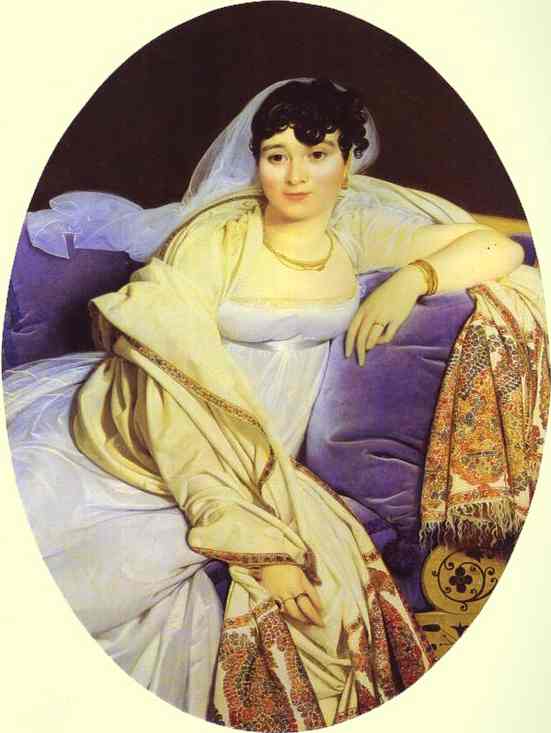
Madame Rivière (1806)
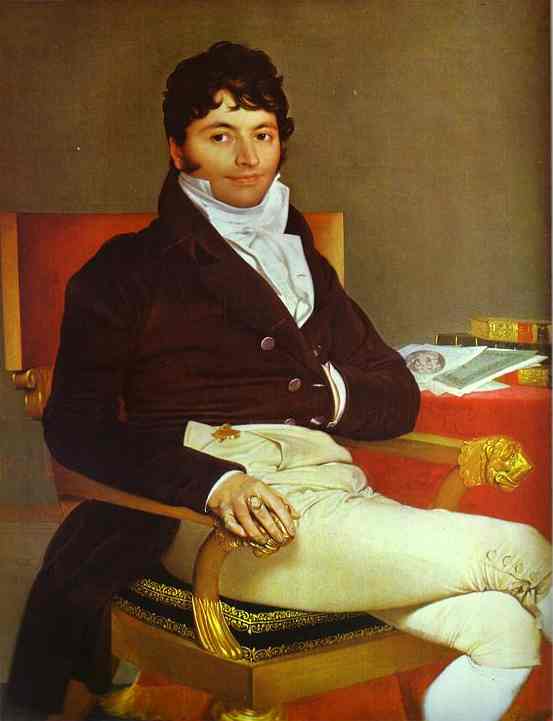
Monsieur Rivière (1806)

It was around this time that he was commissioned by a court official, Philibert Rivière, to commemorate himself, his wife, Marie-Francois and their fifthteen year old daughter Caroline.  Ingres at the time, had a passion for classical paintings with subjects based on history or Greek legends, but as he had to eke out a living, he painted portraits for clients and so accepted the commission.

 Ingres was fascinated by the young girl and was quoted as describing her as “ravishing”.   The portrait entitled Mademoiselle Rivière is My Daily Art Display for today.  It is a three-quarter length portrait.  Her young age is not immediately obvious to the viewer.  Look closer though and one can detect a childlike femininity.  She looks out at us in her virginal-white muslin dress with a large white ermine boa over her arms.  The bodice which was all the fashion at the time struggles to give an illusion of cleavage.  She appears to be quite self-conscious or maybe that is the expression she wanted to give to retain an air of respectability.  There is an overwhelming element of purity in Ingres’s depiction of her or is there?  This portrait is not completely devoid of sensuality. Look at the way Ingres has painted her full red lips, her bared neck and porcelain-like white skin which gives her slight and childlike body a sensuality of which she may not even have understood.  Her gloved arms give Caroline a hint of sophistication and she is at an age when she is neither child nor woman.  You could almost say she was the unfinished article.  

 However, it has to be remembered that her portrait was to hang next to those of her parents and therefore Ingres had to be careful on how he portrayed her.  She must come over as being an intelligent young lady of good breeding and most of all a credit to her parents who have lavished so much upon her.   This painting may be as much about her parents as it is of herself.  It may be a statement of the family wealth and the quality of life the three of them can afford to enjoy.

It was, along with the portraits of her father and mother, exhibited at the Paris Salon, the greatest annual art event in the Western world, in 1806.  The art world greeted this painting with mixed reviews; many disliked it for its “Gothicness” because of its linear precision and enamel-like finish.  It was also disapproved of because of its similarity to Early Netherlandish paintings and the French art critics of the time looked upon these painters from the Nertherlands as Les Primitifs Flamands.     Ingres’s also had many detractors who were critical of the painting saying that the proportions were not right.  They said that her head was too large, her neck was too long and curiously broad, her eyes were too far apart, which made her nose look flat and excessively long as it flows uninterrupted into her brow.  Although “puffed” botoxed lips are all the rage now, critics said that Ingres had made Caroline’s lower lip too fat which drew people’s attention to the lower part of her face which is petite in comparison to the span of her forehead.    The critics also deemed that there was a noticeable lack of definition to her shoulders. 

The background is secondary to the portrait itself and is a mainly bluish-white in colour featuring an Ile de France landscape with a distant town across the wide river.  There is freshness about the landscape and it must be presumed that Ingres wanted it to echo the fresh adolescence of his subject.

And so I return to the beginning when I said there was sadness to today’s painting.  Here we see in front of us a young girl, the daughter of a wealthy family, with everything to live for.  The sadness is that within a year of this painting being exhibited she was dead.

Pope Julius II by Raphael

Pope Julius II by Raphael Sanzio (1512)

Giuliano della Rovere was born in 1443 in Liguria, Italy.  He came from a noble, but poor family.  He received his schooling from his uncle Francesco who was a member of the Franciscan Order.   In 1471 Francesco became Pope Sixtus IV and was able to further the career of his nephew. At the end of 1471, he made the twenty-eight year old Giuliano a cardinal priest in Rome and this post afforded him many beneficiaries from which he built himself a considerable income.  His uncle died in 1484.  Giuliano was not in the position to become pope himself but his sizeable wealth allowed him to bribe the papal electors so as to have the weak but now indebted Cardinal Cibo made Pope Innocent VIII.  This newly elected pope was merely a puppet of Giuliano for the ensuing eight years.  When Pope Innocent VIII died, Giuliano made his move to become the next pope but during the eight years of being the power behind the late pope he had made enemies of many of the other cardinals and for them it was “pay-back time”.  They ignored Giuliano’s candidacy and instead in 1492 voted in his enemy Cardinal Rodrigo Borgia as Pope Alexander VI.  Giuliano was devastated at being overlooked and fearing for his life fled the country and journeyed to France where he remained until Pope Alexander VI died in 1503.  Once again Giuliano was overlooked when it came to vote in a new pope and the cardinals elected Pius II, who was ill at the time and died twenty-six days after becoming the new pontiff.  Giuliano della Rovere sensed that his time had come at last and with the help of much bribery and promises of high office he persuaded the cardinals to vote for him at the papal elections and so in 1503 Giuliano della Rovere became Pope Julius II.

Unlike the papacy of today in the fifteenth and sixteenth centuries the office of the pope had great temporal power and Julius II, known as “The Fearsome Pope” was a war-like pope who wanted the Papal States to become stronger, more powerful and for it to extend its control and by so doing, enlarging the papal rule.  With his powerful army he recaptured the lands of Romagna and Perugia and brought them under his control.  In 1509 his forces defeated the might of Venice.  Next he turned to ousting the French from Italian lands with the help of the Holy League, an alliance he formed for the purpose of expelling the forces of Louis XII of France from Italy and thereby consolidating his papal power.   Venice, the Swiss cantons, Ferdinand II of Aragón, Henry VIII of England, and Holy Roman Emperor Maximilian I were the chief members of the League.   The Swiss, who did most of the fighting, routed the French at Novara in 1513, but in the same year Julius II died and the league fell apart. Two years after his death the France re-established the French in Lombardy

One of the most important legacies Pope Julius II left was as a patron of the arts.  He persuaded, some historians would say bullied, Michelangelo into re-painting the Sistine Chapel.  It was Julius II who commissioned Raphael to paint four rooms in the Vatican, now known as Stanza di Raffaello and it was Julius who hired the Italian architect Donato Bramante to design and build an impressive new basilica in place of the old Basilica of St Peters , which sadly Pope Julius II never saw completed.
My Daily Art Display today is an oil on panel portrait of Pope Julius II painted by Raphael Sanzio in 1512, two years before the pontiff’s death.  It is an awe-inspiring work of art.  The pontiff doesn’t look at us.  His look is somewhat downcast and there is a definite melancholia about his demeanour.  It is as if he didn’t want to sit for his portrait.  We are almost dismissed by his dejected expression as if he wants desperately to be left alone.  Is this a realistic expression or just Raphael’s slightly unkind take on the pontiff’s mood?  According to the biographer and artist Giorgio Vasari, the contemporaries of the pope found the portrait

“….so true and lifelike that the portrait caused all who saw it to tremble as if it had been the living man himself…”

To be fair, the pontiff was sixty eight years of age and maybe at that age we are all allowed to look grumpy !  There is a feeling that the pope is just too despondent to speak, even too dispirited to look you in the eye.  Maybe he believed he had cause to be downhearted as it was around this time, 1511, that he learnt that Bologna had seceded from the Papal States.  At this loss, he grew a beard as a token of his mortification, which was also an ancient form of mourning.  He let this soft milky-white beard grow and did not shave it off until a year later.

The pontiff sits before us in an armchair on which is carved his own personal emblem, the acorn.  Julius’s family name was della Rovere which is the Italian word for oak.  Raphael has not positioned the pope “face-on” as was the norm for portraits of enthroned rulers of that time.  Raphael has captured in this painting an ageing man with a lined face and its sagging flesh.  Raphael however has given it colour and radiance.  The fingers of his hands bear emerald and ruby rings.  His right hand grips a white handkerchief giving an air of private compassion whilst his left hand grips the arm of the chair.  The white ruched fabric of his robe cascade and billow over his knees and hide his frail body.    We are not approaching the portrait as mere commoners about to kneel before our religious master.   We approach an elderly man from the side as if we are coming up to an elderly relative.   The pope is not wearing his ceremonial triple-crown hat.  He just wears his simple red fur-trimmed cap.

This painting of the somewhat frail and bearded leader of men makes us forget that he was, years earlier, a leader, who rode into battle with his troops.  His fragility belies that image we have of that fierce figurehead.  This was once a powerful man, someone to be reckoned with and  of whom Michelangelo said that on their falling out “he could feel the rope around his neck”.   When we look at this man we know we are in the presence of somebody special, someone who exudes unquestionable authority.  Raphael gave this old man a demeanour, which despite the ravages of time, makes us believe we are in the presence of greatness.

Portrait of a Man (Self Portrait?) by Jan Van Eyck

Portrait of a Man by Jan van Eyck (1433)

My Daily Art Display yesterday featured the painting A Man with a Quilted Sleeve by Titian in which we saw a portrait of a man with a brightly-coloured blue tunic and I discussed what was one’s initial focus of attention, the face of the subject or the blue sleeve of the tunic.   Today’s painting, Portrait of a Man (Self portrait?), poses a similar question, what do we focus on when we first look at the painting, the bright red head gear of the man or the man himself?

Portrait of a Man (Self Portrait?) is a painting by Jan van Eyck which he completed in 1433 and is housed in London’s National Gallery.  The painting is still in its original wooden frame on which are inscriptions that have been painted in such a way that they look like they have been carved into the wood.    Along the bottom the inscription reads:

JOHES DE EYCK ME FECIT ANO MCCCC.33. 21. OCTOBRIS

Which when translated reads “Jan Van Eyck Made me on October 21st 1433”

Across the top of the wooden frame is the motto:

AlC IXH XAN

This is considered to be a punning allusion to the painter’s name “Als Ich Can (as I/Eyck can) which loosely translated reads “I Do as I Can” – a motto which appeared on a number of other paintings by Jan Van Eyck.

And so to the picture itself.  At first glance it is just a simple portrait.  The man stares out at us.  On his head is a red chaperon which was a form of hat that was worn throughout Western Europe in the Middle Ages.  Van Eyck’s painting of the headgear is wonderful.   The hat actually occupies more space in the painting than the face of the sitter.  Look at the multitude of folds and tucks in the chaperon.   One wonders how long it took the artist to master this part of the painting and how many preliminary drawings were made before he was happy.    As was the case of Titian’s A Man with a Quilted Sleeve, Jan Eyck’s man is seen against a plain dark background, which makes the figure stand out.  At first our eyes just register a red headpiece on the head of a pale white-faced man and do not take in the detail.  However careful examination of the face and the chaperon reveals a multitude of subtle shades and it is actually the painting is awash with detail. 

His eyes have a slight bloodshot appearance. In the book by Lorne Campbell, research curator at the National Gallery, London, entitled The Fifteenth-Century Netherlandish Paintings, he wrote of Jan Van Eyck’s depiction of the left eye thus:

 “…The white of the eye is laid in white mixed with minute quantities of red and blue. A very thin scumble of red is brought over the underlayer, which is, however, left exposed in four places to create the secondary highlights. The veins are painted in vermilion into the wet scumble. The iris is ultra-marine, fairly pure at its circumference but mixed with white and black towards the pupil. There are black flecks near the circumference and the pupil is painted in black over the blue of the iris. The principal catchlights are four spots of lead white applied as final touches, one on the iris and three on the white, where they register with the four secondary lights to create the glistening effect…”

 The man’s skin is weather-beaten and wrinkled.  There are signs of stubble on the chin, the texture of which is in contrast with the smoothness of the soft fur collar.   It is hardly a flattering portrait and has a “warts and all” reality to it, which makes one think that it may be a self-portrait of the then thirty-eight year old artist, as if it had been a portrait of a dignitary they may wanted it to be more pictorially agreeable.

 There is a distinct realism to this painting and Jan Van Eyck’s clever use of shadows is a characteristic of Italian Renaissance paintings.

 So there you have it – today and yesterday I have given you two portraits with some similar characteristics, which do you like the most and why?

A Man with a Quilted Sleeve by Titian

A Man with Quilted Sleeve by Titian (c.1510)

My Daily Art Display today is the oil on canvas painting entitled  Portrait of a Man, sometimes known as A Man with a Quilted Sleeve, painted around 1510 by Titian and which now hangs in the National Gallery, London.  There is some doubt as to the identity of the figure in the portrait.  Some art historians would have us believe that it is a portrait of Ludovico Aristo, the Italian poet whilst others believe it to be a portrait of a member of the noble and very wealthy Barbarigo family of Venice, who were early patrons of the young artist.  It is also possible that it is an early self portrait of the artist himself,  as in those days a number of Renaissance artists used the genre of self portraiture as a means by which their standing in the art world could be enhanced.

 As was the case of many of Titian’s portraits, the artist had the ability of giving his subject a flattering and dignified appearance.  The sitter looks directly out at us.   How would you describe the sitter’s expression?    There is an air of self-confidence and determination in his thoughtful gaze, which is enhanced by the relaxed and calm manner of his posture. Is there a tinge of arrogance in the way he gazes out at us?   He is almost but not quite smiling.  There is nonchalance in his expression.  Baldassare Castiglione, the Italian courtier, diplomat and famous Renaissance author wrote a book about Courtiers and the way they dress and their manners and he sums up the way grace and courtesy will triumph and be the hallmark of a refined man.  Maybe the expression on Titian’s Man with the Quilted Sleeve follows Castiglione’s rule that encapsulates the secret of the class of a refined man, for the author wrote:

 “…In so far as one may, flee affectation as if it were a sheer and treacherous precipice; and perhaps to propose a new idea, employ in all things a certain casual unconcern that will disguise artfulness and demonstrate what is done and said to be done effortlessly, as if giving the matter no thought…”

 This concept of “casual unconcern” became a guiding principal in painting in the 16th century. 

Note the stone parapet on which the subject’s arm rests.  If you look carefully one can see the artist’s monogram, “  T   V  ”  (Tiziano Vecellio) carved into to it.   This addition of a parapet or balustrade was a favoured convention of Venetian painters, which gives a separation between the observer’s space and the space occupied by the subject of the painting.  In this case, the parapet also acts as a hard textural contrast to the softness of the blue sleeve. 

The prominence of the man in the painting is enhanced by the plain and dark background.  Blue is the predominant colour of the man’s clothes and this gives the painting both a feeling of restraint and coolness.  What detail strikes you first with this painting?   Is it the man’s face and his facial expression or maybe it is the full, quilted blue sleeve in the foreground that captures your attention?  In tomorrow’s offering I will look at Jan van Eyck’s painting Man in a Turban and again the question is raised as to what we focus on, -the sitter’s face or the bright red turban?  However, the one thing that is outstanding about this portrait is the detail of that blue satin sleeve.  It is beautifully painted.  One almost feels that by reaching out one could touch the expensive fabric and smooth down the folds.  One is being shown quality material at its best.  Look carefully how the artist has painted the stitching of the satin in such great detail.  Note also how the artist shows a billowing effect of the soft quilted puffed-sleeve with its many folds. 

It is an enigmatic painting and the more times one looks at it, the more one discovers.  It is a veritable gem.


Portrait of Francesco Giamberti San Gallo, Musician and Portrait of Giuliano da San Gallo, Architect by Piero di Cosimo

Yesterday I offered you a painting by Piero di Cosimo and most of My Daily Art Display was taken up with the story behind the painting and the painting itself without touching on the life of the artist.  Today, to make amends, I am giving you not just one painting by Cosimo but two portraitures ,but first, just a little about the artist himself.

Piero di Cosimo, also known as Piero di Lorenzo was born in Florence in 1462.  His father Lorenzo was a goldsmith.  He was apprenticed to the artist Cosimo Rosseli, his godfather and a painter of the Quattrocento, which takes in the artistic styles and cultural events of the 15th century. It was from Rosseli that Piero di Lorenzo derived his more common name “Cosimo”.   In 1481 Pope Sixtus summoned Rosseli to Rome where he was commissioned to decorate part of the Sistine Chapel.   Rosseli took Cosimo with him and he helped Rosseli with the fresco of the Sermon on the Mount, painting the background landscape.

In Rome Cosimo developed a love for the Renaissance painting genre completing many works appertaining to Greek Mythology, one of which was showcased yesterday in My Daily Art Display.   He is best known for his idiosyncratic paintings featuring fanciful mythological inventions in a world inhabited by satyr, centaurs and primitive men.  He was a superb painter of animals and a master of portraiture as one can see by today’s paintings.

Cosimo was an eccentric.  He was a solitary person, a loner, who preferred his own company.  He didn’t like people to see him at work and would lock himself away for days on end.  He was untidy and his studio rooms were dirty but he seemed oblivious to the chaotic circumstances of his life. He also had an irrational fear of fire and rarely cooked his food and he was terrified of thunderstorms.  Piero di Cosimo died of the plague in 1522, aged sixty.

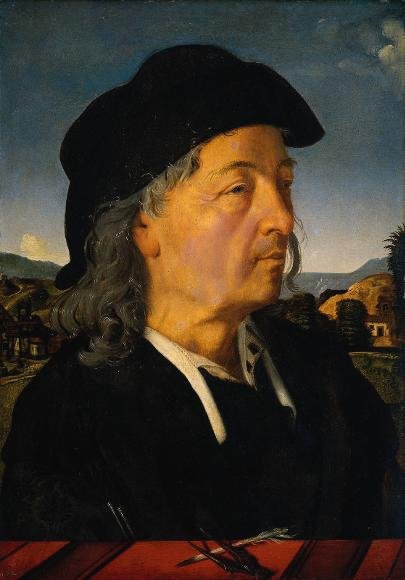
Portrait of Francesco Giamberti San Gallo, Musician (1482)

My Daily Art Display today is paired portraits painted by Cosimo.  Portraits featuring two people at that time were usually male and female and often man and wife.   This set of paired portraits is a rare example of a portrait pair featuring two men, actually father and son, from different generations.    They are the only surviving portraits, which have been irrefutably accepted as being the work of Cosimo.   Both are wood panel paintings, one is entitled Portrait of Giuliano da San Gallo, Architect  (the son) and the other is Francesco Giamberti San Gallo, Musician  (the father), a cabinet maker, architect and musician in the service of Cosimo de Medici family.  The name “San Gallo” was added later to the family name “Giamberti”.  The name derived from the Porta San Gallo, one of the gates of the city of Florence, near which the Giamberti family had their house.

Portrait of Giuliano da San Gallo, Architect (1482)


Portrait of Giuliano da San Gallo, Architect  by Cosimo was completed in 1482.  This highly successful architect and master builder to Lorenzo de’ Medici, the Florentine ruler, stands at a balustrade, turned three-quarters towards the observer.  On the balustrade are the tools of his architectural trade, namely a compass and a quill.  In the background there is an undulating Tuscan landscape which abuts a mountain range.  His appearance is formal and dignified.  He looks self-confident and somewhat aloof.  Note the detail reproduction of the cloth on the upper part of his sleeve.  Note also the effort Cosimo has put in with regards his appearance, the wrinkles around the eyes and the silvery tints in his graying hair.

Francesco Giamberti San Gallo, Musician belongs, like the other portrait, belongs to the Rijksmuseum in Amsterdam but has been loaned out to the National Gallery in London.  The painting was completed circa 1482 and was commissioned by the son Giuliano on the death of his father in 1480, the intention being that it would form a portraiture pair with his own earlier portrait carried out by Cosimo.  The father is painted in profile which gives a clear outline of the face offset against the background.   This clear-cut portrait shows an old man with sunken cheeks.  He is formally dressed which makes some art historians believe that the father had already died and the portrait was based on the death mask of the father.  His face has signs of light gray stubble and we can see the veins on his temple and his ear lobe.  His ear is almost bent double by the weight of his hat.  As was the case in the son’s portrait the father is side on to a balustrade on which are the “tools of the father’s trade” – not the tools of a cabinet maker or architect but the “tools” of a musician – a sheet of music for Francesco Giamberti often composed music for the Medicis on special occasions.

The two paintings are outstanding in the way the faces contrast sharply against the background landscape and sky.  Note the silken cover on the balustrade of both portraits.  Observe how the pattern of the striped silken fabric seems to run continuously through both portraits.  It is thought that after Cosimo completed the portrait of the father, Francesco along with the tools of his trade he went back to the portrait of the son, Giuliano and added this ornamentation and his “tools of the trade” to his portrait in order to achieve a commonality between the two paintings .  So why did Giuliano commission the painting of his father?  Was it for him to remember him or is it as some art historians postulate that it was to enhance his own reputation by emphasising his own intellectual heritage and thus improving his own standing as an architect.  Maybe that is an unjustified and a cynical view of the situation.  You must decide !