I am, as you probably know by now, fascinated by interpretation and symbolism of paintings. It fascinates me to read what art experts say about the meaning of certain aspects of a painting and of course in the majority of works the artist has died many years if not centuries ago. This of course gives the experts and critics alike, free rein to interpret what the artist was thinking as he or she put brush to canvas without fear of the artist publicly announcing that their views are nonsense. I guess in some small, and on isolated occasions, I have dipped my toe into the waters of interpretation and pontificated on what I believed the artist was thinking and meaning by his painting, knowing full well that the artist wouldn’t add a comment to my blog telling me I didn’t know what I was talking about! Today I need to tread carefully with my discussion of My Daily Art Display featured painting as the artist is still alive and although I doubt very much he will be reading this, I don’t want to be belittled by adverse comments from the great man.
My featured painting today is entitled Mr and Mrs Clark and Percy by David Hockney. Hockney painted this between 1970 and 1971 and it is of the English fashion designer, Ossie Clark, and the textile designer and his then wife Celia Birtwell. It was painted just after the couple’s wedding at which Hockney, a long term friend of the groom, was the best man. It was a time when we had just emerged from the Swinging Sixties. She also worked from home designing textiles for Ossie Clark, who would use his skill in cutting and understanding of form, and so together with her knowledge of fabrics and textures they produced haute couture for the emerging ‘sixties culture. Celia Birtwell acted as Hockney’s muse and model for some time after this painting.
Here before us we have a double-portrait which harks back to a couple of double-portraits I have featured earlier in My Daily Art Display, such as The Arnolfini Portrait by van Eyck (Nov 27th 2010) and Mr and Mrs Andrews by Gainsborough (May 2nd 2011). However, unlike those paintings, today double-portrait is not awash with symbolism but we still have a chance to interpret what we see. Ossie Clark, who looks out at us with a somewhat anxious and questioning glance, is seated, slightly slumped in a tubular chair in a very relaxed posture and standing across from him his Celia Birtwell. The mere fact that she stands and he is seated could allude to her dominance in the partnership. They are set apart by the vertical separation of the room’s full length casement window through which we can see a small balustraded balcony. I wonder if the fact that they are set so much apart was a reference to their independent careers and lives.
The setting itself, although not devoid of accoutrements, is quite minimalistic and informal, which is the complete opposite to the way nineteenth century family rooms were depicted in family portraits of that time. Then it was important that the artist made the viewer aware of the wealth of the people depicted and who often had commissioned the work. Ornate furniture with rich tapestries and sumptuous clothing were the standard trappings of such works of art and we were left in no doubt with regards the class and wealth of the people depicted. In this painting, despite its lack of ostentatious wealth, we are aware that this is not a room of the poor. The room, through its muted and plain colouring, gives it a cool feeling but amidst the cooler shades we do have the red in her dress and the blue of his jumper which stand out. The book with the yellow cover makes an admirable contrast to the pale blue of the table. On the floor sits a white plastic 60’s telephone.
On the lap of Ossie Clark is the white cat which according to the painting’s title is called Percy. Actually, although the couple had a cat called Percy, this was their other cat, called Blanche. So why switch the name of the cat? One reason could possibly be that the cat, because it is sittings upright on the man’s crotch, should have the slang term for a penis, Percy!!! Cats were also symbols of infidelity and envy and if we are to believe rumours of the time Clarke was bisexual and had many affairs which eventually lead to the break-up of their marriage three years later in 1974.
On the table we see a vase of white lilies and these flowers symbolise female purity and are often symbolic editions in paintings of the Annunciation. So was this just a coincidence? Probably not because at the time of the painting Celia Birtwell was pregnant
The painting is outstanding and featured in the final 10 of the Greatest Paintings in Britain Vote in 2005 and it was the only work by a living artist to do so.
The Madwoman sometimes known as Hyena of Salpétrière.by Géricault (1823)
My Daily Art Display today is a painting by the French artist and pioneer of the Romantic Movement Théodore Géricault. Many will be familiar with his two masterpieces, namely, Officer of the Hussars and The Raft of Medusa but today I am going to take a look at a rather disturbing portrait he completed in 1823 entitled TheMadwoman or sometimes known as Hyena of Salpétrière.
But first, a little about the artist. Théodore Géricault was born in 1791 in Rouen in the north west of France. He began his art tuition under the tutelage of Carle Venet an expert painter of horses and the “sport of kings”. He also spent time with the classical painter Piere-Narcisse Guérin who believed the young Géricault had great talent but lacked calmness and composure which was needed to become a first-rate painter.
He went on to study at The Louvre where he copied the paintings of the Masters, such as Rubens, Titian and Rembrandt. He did this for almost six years and developed a love for their style of painting which he believed to be of much more importance in comparison to the new art genre Neoclassicism, which had begun to come to the fore at the end of the eighteenth century. In 1816 he went to Italy and visited Florence, Rome and Naples and this trip was the start of his love affair with the art of Michelangelo. Géricault’s first great success as an artist came in 1821 when he was thirty years of age and he exhibited The Charging Hussar at the Paris Salon.
A Madwoman and Compulsive Gambler by Géricault
It was in 1821 and just three years before his death at the young age of thirty-three that he embarked on a series of ten portraits of the insane who were all patients of his friend Doctor Etienne-Jean Georget, the French psychiatrist who pioneered in psychiatric medicine and worked at the infamous Pitié-Salpêtrière Hospital in Paris. They series of portraits were all of maniacs who had an obsession. One was a person who stole children, one was a person who obsessed with gambling, one was a man who was obsessed with robbery, a kleptomaniac, and the poor woman in our featured painting was obsessed with envy. The name of the establishment derived from the fact that it had originally been a gunpowder factory and then later was converted to a dumping ground for the poor of Paris. It served as a prison for prostitutes, and a holding place for the mentally disabled, criminally insane and the poor. Its other “claim to fame“was that it was infested by rats!
Portrait of a Kleptomaniac by Géricault
Of the ten portraits only five, including the one featured today, remain. The Madwoman is housed at the Musée des Beaux Arts de Lyon. In this painting Géricault has with compassion tried to capture and understand the image of mental illness. Géricault, like many of his contemporaries, examined the influence of mental states on the human face and believed, as others did, that a face more accurately revealed character, especially in madness and at the moment of death.
Let us look closely at the old woman in the painting. She avoids our gaze as she looks downwards with slightly bulging eyes. Her eyes are red-rimmed probably brought on by the amount of mental and physical pain she has had to endure. Her mouth is tense. You can see the anger in her face but angry with what? Her case notes stated that she suffered from “envy obsessions” and maybe the slightest hint of a green tint to her face was the artist’s way to signify her obsession with envy. Her expression was likened to that of a hyena and hence the subtitle of the painting Hyena of Salpétrière.
Gericault’s career was short-lived. His love of horse riding was to be his downfall as after many riding accidents, which had weakened him, coupled with chronic lung infections, the young artist died after much suffering in Paris at the tender age of thirty-three.
Géricault's tomb at Père Lachaise Cemetery, Paris
If you ever visit Paris you should, like I have done on many occasions, make the journey to the Père Lachaise Cemetery, which houses the graves and tombs of many famous people including that of Géricault, his bronze figure reclines, brush in hand, on top of his tomb.
My Daily Art Display for today returns to portraiture. The oil on canvas painting is entitled A Man aged 38 and is by the Dutch artist Lucas van Leyden. Along with the likes of Gossaert and Massys he was looked upon as one of the most significant Netherlandish artist of the early sixteenth century. According to the eminent Dutch painter and biographer of Netherlandish artists, Karel van Mander, Leyden was born around 1494 in Leiden, one of five children. His father was the painter Huig Jacobsz. Leyden is looked upon as a child art prodigy as at the age of nine he was already making engravings and three years later had sold his first painting, Legend of St Hubert. He received artistic training from his father and also from Cornelis Engelbrechtsz, a leading artist of the day. By 1508 he was, according to the biographer van Mander, “a master of repute as a copperplate engraver”.
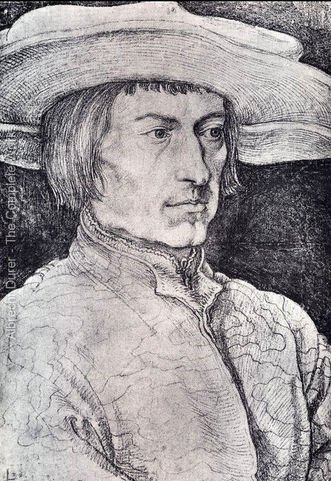
Lucas Van Leyden portrait in silverpoint by Durer
In 1521, whilst in Antwerp, van Leyden met Albrecht Dürer, an artist who had influenced his work. In Dürer’s diary kept during his travels in the Low Countries, he records that whilst at Antwerp he met Lucas, who asked him to dinner, and that he had accepted the invitation. He valued the art of Lucas at its true figure, and exchanged the Dutchman’s prints for eight florins’ worth of his own. Dürer even drew a silverpoint portrait of the young Dutch artist (above). Lucas returned to his home town of Leiden. In 1526 he married Lysbeth van Bosschuysen, a young lady from one of the most influential and wealthiest families of the town. In 1527 Lucas journeyed around the Netherlands, hosting dinners to the painters of the guilds of Middleburg, Ghent, Malines and Antwerp. During his tour of the Netherlands he had Jan Mabuse (Gossaert) as a companion. Van Leyden liked to imitate him in his style as well as in his love of rich costume.
After returning home, van Leyden took ill and remained unwell until his death in 1533, aged 39 years of age. Van Leyden was convinced that an envious colleague, who was jealous of his success, had given him poison. He left a wife, daughter Gretchen who days before his death had given birth to van Leyden’ first grandchild.
The majority of van Leyden’s work was engravings and etchings of which he completed almost one hundred and seventy between 1508 and 1530. These circulated throughout Europe and because of this the young artist’s reputation grew steadily. However today I am not featuring one of his many engravings or etchings but his painted portrait of a young man which he completed around 1521 at around the time he met up with Albrecht Dürer.
We see in front of us the bust-length figure of a clean-shaven man wearing a black coat and dark green gown clutching a piece of paper in his right hand. Inscribed on the paper are the numbers “3” and “8” and it is believed that this refers to the age of this unknown sitter. He looks lost in his own thoughts. He is a picture of concentration. The background is of a plain mid-green colour and is only interrupted by the dark shadow cast by the man’s head and his black cap. This type of shadowing effect was often seen in sixteenth century portraiture. Although the man is looking to our left we see his face in full. Look carefully at his eyes. I am fascinated by how we can see the reflection of a double-light window in his eyes as he stares out at the light. This full light shining on the sitter allows us to see clearly every detail of the tone and colour his face. One strange facial characteristic of the sitter is his extremely low-set eyebrows. Art historians have discussed the face and lean towards the view that maybe van Leyden has by enlarging the eyes and the angles of the face made the sitter’s portrait more flattering. Obviously the sitter has commissioned the portrait from the artist and is expecting both a truthful and flattering image, which of course is often at odds with one another! Still, I am sure the sitter was pleased with the result.
Of the painting the English writer and art historian Sir Claude Phillips wrote:
“…neither Dürer nor Holbein has painted anything more expressive than this still youthful dreamer of dreams, who but seems to look out at the spectator – in reality absorbed in the sad contemplation of his own soul….”
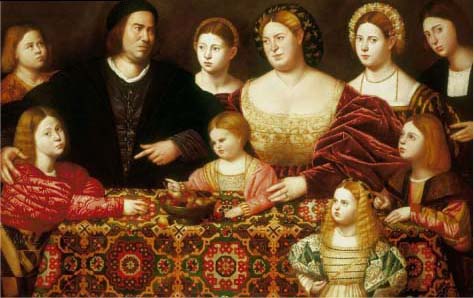
Bernardino Licinio was born in Venice around 1489 during the Italian High Renaissance. It is thought that he could have trained as an artist in the workshop of Giovanni Bellini, the founder of the Venetian School of Painting. Although being influenced by his “master”, Licinio soon developed his own down-to-earth style of realism painting. When he had finished his artistic apprenticeship, Licinio set up his own workshop and produced a number of half length panels of the Virgin and Child, some altarpieces and group portraits one of which is featured in My Daily Art Display for today. It is simply entitled A Family Group and was painted by Licinio in 1524.
In the painting we see nine members of a family. It was once thought that it was an actual portrait of Licinio’s own family but there has been no documented evidence that he was ever married. Licinio was famous for his group portraits and a few years after today’s painting he completed two similar works, namely, Arrigo Licinio and his Family (1535) and Portrait of a Sculptor with Five Apprentices(c. 1530) and all three are looked upon as his greatest works.
Small-patterned Holbein carpet
The members of the family are grouped around a table on which we see a Turkish table carpet, known as a small-patterned Holbein named after its characteristic geometric design. These carpets are of Ottoman origin and so named because Hans Holbein used to often incorporate them into his paintings. The “small pattern” terminology referred to the small size of the motifs. These were expensive carpets and in paintings often symbolised wealth and in this case we are being subtly told that this family did not have any financial problems.
What I like about this family portrait is its realistic quality. How many times have you wanted a family photograph taken with your children only to be thwarted by arguments between the young ones? This is exactly what Licinio is recording in the painting. The young boy in the elaborately painted striped hose, seated at the end of the table on the left, has just taken an apple from the bowl and of course this was the very one which his siblings had wanted. Sounds familiar? We can see the father, dressed in black, attempting to mediate in the argument. His wife, in the gold and cream low-cut dress, is listening intently to his proposed solution.
The determined child
My favourite character in the painting has to be the young girl standing in front of the table in the right foreground. Look how she stands defiantly, arms akimbo, lips pouted as she demands justice. Although she maybe the youngest of the siblings she demands to be heard. The one aspect of the painting which art critics have commented on is that there seems to be no face-to-face interaction between family members. They fail to relate to each other.
Seven Members of the Albani Family by Cariani
Compare this with, for example, Lotto’s 1547 family painting, Portrait of Giovanni della Volta with his Wife and Children, which has a similar bowl of fruit on a carpeted table but where there is an interaction between the family members or Giovanni Cariani’s Seven Members of the Albani Family (above) where everybody seems so animated. Licinio’s family group seem to be just a collection of individuals who have no connection with each other. The difference in style of the two portraits reminds me of two photographs a family photographer has taken. In one he has instructed everybody to be still and look at the camera. The result is a wooden photo, which often occurs in a formalised event where everybody has to stand still and look at the camera and not at each other. In the other the photographer has let things develop naturally before he presses the camera button without warning.
Yesterday I visited the Lady Lever Art Gallery on the Wirral peninsular in order to stand face to face with Holman Hunt’s painting The Scapegoat as this was going to be my featured painting. Of course, whilst I was there I went around the gallery, half of which is taken up by fine art paintings, mainly from British artists, and the other half was set aside for tapestries, sculptures, furniture and porcelain. It was an interesting gallery and I can thoroughly recommend you visit it if you are in the vicinity. The reason I mention all this is that I was mesmerised by one of the paintings on display. I kept having to return to it and try and work out in my own mind what was the magnetic attraction of the work. It still haunts me even now as I put my thoughts on paper. Unfortunately the gallery shop could not offer met a print of it or even a postcard which was very disappointing. My Daily Art Display today is this exquisite painting entitled Jeunesse Dorée by Gerald Leslie Brockhurst, who was one of the outstanding English artists of the twentieth century and a renowned portrait painter.
Gerald Brockhurst (Self Portrait)
Brockhurst was born in Edgbaston, a suburb of Birmingham, in 1890. His father, a coal merchant, deserted the family and went to America. He attended a number of local schools but found it hard to settle down to school life. This was exacerbated by recurring ear infections he frequently suffered from and which often left him bedridden. The young lad had an aunt who lived in India and he would frequently send her illustrated letters and it was this that got him interested in art and he was determined to become a painter. His artistic talent was recognised at the early age of twelve and he won a place at the Birmingham School of Art where he remained for five years. It was here he began to fall in love with portraiture. He won many awards at the Birmingham School of Art and later the Royal Academy Schools, the oldest art school in the country, which was founded through a personal act of King George III in 1768.
In 1912 Brockhurst was awarded the prestigious Gold Medal and Travelling Scholarship. Two years later he used this scholarship to travel with his new wife Anais to Paris and Italy. During his travels he studied the works of the “Old Masters” of the 15th and 16th centuries and these were to have a lasting impact on his art.
Anais Brockhurst first wife of the artist
Brockhurst and his wife Anais Folin went to live in Ireland and remained there for five years. It was during those years that he created many etched and painted portraits of his wife. From them, we can see that he was truly in love with her and was mesmerised by her beauty. It was during this period of his life that he first met the portraitist, Augustus John who introduced Brockhurst to his circle of friends. In fact, it was Augustus John who persuaded him to stage two major exhibitions of his works at the Chenil Gallery, London in 1916 and again in 1919. These launched his career and Brockhurst, who had moved back to London in 1920, started to enter some of his etchings and drawings to the Royal Academy. It was in the 1920’s that he established himself as an outstanding and flourishing portrait painter, and also strengthened his reputation as one of the exceptional printmakers of his generation
Teaching in the Royal Academy Schools was undertaken by a system of lectures delivered by Professors and Royal Academician ‘Visitors‘, and in 1928, when Brockhurst was thirty-eight years old, he was appointed a Visitor to the Royal Academy Schools. During this time he met the sixteen year-old artist’s model Kathleen Woodward. Brockhurst was immediately besotted by her youthful beauty and she was to become his lifelong model. He renamed her Dorette. Their relationship led to the break-up of Brockhurst’s marriage to Anais and a protracted and bitter divorce case, much sensationalised in the press. The adverse publicity from this divorce together with the onset of World War II led to his decision to leave England with Kathleen ‘Dorette’ Woodward in 1940 and emigrate to America. Brockhurst and Kathleen eventually married in 1947.
In New York Brockhurst became both famous and wealthy and lived out his life supported by a number of loyal patrons who loved his portraiture. During his career, he carried out over six hundred portraits including portraits of the rich and famous such as the Duchess of Windsor, Wallis Simpson, J Paul Getty and Marlene Dietrich. He died in New Jersey in 1978 at the age of 88. Kathleen Dorette Woodward died in 1996.
And so to the painting which captivated me yesterday. Jeunesse Dorée, meaning “gilded youth” in French, is a term applied to wealthy and fashionable society people. It was painted by Brockhurst in 1934 and exhibited at that year’s Royal Academy Summer Exhibition. It was purchased for £1000 by Lord Leverhume, for his Lady Lever Gallery on the very first day of the show. The buyer’s determination to have the painting stemmed from his disappointment the year before when he tried to buy Brockhurst’s etching Dorette, but his Gallery Trustees dithered on funding the proposed acquisition and it was bought by the Harris Museum and Art Gallery of Preston.
Like myself yesterday, many people have been captivated by this wonderful painting. The Daily Mail of the day reported on the painting and its admirers stating:
“…again I saw people yesterday standing before the picture trying to fathom the secret of those curiously haunting deep-blue eyes…”
Let us look at the painting in more detail. It is a half-length portrait with an almost two-dimensional stark and rocky idealised landscape along with an immense sky as the background. There is a lack of depth to the background of this painting, which in a way projects the young girl towards us. This setting was consistent with his many portraits of the 1930’s and 1940’s but which was in contrast to the works of other portraitist who preferred to use realistic three-dimensional settings. He has used sombre colours. The girl stares straight at us almost daring us to blink. As you look at her you wonder what is going through her mind. Her eyes are penetrating as if she is looking into your very soul. There is no hint of a smile on her full-red lips. Hers is an inscrutable expression as she fixes her gaze on us. Having said all that, in my mind, there can be no doubting her beauty and her alluring sensuality. Her plain-coloured cardigan, echoing the shades of the background, clings tightly to her body. Her full breasts strain against the material and the buttons of the cardigan which hold them captive. It is no wonder that Brockhurst was seduced by her beauty and fell in love with her. I think I too was lost in her enigmatic loveliness.
My featured artist today is the Venetian portraitist Rosalba Carriera. I have chosen her because I saw her painting whilst in Venice and I was greatly moved by it. As I told you yesterday, when I discover a “new” artist I become intrigued and curious to know more about them and so now that I am back home I have delved through my books and have come up with a somewhat sad tale which I will now tell you.
Rosalba Carriera was born in Venice in 1675 and was one of three sisters, one of whom, Angela, was later to marry the great Venetian painter Giovanni Pellegrini. Rosalba studied art under Giuseppe Diamantini, the notable Baroque painter and printmaker, during which time she would copy oil paintings. Her own first successes came in 1700 with her tempera portrait miniatures which she painted on ivory. In 1705 she was made accademico di merito by the Accademia di San Luca in Rome. This was a great honour and was reserved for non-Roman artists. Her work was so good that soon her fame spread throughout Europe.
Here is another question for you. What do you think the connection was between Rosalba and snuff?
By the 18th century, snuff had become the tobacco product of choice among the elite, prominent users included Napoleon, King George III and his wife Queen Charlotte and even Pope Benedict XIII. The taking of snuff helped to distinguish the elite members of society from the common populace, which generally smoked its tobacco. As snuff-taking became popular in Europe so did Rosalba’s commissions. Why? Rosalba Carriera was able to paint miniature portraits, often on ivory, which formed the lids of the snuff boxes. Her talent for these delicately painted snuff-boxes was in great demand. From that, she progressed to portrait painting but again on a small scale, usually about 30cms x 50 cms. In 1706 she was invited to the court in Dusseldorf to carry out various commissions and following on from that she was besieged by the nobility of Europe who flocked to her studio in Venice for her to paint their portraits or portraits of somebody from their family.
And so to My Daily Art Display painting simply entitled, Self-portrait which she completed around 1746 when she was aged 71. This was unlike many of her portraits she did of women of the nobility. Those portraits were of good-looking women, dressed in sumptuous clothes. Here we have before us a pale faced elderly woman. She is not smiling and it appears that happiness has passed her by. She looks tired, drained by her long and arduous life. I wonder if , in general, we are lulled into believing that somebody who has the ability to paint beautiful things must be happy. But maybe that is at the crux of her sadness, as it is at about this time that she began to lose her sight and she must have realised that her ability to produce such beautiful works as she had once done, was rapidly coming to an end. Can you imagine what she must have been thinking at this time in her life? Can you imagine her torment when she realised her days of painting were coming to an end?
Sadly, she became totally blind five years after completing this self portrait and this sent her spiralling into a deep depression and she died six years later in 1757, aged 82.
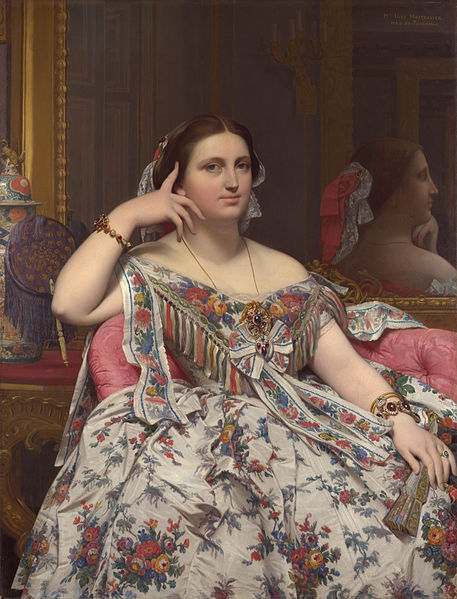
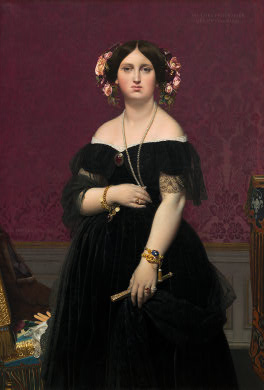
By now you will have realised that the paintings I like the most are ones that have a story behind them. My Daily Art Display today has an intriguing tale attached to it which I will now share with you. The painting is entitled Madame Moitessier and the artist who created this work of art was Jean-Auguste- Dominique Ingres. This painting which was completed in 1856 is housed at the National Gallery in London. It is the date which is interesting as Ingres initially started the painting in 1844!
Marie-Clothilde-Inès Moitessier, née de Foucauld, was the daughter of a civil servant. Born in 1821 she married the wealthy banker, and one time importer of Cuban cigars, Sigisbert Moitessier. He was in his forties whilst she was just twenty-one years of age. Two years later, her husband spoke to a friend of Ingres and asked him to speak to the artist about painting a portrait of his new wife, Madame Montessiere. Ingres refused the commission, as to him, portraiture was a “low” form of art and he preferred to concentrate on “history paintings”. However his friend Marcotte persevered with the Monsieur Moitessier’s request and finally Ingres agreed to meet the new wife.
Ingres was immediately struck and captivated by her beauty and agreed to paint her portrait. Ingres then made his first mistake by suggesting that Moitessier should include her young daughter “la charmante Catherine” in the portrait. If you look at preliminary sketches of this work, which can be seen at the Ingres Museum in Montauban, you can see the head of Catherine under her mother’s arm. However by 1847 the young child had become so restless, couldn’t sit still for any lengthy period and finally rebelled against any artistic instructions and so, was banished.
Ingres was a perfectionist. Everything had to be just right with the work and over a period of time the clothes which Madame Montessier wore were changed to suit the artist and be of the latest fashion. In the finished painting she wears the latest woven floral fabric with a crinoline, the stiffened petticoat, which had just come into fashion in 1855. The lady also had little choice on what jewellery she should wear. Ingres was the Master and told her what to wear and couched his suggestions in terms of flattery. He was reported to have told her one day when discussing how she should adorn herself:
“……Since you are clearly beautiful all by yourself, I am abandoning, after mature consideration, the projected grand headdress for a gala. The portrait will be in even better taste and I fear that it would have distracted the eye too much at the expense of the head. Same thing for the brooch at your breast; the style is too old-fashioned and I beg you to replace it with a gold cameo. However I am not against a long and simple chatelaine, which I could terminate with the pendant of the first one. Please….bring on Monday your jewel chest, bracelets and the long pearl necklace……”
More bad luck for the commission was to follow as in 1849 Ingres’s wife died suddenly and the artist was devastated and didn’t paint for the next seven months. In 1851, seven years after he started the painting of the seated Madam Moitessier, little progress had been made and the husband became restless at this lack of progress. So that year, after constant cajoling and support from his friends and the demand of the sitter and her husband, he went back to the easel. Ingres started another painting of Moitessier’s wife, dressed in black, this time in a standing position. He completed this at the end of 1851 and this work can now be found in the National Gallery of Art in Washington.
After completing the standing portrait of Madame Moitessier he reverted back to the one he had begun in 1844. The lady is sitting in a rather strange pose. Art historians believe that the pose of the lady, hand touching cheek, captured in Ingres’s painting, was reminiscent of the fresco Hercules and Telephus from Herculaneum which Ingres probably saw when he was there in 1814. It is believed that Ingres had the sitter take up this pose but had to convince her husband that it was in keeping with Classical art and it made his wife look more learned and cultured. The husband liked this idea as he was of the nouveau riche and liked the idea that the painting may have people believe they were more akin to nobility. It is also quite amusing to read that Madame Moitessier had gained weight during her pregnancies and had demanded of Ingres that he should re-paint her arms and make them look thinner and thus more flattering! This painting took over twelve years to complete and there are many preliminary drawings of it in existence.
Why did it take him so long? I have told you of some problems he encountered during this epic and I suppose we should also remember that he was 76 years of age when he finally completed the work and age may have played a large part in the agonisingly slowness in his progress. Still, now we look at the finished article we must admire Ingres’s work.
By now you will have realised that the paintings I like the most are ones that have a story behind them. My Daily Art Display today has an intriguing tale attached to it which I will now share with you. The painting is entitled Madame Moitessier and the artist who created this work of art was Jean-Auguste- Dominique Ingres. This painting which was completed in 1856 is housed at the National Gallery in London. It is the date which is interesting as Ingres initially started the painting in 1844!
Marie-Clothilde-Inès Moitessier, née de Foucauld, was the daughter of a civil servant. Born in 1821 she married the wealthy banker, and one time importer of Cuban cigars Sigisbert Moitessier. He was in his forties whilst she was just twenty-one years of age. Two years later, her husband spoke to a friend of Ingres and asked him to speak to the artist about painting a portrait of his new wife, Madame Montessiere. Ingres refused the commission as to him portraiture was a “low” form of art and he preferred to concentrate on “history paintings”. However his friend Marcotte persevered with the Monsieur Moitessier’s request and finally Ingres agreed to meet the new wife.
Ingres was immediately struck by her beauty and agreed to paint her portrait. Ingres then made his first mistake by suggesting that Moitessier should include her young daughter “la charmante Catherine” in the portrait. If you look at preliminary sketches of this work, which can be seen at the Ingres Museum in Montauban, you can see the head of Catherine under her mother’s arm. However by 1847 the young child had become so restless, couldn’t sit still for any lengthy period and finally rebelled against any artistic instructions and was banished.
Ingres was a perfectionist. Everything had to be just right with the work and over a period of time the clothes which Madame Montessier wore were changed to suit the artist and be of the latest fashion. In the finished painting she wears the latest woven floral fabric with a crinoline, the stiffened petticoat, which had just come into fashion in 1855. The lady also had little choice on what jewellery she should wear. Ingres was the Master and told her what to wear and couched his suggestions in terms of flattery. He was reported to have told her one day when discussing how she should adorn herself:
“……Since you are clearly beautiful all by yourself, I am abandoning, after mature consideration, the projected grand headdress for a gala. The portrait will be in even better taste and I fear that it would have distracted the eye too much at the expense of the head. Same thing for the brooch at your breast; the style is too old-fashioned and I beg you to replace it with a gold cameo. However I am not against a long and simple chatelaine, which I could terminate with the pendant of the first one. Please….bring on Monday your jewel chest, bracelets and the long pearl necklace……”
Madame Moitessier by Ingres (1851)
More bad luck for the commission was to follow as in 1849 Ingres’s wife died suddenly and the artist was devastated and didn’t paint for the next seven months. In 1851, seven years after he started the painting of the seated Madam Moitessier little progress had been made and the husband became restless at this lack of progress. So that year after constant cajoling and support from his friends and the demand of the sitter that he produced something, Ingres started another painting of Moitessier’s wife, dressed in black, this time in a standing position. He completed this at the end of 1851 and this work can now be found in the National Gallery of Art in Washington.
After completing the standing portrait of Madame Moitessier he reverted back to the one he had begun in 1844. The lady is sitting in a rather strange pose. Art historians believe that the pose of the lady, hand touching cheek, captured in Ingres’s painting was reminiscent of the fresco Hercules and Telephus from Herculaneum and which Ingres probably saw when he was there in 1814. It is believed that Ingres had the sitter in this pose, and he had tgo convince her husband that it was in keeping with Classical art and it made his wife look more learned and cultured. The husband liked this idea as he was of the nouveau riche and liked the idea that the painting may have people believe they were more akin to nobility. It is also quite amusing to read that Madame Moitessier had gained weight during her pregnancies and had demanded of Ingres that he should re-paint her arms and make them look thinner and thus more flattering! This painting took over twelve years to complete and there are many preliminary drawings of it in existence.
Why did it take him so long? I have told you of some problems he encountered during this epic and I suppose we should also remember that he was 76 years of age when he finally completed the work and age may have played a large part in the agonisingly slowness in his work. Still, now we look at the finished article and must admire Ingres’s work.
El bufón don Sebastián de Morra by Velázquez (c.1646)
The oil on canvas painting featured in My Daily Art Display today is a somewhat unusual, and to me, disturbing portrait by Diego Rodriguez de Silva y Velázquez entitled El bufón don Sebastián de Morra. Sebastián de Morra was a dwarf and jester to the court of Philip IV of Spain. He was crippled from birth and sadly was the subject of ridicule and mistreatment from the nobleman at Philip’s court. He was the servant of the King’s eldest son and heir, the teenage Prince Baltasar Carlos. On the prince’s untimely death at the age of 16, due to contracting smallpox, Baltasar left in his will a small silver sword and other objects to Don Sebastian and from this gesture we must believe the two of them had a very close and amicable relationship. Velázquez painted the portrait of other dwarfs of the Spanish court. Look back at My Daily Art Display of December 27th when I featured Velázquez’s painting Las Meninas in which we saw the dwarf, Maribárbola. The German philosopher and art historian Carl Justi said of their life at court: “they were loved and treated as dogs”. These unfortunate people were often found at courts in the Middle Ages and were given shelter in return for their services as court jesters, a position which left them open to offensive remarks and practical jokes. It was their lot in life to accept such unkindness and had just to be thankful that they had a roof over their heads.
This painting by Velázquez around 1646 is, by far, one of the painter’s most impressive and unforgettable works. Against a dark background we see the figure of the dwarf, Don Sebastián. There is a lack of elegance in the way he sits on the ground. He is leaning slightly to one side. His foreshortened legs stick out and he reminds us somewhat of a puppet which has been abandoned and his strings released by his puppeteer master. His tightly clenched hands rest on his thighs. He looks intently out at us making us feel slightly guilty that we are staring in at him. Can you look at him for any length of time without wanting to turn away as if you know you shouldn’t be staring at him? He looks somewhat annoyed. There is sadness in his dark eyes, which is contrary to his role as a jester, when his sole aim was to exude happiness and make people laugh. Maybe his expression is to remind us, lest we forget or are swayed by his opulent attire, that his life is not full of fun. Although he displays a dignified air, he also looks tormented and gloomy.
He wears a plush red and gold cape with a flamenco lace collar over a buttoned green doublet. His clothing, although splendid, cannot conceal from us his menial position in the court and this is emphasised even more by the fact that this sad diminutive figure is seated on the bare ground and not within the opulence of a court setting. Was it in the mind of the artist, or from the instructions of his patron, that the dwarf, Don Sebastián, should be dressed lavishly so as to portray to us, the viewers, that the jester was well treated and that he enjoyed the best life could give? Are we taken in by that premise?
Portrait of a Young Woman with Loose Hair by Albrecht Dürer (1497)
As promised yesterday, today the featured painting in My Daily Art Display today, is Albrecht Dürer’s work entitled Portrait of a Young Fürleger with Long Hair which was also completed in 1497 and was along with yesterday’s portrait, part of the diptych. The two paintings remained together as such until 1830 at which time they were sold privately to different art collectors. As was explained in yesterday’s blog the two portraits purport to be of the daughters of the wealthy Fürleger family of Nuremburg although this fact has since been disputed.
As with the case of yesterday’s portrait this painting bears a similar coat of arms but in this instance, it is an inverted red lily which was similar to the one used by the Fürleger family, albeit theirs was a yellow lily on a blue background. Again, as was the case in yesterday’s portrait it is believed that this coat of arms was added later.
There is a marked contrast between the two portraits. Yesterday’s portrait of the young woman with her hair in braids had part of the background taken up by a window, out of which one could see a countryside landscape. Today there is no such view of the world outside and has a rather sombre, dark, neutral and enclosed background. Art historians believe that this aspect of the two paintings leads us to believe that the woman with the braided hair is a woman who openly welcomes the world and who is either open to offers of betrothal or is indeed already betrothed. On the other hand, today’s young woman has shut herself off from the world. She has renounced the world and its temptations and will pledge her life to Christ’s work in a convent. This is also borne out by her devout pose. Her head is lowered with her hands clasped together in prayer. She seems somewhat shy and retiring and avoids our gaze as she looks downwards.
Our young woman today wears a simple coral bracelet around her left wrist. Her clothes are drabber. The neckline of her chemise is high covering all of the upper part of her chest. This is in complete contrast to the more plunging neckline of the chemise worn by “the young Fürleger with her hair up”. It is interesting to look at the shape of the two girl’s necks. They seem somewhat swollen which has led experts to believe that both may have suffered with thyroid problems.
In today’s portrait the young woman’s hair cascades down over her shoulders. It is a simple style. One could say that it is “as God intended it to be”. A simple headband holds it place allowing us to have an interrupted view of her delightful face. The light comes from her right hand side casting a shadow on the left side of her face. Her lips are closed but there is a hint of a smile. This is indeed a soft and beautiful face and the young woman exudes a demure expression in complete contrast to the expression on the face of yesterday’s young woman which was harder and more worldly-wise.
I have to admit when I looked at the two portraits I initially “fell in love” with the girl with her hair up but on close scrutiny I believe today’s young woman is the more beautiful of the two and the one I would like to meet and get to know. Maybe it is her unavailability that intrigues me and makes me want to know more about her. Maybe it is her gentle expression that has seduced me.
Once again “beauty is in the eye of the beholder”, so look at the two images and decide for yourself “who is the fairest of them all”
Portrait of Young Woman with Her Hair Done Up by Albrecht Dürer (1497)
My Daily Art Display for today is a tempera on canvas portrait by Albrecht Dürer. It is entitled Portrait of a Young Woman (Katharina Fürleger). It was painted in 1497 and can now be found in the Gemäldegalerie, Staatlich Museen, Berlin. This painting is sometimes known as Portrait of a Young Fürleger with Her Hair Done Up, to differentiate it from another portrait by Dürer of a girl with her hair loose, entitledPortrait of a Young Fürleger with Loose Hair, which is on display at the Städelsches Kunstinstitut, Frankfurt.
When the two portraits were hung together they formed part of a diptych but in 1830 they were sold separately and are now looked upon as single portraits. At one time it was thought that both pictures were of the same young woman, namely Katharina Fürleger but nowadays art historians have changed their minds and believe the two paintings are of two different younger sisters of the wealthy Nuremburg Fürleger family. A lot of the finer details of this painting have been totally or partially destroyed during restoration attempts and some of the details of the painting are only known because of Wenceslaus Hollar’s engraving of this painting, which he etched in 1646, before some of the details had been damaged.
We see the young woman sitting by a window, out of which we can just make out an undulating landscape. In the foreground, there is a path leading to a large gate in a wall. Parts of the landscape in the painnting have been totally or partially destroyed during various restoration attempts. Although it cannot be seen in my attached picture the wooden window post on the frame of the window is decorated with a carving of a robed man, possibly a prophet, who is reading a book on which is painted Dürer’s monogram. This also has been partially destroyed but it is known to be part of the original as recorded by the Hollar engraving. Seen from the side, this man used to look towards the other portrait of the diptych, Portrait of aYoung Girl with her Hair Down.
The young girl is eighteen years of age. How is that known? The paper or parchment cantellino, which can be seen, fixed to the wall to the right of her head bears an inscription which is not visible on the painting today but Hollar’s engraving shows that the cantellino originally had the inscription:
ALSO PIN ICH GESTALT / IN ACHCEHE JOR ALT / 1497
which translated means:
“This was my appearance when eighteen years old in 1497”
Just below this cantellino one can just make out a small shield hanging by a strap from a nail in the wall. On the shield is an inverted red cross which was similar in design to the Fürleger’s coat of arms – a yellow cross on a blue background.
The young woman is wearing her hair up in large braids wrapped around her head, which often signifies she has reached a marriageable age or is in fact betrothed. Around her head is a pearl-studded headdress which suggests she comes from a wealthy family. Her hands rest on a parapet. In her right hand she delicately holds between finger and thumb a stalk of a plant identified as eryngium, which symbolises fortune and two stalks of southern-wood, also known as Lover’s Plant or Maid’s Ruin, which was used in love potions. Her hands seem slightly deformed as if she is suffering an early onset of arthritis but this may just be the way Dürer painted hands. She wears a red gown, which is partially covering her chemise. The black trim of this chemise has an embroidered series of letters on it which are thought to be part of a motto.
There is just one final twist to the story of this painting. Art historians now say that the shield seen on the wall, which bore a resemblance to the Kürtleger’s family emblem, was added later to the painting as it was not shown in an early copy of the painting, which is now in Leipzig but it did appear in Hollar’s engraving of 1646. It was because of this family emblem that people originally believed it to be a portrait of Katharina Fürleger but there is no record of such a daughter. There was however a daughter, Anna Fürleger, but in 1497, the date of this painting, she was only thirteen years of age.
So is this Katharina Fürleger or should we believe art historian Fedja Anzelewsky, who believes the young woman in both paintings to be Dürer’s sister-in-law Katharina Frey? Others however suggest that the young women in the two portraits are in fact Dürer’s sisters Agnes and Katharina.
Tomorrow I will feature the other painting of the woman, the young woman with her hair loose.









 my daily art display