The Execution of the Innocent Count by Dieric Bouts

The Execution of the Innocent Man by Dieric Bouts (1470-5)

On January 27th  I showed you two painting by Gerard David entitled the Judgement of Cambyses and the Flaying of Sisamnes which was originally hung in the magistrates chambers in Bruges to act as a salutary warning to all those who dispensed justice in that city.  Town halls were often decorated with justice scenes in those days and today and tomorrow I want to look at two more examples of this artistic genre.  Our artist featured in today’s My Daily Art Display is the Dutch artist, Dieric Bouts the Elder.

Bouts was born in Haarlem around 1420 where he spent most of his early life.  Little is known about his childhood and early life except to say that most of his work was carried out whilst he was living in Louvain from 1457 until his death in 1475.  It was in this town that Bouts became city painter in 1468.  We know that he was influenced by the works of Jan van Eyck and Rogier van der Weyden, the latter at one time being his tutor.  Art critics talk of a certain stiffness to his drawing and drew attention to the disproportionate length and angular nature of the figures in his paintings.  However they do concede that his figures are extremely expressive and that there is a richness of colour in all his works especially the backgrounds of his landscapes.

 Our painting today is one half of the diptych known as the Justice of the Emperor Otto or simply the Justice Panels which he commenced in 1470 and which he was still working on at the time of his death five years later.  He had completed one of the two panels and had begun on the second one.  There were to be four panels in all but the third and fourth panel were never completed.  The two panels that exist and now form a diptych are now on view at the Musées Royaux, Brussels.  In 1468, Bouts who was at the height of his career had just completed his greatest masterpiece, The Last Supper.  He was approached by the town council of Louvain to paint a series of four panels for the town hall.  The town council’s reason behind such a commission was that they believed that their magistrates would benefit from the depictions of this old moral story – a judicial exemplum.

 Today I am going to look at the left hand panel which is entitled The Execution of the Innocent Count.  First let me relate the background to this painting.  The tale which is wholly legendary comes from the 12th century chronicle of Gottfried the then Bishop of Viterbo.  The story is also mentioned in Jacobus de Voragine’s Golden Legend or Aurea Legenda.  It tells of the Holy Roman Emperor Otto III whose wife was the daughter of the King of Aragon.  According to the story Otto’s wife was a very hot-blooded and feisty young Aragonese woman.  She became captivated by a married nobleman of Otto’s imperial court and without a care of the consequences tried to seduce him.  However, to her horror and anger, the nobleman rejected her amorous approaches and remained faithful to his wife and loyal to his lord, Otto.  The woman had been scorned and was furious and sought revenge on the noble who had rebuffed her.  She immediately went to her husband, Otto, and falsely accused the nobleman of having raped her and this set in motion a terrible set of events and a great injustice.  The emperor was furious and without even listening to the pleas of innocence from the nobleman ordered his execution by beheading. 

Otto and his wife

This oil on panel painting which is very large, measuring 325cms tall and 182cms wide and the people depicted in the scene are life-sized.    There are three distinct scenes to this painting and they are arranged in chronological order.  To the right, in the middle-ground, behind a stone wall, in their Imperial garden, we have the Emperor and his wife.  Their high position in the painting symbolises the fact that they were present, overseeing the proceedings.  They are witnessing the execution of the innocent man solely condemned by the perjury of the emperor’s wife.  She is emotionless and even seems bored with the event unfolding before her.

The condemned man and his wife.

On the left hand side of the middle-ground we have the accused, barefooted, with his hands tied before him.  He is dressed in a simple white robe and stands next to his wife who is dressed in red, with clasped hands praying for the soul of her husband.   The nobleman shows no emotion and seems resigned to his fate.  A Franciscan monk walks ahead of the man and his wife as they share their last words.  He is the confessor.  His hand is raised as he begins to make the sign of the cross.  He will listen to the nobleman’s last wishes and will pray with him at the end and offer him absolution for his sins.

Executioner and the severed head

In the foreground we see the aftermath of the execution.  The executioner is dressed in green and yellow tights which show splashes of blood.   His bloodied sword is held behind his back as he hands the severed head of the nobleman to the grieving wife.  She lovingly cradles the head in a white shroud.  The decapitated body of her husband with blood pouring from the severed neck lies on the green grass.  This stark contrast of the two colours intensifies the painting.   The scene is witnessed by townspeople, merchants and the clergy and probably some of them would be portraits of actual people of Louvain at the time of Bouts.

The moral of the tale depicted in this painting and what the burgers of Louvain wanted to stress to their magistrates was that one should not judge top hastily.  One should not judge a case without hearing the other side of a story and finally a judge should not make a judgement on a case in which he is personally involved.   The tale and the painting also highlight the damage which can be done through perjury and defamation.

This is just the first part of the story depicted by Bouts on one of the two panels.  Tomorrow I will focus on and discuss the second panel which deals with the repercussions of the execution of the innocent man.

The Procession to Calvary by Pieter Bruegel the Elder

Procession to Calvary by Pieter Bruegel the Elder (1564)

One of my very first offerings for My Daily Art Display was a painting by one of my favourite artists Pieter Bruegel the Elder.  Today I would like to revisit this artist and show you another of his paintings entitled The Procession to Calvary which he completed in 1564 and which now hangs in the Kunsthistoriches Museum in Vienna.  This was probably the most complex composition of the Flemish painter.

This oil on oak panel painting was the largest known work of art by Bruegel the Elder, measuring 124cms x 170cms.  It is one of sixteen paintings by him which are listed in the inventory, drawn up in 1566, of the wealthy Antwerp collector, Niclaes Jonghelinck.  The composition is in some ways a traditional one.  It is the solemn religious event of Jesus bearing the cross on his way to Calvary where he is to be crucified.  However the story is transported into the time of Bruegel and by doing this the artist has given the subject of the painting an immediacy for his contemporaries as well as making a general valid statement about human actions.   It is not the Roman soldiers of Pontius Pilate that we see escorting Christ, but the mercenaries, in their bright-red tunics, who were in the service of Philip II of Spain, the ruler of Bruegel’s Netherlands. 

 When one first looks at the painting one does not know what to focus upon first.   It is a composition depicting Christ carrying the cross, as a semi-circular procession of incidental scenes set against a wide landscape crowded by tiny and animated figures.  Our eyes dart from scene to scene of this multi-faceted painting.  It is as if the painting invites us to look everywhere at once and not let our eyes loiter on one specific spot.   It is in some ways a chaotic scene, which one finds very bewildering.  It is typical of many of Bruegel’s paintings, which are usually filled with all types of characters.  There is a myriad of tiny figures rushing about, each with a task to be completed.   We are mesmerised as we try to see what each of the hundreds of figures is doing.  As we look at the bedlam we are drawn into it and become part of the crowd.   Some are arguing, some are fighting and as we look on we wonder what it is all about.  Our mind is in a whirl with all this hyper-activity.

The Mourners

So let me try and dissect the painting.   In the foreground, the sorrowful friends of Christ, standing on a small rocky crag, and are deliberately distanced by Bruegel from the hordes below.   These four figures, the Virgin Mary, John the Disciple and the two holy women, are larger in size than the rest and they are perched motionless and distraught above the chaotic goings-on below.  They are grief-stricken at what is going on behind them.  Saint John has moved to Mary, with her large blue veil.  Her face is pale and it seems as if she is about to collapse.  It is interesting to note that these two characters and those of the holy women are dressed in the clothes worn at the time of the crucifixion, whilst the rest of the figures, with the exception of Christ himself, are dressed in Flemish garments of Bruegel’s time.  Bruegel did this to give the painting a particular reference to his own day.

The Fallen Christ

Having let our eyes dart from scene to scene amongst the heaving mass our eyes try to find and focus on the figure of Jesus.  Our attention is drawn to the white horse and rider in the centre of the picture and then we see behind them the figure of Jesus who has fallen under the weight of the cross and is on one knee trying to raise himself up once again.  He is dressed in blue and yet for some reason it was hard for us to pick him out amongst the other characters.  Was that Breugel’s intention?  Did he purposely “hide” the figure of Jesus?  It is interesting to note that although Jesus is at the centre of the painting he is difficult to discern amongst the crowd.  His insignificance amongst the masses of people is a familiar device of Mannerist painting. 

Public executions were quite normal in 16th century life and especially in the troubled land of Flanders where Bruegel lived.  These macabre events were always well attended and had a carnival-type air to them.  I suppose that as such executions were carried out on a regular basis the onlookers became hardened and completely indifferent to the fear and misery of those being led to their death.   It is interesting to see that Bruegel has also added into his painting another regular happening at these events – pick-pocketing, as the crowds, in their excitement of seeing unfortunates being executed, were often oblivious to what was going on around them and were easy targets for the pickpockets.    

The two thieves

We see the two thieves sitting in a horse-driven cart being transported to their place of execution.   Their hands which hold a crucifix are tied in front of them and they look heavenwards beseeching for some divine mercy and at the same time babbling their final confessions to the cowled priests besides them.   The cart which trundles slowly on its way is surrounded by throngs of ghoulish spectators.

Golgotha

If we look to the upper right of the picture we see the mount of Golgotha and the two crosses already erected for the crucifixion of the two thieves.  Between them we can see men digging a hole into which the third cross, from which Christ will hang, is to be placed.  Crowds walk whilst others go on horseback towards this place so as to get a “ring-side” view of the forthcoming crucifixion.    As they move up the hill they pass through a landscape dotted with gallows on which corpses still hang and wheels to which fragments of cloth and remnants of broken bodies, not eaten by the ravens, still cling.

The sky to the left is blue and calm whereas the sky to the right over Golgotha is dark and storm-like and Bruegel’s landscape has us focusing on an impossible sheer rock outcrop atop of which perches a windmill.  Art historians differ on the significance of the windmill on this rocky structure.  However, impossibly sheer outcrops of rock characterize the landscape tradition of the Antwerp School founded by Joachim Patenier.

This is in some ways a moving painting with religious significance of Jesus on his long journey to his ultimate death.  However, as is the case in many of Bruegel’s painting, the animated antics of the numerous peasants depicted brings a smile to your face as you look to see what each individually painted character is doing.

Portrait of a Man (Self Portrait?) by Jan Van Eyck

Portrait of a Man by Jan van Eyck (1433)

My Daily Art Display yesterday featured the painting A Man with a Quilted Sleeve by Titian in which we saw a portrait of a man with a brightly-coloured blue tunic and I discussed what was one’s initial focus of attention, the face of the subject or the blue sleeve of the tunic.   Today’s painting, Portrait of a Man (Self portrait?), poses a similar question, what do we focus on when we first look at the painting, the bright red head gear of the man or the man himself?

Portrait of a Man (Self Portrait?) is a painting by Jan van Eyck which he completed in 1433 and is housed in London’s National Gallery.  The painting is still in its original wooden frame on which are inscriptions that have been painted in such a way that they look like they have been carved into the wood.    Along the bottom the inscription reads:

JOHES DE EYCK ME FECIT ANO MCCCC.33. 21. OCTOBRIS

Which when translated reads “Jan Van Eyck Made me on October 21st 1433”

Across the top of the wooden frame is the motto:

AlC IXH XAN

This is considered to be a punning allusion to the painter’s name “Als Ich Can (as I/Eyck can) which loosely translated reads “I Do as I Can” – a motto which appeared on a number of other paintings by Jan Van Eyck.

And so to the picture itself.  At first glance it is just a simple portrait.  The man stares out at us.  On his head is a red chaperon which was a form of hat that was worn throughout Western Europe in the Middle Ages.  Van Eyck’s painting of the headgear is wonderful.   The hat actually occupies more space in the painting than the face of the sitter.  Look at the multitude of folds and tucks in the chaperon.   One wonders how long it took the artist to master this part of the painting and how many preliminary drawings were made before he was happy.    As was the case of Titian’s A Man with a Quilted Sleeve, Jan Eyck’s man is seen against a plain dark background, which makes the figure stand out.  At first our eyes just register a red headpiece on the head of a pale white-faced man and do not take in the detail.  However careful examination of the face and the chaperon reveals a multitude of subtle shades and it is actually the painting is awash with detail. 

His eyes have a slight bloodshot appearance. In the book by Lorne Campbell, research curator at the National Gallery, London, entitled The Fifteenth-Century Netherlandish Paintings, he wrote of Jan Van Eyck’s depiction of the left eye thus:

 “…The white of the eye is laid in white mixed with minute quantities of red and blue. A very thin scumble of red is brought over the underlayer, which is, however, left exposed in four places to create the secondary highlights. The veins are painted in vermilion into the wet scumble. The iris is ultra-marine, fairly pure at its circumference but mixed with white and black towards the pupil. There are black flecks near the circumference and the pupil is painted in black over the blue of the iris. The principal catchlights are four spots of lead white applied as final touches, one on the iris and three on the white, where they register with the four secondary lights to create the glistening effect…”

 The man’s skin is weather-beaten and wrinkled.  There are signs of stubble on the chin, the texture of which is in contrast with the smoothness of the soft fur collar.   It is hardly a flattering portrait and has a “warts and all” reality to it, which makes one think that it may be a self-portrait of the then thirty-eight year old artist, as if it had been a portrait of a dignitary they may wanted it to be more pictorially agreeable.

 There is a distinct realism to this painting and Jan Van Eyck’s clever use of shadows is a characteristic of Italian Renaissance paintings.

 So there you have it – today and yesterday I have given you two portraits with some similar characteristics, which do you like the most and why?

Judgement of Cambyses and the Flaying of Sisamnes by Gerard David

The Judgment of Cambyses and the Flaying of Sisamnes by Gerard David (1498)

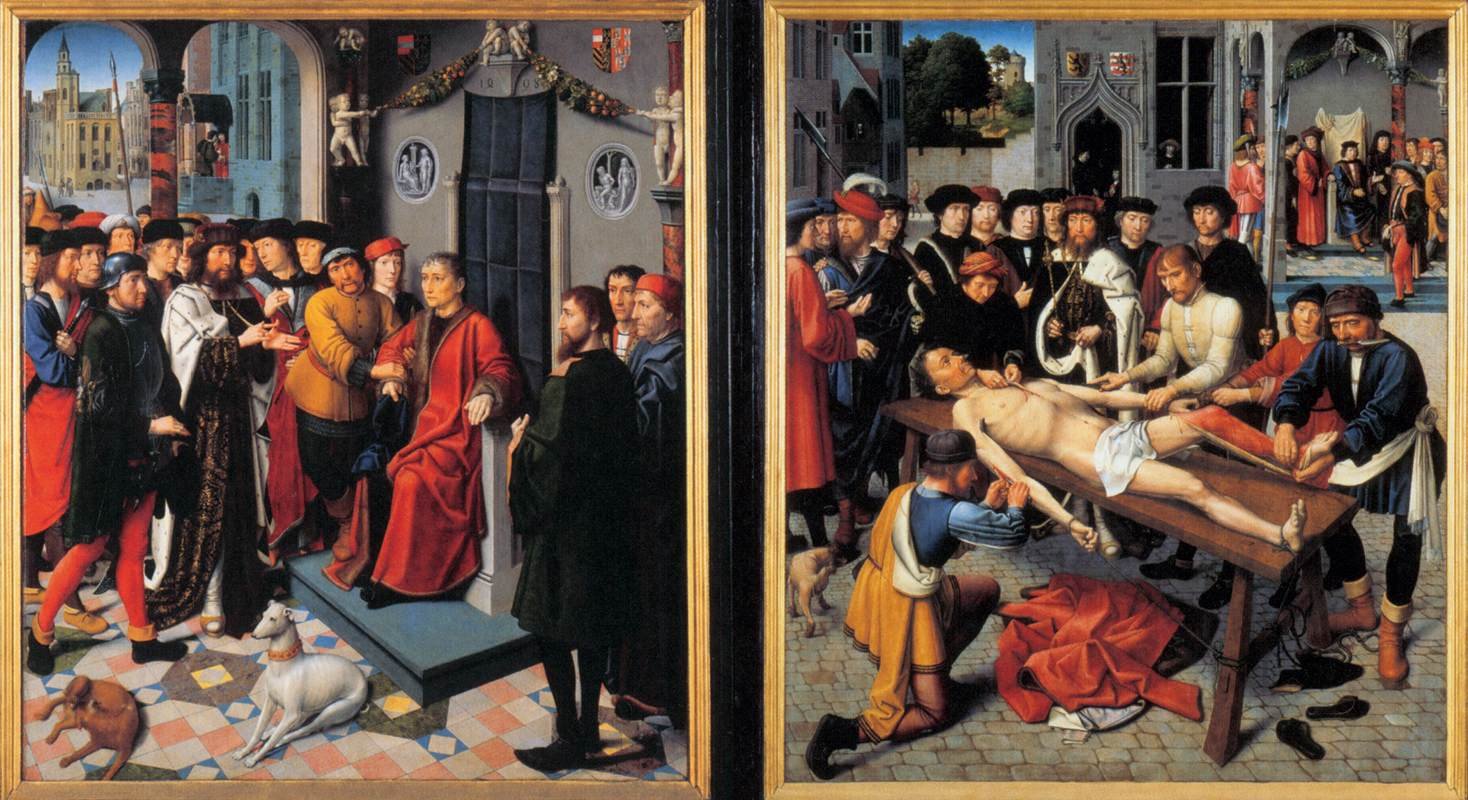
Once again I apologise to all of you who do not like the sight of blood as today’s offering is not for the squeamish !   My Daily Art Display painting for today is a diptych consisting of two oil on wood panel paintings, hinged together.  The left panel painting is entitled Judgement of Cambyses and the right hand panel is entitled Flaying of Sisamnes.  The diptych painted in 1498 by Gerard David, the Netherlandish painter can be seen at the Groeninge Museum in Bruges.

The paintings are based on a story concerning the trial and execution of an unjust and corrupt judge, Sisamnes which occurred in the 6th BC.  The great Greek historian Herodotus preserved for posterity the story of the harsh judgment of the Persian King Cambyses II, who reigned 529-522 B.C.,  against the corrupt judge Sisamnes. It is a story that for both its moral and its horror is not easily forgotten. The story is succinctly presented in the fifth book of Herodotus’s Histories.

Sisamnes, Herodotus tells us, was a royal judge under the reign of King Cambyses II. Sisamnes accepted a bribe from a party in a lawsuit, and therefore rendered an unjust judgment. King Cambyses learned of the bribe, accused Sisamnes, and had him arrested and punished, but by no ordinary punishment. The punishment was as creative as it was cruel:

King Cambyses slit his throat and flayed off all his skin and he strung the chair, on which Sisamnes had used to sit to deliver his verdicts, with these thongs.

Cambyses’s creativity did not stop there. To replace Judge Sisamnes whom he had killed and flayed, Cambyses appointed Sisamnes’s son, Otanes, as the new judge. Cambyses warned Otanes to bear in mind the source of the leather of the bench upon which he would sit to hear evidence, deliberate, and deliver his decisions. Without doubt, King Cambyses’s warning buttressed by the reupholstered seat left a lingering impression on his new judge.

Judgement of Cambyses by Gerard David

In 1498, Gerard David was commissioned by the aldermen of the town of Bruges to paint two panels depicting this ancient tale and the finished work was to hang in the chambers of the aldermen in the town hall.  This was then a warning to the local magistrates, who would see the painting every day, that the town expected them to uphold their duty to render justice free of the corruption of outside financial interests.  So that this 6th century BC story had any relevance to 15th century society, David used the technique known as “actualisation”, in which his painting was representative of that period by having the characters dressed in 15th century Flemish clothing. 

Burghers's Lodge

As was the case in yesterday’s painting, I would like you to focus on the details of the painting and by so doing, understand how David’s attempts to tell the story without the use of words.   Look under the arch of the loggia.  There we see Sisamnes’s crime taking place – that of a litigant or his servant handing over a purse of money to him as a payment for a bribe and this was the basis of the crime.  Through the left hand arch of the loggia we can see David’s depiction of the Burgher’s Lodge in Bruges.  Above the judge’s bench where Sisamnes sits one can see the crests of Phillip the Handsome and his wife Joanna of Castille.

The bearded central character in the group who stand before Sisamnes is Cambyses, the accuser.  Look how he seems to be counting on his fingers.  This could well be him counting off the acts of Sisamnes’s bribery on his fingers as he angrily regales him with the accusations.  One can see the concern on Sisamnes’s face as he realises his fate has been sealed.  One thing David had to achieve with this painting was to conjure up a hate for Sisamnes and he did this by giving him the likeness of Pieter Lanchals, a conspirator who betrayed the City of Bruges to Maximillian I of Austria in his dispute with the Council of Bruges.  The group of people, some of which were portraits of the then Bruges aldermen, represented the fact that the whole town was witnessing Cambyses’s accusation.  The man, wearing the red cap, on the left of the seated Sisamnes is the young Phillip the Handsome, the ruler of Burgundy and the Burgundian Netherlands.

The lozenge shaped medallions on either side of the judge’s bench illustrate scenes from Ovid’s Metamorphoses.  On the left are Hercules and Delaneira, the wife he betrayed, and who then gave him a robe to wear which was soaked in the blood of the Centaur, which caused the flesh of Hercules to fall from his body.  The crime perpetrated by Sisamnes was a betrayal of justice – a betrayal of the people of Bruges and the outcome of his punishment was going to be similar to that which happened to Hercules. 

The medallion on the right shows the god Apollo and the satyr Marsyas, who in the contest between them, the terms stated that the winner could treat the defeated party any way he wanted. Since the contest was judged by the Muses, Marsyas naturally lost and was flayed alive in a cave near Celaenae for his challenge of a god.  Marsyas was the symbol of hypocrisy.  David’s addition of this medallion was presumably a reminder of that salutary tale and that justice, which Sisamnes dabbled with, was a gift of the Gods, a gift to the public and his acceptance of a bribe to change the course of justice was a sin against his people as justice did not belong to him, it belonged to the people.

The Flaying of Sisamnes by Gerard David

The right hand panel of the diptych illustrates the fate of Sisamnes after being convicted of bribery.  The punishment was brutal, and yet not uncommon in the fifteenth century, that of flaying.  David’s portrayal of the flaying is graphic and shocking. We see Sisamnes lying naked on a table, his judicial red robes cast aside on the ground below.  One can quite clearly see the grimace of excruciating pain on Sisamnes’s contorted face as the four flayers busy themselves methodically with the gruesome task at hand.  The skin of the body is carefully removed as it will be turned into leather strips to be used as upholstery for the judge’s chair.  

Otanes seated on judge's chair

Look in the background and one can see seated on the judge’s chair, which is draped with flayed skin, Otanes, who is the son of the dying Sisamnes and who Cambryses has appointed to succeed his father.  According to the book Gesta Romanorum, the Latin book of anecdotes and tales, Cambryses said to Otana on making him a judge:

“  You will sit, to administer justice, upon the skin of your delinquent father: should any one incite you to do evil, remember his fate. Look down upon your  father’s skin, lest his fate befall you ”

 Those words were also meant to act as a deterrent to all future magistrates of Bruges, who may foolishly consider repeating the sins of Sisamnes.  The paintings reminded them in a most abhorent way that they needed to be mindful that any betrayal of the trust given to them would be severely dealt with.

These two paintings, although gruesome, are rich in colour and detail and worthy of a place in My Daily Art Display.