
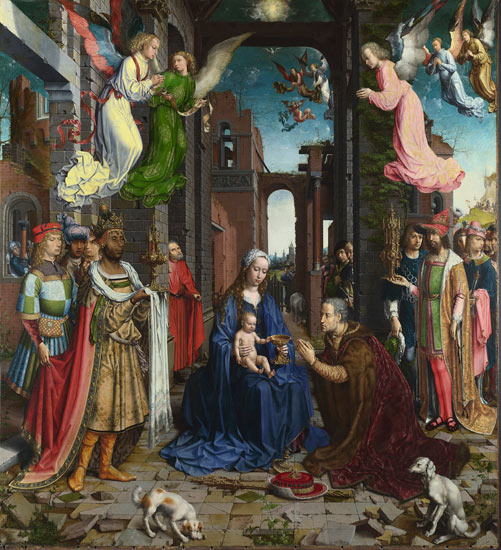
The Adoration of the Kings by Jan Gossaert

The Adoration of the Kings by Jan Gossaert (c.1515)

I ended My Daily Art Display yesterday by promising you a feature on what I believed the best painting in the Gossaert exhibition at the National Gallery, London.  I was three quarters of the way around the exhibition when I entered a small room and hanging on one wall was the magnificent work of art by Gossaert entitled The Adoration of the Kings.  This oil on wood painting was completed around 1515 after his return from Rome.  It is a very large painting measuring 177cms x 161cms.  It is part of the National Gallery’s permanent collection.  It is one of Gossaert’s largest works of art It is truly breath-taking.  I stood in front of it for a full five minutes mesmerized much to the annoyance of my fellow visitors.  There was so much going on within the picture and thus so much to take in. 

The picture is thought to have been the altarpiece of the Lady Chapel of Saint Adrian’s,  Geraardsbergen (Grammont) a town near Brussels  The patron who commissioned the painting was thought to be Daniel van Boechout, the Lord of Boelare, a well-connected nobleman.  The many figures in the painting have rigidity about them and all are colourfully dressed.  The multitude of colours and tones are what strikes your eye when you first stand in front of the painting.  The rich fabrics of the very fashionable clothes are gloriously depicted.  The backdrop which we can see through the colonnades is laid out with tiny towers and steeples

Let us take a look at some of the detail.  There are approximately thirty figures depicted in this elaborate and highly colourful painting.  These are grouped within an ornate architectural structure which adds a sense of depth to the picture.   Gossaert was master of this type of presentation.  The once palatial buildings are now in ruins.  The stones and brickwork are  chipped and overgrown with plants and small trees.  The frieze above the Virgin bears a relief of naked dancing putti which also appears on four of the pillar capitals.  They probably represent the pleasures of innocence.   

Conversion of Saint Eustace by Durer


The floor is made up of slabs and coloured stones arranged in geometrical patterns but it is chipped and broken and weeds can be seen growing between the stones.  Two dogs have been added to the foreground.  Art historians believe that the dog in the right foreground is copied directly from Durer’s famous engraving of the miraculous conversion of Saint Eustace, dated 1500/01.
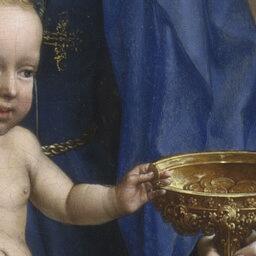
Baby Jesus with gold coin

Centrally positioned in the painting is the Virgin Mary with the baby Jesus sitting on her knee.  Kneeling in front of them is the eldest king, Caspar, with a wart on his left cheek.  He is offering his gift, a gold chalice containing gold coins.  The baby with his hand outstretched takes one of the coins. The lid of the chalice which lies on the floor next to his hat and golden sceptre bears his name.   The second king, Melchior, stands behind Caspar.  He is dressed in a green patterned doublet over which is his gold patterned coat lined with ermine.  He carries the frankincense in a highly decorative golden container.  Behind him stand four attendants.   The third king is Balthasar, and this is one of the earliest known depictions of a black man in western art.   He approaches Mary from the left of the painting.  He carries a highly ornate vessel, which contains his gift of myrrh.  His elaborate hat which incorporates a crown is inscribed with his name, BALTAZAR, and also has on it the artist’s signature.  The artist’s signature also appears on the neck ornament of Balthazar’s black attendant.    

Gossaert himself ???

Behind him are his three attendants.  If we look at the middle-ground, just behind Mary, we can see Saint Joseph, dressed in a red robe, leaning on his staff.  To the right of him we can just make out the head of an ox which peers out of a doorway and if you look closely between the Virgin Mary and King Caspar you can just make out the ass munching on weeds. Between the ox and Saint Joseph we see two men looking over a dilapidated fence.  Some believe that the man on the left is Gossaert himself.   Above all these earthly beings hover nine angels all dressed in various coloured shot fabrics.  On the hillside behind Melchior’s retinue, we can just make out the angel announcing Christ’s birth to the shepherds

The colours Gossaert uses in this painting are so rich and varied and his attention to detail of every aspect of this picture gives the impression that the artist was trying to push his powers of invention and artistry to their very limits.  The painting shown above and any others I have come across in catalogues or on the internet do not give you any idea of the true beauty of this work of art and I urge you to try and visit the Gossaert exhibition even if it is just to stand in front of this painting and absorb the beauty of this sumptuously painted work of art.

I will leave you with not my words of praise for the artist but the words of the the person who is the curator of this exhibition.  Of the Gossaert exhibition she says:

“When I stand in a room full of his paintings, the sheer quality of the work is overwhelming.  His technique is extraordinary: the way he paints textures, so you feel every strand of fur, every hair. He is undoubtedly one of the giants.”

Finally, have a look at the website below where you can use the viewer to move around the painting and zoom in on all the details.

http://www.nationalgallery.org.uk/paintings/research/jan-gossaert-the-adoration-of-the-kings-introduction

An Elderley Couple by Jan Gossaert

An Elderley Couple by Jan Gossaert (C.1520)

Yesterday I told you I had been to London to visit some art galleries and I talked about the Dulwich Picture Gallery.   I also mentioned I had been to the National Gallery to see the Jan Gossaert exhibition.   This was a wonderful exhibition with an exceptional collection of his paintings.  Today and tomorrow I would like to focus on two of the paintings which were on display.

My Daily Art Display today is An Elderley Couple painted by Gossaert circa 1515-1520.  This is an oil on parchment laid down on canvas work.  It is thought that the artist used parchment as this medium is fine and smooth and allows the artist to include fine detailing.  It is the only known double portrait painted by Gossaert.  This painting demonstrates Gossaert’s mature style and combines Italianate fundamentals and Flemish naturalism.  We have before us two people depicted in a bust-length pose against a dark green background.  The light in the painting emanates from the upper left corner and manages to highlight their facial features.   Who are these people?   Nobody seems to have put names to the faces.  By the clothes they wear, we must assume that they are wealthy, not noble but of the merchant-class.  Their heads almost seem too large for their bodies but by doing this Gossaert makes us concentrate on their faces.

Looking at their faces, would you say they looked a happy couple?  I wouldn’t.  To me, they exude more an air of resignation than contentment.   I don’t detect any signs of happiness in their expressions.  I don’t see any suggestion of interaction between the couple.  In many ways it is a sad portrait.  As you look at the couple you hope that your relationship with your partner will not end up like theirs.   The man’s face has an uncompromising look and the woman looks gloomy almost miserable and for my mind exudes an air of acquiescence and subservience which is emphasised by the way she is positioned behind the man.   She seems somewhat downtrodden and I have the feeling that she would walk a few steps behind this man when they were out and about.   Note how her eyes are cast down.  Her mouth curves slightly downwards which gives her the unhappy appearance.   Her white head-dress is reflected on her cheek and chin and casts a shadow across her forehead. 

The man’s face is wrinkled and we can see a  silvery stubble on it.  His neck is scrawny with age and the sinews of the neck seem strained.   His silvery hair rests upon the soft fair of his coat.  The fingers of his left hand are wrapped tightly around the silver top of his cane whilst his left hand grasps the fur collar of his coat.   He wears a black cap, on the front of which is a gold badge with two nude figures and a cornucopia.  The nude couple were probably Mercury, the god of trade and Fortuna the goddess of fortune and prosperity and could be the badge of some merchant society of which the man is a member.  His lips are pressed tightly together.  His face looks sunken.  His skin appears worn and tired.  His cheeks are hollow, which suggests he has lost many of his teeth.  However having noted his physical facial failings, it has to be said that he has a determined look.  I believe he still wields power in his business and probably in his relationship with his wife.

I wonder what the couple made of their portrait.  Have they just accepted that life has almost passed them by or do they believe that they look dignified?   This is almost a vanitas painting in which we are reminded of our own mortality.  Like it or loathe it, if I had been the man in the painting, I don’t think I would have it on prominent display in my house !

Tomorrow I will show you the gem in the Gossaert exhibition which I found totally mesmerising.

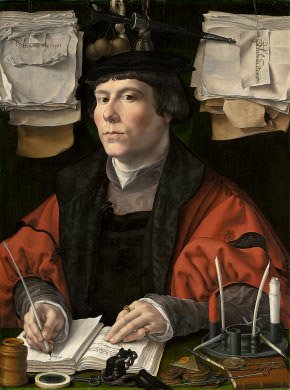
Portrait of a Merchant by Jan Gossaert

Portrait of a Merchant by Jan Gossaert (c.1530)

Today’s featured painting is by the a Netherlandish artist who was also known by his place of birth.  Jan Gossaert was born around 1478 in the town of Maubeuge  a town which now lies in present day France, from which his other name, Mabuse, derived.  He worked around Bruges in the early days and in 1503 was in Antwerp where he became a master in the painter’s guild.  Five years later he entered the service of Philip of Burgundy and travelled with him and his entourage to the Vatican.  In 1509 he moved back to the Netherlands to Philip’s castle in Middelburg where he remained until 1517.  In that year Philip was made Bishop of Utrecht and Gossaert went with him to Duurstede Castle.  Philip of Burgundy died in 1524 and Gossaert returned to Middelburg where he entered the service of Philip’s half-brother Adolf of Burgundy as court painter.  He spent most of his last days here and in the Zeeland area in the South West of Netherlands.   Jan Gossaert died in Antwerp in 1532 aged fifty four.

My Daily Art Display today is Gossaert’s Portrait of a Merchant, an oil on panel painting, which he completed around 1530 just two years before his death.   The painting belongs to the National Gallery of Art in Washington DC but is likely to be included in an exhibition of the artist’s work at the National Gallery, London in March 2011.

This work of art is termed an “occupational portrait” and were traditional forms of art at this time in northern Europe.  The subject of this work is believed to be Jeronimus Sandelin a businessman and later a tax collector in Zeeland.  In the foreground we see the businessman’s tools of his trade; writing implements, sealing wax, scales and a pile of coins.  Behind him are two sheaves of papers, one marked “Alrehande Missiven” (miscellaneous letters) and the other is marked “Alrehande Minuten (miscellaneous drafts)

As is the case nowadays, successful businessmen and bankers in those days were viewed with great wariness and mistrust even though they were a necessity of life.  Look closely at the expression on the face of the subject.  How would you describe his facial expression?  Is it an almost haughty arrogance in his look towards us?   Maybe it could be described as a furtive look.  On the other hand is his arrogant gaze a counter to his insecurity felt by many of his kind who were aware of their own unpopularity.

The sixteenth century Dutch humanist and theologian Erasmus questioned the morality of such businessman asking “ When did Avarice reign more largely and less punished

Sounds like something we would read in today’s newspapers !!!!!!