
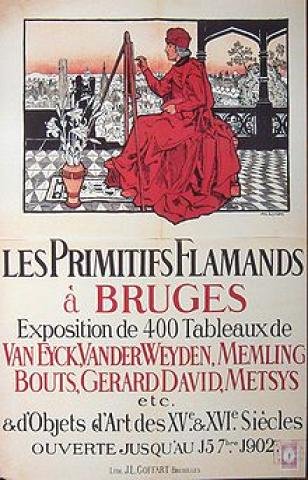
In 1902, a major exhibition of Flemish Primitive works entitled Les Primitifs flamands et l’art ancien was held in Bruges. Almost four hundred paintings, including works by (or attributed to) Jan van Eyck, Rogier van der Weyden, Dieric Bouts, Hans Memling, Gerard David and Quentin Massijs, were on show. The exhibition drew in more than 35,000 visitors. It is believed that never before had so many Flemish paintings from the 15th and early 16th centuries been on display together. If you manage to visit the Groeningen Museum in Bruges you will be able to see many works by the Flemish Primitives.
Portrait of a Theologian with his Secretary by Jacob van Oost the Elder

Portrait of a Theologian with his Secretary by Jacob van Oost the Elder (1686)
The first painting I am looking at in this blog is the dual portrait entitled Portrait of a Theologian and his Secretary by Jacob van Oost the Elder which he completed in 1668 and is part of the Groeninge Museum in Bruges.

Jacob van Oost the Elder was the leading artist of 17th-century Bruges. He painted many altarpieces in the churches of Bruges and he was also exceptionally gifted as a portrait painter as one can see in this work. Van Oost was born in Bruges, and trained there by his elder brother, Frans. He entered the Guild of Saint Luke in 1619, and became a Master two years later. He took a trip to Rome in the 1620s and on his return to Bruges in 1628, his work was influenced Caravaggio, albeit the depiction of his paintings were of a contemporary Netherlandish setting.
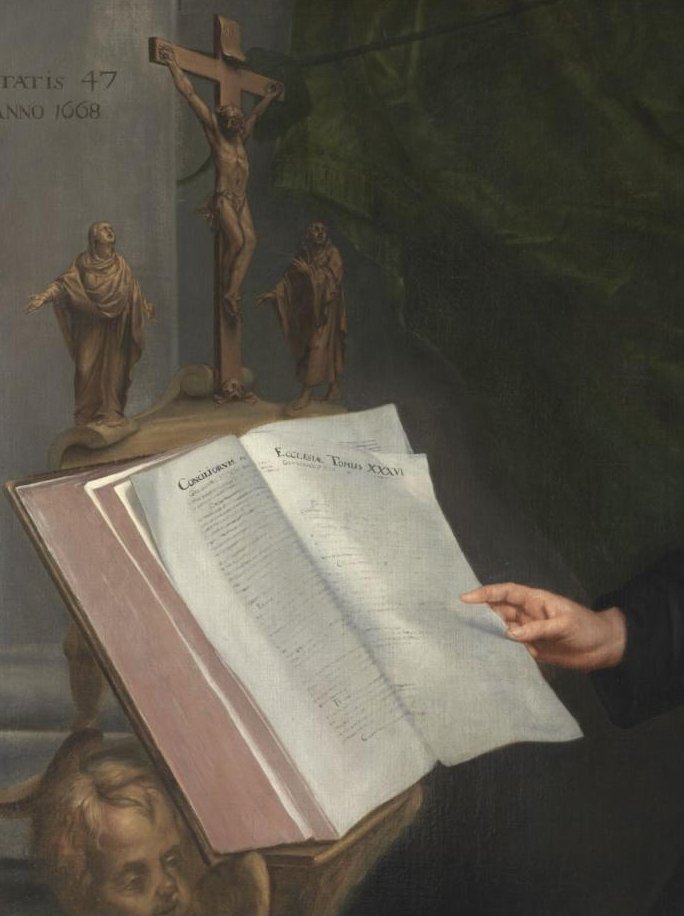
The work depicts a theologian, probably a Jesuit, reading the council’s decisions and comments on them to his secretary. His secular secretary takes notes. On the left of the painting we see a lectern, which is decorated with a sculpture of a Calvary group, and open on it is volume thirty-six of the collected Council Decrees. On the right of the painting we see a work table bedecked with a richly coloured tablecloth, at which the priest and the secretary are seated. On top of the table are study accoutrements, such as a globe and a book. Behind the two men is a bookcase with editions of the Bible and literature in the fields of theology and canon law.

Thomas Wentworth, Earl of Strafford, with Sir Philip Mainwaring by Anthony van Dyck
Once again, in this depiction we are reminded of the influence of Anthony van Dyck portraiture, such as his 1640 painting entitled Thomas Wentworth, Earl of Strafford, with Sir Philip Mainwaring, also the Caravaggesque treatment of the light, with its characteristically heavy contrasts between light and shade, in this case between the open book on the lectern and the black clothes of the English statesman and the lightness of his face in comparison to the dark background.
Portrait of a Bruges Family by Jakob van Oost the Elder

Portrait of a Bruges Family by Jakob van Oost the Elder (1645)
Portrait of a Bruges Family is another painting by the Bruges born painter Jakob van Oost. He had been commissioned to paint a family portrait. This work is regarded as a masterpiece of high Baroque painting. For the man who commissioned the work, it is a vanity painting in which he is asking the viewer to recognise his status, his wealth and his handsome family. He stands before us his arm outstretched. The focal point of this painting is the wealthy man who draws our attention to his assets. He points towards the estate he owns which stretches into the distance. He is surrounded by his family and standing next to him is his wife. We also see the children’s maid and the gardener and by catching a glimpse of the terrace he is standing on we know that his house will be palatial. Van Oost has made his viewpoint low which adds to the imposing air of the central figure. It is a painting which carefully exudes two facts for us to take in. Firstly, the portrait is a glorification of family life based on love and fertility and secondly, it is a work of art which affirms the family’s social status. In the seventeenth century the wealthy bourgeois yearned to be accepted into the realms of the aristocracy and one way of elevating themselves to that social status was to buy an estate that came with a title of nobility and we can clearly see the man in the portrait aspired to that elevated status.

What is fascinating about this painting, albeit you will probably not be able to see it clearly in the attached picture, is that the painting is signed and dated on the lower right on the parapet. However, even more bizarre is that the painter has incorporated the age of the various figures in the work. The man is 46 as we can see written on the heel of his shoe. His wife is aged 26 and this figure appears on her fan and the boy who stands close to her is 3 as can be seen written on his hat. The girl sitting on the steps sits on a cushion is 15 as shown on her basket and the young man is 17 as shown on his boot. The baby who is being carried by the nursemaid has the figure 1 inscribed on his hand. The ages of the various children suggest that there have been two separate marriages and the lady holding hands with the central figure is probably the mother of the two youngest children. This work of art is considered to be one of van Oost’s greatest masterpieces. It would be interesting to find out if anybody visits the museum and looks closely at the painting whether they can see the numbers inscribed in the painting
Jan Provoost Triptych
Donor with Saint Nicholas and Wife with Saint Godeliva.
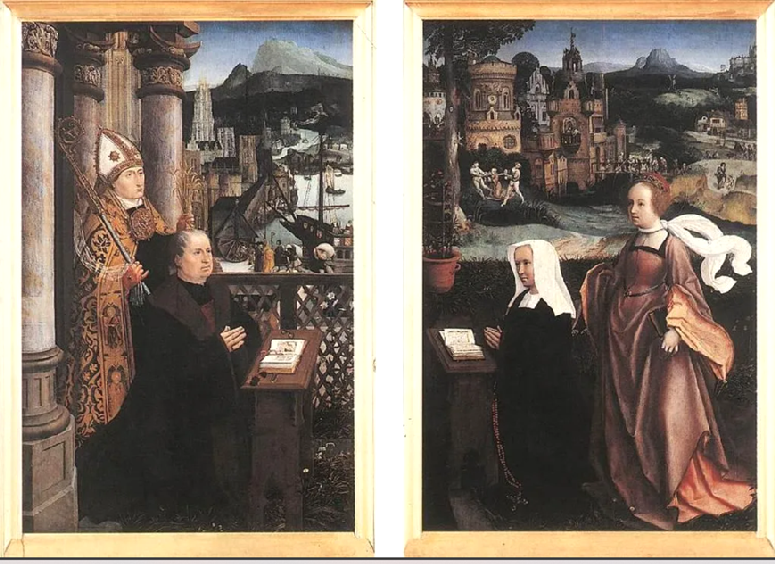
The next offering was once a triptych by the Belgian artist, Jan Provoost, and belonged to the former Dominican monastery in Bruges. Sometime before 1861 the front and back sides of the wing panels were separated by sawing them apart lengthwise. The four panels are now displayed separately. The original central panel is missing.
Jan Provoost was born in the Belgian town of Mons around 1463. By 1491 he had married the widow of the miniaturist and painter, Simon Marmion and in 1494 he settled in Bruges. He simultaneously headed up two workshops, one in Bruges, where he was made a burgher, the other in Antwerp, which was then the economic centre of the Low Countries. Provost was also a cartographer, engineer, and architect.
Inner wings of the original Triptych (c.1515)
The wealthy, but unknown, donors who commissioned the triptych are depicted on the original inner wing panels kneeling in prayer in a small, enclosed garden. The background scenes include episodes in the lives of their patron saints, Nicholas of Myra and Godeliva who are also depicted in the panels. Behind each of the saints are pictorial episodes from their lives.

The depiction in the background of the left hand panel we can just see men carrying sacks of food as they walk along the quayside next to a sailing vessel. When the people of Myra, a Lycian city in Ancient Greece in what is today the provinces of Antalya in Turkey, faced starvation, Bishop Nicholas had a shipload of grain that was destined for Alexandria distributed among the people. When the vessel completed its onward journey and arrived at Alexandria the cargo was found to have been miraculously replenished.
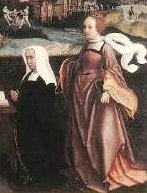
The right hand panel depicts the female donor along with her patron saint, Godeliva of Gistel and in the background we can see how the saint met her death. The story goes that she accepted an arranged marriage as was the custom, but her husband and family turned out to be abusive. Eventually he had her strangled by his servants. The large white scarf around the saint’s neck is to remind us of the manner of her death.
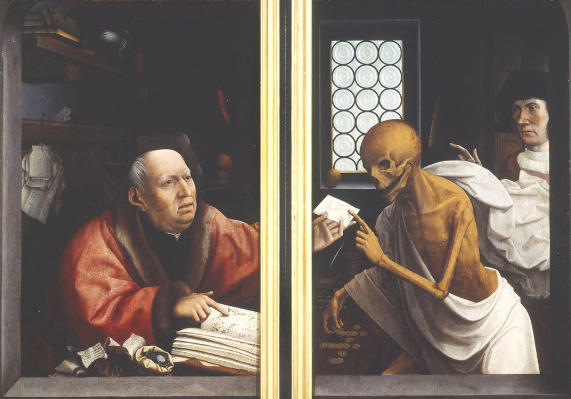
Outer (reverse)wings of the Triptych (c.1515)
Originally when the triptych was closed it showed the images Death and the Miser. These two rear sides form a continuous scene and depict a moneychanger who points to a line in an accounting register. Death lays down some tokens and points to the text held out to him by the moneychanger, presumably a promissory note. It is possibly that the man in the doorway with a raised finger could be the artist himself.
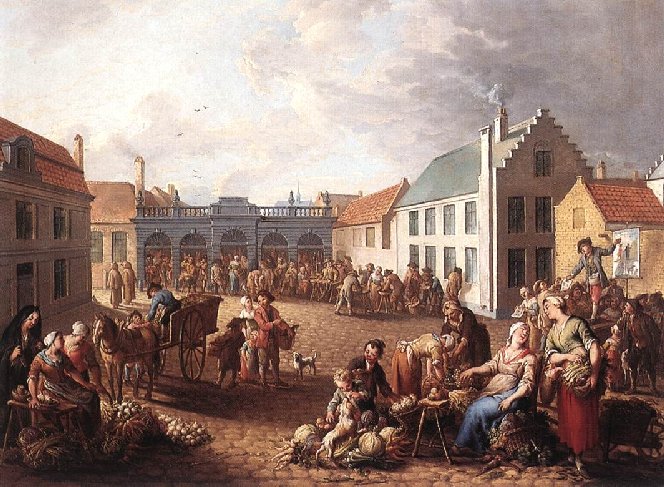
The Pandreitje in Bruges by Jan Antoon Garemijn (1778)
The world of art constantly changed. Leaving the 15th- and 16th-century Northern Renaissance period, once known as the Flemish Primitives and moving on a quarter of a century, through the bombastic art of the Baroque period we arrive at the time when light-hearted charming, themed art of the Rococo period had gained in popularity. In France, Antoine Watteau, Jean Honoré Fragonard and François Boucher held centre stage and defined the French Rococo period spanning from the reign of Louis XIV “The Sun King” to that of Napoleon Bonaparte. They created soft-coloured dreamworld paintings set in idyllic surroundings exuding a light poetic atmosphere. The Flemish Rococo artists never attained the aristocratic elegance of their French counterparts although they did manage to produce fresh bourgeois drawing-room style works.

Portrait of Jan Antoon Garemijn by Charles-Nikolas Noel (1771)
The most talented of these Flemish artists was Jan Antoon Garemijn. The Groeningemuseum houses his portrait and also a number of his beautiful works including one entitled The Pandreitje in Bruges which he completed in 1778. The Pandreitje was a square in Bruges used as a vegetable market. In the foreground we see women who have come to town from their rural homes bringing with them their vegetables which they hope to sell. In the background, occupying the porticos of the prison building are the butchers selling their wares.
On the left of the square we see a street entertainer singing songs and cracking jokes to keep the marketgoers entertained. He is also depicted selling mannekensbladen, a kind of 18th century Flemish illustrated paper which is full of sensational stories. Behind him is an advert for the paper he is trying to sell which bears the incomplete inscription:
DERLYCKL VAN- 1778
(Wonderful stories of 1778)
Garemijn always paid attention to detail in his paintings of market scenes, such as this one, which offered an idealised image of the common people without the symbolism and moralising undertone that earlier artists would insert into their genre works. There was no hint of social criticism in this work.
Another painting housed in the Groeningemuseum is one I featured in one of my early blogs of 2011 and so I won’t repeat it but I will give you a link to the page. The painting and the story behind it, The Judgement of Cambyses and the Flaying of Sisamnes by Gerard David, was one of my most popular posts and it is well worth a visit.
Following these last two blogs featuring works housed in the Groeningemuseum I hope you will be able to visit one day in the future.
 my daily art display