
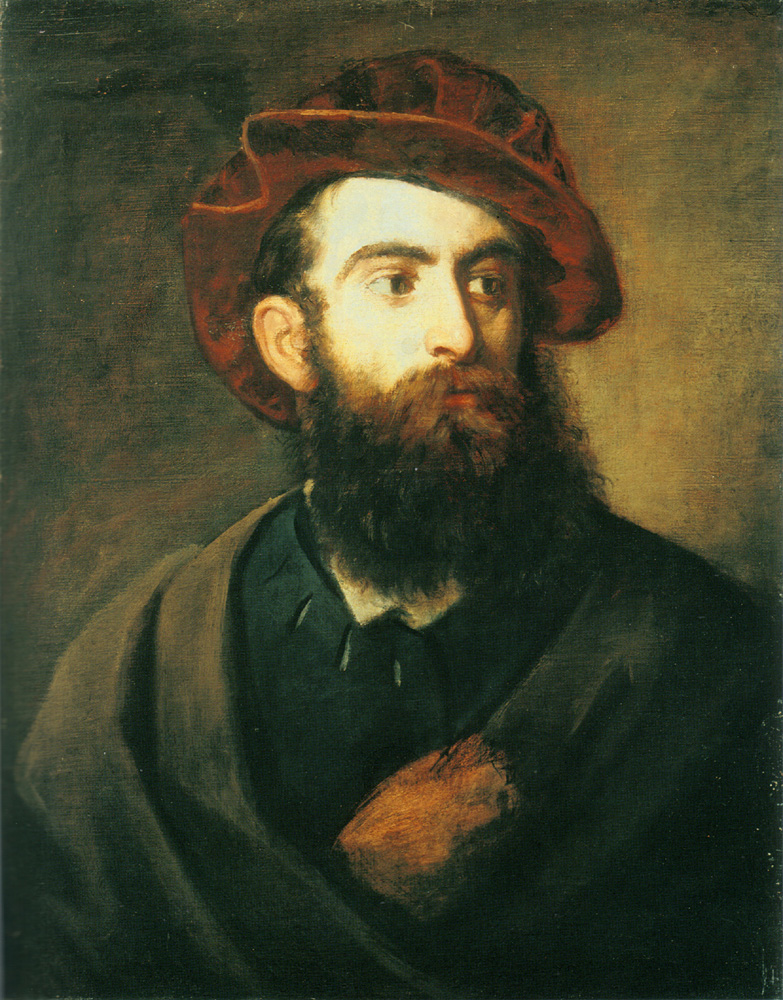
Self Portrait by Hans Makart (1878)
The artist I am looking at today, and had written about in 2013, was one who was revered by many of the art critics of the time and yet hated by others, who baulked at his general lack of interest in factual accuracy in his depictions and for disparaging important episodes in history by including unwarranted female nudity in his paintings. It would appear that he refused to tone down his flamboyant lifestyle and was known as much for the outrageous society parties he held in his studio as for his works of art. Let me introduce you to the Austrian painter, Hans Makart.
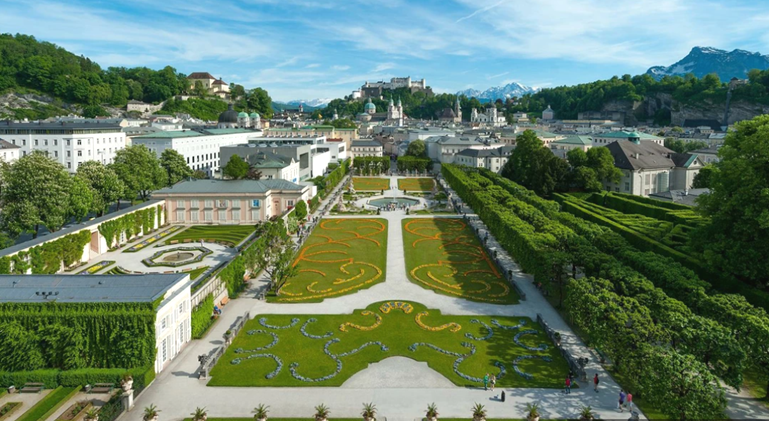
Mirabell Palace and Gardens, Salzburg
“Hans” Johann Evangelist Ferdinand Apolinaris Makart was born to Johann Makart and Maria Katharina Rüssemayr in Salzburg on May 28th, 1840. His father, an amateur painter, worked as the chamberlain of the Mirabell Palace, which was the home of the powerful Prince-Archbishop. Few facts are known about the early years of Makart, but because of his father’s job, it is thought that he grew up surrounded by the Neoclassical grandeur of this magnificent palace and its extensive Baroque gardens. It is more than likely that living amongst the splendour of the palace with its luxurious furnishings influenced young Makart who would later in life indulge in the excesses of extravagance and ornamentation as depicted in his artwork as well as his work as a designer and decorator.

The Valkyrie by Hans Makart (1877)
It seems likely that his father, having failed as an artist, urged his young son to take up painting and to endeavour to succeed where he had been unsuccessful. Sadly, in 1849, Hans Makart’s father died shortly after his son had celebrated his tenth birthday. A year after his father’s death the family moved to Vienna and Makart went to study painting under the Austrian painter, Johan Fischbach, at the Academy of Fine Arts, a public art school in Vienna. Living in Vienna, Makart immersed himself into the worldly life of the great capital, where the women were beautiful and elegant, where dress was held of paramount importance, and where Society balls and entertainments went on through the greater part of the year. In the midst of living such a life, the world Makart witnessed was seen on its brightest most appealing side, and as a young man his ideas were developed into a passion for beauty. From his time and experiences of life in Vienna, Makart could never paint a woman unless she was adorned in the most sumptuous clothes, and he could never help depicting the female with the grace and beauty that distinguished the ladies of the Austrian capital.

Die Japanerin by Hans Makart (1870)
However, Makart’s time at the Academy did not go well and as I have recounted many times in previous blogs, he, like many young aspiring painters, could not accept the precise structure and order of the Academy, as far as the teaching methodology and the type of artwork which those in charge celebrated. He was impatient to escape the endless routine of art school drawing. It was not for him and his stay at the Academy ended in 1851 when he was dismissed after only one year. Those in authority at the Academy gave the reason for his dismissal as his lack of natural talent. It could well have been that Makart’s love of intense colour, movement, and sensuality, a style which was similar to that of Titian or Rubens was unacceptable to the Academy hierarchy who wanted students to follow a more sombre, well-ordered classicism that still dictated academic art at the time. Makart would develop his own recognisable style but that would be ten years in the future.
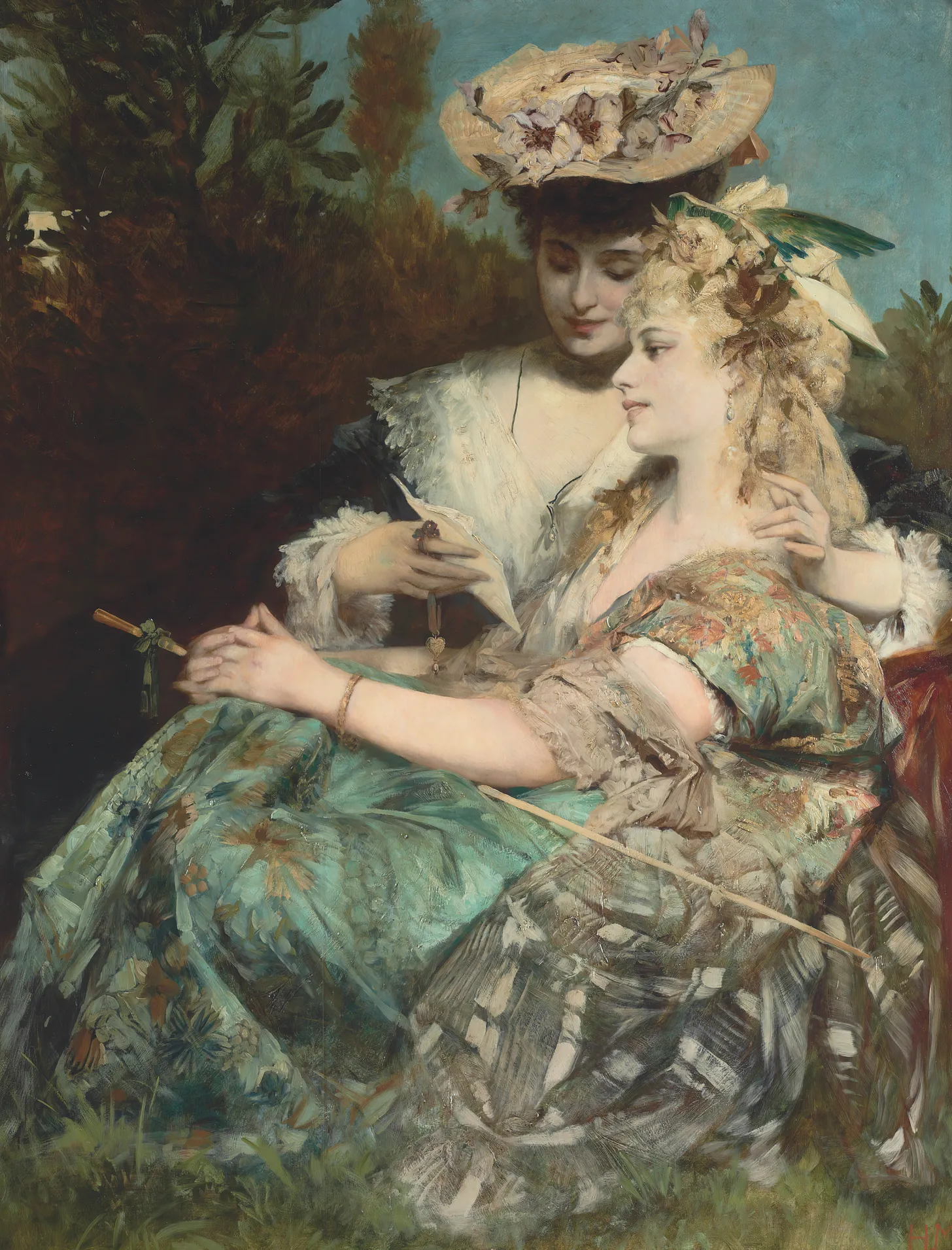
Die Liebesbrief (The Love Letter) by Hans Makart
Makart believed in himself and was completely impervious to criticism, whether it be his artistic style or his decadent lifestyle. He was a rebel and proud of it. He left Vienna and travelled to Munich where the next two years passed without him receiving any formal artistic tuition. Makart became aware that he needed to learn the technique of his business — the mechanical side of it, so to speak — in short, to learn to paint and for that to happen he needed a good tutor.
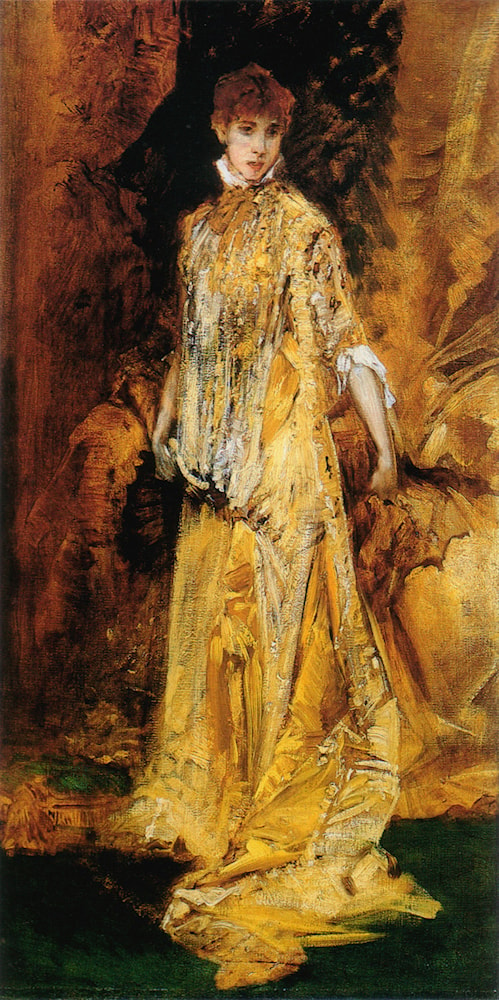
Sarah Bernhardt by Hans Makart (1881)
In 1853, Makart enrolled in the Munich Academy where he was tutored by the German realist painter Karl von Piloty, who was noted for his historical subjects, and recognised as the foremost representative of the realistic school in Germany.

Moderne Amoretten (Modern Cupids) by Hans Makart (1868)
In 1864, after studying under Piloty for some years, twenty-four-year-old Makart left Munich. His confidence in his ability had been heightened during the years under the guidance of Piloty. He was now full of self-confidence. During this early period, he perfected his highly decorative style. Makart also journeyed to London, Paris and Rome visiting all the major art galleries. In 1868, while he was staying in the Italian capital, Makart was invited to submit a piece for the opening of the Austria Artists’ Society in Vienna. Makart sent over his colossal three-part work Modern Cupids, along with painstaking instructions on how it should be displayed. All three paintings were bought by the Count Johann Palffy, who became one of Makart’s regular patrons.
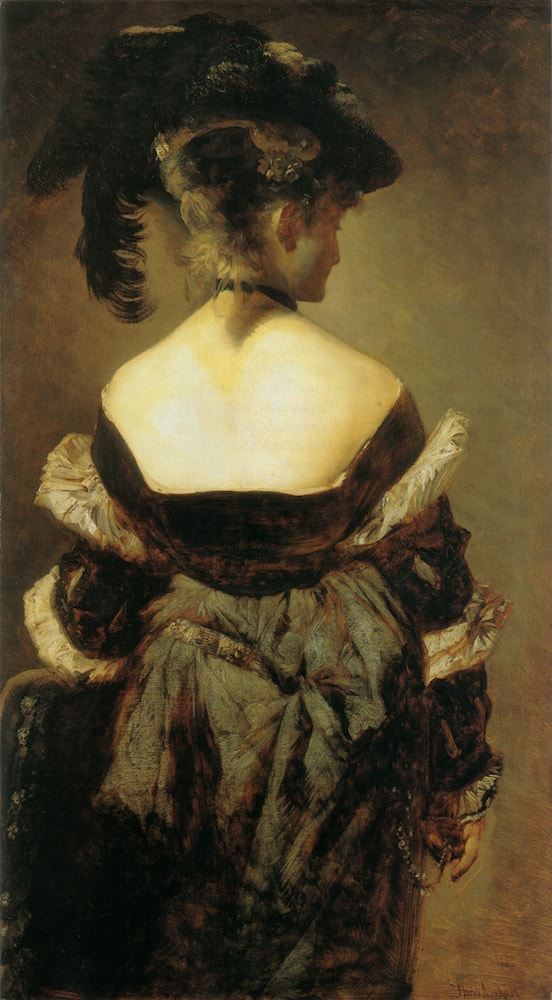
Dame mit Federhut in Rückenansicht (Lady with Feather Hat from Behind) by Hans Makart (1875)
It has to be said that Makart was neither totally impressed by Raphael’s Madonnas which he saw in Rome, nor was he moved by the gilded glories that crown the virgin martyrs, and there can be no doubt that the Italian capital failed to fire his soul. However, when he moved to Venice all that was to change. It was the art he witnessed in that city that fired his imagination and would influence him for the rest of his life. Makart had always been a devoted colourist and in Venice he witnessed the colourful works of Veronese, Titian and Tintoretto. These three Italian (Venetian) Masters were to be his mentors. To him, they were inspirational.
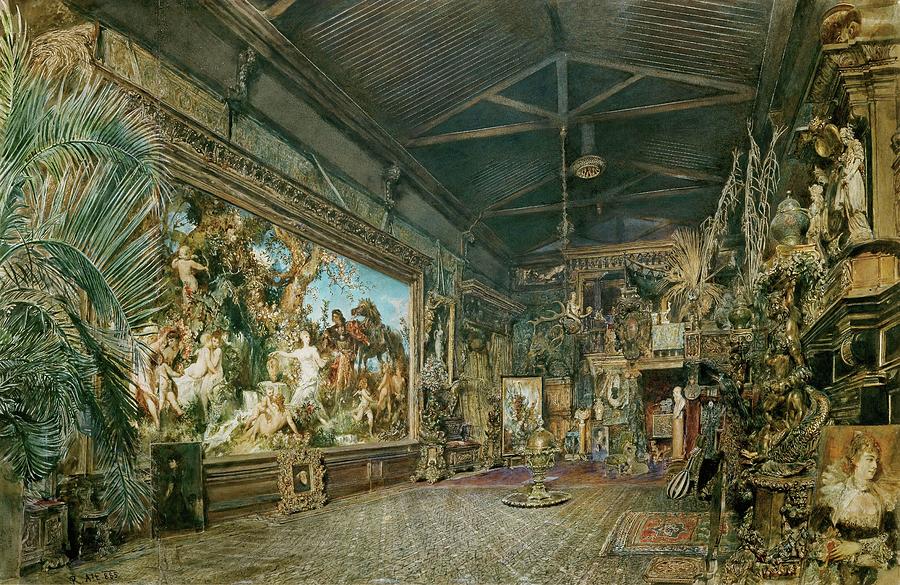
Hans Makart’s Studio in Vienna
Makart’s artistic achievements came to be noticed by the Emperor of Austria, Franz Joseph who, in 1869, summoned him to work in Vienna. Buoyed up by this prestigious support, Makart requested set of lavish apartments. That request was denied but instead the Emperor arranged for Makart to be given a studio which had been converted from a disused foundry. Far from being disheartened, Makart transformed this industrial space into the plush, decadent heart of Viennese society. It was not just his art which was colourful. His lifestyle was equally flamboyant and rich in vibrancy. His studio, in the Ring-Strasse, at the heart of Vienna, was resplendent. It was transformed into a ballroom-like space and decorated in lustrous colours. It was here that he depicted females adorned in beautiful satin gowns in shimmering satin tones. In his studio he surrounded himself with richly ornamented German chests of the Renaissance, Chinese idols, Greek terracotta, Smyrna carpets and old Italian and Netherlandish pictures mingling beside antique and medieval weapons. The walls of his studio were covered with splendid vessels, weapons, sculpture and costumes. Makart turned his hand to interior design, costume design, furniture design and soft-decoration, and his studio overflowed with statues, flowers, fine fabrics, and music. It acted thus as the perfect artistic backdrop for his models – largely nude women – who were also welcomed into his high-society circle.
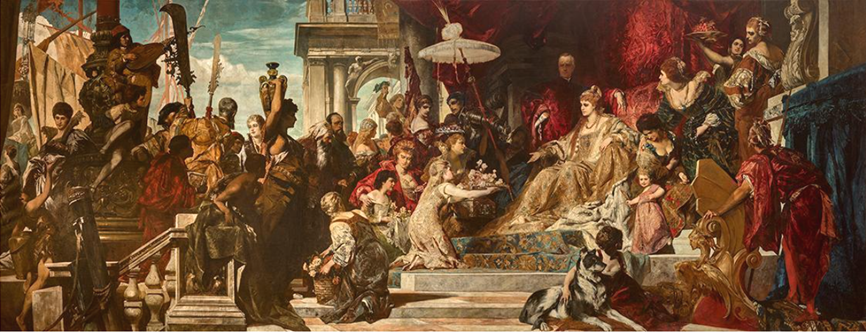
The Espousals of Catterina Cornaro by Hans Makart (c.1873)
A good example of Makart’s large colourful paintings is his work entitled The Espousals of Catterina Cornaro, (Venice pays tribute to Caterina Cornaro), which he completed around 1873. Caterina Cornaro was the last monarch of the Kingdom of Cyprus, also holding the titles of the Queen of Jerusalem and Armenia. She had been engaged by proxy to the King of Cyprus, James II Lusignan, since 1468, when she was just fourteen years old, and at the same time she was declared the daughter of the Republic of Venice. It was not until 1472 that she went to Cyprus for her wedding. The painting depicts representatives from Cyprus and Venice, of dignified men, of procurators of St. Mark, of women in foreign garb of bright colour, who crowd round their young mistress, the queen of the feast, rejoicing, amid the splendid architecture of the piazza. Sadly the marriage did not last long as eight months after the ceremony. James died and according to his will Catherine, who was carrying his child, became regent. Caterina’s son James died under suspicious circumstances in 1474 before his first birthday.
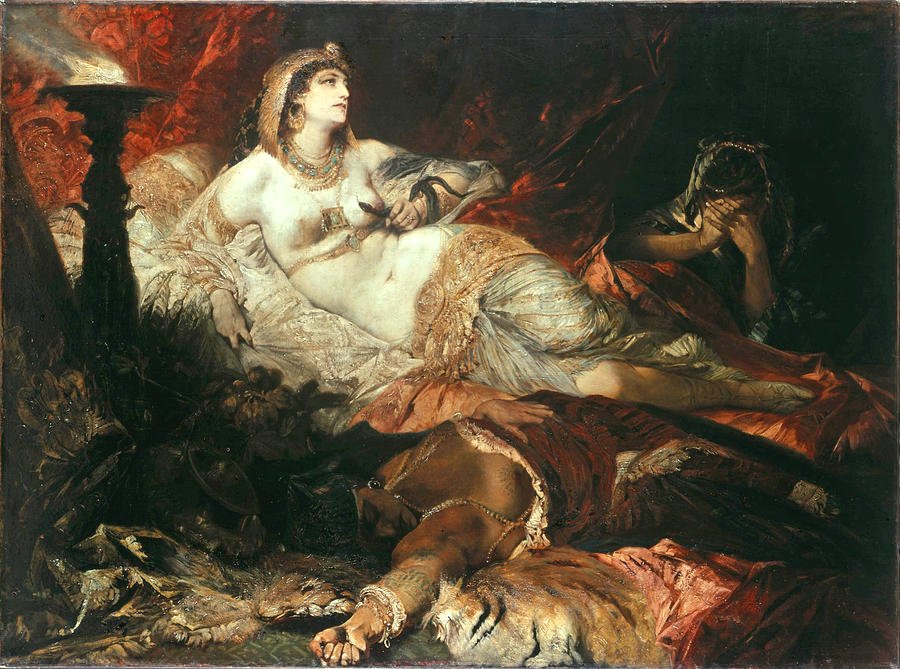
Death of Cleopatra by Hans Makart (1876)
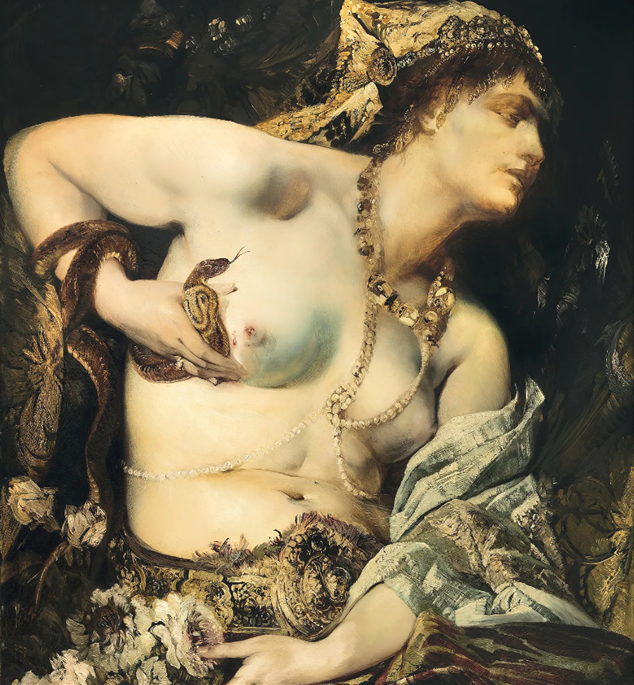
Around 1875 Makart completed some paintings depicting the death of Cleopatra. They both portray Cleopatra, the legendary queen of Egypt, contemplating suicide. The Roman Emperor Octavian’s forces had fought their way into Alexandria, and knowing that her country had fallen, Cleopatra withdrew to her tomb with her closest attendants, Iras and Charmion. In one of the paintings, we see Cleopatra reclining on a bed of fabrics, semi-nude and wearing jewelry and her crown. To her left, one of her servants weeps, whilst just below the queen another has already died. A brazier burns on the left-hand side.
Death of Cleopatra by Hans Makart (1875)
In both paintings the asp is menacingly depicted. It is a thin, black form with a tiny wisp of a tongue, and stands out against Cleopatra’s breast. This adds a sense of eroticism, and danger to the painting which reminds us of the line from Shakespeare’s play, Anthony and Cleopatra:
“…The stroke of death is as a lover’s pinch, which hurts and is desired…”
There is a sensuous decadence about Makart’s depiction of Cleopatra’s naked, bejeweled body and the way his use of chiaroscuro picks out the stark whiteness of Cleopatra’s body, as if she were spot-lit on a stage.

Das Schlafende Schneewittchen (The Sleeping Snow White) by Hans Makart (1872)
Makart’s life in Vienna enabled him to immerse himself into the worldly life of the great Austrian capital, a city where the women were beautiful and elegantly dressed and where Society balls and entertainments are held throughout the greater part of the year. In the midst of living such a life, the world the painter witnessed was seen on its brightest side, and consequently, as a young man his ideas were developed into a passion for beauty.
The Dream after the Ball by Hans Makart
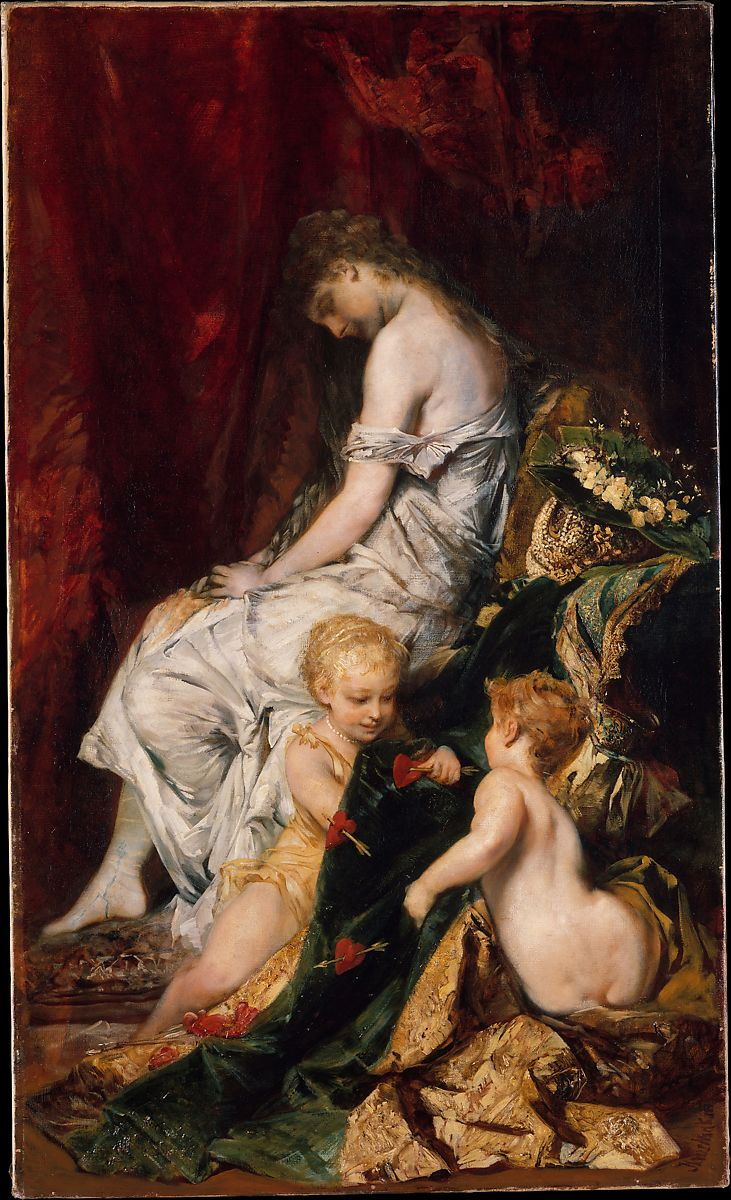
In 1878, Makart took a post as a professor at the Viennese Academy in 1878. This was the very same institution which had expelled him for lack of artistic talent in the late 1850s. Two years later, he became the institution’s head of a particular school for historical painting, a position he held until he died. It was during this time that Makart, as teacher, met Klimt, one of his students. Klimt had an important role in continuing Makart’s legacy after his death. In addition to his position as a professor, Makart’s work kept him well-off and well-known. Even the negative comments regarding his art appeared to simply inspire him to strive more.

Statue of Hans Makart in Vienna City Park (“Stadtpark”)
Hans Makart died on October 3rd 1884, aged 44. He was buried in the Wiener Zentralfriedhof in Vienna. Makart influenced many painters who followed him, the most notable being Gustav Klimt, who is said to have idolized him. It can be seen in Klimt’s early style which is based in historicism and has clear similarities to Makart’s paintings. Jugendstil, the Austrian Art Nouveau, of which Klimt was a part and it has been suggested that primacy of sexual symbolism in Jugendstil artworks were influenced by the sensuality in many of Makart’s paintings.




 my daily art display