Self Portrait with Model by Christian Schad (1927)

Self Portrait with Model by Christian Schad (1927)

Today’s work for My Daily Art Display is the first twentieth century painting I have showcased.  It is a painting by the German artist, Christian Schad.  He was born in 1894 in Miesbach a small town in Upper Bavaria, thirty miles south of Munich, a city, in which at twenty years of age Schad attended at the art academy.  At the onset of the First World War, he, being a pacifist, managed to simulate a heart problem in order to avoid military service. Furnished with a medical certificate so as to avoid military duties, he fled to Switzerland settling down for a time in Zurich and later in Geneva.  Zurich was the city in which the Dada movement started in 1916.   The movement primarily involved visual arts, literature – poetry, art manifestoes, art theory – theatre and graphic design, and concentrated its anti-war politics through a rejection of the prevailing standards in art through anti-art cultural works. Its purpose was to ridicule what its participants considered to be the meaninglessness of the modern world. In addition to being anti-war, Dada was also anti-bourgeois and anarchistic in nature.  Schad found the aims of this movement to be similar to his own personal views and soon became a Dadaist.  After the war he left Switzerland and travelled to Italy where he resided until 1925.  In 1927 he and his Italian wife Marcella and three year old son Niklaus moved to Vienna but a year later, having separated from his wife, Schad returned to his homeland, settling in Berlin.  His paintings of the late 1920’s are closely associated with the New Objectivity art movement which arose in the early 20’s but ended with the rise of Nazi power.

Self Portrait with Model, an oil on wood work, was painted by Christian Schad in 1927 and is currently to be seen at the Tate Modern, on loan from a private collector.  A narcissus, indicating vanity, leans towards the artist. The woman’s face is scarred with a freggio, inflicted on Neapolitan women by their lovers to make them unattractive to others. It is a startling emblem of the potential violence underlying male possession of the female body.

This is considered to be one of his Schad’s masterpieces.

 Schad died aged 87 in Stuttgart.

The Isenheim Altarpiece

The Crucifixion from the Isenheim Altarpiece by Grünewald (1515)


Many years ago I took a driving holiday in France and drove along the Alsatian wine route from Strasbourg to Colmar, where I stayed for a few days…   At this time in my life I was more interested in experiencing the joys of good weather and good wine and the thrill of discovering of new lands.   Sadly fine art was not foremost in my mind, as if it had been; I would have been able to have discovered for myself one of the greatest altarpieces known to the world – the Isenheim Altarpiece

This magnificent work of art which was painted for the Monastery of St Anthony in Isenheim, near Colmar, can now be found displayed at the Unterlinden Museum in Colmar.  The Isenheim Altarpiece or retable is a polyptich composed of nine panels mounted on two sets of folding wings. The outer set consists of the Crucifixion with the Entombment below it and is flanked by St. Anthony and St. Sebastian. The inner set displays the Annunciation, the concert of Angels, the Nativity, and the Resurrection. The innermost panels, flanking a carved wooden shrine to St. Anthony, are St. Anthony and St. Paul in the Wilderness and the Temptation of St. Anthony. All three central panels are split in the middle to facilitate the changing of scenes.

This work of art is a collaboration of sculpture and painting.  The former was created by Niclaus of Hagenau and the latter, the actual paintings, were done by the German painter Matthias Grünewald.  The altarpiece was taken apart during the French revolution and is now shown as separate paintings.

For My Daily Art Display today I decided to show just one facet of the magnificent altarpiece – a realistic but horrific depiction of the Crucifixion scene.  Grünewald decided that the end justified the means in his attempt to gain the attention of spectators and move them by the unattractiveness and misshapenness of the body of Christ, with limbs twisted and hands distorted, racked in pain and writhing in agony.  The skin of the Christ figure has a grey-green tone to it and is covered with wounds.  It is a heart-rending scene and one that was rarely shown in works of art of the time.   

 On the left is the Virgin Mary being comforted by St John the Apostle while Mary Magdalene is seen kneeling in the foreground.  On the right is John the Baptist appearing to say: “Illum oportet crescere, me autem minui “(John 3:30) ‘He must become greater, I must become less’

The Battle of Issus by Albrecht Altdorfer

The Battle of Alexander at Issus by Albrecht Altdorfer (1529)

Albrecht Altdorfer was a German painter, born in Amberg, Germany around 1480   He was a German painter, printmaker, draughtsman and  architect of the Renaissance era, the leader of the Danube School in southern Germany, and a near-contemporary of  Albrecht Dürer.  He is best known as a significant pioneer of landscape in art.  His early works was influenced by Lucas Cranach.  His patrons included Maximillian I and Louis X, the duke of Bavaria, who commissioned today’s painting.  

My Daily Art Display today is Altdorfer’s Battle of Issus which he painted in 1529 and now hangs in the Alte Pinakothek, Munich.  This is said to be the greatest picture ever created by a German artist with its apocalyptic scene,  the whirlpool of action of the two huge armies and dazzling light effects of the sky on the over-elaborate  landscape.  This picture depicts the battle between Alexandra the Great, who is centre left in the painting riding a chariot hauled by three white horses, and the Persian Emperor Darius.  This painting formed part of a large series of famous battle pieces from classical antiquity.

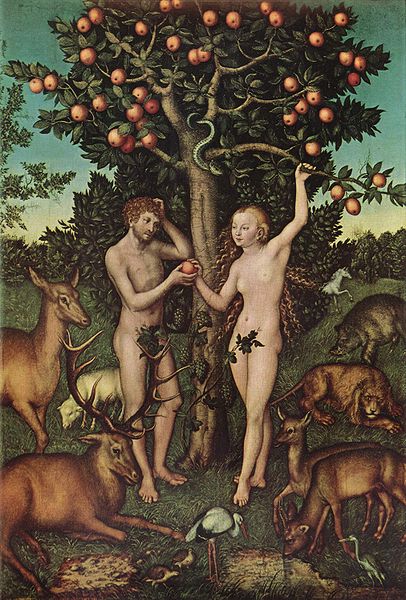
Adam and Eve by Lucas Cranach the Elder

Adam and Eve by Lucas Cranach the Elder (1526)

Lucas Cranach the Elder was born Lucas Sünder in Kronach, Franconia in 1472 but later changed his surname in honour of his German birthplace.  Moved to Vienna in 1501 where he stayed for three years during which time he painted some of his finest and most original works.   Several of his religious works of that period show a remarkable feeling for the beauty of landscape characteristics of the Donnauschule (Danube School), which was a group of German and Austrian artists of the early sixteenth century, who were among the pioneers in depicting landscape, in particular those of the forests and hills of the Danube, for its own sake, in drawings and prints as well as paintings.

Today’s painting in My Daily Art Display is Lucas Cranach the Elder’s Adam and Eve painted in 1526 and is one of 50 depictions Cranach did of this subject and this depiction is inarguably the most beautiful. In this earlier depiction, the tree of knowledge stands in the centre of the painting between them and they are surrounded by painted wildlife and green pastures. Eve raises the fruit to give to a confused Adam. The painting shows the skill Cranach had in painting wildlife and game and his continued attention to detail, for example, the reflection of the Deer in the pond and the Unicorn in the background. The portrayal of Eve shows his growing attention to portraying the female form, which becomes more evident in paintings such as The Venus (1532). Throughout his career Cranach used his artistic talents to further the Lutheran cause. In depictions such as Adam and Eve, Cranach was able to develop his talent in detailed studies of wildlife, nudes and landscapes with no objection from Luther, who saw Cranach’s depictions as furthering the biblical message.