Portraits of Johann the Steadfast and Johann Friedrich the Magnanimous by Lucas Cranach the Elder

Portraits of Johann the Steadfast and Johann Friedrich the Magnanimous by Lucas Cranach the Elder (1509)

My Daily Art Display featured artist today is the German Renaissance painter and designer of woodcuts, Lucas Cranach the Elder.  He was born in Kronach a small German town in Upper Franconia, Bavaria in 1472.  His adopted surname was a derivation of the name of his birthplace, which was a quite usual practice at the time.  His father who had the unusual name of Hans Maler, the surname being the German word for “painter”.   In those days it was also not uncommon for a person’s surname to have no connection with ancestors but to do with the person’s profession.  Lucas Cranach’s father was indeed an artist, hence his surname.  Little is known of Cranach’s early life or fledgling artistic training except that one of his tutor commented that Cranach had displayed his artistic talents whilst a teenager.   It is recorded that Cranach arrived in Vienna in 1501 and stayed until 1504.  It was during this period that he completed many of his earliest works such as The Crucifixion (1503) and Portrait Doctor Johann Stephan Reuss’s (1503).  These and his other artistic works captured the attention of Duke Friedrich III, Elector of Saxony, known as Frederick the Wise who, in 1505, employed Cranach as a court painter at the palace of Wittenberg and although he took on private commissions, Cranach remained as court painter almost to the end of his life.

In 1508 Cranach married Barbara Brengbier and they were to have six children, four daughters and two sons.  The most famous of the children was Lucas the Younger who went on to become a well known artist in his own right.  At the court Cranach, along with other artists such as Dürer and Burgkmair painted many altarpieces for the castle church.  In 1509 Cranach temporarily left the court at Wittenberg and went to the Netherlands and painted the portrait of Emperor Maximilian I and his eight year old young grandson Charles who would later become Emperor Charles V.

It is interesting to note that up until this time Lucas Cranach the Elder always signed his works with his initials “L C” but in 1508 the Elector of Saxony, Frederick the Wise knighted him and awarded him the coat of arms of a winged serpent as an emblem which, from that time on, superseded or was added to his initials on his paintings.
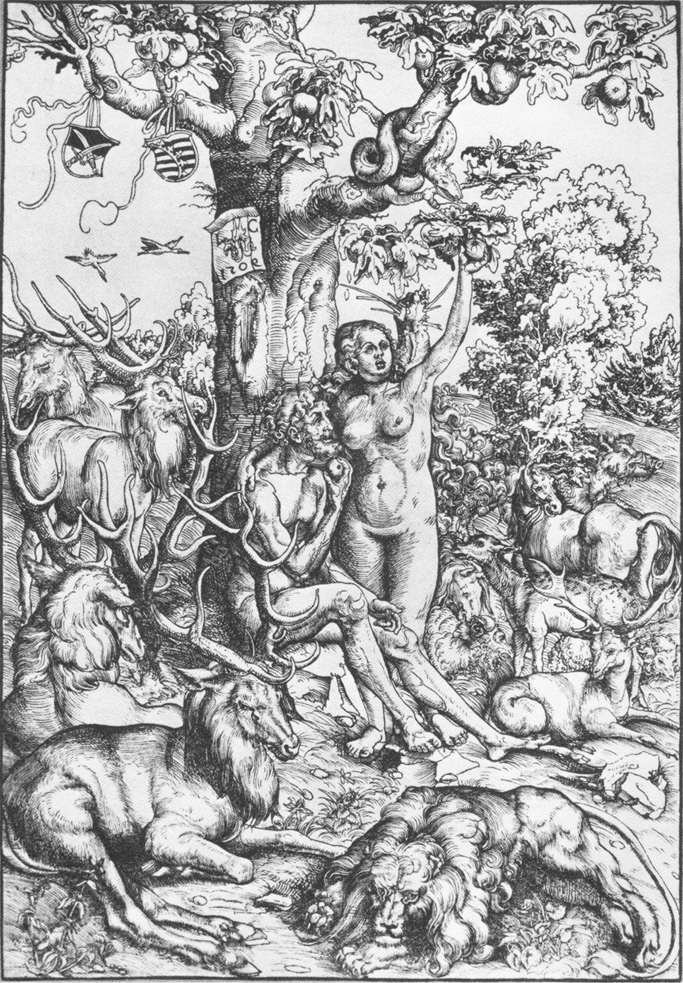
Adam and Eve - woodcarving by Cranach

An example of this can be seen in his woodcarving of Adam and Eve which he completed in 1509.

Signature with Serpent logo

Look at the note on the tree showing Cranach’s initials as well as the winged serpent.  The coats of arms hanging from the branch to the left of the trunk are those of the Elector of Saxony

Cranach was a friend of Martin Luther, and his art expresses much of the character and emotion of the German Reformation. Cranach, through many of his paintings and engravings, championed the Protestant cause. His portraits of Protestant leaders, including the many portraits of Luther and Duke Henry of Saxony are solemn and thoughtful and painstakingly drawn.   At this time Cranach had a large workshop and worked with great speed.  His output of paintings and woodcuts was immense.

He died in Weimar, in 1553 aged 81.   Cranach’s sons, Lucas and were both artists, but the only one to achieve distinction was Lucas Cranach the Younger, who was his father’s pupil and often his assistant. His oldest son Hans Cranach was also a promising artist but died prematurely.

Johann the Steadfast

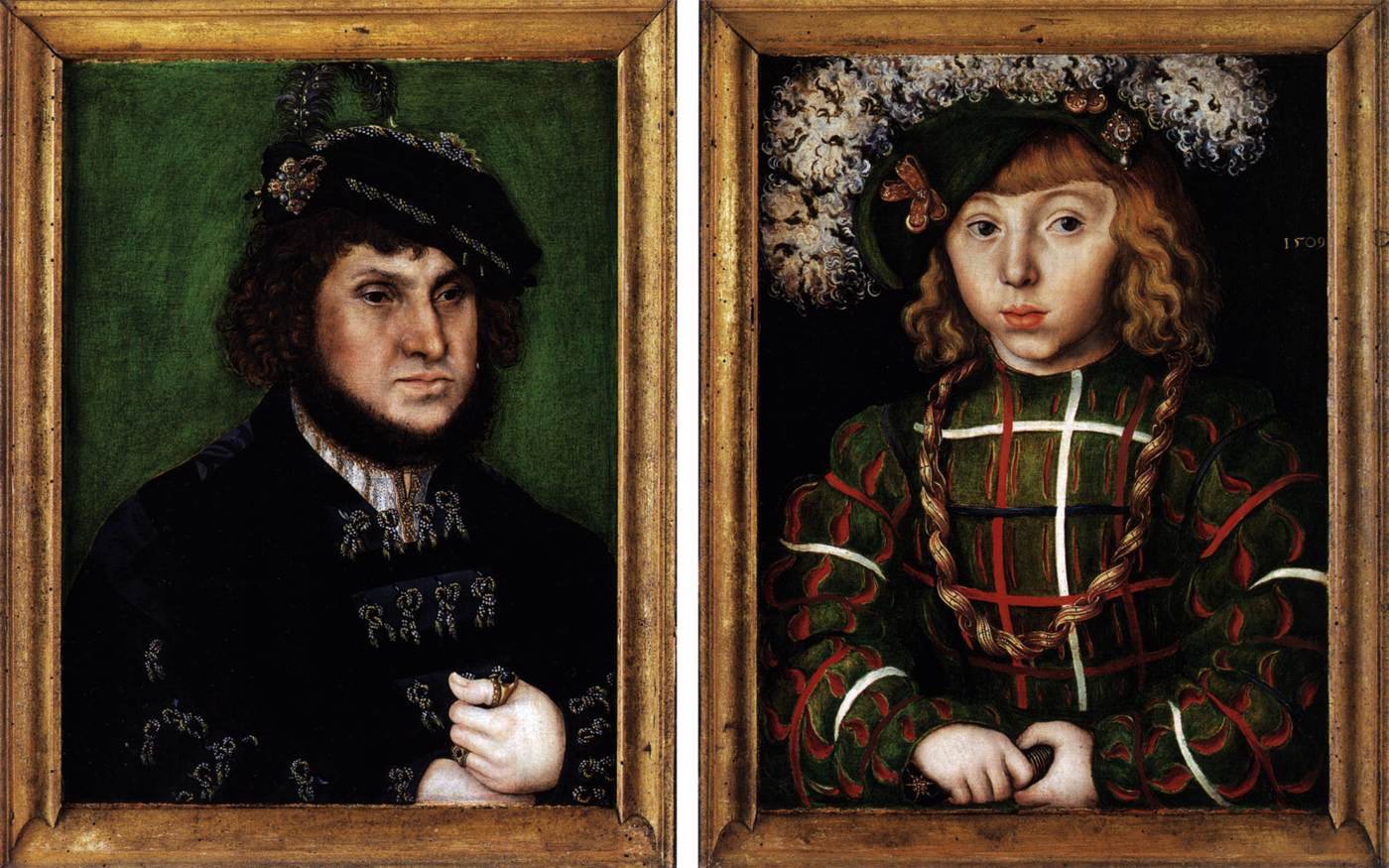
My Daily Art Display featured painting today is a diptych, which is a picture or other work of art consisting of two equal-sized parts, facing one another like the pages of a book.  It is entitled Portraits of Johann the Steadfast and Johann Friedrich the Magnanimous which he painted in 1509.  They are usually small in size and hinged together.  This one was painted by Lucas Cranach the Elder in 1531.   It consists of two portraits.  On the left hand panel of the diptych we have a portrait of Johann the Steadfast who was the Elector of Saxony following the death of Frederick the Wise in 1525.  On the right hand side we have a portrait of Johann Friedrich the Magnanimous the eldest son of Johann the Steadfast and who became Elector of Saxony on the death of his father in 1533.  Cranach was the court painter during the time both of these men were in power.

Looking at the left hand portrait of Johann the Steadfast we see him against a dark green background wearing a black coat with some sort of grey patterning.  On his head he has a black hat highlighted with small pearl ornaments.

Johann Friedrich the Magnanimous

On the right hand panel we see the portrait of the six-year old, fair-haired boy, Johann Friedrich.  Note how Cranach has reversed the colours in comparison to the left hand panel.  Where we had a man in black with a green background, in this right hand panel, we have the young lad dressed in a green doublet with bands of red and white in what almost looks like a “tartan pattern” against a black background.  The “slashed doublet” which was very fashionable in the first half of the 16th century reveals the red of the shirt which he wears underneath it.  He too wears a hat, green in colour to match the doublet, on which are ornamental brooches and atop of which are multi-coloured ostrich plumes.  In his hands we see him clutching hold of the golden pommel of a sword with his still-chubby little fingers.

It is unusual to see two men in a diptych which would normally hold portraits of a man and his wife.  However there is some degree of poignancy about this coupling of father and son as the father lost his wife a couple of weeks after she gave birth to the young boy so we are looking at a widowed father and his motherless son.

The Stages of Life by Caspar David Friedrich

The Stages of Life by Caspar David Friedrich (1835)

I read the other day that life expectancy for men in the UK is somewhere between 75 and 80 years of age which is some ten years higher than it was in the 1970’s and of course what were once killer diseases are now more often or not, treatable.  So why worry about dying if you are still young?

Well of course, as far as longevity is concerned, the life expectancy back in the nineteenth century was much less, due to such diseases as cholera and typhus and  probably for a man living in Europe to reach the age of 45 in the nineteenth century was somewhat of an achievement.  All this leads me nicely on to my featured artist of the day, the German painter Casper David Friedrich, who was continually concerned with, and depressed by, the thought of his own mortality.  To be fair to him, he probably had good reason to be concerned and depressed by death for Friedrich had early acquaintances with death: his mother, Sophie Dorothea Bechly, died in 1781 when Caspar David was just seven.   At the age of thirteen, Caspar David was present when his brother, Johann Christoffer, fell through the ice of a frozen lake and drowned.    It was even reported that Johann Christoffer died while trying to rescue Caspar David, who was also in danger on the ice. His sister Elisabeth died in 1782, while another sister, Maria, died of typhus in 1791.

Friedrich’s contemporaries said that the melancholy in his art could be attributed to these tragic childhood events.  However I am not so sure that he was a manic depressive as there are many reports that stated he at times had a great sense of humour.   This was borne out by the famous German doctor, natural scientist and writer Gotthilf Heinrich von Schubert, who knew the artist and in his autobiography, wrote of Friedrich:

“…..He was indeed a strange mixture of temperament, his moods ranging from the gravest seriousness to the gayest humour … But anyone who knew only this side of Friedrich’s personality, namely his deep melancholic seriousness, only knew half the man. I have met few people who have such a gift for telling jokes and such a sense of fun as he did, providing that he was in the company of people he liked…..”

So these mood swings of Friedrich could have been more symptomatic of a bi-polar disorder.

The painting featured today in My Daily Art Display is an allegorical painting by this German Romantic landscape painter Caspar Friedrich David, one of the greatest of all the landscape painters.  He completed this work of art five years before his death in 1840 aged 66.  So despite his concerns about his own mortality, he lived much longer than the then life expectancy of a German man.

The work of art is entitled The Stages of Life.  Art historians do not believe that this would have been the title that Friedrich gave to his painting as the artist believed that titles of paintings should not be blatantly descriptive as he wanted his paintings to speak for themselves and he did not want viewers to be swayed by descriptive titles.  It is quite possible that this title was added much later, after Friedrich’s death, and when the public’s interest in his work returned in the latter years of the nineteenth century.

So what do we have before us in Friedrich’s allegorical painting about mortality and the transient nature of life?  The setting for the painting is dusk on the peninsular headland at Utkiek, overlooking the entrance to the northeastern German Hanseatic seaport of Griefswald,  which is bathed by the light from the gold and lavender evening sky.  Griefswald was the birthplace of Caspar David.  In the foreground we see an elderly man wearing a long brown coat and black hat standing with his back to us looking out to sea.  He walks with the aid of a stick towards a group of people.    In front of him is a younger man with a top hat.  He has turned towards the elderly man beckoning him on and pointing something out to him.  Seated on the ground at the feet of the young man is a woman and between the young couple and the sea we can see two children.  These in fact were family members of Caspar David.  The elderly man is the artist himself.  The young man with the top hat was Caspar David’s nephew Johann Heinrich and the young woman, his daughter Emma.

The Swedish Pennant held aloft

The two children holding the Swedish pennant are his son Gustav Adolf, who the artist named after the Swedish king, King  Gustav Adolf IV, and his daughter Agnes Adelheid.  The Swedish flag was probably added by the artist as he believed himself to be half-Swedish as from 1630 Griefswald was part of Swedish Pomerania and under Swedish control, before it was taken by Prussia in 1815 and formed part of the Prussian Province of Pomerania.  This of course throws up the question as to the date of the painting which is given as 1835, some twenty years after control of this area changed from being Swedish to coming under Prussian jurisdiction.  So does the Swedish pennant held by the children mean that the town was still under Swedish control and thus the painting is pre-1815 or is it just a sentimental addition by the artist to those glorious days under Swedish control?

Art historians believe that this group of people represents the various stages of life.  The artist representing old age, the gentleman with the top hat representing maturity, the young woman seated on the ground representing youth and finally the children representing childhood.  Out at sea, and corresponding to the number of people depicted, we can see five sailing ships of various sizes and designs and differing distances from the shoreline.  The five ships, and their distance from shore, in a way symbolises the transience of life in the way that they are at different distances from the harbour and the end of their voyages symbolising man’s journey through life and his ultimate destination, death.   The largest of these sailing ships which we look at, head-on, has a mast and crosstree which form the shape of a cross which some believe symbolizes Friedrich’s deep religious faith.  However, to me, I must doubt that symbolism as it just appears to me as a simple sailing ship design.  There are many interpretations of the what the ships and people represent but I like the one given by Charles Rosen and Henri Zerner in their book Caspar David Friedrich and the Language of Landscape in which they postulate that the two ships in the distance represent the mother and father sailing off into the distance to discover life and by so doing, gaining experience and wisdom through parenthood.   The largest ship close to shore, on the other hand,  represents the old man, a person who has built up experience over time and who has lived life to the full and who now is finally putting into the harbour to end life.

Whether we agree with or argue against the  interpretaion and symbolism of the painting I am sure we all agree that it is a wonderful work of art.

The Meyer Madonna by Hans Holbein the Younger

The Meyer Madonna by Holbein the Younger (1526-28)

My painting today is the 1526 work by Hans Holbein the Younger and is known as the Meyer Madonna or sometimes as the Darmstadt Madonna as the painting was commissioned by Jakob Meyer zum Hasen a senior official and sometime mayor of Basel and  the painting is housed  in the Schlossmuseum, Darmstadt.  It is considered to be one of the great masterpieces of European art.  At first glance there seems nothing unusual about the figures in the painting but in fact nothing is quite as it seems.  Let us look closely at what is being displayed.

Before Hans Holbein left Germany for England, he was approached by his early and most important patron, Jakob Meyer, to paint this family portrait which would hang in the Meyer chapel at Gross Gundeldingen.  Meyer had a colourful and controversial life.  He was a businessman who in 1516 was elected Burgermeister (Mayor) of Basel.  In 1521, he was impeached for taking a large bribe from the French, imprisoned and when he protested at this treatment he was barred from office thereafter. Meyer was a staunch Catholic even after the city’s secession to the reformed religion and led the Catholic party in the city.  Holbein started the painting in 1526 before journeying to England but on his return two years later, at Meyer’s request, made some changes to it.

In the upper central portion of the painting we have the Virgin Mary and the baby Jesus.  This is a Schutzmantelmadonna, a Virgin of Pity painting in which the Virgin Mary covers Meyer and his family with a mantle of protection and stands within a scallop-shell like niche.  A friend of Holbein, possibly also his mistress and who appears in other Holbein paintings, Magdalena Offenburg, posed for the Madonna.  The Virgin’s symbolic inclusion into this family portrait is because it was believed that by her intercession she can win the mercy of the Father. What such a figure represents is benign, protecting power of destiny. Holbein depicts the Madonna as a cloaked figure enthroned by the scallop shell, which symbolizes the womb, divine space, and femininity. The golden crown she wears is a symbol of sovereignty. The Child’s twisting body emphasizes the weight the Madonna’s arms must carry.  To the left we have Meyer himself and two young boys who were thought to be his two sons.  To the right are three women.  In the foreground, kneeling, we have Meyer’s daughter Anna.  In the middle we have Meyer’s second wife Dorothea Kannengiesser and the other lady is his first wife Magdalena Baer who died in 1511.  So before you is a family portrait with religious connotations and so, what you see is how it was?

Meyer's two wives

Well actually NO.  What you see was not how it was.     I suppose you may have reasoned that something was not quite right, seeing the two wives side by side and of course I had already said that Meyer’s first wife Magdalena had died fifteen years before Holbein had started the painting.  Jakob Meyer, when he discussed the composition of the painting with Hans Holbein on his return to Basle two years later, stipulated that the artist included his first wife, even though she had died in 1511.  Holbein had of course never seen her and that is probably why, not knowing her facial features , added her at the back of the group and almost covered her face in cloth.   One should remember that this was what Meyer wanted to remember as having been his family at one time or another.  However there is another unhappy  twist in the saga of this deceptive looking happy family portrait. 

Father and sons

This painting acted as a grim reminder to Meyer of his two sons who are seen in the painting positioned close to him.  At the time of the painting both were dead.   In fact only he and his daughter were alive at the completion of this work by Holbein but Meyer insisted that Holbein included all members of his family, living and dead, rather than omit any individual.  Unlike Holbein’s depiction of Meyer’s daughter Anna, the figures of the boys are not portraits, since they lack any individual features. In his elegant face and hands, the seated youth shows a certain resemblance to the Mary figure.    The naked boy, Meyer’s younger son and the Child Jesus also look similar and correspond to figure types found in Italian Renaissance paintings, and it is conceivable that Holbein was inspired by compositions by Raphael and Leonardo that he had seen on his trip to France.

The original sketch of Anna, the daughter

As I said earlier, this painting was started by Holbein in 1526.  He then left for England and did not return to Basle until 1528.   It was on his return that Meyer asked Holbein to make changes to this family grouping.  The main change was to be made to the portrait of his daughter Anna.  When Holbein first made sketches of her for the painting she was shown seated, almost child-like,  with long flowing hair, probably signifying her virginity.  When Holbein returned two years later she was probably fifteen years old and at a marriageable age and Meyer wanted his daughter portrayed as a young woman not as a child.   

The “updated” depiction of Anna

In the final version of the painting, Anna is now seen kneeling next to the two wives and looks older.   Gone are the long flowing locks and instead her hair is tucked into a chaplet headdress which was how girls of that age wore their hair when they went to church.  In her hair one can see pink flowers which often symbolised a girl’s betrothal.  So Meyer obviously wanted either to have his daughter portrayed as a girl of marriageable age or he wanted people to know that she was betrothed.

And so you see, at first glance this appears to be a simple family portrait with a religious connotation.  We know by the clothes of the man that he is of some importance.  We know by the elder son’s clothing that the family was wealthy.  This wealth is also shown by how Holbein has included a beautiful and expensive-looking carpet.  At first glance one may be slightly jealous and envious of the Meyer family’s depicted affluent and happy lifestyle but then once the facts are revealed one’s envy evaporates and one looks at the composition with some sympathy for this man who at one time had everything and then was left with just his painting and his memories.

Three Women in Church by Wilhelm Leibl

Three Women in Church by Wilhelm Leibl


The artist featured in My Daily Art Display today is Wilhelm Maria Hubertus Leibl.  He was born in Cologne in 1844 and became one of Germany’s greatest Realist painters of that time.

Originally apprenticed as a locksmith and later as a precision instrument maker, Wilhelm decided to follow his love of art, gave up his apprenticeship, and took to studying and training to become an artist.  His first teacher in Cologne was the painter and author, Herman Becker.  When Leibl was nineteen years of age he moved to Munich and became a student at the Academy of Fine Arts.   He studied under many art tutors including Anschutz, Straehuber and von Piloty.  The standards of his works of art fluctuated and every so often he would produce a gem.  The first such treasure was his painting entitled Aunt Josephia which he completed around 1864 and now hangs in the Walter-Richartz Museum in Cologne.   He was praise for his clever depiction of the woman’s hands which added to the expression, mood and the characterisation of the sitter.  Whilst later at the Academy he taught art to the students but a lot of his free time was spent visiting the Alte Pinakothek to study the works of art of the Masters.  His favourite art-genre was the Baroque Period and the works of van Eyck, Rubens and de Vos but also he had an affinity with the great portraiture artists such as Frans Hals and Diego Velazquez.

In 1869 he produced his portrait of Frau Gedon, which hangs in the Neue Pinakothek in Munich.  This work of Leibl was shown at the Grosse International Kunstausstellung and Gustave Courbet, the French Realist painter judged it to be the best exhibit.  So impressed by it, Courbet invited Leibl to join him in Paris.  Whilst in the French capital Leibl spent much time studying the works  of his host Courbet and those of  Édouard Manet and these artists and their paintings inspired Leibl for the rest of his life.

Leibl only remained in Paris for a year as 1870 saw the outbreak of the Franco-Prussian War that July.  Despite returning to Munich, Leibl continued to keep in touch with the French Art world and regularly submitted his own works to the Paris Salon.    In Munich he and his artist friends Carl Schuch, Wilhelm Trübner and Johann Sperl formed an artistic group known as the “Leibl Circle”.  This group’s passion for art was for art’s sake.  Their ethos was simple – art should be convincing exclusively through it formal qualities.  It was at the time of his return to Munich that Leibl started to experiment with etchings but his love of this artistic medium waned after a few years.  In 1873, at the age of twenty nine he left the city life of Munich and moved to Grassling, a countryside suburb of the city.  He enjoyed the country and village lifestyle and spent the rest of his life in various small villages around southern Bavaria and it was during those years that he painted the local peasantry in a sombre realistic style.  Leibl’s standing as an artist was principally dependent on the French critics, since his artistic reputation in Germany fell long before his standing went into decline in France.  Sadly, he never gained the acknowledgement he merited in his homeland .   Leibl died in 1900 in Wurzburg at the age of fifty-six.

My Daily Art Display today is Leibl’s oil on mahogany painting entitled Three Women in Church which took him almost three and a half years to complete and was finally exhibited in 1882, and now hangs in Hamburg’s Kunsthalle.  This was to be Leibl’s greatest masterpiece.  It is a haunting piece by an artist who, at the age of thirty eight, was at the zenith of his career and this work of art enhanced his reputation as one of Germany’s greatest Realist painters.

The three women are painted in great detail, despite, as he told his sister in a letter, the poor lighting inside the church.  The three women, all of different generations, are wearing their local costumes.  Look at their faces as they sit deep in prayer.  See how Leibl, by his attention to facial details, has portrayed their piousness.  They are all dressed in their “Sunday-best” clothes, looking their best for their church visitation.  This is a wonderful example of Realism painting depicting simple Bavarian country folk at prayer.  It emphasizes emotion and individuality and I hope you agree that this painting is a joy to behold.

The Body of the Dead Christ in the Tomb by Hans Holbein the Younger

Just over a fortnight ago an elderly relative of a friend of mine died.  Last week I went to the funeral service and just prior to the ceremony I was asked if I would like to view the body lying in the coffin before the lid was closed.  I said that I would like to pay my last respects to the deceased.   I was somewhat prepared for what I might see but when you gaze down at the lifeless body it still comes as a shock.  Notwithstanding how well the funeral home people have prepared and dressed the body, the viewing of the deceased is still a harrowing experience.

The Body of the Dead Christ in the Tomb by Hans Holbein the Younger (1521)

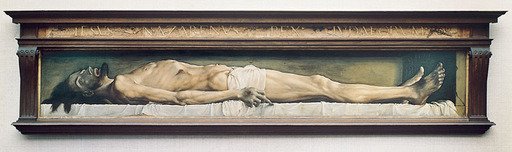
The other day I came across a painting by Hans Holbein the Younger, which reminded me acutely of my experience and I decided to make it My Daily Art Display for today.  The oil and tempera on limewood painting, which can be found in the Kunstmuseum in Basle, is entitled The Body of the Dead Christ in the Tomb and Holbein completed it in 1521.  The painting is lifelike in size, measuring 2 metres long and just 31 centimetres high (79 inches x 12 inches) and depicts the dead Christ lying stretched and unnaturally thin in a wooden tomb.  The dimensions of the painting create a disturbing effect.  The painting has an almost claustrophobic shape.  Many artists, such as Caravaggio, Delacroix, Titian and van der Weyden have painted The Entombment but looking at Holbein’s portrait of the dead Christ is probably as shocking a picture as one is ever likely to come across.  Grunewald’s Isenheim Altarpiece showing the ravaged and distorted body of Christ on the cross and The Deposition, his lowering to the ground, shows the strain on the body of Christ which one can barely imagine but Holbein’s Christ lying before us, dead in his tomb, is both intense and overwhelming.

One has to wonder what Holbein intended for this piece of art of such unusual dimensions.  Was it meant to be a free-standing painting or maybe it was to be a predella below an altarpiece?

Borne above the painting by angels holding the instruments of the Passion is an inscription in brush on paper:

                           “IESVS NAZARENVS REX IUDAEORUM”

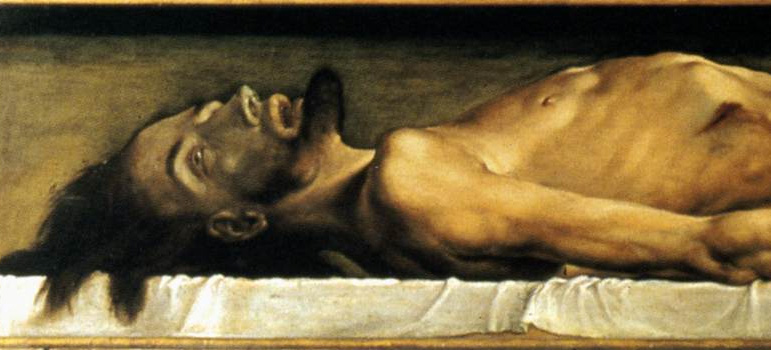
There is a stark realism about the painting and I can only imagine that to stand in front of this life-sized work of art must be both awe-inspiring and shocking.  I am told that when you look at the painting, it is as if the tomb has been set into the wall of the gallery because Holbein has created a three-dimensional illusion.  The physical depiction of the body is realistic.  It is said that Holbein used a body dragged out of the Rhine as his model.  Looking at the body of the dead Christ is just like the experience I had a week ago when I gazed at the dead person, albeit she was clothed, but her hands, wrist and face were uncovered and discoloured.  Every physical feature of death is portrayed in this painting.  The body of Christ has the marks of the crucifixion.  We look in horror at the blood-caked wounds in the back of his hand and his feet, where the nails had penetrated.  We see the wound in his side which had been penetrated by the lance.  All the wounds are turning a gray-green and becoming swollen, due to the onset of gangrene.  Surprisingly, there are no marks on Christ’s forehead from the crown of thorns.

Details of the upper body


Details of the lower body

Let us look at some of the detailed work this great artist has given to this painting.  The blackened feet of Christ lie almost to the end of the stone-walled enclosure.  The bones of his body push against the flesh like spikes emphasising the hollowness of his ribcage.  String-like muscles press against the lifeless yellow skin.   Look carefully at the face of Christ which is slightly tilted towards us.  The hair of Christ spills over the stone block which has been covered with a white shroud.   His beard points upwards towards the low roof of this wooden box-like tomb.  His right hand balances on the edge of the dishevelled shroud.  All but his middle finger is curled inward and we can almost feel the pain the dying Christ felt as his life ebbed away.   His bony middle finger points, to what we do not know.  Except for the deathly pallor we may believe he is still alive.  His eyes and mouth are open.  We could be forgiven in thinking we are at the bedside of a dying man who looks heavenwards as he exhales for the last time.  Why did Holbein paint the dead Christ with his mouth and eyes open?  Could it be that Holbein is reminding us that even in death Christ nonetheless sees and speaks?  Is it to remind us that even from the decay of the tomb Christ did rise again on the third day?  In the fifteenth and sixteenth century, works of art similar to this, intensified the imagination of the observer with regards to the suffering Christ had to endure and by doing so giving an intensity to people’s meditations on Christ’s Passion.

This panel painting has attracted fascination and praise since it was created.   The Russian author Fyodor Dostoyevsky was wholly captivated by the work.  It is said that in 1867, his wife had to drag her husband away from the panel lest its grip on him induce an epileptic fit.

The Pillars of Society by George Grosz

The Pillars of Society by George Grosz (1926)

My Daily Art Display today is a painting by the German painter George Grosz.  He was born in Berlin in 1893. His father died when he was eight years of age and his mother moved to the Pomeranian town of Stolp.  It was here that George attended weekly drawing classes.  At the age of sixteen he went to the Dresden Academy of Fine Arts and remained there for two years before moving to the Berlin College of Arts.

In 1914 at the onset of World War I he volunteered for military service.  His military life lasted less than a year being discharged on medical grounds for sinusitis.  In 1919 he joined the Communist Party of Germany but his loathing of any sort of dictatorial authority whether it was left wing or right wing was abhorrent to him and so he resigned.  The early 1930’s saw the rise of the Nazi Party and George Grosz found this faction extremely repugnant and so in 1933 he and his family emigrated to America where he became a naturalised citizen five years later.  He enjoyed the American way of life and took up a number of art jobs and exhibited his works on a regular basis.  He always intended to return to his homeland one day and that day came in 1959 when he went back to Berlin somewhat disillusioned with American life.  Sadly he died there shortly after his return when he fell down a flight of stairs.  His death came three weeks before his sixty-sixth birthday.

Today’s painting is entitled The Pillars of Society and was completed in 1926 and can be found at the Nationalgalerie in Berlin. It is a deeply sarcastic portrait of the German elite classes who supported Fascism.   Like many of his paintings of this era it satirized what he believed was the corrupt and bourgeois society of Germany.  In this painting Grosz uses his skills as a caricaturist to produce vivid, grotesque, nightmarish, portrayals of those who controlled society.   Businessmen, clergy and generals, are all portrayed not as the polished, fine, refined gentlemen of Academy art, but as vicious, selfish, and uncaring individuals.  Grosz was a leading figure of the Neue Sachlikeit (New Objectivity) Movement which reflected the resignation and cynicism of the post-war period and it used violent satire to depict the face of evil.   The name of the painting, The Pillar of Society, derived from a play of that name by Henrik Ibsen. 

In the painting we can see four main characters.  In the foreground we have the old beer-drinking aristocrat with his head full of the pageant of war with a dueling scar on his left cheek and a swastika on his necktie.  In one hand he holds a glass of beer and in the other a foil.  His monocle is opaque and he has difficulty in seeing.  His skull is open and from it rises a war-horse.  On the left of the picture stands the journalist, Alfred Hugenberg with a chamber pot on his head, symbolizing his lack of intelligence, clasping newspapers in one hand and a bloodied palm branch in the other.  On the right hand side we have a Social Democrat, probably a caricature of Friedrich Ebert, the German president, holding a flag and a socialist, pamphlet stating “Socialism must work”, with his head opened to expose a steaming pile of dung.  Behind these three characters is a pro-Nazi clergyman, bloated and preaching peace, choosing to ignore the murderous actions of the military seen in the background.  Through the windows we can see the city in flames and in the background chaos reigns unchecked.  For George Grosz the instructions given to the brainless politicians came from the military, the clergy and the press all of whom he believed to be amoral and lacking integrity and were despised by him.

Maximillian I with his Family by Bernhard Strigel

Maximillian I with his Family by Bernhard Strigel (1516)

One of the things I aim to do with My Daily Art Display is to offer up a painting by an artist which may be unknown to many.  Today’s featured artist is Bernhard Strigel, the German painter who straddled the late Gothic and Renaissance period in painting.  He was born in Memmingen, in the Allgäu region of southern Germany in 1460 and came from a family of talented artists.   His early paintings concentrated on religious subjects but then later in his life he turned to portraiture.  It was possible that his abandonment of religious paintings was on account of his Protestant sympathies.  In 1515 he left Germany and went to Vienna where he became court painter to Emperor Maximillian I.  Shortly after he had completed today’s painting he left the court of Maximillian and returned back to Memmingen but he still continued to work on commissions for Maximillian whilst back in Germany.  He died in Memmingen in 1528, aged 67.

Today’s work of art is Emperor Maximillian I with his Family which Strigel painted in 1515 and now hangs in the Kunsthistoriches Museum in Vienna.  This painting was commissioned by the Emperor and is one of the earliest group portraits in Germany.

Emperor Maximillian was a great arranger of marriages for the greater territorial glory of his Austro-Hungarian House of Habsburg.  He gained the Low Countries and Burgundy by marrying Mary of Burgundy and he married off his son Philip the Handsome to Joanne of Castille who was heir to the Spanish throne.  However Philip died of typhoid at the age of 26 and his wife was driven mad with grief. Because of her mental state of mind,  the Spanish throne passed to his Philip’s young son Charles who became Charles I of Spain in 1516 and three years later Emperor Charles V of the Holy Roman Empire when Maximillian died.

In the painting we see Maximillian on the left.  His first wife, Maria of Burgundy, who died over thirty years before this painting was commissioned, is on the right.  Their son Philip the Fair, who died ten years before the painting was completed, is in the centre.  In the foreground are two of Maximillian’s grandchildren, Ferdinand I and Charles V as well as Maximillian’s adopted son Ludwig, who as heir to the kingdoms of Hungary and Bohemia  later became Ludwig II of Hungary.  Thus the painting refers to the double betrothal of 1515 in Vienna which sealed the union between the Habsburgs and the Magyar Jagellon Royal Family

The painting is an example of the way in which Maximillian used his family to carry out his political plans and his desire to document his intentions in works of art.

For those of you who just want to see a painting, I apologise for the history lesson !!!

Wanderer above the Sea of Fog by Casper David Friedrich

Wanderer above the Sea of Fog by Caspar David Friedrich (1818)

My Daily Art Display painting today is a mesmerising scene of a young man, believed to be a portrait of the artist himself,  with his back to us perched on a rocky outcrop gazing out reverentially over a landscape which is almost hidden by thick swirls of fog and clouds.  He is bedecked in a green frock-coat, leaning slightly on his walking stick, his curly blonde hair caught by the wind.  We, the viewer, look with the eyes of this young man and can just make out, through the thick pervading grey fog, a middle ground with its small clumps of trees which stand atop a rocky escarpment.  Further into the background one can see the tall greyish-blue toned mountains, lightly shrouded by the clouds, above which we are able to observe the sky with its slight glowing hue indicating that we  are witnessing either the start or end of the day.

Casper David Friedrich, the German Romantic artist, painted Wanderer above the Sea of Fog in 1818 and it can be found in the Kunsthalle in Hamburg.  It is one of the great Romantic landscape paintings of its time.  The setting for his painting is a fusion of various mountains in the Saxony and Bohemia region.  The outcrop of rocks on which the man stands is on the Kaiserkrone.  The painting draws attention to the smallness and insignificance of an individual in comparison to the untamed and possibly hostile natural setting.  Many of Friedrich’s paintings let people share his captivation with encountering nature in solitude whether it be from a rocky outcrop as in today’s painting or the frozen arctic as depicted in his painting The Arctic Sea.  He was a Romantic artists and their belief was that any artist who wanted to explore his own emotions, had necessarily to stand outside of the throng of money-making, political gimmickry, and urban noise in order to assert and maintain their positions.

Caspar David Friedrich was born in Greifswald, Germany in 1774.   At the age of twenty, he began his studies at the Academy in Copenhagen.  In 1798 he moved and settled down in Dresden but travelled extensively throughout Germany.  His landscapes, like that of his painting today, were based entirely of those of northern Germany and show in detail the breathtaking magnificence of the hills, harbours and weather conditions of that area which Friedich had observed.  Many of his scenes are devoid of people and concentrate on menacing ravines, intimidating cliffs and terrifying seas of ice.  One can see that in his landscape paintings, Friedrich gave more emphasis to threatening landscapes rather than the benign beautiful ones often painted by other artists.

David d’Angers, the French sculptor and contemporary of Friedrich said of Caspar David Friedrich, “Here is a man who has discovered the tragedy of landscape.”

The Holy Family in the Open by Hans Baldung

The Holy Family in the Open by Hans Baldung (Grien) c.1512

For me, the joy of walking around art galleries is to discover artist I had never heard of and then later examine their life and other works of art they have completed.   When I was walking around The Academy of Fine Arts in Vienna I came across this quirky picture of the Virgin and Child which was unlike any other I had seen before.  It is often used on Christmas cards as it has a jolly feel to it.  The painting entitled The Holy Family in the Open is by Hans Baldung, a German Renaissance artist born in Swäbisch Gmund in 1484.   In Briesgau and Strasbourg he was the dominant influence on religious panel painting in the early sixteenth century.

Baldung joined the Albrecht Dürer workshop in 1503 and remained there for four years where he was looked upon as a most talented pupil and was even left in charge of it whilst Durer made his second journey to Italy.   Maybe because of his love for the colour green, which he used a lot in his works, he was nicknamed Grien.  His work was very varied in its nature and included religious paintings, allegorical and mythological pictures, portraits, and designs for stained glass, tapestries and book illustrations.   He also had a great fascination with witchcraft and made many beautiful images on this subject in different medias some of which were of an erotic nature. 

In 1509 he bought a citizenship to the, then, German city of Strassburg, now the French city of Strasbourg, where he became a member of the town council and owned a number of local properties.  He died there at the age of sixty one.

Today’s painting; The Holy Family in the Open, tempera on wood, was painted around 1512.  Baldung adopted a view of landscape that was close to the Danube School and reflected the unique romantic character of the alpine foothills.  Today’s painting features this atmospheric mountainous landscape.  The main character in this composition is Mary who lovingly holds the Christ Child in her arms.  She can be seen sitting on the ground beneath the crown of a vast mossy tree which acts as a canopy, and the scene is set in the midst of a flowery meadow with animals and plants.  A spring trickles out of the earth besides her where a small putto quenches his thirst, secretly watched over by Joseph.

All the elements in this picture, namely, the spring, the stream, the lush meadow, the shady tree, Mary embracing the child in such a loving manner all call to mind the atmosphere of a paradise garden even though it is not enclosed but incorporated in a mountainous scene.

Portrait of Emperor Rudolf II by Hans van Aachen

The Kunsthistorisches Museum in Vienna has three floors.  The ground floor has collections of Greek and Roman Antiquities as well as a collection of Egyptian and Near Eastern artefacts.  The top floor is set aside for special collections and a large coin collection.  I concentrated on the middle floor which housed the art treasures.  On one side were the Dutch, Flemish and German paintings and on the other side hung the Italian, Spanish and French works of art.  A central section of this floor was set aside for special exhibitions.

The day I was at the museum the special exhibition was of the extraordinary art of the German painter Hans van Aachen.  In all there were 112 of his works on display.  This exhibition was the culmination of a three-museum tour as it had previously been at the Suermondt-Ludwig-Museum in Aachen the birthplace of the artist’s father.  Then it moved to the Castle Gallery in Prague before finally ending its tour in Vienna.

Hans van Aachen, a German Mannerist painter, was born in Cologne in 1552.  He, like so many of the northern European artists spent time in Italy.  He lived in Venice from 1574 to 1588 and during that period in Italy, spent time in Rome and Florence.  He returned to Germany in 1588 where he built a reputation as an exceptional portrait painter concentrating on paintings of the nobility.  In 1592 he became the official court painter of Rudolf II, Emperor of the Holy Roman Empire.   In 1600 he went to live in Prague where he died, fifteen years later, aged 63.

My Daily Art Display painting for today is Emperor Rudolf II, a portrait by Hans van Aachen, which he painted in 1607