
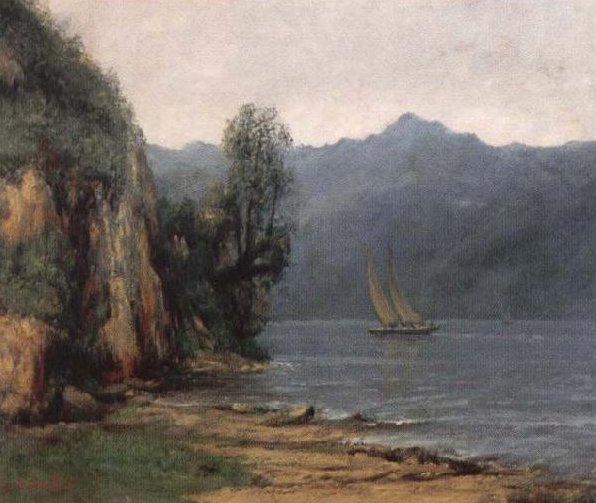
Gustave Courbet was born in Ornans, France in 1819. In his early twenties he moved to Paris and worked at the studio of Steuben and Hesse. He spent a lot of time studying the art of the French, Spanish and Flemish painters and often made copies of the works of Caravaggio and Velazquez. He was to become one of the most powerful and influential painters of his time. Although he spent most of his life in Paris he hardly ever painted urban subjects. Cezanne said of him: “His palette smells of hay”. His many pictures of peasants and scenes of everyday life established him as the leading figure of the realist movement of the mid nineteenth century. He was an outspoken opponent of the French government and took part in the destruction of the Vendôme Column, which resulted in imprisonment and exile from France. In 1873, he was forced to spend his final years in Switzerland.
Courbet rejected idealisation in his paintings and concentrated on painting what was believable and this had an enormous influence on 19th century art. American Art Historian, Lorenz Eitner, wrote of Courbet in his book An Outline of 19th Century European Paintings “ ….Courbet acted as the bull in the china shop of polite art, whether academic or preciously avant-gardist, thus enabling a new generation (including the Impressionists)to concentrate of the problem of expressing visual experience”. Once when asked to include angels in a painting for a church, Courbet replied “ I have never seen angels. Show me an angel and I will paint one”.
Today’s painting in My Daily Art Display is Landscape with Lake Geneva by Gustave Courbet, which he painted in 1874 whilst living in exile in Switzerland, three years before he died. There is an air of tranquillity in this painting and this probably mirrors his quiet years in exile away from the turbulent life and politics of his previous life in Paris.

 my daily art display