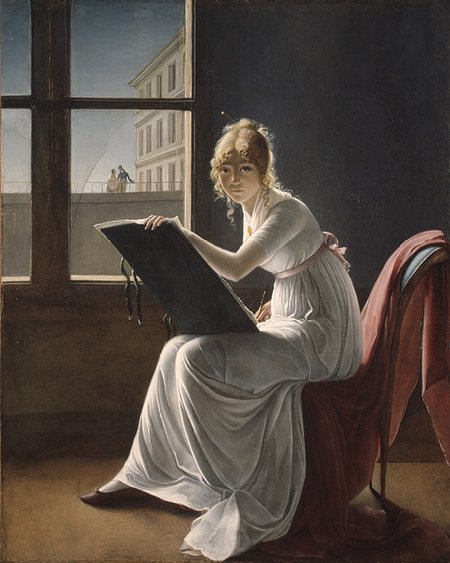
Young Woman Drawing by Marie-Denise Villers

Young Woman Drawing by Marie-Denise Villers (1801)

My Daily Art Display painting for today is literally a whodunit mystery which may or may not have been solved conclusively and who knows what twists may still come in the future.  It is a work of art which has three different artists and two different titles but having said that, to my mind it doesn,t matter as it is an exquisitely delightful painting.

 In 1951 Charles Sterling, Louvre curator and foreign advisor to the Metropolitan Museum, after some lengthy consideration, stated that the unsigned Portrait of Mademoiselle Charlotte du Val d’Ognes, which the establishment had acquired in 1917, was not the work of Jaques-Louis David the highly influential French painter but by one of his students, namely Constance Marie Charpentier.  So there we have it – just a simple mis-identification of the artist.  Sadly, after this revelation, its value plummeted and so-called artistic experts looked at it again and “tut-tutted” about its poor quality.  Labels on the wall of the gallery describing the work of art were changed but the painting remained in place.

However since that proclamation in 1951 by Charles Sterling the debate has raged as to whether Charpentier did actually paint this picture.   The Metropolitan Museum of New York has now decided that she didn’t paint it and furthermore that have now changed the title of the work to Young Woman Drawing which they now believe was painted by Marie-Denise Villers a female portrait painter of the time.   Whoever painted this work of art, it is still one of the most popular and most enthralling paintings in the New York Museum and for anybody close to this museum, I urge you to go and study it.  

Marie-Denise Villers, known to her friends as Nisa, a gifted French portrait painter, was born Marie-Denise Lemoine in Paris in 1774.   She came from an artistic background with her two sisters, Marie-Victoire and Marie-Elisabeth both being talented artists and her cousin Jean-Chaudet Elizabeth the portrait and genre painter.   At the age of twenty she married an architect student Michel-Jean-Maximillien Villers.    She was a pupil of Girodet and exhibited in the Salons.  Her first exhibit was of three paintings at the Paris Salon in 1799, and one of them won her 1500 francs.  From then on her portraits attracted much attention.  Her last exhibit at the Paris Salon iwas in 1814, seven years before she died at the age of 47. 

Today’s work of art, which could have been a self-portrait, was exhibited in the Paris Salon of 1801.

The Face with the haunting eyes

It is outstanding oil on canvas painting.  The luminous image of this beautiful young woman with her drawing board immediately grabs your attention.  Look at her face.  What an extremely beautiful face.  It has been termed “an eighteenth century Mona Lisa” Look how the folds of her white dress are bathed in the sunlight, which streams through the window with the cracked pain of glass.  Why has she painted a broken pane of glass?  Her gaze is directly towards the viewer and holds one’s attention. As I look at the picture I can almost imagine she is carrying out a portrait and I am the subject matter.

Montagne Sainte-Victoire by Paul Cézanne

Montagne Sainte-Victoire by Cezanne (1887)

I suppose it is only natural that when a landscape artist moves to live in a new place the surrounding area will become subjects for their future paintings.  The year 1886 was a memorable year for the French Impressionist painter Paul Cézanne.  Firstly he married Hortense Fiquet, a model he had been living with for seventeen years and in this same year his father died.  After the death of his father, Louis that August, Cézanne inherited the family estate, Jas de Bouffain, which was situated on the outskirts of Aix, in Provence, and he moved there from Paris.  Nearby and to the east, looms the mountain, Sainte-Victoire, which dominates the countryside of this area.   Cézanne was mesmerised by, and fell in love with, the view of this peak and the surrounding area.  Locals venerated it for its legendary ties to antiquity—its very name had come to be associated with a celebrated victory by the ancient Romans against invading Teutonic armies.   Over many years, Cézanne produced forty four oil paintings and forty three watercolours of the area.

My Daily Art Display today features an early painting of this subject, simply entitled Montagne Sainte-Victoire which he completed in 1887 and hangs in the Courtauld Gallery in London.  It shows the mountain as viewed from the west, some eight miles away.  The tree branches in the foreground frame the panoramic view of the valley in the middle ground and the mountain in the background.  Cezanne has focused on a comparatively small part of the scene but the mountain has been given a dominant central position in the work.  The middle ground is dominated by farmland and the yellows of the wheat fields.  To the far right of the painting in the middle-ground, one can see the presence of a railway viaduct.

There is a gradual transition from the clearer greens of the vegetation and the orange-yellows of the buildings seen in the foreground of the picture to the softer atmospheric blues and pinks on the mountain in the background.  Cézanne has connected the foreground and the background by the way he has given the foliage in the foreground the blue and pink tinges similar to the colour shades of the mountain.

With this painting, Cézanne has captured the peaceful and serene beauty of this part of Provence.  This was Cézanne’s truly exquisite and picturesque Shangri-la.

Peasant Couple Eating by Georges de la Tour

Peasant Couple Eating by Georges de la Tour (c.1623)

Georges de la Tour was born in 1593 in Vic-sur-Seille a small town in the department of Lorraine in north-eastern France which, at the time, was part of the Holy Roman Empire  He was one of seven children born to father Jean, a baker and mother Sybille.  Little is known of his early upbringing but we know he married Diane le Nerf at the age of twenty four and they went on to have ten children.  Three years after marrying, the couple moved to Lunéville, his wife’s home town, a short distance from Georges’ birthplace, where he spent the rest of his life.    He had quite a successful career and his paintings were bought by the likes of King Louis XIII, Cardinal Richelieu and the Duke of Lorraine whom he worked for between 1639 and 1642. He died in 1652 just short of his fifty-ninth birthday.

    The style of Georges de la Tour is incredibly unique in its depiction of common subject matter as well as in the design and composition of the works themselves.  De la Tour devoted himself mainly to the representation of genre and religious subjects, both in day scenes as well as nocturnal ones.  On the whole, the paintings are generally small, and thus it can be assumed that he was patronised by mostly private clients from the bourgeoisie or for small religious houses.

My Daily Art Display today is the Peasant Couple Eating painted by Georges de la Tour around 1623 at the early part of his artistic career.   The two half length figures which are almost life-size are tightly framed in the pictorial space.  They face us as if we have interrupted them during their meagre meal of dried peas.  The man exhibits a sour and resentful look as he looks down.  The woman stares fixedly at us with her deep-set almost dead eyes as she raises a spoon to her mouth.  As the background is a simple grey we have no idea where the event is taking place.  However, this background enhances the old couple.  The painting of half-length figures like this one was a characteristic of Caravaggio’s style, an artist who influenced de la Tour in his early works.  This painting proved very popular and there are records of three 17th century copies.

In the book, Georges de la Tour of Lorraine, 1593-1652, by Furness, the author wrote of the artist:

“……Georges de la Tour is classed as a realist.  Realist he is in that his subjects, predominantly if not exclusively religious, are represented in terms of “real” life, often the life of his own country-town and surroundings in Lorraine.  But he avoided naturalism; rather, he chose to simplify, modelling his forms by marked contrasts of light and shade, and using large volumes and severe lines, with great selective economy of detail…”

Georges de la Tour’s use of light in his paintings of people, including this one, bestows them with a sharp eye to detail and clearness within the scene depicted.  He wants us to react to the figures and in some way believes an elaborate background would detract from that scenario.  Grove Art OnLine comments about his lack of backgrounds in his paintings and states:

“…..La Tour’s sparsely populated pictures almost always represent scenes that take place nowhere, if they are judged by the almost complete absence of scenery. The boundaries of the settings are, nevertheless, delineated. There appear to be walls, but they have no texture and the colour is not descriptive….”

The Burial of Atala by Girodet

The Burial of Atala by Anne-Louis Girodet (1808)

A novella written in 1801 by the French writer Francois-René de Chateaubriand entitled Atala tells of the tragic love story of Chactas, a Natchez Indian and Atala the half-caste Christian daughter of Simagan, the chief of the Muscogees, an enemy Indian tribe, who had captured and sentenced Chactas to death.  Atala eventually frees him from captivity and they run away together.   They are helped by Père Aubry, a Christian missionary and hermit, who takes them to his cave and gives them refuge.   Atala falls in love with Chactas, but cannot marry him as she has taken a vow of chastity. In despair she takes poison.  Père Aubry assumes that she is merely ill, but in the presence of Chactas she reveals what she has done, and Chactas is filled with anger until the missionary tells them that in fact Christianity permits the renunciation of vows. They tend her, but she dies.

My Daily Art Display for today is the painting completed in 1808 entitled The Burial of Atala by the French artist Anne-Louis Girodet who was inspired by the poignant story of the would-be lovers Chactas and Atala.  The death scene, set inside the mouth of the cave, is a representation of the traditional paintings of the “burial of Christ” but in this instance the emotions of passion, love and death are all entwined.  The monumental arrangement of the three figures, the setting of the grotto and the solitary cross seen in the background against the sky reminds one of his earlier painting The Dead Christ Supported by the Virgin.

Girodet, usually known as Girodet-Trioson, a name he took in honour of a surgeon Dr Trioson, who adopted him after he was orphaned, was born in Paris in 1767.  He started school and studied architecture and military studies before concentrating on art.  He became a pupil of Jaques-Louis David one of the greatest Neoclassical painters.  Girodet was looked upon as a star pupil winning a number of prestigious prizes for his works of art.  As was the case in today’s painting, Girodet often preferred literary themes for his paintings.  He also gained a reputation as a first class portraitist and many of his works revolved around the power and glory of Napoleon.

When he was 48 his adopted father, Dr Trioson died leaving him a sizeable inheritance.  From then until his death in 1824 Girodet had no need to earn money by selling his paintings and instead concentrated on his other love, the writing of poetry.

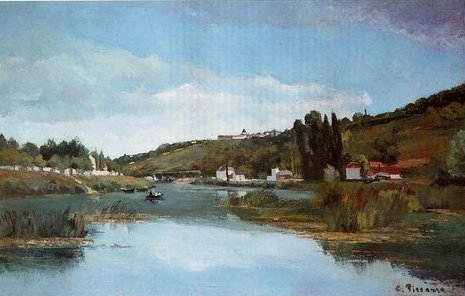
The Marne at Chennevières by Camille Pissarro

The Banks of the Marne at Chennevieres by Pissarro (1864)

The painting featured in My Daily Art Display can be found in Edinburgh at the National Gallery of Scotland.  It is entitled The Marne at Chennevières and is an oil on canvas  painting completed in 1864 by Camille Pissarro.

Pissarro, a French Impressionist painter, was born Jacob Abraham Camille Pissarro in 1830  in the small port town of Charlotte Amalie on the Carribean Island of St Thomas in the Danish West Indies.  His father, Abraham Gabriel Pissarro, of French-Sephardic Jewish descent and his mother Rachel Manzano-Pomié, a Creole from the Dominican Republic ran a flourishing general store in the Danish West Indies.  At the age of 12, Pissarro was sent to a French boarding school in Paris where he started to become interested in art.  He remained there until 1847 when he returned to the Caribbean to help his parents with the running of the shop.  He soon became bored with this humdrum life and wanted to concentrate on his true love, art.  However his parents did not support his ambition.   Whilst sketching locally at the busy port he met Fritz Melbye a Danish painter who had come to the island from Copenhagen in the hopes of becoming a marine artist.  It was he who inspired Pissarro to develop into a full time professional painter and Melbye became not only a close friend to Pissarro but his art teacher.  Pissarro, having no support for his desire to become a full time artist, ran away to Venezuela with Melbye in 1852 where they lived for three years.  In 1855, after his parents pledged to support his artistic ambitions, he returned home and later went to Paris to continue his artistic studies in the likes of École des Beaux-Arts and Académie Suisse and studied under Corot and Courbet.

During the Franco-Prussian war of 1870 and 1871 Pissarro had to flee to London from his home in Louveciennes, a western suburb of Paris.  Sadly, a number of his paintings were destroyed by the invading Pruissian soldiers.  He remained in London until 1890 but returned to visit the English capital on a number of occasions and painted many local scenes.

Pissarro died in Paris in 1913 aged 73 and his grave can be found in the Père Lachaise Cemetery in Paris.

Strong blues, greens and whites dominate this painting of the River Marne and its banks as it meanders passed the town of Chennevières.   Chennevières’ church and houses are just visible at the top of the right bank. Paintings by Daubigny and Corot inspired Pissarro’s carefully structured composition and Courbet’s work influenced his extensive use of a palette knife. The small factory buildings and ferry boat add a contemporary note. The painting was exhibited at the Paris Salon in 1865.

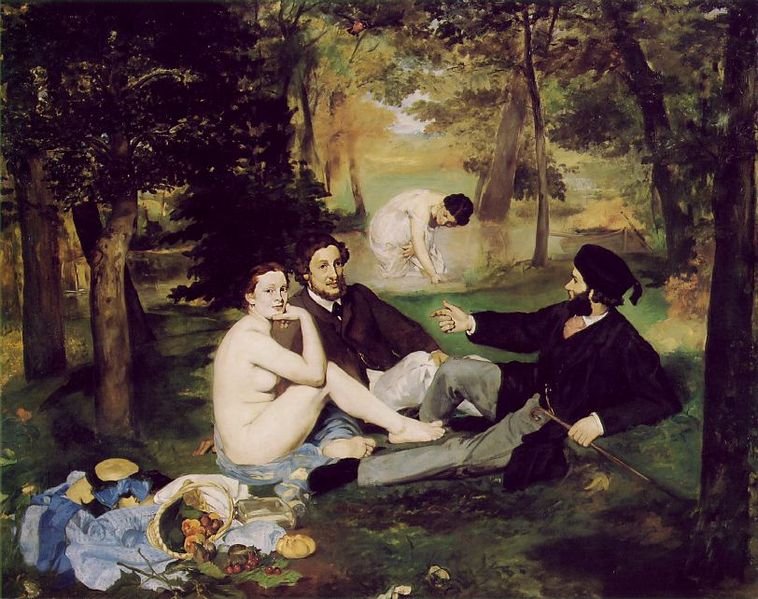
Le Déjeuner sur l’Herbe by Édouard Manet

Le Dejeuner sur l'Herbe by Edouard Manet (1863)

My Daily Art Display for today is the Le Déjeuner sur l’Herbe (Luncheon on the Grass) by Édouard Manet which can be found in the Musée d’Orsay, Paris.

 Manet, who is acknowledged as one of the most famous artists from the second half of the nineteenth century, was born in Paris in 1832 to a wealthy and well connected family.   His father Auguste was a French judge and his mother, Eugénie-Desirée was the goddaughter of the Swedish crown prince.   Although his father expected Édouard to follow him into the judiciary his uncle encouraged him to become an artist.

Today’s painting is an intriguing one for many reasons and caused a stir over its alleged indecency when it was first exhibited in 1863 under the title Le Bain at the Salon des Refusés in Paris having been previously rejected for exhibition at the Paris Salon.  Here the presence of two fully clothed men with a naked woman scandalised some, whilst others found it humorous.   As with all controversies the perpetrator of a public controversy and outrage often becomes a cult hero and the same was true in this case as it made Manet a hero in the eyes of the young painters of the time and brought together in his support the group from which the Impressionists emerged.

Raimondi engraving Judgement of Paris

In the foreground of the picture is a basket of fruit which lies on the lady’s blue dress and seems to take as much importance as the main characters but shows Manet’s skill has a still-life painter.   The main characters in the painting were two fully clothed males and a nude woman looking directly out at us with a relaxed air and with little sign of embarrassment.     Manet must have known this would be controversial.  The subject of the painting was possibly borrowed from Titian/Giorgione’s Concert Champêtre and the posture of the male figure on the right hand side closely resembles that of a reclining figure in Raimondi’s engraving Judgement of Paris.   Whether he cared or not is a moot point as recently his father had died leaving him a substantial inheritance and he no longer needed commercial viability for his works of art.  The female in the painting was Manet’s favourite model Victorine Meurend and her two male companions in the scene were his younger brother Eugène Manet and his brother-in-law Ferdinand Leenhof. 

At the time, the painting style itself also brought about critical comments in some quarters.  There was no transition between the light and dark elements of the picture.  Gone were the subtle gradations and in their place was a brutal disparity of colour.  Depth and perspective seem to be lacking.  Look at the size of the woman standing in the water in the background in comparison to the rowing boat seen to the right of her.   Was this deliberate or was it just Manet’s refusal to conform to convention?

 Have you a favourite painting which you would like to see on My Daily Art Display?   If so, let me know and tell me why it is a favourite of yours and I will include it in a future offering.

The Court Jester Gonella by Jean Fouquet

Interior of Vienna's Kunsthistorisches Museum

Just a short walk away from the Vienna Academy of Fine Art is the Kunsthistorisches Museum, which is one of the largest museum/galleries in the world.  It was built in 1872 and was opened in 1891 by Emperor Franz-Joseph the ruler of the then dual Austria-Hungary monarchy.  It had been his wish to find a home for the Hapsburgs’ remarkable art collection.  The interior of this rectangular building, above which sits a massive octagonal dome, is lavishly decorated with marble, stucco ornamentations, gold leaf and paintings which make the interior a fabulous work of art itself.

The Court Jester Gonella by Jean Fouquet (c. 1440/1445)

The painting featured in today’s My Daily Art Display hangs in the museum.  It is The Court Jester Gonella by Jean Fouquet. 

Jean Fouquet was born in Tours around 1420 and is now acknowledged as the greatest fifteenth century French painter.  He was an exceptional panel painter and manuscript illuminator.  Although little is known of his early upbringing it is known he lived in Rome between 1443 and 1447 before returning to France where he became court painter to Louis XI. 

In the Archduke Leopold Wilhelm’s collection the painting was described as a portrait of a court jester known as Gonella but the portrait of a wily old man remains a mystery.  With his arms are tightly folded, his head tilted to one side he seems to have been squeezed into the picture.  The minutely detailed reproduction of his face complete with wrinkles stubble and reddened eyes is precise and often likened to portraiture by Jan van Eyck.  Here we have a fool acting the part of a simple peasant who is able to amuse the court with his crude jokes or his rough wisdom.

Death of Marat by Jaques-Louis David

Death of Marat by Jaques-Louis David (1793)


Today’s featured artist is another French Neoclassical painter.  Jaques-Louis David was born in 1748 in Paris and is considered one of the foremost painters of his time.  From the age of nine, after his father was killed in a duel, he went to live with his wealthy uncles who ensured he had the best education.

He was a highly political being and actively supported the French Revolution and counted Robespierre, one of the best-known and most influential figures of the Revolution, as one of his friends.  His influence with Robespierre allowed him to almost be a dictator of the arts under the new French Republic.   However, the downside of such a close friendship was the fact that with the fall from power of Robespierre, came David’s fall from favour, which landed him in prison.  After his release his interest in politics continued and he became a supporter of Napoleon I.

My Daily Art Display features David’s Death of Marat which he painted in 1793 and can be found in the Musées Royaux des Beaux Arts in Brussles.  It is considered by many as his greatest work.  The oil on canvas painting depicts the assassination of the revolutionary journalist and member of the National Assembly, Jean-Paul Marat.  In that same year, Marat was killed as he lay in his bath by the young anarchist Charlotte Corday, who had come to Marat on the pretence of giving him a list of people who should be executed as enemies of France.  The picture shows Marat dying, clutching the list on which can be seen Corday’s name.   Corday blamed Marat for his part in the September Massacres which occurred the previous year leading to the death of over a thousand people.

Jaques Louis David , on completion of the painting, handed it over to the National Convention saying:

Citizens, the people were again calling for their friend; their desolate voice was heard: David, take up your brushes.., avenge Marat… I heard the voice of the people. I obeyed.”

The painting of Marat is somewhat romanticised as it shows a flawless skin when in fact for the last three years of his life Marat suffered from a disfiguring skin condition.   In John Adolphus’s  Biographical Anecdotes of the Founders of the French Republic published in 1799 he describes Marat  as  a man “short in stature, deformed in person, and hideous in face”

Marat suffered extreme pain caused by this disease which could only be soothed slightly by immersing his body in the bath.

The Death of Sardanapalus by Eugène Delacroix

The Death of Sardanapulus by Eugène Delacroix (1827)

Ferdinand Victor Eugène Delacroix was born in Charenton–St-Maurice near Paris in April 1798.   Delacroix was a French Romantic artist regarded from the outset of his career as the leader of the French Romantic school.   As an artist he was inspired by the works of Rubens and the Venetian Renaissance painters, Mantegna, Giorgione and Titian.  Baudelaire the writer and art critic said of Delacroix “Delacroix was passionately in love with passion, but coldly determined to express passion as clearly as possible

My painting for today is one that hangs in the Louvre entitled Death of Sardanapalus which Delacroix painted in 1827.   This massive canvas features the defeated Assyrian ruler Sardanapalus propping himself up on a large bed on which a naked woman prostrates herself begging for mercy.   Sardanapalus, on learning that his armies had been defeated, ordered that his possessions were to be destroyed and that his sex slaves were to be murdered before immolating himself.

Landscape with Lake Geneva by Gustave Courbet

Landscape with Lake Geneva by Gustave Courbet (1874)

Gustave Courbet was born in Ornans, France in 1819.  In his early twenties he moved to Paris and worked at the studio of Steuben and Hesse.  He spent a lot of time studying the art of the French, Spanish and Flemish painters and often made copies of the works of Caravaggio and Velazquez.  He was to become one of the most powerful and influential painters of his time.  Although he spent most of his life in Paris he hardly ever painted urban subjects. Cezanne said of him: “His palette smells of hay”.    His many pictures of peasants and scenes of everyday life established him as the leading figure of the realist movement of the mid nineteenth century.  He was an outspoken opponent of the French government and took part in the destruction of the Vendôme Column, which resulted in imprisonment and exile from France.  In 1873, he was forced to spend his final years in Switzerland.

Courbet rejected idealisation in his paintings and concentrated on painting what was believable and this had an enormous influence on 19th century art.  American Art Historian, Lorenz Eitner, wrote of Courbet in his book An Outline of 19th Century European Paintings “ ….Courbet acted as the bull in the china shop of polite art, whether academic or preciously avant-gardist, thus enabling a new generation (including the Impressionists)to concentrate of the problem of expressing visual experience”.   Once when asked to include angels in a painting for a church, Courbet replied “ I have never seen angels.  Show me an angel and I will paint one”.

Today’s painting in My Daily Art Display is Landscape with Lake Geneva by Gustave Courbet, which he painted in 1874 whilst living in exile in Switzerland, three years before he died.  There is an air of tranquillity in this painting and this probably mirrors his quiet years in exile away from the turbulent life and politics of  his previous life in Paris.