The Ecstasy of Mary Magdalen by Peter Paul Rubens

The Ecstasy of Mary Magdalene by Peter Paul Rubens (c.1620)

My Daily Art Display offers up a painting currently in the Palais des Beaux Arts in Lille.  It is an oil on canvas painting entitled The Ecstasy of Mary Magdalene by Peter Paul Rubens.  Rubens completed this work around 1620 as an altarpiece for the Church of the Recollets in Ghent.  Art historians now believeg that this painting by the Rubens was done as they put it “perhaps with some help from assistants”.

The subject of the painting is Saint Mary Magdalen, in ecstasy, being supported by two angels.  Rubens’s  inspiration for this painting came from Jacques de Voragine’s  book of the saints entitled Légende dorée (The Golden Legend) in which is written:

“… The saint, desiring to contemplate celestial things, withdrew into a mountain cave which had been prepared by the angels’ hands and there she remained for thirty years unknown to everyone……each day, the angels lifted her into the skies and for an hour she heard the music; after which, replete with this delicious meal, redescended into her cave, and had not the slightest need of body aliments….”

The setting for the painting is a rocky ledge at the mouth of a cave.  Rubens conveys a deep mysticism in this painting.  Look at the expression on Mary Magdalene’s face.  Her eyes are slightly open but appear somewhat lifeless.  Her face and upper body have been lit-up by a shaft of light.  She appears to be in a trance-like state.  Her face and body are as pale as white marble.  Rubens has beautifully and skilfully painted the folds of her white robe which clings tightly to her body.  The robe has partly fallen away from her upper body exposing her left breast.  Her body is in a state of collapse and the angel on the left supports her as he looks down at her face with an expression of concern for her well-being.  The angel to the right supports her wrist as he looks upwards in awe at the divine shaft of light which has penetrated the mouth of the cave.   The art historian Baudouin points out that the ecstasy which transfigures Mary Magdalene is surprisingly reminiscent of the detailed descriptions that the Spanish saint, Teresa of Avila, wrote about in her biography entitled Vida.  She recounted her experiences at the height of her moments of mystical union and wrote:

“…While it [the soul] thus searches its God, it experiences, amidst the deepest and sweetest delights, an almost total collapse, a sort of fainting fit which gradually takes away one’s breath and all one’s bodily strength….”

This is a beautifully painted picture and the skilled portrayal of the three characters with their varied expressions by Rubens, is superb.

The Peasant Dance by Pieter Bruegel the Elder

Peasant Dance by Pieter Bruegel the Elder (c.1567)

Today for My Daily Art Display, I return, after too long an absence,  to one of my favourite painters, Pieter Bruegel the Elder.  I want to look at his painting the Peasant Dance which is not dated but thought to be a companion painting of the same size to Peasant Wedding, which he completed around 1567 and both of which illustrated peasant life.  This is an example of his later work which is characterised by his use of monumental Italianate figures.  This painting can be found in the Kunsthistoriches Museum Vienna.   There is a very similar painting by Bruegel in the Institute of Arts, Detroit which is entitled The Wedding Dance in the Open Air, the main difference between the two is that the Detroit version has more figures in it making it a more crowded scene. 

But I start with a poem by the American poet; William Carlos Williams entitled The Dance, which sums up the painting, the setting of which is the village fair (La Kermess).

In Brueghel’s great picture, The Kermess,

the dancers go round, they go round and

around, the squeal and ther blare and the

tweedle of bagpipes, a bugle and fiddles

tipping their bellies (round as the thick-

sided glasses whose wash they impound)

their hips and their bellies off balance

to turn them.  Kicking and rolling about

 the Fair Grounds, swinging their butts, those

shanks must be sound to bear up under such

rollicking measures, prance as they dance

in Brueghel’s great picture, The Kermess.


The Peasant Dance, along with Peasant Wedding are thought to be the most outstanding examples of Breugel’s late style and are personified by his use of enormous figures.   Bruegel the Elder was well known for his peasant scenes, so much so, he was often referred to as “Peasant Bruegel”.  Bruegel specialised in genre paintings which depicted peasants at work and at play.  From his paintings we came to understand more about village life of that time and the about the peasants who inhabited them – how they ate, how they dressed, how they hunted and as is the case of today’s painting, how they relaxed and celebrated.  He never sentimentalised the life of the peasant folk as they got on with their life and his portraits were a great source of evidence regarding both the physical and social aspects of 16th century life in the Netherlands.  Bruegel pioneered the painting of ordinary life and although he was not of “peasant-class”, he would associate with the peasants so as to understand their lifestyle which he then painted.

The picture is about a dance at a fair which is being held in the village square outside an inn.  This picture of a dance is in sharp contrast to the paintings featuring the courtly settings of formal dances where everybody is dressed in their finest clothes.  Here we see a scene of rural merriment reflecting sixteenth century custom.  It is an actual point in the celebrations – the opening of a Kermesse, or village fair with a traditional dance performed by two couples.  The large couple in the foreground appear to be hurrying to the dance whilst we observe further back two other couple lost in the joys of the dance.  If we look at the house with the banner, to the left side of the background, we can see a man trying to coax (or is it drag!) a reluctant woman towards the dancing.

Bruegel in this painting has once again put a moral slant on what he depicts.  This is not just a humorous picture recording village life.  Gluttony, lust and anger can all be seen in this painting.   Look at the man seated next to the bagpipe player.  He looks drunkenly at the bagpipe player trying to offer him a jug of ale.   See how he has a peacock feather in his hair.  This is symbolic of vanity and pride.   Bruegel also draws our attention to the fact that although this is a “saint’s day”  he has depicted the dancers having turned their backs on the church and take little notice of the picture of the Virgin which hangs from the tree. 

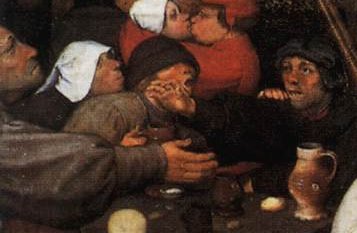
Three men arguing

The positioning of the tavern in the foreground and all that is going on around the table clearly shows that the peasants are engrossed with material things rather than spiritual issues.   An animated conversation between three men is taking place at the table.   One of them stretches out his hand to another on the extreme left but probably due to an excess of alcohol, he knocks his neighbour in the face.

Two small females

There are two strange figures in the left foreground.  They are two small females.  I have heard these being described as a mother and child even though the size of the one seated would be completely wrong.  However it should be noted that children often dressed like smaller versions of their parents and these could be two children.

Bottle of Bruegel beer


Finally this excellent work of art has been the inspiration for Bruegel Belgian Amber Ale from Brewery Van Steenberge. The 5.2 percent alcohol by volume beer has a scene from The Peasant Dance on the label.  So you see, Bruegel is still making his mark on today’s society !

The Portinari Triptych by Hugo van der Goes

The Portinari Triptych by Hugo van der Goes (c.1475)

Today My Daily Art Display looks at the oil on wood triptych painting by the Flemish artist Hugo van Goes known as the Portinari Altarpiece or the Portinari Triptych.   It was completed around 1475 and can now be found in the Uffizi Gallery, Florence.   The work was commissioned by Tommaso Portinari, an Italian banker for the Mèdici bank in Bruges and a wealthy man in his own right.   The commission was for the high altar of the Sant’ Egidio, the  church of the hospital of Santa Maria Nuova in Florence which was founded two hundred years earlier by Tommaso’s ancestor, Folco Portinari.  This is a huge work of art measuring 253cms x 586cms (almost 8.5ft high and 19ft across)

The three shepherds

The triptych consists of three hinged panels.  The centre and largest panel depicts The Adoration of the Shepherds.  One can see the three shepherds on their knees with their hands clasped in prayer.  Look how well the artist has portrayed the facial expressions of the three men.  They look mesmerised by what lies before them.    Look at the detail he has put into their lined faces.  Look at their hands, rough and wrinkled.  These are hard working-class men of meagre wealth who have left their place of work to come and pay homage to the baby Jesus.  They look down at the baby with a degree of wonderment and affection.  It is interesting to note that the artist has not included the three Kings with all their wealth.  Was this intentional and if so why was there this omission?

Kneeling around the Virgin Mary and the baby we can see a number of angels.  The artist for some unknown reason does not present us with the baby Jesus in a crib but instead has him lying on the ground and for this reason many have said that this is not a Nativity scene but rather an Adoration of the Child setting.  In the background, on the right hand side of this central panel, we have the shepherds being visited by the angel telling them of the birth of Jesus.  In the foreground we have a still-life of two vases, one earthenware with a grape motif and one made of glass containing flowers behind which is a sheaf of wheat.   Art historians would have us believe that the glass vase symbolizes the “entry of the Christ Child into the Virgin’s womb without destroying her virginity the way light passes through the glass without breaking it”.  Of the grape motif on the earthenware vase, this alludes to the fact that it is wine made from the grapes and then we are to believe that this therefore is symbolic of the Eucharist wine.

Floral display and wheatsheaf

The flowers are a mixture of orange lilies, red carnations, blue columbine and purple and white irises.  The orange lilies symbolise The Passion whilst the white irises are a sign of purity.   The purple irises and blue columbine represent the seven sorrows of the Virgin.    Many art historians who love delving into interpretations of paintings would have us believe that the three red carnations symbolise the three nails of cross.  The bundled wheat in all probability is there to remind us of bread and the Last Supper in which Christ broke the bread.  In the centre middle-ground we have the Virgin Mary with eyes closed, contemplative and in prayer.  To the left of this central panel we see the figure of Saint Joseph, almost lost from our view in the shadows.  He exudes dignity and humbleness but appears rather weary.

 Saint Margaret holding a book and Mary Magdalen with the pot of ointment are shown on the right wing of the triptych along with Portinari’s wife Maria di Francesco Baroncelli and their daughter Margarita both seen kneeling in front of the saints.     On the left wing we see Saint Anthony, with a bell, and Saint Thomas, holding the spear along with Tommaso Portinari himself and his two sons Antonio and Pigello.

The closed triptych

The two outer wings of the closed triptych are painted in monochrome and are much more sombre than the three colourful inner panels.  On one side one has the Archangel Gabriel and on the other one has the depiction of the Virgin of the Annunciation.  Both figures stand under retreating arches.  The figures themselves and the way in which the artist has painted the folds of their robes give the two scenes a somewhat 3-D feel.  There is also an emptiness about the scenes which is in sharp contrast to what our eyes are greeted with when the wings of the triptych are opened.  Surely this contrast was intentional.  I am sure the artist intended to astound people when the wings were opened and they beheld the three panels and the amazing colourful scenes before them.

This was one of Hugo van de Goes‘s last masterpieces and probably marks the high point in his artistic career.  His mental state began to fail and he became afflicted by severe depressions.  He gained some solace by entering a monastery in Brussels where he continued to paint and he lived there until his death in 1482.   Once again we look at the life of an artist who created such beauty and had given so much pleasure to so many and yet  during his later life was unable to alleviate his own depression.  Maybe he was a perfectionist who just could not believe in the perfection he created.

Portrait of Susanna Lunden by Peter Paul Rubens

Portrait of Susanna Lunden by Peter Paul Rubens (c.1622-5)

My Daily Art Display today is an oil on oak painting by Peter Paul Rubens which he completed around 1625.  It was entitled Portrait of Susanna Lunden (?).   An alternate title Le Chapeau de Paille, meaning straw hat, was first used in connection with this painting in the early 18th century.  However looking at the painting one can see that the lady is not wearing a straw hat which leads some art historians to believe that the alternate title of the painting is more likely to have been Le Chapeau de Poilpoil being the French word for fur.

There is a relaxed attitude to this picture presumably because of the family connection of artist and sitter.  The hat which partly shades the face of the lady is a dominant feature of this painting.   It is believed that the sitter is Susanna Lunden who was the third daughter of the Antwerp tapestry and silk merchant Daniel Fourment for whom Rubens designed.  There was, besides a working connection, a relationship between Fourment and the artist as in 1630, Rubens was to marry Susanna’s younger sister Hélène.  Also his sister-in-law, from his first marriage to Isabella Brunt was married to Susanna’s brother David Fourment.  The picture, which was started by Rubens around 1622, was at the time of Susanna’s second marriage, this time to Arnold Lunden.  Her first marriage ended with the death of her husband when she was still a teenager.  Judging by the ring on Susanna’s right index finger it is quite possible that the painting was a betrothal or marriage portrait.

Strange as it may seem, the painting grew in size as it was being painted as we now know that an extra strip of wood was added to the right-hand side and further strip of wood added to the bottom.  These additional strips allowed Rubens to enlarge his background and create a greater spread of sky to which the artist was then able to add some dark clouds to the right-hand side of the background, which contrasted to the clearer blue sky to the left.  Maybe there was some meaning to this contrast in the skies.  Maybe the dark clouds symbolised the sadness of a young widow and the bright blue skies represented the coming of a new and happy life through her second betrothal.  The light from the left hand side of the painting falls across the lady’s body and hands but the right side of her face is partly in shadow owing to the large brim of the hat.  However even the shadow could not lessen the lustre of her skin and the intensity of her eyes. 

It is a sparkling portrait.  The smiling Susanna seems thoughtful.    Maybe it is a shy smile.  Maybe it is a coy smile.  I wonder if she realises the beauty Rubens has conjured up for this portrait.  I am not even sure she is aware of her loveliness or, if she is, maybe it causes her embarrassment.   Her felt hat, adorned with its downy peacock feathers, is so wide and floppy that it almost borders on the absurd but would, I am sure, be well received on Lady’s Day at Ascot races!  The lady, with her full Rubenesque breasts,  a trademark of the Belgian painter, stands demurely before us but, to some extent, avoids our gaze.  

Rubens portrayal of Susanna presents us with a beautiful and desirable woman.  Look at her eyes.  See how Rubens has made the eyes large and lustrous and note how he has chosen black as the colour of the iris.   This enhances the beauty of the subject and her slightly parted pink lips add to her sensuousness and offer a suggestion of eroticism to the painting.  Her pale skin glistens in the light.  She almost glows.  Her red and grey robes are both opulent and unusual with the detachable red sleeves attached to her bodice with ribboned gold-tipped laces.  The colour of the ribbons match that of her lips, nostrils and eyelids.

Could the artist not help but be seduced by the beauty of his sitter ? 

Are we not beguiled by her beauty?

The Procession to Calvary by Pieter Bruegel the Elder

Procession to Calvary by Pieter Bruegel the Elder (1564)

One of my very first offerings for My Daily Art Display was a painting by one of my favourite artists Pieter Bruegel the Elder.  Today I would like to revisit this artist and show you another of his paintings entitled The Procession to Calvary which he completed in 1564 and which now hangs in the Kunsthistoriches Museum in Vienna.  This was probably the most complex composition of the Flemish painter.

This oil on oak panel painting was the largest known work of art by Bruegel the Elder, measuring 124cms x 170cms.  It is one of sixteen paintings by him which are listed in the inventory, drawn up in 1566, of the wealthy Antwerp collector, Niclaes Jonghelinck.  The composition is in some ways a traditional one.  It is the solemn religious event of Jesus bearing the cross on his way to Calvary where he is to be crucified.  However the story is transported into the time of Bruegel and by doing this the artist has given the subject of the painting an immediacy for his contemporaries as well as making a general valid statement about human actions.   It is not the Roman soldiers of Pontius Pilate that we see escorting Christ, but the mercenaries, in their bright-red tunics, who were in the service of Philip II of Spain, the ruler of Bruegel’s Netherlands. 

 When one first looks at the painting one does not know what to focus upon first.   It is a composition depicting Christ carrying the cross, as a semi-circular procession of incidental scenes set against a wide landscape crowded by tiny and animated figures.  Our eyes dart from scene to scene of this multi-faceted painting.  It is as if the painting invites us to look everywhere at once and not let our eyes loiter on one specific spot.   It is in some ways a chaotic scene, which one finds very bewildering.  It is typical of many of Bruegel’s paintings, which are usually filled with all types of characters.  There is a myriad of tiny figures rushing about, each with a task to be completed.   We are mesmerised as we try to see what each of the hundreds of figures is doing.  As we look at the bedlam we are drawn into it and become part of the crowd.   Some are arguing, some are fighting and as we look on we wonder what it is all about.  Our mind is in a whirl with all this hyper-activity.

The Mourners

So let me try and dissect the painting.   In the foreground, the sorrowful friends of Christ, standing on a small rocky crag, and are deliberately distanced by Bruegel from the hordes below.   These four figures, the Virgin Mary, John the Disciple and the two holy women, are larger in size than the rest and they are perched motionless and distraught above the chaotic goings-on below.  They are grief-stricken at what is going on behind them.  Saint John has moved to Mary, with her large blue veil.  Her face is pale and it seems as if she is about to collapse.  It is interesting to note that these two characters and those of the holy women are dressed in the clothes worn at the time of the crucifixion, whilst the rest of the figures, with the exception of Christ himself, are dressed in Flemish garments of Bruegel’s time.  Bruegel did this to give the painting a particular reference to his own day.

The Fallen Christ

Having let our eyes dart from scene to scene amongst the heaving mass our eyes try to find and focus on the figure of Jesus.  Our attention is drawn to the white horse and rider in the centre of the picture and then we see behind them the figure of Jesus who has fallen under the weight of the cross and is on one knee trying to raise himself up once again.  He is dressed in blue and yet for some reason it was hard for us to pick him out amongst the other characters.  Was that Breugel’s intention?  Did he purposely “hide” the figure of Jesus?  It is interesting to note that although Jesus is at the centre of the painting he is difficult to discern amongst the crowd.  His insignificance amongst the masses of people is a familiar device of Mannerist painting. 

Public executions were quite normal in 16th century life and especially in the troubled land of Flanders where Bruegel lived.  These macabre events were always well attended and had a carnival-type air to them.  I suppose that as such executions were carried out on a regular basis the onlookers became hardened and completely indifferent to the fear and misery of those being led to their death.   It is interesting to see that Bruegel has also added into his painting another regular happening at these events – pick-pocketing, as the crowds, in their excitement of seeing unfortunates being executed, were often oblivious to what was going on around them and were easy targets for the pickpockets.    

The two thieves

We see the two thieves sitting in a horse-driven cart being transported to their place of execution.   Their hands which hold a crucifix are tied in front of them and they look heavenwards beseeching for some divine mercy and at the same time babbling their final confessions to the cowled priests besides them.   The cart which trundles slowly on its way is surrounded by throngs of ghoulish spectators.

Golgotha

If we look to the upper right of the picture we see the mount of Golgotha and the two crosses already erected for the crucifixion of the two thieves.  Between them we can see men digging a hole into which the third cross, from which Christ will hang, is to be placed.  Crowds walk whilst others go on horseback towards this place so as to get a “ring-side” view of the forthcoming crucifixion.    As they move up the hill they pass through a landscape dotted with gallows on which corpses still hang and wheels to which fragments of cloth and remnants of broken bodies, not eaten by the ravens, still cling.

The sky to the left is blue and calm whereas the sky to the right over Golgotha is dark and storm-like and Bruegel’s landscape has us focusing on an impossible sheer rock outcrop atop of which perches a windmill.  Art historians differ on the significance of the windmill on this rocky structure.  However, impossibly sheer outcrops of rock characterize the landscape tradition of the Antwerp School founded by Joachim Patenier.

This is in some ways a moving painting with religious significance of Jesus on his long journey to his ultimate death.  However, as is the case in many of Bruegel’s painting, the animated antics of the numerous peasants depicted brings a smile to your face as you look to see what each individually painted character is doing.

Archduke Leopold William in his Gallery at Brussels by David Teniers the Younger

Archduke Leopold William in his Gallery at Brussels by David Teniers the Younger (1651)

The other day whilst researching the family tree of the Bruegels I came across the Teniers, an artistic family who had a connection with Peter Bruegel as David Teniers the Younger was married to Anna Brueghel, the daughter of Jan Brueghel the Elder and granddaughter of Pieter Bruegel the Elder. 

David Teniers the Younger, a Flemish artist of the Baroque period, was born in Antwerp in 1610.  His father David Teniers the Elder, his son and his grandson were also celebrated artists.   However he has always been looked upon as the most accomplished painter of the Teniers’s dynasty.   He was a prolific painter with over two thousand pictures attributed to him.  He was influenced by the Flemish painter Adriaen Brouwer.   Many of his greatest works were completed between 1640 and 1650.  He painted almost every genre of picture but his favourite appears to be that of peasant life.  A century later a number of these paintings were made into designs for tapestries.  Like his wife’s grandfather, Pieter Bruegel the Elder David Teniers the Younger was a master of portraying crowd scenes with each of his figures displayed with a tender, human and often amusing touch.   A good example of that would be a painting he completed in 1646 entitled The Village Fête

David Teniers married Anna Brueghel in 1637.  In 1647 he and his family moved to Brussels and became the court painter and the keeper of the art collections of the then regent of the Netherlands, the archduke Leopold William,  who was a great art lover and who spent an immense fortune in acquiring paintings.  He was by far the most important collector of paintings among the Habsburgs.  Whilst curator of the royal art gallery he took time to make small-scale paintings of some of the works in the gallery by the foreign artists, especially those of Italian artists, for use by engravers who produced the illustrations.  He painted many views of Leopold William’s picture gallery and today’s offering for My Daily Art Display is one he painted in 1651 entitled Archduke Leopold William in his Gallery in Brussels, which portrays  the archduke along with his paintings in a fictionalized gallery setting and which now hangs in the Kunsthistoriches Museum, Vienna.

Leopold William is portrayed on a visit to his own gallery accompanied by his courtiers and Teniers himself.  These “gallery interiors”, a traditional genre in the Netherlands, were sent as gifts to other princely collections.   Today’s painting was owned by Leopold William’s brother, Emperor Ferdinand III, in Prague.  There are fifty one Italian paintings depicted in this picture, some of which have had their proportions altered to achieve an impression of decorative profusion.  They are from the collection of the Duke of Hamilton, from whom Leopold William had purchased them, shortly before this painting was commissioned.    Most of the paintings are now housed in the Kunsthistoriches Museum, Vienna.

I wonder how many you can recognise.

The Family of Jan Brueghel the Elder by Peter Paul Rubens

The Family of Jan Brueghel the Elder by Rubens (c.1615)

My Daily Art Display for today is The Family of Jan Brueghel the Elder painted by Peter Paul Rubens circa 1613-15 and now hangs in the Courtauld Gallery, London.  He was a close friend of Jan Brueghel the Elder.  In the painting we have Jan with his second wife Catherina van Marienberghe and their children Pieter who was born in 1608 and Elizabeth who was born a year later.  For a family portrait it is unusual that the mother should be the central and most dominant of all the figures present.   It is thought that the original idea of the portrait was to be just that of Catherine and her two children and that Jan was missing from early copies but added, somewhat unsymmetrically in an otherwise balanced composition later.   All are dressed as if they were members of Antwerp’s wealthy and highly regarded middle class and maybe this was Rubens’ idea to establish that artists were on an equal social and professional footing to the likes of physicians, lawyers and bankers. 

Father and mother are dressed in black adding a certain amount of gravitas to the parents unlike the children who are dressed much more colourfully.  Jan, with his kindly features, is dressed soberley with a tall black hat enfolding his family with his outstretched left hand and in turn Catherina, the loving mother and wife, has one hand around her son, Peter can be seen touching his mother’s precious bracelet, probably a betrothal gift, as if to draw attention to it.   Catherina’s other hand clasps the delicate fingers of her daughter, Elisabeth who is gazing lovingly at her mother. This meeting of hands occurs in the very centre of the canvas and is intended to portray familial love and devotion.  The way in which the family are depicted in the painting, almost in a huddle, emphasises the closeness of the family.

This is a very touching family portrait with its unusual intimacy.  Sadly such family love and happiness was to be devastated ten years later, in 1625, when a cholera epidemic struck Antwerp and of the four people in the picture, only Catherine survived.

The Arnolfini Portrait by Jan van Eyck

The Arnolfini Portrait by Jan van Eyck

Today’s painting in My Daily Art Display is one that art historians have written about probably more than any other with the exception, maybe, of Da Vinci’s Last Supper which of course received renewed speculation after Dan Brown’s novel.

The Arnolfini Portrait which can be seen at the National Gallery, London was painted by Jan van Eyck around 1434.  The two main characters in the painting are Giavanni  Arnolfini and Giovanna Cenami.  Art historians have looked at the painting and tried to decide whether this is a picture of their wedding  or just one of their betrothal ceremony.  Was the lady pregnant or was that just a fashion style of the day?  Much has been written about the symbolism of the dog, the oranges, the mirrored reflection and virtually anything you can see has been given an interpretation of its symbolism.  Notwithstanding the symbolism and the many interpretations I believe it is a painting of haunting beauty.

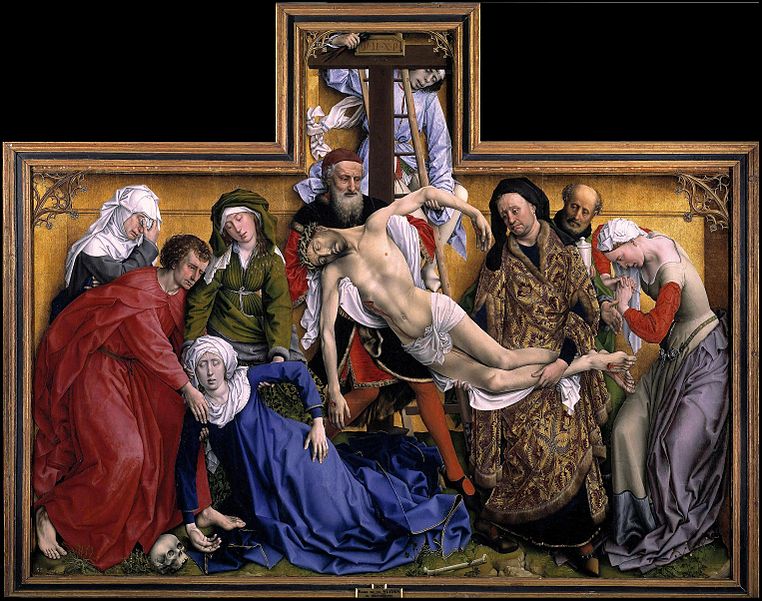
The Descent from the Cross by Rogier van der Weyden

Rogier van der Weyden was born in, what is now, the Belgium town of Tournai around 1399.  His name at that time was actually Rogier de le Pasture which literally translated meant Roger of the Pasture.   His father Henri de le Pasture was a knife manufacturer.  At the age of 26 he married Elisabeth Goffaert, the daughter of a Brussels shoemaker, and they had four children.  In 1436 he was given the position of stadsschilder,  (painter to the town), of Brussels, a post especially created for him.  It was whilst living in Brussels, which was then a Dutch-speaking town, he began to use the Dutch version of his name: Rogier van der Weyden.

Today’s painting, The Descent from the Cross, was the centre panel of an altarpiece, of which the wings are lost, created by Rogier van der Weyden around 1436.  It can be found in the Prado, Madrid.  The painting depicts the lifeless body of Christ being lowered down from the cross.  The painting was commissioned by the Greater Guild of Crossbowmen of Leuven and was installed in the Chapel of Our Lady Without the Walls which was demolished in 1798.

The main figures in the painting are, to the right, Mary Magdalen with her fingers entwined. To the left of her, is Nicodemus, wearing a black hat and a gold-coloured robe.  At the centre of the picture is Joseph of Arimathea, wearing a brown skull cap, who can be seen supporting the body of Christ.   Mary Salome another half sister of the Virgin Mary, dressed in green, is to the left of the body of Christ seen supporting Mary.  On the left of the picture, dressed in a red robe, and also supporting the Virgin Mary is St John the Evangelist.

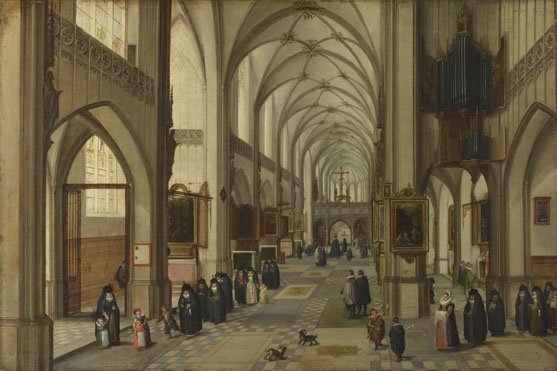
The Interior of a Gothic Church looking East by Hendrick van Steenwyck the Younger (1604-1615)

Interior of a Gothic Church looking East by Hendrick van Steenwyck

The Flemish painter, Hendrick van Steenwyck the Younger, was born in Antwerp around 1550.  He was an artist who specialised in paintings of the interior of churches and cathedrals and through his paintings he is credited with rediscovering the art of perspective using realistic ,if imaginary, architectural scenes as the main subject of his paintings.  In all of his paintings his architectural themes predominated as, for him, the figures within his pictures were merely subsidiaries.   In the case of today’s featured painting, The Interior of a Gothic Church looking East , the architectural details of the painting are by Steenwyck but the figures were thought to have been painted by Jan Bruegel the Elder.  The building has not been identified.  In the foreground on the right we have a christening party while behind them one can just make out a priest celebrating mass.