Marriage à la Mode: The Tête à Tête by William Hogarth

Marriage à la Mode: The Tête à Tête by William Hogarth

For those of you who have just alighted on this page, I would suggest you start by looking at yesterday’s offering, which is the first in a series of six paintings by William Hogarth, which together were entitled Marriage à-la-mode.  My Daily Art Display today is the second painting in the series entitled The Tête à Tête.  The six paintings tell a story, in chronological order, (hence my suggestion to start at yesterday’s blog) of the consequences of an ill-conceived marriage.

In the painting we see four characters.  The newly married Viscount and his bride, the Viscountess,  and two servants, one who is just taking his leave of the couple and the other we can spot in the ante-room.  The setting is the drawing room of their palatial home.  If we look above the Viscount’s head we can see a clock showing a time of 1:20 and this has generated two lines of thought as to whether we are viewing this scene in the early afternoon or in the early hours of the morning.  I will leave you to decide.

The Viscount - Lost in thought

The Viscount sits slumped in his chair with his hands stuffed in his pocket.  He is disheveled and completely lost in thought.  It is as if he has just returned from a night out with the lads and is now feeling ill from the onset of a hangover and a night of debauchery.  He looks exhausted and maybe his night out was not just a tour of the inns with his male friends but maybe his fatigue has been brought on by their visiting a brothel.   So maybe 1:20 in the morning is a better bet!  

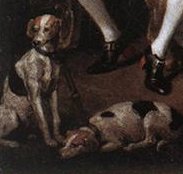
He pays no attention to his wife who sits across from him in a separate chair.  A dog can be seen at his side.  It is quite animated as it sniffs at something sticking out of his pocket, possibly a woman’s lace cap which he obtained as a “trophy” during his sojourn in the brothel. Once again, we see in this picture a large black patch on the Viscount’s neck, which Hogarth used to signify that the Viscount has contracted syphilis.  It should be remembered that this patch was there in the first picture and therefore he had this affliction prior to his marriage.  However Hogarth has cast doubt on the Viscount’s sexual prowess as lying by his feet is his sword still in its scabbard but the tip has broken off which alludes to the fact that he may be impotent.

The Viscountess - Contented look of pleasure

So let us take a look at the Viscountess.  To her right we see some playing cards scattered on the floor.   In front of her, on the ground, is the book entitled Hoyle on Whist suggesting that her evening entertainment has been simply playing cards, but maybe the question we should be asking ourselves is, with whom?  Am I adding intrigue when there is none to be savoured?  Observe the young woman more closely.  Her pose lacks dignity.  She sits with her legs apart,  a not very lady-like pose. Her arms are outstretched and she is lost in thought.  In contrast to her husband’s thoughts, her thoughts seem to be very pleasurable.  Look at her dress.  Look at the stain or damp patch on it.  Why has Hogarth painted it like this?  What is the artist trying to convey to the viewer?  Her facial expression is one of contentment and joy and we know that this is not the result of a happy marriage or the fact of being left at home alone, whilst her husband is off gadding about.  She is probably aware of his womanizing, so what has brought about this expression of happiness?  There is something sly and devious about her expression as she furtively peeks under eyelashes at her husband.  Take a look at what she is holding above her head in her right hand.  It is a mirror.  Maybe she is using it just before she stretched out her hands or maybe she is signaling to somebody just out of picture – maybe her lover with whom she has spent an evening of pleasure?  Maybe that is what has put the contented expression on her face.  Hogarth has given us one other clue to a possible meeting of lovers.  Look on the floor in the foreground.  We see an upturned chair and an abandoned musical instrument and sheets of music.  Was the lover of the Viscountess seranading her and on hearing the arrival home of her husband, dashed out of the room, knocking over the chair in his haste? 

The frustrated steward and the unpaid bills

We see the steward just about to take his leave of the couple.  He does not seem best pleased.  He is portrayed by Hogarth as a pious Methodist and in the pocket of his coat we can just see a book sticking out with the title “Regeneration” a book on Christian theology.  A quill pen is behind his ear.  In his left hand he is grasping a stack of unpaid bills and a ledger is tucked under his arm.   Hanging from the little finger of his left hand is a spike upon which are the paid bills.  Alas, there would appear to be only one, which fades into insignificance if we contrast that to the sheaf of unpaid bills.  It is quite obvious that the young Viscount likes to spend and is treading the same perilous path his father took – the road to financial ruin.    The steward is leaving them with his right hand thrown upwards in a sign of despair that neither of the couple will take their financial situation seriously.

Mishmash of ornaments

Over the fireplace we see a painting of Cupid amongst ruins playing what looks like a set of bagpipes.  This symbolizes the inharmonious and flawed state of the young couple’s marriage.  Below the painting of cupid we see a bust which has, at one time, had its nose broken off and this once again this symbolizes impotence – maybe alluding once again to the impotency of the Viscount.  On the mantlepiece there is a terrible mishmash of ornaments, jars, statuettes and figurines.  This probably alludes to the chaotic existence of the couple’s lifestyle.

That painting !!!!

Do you know what amuses me the most?  It is is in the other room.   Look at the paintings on the wall.  We can see three paintings, portraits of the apostles, but look at the fourth painting, the one to the right.  A green cover almost hides the subject from view but we can see a naked foot.  I will leave you to decide what the rest of the painting was about.  It had to be something too risqué for us to see!

We are left in no doubt by this second painting that the marriage of the Viscount and the Viscountess is heading for the rocks and you will have to wait until tomorrow to see the third “episode” of this pictorial soap opera to find out what happens next!

Marriage à la Mode: The Marriage Settlement by William Hogarth

Marriage à la mode: The Marriage Settlement by William Hogarth (c.1743)

A couple of days ago I featured a portrait of a couple by Thomas Gainsborough.  The type of portrait was known as an “outdoor conversation piece” with it being a group portrait of real people in a landscape setting.  Today I am going to introduce you to another form of art known as “the modern moral subject”.  This form of art was developed by the English artist William Hogarth.  Hogarth had a great desire to be an English painter of grand manner history subjects.  He wanted to break the foreigner’s monopoly in high art. However, unlike the up and coming portrait painter, Joshua Reynolds, he rejected the idea of travelling to Rome where that manner was to be acquired.

Hogarth believed there was enough evidence of the “foreigners’ work” in England without him having to make them pilgrimage to Italy.  The Raphael cartoons, which were considered to be among the greatest treasures of the High Renaissance, were in England.  They had been painted by Raphael as designs for the tapestries that were made to cover the lower walls of the Vatican Sistine Chapel had been brought to England in 1623.  There were also many engravings of great art at hand in England and Hogarth considered travelling through Europe to study High Renaissance art was unnecessary.  Hogarth had created a different role for himself, painting narrative series of “modern moral subjects”.  The novelist and dramatist Henry Fielding called them “comic history paintings”.

My Daily Art Display for today is The Marriage Settlement, the first painting of a set of six entitled Marriage à-la-mode which Hogarth painted between 1743 and 1745.  It is a moralistic warning, which gives us a clear vision of what happens as a result of an ill-conceived marriage, which only took place for financial reasons and not for love.  Art historians believe that this project of Hogarth was his finest.   It is a finely crafted story divided into six parts and I like to consider it as a six-episode pictorial soap opera.

The main protaganists

So now let me introduce you to the characters that are all assembled in this, the first painting of the series.  Seated at the far right of the foreground we have the Earl of Squander.  The index finger of his left hand points to an unfurled parchment depicting his family tree, which shows his family being direct descendents of William, Duke of Normandy (William the Conqueror).    Hogarth has cynically incorporated a broken branch in to the family tree, which was indicative of  a prior marriage, but one outside the nobility and was thus disowned, hence the break from the main tree.  Obviously one would not have shown such a thing on a real family tree but it is reminding the viewers that this great noble’s set of descendents were not quite as noble as the earl would have us believe!   Although titled, the man is almost penniless and heavily in debt due to his foolish ways and needs urgently to replenish his wealth.  Despite his poverty look at the luxurious and costly clothes he is wearing.  There is an arrogance about the man.  He has surrounded himself with symbols of his nobility.  There are coronets everywhere.  If you look carefully you can see how Hogarth has painted them on his foot stool, on the canopy above his head, and even on the head of his crutches.     Observe how Hogarth has painted him with his right foot resting on a stool which is a tell-tale symptom of gout, and which is often associated with overindulgence in alcohol and rich foods.

Sitting across from the Earl, in his red frock coat is The Alderman.  He, unlike the Earl, is extremely rich.  He is what we would now term, the nouveau riche.  However, he is not of the “noble class” and all he wants is to become the grandfather to a noble son.  He has what the Earl needs – money.  The Alderman has what the Alderman needs – nobility and so they have hatched up the plan of a marriage between the Alderman’s daughter and the Earl’s son.

Bride and groom with Silvertongue the lawyer

We can see the bride and groom sitting in the background.  Note how they are not looking at each other, which is Hogarth’s way of illustrating that there is no “love” in this union.  The young girl looks despondent but resigned.  Her clothes are quite plain in comparison to those of her new husband.  She is fiddling nervously with her handkerchief through which she has threaded her wedding ring.  We feel a little sorry for her.  Next to her stands Silveretongue, the lawyer.  He has a somewhat fawning appearance as he is outlines the terms of the marriage to her.

On the other hand, there is nothing about the groom’s appearance and demeanour that we can possibly like.  The young man, the Viscount, has a foppish air about him.  He sits with his back to his new wife.  He is dressed expensively in a French-style wearing a powdered wig with a black bow in the back of it.  His high heeled shoes and open spindly-legged posture give him a distinctly effeminate look.  There is a black spot on his neck which some believe indicates that he may have syphilis or scrofula.  He vainly stares at his reflection in the mirror in a narcissistic manner.

The tethered couple

On the floor at the feet of the Viscount we can see two unhappily-looking animals tethered together, a bitch and a dog.  Despite being tied together, they seem to be ignoring each other.   This is how Hogarth cleverly insinuates and compares pictorially the entrapment that the marriage has brought to the newly-married couple.  It is a tethering together of the man and the woman in a loveless arrangement.  The arrangement is purely something the Earl and the Alderman wanted. For the Earl it would be a future heir and for the Alderman it would mean and entry to the noble class.

The sixth character in this composition is the man standing looking out of the window, between the Earl and the Alderman.  He is the architect.  He holds in his hands a set of architectural plans and as we look through the window we can make out an un-finished building the cost of which has probably bled the Earl dry of his money.  The architect in a way is part of this ill thought out marriage as he needs the Earl to have his coffers refilled so that he can get back to work on this grand building project.

The final player in this scene is the man leaning over the table handing back to the Earl his mortgage papers which have been signed in return for the bill of exchange provided by the Alderman, which was his daughter’s dowry.  On the table we see a pile of gold coins which the Earl has just received from the Alderman.

Hogarth has amusingly given us one more clue that this marriage is doomed to failure.   Around the room he has added a number of paintings all of which depict scenes of devastation, tragedy or martyrdom.  We see David killing Goliath, St Lawrence being burnt at the stake, The Massacre of the Innocent, Cain slaying Abel and Judith decapitating Holofernes.

Obviously the artist has no doubt as to how this story will unfold!

Tomorrow we will look at the second painting in the series and see how the tale unfolds

Mr and Mrs Andrews by Thomas Gainsborough

Mr and Mrs Andrews by Thomas Gainsborough (c.1750)

Have you ever thought that you might like to have your portrait painted by an artist?  Maybe just you or maybe you and your partner.  How do you visualise your pose and the setting for this great work of art?   What do you want to portray to the viewers about yourself and your partner.  Obviously you want to be seen in the best light and bring out all your beauty but how will you get the artist to communicate to us, the viewer,  your status and wealth?  Should the background of this portrait be just a simple plain coloured background so that it in no way detracts from your presence in the painting.  You of course will wear the most expensive clothes to give the air of wealth whether it is true or not.  Maybe you will be a little more daring and have your prized possession in the background of your portrait.  You could be painted standing by your expensive car or you could stand in front of your house but of course if your house is of little value then it may detract from your image, for remember even though the camera may never lie, the artist and his paintbrush can certainly mask the truth.

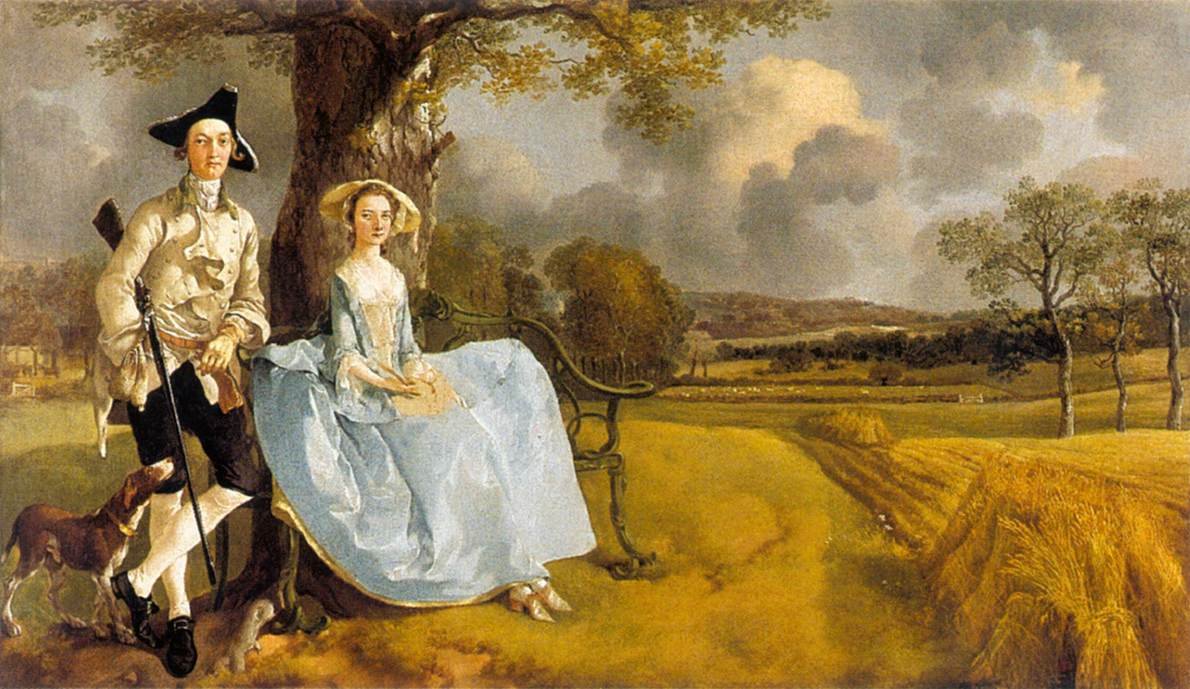
So that brings me nicely to today’s My Daily Art Display which is a portrait of a wealthy couple on their huge estate.  The portrait is simply entitled Mr and Mrs Andrews and was painted by the great English landscape and portrait Thomas Gainsborough in 1749.  This was one of Gainsborough’s earliest portraits.  The subjects of the painting are the English country squire, Robert Andrews and his wife Frances Mary, née Carter who he had married a year earlier and this work by Gainsborough was commissioned to celebrate the marriage.    Both bride and bridegroom came from wealthy families.  Robert’s family owned land on the Essex-Sussex border around the town of Bulmer.  Frances was the daughter of William Carter a wealthy cloth merchant who owned a large estate in the parish of Bulmer and the joining in matrimony of the two meant the coming together of two large estates.  This is a portrait, which not only celebrates the coming together of the young lovers, but demonstrates that this union has brought about the considerable wealth of property they now jointly owned.

This delightful portrait of the pair posing on their country estate in the summer sunshine is full of charm.  The church in the background is St Peter’s, Sudbury, and the tower to the left is that of Lavenham church. The gold and green of their fertile fields and their well-kept estate is beautifully painted.  It is interesting to note that this type of portraiture was known as “outdoor conversation pieces”.  The term was given to portraits showing two or more full length figures engaged in conversation or other polite social activity and were generally part of a domestic or landscape painting.  This idea of having a country scene as a backdrop to a portrait probably came from the French and their fêtes galantes, which was a French term used to describe a type of painting which first came to prominence with Antoine Watteau but unlike outdoor conversation pieces, they normally featured fictional characters.

Let us now have a close look at the painting.  The first thing that strikes me is that although it is a portrait, the landscape take up more than half of the space of this oil on canvas painting.  Maybe the couple wanted to subtly highlight their wealth by having their vast estate featured as a backdrop to their portrait.  This you must remember is not an idealistic landscape concocted to enhance the painting.  This is the real thing.  This is their own estate which was a joining together of the two lands of their parents.  This vast estate was now a celebration of their union.

Robert Andrews stands straight.  His faithful gun-dog at his side looking lovingly up at his Master.   There is an air of relaxed nonchalance about his pose.  He looks to have “not a care in the world”.  His hand is in his pocket but even so it is a somewhat formal pose.  His frock-coat is unbuttoned at the top and by the way he holds his hunting gun under his arm, is to have us believe he has just returned from a shoot.  He is, by depiction, one of the landed gentry and the way he is at ease shows he is happy to show off his good fortune and his possessions, namely his large estate and of course, his wife.  We can have no doubt of his standing in society.  His character and future are like the well established oak tree which they shelter under – solid.  It is easy for us to understand that his wife will want for nothing

The genteel Mrs Andrews sits primly next to her husband on an ornate Rococo-style bench.  She was about eighteen at the time of this portrait.  She is dressed in her finest clothes and her demeanour, like that of her husband, oozes wealth and respectability.  She, in some ways, appears doll-like in her bright blue hooped skirt and pointed silver-coloured shoes.  I am sure the couple didn’t pose for the artist in the fields of their estate and this painting is likely to have been carried out in the artist’s studio and Gainsborough may have used tailor’s dummies to hang their clothes on and then later gone out to study the landscape of their estate.  Still I am sure the couple were happy with this work of art and it would have pleased them to see how it portrays them and their land.  There has been some conjecture as to whether the original intention was to have Mrs Andrews hold a book or maybe a brace of pheasants which her husband had just shot as there seems to be a space on her lap left unfilled.  It was also surmised that the space was left empty in order that, at a later date, one of her children may have been added, sitting on her lap.

So the couple had everything.  Sadly however, after giving her husband nine children, Mary Andrews died at the relatively young age of forty-eight.  Robert Andrews went on to re-marry and lived a long life surviving to the good old age of eighty.  They now rest together, side by side, in the graveyard of Saint Andrews in Bulmer.

The Brown Boy by Sir Joshua Reynolds

The Brown Boy by Sir Joshua Reynolds (1764)

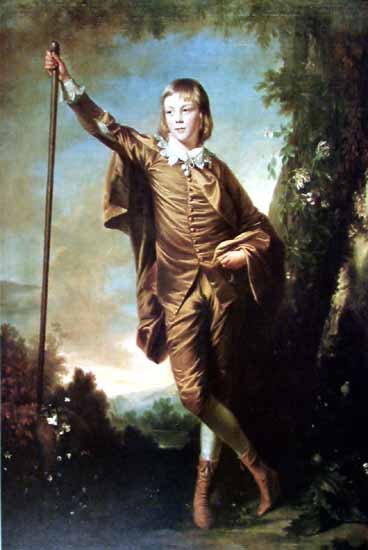
My Daily Art Display today moves away from symbolism and interpretation and allegorical tales.  Today we have a simple portrait by an artist who was one of the greatest influences on English painting.  His name was Sir Joshua Reynolds.   His portraits were of the lofty and rhetorical manner of history painting a genre which showed figures involved in significantly important or morally enlightening scenes and treated them in a suitably impressive and gallant way.  It was often termed painting in the Grand Manner.   It was an idealized aesthetic style derived from classical art, and the modern “classic art” of the High Renaissance and it depended on the idealization of the imperfect.

Reynolds was born in Plympton St Maurice, Devon in 1723.  At the age of seventeen, he was apprenticed for three years to the prolific English portrait artist, Thomas Hudson.  In 1749 he travelled to Italy where he spent more than two years, mainly in Rome, during which time he studied the Old Masters and it was here that he developed a liking for the “Grand Style” of painting…  He was back in London in 1753 and made friends with the artistic and literary elite of the time including writers Samuel Johnson, Oliver Goldsmith, Edmund Burke and the actor David Garrick.  He became an early member of the Royal Society of Arts and later with Thomas Gainsborough, the great portrait and landscape painter, founded the Royal Academy.  Reynolds and Gainsborough were the dominant portraitists of the late 18th century.  Sadly in 1789 when Reynolds was 62 he lost the sight in his left eye.  Three years later he died and was buried in St Paul’s Cathedral, London.

The cherubic face of Master Thomas

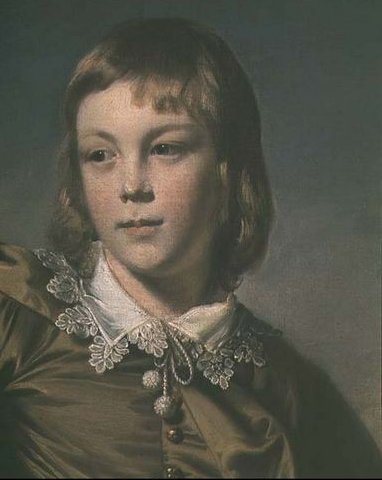
The other person featured in My Daily Art Display today is the person depicted in the painting, 12-year old Master Thomas Lister, who would become the 1st Baron Ribblesdale of Gisburn Park in 1797 when he was forty-five years old.  Reynolds has given the young lad’s face a flattering, slightly romantic look.  The young boy looks thoughtful as he stands leaning slightly on his stick.  There are child-like qualities in the way in which he has been portrayed.  He is at an “in-between” age, neither man nor boy he is embarking on a new stage in his life.   His costume is of plush velvet and reminds one of the ways Anthony Van Dyke, a century earlier, painted portraits of aristocrats which gave them a look of both grandeur and poise.  In this picture the colour of Thomas Lister’s clothes blends with the colour Reynolds used for the background which has an Arcadian feel to it is reminiscent of classical landscapes of the Italianate painters. 

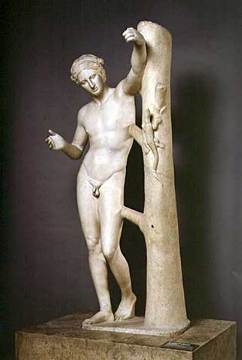
Apollo Sauroctonos


Art historians believe that Reynolds had the boy pose in a similar way to the Apollo Sauroctonos, a sculpture dating back c. 350BC, which Reynolds would have seen when he was in Rome.

In the mid 18th century, history painting was the most favoured of art genres and in this painting Reynolds has managed to intertwine historical references into this painting. 

Reynolds was well loved and admired.  William Makepeace Thackeray said of him:

“…of all the polite men of that age, Joshua Reynolds was the finest gentleman…”

I will close today with part of a poem by Thomas Bernard, who was to become Bishop of Killaloe, and who wrote in his verses on Reynolds:

“ Dear knight of Plympton, teach me how
To suffer, with unruffled brow
And smile serene, like thine,
The jest uncouth or truth severe;
To such I’ll turn my deafest ear
And calmly drink my wine.

Thou say’st not only skill is gained
But genius too may be attained
By studious imitation;
Thy temper mild, thy genius fine
I’ll copy till I make them mine
By constant application.”


The White Horse by John Constable

The White Horse by John Constable (1819)

If I was to ask you what was your idea of an English countryside I am sure a large number of you would think about the paintings of John Constable, such as his famous work, The Hay Wain.  Certainly when I conjure up in my mind the tranquillity of the countryside, I reflect on the beauty of the English country landscapes paintings of the English Romantic artist John Constable.  In fact the term “Constable Country” is often used to describe the loveliness of that part of the eastern England located on the Suffolk and Essex border.  It is a truly wonderful area with countryside which lends itself easily to paintings.   Like Thomas Gainsborough, Constable was influenced by Dutch artists such as Jacob van Ruisdael. The works of Rubens proved to be useful colouristic and compositional models. However, the realism and vitality of Constable’s work make it highly original.

John Constable was born in 1776 in the village of East Bergholt in the county of Suffolk.  Art historians tell us that he was not a naturally gifted artist and it took many years of hard work and his love of art to place him alongside Turner as one of the two greatest figures in the history of British landscape painting.   He always wanted to pursue an artist’s life and had to fend off pressure for him to become a clergyman.  Eventually after leaving Dedham Grammar School he trained for a career in the family business.   Whilst living at home he had many opportunities to sketch the Stour area and he met up with and became a close friend of Sir George Beaumont, an artist and collector, who would later establish the National Academy.  It was he who would once again awaken Constable’s love of painting and would later tutor him at the Academy.  

When he was twenty three and after much pressurising of his father, he was allowed to leave the family business and follow his passion for art and he became a student at the Royal Academy Schools of London.  Also studying at that Academy was Turner, although they never became close associates. 

He exhibited his first paintings in 1802, but unlike Turner, Constable did not sell many of his works.  In fact during his lifetime he only sold twenty paintings and failed to gain the recognition achieved by Turner in Britain although that was not the case in France where his works were well received.  His paintings, especially his “six footers” greatly influenced the French artist Delacroix and the French Romantic Movement.  He also inspired the Barbizon School, which is the name given to a community of mid-19th-century painters who worked in and around the village of Barbizon in the forest of Fontainebleau, south-east of Paris.   They painted landscapes and scenes of rural life, occasionally working in the open air.  John Constable died in Hampstead, London in 1837, aged 60.

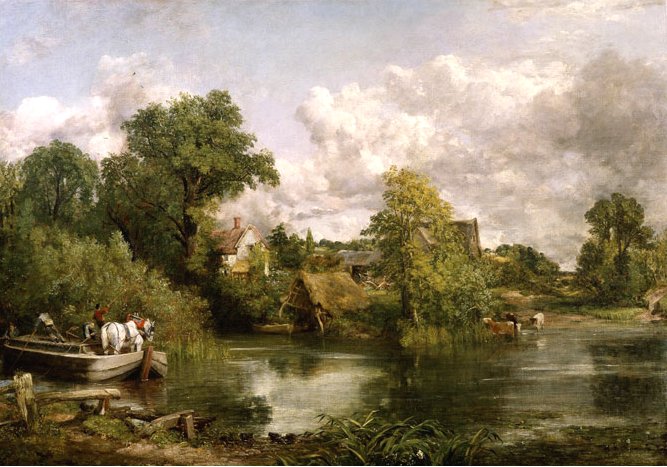
 My Daily Art Display for today is The White Horse which Constable completed in 1819 and is part of the Frick Collection in New York.  This was the first of Constable’s “six footer” exhibition canvases, a set of 6ft x 4ft landscape paintings he completed between 1818 and the mid 1830’s.   He started with sketching the scenes outdoors but because of the size of the finished paintings he had to come indoors to work on the finished product.  

The view in this work of art is from the south bank of the River Stour, looking back across the river just below Flatford. The barge on the left has taken on board the white horse and is about to set off to reach a spot downstream where the tow path resumes on the opposite bank. Cows can be seen wading in the shallow waters.   Just beyond the barge is a small island called ‘The Spong’. Willy Lott’s house, which is featured in Constable’s The Hay Wain, is just visible to the left centre in the middle distance. Following the exhibition of this work, Constable was elected an Associate of the Royal Academy.

If you liked today’s painting why not go and discover other  Constable’s  “six footers” such as, Salisbury Castle from the Meadows, 1831, Stratford Mill, 1820 and of course The Hay Wain, 1821.

His” six footer” painting entitled Hadleigh Castle, which he painted a year after his wife Maria died of tuberculosis, is a more sombre painting which probably reflects Constable’s mood at the time and who said of his late wife:

” I shall never feel again as I have felt.

The face of the world is totally changed to me.”

Take some time and ave a look at some of John Constable’s works and see if you have a favourite.