A Dream of the Past – Sir Isumbras at the Ford by John Everett Millais

A Dream of the Past – Sir Isumbras at the Ford by Millais (1857)

My Daily Art Display painting of the day is one by John Everett Millais, entitled A Dream of the Past – Sir Isumbras at the Ford, which he completed in 1857.  It depicts an ancient knight on horseback carrying two children of a poor woodcutter across a river.  The character of Sir Isumbras comes from the 14th century medieval romance written in Middle English.   The actual scene we see before our eyes was not part of the original tale but more than likely came from a romance written in fake medieval verse based on the original and penned by Millais friend, the art critic Tom Taylor. 

The original poem tells the story of the humbling of the once arrogant knight.  The scene is set by the art critic and member of the Pre- Raphaelite Brotherhood, Frederic Stephens.  Stephens was not an artist but in today’s terminology, he would be described as the Pre-Rapaelite’s public relations man.  It was his job to communicate the aims of the Brotherhood to the public.  Of this painting, he wrote:

“….Sir Isumbras at the Ford was the subject of the picture Millais made his leading work in the year 1857.   It represented an ancient knight, all clad in golden armour, who had gone through the glories of this life — war honour, victory and reward, wealth and pride. Though he is aged and worn with war, his eye is still bright with the glory of human life, and yet he has stooped his magnificent pride so far as to help, true knight as he was, two little children, and carries them over a river ford upon the saddle of his grand war-horse, woodcutter’s children as they were. The face of this warrior was one of those pictorial victories which can derive their success from nothing less than inspiration. The sun was setting beyond the forest that gathered about the river’s margin, and, in its glorious decadence, symbolised the nearly spent life of the warrior…”.

This painting is a classic example of the Pre-Raphaelites’ interest in topics about medieval chivalry.  The old knight in his gleaming golden armour has helped the two children cross the stream.  The girls stares into the face of the knight with a worried expression whilst the young lad, with the wood strapped to his back, looks out at us, as he desperately clings on to the knight.   The bright and vivid colours of the children’s clothes is typical of the colours used in Pre-Raphaelite paintings

When Millais exhibited the painting it received hostile reviews and was condemned by many art critics of the time.  The leading art critic of the day, and former patron of Millais, John Ruskin, savagedly criticised the artist and the painting declaring it to be a “catastrophe”.  Millais was criticised for painting the “ugly” horse out of proportion to the figures on its back and by doing so had given the illusion that the three figures are almost floating above the animal’s back.   He also criticised Millais for how he had painted the foreground lighter than the exposed hills in the background, saying that the artist had “made errors in pictorial grammar”.   I suppose it has to be remembered that Millais, two years earlier, had married Ruskin’s wife Effie, after she had been granted an annulment of her marriage to Ruskin on the grounds that it had never been consummated.  This whole affair was splashed across the London press and had caused a scandal.   Ruskin never forgave his former protogé Millais.  Millais must have listened to the torrent of criticism as he repainted parts of it before exhibiting it in an exhibition in Liverpool. For all its criticism and the large number of detractors, this painting inspired many other artists to depict gallant knights rescuing beautiful maidens.

A Nightmare by Frederick Sandys (c.1857)

Finally let me finish with another Pre-Raphaelite painter, Frederic Sandys who satirised Millais’ painting with his print entitled A Nightmare,  in which he caricatured  Millais as the knight and his fellow artists Gabriel Dante Rossetti and Holman Hunt as the children and Sandys adds more scorn on the trio by turning the horse into a donkey which has been branded on its flank with the letters “J  R” – the initials of Ruskin !

An Al-Fresco Toilette by Samuel Luke Fildes

An Al-Fresco Toilette by Samuel Luke Fildes (1889)

For the third day running I am featuring a British artist.  The reason being is that the small art gallery I visited last week, although it had some wonderful pictures, ninety per cent were by British artists and whilst the paintings were fresh in my mind and I could still decipher my notes I thought I would dwell on what I saw.

My featured artist today is Samuel Luke Fildes who was born in Liverpool in 1844.  At the age of 17 and after he had completed his basic schooling he moved to the nearby Warrington School of Art before moving south to London and becoming a student at the South Kensington Art School and later the Royal Academy.   It was here that he was influenced by Frederick Walker, the English Social Realist painter who John Everett Millais described as “the greatest artist of the century”.   The Social Realism, sometimes termed Socio-Realism, was an  art movement whose members depicted social and racial injustice and economic hardship and in their works of art.  The subjects of their paintings were often members of the “working class” pictured struggling to survive the hardships of life.    Social Realism genre of painting was also very popular in America during the Great Depression and one famous example of  an American Social Realism painting was one by Grant Wood, entitled American Gothic which I featured on January 7th.

In 1869 when he was 24, Fildes joined the staff of the The Graphic, a new illustrated weekly newspaper, which was founded by the artist and social reformer William Luson Thomas.  Thomas believed strongly in the power of visual images and that they could change public opinion and it was his hope that this may lead to the eradication of social injustice and poverty.  Luke Fildes submitted an illustration, which was to run side by side with an article on the 1864 Houseless Poor Act and his poignant offering showing a line of homeless people queueing  up to get a ticket which would give them access to overnight accommodation.  This engraving entitled Houseless and Hungry caught the attention of a fellow artist who also worked for The Graphic, the Pre-Raphaelite painter, John Everett Millais, who showed it to the author Charles Dickens.  The author having recently just lost his book illustrator through ill-health, immediately commissioned Fildes to illustrate his new novel, The Mystery of Edwin Drood.  Fame soon followed and in 1870, Fildes left the newspaper to concentrate on his artistic work. 

I am leaving the story of Fildes life at this point as I want to conclude it tomorrow with another of his paintings, which is extremely poignant and sad and is connected to an incident later in his life.  However for today, I want to look at a painting which he completed in 1889 entitled An Al-Fresco Toilette and which can now be found in the Lady Lever Art Gallery on Merseyside.  This painting was a move away from his social realist work which was the main focus of his early artistic life.  Fildes, who began this painting in Venice, had originally decided to call this painting The Morning of the Fiesta.  It is set in a Venetian courtyard of a very old building with its vine-covered trellis work over the main entrance.   The building belonged to the artist Henry Wood.  Fildes and Wood were, at that time, looked upon as leaders of the Neo-Venetian art movement and many of their works depicted scenes of happy groups of girls passing the time away along the sides of the canals or posing on their balconies.  This type of painting was extremely popular in exhibitions and as illustrations in magazines and most importantly with art collectors.

In this painting, we see some women and children preparing themselves for that day’s Fiesta.  It is a vibrant painting full of charm and the sun has lit up the courtyard and the three women as they discuss the forthcoming event.  It is not known with any amount of certainty but it is believed that this is not an en plein air painting of a real life scene but was probably based on various individual preliminary sketches Fildes made and which were then used to build up the finished composition when he returned to his studio.  This type of happy, sunny painting was popular with art buyers.  Lord Leverhulme, the Northern Industrialist, philanthropist, and soap-manufacturer bought the painting in 1913 and considered it appropriate for his soap advertisements. 

However not everybody was happy with Fildes new art genre.  Art critics and the Art Establishment never forgave Fildes for abandoning the Social Realism genre of his early career, which had highlighted the terrible circumstances some of the poorest people in Britain had to suffer.   The Art Establishment still fervently believed that art still had an important moralistic role to play but unfortunately the taste of the buying public was starting to change.   They were moving away from these downbeat works, with all their distressing scenes, and look towards happier and sunnier scenes and Fildes realised that this was the route to financial stability.

The Doctor by Samuel Luke Fildes

The Doctor by Luke Fildes (1889)

Yesterday I was telling you about the life of Samuel Luke Fildes and featured one of his paintings An Al-Fresco Toilette, which he completed in 1889.  I ended by saying I would return to his life later as it had a connection with another of his paintings, entitled The Doctor which he completed in 1891.

Yesterday I told you how he had given up his work on the Socialist magazine The Graphic and also changed his painting style from the Socialist Realism genre to become, along with his artist friend and brother-in-law, Henry Wood, leaders of the Neo-Venetian school of painting, which had become very popular. His popularity was in the ascendancy and he had become one of the best British painters of his time.  Besides his Venetian-style paintings he completed a number of portraits including those of King Edward VII and Queen Alexandra.  He was elected as an associate of the Royal Academy in 1879 and eight years later an academician.  He was knighted in 1906.

Fildes’ eldest son, Philip tragically died of tuberculosis in 1877.  Fildes was devastated at this sad event and this terrible ordeal was captured in his painting The Doctor, which shows the medical man at the side of an ailing child.  In 1949 this painting was used by the American Medical Association in its campaign against a proposal put forward by the President of America, Harry Truman to nationalise health care.  Sixty-five thousand posters incorporating Fildes’ painting with words “Keep Politics Out of this Picture” were displayed around the country with the intention of raising public awareness of what the government was trying to do and by doing so, raising public scepticism for this new-fangled idea of nationalised health care.

Luke Fildes R.A., Painting his Picture "The Doctor" by Reginald Cleaver (c.1891)

The Doctor is probably the most famous painting by Luke Fildes.  He made numerous sketches before he sat down to paint the picture.  Fildes had travelled all over the Scottish highlands sketching the interiors of small cottages which he could maybe use in his painting.   He even had an exact replica of the sick room made in his studio right down to the table cloth and lampshade tilted towards the sick child, as shown in the drawing by the artist Reginald Cleaver.  This was actually published in the illustrated newspaper, The Graphic, which twenty-two years earlier had been the place of employment for the young aspiring artist.

In the painting we see the early morning light streaming in through the window on the left hand side.  In some ways it is a time of jubilation as the child has survived through the night.  It is a new dawn and maybe hope comes with it.  In the background we see the mother, who is both relieved and exhausted from a sleepless night, laying her head on her hands on the table.  Her husband places a comforting hand on her shoulder.  In the foreground we have the doctor and the child both illuminated by sunlight.  Look at the child.  He is not lying on a comfortable bed but stretched across two wooden chairs which are maybe all the family could afford. 

It is a poignant picture, the subject of which obviously brought memories flooding back to Fildes regarding the death of his son.  It is also, in a way, a return to the Social Realism genre of painting which Fildes did in his early twenties,  in the way it shows the poverty some people had to endure.

Jeunesse Dorée by Gerald Leslie Brockhurst

Jeunesse Dorée by Gerald Brockhurst

Yesterday I visited the Lady Lever Art Gallery on the Wirral peninsular in order to stand face to face with Holman Hunt’s painting The Scapegoat as this was going to be my featured painting.  Of course, whilst I was there I went around the gallery, half of which is taken up by fine art paintings, mainly from British artists, and the other half was set aside for tapestries, sculptures, furniture and porcelain.  It was an interesting gallery and I can thoroughly recommend you visit it if you are in the vicinity.  The reason I mention all this is that I was mesmerised by one of the paintings on display.  I kept having to return to it and try and work out in my own mind what was the magnetic attraction of the work.  It still haunts me even now as I put my thoughts on paper.  Unfortunately the gallery shop could not offer met a print of it or even a postcard which was very disappointing.  My Daily Art Display today is this exquisite painting entitled Jeunesse Dorée by Gerald Leslie Brockhurst, who was one of the outstanding English artists of the twentieth century and a renowned portrait painter.

Gerald Brockhurst (Self Portrait)

Brockhurst was born in Edgbaston, a suburb of Birmingham, in 1890.  His father, a coal merchant, deserted the family and went to America.   He attended a number of local schools but found it hard to settle down to school life.  This was exacerbated by recurring ear infections he frequently suffered from and which often left him bedridden.  The young lad had an aunt who lived in India and he would frequently send her illustrated letters and it was this that got him interested in art and he was determined to become a painter.  His artistic talent was recognised at the early age of twelve and he won a place at the Birmingham School of Art where he remained for five years.  It was here he began to fall in love with portraiture.  He won many awards at the Birmingham School of Art and later the Royal Academy Schools, the oldest art school in the country, which was founded through a personal act of King George III in 1768. 

In 1912 Brockhurst was awarded the prestigious Gold Medal and Travelling Scholarship.  Two years later he used this scholarship to travel with his new wife Anais to Paris and Italy.  During his travels he studied the works of the “Old Masters” of the 15th and 16th centuries and these were to have a lasting impact on his art.

Anais Brockhurst first wife of the artist

Brockhurst and his wife Anais Folin went to live in Ireland and remained there for five years.  It was during those years that he created many etched and painted portraits of his wife.  From them, we can see that he was truly in love with her and was mesmerised by her beauty.  It was during this period of his life that he first met the portraitist, Augustus John who introduced Brockhurst to his circle of friends.  In fact, it was Augustus John who persuaded him to stage two major exhibitions of his works at the Chenil Gallery, London in 1916 and again in 1919.  These launched his career and Brockhurst, who had moved back to London in 1920, started to enter some of his etchings and drawings to the Royal Academy.  It was in the 1920’s that he established himself as an outstanding and flourishing portrait painter, and also strengthened his reputation as one of the exceptional printmakers of his generation

Teaching in the Royal Academy Schools was undertaken by a system of lectures delivered by Professors and Royal Academician ‘Visitors‘, and in 1928, when Brockhurst was thirty-eight years old, he was appointed a Visitor to the Royal Academy Schools.  During this time he met the sixteen year-old artist’s model Kathleen Woodward.  Brockhurst was immediately besotted by her youthful beauty and she was to become his lifelong model.  He renamed her Dorette.  Their relationship led to the break-up of Brockhurst’s marriage to Anais and a protracted and bitter divorce case, much sensationalised in the press.   The adverse publicity from this divorce together with the onset of World War II led to his decision to leave England with Kathleen ‘Dorette’ Woodward in 1940 and emigrate to America.   Brockhurst and Kathleen eventually married in 1947.

In New York Brockhurst became both famous and wealthy and lived out his life supported by a number of loyal patrons who loved his portraiture.  During his career, he carried out over six hundred portraits including portraits of the rich and famous such as the Duchess of Windsor, Wallis Simpson, J Paul Getty and Marlene Dietrich.  He died in New Jersey in 1978 at the age of 88.  Kathleen Dorette Woodward died in 1996.

And so to the painting which captivated me yesterday.  Jeunesse Dorée, meaning “gilded youth” in French, is a term applied to wealthy and fashionable society people.  It was painted by Brockhurst in 1934 and exhibited at that year’s Royal Academy Summer Exhibition.  It was purchased for £1000 by Lord Leverhume, for his Lady Lever Gallery on the very first day of the show.  The buyer’s determination to have the painting stemmed from his disappointment the year before when he tried to buy Brockhurst’s etching Dorette, but his Gallery Trustees dithered on funding the proposed acquisition and it was bought by the Harris Museum and Art Gallery of Preston.

Like myself yesterday, many people have been captivated by this wonderful painting.  The Daily Mail of the day reported on the painting and its admirers stating:

“…again I saw people yesterday standing before the picture trying to fathom the secret of those curiously haunting deep-blue eyes…”

Let us look at the painting in more detail.  It is a half-length portrait with an almost two-dimensional stark and rocky idealised landscape along with an immense sky as the background.  There is a lack of depth to the background of this painting, which in a way projects the young girl towards us.  This setting was consistent with his many portraits of the 1930’s and 1940’s but which was in contrast to the works of other portraitist who preferred to use realistic three-dimensional settings.  He has used sombre colours.  The girl stares straight at us almost daring us to blink. As you look at her you wonder what is going through her mind.  Her eyes are penetrating as if she is looking into your very soul.   There is no hint of a smile on her full-red lips.  Hers is an inscrutable expression as she fixes her gaze on us.  Having said all that, in my mind, there can be no doubting her beauty and her alluring sensuality.  Her plain-coloured cardigan, echoing the shades of the background, clings tightly to her body.  Her full breasts strain against the material and the buttons of the cardigan which hold them captive.   It is no wonder that Brockhurst was seduced by her beauty and fell in love with her.  I think I too was lost in her enigmatic loveliness.

The Scapegoat by William Holman Hunt

The Scapegoat by William Holman Hunt (Lady Lever Gallery) 1854

Normally I try and publish my daily blog in the morning but today I am late, but for a very good reason.  I think we all agree that to stand in front of the actual painting is vastly more satisfying than looking at it on the internet or in a book, so although I had made notes for today’s blog I decided that I would go and see the actual painting before publishing my thoughts.

My featured artist today is William Holman Hunt, the English Pre-Raphaelite painter.  In 1854 he had just completed The Light of the World,  which to this day, remains one of the best known religious paintings of the 19th century.  Hunt wanted to carry on painting religious subjects but decided that any future paintings involving biblical subjects should be painted in the very places where they happened.  So in 1854 Hunt decided to journey to the Holy Lands.  This was typical of Hunt’s thoroughness, and also typical of the rational, scientific spirit of the age.     Another reason for the journey was that it was also at this point in his life when he was suffering a crisis of religious faith and he believed that such a visit to the Holy Lands may bring him a better understanding of his faith.  However, his move away from his friends, Millais and Rossetti effectively marked the beginning of the end of the Pre-Raphaelite Brotherhood which they had founded six years earlier.  

The subject of today’s featured painting in My Daily Art Display is entitled The Scapegoat and the subject is derived from the Talmudic tradition of driving a sacrificial white goat out into the wilderness on the Day of Atonement (Yom Kippur).  A strip of red wool was bound to the goat’s horns, in the belief that it would turn white if the appeasement was accepted.  This also harked back to the Book of Isaiah 1:18:

Come now, let’s settle this,” says the LORD. “Though your sins are like scarlet, I will make them as white as snow. Though they are red like crimson, I will make them as white as wool.

Hunt regarded the Old Testament scapegoat as a forerunner of the New Testament Christ whose suffering and death similarly expunged man’s sins.

Hunt travelled first to Jerusalem in June 1854 and then in the October on to Oosdoom, a place on the southern edge of the salt-encrusted shallows of the Dead Sea.  In his diary Hunt described this setting as:

 ‘“…never was so extraordinary a scene of beautifully arranged horrible wilderness. It is black, full of asphalte scum and in the hand slimy, and smarting as a sting — No one can stand and say that it is not accursed of God…”

Hunt saw the Dead Sea as a ‘horrible figure of sin’,  believing as did many at this time, that it was the original site of the city of Sodom.    Here he remained painting the landscape, the mountains of Edom, and the lake which would become the background of the painting.  He also made preliminary sketches of the goat.  However the goat proved to be a “fidgety model” refusing to stand still.  Bad weather forced Hunt to head back to Jerusalem.   He had not completed the picture of the goat so brought it, some Dead Sea mud and stones back to his studio in Jerusalem so as to complete the work. However, on the journey back the goat died.  Hunt bought another goat and proceeded to have it stand in a tray of salty Dead Sea mud and stones which he had brought back to his studio and continued with the painting.  To complete the details of the painting he bought a skeleton of a camel and the skull of an ibex both of which he incorporated into the painting. 

The Scapegoat by William Holman Hunt (Manchester Art Gallery) 1854

He made two copies of the painting, one (above) of which is a smaller version with a black goat and a rainbow symbolising hope and forgiveness of sins and this can be found in the Manchester Art Gallery, and the other (at the top of the page) hangs in the Lady Lever Gallery, Port Sunlight.  

Inscription along top of frame

The Lady Lever Art Gallery painting has an inscription engraved onto its frame, which was designed by Hunt himself.   It was intended to compliment the painting.  The seven stars at the top may have come from the apocalyptic text mentioning the seven stars that fell on the day of wrath or it may indicate the Book of Revelation’s “ancient” Christ who held seven stars in his right hand.   On the top of the frame, as wel,l is the inscribed a scriptural text from Isaiah 53:4:

” Surely he hath borne our Griefs, and carried our Sorrows:

yet we did esteem him stricken, smitten of GOD, and afflicted. “

and on the bottom part of the frame are the words from the Book of Leviticus 16:22:

“And the Goat shall bear upon him all their Iniquities unto a Land not inhabited.”

 Hunt submitted the painting to the Royal Academy exhibition of 1856 where it was greeted with puzzlement and derogatory remarks.  The landscape colour was described as “lurid”.  Hunt was not put off by that comment and the purple colour of his mountains subsequently became the hallmark of much of his landscape painting.

John Ruskin, the foremost art critic of the time, commented:

‘…This picture, regarded merely as a landscape, or as a composition, is a total failure.   Mr Hunt …in his earnest desire to paint the Scapegoat has forgotten to ask himself first, whether he could paint a goat at all…’

His Pre-Raphaelite Brethren commented differently.  Dante Gabriel Rossetti said of the painting:

“…a grand thing, but not for the public…”

Ford Madox Brown wrote in his diary:

“….Hunt’s Scapegoat requires to be seen to be believed in. Only then can it be understood how, by the might of genius, out of an old goat, and some saline encrustations, can be made one of the most tragic and impressive works in the annals of art….”.

You must make up your own mind about this work of art.  I side with Ford Madox Brown. I stood in front of the painting this afternoon and was moved by the tragic and heart-rending depiction of the goat as it stumbles alone along the salt-encrusted shoreline, to what we know will inevitably culminate in its lonely death.  

I love the way in which Hunt’s use of colour to depict the Jordanian mountains in the background.    This was certainly one of the most original painting by Holman Hunt.  Maybe one should say it was one of his most peculiar works of art.  People are divided in their views.  Whilst some admire the painting for its exceptional and powerful image in such an unusual setting, others dislike it and wonder why the artist spent so much time and effort on such a gloomy subject.

I will let you be the judge.

The Mirror of Venus by Sir Edward Burne-Jones

Mirror of Venus by Edward Burne-Jones (1898)

 The featured artist in My Daily Art Display today is the English painter Sir Edward Coley Burne-Jones.  He had close connections with the later phase of the  Pre-Raphelite movement and had close links with the textile designer and artist William Morris.  Burne-Jones was born in Birmingham.  His father, Edward, was Welsh and worked as a frame-maker.  His mother, Elizabeth sadly died   just six days after giving birth to Edward, who from then on was brought up by his father and the family housekeeper.

From the age of eleven Burne-Jones attended the King Edward VI Grammer school in Birmingham and at the age of fifteen transferred to the Birmingham School of Art.  In 1852, aged 19, he attended Exeter College, Oxford where he studied theology and it was here that through his love of poetry he first met William Morris, a similar devotee to the written word.  These two poetry-lovers along with some of their friends formed a close and intimate society which they called The Brotherhood.  In 1856 Burne-Jones founded the Oxford and Cambridge Magazine.  It was at that time that Morris and Burne-Jones decided to seek outside contributions to their magazine and approached the poet and artist Dante Gabriel Rossetti.  The ensuing meetings between Burne-Jones and Rossetti was to change the former’s life forever, for he had set his heart on becoming a church minister but Rossetti persuaded him, and William Morris, to become artists.  Soon afterwards Burne-Jones put university life behind him and began a new life as an artist.  It was not just that Rossetti had inspired the two university students, but both Morris and Burne-Jones had made an impact on Rossetti himself, for some time after their first meeting Rossetti told his friend the poet and artist, William Bell Scott, about the encounter, writing:

“…Two young men, projectors of the Oxford and Cambridge Magazine, have recently come up to town from Oxford, and are now very intimate friends of mine. Their names are Morris and Jones. They have turned artists instead of taking up any other career to which the university generally leads, and both are men of real genius. Jones’s designs are marvels of finish and imaginative detail, unequalled by anything unless perhaps Albrecht Dürer’s finest works…”

In his early days as an artist Burne-Jones was heavily influenced by the works of Rossetti and it was not until he travelled to Italy with John Ruskin that his style changed and he became his own man.  In 1877 he was persuaded by a group of his friends to submit some of his oil paintings at the opening show of the Grosvenor Gallery, a newly established venue which was a rival to the well-established Royal Accademy.  Over the early years the gallery, founded by Sir Coutts Lindsay, was to become vital to the Aesthetic Movement for it gave them an opportunity to showcase their works, the like of which was often scorned and rejected by the conservative Royal Academy.  One of those paintings put forward by Burne-Jones is my featured painting of the day, entitled The Mirror of Venus.  The exhibition was highly acclaimed and his career as an artist took off.

There followed an honorary degree from Oxford in 1881 and the following year he was made an Honorary Fellow.  In 1893 Prime Minister Gladstone was instrumental in him being created a baronet.  On his death five years later, the Prince of Wales intervened and insisted that the death of Sir Edward Coley Burne-Jones should be honoured with a memorial service at Westminster Abbey.  This was an outstanding honour as he was the first artist to be recognised in such a way.

This painting is a mix of the traditions of Pre-Raphaelitism and Italian Renaissance culminating in a new aesthetic style.  We see in front of us ten women peering at their own reflections in a small pool of water.  The landscape is quite barren almost like that of a lunar landscape.   Burne-Jones often used this type of background and of course his reasoning may have been that it does not detract from the scene in the foreground.  In fact it is a complete contrast.  By the title of the painting we are to believe that the elegant young woman standing is in fact Venus and the other nine females are her handmaidens.  The bright colour of their dresses and their dream-like mood is consistent with Pre-Raphaelite paintings but the grace and style of the figures themselves leans towards the Italian Renaissance style and especially that of Sandro Botticelli, whose work had always inspired Burne-Jones.

There is no background story to this painting.  This is not part of a tale from Greek or Roman mythology.  There is nothing in the painting which needs to be interpreted.  There is no hidden symbolism to discover.  What you see is what you get, and what you get is a group of beautiful young ladies sumptuously dressed in clothes of varying colours.    The women look rather wistful and do not seem particularly happy as they stare down at their own reflections.  I wonder what is going through their minds.  I wonder what is causing them to be anxious.  Maybe my inquisitiveness is just what the artist wants.  Maybe he wants me to decide what the painting is all about.  The painting, to my mind,  has a romantic element to it.  There is a definite sense of beauty to the painting , similar to that which we see with most Pre-Raphaelite works.

On painting in general,  Burnes-Jones said:

“…. I mean by a picture a beautiful romantic dream of something that never was, never will be – in light better than any light that ever shone – in a land no-one can define, or remember, only desire….”

It is a painting I would love to hang on my wall.

Marriage à la Mode: The Lady’s Death by William Hogarth

Marriage à la Mode: The Lady's Death by William Hogarth (c.1743)

We have finally arrived at the final chapter of this set of six satirical paintings by the English artist, William Hogarth, entitled Marriage à la Mode.  This final canvas in this moral drama is entitled The Lady’s Death and this of course gives away the final twist in the pictorial story.  When I gave you the first of the six paintings on May 4th I had intended it has a “one-off” in case you got bored if I had gone through all six of the paintings.  However,  I became so fascinated by them I thought that my fascination would be transferred to you and so for the last six days we have followed the life of the Earl and Countess of Squander through the eyes of Hogarth.  Sit back and enjoy the dénouement.  For those of you who have not seen the earlier paintings in my blogs I suggest you head back to My Daily Art Display of May 4th where the story starts.

Yesterday in My Daily Art Display we witnessed the scene at the bagnio, the death of the Earl at the hands of his wife’s lover, Silvertongue, the family lawyer.  Now we are transported to the home of the Countess’ father the rich merchant who had arranged his daughter’s marriage to the Earl, paid a sizeable sum of money to the groom’s father and in return, achieved entry in to the world of nobility.  The decor of the room is not like anything we saw earlier in the house of the young noble couple.  This has a bareness and frugality to it.  There is no sign of aristocratic profligacy we had seen in the earlier paintings.  The floors are bare.  This is not because of the owner’s lack of wealth but more to do with his business-like bourgeois miserliness.  Unlike his daughter and his son-in-law, he was careful with his money.

The Grieving

So let us look carefully at this final scene.  In a chair we see the tragic figure of the dying countess.  She has been informed that her lover, Silvertongue, the family lawyer, has been hanged at Tyburn for killing her husband.  She is wracked with guilt and inconsolable and has taken an overdose of poison.  Hogarth has piled on more tragedy by showing the nursemaid bringing the Countess’ child to the dying woman for one last cuddle.  The nursemaid is wracked with grief, tears streaming down her cheeks.   Sadly, it should be noted that this maid’s expression of grief is the only one we can see on the faces of the people in the room.   The small child puts her lips to her mother’s face to give her one final kiss.  Once again Hogarth has signified, by painting a black spot on the child’s cheek that the child is suffering from syphilis, almost certainly passed on by the father who we knew was suffering from that sexually-transmitted disease. It probably also means that the future health of the child looks extremely bleak.    If that was not bad enough, we can see the poor young thing has legs strapped in callipers, possibly caused by rickets…

The Mercenary Deed

We see the father of the countess standing next to the chair his daughter in which  she is lying slumped.  He has hold of her right hand.  Is this a touch of tenderness from the heart-broken father?   I fancy not as we can see his sole intention seems to be to remove the gold wedding ring from his daughter’s finger before rigor mortis sets in.   He is aware that this sordid episode will prove financially disastrous to him as in cases of suicide the property and possessions of his daughter will revert to the State, which of course means he will lose the considerable dowry he put up as part of the marriage contract.  His best-laid plans have fallen asunder.  Do I hear a cheer of delight from my readers?

The Remonstration

 To the right of the dying woman we see the apothecary reproaching the foolish servant for allowing this all to happen, for it was the servant, who had been persuaded by his mistress to go out and procure some laudanum from the apothecary.  Now the apothecary will be blamed and his rage at the servant is probably to deflect such onus of blame from himself for allowing the poison to enter the household.   The empty bottle lies on the floor by the feet of the countess with the label “Laudanum” still attached.  Next to the empty vial we see a handbill reporting the notice of execution at Tyburn of Silvertongue and recording the dying words of the convicted murderer.  It is probably these tragic last words of her lover that tipped the countess into a suicidal depression.

Let us now look at some of the minor details of the painting that Hogarth has tantalised us with.  Through the open door from which the doctor is leaving we see a row of leathern buckets hanging on the wall.  These were the normal accoutrements of a merchant’s house and were, before a fire engines came into being, in case of fire. Once again we see an overturned chair, this time by the table.  Hogarth used this to symbolise disagreement and conflict.  On the table, we see a pig’s head, which presumably was to be part of a meal, being dragged off by an emaciated-looking dog.  This sort of unappetising meal woulds probably cost little and is a direct reference to the frugality of life in the miserly merchant’s abode.

The paintings on the wall are Dutch genre showing satirically the life of the common people.  In one, we can just make out a woman lighting her pipe using the heat from a drunken man’s nose.  In another, a still-life, we see a pile of dirty dishes lying untouched in a sink and in another we are presented with a drunken man urinating against a wall. 

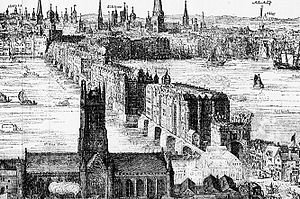
Old London Bridge

The window to the right of the painting bears the St George’s Cross, the City of London coat of arms. In the upper right quadrant we see an upturned sword which is indicates that this house is situated north of the Thames.  Looking out of the open window we can see the old London Bridge with all its old dilapidated houses built along its entire length.  Art historians tell us that this view was one Hogarth would have witnessed from a window in his uncle’s house. 

So that is finally the end of Hogarth’s satirical story depicted in his six paintings.  I hope you liked them.  When they were first shown to the public around 1743 they received poor reviews, much to the artist’s disappointment considering the amount of time he had put into them.  His peers denigrated his efforts saying that they were merely caricatures.  Hogarth had started preliminary work on what was to be another set of paintings entitled The Happy Marriage but probably, after the poor reception he received for Marriage à la Mode, he decided to shelve the project and now only a few unfinished sketches exist.  In my opinion they were much more than just caricatures.  The paintings give us a very human story and although we may take pleasure in the downfall of the Earl, his wife and the lawyer, I believe Hogarth wanted to draw from us a condemnation of the two fathers who, for financial gain, forced the two young people into an arranged marriage.

Hogarth sold his paintings for a mere twenty guineas and after changing hands a few more times became the property of the British Government and are part of the collection of the National Gallery in London and where they reside today in Room 35.  I will certainly be heading there the next time I visit this great gallery.

Marriage à la Mode: The Bagnio by William Hogarth

Marriage à la Mode The Bagnio by William Hogarth (c.1743)

My Daily Art Display for today will look at the fifth painting in a set of six by William Hogarth, entitled Marriage à la Mode.  Today’s painting is subtitled, The Bagnio.  For anybody who has just come to this page, I suggest you flick to My Daily Art Display of May 4th as that looks at the first painting of the set and as the six paintings are telling a story in chronological order that is where you should start this pictorial soap opera about the Earl of Squander and his young bride.  The title of the Hogarth painting today is The Bagnio.  In England, bagnios were originally used to name coffee houses which offered Turkish baths, but by 1740, which was around the time Hogarth painted these pictures, they signified places where rooms could be hired “with no questions asked”, later they became houses of prostitution.

Yesterday we looked at the fourth painting in the series, subtitled The Toilette and we learnt for the first time that the relationship between the Countess of Squander and her lawyer, Silvertongue was not as pure and business-like as we first believed.  They were arranging to go to a masquerade together and we learnt that the anonymity that these soirées provided guests, allowed them to behave as flirtatiously as they liked without fear of their identity being known. 

The scene of the painting today is set in a dimly lit room in the Turks’ Head Bagnio, which actually existed in London at the time of Hogarth, in Bow Street, Covent Gardens.  Hogarth identifies the establishment by showing a bill on the floor next to the upturned table in the far left foreground of the painting.    Silvertongue and the Countess did go to the masquerade but instead of her returning home she has decided to accompany her lawyer to the bagnio to consummate their sexual desires.  We know they attended the masquerade as their masks lie discarded on the floor.  The floor is also strewn with discarded clothes, the two masques and their bags and it is obvious the two lovers were in great haste to make love.  However for the lovers the night of passion turned out to be an unmitigated disaster as somehow the Earl of Squander, her husband, had found out about their secret assignation and had burst in on them whilst they were carrying out their dastardly deed.   It makes you wonder whether the Earl himself had been using the bagnio for his own forbidden pleasures and the landlord had said something like “I see your wife and her lawyer are here tonight”.  Ok, that is stretching the imagination too far, but somehow he found out about this tryst.

Begging forgiveness

An ensuing sword-fight broke out between Silvertongue and the Earl.  Unfortunately for the Earl, whose life had been spent gambling, drinking and fornicating, fencing had not been his forte and the result of the short-lived duel ended with him receiving a fatal wound to the heart.  Silvertongue now fearing the consequences of his action drops his bloodied sword, which we see on the floor, and decides to vacate the room through the window without stopping to get dressed.  The Countess racked with guilt, falls to her knees at the feet of her dying husband begging forgiveness.  The sound of the commotion has alerted the landlord of the establishment who bursts through the door with the Night Watch to investigate.  This is the scene we now see before us.

As ever, I get great pleasure in looking at the detail in paintings rather than just standing back and having a cursory glance at a work.  I think we owe that to the artist, who has spent so much time on the details and shouldn’t we try and get into the head of the painter and try and rationalise the details he has meticulously added to his masterpiece? 

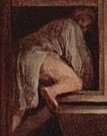
The lover makes his escape

We are given a rear-view of Silvertongue in the left background, disappearing out of the window in his night shirt.  There is something quite comical and ludicrous about his pose and maybe it was Hogarth’s intention to cast him as a fool.

On the rear wall hangs a tapestry.  It is a woven depiction of the Judgement of Solomon, which if you remember tells the story from the bible which was about his judgement on the parenthood of a baby between two women claiming the infant as theirs.  His judgement was that the baby should be split asunder, giving half to each mother.  Hogarth probably added this as a backdrop to this painting as a reference to the destructive split of the marriage between the Earl and the Countess due to their self-centred life choices they had made which resulted in the ruin of both their lives.

The humour of Hogarth

Hogarth must have had a sense of humour for look on the back wall at the framed three-quarter length picture of a prostitute, which has been placed on the tapestry in such a way that the legs from part of the tapestry scene look to be those of the prostitute!   The bedclothes lie ruffled on the bed which leads us to believe that the Earl had entered the room and caught the lovers in flagrante delicto.

From what Hogarth depicted in this painting, we can have no doubt that the final painting, which we will look at tomorrow, is not going to have a happy ending.

Marriage à la Mode: The Toilette by William Hogarth

Marriage a la Mode The Toilette by William Hogarth (c.1743)

This is the fourth day of My Daily Art Display which looks at the set of six Hogarth paintings entitled collectively as Marriage à la Mode.  To follow the story in chronological order you should start at my blog of May 4th.  Today we are at Episode Four of this pictorial soap opera, a veritable tragic-comedy about a doomed marriage.  Today’s painting is the fourth in William Hogarth’s series and is entitled The Toilette. 

There has been a passage of time between the happenings in the first painting in the series when the two young people became husband and wife and the setting for this fourth painting.   We are in the house of the Viscount and his wife.  We are in the ante-chamber of her boudoir as she prepares herself for the trials and tribulations of the coming day.  What is happening is a morning ritual that the nobility copied from the life of the monarch and which was developed in the French Court.  It was known as the lever du roi.  The royal morning toilette unfolded in two phases. The king was joined for the petit lever by his most senior officials, who gave him the day’s news. While they talked to him, the king was given his dressing gown, was shaved and powdered, and relieved himself on his commode. This was followed by the grand lever, a more public morning reception, during which the king took his chocolate, was given his wig and dressed.

If we look above the pink-curtained alcove we see a coronet which signifies the Viscount has become an Earl and means he has inherited the title from his late father.  The Viscount is now the new Earl of Squander and his wife is now Countess of Squander.   This painting is bursting with all the characters Hogarth has added.  Let me introduce them to you.  The now Countess of Squander is the lady on the right, wearing the yellow and silver morning gown sitting at her dressing table.  On the back of her chair, tied to a red ribbon is a child’s teething coral so we know that she has become a mother.  She has her back to her guests with the exception of Silvertongue, the lawyer, who she is in animated conversation with.    Silvertongue is the lawyer whom we saw in the first painting as he carried out the duties of an adviser to the late Earl and consoled the unhappy viscountess.  Behind her stands her hairdresser who is testing the heat of his curling tongs. 

The invitation

The lawyer seems to have become very “close” to the Countess and seems to have made himself quite at home as he lies full length on a sofa.  In his right hand are some tickets – but for what and why?  If we look at his left hand, it is pointing towards a folding-screen which is illustrating a masked company and we can assume that his conversation with the Countess involves inviting her to come with him to some sort of masquerade. As people wore masks at these events they could not be identified and any dubious behaviour carried out by the revellers was done so without the fear of identification.  Such masquerades in those days often went on right through the night and often the men and their partners would slip away to a bagnio, which was a place where rooms could be hired with no questions asked, and where lovers could “consummate their relationship”.  We now begin to realise that the lawyer, Silvertongue, is not just the Countess’ legal adviser.   Another hint at the sexual nature of their relationship is the book which lies against the back of the sofa on which he lies sprawled.  It is La Sopha a 1742 libertine novel by French author Claude Prosper Jolyot de Crébillon.  It is a story concerning a young courtier, Amanzéï, whose soul in a previous life was condemned by Brahma to inhabit a series of sofas, and not to be reincarnated in a human body until two virgin lovers had consummated their passion on him.  It became the favourite reading of all, male and female alike, who enjoyed indulging in erotic fantasies.

The entourage

To the left, on the sofa we have a singer, probably a castrato, a type of male singer which was very popular at the time.  He is sumptuously dressed with his silken waistcoat which is somewhat spoiled by his corpulence.   He wears rings on his ear and all of his fingers.  His profession has brought him great wealth.  Look at his diamond-encrusted tie pin and the buckles on his shoes and on his knees.  The Countess will have paid dearly for this “morning serenade.  Her female companion is mesmerised by the singing and seems about to fall to her knees in homage to the singer.  At the opposite end of the sofa to the fat singer we see a strange looking man with curl papers in his hair.  We know it is not the husband as we have seen him in the three previous paintings and from what we know of his character we know he was unlikely to give up his time to be with his wife at her petit leve.   Behind the sofa we see a very thin flautist who accompanies the singer.  In the background we see two other gentlemen, part of her ladyship’s entourage.  One holds a cup with what looks like a chocolate biscuit dunked in it.  He has the cursed black patch on his lower lip which could mean he is yet another person carrying a sexually-transmitted disease.  Looking at his facial expression, he too seems much enamoured by the singer’s rendition.  His companion, seated behind him, on the other hand, seems less taken by the music as he is sound asleep albeit still clutching hold of his riding crop.

In the background of this painting we see a black servant handing out a cup of possibly tea or hot chocolate to the Countess’ companion.  On the floor, in front of the countess and Silvertongue we see a small black boy wearing an Indian turban.  It was very fashionable in those days to have at least one coloured servant or pageboy and by the way this small child is allowed to be present at the petit leve  he must have been one of the household. 

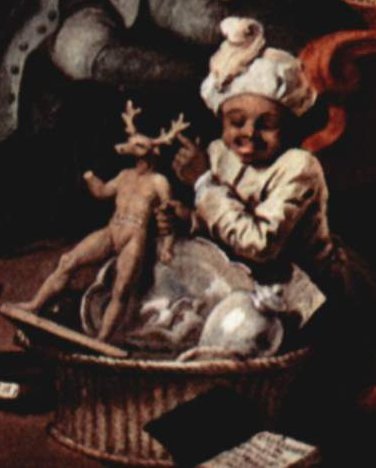
The Indian boy and Actaeon

It is interesting to note that he is smiling as he holds a figure of a naked man who is wearing antlers on his head.  This symbolises a cuckold – a deceived husband.  The figure is almost certainly Actaeon, the mythical hunter who surprised the goddess Diana while she was bathing naked and who was turned into a stag in punishment and torn to pieces by his own dogs.   This must have been bought at auction by the countess as it still has the lot number affixed to it.  More erotic items can be seen in the basket the boy is rummaging through – the picture on the tray also recalls forbidden erotic pleasures: the married Zeus, in the shape of a swan, approaches the similarly married Queen Leda. 

Scattered on the floor are various invitations received by the Countess along with a number of ugly ornaments, similar to those we saw on the mantelpiece in the second painting of the series.  On the walls there are a number of paintings which we can recognise. Such as Lot and his Daughters, which was a Biblical reference to incest and Jupiter and Io, a Greek mythological tale of seduction concerning Io who was a river goddess.  Jupiter fell in love with the beautiful maiden, and one day, as she rested on the banks of the River, he changed his shape into that of a cloud, and embraced her. He whispered words of love to her, and then planted an immortal kiss upon her upturned cheek.  However the strangest painting on the wall of the Countess’ room is a portrait of Silvertongue himself!   I wonder how she explained that away to her husband!

There are so many things in this painting which leads us to believe that the Countess has or is about to be unfaithful to her husband.  Prior to this painting, we have just looked at the first three paintings in Hogarth’s six piece cycle and we have surely felt sympathy for the young wife.   Let us examine her lot in life.   Forced into a marriage by her father, who was willing to do anything to join the nobility.  Married to a wastrel who we learn was suffering from a sexually transmitted disease and who spends his evening in the company of whores.  However after examining today’s painting, the fourth episode of the story, maybe we are having doubts about our unconditional love for the young woman.  Can we justify her actions by saying it is purely an act of revenge on her wayward husband?

Marriage à la Mode: The Inspection by William Hogarth

Marriage a la Mode The Inspection by William Hogarth (c.1743)

For anybody who has just clicked on to this page, be warned, we are now almost half way through William Hogarth’s pictorial saga entitled Marriage à la Mode and I suggest you click on to the May 4th blog which is the starting point to this cycle of paintings.  This is painting number three in the cycle and is entitled The Inspection.  In My Daily Art Display on the two previous days we looked at the coming together of the young couple and then the onset of the deterioration of the relationship.  Today things take a turn for the worse in the marriage saga.

Today, the setting for the painting is not the Viscount and Viscountess’s house but the consulting rooms of the French doctor, M. De LaPillule.  In the surgery we see the doctor to the left, the Viscount, with his young mistress, who stands on his left hand side and in the centre a rather large woman in a voluminous maroon hooped dress.  There is no sign of the Viscountess and as the story unfolds you will know the reason for her absence.

In the two previous paintings in the cycle we have noted that the Viscount has a black patch on his neck, a way Hogarth signified that the Viscount has contracted the sexually transmitted disease, syphilis.  It is for that very reason that he now appears at the doctor’s surgery.  The Viscounts voracious sexual appetite has been the undoing of him and now he is paying the penalty for his many indiscretions and sexual liaisons.  He, however, seems unabashed by his predicament.  In fact he seems quite good humoured, which is in stark contrast to the worried look on the face of his very young mistress.  She is but a mere child.  They have come to the doctor for a cure for his ailment.  He had originally been prescribed mercury tablets, which at the time were the only known cure for the disease, but they have had not achieved the desired effect so we can see the Viscount handing back the pill to the doctor and asking for an alternative medication.  I say “asking” but we see that in his left hand he is brandishing a cane.  Is this a threatening move on his part towards the doctor?  Is it his belief that his confrontational action will get him a more potent and successful remedy?

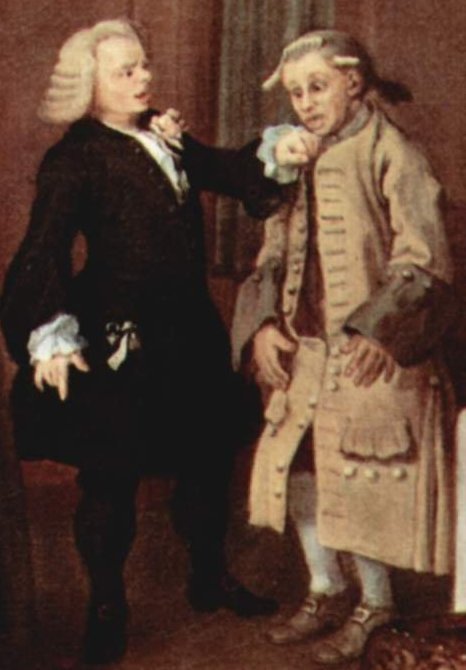
I am not sure how much faith I would have in a doctor who looks like the one in the painting.  He looks unclean and unshaven and is dressed in shabby brown clothes.  Maybe he is what was termed a “back-street” doctor.  Maybe the Viscount dare not go to his regular physician in case his plight became known to his social circle.  The surgery, like the doctor, is dirty and full of masks and bones and on the table next to Doctor La Pillule is a skull.  In the cupboard at the rear of the painting we see a skeleton which almost appears to be groping the genitals of a musculature model or is it an embalmed body !!!!   If we look to the side of the cabinet we can see a narwal tusk which is a classic phallic symbol.  On the cabinet we observe a plethora of pill boxes, a scalloped-sided bleeding basin, a glass urinal, a giant plaster head with a huge femur behind, an alchemist’s tripod for holding flasks over burners, a broken mediaeval comb, a tall red Jacobean hat, two mismatched mediaeval shoes, a spur buckler and a sword and shield, all of which are covered in dust.  So what does this tell us about the doctor and his practice?   Georg Christoph Lichtenberg, the German scientist and artist wrote in his book entitled Hogarth on High Life. The Marriage à la Mode Series,

“…The Doctor’s collection, commenting as it does both historically and prophetically on his career, might be interpreted as follows: he began as a beard trimmer; graduated to piss-analyst; barely skirting the gallows (by virtue of his curative powers) he grabbed for himself a doctor’s hat; and is now counting on a knighthood, if he has not one already…” 

Hardly a resounding recommendation on the good doctor’s ability to cure the Viscount and his mistresses.

The large irate lady at the centre of the painting, which we are presuming is the young mistress’s mother, has similar black patches on her face and we can only surmise that she too is suffering from syphilis.  It is thus a matter of conjecture as to whether the lady is purely the mother of the Viscount’s young mistress or is she the mistress as well, as the Viscount seems to be very relaxed in her company and not fearful of the consequences of having given her young daughter a sexually transmitted disease.  Also, if she was the child’s mother would she and the child be standing together?   Maybe they are not related and they are just two females of vastly different ages plying the same trade.  I am not sure whether, if I was the Earl, I would be feeling relaxed as him,  especially as in her hand we see her opening up a clasp knife as she stares down malevolently at him. 

We look at the young girl.  She is but a child.  She looks worried and sad knowing what has befallen her.  It is a pathetic sight.  For a supposed mistress she seems so young, too demure, too prim and proper but we see her dabbing a sore on her mouth with a handkerchief and this is probably the early signs of the onset of syphilis.  In her other hand is a pill box.  Maybe she too is seeking an alternative remedy to her illness.

That’s the end of Episode Three of Marriage à la Mode.  Tomorrow we will take a look at the next part of the Hogarth’s saga, entitled The Toilette.