The Bard by John Martin

The Bard by John Martin (1817)

My Daily Art Display today looks at a painting and the poem which inspired the work of art.   The artist who painted the picture was the English Romantic painter John Martin and his work which I am featuring today is entitled The Bard which he completed in 1817.

Martin was born in 1789 in the small Northumbrian village of Haydon Bridge which lies close to Hexham.  He was the youngest of thirteen children.  He attended the local school an although he showed a talent for drawing was not academically gifted.   In 1804, his father arranged for him to become an apprentice coach painter in Newcastle in order for him to learn the art of heraldic painting but John was not happy with the work and this, coupled with problems with wages, resulted in the cancelation of Martin’s  indentures.   His father then arranged for him to be tutored by Boniface Musso, an artist who had come to the country from Italy.  In 1806 John Martin moved from Northumbria to London with Boniface Musso and his son Charles, who a few years later sets himself up in the china and glass business and employed John Martin.  Not long after however, the business of selling painted china fell out of fashion and Musso’s business failed.

John Martin moves out of the Musso household in 1809 when he marries Susan Garrett.  The following year John submits a painting of a water nymph entitled Clytie, to the Royal Academy but it is rejected.   In 1811 he was delighted when he has his painting A Landscape Composition accepted.  The following year, by which time he has become a full-time artist, he managed to get a second painting exhibited at the prestigious establishment entitled Sadak in Search of the Waters of Oblivion and it eventually sells for 50 guineas to the Member of Parliament and  Governor of the Bank of England, William Manning.    Many of his works of this time were large in size depicting grand biblical scenes.  During this period many people made the Grand Tour of the Middle East and the Holy Land and so Martin’s paintings became very fashionable.

The year 1813 was to prove a very sad and traumatic year for John Martin with both his mother and father as well as his grandmother and one of his sons, Fenwick, dying.  His painting continued after a period of mourning and still his subjects were mainly biblical and the enormous canvases often depicted scenes of apocalyptic death and destruction.  In 1814 there is another addition to his family with the birth of his fourth child, sadly however that same year his second son, John, dies.  More bad luck was to befall the artist as he submits another painting of a water nymph for inclusion at the Royal Academy but whilst it was waiting to be hung another artist, whilst touching up his painting,  accidentally spills some dark restorative varnish over it and his work is ruined.

Joshua Commanding the Sun to Stand Still upon Gibeon by John Martin (1816)

In 1816 his fifth child Zenobia is born and in that year he exhibits his masterpiece Joshua Commanding the Sun to Stand Still upon Gibeon and once again Martin’s obsession with depicting Old Testament scenes.  For the first time we see Martin, instead of depicting a solitary figure in his biblical scene,  has filled the location with a multitude of little figures both Palestinian and Isrealites, whilst the spear-brandishing figure of Joshua takes centre stage.

And so to 1817 and the year John Martin painted today’s featured painting, The Bard.  I was drawn to this work as it has a connection with the Conwy Valley, where I live and I like its connection to a poem, with the same name, written by by Thomas Gray in 1755.  In the poem Gray narrates the story of King Edward I of England and his conquest of Wales in the late 13th century.   Following his victory over the Welsh Edward decided that all the bards, the professional poets, could be dangerous if they were allowed to spread the story of the bygone power of the Welsh people as this may incite the defeated Welsh to rise up against their English masters.

Edward ordered the Bards to be slaughtered and the painting depicts the fate of the last surviving bard who has been chased by Edward’s troops and who has climbed a precipice above a swirling river.  He stands aloft cursing the English troops, who having left their castle, are in pursuit of their quarry .  The castle, based on the one at Harlech, we see perched on rocks in the left middle-ground.  In the left foreground we see Edward’s riders with banners unfurled as they rush along the valley side like a swarm of ants.  On the top of the cliff on the opposite side of the fast flowing river we observe the bard, cursing his pursuers before throwing himself off the ledge and plunging to his death.

The painting is an example of sublime landscape style, which was very popular at the time, in which the landscapes feature craggy mountains, similar to those seen in the Alps, instead of softer rounded ones.  Waterfalls and trees seem taller than in actuality and there is a certain savagery about the depiction of the vistas.  I leave you to look at this amazing painting and read extracts from Gray’s poem, The Bard.

“Ruin seize thee, ruthless King!
Confusion on thy banners wait!
Tho’ fanned by Conquest’s crimson wing,
They mock the air with idle state.
Helm, nor hauberk’s twisted mail,
Nor e’en thy virtues, Tyrant, shall avail
To save thy secret soul from nightly fears,
From Cambria’s curse, from Cambria’s tears!”
Such were the sounds that o’er the crested pride
Of the first Edward scattered wild dismay,
As down the steep of Snowdon’s shaggy side
He wound with toilsome march his long array.
Stout Glo’ster stood aghast in speechless trance:
“To arms!” cried Mortimer, and couched his quiv’ring lance.

On a rock, whose haughty brow
Frowns o’er cold Conway’s foaming flood,
Robed in the sable garb of woe
With haggard eyes the Poet stood;
(Loose his beard and hoary hair
Streamed like a meteor to the troubled air)
And with a master’s hand, and prophet’s fire,
Struck the deep sorrows of his lyre.
“Hark, how each giant-oak and desert-cave
Sighs to the torrent’s awful voice beneath!
O’er thee, O King! their hundred arms they wave,
Revenge on thee in hoarser murmurs breathe;
Vocal no more, since Cambria’s fatal day,
To high-born Hoel’s harp, or soft Llewellyn’s lay.


Enough for me: with joy I see
The diff’rent doom our fates assign.
Be thine Despair and sceptred Care;
To triumph and to die are mine.”
He spoke, and headlong from the mountain’s height
Deep in the roaring tide he plunged to endless night.

Sir Joseph Banks by Benjamin West

Sir Joseph Banks by Benjamin West (1773)

My Daily Art Display today features two celebrated men, one the American artist, Benjamin West and the other his English sitter, the naturalist and botanist Sir Joseph Banks.

Benjamin West was born in Springfield Pennsylvania in 1738.  He came from a large family, being the tenth child.  His father was an innkeeper and ran different inns during Benjamin’s early life.  Being one of such a large family he had to look after himself a lot of the time, had little formal education and as far as his art was concerned he told his biographer, John Galt,  that he was taught how to make paint by the native Indians.  During his teenage years he began to paint, mainly portraits.  The provost of the College of Philadelphia, Doctor William Smith saw one of his works and was so impressed, he offered the twenty year old West an education which up to then had been sadly lacking but maybe more importantly he offered West the chance to meet members of the affluent society of Pennsylvania and in some cases, ones with political connections.

In 1760 these newly-found connections were to prove fortuitous as with the help of financial support from William Allen, a very wealthy merchant and mayor of Philadelphia, he travelled to Italy where he spent time copying the works of the Italian Masters such as Titian and Raphael.  Three years later he moved from Italy to England where he established himself as a portrait painter.  His works were well received and he soon built up a rich cliental including the prestigious patronage of the monarch, King George III, who appointed West the court’s historical painter.  He retained the monarch’s patronage until the turn of the century.   Whilst in England he met the great English portraitist, Sir Joshua Reynolds, and together, with the help of the monarch, founded the Royal Academy of Arts in 1768.  Reynolds was made the inaugural president and West became the second president of the Academy in 1792, a position he held until 1802.  Four years later he became Academy president again and retained that position until his death in 1820 aged 82.

The sitter for today’s portrait was Sir Joseph Banks.  Born in 1773 in London, Banks was to become the outstanding botanist of his generation.   The son of a Lincolnshire country squire and Member of Parliament, he unlike Benjamin West, received the best education possible passing through the finest educational establishments such as Eton, Harrow and Christ College, Oxford.  On the death of his father, Joseph Banks inherited the family estate of Revesby Abbey in Lincolnshire.  He had always retained his interest in science and botany and soon he began to move in the top scientific circles of London.  In 1776 he became a member of the Royal Society of London for Improving Natural Knowledge, better known simply as the Royal Society.   He was to hold the position of president of the Society from 1778 until his death.  He became a scientific adviser to King George III and through this managed to persuade the monarch to fund expeditions to the “new territories”.  In 1768 Banks was made the leading scientist on Captain James Cook’s first expedition which lasted three years, journeying to the southern hemisphere on HMS Endeavour.  On his return home from this epic voyage he was received by the public as a “returning hero” and many portraits were made of the “man of the moment” including one by Reynolds and one by today’s featured artist.

Joseph Banks by Sir Joshua Reynolds (1773)

My Daily Art Display’s featured painting is the portrait painted of our hero by Benjamin West in 1773, simply entitled, Sir Joseph Banks.  His depiction of Banks differed somewhat from the Reynold’s portrait, which was completed the same year.  In Reynolds’ portrait we see the well-groomed and charming explorer and botanist smiling at us.  He is completely at ease, sitting forward in his armchair, with his arm resting on a table strewn with pages of a letter, quill pen and ink stand and a freestanding globe.

Benjamin West’s work is a full length portrait of Banks standing amongst a selection of artefacts that the explorer had brought back home.  He is wrapped in a Tahitian cape and by him is a native headdress, a paddle from a canoe and a carved fighting staff.  If we look down at his feet we can a Polynesian adze, which was a tool used for carving and smoothing wood and by it are pages of a notebook which was a reference to the myriad of notes Banks made during his expedition with regards to all the flora and fauna he had come across during the three-year journey of discovery around the South Pacific territories.  The painting with its accoutrements even has a hint of the American Wild West, which of course the artist, West, would have seen in paintings back home.  There is also a classical element to this picture with its column and tied-back curtain in the background.  West may have picked up this type of detail when he was studying works of art during his Italian sojourn.

So there you have it, two men of completely differing backgrounds, upbringing and education, Benjamin West the artist and Joseph Banks the explorer, both of whom went on to head up prestigious London societies, and were connected through this painting and their dealings with King George III of England.

The Fairy Feller’s Master-Stroke by Richard Dadd

The Fairy Feller's Master-Stroke by Richard Dadd (1855-1864)

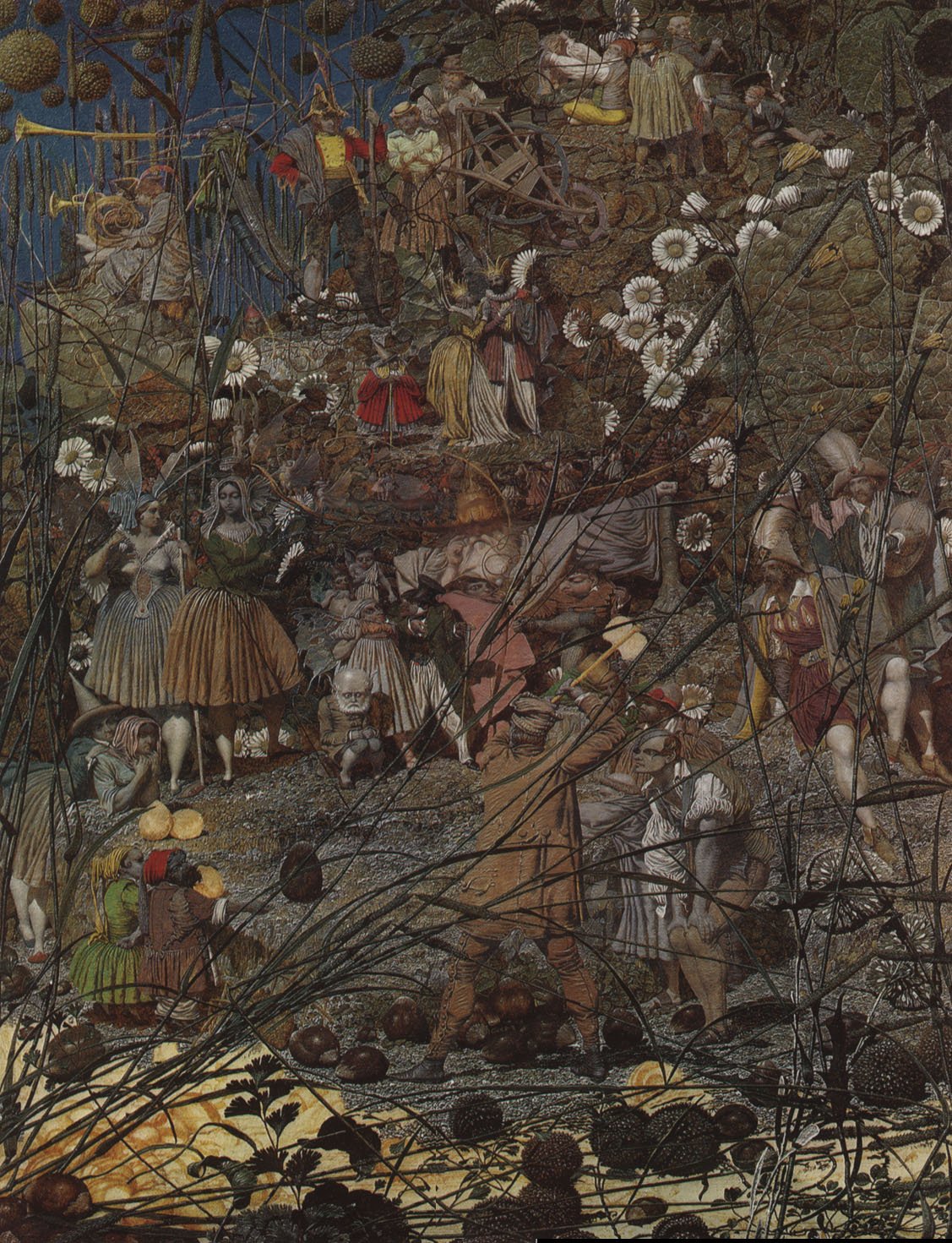
My Daily Art Display featured painting today is a very strange one.  It is Bosch-like in its depiction and I find it fascinating, part of the fascination coming from the story that comes with it.  The painting is entitled The Fairy Feller’s Master-Stroke and it was completed in 1864 by the English artist of the Victorian era, Richard Dadd, and now hangs in the Tate Britain.

The story of the life of the artist is quite a sad one.  Richard Dadd was born in 1817 in Chatham, Kent, fourth of seven children.  He attended The King’s School at Rochester and developed a love for Shakespeare and the Classics while at the same time beginning to display an artistic talent.  In 1834 his family moved to London and three years later Dadd gained admission to the Royal Academy of Arts.  Whilst there he won three silver medals for his draughtsmanship and during his first year began exhibiting some of his works.  It was whilst at this artistic establishment that he and six of his fellow art students founded an artistic group known as The Clique.  The group would have regular meetings, often in Dadd’s rooms,  at which they would show off their latest works.  In some ways The Clique was characterised by their rejection of “academic” high art in favour of genre painting. They held the belief that art was for the people and should therefore be judged by the people and not by its conformity to academic ideals.

In 1842, when Dadd was twenty-five, he travelled with his patron, Sir Thomas Phillips, on a Grand Tour of Europe and the Middle East. They travelled through Italy and Venice before journeying through Greece, Turkey.  They continued on through Syria by mule and finally arrived in Egypt where they travelled by boat along the Nile.   It was at this time that Dadd’s health started to deteriorate due to a combination of exhaustion and sun-stroke and he was starting to suffer with blinding headaches.  The two returned home the following year but on the return journey Dadd had begun to become disorientated and delusional and increasingly violent towards his patron.  The pair split up in Paris and Dadd returned to London.

Nowadays, Dadd would have been diagnosed as suffering from manic-depression which stemmed back from his time in the Nile Valley when he first became delusional and had a fixated fascination with Egyptian Gods and in particular Osiris.   Dadd had become convinced that he was being called upon by divine forces, such as Osiris to do battle with the Devil.  In Allderidge’s biography of Richard Dadd he quotes Dadd’s own words regarding the subject:

“….On my return from travel, I was roused to a consideration of subjects which I had previously never dreamed of, or thought about, connected with self; and I had such ideas that, had I spoken of them openly, I must, if answered in the world’s fashion, have been told I was unreasonable. I concealed, of course, these secret admonitions. I knew not whence they came, although I could not question their propriety, nor could I separate myself from what appeared my fate. My religious opinions varied and do vary from the vulgar; I was inclined to fall in with the views of the ancients, and to regard the substitution of modern ideas thereon as not for the better. These and the like, coupled with an idea of a descent from the Egyptian god Osiris…”

Dadd was now living back in London but his mental illness worsened so much so his father called in specialist to examine his son.  The specialist came to the undeniable conclusion that Dadd “was not of sound mind” and that he should be institutionalised.  However his father wanted time to think about this and decided to accompany his son on a trip out to Cobham which he believed would help his son.  The trip proved to be a disaster and culminated in Richard Dadd killing his father with a knife and a razor.   Dadd then hurriedly left the scene and went to Dover and took a ferry to Calais.  The body of Robert Dadd was found the next day.

Dadd travelled from Calais to Paris by coach and during this trip he attacked a fellow passenger and tried to cut his throat.  He was arrested and on searching him the French police found a handwritten list of people “who must die” and topping this list was the name of his father.  Dadd was brought out of the Clermont asylum where he had been incarcerated and sent back to England where he was to stand trial for the murder of his father.  He pleaded guilty to the charge and the case never came to trial.  Dadd, who was just twenty-seven years of age, was sentenced to be placed “in a place of permanent safety” at the Bethlem Hospital in the criminal lunatic department and there he remained for twenty years.  In 1884 he was transferred to Broadmoor high-security psychiatric hospital where he died two years later in 1886

It was whilst Dadd was in Bethlem psychiatric hospital that he completed today’s featured painting.  Maybe now having read about his tortured mind and his incarceration you can understand what made an artist paint such a strange picture.  The work was commissioned by George Hayden, the Steward of Bethlem Hospital, who asked Dadd to paint him a “fairy painting”, a popular genre at the time.  It took Dadd nine years to complete, what is considered to be his greatest work.    It is an elaborate picture painted meticulously.  It lacks any kind of horizon and in some ways resembles a tapestry.  It is awash with strange little figures most of who are concentrating on the central figure, the fairy woodsman who is the “fairy feller” in the title of the painting as he brings his axe down on a hazelnut.   This is a painting one can return to many times and see different aspects which were not spotted before.

So what does it all mean?  Who are all those characters Dadd has lovingly painted?  Dadd decided to compose a poem in which he described all the character in the hope that it would add meaning to his work.  He called the poem Elimination of a Picture & its subject–called The Feller’s Master Stroke and from it we are supposed to derive that nothing is random about the figures shown.  Every character has a roll to play.

The poem describes the action of the fairy woodsman:

fay woodman holds aloft the axe
Whose double edge virtue now they tax
To do it singly & make single double
Featly & neatly–equal without trouble.

And once the hazelnut has been split asunder,  the two halves would be used to build a chariot for his queen, Queen Mab:

She is the fairies’ midwife, and she comes
In shape no bigger than an agate stone
On the forefinger of an alderman,
Drawn with a team of little atomies
Athwart men’s noses as they lie asleep:
Her wagon spokes made of long spinners’ legs,
The cover, of the wings of grasshoppers;
Her traces, of the smallest spider’s web;
Her collars, of the moonshine’s watery beams;
Her whip, of cricket’s bone; the lash, of film;
Her wagoner, a small gray-coated gnat,
Not half so big as a round little worm
Prick’d from the lazy finger of a maid;
Her chariot is an empty hazelnut,
Made by the joiner squirrel or old grub,
Time out o’ mind the fairies’ coachmakers.
And in this state she gallops night by night
Through lovers’ brains, and then they dream of love. . . .

The painting is fascinating with its large cast of characters which we see amongst the clutter of nuts and berries, and the tangle of grass and stems in the foreground.  Is it just a piece of madness painted by a madman – probably yes, but the we only need to look at works by Hieronymus Bosch and Dali and wonder at the state of their minds when he puts brush to canvas.

The White House at Chelsea by Thomas Girtin

The White House at Chelsea by Thomas Girtin (1800)

From Tudor-period portraiture by a Flemish artist yesterday, I am switching today to a landscape painting by an English Artist.  My Daily Art Display’s featured artist today is Thomas Girtin who was born in Southwark, London in 1775.  Girtin was to become recognised as one of the greatest watercolour landscape artists of his time and a rival to his contemporary, Turner.

Girtin’s father, Thomas, who was a prosperous brush maker, died when his son was only a child and Thomas was brought up by his mother and step-father.  Initially Thomas received his art tuition from the painter and engraver, Thomas Malton and this was followed by an apprenticeship with the watercolourist Edward Dayes.  His seven-year apprenticeship did not run smoothly as Thomas had a turbulent existence with his master, Dayes.  Girtin had become friendly with a fellow pupil of Thomas Malton and they were both employed to fill in the outlines of pencil sketches by the antiquarian James Moore with watercolours.  Sometimes they would be set the task of copying drawings by John Cozens.   This friend and pupil was to prove to be one of Girtin’s great rivals.  His name was Joseph Mallord William Turner.  For Girtin, these tasks were of great importance for unlike Turner he never attended the Royal Academy schools and these tasks honed his talent as a watercolourist.

Girtin first exhibited a painting at the Royal Academy in 1794 at the age of nineteen.  He produced many landscape sketches and his use of watercolours was to establish his reputation as a great artist.  He travelled widely throughout Britain on sketching expeditions visiting the Lake District, North Wales and the West Country.  By the end of the eighteenth century, he had managed to acquire the influential patronage of Elizabeth, Countess of Sutherland and the wealthy British art patron and amateur painter, Sir George Beaumont, a man who played a decisive part in the creation of the London National Gallery.  In 1800 Girtin, who had attained financial security through the sale of his paintings, married sixteen year old Mary Ann Borrett, the daughter of a London goldsmith and the couple set up house in the fashionable Hyde Park area.  Although free of money worries, his health was beginning to deteriorate,  Despite this he travelled to Paris and spent five months painting watercolours and making a series of sketches which he then turned into engravings on his return to London, some of which were published posthumously as Twenty Views in Paris and its Environs after his death the following year.  In 1802, Girtin exhibited Eidometropolis, a monumental panorama of London that dazzled his contemporaries.  It was 18ft high and 108 feet in circumference.  In November 1802, whilst in his painting studio he collapsed and died at the young age of twenty seven.  The reported cause of death was thought to be asthma or tuberculosis.

My Daily Art Display today is entitled The White House at Chelsea and was completed by Thomas Girtin in 1800.  The scene is set on the River Thames and we see the great waterway as it flows peacefully under a twilight summer sky.  It is believed that the actual view can be narrowed down to an upstream view of the Thames as seen from a location very close to where Chelsea Bridge now stands.   In the background on the left we have Joseph Freeman’s windmill.  If we look to the right of this we can see the sunlit white house, which gives its name to the painting.  The little house glistens.  Its brightness is uncanny and its glow is added to by its own reflection in the water.   The position of the white house is about where Battersea Park is now located.  Move further round to the right and you can see Battersea Bridge and on the other side of the river is the Chelsea Old Church, which was almost completely destroyed in the Second World War in 1941.

Look how Girtin has painted the tranquil surface of the river.   It is awash with colour under the grey and pink clouds of the summer sky.  We see two working boats on the water.  The one on the left has its sails down as it lays peacefully at anchor whilst the other wends its way slowly upstream, its wake breaking the smooth glass-like appearance of the water.

The painting is amazing, as before us we don’t have the sun lighting up a magnificent building or famous London landmark.  All we have is a small nondescript building suddenly illuminated by Girtin’s evening sun.  It is just an ordinary house on a nondescript stretch of the Thames.

To end with let me give you two famous quotes by Thomas Girtin’s friend Turner.   On hearing of Girtin’s death Turner remarked:

“Poor Tom……..If Tom Girtin had lived, I should have starved.”

Today’s watercolour by Girtin was much admired by Turner and this was borne out by the anecdote:

“………..A dealer went one day to Turner, and after looking round at all his drawings in the room, had the audacity to say, I have a drawing out there in my hackney coach, finer than any of yours. Turner bit his lip, looked first angry, then meditative. At length he broke silence: Then I tell you what it is. You have got Tom Girtin’s White House at Chelsea………”.

Praise indeed !

February Fill Dyke by Benjamin Williams Leader

February Fill Dyke by Benjamin Williams Leader (1881)

My Daily Art Display returns to landscape painting but remains with English Victorian artists for the third day running.  My featured artist today is Benjamin Williams Leader who was to become one of the most acclaimed Victorian landscape painters during his lifetime.   He was born in Worcester in 1831 and he was the eldest of eleven children.  His father, Edward Leader Williams was a civil engineer and staunch non-conformist whilst his mother Sarah Whiting was a Quaker.  However after the two of them married in an Anglican church the Quaker establishment disowned them.     Benjamin was actually born as Benjamin Williams but in 1857 he added the surname, Leader, which was his father’s middle name, to distinguish himself from the rest of the Williams clan.

His father Edward was a keen amateur artist and was on friendly terms with John Constable.  Benjamin would often accompany his father on his painting expeditions along the Severn valley and soon he developed a love of art.  He attended the Royal Grammar School in Worcester and when he completed his schooling in 1845 was apprenticed as a draughtsman in his father’s engineering office.  However Benjamin never gave up his fondness for apinting and drawing and after many discussions with his father he was allowed to leave the world of engineering and follow his love of art.  His father gave his son one year to prove himself artistically.  Benjamin enrolled at the Worcester School of Design and one year later had achieved the position of “probationer” at the Royal Academy Schools.  A year on, and quite exceptionally for a first year student, he exhibited his first painting, Cottage Children Blowing Bubbles, which was bought by an American.  From then on he exhibited in every Summer Exhibition of the Royal Academy up until 1922 when he had reached the fine old age of 91.

Leader married fellow artist Mary Eastlake in 1876.  She was an artist whose subject speciality was flowers.  She came from an artistic background being the grand-niece of Sir Charles Locke Eastlake who was President of the Royal Academy between 1850 until his death in 1865.  The marriage of the couple did not find favour with her family as Benjamin Leader was twenty-two years older than their daughter and whereas the Eastlake family came from a long line of Plymouth gentry, Benjamin’s family where  mere “trades people”.  However as is often the case, the noble Eastlake family had seen better financial days whereas Benjamin Leader, with the sale of his many paintings,  was financially sound.  They did marry and went on to have six children, one of whom Benjamin Eastlake Leader, became an artist but was sadly killed in action during the First World War.

Leader spent most of time painting landscape scenes of his beloved Worcestershire and the Severn Valley and in Lewis Lusk’s The Works of B.W.Leader, R.A. which was published in The Art Journal of 1901, Leader was quoted as saying:

“…The subjects of my pictures are mostly English.  I have painted in Switzerland, Scotland and a great deal of North Wales, but I prefer our English home scenes.  Riversides at evening time, country lanes and commons and the village church are subjects that I love and am never tired of painting…”

It was the Summer Exhibition of 1881 at the Royal Academy that Leader exhibited today’s featured work, February Fill the Dyke and it was highly commended.  The Art Journal of the day commented:

“…title and picture suit one another well.  The characteristics of the kind of weather which gives the epithet of “fill dyke” to the month of February are most truthfully depicted in the overflowing ponds and splashy roads and the pale, streaked evening sky.  It is a thoroughly English landscape…”

And so to today’s featured painting which is a beautiful landscape painting with the unusual title February Fill Dyke by Benjamin William Leader.  I was intrigued by the title of the painting, which I discovered comes from an old country rhyme:

February fill the dyke,
Be it black or be it white;
But if it be white,
It’s the better to like

It means that the ditches get filled in February either with mud or with snow.  The first thing which struck me about this painting was its realism.  This was not an Italianate landscape painting with the sun glinting on a beautiful landscape.  This is a painting of the fields in Leader’s native Worcestershire.  The wet ground is being warmed slightly by the late winter’s sun.  Leader has humanised the scene by adding a couple of children and their dog heading home through pools of water on the muddy path.  Ahead of them, the farmer stands at the gate and we can see a woman in front of the cottage busily collecting firewood.

This is what we see when we go for a walk in the countryside on a wet winter’s day.  Before us we have what appears to be a cold and somewhat miserable end to a winter’s day.  Darkness is rapidly approaching and it is time to get back indoors to the safety of our home and the warmth of an open fire and maybe a hot scented bath which will banish the lingering thoughts of what lies outside.  It is a type of day in which the cold and dampness moves stealthily into one’s bones adding to our aches and pains.  Yet having said all that  is this not truly a beautiful painting?  Maybe it is the type of painting you enjoy looking at when you are sitting cosily in the warmth of your house

I do like landscape paintings even more so if they replicate an actual view.  I do understand and appreciate idealised landscapes where an artist has put together various pieces of landscapes he likes, to finish with his idea of a perfect landscape.  What I am not very fond of is a painting of a landscape which seems to bear no resemblance to the scene it is supposed to be portraying.  I am not an artist and have never had the ability to draw anything that one would recognise so I suppose I shouldn’t criticise but we all have the right to freedom of speech so I will exercise my right.  I watched a documentary the other day which was about landscape painting and we were with this artist who was in a field painting a scene with a mountain in the background.   When he finished it we saw his work which was depicting what we had all been looking at but the landscape we had seen was not on the artist’s canvas .  I wonder whether he read my thoughts as he said that his painting was not necessarily a true reflection of what we and he were looking at but it was the view that was conjured up in his mind at the time.  I am not sure I can go along with that thought process but maybe for any of you artists out there you will understand what he was saying.  However if he had given me the painting to hang on my wall I would have no idea what it was all about!

Never Morning Wore to Evening but Some Heart Did Break by Walter Langley

Never Morning Wore to Evening but Some Heart Did Break by Walter Langley (1894)

My Daily Art Display today features an extremely moving picture which has the very long title Never Morning Wore to Evening but Some Heart Did Break.  The painting was completed by the English artist Walter Langley in 1894.  The painting today, as was the painting yesterday, is about loss.  The title of the painting emanates from Tennyson’s poem In Memoriam, one verse of which reads:

That loss is common would not make
My own less bitter, rather more:
Too common! Never morning wore
To evening, but some heart did break

Walter Langley was born in 1852 in Birmingham.   His father, William, was a tailor and Walter was one of eleven children brought up in an area close to the inner-city, poverty-stricken slums of one of England’s largest Victorian cities.  At the age of fifteen he was taken on as an apprentice lithographer and six years later he managed to gain a scholarship to South Kensington where he studied design for two years.  In 1876 Langley married Clara Perkins. The couple went off to Whitby on their honeymoon which was a favourite hangout of Victorian artists and this was Langley`s first encounter with a working fishing village.  In 1881 he returned to Birmingham and at the age of twenty-nine he was elected an Associate of the Royal Birmingham Society of Artists, which had been established in the early nineteenth century

His lithography work was starting to dry up and this coupled with the news that his wife was expecting twins forced him to make a choice between continuing to be a full-time lithographer or concentrate all his efforts into his painting.  Langley`s growing commercial success as an artist made the decision easier for him to make as he knew he needed the money to support his rapidly increasing family..

He had visited the Cornish fishing port of Newlyn before and was very impressed with the surrounding area and in July 1881 he returned.  This time he went there with a commission for 20 paintings from an important Birmingham patron, Edwin Chamberlain. As the year came to close he received a further remarkable commission from the Birmingham art dealer JW Thrupp, acting on behalf of the Alldays family, of 500 pounds for a year`s paintings in Newlyn.  The year of 1881 was a great year for the artist and his family with the commercial success of his paintings which far outshone anything he could have hoped to earn as a lithographer in Birmingham.   In 1882 he and his family moved permanently to the Cornish fishing port of Newlyn which was to become a haven for artists.  The Newlyn School was the term used to describe this new art colony that was based around the fishing port and in some ways mirrored the artist colony based on the outskirts of Paris, known as the Barbizon School.  Artists from both schools were associated with en plein air painting.   Although Langley was not the first artist to move and settle in Newlyn, he is largely credited with being the Pioneer of the Newlyn Art Colony and this “title” was engraved on his tombstone in Penzance.

Having been brought up close to the poverty of slum life he was a great supporter of left-wing politics and was a follower of the left wing radical Charles Bradlaugh, the great advocate of trade unionism.  Many of his paintings were of the social realist genre depicting working class folk and their struggle for survival.  Some of his paintings highlight the empathy he had for the hard-working fishermen and their families amongst whom he lived, no more so than today’s featured painting,  Never Morning Wore to Evening but Some Heart Did Break.   Before us we see an old woman comforting a younger one.  Her arm is wrapped around the young woman’s shoulder who holds her head in her hands and cries over a fisherman who never made it back home.   Look how the artist shows the moonlight dancing over the ripples of the sea.

This turmoil of human emotions is in direct contrast to the flat calm sea we can observe in the background of the painting.  It is the calm after the storm which has taken the life of the young woman’s beloved.  This is a very emotional painting and “speaks” more than any words could possibly do.  It succinctly illustrates the tragedies which can befall the family of working-class fishermen as they battle against all weathers simply to put food on the family table.

The Boer War by John Byam Liston Shaw

The Boer War by John Byam Liston Shaw (1900-01)

Once again, I am featuring an English artist.   My Daily Art Display’s featured artist was one of England’s most prolific painters of the late Victorian and Edwardian eras, John Byam Liston Shaw.  He was actually born in Madras, India in 1872, where his father was the registrar of the High Court.  He and his family lived in India until he was six years old at which time they came back to Londond and settled down in Kensington.  Byam Shaw showed early promise as an artist and when he was fifteen years old some of his paintings and drawings were shown to the Pre-Raphaelite painter, Sir John Everett Millais who was very impressed by the artistic standards achieved by the boy.  It was on Millais’ advice that Shaw entered the St John’s Wood Art School.  Also at the school at the time were the portraitist George Spencer Watson, the animal painter Roland Wheelwright and the landscape artist Rex Vicat Cole.  However probably the most important art student he met there was Evelyn Pyke-Nott, whom he was to marry in 1899.

In 1890, aged 18 years old, Byam Shaw attended the Royal Academy Schools at which in 1892 he won the prestigious Armitage Prize for his painting The Judgement of Solomon.   In 1893 he and fellow art student the portraitist and miniaturist, Gerald Metcalf who like Byam Shaw was born in India, moved into a studio together that at one time had been owned by Whistler.  Byam Shaw’s early works showed the influence on him of the Pre-Raphaelite Brotherhood.     He had been a great admirer of Dante Gabriel Rossetti and John Millais and one of his earliest works, and the first one he exhibited at the Royal Academy entitled Rose Mary, was based on a poem by Dante Gabriel Rossetti.  Looking at Byam Shaw’s works, it is easy to see the influence of the Pre-Raphaelites had on his work, not just in the subject matter but in his use of colour.

In 1899 Byam Shaw married Evelyn Pike Nott and they went on to have five children, four daughters and a son.  Besides his painting Byam Shaw spent a great deal of time on illustrations and drawings for books and in 1904 he was commissioned to produce thirty-four illustrations for the book, Historic Record of the Coronation of King Edward VII and Queen Alexandra.  It was around this time that Byam Shaw also became interested in theatrical costume design.  In 1904, aged thirty-two, he and his fellow artist friend, Rex Vicat Cole, became part-time teachers at the Women’s Department of King’s College at which ladies were allowed to attend lectures on various subjects but had to have chaperones in attendance !  The two friends resigned from their posts at King’s College and set up their own school of art in Kensington, which still exists as Byam Shaw’s School of Art and which is an integral part of the world-renowned Central Saint Martin’s College of Art and Design.  Shaw’s wife Evelyn also had a major role in the school.

During the First World War, Shaw produced many war cartoons for the newspapers of the day.  Shortly after the war in January 1919 he collapsed and died aged 46.

My featured painting today is John Byam Shaw’s work entitled The Boer War which he started in 1900 and completed in 1901.  When Shaw first exhibited this painting he added two lines to the title which came from A Bird Song, a poem by the English poet Christina Rossetti:

Last Summer greener things were greener

Brambles fewer, the blue sky bluer

This verse was a reflection of the mood of the young lady dressed in black.  She is heartbroken at hearing the news of the death of a loved one, killed in the Boer War.  She stands on the bank of the river and tries to remember happier days but she finds even that difficult.  In her eyes, the once beloved beauty of Mother Nature seems to have deserted her.  She struggles to come to terms with the death.  She is inconsolable.  However she is the archetypal English heroine who manages to bear her sorrows with a degree of stoicism as she deliberates on the death of a loved one who has given up his life for his country.

The model Byam Shaw used for this painting was his sister Margaret Glencair who at the time was in mourning  for her cousin who had been killed in the fighting in South Africa.   Byam Shaw drew on his knowledge of the banks of the River Thames near Dorchester to construct this beautiful picture.  Although Byam Shaw was influenced by the bright colours of the Pre-Raphaelites, the colours of the fauna in this painting are more subdued as if in the shadow of a dark cloud.  This muted colouring of the overgrown plants which kiss the water could well be part and parcel of the mood of the subject.  Look at the water in the right foreground and you can see a single feather of a swan.   It is more than likely that this symbolises loss as we are all aware that swans mate for life and if one dies, the other pines for it.  Could this then be drawing a parallel to the suffering of the woman who has lost her partner on the field of battle?  Another piece of symbolism in the painting is the way the artists has painted ravens in flight over the trees which is a sign of ill omen and thus amplifies the ominous atmosphere of the painting.

This is a truly beautiful painting, the subject of which is heartbreaking.

The Blind Girl by John Everett Millais

The Blind Girl by Millais (1854-56)

Another day, another painting, another offering from the Pre-Raphaelite Brotherhood.  My Daily Art Display for today is one of John Everett Millais’ finest works of art, entitled The Blind Girl which he painted in 1856.  In it we have a fusion of the elements of figure and landscape painting depicting, in the foreground, two girls sitting near a roadside against the backdrop of an expanse of wide, open fields with a distant view of a town.

Begging plea

The elder of the two girls, with her eyes closed, is blind.  She is homeless and forced to beg for sustenance by playing her concertina, which we see on her lap.  Her wretched plight is emphasized even more by the sheet of paper hanging around her neck with the words “PITY THE BLIND”.   Millais has chosen as his subject for this painting the social evil of the day – vagrancy among children and the disabled.  Millais hoped that his painting would elicit sympathy from its viewers for the plight of this blind girl and those like her.  There is a stillness and tranquility about the girl and this is borne out by the fact that we see a tortoiseshell butterfly resting on her shawl.

The younger girl, who is partly perched on the lap of the blind girl, and whom we believe maybe her sister, does not look out at us but is looking back at the double rainbow and the enchanting landscape below this phenomenon.  Some art historians have interpreted Millais’ depiction of the double rainbow as a Christian symbol of hope and one must remember that at the time Millais was still influenced by his former patron John Ruskin and it was Ruskin’s belief that there was a connection between the beauty of nature and the divine handiwork of God.   It is an enchanting scene we see before us and has luminosity brought on by the aftermath of what has probably been a heavy downpour of rain.  The rain has made the grass looks so green and its fresh appearance tempts us to sniff the air so as to take in the delights of the countryside.

Look at the way the two girls are depicted by Millais.  See how the younger girl snuggles within the shawl of the blind girl.  I wonder whether Millais meant us to look at their positioning and think of the Madonna and Child.  Whereas we would expect the sighted girl to look after the blind girl there appears to be a role reversal in this painting.  Maybe the blind girl is comforting her young companion who may have been frightened by the storm which has just passed.  Maybe the young girl is peeking around the blind girl’s shawl at a point in the distance where there had once been flashes of lightning and the rumble of thunder.  Take a moment to study the blind girl.  See how she seems to be trying to compensate her loss of sight through her other senses – the sense of touch.   See how, with one hand, she grips the hand of her young companion and with the other she fingers a blade of grass.  It is interesting to note how meticulous Millais has painted each individual blade of grass near to the hand of this blind girl.  She is also doing what so many of us do when the sun is shining – we close our eyes and face the sun and absorb the warmth of its rays.  The girl is taking pleasure in her surroundings, the warmth of the sunlight, the sounds of the birds and the smells emanating from the countryside all around her.

The background of this picture is a view of Winchelsea, a small village in East Sussex, located about two miles south-west of the coastal town of Rye.   The village stands on the site of a medieval town, founded in 1288, to replace an earlier town of the same name, sometimes known as Old Winchelsea, which was lost to the sea.   It is known that Millais, along with his fellow artists, Holman Hunt and Edward Lear visited the town in 1852.   It is recorded that Millais completed the middle ground of the painting whilst in Perth, Scotland where he had taken his new bride, Effie, the former Mrs Ruskin, in the summer of 1855.  The history of the painting chronicles that the last thing to be painted was the amber-coloured skirt, which the blind girl is wearing and which Effie cajoled an old woman into lending it to her.  Effie recorded the incident, writing:

“…She swore an oath and said what could Mrs Millais want with her old Coat, it was so dirty, but I was welcome.  I kept it two days and sent it back with a shilling and she was quite pleased…”

For his models for this painting, Millais used Matilda Proudfoot as the blind girl and Isabella Nichol as her younger sister. Originally Millais had used his wife Effie as the model for the blind girl but later he decided to use Matilda.

The Liverpool Academy awarded this painting its annual prize in 1857.    It was well received and is now looked upon as one of Millais’ finest works of art.  His Pre-Raphaelite colleague, Dante Rossetti declared it to be:

“…One of the most touching and perfect things I know….”

John Ruskin his former mentor and patron described The Blind Girl:

“…’The common is a fairly spacious bit of ragged pasture, and at the side of the public road passing over it the blind girl has sat down to rest awhile. She is a simple beggar, not a poetical or vicious one, a girl of eighteen or twenty, extremely plain-featured, but healthy, and just now resting, not because she is much tired but because the sun has but this moment come out after a shower and the smell of grass is pleasant….”

One interesting technical aspect of the painting is Millais’ depiction of the double rainbow.  When he showed the painting for the first time, somebody made him aware of his technical error as he had painted the two rainbows with their colours in the same order but he was advised that with double rainbows the inner rainbow of the two inverts the order of the colours.  Later Millais, in order to satisfy scientific accuracy, re-painted the inner rainbow.

Mr and Mrs Clark and Percy by David Hockney

Mr and Mrs Clark by David Hockney (1970-1971)

I am, as you probably know by now, fascinated by interpretation and symbolism of paintings.  It fascinates me to read what art experts say about the meaning of certain aspects of a painting and of course in the majority of works the artist has died many years if not centuries ago.  This of course gives the experts and critics alike, free rein to interpret what the artist was thinking as he or she put brush to canvas without fear of the artist publicly announcing that their views are nonsense.  I guess in some small, and on isolated occasions, I have dipped my toe into the waters of interpretation and pontificated on what I believed the artist was thinking and meaning by his painting, knowing full well that the artist wouldn’t add a comment to my blog telling me I didn’t know what I was talking about!  Today I need to tread carefully with my discussion of My Daily Art Display featured painting as the artist is still alive and although I doubt very much he will be reading this, I don’t want to be belittled by adverse comments from the great man.

My featured painting today is entitled Mr and Mrs Clark and Percy by David Hockney.  Hockney painted this between 1970 and 1971 and it is of the English fashion designer, Ossie Clark, and the textile designer and his then wife Celia Birtwell.  It was painted just after the couple’s wedding at which Hockney, a long term friend of the groom, was the best man.  It was a time when we had just emerged from the Swinging Sixties. She also worked from home designing textiles for Ossie Clark, who would use his skill in cutting and understanding of form, and so together with her knowledge of fabrics and textures they produced haute couture for the emerging ‘sixties culture.  Celia Birtwell acted as Hockney’s muse and model for some time after this painting.

Here before us we have a double-portrait which harks back to a couple of double-portraits I have featured earlier in My Daily Art Display, such as The Arnolfini Portrait by van Eyck (Nov 27th 2010) and Mr and Mrs Andrews by Gainsborough (May 2nd 2011).  However, unlike those paintings, today double-portrait is not awash with symbolism but we still have a chance to interpret what we see.  Ossie Clark, who looks out at us with a somewhat anxious and questioning glance,  is seated, slightly slumped in a tubular chair in a very relaxed posture and standing across from him his Celia Birtwell.  The mere fact that she stands and he is seated could allude to her dominance in the partnership.  They are set apart by the vertical separation of the room’s full length casement window through which we can see a small balustraded balcony.  I wonder if the fact that they are set so much apart was a reference to their independent careers and lives.

The setting itself, although not devoid of accoutrements, is quite minimalistic and informal,  which is the complete opposite to the way nineteenth century family rooms were depicted in family portraits of that time.  Then it was important that the artist made the viewer aware of the wealth of the people depicted and who often had commissioned the work.  Ornate furniture with rich tapestries and sumptuous clothing were the standard trappings of such works of art and we were left in no doubt with regards the class and wealth of the people depicted. In this painting, despite its lack of ostentatious wealth, we are aware that this is not a room of the poor.  The room, through its muted and plain colouring, gives it a cool feeling but amidst the cooler shades we do have the red in her dress and the blue of his jumper which stand out.  The book with the yellow cover makes an admirable contrast to the pale blue of the table.  On the floor sits a white plastic 60’s telephone.

On the lap of Ossie Clark is the white cat which according to the painting’s title is called Percy.  Actually, although the couple had a cat called Percy, this was their other cat, called Blanche.  So why switch the name of the cat?  One reason could possibly be that the cat, because it is sittings upright on the man’s crotch, should have the slang term for a penis, Percy!!!   Cats were also symbols of infidelity and envy and if we are to believe rumours of the time Clarke was bisexual and had many affairs which eventually lead to the break-up of their marriage three years later in 1974.

On the table we see a vase of white lilies and these flowers symbolise female purity and are often symbolic editions in paintings of the Annunciation.  So was this just a coincidence?  Probably not because at the time of the painting Celia Birtwell was pregnant

The painting is  outstanding and featured in the final 10 of the Greatest Paintings in Britain Vote in 2005 and it was the only work by a living artist to do so.

The Farmer’s Wife and the Raven by George Stubbs

The Farmer's Wife and the Raven by George Stubbs (1782)

George Stubbs, the English artist who is best loved for his painting of horses, was born in Liverpool in 1724.  He would become the finest painter of horses that ever lived.  His father was a prosperous currier – a specialist in the leather processing industry.  Stubbs helped his father in that trade until his father died when George was seventeen years of age.  He then went on to serve a short term apprenticeship as a painter and engraver but didn’t like the work he was asked to perform.   He carried on with his love for art and took a keen interest in anatomy which was to be one of the driving passions of his life.   He was able to study this at close hand at the York County Hospital.

When he was thirty years of age he travelled to Italy.  The purpose of this European journey, he told his friend and fellow artist, Oziah Humphrey, was “to convince himself that nature was and always  is superior to art whether Greek or Roman and having renewed this conviction he immediately resolved upon returning home”.  He did return to England and settled down in a rented farmhouse in a remote part of Lincolnshire with his common-law wife Mary Spencer and with her assistance set about dissecting dead horses to learn more about their anatomy.  In 1766 he published a paper entitled The Anatomy of the Horse and the original drawings and etchings he made for this are now kept in the Royal Academy collection.

George Stubbs was recognised as a “Master” of horse painters and he received many commissions from several dukes and lords.  His masterly depictions of hunters and racehorses commanded high prices.  Stubbs soon became quite rich from the sale of his horse paintings and with the proceeds bought a house in Marylebone, an extremely fashionable part of London, where he lived until his death in 1806, a few weeks short of his eighty-second birthday.

My Daily Art Display today is not one of his many fine horse paintings but one of comparatively few subject pictures by the artist.  The painting is entitled The Farmer’s Wife and the Raven, which he painted in 1782,  and is based on a tale from John Gay’s Book of Fables.  In the painting we see a farmer’s wife astride her old white horse on her way to the market.  In the pannier baskets are her eggs which she intends to sell.   Her poor old horse, Blind Ball, is startled by the squawking of a raven, which sits high up on the branch of a nearby tree, causing it to stumble and fall.  The eggs fall out of the basket and lie broken, their yellow yokes can be seen clearly on the ground.  This painting is a tale of greed.  The large farmer’s wife did not care for the welfare of her old horse, her mind being set on the profits she was going to make from the sale of her eggs.  English people loved horses and a  painting illustrating the come-uppance of someone who did not treat their animal well was a very  popular subject for artists of the time.

The way in which Stubbs has painted the stumbling horse is testament to his great ability as an artist and his knowledge of a horse’s anatomy.     It is a perfect anatomical depiction which manages to capture the anguish of the horse in pain and its movement as it staggers to the ground.  Look how he has captured the woman who is desperately trying to avoid being thrown over the head of the stumbling horse.  Our eyes follow the story the artist has depicted.  First our eyes are drawn to the fallen white horse which stands out vividly against a dark background.  Our gaze moves up the horse’s withers to the unfortunate woman whose right arm is flung high like a rodeo rider on a bucking bronco.   We see her look of horror as she fixes her eyes on the “over-sized” raven sitting on the branch of the nearby oak tree.  The bird’s mouth is still open after letting out the squawk which has set the disaster in motion.

The painting has an inscription (in bold type below) taken from this fable:

Betwixt her swagging panniers’ load
A farmer’s wife to market rode,
And, jogging on, with thoughtful care
Summed up the profits of her ware;
When, starting from her silver dream,
Thus far and wide was heard her scream:
   ‘That raven on yon left-hand oak
(Curse on his ill-betiding croak)
Bodes me no good.’ No more she said,
When poor blind Ball, with stumbling tread,

Fell prone; o’erturned the pannier lay,
And her mashed eggs bestrewed the way.
   She, sprawling in the yellow road,
Railed, swore and cursed: ‘Thou croaking toad,
A murrain take thy whoreson throat!
I knew misfortune in the note.’
   ‘Dame,’ quoth the raven, ‘spare your oaths,
Unclench your fist, and wipe your clothes.
But why on me those curses thrown?
Goody, the fault was all your own;

For had you laid this brittle ware,
On Dun, the old sure-footed mare,
Though all the ravens of the hundred,
With croaking had your tongue out-thundered,
Sure-footed Dun had kept his legs,
And you, good woman, saved your eggs.’