Three Ages of Woman by Gustav Klimt

Three Ages of Woman by Gustav Klimt (1905)

I have already featured paintings by two of the great Austrian artists, Egon Schiele (May 26th and 27th) and Oskar Kokoschka (Dec 10th), and today I would like to present a painting by an artist, who has been termed by many, as the greatest Austrian painter who ever lived.  Between 1900 and his death in 1918, Klimt dominated the art scene in Vienna.

The featured painting in My Daily Art Display today is entitled Three Ages of Woman which he painted in 1905.  It is also sometimes referred to as Mother and Child.  The painting is housed in the Galleria Nazionale d’Arte Moderna in Rome.  This was one of the artist’s most beloved paintings.  For Klimt, although he had painted smaller allegorical pictures, this was to be his first and one of his last multi-figured large-scale allegorical painting, which simply put, is a painting in which there is a pictorial representation of abstract ideas by the depiction of the characters or events in the painting.  It is a visual symbolic representation.  This painting by Klimt is about the transience of life and the permanence of death.

In the painting we see three women at different stages of life.  The youngest is the baby, representing infancy, who in turn is being cradled in the arms of the mother, who although is an adult, is a young adult, representing motherhood.  The third figure, on the left of the group is the old woman who represents old age.  These three figures have appeared before, slightly altered in form, in some of his earlier and later paintings, such as Medicine which he first exhibited at the 10th exhibition of the Secession Group in Vienna in 1901 and Death and Life which he completed in 1911.

The background of this is a sea of silver bubbles but the three figures are closely surrounded by unusual shapes.  So what are the shapes?  It is believed that Klimt had a great interest in the science of microbiology and the shapes floating above the head of the younger women resemble colonies of bacteria, whilst the older woman stands amid the elongated protozoa, which is associated with death and decomposition.  This painting is about transition – birth to death.  It reminds me of the words uttered at a graveside when the coffin is being lowered “while we are in life we are in death”.  It is the thought that on the day you are born you start the dying process.

The Old Courtesan by Rodin

Let us first concentrate our gaze on Klimt’s portrayal of the old woman.  There is nothing endearing about his depiction of the woman.  Some would have us believe that Klimt based his depiction of the old woman on Rodin’s sculpture called The Old Woman.  In the painting, the head of the elderly woman is bowed as if she has lost all her strength, both physically and mentally, and the will to carry on with life.  She is withering away.  Her right arm lies limply by her side.  Her breasts have sagged.  Her stomach muscles can no longer hold in her belly.  The veins and arteries in her hand and arm stand out.  Her left hand covers her face and by this gesture we take it that she wants to see no more of life.  She wants to close it out.  She has had enough.   She just wants to hide away from all the trials and tribulations that come with life. In her mind she has lived too long.

The mother with the child in the middle of the group represents beauty and the way she lovingly cradles the baby is a representation of the unconditional love of a mother.  See how she rests her head on the head of the child.  She is the personification of contentment and this look of contentment is mirrored in the face of the baby as she peacefully sleeps in the knowledge that the arms that hold him and the sound of his mother’s heartbeat offer him safety and affection.

So did the painting receive with universal acclaim?  Not really.  Many feminists viewed the painting with disdain pointing out that Klimt’s “message” is that a woman’s life is over after the young motherhood stage of life.  The overall feel to this painting is one of isolation.  The three women look as if they are trapped inside a column surrounded on both sides by a void.  After the death of his baby son, Otto, in 1902, Klimt became preoccupied with the subject of death and the passage of life on its unstoppable journey towards death.

This is a truly wonderful and yet disturbing painting and once again I would like to have been in the head of the artist as he painted this picture so as to understand what was going through his mind.
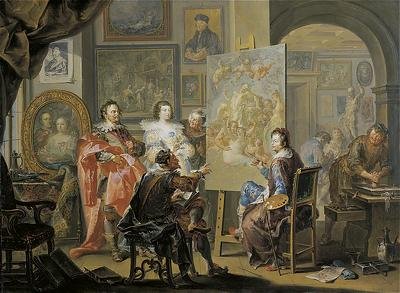
 

The Artist’s Studio by Johann Georg Platzer

The Artist's Studio by Johann Georg Platzer

My featured artist for My Daily Arty Display is the Austrian painter and draughtsman, Johann Georg Platzer, who was born in 1704 in St Paul in Eppan,  a small village in the South Tyrol, Austria.  He came from a family of painters and was tutored, when young, by his stepfather Josef Anton Kessler and then later by his uncle Christoph Platzer, who was the court painter in Passau. In 1724 at the age of twenty, he painted an altarpiece for the church of St Helena in Deutschnofen. Probably after 1726 he went to Vienna, where he enrolled at the Akademie der Bildenden Künste and became a friend of Franz Christoph Janneck, one of the leading lights of Austrian Rococo art.   Perhaps because of a stroke that impeded his work, he returned to St Michael in Eppan by 1755.  In 1761 Platzer died aged 57.

Platzer produced a great number of small paintings, mostly on copper. He was the most important master of the informal group portraits, known as conversation pieces in 18th-century Austria.  His cultivated embourgeoisé public was fascinated by the skilful manner, lively colours and countless details of his compositions. According to the principles of modesty and good manners, he chose his models and style to suit the subject-matter: for histories and allegories he took his models from antiquity, the Renaissance and Italian and Flemish Baroque art, as in Samson’s Revenge which hangs in the Belvedere in Vienna.   In his genre scenes and more so his conversation pieces, one can detect the inspiration of the French Rococo and the Netherlandish cabinet painters, while in his scenes of today’s featured painting, The Artist’s Studio, his academic knowledge is revealed.

My Daily Art Display is, as I have just said, The Artist’s Studio by Johann Georg Platzer .  This oil on copper painting shows the interior of an artist’s studio.  If we look at the painting we see the various stages in the production of a painting.   In an arched recess in the right background, behind the figure of the man grinding pigments, we can see a group of young students intently drawing the anatomy of an écorché, a figure drawn, painted, or sculpted showing the muscles of the body without skin.   Their silent work ethic provides a telling contrast with the outspoken and garrulous ways of the old art critic.  Above the heads of the students Platzer has introduced one of his own history paintings: The Samnites before Curius Dentatus.

In the centre foreground we are witnesses to the animated conversation which is taking place  between the old critic seated on a stool and the artist himself.  The artist, who has been at work on a freely-painted picture of a Bacchanale in the Venetian style, has interrupted his painting to listen to his elderly visitor, who gestures towards the picture on the easel, as though providing a critique of the painting, or maybe he is just talking about art in general because in his lap we see a book which may be a theoretical tome.  The inclusion of the book could well be Platzer’s condemnation of art critics by pointing out to us that the critic has probably gained all his artistic knowledge from books and has little or no practical experience of painting.

To the left of the artist and the critic stand an elegant and aristocratic couple wearing seventeenth-century costume, probably patrons of the artist.  While her husband strikes a swaggering pose reminiscent of a full-length portrait by Van Dyck, his wife, also wearing a Van Dyck dress, looks out of the picture, as though coolly appraising us, the viewers, with an air of scornful disdain.  The addition of paintings on the walls reminds one of the 17th century Flemish paintings which depicted collector’s picture galleries which of course alluded to their wealth.  In the middle of the back wall hangs a genre painting in the style of Teniers, an artist who was very popular with 18th-century collectors. If we look above the top left corner of the easel we can see a copy of Holbein’s Portrait of Erasmus.  To the left, by the window, there is an engraving after Van Dyck’s Portrait of Gustavus Adolphus of Sweden pinned to the wall.  His costume reflects that of the elegantly dressed visitors below.   Just below the engraving, in an elaborate carved and gilded frame we can see a picture, which has a self-portrait of Platzer looking over the shoulder of a beautiful young woman as she offers a scrap of food to a parrot.  This double representation, male with female, is in the tradition of marital portraits, but strangely Platzer himself never married, so we can only wonder at his reasoning for the inclusion of this painting.  Could she be his favourite model or even his mistress?

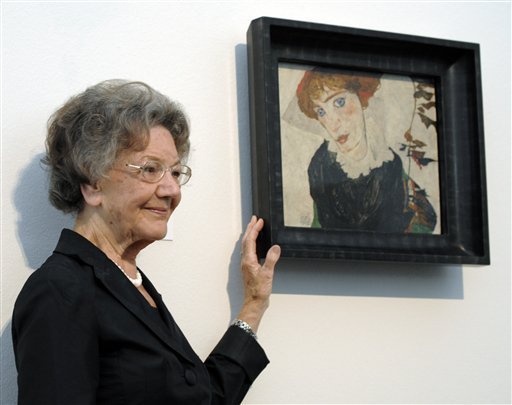
Portrait of Wally by Egon Schiele

Portrait of Wally by Egon Schiele

My Daily Art Display today is a continuation from yesterday’s life of Egon Schiele so if you have just landed on today’s page, it would be worthwhile for you to look at yesterday’s blog before reading today’s offering.

The story of Egon Schiele’s life in My Daily Art Display yesterday reached 1910 when the artist had reached twenty years of age and was living in Vienna.   He was the complete bohemian, an independent free spirit, and a great draughtsman with little or no care for anyone or anything outside his own close circle.  The following year, Schiele met the seventeen year old artist model, and at one time a model for Gustav Klimt, Valerie Neuzil, whom he nicknamed “Wally”.  He was immediately mesmerised by her youthful beauty and soon she moved in with him and became his lover as well as his model.  Schiele had fallen out of love with Vienna and he and his lover moved to Cesky Krumlov in Southern Bohemia, the birthplace of his mother.  His residency here did not last long as the residents were up in arms with his and his lover’s behaviour and his use of local teenage girls as his nude models.  Reluctantly he moved back to Austria and he and Valerie set up home in Neulengbach, a quiet village in the pastoral, tranquil countryside of Lower Austria, some twenty miles to the west of Vienna. 

This was a mistake on the part of Schiele because although Vienna tolerated his bohemian way of the life, this small village with its retired officers and elderly neighbours, who were always interested in their neighbours’ business, certainly did not.  Schiele’s studio had a small garden attached to it and this became home to many of the local children who sought escape from their mundane lives.  Schiele managed to persuade many of the young girls to pose for him, often naked so that he could indulge in the intimate figure drawings that had become an obsession to him since he lost his childhood interest of sketching trains.   His behaviour and his use of under-age girls as models fell foul of the authorities.  The final straw came when a thirteen year old girl, Tatjana van Mossig, daughter of a retired naval officer ran away from her home and sought refuge at the home of Schiele and his lover “Wally” and although she returned home “unharmed” after a week, her father accused Schiele of kidnapping.  He was arrested by the police on April 13th 1912, for seducing the girl below the age of consent.   The police, when they arrested Schiele, raided his workshop and confiscated many of his drawings which they termed as pornographic.   He came before the judiciary and was sentenced to twenty-four days in prison for exhibiting pornographic material – the original charge of seducing an underage girl having been dropped prior to his trial.  During his time of incarceration, he produced thirteen watercolour drawings that bear witness to his “sufferings”.

Once released it was obvious to Schiele that he had to move away from Neulengbach and he returned to Vienna where he rented a studio which he retained for the rest of his life.  By 1914 Schiele’s financial situation was dire even though he had good reviews for some of his exhibited works and had gained a couple of new patrons.   This same year his favourite sister Gertri marries his friend.  It was at this point that Schiele realises he needed a wife and although he still lived with his lover Valeri “Wally” Neuzil, he resolved to find a more “acceptable” partner.   He intensifies his relationship with two sisters, Adele and Edith Harms whom he had recently encountered and who lived with their middle-class bourgeois Protestant parents across from his studio.  A year later, in 1915 he decided, (in his wisdom?), to marry the more socially-accepted Edith, the younger of the sisters.  However he had not given up his relationship with “Wally” who had always remained faithful to him but was considered by him to be socially inferior in comparison to the Harms’ girls.  He asked her if she would remain his lover.   She was devastated by the turn of events and, not unexpectedly, she would not agree to Schiele’s strategy and she left him.  Schiele and Edith married on June 17th 1915 on the wedding anniversary of his parents. 

World War I intervened and Schiele was called-up to join the army.  He was stationed in Prague and fortunately for him the officers of his corps were so impressed with his artistic talents they allowed him to continue with his art whilst he was involved in non-combative work for the army.   Schiele was never involved in the fighting and managed to keep well away from the Russian Front.  In 1917 he was transferred to the Military Supply Depot in Vienna.  His duties were relatively light and he was able to carry on with his art and continued to regularly exhibit his works in the Austrian capital as well as Zurich, Prague and Dresden.

In February 1918 Gustav Klimt dies and suddenly Egon Schiele is recognised as the leading Austrian artist.  His new status is confirmed by his sell-out exhibition at the Vienna Secession that March.  In June he is transferred to the Army Museum where he is given free rein to pursue his artistic activities.  He becomes financially better off and moves into a larger studio.  Sadly, the Spanish flu epidemic hit Europe, claiming the lives of twenty million people.  Vienna was eventually affected by this devastating epidemic and one of its victims was Schiele’s wife Edith who was six month pregnant.  Sadly, three days later on October 31st 1918, the 28 year-old artist, Egon Schiele, died.

The painting featured in My Daily Art Display is entitled Portrait of Wally and was completed in 1912.  It was bought in 1954 by Rudolf Leopold, a wealthy Austrian art collector, whose collection of more than 5000 works of art were bought by the Austrian government and became part of the collection of the Leopold Museum.  However when an exhibition of Schiele’s works including today’s painting was held at the Museum of Modern Art in New York in 1997, this painting was seized on the orders emanating from the New York County District Attorney.  The U.S. customs refused to let the work leave the country after Henry Bondi of Princeton, N.J., filed a claim that said his late aunt, Lea Bondi Jaray, was forced to sell the painting at a vastly reduced price to the Nazis before fleeing Vienna in 1939 to escape to London when Germany annexed Austria. 

Member of Leopold Museum staff with returned painting (2010)

The litigation brought by Henry Bondi lasted twelve years and was finally settled in 2010 when the Leopold Museum of Vienna agreed to pay 19 million US dollars to the estate of Lea Bondi Jaray who died in 1969 and her nephew Henry who brought the litigation had also passed away.

Woman with Homunculus by Egon Schiele

Woman with Homunculus by Egon Schiele (1910)

The best laid plans of mice and men….. etc etc.   I had intended to travel to London yesterday and visit a couple of art galleries including the Queens Gallery to see the Dutch Landscape exhibition but because of a certain visitor by the name of Mr Obama the Buckingham Palace Gallery was closed to the public.   However I did go to the National Gallery to see The American Experiment, a small exhibition of paintings by the Ashcan School of painters which was small but made for excellent viewing.   More about that later in the week.

Richard Nagy Gallery exhibition

As I had time on my hand I decided to visit the Richard Nagy private gallery in Old Bond Street and have a look at an Egon Schiele exhibition.  I am not sure what I expected to find at this display but the weekend newspapers gave it a “Must not miss” tag so I had high hopes.   They were not wrong.  It is a small but excellent exhibition and you should really try and visit it before it closes on  June 30th.  I remember when I visited Vienna at the end of last year; the three beloved artists of that country were Klimt, Kokoschka and Schiele.  This exhibition had more than forty paintings and drawings by Schiele which had not been previously seen together in a UK gallery and which of course is just the tip of his iceberg as he has more than four thousand works attributed to him. 

I intend to look at the life of Schiele over the next two days and see if I can offer you examples of his work, which are not likely to offend my readers.  I am not sure one can shy away from the word “pornographic” by clouding it with the word “art” but then it is a matter of opinion.  You will be able to look at his more risqué works on the internet and then decide for yourself.  It is up to each individual to decide when  art crosses the line from being erotic and sensual to becoming pornographic.

Egon Schiele was born in 1890 in the small Austrian town of Tulln, which lies on the River Danube, just outside Vienna.  He was the first and only surviving son of  Adolph and Marie Schiele.   His mother Marie came from Krumau (now Cesky Krumlov) in Bohemia and his father Adolph, an Austrian, was a station master for the State railways.  Schiele had two sisters, Melanie who was four years older than him and Gertrude who was four years his junior.   They all lived with their parents in an apartment above the Tulln train station which was also the place of work for their father.  Egon went to the local school and soon developed a love for art. His parents hoping he would be university-material enrolled him at the age of eleven as a boarder at the Krems Realgymnasium some twenty-five miles from their home.   Although his father had hoped he would use his artistic skills coupled with his seeming love of trains to become a railway engineer,  it was not to be.  His father lost patience with young Egon when he fell behind in his academic studies due to his fixation on art and at one point his father destroyed his sketch books.

In 1904 Adolph was taken ill having contracted syphilis.   He had to leave his job and that year he died.  It was a prolonged and painful death, with its sickness and eventual insanity and it affected Egon badly. Ten years later he wrote to a friend recalling this harrowing time.  In the letter he wrote:

“… I don’t know whether there is anyone else at all who remembers by noble father with such sadness.  I don’t know who else is able to understand why I visit those places where my father used to be and where I can feel the pain…….Why do I paint graves and many similar things?   Because this continues to live in me….”

Later, his sister, Melanie, would assert that her brother’s promiscuity was a challenge to the “Gods” to inflict him with the same disease which had killed his father.  The death of the main breadwinner caused the family financial hardship and Egon’s mother had to turn to Egon’s uncle, Leopold Czihaczek for help.  He eventually became joint guardian of the boy.

Egon attended the School of Arts and Crafts in Vienna which was the old alma mater of Klimt.  Schiele excelled at this school, so much so, that in 1906, he transferred to Vienna’s Akademie der Bildenden Kunste, the more traditional route for aspiring artists.  It was around this time that he met and was mentored by Gustav Klimt who appreciated the young Schiele’s talent.  Klimt even bought some of Schiele’s works as well as swapping some of his own work with that of the young would-be painter.  Schiele owed a lot to Klimt who put him in touch with potential buyers and Schiele held his first exhibition at the age of 18.  A year later in 1909 he left the Academy disillusioned with its teaching style and artistic constraints.  He joined a group of like-minded painters to form the Neukunstgruppe, (New Art Group).

Although Schiele had benefited immensely from what he learnt and who he met at the Academy he had felt artistically constrained and once away from the establishment he began to delve into not just the human form but also human sexuality.  It was this aspect of his paintings and drawings which was to engender controversy.  His critics described some of his works which focused on death and sex as grotesque and pornographic.  His portraits, often of nudes were painted in a realist manner and that was what probably upset some of his detractors.  Schiele took part in the International Jagdausstellung in Vienna in 1910 and he showed his life-sized, seated female nude.  Allegedly when Emperor Franz Joseph saw it he turned away muttering “This is absolutely hideous”

The Egon Schiele painting I am featuring in My Daily Art Display was painted by him in 1910 and is entitled Woman With Homonculus.  A homunculus being a scale model of a human body and refers to the seated figure to the right of the woman which tries to cling to her.  This is undoubtedly an erotic painting of a woman with her back to us, wearing only a pair of black stockings.   She has twisted her upper torso around to look over her shoulder at us in a coquettish fashion.  The reddening with rouge of the tip of her left breast and nipple can just be seen and it is this “just be seen” look which tantalises the viewer.   It is most certainly a pose and a look of a seductress and I believe she is wondering what we make of her body –  but I am sure she already knows the answer.

Tomorrow I will complete the life story of Schiele and show you a few more of his paintings and sketches.

Woman in a Yellow Dress by Max Kurzweil

Woman in Yellow Dress by Max Kurzweil (1899)

It is would be quite easy for me to play safe and just offer you works of art by famous painters but one of the things I like doing most with My Daily Art  Display is to discover and highlight artists whom I have never heard of before.   I find it very enjoyable and stimulating to research into their lives and searching out their works of art.  I hope by offering you works of artists you have never heard of will also give you some pleasure and maybe make you curious to find out more about their lives and their art.

Today My Daily Art Display is about the Austrian painter and printmaker Maximilian Kurzweil who was born in 1867 in Bisenz, which is now known as Bzenec in the Czech Republic.  He first studied art at the Academy of Fine Arts Vienna.  At the age of twenty five he travelled to Paris and attended the Académie Julian and it was here that he first exhibited his paintings.  Whilst living in France he visited the Breton harbour town of Concarneau and fell in love with the area, its vivid sunrises and sunsets, its people and the busy port with its sailing ships and fishing fleet.  In 1894 he returned to Vienna and the Academy and studied the art of portraiture.  He began to be influenced by French art especially Impressionism and plein-air painting which showed him the way to use lighter – much brighter colours than those he used before.

In 1895 he married Martha Guyot a woman from Brittany and they used to spend their summers in Brittany and their winters in Vienna.  In 1896, at the age of twenty nine he became a member of the Künstlerhaus in Vienna but the following year he, along with Kustav Klimt, became founder-member of the Vienna Secession, also known as the Union of Austrian Artists, which was a group of Austrian artists who had resigned from the Association of Austrian Artists, housed in the Vienna Künstlerhaus.  This movement included painters, sculptors, and architects.  He was also editor of the Secessionist magazine Ver Sacrum (Sacred Spring).  Kurzweil participated in their exhibitions with such paintings as Woman in a Yellow Dress which is My Daily Arts Display painting for today and which Kurzweil painted in 1899.

Maximilian Kurzweil was also professor at the Frauenkunstschule, an academy in Vienna for female artists.  He committed suicide in 1916, aged 49 after having shot a female student who was his lover.  Although his artistic career was cut short he is held in high esteem and ranks almost as high as the two great Austrian artists Gustav Klimt and Egon Schiele.

Woman in a Yellow Dress is a stunning painting of his beautiful wife Martha.  Her arms are draped over the back of a chaise longue which is upholstered in a green patterned fabric, as she gazes out at us in a languid and relaxed pose.  There is a supreme look of contentment in her expression.  The yellow dress with its many tones is in total harmony with the sofa and compliments her pale limbs.

Die Windsbraut by Oskar Kokoschka

die Windsbraut by Oskar Kokoschka

Today I am composing my My Daily Art Display blog from Vienna.   I have bestowed upon myself an early Christmas present – a three day holiday in the Austrian city and with it, a chance to visit three of the city’s wonderful art galleries.  As I am in Austria, I thought it only right to feature an Austrian artist in today’s blog.  One of the country’s three most illustrious painters, along with Egon Schiele and Gustav Klimt, was Oskar Kokoschka, who was born in 1886 in Pochlarn, a small town on the Danube.  His father was a goldsmith from Prague and Oskar was his second of four sons.

Oskar graduated from a state school and then went to Vienna where he studied at the Vienna School of Arts and Crafts from 1905 to 1909.  During that time, he also worked at The Vienna Workshops, at which in 1908 they published his book, Die Träumenden Knaben (The Dreaming Youth).  His book, which as well as comprising of a number of his colour lithographs, was accompanied by some of his own poems.  Originally the book had been planned for children but the nature of some of his writings was deemed to be more suitable for adult readers.

In 1912, Kokoschka met Alma Mahler, the widow of the great composer Gustav.  Within a year of that first meeting they became inseparable.  The affair lasted for years but eventually their relationship deteriorated and their passion for one another waned and they began to drift apart.  Alma bargained with Kokoschka challenging him to paint a masterpiece for her and in return she would marry him.   Kokoschka was consumed with this task and the “reward” at its completion. 

The painting, die Windsbraut, (The Tempest) was one of his most famous works, which now hangs in the Kunstmuseum Basle.  The picture shows the lovers side by side sheltering from a ferocious storm.  His early preliminary sketches for this work show the bodies of the lovers almost as one, hand in hand but the final picture shows space between them and their hands apart.  Maybe Kokoschka, as time went by, realised that his relationship with Alma was coming to an end.  In the picture, whilst Alma looks peaceful and contented, the face of Kokoschka is more pensive and shows signs of worry.  Was this because of the storm or was it his realisation that his beloved affair with Alma was doomed.  It is not a look of a lover’s satisfied contentment.  It is a sad look, almost one of bereavement – the death of the affair – the imminent loss of his soul mate.