Automat by Edward Hopper

Automat by Edward Hopper (1927)

“All the lonely people, where do they all belong? “

I am sure the words from the Beatles song Eleanor Rigby are known by most people.  Loneliness can be a terrible burden to have to bear and its often associated with the impersonality of a large city, which although teeming with people, they seem to remain as strangers, whereas within small village communities there is a sense of camaraderie and friendliness which ensures that with a minimum of effort your loneliness can be banished. 

 My Daily Art Display featured painting for today is entitled Automat by the American artist Edward Hopper, which he completed in 1927.  His theme of loneliness and the loneliness of city life was a constant theme in a number of his paintings.  Look back to My Daily Art Display of January 23rd when I featured his famous work entitled Nighthawks. 

In today’s painting we see a woman, with her cloche hat pulled low down over her forehead, staring into her coffee cup as she sits by herself, in what Hopper terms as an Automat.  I have to admit I had never heard of this term before  but I believe they were what we would now call fast food outlets,  which served simple food or drinks,  and which were served by coin-operated and bill-operated vending machines but I guess the machines have been removed an there is waitress service nowadays.   There is a starkness about the setting, almost but not quite minimalist.  Like the scene in Nighthawks there are just windows but no doors on view, giving a slight sense of entrapment.  Her look of preoccupation would suggest she may be, for some reason unknown to us, mentally entrapped.

The woman we see before us is pensive, her eyes are downcast and to my mind she seems a little sad.  She is well dressed with her warm winter coat with its fur collar and cuffs.  She wears makeup so maybe she is on her way for an evening out or looking how dark it is outside, maybe she is on her way back home.  Of course we are not really sure whether she is on her own or whether the empty chair at her table is for somebody else.  Maybe she is awaiting her companion or is her despondency due to the companion’s non-arrival.

Another strange thing about the woman is that she has only one glove on.  Could it be that this café is not only a lonely place but also a cold one and the one glove is all she wanted to remove so that she could hold the cup and yet still retain some warmth?  The dark window takes up a lot of space in the painting and its darkness adds to the atmosphere of the painting.  It is pitch-black outside and, along with the way the woman is dressed, gives us the feeling that this scene takes place on a cold autumn or winter night.  There is no sign of life outside, no people, no lights from other buildings and no headlights from cars.  This lack of outside lights works well and allows just the penetration of the blackness by the reflection of the café lights to be more effective and in so doing adds to the feeling of isolation. Does Hopper want to liken the woman’s mood and her life to this view of the window – dark with little going on in it?  She is in the middle of a deserted town which adds to the sense of her isolation and solitude.  Note how Hopper has painted the woman’s legs.  The brightness of his colouring of them draws our eyes to them even though they are under the table.  It adds a little bit of overt sensuality to the painting and makes us wonder how such a woman could feel sad and lonely.  We are now concerned about her vulnerability.  Is her pensiveness also due to her feeling vulnerable as she sits alone in this café?

Time Magazine, August 1995

Hopper’s painting and ones of a similar theme are linked with the perception of urban alienation, which by definition is the state of being withdrawn or isolated from the urban world, as through indifference or disaffection.  It is interesting to note that in August 1995 Time magazine used this painting on its front cover with its lead article dedicated to stress, anxiety and depression.

Loneliness is often the central subject matter in Hopper’s art. The people he depicts look as though they are far from the comfort and reassurance of home. We see clues as to their isolation in the way they stand reading a letter beside a hotel bed or drinking in a bar. They stare out of the window of a moving train or read a book in a hotel lobby. Their faces often have the look of vulnerability and introspection. They look like they may have just been jilted or have just broken up with someone. They often seem to be mentally searching for something or someone and have been cast adrift in transient settings. His paintings are often set at night, as this adds to the mood and evocatively all we see through the window is darkness.

Yet despite this bleakness we witness in Hopper’s paintings, they are not themselves bleak to look at – perhaps because they allow us, the viewer, to witness some of the artist’s grief and disappointments, and from that we feel less personally persecuted and beset by them.  It is as if we suddenly realise we are not the only person to feel sad or depressed, for isn’t it true that sometimes a sad book consoles us more when we feel sad.  Maybe we just need to realise we are not alone in our sufferings. 

In some ways Hopper has challenged us to make up our own mind about the story behind the painting.  There is no action going on to give us any clues.  Maybe the story we come up with will depend on our own state of mind.  If we are happy, we may well believe that the woman is thinking about the coming to the café of her beloved.  If we ourselves are feeling lonely and slightly depressed then maybe we empathize with the woman and share her isolation and vulnerability.  So what is to be?  What is your take on the scene in the painting?  Maybe it is at times like this, when we look at the painting and we perceive the loneliness and unhappiness of the woman that we should take time to be grateful for what we have.  Maybe we should not always desire something else.  Maybe we should want what we have.

The Embarkation at Margate of Elector Palatine and Princess Elizabeth by Adam Willaerts

The Embarkation at Margate of Elector Palatine and Princess Elizabeth by Adam Willaerts (1623)

Another day another Dutch artist but we move from the countryside and animals to sea and ships.  My featured artist today is the Flemish painter Adam Willaerts, who was actually born in London.  Born to Flemish parents in 1577 he was a painter of the Dutch Golden Age, a period in Dutch history, approximately spanning the 17th century, in which Dutch trade and science, military, and art were some of  the most admired and highly-praised in the world.  The reason of his birthplace being in England was because his parents had to flee Antwerp to avoid religious persecution.  They returned to their Flemish homeland in 1585 and Adam remained there for the rest of his life.  He spent the majority of his time in Utrecht where he became a member of the local Guild of St Luke.   The Guild of Saint Luke was the most common name for a city guild for painters and other artists in early modern Europe, especially in the Low Countries. They were so called in honour of the Evangelist Saint Luke, who was the patron saint of artists.

The Arrival of the Elector Palatine at Flushing by Adam Willaerts (1623)

Willaerts was known for his paintings of rivers and coastal landscapes but in particular his depictions of grand arrivals or departures of ships carrying dignitaries, which is exactly what is shown in my featured painting in today’s My Daily Art Display.  This is one of a series of paintings produced to document the marriage of Frederick V, Elector Palatine, to Princess Elizabeth, daughter of James I and Anne of Denmark, in 1613.   It was painted ten years after the event in 1623 by Adam Willaerts in and is entitled The Embarkation at Margate of Elector Palatine and Princess Elizabeth.  The painting was acquired by Queen Victoria in 1858 and can now be seen in the Queens Gallery at Buckingham Palace. 

The Arrival at Vlissingen of the Elector Palatinate Frederick V by Hendrick Cornelisz Vroom (1623)

One presumes that the painting was commissioned in the Netherlands around the same time that other artists such as Hendrik Cornelisz Vroom in 1623 and Cornelis Claez van Wieringen in 1628 were commissioned to paint similar works. 

Embarkation of the Elector Palatine in the Prince Royal at Dover 25 April 1613 by Claes van Wieringen (1628)

So who were these people and what were they doing in the south-east English port of Margate ?  Frederick, or to give him his Germanic title, Friedrich V, was the protestant Elector Palatine of the Rhine and for a short time King Fredrick I of Bohemia.  His wife was Princess Elizabeth the daughter of the protestant King James VI of Scotland (and simultaneously King James I of England).  In 1619 Frederick accepted the crown of Bohemia and ruled in Prague for one winter (hence his name the ‘Winter King’) before being defeated in 1620 by the Imperial army.  The couple arrived as exiles in the Netherlands in 1622 and were formally deprived of the Palatinate by imperial edict in 1623.

Princess Elizabeth married Frederick in London on February 14th 1613 and after prolonged celebrations sailed from Margate on 25 April 1613 for Heidelburg and Prague, via the port of Flushing (in Dutch: Vlissingen).  The couple were seen off by James I and Anne of Denmark both of whom can be seen in the foreground of the painting; they then were rowed out by bargemen in livery and brought aboard the sailing vessel, Prince Royal, which we can see lying at anchor awaiting the arrival of its distinguished guests.  The vessel, Prince Royal was built in 1610 by Phineas Pett for Henry Prince of Wales, the king’s eldest son.  This in all probability explains its “HP” monograms, Henry’s initials, (Henricus  Princeps)  and the Prince of Wales feathers as well as a figurehead of St George on a horse.  Prince Henry did not attend his sister’s wedding to Friedrich as he died of typhoid fever, aged 18, a year before the event. The painting depicts a scene of pomp and ceremony as King James I sees off his daughter Princess Elizabeth and her husband.  The beach scene with its mass of figures is typical of Willaert’s works.  The ship lies in the centre of the picture surrounded by a blaze of natural, but highly suggestive white light.

Critics of the painting were less than enthused by the depiction of the choppy sea with one describing it as “a rolling vegetable patch, with cresting waves emerging like florets of broccoli sprouting from the soil”. 

Rather harsh but if you zoom in on the waves there is that look as described by the critic!!!!

The Young Bull by Paulus Potter

The Young Bull by Paulus Potter (c.1647)

After yesterday’s controversial and somewhat depressing painting by Klimt I thought I would lighten spirits with not one but two paintings which have a connection to each other.   I don’t really have a forward plan of what my next featured painting will be, the choice is often coincidental.  For example, today I received in the mail a long awaited catalogue which goes with the Dutch Landscapes exhibition at the Queen’s Gallery, Buckingham Palace.  A couple of weeks ago I had intended to visit the exhibition and was not best pleased that the catalogue had not arrived before my trip to London.  However if you read my blog on that day you will know I never made the exhibition as the Gallery was closed owing to the state visit of Barrack Obama.

So I was looking through the catalogue this morning and came across a work that is on display in the exhibition by Paulus Potter.  I had intended to feature that painting but when I was researching the artists and his paintings I changed my mind and My Daily Art Display features his most famous painting entitled The Young Bull.  The reason I changed my mind was because of an interesting connection his painting has with one by a American Modernist painter, Mark Tansey – but more about that later.

Paulus Potter was born in 1625, in Enkhuizen, a harbour town in Northern Netherlands.  His painting speciality was that of animals, especially cows, horses and sheep in landscape settings.  From Enkhuizen he and his family moved to Leiden and later Amsterdam.  His father, an artist, taught his son the basics of painting.  We know that Paulus eventually arrived in Delft because it is recorded that when he was in his early twenties he became a member of the Guild Of St Luke in Delft. In 1649 he  moved on to The Hague where he married.  His father-in-law was a wealthy builder and through him Paulus was introduced to the rich and privileged of Dutch society and with this fortuitous turn of events Paulus had a market for his paintings.  He wasn’t to capitalise on that for long as his life was cut short by tuberculosis in 1654 at the young age of 28.

Today’s painting, an early example of Romanticism, entitled The Bull, was painted by the twenty-one year old Paulus Potter around 1647  and can now be found at the Mauritshuis in The Hague.  This remarkable life-sized painting was, in the early nineteenth century, as popular with the Dutch people as Rembrandt’s Nightwatch.  Paintings featuring cattle were de rigueur in Holland at this time.  The scene of a bull in the meadow in itself is unremarkable but what makes it so special is the amount of detail in the painting.  Look at the flies hovering around the back of the bull which stands in the shade of the tree.   Look too on the ground by the feet of the cow and you can just make out a small frog which is being watched closely by the cow which is lying on the ground.    The standing bull takes centre stage in the picture and the artist has added a cow, three sheep and a farmer.  To the right we see a low-lying meadow with some cattle grazing and in the distance, just visible on the horizon sheltering below a low dark threatening sky is a church spire.  This has been identified as the church spire of Rijswijk which is now a suburb of The Hague.

The Innocent Eye Test by Mark Tansey (1981)

So now to the second painting I promised.  This is a much more modern painting.  The painting entitled The Innocent Eye Test is by the American Postmodernist painter Mark Tansey.  His forte is monochromatic paintings, which are often amusing, sometimes mocking and often touch on the subject of art critics and their critiques.   The picture (above) which he painted in 1981 depicts a group of officials looking at a cow who in turn is staring at a painting.  They are wanting to take note of the cow’s reaction to seeing a life-sized painting of a cow and a bull .  The painting which is being observed closely by the bull is the Paulus Potter painting The Young Bull.  I am amused to see all the bespectacled officials in business suits or lab coats especially the one holding the mop which one must presume is in case the bull gets too excited by the painting and has an “accident”!!!

……….and finally another twist to the story of the paintings, below is a recent article from the  New York Times newspaper dated May 11th 2011, regarding Mark Tansey’s painting The Innocent Eye Test…….

“..British collector Robert Wylde filed federal suit against the Gagosian Gallery on Thursday over a Mark Tansey painting, “The Innocent Eye Test.” Wylde alleges that the Manhattan gallery concealed the Metropolitan Museum of Art’s 31 percent partial ownership of the work, and the fact that the museum planned to eventually to reclaim the painting altogether.

The Innocent Eye Test was originally owned by Artforum publisher and established art dealer Charles Cowles, then partially owned and promised to the Metropolitan Museum in 1988.  In 2009, collector Robert Wylde was shown the Mark Tansey painting at Cowles’ SoHo apartment, when Cowles was closing his Chelsea Gallery after 30 years.

Wylde, who lives in Monaco, purchased the Tansey through the Gagosian Gallery for $2.5 million on August 5th, 2009. In spring of 2010, a Gagosian lawyer contacted Wylde, when the gallery learned of the Metropolitan Museum’s partial ownership.

Gagosian Gallery is internationally renowned as a foremost art market institution, and rarely discloses transactions on the basis of client confidentiality and business discretion. Although this is not the first suit against the gallery – most recently, misidentified protester Ingrid Homberg filed after being removed from an Anselm Keifer show in February–the Tansey suit is uniquely sale-related.  Robert Wylde additionally contends that Gagosian Gallery canceled his Richard Prince sale when a higher offer was received.

Gagosian Gallery spokeswoman Virginia Coleman told the New York Times that Charles Cowles claimed clear title to the painting, and that, “the gallery acted in good faith.”

In lieu of the lawsuit, Cowles himself told the New York Times he considered the 2009 sale his mistake. He “didn’t think about” the Metropolitan Museum’s stake in the painting once it was returned from its initial showcase, and sold it through Gagosian in 2009 for financial reasons.

The Beverly Hills  Gagosian Gallery is set to show its latest Mark Tansey works in an upcoming exhibition from April 19th to May 28th. The gallery’s artist summary alludes to complex uncertainty, inviting the viewer to engage in the metaphorical aesthetic disorientation during exhibition..”

….and all this because my gallery catalogue arrived in today’s mail !!!


Three Ages of Woman by Gustav Klimt

Three Ages of Woman by Gustav Klimt (1905)

I have already featured paintings by two of the great Austrian artists, Egon Schiele (May 26th and 27th) and Oskar Kokoschka (Dec 10th), and today I would like to present a painting by an artist, who has been termed by many, as the greatest Austrian painter who ever lived.  Between 1900 and his death in 1918, Klimt dominated the art scene in Vienna.

The featured painting in My Daily Art Display today is entitled Three Ages of Woman which he painted in 1905.  It is also sometimes referred to as Mother and Child.  The painting is housed in the Galleria Nazionale d’Arte Moderna in Rome.  This was one of the artist’s most beloved paintings.  For Klimt, although he had painted smaller allegorical pictures, this was to be his first and one of his last multi-figured large-scale allegorical painting, which simply put, is a painting in which there is a pictorial representation of abstract ideas by the depiction of the characters or events in the painting.  It is a visual symbolic representation.  This painting by Klimt is about the transience of life and the permanence of death.

In the painting we see three women at different stages of life.  The youngest is the baby, representing infancy, who in turn is being cradled in the arms of the mother, who although is an adult, is a young adult, representing motherhood.  The third figure, on the left of the group is the old woman who represents old age.  These three figures have appeared before, slightly altered in form, in some of his earlier and later paintings, such as Medicine which he first exhibited at the 10th exhibition of the Secession Group in Vienna in 1901 and Death and Life which he completed in 1911.

The background of this is a sea of silver bubbles but the three figures are closely surrounded by unusual shapes.  So what are the shapes?  It is believed that Klimt had a great interest in the science of microbiology and the shapes floating above the head of the younger women resemble colonies of bacteria, whilst the older woman stands amid the elongated protozoa, which is associated with death and decomposition.  This painting is about transition – birth to death.  It reminds me of the words uttered at a graveside when the coffin is being lowered “while we are in life we are in death”.  It is the thought that on the day you are born you start the dying process.

The Old Courtesan by Rodin

Let us first concentrate our gaze on Klimt’s portrayal of the old woman.  There is nothing endearing about his depiction of the woman.  Some would have us believe that Klimt based his depiction of the old woman on Rodin’s sculpture called The Old Woman.  In the painting, the head of the elderly woman is bowed as if she has lost all her strength, both physically and mentally, and the will to carry on with life.  She is withering away.  Her right arm lies limply by her side.  Her breasts have sagged.  Her stomach muscles can no longer hold in her belly.  The veins and arteries in her hand and arm stand out.  Her left hand covers her face and by this gesture we take it that she wants to see no more of life.  She wants to close it out.  She has had enough.   She just wants to hide away from all the trials and tribulations that come with life. In her mind she has lived too long.

The mother with the child in the middle of the group represents beauty and the way she lovingly cradles the baby is a representation of the unconditional love of a mother.  See how she rests her head on the head of the child.  She is the personification of contentment and this look of contentment is mirrored in the face of the baby as she peacefully sleeps in the knowledge that the arms that hold him and the sound of his mother’s heartbeat offer him safety and affection.

So did the painting receive with universal acclaim?  Not really.  Many feminists viewed the painting with disdain pointing out that Klimt’s “message” is that a woman’s life is over after the young motherhood stage of life.  The overall feel to this painting is one of isolation.  The three women look as if they are trapped inside a column surrounded on both sides by a void.  After the death of his baby son, Otto, in 1902, Klimt became preoccupied with the subject of death and the passage of life on its unstoppable journey towards death.

This is a truly wonderful and yet disturbing painting and once again I would like to have been in the head of the artist as he painted this picture so as to understand what was going through his mind.


The Madwoman sometimes known as Hyena of Salpêtrière by Théodore Géricault

The Madwoman sometimes known as Hyena of Salpétrière.by Géricault (1823)

My Daily Art Display today is a painting by the French artist and pioneer of the Romantic Movement Théodore Géricault.  Many will be familiar with his two masterpieces, namely, Officer of the Hussars and The Raft of Medusa but today I am going to take a look at a rather disturbing portrait he completed in 1823 entitled The Madwoman or sometimes known as Hyena of Salpétrière.

But first, a little about the artist.   Théodore Géricault was born in 1791 in Rouen in the north west of France.  He began his art tuition under the tutelage of Carle Venet an expert painter of horses and the “sport of kings”.  He also spent time with the classical painter Piere-Narcisse Guérin who believed the young Géricault had great talent but lacked calmness and composure which was needed to become a first-rate painter.

He went on to study at The Louvre where he copied the paintings of the Masters, such as Rubens, Titian and Rembrandt.  He did this for almost six years and developed a love for their style of painting which he believed to be of much more importance in comparison to the new art genre Neoclassicism, which had begun to come to the fore at the end of the eighteenth century.  In 1816 he went to Italy and visited Florence, Rome and Naples and this trip was the start of his love affair with the art of Michelangelo.  Géricault’s first great success as an artist came in 1821 when he was thirty years of age and he exhibited The Charging Hussar at the Paris Salon. 

A Madwoman and Compulsive Gambler by Géricault

It was in 1821 and just three years before his death at the young age of thirty-three that he embarked on a series of ten portraits of the insane who were all patients of his friend Doctor Etienne-Jean Georget, the French psychiatrist who pioneered in psychiatric medicine and worked at the infamous Pitié-Salpêtrière Hospital in Paris.  They series of portraits were all of maniacs who had an obsession.  One was a person who stole children, one was a person who obsessed with gambling, one was a man who was obsessed with robbery, a kleptomaniac,  and the poor woman in our featured painting was obsessed with envy.  The name of the establishment derived from the fact that it had originally been a gunpowder factory and then later was converted to a dumping ground for the poor of Paris. It served as a prison for prostitutes, and a holding place for the mentally disabled, criminally insane and the poor.  Its other “claim to fame“was that it was infested by rats!

Portrait of a Kleptomaniac by Géricault

Of the ten portraits only five, including the one featured today, remain.  The Madwoman is housed at the Musée des Beaux Arts de Lyon.  In this painting Géricault has with compassion tried to capture and understand the image of mental illness.  Géricault, like many of his contemporaries, examined the influence of mental states on the human face and believed, as others did, that a face more accurately revealed character, especially in madness and at the moment of death. 

Let us look closely at the old woman in the painting.  She avoids our gaze as she looks downwards with slightly bulging eyes.  Her eyes are red-rimmed probably brought on by the amount of mental and physical pain she has had to endure.  Her mouth is tense.  You can see the anger in her face but angry with what?   Her case notes stated that she suffered from “envy obsessions” and maybe the slightest hint of a green tint to her face was the artist’s way to signify her obsession with envy.  Her expression was likened to that of a hyena and hence the subtitle of the painting Hyena of Salpétrière.

Gericault’s career was short-lived.  His love of horse riding was to be his downfall as after many riding accidents, which had weakened him, coupled with chronic lung infections, the young artist died after much suffering in Paris at the tender age of thirty-three. 

Géricault's tomb at Père Lachaise Cemetery, Paris

If you ever visit Paris you should, like I have done on many occasions, make the journey to the Père Lachaise Cemetery, which houses the graves and tombs of many famous people including that of Géricault, his bronze figure reclines, brush in hand, on top of his tomb.

Portrait of Savonarola by Fra Bartolomeo

Portrait of Girolamo Savonarola by Fra Bartolomeo (c.1498)

Baccio della Porta was nicknamed as such due to his house being near the Porta (“Gate”) San Pier Gattolini.  He would be later known as Fra Bartolomeo.  He was born in Savignano di Prato, a town in Tuscany in 1472.  As a teenager he worked in the workshop of Cosimo Rosselli, the Florentine painter.  Besides being a gifted artist and one of the most accomplished painters of the Italian Renaissance, Fra Bartolomeo was a very religious man and it was said that he spent as many hours praying as he did painting.  The Renaissance scholar John Van Dyke even went further calling him a religionist, a person addicted to religion in other words, a religious zealot.

During his late twenties Fra Bartolomeo became a follower of Girolamo Savonarola the fierce and passionate Dominican friar, who vehemently preached against the moral corruption of much of the clergy at the time.  He arrived in Florence in 1481 having been sent there by his order in Bologna to “go out and preach”.  Initially his sermons were met with little enthusiasm but over time his following grew.  By 1491, Savonarola stood before massive crowds with a fiery and fervent enthusiasm. He spoke to the masses and what he told them quickly earned him massive influence over all who heard him.  By this time printing had been introduced in Florence  and Savonarola was one of the first figures to use printing to spread political and religious propaganda.  It was not just the common peasant but artists, writers and members of the aristocracy who listened to this great orator and was swayed by what he preached.   For many, he was a prophet and what he uttered were words which came directly from God.  Savonarola loathed some of the religious art of the time with its eroticized Virgin Marys and the smirking putti such as could be seen in the works of Raphael.    Savonarola was opposed to the humanist trend which had become popular.  He hated poetry, literature, perfume, non religious art or anything that was vaguely “fun”.  Savonarola once stated:

“They have built up a new Church after their own patter. Go to Rome and see! In the mansions of the great prelates there is no concern save for poetry and the oratorical art. Go thither and see!” 

He persuaded painters and their patrons to burn and destroy all artworks that did not conform to his strict code of morality. This edict was listened to by many and the result was that thousands of the greatest Florentine masterpieces ever created by some of the giants of renaissance art were tossed into his notorious Bonfire of the Vanities in February 1497.

In 1492 the death of two of the most powerful men of the time and sworn enemies of Savonarola died within three months of each other.  In April, Lorenzo de Medici, the ruler of Florence and once patron of Savonarola died and in July that same year came the death of Pope Innocent VIII.  This immediately caused a power vacuum and in 1494 after Charles VIII of France invaded Florence and overthrew the Medicis, Savonarola emerged as the new ruler of the city of Florence.  His rule was one of total morality and he criminalized gambling and the wearing of decadent clothing.  For him the epidemic of syphilis, which was a growing scourge on the country, was God’s way of punishing the sexual transgressors and he condemned homosexuals and adulterers to death.

At the beginning Savonarola had the majority of the populace on his side and he became even more powerful but slowly and surely the Florentine people tired of his religious zeal and his ever more puritanical laws.  His laws were also beginning to affect trade and the once prosperous Florence was having financial difficulties.  Things became worse for Savonarola who on May 13, 1497, was excommunicated by Pope Alexander VI and the next year, 1498, Pope Alexander demanded his arrest and execution.  A crowd attacked the Convent of San Marco and Savonarola was captured.  He was charged with heresy, uttering false prophecies and sedition.  He was tortured for several days but would never renounce his words.  He stood trial, was found guilty and hung from a high cross and burnt alive.  His era was over and shortly afterwards normal Florentine life returned with the artists and Florentine art once again flourishing.

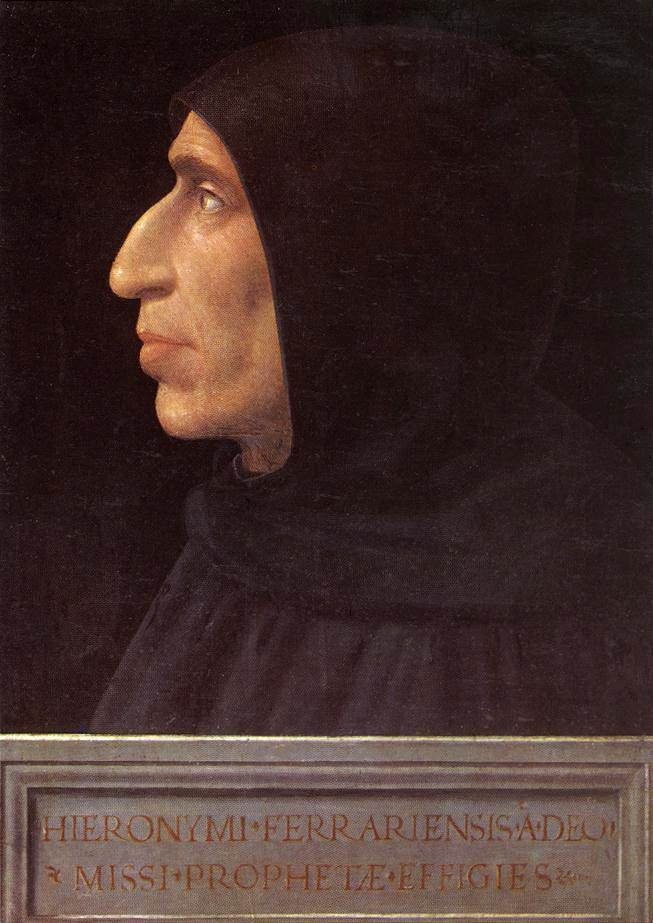
Fra Bartolomeo painted Portrait of Savonarola just before the Dominican friar was executed in 1498.  The head and shoulder portrait of the hooded monk is painted against a black background.  His unwavering look is stern and one feels that this was a man who held views, the dilution of which he would not countenance.  The portrait lacks any human warmth and for that reason one must believe that it is not only a good physical likeness but one which encapsulates Savonarola’s mental state.  The Latin inscription on the panel below the portrait proves that the monk was considered to be a prophet:

Portrait of the prophet Jerome of Ferrara, sent by God.”

The twenty-six year old Baccio della Porta was greatly distressed by the execution of Savonarola and two years later in 1500 he gave up painting all together and took his monastic vows and assumed the name Fra Bartolomeo.  He moved into the convent of Saint Marco in Florence.  It was not until 1504, with the authorization of the prior, did he resume painting and he dedicated the rest of his life to painting religious studies.  By 1508, Leonardo da Vinci, Raphael and Michelangelo had all left the city of Florence and Fra Bartolomeo became the leading painter of Florence.

The Artist’s Studio by Johann Georg Platzer

The Artist's Studio by Johann Georg Platzer

My featured artist for My Daily Arty Display is the Austrian painter and draughtsman, Johann Georg Platzer, who was born in 1704 in St Paul in Eppan,  a small village in the South Tyrol, Austria.  He came from a family of painters and was tutored, when young, by his stepfather Josef Anton Kessler and then later by his uncle Christoph Platzer, who was the court painter in Passau. In 1724 at the age of twenty, he painted an altarpiece for the church of St Helena in Deutschnofen. Probably after 1726 he went to Vienna, where he enrolled at the Akademie der Bildenden Künste and became a friend of Franz Christoph Janneck, one of the leading lights of Austrian Rococo art.   Perhaps because of a stroke that impeded his work, he returned to St Michael in Eppan by 1755.  In 1761 Platzer died aged 57.

Platzer produced a great number of small paintings, mostly on copper. He was the most important master of the informal group portraits, known as conversation pieces in 18th-century Austria.  His cultivated embourgeoisé public was fascinated by the skilful manner, lively colours and countless details of his compositions. According to the principles of modesty and good manners, he chose his models and style to suit the subject-matter: for histories and allegories he took his models from antiquity, the Renaissance and Italian and Flemish Baroque art, as in Samson’s Revenge which hangs in the Belvedere in Vienna.   In his genre scenes and more so his conversation pieces, one can detect the inspiration of the French Rococo and the Netherlandish cabinet painters, while in his scenes of today’s featured painting, The Artist’s Studio, his academic knowledge is revealed.

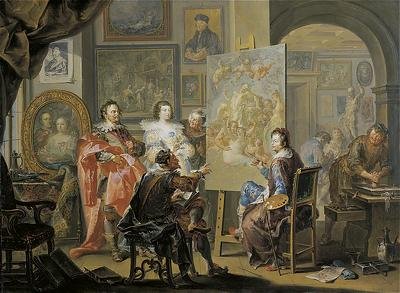
My Daily Art Display is, as I have just said, The Artist’s Studio by Johann Georg Platzer .  This oil on copper painting shows the interior of an artist’s studio.  If we look at the painting we see the various stages in the production of a painting.   In an arched recess in the right background, behind the figure of the man grinding pigments, we can see a group of young students intently drawing the anatomy of an écorché, a figure drawn, painted, or sculpted showing the muscles of the body without skin.   Their silent work ethic provides a telling contrast with the outspoken and garrulous ways of the old art critic.  Above the heads of the students Platzer has introduced one of his own history paintings: The Samnites before Curius Dentatus.

In the centre foreground we are witnesses to the animated conversation which is taking place  between the old critic seated on a stool and the artist himself.  The artist, who has been at work on a freely-painted picture of a Bacchanale in the Venetian style, has interrupted his painting to listen to his elderly visitor, who gestures towards the picture on the easel, as though providing a critique of the painting, or maybe he is just talking about art in general because in his lap we see a book which may be a theoretical tome.  The inclusion of the book could well be Platzer’s condemnation of art critics by pointing out to us that the critic has probably gained all his artistic knowledge from books and has little or no practical experience of painting.

To the left of the artist and the critic stand an elegant and aristocratic couple wearing seventeenth-century costume, probably patrons of the artist.  While her husband strikes a swaggering pose reminiscent of a full-length portrait by Van Dyck, his wife, also wearing a Van Dyck dress, looks out of the picture, as though coolly appraising us, the viewers, with an air of scornful disdain.  The addition of paintings on the walls reminds one of the 17th century Flemish paintings which depicted collector’s picture galleries which of course alluded to their wealth.  In the middle of the back wall hangs a genre painting in the style of Teniers, an artist who was very popular with 18th-century collectors. If we look above the top left corner of the easel we can see a copy of Holbein’s Portrait of Erasmus.  To the left, by the window, there is an engraving after Van Dyck’s Portrait of Gustavus Adolphus of Sweden pinned to the wall.  His costume reflects that of the elegantly dressed visitors below.   Just below the engraving, in an elaborate carved and gilded frame we can see a picture, which has a self-portrait of Platzer looking over the shoulder of a beautiful young woman as she offers a scrap of food to a parrot.  This double representation, male with female, is in the tradition of marital portraits, but strangely Platzer himself never married, so we can only wonder at his reasoning for the inclusion of this painting.  Could she be his favourite model or even his mistress?

Autumn by Jean-Baptiste Pillement

Autumn by Jean-Baptiste Pillement (1792)

On my journeys abroad I have always tried to visit the major public galleries, such as the Prado in Madrid, the Louvre in Paris and the Metropolitan Museum of Art in New York but I have never ever visited private galleries which I suppose could be termed “selling” galleries.  I have always thought I would feel slightly uncomfortable looking around the paintings knowing I had no intention of buying a work.  I did visit the Schiele Exhibition at the private Richard Nagy Gallery in London last week but that was advertised as an exhibition even though six of the paintings could have been bought by a viewer.  I was told the six on sale ranged between £280,000 and £3 million so that kind of put them out of my price range!  After leaving the gallery I was walking down Old Bond Street and happened upon another private gallery, Colnaghi, which according to the notice in the window had a small collection of Old Master Paintings.  I went in and asked if I could look around and they told me I could and I walked into their one main room which was probably about 20 metres square and hung on the walls were about twenty exquisite paintings.  I was the only person in the room and I could take my time to study these beautiful works of art.  The next time I return to London for a visit I will go to that Mayfair area and try and visit some of the other private galleries and see what other hidden gems are waiting to be discovered.

My featured artist today is Jean-Baptiste Pillement, the French artist, engraver and designer who was born in Lyon in 1728 and is best known for his Rococo style of painting and the engravings done after his drawings.  He was also well-known for his chinoiserie theme in many of his paintings and designs.  Chinoiserie being a French term for an artistic style which reflects Chinese influences.   His beautiful designs were used in porcelain and pottery as well as textile manufacture.  He became one of the most talented French landscape painters of the period.  His extensive travels throughout Europe gave him an opportunity to build a large portfolio of en plein-air drawings which he would later convert into beautiful landscape paintings.  Pillement was influenced by painters such as Francesco Zuccarelli, the great Italian Rococo painter, and Francois Boucher, the French painter and proponent of Rococo taste, who in the eighteenth century made pastoral paintings very popular.

When he was fifteen years old he moved to Paris and worked at the Gobelin factory which was a family run firm of dyers and manufacturers of tapestries.  Two years later he travelled to Spain to work as both a designer and painter and remained in the country for five years.  From there at the age of twenty-two he moved to Portugal and in 1754, aged twenty-six he travelled to London.  Whilst in England Pillement concentrated on landscape painting and soon he discovered a ready market for his quality works and the great English thespian, David Garrick became an avid collector of his work.

He left England in 1756 and journeyed around Europe.  He was employed as an artist at the Court of Marie Theresa and Francis I in Vienna.  In Warsaw he was commissioned to decorate the Royal Castle and the Ujazdowski Castle.  Wherever he went, whether it be St Petersburg, Milan or Rome he received lucrative commissions for his work and in Paris he worked for Marie Antoinette in the Petit Trianon.    In 1800 he returned to his birthplace, Lyon where he carried on painting, teaching at the local Academy and designing for the local silk industry.  Unfortunately for him the Rococo  genre was losing its popularity with the onset of the French Revolution and his commissions became less and less.  Due to his past association with matters royal, he was forced to seek refuge in the south of France, in the town of Pézenas. There he remained for ten years. It was during that time that he created some of his most admired works of art.  The last ten years of his life he spent in Lyon until his death in 1808, at the age of 80.

My Daily Art Display for today is a painting which I saw at the Colnaghi Gallery entitled  Autumn which Pillement completed in 1792.  This sun-drenched landscape has a feel of the 17th century Dutch Italianate paintings of Nicolaes Berchem and Jan Both and the French master of Arcadian landscape paintings, Claude Lorrain.  The romantic sensitivity of the painting probably emanates from his alpine travels and his contact with landscape painters such as Philippe de Loutherbourg.  Landscapes like this one by Pillement were very popular at the time, especially the sets of paintings showing the countryside during the different seasons.  Pillement painted a “companion” picture to go with today’s featured painting entitled Winter which was also present at the Colnaghi gallery.

The Art Student (Miss Josephine Nivison) by Robert Henri

The Art Student (Miss Josephine Nivison) by Robert Henri (1906)

Robert Henri, a leading figure of the Ashcan School in art, was born Robert Henri Cozad in Cincinnati, Ohio in 1865.  His father John Cozad was a real estate developer and founded the town of Cozaddale, Ohio and later when the family moved west, he founded the Dawson County town of Cozad in the state of Nebraska.  Robert had one brother, also named John, and was a distant cousin of Mary Cassatt, the much admired artist and printmaker.  In October 1882, Henri’s father became embroiled in a dispute with a rancher over the right to pasture cattle on land claimed by the family. When the dispute turned physical, Cozad shot Pearson fatally with a pistol. Cozad was eventually cleared of wrongdoing, but the mood of the town turned against him. He fled to Denver, Colorado, and the rest of the family followed shortly afterwards.  In order to disassociate themselves from the scandal, family members changed their names. The father became known as Richard Henry Lee, and his sons posed as adopted children under the names Frank Southern and Robert Earl Henri.  In 1883 the family moved again, first to New York City and then on to Atlantic City, New Jersey.

At the age of  twenty-one, Robert began studying art at the Pennsylvania Academy of Fine Art in Philadelphia under the tutelage of  Robert Anschutz, the painter who also taught several well-known painters including Everett Shin, George Luks and George Bellows who along with Henri would become known as the Ashcan School.  Two years later in 1888 Robert Henri travelled to Paris and studied at the Académie Julian and later he was admitted to École des Beaux Arts.  It was during this time that he embraced Impressionism.

In 1891 he returned to America and settled down in Philadelphia and began teaching at the Philadelphia School of Design for Women.  He became friendly with a group of artists and newspaper illustrators and they, William Glackens, George Luks, Everett Shin and John French Sloan, became known in artistic circles as the Philadelphia Four.  In 1898 he married Linda Craige who was a student attending one of his private art classes, and they set off on a two-year long honeymoon/vacation in France.

In 1902 he started teaching at the New York School of Art and many “soon to be famous” artists were taught by him, including Joseph Stella, Edward Hopper, Rockwell Kent, George Bellows, Louis Fancher, Stuart Davis and Norman Raeburn.  Sadly in 1905 after a long period of poor health his wife Linda died.

A year later in 1906 Robert Henri was elected to the National Academy of Design which would later be known as The National Academy Museum and School of Fine Arts but his tenure at this establishment was short lived for when works of art by his painter friends were rejected for the Academy’s 1907 exhibition, he resigned labelling the Academy as a “cemetery of art” and threatened to stage his own art exhibition.

He carried out his threat the next year, 1908, when he and his friends staged a landmark exhibition at the Macbeth Gallery in New York entitled The Eight after the eight artists who displayed their works).  Besides his own works and those of the Philadelphia Four who had moved from Philadelphia to be with Henri, the other exhibitors were Maurice Prendegast, Ernest Lawson and Arthur B Davies.  The exhibition was a sensation and these painters would soon become associated with the Ashcan School, which was a realist artistic movement and was best known for its portrayal scenes of daily life in the city of New York.  The name “Ashcan” was first used to describe the artistic movement some years later by the American cartoonist and writer, Art Young.

In May 1908 Henri married for a second time, this time to Marjorie Organ a twenty-two year old Irish immigrant.  Henri continued to paint and teach art  in various establishments and when he was sixty-four he was chosen, by the Arts Council of New York, as one of the top three living American artists.  A year later in 1929 Robert Henri died of cancer aged 65 and in 1931 the Metropolitan Museum of Art staged a Memorial exhibition of his work to honour this giant of American Art.

My Daily Art Display for today is a work by Robert Henri called The Art Student (Miss Josephine Nivison) which he completed in 1906 and was one of the paintings I saw at the National Gallery this week at their small exhibition entitled An American Experiment.   It is a life-sized oil on canvas painting (196cms x 98cms) and is quite dark.  The model for the painting was Josephine Nivison who studied with Robert Henri at the New York School of Art the previous year.  After Henri befriended her, she and some other students from his class travelled with him to Europe.  Miss Nivison later married another influential painter, Edward Hopper (see my blog Nighthawks on Jan 23rd) and she helped promote his work and acted as his model.

In the picture her body is undefined due to the all-encompassing heavy black artist’s smock she is wearing which reaches down to her feet.  We are just able to glimpse the white collar and the red patterned shoulder of her dress she wears under the smock.  Against a plain brown background, she clutches hold of her paintbrushes in her left hand as she looks out at us with a very determined expression.

This painting was one of only a few Robert Henri painted in 1906, the year after his wife’s death.

Portrait of Wally by Egon Schiele

Portrait of Wally by Egon Schiele

My Daily Art Display today is a continuation from yesterday’s life of Egon Schiele so if you have just landed on today’s page, it would be worthwhile for you to look at yesterday’s blog before reading today’s offering.

The story of Egon Schiele’s life in My Daily Art Display yesterday reached 1910 when the artist had reached twenty years of age and was living in Vienna.   He was the complete bohemian, an independent free spirit, and a great draughtsman with little or no care for anyone or anything outside his own close circle.  The following year, Schiele met the seventeen year old artist model, and at one time a model for Gustav Klimt, Valerie Neuzil, whom he nicknamed “Wally”.  He was immediately mesmerised by her youthful beauty and soon she moved in with him and became his lover as well as his model.  Schiele had fallen out of love with Vienna and he and his lover moved to Cesky Krumlov in Southern Bohemia, the birthplace of his mother.  His residency here did not last long as the residents were up in arms with his and his lover’s behaviour and his use of local teenage girls as his nude models.  Reluctantly he moved back to Austria and he and Valerie set up home in Neulengbach, a quiet village in the pastoral, tranquil countryside of Lower Austria, some twenty miles to the west of Vienna. 

This was a mistake on the part of Schiele because although Vienna tolerated his bohemian way of the life, this small village with its retired officers and elderly neighbours, who were always interested in their neighbours’ business, certainly did not.  Schiele’s studio had a small garden attached to it and this became home to many of the local children who sought escape from their mundane lives.  Schiele managed to persuade many of the young girls to pose for him, often naked so that he could indulge in the intimate figure drawings that had become an obsession to him since he lost his childhood interest of sketching trains.   His behaviour and his use of under-age girls as models fell foul of the authorities.  The final straw came when a thirteen year old girl, Tatjana van Mossig, daughter of a retired naval officer ran away from her home and sought refuge at the home of Schiele and his lover “Wally” and although she returned home “unharmed” after a week, her father accused Schiele of kidnapping.  He was arrested by the police on April 13th 1912, for seducing the girl below the age of consent.   The police, when they arrested Schiele, raided his workshop and confiscated many of his drawings which they termed as pornographic.   He came before the judiciary and was sentenced to twenty-four days in prison for exhibiting pornographic material – the original charge of seducing an underage girl having been dropped prior to his trial.  During his time of incarceration, he produced thirteen watercolour drawings that bear witness to his “sufferings”.

Once released it was obvious to Schiele that he had to move away from Neulengbach and he returned to Vienna where he rented a studio which he retained for the rest of his life.  By 1914 Schiele’s financial situation was dire even though he had good reviews for some of his exhibited works and had gained a couple of new patrons.   This same year his favourite sister Gertri marries his friend.  It was at this point that Schiele realises he needed a wife and although he still lived with his lover Valeri “Wally” Neuzil, he resolved to find a more “acceptable” partner.   He intensifies his relationship with two sisters, Adele and Edith Harms whom he had recently encountered and who lived with their middle-class bourgeois Protestant parents across from his studio.  A year later, in 1915 he decided, (in his wisdom?), to marry the more socially-accepted Edith, the younger of the sisters.  However he had not given up his relationship with “Wally” who had always remained faithful to him but was considered by him to be socially inferior in comparison to the Harms’ girls.  He asked her if she would remain his lover.   She was devastated by the turn of events and, not unexpectedly, she would not agree to Schiele’s strategy and she left him.  Schiele and Edith married on June 17th 1915 on the wedding anniversary of his parents. 

World War I intervened and Schiele was called-up to join the army.  He was stationed in Prague and fortunately for him the officers of his corps were so impressed with his artistic talents they allowed him to continue with his art whilst he was involved in non-combative work for the army.   Schiele was never involved in the fighting and managed to keep well away from the Russian Front.  In 1917 he was transferred to the Military Supply Depot in Vienna.  His duties were relatively light and he was able to carry on with his art and continued to regularly exhibit his works in the Austrian capital as well as Zurich, Prague and Dresden.

In February 1918 Gustav Klimt dies and suddenly Egon Schiele is recognised as the leading Austrian artist.  His new status is confirmed by his sell-out exhibition at the Vienna Secession that March.  In June he is transferred to the Army Museum where he is given free rein to pursue his artistic activities.  He becomes financially better off and moves into a larger studio.  Sadly, the Spanish flu epidemic hit Europe, claiming the lives of twenty million people.  Vienna was eventually affected by this devastating epidemic and one of its victims was Schiele’s wife Edith who was six month pregnant.  Sadly, three days later on October 31st 1918, the 28 year-old artist, Egon Schiele, died.

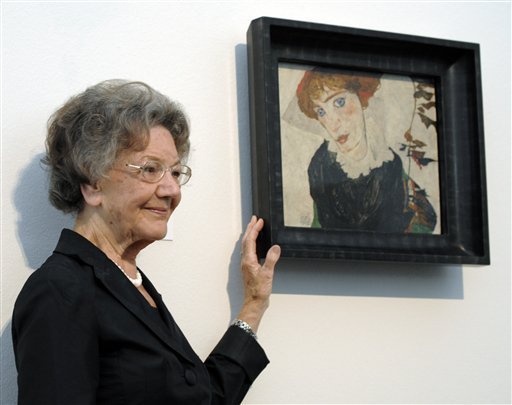
The painting featured in My Daily Art Display is entitled Portrait of Wally and was completed in 1912.  It was bought in 1954 by Rudolf Leopold, a wealthy Austrian art collector, whose collection of more than 5000 works of art were bought by the Austrian government and became part of the collection of the Leopold Museum.  However when an exhibition of Schiele’s works including today’s painting was held at the Museum of Modern Art in New York in 1997, this painting was seized on the orders emanating from the New York County District Attorney.  The U.S. customs refused to let the work leave the country after Henry Bondi of Princeton, N.J., filed a claim that said his late aunt, Lea Bondi Jaray, was forced to sell the painting at a vastly reduced price to the Nazis before fleeing Vienna in 1939 to escape to London when Germany annexed Austria. 

Member of Leopold Museum staff with returned painting (2010)

The litigation brought by Henry Bondi lasted twelve years and was finally settled in 2010 when the Leopold Museum of Vienna agreed to pay 19 million US dollars to the estate of Lea Bondi Jaray who died in 1969 and her nephew Henry who brought the litigation had also passed away.