American Lake Scene by Thomas Cole

American Lake Scene by Thomas Cole (1844)

In the mid nineteenth century a group of American landscape painters got together to form a group whose inspiration was the pride they had in the beauty of their homeland.  They were influenced by the Romanticism Movement that flourished at that time in Europe and many of this newly formed group had studied there and were familiar with the plein-air Barbizon School painters who had become very popular with both American patrons and collectors.  The early leaders of this Hudson River Movement were Thomas Doughty, Asher Durand and the artist which is featured in today’s My Daily Art Display, Thomas Cole.   This group of painters concentrated their art work on the Catskill, Adirondack and White Mountains areas and all along the Hudson River valley.  These were often untouched areas of great natural beauty.  There were three main themes reflected in the Hudson River School artists.  They wanted to depict in their works of art,  the discovery, exploration and the settlement of this area of America.  For most of these artists there was a devout belief that nature in the form of the American Landscape was an indescribable expression of God.  These artists would travel extensively through the sometimes inhospitable areas surrounding the Hudson Valley with its extreme environment just to be able to sketch and memorise the wild and rugged beauty of nature and then return to the safer surroundings of home where they would transfer their memories on to canvas.  Often their works of art, although painted with realism, would be made up of a combination of the many scenes they had witnessed during their wanderings in the wilderness.

Today’s artist Thomas Cole, although now looked upon as an American artist, was actually born in 1801 in Bolton in Lancashire, England.   He is regarded as the founder of the Hudson River School.  His family emigrated to America when he was seventeen and settled down in Steubenville, Ohio.  Cole started his artistic career, studying portraiture but achieved little success with his finished works.  It was then that he turned to landscape painting.  In his early twenties he moved around a great deal, living in Pittsburgh and Philadelphia before rejoining his parents in New York.  Whilst in New York he made an artistic breakthrough when he sold some of his landscape paintings to George Bruen, a prominent figure in the business and financial circles of New York.  So impressed was he by Cole’s work he funded the artist,  so that he could travel to the Hudson Valley and carry out some more paintings of that area.  On his return Cole displayed some of his art work, which he had completed, in a bookstore window.  The artist John Trumbull saw the paintings, bought one and put Cole in contact with some of his wealthy friends who became his most important patrons. 

The Thomas Cole House in Catskill

After this Thomas Cole never looked back and his reputation as a landscape artist grew.  He had a studio on the Cedar Grove farmstead in the town of Catskill, New York at which he completed most of his works of art.  In 1836, aged thirty five, he married Maria Bartow, who was the niece of the farmstead owner and they had five children.  Thomas Cole died in 1848, aged forty seven, at Catskill and the fourth highest peak in the Catskill Range mountain range was named Thomas Cole Mountain in his honour and his studio at the Cedar Grove farm became known as the Thomas Cole House and was declared a National Historic Site in 1999 which has been opened up to the public.

My Daily Art Display offering today is Thomas Cole’s oil on canvas painting entitled American Lake Scene which he completed in 1844, four years before his premature death, and which can be seen in the Detroit Institute of Arts.  If you look closely you will be able to make out a lone Native American sitting under the tree contemplating the tranquillity of the lake.  In this painting the clever use of colour and the natural setting adds to the atmospheric calmness and beauty of the scene.  Of this painting one art critic of the time said that the painting “looks like the earth before God breathed on it

This painting and many of his others was how Thomas Cole would have liked those pioneering days to have been as he was a great opponent of the railroad’s push into the heart of America destroying God’s beautiful landscape.  I believe, like Thomas Cole, we should try and appreciate and preserve more of the natural beauty of our countryside and fervently hope that the march to industrialism does not destroy all that we love.

La Lecture, Deux Femmes aux Corsages Rouge et Rose by Renoir

La Lecture, Deux Femmes aux Corsages Rouge et Rose by Renoir (1918)

My Daily Art Display for today is a painting by the French Impressionist painter Pierre- August Renoir.  He was born in Limoges, France in 1841.  He came from a working class family.  His father Léonard was a tailor and his mother Marguerite was a dressmaker.  At the age of 14 he was apprenticed to a M. Levy a porcelain-painter and he worked in the local porcelain factory.  His ability to draw was soon noted and he was soon working in the department which painted designs on the finished fine china.   At the age of twenty one he began studying art in Paris where he met Alfred Sisley and Claude Monet.  He led a very frugal existence at this time and often could not afford to buy the paints he needed for his art work.  Renoir was twenty three years of age when he exhibited his first paintings at the Paris Salon.  His works were greeted with much acclaim at the first Impressionist exhibition in 1874

In 1881 Renoir set off on his travels visiting Algeria, Spain and Italy.  In Italy he visited Florence and Rome and saw the works of the great Masters, such as Titian and Raphael.  In the summer of 1883 Renoir spent the summer in Guernsey, with all its varied landscapes with its beeches, cliffs, bays, forests and mountains.  Whilst there, he created fifteen paintings of the island.  From there he moved back to mainland France and for a time settled down in the Montmartre district of Paris and it was whilst here that he met Suzanne Valadon who modeled for some of his paintings including The Bathers and Dance at Bougival.  Valadon also was a model for Toulouse-Lautrec before becoming a noted painter herself.

In 1890 Renoir married his lover, Aline Victorine Charigot, a model he had used in his painting Luncheon of the Boating Party and with whom he had already had a son, Pierre five years earlier.  His wife and children featured in many of his paintings as did their nursemaid Gabrielle Renard who as well as carrying out her domestic duties, often modeled for Renoir.

In 1907 due to the fact that he suffered badly from rheumatoid arthritis and to try and alleviate the symptoms he moved to the Cagnes-sur-Mer in the south of France.  Despite his arthritis he continued to paint until his death in 1919 at the age of 78, five years after the death of his wife Aline.

My Daily Art Display today is Renoir’s painting La Lecture, Deux Femmes aux Corsages Rouge et Rose which he completed in 1918 a year before he died.  This was by far his most successful of his large scale works.  It is a tender and harmonious portrait of two women as they sit serenely, completely absorbed in the words of a book they are reading.  They seem totally oblivious to what is happening around them, even unmindful of the artist himself.  The dark haired lady on the right is thought to be the erstwhile long serving maid Gabrielle Renard who had left the family five years earlier after looking after them for nineteen years.   The woman on the left maybe Andrée Heuschling, who was introduced to Renoir by Matisse, and who later married Renoir’s son, the film maker, Jean.

Finally, I will leave you with the words Théodore Duret, the French journalist, author and art critic,  who wrote of Renoir in his book,  Histoire des peintres impressionnistes:

“Renoir excels at portraits.  Not only does he catch the external features, but through them he pinpoints the model’s character and inner self.  I doubt whether any painter has ever interpreted women in a more seductive manner.  The deft and lively touches of Renoir’s brush are charming, supple and unrestrained, making flesh transparent and tinting the cheeks and lips with a perfect living hue.  Renoir’s women are enchantresses”

La Lecture by Pablo Picasso

La Lecture by Pablo Picasso (1932)

Check your finances.  Have you a little spare money to buy yourself a painting ?  I know of a bargain to be had on February 8th.  It was only painted seventy nine years ago.  It is highly colourful.  Lots of yellows and greens and I am sure it would blend nicely with the colour of your lounge carpet or the fabric of your settee.  So how much spare cash have you got ?  Is that all ?  Sadly you will need a little more than that as you will probably have to come up with at least £18 million and some reckon the final figure could triple that.

My Daily Art Display offering today and the painting in question, which is due to come up at the Sotheby’s Impressionist and Modern Art Evening Sale in London this coming Saturday, is Pablo Picasso’s La Lecture.   The thing that fascinates me the most about this painting is the background story.  It was completed by Picasso in January 1932 in time for his exhibition at the Kunsthaus in Zurich,  entitled Picasso by Picasso: His first Museum Exhibition 1932, and is a portrait of his muse, Marie-Thérèse Walter, who it is said transformed the life of this great Modernist artist. This painting was among a series from the beginning of 1932, which introduced this young woman as an extraordinary presence in Picasso’s life and his art.

The story goes that the then forty five year old artist introduced himself to the seventeen year old girl outside a Paris Metro station.  On recounting the tale of the meeting, Marie-Thérèse said she remembered Picasso’s words as they came face to face:

“…I knew nothing – either of life or of Picasso… I had gone to do some shopping at the Galeries Lafayette, and Picasso saw me leaving the Metro. He simply took me by the arm and said, ‘I am Picasso! You and I are going to do great things together’…”

Today, I am sure we would think this bold introduction of the Spanish artist was simply a very cheesy chat-up line and would nowadays probably get a middle-aged man a slap in the face!   However for that forty-five year old man standing outside the Metro station in 1927 those words and his possible charm won over the young girl.  For in that year Marie Thérèse Walter became the secret lover of Pablo Ruiz Picasso and their relationship lasted eight years despite the artist still living with and still married, if unhappily, to his wife Olga Khokhlova, a Russian-Ukrainian dancer whom he  met whilst she was on tour with Diaghilev.

Their liaison was a closely guarded secret for many years for two main reasons.  Firstly, because of Picasso’s marriage to Olga and secondly, because of Marie-Thérèse’s age.  Their secret liaisons took place in a chateau  he had bought at Boisgeloupe, near Gisors.  His studio here was much larger than the one he had in Paris and it enabled him to create monumental plaster busts of Marie-Thérèse that were later depicted in several paintings.

La Lecture belonged to a group of paintings, painted by Picasso in January 1932 in anticipation of the major retrospective he was planning that June.  Today’s painting is Picasso’s depiction of Marie-Therese and it was the first time that she had appeared in one of his works.  Earlier paintings of his showed her features implanted discreetly in the background and it was this unconcealed portrayal of his mistress which led his wife to realise that there was another woman in her husband’s life.

Picasso’s lover and muse’s potent mix of physical attractiveness and at the same time her sexual naivety had an intoxicating effect on him and his rapturous desire for her brought about a number of compositions that are amongst the most sought after of his long career.  In 1935, Marie Thérèse Walter had a daughter with Picasso, Maria de la Concepión, called Maya.  Sadly for Maria-Thérèse, a year later in 1936, Picasso switched his affections to a new love, Dora Maar a woman he met when he was painting Guernica.  Marie-Thérèse left Picasso and took their daughter to live in Paris. 

Picasso died in April 1973 and four years later in October 1977, Marie-Thérèse committed suicide by hanging herself.  For the young seventeen year old who first met the Spanish painter life with him was almost certainly exciting and fulfilling but alas, like Picasso’s wife Olga, she was to suffer the humiliation and sadness caused by her lover’s unfaithfulness but for Marie-Thérèse life was just never the same again and life was not worth living without her elderly lover.

Paul Helleu Sketching with his Wife by John Singer Sargent

Paul Helleu Sketching with his Wife by John Singer Sargent (1894)

My Daily Art Display today is a tale of two artists who were very close friends.  One is the great American Impressionist John Singer Sargent, the other is the French painter Paul César Helleu.  Today’s work of art is a picture by the American artist Sargent of the French painter Paul César Helleu and his wife Alice Guérin.

John Singer Sargent was to become a leading portrait painter of his era.  His family were extremely wealthy, his father, Fitz William, being an eye surgeon in Philadelphia.  Sadly Sargent’s mother, Mary (née Singer) suffered a nervous breakdown after the death of her daughter and to aid her recovery her husband decided that his wife and their family should go to Europe to allow Mary to convalesce. 

Whilst in Europe, they travelled extensively.  John Singer Sargent was born in 1856 whilst his parents lived in Florence and his sister Mary was born there a year later.  After much discussion and to please his wife John’s father reluctantly relinquished his post at the Philadelphia hospital and remained in Italy were they led an unassuming lifestyle relying on a small inheritance and what savings they had managed to accrue. 

John Singer Sargent proved to be a rebellious child who would not take to formal schooling and so was taught by his parents.  His mother was a good amateur artist and she soon got John interested in that subject.  His parents must have provided him with a good education as by his late teens he was fluent in French, Italian and German and accomplished in art, music and literature.  No doubt the extensive travelling of European countries by the family improved his education.

In 1876, at the age of eighteen, Sargent passed the entrance exam to the École des Beaux-Arts in Paris.  Here he studied anatomy and perspective and spent time in the Paris museums copying the works of art of the masters.  It was whilst studying at the Art Academy that he met and became close friends with a young French artist, four years his junior, Paul César Helleu.  Whereas Sargent was having success with the sale of his paintings and was having no trouble in securing commissions, Helleu was becoming very despondent and disheartened, finding sales of his works difficult to come by and he was struggling to make needs meet.  Sargent, on hearing that Helleu was at the point of giving up his career as an artist, visited his friend on the pretext of looking at the young Frenchman’s work.  He congratulated his friend on the standard of his work and asked to buy one.  Helleu was delighted but told Sargent he must have the painting of his choice as a gift as it was not right to charge his friend.  Sargent replied to this offer saying:

 “I shall gladly accept, Helleu, but not as a gift. I sell my own pictures, and I know what they cost me by the time they are out of my hand. I should never enjoy this pastel if I hadn’t paid you a fair and honest price for it.”

He gave his friend a thousand-franc note for the painting.  Can you imagine how Helleu felt on receiving such a large sum of money for one of his paintings ?

In 1884 Sargent painted the portrait of Madame Pierre Gautreau, entitled Madame X, wearing a very risqué off the shoulder gown.  It was also shockingly low-cut.  Her mother asked him to withdraw the painting but he refused.  Although, now it is acclaimed as his best work of art, it scandalised Paris society and he was widely criticised in Paris art circles for being improper.  Sargent found the criticism unjustified and at the age of 28 he left Paris disillusioned by the incident and the fall off of sales of his paintings and moved to London where he remained for the rest of his life England.  He died there in 1925, aged 71.

My Daily Art Display painting today is entitled Paul Helleu Sketching with his Wife which he completed in 1889 and is in the Brooklyn Museum, New York.  It is difficult to put a name on Sargent’s genre of painting.   He was a prolific painter, painting over 2000 watercolours.  He was a very successful portraitist but labelled portraiture as “a pimp’s profession” and in 1907 he announced that he would paint “no more mugs” and with a few exceptions kept to his word.   He loved to paint landscape watercolours.  Today’s painting of his is very much in the characteristic style of Impressionism.

Sad Inheritance by Joaquín Sorolla

Sad Inheritance by Joaquín Sorolla (1900)

 My Daily Art Display artist of the day is the Spanish prolific painter and illustrator, Joaquín Sorolla y Bastida who was born in Valencia in 1863.  Both his father, also named Joaquin and his mother Concepción died of cholera when he was only two years of age, leaving him and his younger sister Concha orphaned and brought up by their maternal aunt and uncle.  From an early age Joaquín acquired a great love for art and developed into a fine young artist, winning major prizes for his works at the Academy of Valencia.  At the age of 18 he travelled to Madrid and spent time studying the works of art of the Masters at the Museo del Prado.   Military service temporarily put an end to his art studies but on its completion, he applied for, and was granted a four year scholarship to study painting in Rome

In 1888 he returned to his home town, Valencia and married Clotilde García del Castillo a girl he had met almost nine years earlier when he was working at her father’s studio.  At this time Joaquín had established himself as an artist in Spain and by the age of 30 his paintings had been exhibited in Madrid, Paris, Venice, Munich, Berlin and Chicago.  He won  numerous gold medals in major international art exhibitions and by the time the twentieth century had arrived, he was recognized as one of the world’s greatest living artist

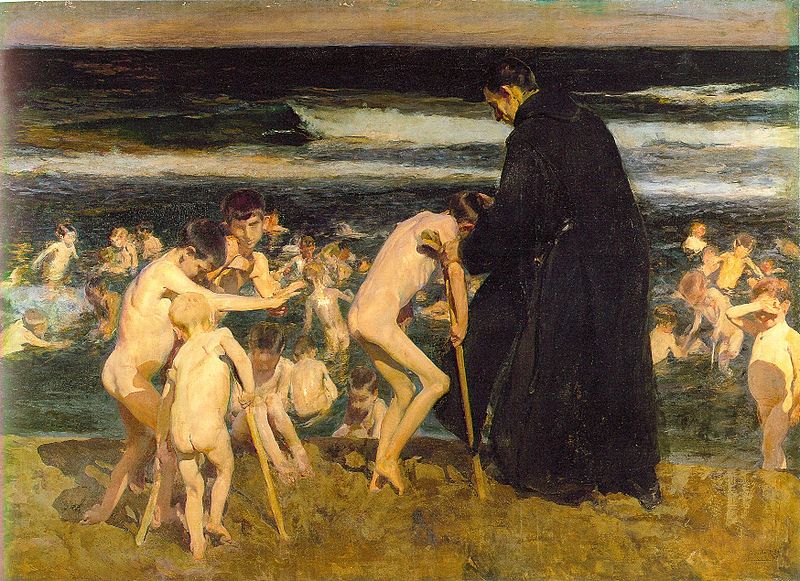
My Daily Art Display today was Joaquín Sorolla’s painting Sad Inheritance which he completed in 1899.  This was a very large oil on canvas painting measuring 284cms wide and 208cms high.  The painting was in tune with Sorolla’s desire of capturing the immediacy of everyday life, warts and all.  This is often termed Social Realism.  Social Realist artists try to illustrate people and their lives in a realistic way and because of this it is often the case that people in their paintings are not continually shown as beautiful, attractive and happy.  It is often the case that these Social Realism artists will focus on the elderly and the sick, the sad and the insane or those people who have to endure a disability.

The subject matter of the painting Sad Inheritance is a party of crippled children bathing at the sea in Valencia under the watchful eye of a monk.  It was in the late nineteenth century that a polio epidemic struck the Valencia area and in the painting one can see two of the boys affected by this affliction.  When Sorolla exhibited this painting in the Universal Exhibition in Paris in 1900 he was awarded the Grand Prix and a medal of honour.  A year later he received the medal of honour at the National Exhibition in Madrid.  Award after award followed for Sorolla and in 1906 following a special exhibition of over five hundred of his paintings in Paris, he was appointed Officer of the Legion of Honour.  From then on Sorolla was inundated with commissions.

Sorolla suffered a paralysing stroke in 1920 and he died three years later in 1923 aged 60.  His former home in Madrid is now a museum dedicated to his work.

Woman in a Yellow Dress by Max Kurzweil

Woman in Yellow Dress by Max Kurzweil (1899)

It is would be quite easy for me to play safe and just offer you works of art by famous painters but one of the things I like doing most with My Daily Art  Display is to discover and highlight artists whom I have never heard of before.   I find it very enjoyable and stimulating to research into their lives and searching out their works of art.  I hope by offering you works of artists you have never heard of will also give you some pleasure and maybe make you curious to find out more about their lives and their art.

Today My Daily Art Display is about the Austrian painter and printmaker Maximilian Kurzweil who was born in 1867 in Bisenz, which is now known as Bzenec in the Czech Republic.  He first studied art at the Academy of Fine Arts Vienna.  At the age of twenty five he travelled to Paris and attended the Académie Julian and it was here that he first exhibited his paintings.  Whilst living in France he visited the Breton harbour town of Concarneau and fell in love with the area, its vivid sunrises and sunsets, its people and the busy port with its sailing ships and fishing fleet.  In 1894 he returned to Vienna and the Academy and studied the art of portraiture.  He began to be influenced by French art especially Impressionism and plein-air painting which showed him the way to use lighter – much brighter colours than those he used before.

In 1895 he married Martha Guyot a woman from Brittany and they used to spend their summers in Brittany and their winters in Vienna.  In 1896, at the age of twenty nine he became a member of the Künstlerhaus in Vienna but the following year he, along with Kustav Klimt, became founder-member of the Vienna Secession, also known as the Union of Austrian Artists, which was a group of Austrian artists who had resigned from the Association of Austrian Artists, housed in the Vienna Künstlerhaus.  This movement included painters, sculptors, and architects.  He was also editor of the Secessionist magazine Ver Sacrum (Sacred Spring).  Kurzweil participated in their exhibitions with such paintings as Woman in a Yellow Dress which is My Daily Arts Display painting for today and which Kurzweil painted in 1899.

Maximilian Kurzweil was also professor at the Frauenkunstschule, an academy in Vienna for female artists.  He committed suicide in 1916, aged 49 after having shot a female student who was his lover.  Although his artistic career was cut short he is held in high esteem and ranks almost as high as the two great Austrian artists Gustav Klimt and Egon Schiele.

Woman in a Yellow Dress is a stunning painting of his beautiful wife Martha.  Her arms are draped over the back of a chaise longue which is upholstered in a green patterned fabric, as she gazes out at us in a languid and relaxed pose.  There is a supreme look of contentment in her expression.  The yellow dress with its many tones is in total harmony with the sofa and compliments her pale limbs.

Child in a Straw Hat by Mary Cassatt

Child in a Straw Hat by Mary Cassatt (1886)

Today my painting for My Daily Art Display is a work of art by the American artist Mary Cassatt.   She was born in Allegheny City, Pennsylvania, which is now part of Pittsburgh, in 1844 and was the fourth of seven children, two of whom died in infancy.  She came from a wealthy family.  Her father, Robert, was a wealthy stockbroker and land speculator and her mother, Katherine, came from a banking family.   She and her family moved from America to Europe when she was seven years of age, where they travelled from country to country before returning back to America.  This European “adventure” was looked upon, by the affluent, as an aid to a good education and offered an understanding of different cultures

Mary decided that a life as an artist was for her but her parents disapproved.  However she was, even at this young age, very headstrong and wasn’t to be discouraged and at the  age of fifteen studied art at the Pennsylvania Academy of the Fine Arts in Philadelphia.  She became disillusioned with the Academy and the way budding female artists were treated and despite her father’s disapproval and his many objections, which she finally overcame, in 1866 she travelled to Paris, initially chaperoned by her mother and some family friends.  Whilst in Paris she met and was taught by Camille Pissarro, the great French Impressionist painter.  She was a great admirer of the works of Edgar Degas whom she met and became great friends with.  He was to have considerable influence on her life and her art work.  As time went on the Impressionist movement in Paris benefited greatly from Cassatt who helped them both financially and by facilitating them getting their works of art recognised and accepted in American museums and galleries.

Cassatt’s family never believed that their daughter would stay long in Paris and were surprised by her determination to succeed in the French capital.  Her sister Lydia, who Mary said was not just a sister but her best friend, joined her in France in 1874, so as to be company for her.   Three years later her parents moved to Paris.   Lydia Cassatt, as well as being very close to Mary, was also the model for many of Mary Cassatt’s most famous paintings.  Sadly after long bouts of illness Lydia died in 1882.  This had a devastating effect on Mary who for a time stopped painting. 

Mary Cassatt was an outspoken individual who was never backward in coming forward with her opinions.  Some say she was too outspoken.  However, being wealthy allowed her to be independent and she did not need to suffer fools.  Her independent attitude and her frankness, which on occasions was considered insulting, became more noticeable as she grew older.   She was highly critical of the modern artists such as Picasso and Matisse and even some of her Impressionist colleagues received her unbridled censure.  

Mary was a prolific and a well respected artist on both sides of the Atlantic and her works of art when they come up for sale now realise millions of dollars.  Like her friend and mentor Edgar Degas she suffered with failing eyesight and when she died in 1926, aged 82 she was blind.

Mary Cassatt’s place in the history of American art is unique, not only because she was one of the few woman artists of any nationality to succeed professionally in her time, but also because she was the only American artist to exhibit with the French Impressionists.

My Daily Art Display today is a painting completed in 1886 by Mary Cassatt entitled Child in a Straw Hat.  Mary Cassatt’s favourite subjects became children and women with children in ordinary scenes. Her paintings express a deep tenderness and her own love for children. But she never had children of her own.  Cassatt was fond of painting young girls in large elaborate hats and bonnets wearing frilly dresses.  However in this painting the girl wears a simple plain gray pinafore and her hat, albeit very large, is a simple straw one.  The child, with a furrowed brow, doesn’t look too pleased and has a sullen and slightly glum look on her face.  There is an air of impatience in her expression and maybe this is due to having to pose for the artist when she would rather have been out playing.

Dead Christ Supported by the Madonna and St John; (Pietà) by Giovanni Bellini

Dead Christ Supported by the Madonna and St John; (Pietà) by Giovanni Bellini (1460)

Some time ago I talked about Madonna and Child genre of paintings and said that I believed that, as far as religious paintings were concerned, they were the most prolific type of religious art throughout the ages.  Other highly popular religious concepts in paintings are the Pietà and the Lamentation. 

The Lamentation represents a particular moment from Christ’s Passion, between the Deposition (the bringing down of the lifeless body of Jesus Christ from the cross after the crucifixion) and the Entombment.   The paintings always show groups of grieving mourners gathered around the central figure of Christ and his mother, the Virgin Mary.  They often appeared in narrative paintings of the Passion of Jesus Christ.

The term Pieta derives from the Italian word for pity.   The Pietà is a timeless image, and is a term applied to a painting or sculpture which usually just depicts the Virgin Mary and the dead Christ, often with the Virgin Mary supporting the body of Christ on her lap.  However, sometimes the characters of St John the Evangelist or Mary Magdalene would be added to the scene.  The setting does not depict a particular moment in the Passion story, unlike scenes of the Lamentation.

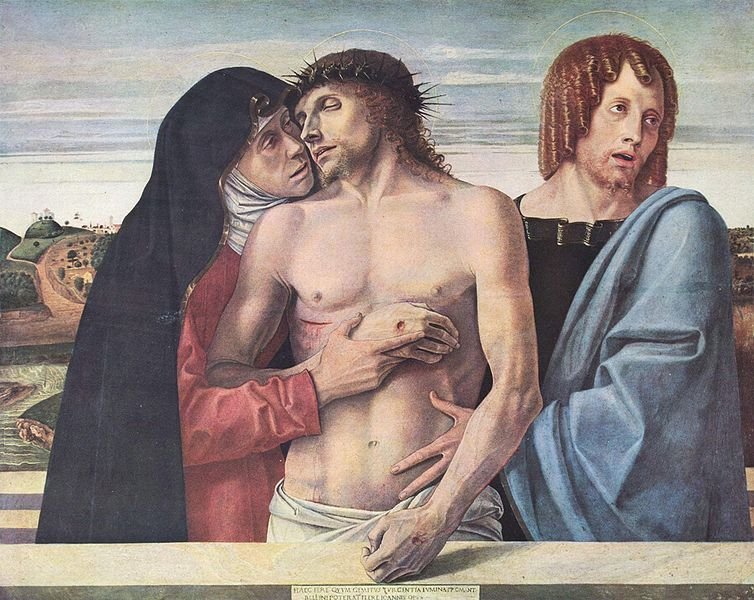
So is My Daily Art Display today a Pietà or a Lamentation?  It is entitled a pietà so who am I to disagree !  It is tempera on panel painting which I came across this week and which I thought was very heartrending and poignant.   One could almost feel the grief of the Virgin Mary and St John the Evangelist.  The work of art painted in 1460 and entitled Dead Christ Supported by the Madonna and St John; (Pietàa) is by Giovanni Bellini and can be seen at the Pinacoteca di Brera in Milan.

At the bottom of the painting, on the parapet is the inscription:

HAEC FERE QUUM GEMITUS TURGENTIA LUMINA PROMANT: BELLINI POTERAT FLERE IOANNIS OPUS

which translated means:

When these swelling eyes evoke groans, this work of Giovanni Bellini could shed tears

To me, this perfectly sums up the painting.  It is not just me that is moved by this painting as it has been rightly considered as one of the most moving paintings in the history of art.  There is a deep passionate feeling to this painting.  It is not just religious passion but human and psychological passion.  Look at the Virgin Mary as she looks into the eyes of her dead son.  See how she is almost using his shoulder to support her chin.  There is a deep hurt and sorrow in her eyes as she looks intently at the face of her lifeless son.  Is there anything more moving that a mother’s sorrow for the loss of her only son?   She clutches the right wrist of Jesus and holds his lifeless limb across his chest.  She is almost cuddling him wishing she could breathe life into his dead body.  We can see the wound on the back of his right hand made by the crucifixion and Jesus’s left hand, with his fingers curled closed in pain, rests on the parapet.

To the right we see Saint John the Evangelist’s with his face wracked with sorrow and one can empathise with his desolation.  His head is turned away from Mary and Jesus as if he can no longer bear to look at the grieving mother clutching at her dead son.  John’s mouth is open as if he is crying out in anguish.  Maybe he is begging for some morsel of comfort.  It is as if he is asking for help to endure what is before him, as he is aware of his task ahead, that of consoling Mary.    

The three figures are in a tight group in the foreground behind which is an infinite horizon.  The sky is a steely grey-blue which gives a feeling of cold and accentuates the pervading anguish of the setting.

This is indeed a very sad and moving painting.

Judgement of Cambyses and the Flaying of Sisamnes by Gerard David

The Judgment of Cambyses and the Flaying of Sisamnes by Gerard David (1498)

Once again I apologise to all of you who do not like the sight of blood as today’s offering is not for the squeamish !   My Daily Art Display painting for today is a diptych consisting of two oil on wood panel paintings, hinged together.  The left panel painting is entitled Judgement of Cambyses and the right hand panel is entitled Flaying of Sisamnes.  The diptych painted in 1498 by Gerard David, the Netherlandish painter can be seen at the Groeninge Museum in Bruges.

The paintings are based on a story concerning the trial and execution of an unjust and corrupt judge, Sisamnes which occurred in the 6th BC.  The great Greek historian Herodotus preserved for posterity the story of the harsh judgment of the Persian King Cambyses II, who reigned 529-522 B.C.,  against the corrupt judge Sisamnes. It is a story that for both its moral and its horror is not easily forgotten. The story is succinctly presented in the fifth book of Herodotus’s Histories.

Sisamnes, Herodotus tells us, was a royal judge under the reign of King Cambyses II. Sisamnes accepted a bribe from a party in a lawsuit, and therefore rendered an unjust judgment. King Cambyses learned of the bribe, accused Sisamnes, and had him arrested and punished, but by no ordinary punishment. The punishment was as creative as it was cruel:

King Cambyses slit his throat and flayed off all his skin and he strung the chair, on which Sisamnes had used to sit to deliver his verdicts, with these thongs.

Cambyses’s creativity did not stop there. To replace Judge Sisamnes whom he had killed and flayed, Cambyses appointed Sisamnes’s son, Otanes, as the new judge. Cambyses warned Otanes to bear in mind the source of the leather of the bench upon which he would sit to hear evidence, deliberate, and deliver his decisions. Without doubt, King Cambyses’s warning buttressed by the reupholstered seat left a lingering impression on his new judge.

Judgement of Cambyses by Gerard David

In 1498, Gerard David was commissioned by the aldermen of the town of Bruges to paint two panels depicting this ancient tale and the finished work was to hang in the chambers of the aldermen in the town hall.  This was then a warning to the local magistrates, who would see the painting every day, that the town expected them to uphold their duty to render justice free of the corruption of outside financial interests.  So that this 6th century BC story had any relevance to 15th century society, David used the technique known as “actualisation”, in which his painting was representative of that period by having the characters dressed in 15th century Flemish clothing. 

Burghers's Lodge

As was the case in yesterday’s painting, I would like you to focus on the details of the painting and by so doing, understand how David’s attempts to tell the story without the use of words.   Look under the arch of the loggia.  There we see Sisamnes’s crime taking place – that of a litigant or his servant handing over a purse of money to him as a payment for a bribe and this was the basis of the crime.  Through the left hand arch of the loggia we can see David’s depiction of the Burgher’s Lodge in Bruges.  Above the judge’s bench where Sisamnes sits one can see the crests of Phillip the Handsome and his wife Joanna of Castille.

The bearded central character in the group who stand before Sisamnes is Cambyses, the accuser.  Look how he seems to be counting on his fingers.  This could well be him counting off the acts of Sisamnes’s bribery on his fingers as he angrily regales him with the accusations.  One can see the concern on Sisamnes’s face as he realises his fate has been sealed.  One thing David had to achieve with this painting was to conjure up a hate for Sisamnes and he did this by giving him the likeness of Pieter Lanchals, a conspirator who betrayed the City of Bruges to Maximillian I of Austria in his dispute with the Council of Bruges.  The group of people, some of which were portraits of the then Bruges aldermen, represented the fact that the whole town was witnessing Cambyses’s accusation.  The man, wearing the red cap, on the left of the seated Sisamnes is the young Phillip the Handsome, the ruler of Burgundy and the Burgundian Netherlands.

The lozenge shaped medallions on either side of the judge’s bench illustrate scenes from Ovid’s Metamorphoses.  On the left are Hercules and Delaneira, the wife he betrayed, and who then gave him a robe to wear which was soaked in the blood of the Centaur, which caused the flesh of Hercules to fall from his body.  The crime perpetrated by Sisamnes was a betrayal of justice – a betrayal of the people of Bruges and the outcome of his punishment was going to be similar to that which happened to Hercules. 

The medallion on the right shows the god Apollo and the satyr Marsyas, who in the contest between them, the terms stated that the winner could treat the defeated party any way he wanted. Since the contest was judged by the Muses, Marsyas naturally lost and was flayed alive in a cave near Celaenae for his challenge of a god.  Marsyas was the symbol of hypocrisy.  David’s addition of this medallion was presumably a reminder of that salutary tale and that justice, which Sisamnes dabbled with, was a gift of the Gods, a gift to the public and his acceptance of a bribe to change the course of justice was a sin against his people as justice did not belong to him, it belonged to the people.

The Flaying of Sisamnes by Gerard David

The right hand panel of the diptych illustrates the fate of Sisamnes after being convicted of bribery.  The punishment was brutal, and yet not uncommon in the fifteenth century, that of flaying.  David’s portrayal of the flaying is graphic and shocking. We see Sisamnes lying naked on a table, his judicial red robes cast aside on the ground below.  One can quite clearly see the grimace of excruciating pain on Sisamnes’s contorted face as the four flayers busy themselves methodically with the gruesome task at hand.  The skin of the body is carefully removed as it will be turned into leather strips to be used as upholstery for the judge’s chair.  

Otanes seated on judge's chair

Look in the background and one can see seated on the judge’s chair, which is draped with flayed skin, Otanes, who is the son of the dying Sisamnes and who Cambryses has appointed to succeed his father.  According to the book Gesta Romanorum, the Latin book of anecdotes and tales, Cambryses said to Otana on making him a judge:

“  You will sit, to administer justice, upon the skin of your delinquent father: should any one incite you to do evil, remember his fate. Look down upon your  father’s skin, lest his fate befall you ”

 Those words were also meant to act as a deterrent to all future magistrates of Bruges, who may foolishly consider repeating the sins of Sisamnes.  The paintings reminded them in a most abhorent way that they needed to be mindful that any betrayal of the trust given to them would be severely dealt with.

These two paintings, although gruesome, are rich in colour and detail and worthy of a place in My Daily Art Display.

Saint Francis in the Desert by Giovanni Bellini

St Francis by Giovanni Bellini (1480)

After yesterday’s rather sad and depressing painting I thought I would try and raise my spirits (and yours) with a picture which has uplifted the spirits of many who have seen it at the Frick Collection in New York. It is Giovanni Bellini’s composition which used to be entitled Saint Francis in Ecstasy, but is now known as Saint Francis in the Desert.  It is an extremely beautiful and powerful work of art which the Venetian master painted in 1480. It is a painting full of detail some of which is easily missed if one only gives it a cursory glance. The gallery itself has no doubt about its worth, stating that it is “the finest work in The Frick Collection and the greatest Renaissance painting in America and also one of the best preserved”. True praise indeed !

This is my type of painting. It is an oil on tempera on poplar panel painting. I love and I am often mesmerised by paintings which are highly detailed and in which the artist has painstakingly spent a good deal of time in presenting us with such an extraordinary level of detail. For me, there is no comparison to be had between a watercolour picture, as beautiful as it may be, in which details are merged and lost in a haze of colour, and an oil painting with its precise detail of every bit of minutiae within the work of art.

Stigmata on St Francis's hand (note rabbit appearing from hole in the wall !!)

There is a spiritual force to this painting, which I am sure moves even those non-believers. The story behind, and the setting for the painting is Saint Francis of Assisi, whilst in retreat, praying and fasting in preparation for Michelmas, received the stigmata, the wounds of Christ’s Crucifixion. This is said to have taken place in 1224 during a retreat at a hut, which was given to Saint Francis by Count Orlando of Chiusi as a place to meditate. It was situated high in the Tuscan hills, above the Apennine forest on Mount Alverna.
Saint Francis, slightly right of centre in the painting, stands, leaning back slightly with his arm outstretched. He is looking transfixed heavenwards at the transcendental light, which emanates from the upper left of the picture. If one looks closely at the figure of St Francis one can just make out the mark of stigmata on the palms of his hands. This miraculous happening is shown as a shadow both illuminates the rocky entrance of St Francis’s dwelling and casts a dark shadow behind the saint and onto the espaliered limbs of the small trees, which act as a screen to the entrance of his dwelling. Look also at the laurel tree at the left of the picture. The laurel, with the fact that its leaves never wilt and preserves its green foliage, makes it symbolic of eternity. In this painting, see how the light illuminates the leaves. It is almost as if it is under a spotlight. Look how it trembles and bends as if being buffeted by strong gusts of wind as it leans into the picture.

Donkey and Crane

Let us look in more detail at the picture. Cast your eyes at the bottom left corner of the painting. One can just see, caught in the branches of a bush, a scrap of paper, on which is written the artist’s signature “IOANNES BELLINUS”. Behind Saint Francis, on the small reading table is a bible and skull, the latter represents death and the transitory nature of life on earth. One can also see a length of cord on the espalier which could have been used as a “bell-pull” by visitors to the retreat. In the field one sees a solitary donkey, standing motionless, and a crane. Further back, below the cliffs and on the outskirts of the city, we see a herdsman with his animals, unaffected by this transcendental happening.

Table with skull and bible with sandals underneath

The water we can see trickling from a spout in the stones is often compared to the miraculous fountain Moses brought forth from the rocks of Mount Horeb to quench the thirst of the Israelites. Another connection with Moses are the abandoned sandals of the saint seen lying under the desk. Bellini may have painted the scene with the bare-footed Saint Francis thus, as a direct connection to the story of Moses on Mount Herob when God spoke to him, saying, “put off the shoes from thy feet for the place whereon thou standest is holy ground
Put all these things together and it is no wonder that people tell you that this painting has such magical appeal and once seen will remain in your memory for a long time. If you live in or are lucky enough to visit New York, pay a visit to The Frick Collection which is much smaller than its nearby neighbour the Metropolitan Museum of Art but offers you a wide range of masterpieces of the art world. Go to today’s painting, stand in front of it, look at all the wonderful detail and absorb the beauty of this breathtaking work of art.