Portrait of a Young Fürleger with Her Hair Done Up by Albrecht Dürer

Portrait of Young Woman with Her Hair Done Up by Albrecht Dürer (1497)

My Daily Art Display for today is a tempera on canvas portrait by Albrecht Dürer.  It is entitled Portrait of a Young Woman (Katharina Fürleger).   It was painted in 1497 and can now be found in the Gemäldegalerie, Staatlich Museen, Berlin.  This painting is sometimes known as Portrait of a Young Fürleger with Her Hair Done Up, to differentiate it from another portrait by Dürer of a girl with her hair loose, entitled Portrait of a Young Fürleger with Loose Hair, which is on display at the Städelsches Kunstinstitut, Frankfurt. 

When the two portraits were hung together they formed part of a diptych but in 1830 they were sold separately and are now looked upon as single portraits.  At one time it was thought that both pictures were of the same young woman, namely Katharina Fürleger but nowadays art historians have changed their minds and believe the two paintings are of two different younger sisters of the wealthy Nuremburg Fürleger family.  A lot of the finer details of this painting have been totally or partially destroyed during restoration attempts and some of the details of the painting are only known because of Wenceslaus Hollar’s engraving of this painting, which he etched in 1646, before some of the details had been damaged.

We see the young woman sitting by a window, out of which we can just make out an undulating landscape.  In the foreground,  there is a path leading to a large gate in a wall.  Parts of the landscape in the painnting have been totally or partially destroyed during various restoration attempts.  Although it cannot be seen in my attached picture the wooden window post on the frame of the window is decorated with a carving of a robed man, possibly a prophet, who is reading a book on which is painted Dürer’s monogram.  This also has been partially destroyed but it is known to be part of the original as recorded by the Hollar engraving.   Seen from the side, this man used to look towards the other portrait of the diptych, Portrait of a Young Girl with her Hair Down.

The young girl is eighteen years of age.  How is that known?  The paper or parchment cantellino, which can be seen, fixed to the wall to the right of her head bears an inscription which is not visible on the painting today but Hollar’s engraving shows that the cantellino originally had the inscription:

ALSO PIN ICH GESTALT / IN ACHCEHE JOR ALT / 1497

which translated means:

“This was my appearance when eighteen years old in 1497”

Just below this cantellino one can just make out a small shield hanging by a strap from a nail in the wall.  On the shield is an inverted red cross which was similar in design to the Fürleger’s coat of arms – a yellow cross on a blue background.

The young woman is wearing her hair up in large braids wrapped around her head, which often signifies she has reached a marriageable age or is in fact betrothed.   Around her head is a pearl-studded headdress which suggests she comes from a wealthy family.  Her hands rest on a parapet.  In her right hand she delicately holds between finger and thumb a stalk of a plant identified as eryngium, which symbolises fortune and two stalks of southern-wood, also known as Lover’s Plant or Maid’s Ruin, which was used in love potions.  Her hands seem slightly deformed as if she is suffering an early onset of arthritis but this may just be the way Dürer painted hands.   She wears a red gown, which is partially covering her chemise.  The black trim of this chemise has an embroidered series of letters on it which are thought to be part of a motto.

There is just one final twist to the story of this painting.  Art historians now say that the shield seen on the wall, which bore a resemblance to the Kürtleger’s family emblem, was added later to the painting as it was not shown in an early copy of the painting, which is now in Leipzig but it did appear in Hollar’s engraving of 1646.  It was because of this family emblem that people originally believed it to be a portrait of Katharina Fürleger but there is no record of such a daughter.  There was however a daughter, Anna Fürleger, but in 1497, the date of this painting, she was only thirteen years of age. 

So is this Katharina Fürleger or should we believe art historian Fedja Anzelewsky, who believes the young woman in both paintings to be Dürer’s sister-in-law Katharina Frey?  Others however suggest that the young women in the two portraits are in fact Dürer’s sisters Agnes and Katharina.

Tomorrow I will feature the other painting of the woman, the young woman with her hair loose.

Portrait of a Young Man by Moretto da Brescia

Portrait of a Young Man by Moretto da Brescia (c. 1545)

Today I am moving away from the interpretive type of allegorical paintings,  which I featured yesterday  and which is a genre I really like.  Today, although staying with an Italian artist, I am returning to portraiture.  Today’s artist is Moretto da Brescia who featured in My Daily Art Display on December 17th.

Moretto da Brescia was born Alessandro Bonvicino around 1498 at Rovato, a town in the province of Brescia in Lombardy. He studied first under Fioravante Ferramola of Brescia and later with Titian in Venice.    He was the leading Brescia painter of the day and concentrated his works on religious subjects mainly producing altarpieces and other religious works.  Today’s painting in My Daily Art Display is simply entitled Portrait of a Young Man which Moretto completed around 1450 and which now hangs in the National Gallery London.

The subject of today’s painting is thought to be Count Fortunato Martinengo Cesaresco who was a member of a branch of Brescia’s most important noble family.  He was also a leading literary figure in Brescia and was founder of the Accademia dei Dubbiosi in 1551 and friend of the Venetian humanist and Italian theorist of paintings, Lodovicio Dolce.  The count married in 1542 and this portrait could well have been done around the time of his betrothal and been a gift for his bride.   

The painting has a background almost completely dominated by a heavy maroon and gold brocade curtain with its pomegranate and carnation design.  The count is depicted lavishly if somewhat flamboyantly dressed in this portrait, .  There is no doubting his wealth and nobility.   On the table to the left of him are some rare ancient coins, one of which is in an open ivory case, which gives the impression that he may have been a collector of such items.  Lying next to them is also a bronze oil lamp in the shape of a sandalled foot.  Hanging over the edge of the table we can see a pair of grey leather gloves.  He is half sitting, half slumped as he rests his right elbow on a couple of pink tasselled taffeta cushions whilst his right hand supports his face.  Look at his face.  What does his facial expression convey to you?  To my mind we are not looking at a happy contented man.  Wealth has brought him neither satisfaction nor happiness.   It is a look of a man who is melancholic and his eyes seem to suggest that he does not know how to lift his depression.   Does he know what is causing this depression or is he one of those unfortunate people who feel depressed but are not sure what has brought about such depression?   Maybe we get an incline of his problem.  On his black velvet cap is a cap badge with the Greek words which translate as:

“Alas I deserve too much”

So how do we translate those words in relation to the Count?    Is it referring to his dilemma as a collector that he knows no matter how wealthy he is, he will never be able to possess all the prized items he needs for his collection to be complete.  All collectors will empathise with this sentiment.  Some art historians would rather put a more romantic slant on his melancholic expression and the inscription on his cap badge.   They believe that as this painting was a gift to his wife he is indicating pictorially to her that no matter how much treasure he owns, nothing will take away the pain of separation from his beloved. 

This is a sumptuous painting and a magnificent portrait.  However, I will leave you to decide what is causing his anguish.

An Allegory with Venus and Cupid by Il Bronzino

An Allegory with Venus and Cupid by Bronzino (c. 1545)

Agnolo di Cosimo di Mariano, usually known as Il Bronzino (probably because of his dark complexion), was born in Monticello, a town south east of Florence, in 1503.  His early artistic training was as a student of Raffaellino del Garbo, the Florentine painter of the early Renaissance.  From his tutelage Il Bronzino went on to study under Jacopo Pontormo who was one of the founders of Florentine Mannerism.  The plague hit the area where they lived and so Bronzino and Pontormo moved north to Certosa where they continued to collaborate on a series of frescos.  Master and pupil got on well which was surprising as Pontormo was known to be a curmudgeonly and melancholy old man.  Il Bronzino established his own reputation as a great artist in his late twenties and in 1530 he was working for the Duke of Urbino.  Two years later he returned to Florence where he concentrated on portraiture and some fresco work.  At the age of 37 he was made court painter to Còsimo di Giovanni degli Mèdici, the de facto ruler of Florence and his wife Eleanora of Toledo for whom he decorated the chapel in the Palazzo Vecchio with fantastic coloured frescoes of astonishing incoherence and they were filled with the usual Mannerist exaggerated distortions.

It was about this time (c.1545) that Il Bronzino completed the painting which I am featuring in My Daily Art Display today.  It is an oil on wood painting entitled An Allegory with Venus and Cupid.  It is believed that Il Bronzino was commissioned to do this by Cosimo de’ Medici as a gift for King Francis I of France.  This is a complex painting full of hidden meanings and open to a great deal of interpretation.  Many art historians have submitted long and complex theses with regards to the meaning of this many faceted work of art.  So let us take a look at the painting and see what we can glean from Il Bronzino’s  enigmatic and complex painting.

First of all we need to identify the characters within the scene.  The leading individual at the centre of the painting is Venus, the goddess of love and beauty, holding the golden apple in her left hand, which she had been given to her by Paris for being the fairest of all the goddesses.  To the left of her and slightly behind her is her son Cupid. 

The incestuous kiss

They are entwined in an incestuous act.  His right hand is fondling his mother’s breast at the same time as he plants a kiss on her mouth.  Is she seducing her adolescent son who by now would appreciate her sexuality?  Which of them do you think is controlling the situation?  But look more closely at Venus and her son.  Although they are exchanging a kiss they have other thoughts on their minds.  Venus is reaching behind Cupid removing an arrow from his quiver whilst he is trying to remove her crown with his left hand.
To the right of Venus with an anklet of bells is the smiling nude putto who represents Foolish Pleasure.   He dances towards them with a somewhat lascivious expression, scattering flowers, blissfully unaware of the thorn which pierces his right foot.    

Deceit

Behind him is a female dressed in green and purple robes holding in her right hand a sweet honeycomb which she is offering up as a gift.  However beware as this Fraud or Deceit and as the saying goes she is “fair of face but foul of body”.  Why do we believe this?  Well look at her left hand and you can just make out the sting in her serpentile tail which she tries to hide behind her back. 

Above Fraud and Foolish Pleasure we see a bald bearded elderly man, whose well-muscled arm is holding up an exquisite ultramarine coloured cloth behind all the characters in this scene.  He is Father Time and he has an angered expression as he looks across at the half-completed head of Oblivion

Suffering or Syphillis

Below this unusual unfinished head is the very disturbing figure of Suffering or Jealousy.  He clutches his head and we can see that his face is distorted in pain.  Art historians now believe this character could represent Syphilis which had reached epidemic proportions in Europe at this time. 

So there you have it, seven strangely portrayed characters but why did Il Bronzino paint them like he has done.  The painting, as I  said earlier, was thought to be for King Francis I of France who was notoriously lecherous and maybe this is why the painting has a predominately erotic feel to it.  He was also known to like heraldry and obscure symbolism so this in a way may have been a puzzle for him to fathom out.  But remember Il Bronzino was a painter of the Mannerism genre and this ambiguous imagery with its erotic overtones is typical of the Mannerist period of art.  His wealthy noble patrons would also have liked the silky-smooth textures, masks and the jewels on display in this painting.

If you like paintings with hidden meanings and varied interpretations then this painting is for you.  Look at it carefully and see if you can see any other hidden clues as to its meaning.

 Enjoy !

A Lady at the Virginals with a Gentleman by Johannes Vermeer

A Lady at the Virginals with a Gentleman by Johannes Vermeer (c. 1664)

The Dulwich Picture Gallery has had an unusual but ingenious idea for their two hundredth birthday celebrations.  They wanted to do something which would reflect the importance of the building and the beauty of their collection as well as reflect Gallery’s unique place in the history of museums in England and the world.  They have what they term the “Masterpiece a Month”.  It features  just one sensational work of art at a time, one a month, each a work of genius presiding as a kind of high altarpiece at the end of the main gallery.  These great works of art would be looked upon as a series of the most beautiful birthday cards for the Gallery.  To achieve this dream the director of the Dulwich Picture Gallery had to approach famous institutions and curators of private collections and ask to borrow one of their great paintings.

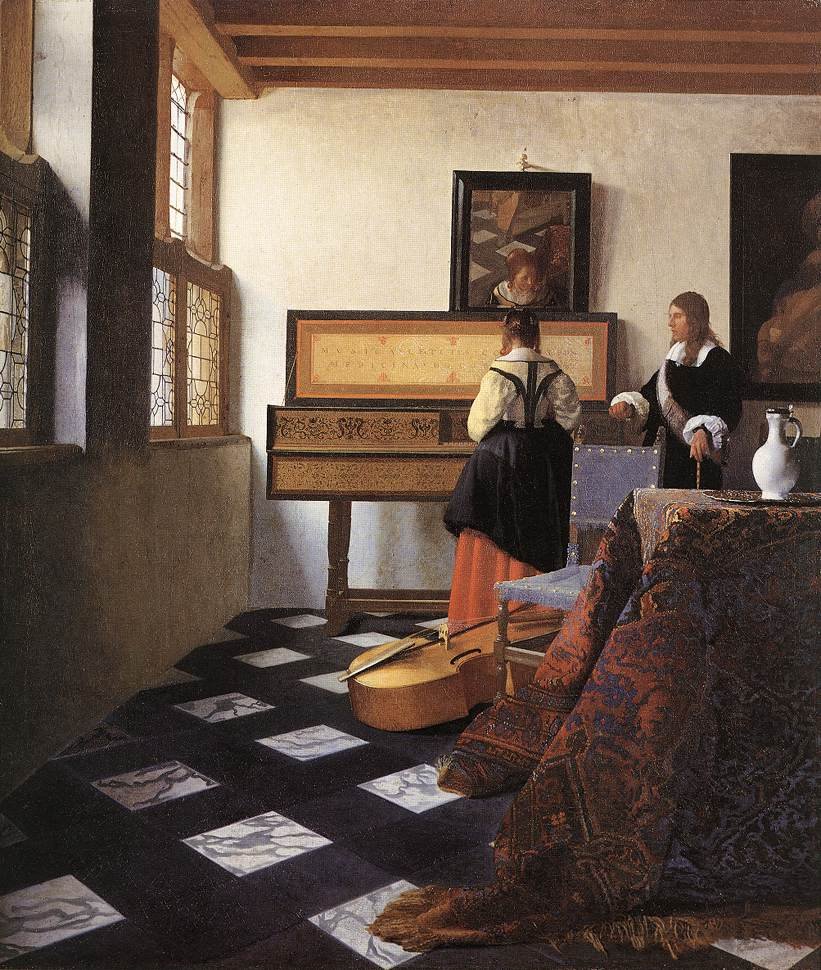
Today’s painting for today’s My Daily Art Display was the featured painting for March at the Dulwich Picture Gallery which was on display when I visited last week and is from a private collection – the Royal Collection of Her Majesty Queen Elizabeth II.  It had been acquired for the collection by George III in 1762.  It is Johannes Vermeer’s A Lady at the Virginals with a Gentleman, sometimes known as The Music Lesson.    Vermeer completed this oil on canvas work circa 1664.  When King George III acquired the painting it was thought to have been painted by Frans van Mieris the Elder due to a misinterpretation of the signature and this error was not rectified for another century when in 1866 the well-known art critic and Vermeer scholar, Théopile Thoré, conclusively proved the work of art to have been painted by the great Dutch artist Vermeer.  The artist’s signature, IV Meer (IVM in monogram), is along the lower edge of the frame on the extreme right.  More writing can be seen on the underside of the lid of the virginals:

MUSICA LETITIAE CO[ME]S /MEDICINA DOLORS[IS]

which translated means

“Music – companion of happiness / medicine for grief”

Porcelain pitcher

So what can we observe in this painting.  Light streams in through the windows on the left and fills the room.  The light emphasizes the texture of the objects such as the pile of the Oriental table covering, the small white porcelain pitcher on a silver plate and the brass studs on the blue chair.  Vermeer often depicted white porcelain jugs in his works of art. They usually contained wine, which was supposed to act as a love potion and help men seduce women.

The painting is characterised by the meticulous use of perspective which draws our eyes to the rear of the room where the figures are placed.  There is a young woman with her back to us, seated at the virginals, a keyboard instrument of the harpsichord family.  The instrument and the inscription are similar to those made by Andres Ruckers of Antwerp in the early part of the 17th century.  As we look at the painting, our eyes follow the line of perspective towards the people and we become aware of a table jutting out into our line of sight and on which is a multicoloured Oriental carpet covering.  Just behind it is a chair covered with a light-blue fabric and on the floor lies a discarded honey-coloured viola da gamba, which was one of a family of bowed, fretted string instruments which first came to prominence in the 15th century and was used mainly in the Renaissance and Baroque period. 

Detail of man and woman at the Virginals

However all the activity is at the back of the room.  Vermeer has used the colour black and this immediately grabs our attention.  The colour is used to outline the virginals.  It is also used to frame the picture on the wall and this colour is utilised by Vermeer on the back of the lady to draw the tailored lines of her bodice and acts as a stark contrast with the inlay that embellishes the front of the instrument, the red of the lady’s dress and light-blue of the chair.  The most startling use of black is in the patterned floor design.

We, the viewers, have been moved back by this use of perspective.  We almost feel we are interlopers or eavesdroppers on this private scene.  Take a look at the mirror on the wall.  We see the reflection of the woman’s face and shoulders as she turns towards the man. Her reflection is slightly out of focus and diminished in scale reflecting the optical effects of a mirror which is a sign of Vermeer’s observational skills.  However some art historians believe that this could also be due to the fact that Vermeer may have used a camera obscura.     We can also see part of the table and the legs of the artist’s easel and a box which we assume contained the artist’s paints (or the camera obscura?).    From this we pick up the inference that Vermeer is part of this scene although, like us, he is standing back from the space occupied by the two main proponents. 

On the back wall,  to the right of the mirror is the painting Roman Charity (Cimon and Pero) by Dirk van Baburen.  It was known that this painting was at one time owned by Maria Thins, the mother-in-law of Vermeer.

Who are these two people?  Teacher and pupil?  Lovers sharing a musical interlude?   Simply fellow musicians?   Who knows what their relationship is but as there are two musical instruments in the room and an empty chair we can deduce that they are fellow musicians and he is listening to her playing and who knows, maybe he is accompanying her playing with a song.  Observe the man’s facial expression.  It is a rapt and loving expression and I am hazarding a guess that there is “love in the air”.   The association between music and love as a theme was often used by Dutch 17th century artists.  The fact that we have two instruments in this picture probably signifies that at one time this was a musical duet and this represents the emotions of the two people.

If you needed to have another reason for visiting the Dulwich Picture Gallery other than to view their magnificent permanent display then this bi-centennial idea of having one additional masterpiece per month is a winner.  The next Masterpiece a Month will be in April and is The Vision of Saint John by El Greco.

The Ecstasy of Mary Magdalen by Peter Paul Rubens

The Ecstasy of Mary Magdalene by Peter Paul Rubens (c.1620)

My Daily Art Display offers up a painting currently in the Palais des Beaux Arts in Lille.  It is an oil on canvas painting entitled The Ecstasy of Mary Magdalene by Peter Paul Rubens.  Rubens completed this work around 1620 as an altarpiece for the Church of the Recollets in Ghent.  Art historians now believeg that this painting by the Rubens was done as they put it “perhaps with some help from assistants”.

The subject of the painting is Saint Mary Magdalen, in ecstasy, being supported by two angels.  Rubens’s  inspiration for this painting came from Jacques de Voragine’s  book of the saints entitled Légende dorée (The Golden Legend) in which is written:

“… The saint, desiring to contemplate celestial things, withdrew into a mountain cave which had been prepared by the angels’ hands and there she remained for thirty years unknown to everyone……each day, the angels lifted her into the skies and for an hour she heard the music; after which, replete with this delicious meal, redescended into her cave, and had not the slightest need of body aliments….”

The setting for the painting is a rocky ledge at the mouth of a cave.  Rubens conveys a deep mysticism in this painting.  Look at the expression on Mary Magdalene’s face.  Her eyes are slightly open but appear somewhat lifeless.  Her face and upper body have been lit-up by a shaft of light.  She appears to be in a trance-like state.  Her face and body are as pale as white marble.  Rubens has beautifully and skilfully painted the folds of her white robe which clings tightly to her body.  The robe has partly fallen away from her upper body exposing her left breast.  Her body is in a state of collapse and the angel on the left supports her as he looks down at her face with an expression of concern for her well-being.  The angel to the right supports her wrist as he looks upwards in awe at the divine shaft of light which has penetrated the mouth of the cave.   The art historian Baudouin points out that the ecstasy which transfigures Mary Magdalene is surprisingly reminiscent of the detailed descriptions that the Spanish saint, Teresa of Avila, wrote about in her biography entitled Vida.  She recounted her experiences at the height of her moments of mystical union and wrote:

“…While it [the soul] thus searches its God, it experiences, amidst the deepest and sweetest delights, an almost total collapse, a sort of fainting fit which gradually takes away one’s breath and all one’s bodily strength….”

This is a beautifully painted picture and the skilled portrayal of the three characters with their varied expressions by Rubens, is superb.

The Adoration of the Kings by Jan Gossaert

The Adoration of the Kings by Jan Gossaert (c.1515)

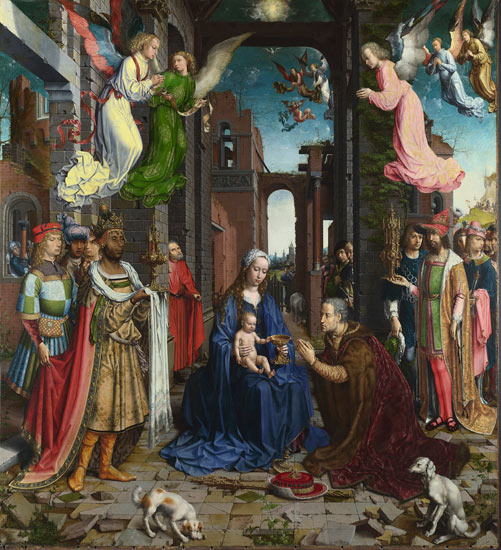
I ended My Daily Art Display yesterday by promising you a feature on what I believed the best painting in the Gossaert exhibition at the National Gallery, London.  I was three quarters of the way around the exhibition when I entered a small room and hanging on one wall was the magnificent work of art by Gossaert entitled The Adoration of the Kings.  This oil on wood painting was completed around 1515 after his return from Rome.  It is a very large painting measuring 177cms x 161cms.  It is part of the National Gallery’s permanent collection.  It is one of Gossaert’s largest works of art It is truly breath-taking.  I stood in front of it for a full five minutes mesmerized much to the annoyance of my fellow visitors.  There was so much going on within the picture and thus so much to take in. 

The picture is thought to have been the altarpiece of the Lady Chapel of Saint Adrian’s,  Geraardsbergen (Grammont) a town near Brussels  The patron who commissioned the painting was thought to be Daniel van Boechout, the Lord of Boelare, a well-connected nobleman.  The many figures in the painting have rigidity about them and all are colourfully dressed.  The multitude of colours and tones are what strikes your eye when you first stand in front of the painting.  The rich fabrics of the very fashionable clothes are gloriously depicted.  The backdrop which we can see through the colonnades is laid out with tiny towers and steeples

Let us take a look at some of the detail.  There are approximately thirty figures depicted in this elaborate and highly colourful painting.  These are grouped within an ornate architectural structure which adds a sense of depth to the picture.   Gossaert was master of this type of presentation.  The once palatial buildings are now in ruins.  The stones and brickwork are  chipped and overgrown with plants and small trees.  The frieze above the Virgin bears a relief of naked dancing putti which also appears on four of the pillar capitals.  They probably represent the pleasures of innocence.   

Conversion of Saint Eustace by Durer


The floor is made up of slabs and coloured stones arranged in geometrical patterns but it is chipped and broken and weeds can be seen growing between the stones.  Two dogs have been added to the foreground.  Art historians believe that the dog in the right foreground is copied directly from Durer’s famous engraving of the miraculous conversion of Saint Eustace, dated 1500/01.

Baby Jesus with gold coin

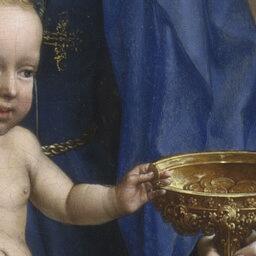
Centrally positioned in the painting is the Virgin Mary with the baby Jesus sitting on her knee.  Kneeling in front of them is the eldest king, Caspar, with a wart on his left cheek.  He is offering his gift, a gold chalice containing gold coins.  The baby with his hand outstretched takes one of the coins. The lid of the chalice which lies on the floor next to his hat and golden sceptre bears his name.   The second king, Melchior, stands behind Caspar.  He is dressed in a green patterned doublet over which is his gold patterned coat lined with ermine.  He carries the frankincense in a highly decorative golden container.  Behind him stand four attendants.   The third king is Balthasar, and this is one of the earliest known depictions of a black man in western art.   He approaches Mary from the left of the painting.  He carries a highly ornate vessel, which contains his gift of myrrh.  His elaborate hat which incorporates a crown is inscribed with his name, BALTAZAR, and also has on it the artist’s signature.  The artist’s signature also appears on the neck ornament of Balthazar’s black attendant.    

Gossaert himself ???

Behind him are his three attendants.  If we look at the middle-ground, just behind Mary, we can see Saint Joseph, dressed in a red robe, leaning on his staff.  To the right of him we can just make out the head of an ox which peers out of a doorway and if you look closely between the Virgin Mary and King Caspar you can just make out the ass munching on weeds. Between the ox and Saint Joseph we see two men looking over a dilapidated fence.  Some believe that the man on the left is Gossaert himself.   Above all these earthly beings hover nine angels all dressed in various coloured shot fabrics.  On the hillside behind Melchior’s retinue, we can just make out the angel announcing Christ’s birth to the shepherds

The colours Gossaert uses in this painting are so rich and varied and his attention to detail of every aspect of this picture gives the impression that the artist was trying to push his powers of invention and artistry to their very limits.  The painting shown above and any others I have come across in catalogues or on the internet do not give you any idea of the true beauty of this work of art and I urge you to try and visit the Gossaert exhibition even if it is just to stand in front of this painting and absorb the beauty of this sumptuously painted work of art.

I will leave you with not my words of praise for the artist but the words of the the person who is the curator of this exhibition.  Of the Gossaert exhibition she says:

“When I stand in a room full of his paintings, the sheer quality of the work is overwhelming.  His technique is extraordinary: the way he paints textures, so you feel every strand of fur, every hair. He is undoubtedly one of the giants.”

Finally, have a look at the website below where you can use the viewer to move around the painting and zoom in on all the details.

http://www.nationalgallery.org.uk/paintings/research/jan-gossaert-the-adoration-of-the-kings-introduction

An Elderley Couple by Jan Gossaert

An Elderley Couple by Jan Gossaert (C.1520)

Yesterday I told you I had been to London to visit some art galleries and I talked about the Dulwich Picture Gallery.   I also mentioned I had been to the National Gallery to see the Jan Gossaert exhibition.   This was a wonderful exhibition with an exceptional collection of his paintings.  Today and tomorrow I would like to focus on two of the paintings which were on display.

My Daily Art Display today is An Elderley Couple painted by Gossaert circa 1515-1520.  This is an oil on parchment laid down on canvas work.  It is thought that the artist used parchment as this medium is fine and smooth and allows the artist to include fine detailing.  It is the only known double portrait painted by Gossaert.  This painting demonstrates Gossaert’s mature style and combines Italianate fundamentals and Flemish naturalism.  We have before us two people depicted in a bust-length pose against a dark green background.  The light in the painting emanates from the upper left corner and manages to highlight their facial features.   Who are these people?   Nobody seems to have put names to the faces.  By the clothes they wear, we must assume that they are wealthy, not noble but of the merchant-class.  Their heads almost seem too large for their bodies but by doing this Gossaert makes us concentrate on their faces.

Looking at their faces, would you say they looked a happy couple?  I wouldn’t.  To me, they exude more an air of resignation than contentment.   I don’t detect any signs of happiness in their expressions.  I don’t see any suggestion of interaction between the couple.  In many ways it is a sad portrait.  As you look at the couple you hope that your relationship with your partner will not end up like theirs.   The man’s face has an uncompromising look and the woman looks gloomy almost miserable and for my mind exudes an air of acquiescence and subservience which is emphasised by the way she is positioned behind the man.   She seems somewhat downtrodden and I have the feeling that she would walk a few steps behind this man when they were out and about.   Note how her eyes are cast down.  Her mouth curves slightly downwards which gives her the unhappy appearance.   Her white head-dress is reflected on her cheek and chin and casts a shadow across her forehead. 

The man’s face is wrinkled and we can see a  silvery stubble on it.  His neck is scrawny with age and the sinews of the neck seem strained.   His silvery hair rests upon the soft fair of his coat.  The fingers of his left hand are wrapped tightly around the silver top of his cane whilst his left hand grasps the fur collar of his coat.   He wears a black cap, on the front of which is a gold badge with two nude figures and a cornucopia.  The nude couple were probably Mercury, the god of trade and Fortuna the goddess of fortune and prosperity and could be the badge of some merchant society of which the man is a member.  His lips are pressed tightly together.  His face looks sunken.  His skin appears worn and tired.  His cheeks are hollow, which suggests he has lost many of his teeth.  However having noted his physical facial failings, it has to be said that he has a determined look.  I believe he still wields power in his business and probably in his relationship with his wife.

I wonder what the couple made of their portrait.  Have they just accepted that life has almost passed them by or do they believe that they look dignified?   This is almost a vanitas painting in which we are reminded of our own mortality.  Like it or loathe it, if I had been the man in the painting, I don’t think I would have it on prominent display in my house !

Tomorrow I will show you the gem in the Gossaert exhibition which I found totally mesmerising.

A Smith shoeing an Ox by Karel Du Jardin

A Smith Shoeing an Ox by Karel du Jardin (c.1650's)

Although I am not a great lover of London and would absolutely hate to live there as it so crowded.   I guess that is an age thing!   I know that when you are young you love the vibrancy of a city but as you get older you seek peace and tranquillity of the countryside or a small coastal town.   The one thing I do like about visiting London is the opportunity to visit great art galleries.  Currently, I am trying to wean myself off just visiting the National Gallery and getting completely lost time-wise in the vast and wondrous works on display.  I have now set myself a strategy for my London visits.  I will just set myself a time limit at the National Gallery and then just concentrate solely on an exhibition or a couple of rooms per visit and then go and seek out a smaller gallery and discover some other hidden gems.

With that in mind, yesterday, I went to the Jan Gossaert exhibition at the National Gallery and then went across the Thames and visited the Dulwich Picture Gallery.  This gem of a gallery was founded in 1811 through the bequest of Sir Peter Francis Bourgeois, a painter, art dealer and collector, who bequeathed no fewer than 360 paintings to the establishment.  Since 1994 when it finally ceased to be part of Dulwich College, it has been maintained as an Independent Charitable Trust and survives without any government funding.  A Heritage Lottery-funded refurbishment took place in 1999-2000 and this enabled the building to be brought back to its original splendour as well as breathing new life into the gardens and the much-needed 21st century facilities. This year is its 200th birthday.

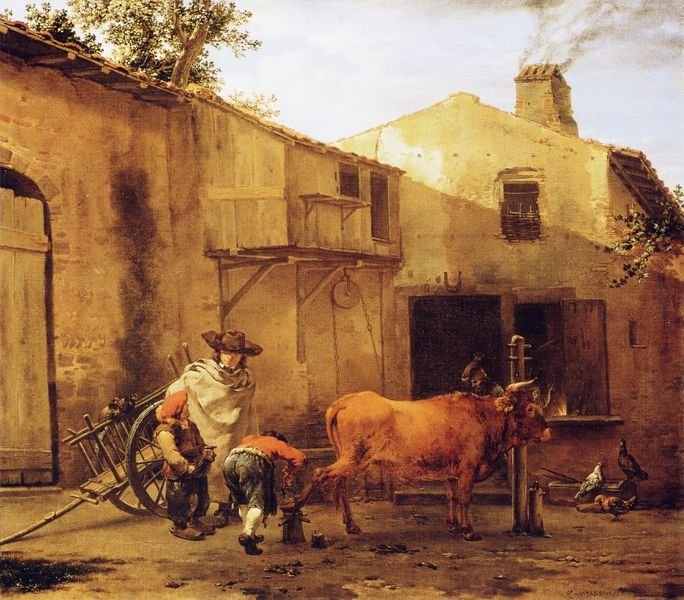
The painting featured in My Daily Art Display today was one of the 360 bequeathed paintings of the 1811 Bourgeois Bequest.  It is entitled A Smith shoeing an Ox and was painted around the late 1650’s by the Dutch Italianate painter and etcher, Karel Du Jardin. He was a painter of religious and mythological scenes as well as landscapes but he was best known for his depiction of Italian peasants and shepherds with their animals.   He was born in 1626 in Amsterdam.  In his early twenties, he visited Paris and from there went to Lyon before ultimately heading for Italy.  It was during his journeys through Italy that he completed many sketches of the Italian countryside and its people.

Today’s painting has an Italianate setting with its humble subject matter and earthy shadowed foreground.  This was typical of the Bamboccianti genre painters, most of whom were Dutch and Flemish and who had brought with them to Italy the traditions of depicting peasant subjects from 16th century Netherlandish art.   

Look how the bold diagonal formed partly by the roof tiles and partly by the shadow divides sun from shade and how the tone and colour change between these two sectors.  One can look through the window of the building on the right to see the blacksmith’s furnace roaring away and the smith hard at work hammering away at some piece of metal.  Smoke from his furnace emanates from the brick chimney and rises vertically into the grey-blue cloudy sky.  The two small but sturdy-looking figures to the left we must presume are the children of the blacksmith busying themselves shoeing the ox.  Their clothes are ragged but well patched.   One of them is engaged in conversation with the cloaked gentleman, who could be the owner of the sturdy beast.    As we look at all the human figures in the painting we somewhat overlook the ox.  This magnificent creature is a typical Du Jardin-esque animal and takes centre stage in the scene.  It stands, with one of its hind legs raised, like a bulky ballerina at the barre.  It is a distinguished-looking beast displaying just a hint of concern at what it is has to endure.  Two cockerel perch on the old wooden cart observing proceedings, whilst another pair quench their thirst at the stone water trough.

It is a congenial and tranquil scene and there is a warmth to its depiction which reminds us that the warmer days of spring and summer beckon.  Maybe I need to look at this picture on a regular basis so as to rid myself of the memories of the past cold winter.

Reclining Girl by François Boucher

Reclining Girl by François Boucher (1751)

There is always some debate with regards paintings and nudity and what is appropriate and what is inappropriate and whether the depiction is merely erotic or crosses the line and becomes pornographic.  There has been much discussion about today’s painting in My Daily Art Display as to whether the female body is being treated as a person or as an object.

My featured artist today is François Boucher a French Rococo painter who was well known for his paintings of voluptuous females which also incorporated classical themes.  Some of his works of art were portraits of the famous Madame Pompadour but what made today’s work somewhat controversial was that his nude painting featured a fourteen year old girl.  Today’s oil on canvas picture entitled Reclining Girl was painted in 1751 and can be seen in the Wallraf-Richartz Museum in Cologne.  There is also a very similar painting featuring this girl, by the same artist, in a similar pose in the Alte Pinakothek in Munich.  So who is the girl and how did she come to pose naked for the artist?

The girl is Mary-Louise O’Murphy de Boisfaily who was born in Rouen in 1737.  She was the fifth daughter of an Irish army officer who, after her father’s retirement from military service, had taken up shoemaking to bring money into the household.  After her father died her mother took the family to live in Paris where she tried to find work for her daughters and made ends meet by trading second hand clothes.  Mary-Louise finally got work as a dancer at L’Opera and earned some money as a model.    It was around this time that she came into contact with Casanova the famous Venetian adventurer and womaniser and was he, according to his memoirs, who takes the credit for introducing the young girl to both Louis XV of France and the artist Boucher.  Art historians have said that the painting was simply a way of offering herself up to Louis XV as a prospective mistress.  It was almost an advert for her services and this is why, in some quarters, the painting was looked upon as being somewhat degrading and vulgar.   However whatever the intentions of Marie-Louise and Boucher were, it proved successful for she became one of Louis’s courtesans, albeit to start with, not one of his principal courtesans but one of his lower-echelon “companions”.  However through her guile and beauty she soon rose through the “ranks” and became one of the ruler’s favourites.  In 1754 she gave birth to Louis’s illegitimate daughter Agathe Louise de Saint-Antoine.  Marie-Louise remained a favourite of Louis and all would have remained well but she made the fatal error of attempting to oust Madame Pompadour as Louis’s favourite mistress and for that she paid the penalty – banishment from the royal court and at the tender age of 17 was married off to Comte de Beaufranchet.  The marriage did not last very long as her husband was killed in battle.   Marie-Louise married twice more, her last being at the age of sixty-one, to a man some thirty years older her junior but this partnership ended in divorce.  She died in 1814 at the age of 77.  If you want to read more about her life you can as her story was dramatised in the 1997 novel by Duncan Sprott entitled Our Lady of the Potatoes.

The painting is without doubt sexually provocative.   The girl, and we should remember she was barely fourteen years of age, is seen face down, lying naked, splayed on a chaise-longue.   I wonder whether the artist decided that because of her age he should not show her frontally naked.  Her face-down pose however does not detract from the sensuality of the painting and in some way may add to it.  We concentrate our view on the girl’s buttocks and her thighs which are wide apart.   This pose shows the willingness of the model to entertain any sexual overtures from a lover.  This was exactly the message she wanted to give Louis.   One notes the similarity between the curves of her body and the curves and creases of the pillow on which her right leg rests and which pushes upwards separating her thighs.   It is a sumptuous setting with the heavy velvet drapes and the silk bedding.

It is a painting you will either like and find it beautifully erotic or you will hate it and condemn it as just another form of pornography wrapped in the guise of a work of art.  It is simpy up to you as it is all in the eye of the beholder.

The Swing by Jean-Honoré Fragonard

The Swing by Jean-Honoré Fragonard (1767)

The Rococo style of art was characterised by lightness, grace, playfulness and intimacy and emerged out of France around the beginning of the 18th century and in the following century spread throughout Europe.  The actual word rococo is thought to have been used disapprovingly by a pupil of Jacques-Louis David who ridiculed the taste, which was in vogue in the mid-18th century.  He combined the artistic genres of rocaille, which prospered in the mid 16th century and was applied to works that depicted fancy rock-work and shell-work, and barocco (baroque) genre. 

The featured artist in My Daily Art Display is Jean-Honoré Fragonard, whose works are amongst the most complete embodiments of the Rococo spirit.   He has been described as the “fragrant essence” of the 18th century.  He was famous for the fluid grace and sensuous charm of his paintings and for the virtuosity of his technique.  The painting by Fragonard featured today is probably his most famous and is the oil on canvas work entitled The Swing which he completed in 1767 and which is now part of the Wallace Collection in London.

The story behind the painting is fascinating and well documented.  The French dramatist and songwriter Charles Collé tells how he met the painter Francois Doyen in 1767 who tells him that he has been approached by a “gentleman of the court” who had seen one of his religious paintings being exhibited in Paris.  The painter Doyen goes to meet the gentleman and relates to Collé what happened next:

“…I found him at his ‘pleasure house’ with his mistress.  He started by flattering me with courtesies and finished by avowing that he was dying with a desire to have me make a picture, the idea of which he was going to outline. I should like Madame (pointing to his mistress) on a swing that a bishop would set going. You will place me in such a way that I would be able to see the legs of the lovely girl, and better still, if you want enliven your picture a little more……. I confess, M. Doyen said to me, that this proposition, which I wouldn’t have expected, considering the character of the picture that led to it, perplexed me and left me speechless for a moment. I collected myself, however, enough to say to him almost at once: “Ah Monsieur, it is necessary to add to the essential idea of your picture by making Madame’s shoes fly into the air and having some cupids catch them.”

Doyen decided not to accept the commission but instead passed it on to Fragonard.  The identity of the patron is unknown, though he was at one time thought to have been the Baron de Saint-Julien, the Receiver General of the French Clergy, which would have explained the request to include a bishop pushing a the swing.  However Fragonard insisted on replacing the bishop with the more traditional figure of the cuckholded husband.  

So let us examine the picture.  We see a young woman on a swing.  She is swinging with gay, if somewhat thoughtless, abandon as the sunlight beams down upon her.  She is at the apex of her arc and suddenly her shoe has flown off.  She has achieved this position due to the help afforded to her by the naive cleric (or cuckholded husband), on the right, who we can see pulling the swing rope.  On the left, lying on the ground below the swing, semi-concealed in the shrubbery,  is a young attentive male courtier who is staring at the long and exposed legs of the young woman.  Her legs are parted and with the motion of the swing, her skirt is open.  Not only are her legs exposed but the young man is able to see under the many petticoats that she is wearing under her pink flowing dress.  She knows he is watching her every move and is obviously pleased by this attention.   He reaches out as if to try and touch her. 

Fragonard once again made free association of fanciful costumes and provided us with a slight bit of erotic suggestions.  This work by Fragonard is without doubt erotic but does not actually cross the line to be viewed as vulgar.  There is a joyful aspect to this painting.  However the painting received mixed reviews with the artist being criticised for the frivolity of the picture and that he should show “a little more self-respect”.    The artist was unmoved by such disparagement and truth be told the popularity of his work continued.   His commissions came in thick and fast, both from wealthy patrons and from the royal government.   The royal patronage came to an end with their downfall during the French Revolution of 1789 and a year later Fragonard returned to his native Provence.  Two years later, he went back to live in Paris.  He died there in 1806 aged 74.

Jean-Honoré Fragonard was born in Grasse, Provence and since 1926 the town has been the home of the very famous French Parfumerie Fragonard !!