The Battle of Issus by Albrecht Altdorfer

The Battle of Alexander at Issus by Albrecht Altdorfer (1529)

Albrecht Altdorfer was a German painter, born in Amberg, Germany around 1480   He was a German painter, printmaker, draughtsman and  architect of the Renaissance era, the leader of the Danube School in southern Germany, and a near-contemporary of  Albrecht Dürer.  He is best known as a significant pioneer of landscape in art.  His early works was influenced by Lucas Cranach.  His patrons included Maximillian I and Louis X, the duke of Bavaria, who commissioned today’s painting.  

My Daily Art Display today is Altdorfer’s Battle of Issus which he painted in 1529 and now hangs in the Alte Pinakothek, Munich.  This is said to be the greatest picture ever created by a German artist with its apocalyptic scene,  the whirlpool of action of the two huge armies and dazzling light effects of the sky on the over-elaborate  landscape.  This picture depicts the battle between Alexandra the Great, who is centre left in the painting riding a chariot hauled by three white horses, and the Persian Emperor Darius.  This painting formed part of a large series of famous battle pieces from classical antiquity.

The Death of Sardanapalus by Eugène Delacroix

The Death of Sardanapulus by Eugène Delacroix (1827)

Ferdinand Victor Eugène Delacroix was born in Charenton–St-Maurice near Paris in April 1798.   Delacroix was a French Romantic artist regarded from the outset of his career as the leader of the French Romantic school.   As an artist he was inspired by the works of Rubens and the Venetian Renaissance painters, Mantegna, Giorgione and Titian.  Baudelaire the writer and art critic said of Delacroix “Delacroix was passionately in love with passion, but coldly determined to express passion as clearly as possible

My painting for today is one that hangs in the Louvre entitled Death of Sardanapalus which Delacroix painted in 1827.   This massive canvas features the defeated Assyrian ruler Sardanapalus propping himself up on a large bed on which a naked woman prostrates herself begging for mercy.   Sardanapalus, on learning that his armies had been defeated, ordered that his possessions were to be destroyed and that his sex slaves were to be murdered before immolating himself.

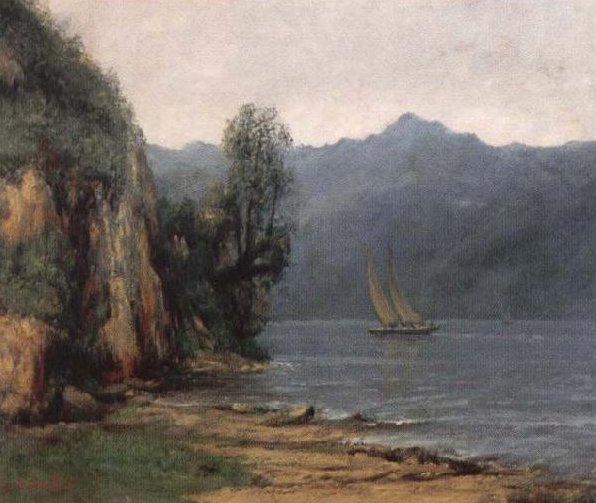
Landscape with Lake Geneva by Gustave Courbet

Landscape with Lake Geneva by Gustave Courbet (1874)

Gustave Courbet was born in Ornans, France in 1819.  In his early twenties he moved to Paris and worked at the studio of Steuben and Hesse.  He spent a lot of time studying the art of the French, Spanish and Flemish painters and often made copies of the works of Caravaggio and Velazquez.  He was to become one of the most powerful and influential painters of his time.  Although he spent most of his life in Paris he hardly ever painted urban subjects. Cezanne said of him: “His palette smells of hay”.    His many pictures of peasants and scenes of everyday life established him as the leading figure of the realist movement of the mid nineteenth century.  He was an outspoken opponent of the French government and took part in the destruction of the Vendôme Column, which resulted in imprisonment and exile from France.  In 1873, he was forced to spend his final years in Switzerland.

Courbet rejected idealisation in his paintings and concentrated on painting what was believable and this had an enormous influence on 19th century art.  American Art Historian, Lorenz Eitner, wrote of Courbet in his book An Outline of 19th Century European Paintings “ ….Courbet acted as the bull in the china shop of polite art, whether academic or preciously avant-gardist, thus enabling a new generation (including the Impressionists)to concentrate of the problem of expressing visual experience”.   Once when asked to include angels in a painting for a church, Courbet replied “ I have never seen angels.  Show me an angel and I will paint one”.

Today’s painting in My Daily Art Display is Landscape with Lake Geneva by Gustave Courbet, which he painted in 1874 whilst living in exile in Switzerland, three years before he died.  There is an air of tranquillity in this painting and this probably mirrors his quiet years in exile away from the turbulent life and politics of  his previous life in Paris.

To Pastures New by Sir James Guthrie (1882)

To Pastures New by Sir James Guthrie (1882)

Today’s work of art is by a Scottish painter, Sir James Guthrie, who was a founder member of the “Glasgow Boys”.   The Glasgow Boys identified themselves as young artists by claiming vociferously to be anti-establishment rejecting the older generation of artists, whom they called “Glue-Pots”.  This group of young artists formed in the 1880’s and were extremely popular between the 1890’s and 1910.  The Glasgow Boys consisted of several men, most of whom were trained in, or had strong ties to the city of Glasgow.  However, although enjoying being looked upon as being one of this rebellious group of artists, Guthrie exhibited his first major picture at the Royal Academy in London and within twenty years of painting, became the president of the Royal Academy which was the pinnacle of the “Establishment”.  In 1921 he was knighted.  So despite the bravado of their anti-establishment stance in their early days, many of the Glasgow Boys became very rich painting, as one art reviewer put it, “fat gentlemen in civic robes”.

Today’s painting by James Guthrie, aged 23 at the time, is an oil on canvas painting entitled To Pastures New, completed in 1882, and is of a goose girl driving her charges to pastures new.  The girl, who is about eight years of age, wearing, what look like, borrowed boots, which appear too large for her, wears a drab dress and a bright straw hat.  She, like a giant, marches into the picture shepherding her entrusted animals before her, all of whom fill the canvas with the background landscape taking only a secondary role in the composition.

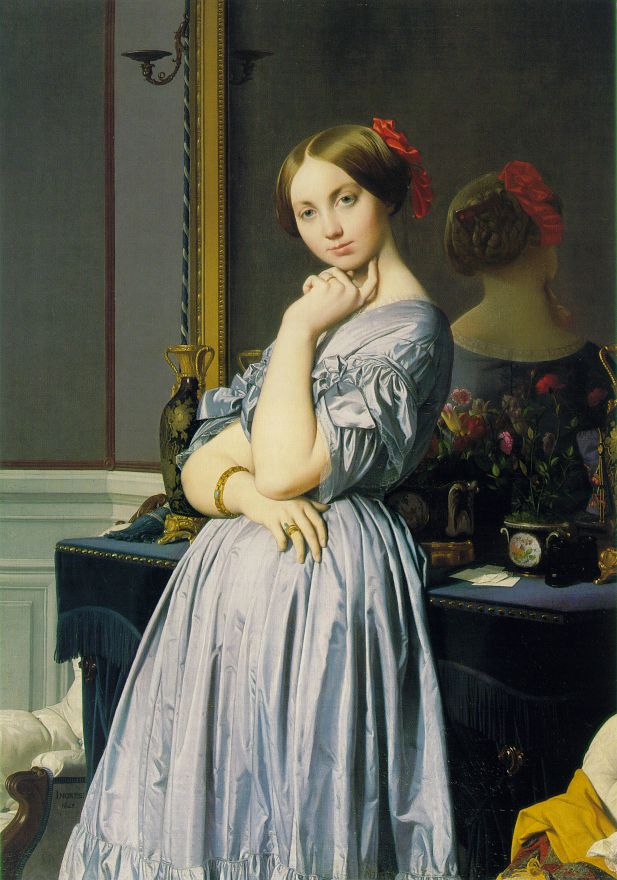
Comtesse d’Haussonville by Ingres (1845)

Comtesse d'Haussonville by Ingres (1845)

Ingres, or to give him his full name, Jean-Auguste-Dominique Ingres, a French Neoclassical painter was born in Montauban in 1780.   Ingres after spending some time in Italy returned to Paris in 1834.  It was at this time that he began to earn the reputation of being  a great portrait artist.  His greatest paintings were his portraits, which were both painted and drawn.  He is looked upon now as one who embodied the Romantic spirit of his time.

Today’s painting is Louis de Broglie, Countesse d’Haussonville which Ingres painted in 1845 and I was fortunate to see it when I visited the Frick Collection in New York some years ago.  Ingres had the ability of expressing the beauty of his subject, none more so than this portrait of the Comtesse d’Haussonville who, despite her reserved and somewhat prim appearance, was an outspoken liberal, author and well regarded intellectual.  Note the luxurious opulent folds of her silk dress and the lustre of her red hair ribbon.

The Red Roofs by Camille Pissarro (1877)

The Red Roofs by Camille Pissaro (1877)

Camille Pissarro, the Impressionist painter of French descent, was born in 1830 on the island of St Thomas in the Danish West Indies.  At the age of twelve he went to Europe where he attended a Paris boarding school.  During his time in Paris he studied at various academic institutions including the École des Beaux Arts and Académie Suisse and under a succession of masters such as Corot and Courbet.  In the 1860’s he, along with Monet, became involved in the Impressionist Movement and spent most of his time painting urban and rural pictures which illustrated French life of that era, particularly in the area around Pontoise.  Pissarro died in Paris in November 1903 and was buried in Père Lachaise Cemetery, Paris.

Painted in 1877, today’s painting is entitled The Red Roofs and is a small (55 x 85cms) oil on canvas picture which hangs in the Musée d’Orsay.  The location for this painting is a group of farm buildings called La Côte des Boeufs, near Pontoise.   The painting is complicated by the fact that the artist wanted to show the buildings as seen through the trees but the screen of trees makes us look quickly beyond the trees, into the heart of the painting, and by doing so one can differentiate the many layers of colour.

The Arnolfini Portrait by Jan van Eyck

The Arnolfini Portrait by Jan van Eyck

Today’s painting in My Daily Art Display is one that art historians have written about probably more than any other with the exception, maybe, of Da Vinci’s Last Supper which of course received renewed speculation after Dan Brown’s novel.

The Arnolfini Portrait which can be seen at the National Gallery, London was painted by Jan van Eyck around 1434.  The two main characters in the painting are Giavanni  Arnolfini and Giovanna Cenami.  Art historians have looked at the painting and tried to decide whether this is a picture of their wedding  or just one of their betrothal ceremony.  Was the lady pregnant or was that just a fashion style of the day?  Much has been written about the symbolism of the dog, the oranges, the mirrored reflection and virtually anything you can see has been given an interpretation of its symbolism.  Notwithstanding the symbolism and the many interpretations I believe it is a painting of haunting beauty.

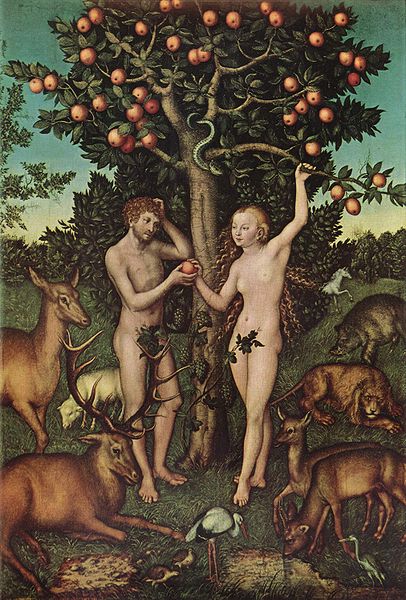
Adam and Eve by Lucas Cranach the Elder

Adam and Eve by Lucas Cranach the Elder (1526)

Lucas Cranach the Elder was born Lucas Sünder in Kronach, Franconia in 1472 but later changed his surname in honour of his German birthplace.  Moved to Vienna in 1501 where he stayed for three years during which time he painted some of his finest and most original works.   Several of his religious works of that period show a remarkable feeling for the beauty of landscape characteristics of the Donnauschule (Danube School), which was a group of German and Austrian artists of the early sixteenth century, who were among the pioneers in depicting landscape, in particular those of the forests and hills of the Danube, for its own sake, in drawings and prints as well as paintings.

Today’s painting in My Daily Art Display is Lucas Cranach the Elder’s Adam and Eve painted in 1526 and is one of 50 depictions Cranach did of this subject and this depiction is inarguably the most beautiful. In this earlier depiction, the tree of knowledge stands in the centre of the painting between them and they are surrounded by painted wildlife and green pastures. Eve raises the fruit to give to a confused Adam. The painting shows the skill Cranach had in painting wildlife and game and his continued attention to detail, for example, the reflection of the Deer in the pond and the Unicorn in the background. The portrayal of Eve shows his growing attention to portraying the female form, which becomes more evident in paintings such as The Venus (1532). Throughout his career Cranach used his artistic talents to further the Lutheran cause. In depictions such as Adam and Eve, Cranach was able to develop his talent in detailed studies of wildlife, nudes and landscapes with no objection from Luther, who saw Cranach’s depictions as furthering the biblical message.

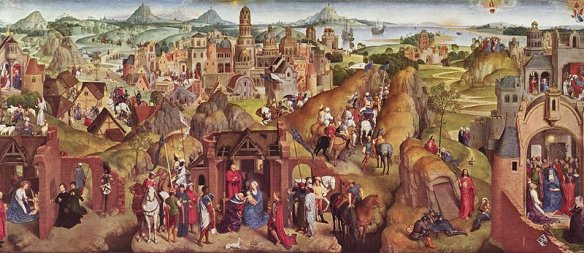
The Seven Joys of the Virgin by Hans Memling

The Seven Joys of the Virgin by Hans Memling (1480)

Hans Memling was born circa 1433 in Seligenstadt, a small town close to Frankfurt.  Although German by birth, after serving his apprenticeship in the Cologne/Mainz area he moved to the Netherlands where he is believed to have been worked under the tutelage of Rogier van der Weyden.  He later moved to Bruges and was admitted to the Painters’ Guild of Bruges in 1466.  He soon became the most popular Netherlandish painter of his day.  His popularity as a painter earned him many commissions especially from the rich Florentine merchants of the city, such as Tommaso Portinari, whose portrait he painted.  He soon became one of the wealthiest citizens of Bruges.   He painted many portraits and religious paintings and his works can be seen in all the major galleries of the world as well as a museum in Bruges which is devoted to him.   Memling died in Bruges in 1494.

My Daily Art Display Today is Hans Memling’s Scenes from The Seven Joys of the Virgin, painted in 1480 and now in the Alte Pinakothek, Munich.  The painting was commissioned by the tanner and merchant Pieter Bultnyc and his wife Katharina van Riebeke for the chapel of the Tanner’s Guild in the Church of Our Lady in Bruges.  The painting incorporates the figures of Bultynyc and his son kneeling at the lower left, outside the stable where Christ is born.  Katharina van Riebeke is also in the painting, at the lower right, in front of the scene of the Pentecost.

This is a picture with an astonishing combination of scenes illustrating parts of the New Testament. The landscape is very much manipulated, segmented into neat vignettes.  It is sumptuous, showing all the various possible geographies of earth: land, mountains, sea. There are towns and castles, meadows and winding roads. There are no fewer than twenty five scenes beginning with the Annunciation of Christ’s birth to the Virgin Mary in the upper left part of the painting through to her death and assumption in the upper right segment of the work.   The ‘Nativity’ is the central scene. Other smaller scenes are the ‘Resurrection’, the ‘Visitation’, and the ‘Entry of Christ into Jerusalem’.

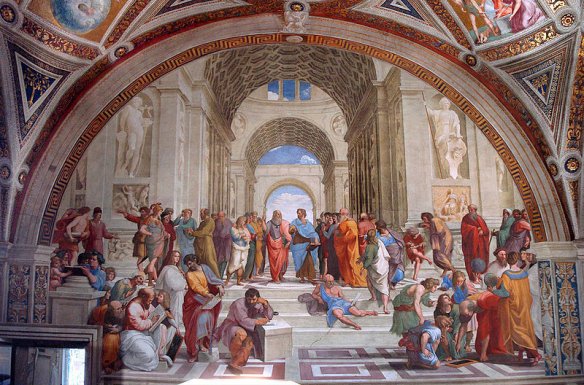
The School of Athens by Raphael

The School of Athens by Raphael

Raphael was commissioned by Pope Julius II in 1510 to decorate with frescos the walls of his private apartment, now known as the Stanze di Raffaello in the Apostolic Palace in the Vatican.  For Raphael, this must have been a daunting task as he had never worked on a project of such magnitude and he had little experiencein fresco. 

The second of his frescos entitled The School of Athens was on the wall of a room, known as the Stanza della Senatura and is one of the most famous paintings by the Italian Renaissance artist.  This room was intended by the Pope to be filled with portraits of great intellectuals of the ancient world.   The fresco is a who’s who of the famous thinkers of the past and there have been many arguments when it comes to identifying the characters of the fresco. 

School of Athens - Who's who

According to Michael Lahanas in his book The School of Athens, “Who is Who?” Puzzle   they are usually identified as follows:

1: Zeno of Citium 2: Epicurus 3: Federico II of Mantua 4: Anicius Manlius Severinus Boethius or Anaximander or Empedocles 5: Averroes 6: Pythagoras 7: Alcibiades or Alexander the Great? 8: Antisthenes or Xenophon 9: Hypatia (Francesco Maria della Rovere) 10: Aeschines or Xenophon 11: Parmenides 12: Socrates 13: Heraclitus (Michelangelo) 14: Plato (Leonardo da Vinci) 15: Aristotle 16: Diogenes 17: Plotinus or Michelangelo 18: Euclid or Archimedes with students (Bramante) 19: Zoroaster 20: Ptolemy R: Apelles (Raphael) 21: Protogenes (Il Sodoma, Perugino, or Timoteo Viti)

 See also:  http://www.mlahanas.de/Greeks/SchoolAthens.htm