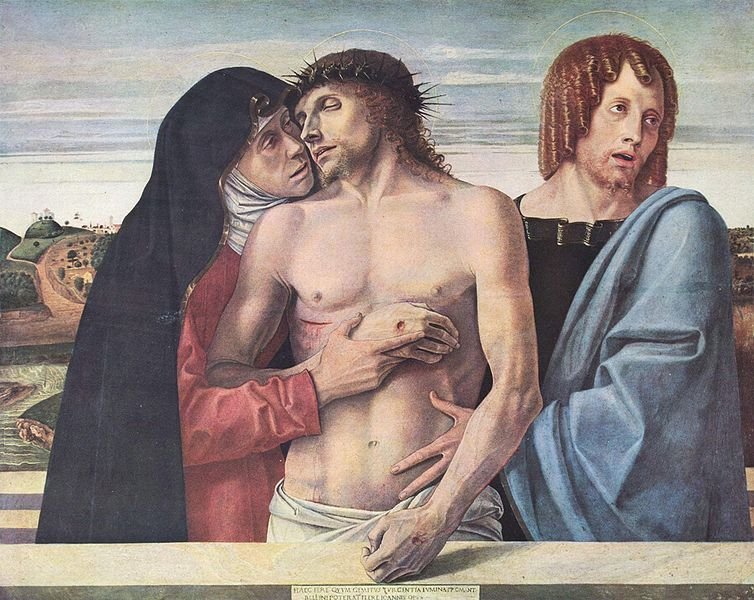
Dead Christ Supported by the Madonna and St John; (Pietà) by Giovanni Bellini

Dead Christ Supported by the Madonna and St John; (Pietà) by Giovanni Bellini (1460)

Some time ago I talked about Madonna and Child genre of paintings and said that I believed that, as far as religious paintings were concerned, they were the most prolific type of religious art throughout the ages.  Other highly popular religious concepts in paintings are the Pietà and the Lamentation. 

The Lamentation represents a particular moment from Christ’s Passion, between the Deposition (the bringing down of the lifeless body of Jesus Christ from the cross after the crucifixion) and the Entombment.   The paintings always show groups of grieving mourners gathered around the central figure of Christ and his mother, the Virgin Mary.  They often appeared in narrative paintings of the Passion of Jesus Christ.

The term Pieta derives from the Italian word for pity.   The Pietà is a timeless image, and is a term applied to a painting or sculpture which usually just depicts the Virgin Mary and the dead Christ, often with the Virgin Mary supporting the body of Christ on her lap.  However, sometimes the characters of St John the Evangelist or Mary Magdalene would be added to the scene.  The setting does not depict a particular moment in the Passion story, unlike scenes of the Lamentation.

So is My Daily Art Display today a Pietà or a Lamentation?  It is entitled a pietà so who am I to disagree !  It is tempera on panel painting which I came across this week and which I thought was very heartrending and poignant.   One could almost feel the grief of the Virgin Mary and St John the Evangelist.  The work of art painted in 1460 and entitled Dead Christ Supported by the Madonna and St John; (Pietàa) is by Giovanni Bellini and can be seen at the Pinacoteca di Brera in Milan.

At the bottom of the painting, on the parapet is the inscription:

HAEC FERE QUUM GEMITUS TURGENTIA LUMINA PROMANT: BELLINI POTERAT FLERE IOANNIS OPUS

which translated means:

When these swelling eyes evoke groans, this work of Giovanni Bellini could shed tears

To me, this perfectly sums up the painting.  It is not just me that is moved by this painting as it has been rightly considered as one of the most moving paintings in the history of art.  There is a deep passionate feeling to this painting.  It is not just religious passion but human and psychological passion.  Look at the Virgin Mary as she looks into the eyes of her dead son.  See how she is almost using his shoulder to support her chin.  There is a deep hurt and sorrow in her eyes as she looks intently at the face of her lifeless son.  Is there anything more moving that a mother’s sorrow for the loss of her only son?   She clutches the right wrist of Jesus and holds his lifeless limb across his chest.  She is almost cuddling him wishing she could breathe life into his dead body.  We can see the wound on the back of his right hand made by the crucifixion and Jesus’s left hand, with his fingers curled closed in pain, rests on the parapet.

To the right we see Saint John the Evangelist’s with his face wracked with sorrow and one can empathise with his desolation.  His head is turned away from Mary and Jesus as if he can no longer bear to look at the grieving mother clutching at her dead son.  John’s mouth is open as if he is crying out in anguish.  Maybe he is begging for some morsel of comfort.  It is as if he is asking for help to endure what is before him, as he is aware of his task ahead, that of consoling Mary.    

The three figures are in a tight group in the foreground behind which is an infinite horizon.  The sky is a steely grey-blue which gives a feeling of cold and accentuates the pervading anguish of the setting.

This is indeed a very sad and moving painting.
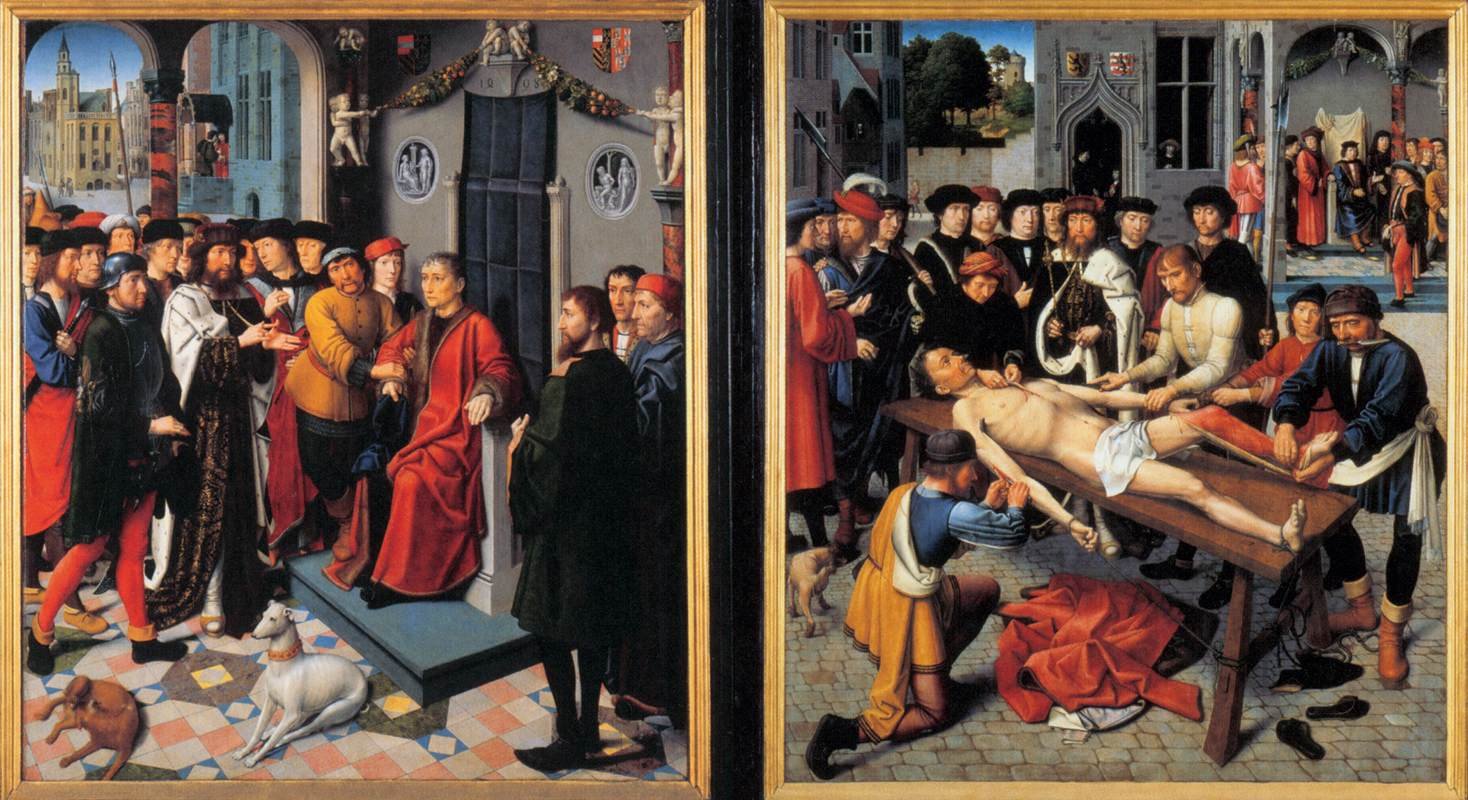
Judgement of Cambyses and the Flaying of Sisamnes by Gerard David

The Judgment of Cambyses and the Flaying of Sisamnes by Gerard David (1498)

Once again I apologise to all of you who do not like the sight of blood as today’s offering is not for the squeamish !   My Daily Art Display painting for today is a diptych consisting of two oil on wood panel paintings, hinged together.  The left panel painting is entitled Judgement of Cambyses and the right hand panel is entitled Flaying of Sisamnes.  The diptych painted in 1498 by Gerard David, the Netherlandish painter can be seen at the Groeninge Museum in Bruges.

The paintings are based on a story concerning the trial and execution of an unjust and corrupt judge, Sisamnes which occurred in the 6th BC.  The great Greek historian Herodotus preserved for posterity the story of the harsh judgment of the Persian King Cambyses II, who reigned 529-522 B.C.,  against the corrupt judge Sisamnes. It is a story that for both its moral and its horror is not easily forgotten. The story is succinctly presented in the fifth book of Herodotus’s Histories.

Sisamnes, Herodotus tells us, was a royal judge under the reign of King Cambyses II. Sisamnes accepted a bribe from a party in a lawsuit, and therefore rendered an unjust judgment. King Cambyses learned of the bribe, accused Sisamnes, and had him arrested and punished, but by no ordinary punishment. The punishment was as creative as it was cruel:

King Cambyses slit his throat and flayed off all his skin and he strung the chair, on which Sisamnes had used to sit to deliver his verdicts, with these thongs.

Cambyses’s creativity did not stop there. To replace Judge Sisamnes whom he had killed and flayed, Cambyses appointed Sisamnes’s son, Otanes, as the new judge. Cambyses warned Otanes to bear in mind the source of the leather of the bench upon which he would sit to hear evidence, deliberate, and deliver his decisions. Without doubt, King Cambyses’s warning buttressed by the reupholstered seat left a lingering impression on his new judge.

Judgement of Cambyses by Gerard David

In 1498, Gerard David was commissioned by the aldermen of the town of Bruges to paint two panels depicting this ancient tale and the finished work was to hang in the chambers of the aldermen in the town hall.  This was then a warning to the local magistrates, who would see the painting every day, that the town expected them to uphold their duty to render justice free of the corruption of outside financial interests.  So that this 6th century BC story had any relevance to 15th century society, David used the technique known as “actualisation”, in which his painting was representative of that period by having the characters dressed in 15th century Flemish clothing. 

Burghers's Lodge

As was the case in yesterday’s painting, I would like you to focus on the details of the painting and by so doing, understand how David’s attempts to tell the story without the use of words.   Look under the arch of the loggia.  There we see Sisamnes’s crime taking place – that of a litigant or his servant handing over a purse of money to him as a payment for a bribe and this was the basis of the crime.  Through the left hand arch of the loggia we can see David’s depiction of the Burgher’s Lodge in Bruges.  Above the judge’s bench where Sisamnes sits one can see the crests of Phillip the Handsome and his wife Joanna of Castille.

The bearded central character in the group who stand before Sisamnes is Cambyses, the accuser.  Look how he seems to be counting on his fingers.  This could well be him counting off the acts of Sisamnes’s bribery on his fingers as he angrily regales him with the accusations.  One can see the concern on Sisamnes’s face as he realises his fate has been sealed.  One thing David had to achieve with this painting was to conjure up a hate for Sisamnes and he did this by giving him the likeness of Pieter Lanchals, a conspirator who betrayed the City of Bruges to Maximillian I of Austria in his dispute with the Council of Bruges.  The group of people, some of which were portraits of the then Bruges aldermen, represented the fact that the whole town was witnessing Cambyses’s accusation.  The man, wearing the red cap, on the left of the seated Sisamnes is the young Phillip the Handsome, the ruler of Burgundy and the Burgundian Netherlands.

The lozenge shaped medallions on either side of the judge’s bench illustrate scenes from Ovid’s Metamorphoses.  On the left are Hercules and Delaneira, the wife he betrayed, and who then gave him a robe to wear which was soaked in the blood of the Centaur, which caused the flesh of Hercules to fall from his body.  The crime perpetrated by Sisamnes was a betrayal of justice – a betrayal of the people of Bruges and the outcome of his punishment was going to be similar to that which happened to Hercules. 

The medallion on the right shows the god Apollo and the satyr Marsyas, who in the contest between them, the terms stated that the winner could treat the defeated party any way he wanted. Since the contest was judged by the Muses, Marsyas naturally lost and was flayed alive in a cave near Celaenae for his challenge of a god.  Marsyas was the symbol of hypocrisy.  David’s addition of this medallion was presumably a reminder of that salutary tale and that justice, which Sisamnes dabbled with, was a gift of the Gods, a gift to the public and his acceptance of a bribe to change the course of justice was a sin against his people as justice did not belong to him, it belonged to the people.

The Flaying of Sisamnes by Gerard David

The right hand panel of the diptych illustrates the fate of Sisamnes after being convicted of bribery.  The punishment was brutal, and yet not uncommon in the fifteenth century, that of flaying.  David’s portrayal of the flaying is graphic and shocking. We see Sisamnes lying naked on a table, his judicial red robes cast aside on the ground below.  One can quite clearly see the grimace of excruciating pain on Sisamnes’s contorted face as the four flayers busy themselves methodically with the gruesome task at hand.  The skin of the body is carefully removed as it will be turned into leather strips to be used as upholstery for the judge’s chair.  

Otanes seated on judge's chair

Look in the background and one can see seated on the judge’s chair, which is draped with flayed skin, Otanes, who is the son of the dying Sisamnes and who Cambryses has appointed to succeed his father.  According to the book Gesta Romanorum, the Latin book of anecdotes and tales, Cambryses said to Otana on making him a judge:

“  You will sit, to administer justice, upon the skin of your delinquent father: should any one incite you to do evil, remember his fate. Look down upon your  father’s skin, lest his fate befall you ”

 Those words were also meant to act as a deterrent to all future magistrates of Bruges, who may foolishly consider repeating the sins of Sisamnes.  The paintings reminded them in a most abhorent way that they needed to be mindful that any betrayal of the trust given to them would be severely dealt with.

These two paintings, although gruesome, are rich in colour and detail and worthy of a place in My Daily Art Display.

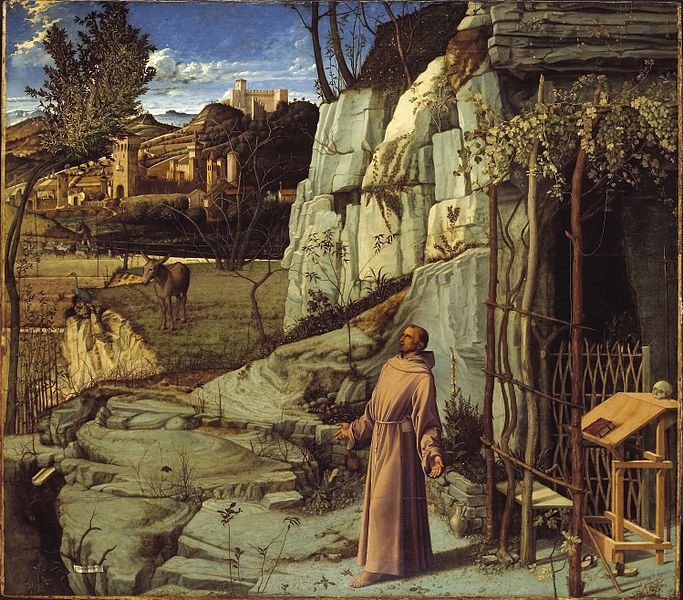
Saint Francis in the Desert by Giovanni Bellini

St Francis by Giovanni Bellini (1480)

After yesterday’s rather sad and depressing painting I thought I would try and raise my spirits (and yours) with a picture which has uplifted the spirits of many who have seen it at the Frick Collection in New York. It is Giovanni Bellini’s composition which used to be entitled Saint Francis in Ecstasy, but is now known as Saint Francis in the Desert.  It is an extremely beautiful and powerful work of art which the Venetian master painted in 1480. It is a painting full of detail some of which is easily missed if one only gives it a cursory glance. The gallery itself has no doubt about its worth, stating that it is “the finest work in The Frick Collection and the greatest Renaissance painting in America and also one of the best preserved”. True praise indeed !

This is my type of painting. It is an oil on tempera on poplar panel painting. I love and I am often mesmerised by paintings which are highly detailed and in which the artist has painstakingly spent a good deal of time in presenting us with such an extraordinary level of detail. For me, there is no comparison to be had between a watercolour picture, as beautiful as it may be, in which details are merged and lost in a haze of colour, and an oil painting with its precise detail of every bit of minutiae within the work of art.

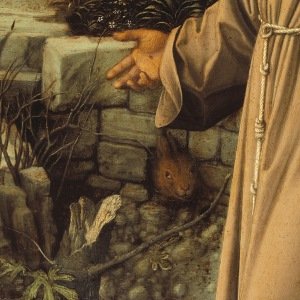
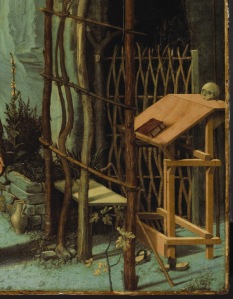
Stigmata on St Francis's hand (note rabbit appearing from hole in the wall !!)

There is a spiritual force to this painting, which I am sure moves even those non-believers. The story behind, and the setting for the painting is Saint Francis of Assisi, whilst in retreat, praying and fasting in preparation for Michelmas, received the stigmata, the wounds of Christ’s Crucifixion. This is said to have taken place in 1224 during a retreat at a hut, which was given to Saint Francis by Count Orlando of Chiusi as a place to meditate. It was situated high in the Tuscan hills, above the Apennine forest on Mount Alverna.
Saint Francis, slightly right of centre in the painting, stands, leaning back slightly with his arm outstretched. He is looking transfixed heavenwards at the transcendental light, which emanates from the upper left of the picture. If one looks closely at the figure of St Francis one can just make out the mark of stigmata on the palms of his hands. This miraculous happening is shown as a shadow both illuminates the rocky entrance of St Francis’s dwelling and casts a dark shadow behind the saint and onto the espaliered limbs of the small trees, which act as a screen to the entrance of his dwelling. Look also at the laurel tree at the left of the picture. The laurel, with the fact that its leaves never wilt and preserves its green foliage, makes it symbolic of eternity. In this painting, see how the light illuminates the leaves. It is almost as if it is under a spotlight. Look how it trembles and bends as if being buffeted by strong gusts of wind as it leans into the picture.

Donkey and Crane

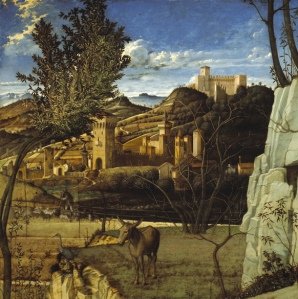
Let us look in more detail at the picture. Cast your eyes at the bottom left corner of the painting. One can just see, caught in the branches of a bush, a scrap of paper, on which is written the artist’s signature “IOANNES BELLINUS”. Behind Saint Francis, on the small reading table is a bible and skull, the latter represents death and the transitory nature of life on earth. One can also see a length of cord on the espalier which could have been used as a “bell-pull” by visitors to the retreat. In the field one sees a solitary donkey, standing motionless, and a crane. Further back, below the cliffs and on the outskirts of the city, we see a herdsman with his animals, unaffected by this transcendental happening.

Table with skull and bible with sandals underneath

The water we can see trickling from a spout in the stones is often compared to the miraculous fountain Moses brought forth from the rocks of Mount Horeb to quench the thirst of the Israelites. Another connection with Moses are the abandoned sandals of the saint seen lying under the desk. Bellini may have painted the scene with the bare-footed Saint Francis thus, as a direct connection to the story of Moses on Mount Herob when God spoke to him, saying, “put off the shoes from thy feet for the place whereon thou standest is holy ground
Put all these things together and it is no wonder that people tell you that this painting has such magical appeal and once seen will remain in your memory for a long time. If you live in or are lucky enough to visit New York, pay a visit to The Frick Collection which is much smaller than its nearby neighbour the Metropolitan Museum of Art but offers you a wide range of masterpieces of the art world. Go to today’s painting, stand in front of it, look at all the wonderful detail and absorb the beauty of this breathtaking work of art.

The Beggar Boy by Bartolomé Esteban Murillo

The Beggar Boy by Murillo (c.1650)

On December 31st the painting of the day was The Beggar known as the Club-foot by Ribera.  It was a painting of a smiling boy, despite his physical disability, on his way to town to beg for food.  Today’s painting is also of a beggar but in this work of art we are not treated to the sight of a happy child.    My Daily Art Display offering today is The Beggar Boy by the Spanish Baroque Bartholomé Esteban Murillo, the Spanish Baroque painter who was born in Seville in 1616.

Murillo came from a very large family, the youngest of fourteen children.  His father was both a barber and surgeon.  His parents died when he was young and he went to live with a distant relative and artist, Juan del Castillo who started Murillo’s artistic education.  He stayed with Castillo until 1639 when his mentor had to move to Cadiz.  Now Murillo, aged twenty two, had to fend for himself and scraped a living by selling some of his paintings.  In 1643 he travelled to Madrid where he met Velazquez who was also from Seville and had now become a master of his craft.  He took pity on Murillo and let him lodge in his house.  He stayed in Madrid for two years before returning to Seville.  In 1648, at the age of thirty one, Murillo married a wealthy lady of rank, Doña Beatriz de Cabrera y Sotomayor.   Murillo died as he lived, a humble, pious and brave man, in 1682,  leaving a son and daughter, his wife having died before him. 

Murillo has always been one of the most popular painters.  His works show great technical attainment and a strong feeling for ordinary nature and for truthful or sentimental expression without lofty beauty.  He was the last pre-eminent painter of Seville, a prolific worker hardly leaving his painting-room save for his devotions in church.  His works of art achieved high prices and made him a great fortune.  Probably best known for his religious works but produced a large number of paintings depicting contemporary people, mainly women and children.  His realist style when painting those struggling with poverty, such as beggars, street urchins and flower girls gives one a good insight of life in those days for those who were impoverished.

Today’s painting The Beggar Boy, painted circa 1650 and which now hangs in the Louvre, shows a bare-footed young boy sitting, lit up by sunlight streaming in through an opening in the thick walls of the building.  He, dressed in ragged clothes and is slumped on the stone floor of the darkened room with a sad downcast expression.  His feet are bare and the soles are blackened and bloodied.  There is no hint of happiness in his expression, which is in complete contrast to Ribera’s Boy with Club-Foot.  We can only imagine what is going through his mind.  Desperation and sadness with his lot in life must be uppermost in his thoughts.  The feeling of dejection and hopelessness pervades his being and the future for him looks bleak indeed.

Young Woman Drawing by Marie-Denise Villers

Young Woman Drawing by Marie-Denise Villers (1801)

My Daily Art Display painting for today is literally a whodunit mystery which may or may not have been solved conclusively and who knows what twists may still come in the future.  It is a work of art which has three different artists and two different titles but having said that, to my mind it doesn,t matter as it is an exquisitely delightful painting.

 In 1951 Charles Sterling, Louvre curator and foreign advisor to the Metropolitan Museum, after some lengthy consideration, stated that the unsigned Portrait of Mademoiselle Charlotte du Val d’Ognes, which the establishment had acquired in 1917, was not the work of Jaques-Louis David the highly influential French painter but by one of his students, namely Constance Marie Charpentier.  So there we have it – just a simple mis-identification of the artist.  Sadly, after this revelation, its value plummeted and so-called artistic experts looked at it again and “tut-tutted” about its poor quality.  Labels on the wall of the gallery describing the work of art were changed but the painting remained in place.

However since that proclamation in 1951 by Charles Sterling the debate has raged as to whether Charpentier did actually paint this picture.   The Metropolitan Museum of New York has now decided that she didn’t paint it and furthermore that have now changed the title of the work to Young Woman Drawing which they now believe was painted by Marie-Denise Villers a female portrait painter of the time.   Whoever painted this work of art, it is still one of the most popular and most enthralling paintings in the New York Museum and for anybody close to this museum, I urge you to go and study it.  

Marie-Denise Villers, known to her friends as Nisa, a gifted French portrait painter, was born Marie-Denise Lemoine in Paris in 1774.   She came from an artistic background with her two sisters, Marie-Victoire and Marie-Elisabeth both being talented artists and her cousin Jean-Chaudet Elizabeth the portrait and genre painter.   At the age of twenty she married an architect student Michel-Jean-Maximillien Villers.    She was a pupil of Girodet and exhibited in the Salons.  Her first exhibit was of three paintings at the Paris Salon in 1799, and one of them won her 1500 francs.  From then on her portraits attracted much attention.  Her last exhibit at the Paris Salon iwas in 1814, seven years before she died at the age of 47. 

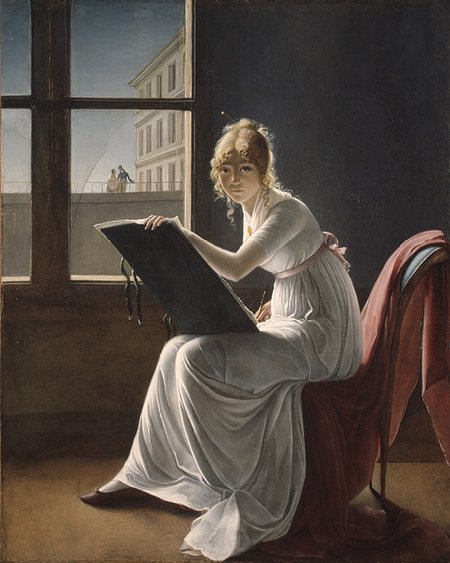
Today’s work of art, which could have been a self-portrait, was exhibited in the Paris Salon of 1801.

The Face with the haunting eyes

It is outstanding oil on canvas painting.  The luminous image of this beautiful young woman with her drawing board immediately grabs your attention.  Look at her face.  What an extremely beautiful face.  It has been termed “an eighteenth century Mona Lisa” Look how the folds of her white dress are bathed in the sunlight, which streams through the window with the cracked pain of glass.  Why has she painted a broken pane of glass?  Her gaze is directly towards the viewer and holds one’s attention. As I look at the picture I can almost imagine she is carrying out a portrait and I am the subject matter.

Nighthawks by Edward Hopper

Nighthawks by Edward Hopper (1942)

My Daily Art Display’s offering today is in complete contrast to Raphael’s Madonna which I gave you two days ago.  Today I have skipped almost four hundred and fifty years to look at a work of modern art by the American artist Edward Hooper.  It is entitled Nighthawks and portrays three people sitting in a downtown diner.  For Hopper it was to be his most famous painting and one of the most recognisable in American art.

Edward Hopper was born in Nyack, on the Hudson River, in the state of New York in 1882.  He was an outstanding American Realist and American Scene painter as well as a  printmaker.  He came from a middle-class background and was an able student at school where he developed a love of art from an early age.  His parents encouraged this love and helped him develop his talent for drawing.  At the age of seventeen he attended the New York Institute of Art and Design and remained there for six years.  In 1905 he went to work at an advertising agency where he was employed to design covers for trade magazines but he did not like this type of illustration work but like all of us, needed the money.   He managed to visit Europe on three occasions during which time he discovered and fell in love with works of Rembrandt and some of his contemporaries.  Whilst in Paris he spent a lot of his time painting café and street scenes, a hobby he carried on with when he returned to New York.  He became very interested in the Realist art genre.

It was in 1942, at the age of sixty that Hopper painted today’s work of art, Nighthawks.  The expression “nighthawk” is a word used to describe somebody who stays up late, often also termed a “night owl”.  The scene of his painting was inspired by one in Greenwich Village, Manhattan where Hopper lived for fifty four years.  There is a mood of despondency about this painting and this may be in part due to the fact that Hopper started this painting soon after Pearl Harbour was attacked by the Japanese and the whole of America, after the initial shock, was in a mood of hopelessness and misery after such a loss of American lives.

The diner is probably not an up-market establishment due to the fact that the advertisement above the window is for “Phillies” which is a brand of popular but cheap cigars, which were usually on sale at gas stations and convenience stores.  The three “nighthawks” are bathed in a swathe of fluorescent light which also lights up the corner of the deserted street.  There is an Art Deco feel to the diner.  As is the case in this work, Hopper often painted pictures which illustrated the loneliness of life with motel rooms and gas stations being the setting for some of his works.  Here we see a couple at the bar with their hands almost, but not quite, touching.   They remind me of Bogart and Bacall.  The third diner sits alone around the corner of the bar.  There is a definite sense of isolation and loneliness about the people in the picture.  Instead of sitting comfortably at home with their families they are in an impersonal friendless late-night diner.  It is interesting to note that the picture does not show any obvious entrance to the diner and thus it gives a feel of entrapment as if the people are prisoners of their loneliness.  Hopper himself disagreed with the idea that he had made the diner a lonely-looking venue stating:

“…I didn’t see it as particularly lonely…….Unconsciously, probably; I was painting the loneliness of a big city…”

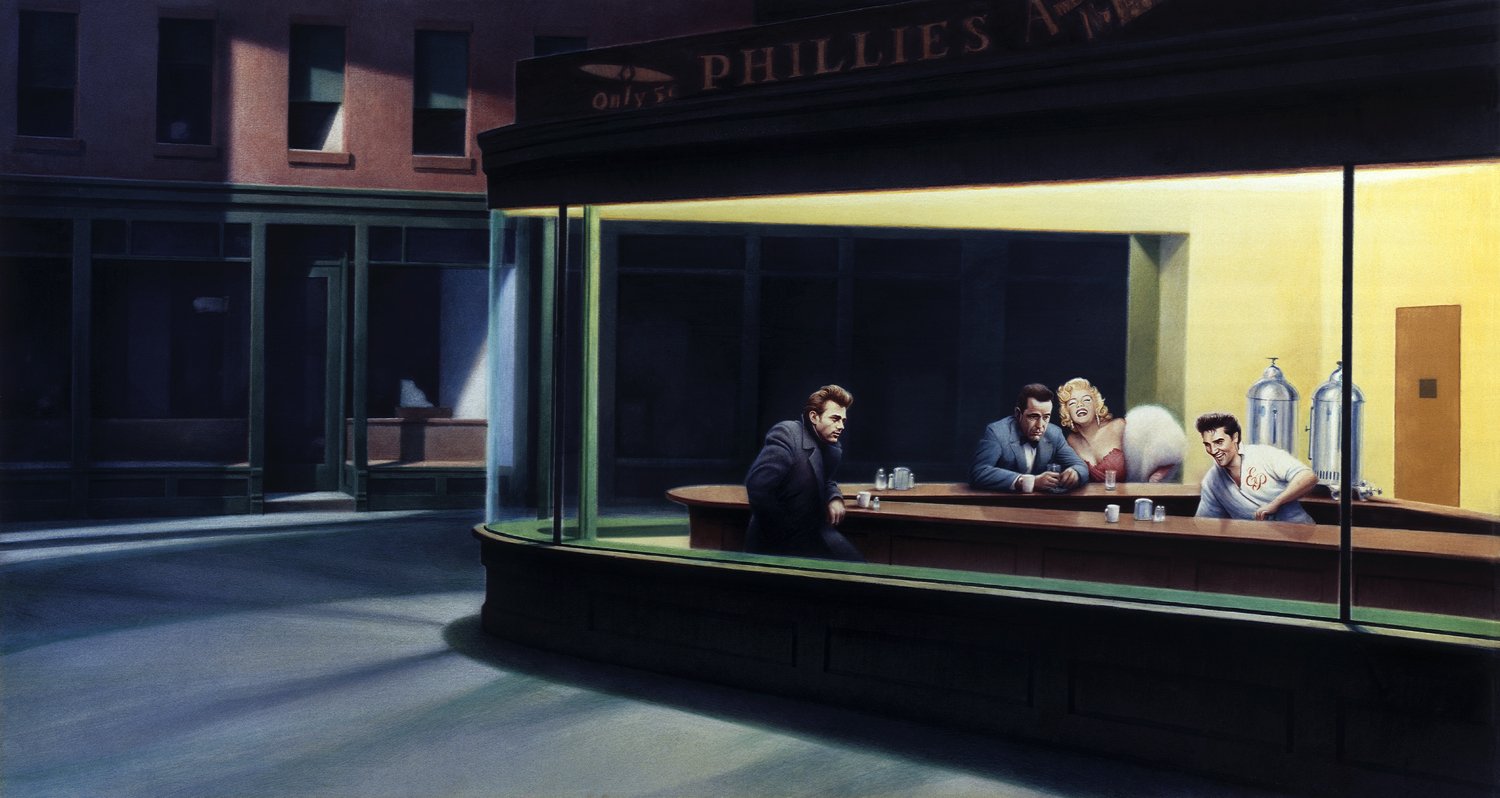
Boulevard of Broken Dreams by Gottfried Helnwein (1984)

Hopper’s iconic painting was reproduced many times.  One of the most famous is probably Gottfried Helnwein’s painting entitled Boulevard of Broken Dreams in which the bar tender is Elvis, the couple Humphrey Bogart and Marilyn Munroe and the solitary figure, with his back to us, James Dean.  This was sold extensively as a poster.  I suppose that because we know the characters in this picture and we know of their lives, maybe the feeling of loneliness of these “nighthawks” is not so obvious at first glance but maybe their tragic fates were meant to add to the mood of their diner.

I will leave you with a poem, written by Wolf Wondratscheck, based on Hopper’s painting Nighthawks in which he reasons as to why the customers came to the diner and what will happen next

 It is night
and the city is deserted.
The lucky ones are at home,
or more likely
there are none left.

 In Hopper’s painting, four people remain
the usual cast, so-to-speak:
the man behind the counter, two men and a woman.
Art lovers, you can stone me
but I know this situation pretty well.

 Two men and one woman
as if this were mere chance.
You admire the painting’s composition
but what grabs me is the erotic pleasure
of complete emptiness.

 They don’t say a word, and why should they?
Both of them smoking, but there is no smoke.
I bet she wrote him a letter.
Whatever it said, he’s no longer the man
who’d read her letters twice.

 The radio is broken.
The air conditioner hums.
I hear a police siren wail.
Two blocks away in a doorway, a junkie groans
and sticks a needle in his vein.
That’s how the part you don’t see looks.

 The other man is by himself
remembering a woman;
she wore a red dress, too.
That was ages ago.
He likes knowing women like this still exist
but he’s no longer interested.

 What might have been
between them, back then?
I bet he wanted her.
I bet she said no.

 No wonder, art lovers,
that this man is turning his back on you.

The Pillars of Society by George Grosz

The Pillars of Society by George Grosz (1926)

My Daily Art Display today is a painting by the German painter George Grosz.  He was born in Berlin in 1893. His father died when he was eight years of age and his mother moved to the Pomeranian town of Stolp.  It was here that George attended weekly drawing classes.  At the age of sixteen he went to the Dresden Academy of Fine Arts and remained there for two years before moving to the Berlin College of Arts.

In 1914 at the onset of World War I he volunteered for military service.  His military life lasted less than a year being discharged on medical grounds for sinusitis.  In 1919 he joined the Communist Party of Germany but his loathing of any sort of dictatorial authority whether it was left wing or right wing was abhorrent to him and so he resigned.  The early 1930’s saw the rise of the Nazi Party and George Grosz found this faction extremely repugnant and so in 1933 he and his family emigrated to America where he became a naturalised citizen five years later.  He enjoyed the American way of life and took up a number of art jobs and exhibited his works on a regular basis.  He always intended to return to his homeland one day and that day came in 1959 when he went back to Berlin somewhat disillusioned with American life.  Sadly he died there shortly after his return when he fell down a flight of stairs.  His death came three weeks before his sixty-sixth birthday.

Today’s painting is entitled The Pillars of Society and was completed in 1926 and can be found at the Nationalgalerie in Berlin. It is a deeply sarcastic portrait of the German elite classes who supported Fascism.   Like many of his paintings of this era it satirized what he believed was the corrupt and bourgeois society of Germany.  In this painting Grosz uses his skills as a caricaturist to produce vivid, grotesque, nightmarish, portrayals of those who controlled society.   Businessmen, clergy and generals, are all portrayed not as the polished, fine, refined gentlemen of Academy art, but as vicious, selfish, and uncaring individuals.  Grosz was a leading figure of the Neue Sachlikeit (New Objectivity) Movement which reflected the resignation and cynicism of the post-war period and it used violent satire to depict the face of evil.   The name of the painting, The Pillar of Society, derived from a play of that name by Henrik Ibsen. 

In the painting we can see four main characters.  In the foreground we have the old beer-drinking aristocrat with his head full of the pageant of war with a dueling scar on his left cheek and a swastika on his necktie.  In one hand he holds a glass of beer and in the other a foil.  His monocle is opaque and he has difficulty in seeing.  His skull is open and from it rises a war-horse.  On the left of the picture stands the journalist, Alfred Hugenberg with a chamber pot on his head, symbolizing his lack of intelligence, clasping newspapers in one hand and a bloodied palm branch in the other.  On the right hand side we have a Social Democrat, probably a caricature of Friedrich Ebert, the German president, holding a flag and a socialist, pamphlet stating “Socialism must work”, with his head opened to expose a steaming pile of dung.  Behind these three characters is a pro-Nazi clergyman, bloated and preaching peace, choosing to ignore the murderous actions of the military seen in the background.  Through the windows we can see the city in flames and in the background chaos reigns unchecked.  For George Grosz the instructions given to the brainless politicians came from the military, the clergy and the press all of whom he believed to be amoral and lacking integrity and were despised by him.

The Madonna of the Grand Duke by Raphael

The Madonna of the Grand Duke by Raphael (1504)

I wonder if you have ever considered what subject has been depicted the most in art.  If I was to guess and knowing the plethora of religious paintings I would have to say it was the depiction of the Madonna and Child.  It is very interesting to study how both the Virgin Mary and the Christ child are visually represented in these paintings and how they differ down the ages.  In some the young Christ Child almost has the face of a grown man.  In some the Virgin Mary has a very wooden expression and her looks would be described in modern terminology as plain.   Today I was attending a talk about the artist Raffaello Sanzio da Urbino, better known simply as Raphael and one of the paintings we looked at was his Madonna of the Grand Duke and the more I looked at it the more I fell in love with it,  so come and join me in this journey of discovery of what I believe is one of the most beautiful Madonnas.

The Madonna of the Grand Duke, or to give it its correct title Madonna del  Granduca, was painted by the Italian Renaissance artist Raphael Sanzio in 1504 shortly after he arrived in Florence and was owned by Grand Duke Ferdinand III, hence the name of the painting.  It can be found now in the Palatine Gallery of the Pitti Palace in Florence.  In the painting Mary is shown standing and we see her in more length than in Raphael’s other Madonna paintings such as the Madonna Tempi and Virgin with Chair. She has the features of a beautiful Italian girl.   She is wearing a long cloak that begins in a veil over her head which then cascades downwards and in doing so emphasises the long vertical lines of the frame.  Instead of the baby being held at shoulder height the Christ Child is tenderly held and supported by her at almost waist level.  It is almost as if the characters are painted to fit with the long length of the frame.  This has allowed Mary to be shown in a more majestic and venerable pose.  There is a dignified look about Mary but one also detects a look of sadness.  Whereas Mary gazes downward in an almost trance-like expression the Christ child is wide eyed and inquisitive.

Many artists despaired at Raphael’s talent.  His depictions of the Madonna, like today’s painting, and other female portraits show tenderness, warmth and elegance which other artists struggled to attain.  To many he is simply the painter of sweet Madonnas, which have become so well known as hardly to be appreciated as paintings any more.  Today’s painting is a classic and for artists that followed Raphael it acted as a standard of perfection. 

I challenge you to find me another Madonna painting of such exquisite beauty

The Discovery of the Body of Holofernes and the Return of Judith by Alessandro Botticelli

The Discovery of the Body of Holofernes by Botticelli (c.1470-1472)
The Return of Judith by Botticelli (c. 1470-1472)


Two for the price of one today.  Actually they were originally two panels of the same diptych, which had a carved and gilded walnut frame but which has since been lost.  These two tempera on wood panels can now be found as separate items in the Uffizi Gallery in Florence.  There is, as you would expect, a story connecting the two works of art.  For those who are slightly squeamish and don’t like the sight of blood, I apologise !

Both of today’s paintings are by Alessandro Botticelli and both refer to an Old Testament story from the Book of Judith (13:10).  It is very much like the story of David and Goliath, in which the underdog triumphs against great odds, a sort of virtue conquering vice.  Holofernes was the Assyrian general whose army was laying siege to the Jewish settlement of Bethulia. Under intense pressure from the enemy, some of the residents voiced their opinion that they should surrender.  However a rich widow, Judith, conceived a plan which would save her people.  One night, dressed in her finest clothes and looking her most alluring she passed through the town gates and with her maid and walked across the valley to the camp of her town’s oppressor, Holofernes.  She gained an audience with him by telling his guards that she would provide them with a route which would enable them to enter Bethulia.

Judith told Holofernes that she had deserted Bethulia and had been sent by God saying that her people had turned away from religion and therefore deserved to be destroyed and she would aid Holofornes in his battle.  Holofornes was pleased with this and said that Judith could remain in his camp and would be allowed to leave each evening with her maid, Abra, so as to pray.  He was mesmerised by Judith’s beauty.  On the fourth night Holofernes held a banquet for his commanders and Judith dressed seductively, went to Holofornes tent.  Holofernes drank excessively and sent all his men away so he could be alone with Judith.  Due to the amount he had drunk, he rapidly lost consciousness.  When he finally fell into a stupor Judith grasped his sword and with two mighty blows decapitated him.  Then she and her maid left the camp as they did each evening on the pretence to pray before returning.

This time, however, they kept walking.  At the gate of Bethulia, she called for entry, showed her trophy, and told the men to mount an attack on the Assyrian camp next morning. They did so, and when the Assyrians ran to Holofernes’s tent to rouse him, they found their leader headless. Horrified, the Assyrians decamped. The Israelites plundered the camp; all the best things of Holofernes were given to Judith, who then passed them to her late husband’s heirs.

So there you have it, the story of Judith and Holofernes.  The paintings, on offer today, are depictions of this tale.  One shows the headless body of the Assyrian leader being found by his servants.  Look at the faces on the servants.  Notice the shock and horror as they gaze down upon the muscled almost naked headless corpse of their leader Holofernes.  Study the musclature of the body.  It is an excellent nude study.  Note the skilful combination of colours and in the use of light to illuminate the clothing as well as the bedsheet on which the body of the dead Holofernes sprawls.

In the other painting, The Return of Judith, she and her maid are seen in flowing robes looking similar to young nymphs that are often found in this era of painting.  We see a jubilant Judith returning home with her maid, Abra, who carries the sack in which is the decapitated head of Holofernes. In one hand Judith has the bloodied sword which she used to kill Holofernes and countering that act of violence she carries in her other hand an olive branch which symbolises peace.  The painting of Judith shows a female heroine and depicts female dominance which is a theme that Botticelli often used in his paintings.  Botticelli has succeeded here in capturing both movement and stillness in a unique balance. Judith is pausing a moment in her striding forward to turn towards the observer, self-assured if not without a touch of melancholy, exactly as if she wished to present herself as the victor.

Although you do not get a sense of the size of the paintings, you may be surprised to know how small they are, measuring only 31cms x 24cms.

The White Horse by John Constable

The White Horse by John Constable (1819)

If I was to ask you what was your idea of an English countryside I am sure a large number of you would think about the paintings of John Constable, such as his famous work, The Hay Wain.  Certainly when I conjure up in my mind the tranquillity of the countryside, I reflect on the beauty of the English country landscapes paintings of the English Romantic artist John Constable.  In fact the term “Constable Country” is often used to describe the loveliness of that part of the eastern England located on the Suffolk and Essex border.  It is a truly wonderful area with countryside which lends itself easily to paintings.   Like Thomas Gainsborough, Constable was influenced by Dutch artists such as Jacob van Ruisdael. The works of Rubens proved to be useful colouristic and compositional models. However, the realism and vitality of Constable’s work make it highly original.

John Constable was born in 1776 in the village of East Bergholt in the county of Suffolk.  Art historians tell us that he was not a naturally gifted artist and it took many years of hard work and his love of art to place him alongside Turner as one of the two greatest figures in the history of British landscape painting.   He always wanted to pursue an artist’s life and had to fend off pressure for him to become a clergyman.  Eventually after leaving Dedham Grammar School he trained for a career in the family business.   Whilst living at home he had many opportunities to sketch the Stour area and he met up with and became a close friend of Sir George Beaumont, an artist and collector, who would later establish the National Academy.  It was he who would once again awaken Constable’s love of painting and would later tutor him at the Academy.  

When he was twenty three and after much pressurising of his father, he was allowed to leave the family business and follow his passion for art and he became a student at the Royal Academy Schools of London.  Also studying at that Academy was Turner, although they never became close associates. 

He exhibited his first paintings in 1802, but unlike Turner, Constable did not sell many of his works.  In fact during his lifetime he only sold twenty paintings and failed to gain the recognition achieved by Turner in Britain although that was not the case in France where his works were well received.  His paintings, especially his “six footers” greatly influenced the French artist Delacroix and the French Romantic Movement.  He also inspired the Barbizon School, which is the name given to a community of mid-19th-century painters who worked in and around the village of Barbizon in the forest of Fontainebleau, south-east of Paris.   They painted landscapes and scenes of rural life, occasionally working in the open air.  John Constable died in Hampstead, London in 1837, aged 60.

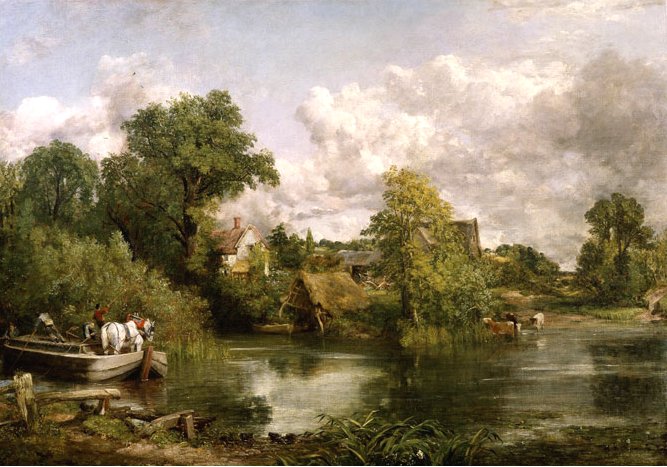
 My Daily Art Display for today is The White Horse which Constable completed in 1819 and is part of the Frick Collection in New York.  This was the first of Constable’s “six footer” exhibition canvases, a set of 6ft x 4ft landscape paintings he completed between 1818 and the mid 1830’s.   He started with sketching the scenes outdoors but because of the size of the finished paintings he had to come indoors to work on the finished product.  

The view in this work of art is from the south bank of the River Stour, looking back across the river just below Flatford. The barge on the left has taken on board the white horse and is about to set off to reach a spot downstream where the tow path resumes on the opposite bank. Cows can be seen wading in the shallow waters.   Just beyond the barge is a small island called ‘The Spong’. Willy Lott’s house, which is featured in Constable’s The Hay Wain, is just visible to the left centre in the middle distance. Following the exhibition of this work, Constable was elected an Associate of the Royal Academy.

If you liked today’s painting why not go and discover other  Constable’s  “six footers” such as, Salisbury Castle from the Meadows, 1831, Stratford Mill, 1820 and of course The Hay Wain, 1821.

His” six footer” painting entitled Hadleigh Castle, which he painted a year after his wife Maria died of tuberculosis, is a more sombre painting which probably reflects Constable’s mood at the time and who said of his late wife:

” I shall never feel again as I have felt.

The face of the world is totally changed to me.”

Take some time and ave a look at some of John Constable’s works and see if you have a favourite.