Trial by Fire by Dieric Bouts

Justice of Otto III The Trial by Fire panel by Dieiric Bouts (1470-75)

Yesterday we looked at the left hand panel of the Justice of Emperor Otto diptych entitled The Execution of the Innocent Count.  Today I want to show you the right-hand panel which is entitled Trial by Fire.

To follow on from yesterday’s story regarding the execution of the innocent nobleman we delve further into the legendary tale The Golden Legend  written by Jacobus de Voragine in the late Middle Ages to seek out the consequences of that execution and discover the meaning behind Bout’s painting.   The nobleman’s widow, convinced of her dead husband’s innocence, asked for an audience with Emperor Otto so that she be allowed to prove the truth of her husband’s claim of innocence and clear her husband of the stain of adultery by suffering an ordeal of fire.   The Golden Legend tells of the event as follows:

 “…In the year of the Lord 984 Otto III, surnamed the Wonder of the World, succeeded Otto II. According to one chronicle his wife wanted to prostitute herself to a certain count. When the count refused to perpetrate so gross a crime, the woman spitefully denounced him to the emperor, who had him beheaded without a hearing. Before he was executed, the count prayed his wife to undergo the ordeal of the red-hot iron after his death, and thus to prove his innocence. Came the day when the emperor declared that he was about to render justice to widows and orphans, and the count’s widow was present carrying her husband’s head in her arms. She asked the ruler what death anyone who killed a man unjustly was worthy of. He answered that such a one deserved to lose his head. She responded: “You are that man! You believed your wife’s accusation and ordered my husband to be put to death. Now, so that you may be sure that I am speaking the truth, I shall prove it by enduring the ordeal of the burning iron.”

Seeing this done the emperor was overwhelmed and surrendered himself to the woman to be punished. The prelates and princes intervened, however, and the widow agreed to delays of ten, eight, seven, and six days successively. Then the emperor, having examined the case and discovered the truth, condemned his wife to death by fire, and as ransom for himself gave the widow four burgs, naming them Ten, Eight, Seven, and Six after the above-mentioned delays….”

So now look at the painting which depicts the scene described in the passage from the book.  As was the case with yesterday’s left panel, the painting on the right panel is split into two different scenes.  The main scene is featured in the foreground and middle-ground and features the widow kneeling before the emperor with the head of her dead husband, cradled by her right arm. In her left hand she defiantly holds the red-hot iron bar and by this action has, according to the emperor’s dictate, passed the test.    Otto sits on his throne surrounded by six courtiers.  He wears his red and gold brocaded robe with its sumptuous brown ermine lining.  A crown sits upon his head and he holds his sceptre of office in his right hand.  His eyes are transfixed on the poor woman before him as she pleads with him.   He realises with some disconcert that he has ordered the death of an innocent and loyal man.  His left hand is placed over his heart acknowledging his heartfelt contrition.  He is dumbstruck at the realisation he has condemned an innocent man to death and has discovered the truth about his wife’s infidelity and perjury.  He knows he has to try and rectify the wrong and orders the execution of his wife. 

In the second scene we see the burning of his wife at the stake, watched by crowds, and is depicted in the background of the painting.  She is bound to a pole watched over by a white-frocked cleric, who has been with her during her last few moments extending God’s mercy to the hapless woman.  The place of execution appears to be on the hillside in the country, outside the walls of the town.

 The diptych on view for the magistrates of Louvin to see each day was to act as a salutary lesson of the consequences of hasty and ill-thought out judgements and the perils of not hearing both sides in a case.  It also reminds them that no matter how powerful they may be they should not sit in judgement in cases in which they are personally involved for fear of bias.  Some historians believe Bouts was putting forward the idea that such errors of judgement ultimately cause the judges great anguish.

To end on an historical note Emperor Otto III in reality lived a very short life, dying of the plague or malaria at the age of twenty-one in the year 1002 during one of his military campaigns.  So what of his wife?   Actually Otto never married and had never had any children and on his death the great Ottonian Dynasty ended.

The Execution of the Innocent Count by Dieric Bouts

The Execution of the Innocent Man by Dieric Bouts (1470-5)

On January 27th  I showed you two painting by Gerard David entitled the Judgement of Cambyses and the Flaying of Sisamnes which was originally hung in the magistrates chambers in Bruges to act as a salutary warning to all those who dispensed justice in that city.  Town halls were often decorated with justice scenes in those days and today and tomorrow I want to look at two more examples of this artistic genre.  Our artist featured in today’s My Daily Art Display is the Dutch artist, Dieric Bouts the Elder.

Bouts was born in Haarlem around 1420 where he spent most of his early life.  Little is known about his childhood and early life except to say that most of his work was carried out whilst he was living in Louvain from 1457 until his death in 1475.  It was in this town that Bouts became city painter in 1468.  We know that he was influenced by the works of Jan van Eyck and Rogier van der Weyden, the latter at one time being his tutor.  Art critics talk of a certain stiffness to his drawing and drew attention to the disproportionate length and angular nature of the figures in his paintings.  However they do concede that his figures are extremely expressive and that there is a richness of colour in all his works especially the backgrounds of his landscapes.

 Our painting today is one half of the diptych known as the Justice of the Emperor Otto or simply the Justice Panels which he commenced in 1470 and which he was still working on at the time of his death five years later.  He had completed one of the two panels and had begun on the second one.  There were to be four panels in all but the third and fourth panel were never completed.  The two panels that exist and now form a diptych are now on view at the Musées Royaux, Brussels.  In 1468, Bouts who was at the height of his career had just completed his greatest masterpiece, The Last Supper.  He was approached by the town council of Louvain to paint a series of four panels for the town hall.  The town council’s reason behind such a commission was that they believed that their magistrates would benefit from the depictions of this old moral story – a judicial exemplum.

 Today I am going to look at the left hand panel which is entitled The Execution of the Innocent Count.  First let me relate the background to this painting.  The tale which is wholly legendary comes from the 12th century chronicle of Gottfried the then Bishop of Viterbo.  The story is also mentioned in Jacobus de Voragine’s Golden Legend or Aurea Legenda.  It tells of the Holy Roman Emperor Otto III whose wife was the daughter of the King of Aragon.  According to the story Otto’s wife was a very hot-blooded and feisty young Aragonese woman.  She became captivated by a married nobleman of Otto’s imperial court and without a care of the consequences tried to seduce him.  However, to her horror and anger, the nobleman rejected her amorous approaches and remained faithful to his wife and loyal to his lord, Otto.  The woman had been scorned and was furious and sought revenge on the noble who had rebuffed her.  She immediately went to her husband, Otto, and falsely accused the nobleman of having raped her and this set in motion a terrible set of events and a great injustice.  The emperor was furious and without even listening to the pleas of innocence from the nobleman ordered his execution by beheading. 

Otto and his wife

This oil on panel painting which is very large, measuring 325cms tall and 182cms wide and the people depicted in the scene are life-sized.    There are three distinct scenes to this painting and they are arranged in chronological order.  To the right, in the middle-ground, behind a stone wall, in their Imperial garden, we have the Emperor and his wife.  Their high position in the painting symbolises the fact that they were present, overseeing the proceedings.  They are witnessing the execution of the innocent man solely condemned by the perjury of the emperor’s wife.  She is emotionless and even seems bored with the event unfolding before her.

The condemned man and his wife.

On the left hand side of the middle-ground we have the accused, barefooted, with his hands tied before him.  He is dressed in a simple white robe and stands next to his wife who is dressed in red, with clasped hands praying for the soul of her husband.   The nobleman shows no emotion and seems resigned to his fate.  A Franciscan monk walks ahead of the man and his wife as they share their last words.  He is the confessor.  His hand is raised as he begins to make the sign of the cross.  He will listen to the nobleman’s last wishes and will pray with him at the end and offer him absolution for his sins.

Executioner and the severed head

In the foreground we see the aftermath of the execution.  The executioner is dressed in green and yellow tights which show splashes of blood.   His bloodied sword is held behind his back as he hands the severed head of the nobleman to the grieving wife.  She lovingly cradles the head in a white shroud.  The decapitated body of her husband with blood pouring from the severed neck lies on the green grass.  This stark contrast of the two colours intensifies the painting.   The scene is witnessed by townspeople, merchants and the clergy and probably some of them would be portraits of actual people of Louvain at the time of Bouts.

The moral of the tale depicted in this painting and what the burgers of Louvain wanted to stress to their magistrates was that one should not judge top hastily.  One should not judge a case without hearing the other side of a story and finally a judge should not make a judgement on a case in which he is personally involved.   The tale and the painting also highlight the damage which can be done through perjury and defamation.

This is just the first part of the story depicted by Bouts on one of the two panels.  Tomorrow I will focus on and discuss the second panel which deals with the repercussions of the execution of the innocent man.

The Madonna of the Long Neck by Parmigianino

Madonna with the Long Neck by Parmigianino (1534)

Two days ago (March 16th) I gave you what I thought was a very strange painting entitled Child with Doll by Henri Rousseau.  The depiction of the child was odd and the proportions of the figure just didn’t look right.  The figures in today’s painting have similar unusual proportions but in my mind there is still an element of beauty about the figures.  The title of today’s painting actually derives from such artistic distortions.  The picture painted in 1534 by the Italian Mannerist artist, Parmigianino is entitled Madonna with the Long Neck, and hangs in the wonderful Uffizi Gallery in Florence.  Before we look at the painting in detail I think we need to understand a little about Mannerism and Mannerist artists.

Around the 1520’s in Italy, art in many ways had reached its peak of excellence.  It was the time of the great High Renaissance painters Leonardo da Vinci, Michelangelo Buonaroti, Titian and Raphael Santi.  It was believed by many that the works of these four giants of art could never be bettered.  Their paintings combined splendour and harmony with correctness.  Although few would disagree with this appraisal of their work, think how it affected a young up-and-coming artist of the time to be told that no matter how hard they tried, their work would never come up to the standard of those that went before them.  Would you be disappointed and disheartened by that appraisal of your future?  Would that just make you want to give up your artistic career?  For many aspiring artists at that time that is what they did – gave up their dreams but for others they decided to imitate the works of the great High Renaissance artists.  They looked at the musculature of the figures in some of Michelangelo’s paintings and copied the figures in to their works and as Gombrich wrote in his book The Story of Art:

“….Michelangelo had loved to draw nudes in complicated attitudes – well, if that was the right thing to do, they would copy his nudes, and put them into their pictures whether they fitted or not.  The result was slightly ludicrous – the sacred scenes from the Bible were crowded out by what appeared to be a training team of young athletes….”

 Others searched for a way to overcome the situation they found themselves in.  They knew that art would eventually move on and they decided they must be part of that future.  They realised that they would never be able to improve on the works of the Renaissance Masters and for them to become great artists and have their works of art become popular they needed to change their painting style.  Something had to be different about their work if it was to achieve greatness.  They looked at how they would depict people in their paintings.  They played round with how their figures posed within a scene.  Often figures would be distorted into almost impossible poses.  Sometimes they would disregard the true physical proportions of their figures, frequently elongating them. They did not believe their paintings had to exhibit balance or harmony, which was of great importance to the High Renaissance artists.  These mid 16th century Italian artists believed they could be the new future of art and were known as the Mannerists.  The art produced by these Mannerist painters was not loved by all.  Many critics suggested that this art genre was simply characterised by its artificiality, superficiality and exaggeration.  One could sum up Mannerism by saying it is a style in art and originating in Italy as a reaction against the equilibrium of form and proportions characteristic of the High Renaissance. However, the term Mannerism, to some people, rather than be thought of a style, is just the era in Italian art, sandwiched between the High Renaissance period which began around 1490 and ending circa 1527 and the arrival of the Baroque period of art circa 1600.  Art critics and writers have varied views on what they believe Mannerism to be and in his 1957 book entitled Mannerism, John Shearman, the author, wrote:

“…This book will have at least one feature in common with all those already published on Mannerism; it will appear to describe something quite different from what all the rest describe…”

And so to our picture today, which was painted by the great Mannerist artist Girolamo Francesco Mari Mazzola, more commonly known a Parmigianino which translated means “the little one from Parma”, his birthplace.  Today’s work of art is his painting, Madonna with the Long Neck.   This was his crowning masterpiece.  He commenced working on the painting in 1534 for the church Santa Maria dei Servi at Parma.  However at this time of his life the artist became fascinated with alchemy and all the magic that goes with it and this obsession resulted in his art commissions being neglected and on his death six years later this painting was still incomplete.

The revealed body of the Madonna

 As we look at this painting, the title is self explanatory.  The painting depicts the Virgin Mary dressed in luxurious robes.  On her lap is the baby Jesus.  To the left we see a group of angels and to the right of the Madonna, in the background we see the diminutive figure of the prophet, Saint Jerome, almost naked standing before a vertical column, holding an unfurled scroll.  This tiny figure of St Jerome is in marked contrast and completely out of proportion with the overbearingly large figure of the Madonna.

If we look closely at the Madonna we can see that her physical features have been distorted by elongation.  Look at the length of her neck, hands, fingers and feet, all of which are too long.  Look at the lower half of her body.  This seems to be far too wide.  Are all those features part of the Mannerism concept?  Some art critics would have us believe that the elongated length of her neck has religious significance and harks back to medieval hymns and litanies to the Virgin Mary which compares her neck to a great ivory tower or column (is that why we have a white column in the background of the painting?) and that the architectural reference to the column furthered her symbolic role as representing the Church.  But if this was the reasoning behind the long neck what was the reasoning behind the elongation of her hands, fingers and feet?   Another strange aspect to the painting of the Virgin Mary is there is a sensuousness about her pose and her clothing which is very unusual in Madonna portraits.   Look how the fingers on her right hand touch her breast.  Look how the almost transparent greyish garment lies against her breast and how the cloth hangs against her nipple.  See how her fingers almost point towards her breast and nipple as if guiding our eyes to what we should observe.  Look at how the cloth gathers tightly against her stomach and how we can clearly see her navel.  Parmagianino’s Madonna has elaborately curled hair which is decorated by pearls and frames her exquisite and beautiful face.  The robes she is wearing are sumptuous and cascading.   This is a very unusual portrayal of the Mother of Christ.  This is more a portrait of a (then) present day beauty.  She has the beauty of a Raphael Madonna but incorporates, some would say, “suffers from”, the elongation at the hands of a Mannerist painter.

Now look at the baby Jesus who rests on his mother’s lap.   The baby is not being lovingly cradled as it is in the more normal depictions.  His elongated figure just lies across her lap and we wonder if he will slide to the floor.  Look closely at the figure.  Is the baby alive and asleep or are we looking at a dead body with his lifeless arm hanging downwards.     Are we looking at a lifeless body lying across the thighs of the Virgin Mary similar to the dead Christ’s portrayal in the familiar Pietà figures?  Why has the artist given the baby a deathly-grey pallor?  Again look at the face.  Do you think this is the face of a baby or an older infant or are we being tricked into believing that the child is older because of his elongated features?

The sensuous quality of the angel


The group of six angels are crammed into the left hand side of the painting.  The artist, being a true Mannerist, made no attempt to balance the painting by having them split into equal numbers on either side of the Madonna and Child.  If you think I have counted up the number of angels incorrectly and can only see five, I believe the face of the “unfinished” angel is just below the right elbow of the Madonna.  Earlier I talked about the sensuousness of the artist’s depiction of the Madonna, this time I again have to draw your attention to the sensual depiction of the angels, particularly the angel standing at the front. Look at the way her silky gown is cut high exposing her upper thigh.  Note how the toes of the elongated left leg of the baby press the skin of the angel’s upper thigh.  It is almost acting as a pointer to where our eyes should look.  This is similar to the Madonna’s fingers and where they direct our gaze, which I mentioned earlier.  Was this just coincidental and am I making too much of it?  Did the artist intend to add an element of eroticism into this “sacred” painting which was to hang in a church?  Look at the vase which this angel at the front carries.  Although my picture doesn’t show it so clearly, there is a cross on it which was thought to be a reference to the future fate and coming Passion of Christ and the Crucifixion.

As I said at the beginning, this painting was unfinished at the time of Parmigianino’s death.  The sixth angel has not been completed. nor has most of the upper right background.   Look carefully at the feet of Saint Jerome, the man who is holding the scroll.  Just to the right of his feet are another pair of feet which presumably was to be the start of another figure !   The capital of the single column (the crown) is missing.  Was that just because the painting is unfinished or did the artist paint it as such to make the comparison of the Madonna’s elongated neck and this single smooth column more tenable.  If we prefer the “unfinished” reasoning then maybe we should also consider that it is quite possible that this was to be one of a number of columns, which would be shown in the background if the artist had completed the work.

There are so many unanswered questions for you to ponder upon.  All in all, this is a strange painting but this should not detract from its magnificence.  This is now looked upon as one of Parmigianino’s greatest works of art.

Self-portrait at the Easel by Jean-Siméon Chardin

Self-portrait at the Easel by Chardin (c.1776)

Another day, another French painter.  Today I wanted to look at the French painter Jean-Baptiste-Siméon Chardin and My Daily Art Display for the day is his pastel on blue paper Self-portrait at the Easel which he painted around 1776.  It is currently housed in the Louvre, Paris.

Chardin, the son of a cabinet maker, was born in Paris, in 1699.  He lived on the Left Bank of the River Seine, close to the church of Saint Sulpice, which has, along with its “Rose Line”, recently gained notoriety because of the film The Da Vinci Code.    He studied art under the tutelage of the French History painters Pierre-Jacques Cazes and Noél-Nicolas Coypel and in 1724, aged twenty-five he became a master in the Acadèmie de Saint-Luc.  A year earlier, he entered into a marriage contract with Marguerie Saintard but it was not until eight years later that the couple married in 1731 and that year his son Jean-Pierre was born.  Two years later the couple had a daughter, Marguerite-Agnés.  Sadly his wife died in 1735 and two years later his daughter passed away.

In 1728 he presented two of his painting, The Ray, and The Buffet to the prestigious Acadèmie Royale de Peinture et de Sculpture and they were of such quality that he was accepted into this hallowed society.  For fifty years, he regularly attended the Society’s meetings and during which, served as counsellor, secretary and treasurer.  He consistently exhibited at the Salon each year and he proved to be a “dedicated academician.  Chardin earned money from his artistic talents in any way he could.  His paintings were not restricted to any single genre; it just depended on the whims of his clients. 

In 1744 he married for the second time.  His second wife was Françoise-Marguerite Pouget. The following year their daughter, Angèlique-Françoise, was born, but she died in 1746.  In 1752 Chardin was granted a pension of 500 livres by Louis XV.  Beginning in 1761, his responsibilities on behalf of the Salon, simultaneously arranging the exhibitions and acting as treasurer resulted in a slow-down in the productivity of his painting.   In 1763 his services to the Acadèmie were acknowledged with an extra 200 livres in pension. In 1765 he was unanimously elected associate member of the Acadèmie des Sciences, Belles-Lettres et Arts of Rouen, but there is no evidence that he left Paris to accept the honour. By 1770 Chardin was the ‘Premiere peintre du roi’, and his pension of 1,400 livres was the highest in the Academy.

Chardin rarely travelled far from his Left Bank home, just occasionally making the short trips to Versailles and Fontainebleau.   In 1757 he finally moved house as Louis XV granted him a studio and living quarters in the Louvre.  Five years later more tragedy was to enter his life with the death of his artist son, Jean-Pierre, who was found drowned in Venice.  The belief was that he had committed suicide.  Chardon carried on painting and his last known painting was dated 1776, just four years before his death in 1780 at the age of 80.

Chardon was secretive about his methods. No one saw him painting; he had no pupils or followers. He seems to have worked slowly, in a style that is evocative rather than literally descriptive. He made few, if any, preparatory drawings. His contemporaries observed that his still-life paintings, which on close inspection seemed to be just a flurry of strokes, were in fact paintings of a startling immediacy and naturalism.   He portrayed household and family routines and children at play in genre scenes with a touch that was tenderly true to life.  These were engraved and claimed the imagination of a wide public. The subject matter he chose for his paintings was unassuming.  They were also often small in size.  Chardin’s paintings are supremely colourful and his work has long been admired by artists and critics alike.

Throughout the eighteenth century there were two competing hierarchies of painting genres.  On one side, one had the history painting genre and on the other side there was the portraiture and still-life genre paintings.  Chardin,  who painted many still-lifes including many which featured food, never attempted portraiture until 1837 when, according to Nicolas Cochin’s 1737 book Essay on the Life of Chardin1737, wrote of Chardin:

‘….A remarkable occurrence led him to try his hand at this new genre.  Monsieur Avid, a portraitist, was a great friend.  He often asked Monsieur Chardin for advice, which he found beneficial.  However one day when Monsieur Chardin criticised him too keenly, Monsieur Avid sharply retorted: “Do you suppose that it is as easy to paint as your stuffed tongue and saveloys?”  Monsieur Chardin was extremely vexed at this remark…’

Today’s pastel, Self-portrait at the Easel by Chardin sees him standing at his easel.  He stands before us at a time when his eyesight was failing and his health was deteriorating.  He gives us an unflattering and unsentimental vision of himself.  It is, in some ways a disturbing sight.  His enormous prince-nez have slipped down to the end of his nose as he peers over them at us, his viewers.  His eyes do not sparkle.  They look tired and dull.  This was to be one of the last paintings from the artist who seems weary and aware of how the passing years have affected him both physically and mentally.  Although he had many successes in his life, he also experienced many tragedies and one can see that they have taken their toll on him.  His faded skin with its slight ruddy tinge has a look of roughness about it.  His lips have a slight upward turn to them as he forces himself to smile at us.  What is he thinking about?  Around his neck is a multi-coloured scarf, a mixture of warm reds balanced by cool blues and grays.  Such colours can also be seen in his well-worn coat and reflected in his face.

Unfortunately for Chardin, public taste in paintings changed in the mid 18th century and there was a desire to see historical paintings once again come to the fore.  This was not Chardin’s painting genre and he fell from favour with the Academy.  His pension was reduced and slowly his duties at the Academy shrank.  It was not until a hundred years later that the paintings of Chardin came back in vogue and his works are now coveted by the top museums and the wealthy collectors.  Chardin influenced many of the great artists that followed, such as Manet and Cezanne.   Henri Matisse ranked Chardin as one of his most admired painters.

Mademoiselle Rivière by Ingres

Mademoiselle Caroline Rivière by Ingres (1806)

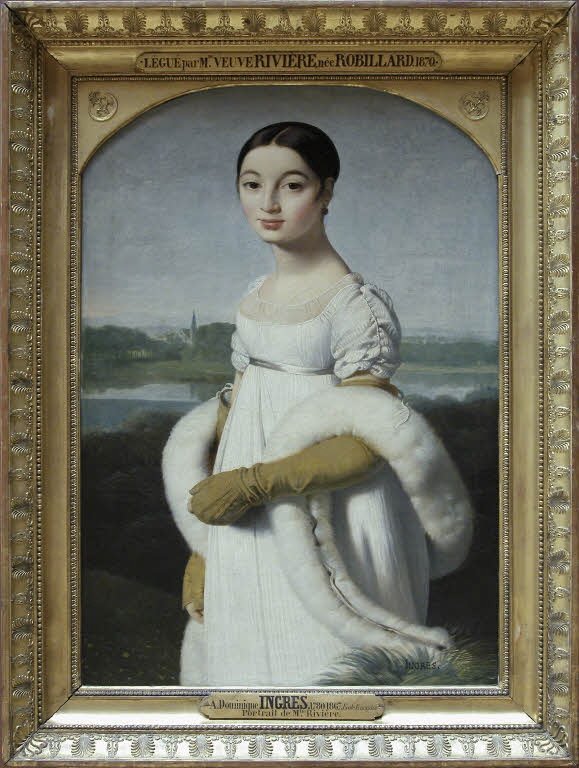
My Daily Art Display today is a portrait of a fifteen year old French girl, Caroline Rivière, which was painted by French neo-classical artist Jean-Auguste-Dominique Ingres in 1806 and can be found hanging in the Louvre, Paris.  Regrettably the story attached to this painting of this youthful beauty has a sad ending, but more of that later.

Ingres was born in 1780, the son of a small time miniature-painter and sculptor, Josef Ingres, from whom he learnt the basics of art and music.  His formal academic life started at the Toulouse Academy of Art at the age of eleven and at the same time he kept up his musical training by taking violin lessons.   He went to Paris at the age of sixteen where he was a student of Antoine-Jean Gros at the studio of Jaques-Louis David.  In 1801 he won the Prix de Rome for his painting Ambassadors of Agamemnon.  The Prix de Rome was a scholarship, founded concurrently with the French Academy in Rome, that enabled prize-winning students at the Académie Royale de Peinture et de Sculpture in Paris to spend a period, usually 4 years, in Rome studying art, at the state’s expense.  Unfortunately for Ingres, because of the financial problems with the French economy, he was not awarded his trip to Rome until 1807.  It was during his stay in Paris from 1801 to 1807, before heading for Rome, that he completed his first portraits.  Some were of wealthy dignitaries such as the portrait,  Napoleon I on the Imperial Throne which hangs in the Musée de l’Armée, Paris  and some where of himself and his friends such as his  Self Portrait at the Age of 24, which is housed in the Musée Condé in Chantilly.                

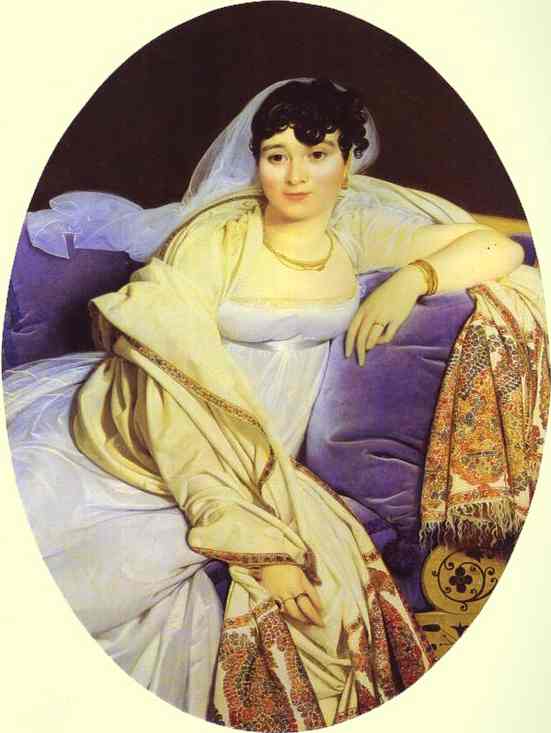
Madame Rivière (1806)
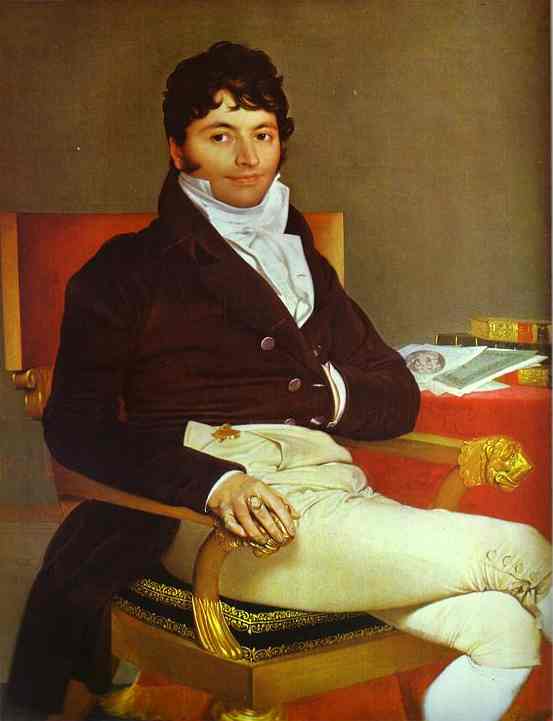
Monsieur Rivière (1806)

It was around this time that he was commissioned by a court official, Philibert Rivière, to commemorate himself, his wife, Marie-Francois and their fifthteen year old daughter Caroline.  Ingres at the time, had a passion for classical paintings with subjects based on history or Greek legends, but as he had to eke out a living, he painted portraits for clients and so accepted the commission.

 Ingres was fascinated by the young girl and was quoted as describing her as “ravishing”.   The portrait entitled Mademoiselle Rivière is My Daily Art Display for today.  It is a three-quarter length portrait.  Her young age is not immediately obvious to the viewer.  Look closer though and one can detect a childlike femininity.  She looks out at us in her virginal-white muslin dress with a large white ermine boa over her arms.  The bodice which was all the fashion at the time struggles to give an illusion of cleavage.  She appears to be quite self-conscious or maybe that is the expression she wanted to give to retain an air of respectability.  There is an overwhelming element of purity in Ingres’s depiction of her or is there?  This portrait is not completely devoid of sensuality. Look at the way Ingres has painted her full red lips, her bared neck and porcelain-like white skin which gives her slight and childlike body a sensuality of which she may not even have understood.  Her gloved arms give Caroline a hint of sophistication and she is at an age when she is neither child nor woman.  You could almost say she was the unfinished article.  

 However, it has to be remembered that her portrait was to hang next to those of her parents and therefore Ingres had to be careful on how he portrayed her.  She must come over as being an intelligent young lady of good breeding and most of all a credit to her parents who have lavished so much upon her.   This painting may be as much about her parents as it is of herself.  It may be a statement of the family wealth and the quality of life the three of them can afford to enjoy.

It was, along with the portraits of her father and mother, exhibited at the Paris Salon, the greatest annual art event in the Western world, in 1806.  The art world greeted this painting with mixed reviews; many disliked it for its “Gothicness” because of its linear precision and enamel-like finish.  It was also disapproved of because of its similarity to Early Netherlandish paintings and the French art critics of the time looked upon these painters from the Nertherlands as Les Primitifs Flamands.     Ingres’s also had many detractors who were critical of the painting saying that the proportions were not right.  They said that her head was too large, her neck was too long and curiously broad, her eyes were too far apart, which made her nose look flat and excessively long as it flows uninterrupted into her brow.  Although “puffed” botoxed lips are all the rage now, critics said that Ingres had made Caroline’s lower lip too fat which drew people’s attention to the lower part of her face which is petite in comparison to the span of her forehead.    The critics also deemed that there was a noticeable lack of definition to her shoulders. 

The background is secondary to the portrait itself and is a mainly bluish-white in colour featuring an Ile de France landscape with a distant town across the wide river.  There is freshness about the landscape and it must be presumed that Ingres wanted it to echo the fresh adolescence of his subject.

And so I return to the beginning when I said there was sadness to today’s painting.  Here we see in front of us a young girl, the daughter of a wealthy family, with everything to live for.  The sadness is that within a year of this painting being exhibited she was dead.

Landscape with Aeneas at Delos by Claude Lorrain

Landscape with Aeneas at Delos by Claude Lorrain (1672)

The featured artist in today’s My Daily Art Display is the French landscape painter of the Baroque era, Claude Lorrain.  The artist was born around 1604 in the town of Chamagne in the province of Lorraine, which at that time was an independent Duchy.  His actual name was Claude Gellée but was better known by the province in which he was born.  He was one of five children who came from a poor family and became an orphan when he was twelve years of age.  After the death of his parents he went to Freiburg to live with his elder brother Jean who was a woodcarver.

In his teens he travelled to Rome and Naples where he became an apprentice to the German Baroque landscape painter Goffredo Wals.  In his early twenties he moved to Rome and became a student of Agostino Tassi, the Italian landscape artist. Whilst in Rome he was commissioned by Cardinal Bentivoglio to produce two landscape paintings.  His works received great acclaim, which earned him patronage from Pope Urban VIII. Over the next ten years he became more and more successful and his fame as a landscape and seascape painter blossomed.  It was around this time that he became friends with the French artist Nicolas Poussin and together they would travel into the Italian countryside sketching the beautiful and breathtaking landscapes.

Claude Lorrain was, in the main, a landscape artist and he would often commission other artists to add figures into his paintings.  He often commented to his patrons that he was giving them an exquisite landscape and the figures in the painting were gratis !   Lorrain was concerned that some of his work may be copied and passed off as his and he wanted to ensure also he didn’t want to duplicate his work.  To circumvent these problems he decided to make tinted outline drawings of all his pictures he had sent to different countries.  He collated these in six paper books and on the back of each drawing he wrote the name of the purchaser.   These six volumes he named  Liber Veritatis (Book of Truth).  Many of his works were engraved and published and have always been popular with aspiring landscape artists.  Claude Lorrain although brought up in a poverty-stricken background, died a rich man in Rome in 1682.

Today’s painting, which was included in his Liber Veritatis and completed in 1672, is entitled Landscape with Aeneas at Delos.  During his last ten years, Lorrain painted six stories of Aeneas, the hero of Virgil’s epic poem Aeneid, which told of the legendary origins of Rome.   He was also very interested in Ovid’s  Metamorphoses  which also recounted the adventures of Aeneas.  In Book III, Ovid tells how Aeneas fled from the burning Troy:

“..  taking with him sacred images of the gods, his father Anchises (the bearded man in blue) and his son Ascanius (the child on the right) Aeneas (in short red cloak) set sail and reached with his friends the city of Apollo [Delos].   Anius [in white on the left], who ruled over men as king and served the sun god as his priest, received him in the temple and his home. He showed his city, the new-erected shrines and the two sacred trees [olive and palm] to which Latona had once clung when she gave birth to her children [Diana and Apollo]….”

This type of painting genre encompassing classical and biblical tales was very popular in the 17th century and often these stories were the motivational foundation for Grand History paintings.  Although the painting is based on a classical story, Lorrain’s emphasis is on the natural surroundings and the panoramic view of the seaport.  Even though the story plays a fundamental part in the work of art, the figures, as far as Lorrain was concerned were of less importance.  We look down on this setting.  We see a woman and child crossing a bridge over a stream.  Sheep graze unhindered under the shade of two tall trees.   Further into the picture we see a semi-enclosed harbour with its many boats.  In the far distance we can just make out the distant hills.  There is much to see in the painting and it is an invitation from Lorrain for us to take in all that is going on.  It is a very airy scene and is enhanced by the cool blueness of the sky with the puffy white clouds which almost fills the upper half of the painting.  There is a definite contrast in the colours Lorrain used in this painting.  By using light whites and blues in the background and darker browns and greens in the foreground the artist has created an impression of spatial depth.  There is also a sense of stability in this painting.  The vertical elongation brought on by the tall trees and the columns of the building is balanced by the horizontal lines of the land and sea

Do you like the painting?  The great English landscape artist John Constable was very impressed with the artist and of Lorrain and his landscape paintings, he commented:

” …he is the most perfect landscape painter the world ever saw”, and declared that in Claude’s landscape “all is lovely – all amiable – all is amenity and repose; the calm sunshine of the heart…”

The Burial of the Count of Orgaz by El Greco

The Burial of Count Orgaz by El Greco (1586)

My Daily Art Display for today is the very large (460cms x 360cms) painting by El Greco entitled The Burial of the Count of Orgaz which he completed in 1586 and can be found in the church of Saint Thomas in Toledo, Spain.

The story behind this painting is fascinating.  The church of Santo Tomé (Saint Thomas) was founded in the 12th century.  In 1312 a leading light in the society of Orgaz, a suburb of Toledo, Don Gonzalo Ruiz died.  He was a very pious man and in his will he bequeathed a large sum of money,  in the form of annual endowments, for the improvement and decoration of his local parish church of Santo Tomé where he was to be buried.    On Don Gonzalo’s death, legend had it that Saint Stephen and St Augustine intervened at his burial to lay him to rest.  However the descendents of the Count withheld the money from the church for almost 300 years and it was not until 1586 after much legal wrangling that the church finally received its promised bequest.   El Greco, who was a parishioner of Santo Tomé , was then commissioned by the parish priest, Andrés Núñez, to paint a picture, for the side-chapel of the church, depicting the legend of the visitation of the Saint Augustine and Saint Stephen.  The painting remains in the chapel to this very day.

The painting, depicting the burial of the Count of Orgaz a title the family received after his death), is divided into two sections and was completed in 1588.  The upper semi-circle represents heaven evoked by the swirling icy clouds and angels whilst the oblong forming the lower half represents the earthly section and all that is going on at the funeral.  If we look closely at the upper “heavenly” section we can see the clouds parting in readiness to receive the Count into Paradise.  Christ dressed in a white shroud sits at the very top of the painting and forms an apex to a holy triangle which is formed by the Virgin Mary, dressed in blue and red, on the left and St John the Baptist, also dressed only in a loin cloth, on the right.   To the left of the Virgin Mary is St Peter with the “keys of Paradise” dangling from his hand.  The three central figures are surrounded by elongated figures of apostles, martyrs and Biblical kings and the just who have passed into paradise.  However amongst them was King Philip II of Spain who was very much alive at the time of the painting !   This “heavenly” upper space of the painting is awash with ivoried-greys and a sense of transparency.

The Saints with Count Orgaz

In the lower part of the painting, the “earthly” section, there are numerous figures depicted in the painting.  In the middle foreground we see Saint Stephen (on the left) and Saint Augustine (on the right), dressed in gold and red vestments, cradling the body of the dead count who is dressed in his splendid reflective armour.  We are witnessing the burial of the benefactor of the church with the posthumous assistance of the two saints who have miraculously appeared to thank Count Orgaz for the money he gave to religious institutions. 

El Greco's son Jorge Manuel

Next to Saint Stephen is a small boy pointing to the dead Count.  This is the artist’s beloved illegitimate son, Jorge Manuel, and on the white handkerchief which we can see hanging from his pocket is inscribed the artist’s signature and the date 1578 which was the year El Greco’s son was born. 

Father Nunez

The artist even included himself in the painting and he can be seen just above St Stephen with his hand raised.   On the left of this group there are the officiating monks and to the right are the priests including a portrait of the parish priest,  Andrés Núñez, with the elaborate golden stole, seen reading . Behind them there is a large group of men dressed in 16th century attire, albeit the burial occurred in the 14th century.  These were the most eminent social figures of that time in Toledo.  Custom had it that when a “high-born” died then the eminent and noble men of the town should assist at the funeral and when this painting was commissioned it was stipulated that the scene should include miniature portraits of the local leading men of the Toledo society.

Between the heavenly and earthly planes in the centre of the painting, amid the cloud formations above the funeral, we see, what appears to be a vortex and the soul of the Count, which has the appearance of a child, being escorted to heaven by an angel towards the seated Christ,   who is waiting to receive him.

The Church of Santo Tomé

This painting is a visual triumph as it portrays life, the mystery of death and the resurrection which of course is the most crucial premise in Christianity.  The parish priest had asked El Greco to glorify the local legend of the saints appearing at the Count’s funeral and by doing so remember the good works and generosity of the church’s benefactor Count Orgaz.  It is a painting of great serenity and simplicity.

River Landscape with Horseman and Peasants by Aelbert Cuyp

River Landscape with Horseman and Peasants by Aelbert Cuypt (Late 1650's)

 My Daily Art Display today is a return to landscape painting and a revisiting of the Dutch artist Aelbert Cuyp.  The last time I offered you a painting by this great artist was over a month ago (February 8th) when I talked about a seascape of his.  Today I want to look at one of his many landscapes entitled River Landscape with Horseman and Peasants, which he completed in the late 1650’s and can now be found in the National Gallery, London.

This talented Dutch Italianate painter was born in 1620 in Dordrecht, a city in the Netherlands. He is one of the country’s most important landscape painters of 17th century.  This was the time of the Dutch Golden Age – a time when the local trade, science and art were recognized throughout the world.   Looking at a number of Cuyp’s landscape paintings, it is thought he may have spent time in Italy or he may simply have mixed with other Dutch Italianate landscape painters who had made the artistic pilgrimage. Throughout the 17th century a steady flow of Dutch painters made the difficult and strenuous journey to Italy, which was recognized as the “home of art.”   Here artists of other nationalities studied the great masters of the Renaissance and the contemporary painters of the Baroque genre.   The Dutch at this time  were enchanted with Italy  and landscapes of the Italian countryside.  They loved everything about the country.

Cuyp painted still lives, animals, portraits, and landscapes and worked in two distinct styles. In his early twenties he came under the influence of other artists and he tended to paint naturalistic, diagonal compositions that show a good sense of space and an almost monochromatic yellowish-gray colour. It wasn’t until he was in his thirties and forties that he exhibited a more individualistic style.  This was considered his best period.   Cuyp’s paintings are sunny and lively in atmosphere, profound in tonalities, simple in outline, well-balanced in composition, and notable for the large, rich foreground masses. His palette tends largely to yellow, pinkish red, warm browns, and olive green rather than blue and silver grey.

Today’s painting by Cuyp is looked upon as one of the greatest 17th century Dutch landscape paintings.   It is also believed to be the largest surviving landscapes of the Dordrecht artist and I believe one of his most beautiful. This river landscape with its distant mountain and town across the river is not topographically accurate.  It is not a painting of an actual location but a work of art which encompasses an evocation of an idyllic pastoral land bathed in sunlight, populated by a hunter, an elegant rider and some peasants tending the sheep and cattle. 

The elegantly dressed horseman surveys his animals and the peasants who are in charge of herding them.  This harks back to the feudal past and it is probable that the painting was for some rich landowner or member of the nobility who liked to be reminded of those “happy” days.  It is a very serene setting.  However, in the foreground to the left we spot a huntsman crouched down behind the reeds taking aim at the ducks, which are on the water, unaware of their coming fate.  Very soon the tranquility of the scene will be shattered by the deafening sound of gun fire.

Look how the riverbank is suffused in soft sunlight.  It lights up the animals and people as well as the fauna.  The cows cool themselves by resting quietly under the shadow of the trees.  The characteristic of this light is symptomatic of the Dutch Italianate artist’s approach to landscape painting where the artist turned to the Italian campagna for their subject matter with their glorious tonal control, mastery of colour and magical handling of light.  These Dutch Italianate artists would trek across the mountains to Italy and spend many days sketching the sun drenched Italian landscapes which were so different to the flat openness of their homeland with its often cloudy skies.   Cuyp’s landscape is truly remarkable.  It was painted at a time when the taste of wealthy Dutch patrons combined with the artist’s imagination and the influence of Italy and the important cultural elements of the Netherlands came together.  This actual painting was acquired by the Earl of Bute in the mid 18th century and it lead to other British collectors wanting to get hold of the artist’s work.

Is this not the type of spring day we dream of after coming through the cold of a prolonged winter?   Could you not lie back on the river bank and let the sun gently kiss your skin.   Can you see why the Dutch wanted to buy this little piece of heaven ?

Portrait of Susanna Lunden by Peter Paul Rubens

Portrait of Susanna Lunden by Peter Paul Rubens (c.1622-5)

My Daily Art Display today is an oil on oak painting by Peter Paul Rubens which he completed around 1625.  It was entitled Portrait of Susanna Lunden (?).   An alternate title Le Chapeau de Paille, meaning straw hat, was first used in connection with this painting in the early 18th century.  However looking at the painting one can see that the lady is not wearing a straw hat which leads some art historians to believe that the alternate title of the painting is more likely to have been Le Chapeau de Poilpoil being the French word for fur.

There is a relaxed attitude to this picture presumably because of the family connection of artist and sitter.  The hat which partly shades the face of the lady is a dominant feature of this painting.   It is believed that the sitter is Susanna Lunden who was the third daughter of the Antwerp tapestry and silk merchant Daniel Fourment for whom Rubens designed.  There was, besides a working connection, a relationship between Fourment and the artist as in 1630, Rubens was to marry Susanna’s younger sister Hélène.  Also his sister-in-law, from his first marriage to Isabella Brunt was married to Susanna’s brother David Fourment.  The picture, which was started by Rubens around 1622, was at the time of Susanna’s second marriage, this time to Arnold Lunden.  Her first marriage ended with the death of her husband when she was still a teenager.  Judging by the ring on Susanna’s right index finger it is quite possible that the painting was a betrothal or marriage portrait.

Strange as it may seem, the painting grew in size as it was being painted as we now know that an extra strip of wood was added to the right-hand side and further strip of wood added to the bottom.  These additional strips allowed Rubens to enlarge his background and create a greater spread of sky to which the artist was then able to add some dark clouds to the right-hand side of the background, which contrasted to the clearer blue sky to the left.  Maybe there was some meaning to this contrast in the skies.  Maybe the dark clouds symbolised the sadness of a young widow and the bright blue skies represented the coming of a new and happy life through her second betrothal.  The light from the left hand side of the painting falls across the lady’s body and hands but the right side of her face is partly in shadow owing to the large brim of the hat.  However even the shadow could not lessen the lustre of her skin and the intensity of her eyes. 

It is a sparkling portrait.  The smiling Susanna seems thoughtful.    Maybe it is a shy smile.  Maybe it is a coy smile.  I wonder if she realises the beauty Rubens has conjured up for this portrait.  I am not even sure she is aware of her loveliness or, if she is, maybe it causes her embarrassment.   Her felt hat, adorned with its downy peacock feathers, is so wide and floppy that it almost borders on the absurd but would, I am sure, be well received on Lady’s Day at Ascot races!  The lady, with her full Rubenesque breasts,  a trademark of the Belgian painter, stands demurely before us but, to some extent, avoids our gaze.  

Rubens portrayal of Susanna presents us with a beautiful and desirable woman.  Look at her eyes.  See how Rubens has made the eyes large and lustrous and note how he has chosen black as the colour of the iris.   This enhances the beauty of the subject and her slightly parted pink lips add to her sensuousness and offer a suggestion of eroticism to the painting.  Her pale skin glistens in the light.  She almost glows.  Her red and grey robes are both opulent and unusual with the detachable red sleeves attached to her bodice with ribboned gold-tipped laces.  The colour of the ribbons match that of her lips, nostrils and eyelids.

Could the artist not help but be seduced by the beauty of his sitter ? 

Are we not beguiled by her beauty?

Pope Julius II by Raphael

Pope Julius II by Raphael Sanzio (1512)

Giuliano della Rovere was born in 1443 in Liguria, Italy.  He came from a noble, but poor family.  He received his schooling from his uncle Francesco who was a member of the Franciscan Order.   In 1471 Francesco became Pope Sixtus IV and was able to further the career of his nephew. At the end of 1471, he made the twenty-eight year old Giuliano a cardinal priest in Rome and this post afforded him many beneficiaries from which he built himself a considerable income.  His uncle died in 1484.  Giuliano was not in the position to become pope himself but his sizeable wealth allowed him to bribe the papal electors so as to have the weak but now indebted Cardinal Cibo made Pope Innocent VIII.  This newly elected pope was merely a puppet of Giuliano for the ensuing eight years.  When Pope Innocent VIII died, Giuliano made his move to become the next pope but during the eight years of being the power behind the late pope he had made enemies of many of the other cardinals and for them it was “pay-back time”.  They ignored Giuliano’s candidacy and instead in 1492 voted in his enemy Cardinal Rodrigo Borgia as Pope Alexander VI.  Giuliano was devastated at being overlooked and fearing for his life fled the country and journeyed to France where he remained until Pope Alexander VI died in 1503.  Once again Giuliano was overlooked when it came to vote in a new pope and the cardinals elected Pius II, who was ill at the time and died twenty-six days after becoming the new pontiff.  Giuliano della Rovere sensed that his time had come at last and with the help of much bribery and promises of high office he persuaded the cardinals to vote for him at the papal elections and so in 1503 Giuliano della Rovere became Pope Julius II.

Unlike the papacy of today in the fifteenth and sixteenth centuries the office of the pope had great temporal power and Julius II, known as “The Fearsome Pope” was a war-like pope who wanted the Papal States to become stronger, more powerful and for it to extend its control and by so doing, enlarging the papal rule.  With his powerful army he recaptured the lands of Romagna and Perugia and brought them under his control.  In 1509 his forces defeated the might of Venice.  Next he turned to ousting the French from Italian lands with the help of the Holy League, an alliance he formed for the purpose of expelling the forces of Louis XII of France from Italy and thereby consolidating his papal power.   Venice, the Swiss cantons, Ferdinand II of Aragón, Henry VIII of England, and Holy Roman Emperor Maximilian I were the chief members of the League.   The Swiss, who did most of the fighting, routed the French at Novara in 1513, but in the same year Julius II died and the league fell apart. Two years after his death the France re-established the French in Lombardy

One of the most important legacies Pope Julius II left was as a patron of the arts.  He persuaded, some historians would say bullied, Michelangelo into re-painting the Sistine Chapel.  It was Julius II who commissioned Raphael to paint four rooms in the Vatican, now known as Stanza di Raffaello and it was Julius who hired the Italian architect Donato Bramante to design and build an impressive new basilica in place of the old Basilica of St Peters , which sadly Pope Julius II never saw completed.
My Daily Art Display today is an oil on panel portrait of Pope Julius II painted by Raphael Sanzio in 1512, two years before the pontiff’s death.  It is an awe-inspiring work of art.  The pontiff doesn’t look at us.  His look is somewhat downcast and there is a definite melancholia about his demeanour.  It is as if he didn’t want to sit for his portrait.  We are almost dismissed by his dejected expression as if he wants desperately to be left alone.  Is this a realistic expression or just Raphael’s slightly unkind take on the pontiff’s mood?  According to the biographer and artist Giorgio Vasari, the contemporaries of the pope found the portrait

“….so true and lifelike that the portrait caused all who saw it to tremble as if it had been the living man himself…”

To be fair, the pontiff was sixty eight years of age and maybe at that age we are all allowed to look grumpy !  There is a feeling that the pope is just too despondent to speak, even too dispirited to look you in the eye.  Maybe he believed he had cause to be downhearted as it was around this time, 1511, that he learnt that Bologna had seceded from the Papal States.  At this loss, he grew a beard as a token of his mortification, which was also an ancient form of mourning.  He let this soft milky-white beard grow and did not shave it off until a year later.

The pontiff sits before us in an armchair on which is carved his own personal emblem, the acorn.  Julius’s family name was della Rovere which is the Italian word for oak.  Raphael has not positioned the pope “face-on” as was the norm for portraits of enthroned rulers of that time.  Raphael has captured in this painting an ageing man with a lined face and its sagging flesh.  Raphael however has given it colour and radiance.  The fingers of his hands bear emerald and ruby rings.  His right hand grips a white handkerchief giving an air of private compassion whilst his left hand grips the arm of the chair.  The white ruched fabric of his robe cascade and billow over his knees and hide his frail body.    We are not approaching the portrait as mere commoners about to kneel before our religious master.   We approach an elderly man from the side as if we are coming up to an elderly relative.   The pope is not wearing his ceremonial triple-crown hat.  He just wears his simple red fur-trimmed cap.

This painting of the somewhat frail and bearded leader of men makes us forget that he was, years earlier, a leader, who rode into battle with his troops.  His fragility belies that image we have of that fierce figurehead.  This was once a powerful man, someone to be reckoned with and  of whom Michelangelo said that on their falling out “he could feel the rope around his neck”.   When we look at this man we know we are in the presence of somebody special, someone who exudes unquestionable authority.  Raphael gave this old man a demeanour, which despite the ravages of time, makes us believe we are in the presence of greatness.